



Abstract
Audiences expect music performers to follow tacit dress codes for the concert stage. In classical music performance, audiences favor performers in formal dress over casual dress, but it is unclear what constitutes appropriate formal attire. A perceptual study was designed to test for different interpretations of suitable concert dress. Four female pianists in three contrasting black outfits (long dress, short dress, and suit) were video-recorded performing three musical pieces, and the audio was dubbed throughout for audio consistency. Thirty listener/viewers rated the clips on musicality, technical proficiency, overall performance, and appropriateness of dress. Performances in the long dress were rated significantly higher than in the short dress or suit. The short dress was consistently rated lowest, whereas the suit received more complex responses. Follow-up interviews confirmed listener/viewers’ unconscious bias toward untraditional formal attire and their tendency to objectify the performers. They were unblinded to the purpose of the task and were able to reflect on the tangible implications of concert dress, stage manner, and physical appearance on their evaluations. Future studies should harness the potential for experiential learning, or “learning by doing,” to expand future music professionals’ critical evaluation skills.
Music performance is widely accepted as both an aural and visual phenomenon. Music listeners are also spectators, and sight can be more important than sound in the perception of music performance (Tsay, 2013, 2014). Listener/viewers respond to performers’ extramusical cues to understand their expressive intentions and to judge the quality of their performance. They are influenced by stage demeanor, audience engagement, attractiveness, and choice of attire. While formal rather than casual attire is the expected norm in classical performance (Griffiths, 2008, 2010), it is now critical to explore the effect of different formal dress codes on evaluators’ reception of performances and performers’ experiences.
Music performance
Music evaluators invariably make judgments about performers from the moment they walk on stage (Platz & Kopiez, 2013). Evaluations about performers’ musical ability and competence are immediate and unconscious, and these expectations influence evaluators’ objectivity for the task (Stanley, Brooker, & Gilbert, 2002). Performers’ body language and confidence of gait command favor with the audience (Platz & Kopiez, 2013), while nervousness and timid stage entry are disadvantaged, as they do not inspire confidence in their audience (Davidson & Coimbra, 2001). However, first impressions can be countered and performers are eventually able to recover from poor stage entrance during the performance (Williamon & Waddell, 2017).
When the music starts, audiences’ attention shifts to performers’ stage demeanor. Music examiners demonstrate an unintentional dependence on visual cues, commenting on the appropriateness of performers’ stance, appearance, and dress, instead of the music (Davidson & Coimbra, 2001). They monitor performers’ facial expressions to gauge their reactions to mistakes and rely on performers’ movements to infer their expressive intentions (Vuoskoski, Thompson, Spence, & Clarke, 2016) and emotions (Vines, Krumhansl, Wanderley, Dalca, & Levitin, 2005). It seems even experienced music evaluators are susceptible to unconscious bias, and may not be aware of its effects (McPherson & Schubert, 2004). Attractive performers are favored over less attractive performers (Wapnick, Mazza, & Darrow, 2000) and music examiners may be swayed by unconscious racial (Clauhs, 2013; Elliott, 1995) and gender biases (Davidson & Edgar, 2003; Stronsick, Tuft, Incera, & McLennan, 2018). Even a performer’s clothing impacts on examiners’ ability to adjudicate impartially (Griffiths, 2008, 2010; Howard, 2012).
Musicians are expected to follow stylized attire which creates the impression of “poshness” for the event (Griffiths, 2010). Griffiths (2008) identified audiences’ unintended preference for formal rather than informal performance clothing, and confirmed that audiences would only deem a traditional long dress appropriate. Audiences considered informal attire, such as a nightclubbing dress or T-shirt and jeans, incongruous with classical performance although more fitting for jazz and folk performances (Griffiths, 2010). For female classical musicians, the interpretations of dress codes have profound implications for them and their audiences.
Dress code
Expectations of what to wear, and what not to wear, play a critical role in how society perceives individuals in every context. Dress codes can represent a sense of interpersonal homogeneity, and the degree of conformity or divergence from these dress codes may reveal complex information about the wearer to others. An understanding of these visual dress cues develops from the formative years and continues into professional life. Student uniforms are implemented to facilitate social cohesion and ensure a disciplined environment (DeMitchell, Fossey, & Cobb, 2000). Particular formalities, such as blazer and tie, can imply higher student IQ and greater academic potential than more casual dress codes (Behling, 1995). In schools, teachers strive to assert leadership and authority in the classroom through formal dress to delineate between the roles of teacher and student (Davis, Clarke, Francis, & Hughes, 1992; Kashem, 2019). Teachers’ formal dress code may even improve students’ academic performance (Kashem, 2019).
In work environments, dress codes are tailored to the requirements of each profession and are largely determined by the employer. Staff are required to adhere to standards of attire, ranging from explicit uniforms to a broad range of clothing deemed acceptable for the work environment. For the worker, donning appropriate business dress leads to an increased self-confidence and belief, while casual attire is perceived to reduce formality and increase friendliness (Peluchette & Karl, 2007). In business, the choice of dress can reinforce suitable attributes such as confidence, professionalism, approachability, and even financial prosperity of employees (Gurney, Howlett, Pine, Tracey, & Moggridge, 2017). In medicine, patients struggle to accept doctors who disregard conventional dress and white coats as equal to their traditionally dressed peers (Marino, Rosenfeld, Narula, & Karakurum, 1991; Matsui, Cho, & Rieder, 1998). In sport, even female Olympic athletes are considered stronger, more capable, intelligent, and self-respecting in their normal sports attire than in more revealing clothing (Gurung & Chrouser, 2007).
Dress codes can be typecast for both males and females and reflect unspoken gendered stereotypes. Professional attire is tailored to reinforce the wearer’s stereotyped gender role, especially in untraditional occupations (Williams, 1989). Female marines are expected to wear more feminine clothing than their male colleagues (Williams, 1989), while businesswomen are regarded as the most competent when wearing knee-length skirts rather than trousers, even more than men in suits (Gurney et al., 2017). It seems that women’s dress is expected to provide both a certain feminine appeal and a sense of professionalism. However, women are conscious of the objectifying male gaze and report greater body shame and social physique anxiety preparing for male rather than female interaction (Calogero, 2004). Female university staff are keenly aware that their work attire must reflect their professional position, as overtly feminizing clothing may encourage unwelcome judgments from staff and students and undermine their position (Rafaeli, Dutton, Harquail, & Mackie-Lewis, 1997; Tsaousi, 2019).
Western society has unrealistic expectations of the female body (Calogero, Boroughs, & Thompson, 2007; McBurney & Streeter, 2007), for which clothing can either draw attention or distract. Clothing which emphasizes the body can encourage the wearer to fixate on their own figure (Berberick, 2010; Tiggemann & Andrew, 2012) and enables others to objectify their physical appearance (Bartky, 1990; Jacobson & Mazur, 1995). Women who destabilize their societal role by drawing too much awareness to the body in tight or revealing clothes have been subjected to harsh character appraisals from both men and women, which are inaccurate and damaging (Cassidy & Hurrell, 1995; Johnson & Workman, 1992; Workman & Orr, 1996). Women in revealing clothing are seen by men to be more seductive (Abbey, McLaughlin, Cozzarelli, & Harnish, 1987), and more sexually interested or available (Guéguen, 2011), while both men and women consider scantily dressed women as weaker and less intelligent (Gurung & Chrouser, 2007). Women themselves judge other women’s dress choices and determine those in figure-hugging clothing to be threatening, unfriendly, and untrustworthy around their romantic partners (Vaillancourt & Sharma, 2011).
Appropriate dress for classical concert
In the twenty-first century, a number of high-profile classical performers challenge performance dress conventions and experiment with their formal attire (Weisman, 2012). Dress hems have been raised (Schweitzer, 2012; Swed, 2011), backs lowered (Buniatishvili, 2014), and sexualities reinforced through lascivious dress choices (Anon, 2019; Woolfe, 2012). These provocative tactics have met with extreme audience reactions, ranging from joy to horror (Kovan, 2017; Midgette, 2011, 2017), yet these artists’ popularity and acceptance within the conservative industry continues to grow. Performers themselves avoid being constrained by performance dress as uniform, and instead see clothing as a way to reflect their personality and manipulate the design, color, and style of dress to create a sense of occasion for every concert (Griffiths, 2011). Defining formal concert attire is complex, and it is unclear how audiences respond to variations in ostensibly appropriate outfits.
Addressing unconscious bias in tertiary music training
The implications of dress in performance are often not inculcated in the training of future musicians. Young professionals rarely get to shadow experienced music professionals (Bennett, 2008, 2009), and understand the complexities of real-world performance evaluation. In a masterclass, students observe how professionals appraise fellow students and start to understand the multifaceted evaluation process as both performer and audience member (Creech, Gaunt, Hallam, & Robertson, 2009; Haddon, 2014; Hanken, 2015). Audition simulations, where students role-play as evaluators, compel them to “learn by doing,” and to engage with critical performance evaluation skills in their own assessments (Masaki, Hechler, Gadbois, & Waddell, 2011). These experiential learning opportunities encourage students to reflect intuitively on the realities of their unconscious biases and absorb the implications into their own performance preparation (Mitchell, 2018; Mitchell & Benedict, 2017). It is now critical to explore young professionals’ perceptions of formal concert dress as they interpret music performances and performers.
Aim
The aim of this study was to investigate audiences’ evaluations of female pianists’ performances in a spectrum of appropriate performance clothing (long dress, short dress and suit). We hypothesized that performances in the long dress would receive higher ratings than the short dress or suit as they are less conventional on the concert stage. We then encouraged both performers and listener/viewers to consider their responses and actively reflect on the implications of their unconscious bias.
Method
Study design
The perceptual experiment was designed to test the influence of performer dress code on ratings of musical, technical and performance ability. Four female pianists played a Baroque, Classical and Romantic excerpt wearing a long dress, short dress, and suit. Listener/viewers rated each performance for musicality, technical proficiency, appropriateness of dress, and overall performance on a 6-point Likert-type scale (after Griffiths, 2008). In interviews, performers reflected on their personal experiences and clothing preferences. Listener/viewers considered their evaluations and were unblinded to the true purpose of the study before reflecting on the implications of dress codes on their judgments.
Participants
Thirty music students and recent graduates known to the researchers volunteered to take part as listener/viewers. Listener/viewers were invited to act as adjudicators in a piano competition.
Listener/viewers (F = 14, M = 16) were undergraduate students (n = 16), postgraduate students (n = 7), or graduates within the last 5 years (n = 7) from the Sydney Conservatorium of Music. Twenty were pianists and 10 were other classical instrumentalists: voice (n = 4), piano/percussion (n = 1), woodwind (n = 1), or strings (n = 4). Nineteen had performed between 10 and 20 years, nine for 5–10 years, one for less than 5 years, and one for over 30 years. Twenty-two had taught a musical instrument for up to 5 years, seven had taught for up to 10 years, and one had taught for up to 20 years.
Stimuli and materials
Four female undergraduate pianists at the Sydney Conservatorium of Music volunteered to provide stimuli material for a perceptual study. They were informed that the purpose of the study was to investigate how different dress codes affect listener/viewer evaluation of music performance.
Musical tasks
Each pianist gave nine performances of three musical works: J. S. Bach’s Prelude in C major, BWV 846 (b. 1–11), Mozart’s Sonata No.16 in C major, K.545 (b. 1–12), and Albéniz’ Asturias (Leyenda; b. 1–24). Performers were given the music about 2 weeks before the recording to ensure they were familiar with the pieces and all performed from sheet music. The performers wore a concealed headphone and were set a consistent metronome speed during playing (Bach crotchet = 78, Mozart crotchet = 104, and Albéniz crotchet = 118).
Dress codes
Figure 1 shows the three black dress codes (long dress, short dress, and suit). The four performers were of comparable physique and wore the same clothing for the recordings.

Three Dress Conditions (1) Long Dress, (2) Short Dress, and (3) Suit.
Recording
Pianists performed in an ensemble room at the Sydney Conservatorium of Music. Performers were instructed to perform as they normally would in terms of expression, dynamics, and physical movements. The audio and visual signals were captured using a stereo microphone (Zoom H5) and high-definition DSLR camera (Canon D60) with identical visual and audio setup. The audio and video footage was edited in Adobe Premier Pro.
Experimental design
Forty-five excerpts were prepared as audio-only (n = 9) and audio-visual tracks (n = 36). Excerpts were separated by 3 s of silence and black screen with the track number. Excerpt order was randomized. All audio was played by one pianist and dubbed in the audio-visual tracks to the visual footage by each of the four performers. The nine audio-only tracks were randomized to divert attention away from the visual purpose of the study and focus attention on the evaluation task. This was implemented to ensure there were no recognizable artifacts if a single recording had been chosen which may have fixated listener/viewers. A pilot test confirmed that differences in each audio take were not identifiable to listeners.
Procedure
The perceptual experiment was conducted in quiet environment in person at the Sydney Conservatorium of Music or online during COVID-19. Participants were seated in front of a high-definition screen with circum-aural closed-back stereo monitoring headphones.
Participants attended one session individually. They followed instructions from the researcher on the perceptual test at the beginning of the session. They were asked to assess a series of piano performance excerpts as if they were adjudicators in a piano competition. Participants rated the technical proficiency, musicality, appropriateness of dress, and overall performance on a Likert-type scale of 1–6, where 1 was the lowest and 6 was the highest (after Griffiths, 2008).
Performers and listener/viewers were interviewed following their participation in the study. A semi-structured interview format was chosen to allow for spontaneous comments within a set of standard questions. Performers were asked about their experiences performing in the three different dress codes, their preferred dress codes in concert, and whether the dress codes were reflective of their personalities.
In semi-structured interviews, listener/viewers were asked to share their spontaneous observations about their evaluation process, listening fatigue, marking criteria, and their general impressions of the performances, performers, and dress. At the end of the interviews, participants were unblinded to the true purpose of the study and discussed their impressions and the significance of the study experience. At this point, listener/viewers were asked to re-evaluate their evaluation process and reflect on potential unconscious biases.
Analysis
The study employed a three-way repeated measures ANOVA with two-way interactions. Listener/viewers’ evaluations were tested for the effects of dress, performer, and musical task. Tukey’s post hoc Honestly Significant Difference (HSD) tests were undertaken to perform pairwise comparisons. Interviews were audio-recorded, transcribed and analyzed thematically. Responses were coded according to gender.
Results
Perceptual study
Descriptives
Table 1 presents the complete dataset, showing the overall means and standard deviations for ratings of Appropriateness of Dress, Overall Performance, Musicality, and Technical Proficiency for each performer in each dress condition. Each rating (appropriateness of dress, overall performance, musicality, and technical proficiency) was considered separately for effects of condition (long dress, short dress, and suit) and task (Bach, Mozart, Albéniz).
Mean Ratings and Standard Deviation for Appropriateness of Dress, Overall Performance, Musicality, and Technical Proficiency, For Each Performer in Each Dress Condition (long, short, and suit).

Appropriateness of dress
A three-way repeated meastures ANOVA with two-way interactions was performed on ratings of appropriateness of dress to test the impact of the three dress types. There was a significant effect of dress on ratings of appropriateness of dress, F(2, 824) = 375.238, p < .001,
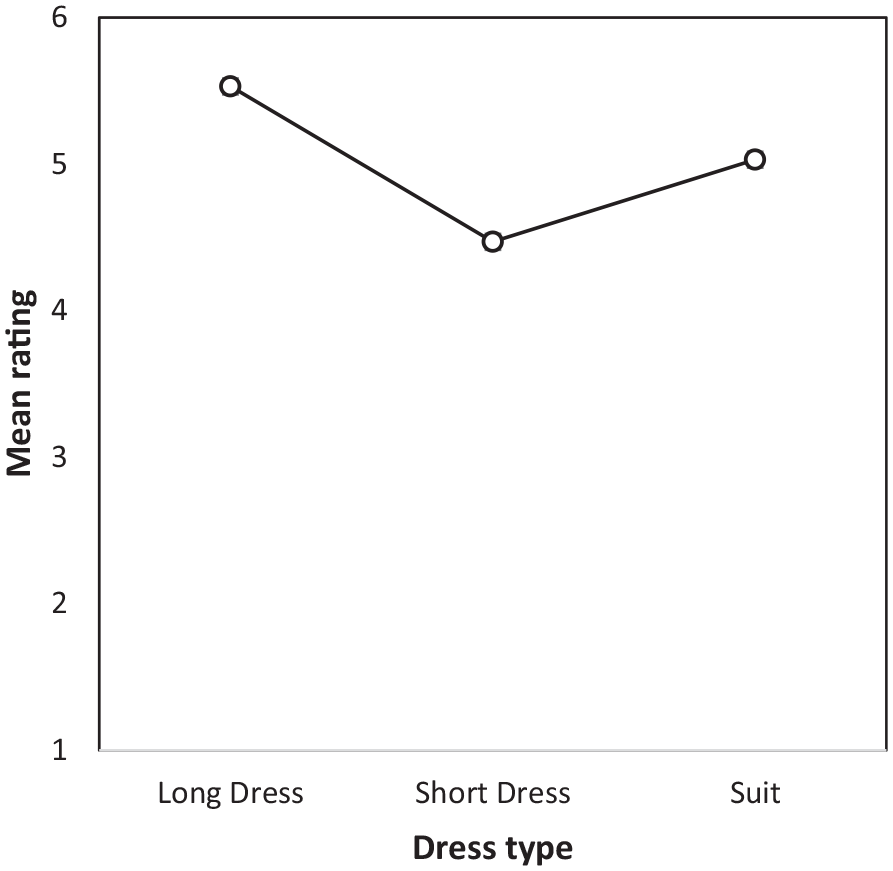
Main Effect of Dress (Long, Short, and Suit) on Ratings of Appropriateness of Dress.
An interaction between performer and dress was shown to affect the mean rating of appropriateness of dress, F(6, 824) = 11.934, p < .001,
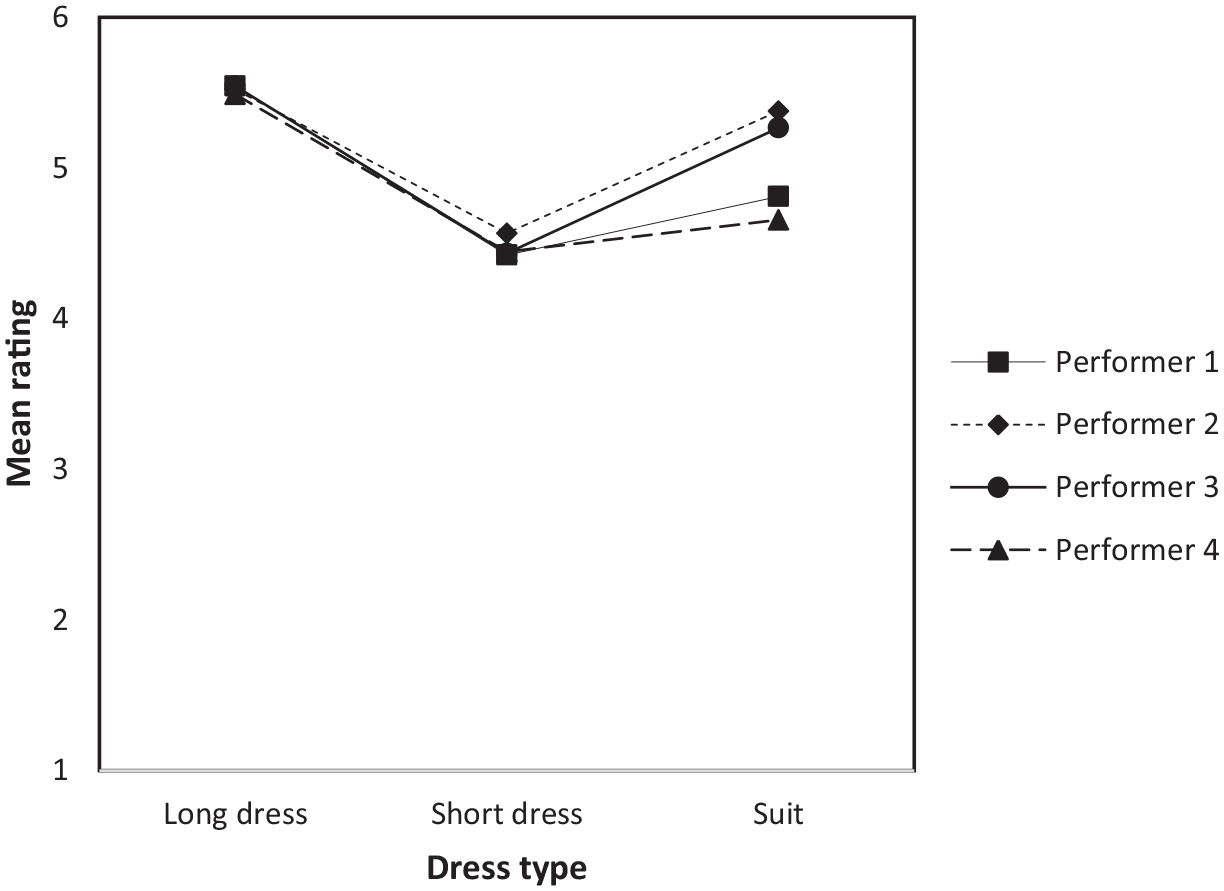
Interaction Plot of Performers (1, 2, 3, and 4) and Dress (Long, Short, and Suit) on Ratings of Appropriateness of Dress.
Overall performance
A three-way repeated measures ANOVA with two-way interactions was performed on the overall mark to test the impact of the three dress types. There was a significant effect of dress on overall mark, F(2, 824) = 29.175, p < .001,
Technical proficiency
A three-way repeated measures ANOVA with two-way interactions was performed on the ratings of technical proficiency to test the impact of the three dress types. There was a significant effect in mean score of dress on technical proficiency, F(2, 824) = 7.143, p < .001,
Musicality
A three-way repeated measures ANOVA with two-way interactions was performed on the ratings of musicality to test the impact of the three dress types. There was a significant effect of dress on musicality, F(2, 824) = 8.375, p < .001,
There was a significant effect of performer in all marking criteria (p < .001) where performers were rated differently based on perceived individual traits, and assumed to have individual levels of musical skill. There was a significant interaction between dress and listener/viewer in the average rating of appropriateness of dress (p < .001,
Interviews
The experience of mock-adjudication
Listener/viewers shared their observations about their own evaluation process. Overall, the majority of listener/viewers reported a lack of confidence in their ability to mark consistently and reliably (F = 9, M = 13). They questioned their objectivity and the impact of listening fatigue (F = 9, M = 11). Listener/viewers were convinced they could hear individual performers’ personalities (F = 11, M = 10), possibly through facial expression and body language (F = 6, M = 6) or previous experiences with the performers (F = 1, M = 3).
Appropriateness of dress
Listener/viewers were divided on whether it was appropriate to mark appropriateness of dress in competitions (F = 7, M = 6), or not (F = 5, M = 4). Those who agreed appropriateness of dress was a valid criterion credited the holistic nature of performance: “we don’t always just look at the music, we also look (in a competition) at their dress” (F4). These listener/viewers acknowledged that, while potentially divisive, performers’ outfits were part of holistic adjudication: “I know the dress [criterion] is a bit controversial, but it’s part of the performance” (F13). They noted that despite societal efforts to be less judgmental about dress, adjudicators still comment on performers’ outfits: “even though we’re in the 21st century and you’d think women’s rights have come a long way, or dress standards, people still do comment about particular performers—about how they dress, and what they wear” (M14). However, other listener/viewers believed that adjudicating dress was “distracting” (F2), as “what you’re wearing shouldn’t say anything about you being a musician” (M9). They considered it entirely inappropriate to mark performers on how they are dressed, as it is completely separate from the performers: “the most out-there, inappropriate way to view it, the furthest from the music” (M15). A few listener/viewers (M = 3, F = 2) did not discuss their judgments of dress at all, apart from to mention they “don’t see it as a necessary thing to mark on” (M10).
Overall, listener/viewers were cognizant of the multitude of different factors that influenced appropriateness of dress. They judged how the dress types looked on different people and in different musical contexts and “had so many different ideas about what would be appropriate. For some of them, the outfit didn’t match the piece, for some of them I felt like the outfit didn’t match the person” (M15). Outfits were more accepted if they were deemed appropriate for the performer and musical context, as “when you’re presenting yourself on stage, it’s a package deal” (M16). Some female listener/viewers (F = 4) commented on how their expectations of dress were shaped parents or teachers: “I’m not judging their appearance. . . Maybe it’s just my upbringing, but I think there should be a standard of nice dress” (F8).
Long dress
Listener/viewers (F = 13, M = 9) were acutely aware of the different types of dress worn by the performers. Overall, listener/viewers favored the conventional long dress over the less conventional suit and short dress. The long dress was uncontroversial with listener/viewers specifying their approval explicitly (F = 5, M = 4) or implicitly (F = 3, M = 3). The long dress was described as “respectful” (F2), “flowy” (F5), “appropriate” (F7), and “safe” (M15). However, three listener/viewers noted that the fit of the long dress detracted, as it was “too long” (F1) and “uncomfortable” (F4; F = 3, M = 1).
Suit
The less conventional performance outfits (short dress and suit) provoked stronger responses than the traditional long dress and were responsible for doubt in listener/viewers’ responses: “I think you should dress appropriately for whatever you’re doing. It’s a professional thing, it’s less professional if you don’t dress to the occasion.” (M4). The suit was a problematic performance outfit (F = 3, M = 6). Its loose fit prompted descriptions ranging from “homeless” and “awful” (M11) to “frumpy” (F8), like “trackies and sweatshirt” (F7) or “pyjamas” (F6). Listener/viewers agreed that the suit “looked like you were accompanying someone else, it looked baggy and subservient” (M6) and was an inappropriate performance outfit for solo performance. The unconventional look meant that “You have to play amazing[ly] if you’re dressing like that because it’s something more out there, it’s like genius clothes” (M11).
Short dress
The short dress divided listener/viewers’ opinions. For some, the short dress was “sex[y]” (M1), and “fun” (F5) in the right context, but for others, “too short” (F4, M9) and “uncomfortable” (M10). Listener/viewers brought attention to the short dress for its less conventional style (F = 9, M = 7), and some (F = 6, M = 1) disapproved of the short dress on principle, finding it “disrespectful” (F8) or “too casual” (F12) for performance. For two, the short dress was a distraction, as “showing legs was too much skin to be classy” (F2). One of these listener/viewers also preferred “when the arms were covered” (M7). However, sometimes listener/viewers found their perspectives nuanced over time (F = 2), and after repeated exposure found that “it’s alright” (F5) or “depends on different people” (F4). The short dress suited the “fiery, more intensive” (M11) spirit of the Albéniz, and some listener/viewers “felt the outfits that were sexier, more revealing, more insouciant, were great in the Albéniz” (F = 3, M = 3). Its success was dependent on whether it suited the character of the piece (M = 3, F = 3) and whether the performer wearing it looked acceptable (F = 3, M = 5).
Performers on wearing the clothing
Performers revealed their experiences of performing in each of the three dress conditions and agreed that there was a universal dress code for classical performance (F = 3). Two of four performers felt that a “classical, simple dress” (P2) was essential concert attire. One preferred the suit because trousers “looked sleek and professional, without looking too girly” (P1). The short dress divided pianists’ opinions with complex reactions to performer intention and audience response. One performer preferred the “sexy Yuja Wang outfit [short dress]” as she felt “more feminine, fun, excited. I felt better in that because I knew I looked better,” (P3) although another was conscious that while the “Yuja Wang style” inspired her “to play in a more extroverted style,” she found “it almost could be distracting from the way you are playing” (P2). All performers felt a level of discomfort or exposure performing in short dress as it drew attention to the body and introduced unnecessary insecurities such as the need to “[suck] in my tummy” (P1). Regardless of performer confidence or discomfort, audiences were unanimous in their preference for the conventional long dress and in their disapproval for the short dress. Listener/viewers’ comments on the performers and the voyeuristic nature of the rating task revealed a more complex effect on evaluation.
If the clothes fit . . .
The fit of the clothing impacted ratings of appropriateness of dress (F = 6, M = 5), and ratings of dress were “influenced by each person’s different body shape” (F3). Listener/viewers favored clothing that flattered individual performers’ physiques, as “sometimes the billowy ones were way too billowy, and sometimes the tight ones seemed way too tight” (M15). This was particularly evident in the evaluation of performers in the short dress, whose bodies were scrutinized alongside the dress, with listener/viewers “half judging the dress and half judging the body” (M6). Across the four performers, who were of comparable physique, listener/viewers found that “some had better bodies for the shorter dress” (M12). Specifically, being “skinny” or having a similar frame to Yuja Wang was considered an asset in the short dress for some (F = 1, M = 1) but a detraction for another (F = 1). Both the long dress (F = 3) and the suit (M = 2) were occasionally deemed ill-fitting, as if “someone was wearing the ballgown and it was way too big for them.” (F8). However, the parameters of “ill-fit” varied among listener/viewers who singled out different pianists with the same criticism.
There was a degree of discomfort watching clips to rate appropriateness of dress, as in recitals “you don’t really talk about how appropriate[ly] they’re dressing, it’s kind of weird looking at them and marking them on how appropriately they’re dressed” (F9). Listener/viewers perceived a risk of objectifying the performers (F = 1, M = 4), and realized they “don’t like [this] reaction” (M6). Some found they made instantaneous judgments about dress, “as soon as you see it” (M2; F = 3, M = 3) and two listener/viewers (F = 1, M = 1) felt that they were “too quick to make a judgement” (F1). Other listener/viewers seemed to put more thought into their decisions and considered dress in relation to expression, piece and performer (F = 5, M = 5).
Awareness of bias
During the course of the study, listener/viewers became cognizant of the significance of dress in their evaluations: “my biases flared up and I felt like such a douchebag, I was afraid because I was thinking about the dress each time” (M6). While listener/viewers strived for objectivity, “I was trying to assess the prescribed marking criteria only” (F14), they started to question the impact of their unconscious biases, asking themselves, “what kinds of biases am I bringing to this?” (M15). Listener/viewers were ashamed to find that they had unconsciously been judging on dress and there was an element of shock which prompted introspection (F = 12, M = 15). Some even showed frustration and horror as they realized the true focus on visual: “There’s something wrong with me. Everything I know is a lie” (F8) and this realization “confused” (M10) some listener/viewers.
Despite the initial surprise, the challenging implications encouraged listener/viewers to explore their unconscious biases and strive for a more objective mind-set (F = 11, M = 12). Participants reflected on the role of visual bias in their initial critiques, as “some of them sounded really different to me. [. . .] How we look actually influences how we hear stuff!” (F7). They swiftly realized that their perception of the performances and the reality were differentiated by sight: “my eyes tricked me into thinking I’m hearing things” (F12). Listener/viewers retrospectively confirmed that they strayed from the marking criteria to consider “things which are not always musical” (F13). Listener/viewers were forced to examine the impact of “certain pre-assumption[s]” (F14) about performers and dress on their ability to mark fairly: due to “confirmation bias, I heard what I was expecting to hear” (M15). Listener/viewers ultimately came to the conclusion that their unconscious biases played a much larger role in evaluation than initially predicted, “unfortunately, my inner biases have much more of a say than I thought” (M15).
Future implications
For their own future performances, listener/viewers cultivated a newfound awareness of their own physical appearance in performance (M = 3, F = 4). They felt the need to be “more aware of how I look” (M9) as it is “important to consider in an audition video how you present yourself to the judges” (F3). Through the experience being “on the other side of [the stage],” listener/viewers felt that they could more accurately predict what adjudicators could be looking for in “how you present yourself, and what makes you stand out [from the crowd]” (M16). They concluded that adjudicators seek variety and originality, they “probably look for the unexpected” (M7).
Throughout the perceptual study, listener/viewers were made suddenly aware of the impact of visual bias on their ability to mark fairly: “I pride myself as someone who doesn’t get sucked into superficial things when listening to performances but clearly, I do. I had a problem.” (M3). This realization encouraged listener/viewers to strive to eliminate the impact of unconscious bias in their future adjudications: We do have to think about how and why we judge: we all have personal biases, and while I’ve never been an adjudicator in a competition in a formal setting, I’m sure if I was ever put in that situation, would try to eliminate personal biases as much as I can. (M14)
Discussion
This study investigated the effects of different formal dress codes on the evaluation of female pianists’ performances and results confirmed that dress type was critically important to listener/viewers’ ratings of appropriateness of dress, overall performance, musicality, and technical proficiency. All three outfits were plausible performance attire, rather than the broad spectrum of formal to casual clothing previously studied, from jeans to a nightclubbing dress (Griffiths, 2008, 2010). Here, the long dress was unanimously deemed fit for purpose, while the suit and short dress received more mixed responses. Performances in the long dress consistently achieved the highest ratings, while performances in the short dress received the lowest. Interview responses focused on distaste for the unconventional dress choices and revealed listener/viewers preoccupation with individual performers’ bodies in each outfit. Performers themselves generally valued the tradition and security of conventional dress (Griffiths, 2011), though the short dress drew some praise for its confidence-boosting, body-focused appeal.
Listener/viewers made spontaneous judgments about performers’ musical abilities based on dress. It is of little surprise that the traditional long dress was considered the most appropriate outfit as it conforms to music industry expectations (Griffiths, 2008, 2010), and the variety of formal outfits revealed listener/viewers’ deeply engrained prejudices about their suitability as performance attire. In society more generally, there is a degree of skepticism toward unfamiliar and unconventional clothing, and individuals dressed inappropriately for task are doubted and considered unprofessional (Gurung & Chrouser, 2007; Marino et al., 1991; Matsui et al., 1998). As observed for women in business, performers wearing the suit trousers were less convincing and unbecoming, compared with more feminine attire (Gurney et al., 2017). On the other hand, the overly sexualized short dress drew unprompted negative attention (Johnson & Workman, 1992; Rafaeli et al., 1997) and discredited these performers as less serious musicians (Griffiths, 2008, 2010). Here, the short dress could be justified with certain styles of music and was appropriate to the “fiery” Spanish Albéniz, as jeans might be to folk music or jazz (Griffiths, 2010). It is not unusual in the 21st century for classical performers to challenge traditional dress conventions and modernize their silhouettes, but it became increasingly apparent that listener/viewers contemplated how the various dress codes flattered performers’ individual bodies (Midgette, 2011, 2017; Schweitzer, 2012).
Judgments were not limited to dress alone and listener/viewers became cognizant of their objectifying gaze upon the performers. They could articulate how their evaluations of appropriateness of dress were mediated by performers’ body shapes. Those who explicitly mentioned performers’ bodies freely engaged in a “visual inspection, measurement, evaluation, and manipulation” (Calogero et al., 2007, p. 273) of performers’ physical appearance. Listener/viewers were unabashed in not only appraising the clothing but also the wearers themselves. The clothing acted as a catalyst through which listener/viewers felt justified in their observations of performers’ bodies and physical attributes (Gurung & Chrouser, 2007). When discussing physique and fit of dress, performers were reduced to the sum of their physical features, which determined whether they could “pull off” a certain style (Bartky, 1990; Jacobson & Mazur, 1995). The short dress in particular encouraged both the pianists wearing it (Berberick, 2010; Tiggemann & Andrew, 2012), and the listener/viewers observing it (Gurung & Chrouser, 2007) to describe pianists’ bodies and their sex appeal (Jacobson & Mazur, 1995). As all performers were of comparable size and shape, listener/viewers were judging the bodies based on a narrow and exclusionary set of physical parameters (McBurney & Streeter, 2007). Listener/viewers experienced a heightened awareness of their objectification to the point of discomfort.
Listener/viewers became aware of their struggle to use the assessment criteria to evaluate the performances and were distracted by their gestalt impressions (McPherson & Schubert, 2004; Stanley et al., 2002). As expected, performers with confident body language were assumed to be better prepared and more proficient performers (Howard, 2012; Platz & Kopiez, 2013). It is possible that performers’ body language was influenced by dress type, as performers reported feelings of discomfort in certain dresses (Griffiths, 2008). Listener/viewers acknowledged experiencing a “halo effect,” where they judged performances based on their prior experiences with the performers (McPherson & Schubert, 2004). The repetitive nature of the task resulted in assessment fatigue, where listener/viewers attempted to moderate with an increasingly automatic marking process. Listener/viewers were convinced that each performer had a unique musical identity, and that they could differentiate between the performances by ear, despite the dubbed audio tracks. They were adamant that they could distinguish outstanding, neutral and poor renditions, and would compare directly between adjacent performances to award appropriate marks.
Music students in training are rarely challenged to think or behave like professional evaluators. While they attend masterclasses with experts (Haddon, 2014; Hanken, 2015), they are more accustomed to performing rather than learning to listen critically (Creech et al., 2009). When listener/viewers were tasked with evaluating this series of performances, they struggled to use the assessment criteria and disassociate from the overwhelming multisensory information which hampered their ability to undertake the task. The opportunity to act like an examiner was novel, and accelerated listener/viewers’ learning through self-reflection on the complex nature of the task (Mitchell & Benedict, 2017). Listener/viewers approached the task earnestly and were disappointed to discover that they were vulnerable to superficial visual distraction and unconscious bias. They were initially convinced their judgments were based on the acceptable and predetermined parameters (musicality, technical proficiency, appropriateness of dress, and overall performance), but became aware during interviews of their inappropriate or taboo judgments (McPherson & Schubert, 2004). It appears listener/viewers believed performers in unconventional concert dress were less competent and had been making inaccurate judgments based on preconceived associations (Chaiken & Trope, 1999). To date, music students had not considered the impact of visual cues and the potential for unconscious bias in performance evaluation, but were keen to be better equipped to engage more effectively.
Listener/viewers came to recognize the importance of dress codes on audiences’ impressions of their own performances. Despite the rising popularity and implementation of modern clothing styles in traditional classical performance, there is limited discussion in music training about how to prepare young professionals to foster their public or professional image (Bennett, 2008). While performers are expected to focus on the musical aspects of performance, it seems inevitable that they will be judged unwittingly on their physical appearance (Griffiths, 2008). It is imperative that young professionals are able to appreciate the information on visual bias on their own terms, to make informed decisions about their concert presentation.
In this study, unconscious bias toward formal dress codes was central to listener/viewers’ judgments of music performance. There was an expectation for performers to conform to traditional dress standards, even though all the dress codes in this study were suitable in principle as they fulfilled societal expectations of formal dress. Listener/viewers prided themselves on their high level of musical acuity but were unaware how easily they succumbed to unconscious bias. Performers’ appearances were dissected and analyzed even by those who claimed to focus solely on the music. Future studies will seek to explore the intersection of critical music research and music practice, and how to best prepare future music professionals for the realities of the music industry.
