



Abstract
Ample evidence suggests that people prefer types of music that allow them to portray an image to others, yet less is known about the process through which listeners’ characteristics influence musical preferences. This study, therefore, examined the association between values and musical preferences, and whether uses of music mediate, at least in part, this association in a sample of 364 participants. Multiple regressions revealed that values contributed differentially to the prediction of musical preferences. We also found that cognitive use of music partially mediated the association between openness to change values and preferences for music emphasizing both complexity and rebelliousness. Moreover, the association between conservation values, as well as self-transcendence values, and a preference for music emphasizing positive emotions was partially mediated by emotional use of music. These findings underscore the importance of accounting for specific uses of music when examining how musical preferences express the values of its listeners.
Given the infinite ways in which listeners experience music, and the importance of music in many aspects of everyday life, the question of why different people prefer different types of music has received considerable attention from scholars in the field of psychology and beyond. Indeed, previous research in musicology, sociology, and psychology (e.g., Colley, 2008; Rentfrow & Gosling, 2003; van Eijck, 2001) has provided a solid basis for understanding the determinants contributing to the development of musical preferences. Schäfer and Sedlmeier (2010), for example, remarked that most of these determinants include both the features of the music, such as tempo, rhythm, and complexity, and the unique characteristics of the listener, namely personality, musical training, cognitive abilities, and so forth.
The first study, as far as we know, to establish the structure underlying musical preferences, as well as to examine the personality correlates of musical preferences, was conducted by Rentfrow and Gosling (2003). Using different samples and a variety of methods, they concluded that musical preferences, which can be conceptualized in terms of four dimensions (reflective and complex; intense and rebellious; upbeat and conventional; and energetic and rhythmic), are significantly correlated with the Big Five traits (openness to experience, conscientiousness, agreeableness, extraversion, and neuroticism; McCrae & Costa, 1997). Since that research, which made significant contributions to the field of music psychology, several social and personality psychologists have documented the influence of the Big Five traits on musical preferences (e.g., Fricke & Herzberg, 2017; Greenberg et al., 2016; Langmeyer, Guglhör-Rudan, & Tarnai, 2012; Yoo, Kang, & Fung, 2018). One of the most consistent findings from these studies is a positive association between openness to experience, defined as the tendency to seek out novel and varied experiences (McCrae & Costa, 2008), and a preference for music highlighting complexity (e.g., Fricke & Herzberg, 2017; Langmeyer et al., 2012).
Even though the association between the Big Five traits and musical preferences seems sound, there is an incomplete understanding of how other individual difference characteristics, such as values, direct people’s preferences to specific types of music. North and Hargreaves (2007), for example, provided some empirical evidence that the listeners of different types of music might well be differentiated in terms of their personal beliefs and lifestyle choices. As such, people may prefer listening to a particular piece of music because it can transmit meaningful information about themselves to others. Or, to put it another way, people might actively use music to gratify certain social and psychological needs. In fact, the way in which people use music may serve as an intermediary connection between personality and musical preferences (Vella & Mills, 2017). Such a promising assumption calls for further research to examine the interplay of various individual difference characteristics, such as values, and uses of music in explaining musical preferences. Toward that end, we expand on the existing research in music psychology to examine the association between values and musical preferences, and whether uses of music mediate, at least in part, this association. The present study was informed by the uses and gratifications approach, positing that the needs of media audiences are formed not only on personal interests, but on exogenously imposed restrictions (Katz, Blumler, & Gurevitch, 1974; Rubin, 2009), and the assumption that people make choices that are compatible with their own values, personality, attitudes, perceptions of themselves, and so forth (e.g., Ickes, Snyder, & Garcia, 1997; Wagerman & Funder, 2009).
Values as predictors of musical preferences
The starting point for much of the psychological research concerned with musical preferences was the conceptualization of the Five-Factor Model (McCrae & Costa, 1997), which provided a parsimonious taxonomy for classifying human personality. Similar to the Big Five traits that define individual differences in regard to observed patterns of thoughts, feelings, and behavior (McCrae & Costa, 2008), values are typically defined as cognitive representations of desirable goals that vary in importance and serve as guiding principles in people’s lives (Schwartz, 1992, 2016). The value theory, developed by Schwartz (1992), captures the dynamic structure of associations among 10 values, each of which embodies a clear motivational goal that may, or may not, be reflected in one’s behavior (see Appendix for conceptual definitions). These values, according to the theory, form a circular continuum of related motivations; the more compatible any two values are, the closer they are on the circle. Schwartz (1992) further argued that the 10 values can be organized into four higher-order types of values, which are: (1) conservation emphasizing self-restriction to preserve the status quo; (2) self-transcendence emphasizing acceptance of others as equals and concern for their welfare; (3) openness to change emphasizing independent thought and action; and (4) self-enhancement emphasizing pursuit of own success. Evidence confirming the stability of the circular structure of values stems from more than 200 samples in over 60 countries (e.g., Schwartz & Bardi, 2001).
Considering that people use music to create and strengthen social bonds, as well as to differentiate themselves from others, musical preferences, expressed also through consumption, can communicate the values of its listeners to the outside world (e.g., Boer et al., 2011; Gardikiotis & Baltzis, 2012). Indeed, previous social psychological research on musical preferences has revealed that preferences for rap and rock music are reflected in generally liberal beliefs and patterns of behavior (North & Hargreaves, 2007), while people holding self-transcendent values show a preference for music perceived as sophisticated and complex (Gardikiotis & Baltzis, 2012). Sociological research, likewise, has revealed that social class correlates with musical preferences, such that well educated people and those with a higher social status indicate a preference for highbrow music, including opera and symphonic music, whereas middle-class and less-educated people tend to prefer folk, gospel, and spiritual music (van Eijck, 2001). Therefore, it is reasonable to infer that the music people listen to plays an important role in interpersonal perception, in that, it can serve as a clue to a person’s values and lifestyles (Rentfrow & Gosling, 2007). This assumption led Rentfrow, McDonald, and Oldmeadow (2009) to suggest that musical preferences not only convey meaningful information about membership to a particular social group but elicit stereotypes about fans of different types of music.
Uses of music as predictors of musical preferences
During the long history of the uses and gratifications approach (Katz et al., 1974; Rubin, 2009), which posits that people actively use the media to fulfill certain social and psychological needs, much of the social psychological research has considered how music is used by its listeners to construct, strengthen, and express aspects of their identity (e.g., Lonsdale & North, 2011; North & Hargreaves, 1999). Mood induction studies further denoted that music can be primarily considered to be an instrumental means for mood regulation, especially for adolescents (e.g., Miranda & Claes, 2009; Saarikallio & Erkkilä, 2007), since it provides comfort and reduces stress. Perhaps, Chamorro-Premuzic and Furnham (2007) were among the first scholars to systematically examine individual differences in uses of music, thereby providing evidence that music can be used as a means for emotion regulation, cognitive stimulation, and as a background stimulus.
Most of the studies examining why people listen to music have pointed out that the different ways in which music is used by different people are associated with their favorite music (e.g., Getz, Chamorro-Premuzic, Roy, & Devroop, 2012). That is to say, the better the needs of a listener are met by a particular type of music, the stronger the preference for that type of music will be (Schäfer & Sedlmeier, 2009). Actually, the study of Getz, Marks, and Roy (2014) indicated that uses of music are a better contributor to musical preferences than are listener characteristics, including both perceived stress and optimism. In a more recent study, Vella and Mills (2017) established an indirect association of the Big Five traits with musical preferences through uses of music, with cognitive use of music serving as a partial mediator of the association between openness to experience and a preference for music characterized by complex structure. Current research in music psychology, however, lacks a precise perspective to illustrate whether uses of music mediate the association between various individual difference characteristics and a preference for different types of music.
Aim of the present study and hypotheses
While previous research on individual differences in musical preferences is useful and informative, at least two limitations remain to be addressed. First, most studies have primarily focused on the personality correlates of musical preferences, and, hence, they have rarely addressed the impact of values on musical preferences. Second, despite the growing interest in music listening behavior, much remains to be learned about the process through which a wider range of traits beyond the Big Five influence musical preferences. To advance beyond these limitations, the present study examined the association between values and musical preferences in a young adult population, and whether the ways in which people use music mediate, at least in part, this association. The present study, therefore, aims to contribute to the ongoing investigation of how individual difference characteristics affect preferences for various types of music, thereby facilitating the understanding of the dynamic interplay of values and uses of music in predicting musical preferences.
Since musical preferences serve to express aspects of both personal and social identity (e.g., Lonsdale & North, 2011), we expect that listeners’ values will be associated with those types of music that reflect their beliefs in some respect. For example, people endorsing openness to change values, which emphasize independence of thought and action (Schwartz, 2016), are expected to prefer music highlighting complexity and rebellion, as well as to reject music that is structurally simple. People who attribute high importance to conservation values are vulnerable to social pressure (Schwartz, 2016), which is why they will be more likely to indicate a preference for conventional styles of music, and an aversion for rock and heavy metal music. We can also hypothesize that those embracing values that emphasize transcending own interests for the sake of others will be more likely to prefer music expressing positive emotions.
Given that both values and uses of music have been related to musical preferences (e.g., Chamorro-Premuzic & Furnham, 2007; Gardikiotis & Baltzis, 2012), and that uses of music vary as a function of values (Manolika, Baltzis, & Gardikiotis, 2021), we expect that uses of music may mediate, at least in part, the association between a person’s values and his or her preferences for specific types of music. To be specific, previous research in the psychology of aesthetics has consistently found that the more intellectually curious and creative people are, the more likely they are to appreciate the arts and experience music intellectually (e.g., Silvia, Fayn, Nusbaum, & Beaty, 2015). Therefore, it stands to reason that cognitive use of music will mediate the association between openness to change values, which emphasize independent thought (Schwartz, 2016), and a preference for music displaying complex structure and intense emotions. Since both conservation and self-transcendence values emphasize harmony and concern for the welfare of others (Schwartz, 2016), we also expect that people endorsing such values may prefer particular types of music to express or regulate their emotions in a socially acceptable way. Emotional use of music, therefore, is expected to mediate the association between conservation values, as well as self-transcendence values, and a preference for upbeat and conventional dimension.
Method
Participants
Three hundred and sixty-four students attending the Schools of Education Sciences and Health Sciences of the Democritus University of Thrace volunteered to participate in the present study. Participants ranged in age from 18 to 32 years, with a mean age of 20.33 years (SD = 2.41). In terms of gender, our sample consisted of 270 women (74.2%) and 94 men (25.8%). The high percentage of women participating in the present study was due to the fact that in Greece there are fewer men than women studying education sciences.
Measures
Musical preferences
Musical preferences were assessed utilizing the 14-item Short Test of Musical Preferences (STOMP; Rentfrow & Gosling, 2003), which consists of four dimensions: Reflective and complex (blues, jazz, classical, and folk); intense and rebellious (alternative, rock, and heavy metal); upbeat and conventional (country, pop, religious, and soundtracks); as well as energetic and rhythmic (rap/hip-hop, soul/funk, and electronica/dance). Participants rated the extent to which they like the above genres on a 5-point scale, ranging from 1 (strongly dislike) to 5 (strongly like).
Uses of music
The different ways in which music can be used were assessed with a previously used questionnaire (Manolika et al., 2021), including 35 items that measure three distinct uses of music: Emotional (20 items); cognitive (six items); and social (nine items). Respondents indicated the extent to which each item accurately described their reasons for listening to music on a 5-point scale, ranging from 1 (strongly disagree) to 5 (strongly agree).
Values
An abbreviated version of the Schwartz Value Survey (SVS; Gardikiotis & Baltzis, 2012; Schwartz, 1992) that comprises 23 single values, each of which is listed as a single term followed by a short description of that term, was used to measure participant values. These values can be organized into two sets of opposing higher-order types of values, namely conservation (five items) versus openness to change (four items) and self-enhancement (four items) versus self-transcendence (10 items). Participants rated the importance of each value as a guiding principle in their life on a 7-point scale, ranging from −1 (opposed to my values), through 0 (not important), to 5 (of supreme importance).
Procedure
Prior to survey completion, participants were presented with the informed consent explaining the aim of the study and the voluntary nature of participation. Participants were also assured that their responses would remain confidential, and that they were free to omit the questions they did not wish to answer. After agreeing, they completed an anonymous survey that consisted of the aforementioned measures. In the last section of the questionnaire, all students reported their gender and age. Participants were then thanked and, for those who wanted, fully debriefed.
Plan of analysis
Normal distributions for all variables were confirmed via histogram, as well as via skewness and kurtosis values (greater than ± 2.00; Tabachnick & Fidell, 2013), whereas outliers were checked by detecting cases with z scores greater than ± 3.29 (p < .001; Tabachnick & Fidell, 2013). Internal consistency of all measures was assessed with Cronbach’s α coefficient, which is defined as “a function of the extent to which items in a test have high communalities” (Cortina, 1993, p. 100). Descriptive statistics and zero-order correlations were calculated for all measures. Pearson correlation was also used to examine the effects of age on musical preferences and uses of music, whereas gender differences in musical preferences and uses of music were examined through independent sample t-test.
Specific hypotheses concerning the influence of values on musical preferences were examined with multiple regressions. Moreover, a subsequent set of regression analyses was conducted to examine whether uses of music mediate the association between values and musical preferences. According to Baron and Kenny (1986), mediation occurs when the following criteria are satisfied: (1) the predictor is associated with the criterion variable (i.e., path c); (2) the predictor is associated with the mediator (i.e., path a); (3) the mediator is associated with the criterion variable (i.e., path b); and (4) the association between the predictor and criterion variable is significantly reduced by the inclusion of the mediator in the model (i.e., path c’). Full mediation holds when, controlling for the mediator, the predictor variable does not statistically significantly predict the criterion variable (path c’ is zero). Partial mediation is indicated when, controlling for the mediator, the association between the predictor and criterion variable decreases, but not to zero (path c’ < path c).
Following the procedure outlined above, we estimated a series of regression models for testing whether the hypothesized mediator (e.g., cognitive use of music) accounts for the relation between a predictor variable (e.g., openness to change values) and a criterion variable (e.g., musical preferences). R-squared, which is also known as the coefficient of determination, was considered as a measure of how well the model fits the data. The statistical significance of mediation effects was confirmed with the Sobel test, which examines the significance of the indirect path a × b (MacKinnon, Lockwood, Hoffman, West, & Sheets, 2002).
Results
Preliminary analyses
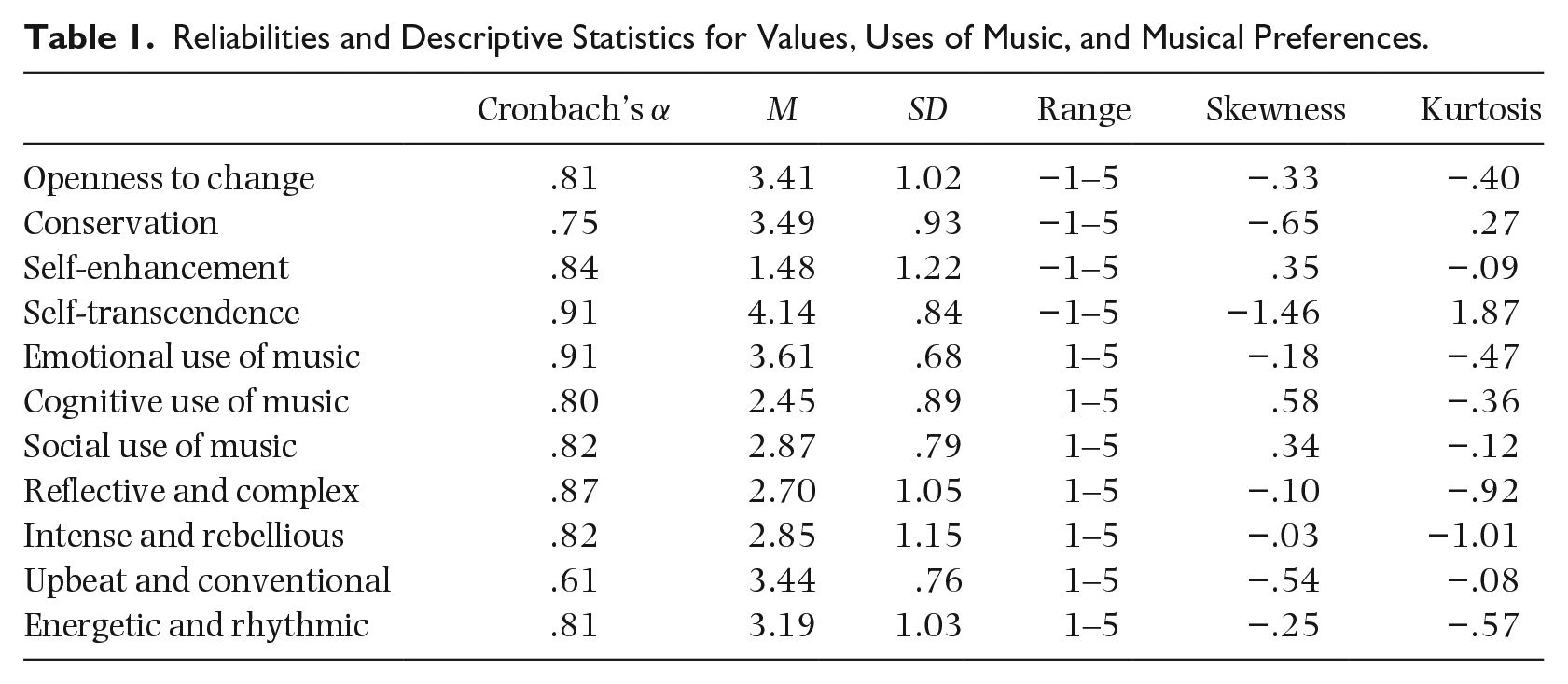
Reliability coefficients and descriptive statistics for values, uses of music, and musical preferences are featured in Table 1. Zero-order correlations, displayed in Table 2, among the examined variables showed that values were significantly correlated with musical preferences and uses of music. Conservation and self-transcendence values were most strongly correlated with a preference for upbeat and conventional dimension, r = .27, p < .01 and r = .18, p < .01, respectively, while openness to change values correlated most strongly with a preference for intense and rebellious dimension, r = .20, p < .01. In addition, cognitive use of music correlated most strongly with preferences for reflective and complex and intense and rebellious dimensions, r = .32, p < .01 and r = .36, p < .01, respectively.
Reliabilities and Descriptive Statistics for Values, Uses of Music, and Musical Preferences.
Zero-Order Correlations Among the Examined Variables.
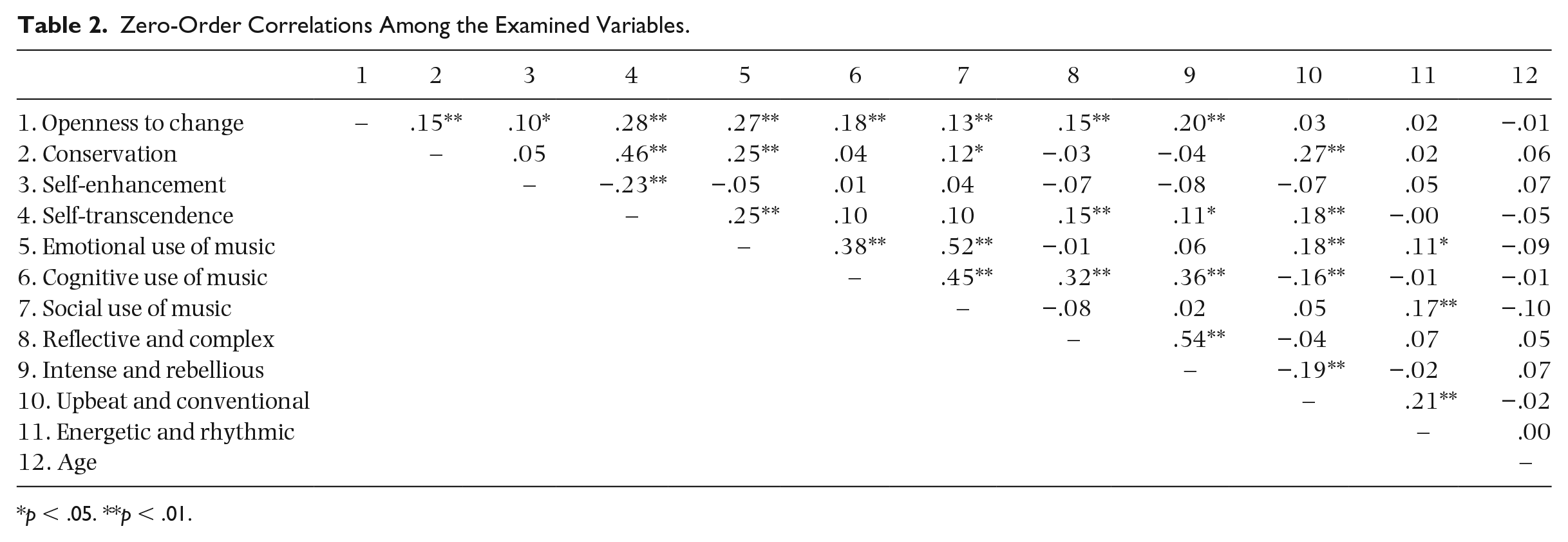
p < .05. **p < .01.
Preliminary analyses, however, did not reveal any significant association between age and musical preferences or uses of music. Exploratory gender analyses revealed that women reported a preference for energetic and rhythmic, t(362) = 3.24, p < .01, and upbeat and conventional dimensions, t(362) = 3.47, p = .001 more than men did. Moreover, women, compared with men, were more likely to use music for emotional, t(362) = 5.62, p < .001, and social reasons, t(362) = 4.26, p = .001. As can be seen in Table 3, gender differences with regard to the remaining dimensions were nonsignificant.
t-test Results Comparing Women and Men on Uses of Music and Musical Preferences.
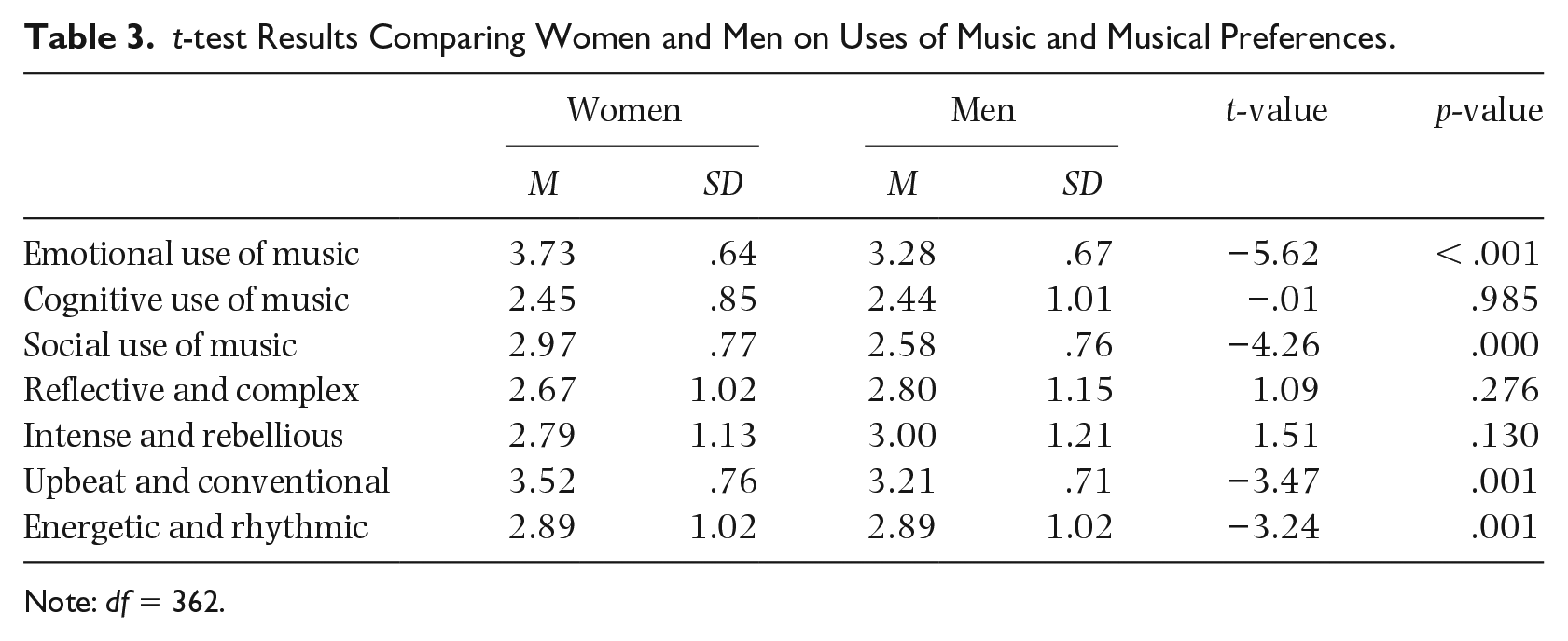
Note: df = 362.
The influence of values on musical preferences
To examine the influence of values on musical preferences, we performed multiple regression analyses. As expected, openness to change values were positively associated with preferences for reflective and complex (β = .15, t = 2.98, p < .01; R2 = .03) 1 and intense and rebellious (β = .21, t = 3.99, p < .001; R2 = .05) dimensions. Consistent with our hypotheses, a model including gender as a covariate revealed a significant association between conservation values and a preference for upbeat and conventional dimension (β = .26, t = 5.22, p < .001; R2 = .10, ΔR2 = .07). Similarly, entering gender as a covariate, self-transcendence values were positively associated with a preference for upbeat and conventional dimension (β = .16, t = 3.02, p < .01; R2 = .05, ΔR2 = .02). Furthermore, self-transcendence values were positively associated with preferences for reflective and complex (β = .16, t = 3.16, p = .001; R2 = .03) and intense and rebellious (β = .13, t = 2.53, p < .05; R2 = .02) dimensions.
Uses of music as a mediator between values and musical preferences
First, we hypothesized that the association between openness to change values and preferences for reflective and complex and intense and rebellious dimensions would be, at least partially, mediated by cognitive use of music. A regression analysis revealed that openness to change values predicted positively cognitive use of music (β = .18, t = 3.50, p = .001; R2 = .03). We also found that cognitive use of music predicted positively preferences for reflective and complex (β = .32, t = 6.58, p < .001; R2 = .11) and intense and rebellious dimensions (β = .36, t = 7.44, p < .001; R2 = .13). The results also showed that after cognitive use of music was taken into account, the effect of openness to change values on a preference for reflective and complex dimension became weaker, from β = .15, p < .05 to β = .09, p < .05, suggesting a partially mediated effect. Likewise, the standardized regression coefficient between openness to change values and a preference for intense and rebellious dimension dropped from β = .20, p < .001 to β = .14, p < .01, when cognitive use of music was entered into the model (see Figure 1), which also suggests a partially mediated effect. Results from the Sobel test showed that cognitive use of music mediated significantly the effect of openness to change values on preferences for reflective and complex and intense and rebellious dimensions (z = 3.09, SE = .02, p < .001 and z = 3.17, SE = .02, p < .001, respectively).
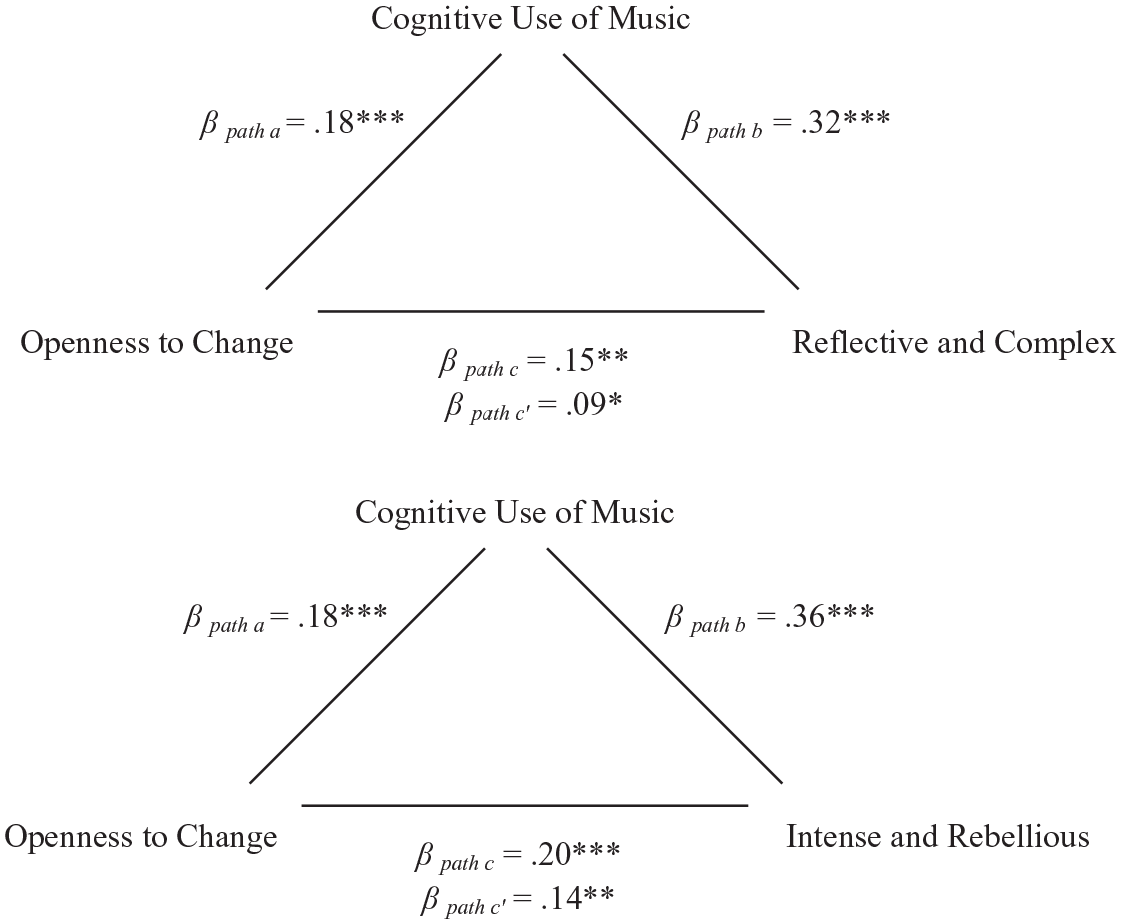
Cognitive Use of Music as a Partial Mediator of the Association Between Openness to Change Values (Predictor Variable) and Preferences for Reflective and Complex and Intense and Rebellious Dimensions (Criterion Variable). Statistically Significant Paths Are Presented by Solid Lines. For Each of the Models, the Sobel Test Indicated Significant Mediation.
It was also expected that emotional use of music would, at least partially, mediate the association between conservation values, as well self-transcendence values, and a preference for upbeat and conventional dimension. A multiple regression analysis, including gender as a covariate, revealed that conservation values predicted positively emotional use of music (β = .23, t = 4.76, p < .001; R2 = .13, ΔR2 = .05); likewise, emotional use of music was positively predicted by self-transcendence values (β = .21, t = 4.20, p < .001; R2 = .12, ΔR2 = .04). Entering gender as a covariate, emotional use of music was found to predict positively a preference for upbeat and conventional dimension (β = .14, t = 2.70, p < .01; R2 = .05, ΔR2 = .02). A multiple regression analysis including gender as a covariate showed that after emotional use of music was taken into account, the effect of conservation values on a preference for upbeat and conventional dimension became slightly weaker, from β = .26, p < .001 to β = .24, p < .001, suggesting a partially mediated effect. Similarly, the standardized regression coefficient between self-transcendence values and a preference for upbeat and conventional dimension dropped from β = .15, p < .01 to β = .13, p = .01, when emotional use of music was entered into the model (see Figure 2). Results from the Sobel test showed that emotional use of music mediated significantly the effect of conservation values (z = 2.35, SE = .01, p < .05), as well as of self-transcendence values (z = 2.28, SE = .01, p < .01), on a preference for upbeat and conventional dimension.
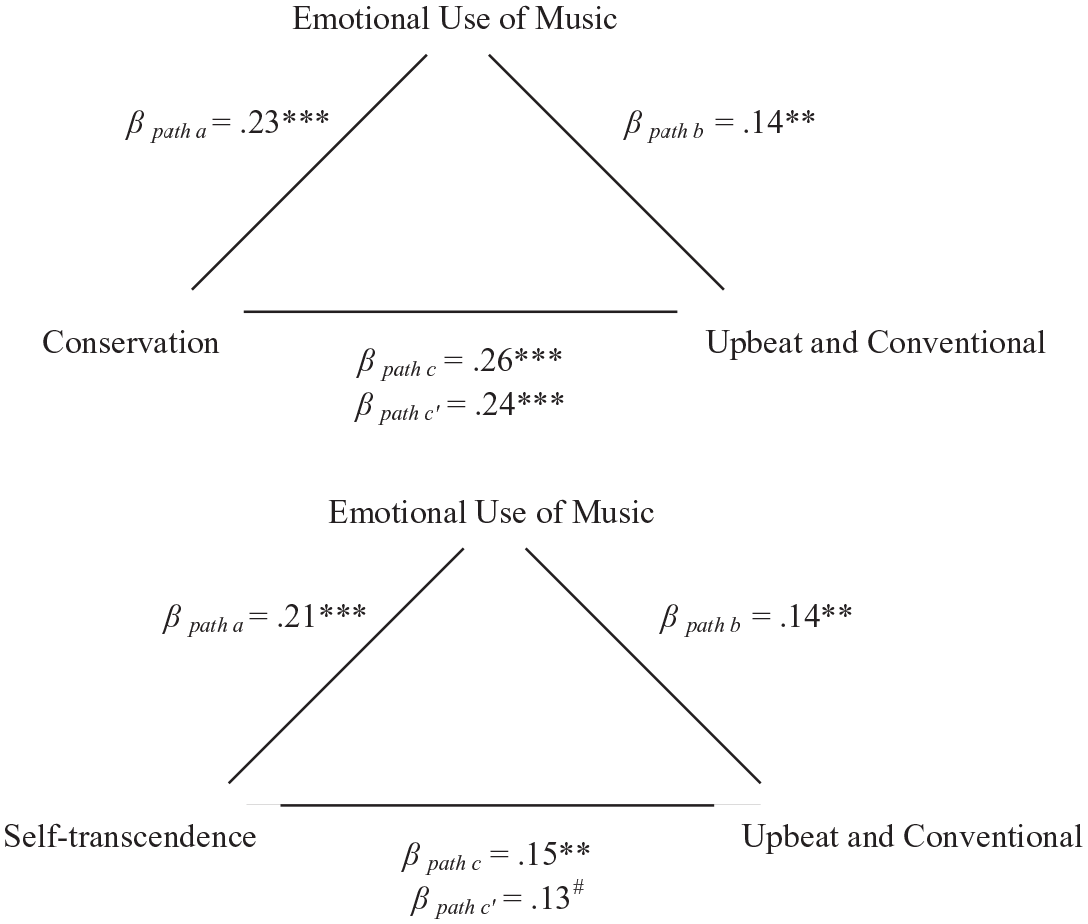
Emotional Use of Music as a Partial Mediator of the Association Between Conservation Values, as Well as Self-Transcendence Values (Predictor Variable), and a Preference for Upbeat and Conventional Dimensions (Criterion Variable). All Regressions Incorporate Gender as a Covariate. Statistically Significant Paths Are Presented by Solid Lines. For Each of the Models, the Sobel Test Indicated Significant Mediation.
Discussion
Although there is ample evidence that individual difference characteristics, including values, personality, cognitive abilities, and so forth, are correlated with musical preferences (e.g., Gardikiotis & Baltzis, 2012; Greenberg et al., 2016; Schäfer & Sedlmeier, 2010), much remains to be learned about the nature of this association. Premised on the uses and gratifications approach (Katz et al., 1974; Rubin, 2009), as well as on interactionist theories (e.g., Ickes et al., 1997; Wagerman & Funder, 2009), we examined how values affect preferences for various types of music, and whether uses of music mediate, at least in part, this association. The findings from this study revealed that musical preferences depend on the ways in which people use music, which are in turn dependent on the values that they hold. Not surprisingly then, one may assume that just as the social environments that people select serve to reinforce their self-perceptions, so do their musical preferences.
Preliminary analyses revealed that preferences for upbeat and conventional and energetic and rhythmic dimensions tend to be higher among women than among men, and that women are more likely than men to listen to music for emotional and social reasons. Research with young adults has also shown that women prefer listening to music that expresses positive emotions, whereas men display stronger preferences for more complex and vigorous music, such as jazz, rock, and heavy metal music (e.g., Colley, 2008; Delsing, Ter Bogt, Engels, & Meeus, 2008). Such gender differences in musical preferences can be probably attributed to the different ways in which music is used by young women and men (Christenson & Peterson, 1988). Preliminary analyses also revealed that there were no significant age differences in musical preferences and uses of music. Given that most young people prefer those types of music that are most accepted by their peers (Mulder, Ter Bogt, Raaijmakers, Nic Gabhainn, & Sikkema, 2010), and that adolescents attribute certain characteristics to others based on their musical preferences (e.g., North & Hargreaves, 1999), this finding is not surprising at all.
In terms of the effects of values on musical preferences, openness to change values were found, as expected, to be positively associated with a preference for reflective and complex and intense and rebellious dimensions; the more listeners value independent though and action, the more they tend to prefer music highlighting complexity and intense emotions. Other relevant studies have also shown that people who score high on reactive rebelliousness, as well as those valuing independence and change prefer listening to rock and classical music (e.g., Gardikiotis & Baltzis, 2012; Robinson, Weaver, & Zillmann, 1996). Therefore, it seems likely that people who endorse openness to change values prefer types of music that maintain a self-view of being both creative and autonomous. Consistent with our hypotheses, both conservation and self-transcendence values were found to be positively associated with a preference for upbeat and conventional dimension, and this suggests that people favoring security and tradition may choose to listen to soothing music because that type of music conforms with the dominant social norms, thereby maintaining group cohesion. Besides, the more people emphasize concern for the welfare of others, the more they prefer reflective and complex and intense and rebellious dimensions. It is possible that those favoring social justice and equality indicate a preference for rock and heavy metal music because such music signals a revolt against mainstream culture and supports, to some extent, solidarity (Gardikiotis & Baltzis, 2012). That is, musical preferences not only reinforce how a person views oneself but portray a social image to others. Similar preferences were also expressed by people endorsing openness to change values, and this lends additional support to Schwartz’s (1992) assumption that the values that are adjacent to one another are likely to be compatible. Thus, just as people actively choose to be in situations that best fit their personal beliefs, so they seek out music that is congruent with their values.
Although it was expected that people who value change, independent thought, and stimulation will reject music that is simple in structure, we did not find a negative association between these two. Similarly, Gardikiotis and Baltzis (2012) indicated a nonsignificant association between openness to change values and a preference for sentimental and sensational dimension, which displays simple structure and positive emotions. Taken together, these findings may indicate that openness to change values do not affect preferences for such types of music. It is also interesting to note that while intense and rebellious dimension expresses intense negative emotions (Rentfrow & Gosling, 2003), people who value tradition do not appear to reject these particular types of music. In part, this is because musical preferences, as well as the ways in which listeners use music, may be influenced by the cultural contexts in which people live (e.g., Boer & Fischer, 2012). As such, to better explain why different people prefer different types of music, multiple parameters have to be taken into account.
The findings from the present study further revealed that cognitive use of music partially mediates the association between openness to change values and preferences for reflective and complex and intense and rebellious dimensions. Therefore, the more people exhibit independent thought, the more they experience music in an intellectual way when they listen to their favorite music. Vella and Mills (2017), likewise, found that the association between openness to experience and a preference for music perceived as complex is mediated by cognitive use of music. It appears, then, that people high in openness to experience and those embracing openness to change values are predisposed to value aesthetic experiences because such experiences can fulfill their need for intellectual stimulation. As expected, we also found that emotional use of music partially mediates the association between conservation values, as well as self-transcendence values, and a preference for upbeat and conventional dimension. Given that both conservation and self-transcendence values foster harmony by encouraging complementary relations and avoiding conflict (Schwartz, 1992), it seems reasonable to assume that the emotional connotations of such music might be what people holding these particular values find appealing.
Limitations and future directions
Although this study can inform our understanding of how values interact with the different ways in which people use music to predict their musical preferences, several limitations should be considered when interpreting the present findings. First, our sample, which included young participants of similar level of education, may undermine the generalizability of the obtained findings to some extent. As argued by Bonneville-Roussy, Rentfrow, Xu, and Potter (2013), musical preferences can change across the lifespan, that is, future studies could replicate the present findings with participants of different age groups. One may also argue that the culture in which the music is listened to can influence the way in which it is appreciated (e.g., Boer & Fischer, 2012). Therefore, it remains to be explored whether similar findings might be found among people from different cultures. Another possible limitation of the study is that musical preferences were assessed using a self-report questionnaire, which is limited when it comes to capturing a broad range of musical preferences. Future studies, therefore, can extend the findings reported here by considering whether the values that people hold influence actual music listening behavior, such as concert and music festival attendance, purchase of music CDs or music magazines, and so forth. Given that an important reason for music listening is its ability to regulate one’s emotions (e.g., Chamorro-Premuzic & Furnham, 2007), a plausible avenue of further research would be to consider how various individual difference characteristics, such as values or empathy, interact with emotional responses to music to explain one’s musical preferences.
Conclusion
The present study sought to provide further insight into the process through which listeners’ characteristics, specifically values, explain musical preferences. Generally speaking, our findings indicated that people choose music on the basis of how well it reflects their values, and whether it provides them with an opportunity to satisfy certain social and psychological needs. For example, people favoring security and tradition prefer listening to music high in positive affect to induce or express emotions that in turn convey important information about their values. This, of course, offers compelling evidence that musical preferences may operate at various levels (Rentfrow & Gosling, 2003). Given that entertainment media are thought to reflect the characteristics of the people who use them, it would be interesting to examine whether preferences for certain content of media operate at different levels, both reinforcing how a person views oneself and communicating personal information to others.
From a practical perspective, understanding the process influencing preferences for specific types of music might provide both educators and health practitioners with useful routes to enrich the social development, as well as the psychological adjustment, of young people. For example, it is well established that shared musical preferences contribute to the creation and maintenance of social bonds (e.g., Boer et al., 2011). As such, listening to music, which is one of the most common leisure activities that people of all age groups and cultures can participate in together, may help young people to connect with each other, thereby facilitating the construction of their social identity.
Footnotes
Appendix
Conceptual Definitions of Values.
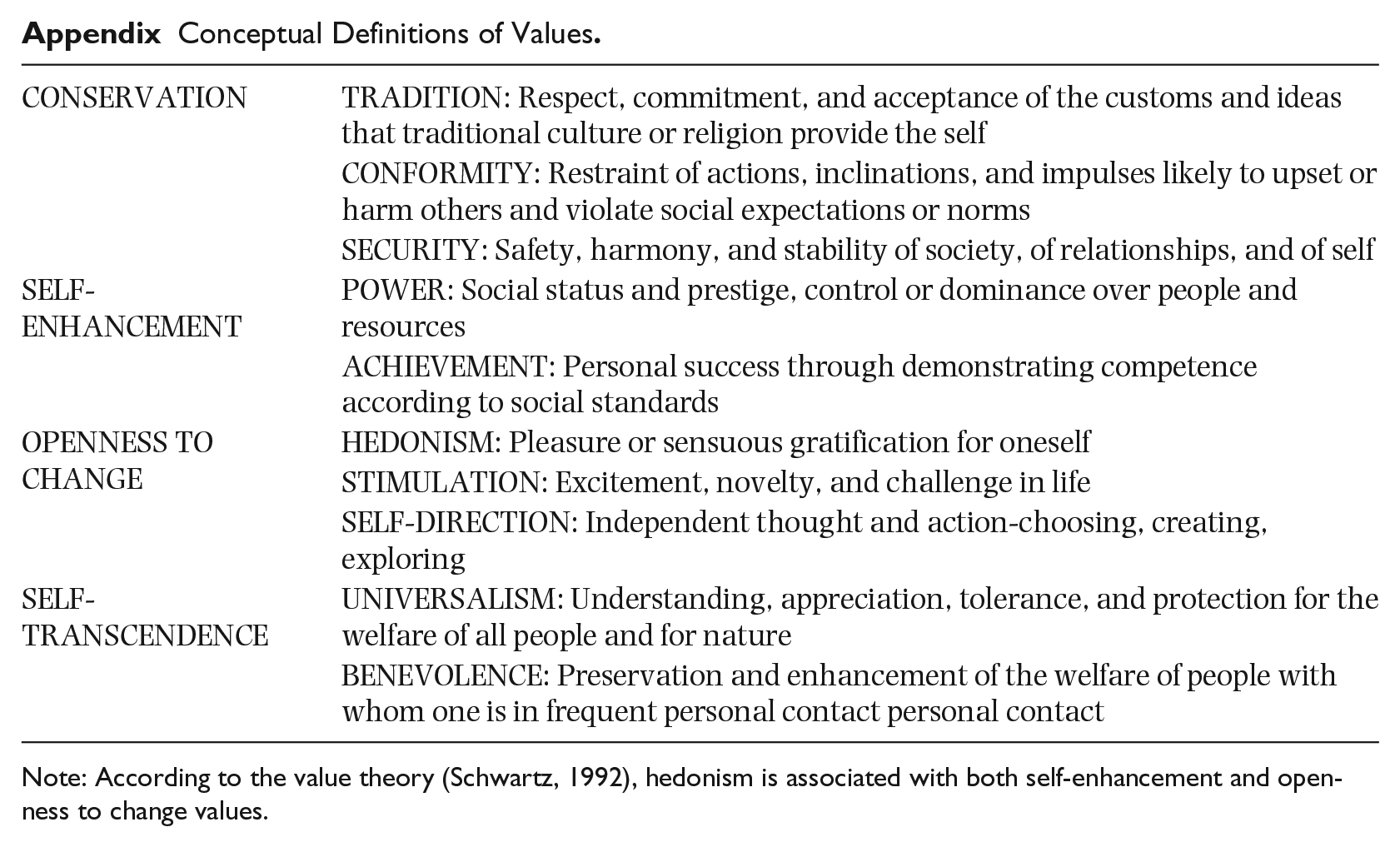
| CONSERVATION | TRADITION: Respect, commitment, and acceptance of the customs and ideas that traditional culture or religion provide the self |
| CONFORMITY: Restraint of actions, inclinations, and impulses likely to upset or harm others and violate social expectations or norms | |
| SECURITY: Safety, harmony, and stability of society, of relationships, and of self | |
| SELF-ENHANCEMENT | POWER: Social status and prestige, control or dominance over people and resources |
| ACHIEVEMENT: Personal success through demonstrating competence according to social standards | |
| OPENNESS TO CHANGE | HEDONISM: Pleasure or sensuous gratification for oneself |
| STIMULATION: Excitement, novelty, and challenge in life | |
| SELF-DIRECTION: Independent thought and action-choosing, creating, exploring | |
| SELF-TRANSCENDENCE | UNIVERSALISM: Understanding, appreciation, tolerance, and protection for the welfare of all people and for nature |
| BENEVOLENCE: Preservation and enhancement of the welfare of people with whom one is in frequent personal contact personal contact |
Note: According to the value theory (Schwartz, 1992), hedonism is associated with both self-enhancement and openness to change values.
Funding
The author(s) received no financial support for the research, authorship, and/or publication of this article.
