



Abstract
In three studies, we explore the subjective construal of associations between music preferences and social class. Two small-scale studies (N = 100, N = 70) and one study involving a large representative sample of the Italian population (N = 1,045) reveal that (a) people hold well-defined stereotypes on how music preferences are linked to social class, (b) that these stereotypes do not map onto actual class differences in music taste, (c) that they operate at both an implicit and explicit level, (d) that they are subject to ingroup bias among those who prefer “low-class” genres, and (e) that they are only weakly affected by streaming habits. Together, these findings shed new light on the psychological processes through which people draw inferences about social class on the basis of cultural expression.
Cultural expression has always been used to signal class (Goffman, 1951). The relationship between arts and social class was extensively analyzed by Pierre Bourdieu (1984) who hypothesized a one-to-one isomorphic relation between cultural taste and social structure, such that specific music genres are associated with, and are markers of, specific social classes. However, this link may have weakened over time as a function of the increasingly “omnivorous” and eclectic upper classes (Peterson & Kern, 1996). Also, the need to mark social class through artistic preferences may vary over time as a function of changing levels of economic inequality (Wilkinson & Pickett, 2018). Although a considerable number of studies in the Bourdieusian tradition have investigated actual class differences in music taste, only few have explored how music and social classes are associated in people’s mind (Aidenberger et al., 2020; Reeves et al., 2015; Rentfrow et al., 2009). We argue that, for artistic tastes to become markers of social class, people need to agree on the meaning of cultural expression and endorse consensually held music–class stereotypes. We therefore focus on the (under-researched) question of whether people associate music preferences with specific social classes and what processes are driving such associations. This research extends the small body of literature on subjective music–class association by pursuing the following five aims.
The first overarching aim was to test whether participants associate specific music genres with specific social classes (Hypothesis 1). This is in line with the few existing studies on subjective music–class associations. For instance, young adults in the United Kingdom were found to share personality and social class stereotypes about fans of specific music genres, which are more distinct for the lower (working and lower-middle class) and upper end of the social scale (upper-middle and upper class) than for the middle class (Rentfrow et al., 2009). Whenever social class becomes salient, such cultural stereotypes are activated and used to locate people in a symbolic hierarchy (Reeves et al., 2015). Most relevant to our research, a recent study by Aidenberger et al. (2020) found that Swiss participants consensually perceived those who prefer classical (vs. folk) music as being of higher social status. This preliminary evidence suggests that people hold consensually shared stereotypes relating music preference to social class.
Our second aim was to understand whether such stereotypic music–class associations reflect actual differences in music preference. Even today, “high arts” can be distinguished from “popular taste,” the former defined as a “cultural capital” of the upper classes and the latter often considered as “obvious” and “inferior” (Wilkinson & Pickett, 2018, p. 199). The social stratification of music preferences is evidenced by its relation to multiple sociodemographic variables such as social origin, occupational status, educational attainment, income, and age (Coulangeon, 2005), although in a more fluid way than originally theorized by Bourdieu (Chan & Goldthorpe, 2006; van Eijck, 2001). We therefore explored whether people of different classes actually prefer the types of music genres that are associated with their social class in the minds of our participants. If stereotypical music–class associations are grounded in reality, rather than being pure social constructions, then people of higher classes should prefer music styles that are consensually associated with higher classes, and vice versa (Hypothesis 2).
Our third aim was to explore music–class associations at both an explicit and implicit level. In one of our studies (Study 2), we employed the Implicit Association Test (IAT; Greenwald et al., 1998; for a critical overview, see Gawronski & Hahn, 2019), along with self-report measures, to test whether people automatically think of music genres as being related to social class. According to Gawronski and Bodenhausen (2006), implicit associations can be activated irrespective of whether a person considers these evaluations accurate or inaccurate. For instance, even if people consciously reject the idea that rap is a “low-class” genre, they may still show an automatic association between the two on the basis of similarity or co-occurrence. Explicit judgments, to the contrary, represent propositional reasoning in which the validation of the statement becomes crucial. Thus, people may associate specific music genres with specific social classes either because they believe that the two are related (propositional process) or because they spontaneously associate the two (automatic process). We expected people to show music–class associations both explicitly and implicitly (Hypothesis 3). If supported, this would demonstrate that music–class associations form through different pathways, which, to our knowledge, have not yet been investigated.
Our fourth aim was to investigate whether music–class associations are consensually shared (independent of personal music preference) or subject to ingroup bias, such that people overrate the social class of the genre that they personally prefer. As many scholars affirmed, music has always had an important role in shaping social identities and making social judgments, both from a developmental perspective (Tarrant et al., 2002) and from a historical/ethno-musicological perspective (Folkestad, 2002). However, to our knowledge, there are few studies that provide evidence for ingroup favoritism. Tekman and Hortaçsu (2003) found that participants with specific music preferences (folklore vs. rock) showed an ingroup bias when assigning psychological characteristics to ingroup and outgroup. Similarly, British adolescents thought that the ingroup (pupils at their own school) liked positively stereotyped music (e.g., dance, pop, indie) more, and negatively stereotyped music (e.g., classical music, jazz, heavy metal) less, than the outgroup (pupils at a different school; Tarrant et al., 2002, Study 1). Also, Aidenberger et al. (2020) found that people placed more trust into others who shared their own music preferences, and this ingroup bias in trust was more pronounced among low-status (preference for folk music) than high-status participants (preference for classical music). However, they did not find any ingroup bias in music–social class associations. On the basis of these findings, we advanced two opposing hypotheses. On the one side, we hypothesized that people tend to overrate the social class of the genre that they personally prefer (Ingroup Bias Hypothesis, Hypothesis 4a). On the other side, we hypothesized that people tend to agree on the social class of music genres, regardless of their personal preference for a specific genre (Shared Consensus Hypothesis, Hypothesis 4b). Since the test of this hypothesis requires large samples due to the subdivision based on preferences, it was tested only in Study 3.
Our final aim was to explore the role of streaming use in music–class associations. Internet Age has drastically changed music consumption. The easy access to any kind of music by streaming can potentially increase familiarity with, and openness to, different genres not necessarily related to the listener’s social class. However, such greater openness to different music genres (“omnivorous taste”) does not necessarily imply a greater openness to, and familiarization with, social classes from which these genres derive (van Eijck, 2001). Following Webster’s (2019) invitation to pay greater attention to how people consume music (e.g., streaming), we therefore investigated whether streaming use broadens music preferences and stimulates the consumption of music associated with a wider range of genres, thereby potentially blurring the association between music taste and social class (Hypothesis 5). This idea was tested with four indices that will be explained in detail in Studies 1 and 3.
We also explored the potential effects of music training and political orientation, given that they may influence the accuracy of classification of music genres and shape attitudes toward social classes, respectively.
Study 1: explicit music–class associations
As a first step of this research program, we investigated, on a sample of psychology students, whether people share ideas about the social class of different music genres (Hypothesis 1), whether these beliefs reflect reality (Hypothesis 2), and whether streaming habits influence the breadth of people’s music preferences (Hypothesis 5).
Method
Ethics statement
Study 1 and Study 2 received institutional review board (IRB) approval from Padua University (#3079). Study 3 was part of a larger research project (https://www.indaginelast.it), conducted in collaboration with, and approved by, Community Research & Analysis, under the direction of the second author.
Participants
Participants were 100 Italian psychology students (age: M = 19.24 years, SD = 1.04; gender: 72 women, 25 men, 1 non-binary, 2 preferred not to provide this information; musical instrument: n = 26). No participants were excluded from analyses.
Procedure
Participants were contacted during a first-year psychology lesson and invited to respond to a paper-and-pencil questionnaire concerning the relationship between music and social classes.
Perceived social class of music genres
Participants first indicated which social class listens most to each of 14 different music genres, using a 5-point scale (1 = lower class, 2 = lower-middle class, 3 = middle class, 4 = upper-middle class, 5 = upper class). Music genres were selected based on the categorizations by Apple Music (https://www.apple.com/it/apple-music/) and Spotify (Spotify Listener Loyalty by Genre, Italy), given that participants were likely streaming users. Music genres were ethnic music, jazz-blues, reggae, Italian pop, punk, classical-opera, indie-alternative, rock, trap, songwriters, metal, international pop, rap-hip hop, and electronic. As the classification of music genres is controversial, we also allowed participants to indicate additional genres.
Personal music preference
Subsequently, participants were asked to write down which genre they personally identified with.
Streaming habits
Participants were asked whether they listened to music in streaming, and if so, with which frequency (“more than 1 hr a day” to “a few times each month”). They also listed up to three genres that they listen to most in streaming and indicated whether they mainly choose genres in streaming that correspond to their preferences and whether they explore other genres in streaming (both on 5-point scales).
Musical training
Participants indicated whether they played an instrument and, if so, which one, and whether they attended or had attended music classes.
Demographics
Participants indicated their age, gender, and their subjective social class (“which social class do you think you belong to?” 1 = lower class, 2 = lower-middle class, 3 = middle class, 4 = upper-middle class, 5 = upper class).
Results and discussion
Perceived social class of music genres
A repeated one-way analysis of variance (ANOVA), comparing the perceived social class of the 14 genres, revealed a main effect, F(13, 1131) = 78.80, p < .001,

Perceived Social Class of Music Genres (Study 1).
Preference for music genres as a function of participants’ social class
Disconfirming Hypothesis 2, the correlation between participants’ self-reported social class and the consensually defined social class of their preferred genre was low and non-significant (for an additional test, see SOM B).
Thus, although people associate different music genres with specific social classes (confirming Hypothesis 1), these associations reflect actual class differences in music preferences only in small parts (disconfirming Hypothesis 2). However, social class was assessed here only with a general self-report measure that did not consider specific facets of social class that may be particularly relevant to artistic taste, such as educational attainment (DiMaggio & Useem, 1978). Hence, the question whether music–class associations are rooted in reality was investigated further in Study 2.
Streaming habits
All participants except one indicated that they listened to music in streaming. Streaming frequency was not significantly correlated with subjective social class. If streaming broadens people’s music experiences, then greater streaming usage should be associated with a greater exploration of unfamiliar genres, with the consumption of more varied genres, and with a greater variance in the social class of genres people listen to. Contrary to these predictions, those who used streaming more frequently did not explore unfamiliar genres any more frequently, did not listen to a wider range of different genres, and did not consume genres representing more diverse social classes (all correlations non-significant). Together, there was no evidence that streaming habits widen the music consumption of our participants, disconfirming Hypothesis 5. This may either reflect the fact that streaming websites tend to propose songs in line with the user’s initial choice or it may be explained by the uniformly high streaming frequency among our young participants, which may have left little variance to test our hypothesis. The hypothesis was therefore tested again on a large representative sample in Study 3.
Study 2: implicit music–class associations
The primary aim of Study 2 was to explore whether people also share implicit class–music associations. Participants performed an IAT (Greenwald et al., 1998) to evaluate their implicit associations between upper-class and lower-class stimuli and classical versus ethnic music stimuli. Based on Study 1, we selected the two most polarized music genres, namely, ethnic music, rated as the “lowest class” (M = 2.07, SD = 0.879), and classical-opera, rated as the “highest class” genre (M = 4.64, SD = 0.523). We expected people to associate classical music with the upper class and ethnic music with the lower class, resulting in a positive IAT score (Hypothesis 3). To further test Hypothesis 2, we also extended our indices of social class by including educational level and profession of participant and parents.
Method
Participants
Participants (N = 70, 36 women, 33 men, 1 non-binary; age M = 22.06 years, SD = 1.93) were mainly students attending an Italian University. Approximately half of the participants played an instrument (n = 34), allowing us to investigate the possible influence of musical skills. All but one participant reported to use music streaming services. No participants were excluded from analyses.
Procedure
Participants were contacted at the University or through social networks of the first author and asked to take part in a study about the relationship between music and social classes. The study was run in a research lab of the Psychology Department and lasted approximately 20 min. After signing a consent form, participants performed the IAT and then responded to an online questionnaire containing the other dependent variables.
Implicit measure of class–music associations
Participants first performed the IAT to evaluate the strength of the implicit association between upper (vs. lower) class stimuli and classical (vs. ethnic music) stimuli. Unlike previous studies using music as a prime preceding the IAT (Vuoskoski et al., 2017), we used pictures of music instruments as IAT stimuli. Participants rapidly classified instruments shown at the center of the computer screen as belonging to classical versus ethnic music; they also classified words as belonging to the upper versus lower classes. After a training period, stimuli were combined to form the compatible versus incompatible blocks. In the compatible block, participants responded with the same key when categorizing instruments as “classical music” and words as “upper class,” and when categorizing instruments as “ethnic music” and words as “lower class.” The opposite combination (e.g., classical music and lower class) was used in the incompatible block. The underlying assumption is that responses will be facilitated, and hence reaction times faster, in the compatible block if concepts are associated in people’s minds. The order of compatible and incompatible blocks was counterbalanced across participants. Target stimuli were created ad hoc for this study: for upper- and lower-class stimuli, we varied the suffixes of the words “rich” and “poor” (in Italian: “ricco,” “ricca,” “ricchi,” “ricche” and “povero,” “povera,” “poveri,” “povere”); for classical and ethnic music stimuli, we retrieved from the Web five photos of instruments typically played in classical and five typically played in ethnic music (the stimuli are available from the first author upon request). Following Nosek et al.’s (2005) indications for stimulus representativeness, for classical music we chose photos of instruments from various families (clarinet from woodwind, French horn from brass, piano and harpsichord from keyboards, violin from string instruments); for ethnic music, we chose photos of typical instruments used in cultures from different countries (North Africa, sub-Sahara, Indonesia, North America). To reduce any influence unrelated to the concept of music genre itself, we selected images without contextual clues, with neutral background, without human figures, and without reference to specific settings (e.g., concert halls) in which instruments are usually played.
Perceived social class of music genres: explicit measure
Participants then completed an online questionnaire on SurveyMonkey. Unlike Study 1, 17 different music genres were used, after addition of three genres suggested by the participants of Study 1: blues (now separated from jazz), reggaeton-Latin, and dance. Also, the question was posed slightly different: “For each of the music genres listed below, please indicate to which social class, in your opinion, the people belong that listen to it most.” Participants assigned each genre to one of five social classes.
Personal music preference
Participants expressed their personal liking for each music genre on a slider (from 0 = not at all to 100 = very much). They then indicated their preferred music genre (forced choice among the 17 genres and option to indicate a different genre).
Music training and streaming habits
See Study 1.
Demographics
To cover more features of social class, participants provided information about their educational level (from 1 = elementary school to 4 = MS degree or above) and occupation (with prestige ranging from 1 = worker/temporary employment to 4 = business owner/independent contractor). Given that most participants were students, they also reported the educational level and occupation of their parents. Participants also indicated their subjective social class, but unlike Study 1, the five social class options were presented in random order rather than as a continuous scale, to reduce the tendency to choose the scale midpoint. Moreover, we added a measure of subjective socioeconomic standing (“Compared to the average Italian family, my family is “better-off/worse-off,” 0 to 100 slider). Finally, participants indicated their political orientation, age, and gender.
Results and discussion
Perceived social class of music genre
A one-way repeated-measures ANOVA on perceived social class of the 17 genres revealed a significant difference between genres, F(16, 1104) = 50.78, p < .001, (see Figure 2; for means and standard deviations, see SOM C). Deviations of genres from the scale midpoint (one-sample t-tests, p = .01) were practically identical to Study 1, with reggae, punk, trap, rap-hip hop, ethnic, metal, and reggaeton-Latin below the scale midpoint (associated with the lower classes), Italian pop, dance, electronic, indie-alternative, international pop, and rock close to the midpoint (associated with the middle class), and songwriters, blues, jazz, and classical-opera above the midpoint (associated with the upper classes). We also found a strong and highly significant correlation between the average perceived social class of the 14 genres of Study 1 and Study 2 (omitting blues, reggaeton-Latin, and dance, not included in Study 1): r(14) = .95, p < .001. Together, these findings suggest a robust association between music genres and social class confirming Hypothesis 1.

Perceived Social Class of Music Genres (Study 2).
Importantly, the two genres used for the IAT, ethnic (M = 2.53, SD = 0.944) and classical music (M = 4.49, SD = 0.847), differed significantly from each other, paired-samples t(69) = 13.82, p < .001, further validating the choice of the two genres.
Personal music preference
Twenty-one percent preferred rock, 13% indie-alternative, 13% songwriters, 9% international pop, and 9% electronic, whereas the remaining genres attracted less than six preferences each. Music preferences were unrelated to political opinion.
Preference for music genres as a function of participants’ subjective and objective social class
To test Hypothesis 2, we correlated the consensually defined social class of the preferred genre with participants’ social class variables. Social class of the preferred genre was not significantly correlated with self-reported social class, subjective standing compared to other Italian families, the participants’ educational level, the parents’ educational level and the mother’s profession; it only was (negatively) correlated with the father’s occupation, r(63) = −.28, p = .03 (for an additional test, see SOM D). Hypothesis 2 was not supported despite the fact that we used multiple indices of social class, including subjective evaluations (one’s own social class, relative social standing of one’s family) and more objective indices (educational attainment of self and parents). Thus, consensually held beliefs about music and social class do not seem to be rooted in actual class differences in music taste.
IAT associations between music genres and social classes
Following Greenwald et al. (2003), trials with reaction times less than 300 ms and greater than 10,000 ms were excluded, and errors were substituted with the mean of the correspondent trial series, plus 600 ms. We employed the Algorithm D6, consisting of the difference between incongruent trials (in our case, lower classes–classical music) and congruent trials (upper classes–classical music). No participant was excluded.
Supporting Hypothesis 3, the overall IAT score was positive (M = 0.72, SD = 0.59), with scores varying from −0.76 to 2.20, and significantly different from 0, t(69) = 10.29, p < .001. Hence, participants associated ethnic music with the lower class and classical music with the upper class. The IAT was practically the same among those who did (M = 0.71, SD = 0.64) or did not play an instrument (M = 0.74, SD = 0.54) and among those who had (M = 0.72, SD = 0.62) or had not taken music lessons (M = 0.74, SD = 0.54), with both t-tests being non-significant, suggesting that music training did not affect music–class associations.
To correlate implicit and explicit measures, we calculated a difference score for the explicit measure (perceived social class of classical music minus that of ethnic music) and correlated it with the IAT score. In line with prior literature (Karpinsky & Hilton, 2001), the IAT score was not correlated with the explicit measure, attesting to the fact that implicit and explicit attitudes tap different aspects of people’s music–class stereotypes.
Together, these results suggest that music preferences are interpreted as signs of social class not only when engaging in reasoned evaluations but also through an implicit and presumably automatic process requiring little if any cognitive resources, and that the two processes operate independently.
As a limitation of the first two studies, the samples were very homogeneous (all participants were young, relatively educated, and most declared themselves belonging to the middle class) so that generalizations to the general population are impossible.
Study 3: representative sample
Here, we tested the same hypotheses on a large representative sample, which also allowed to test two novel competing hypotheses, namely that music–class associations be guided by Ingroup Bias (Hypothesis 4a) or Shared Consensus (Hypothesis 4b) and that streaming increases the difference between the participants’ social class and the class of their preferred music genre (Hypothesis 5).
The inclusion of this study in a large representative research project required that music genres be limited to 8. To avoid personal bias in the selection of music genres, we followed the indications of Tom ter Bogt (personal communication, May 2019), a well-known expert on the psychology of popular music, resulting in the selection of the following genres: ethnic music, pop, classical-opera, rock, songwriters, metal, rap-hip hop, and jazz.
Method
Participants
Participants (N = 1,045) constituted a representative sample of the Italian population in terms of age, gender, geographical distribution, and social class. No participants were excluded from analyses.
Procedure
This research was conducted via an online visual survey, designed in collaboration with Community Research & Analysis, as a part of a larger research entitled “Indagine LaST” under the direction of the second author (for exact data collection procedure and weighting, see SOM E).
Personal music preference
Participants first indicated their preferred music genre, choosing one out of the eight music genres, presented in random order.
Perceived social class of music genres
For each of the five classes, participants chose one genre from the list of eight music genres, presented in random order (“In your opinion, what music genre do people from the following social class listened to most?”). Thus, rather than assigning a social class to each genre (as was done in Studies 1 and 2), here participants assigned a genre to each social class.
Streaming habits
Participants reported the frequency with which they listened to music in streaming (from “more than 1 hr a day” to “never”). Responses were recoded so that higher values respond to greater frequency.
Demographics
Participants reported their educational level, occupation, current region of residence, age, and gender. They were also asked to indicate the social class to which they and their families belong today and to which they belonged 5 years ago (current and past social class).
Results and discussion
For all analyses, variables were weighted so as to assure representativeness with respect to the Italian population.
Perceived social class of music genre
In the minds of our participants, different music genres were systematically associated with social classes, χ2(28) = 3,170.19, p < .001. Comparisons between expected and observed frequencies of genre–class associations are reported in SOM F. The music genres that showed the strongest and most coherent associations with social class were, on the one side, rap-hip hop and pop (both positively associated with the lower classes and negatively with the upper classes) and, on the other side, jazz and classical-opera (both associated positively with the upper classes and negatively with the lower classes). Rock and songwriters were more strongly associated with the middle class than with either the lower or upper classes. Metal and ethnic music showed very weak and unstable relations to social class and were, overall, rarely attributed to any social class. To facilitate interpretation, in Figure 3 we report for each music genre how often, percentagewise, it was assigned to each social class.

Assignment of Social Class to Music Genres, Percentagewise (Study 3).
The representative sample of this study showed a remarkable consensus in associating music genres with specific social classes that greatly exceeded what would be expected by chance. Looking at the music genres that were most strongly associated with each social class, 38% of the respondents provided the same response, which was three times what would be expected by chance (12.5%).
Personal music preference
Twenty-five percent preferred songwriters, 23% pop, 21% classical-opera, 21% rock, 5% jazz, 2.5% metal, 1.5% ethnic music, and 0.7 % rap-hip hop.
Preference for music genres as a function of participants’ subjective social class
Unsurprisingly, the current subjective social class was positively correlated with the subjective social class 5 years ago, r(1,045) = .69, p < .001. To test whether music preferences are influenced by participants’ subjective social class, we first correlated the subjective social class of participants (both current and past) with the consensually perceived social class of preferred genre. To obtain an estimate of the consensually perceived social class of each genre, we multiplied the percentage of participants who had indicated a given social class by the respective weight of the social class (lower class = 1, lower-middle class = 2, middle class = 3, upper-middle class = 4, upper class = 5). 1 We then summed all values and divided the resulting number by 100 to obtain a social class index ranging from 1 to 5, with higher values indicating that the music genre was associated with the higher social classes (see SOM G).
Neither current nor past subjective social class was significantly correlated with the social class index of preferred genre. Also, educational attainment showed no correlation with the social class of the preferred genre (for an additional test, see SOM H). Thus, although people perceive clear associations between music genres and social classes, these do not seem to reflect actual class distinctions in preferences for music genres of different status, hence providing no support for Hypothesis 2.
Music–class associations: shared consensus or ingroup bias
This study allowed us to investigate whether associations between music genres and social class are consensually shared, independent of personal music preference, or subject to ingroup bias, such that people overrate the social class of the genre that they personally prefer (Hypothesis 4). To test the two opposing hypotheses, we compared the social class ratings of those who had chosen versus not chosen a given music genre. This was done for all genres except rap-hip hop and ethnic music that had been chosen by only few participants (n = 7 and n = 16, respectively). If the Ingroup Bias hypothesis is correct, then people who chose the genre as their favorite should provide higher ratings than those who did not choose that particular genre.
Independent-samples t-tests revealed reliable differences for rock, t(431) = 4.08, p < .001, metal, t(127) = 3.28, p = .001, and pop, t(763) = 2.91, p = .004, but not for songwriters, jazz, and classical-opera (see Figure 4). The ratings for the latter three genres are not subject to ceiling effects since all three means differ reliably from the scale endpoint of 5 (single-sample ts < 4.7, ps < .001). These results highlight an interesting difference between “low/lower-middle class” genres (rock, metal, pop) and “middle/upper-middle/upper-class” genres (songwriters, classical-opera, jazz). Whereas people who preferred lower-class genres tended to overrate the social class of their preferred genre, compatible with the Ingroup Bias Hypothesis (Hypothesis 4a), people who preferred “middle-class” or “upper-class” genres associated these genres with upper classes as much as people who had expressed different preferences, supporting Hypothesis 4b of Shared Consensus.
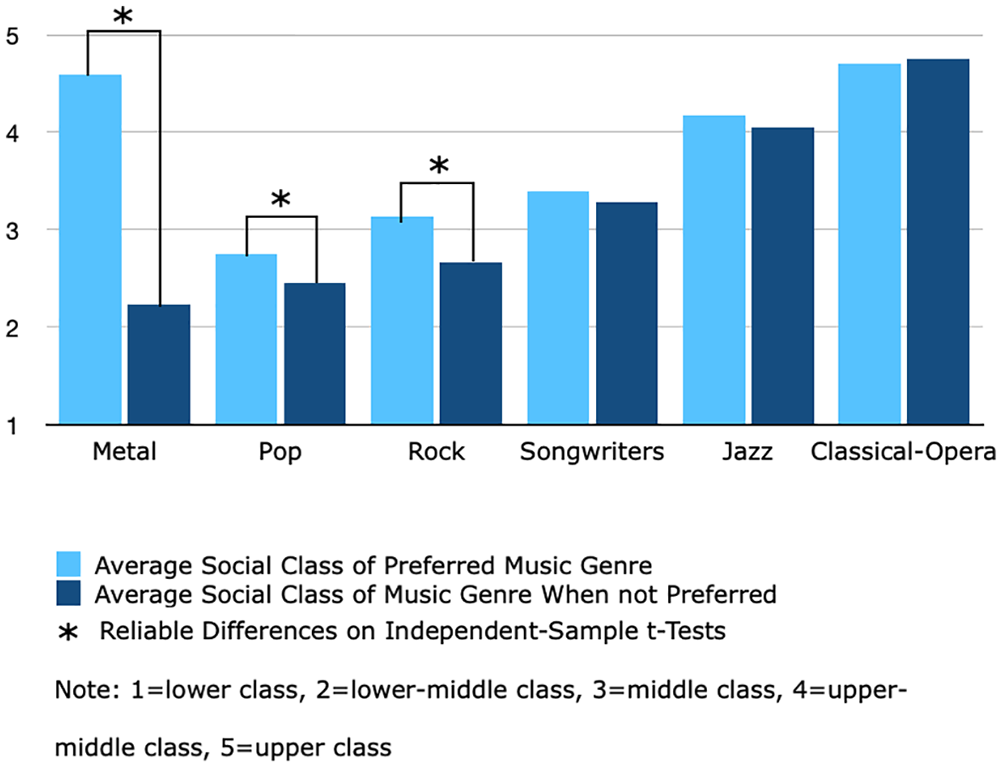
Rated Social Class of Music Genres as a Function of Own Preference (Study 3).
Streaming habits
Streaming habits were more varied in this representative sample; over half of the sample (53%) never or almost never listened to music in streaming, and only 31% used it daily. Streaming correlated negatively with age, r(993) = −.61, p < .001, but was not correlated to participants’ subjective social class of the past and only weakly to current class, r(1,045) = .07, p = .036. The latter correlations remain similar when controlling for age.
Streaming frequency was not correlated with the difference between the participants’ subjective social class and the (consensually defined) social class of their preferred music genre, regardless of whether participant’s current or past social class was considered. Thus, there was no evidence for a broadening of tastes as a function of streaming.
General discussion
The overarching aim of this research was to understand whether music preferences are interpreted as signaling social class in current Italian society. Across three studies, we found congruent and robust evidence that people associate specific music genres with specific social classes. Looking at the extremes of the social spectrum, rap-hip hop was consistently perceived as typical of the lower class and classical music as typical of the upper class. The consensual association between music taste and social class is in line with the few existing studies, conducted in other countries (Aidenberger et al., 2020; Rentfrow et al., 2009), and confirms the idea that, in the eye of the observer, artistic preferences are markers of social standing, and hence are interpreted as status symbols (Goffman, 1951; Kraus et al., 2017).
Somewhat surprisingly, these stereotypical associations reflect only in minimal parts actual class differences in music preferences (Hypothesis 2). Hence, there seems to be a gap between what people think about music and status, and real class distinctions in music preferences. If music–class stereotypes were anchored in reality, then lower-, middle-. and upper-class people should over-proportionally prefer those types of music genres that are consensually associated with their social class in the minds of our participants. Contradicting this prediction, agreement between perceived and actual class–music associations was absent in all three studies, despite the fact that multiple indicators of social class were employed in Study 2 and that a varied and representative sample was used in Study 3. These findings could be interpreted in line with what Peterson and Simkus (1992) defined as “omnivorousness,” namely, “the openness to appreciate everything,” regardless of one’s own social origin. Moreover, Chan and Goldthorpe’s (2006) and van Eijck’s (2001) studies on music consumption suggest that nowadays the traditional distinction of “high/middle/low” class genres does no longer predict the effective music consumption. However, as argued by Van Eijck, one can still identify complex patterns of preferences for music genres associated with different status positions, representing a more fluid society but still outlining social boundaries.
Classical music has a special status in this picture. Across studies (see Figures 1 and 2, SOM F), classical-opera is the genre that is most clearly associated with social class. Looking at the representative sample of Study 3, actual preferences for classical-opera music were almost evenly distributed across social classes (lower and lower-middle class: 17%, middle class: 23%, upper-middle and upper class: 22%), yet participants believed classical-opera to be associated almost exclusively with the upper-middle and upper classes (lower and lower-middle class: 3%, middle class: 7%, upper-middle and upper class: 45%). This may in part reflect Italian cultural policies that have always granted a privileged status to “high” culture (Katz-Gerro, 2002), for instance by allocating, in 2020, 48% of public funding for live cultural events to opera and symphonic concerts, compared to only 26% to “other live music shows” (Ministry of Economy and Finance, 2020). Hence, if society gives great importance to a specific music genre, such as classical music, this may well enhance the accessibility of stereotypes, regardless of actual music consumption.
Together, our findings suggest that socially shared music–class associations reflect stereotypic beliefs rather than actual class differences in music taste. The fact that people are largely unaware of actual music preferences of different social classes also suggests that people may display their social class through cultural symbols other than music taste (e.g., display of possessions, speech style, see Kraus et al., 2017). But if people hold firm consensual beliefs about music–class associations that are not anchored in reality, how do these beliefs come about? One intriguing possibility, to be explored in future research, is that they reflect class differences of the past. Thus, they may be anchored in past class differences in music taste and, hence, operate with a time lag.
To our knowledge, this research is also the first to explore implicit music–class associations. Study 2, using an IAT along with explicit measures, found reliable music–class associations even at an implicit level of evaluation. Interestingly, these did not correlate with self-reported explicit ratings of social class of music genres, suggesting that implicit and explicit associations tap substantially different processes, one being associative and the other involving propositional reasoning (Gawronski & Bodenhausen, 2006). Thus, both processes lead to strong associations between music genres and social class, but for different reasons. Explicit judgments are the likely result of a cognitive elaboration in which people evaluate the likelihood that people of different wealth and educational attainment enjoy different genres. In contrast, automatic stereotypes may derive from the closeness of concepts or images in cognitive networks (e.g., classical music–fancy theaters; ethnic music–poorly dressed musicians). Although such associations may, on logical grounds, not be considered valid cues of social class, their “feature similarity and spatio-temporal continuity” (Gawronski & Bodenhausen, 2006, p. 693) may lead people to automatically associate music style and signs of wealth and status. If supported by future research, this would suggest that music–class links emerge through distinct pathways, one automatic and associative, and the other propositional. For further research, it may be interesting to test music–class associations through auditory IATs, using sound stimuli rather than images (Vande Kamp, 2002).
Importantly, this research also provides first evidence that subjective music–class associations are in part driven by ingroup bias. In Study 3, we found that people who prefer “lower” and “lower-middle class” music genres tend to show an ingroup bias, overrating the social class of the genre they prefer, whereas “upper-middle” and “upper-class” genres were consensually associated with the upper classes, regardless of personal preference. This is conceptually in line with Aidenberger et al.’s (2020) finding that ingroup bias in trust is more pronounced among low-status (preference for folk music) than among high-status (preference for classical music) participants. The greater bias among those who prefer “lower-class” genres may reflect ingroup-protective motivation in line with social identity theorizing (Tajfel & Turner, 1979). People who prefer “upper-class” genres have little motivation to strive for status as they already possess the socially established “cultural capital” (DiMaggio & Useem, 1978), whereas people who like “lower-class” genres probably try to “legitimate” their preference by assigning the genre to a relatively higher social class. By the same token, those expressing “middle-class” or “upper-class” music preferences may well show ingroup bias when exposed to status threat (e.g., by making them feel poorer than others) to protect their threatened social identity, a hypothesis to be investigated in future research.
Finally, we investigated the effect of streaming habits on music–class associations, finding practically no evidence that streaming increases the gap between the participants’ own social class and the social class of their preferred music genre. Thus, streaming does not seem to motivate people to become more omnivorous (Peterson & Simkus, 1992), possibly due to the fact that streaming services use algorithms to propose music in line with the consumer’s prior choices.
Conclusion
This research contributes to the small literature on music preferences as a marker of social class, by extending research to a country (Italy) that has a long and rich musical heritage, but that has rarely been object of scientific studies on music as a social class signal. Different from most prior research, we focus on the subjective construal of music–class associations. Our research reveals robust, shared beliefs about music–class associations, at both the implicit and explicit level, that are not, or only minimally, anchored in actual, class-specific cultural practices and that are largely unaffected by the way music is consumed (streaming). Interestingly, at the lower end of the social scale, these beliefs are subject to ingroup bias such that those expressing “low-class” preferences overrate the status of their preferred genre. Although revealing a complex pattern, our findings are interpretable from a social identity perspective, offering a novel approach to music as a marker of social class.
Supplemental Material
sj-docx-1-pom-10.1177_03057356211030995 – Supplemental material for The sound of social class: Do music preferences signal status?
Supplemental material, sj-docx-1-pom-10.1177_03057356211030995 for The sound of social class: Do music preferences signal status? by Edoardo Cian, Daniele Marini and Anne Maass in Psychology of Music
Footnotes
Acknowledgements
We would like to thank Luciana Carraro for her invaluable help in the construction and analysis of the IAT, Tom ter Bogt for his advice concerning the selection of music genres of Study 3, and Andrea Scatolon and Carmen Cervone for their constructive input throughout the design phase of this research.
Funding
The author(s) disclosed receipt of the following financial support for the research, authorship, and/or publication of this article: This research was funded by grant Progetto di Rilevante Interesse Nazionale (PRIN) 2017 #2017924L2B of the Italian Ministry of Education, University and Research (MIUR), entitled “The psychology of economic inequality”

Supplemental material
Supplemental material for this article is available online.
Notes
References
Supplementary Material
Please find the following supplemental material available below.
For Open Access articles published under a Creative Commons License, all supplemental material carries the same license as the article it is associated with.
For non-Open Access articles published, all supplemental material carries a non-exclusive license, and permission requests for re-use of supplemental material or any part of supplemental material shall be sent directly to the copyright owner as specified in the copyright notice associated with the article.
