



Abstract
Spontaneous sensations (SPS) are bodily sensations that can be perceived even in the absence of any external trigger and are related to self-referential and self-awareness processes. In this study, we investigated whether music, and in particular its emotional arousal dimension, could act as an external stimulus with the ability to modulate SPS. Thirty-two volunteers engaged in an SPS task (focusing on their hands) after having been exposed to high-arousing and low-arousing music. Results showed that after listening to low-arousing, relaxing music (compared to high-arousing, exciting music), participants perceived SPS more intensely, reported more numerous deep interoceptive sensations, and were more confident in specifying the location of these SPS, while their spatial characteristics decreased. These results suggest that relaxing music promoted increased perception by focusing attention on small areas of the hand. By showing for the first time that music can be used as an effective stimulus for modulating SPS, these findings suggest that, by promoting self-awareness processes, the relaxing nature of music can significantly increase the representation of the self.
Spontaneous sensations (or SPS) are tingling, tickly, and other bodily sensations that may be perceived even in the absence of any external trigger. These SPS are a fairly common subjective experience. Recent scientific investigations have shed some light on the factors that may modulate how they are perceived and on their origins. For instance, attention, visibility of a body part, and movement seem to be factors that can enhance or dampen perception of SPS (Bauer, Barrios, et al., 2014; Michael et al., 2012; Michael & Naveteur, 2011, 2017; Naveteur et al., 2015). Recent research has shown that SPS are related to subjects’ interoceptive sensitivity, basic tonic physiological arousal, and embodiment processes. Without equating having sensations as being self-aware, the complete picture provided by previous investigations suggests that SPS are related to self-referential and self-awareness processes (Michael et al., 2015, 2017, 2020; Salgues et al., 2021a), a notion that is backed by the fact that patients whose self-perception is distorted due to pathological conditions such as chronic pain also exhibit a modification in the perception of SPS (Borg et al., 2015; Echalier et al., 2020). Such sensations are grounded within one’s own body and representations of the body and its parts (Kinsbourne, 1998; Sakson-Obada et al., 2018) and contribute to subjective feelings of the sense of Self (Michael et al., 2020), that is, when one knows that this is one’s own hand or face (Gallagher, 2000). Modulating SPS might therefore constitute an intriguing key to accessing self-awareness processes and understanding how they are distorted.
Curiously, all the factors that have been found to contribute to the perception of SPS are intrinsic to one’s own characteristics, be they demographic, such as gender and age (Naveteur et al., 2015), psychological (e.g., working memory, attention, and the propensity to mind-wander; Michael et al., 2012; Michael & Naveteur, 2011, 2017; Salgues et al., 2021a, 2021b; Tihanyi & Köteles, 2017), behavioral (e.g., movement), physiological (e.g., electroencephalogram connectivity at rest; Bauer, Barrios, et al., 2014; Bauer, Díaz, et al., 2014; Michael et al., 2015; Salgues et al., 2021a), or even pathological (e.g., chronic pain; Borg et al., 2015; Echalier et al., 2020). The scientific literature suggests that internal self-referential and self-awareness processes may be modulated by external factors (Marshall et al., 2017). However, whether the perception of SPS may be modulated by external stimuli that are not related to the participant’s body and abilities remains unexplored.
Music can be an emotionally powerful stimulus with the ability to profoundly modulate internal states (Sloboda et al., 2001). The most common goal of musical experiences is to modulate the emotional state of the listener (Juslin & Vastfjall, 2008), helping to regulate arousal and manage mood (Chin & Rickard, 2014; Juslin & Laukka, 2004; Sloboda et al., 2001; van Goethem & Sloboda, 2011). Music helps provide a comfortable level of activation and positive mood awareness (Lonsdale & North, 2011; Schäfer et al., 2013). Interestingly, such strong emotional power seems intimately related to music’s ability to promote self-related thoughts, thus leading to the achievement of self-identity and awareness (Rentfrow, 2012; Schäfer et al., 2013). Furthermore, music with high emotional impact can strongly elicit physiological and physical responses in the human body (Hodges, 2010).
Music research has extensively investigated how music listening can modulate both emotion (usually referred to as brief and intense physiological, affective, and cognitive responses) and mood (referred to more enduring and less intense affective state; Garrido, 2014). Studies on emotional responses have been mainly focusing (see Garrido, 2014) on how music can take the listener on a journey through negative and positive emotions (i.e., emotional valence) as well as calm/relaxed and excited/stimulated states (i.e., arousal; Bigand et al., 2005; Juslin & Laukka, 2004). Within these dimensions, arousal seems particularly suitable for the investigation of bodily sensations and self-awareness-related mechanisms. Musical arousal refers to music’s ability to induce relaxed and excited states. Low-arousing, calming music, compared to high-arousing, exciting music, has been shown to significantly reduce stress (Pelletier, 2004; Sandstrom & Russo, 2010) and promote relaxed (Bernardi et al., 2006) and self-internal states (Taruffi et al., 2017) while decreasing autonomic nervous system activity (Juslin & Vastfjall, 2008). At a neural level, low-arousing music has been shown to specifically activate the ventromedial prefrontal cortex, associated with the processing of self-related information and autobiographical memories, introspection, mind-wandering, and emotion regulation (Trost et al., 2012). In line with these findings, a recent study showed that sad, low-arousing music specifically promotes mind-wandering while activating the default mode network (DMN; Taruffi et al., 2017), a network of interactive brain regions extensively associated with self-referential processes and the conscious awareness of the self (see e.g., Davey et al., 2016; Qin & Northoff, 2011). Taken together, these findings suggest that, while listening to relaxing music, people withdraw their attention inward and engage in spontaneous, self-referential cognitive processes.
Since turning attention inward (Michael et al., 2017) and modulation of physiological arousal (Salgues et al., 2021a) are also known to relate to the perception of SPS, we aim here to modulate SPS perception through music. That is, we aim for the first time to investigate whether the perception of SPS can be modulated by emotional external events such as music.
We investigated SPS after and during participants’ exposure to low- and high-arousing music while controlling for emotional valence. We made the hypothesis that, compared to high-arousing music, low-arousing music would enhance the perception of SPS. In particular, based on previous studies (Michael et al., 2015, 2017; Salgues et al., 2021a), we expected overall higher quality SPS in the low-arousal condition, reflected in their perceived intensity, variety, and spatial characteristics, and also in the confidence participants reported in their perception.
Materials and method
Participants
The study was conducted in accordance with the Helsinki Declaration, and the protocol was approved by the local ethics committee (reference number IRB 00009118). All participants were undergraduate students at the University Lumière—Lyon 2 in France and gave their written informed consent to take part. They were excluded if they were not right-handers (i.e., if the Edinburgh laterality inventory score was below .50; Oldfield, 1971), had a Body Mass Index (BMI) lower than 18.5 and higher than 35 kg/m2, had a history of neurological or psychiatric disease, had a history of cardiovascular disease or any other condition that might impact tactile processing (e.g., diabetes mellitus), reported auditory problems, or had taken psychoactive substances (e.g., marijuana, antidepressants, anxiolytics, etc.) during the 6 months preceding the testing session. Two further exclusion criteria were musical expertise (both amateur and expert musicians) and absence of SPS perception in 50% of the tested conditions. After having applied these exclusion criteria, 32 participants (17 females and 15 males) were included. Their mean age was 21.7 (SD = 2.5; range: 18–29), their mean BMI was 22.5 kg/m2 (SD = 3.35; range: 18.5–33.8), and they were all right-handers according to the laterality inventory (M = .82, SD = .16; range: .50–1.00). Their mean number of years of education was 14.8 (SD = 1.36; range: 12–17). Power analyses were conducted on the effect size of the proximodistal gradient in frequency of SPS, which is a standard characteristic. Based on nine published studies (Michael & Naveteur, 2011; Beaudoin & Michael, 2014; Borg et al., 2015; Echalier et al., 2020; Michael et al., 2012, 2015, 2017, 2020; Salgues et al., 2021a) carried out on 419 participants (11 experiments and 1414 hand maps), the weighted mean effect size expressed as Cohen’s w is .34 (i.e., medium to large) and expressed as Cramér’s V is .19 (i.e., medium to large). To provide a power of 90% to detect a medium effect size, 123 hand maps were required. Given that, in the present study, four hand maps per participant were collected (two arousal degrees × two hands), the sample size needed was 31 participants. With a sample of 32 participants (i.e., 128 hand maps), there was sufficient power (91%) to avoid type II errors.
Music excerpts and audio material
Music stimuli consisted of four classical instrumental music excerpts, two low-arousing: Prelude for String Orchestra and Piano by Marcin Kuczewski from 00:21 (tempo: 75 beats per minute [BPM]) and Piano Trio No. 5 in D major by Ludwig van Beethoven from 10:51 (60 BPM) and two high-arousing: “Night on the Bald Mountain” by Modest Mussorgsky from 00:16 (120 BPM) and “Prelude and Rooftop” from the Vertigo film score by Bernard Herrmann from 3:30 (150 BPM), each lasting 1 min. The selection of these excerpts was a two-step process. First, the experimenters preselected musical excerpts and extracted 1-min sections from each that might qualify as either low- or high arousing. Then, these four excerpts were rated by an independent sample of 18 participants (all non-musicians, 14 female and 4 male, mean age = 20.36 years, SD = 3.87) on 5-point Likert-type scales in terms of arousal (1 = very relaxing to 5 = very arousing), emotional valence (1 = very sad to 5 = very happy), and familiarity (1 = completely unfamiliar to 5 = completely familiar). The two high-arousal and two low-arousal excerpts selected proved significantly different in terms of arousal (M = 2.38, SD = .81 and M = 3.55, SD = .88), t(17) = 4.56, p < .001, and Cohen’s d = 1.38, but did not differ in terms of emotional valence (M = 2.55, SD = .94, and M = 2.05, SD = .96), t(17) = 1.40, and p = .179, or familiarity (M = 1.44, SD = .72 and M = 1.72, SD = .86), t(17) = 1.31, and p = .205. Each excerpt was normalized (−10 dB) and faded (1.5 s in and 1.5 s out) using Audacity software (version 2.3.3).
Thirty seconds of each excerpt (corresponding to the first 30 s of the selected minute) was then decreased in volume (from a mean intensity of 73.5 to 52.9 dB, i.e., a decrease of 20.6 dB) and added to the end of the existing stimulus (i.e., a total duration of 1 min. 30 s for each excerpt) to be integrated with the verbal instruction. The instruction consisted of 20 s of the experimenter’s voice (prerecorded and normalized, −10 dB), followed by 10 s of music only (see SPS task section). The audio material was played via a Bluetooth speaker (JBL Charge 3). The position of the speaker in the room and its volume were kept constant during the entire experiment. All participants were exposed to all musical excerpts (within-subjects design).
SPS task
An eight-page protocol was given to each participant containing four standardized maps of each hand (two per hand) shown palm up, with a distance of 18 cm between the tip of the middle finger and the palm/wrist frontier. Below each map was a list of the 11 SPS and 2 visual analogue scales (i.e., two 10 cm continuous horizontal lines without markers at each end) for rating confidence in the location and in the spatial extent of SPS. It also contained a page with two SAM scales for rating the valence of the music they listened to (1 = unpleasant to 5 = pleasant) and the degree of arousal triggered by the music (1 = low to 5 = high), and three 5-point Likert-type visual analogue scales to rate their familiarity with the music (1 = unknown to 5 = known by heart), the degree to which they enjoyed the music (1 = hated it to 5 = liked it very much), and the degree to which they felt absorbed by that music (1 = not absorbed at all to 5 = completely absorbed). The page containing the music rating scales was presented four times in the protocol. Each participant was also supplied with a pencil and a 25 × 25 cm piece of smooth white fabric.
Participants were tested in groups of two or three in a quiet, normally lit room with an ambient temperature of 21ºC to 23ºC. They sat at a desk, in a line, to ensure none of the participants could see the responses of the others. They first read and signed the consent text, supplied sociodemographic information, and then completed the Edinburgh laterality inventory (Oldfield, 1971). Then, the experimenter explained about SPS. They were presented as normal phenomena and, to give participants some idea of which sensations might be identified as SPS, a list of the 11 sensations most likely to be felt was provided (beat/pulse, itch, tickle, numbness, skin stretch, tingling, warming, cooling, muscular stiffness, flutter, and vibration; Macefield et al., 1990; Michael & Naveteur, 2011; Ochoa & Torebjörk, 1983).
The next step consisted of conducting the main SPS investigation for which participants were asked to remove any jewelry worn on their hands and wrists. For the sake of homogeneity, all subjects were required to spend 15 s cleaning their hands with an antiseptic gel used for medical purposes (Aniosgel® 85 NPC, ≈3 ml per participant). A minimum latency of 15 s was respected between the cleansing operation and the start of the test (Naveteur et al., 2005). The task then began. The protocol and the pencil were placed away from the participants on the desk to prevent any interference from visual stimuli. They were required to sit with their back against the backrest of their chair. The leg ipsilateral to the tested hand was turned outward by about 60º from the midline. Participants placed the white cotton fabric on their thigh, with the tested hand resting on it and palm up with fingers spaced slightly apart. Only a dorsal part of the hand was in contact with the fabric. Participants hung their arms with the hand not being tested down the outer side of the chair. Participants were informed beforehand there was a possibility they would perceive no sensation. They were asked to relax, gaze straight ahead, and listen to the music excerpts. Then, the experimenter played the first music excerpt (1 min) followed by an automatic decrease in volume for 30 s. For 20 s, an audio message was played asking participants to relax and get ready. Then, the audio device gave a “start” signal, marking the beginning of a 10-s period during which participants had to gaze at the tested hand, focusing their attention on the whole hand so that they could detect any sensations that might occur. The audio device gave a “stop” signal to mark the end of the focusing period and the end of the music. Participants were immediately asked to report on the protocol if they had detected any sensations on the tested hand and, if they had, to (a) map the extent and location of the sensations by shading on the map of the tested hands the areas where they perceived sensations, (b) estimate the perceived intensity of each sensation according to a 10-point scale (1 = just perceptible to 10 = very intense but not painful), (c) indicate their degree of confidence as to the location and extent of the perceived sensations on the two visual analog scales (ranging from not confident to very confident), and (d) identify the sensations aided by the list of descriptors. They had the option to choose more than one descriptor and to add descriptors to the list according to the sensations they detected. They were then requested to complete all the scales for each music excerpt they were exposed to. Then the next trial started with a new music excerpt.
The manipulated variable was the arousal (low and high), tested for each hand. Even if the effect of hand was not within the scope of the present study, four conditions were tested: (a) low-arousal left hand, (b) low-arousal right hand, (c) high-arousal left hand, and (d) high-arousal right hand. All participants completed each condition once, balanced in a Latin-square order. The task lasted 30 to 45 min.
Results
Characteristics of the music excerpts
The difference in scores from the five rating scales between low- and high-arousal music excerpts was submitted to t-tests (uncorrected; Table 1). Excerpts of low arousal were indeed judged by participants as being less arousing (M = 2.64, SD = .88) than those of high arousal (M = 3.33, SD = .76), t(31) = 3.33, p < .002, and Cohen’s d = .59, and more familiar (M = 2.45, SD = 1.41) than those of high arousal (M = 1.75, SD = .85), t(31) = 2.74, p < .01, and Cohen’s d = .48. They were also more appreciated (M = 3.89, SD = .77) than those of high arousal (M = 2.84, SD = .96), t(31) = 4.30, p < .001, and Cohen’s d = .76. No difference was found in terms of valence (low M = 2.53, SD = 1.37; high M = 2.34, SD = .94), t(31) = .59, p > .56, or absorption (low M = 3.33, SD = 1.15; high M = 3.27, SD = .93), t(31) = .25, p > .80.
Mean (SD) Scores for the Low- and High-Arousal Music Excerpts Used in the Present Study.

Asterisks denote significant differences.
Topography of SPS frequency
Maps filled in by participants with shaded areas were projected onto a 140 × 140 mm grid, with a 1 mm2 resolution and converted into binary code (0 = nil, 1 = shaded cell). As a result, four binary maps per participant (i.e., right and left hand for low- and high-arousal conditions) were generated. By superimposing these maps, a frequency map was obtained in which each cell value represented the percentage of participants who had shaded it. The presence of a gradient was investigated through a Q’ test (Michael, 2007) for the analysis of proportions and percentages, with the arousal condition (low vs. high) and hand segment (distal phalanx, intermediate phalanx, proximal phalanx, and palm) as factors. The main effect of arousal was significant, Q’(1) = 935.5, p = .0001, Cramér’s V = .10, with SPS frequency being lower for low arousal (15.8%) than high arousal (19.6%). The main effect of segment revealed a significant gradient (19.61% for the distal phalanx, 11.73% for the intermediate phalanx, 16.71% for the proximal phalanx, and 19.10% for the palm), Q’(3) = 2,458.2, p = .0001, and Cramér’s V = .09. A significant arousal × hand segment interaction was also observed, Q’(3) = 1,418.5, p = .0001, Cramér’s V = .07, and post hoc multiple corrected comparisons showed that the palm was the only segment where arousal had an effect, Q’(1) = 51.41, p = .0001. The gradient was also visible for both the low-arousal (distal = 19.67%, intermediate = 11.85%, proximal = 16.62%, palm = 15.31%), Q’(3) = 818.3, p = .0001, and Cramér’s V = .08, and the high-arousal (distal = 19.55%, intermediate = 11.60%, proximal = 16.79%, palm = 22.89%), Q’(3) = 2,565.8, p = .0001, and Cramér’s V = .13, conditions. The separate gradients for the low- and high-arousal conditions are depicted in the flanker hands of Figure 1.
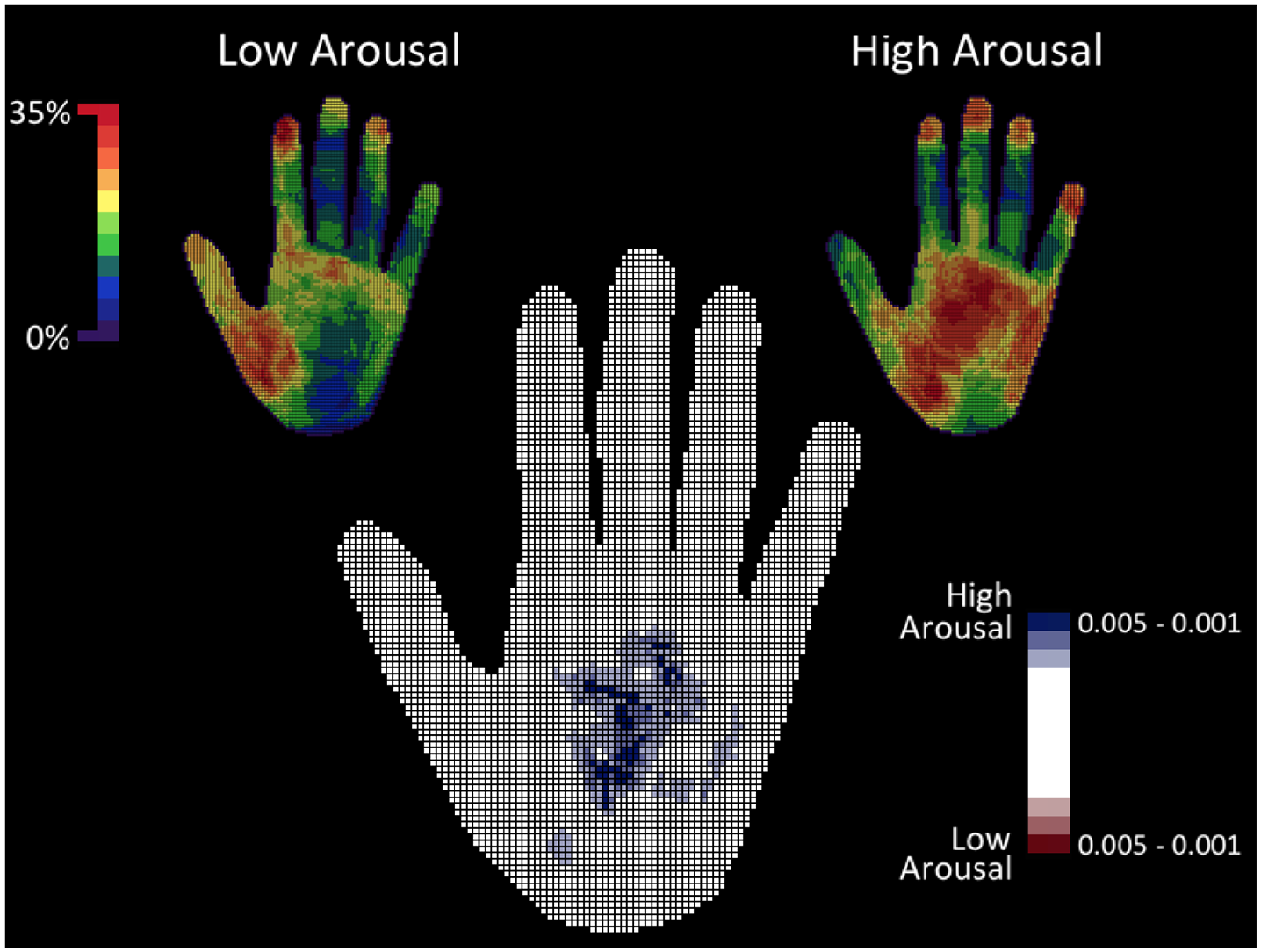
Topographical Analyses of the Frequency of Sensations.
The effect of arousal on SPS frequency
The effect of hand was out of the scope of the present study. Analyses examined only the effect of arousal. Topographical statistics were compiled using cell-by-cell comparisons between the low- and high-arousal conditions, with the exact test for the significance of change (Liddell, 1983) producing maps depicting the cells where significant differences were found between the two arousal conditions. The α level was set to .05, two-tailed. The significance maps resulting from the abovementioned comparisons were subsequently subjected to binary conversion (0 = nonsignificant; 1 = significant), and a spatial scan procedure for binary data (Kulldorff, 1997) was subsequently used. It consists of a circular window that scans, detects, and localizes significant clusters in a stepwise manner. Based on previous studies, a radius of six cells was chosen, containing 113 cells and corresponding to an area of 1 cm2 on a real hand (Michael et al., 2012). After 999 runs of the Bernoulli (binomial) model, all detected and localized clusters were significant at least at the p < .001 level bicaudal. All spatial analyses were carried out using homemade software. Finally, the 95% two-sided asymmetrical confidence interval was also computed (Altman et al., 2000) to determine the significance of the overall percentage of the area of the hand covered by previously detected reliable clusters. The results showed a large area in the center and lower part of the palm where the frequency of SPS was higher under high-arousal conditions. This effect covered an area of 10.16% (95% confidence interval: [9.3, 11.1]) of the overall surface of the hand.
Other parameters
The effect of arousal on all other parameters of SPS was investigated through paired t-tests (uncorrected; Table 2). Excerpts of low arousal increased perceived intensity (M = 3.45, SD = 1.63) compared to those of high arousal (M = 2.78, SD = 1.51), t(31) = 2.58, p < .015, and Cohen’s d = .46, increased confidence in the location of SPS (M = 7.74, SD = 1.48) compared to those of high arousal (M = 6.89, SD = 2.21), t(31) = 2.49, p < .019, and Cohen’s d = .44, and increased confidence in the spatial extent of SPS (M = 7.16, SD = 1.60) compared to those of high arousal (M = 6.07, SD = 2.12), t(31) = 3.37, p < .002, and Cohen’s d = .60. A marginal significance was also found for the percentage of surface per area of SPS but this time in the opposite direction, that is, high arousal tended to increase it (M = 10.42, SD = 14.56) compared to low arousal (M = 6.04, SD = 6.18), t(31) = 1.96, p = .06, and Cohen’s d = .35. No other significant results were found.
Characteristics of SPS Perceived in the Low- and High-Arousal Conditions.

SPS: spontaneous sensations. Effect sizes are expressed as Cohen’s d for all SPS parameters and as Cramér’s V for the types of SPS.
Asterisks denote significant differences. Other symbols denote trends for significance.
Types of sensation
All SPS types were reported at least once, and some participants even reported other types of sensation, such as pins and needles and weightiness. Types of reported SPS were clustered into five categories based on previous studies (Beaudoin & Michael, 2014): thermal (warming and cooling), deep (beat/pulse and muscle tension), paresis-like (numbness and weightiness), surface (tickle, stretch, tingling, flutter, vibration, and compression), and pain-like (pins and needles and itching). Sensation types were not clustered uniformly among these five categories, χ2(4) = 250.7, p < .0001, and Cramér’s V = .38. Surface-like SPS were the most frequently perceived and reported (47.5%), followed by deep (21.5%), thermal (17.5%), paresis-like (8.3%), and pain-like (5.2%) sensations. The effect of arousal was examined (Beaudoin & Michael, 2014; Borg et al., 2015; Echalier et al., 2020; Michael et al., 2012, 2017, 2020; Michael & Naveteur, 2011; Salgues et al., 2021a) by chi-square tests (Table 2). Excerpts of low arousal were found to increase the perception of deep sensations (24.3%) compared to high arousal (18.4%), χ2(1) = 4.2, p < .04, and Cramér’s V = .21. No other difference was observed.
Supplementary analyses: the effects of music versus silence
Although the present study examined the effects of low versus high arousing music on SPS, a subsidiary question is whether music has any effect at all. Since a silence (i.e., without music) condition was not included here, this issue was examined through a comparison of SPS parameters (other than the frequency of spatial distribution) between the results of the present study, taken independent of arousal condition, and nine published studies (Beaudoin & Michael, 2014; Borg et al., 2015; Echalier et al., 2020; Michael et al., 2012, 2017, 2020; Salgues et al., 2021a) in which no music was used. Data about perceived intensity, surface percentage, number of disjoined areas, surface per area, and variety of SPS were available from a sample of 419 healthy participants (381 females and 38 males; mean age 23.5 years, SD = 8.1; mean BMI = 21.6, SD = 3.16), while data for confidence ratings were available from 349 of these participants (317 females and 32 males; mean age 23.6 years, SD = 7.9; mean BMI = 21.8, SD = 3.15). The comparison was conducted through independent samples t-tests (uncorrected; Table 3). It was found that music increased the percentage surface of SPS per area (music M = 8.23%, SD = 9.21; silence M = 3.84, SD = 6.22), t(449) = 3.70, p < .0001, and Cohen’s d = .68, confidence in the location of the perceived SPS (music M = 7.32, SD = 1.61; silence M = 5.80, SD = 2.44), t(379) = 3.44, p < .001, and Cohen’s d = .64, and confidence in their extent (music M = 6.62, SD = 1.64; silence M = 4.90, SD = 2.27), t(379) = 4.18, p < .0001, and Cohen’s d = .77. The types of SPS were analyzed through the Mann–Whitney U test for independent samples. Music increased the percentage of paresis-like sensations (music M = 11.01%, SD = 13.32; silence M = 9.93, SD = 21.13), W = 5028, p < .003, and rank-biserial r = .25, and pain-like sensations (music M = 4.93, SD = 11.11; silence M = 2.84, SD = 10.92), W = 5692, p < .007, and rank-biserial r = .15.
Characteristics of SPS Perceived in the Presence and Absence of Music.

SD: standard deviation; BMI: body mass index; SPS: spontaneous sensations.
Effect sizes are expressed as Cohen’s d for all SPS parameters, and as rank-biserial r for the types of SPS.
Asterisks denote significant differences.
Discussion
The research conducted on SPS to date has highlighted that how they are perceived is related to factors that are intrinsic to the participants’ characteristics and abilities and can include interoception, the propensity to mind-wander, and attention (Michael et al., 2015, 2017; Michael & Naveteur, 2011). The present study is incremental in that it shows that perception of SPS may also be modulated by an external stimulus—music.
The results confirm that, after listening to low-arousing, relaxing music (compared to high-arousing, exciting music), participants perceived SPS more intensely and reported more numerous deep interoceptive sensations, such as heartbeats. Furthermore, they reported having greater confidence in the location and spatial extent of these SPS. Concomitantly, they reported an increase in the spatial characteristics of SPS during high-arousing music, as observed both through the increment of SPS in the center of the palm and a trend for overall larger sensitive areas. These results are in line with studies suggesting that music, via its emotional power, acts as an effective modulator of self-referential processes (Juslin & Vastfjall, 2008; Taruffi et al., 2017; Trost et al., 2012). Furthermore, to the best of our knowledge, this is the first study showing that perception of SPS can be modulated by external factors and the first investigation to make such a finding. The overall picture is that music-induced low arousal helped participants to better perceive some characteristics of SPS and, therefore, to be more confident about what they perceived. On the other hand, music-induced higher arousal seems to dampen perception of SPS, and participants reported larger areas of SPS probably as a result of being unsure about what they perceived. These results are in line with a previous investigation showing that tonic arousal as expressed through resting-state skin conductance level is negatively related to the perception of SPS (Salgues et al., 2021a). Given that decreased arousal helps attention turn inward by activating the DMN (Fan et al., 2012) and that turning attention inward changes the perception of SPS (Michael et al., 2017), it may be suggested that music modulates the focus of attention through its arousal component.
Why music?
Music is an everyday stimulus that captures and holds attention while engaging emotionally. Through different melodies and rhythms, such complex but organized auditory information builds up suspense and holds a listener’s attention (Meyer, 1961). When a person listens to music, external acoustic cues can modulate attentional states by reducing random interfering external information (Csikszentmihalyi, 2009) and directing attention to the body (Suzuki et al., 2013). The ability of music to drive attention inward has been consistently shown by research reporting higher interoceptive processing abilities in musicians compared to non-musicians (Hina et al., 2020; Schirmer-Mokwa et al., 2015). According to Herbert (2011), focusing on a musical source may favor inwardly focused attention, with a lessened orientation to reality and the external world. In a study on pain perception, Mitchell and MacDonald (2006) investigated the ability of music to displace pain through a change in the focus of attention and found that listening to participants’ preferred relaxing music led to an increase of perceived control over pain. In line with these studies, our findings suggest that low-arousing, relaxing music, compared to high-arousing, exciting music, might be particularly helpful in promoting flow and focused states (Csikszentmihalyi, 2009). Accordingly, it could be particularly effective in driving attention to the self, in turn promoting the SPS experience (Michael et al., 2017). In line with such interpretation, Taruffi and colleagues (2017) showed that during sad, low-arousing music, listeners direct their attention inward, engaging in spontaneous self-referential thoughts. Importantly, our supplementary analysis shows that music, when compared to silent conditions tested in previous studies on SPS, was particularly effective in promoting SPS. Crucially, this rules out the hypothesis that music impairs the appearance of SPS, with low-arousing music interfering less than high-arousing, distracting music. On the contrary, results seem to suggest that music promotes SPS per se, with low-arousing music being more powerful in eliciting such self-awareness-related bodily sensations. However, this interpretation is the result of an a posteriori analysis considering silence as control condition. Further studies including an auditory, non-silent condition (such as white noise) in an SPS task are needed to confirm and further clarify the general role of music in promoting SPS.
The source of arousal and its effects
One particular aspect of the results stems from clearly opposite effects of arousal on spatial characteristics of SPS, which decreased due to low arousal, and on all the other parameters (i.e., intensity, confidence ratings), which increased due to low arousal. The latter pattern seemingly concerned deep interoceptive sensations since this was the only category on which arousal had an effect. A straightforward interpretation is that low arousal facilitates orienting attention inward (Fan et al., 2012; Taruffi et al., 2017) in a way that causes thoughts and bodily sensations (Michael et al., 2017) to be perceived as more intense in circumscribed and precise areas of the body, leading participants to be more confident about their perceptions. Conversely, high arousal forces attention away from these internal bodily sensations and toward environmental cues (Fan et al., 2012), dampening perception of SPS, therefore leading participants to feel less confident about the location and spatial extent of these SPS and eventually describing them as occupying larger areas. A previous investigation (Salgues et al., 2021a) showed that physiological arousal at rest assessed through the skin conductance level was inversely related to the perception of SPS, with the perception of SPS being higher in participants exhibiting low physiological arousal and vice versa. However, in that study, there was no evidence of any opposing effects between spatial and nonspatial characteristics of SPS. This discrepancy may be due to methodological differences between the two studies and also due to different kinds of arousal. Indeed, here we assessed the effect of music-induced arousal, which is phasic and of course elicited by music as an external event (Khalfa et al., 2002). On the contrary, the study by Salgues and colleagues (Salgues et al., 2021a) reported the relationship between skin conductance level at rest and SPS reported several weeks later, which is tonic arousal and considered to be a stable physiological individual trait (Crider et al., 2004; O’Gorman & Horneman, 1979).
Limitations
It is noteworthy that musical features other than arousal might influence and modulate bodily awareness and SPS. Indeed, emotional valence has been shown to play an important role in music-driven inward attention, with sad music promoting spontaneous self-related thoughts contrary to happy music (Taruffi et al., 2017). As a first exploratory study, we focused on musical arousal and preselected musical stimuli to control for emotional valence. While subjective ratings provided after the main SPS task confirmed that emotional valence did not differ between low- and high-arousing music, participants reported low-arousing music as being more familiar and enjoyable. It is therefore possible that these musical features, related to musical pleasure, might also be particularly effective in driving participants’ attention inward (van den Bosch et al., 2013) and promote the perception of SPS. It is important to note, however, that these ratings may be biased by participants’ engagement in the preceding trials of the SPS task. That is, experiencing more SPS during low-arousing music might have influenced participants’ listening experience thus modulating their subsequent ratings. Further studies exploring the role of emotional valence or pleasure are therefore needed to disentangle to what extent different musical features may contribute to SPS and, in turn, to increased self-awareness.
Another limitation of the present study is that we have no information about the individual basic level of arousal of participants and no psychophysiological factors were recorded (e.g., skin conductance level measured at rest before the experiment). The absence of such a baseline prevents us from unraveling potential individual differences in the way participants perceive and react to low- and high-arousing music excerpts. This issue merits further investigation.
The relatively small sample size may be another limitation of the present study. Yet, the number of maps used for the investigation of SPS seems to provide sufficient statistical power to avoid errors. We are therefore confident that the results are valid and maybe generalized, all the more given that the sample is fairly well-balanced as far as gender is concerned.
Conclusion
The present study shows that the relaxing nature of an external stimulus (here, low-arousing music) increases the perception of body-related sensations, just as it acts to modulate pain (Mitchell & MacDonald, 2006). Previous investigations showed that chronic pain alters the perception of the body (Lewis et al., 2007) in a way that also distorts the perception of SPS (Borg et al., 2015; Echalier et al., 2020), resulting in a modified and transformed representation of the self. An interesting avenue would be the development of therapies involving music to remediate distortions of the self and body perception in chronic pain patients.
Footnotes
Author contributions
L.F. and G.A.M. supervised the research, conducted statistical analyses, and wrote the majority of the article; O.B. and M.B. conducted the pilot selection and evaluation of the music excerpts, selected participants and administered the full protocol, and participated in statistical analyses. All the authors participated significantly in drafting the article and revising it critically for important intellectual content. They all discussed the results and commented on the manuscript, and all gave their final approval of the version to be published.

Declaration of conflicting interests
The author(s) declared the following potential conflicts of interest with respect to the research, authorship, and/or publication of this article: The authors declare that the research was conducted in the absence of any commercial or financial relationships that could be construed as a potential conflict of interest.
Funding
The author(s) disclosed receipt of the following financial support for the research, authorship, and/or publication of this article: This study benefited from LABEX CORTEX (ANR-11-LABX-0042) funding from the University of Lyon as part of the Investissements d’Avenir program (ANR-11-IDEX-0007) run by the French National Research Agency (ANR).