



Abstract
Recent findings suggest that music listening plays an important role in affect and arousal modulation. Individuals use music to enhance their well-being and counteract negative affect in numerous everyday situations. We investigated whether listening to preferred, non-preferred, or no music altered affect, arousal, psychological and physical health, and stress. Thirty police officers participated in the study. After a baseline assessment, participants were divided into three experimental groups: Group 1 listened to their preferred music; Group 2 listened to their non-preferred music; and Group 3 did not listen to any music. The manipulation was maintained over a period of 7 days. At the end of each day, participants filled out questionnaires concerning their current affect, arousal, psychological and physical health, and stress. Results indicate that the no music group showed significant decreases in affect and psychological and physical health, and significant increases in stress levels compared with the other groups. In contrast, no statistical differences were observed between the non-preferred music group and the preferred music group. We conclude that not listening to any music might be followed by discomfort. We recommend music listening in everyday life for supporting health.
Acute effects of liked and disliked music
Listening to one’s favorite music is highly pleasurable. It causes psychological, physiological, endocrine, and neural responses (Chanda & Levitin, 2013; Schaefer, 2017). Recent studies indicate that some musical pieces elicit so-called chill experiences. Chills are intense sensations during music listening which are evaluated as positive by the listeners. They are described as shivers down the spine, lump in the throat, goose, pimples, trembling, and sexual arousal (Kunkel et al., 2008). In the laboratory, chill experiences are accompanied by certain physiological and neural reactions. Experiencing chills elicits physiological reactions of the sympathetic nervous system such as an increase in heart rate, electrodermal activity, respiration, and pupillary dilation (Laeng et al., 2016; Salimpoor et al., 2009; Starcke et al., 2019). On the brain level, chill experiences are also accompanied by certain neural reactions. In a recent study, brain reactions during chill-inducing musical pieces were assessed with functional magnetic resonance imaging and positron emission tomography (Salimpoor et al., 2011). Results showed increased activation of the mesolimbic reward system which emphasizes the rewarding nature of musical chill experiences. Another study compared brain reactions toward liked versus disliked music throughout the musical piece without the explicit analysis of chills (Montag et al., 2011). Results indicated that listening to the liked musical piece compared to the disliked one also led to an increased activation of the mesolimbic reward system. No findings were reported concerning the opposite comparison, that is, brain regions that are activated when listening to the disliked musical piece compared with the liked musical one. However, another study that assessed brain activations during musing listening used pleasant (consonant) and unpleasant (dissonant) musical stimuli (Koelsch et al., 2006) and reported comparisons in both directions. Results showed that listening to the unpleasant musical stimuli led to an increased activation in the amygdala, the hippocampus, the parahippocampal gyrus, and the temporal poles. Listening to the pleasant musical stimuli led (among others) to an increased activation of the mesolimbic reward system, which is in line with the results of the aforementioned studies. Overall, listening to individual favorite or consonant musical pieces elicits physiological and neural reactions, and are perceived as pleasant and rewarding. Listening to individual disliked or dissonant musical pieces however leads to different reactions and is probably perceived as unpleasant or at least as not rewarding.
Music therapeutic interventions
Given the powerful effects music has on its listeners, music is also used as a therapeutic intervention in numerous clinical contexts (Pauwels et al., 2014). Passive music therapy, that is, music listening, is utilized for treating affective disorders such as depression. A recent meta-analysis implies that listening to music leads to short-term beneficial effects in patients with depression (Aalbers et al., 2017). Patients who also might profit from music listening are patients with obsessive-compulsive disorder (Bidabadi & Mehryar, 2015). Other clinical contexts in which music listening is used for therapeutic purposes are various conditions of stress and pain. Beneficial effects of music listening were observed in patients who are critically ill (Umbrello et al., 2019), in patients who undergo surgery (Kühlmann et al., 2018), and in patients with chronic pain (Ghezeleljeh et al., 2017). A trend was found in reducing blood pressure in patients with hypertension (Kühlmann et al., 2016). Patients with post-traumatic stress disorder may profit from music listening concerning their sleep quality as a pilot study indicated (Jespersen & Vuust, 2012). Patients with primary insomnia also showed improvements due to music listening (Feng et al., 2018). Proposed mechanisms why various patient groups profit from music listening are experiences of pleasure and uplifting mood, activation, relaxation, distraction from negative feelings and thoughts, and feelings of being understood. As different types of music induce different states (Gerra et al., 1998; Lynar et al., 2017; Möckel et al., 1994), music for therapeutic purpose should be chosen in accordance with the patients’ individual clinical condition and the associated therapeutic needs (Trappe, 2009).
Use of music in everyday life, well-being, and health
Not only patient groups profit from music listening, but healthy persons do so as well. When music listening is intended to modulate a current state, persons appear to select the music that matches their current needs. For example, an ambulatory assessment study (Linnemann et al., 2015) monitored participants’ music listening behavior and their stress levels over a period of 5 days for two times. Results indicated that music listening reduced participants’ stress level, particularly, when music listening was explicitly intended for stress reduction. A further study assessed reasons for music listening and analyzed relationships with self-reported physiological and psychological functioning (Thoma et al., 2012). Music listening for reducing loneliness and aggression and arousing or intensifying specific emotions was related with measures that represent physiological and psychological functioning. In addition, the use of music in everyday life might also depend on individual characteristics. Individuals either use music for emotion regulation or for cognitive reasons, depending on their personality, as results of a previous study indicated (Chamorro-Premuzic & Furnham, 2007 ). However, this finding has been questioned recently (Greb et al., 2019). The authors reported that the situation was more influential than individual characteristics. Nevertheless, individual characteristics have been shown to be related to reactions toward music and with the preference of music genres. Musicians versus non-musicians show some differences concerning their affect and arousal during music listening. For example, musicians showed higher positive affect and higher subjective arousal (Liu et al., 2018), as well as a higher breathing rate (Bernardi et al., 2006) toward fast music. An additional important point is that music preferences are related to personality, cognitive ability, and depressive symptoms (Rentfrow & Gosling, 2003). Rentfrow and Gosling developed the Short Test of Music Preferences (STOMP) to assess individual music preferences. Genre preferences were categorized with the help of factor analyses into four main categories: reflexive and complex, intense and rebellious, upbeat and conventional, and energetic and rhythmic. The questionnaire has been applied in the current study for two reasons. First, we determined the preferred and the non-preferred genre of our participants. Second, we ensured that our experimental groups did non-systematically differ concerning their preferences.
A systematic approach that includes situational and individual correlates of music listening is the activation and arousal modulation model (overview in von Georgi, 2013; von Georgi et al., 2006). The macro-part of this model describes the interplay between persons’ personality, which influences affect, arousal, and cognition. The current state in a specific situation leads to behavior planning which can include the use of music. Music listening in the specific situation changes the situation and may in turn change affect, cognition, and arousal, depending on persons’ personality. A questionnaire, the Inventory for the assessment of Activation and Arousal modulation through Music (IAAM), has been developed to assess situations in which individuals listen to music. Factor analyses revealed five dimensions for which reasons music is used in everyday life: relaxation, cognitive problem solving, reduction of negative activation, fun stimulation, and arousal modulation. The micro-part of the model describes the relationship between the five dimensions of affect and arousal modulation through music with individuals’ personality. The personality dimensions extraversion and neuroticism (Eysenck, 1967) and behavioral inhibition, behavioral approach, and fight–flight–freezing system (Gray & McNaughton, 2000) were investigated as potential correlates. Results indicated that relaxation and cognitive problem solving were related to neuroticism and introversion, and the behavioral inhibition system in terms of Gray and McNaughton; reduction of negative activation was related to the fight–flight–freezing system; and fun stimulation and arousal modulation were related to extraversion and neuroticism, and the behavioral approach system in terms of Gray and McNaughton. Empirical findings with the IAAM indicated that the use of music in everyday life has positive effects on health-related variables (Gebhardt et al., 2014; Herr & von Georgi, n.d.; von Georgi, Cimbal, & von Georgi, 2009; von Georgi, Göbel, & Gebhardt, 2009). Thus, music listening appears to be a powerful source for maintaining health in a clinical and non-clinical context (de Witte et al., 2019; MacDonald, 2013). The relationship between psychological health and the use of music has been assessed with the Symptom Checklist (SCL) which was originally developed by Derogatis and colleagues (1973). It has been developed to measure psychological symptoms and has a long tradition in clinical psychology. Meanwhile, revisions and short versions exist. Within the current study, the SCL-27 was used which assesses depressive, dysthymic, vegetative, sociophobic, and agoraphobic symptoms, and symptoms of distrust (Hardt et al., 2004). Physical health variables have previously been assessed with the Inventory for measuring Negative Physiological Affectivity (INKA; von Georgi, 2006) to detect relationships between the use of music and health (von Georgi, 2013). It can be used for the assessment of general as well as current health symptoms such as headache, sleep disturbances, or gastrointestinal symptoms. It has also been used within the current study to assess physical symptoms of health. In addition, we used the Copenhagen Psychosocial Questionnaire (COPSOQ; Nübling et al., 2005) which has been designed to assess psychosocial factors at work, such as cognitive stress, behavioral stress, burnout, and general health. It is applied in the organizational and the scientific context. To the best of our knowledge, it has not been applied in music psychological research before. As we recruited the participants via their workplace, and working as a police officer is regarded as stressful (Violanti et al., 2017), we used this questionnaire as an additional measure of stress and health.
Music at work and during learning
Working time constitutes a main part of everyday life. Attempts to increase work productivity and work satisfaction through music have a long tradition. For example, the British Broadcasting Corporation started broadcasting “music while you work” in 1940. Some years earlier, it was reported that music listening at work increases productivity and satisfaction (Wyatt & Langdon, 1937). Later, experimental laboratory research has stated that music listening facilitates cognitive processes which has become popular as the Mozart effect (Rauscher et al., 1993). However, subsequent studies indicated that this effect is attributable to increased mood and arousal which is elicited by the specific musical stimulus (Thompson et al., 2001). Nonetheless, music listening might facilitate working processes and increase satisfaction and productivity.
In line with these early findings, questionnaire studies assessed the subjectively perceived effects of music listening at work. In one study, it was reported that 63% of physicians and nurses like to listen to music in the operation room (Ullmann et al., 2008). A recent study (Haake, 2011) explored music listening habits of employees who select their individual music during work. The authors reported that employees use music at work not only to increase positive mood, but also to increase inspiration, concentration, positive distraction, stress relief, and managing personal space. Another study found that music can be perceived as positive in the working context (Gatti & da Silva, 2007). The researchers selected classical music by Johann Sebastian Bach and played it in an emergency department of a hospital. The descriptive analysis of participants’ answers indicated that most of them perceived the musical intervention as positive, even if they preferred other musical genres. In contrast to the current study, the selected musical genre (classic) was not the preferred one in most of the participants, but also not especially disliked.
Research that directly manipulates the availability of individually selected music at work is scarce. One study examined the effects of listening to music at work in computer information systems developers (Lesiuk, 2005). Performance and affect were monitored over a period of 5 weeks in a within-subjects design. In the first week, developers should behave as usual concerning their music listening habits at work. In Weeks 2, 3, and 5, they were provided with a music library and asked to listen to music when they liked to. In Week 4, they were instructed not to listen to any music. Twice a week, positive affect, quality of work, and time on task were measured with questionnaires. Results demonstrated that in the no music week, positive affect and quality of work were lowest, while time on task was highest. Overall, the possibility to listen to preferred music appears to have positive effects in the working context. A more recent study has conducted a similar study in online learners (Lim & Bang, 2018). Online learners were monitored over a period of 4 weeks. In the first week, they were instructed to start their online learning according to their habits and preferences. In the second week, they were explicitly asked to listen to their preferred music during learning as long as they wish. In the third week, they were asked to not listen to any music during learning, while in the final week, they were asked to listen to music again during learning. During the no music week, participants had a decrease in positive affect, an increase in negative affect, and an increase in mental exertion. The authors used the Positive and Negative Affect Schedule (PANAS; Watson et al., 1988) which measures positive and negative affect as two independent constructs. It can be used for the assessment of affect in various contexts, for example, after experimental manipulations, over longer periods of time, or as stable traits (depending on the instruction). In the current study, the questionnaire was used to assess positive and negative affect as a trait, and to assess positive and negative affect over the seven experimental days. A further established method (Bynion & Feldner, 2017) for assessing affective responses is the use of the Self-Assessment Manikin (SAM; Bradley & Lang, 1994). It is a non-verbal pictorial instrument that assesses valence, arousal, and dominance toward concrete stimuli. Recently, the instrument has been successfully applied to auditory stimuli (Bradley & Lang, 2007) and musical pieces (Balasubramanian et al., 2018). The SAM was also used within the current study to have an additional measure of pleasure, arousal, and dominance at the baseline assessment and after each of the experimental days (even if this measure was not originally designed for this purpose).
Hypotheses of the current study
In the current study, we aimed to investigate the effects of listening to preferred, non-preferred, or no music over a period of 7 days in a between-within-subjects design. At the end of each day, participants filled out questionnaires concerning their affect, arousal, psychological and physical health, and stress. To the best of our knowledge, this has not been done in previous studies. We expected that the three groups would differ concerning their affect, arousal, psychological and physical health, and stress level. In healthy participants, listening to especially non-preferred (i.e., disliked) music as well as to dissonant music has been shown to be perceived as not rewarding (Koelsch et al., 2006; Montag et al., 2011). Listening to no music has been shown to a deterioration in affect in the working and learning context (Lesiuk, 2005; Lim & Bang, 2018). The intentional use of music has been related to positive health (overview in von Georgi, 2013). In detail, we expect that after the manipulation:
(a) Participants who listen to their preferred music have a higher positive affect and a lower negative affect compared with participants who listen to non-preferred music or no music.
(b) Participants who listen to their preferred music have a lower arousal level compared with participants who listen to non-preferred or no music.
(c) Participants who listen to their preferred music have a better psychological health outcome compared with participants who listen to non-preferred music or no music.
(d) Participants who listen to their preferred music have a better physical health outcome compared with participants who listen to non-preferred music or no music.
(e) Participants who listen to their preferred music have a lower stress level compared with participants who listen to non-preferred music or no music.
In addition, we expected relationships between the participants’ general habits of activation and arousal modulation through music with the outcome variables assessed. As mentioned before, the intentional use of music has been related to high levels of psychological and physical health (von Georgi, 2013). Participants of the preferred music group can use music for affect and arousal modulation as they like, whereas participants of the other two groups cannot do so. Consequently, we expect the following:
(f) In the participants who listen to their preferred music, a relationship between frequent affect and arousal modulation through music with high positive affect, low negative affect, low arousal, high psychological and physical health, and low stress levels exists.
(g) In the participants who listen to non-preferred music or no music, a relationship between frequent affect and arousal modulation through music with low positive affect, high negative affect, high arousal, low psychological and physical health, and high stress levels exists.
Methods
Participants
In the current study, 30 police officers participated (17 females and 13 males). All of them worked in the same section. They were between 23 and 58 years old (M = 42.97, SD = 10.71). Among participants, 43.3% worked at watch and patrol, 40% had leadership tasks, and the remaining 16.7% had other tasks. Participants were no professional musicians. Previous musical training was not assessed. All officers took part in the study voluntarily and were not financially compensated. All of them provided verbal informed consent prior to participation.
A sample size calculation with the program G*Power 3.1.9.2. (Faul et al., 2007) was conducted for the main analyses of interest. Using repeated-measures analyses of variance (ANOVAs), within-between interactions, a medium effect size, an alpha-error probability of .05, a power of 0.95, three independent groups, and seven points of measurement, the optimal sample size was calculated as 33. We were finally able to recruit 30 participants.
Design and experimental manipulation
The study comprised a measurement of musical preferences and further baseline measures. Afterward, the experimental manipulation took place and participants were monitored concerning several state variables over 7 days. The participants were randomly assigned to one of three experimental groups. Participants of Group 1 listened to their preferred music (preferred music group). According to the musical preferences, participants in Group 1 received a playlist of 100 songs of their preferred genre which they should listen to at the times they usually listen to music. Participants of Group 2 listened to their least preferred music (non-preferred music group). According to the musical preferences, participants of Group 2 received a playlist of 100 songs of their non-preferred genre. We did not prescribe the participants of the two music groups when, how long, or during which other activities they should listen to music. The two music groups were instructed to listen to music as they usually do. Thus, they were allowed to use the music according to their individual habits. The playlist was played according to the settings the participants have chosen for their media player (fixed or random order). We have asked participants not to skip forward or backward, and to re-start where it stopped before after pausing listening. Participants in the two music groups chose whether they liked to receive their playlist via CD, USB-stick, or Drop-Box link. Participants of Group 3 did not listen to any music for the complete 7 days (no music group). Thus, besides the baseline measurements, we used a 3 (groups) × 7 (days) design. All questionnaires were filled out with paper and pencil.
Baseline measurement of musical preference and further variables
To measure musical preferences, we used a German translation of the STOMP (Rentfrow & Gosling, 2003). Participants must choose out of 16 musical genres which is their most preferred one (classical, blues, heavy metal, soundtracks/theme songs, modern classical/avantgarde, schlager, country/Western, rap/hip-hop, jazz, alternative, pop, soul/funk, Latin/reggae, rock, religious, techno/dance). Afterward, they were asked which of them is their least preferred one. The 16 genres can be categorized into four main categories: Category 1—“reflexive and complex” includes genres such as classical, jazz, blues, and folk; Category 2—“intense and rebellious” includes genres such as rock, heavy metal, and alternative; Category 3—“upbeat and conventional” includes genres such as country, pop, and religious music; and Category 4—“energetic and rhythmic” includes genres such as rap/hip-hop, soul/funk, and electronic/dance.
The participants’ use of music in everyday life was assessed with the IAAM (von Georgi, 2013; von Georgi et al., 2006). It measures when and why persons listen to music in their everyday life on the five subdimensions relaxation, cognitive problem solving, reduction of negative activation, fun stimulation, and arousal modulation. The questionnaire consists of 55 items that are answered on a 5-point Likert-type scale ranging from 0 (never) to 4 (very frequently).
The SAM (Bradley & Lang, 1994) was used to assess emotional valence, arousal, and dominance at baseline, prior to the experimental manipulation. The rating scales consist of three non-verbal pictorial scales, and each point is associated with a manikin representing a specific state. The first scale assesses emotional valence from negative to positive. The second scale assesses arousal from low to high. The third scale assesses the dimension of dominance from low to high. In each of the subscales, five manikins are shown, and participants should mark which of the current manikins represent their current state. They are also allowed to mark between two of the manikins. Thus, overall, a 9-point scale results. Within the current study, the nine points were coded as 1, 1.5, 2, 2.5, 3, 3.5, 4, 4.5, and 5.
To measure general positive and negative affect, we used the German version of the PANAS (Breyer & Bluemke, 2016). It consists of 10 adjectives that represent positive affect and 10 adjectives that represent negative affect. Each adjective is answered on a 5-point Likert-type scale. In the current study, the scale ranged from 0 (not at all) to 4 (extremely) for the positive affect items and from 4 (not at all) to 0 (extremely) for the negative affect items.
To measure psychological symptoms and psychological distress, the Symptom Checklist 27 in the German version (SCL-27; Hardt et al., 2004) was used. It assesses complaints on the six symptom dimensions depressive, dysthymic, vegetative, agoraphobic, sociophobic, and symptoms of distrust. It consists of 27 items that are answered on a 5-point Likert-type scale that ranges from 0 (not at all) to 4 (very strong).
To measure general health and potential physical complaints, we used the INKA (von Georgi, 2006) which is a German questionnaire. It assesses negative physiological affectivity such as headache, sleep disturbances, and exhaustion. The 24 items are answered on a 5-point Likert-type scale from 0 (not) to 4 (very strong).
Finally, the German version of the COPSOQ (Nübling et al., 2005) was used in a modified (i.e., shortened) version. It assesses stress symptoms that can occur at work on the subdimensions cognitive stress symptoms, behavioral stress symptoms, symptoms of burnout, and general health. In the version used, 19 items that represent the dimensions cognitive stress symptoms, behavioral stress symptoms, and symptoms of burnout are answered on a 5-point Likert-type scale ranging from 4 (always) to 0 (never), or from 4 (completely applies) to 0 (does not apply at all). The subdimension general health is assessed on an 11-point Likert-type scale that ranges from 0 (bad health) to 10 (excellent health).
Measurement of state variables over the seven experimental days
Besides the STOMP that assesses music preferences and the IAAM that measures the use of music in everyday life, all questionnaires were administered over the seven experimental days. Thus, participants filled out all other questionnaires at the end of each of the 7 days. The state versions of the questionnaires were used over the seven experimental days. Thus, participants rated their current emotional state, their current arousal, and their current dominance with the SAM, their current positive and negative affect with the PANAS, their current psychological symptoms and distress with the SCL-27, current negative physiological affectivity with the INKA, and their current stress symptoms that are related to work with the COPSOQ at the end of each of the 7 days.
Statistical analysis
Results were analyzed with SPSS version 27. Potential differences between the three experimental groups concerning gender and music preferences were analyzed with χ2 tests. Potential group differences concerning baseline habitual variables were analyzed with univariate ANOVAs and Scheffé post hoc tests. Potential interactions between groups and study day concerning the state variables were analyzed with repeated-measures ANOVAs (3 × 7). Greenhouse Geisser corrections were applied when appropriate, and partial eta-squared was used as effect size. For the analyses of relationships between the habitual activation and arousal modulation through music with the state variables, we performed Pearson’s correlations. The level of significance was determined as .05, and all results concerning hypotheses testing were Bonferroni corrected. The resulting level of significance for the group × day ANOVAs of the 16 state variables was .003. The resulting level of significance for the correlational analyses was .0006.
Results
Demographic variables and music preferences
Results of the demographic variables and music preferences of the three experimental groups are shown in Table 1. Results indicated that the groups differed concerning age, F(1, 27) = 4.13, p < .05, and that the non-preferred music group was older than the preferred music group according to a Scheffé post hoc test. Further differences between the groups were not observed. The χ2 test concerning gender distribution did not reveal a significant difference between groups, χ2(2) = 0.27, p = .87. The χ2 test concerning music preferences did not reveal a significant difference between the three groups either, χ2(6) = 3.53, p = .74.
Demographic Variables and Musical Preferences of the Participants.

Baseline measures
Results of the variables that were assessed at baseline for the three experimental groups are shown in Table 2. Results indicated that groups did not differ concerning the variables assessed apart from current arousal measured with the SAM. More precisely, a Scheffé post hoc test showed that the preferred music group tended to have higher arousal than the other groups; however, the single comparisons did not reach significance. Overall, results demonstrate successful randomization of the participants.
Baseline Measures of the Participants in the Three Groups.
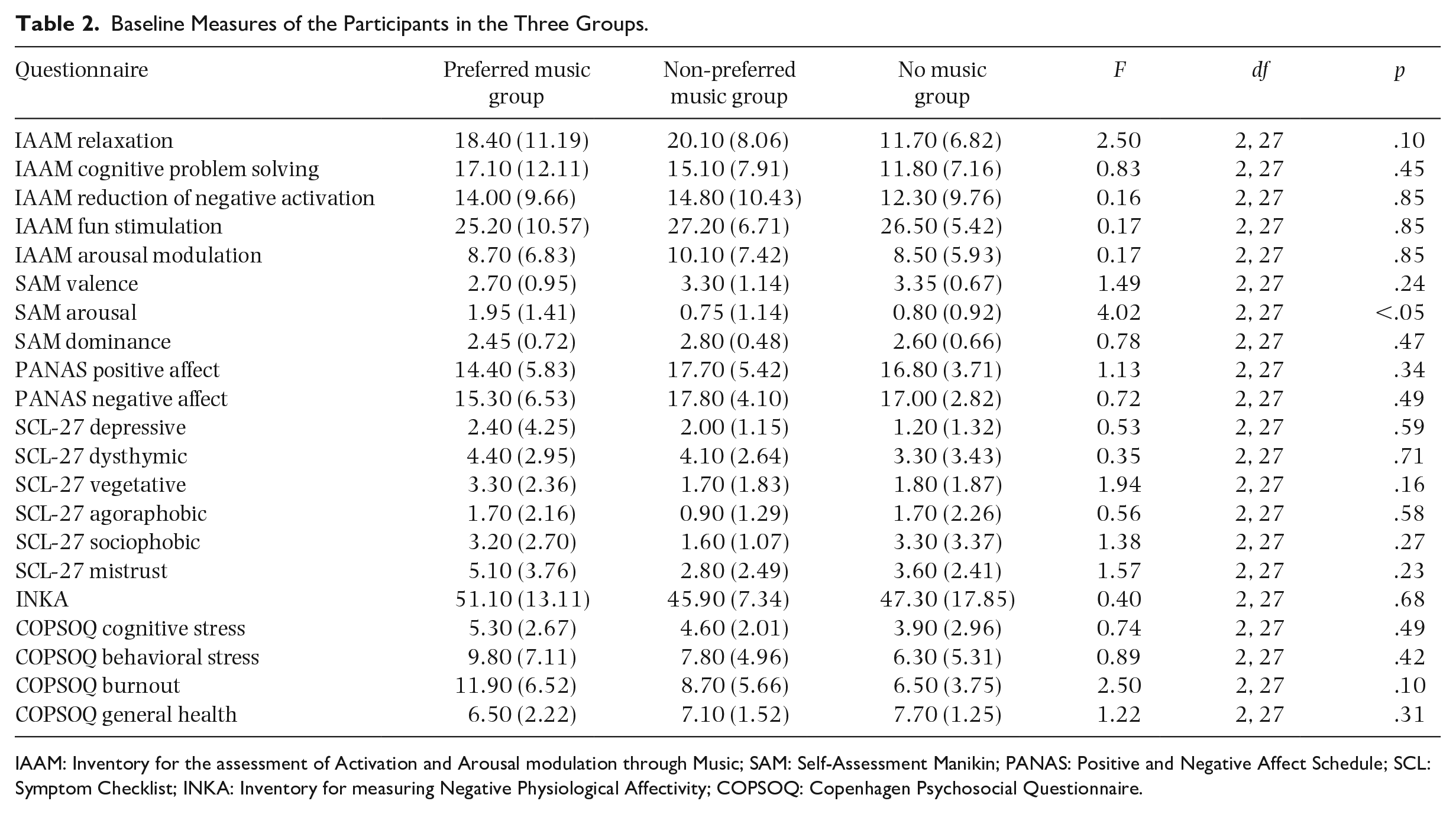
IAAM: Inventory for the assessment of Activation and Arousal modulation through Music; SAM: Self-Assessment Manikin; PANAS: Positive and Negative Affect Schedule; SCL: Symptom Checklist; INKA: Inventory for measuring Negative Physiological Affectivity; COPSOQ: Copenhagen Psychosocial Questionnaire.
Changes over the seven experimental days
Results of the repeated-measures ANOVAs demonstrated a group × day interaction for many of the variables assessed. Results are shown in Table 3. In detail, significant group × day interactions which survived Bonferroni correction were observed for SAM valence, SAM dominance, PANAS negative affect, SCL depressive, SCL dysthymic, SCL vegetative, INKA, COPSOQ cognitive stress, COPSOQ burnout, COPSOQ health. The group × day interactions for SCL agoraphobic, SCL sociophobic, and COPSOQ behavioral stress were significant at the .05 level but did not survive Bonferroni correction. Selected effects are shown in Figures 1 to 4. As shown in the figures, participants of the no music group have a lower valence, higher dysthymic symptoms, more health complaints, and higher cognitive stress at the end of Day 7 compared with the other two groups. Furthermore, the no music group has higher negative affect, higher depressive symptoms, higher vegetative symptoms, higher symptoms of burnout, and lower overall health at the end of Day 7 compared with the other two groups.
Main Effects and Interaction Effects of the State Variables over the Seven Experimental Days.
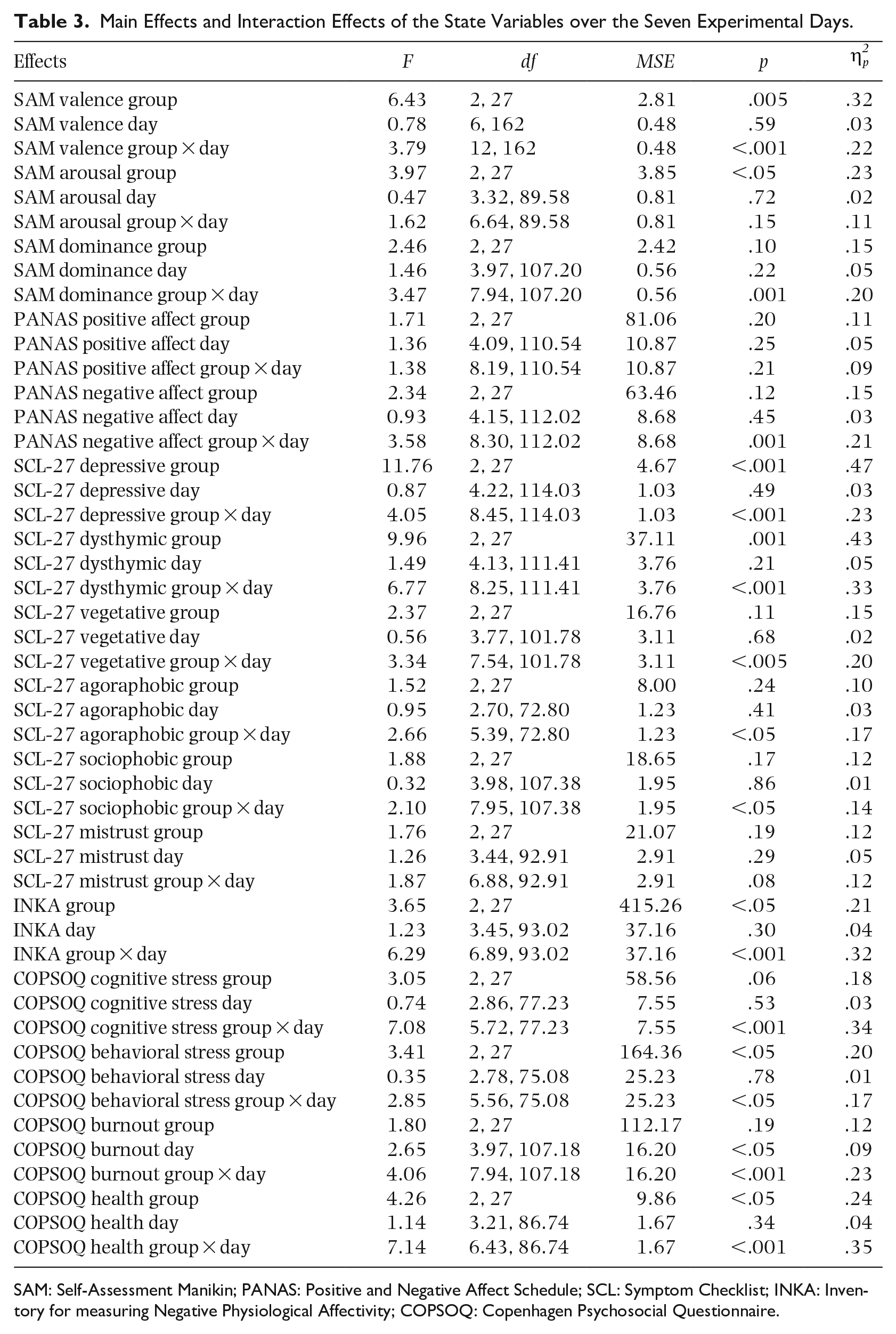
SAM: Self-Assessment Manikin; PANAS: Positive and Negative Affect Schedule; SCL: Symptom Checklist; INKA: Inventory for measuring Negative Physiological Affectivity; COPSOQ: Copenhagen Psychosocial Questionnaire.

Results of the Group × Day Interaction for Valence, Measured with the SAM (Self-Assessment Manikin).

Results of the Group × Day Interaction for Dysthymia, Measured with the SCL-27 (Symptom Checklist 27).

Results of the Group × Day Interaction for Negative Physiological Affectivity, Measured with the INKA (Inventory for Measuring Negative Physiological Affectivity).

Results of the Group × Day Interaction for Cognitive Stress Symptoms, Measured with the COPSOQ (Copenhagen Psychosocial Questionnaire).
Given the fact that experimental groups differed concerning age, analyses were repeated with age as a co-variate. Results were stable after doing so, except the interaction between group × day concerning SAM dominance. This interaction reached a level of significance of .001 before the analysis of covariance (ANCOVA), and a level of significance of .004 after the ANCOVA. It then slightly failed to survive the Bonferroni correction.
Relationship between state variables and habitual activation and arousal modulation through music
We calculated the aggregated scores of the state variables over the seven experimental days for each of the participants. We then performed correlations between these total scores and the activation and arousal modulation through music, assessed with the IAAM. This was done for each of the experimental groups separately. Results indicated that in the no music group, significant relationships were observed between relaxation and depressive symptoms, and between relaxation and sociophobic symptoms. Further relationships were observed in this group, but results did not survive Bonferroni correction. Results of the no music group are shown in Table 4. In the preferred music group, no relationships were observed, besides one between reduction of negative activation and SCL-27 agoraphobic symptoms, r = .79, p < .01. However, this result did not survive Bonferroni correction. In the non-preferred music group, a mixed picture emerged. While negative relationships between affective state variables and the dimensions of the IAAM existed, positive relationships between variables that represent symptoms and IAAM scores were observed. However, none of these results survived Bonferroni correction. Results of the non-preferred music group are shown in Table 5.
Correlations between Total Scores of the State Variables and the Habitual Activation and Arousal Modulation through Music in the No Music Group.

IAAM: Inventory for the assessment of Activation and Arousal modulation through Music; SAM: Self-Assessment Manikin; PANAS: Positive and Negative Affect Schedule; SCL: Symptom Checklist; INKA: Inventory for measuring Negative Physiological Affectivity; COPSOQ: Copenhagen Psychosocial Questionnaire.
p ⩽ .05. **p ⩽ .01. ***p ⩽ .0006 (surviving Bonferroni correction).
Correlations between Total Scores of the State Variables and the Habitual Activation and Arousal Modulation through Music in the Non-Preferred Music Group.

IAAM: Inventory for the assessment of Activation and Arousal modulation through Music; SAM: Self-Assessment Manikin; PANAS: Positive and Negative Affect Schedule; SCL: Symptom Checklist; INKA: Inventory for measuring Negative Physiological Affectivity; COPSOQ: Copenhagen Psychosocial Questionnaire.
p ⩽ .05. **p ⩽ .01. ***p ⩽ .0006 (surviving Bonferroni correction; not observed here).
Discussion
Within the current study, we aimed to detect consequences of listening to preferred music, to non-preferred (i.e., particularly disliked) music, or to no music over a period of 7 days. We collected data concerning affect, arousal, psychological and physical health, and stress level. In detail, we expected that participants who listen to their preferred type of music have a more positive affect, better psychological and physical health, and lower stress levels compared with participants who listen to non-preferred or no music. Results showed that a forced abstinence from music listening is followed by deteriorations in affect, psychological and physical health, and increased levels of stress. This finding is partly in line with our first set of hypotheses. Unexpectedly, listening to non-preferred music was not followed by these adverse effects. Thus, listening to any music appears to be more advantageous than listening to no music, even if it is not the preferred type of music. The habitual activation and arousal modulation through music was related to adverse health effects in the no music group. Thus, our second set of hypotheses was also partly confirmed by our data.
Results emphasize that music listening is a rewarding stimulus (Zatorre & Salimpoor, 2013). It can be assumed that individuals choose music they like in everyday life. Thus, our experimental condition of non-preferred music listening was somewhat artificial. Nevertheless, results are interesting. This group did not show an overall deterioration in affect, arousal, and health, or an increased stress level. This might be explained by the fact that not all the musical pieces within the playlist of non-preferred music were especially hated, although the genre overall was disliked. It might be the case that continuously listening to aversive musical pieces or dissonant ones (Koelsch et al., 2006) would have shown the same results as music abstinence. Alternatively, over a prolonged time, any music might be better than no music. If this proved true in future studies, the tremendous impact of music on well-being and health would be further supported. A previous study also found that even non-preferred music can be perceived as positive in the working context (Gatti & da Silva, 2007). However, the selected genre in the previous study was not especially disliked, but only not the preferred one. Current results also emphasizes the potential therapeutic impact music has. Music therapy in the psychological health context is closely connected with the recovery model of mental health (Shepherd et al., 2008) which emphasizes patients’ resources, strength, and potentials rather than deficits. Thus, music listening is regarded as helpful to support the strength and resources of patients (Gebhardt et al., 2018; Grocke et al., 2008). An advantage of this receptive music therapy is that it can be continued at home after initial support through a music therapist. It can be assumed that numerous patient groups would profit from music listening as current results indicate changes in affect, psychological health, physical health, and stress after music abstinence. Within the current study, all participants were healthy participants who were recruited via their work environment. Results emphasize that music listening in everyday life appears to be a powerful source for supporting well-being and health.
The observed relationship between the use of music for relaxation purposes with depressive and sociophobic symptoms in the no music group indicates that individuals who frequently use music for relaxation might especially suffer from music abstinence. This is in line with findings that demonstrated a positive effect of activation and arousal modulation through music on health-related variables such as the subjective state of health, number and strength of infections, and number of consultations (von Georgi, Cimbal, & von Georgi, 2009; von Georgi et al., 2006). Current results indicate that this positive effect might not only concern physical health variables such as infections, but also psychological health variables such as depressive symptoms and symptoms of anxiety. Within the two music groups, some small relationships were observed, but they did not survive Bonferroni correction. Thus, in individuals who were able to use the music for affect and arousal modulation, no relationship between any of the affect- and health-related variables were observed.
Concerning music listening at work, our results are in line with the findings previously reported (Lesiuk, 2005), that is, decreases in positive affect due to music abstinence at work. The study by Lesiuk additionally reported decreases in productivity at work due to music abstinence. This variable has not been included in the current study, as productivity measures in a police department are somewhat difficult to assess. Our focus laid on affect and health-related variables which might have indirect effects on productivity. More precisely, positive affect and excellent health might increase presence and decrease absenteeism.
Some limitations of the current study must be addressed. First, our sample was highly specific as only police officers were included, and results might not be generalizable to other professional groups. It would be interesting to include other groups of employees, freelancers, students, or trainees in future studies. Second, all dependent variables were assessed via self-report. Further measures such as peripheral physiological, hormonal, or other medical variables would also be useful in future studies. For example, it would be of interest whether stress hormones rise during prolonged music abstinence. Moreover, other variables or occurrences could not be controlled within the current experimental setting, such as familiarity with the songs in the playlist, frequency of music listening during the experimental days, accidental listening to music which does not fit to the respective group (e.g., listening to music in the no music group in a shopping center or when visiting friends). The experimental manipulation only affected the intentional use of music. Interestingly, the effects of the experimental manipulation were observed despite this risk of confounding. Furthermore, it would be interesting to assess personality traits in more detail in future studies. We assessed activation and arousal modulation through music which has been shown to be related with certain personality traits (von Georgi, 2013). In addition, we assessed habitual affect which also constitutes personality traits. Nevertheless, examining direct relationships between personality traits such as extraversion and neuroticism (Eysenck, 1967) and behavioral inhibition, behavioral approach, and fight–flight–freezing system (Gray & McNaughton, 2000) and music listening versus music abstinence could be of additional value. Finally, the sample size was small (albeit close to the calculated optimal sample size). The small sample size should be considered, particular as some of the baseline variables show intra- and inter-group variance. Although we statistically dealt with this problem, it should be kept in mind as a potential limitation.
Despite the aforementioned limitations, results have practical implications for supporting health in numerous everyday situations including work. Many workplaces include high cognitive or affective demands which can cause stress symptoms over time. With no doubt, working as police officer includes high demands (Violanti et al., 2017). Strategies of maintaining a comfortable or at least bearable level of positive affect, health, and stress are therefore of special importance. Employers should enable a working environment in which preferred music listening is possible. A recent study indicates that employees manage their music listening at work in a way it does not disturb others (Haake, 2011). So, music listening appears to have few negative side effects and can be used to maintain health. Or in other words: play it, Sam!
Footnotes
Data availability statement

Declaration of conflicting interests
The author(s) declared no potential conflicts of interest with respect to the research, authorship, and/or publication of this article.
Ethical statement
The study procedures were carried out in accordance with the current Declaration of Helsinki (2013) and with the ethical guidelines of the professional institution of psychologists in the country in which the study took place (2016). Results have not been published or submitted elsewhere.
Funding
The author(s) received no financial support for the research, authorship, and/or publication of this article.