



Abstract
This paper considers the journalism and poetry Claude McKay produced for Sylvia Pankhurst's communist weekly Workers' Dreadnought in 1920 as a collaboratively produced body of work. This allowed Pankhurst to have a Black communist commentator on hand to cover workers' issues, and McKay used Pankhurst's periodical as a platform from which to dramatise the aesthetic and political potential inherent in collaboration between working-class activists, journalists, and artists for the paper's readers. In the Dreadnought's pages, McKay's poems very publicly weighed the value of collaborative labour and considered the arts' place in the class struggle. He simultaneously produced journalism that advocated collaboration among races to resist the racial antagonism that sparked violence in the most impoverished East End communities in the summers of 1919 and 1920. Ultimately, McKay's work for the Dreadnought produced a holistic representation of working-class intellectual life founded on the production of beauty and the exercise of aesthetic as well as political judgment, one that depicts these activities as inevitably commingled and collaboratively produced.
Keywords
Over the course of a few months in the summer and fall of 1920, the Jamaican-born writer Claude McKay gave a remarkable poetic performance in the pages of the communist East London newspaper the Workers' Dreadnought. 1 McKay dramatised for the paper's readers the aesthetic and political potential inherent in collaboration between working-class activists, journalists, and artists. In the Dreadnought's pages, McKay carved out a space in which he very publicly weighed the value of collaborative labour and considered the arts' place in the class struggle. He simultaneously produced journalism that advocated collaboration among races to resist the racial antagonism that sparked violence in the most impoverished East End communities in the summers of 1919 and 1920. In this article, the framework of collaboration enables me to consider the mechanisms through which McKay's work with Sylvia Pankhurst, the Dreadnought's editor, created representations of the East End that are themselves collaboratively produced, and that represent specific East End locations as spaces where collaborative working-class agency was enacted.
Sylvia Pankhurst and The Workers' Dreadnought
Sylvia Pankhurst is now best known for her involvement in the militant wing of the British women's suffrage movement starting in 1905, when she moved to London from Manchester and began organising in the East End – first, with her mother Emmeline and sister Christabel, as one of the founders of the militant women's suffrage organisation, the Women's Social and Political Union, and after 1912 as the founder and leader of the East London Federation of Suffrage Societies. Sylvia's suffrage career and her split from the WSPU have been thoroughly documented by suffrage historians, most notably in several biographies of Pankhurst herself. 2 The split was a result of her disagreement with Christabel and Emmeline over the degree to which the socialist goal of universal adult suffrage should be incorporated into the WSPU's platform, but Sylvia also felt that the autocracy of Christabel's leadership and the ‘middle-class’ image to which the WSPU insisted the Union's members adhere (with the exception of members like Annie Kenney, who performed as token ‘working-class suffragettes’ at rallies) were inappropriate for a democratically based reform movement. 3
Sylvia Pankhurst's activism was not limited to suffrage. Her dedication to socialist politics was life-long, and from 1905 until she emigrated to Ethiopia in the 1950s, her activism in the East End included vocally critiquing nationalism, imperialism, and racist policies and ideologies. 4 It also entailed working among the people for whom she advocated in her political work: she ran a suffrage shop in London, and, after 1914, the Dreadnought took offices in Bow. Between 1914 and 1924, she served as the editor of the Dreadnought, which during her tenure positioned itself at the extreme left of the British political spectrum, attacking the Independent Labour Party (ILP), and later the Communist Party of Great Britain (CPGB) as insufficiently communist.
Claude McKay's biography was clearly a part of his appeal to Pankhurst. McKay, born and raised in Jamaica, had moved to Kansas in 1912 and then to Harlem in 1914, where he became increasingly involved with the radical left press. By 1918, McKay was expressing his admiration for the treatment black workers' received from the International Workers of the World, which may have led to his turn to explicitly Communist language in his writing starting in early 1919. 5 When he came to London in his fall of 1919, he quickly connected with working-class anti-imperialist, socialist, and communist activists through a radical-left meeting place, the International Club. 6
Early twentieth-century representations of the East End
During the late nineteenth century, writers of all stripes took the East End of London as an object of representation. It became a site, only liminally or nominally within London, which was repeatedly rhetorically positioned as a constitutive outside against which to define a ‘civilized’ London. 7 As works like Margaret Harkness's In Darkest London – the title a reference to HM Stanley's In Darkest Africa – make clear, the East End was placed symbolically outside London in ways that paralleled the rhetoric of Africa as the ‘Dark Continent’. 8 Eileen Sypher documents the fin-de-siècle trend of using the East End as a ‘metonym for social inequality’: it ‘became the unchartered frontier for many individuals motivated by various philanthropic and revolutionary aims: university graduates, missionaries, statisticians, political organizers, and independent minded upper and middle class women’. 9 This trajectory runs through the ‘slum fiction’ of the 1880s, a popular subgenre in which ‘authors aimed to shock by showing urban poverty linked with violence and immorality, while creating a tale full of incident and excitement’. 10
What nearly all these Victorian ‘explorers’ shared was their position as visitors in the East End. But by the end of the First World War, writing about the East End was increasingly authored by those who lived there. These accounts took the forms of socialist novels, correspondences with the mainstream press, and newspapers written, edited, and printed locally. Examples of this correspondence include the British ILP's creation of no less than sixty-eight papers between 1893 and 1910, 11 many of which focused on and ran offices out of the East End, the increasingly widely read Daily Herald (1912–64), which promoted working-class voices and socialist ideas, as well as the Dreadnought which, although reaching a more limited audience, gave voice to specifically feminist socialist and then communist arguments. These publications did not replace ‘outsider’ writing about the East End, but rather supplemented that work with the voices of East Enders who were, in unprecedented numbers, finding opportunities to give form to their own lives and political interests in writing for the public. In these venues, rather than having their voices treated as a sort of raw material, which needed to be framed, interpreted, and evaluated by observers, often with the intent to draw a moral lesson from the lives of the poor, members of the East End's working classes found and created opportunities to represent their lives on their own terms.
In doing so, they expanded the audience for writing about the East End. While much nineteenth-century writing was aimed at deciphering the East End for an audience sufficiently socially, geographically, and economically removed from working-class life to need intermediaries to interpret the area, rising literacy among the working classes meant that much of this new writing not only spoke for the East End, but it also spoke to those living there. 12 Publications like the Dreadnought were explicitly engaged in revising classist narratives of life in the East End, but their goal in doing so was not simply to offer new sociological narratives to its neighbours to the West. These editors and journalists took the opportunity to offer new images of working-class lives to the working classes themselves – images that were at times aspirational, collective, collaborative, or political, and that refuted the monolithic story of the East End and its residents as a problem. Rather than appealing to an ideal of progress to be achieved by assimilating to the values of the ruling classes, they found value in life as it was lived by working-class people.
As a communist paper, the Dreadnought necessarily elicits critical readings that consider the class positions of its audience. Modernist periodical studies have not yet considered as fully as is necessary working-class people as producers of media. 13 Much work considers them incidentally or non-specifically as consumers of news: insofar as working-class people are recognised as consumers of more mainstream news, their likely responses to the press have seldom been theorised from their position as classed interpreters, or as different from responses of other readers. Scholars should be wary of assuming a middle-class readership for, for example, women's magazines, especially where demographic statistics about consumers are not available. (In this respect, reception-based readings of the press through the lens of gender have much to offer methodologically to researchers considering how working-class readers might have seen their interests represented in various media.)
The working-class readers of the Dreadnought likely found in it a call to different forms of identification and consumption than they would have encountered in weekly and monthly publications aimed at a general public. The class whose members were most likely to consume both of these media was the lower-middle class, and the very different economic assumptions implied by the various publications' conventions of address would have stratified members of this group. 14 The nature of the content and advertising in magazines like Good Housekeeping or The Economist invited working-class readers to aspire to a middle-class lifestyle, where the Dreadnought constantly used a class-conscious language to invite a stronger identification with working-class interests. 15
Art and activism with the Workers' Dreadnought
While collaborative, transatlantic working-class networks led to the Dreadnought articles, local events in the East End and London docks in 1919 and 1920 shaped the collaboration between Claude McKay and Sylvia Pankhurst. In this section, I consider how their collaboration offered each an opportunity to engage with questions of race, sexuality, the working classes, and communism that were being posed in the leftist and, occasionally, popular press. I demonstrate how the Dreadnought collaboration allowed McKay the opportunity to create a public persona, ‘Hugh Hope’, under which he performed an interrogation of the limitations and uses of politically engaged verse.
Prior to McKay's arrival in Britain from the US in October of 1919, the Dreadnought had consistently depicted the docks as a site of past and potential working-class activism. That fall, the paper participated in the ‘Hands off Russia!’ campaign, which encouraged workers to use the docks as a site of resistance to anti-communist cooperation between England and White Russian factions by refusing to load munitions headed to Poland for use against the Soviets. On 10 May 1919, the Dreadnought’s front page carried a lead article entitled ‘Dockers Beware!’ by Harry Pollitt, the communist organiser (and later secretary of the CPGB).
16
Pollitt writes, Here in the London Docks, British trade unionists are working every possible hour on barges that are being fitted out to carry bombs, ammunition boxes, and aeroplane parts, that are going to Russia to defeat and kill Russian trade unionists … All this effort, all this loss of comradeship, all this prostitution of idealism and manhood, to assist the capitalists of this country to defeat the proletariat! … Therefore I would appeal to all of you … to get busy in your branches and get the members to refuse to touch any ship that is to carry munitions to Russia. Only by such action can the British Labour Movement wipe out this stain that now tarnishes its ideals.
Pollitt's language implies that work in the docks is a choice and is inherently political. It assumes the worker's agency, even as it recognises the constraints on that agency, in order to persuade workers to apply a communist hermeneutics to their workplace and situate the docks as a part of international struggle. The docks open, emphatically, onto the scene of both international capitalism and resistance against it.
‘South African oranges discharged in crates from the SS Dunbar Castle, in a transit shed at the West India Docks, in 1931’. Source: Caption text and photo, Museum of the London Docklands, West India Quay, London.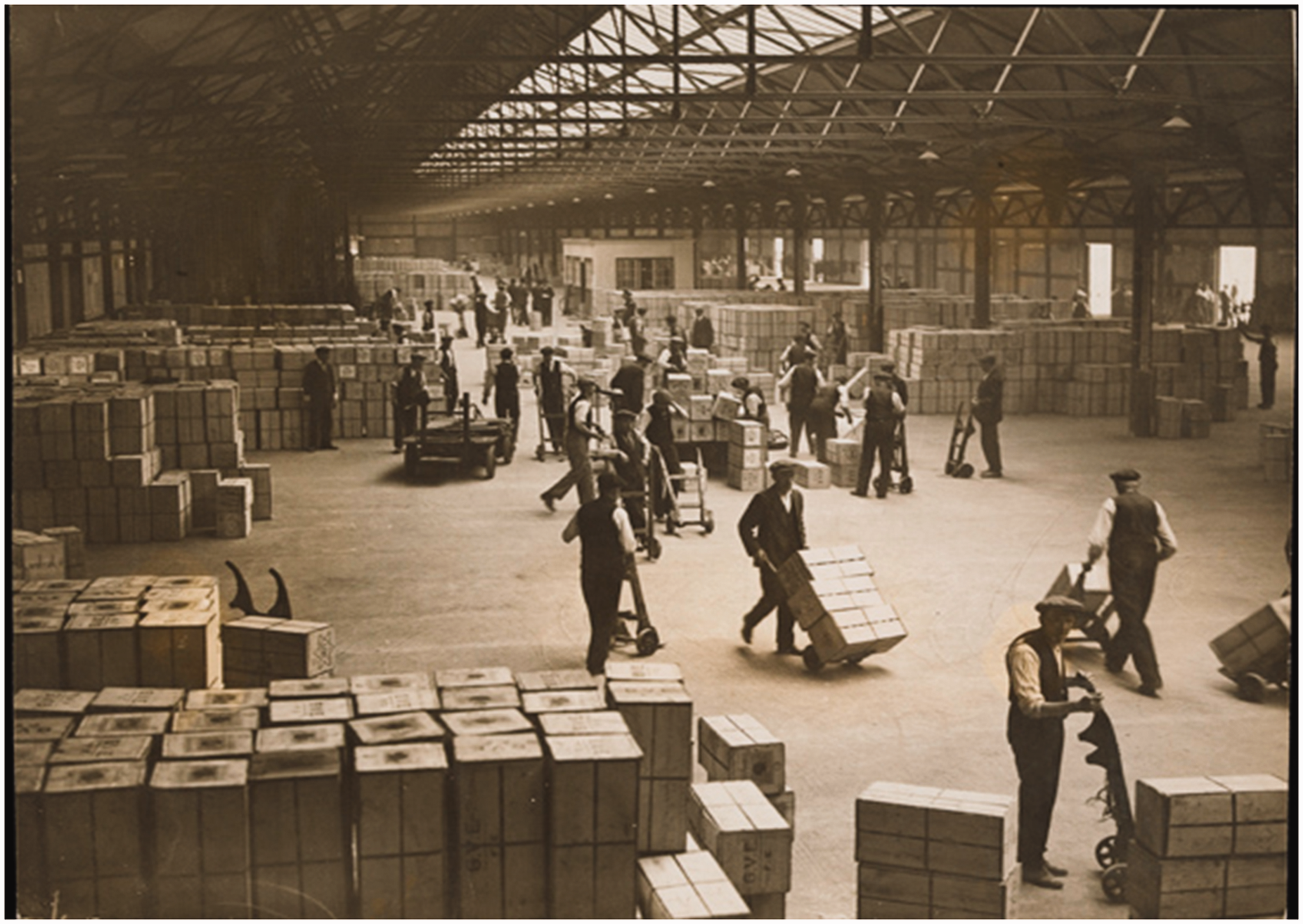
While weapons traffic through the docks remained a topic of interest until the end of the summer of 1920, it is likely to have been the racial character of the violence in the docks during this period that led to McKay joining Pankhurst's staff. 17 In the summer of 1919, an anonymous Dreadnought article reported an incident of ‘Stabbing Negroes in the London Dock Area’. 18 The article posed a series of rhetorical questions about why black men might be frequenting sex workers, whose services unemployed ‘white discharged soldiers’ could not afford (the proximate cause of the stabbings). 19 These questions attempted to show that capitalism connected imperialism, militarism, racialised competition among the working classes, and the use of black troops to suppress Home Rule activism in Ireland. It seems to have occurred to Pankhurst, however, that having a non-white correspondent on the staff might enable the Dreadnought to render these issues more saliently.
By the fall of 1919, Pankhurst was already aware of McKay's work. Just prior to his arrival in September, she reproduced a selection of McKay's poems that had appeared in the New-York-based Liberator that July. It is here that the collaborative ‘voice’ created first for, and then by, McKay in the Dreadnought’s pages can first be heard. I say created first for McKay, because he was not initially aware of the publication and because Pankhurst elected to print only a subset of the Liberator poems. 20 Pankhurst's curation of the Liberator set makes it possible to deduce how she initially understood the nature of McKay's possible contributions to the journal. 21
The prefatory material in the Workers' Dreadnought explains that the poems are ‘by Claude McKay, a Negro of Jamaica, who, when he wrote them, was a waiter in an American dining car’. 22 This preface stresses, as the Liberator’s introduction to the poems does not, McKay's position as a worker: unlike the Liberator, which validates McKay's place in the Romantic tradition by comparing him to Shelley, the Workers' Dreadnought shows no interest in assessing his poetry aesthetically. The poems’ value in their new context is framed as sociological and political rather than aesthetic. Although the Jamaican-born McKay was in fact a British subject, that is not mentioned in the Dreadnought. 23 The selections indicate that Pankhurst was interested in having a black Jamaican-American working-class voice, and one that is notably optimistic about a communist response to class and race struggle: the poems that are cut are those that are more pessimistic about these struggles, foreground the postwar upsurge in violence against men of colour, or depict race or class in ways that might be politically problematic for a communist journal. 24
The selections also suggest that Pankhurst's communism, like McKay's, had no interest in placating the racism against non-white workers that threatened to divide workers along racial lines. Both McKay and Pankhurst's writings emphasise that race antagonism was generated by capitalists to pit workers against one another and make them less likely to cooperatively oppose capitalism. Pankhurst decided to include the most potentially controversial poem from the Liberator set: ‘The Barrier’ offered a provocation to racist readers by depicting reciprocal attraction between a black man and a white woman. The provocation lies not in its depiction of the black speaker, but more alarmingly for some white readers, in how it locates desire in the white woman's ‘trembling throat’ (8), and ‘love's softly glowing spark’ (10) on her face, rather than in the black body. (This inclusion is especially provocative given that Pankhurst herself was a white woman.)
The issues of race and sexuality raised in ‘The Barrier’ are made more explicit, and McKay's position is articulated more forcefully, in the first piece of his prose published in the Dreadnought. In April of 1920, George Lansbury's Daily Herald began publishing articles that were part of E. D. Morel's crusade to remove the French army's African soldiers who were serving in the French-occupied Rhineland. Morel relied on a racist rhetoric of African sexual voraciousness that, he claimed, led these soldiers to rape German women and infect them with syphilis.
25
When the Herald refused to print McKay's letter of response, Pankhurst picked it up for the Dreadnought; it appeared as ‘A Black Man Replies’ on 24 April (see Figure 2): Why all this obscene, maniacal outburst about the sex vitality of black men in a proletarian paper? … To say that the black man is ‘sexually unrestrainable’ is palpably false. I, a full-blooded negro, can control my sexual proclivities when I care to, and I am endowed with my full share of the primitive passion. Besides, I know of hundreds of negroes of the Americas and Africa who can do likewise … During my stay in Europe, I have come in contact with many weak and lascivious persons of both sexes, but I do not argue from my experience that the English race is degenerate … I have known some of the finest and cleanest types of men and women among the Anglo-Saxons.
26
I feel that the ultimate result of your propaganda will be further strife and blood-spilling between the whites and the many members of my race, boycotted economically and socially, who have been dumped down on the English docks since the ending of the European War. I have been told in Limehouse by white men, who ought to know, that this summer will see a recrudescence of the outbreaks that occurred last year.
28
‘A Black Man Replies’, Worker's Dreadnought, 24 April 1920.
Pankhurst's editorial decisions prior to hiring McKay, including the decision to publish this letter, suggest a rough outline of the logic behind his hiring: his work critiqued racialised antagonism while refuting racist premises and provided a discussion of race by an ‘authentic’ black proletarian artist. McKay's account of his first commission from Pankhurst stressed these elements: ‘[p]erhaps I could dig up something along the London docks from the colored as well as the white seamen and write from a point of view which would be fresh and different’, i.e. the point of view specifically of a black workman with a communist vocabulary and experiences of the working class outside of Britain. 30
Pankhurst's assumptions functioned as a starting point for a dialogic collaboration in which McKay eventually shifted his brief from Pankhurst in order to theorise the relationships among artistic production, physical labour, communist politics, and the use of capitalist mass media to create a racial animus among workers that was based on sexual access to (usually white) women. To call this a ‘dialogic collaboration’ as I do here raises a key question about how we characterise collaboration: namely, is describing Pankhurst's editorship of McKay's writing in the Dreadnought as a ‘collaboration’ a polite way of saying that Pankhurst was looking for a black man to use as an ‘exotic’ communist voice, or overselling McKay's working-class bona fides? While it is impossible to deduce Pankhurst's motives from the records available to us one hundred years later, I believe that it is best to accept McKay's own judgment on the question rather than attempting to substitute my own. On at least one occasion, he was willing to cut ties with a white female editor – the British aristocrat Nancy Cunard – when he felt that she was attempting to exploit him for his ‘authentic’ racial voice, and to include an account of their dispute in his memoirs, 31 and Holcomb notes McKay's consistent distrust of white patronage. 32 By contrast, even when he actively distanced himself from his communist past in later writings, McKay wrote warmly of Pankhurst, appreciatively describing her as ‘always jabbing her pin into the hides of the smug and slack Labour leaders’. 33
Likewise, the degree of autonomy McKay was given in his writing, and the fact that he used the Dreadnought as a forum to question communist orthodoxy about the value of ‘proletarian’ art, make it difficult to reduce their collaboration to exploitation. McKay and Pankhurst found themselves at odds over the paper's editorial agenda at least once, when McKay chose to publish an interview with Robert Smillie in 14 August 1920 issue (which went to press while Pankhurst was in Russia). Although McKay was gently ironical about Pankhurst's objection, it seems not to have damaged their working relationship. 34
Ultimately, McKay's Dreadnought articles documented working conditions for black as well as white dockers, examined how British communist and socialist movements treated black members, and aggregated international press coverage of communist activism globally. His work for the Dreadnought also moved outward from the East End, as he solicited narratives from commercial sailors and from sailors in the Navy that depicted the activist work of spreading communist propaganda in the fleet. The poems that he contributed to the Dreadnought must likewise be read as part of his efforts to broaden the paper's scope. Rather than remaining separate from his explicitly political journalism, his poems supplement McKay's editorial work. They advocate forms of political engagement that required highly formal aesthetic representation in order to become visible as possible futures.
Hugh Hope's Dreadnought poems, April–October 1920
It is perhaps impossible to write about McKay the poet in London in 1920 without addressing his relationship to modernism. Although McKay finds himself in ‘modernist’ London, he participates in cultural and aesthetic hierarchies differently from the artists of Bloomsbury or Camden Town, who privileged forms of cultural capital and modes of navigating London (as the capital of an empire and as a cultural space centred around Central London and the West End) that were not only inaccessible to a working-class Jamaican-American immigrant, but first and foremost anathema to McKay as a committed black communist activist.
Relying as much of what was recognised at the time as ‘high’ art did on representing of non-Europeans through the lens of primitivism and Europeans in ‘primitive’ locations as prone to atavist lapses, on an avowed (if not actual) disinterest in overtly political art, and on coterie publication and distribution networks, elite art's means were unsuited to McKay's communist purposes. 35 McKay's return to the sonnet and other traditional forms can be read as distancing him not only from the formal innovations associated with the avant garde (with which his two Jamaican volumes of poetry may have had more in common), but also from the more propagandistic work he was producing in his Dreadnought articles. Creating and maintaining this sceptical distance allowed McKay to explore the inherent possibilities and limitations of an explicitly communist art, about which he was sceptical.
It is most clearly in the poems that McKay grapples with the problems of a communist aesthetic as potentially lacking in the nuance or mimetic possibilities of forms like abstract impressionism or stream-of-consciousness narrative, and I will consider the poems in some detail before turning to his final extended piece of journalism in the next section. McKay's sixteen Dreadnought poems were published between September of 1919 and October of 1920. 36 I will focus on the seven poems published under the pseudonym ‘Hugh Hope’ as distinct from the poems published under McKay's own name or his other pseudonyms. 37 These are ‘Song of the New Solider and Worker’ (published 3 April 1920), ‘Joy in the Woods’ (10 April), ‘Reality’ (24 April), ‘Reaffirmation’ (3 July), ‘The Beast’ (3 July), ‘Battle’ (9 October), and ‘Birds of Prey’ (9 October).
These poems are best understood as a self-contained, coherent set. This group is marked off from most of his Dreadnought journalism and from the other poems by the consistent use of one pseudonym, Hugh Hope. While McKay's biographers have tended to see this pseudonym as a catch-all for the overtly political verse as compared to poems from Spring in New Hampshire that were also published in the Dreadnought, I read ‘Hugh Hope’ as a persona intentionally created by McKay as an experiment in communist voice aimed, more precisely than his other poems, at reflecting the Dreadnought’s editorial position and its political goals. These poems constitute a public performance of overcoming doubt through the rededication of art to political ends – reading the poems in the sequence in which they appeared in the Dreadnought enables a reader to piece together a story arc that looks like a conversion narrative. Tellingly, both for how we understand McKay's deployment of the Hope pseudonym and his collaboration with Pankhurst, McKay's only other uses of the name is on articles that directly endorse or defend Pankhurst's positions. 38 ‘Hugh Hope’ produced the work most clearly tied to his support for Pankhurst's view of a communist press and to their collaboration.
These poems constitute the context for his journalistic representations of the East End. The earliest poems, ‘Song of the New Soldier and Worker’ and ‘Joy in the Woods’, use first-person speakers to elaborate the conditions of being a worker – specifically, the exigencies of manual labour and a thwarted desire for the beautiful. In ‘Song’, Hope uses the communal voice of a first-person plural speaker to present a condensed version of the progression of the entire sequence of poems: beginning with the premise that ‘we are tired, tired, tired—we are work-weary and war weary’, the second stanza concludes that nonetheless ‘we will go on as before, glad to be the willing tools/Of the hard and heartless few … for we are fools’ (1, 5–7). Immediately, the speaker recoils from this foolishness and claims that the answer is a strike, and the poem ends on a note of martyrdom in the name of future generations: ‘We will not still feed and guard the hungry hideous, huge machine … O pull the thing to pieces! … Even though our broken bodies may be caught in the crash … children yet unborn may live!’ (10, 13, 15–6). While the movement from the ‘sore … and aching’ worker (9) to industrial saboteur in the lacuna between the first and last eight lines might make this poem, considered in isolation, read as an exercise in wish-fulfilment, the five poems that follow elaborate the logic and affective content of this specific transition.
‘Joy in the Woods’ (see Figure 3) offers a rejoinder to the stereotype of East End inhabitants as inured to their crowded, ugly surroundings and insensitive to beauty. The first twenty-eight lines of this poem render the simultaneous perception of the beauty of the woods contrasted with the ugliness of the life of the urban worker:
‘Joy in the Woods’, The Worker's Dreadnought, 10 April 1920.
McKay's hired labourer is pained as much by the memory of beauty and the ugliness of his surroundings as he is by the experience of being a ‘machine out of gear.’ The speaker drives this point home with the iteration of the refrain that closes the poem: ‘For a man-machine toil-tired/May crave beauty too—though he's hired’ (29–30).
The next three poems allow McKay to confront the pessimism about politically engaged art implied by forms of modernism that privileged non-representational art and the ideal of the artist's autonomous individuality. This pessimism about the value of specifically collaborative endeavour seems to be embodied by the formal elements in ‘Reality’ and ‘Re-Affirmation’, perhaps the two most depressing and – in meter, diction, and the consistent use of flat, sad vowels – depressed poems of McKay's entire oeuvre. As the title ‘Re-Affirmation,’ suggests, perseverance in the face of an ongoing cycle of ‘men … turning from long-cherished dreams/Of world wide freedom to ignoble rest’ (3–4) is the only thing for which this poem's speaker can hope – not change and certainly not a revolution in human nature; ‘The Beast,’ published in the same issue, is merely a static description of a capitalist status quo that ‘makes men parasites or brutes/And tends to make all women prostitutes’ (13–4). ‘Reality’ likewise concludes that capitalist exploitation ‘is the grim reality of life’ (8). These poems are remarkable because they depict the workers lack of agency in the present moment as nearly absolute: this is clearest in the refusal of ‘Re-affirmation’ to imagine a different future, and of ‘Reality’ and ‘The Beast’ to imagine any future at all.
Voicing this pessimism about the short-term potential of artistic and other forms of labour frees McKay to then reorient the poems that follow to the long term with a measure of optimism about creating meaning through collaborative labour. The rhetorical mode of this optimism can be seen most clearly in the pugilistically titled ‘Battle,’ published in tandem with ‘Birds of Prey’ some months after ‘Reality’ and ‘Re-affirmation.’
39
In this poem, after dreaming of himself as a corpse, a victim of imperialist class and race war, ‘Where privileged power rules with ruthless might’ (1–2), McKay's speaker declares: If such should be my fate, I pray it will Come to me sudden-swift, a keen sword dart, Sent deeply thought my burning breast to still The rhythmic beat of my rebellious heart. If I should have the grand end come to me, While following the only way of duty And questing for the soul of truth and beauty! I'd go convinced that there could never be A fairer life for truth or beauty's flower, While earth is ruled by man's imperial power. (5–14)
The culmination of this narrative arc is ‘Birds of Prey’, which returns to the destructive imagery of the other poems in this sequence, but with an emphasis that reads differently post-‘Battle’. 40 Just as ‘Battle’ concluded that martyrdom in the pursuit of a truer, more beautiful world is the ‘grand end’, this poem depicts that martyrdom as uncontaminated by the ‘merciless’ actions of the ‘greed-impelled … human birds of prey’ (6 and 8). Despite their rendering as animals, the metaphor of ‘human birds of prey’ does not naturalise capitalist brutality. It rather renders them unnaturally inhumane and monstrous: the nocturnal ‘birds of darkness’ find a cruel, all-too-human pleasure in destruction: they ‘flap their hideous wings in wild delight’ (13). These monstrous birds are notably deracinated, and the poem stratifies natural spaces, in which predators dominate the sky (1–4), but the earth is occupied by ‘singing birds of earth’ – poets – and ‘toilers’. 41 This asserts a necessary alliance between creative and manual labour against a ruling class alienated from the natural world. The outcome is still death – as the poem ends, the birds ‘stuff our gory hearts into their maws’ (14) – but the poem's rhetoric and its placement immediately after ‘Battle’ make this outcome register as a protest against the present rather than an acquiescence with an inevitable future.
Collaborative sedition: ‘The Yellow Peril and the Dockers’
One week after the last of the Hugh Hope poems appeared, the Dreadnought published ‘The Yellow Peril and the Dockers’ under another of McKay's pseudonyms, ‘Leon Lopez’ (see Figure 4).
42
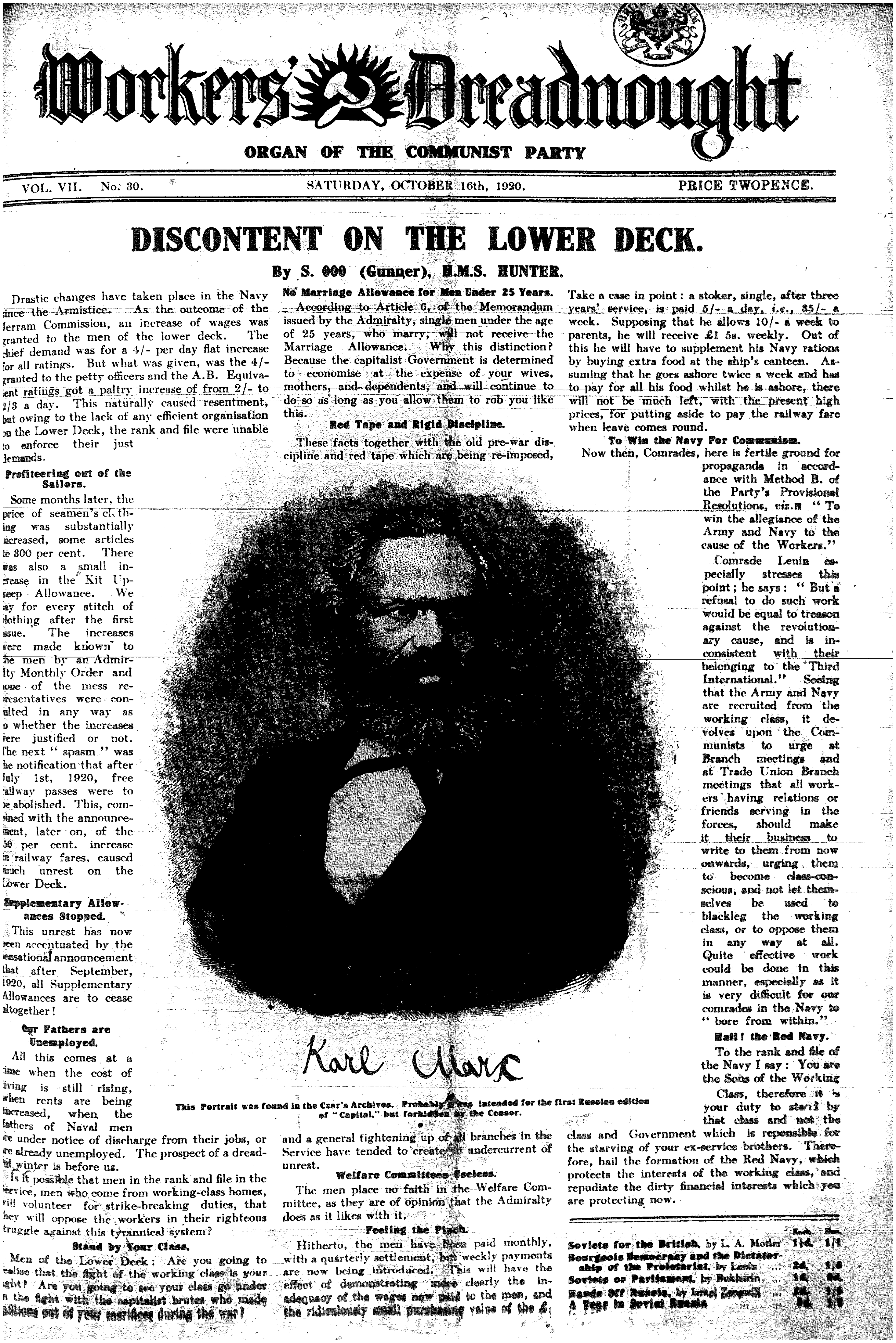
Shortly after, when Sylvia Pankhurst was prosecuted as the Dreadnought’s editor under the Defense of the Realm Act (1911) for ‘an act calculated and likely to cause sedition among his Majesty's Forces, in the Navy, and among the civilian population’, this article was cited in the Crown's case, as were a series of reports by a Navy stoker that were commissioned by McKay (see Figure 5).
43
This piece is McKay's most sustained consideration of the docklands. It invokes, in order to critique, many of the preexisting discourses used to tell stories about the docklands and dockers.
‘Yellow Peril and the Dockers’, Worker's Dreadnought, 16 October 1920. One of the stoker articles solicited by McKay and referenced in Pankhurst's sedition trial. Worker's Dreadnought, 10 October 1920.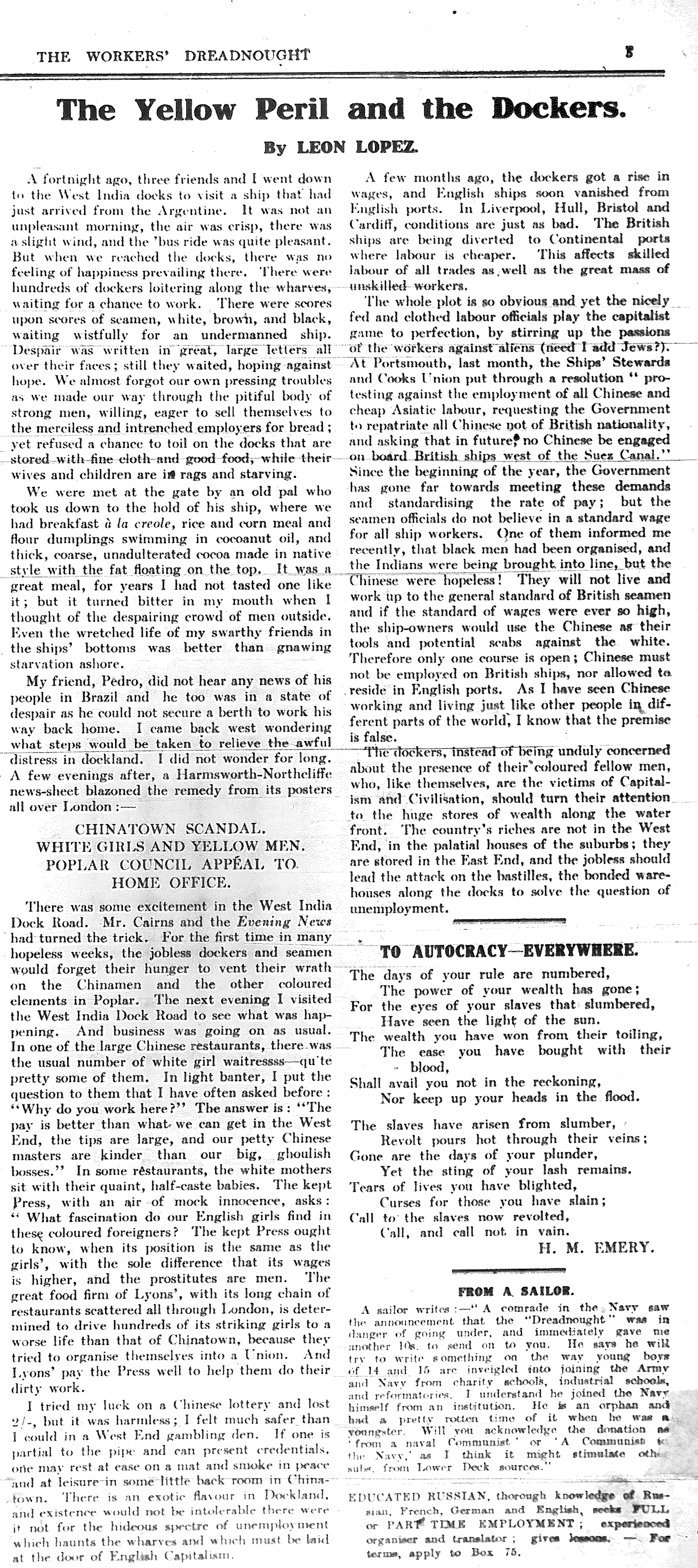
McKay's ‘The Yellow Peril and the Dockers’ sets up its narrator as a visitor to the docks. Judging by the essay's opening, a reader might be forgiven for thinking that she was about to read a chatty, Baedeker-style narrative of dockgoing: ‘three friends and I went down to the West India docks to visit a ship that had just arrived from the Argentine … the air was crisp, there was a slight wind, and the’ ‘bus ride was quite pleasant’. But the tone quickly shifts, as inappropriate to the visible misery on the scene. When we reached the docks, there … were hundreds of dockers loitering along the wharves, waiting for a chance to work. There were scores upon scores of seamen, white, brown, and black, waiting wistfully for an undermanned ship. Despair was written in great, large letters all over their face; still they waited, hoping against hope. We almost forgot our own pressing troubles as we made our way through the pitiful body of strong men, willing, eager to sell themselves to the merciless and intrenched [sic] employers for bread; yet refused a chance to toil on the docks that are stored with fine cloth and good food, while their wives and children are in rags and starving. an old pal … took us down to the hold of his ship, where we had breakfast à la creole, rice and corn meal and flour dumplings swimming in cocoanut oil, and thick coarse, unadulterated cocoa made in native style with the fat floating on the top … for years I had not tasted one like it; but it turned bitter in my mouth when I thought of the despairing crowd of men outside.
What began with the conventions of a local colour story instead hops genres, and momentarily participates in another popular genre used to narrate the East End: the ‘what is to be done?’ article, in which visitors debate policy options or advocate philanthropic solutions. ‘I came back west wondering what steps would be taken to relieve the awful distress in the docklands’ McKay tells us, but then short-circuits the expectation that the return to the West End could create a space of deliberate consideration, opposed to the chaos and immediacy of the East End. Instead, it develops that such a conversation would be moot: something has already been done. McKay presents the outcome in a manner that, in calling it a ‘remedy’, emphasises its grotesquerie: I did not wonder for long. A few evenings after, a Harmsworth-Northcliffe news-sheet blazoned the remedy from its posters all over London: CHINATOWN SCANDAL. WHITE GIRLS AND YELLOW MEN. POPLAR COUNCIL APPEAL TO HOME OFFICE … . Mr. Cairns and the Evening News had turned the trick. For the first time in many hopeless weeks, the jobless dockers and seamen would forget their hunger to vent their wrath on the Chinamen and the other coloured elements in Poplar [a neighbourhood west of the docks, where many dockers lived]. The dockers … should turn their attention to the huge stores of wealth along the water front. The country's riches … are stored in the East End, and the jobless should lead the attack on the Bastilles, the bonded warehouses along the docks to solve the question of unemployment.
The publication timeline and the narrative chronology of the article remind us that McKay's experiences in the docks here both inform and are inflected by the conclusions he reaches in his poetry. (Roughly, McKay sees the men in the docks, in mid-September – ‘a fortnight ago’ – then the final set of Hugh Hope poems go to press, and this article goes to press a week later.) All of the items in this timeline converge around the production of beauty and the exercise of aesthetic as well as political judgment, to create a holistic representation of working-class life that depicts these activities as inevitably commingled and collaboratively produced.
The stakes of these depictions of the docklands ultimately seem to hinge on the questions of audience and address: Pankhurst consistently used the Dreadnought's content to incite strong emotional reactions in her readers – her aim was to convert her audience, by force of vivid demonstrations of capitalism's mercilessness, to a communist politics. So long as McKay's work furthered that goal, even if it did so elliptically, it was welcome in the Dreadnought's pages. Both McKay and Pankhurst made stringent intellectual demands on readers who were expected to inform themselves, if need be, through further reading and to follow up on what they read in the Dreadnought with the exercise of their own political and aesthetic judgment in undertaking activism. Under these terms, their collaboration resulted in public advocacy of a communist aesthetic that posed a material threat to the artistic and political status quo.
Footnotes
Declaration of Conflicting Interests
The author(s) declared no potential conflicts of interest with respect to the research, authorship, and/or publication of this article.
Funding
The author(s) received no financial support for the research, authorship, and/or publication of this article.