




Abstract
This article introduces the concepts of smart cities and smart buildings from the viewpoint of commercial real estate. It summarizes the current academic thinking on how the widespread implementation of digital technologies embodied by smart grids and digital skins impacts cities and buildings in two classic smart city models: ubiquitous city and augmented city. It then explores the consequences of these innovations on commercial real estate at both the city and building levels. In doing so, it presents the concept of a new “omni-use” property type whose characteristics derive from ubiquitous computing in smart urban environments. It also proposes guidelines for smart building scores to define a methodology relevant to the real estate sector and conducive to constructing price indices of smart buildings. It concludes by stressing the dominating role that technology will play in defining property heterogeneity in the digital era.
[With cyberspace], we have the opportunity to rethink received ideas of what buildings and cities are, how they can be made, and what they are for.
Introduction
The digital era, also known as the fourth industrial revolution (Schwab, 2016), is here. It is already affecting the way we live, work, consume, and more broadly how most human activities are carried out. Around us, smart cities and smart buildings are starting to appear.
Behind the hype and buzzwords, there are many important, albeit unanswered, questions facing real estate academics and practitioners. In particular, how does smartness in the built environment impact real estate? What are the consequences for commercial real estate players (e.g. users, developers, investors)? And more fundamentally, in the context of real estate, what is smart?
Answers to these questions remain unclear inasmuch as very little academic research has been conducted on real estate in the context of smart cities. Past research in the real estate academic literature has focused on “smart homes,” for example, Allameh, Jozam, de Vries, Timmermand and Beetz (2012). Despite its economic and social significance, commercial real estate’s role in the context of the fourth industrial revolution has remained mostly unexplored. As a result, the smart city research agenda has many conceptual holes to fill when it comes to real estate.
The physicality of real estate comes with idiosyncrasies that set it apart from other assets in economics. Most notably, real estate is a heterogeneous asset class defined by spatial locations and physical characteristics. Heterogeneity impacts on property market structure and efficiency. It also affects the ability to model real estate assets. As the concepts of space and place in urban environments are being reshaped by the pervasive use of technology, digital disruption provides us with an opportunity to rethink the fundamental tenet of asset heterogeneity in real estate theory.
To address this conceptual point and answer to the broader questions posed by the emergence of smart urban environments, this article adopts a multidisciplinary approach. It compiles a literature review from a broad range of fields (real estate, construction management, engineering, information technology, and geography) and explores the potential impact of smart technologies on commercial real estate in smart cities. The analysis is conducted at two levels: first at the city level by focusing on the nexus between digital and physical spaces in two smart city models (ubiquitous city and augmented city), and second at the building level where research is required for practitioners to better define and capture the wide-ranging implications of smartness in buildings.
The main contribution of the article is to present a two-tier analysis at both the urban and property levels and, in the process, to introduce a few innovative concepts and tools. The issue of property heterogeneity in smart urban environments is the common thread running through this article. As a new market for a new type of properties in technology-embedded urban environments, the market for commercial real estate in smart cities will need to achieve some level of standardization to be a functioning market. The article proposes tools to achieve just that, such as a new property type called “omni-use” and the basic principles of a scoring methodology of smart buildings. The latter is an essential first step toward establishing a solid price index for commercial real estate in the digital era.
The article consists of three sections. The section “Smart cities as commercial real estate’s new urban environments” introduces the concept of smart city as well as the combined role of smart grids and digital skins in enabling smartness in urban environments. It then explains how smart environments powered by ubiquitous computing impact commercial real estate through new conceptions of space, place, and location. The section “Smart buildings” presents the current academic thinking on smart buildings and explores how smart buildings interacting with their users and smart cities’ Information and Communication Technology (ICT) infrastructure are analogous to computing devices. It then explains the challenges of assessing a building’s smartness and the requirements for a scoring methodology to be both relevant to commercial real estate and conducive to constructing price indices of smart buildings. The last section concludes.
Smart cities as commercial real estate’s new urban environments
Overview of the smart city concept
It might appear as a paradox that an idea as prevalent as smart city does not come with a standard definition and wide agreement about its meaning (RICS, 2017a). Batty et al. (2015) acknowledging the broad, and noticeably vague, scope of the smart city concept explain that “smart cities is a label that is now being used generically to cover a wide range of applications of computers, sensors, and related computation and interaction that has any link whatsoever to the city.” According to Kitchin (2015), one of the hurdles preventing a clear understanding of smart cities is the lack of detailed genealogies of the concept, thus allowing global high-tech companies and smart city vendors, such as Cisco and IBM, to promote their own vision of the “corporate smart city” (Hollands, 2015).
Smart cities find their roots in the 1970s when researchers first advocated urban cybernetics and later in the following two decades with the smart growth movement and new urbanism (Townsend, 2013). Glasmeier and Christopherson (2015) explain that while the smart city concept is linked to long-standing ideas about urban technological utopias, contemporary smart cities are different insofar as they put “the emphasis on places transformed by the application of technologies rather than places where new technologies are born such as Silicon Valley.” Smart cities are “the receptacles for technology, the target of its applications.” The authors select two essential attributes to identify a smart city: first, the use of technology to facilitate the coordination of fragmented urban subsystems; second, “urban places where the lived experience calls forth a new reality.”
This new reality could materialize into ambient intelligence, giving rise to the concept of “sense-able city,” that is, a city that can sense its inhabitants thanks to a myriad of sensors (Ratti and Claudel, 2014a). Sensing through the dissemination of electronic systems in smart cities allows urban environments “to sense and respond to people.” Pervasive sensing creates a “feedback loop between the city itself, the city management and the citizens” (Resch et al., 2012). This process turns cities into “complex near real-time control systems” dominated by data-driven operational governance.
Broadly, there are two parallel perspectives on smart cities. First, the smart city is a city enabling real-time monitoring, efficient management of urban services and utilities, the enforcement of public safety and security using an extensive ICT infrastructure (Townsend, 2013). Second, the smart city is a city fostering technically inspired innovation, creativity, and entrepreneurship by smart people, that is, the epitome of the knowledge economy.
Kitchin (2015) explains that smart cities are often seen as an urban panacea for business where “smart politics and judicious investment in appropriate fiscal measures, human capital and technological infrastructures and programmes will attract businesses and jobs, create efficiencies and savings and raise the productivity and competitiveness of government and business.” This is especially the case in the corporate vision of urban smartness where “IT can make cities more economically prosperous and equal, more efficiently governed and less environmentally wasteful.”
A key element of the smart city model is “the ability to promote economic growth” (Shelton et al., 2015). Smart cities’ growth relies on urban innovation ecosystems which are green, smart, open, intelligent, and innovating (Zygiaris, 2013). This leads smart cities to be frequently identified with six dimensions: smart economy, smart mobility, smart environment, smart people, smart living, and smart governance (Caragliu et al., 2011). Many models of smart city, notably in Europe, put a special emphasis on sustainability and quality of life, whereby the six dimensions of urban smartness fuel sustainable economic growth and high quality of life with a “wise management of natural resources.”
To make sense of the smart city concept, some researchers have developed taxonomies of smart cities. For instance, Neirotti et al. (2014) researching European smart cities propose a taxonomy built around application domains. Smart cities are broken down into “hard” domains (office and residential buildings, energy grids, natural resources, energy and water management, waste management, environment, transport, mobility, and logistics) and “soft” domains (education, culture, policies promoting entrepreneurship, innovation and social inclusion, and e-government enhancing communication between local public administration and the citizens). Interestingly, commercial real estate might play an active role in many, if not all, subcategories of the hard domains.
The abundant academic literature on smart cities contains many attempts by geographers and planners to make sense of “smart city imaginaries” promoted by purveyors of smart city systems. While they acknowledge the power of futuristic visions to capture the minds of corporate actors, policymakers, and citizens, they also recommend focusing on how cities use technology to deal with actual urban issues. For instance, Shelton et al. (2015) assert that the “actually existing smart city” is very far from the corporate smart city. “Rather than the construction of new cities from scratch or wholesale importation of universal ideals into existing cities, the smart city is assembled piecemeal, integrated awkwardly into existing configuration of urban governance and the built environment.”
From the viewpoint of commercial real estate, this means that most smart cities will not require building new urban environments. Instead, they will materialize into renovation of existing urban environments and infrastructures (Glasmeier and Christopherson, 2015). Ratti and Claudel (2014a) assess that ambient intelligence and sensing networks will change “the contained, not so much the container.”
This is in contrast to the impact the first industrial revolution had on cities in the 19th century when railroads, among other innovations, reshaped urban landscapes. Markedly, infrastructures of urban smartness underpinning the fourth industrial revolution have a radically different impact on space than innovations that accompanied previous industrial revolutions. Although their footprint in physical space might be light, one can expect their impact on the real estate sector to be extremely pervasive as demonstrated in this article.
Infrastructures of urban smartness
The new intelligence of cities derives from two concomitant technological innovations: smart grids and ICT infrastructures overlaid on physical space.
The smart grid
Smart grids technologies embody a radical enhancement to the basic structure of the electrical power grid, which has remained fundamentally unchanged for 100 years. Güngor et al. (2011) assert that experiences have shown that the hierarchical, centrally controlled grid of the 20th century is ill-suited to the needs of the 21st century. To address the challenges of the existing power grid, the new concept of smart grid has emerged. The smart grid can be considered as a modern electric power grid infrastructure for enhanced efficiency and reliability through automated control, high-power converters, modern communications infrastructure, sending and metering technologies, and modern energy management techniques based on the optimization of demand, energy, and network availability.
Smart grids play a crucial role in enabling cities to be smart. Indeed, it is widely accepted that smart grids serve as “the backbone of a smart city” and create the foundation for smart city projects (Global Data, 2012). Incidentally, smart grids are also vital to commercial real estate because of buildings’ central role in their framework.
Considering that energy consumption for buildings accounts for 40% of the energy used worldwide, Kolokatsa (2016) explains that buildings in the near future should be able to produce the amount of energy they consume, i.e. become zero or nearly zero energy buildings […] Zero energy buildings are buildings that work in synergy with the [smart] grid, avoiding putting additional stress on the power infrastructure.
In addition to fostering renewable energy sources, smart metering, and zero energy buildings, smart grids that rely on a smart information subsystem collecting real-time data from end users (Fang et al., 2012) can also be viewed as “aggregators of buildings, consumers and communities” (Kolokasta, 2016). In that sense, they create a connection between buildings, residential and non-residential, and the broader urban environment where the six dimensions of a smart city materialize.
Pervasive computing and the digital skin of smart cities
Smart grids alone are not enough to make a city smart. Pervasive networks are required. Smart cities are literally covered with a myriad of wireless and connected sensors, mobile devices, Radio Frequency Identification (RFID), and other Internet of Things (IoT) systems. Gross (1999) was the first to compare these pervasive electronic networks with a “digital skin donning planet Earth.” The concept that was later widely adopted by academic researchers highlights the ability of smart cities to generate “a vibrant understanding of patterns and flows” (Ratti and Claudel, 2014b). Thanks to the digital skin, smart cities have become sources of big data, being turned in the process into “sensored and metered cities” (Rabari and Storper, 2015). The skin also turns urban landscapes into “info-scapes” where city dwellers become “hyper-individualized” users.
Beyond the technological prowess of the digital skin which increasingly involves artificial intelligence (RICS, 2017b), there are important sociological implications from the implementation of such powerful networks in cities. Batty (2007) stresses their radical impacts on city dwellers’ lives: Slowly, but surely, a skin […] is forming around the globe which enables instantaneous transmission and access to digital resources wirelessly from any place to everywhere at any time. […] Instantly accessible information is unprecedented and is likely to have radical effects on the way we conduct our affairs in every aspect of modern life. It is changing the nature of markets, of retailing, of social contracts and relationships.
Concretely, as shown in Figure 1, commercial property is positioned between the smart grid represented schematically underneath the urban surface and the digital skin encompassing data analytics (e.g. cloud analytics) and covering all buildings and infrastructures alike.
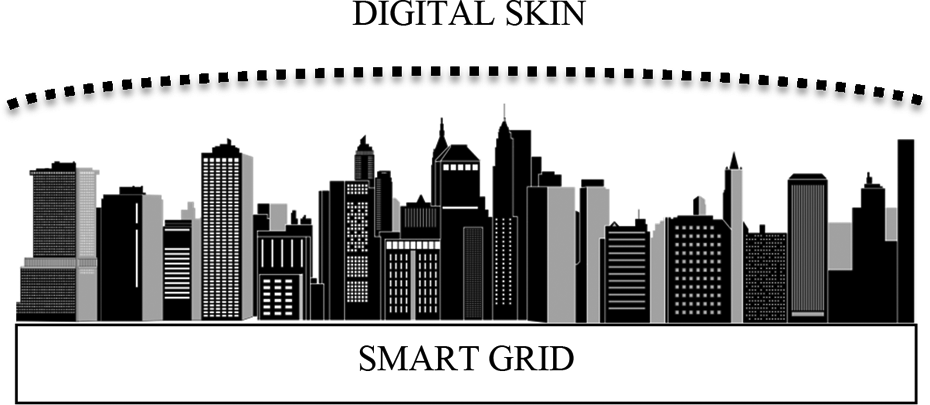
Model of smart city: Ubiquitous City. Source (image cityscape): Creative Commons.
Thus, the setting for real estate in smart cities is radically different from the one real estate has been exposed to until now. With smart cities’ digitally infused space, space is no longer a passive component of real estate whose measurement is anchored in its physicality (Lecomte, 2018).
Space, place and location in smart cities
Cities of bits and atoms
Smart cities’ ambient intelligence has led many researchers to question the spatiality of these new cities especially at the point where physical space and digital space intersect. Digital space is essentially the by-product of the ever-growing digital skin. This issue matters for our analysis insofar as it conditions our understanding of space and place in commercial real estate and ultimately property heterogeneity in smart cities.
The concept of location as a place in space has traditionally played a key role in defining heterogeneity in property markets. Indices of commercial real estate are designed to be granular in terms of both location and property type. Therefore, how does the smart city model which links buildings and their environments into a real time all-encompassing system affect physical space (i.e. location and buildings’ physical characteristics) as a factor of heterogeneity in real estate analysis?
To address this question, most notable are Mitchell’s ideas captured in three seminal books published in the late 1990s and early 2000s. Mitchell’s argument focuses on the nexus between physical and digital in smart cities, and whether the digital domain overtakes the physical realm, that is, bits over atoms.
Mitchell (1995) first envisioned that future cities would be “cities of bits” where urban life is fundamentally reduced to bits. In a city of bits, physical space, place, and location do not matter. Life is unrooted to any physicality.
Over the years, Mitchell’s stance evolved, from his initial views about a city of bits and e-topia (1999) to smart city as the “points where electronic information flows and physical spaces intersect” (2003). One key factor to explain his evolution stems from the emergence of wireless technology which enables radically new relationships between individuals and the environment. As the city itself becomes “the spatial and material of the system,” Mitchell deems that the separation of bits and atoms is over.
The corollary of this evolution is a continuous shift from enclosures to networks. Boundaries in a traditional city used to define a space of containers and places whereas networks establish “a space of links and flows.” The proliferation of networks implies a gradual inversion of the relationship between barriers and links. Mitchell (2003) explains: “Network rather than enclosure is emerging as the desired and contested object.” In other words, value of commercial real estate in smart cities will derive less from physical space but increasingly from real estate’s ability to link with digital space, what industry analysts call access (Bruelher, 2016).
Although not all researchers agree with Mitchell’s analysis (e.g. Deakin, 2012), the overwhelming view is that smart cities redefine the connection between physical and digital. Ratti and Claudel (2016) talk about a “powerful collusion of physical and digital that augments both,” by turning cities into “hybrid spaces of intersection of bits and atoms.”
The crosslinkage of the physical and digital domains transforms commercial real estate’s positioning in cities. Buildings have long been the necessary interfaces between humans and their environment (Ratti and Claudel, 2014b). From the primitive hut to a place of worship, physical structures produced space to enclose human activities and fulfil needs, be it for protection or spirituality. In smart cities, as noted by Ash et al. (2018), digital technologies mediate “tasks such as work, travel, consumption and leisure,” thereby replacing buildings in providing the interface between humans and their every possible needs. Increasingly, spaces are experienced through digital interfaces, thus generating new spatialities that are beyond the traditional realm of real estate.
Ubiquitous city versus augmented city
The issue becomes more complex when one considers that there are two types of digital skin, each type linked to a different model of smart city. In a ubiquitous city (or U-city), the skin is all encompassing and ubiquitous. It delivers homogeneous services all over the city through a centralized wireless infrastructure. This is the case presented in Figure 1. Conversely, in an augmented city, the skin is uneven and peaks at certain places where it produces augmented places, also known as enhanced locations (Aurigi, 2009), as shown in Figure 2.
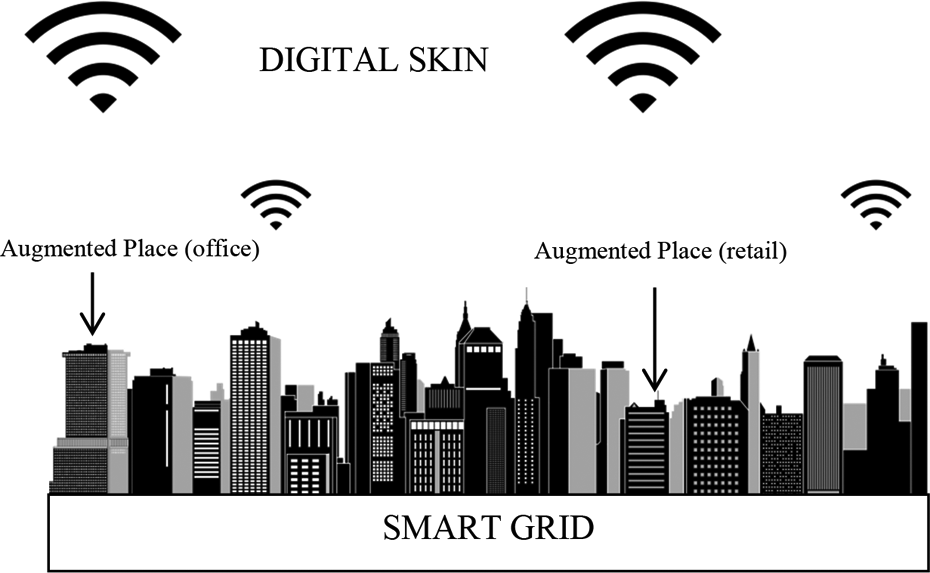
Model of smart city: Augmented City. Source (image cityscape): Creative Commons.
Enhanced locations use space and physical location as a platform to digital. This allows for a discrete and localized coordination of digital and physical into a new type of “augmented places.”
The concept of U-city derives from ubiquitous computing defined by Mark Weiser in a seminal article published in 1991 (Lee, 2009). Weiser had the vision of computers linked by wired and wireless networks, which are so ubiquitous that nobody notices their presence: “The most profound technologies are those that disappear. They weave themselves into the fabric of everyday life until they are undistinguishable from it.” In a visionary essay entitled “The Coming of Age of Calm Technology,” Weiser and Brown (1996) propounded that given its radical social impact, ubiquitous computing would be the third most important innovation in the history of mankind, after the invention of writing and that of electricity.
The interrelated conceptions of U-city and augmented city produce radically different views with respect to space, place, and location in smart cities. Anttiroiko (2013) explains that the U-city model comes with a relative indifference to physical space inasmuch as urban services are fully available regardless of location. The U-city as a whole is a place. On the contrary, the augmented city supposes spaces recombined by digital, thereby establishing a connection with the user’s specific location.
Arguably, this dichotomy oversimplifies ubiquitous life. Aurigi (2009) identifies that a city will always be grounded in its location. Encounters, events, and perceptions embody the “power of place.” Hence, the two models do not have to be exclusive but can actually be hybrid: “the U-city can be an augmented city: global in reach, and very local, personal and ‘spatial’ in the experiences it proposes.”
Commercial real estate’s heterogeneity in smart cities
This ongoing debate has significant implications for commercial real estate. If human life in U-city is truly placeless, commercial real estate’s focus would irremediably move from physical to digital. As a result, one can envision that in a smart city modeled after the U-city concept, digital will ultimately shape physical space. Commercial real estate markets might de facto become less heterogeneous with an underlying trend toward property standardization driven by what Peet (1998) designates as “existential outsiderness in which all places assume the same meaningless identity” (Dodge and Kichin, 2001). Mitchell (2003:159) explains that “in the emerging wireless era, our buildings and urban environments need fewer specialized spaces built around sites and resource availability and more versatile, hospitable, accommodating spaces that simply attract occupation and can serve diverse purposes as required.” Hence, the broader a digital place’s scope, the more commoditized physical space is likely to become. This is a new take on the functionalist approach to architecture: in a U-city, versatility in buildings’ function should override any concern about their physical characteristics.
The lesser importance of physical space in smart cities might have significant consequences for commercial real estate in smart cities. U-city’s placelessness favors mixed-use developments and could trigger a new, highly versatile “omni-use” property type where physical characteristics are mostly nonspecific and applicable to a wide range of digital places, enabling very dynamic uses of properties (e.g. co-working spaces together with co-living spaces).
In contrast, in a smart city modeled after the augmented city concept, since spatial specification matters (i.e. digital skin comes with locational characteristics), augmented places will keep commercial real estate’s focus on properties’ heterogeneities (including their digital capabilities in line with the model’s embedded segmentation of space). Thinking about commercial real estate in terms of activities linked to enhanced locations rather than property types per se will be key. For instance, taxonomies of augmented places could be established based on such fundamental activities as work, shop, sleep, eat, travel, and commute.
In terms of urban structure, U-cities’ assemblage of physical and digital spaces could be more diverse than those in augmented cities where the digital skin naturally results in a clustering of human activities. By being potentially fully random series of spatial events, U-cities will let space users decide whether agglomeration economies make sense in smart environments. Conversely, augmented cities will have to be accompanied with maps of enhanced locations. The dichotomy between U-city and Augmented city will address important questions about how space produced at the intersection of physical and digital affects human need for physical interactions, a need traditionally enabled by real estate.
Moreover, the fact that not all cities will be equally smart and/or ubiquitous, nor all places equally augmented should not be overlooked. As explained by Shelton et al. (2015), “it is important to recognize that smart cities are also internally differentiated. That is, like any other phenomena, they are geographically uneven at a variety of scales.” Consequently, to make sense of these differences, digital places will have to be assessed, measured, and qualified with ad hoc metrics capturing this new spatiality’s contribution to commercial real estate (Lecomte, 2018).
The next section of the article extends our analysis at the property scale by describing the concept of smart buildings and explaining how this new generation of building is changing the positioning of commercial real estate in smart cities.
Smart buildings
Definition of a smart building
Whilst cities’ infrastructures are massively reshaped by the fourth industrial revolution, buildings themselves are going through a dramatic evolution, giving rise to a new generation of buildings called smart buildings.
Despite the instrumental role played by buildings in smart urban environments, there is no standard definition yet of what a smart building is. None of the numerous articles published on smart buildings provides a definition widely adopted by the academic community and industry alike. Baum (2017) identifies over a dozen different definitions of smart building which are customarily created by smart building system vendors to suit their own requirements. To add to the confusion, a lot of terms are used concomitantly, for example, intelligent building, sentient building, smart building among others (Ghaffarianhoseini et al., 2016). As pointed out by Clements-Croome (2013), the world of intelligent buildings and smart cities has a “wide vocabulary.”
The concept of intelligent building has been around since the 1980s. Initially, researchers defined intelligence in a building by its ability to have total control over its environment. Wong et al. (2005) highlight that the early definition of intelligent buildings supposed as little human interaction with the building as possible. The academic view is that smart systems are a subdivision of intelligent buildings since smart buildings are developed upon intelligent building concepts (e.g. Clements-Croome, 2013). However, smart buildings display radically distinctive traits.
Most importantly, adaptability separates smart buildings from previous generations of buildings. As explained by Buckman et al. (2014), smart buildings adapt to events by utilising “information gathered internally and externally from a range of sources to prepare […] for a particular event.” As a result, a smart building is “able to adapt its operation and physical form for these events.” In a nutshell, a smart building is adaptive, whereas an intelligent building is reactive.
Adaptability is also associated with the concept of future-proofing, that is, smart buildings have built-in flexibility, sometimes called elasticity (RICS, 2017a). Embodied intelligence ultimately allows a biotechnological approach to building performance (as opposed to an industrial one), conferring to buildings “a range of properties that are traditionally associated with life” (Amstrong, 2016). A smart building should “learn from its inhabitants, adapt to their life cycle and initiate decisions about changing states of engineering itself” (Volkov and Batov, 2015).
Bidirectional consciousness brings a new dimension of intelligence to buildings. Some researchers even wonder whether buildings are on their way to becoming “conscious” akin to living organisms (Warwick, 2013). Consciousness between buildings and their occupants encapsulates the unique nexus between physical and digital in smart environments.
Smart buildings’ integrated adaptability is assessed both short term (e.g. ability to change the number of people in a room) and long term (e.g. adaptation to change in use). Buckman et al. (2014) explain that long-term adaptability will primarily depend on the materials and physical design of the building. Scott Turner (2016) predicts that “buildings must now no longer be static structures and machines, but dynamic, capable of re-building themselves to meet unpredictable and shifting demands.” Materials and construction should allow for change in use and climate so that future-proofed smart buildings will materialize as “flexible, loose-fit shells with easy access to rewire and retrofit” as new technologies become available (Charles Russell Speechlys, 2016).
Buckman et al. (2014) identify five pillars underpinning smart buildings’ adaptability: intelligence, enterprise, materials, design, and control. Those pillars subsume integrated enterprise systems that are unique to smart buildings: “Enterprise is any method through which building use information is collected.” Enterprise systems consist of both hardware and software. As a by-product of enterprise, buildings are increasingly evolving into repositories of data sourced from building management systems. Thus, in smart cities, buildings are turning into computing devices.
Smart buildings and the positioning of commercial real estate in smart cities
Real estate as service provision
Smart buildings are constitutive of smart environments (McGlinn et al., 2010). Their role is instrumental in activating urban smartness. By interacting with smart environments (i.e. smart grid, digital skin, and other smart buildings), smart buildings are enablers of smart cities.
Concretely, as mentioned in the section “Smart cities as commercial real estate’s new urban environments,” smart grids turn buildings into active participants in energy management and optimization to the point that grid-aware buildings can become “zero energy” prosumers (Schibuola et al., 2014). By the same token, the digital skin becomes alive owing to buildings. Data used to feed analytics are systematically collected within buildings by building management systems acting like neural networks of the built space (Ratti and Haw, 2012). The ambient component of smart cities’ intelligence originates in large part from buildings. Hence, the two layers of a smart city’s intelligence (i.e. smart grid and digital skin) are intrinsically intertwined with buildings.
With smart buildings, commercial real estate moves from asset provision to service provision (RICS, 2017b). As pointed out by Carvalho (2015), buildings in smart cities are “ibuildings,” which allow commercial real estate players to broaden their value chains by linking the built environment with software applications. Indeed, smart buildings have little in common with regular buildings, leading real estate to shift from physical to digital (Lecomte, 2015). From architecture’s standpoint, smart buildings are “living bits and bricks” which embody “a feed-back fuelled world where we don’t just inhabit our architecture but integrate with it” (Ratti and Haw, 2012). Architecture can connect rather than divide, “awakening from the mute motionless matter it has always been into an active state of being.”
Access as factor of heterogeneity and value driver for smart buildings
When space users integrate with buildings, there are obviously implications for their relationship to space, location, and property heterogeneity. Noticeably, commercial real estate’s long held belief about value deriving from location is being challenged. What are the consequences for commercial real estate?
Hyper-connectivity, efficiency, and differentiation powered by technology (such as IoT) are becoming more important than location so much so that the old mantra “location, location, location” might be replaced by “location, information, analytics” (Kejriwal and Mahajan, 2016). Berman et al. (2016) explain: “[Commercial real estate] has always believed that location, location, location rules. But in the mobile world, where ‘location’ is mainly virtual, […] assets are losing ground to access.”
In smart urban environments, buildings will act as platforms to digital. While location is not going away (e.g. augmented places), its relative role as a value driver for commercial real estate lessens (RICS, 2017b). Under the radical disruption brought upon the built environment by Weiser’s pervasive computing, access is where bits and atoms intersect. Access defines interactive loci or gateways where human tasks are mediated and value created.
For commercial real estate players, the emergence of smart buildings means success will depend on their ability to leverage on synergies between bits and atoms, by being positioned where as many services (i.e. interactions) as possible can be provided to space users. Buildings will become one of the tools in that process, the other being technology.
As buildings move toward accrued standardization of physical structure enabling a functionalist approach to the built environment, heterogeneity in property markets traditionally defined by space (locations) and properties’ physical characteristics will have to be redefined in terms of technology and the ability of buildings to fulfil a wide range of functions. As a result, technology will become a major factor of heterogeneity for commercial real estate in smart cities both at the city and property scales.
Property heterogeneity should therefore be incorporated into real estate modeling with a new notion of access (or digital positionality) instead of the traditional physical location. This shift emphasizes the dominance of digital space in future models of commercial real estate in smart cities. Concretely, this implies that technological obsolescence will play a major role in buildings’ overall obsolescence, whereas the physical and economic dimensions of obsolescence become relatively less significant.
Assessing smartness in smart buildings
To overcome the challenges posed by the dominance of technology in the built environment in the digital era, it is important that tools enabling a precise measure of buildings’ smartness be readily available to real estate players who, by training, are not technology experts. One such tool is a scoring methodology for smart buildings which would lay the foundations to a greater standardization of commercial real estate in smart cities.
Similar to green buildings’ Leadership in Energy and Environmental Design (LEED) certification, smart buildings will need to come with standards to assess their performances and guide commercial real estate players. Attempts to design evaluation frameworks and smartness scores have been hindered by the lack of consensus stemming from multiple and diverse stakeholders (private sector, public authorities, technology companies, and real estate specialists). Private companies have been the first to develop their own sets of metrics, which are customarily designed around their clients’ demands and/or product specifications.
As countries across the globe have adopted different KPIs for smart buildings, the resulting indicators tend to reflect deeply rooted interpretation of smart buildings’ essence and contributions to a smart environment. While Europe’s ongoing Smart Readiness Index (SRI) (Stijn et al., 2017) spearheaded by the European Commission Directorate-General for Energy is geared toward sustainability, the United States (Building Intelligence Quotient (BiQ)) emphasizes the performance and cost effectiveness of smart buildings (Katz and Skopek, 2009). By the same token, Asian countries have adopted a wide range of indicators with very different KPIs (Ghaffarianhoseini et al., 2016).
Irrespective of their KPIs, most existing scores embody an engineering view of smart buildings. An engineering view tends to define smart buildings as highly sophisticated, self-contained “machines,” by stressing out their technology rather than their interactive dimension. Noticeably, despite covering a wide array of elements, these scores overwhelmingly ignore a building’s ability to interact with the smart environment. 1 As identified by Alwaer and Clements-Croome (2010), key performance indicators (KPIs) for assessing sustainable intelligent buildings should be based on “people, products and processes, and their inter-relationships.” Therefore, in their current versions, existing scores of smart buildings are not sufficient for commercial real estate. This article lists three directions that future endeavors to build scores should follow.
Firstly, to be relevant to commercial real estate, scoring methodologies should capture buildings’ ability to adapt to technological changes. Assessing adaptability in the midst of an industrial revolution with discontinuous innovations is a challenge. As pointed out by Gaffarianhoseini et al. (2016), the key to designing a relevant scoring methodology is to treat smart buildings as “dynamic and evolutionary entities rather than static and fixed ones”. For instance, Europe’s SRI stresses the importance of buildings’ future proofing and establishes a difference between “smart ready” and “smart now.” Smart ready describes a building that is “itself smart but its potential to realise the benefits from smart services may be constrained by limiting factors in the capability of the services it connects to as its boundary” (Stijn et al., 2017). Smart now captures a building’s operational smart capability. The SRI methodology focuses on smart ready, by allowing “relevant new capabilities to be reflected as soon as possible and address future proofing needs.”
Secondly, in addition to setting industry standards, smart building scores should reflect buildings’ value drivers in smart environments, that is, flexibility and versatility of the physical structure, smart readiness and future proofing of the enterprise, as well as ability to interact with digital space to meet their occupants’ changing needs. The “omni-use” property type introduced in this article would potentially allow maximum versatility of physical structure.
Thirdly, smart buildings scores should be designed with the concept of index in mind. In effect, real estate in smart cities which is still in its infancy offers a unique opportunity to adopt a bottom-up approach to index construction, by aggregating individual scores at the building level into price indices of smart buildings at the neighborhood, city, country, and region levels. Individual scores could be aggregated by predefined ranges of smartness (e.g. derived from scores or smart certifications).
The analysis presented in this article only focuses on the fundamental principles that the scoring methodology should follow. Further research is needed to develop a fully blown methodology. Assessing buildings’ smartness with a standardized framework is a crucial step toward setting up a market for smart buildings in smart cities as no market can properly function without widely agreed norms.
Conclusion
This article presents an introduction to cities and buildings in the digital era. Smart technologies underpinned by ubiquitous computing will have a drastic impact on the way space users interact with the built environment, ultimately giving rise to ambient intelligence embodied by “sense-able cities” and conscious buildings.
Commercial real estate will be massively affected by these changes even though the urban form should not be drastically altered. Hence, one should not expect a construction boom due to the technological disruption real estate is currently facing.
More importantly, the growing role of digital space in cities will challenge buildings’ traditional role as interfaces to human activities. The new positioning of smart buildings as platforms to digital means that access has become more valuable than location. This focus on buildings’ digital positionality has the potential to radically redefine city maps in real estate analysis.
The fourth industrial revolution will also alter the way real estate assets are being modeled, and ultimately valued. While the quest for functional versatility comes to dominate buildings’ physical structure, one can expect technology to become the dominating factor of heterogeneity and the main value driver for commercial real estate in smart cities. Technology’s impact will be felt at two levels: firstly, at the urban level where each city’s idiosyncratic infrastructure (smart grid and digital skin) will affect digital space, and secondly at the building level where buildings’ smartness has to be normalized and assessed.
Mitchell’s “cities of bits and atoms” will represent a new urban environment for corporations. With it will come opportunities as well as challenges. The real estate sector needs to adopt innovative business models, whereby commercial real estate players become service providers rather than physical structure managers. New entrants in the sector (e.g. co-working space operators) are already showing the way ahead.
For the other economic sectors, the role of real estate in corporate strategies is expected to grow inasmuch as commercial property moves from being a silent partner to becoming an active component of corporate value chains with the abilities to generate significant competitive advantages. For instance, tomorrow’s retailers will choose to be located in ad hoc “augmented places” within smart cities. By doing so, they will maximize synergies between physical and digital spaces while generating maximum returns from their real estate-related costs. In their locational choices, companies will focus on optimal access to the digital skin. A similar reasoning applies to smart grids.
In many respects, smart technologies question the social contract between corporations, public authorities, and citizens. There will be a myriad of ethical questions stemming from the implementation of smart technologies in smart cities, for example, privacy and security of data collected in smart buildings, role of corporations in smart cities, importance of technology-driven market forces in shaping urban landscapes. Real estate companies can expect to be at the forefront of these issues.
Beyond the search for efficiency in which artificial intelligence will play an ever-increasing role, smart cities and smart buildings will force managers to ask themselves what role their companies should play in defining human lives in smart urban environments while the fourth industrial revolution keeps delivering on its promises for innovation.
Footnotes
Author’s note
This article was presented at the European Real Estate Society 25th annual conference held at the University of Reading, UK (June 27–30, 2018).
Acknowledgment
The author would like to express his thanks to Professor Lee (Hanbat National University, South Korea) and Professor Aurigi (University of Plymouth, UK) for sharing their book and chapter, respectively, on “Ubiquitous city: future of city, city of future.” The author also grateful to two anonymous referees for their very useful comments. All errors and omissions are mine.
Declaration of conflicting interests
The author(s) declared no potential conflicts of interest with respect to the research, authorship, and/or publication of this article.
Funding
The author(s) received no financial support for the research, authorship, and/or publication of this article.