



Abstract
Leveraging insights from research on strategic leadership, this article theorizes that CEOs’ personal characteristics predict the extent to which CEOs seek strategic advice from executives at other organizations. Further, seeking strategic advice from executives at other organizations is argued to improve organizational performance. The hypotheses are tested with survey data from 287 CEOs of nonprofit agencies in Florida and archival data on organizational performance. Results indicate that CEOs with longer organizational tenure and a higher need for cognitive closure (NFCC) seek less advice from executives at other organizations. Results also show that organizations with CEOs that seek more strategic advice have better performance. These findings contribute to the strategic leadership literature in two general ways. First, through the lens of upper echelons theory, the study highlights three attributes of CEOs that help to explain their advice-seeking behavior: CEO age, CEO organizational tenure, and CEO NFCC. Second, grounded in network theory, the study draws attention to the beneficial effect of CEO advice seeking on organizational performance (i.e. growth in financial donations).
Introduction
To improve organizational performance, pursue new growth opportunities, and improve strategic decision-making, CEOs are often encouraged to capitalize on external sources of advice (McDonald and Westphal, 2003; McDonald et al., 2008). Indeed, as Andres Luski, President and CEO of AES, was quoted as saying, “never make a big decision until you have talked it over with people you trust who are knowledgeable about the matter” (Tkaczyk and Olster, 2014). Seeking out the advice of others can be a useful means of acquiring strategic information important for developing and achieving organizational goals (Arendt et al., 2005; Roberto, 2003). Although research suggests that externally sought-after strategic advice is often helpful (Alexiev et al., 2010; Arendt et al., 2005; Cumming and Fischer, 2012), the extent to which CEOs purposefully seek advice is not as great as some practitioners and scholars believe is necessary (Kets de Vries, 1996; McDonald and Westphal, 2003; Mole, 2016; North et al., 2011).
The growing body of research on CEO advice seeking suggests that because CEOs consider strategic advice from executives at other organizations valuable, exclusive, and trustworthy (McDonald and Westphal, 2003), it has important organizational-level implications. For example, McDonald and Westphal (2003) found that CEOs who seek strategic advice from executives at other organizations are more likely to change their organization’s strategy in response to poor organizational performance. Alexiev and colleagues (2010) found that organizations with top management teams (TMTs) that seek advice from executives at other organizations are more innovative. Finally, McDonald and colleagues (2008) found that CEO advice seeking from friends at other organizations is negatively correlated with firm performance, whereas advice seeking from non-friends is positively correlated with firm performance. These insights notwithstanding, scholars have a narrow understanding of the determinants of CEO advice seeking.
Extant research examining the antecedents of CEO advice seeking focuses almost exclusively on factors external to the CEO, such as environmental dynamism, TMT heterogeneity, relative organizational performance, and various governance factors (Heyden et al., 2013; McDonald and Westphal, 2003; McDonald et al., 2008). Surprisingly, there has been comparatively little research on how CEOs’ personal attributes affect their external advice-seeking behavior. To address this gap, this study adopts an upper echelons perspective of executive behavior (cf. Hambrick, 2007; Hambrick and Mason, 1984) to examine how a CEO’s demographic attributes, as well as their deeper level personality, can shape the extent to which they seek strategic advice from executives at other organizations.
Strategic leadership scholars have devoted considerable attention over the past 35 years to studying the relationship between executives’ personal characteristics and organizational-level outcomes (for reviews, see Carpenter et al., 2004; Finkelstein et al., 2009). Although the relationship between CEOs’ personal attributes and their advice-seeking behavior has yet to receive empirical attention, recent conceptual work suggests that an upper echelons view of executive behavior (cf. Hambrick and Mason, 1984) could be helpful to research in this area (cf. Arendt et al., 2005). Grounded in this theoretical framework, this study hypothesizes that CEOs’ age, organizational tenure, and need for cognitive closure (NFCC) will be negatively correlated with strategic advice seeking from executives at other organizations. Further, because it helps CEOs identify novel or higher quality solutions to the problems they face, external advice seeking is hypothesized to be positively correlated with organizational financial performance. These hypotheses are tested using data collected from surveys sent to CEOs of 287 health and human-service nonprofit organizations and archival data on their organization’s financial performance.
This study contributes to research on strategic leadership and executive advice seeking in a number of ways. First, this study fills an important gap in the research on executive advice seeking by examining distinct individual-level attributes likely to predict CEOs’ external strategic advice seeking. In spite of the recognized importance of this behavior, until now, scholarly interest in its antecedents has focused primarily on factors external to the CEO. The focus on external factors begs questions about the role CEOs’ personal characteristics play in their external advice seeking behaviors. To address this gap, this study examines the relationship between two personal attributes of CEOs that have been central to upper echelons research—CEO age and CEO organizational tenure—and CEO advice seeking. Additionally, this study considers how CEOs’ personality (i.e. NFCC) is associated with their advice-seeking behavior. This study finds evidence that CEOs’ personal characteristics are correlated with their external advice seeking and, thus, extends research that takes an upper echelons view of CEOs and their organizations (cf. Hambrick and Mason, 1984).
Second, this study contributes to research on strategic leadership by systematically comparing the effects of demographics and deep-level personality on CEO advice seeking behavior. Prior research has argued that demographic proxy variables contain little measurement error and are easily obtainable (Finkelstein et al., 2009). However, other scholars have warned that relying solely on observable demographic characteristics of top executives without examining unobserved psychological characteristics may be problematic (Lawrence, 1997). This study’s findings suggest that scholars may be overlooking important innate attributes of CEOs.
Third, this study builds on established research that examines the performance consequences of executive advice seeking. Prior research has found a correlation between advice seeking and radical innovation (Alexiev et al., 2010), strategic change (McDonald and Westphal, 2003), and performance (McDonald et al., 2008). Grounded in network theory (Burt, 1992, 2000), this study finds that strategic advice seeking from executives at other organizations is positively correlated with organizations’ financial performance.
Finally, this study also extends the executive leadership literature by considering how CEOs’ external advice seeking can influence the performance of nonprofit organizations. This is noteworthy, given that this is an organizational form not commonly examined through a strategic leadership lens, despite calls to do so (Short et al., 2009).
Theory and hypotheses
CEO demographics and external strategic advice seeking
Existing research highlights the importance of identifying factors that can influence CEOs’ likelihood of seeking out executives at other organizations for strategic advice (Arendt et al., 2005; Heyden et al., 2013; McDonald and Westphal, 2003). In what follows, this study integrates insights from research on strategic leadership to predict how CEOs’ personal attributes are likely to influence their external advice-seeking behavior. Leveraging research on social networks, the study then explains how strategic advice seeking from executives at other organizations can affect organization performance.
Central to strategic leadership research is the notion that top executives operate under conditions of great uncertainty and face decision-making challenges such as ambiguous and conflicting cues, information overload, and the inability to weigh all pertinent decision variables (Carpenter et al., 2004; Finkelstein et al., 2009). In such limiting situations, choices are made based on behavioral rather than rational factors (Cyert and March, 1963; March and Simon, 1958) and are largely influenced by executives’ cognitions and values. Simply put, when confronted with complex stimuli, executives “inject a great deal of themselves…in figuring out what to do” (Finkelstein et al., 2009: 44). Research from an upper echelons perspective further suggests that executive cognition and values are fundamentally shaped by their individual characteristics and past experiences (Finkelstein and Hambrick, 1996; Hambrick and Mason, 1984). Because neither cognition nor values are easily observable, research consequently turned to executive demographics as proxies for these underlying attributes (Carpenter et al., 2004). Grounded in the same upper echelons perspective, the current study asserts that these demographics are also useful in predicting the extent to which CEOs seek advice from executives at other organizations. In particular, it is expected that CEO age and organizational tenure will predict CEOs’ external strategic advice seeking.
CEO age
CEO age has received significant attention in the management literature as both a predictor and a control variable across studies. Among the findings, researchers report a positive relationship between CEO age and unfavorable attitudes toward change (Musteen et al., 2006), an aversion to risky strategies (McClelland and O’Brien, 2011), a decrease in the frequency of acquisitions (Yim, 2013), and less spending on R&D (Barker and Mueller, 2002). CEO age has also been inversely associated with the ability to integrate diverse information in decision-making and with confidence in decisions (Taylor, 1975), as well as curvilinearly related to dynamic capabilities (von den Driesch et al., 2015). Research also suggests that older CEOs possess greater psychological commitment to well-established, successful practices (McClelland et al., 2010) and place a premium on both financial and career security as their social circles, spending traits, and lifestyle expectations become more and more established (Hambrick and Mason, 1984).
Given their focus on security and commitment to the status quo, when older CEOs have concerns about their current strategies it is expected that they will avoid seeking strategic advice from executives at other organizations. Advice from external sources could run counter to their established viewpoints and be more difficult for them to integrate into existing ways of thinking. If they were to seek strategic advice, it would more likely be from members of the upper apex of the CEO’s own organization. This advice will be more congruent with the CEO’s worldview because of TMT recruitment and selection processes, as well as the CEO’s social influence. These factors often result in a TMT that shares similar points of view with the CEO (Katz, 1982). Thus, older CEOs should prefer advice from executives at their own organizations because it will be less likely to challenge their existing viewpoints. In contrast, external sources of advice are more likely to challenge established ideas and approaches, and therefore, increase uncertainty—something older CEOs often try to avoid. In sum, the logic developed earlier suggests that as CEOs’ age increases, they will seek less strategic advice from executives at other organizations. Thus,
CEO organizational tenure
An experience-based human capital view of CEO tenure suggests that as CEOs’ organizational tenure increases so does their accumulation of domain relevant expertise (Oh et al., 2018; Souder et al., 2012). Long-tenured CEOs have likely acquired a breadth of job- and organization-related knowledge and have a better understanding of the organization and its stakeholders (Oh et al., 2018). These benefits of increasing tenure notwithstanding, research on strategic leadership suggests a different view. This research contends that CEOs tend to follow an identifiable pattern of behavior over their tenure in office. According to the “seasons of a CEO’s tenure” model (Hambrick and Fukutomi, 1991), over time, CEOs’ routines in an organization become habituated and their sources of information tend to cater to personal preferences. Consistent with this view, Tushman and Romanelli (1985) and Miller (1991) argued that the quantity and quality of information gathering and analysis often declines as organizational tenure increases. Even though long-tenured CEOs typically possess a wide breadth of relevant knowledge (Oh et al., 2018), as their tenure increases, they will rely more heavily on their own ideas at the exclusion of seeking out new ideas. With increasing tenure, a CEO’s sources of information become increasingly narrow and restricted such that they rely on fewer, well-trusted sources that tend to provide highly filtered, potentially maladaptive, CEO-preferred information (Luo et al., 2014).
As CEOs’ organizational tenure increases, so does their power (Hambrick and Fukutomi, 1991). Over time, recruitment and selection processes, increasingly influenced by the CEO, produce an internal network of trusted colleagues who share views similar to the CEO. Moreover, through regular social interactions, members of the TMT come to share common attitudes and practices (Geletkanycz and Hambrick, 1997; Haunschild, 1994). Combined, this results in a well-socialized and rather homogenous internal network for the CEO (Michel and Hambrick, 1992). Thus, long-tenured CEOs will prefer to seek strategic advice from colleagues within the organization because their opinions are likely similar to those of the CEO.
Relatedly, a CEO’s organizational tenure has also been associated with commitment to established practices (Katz, 1982; March and March, 1977). This commitment is then likely to cause the CEO to seek information from well-established sources as opposed to new contacts that may challenge established policies and practices (Arendt et al., 2005). Having learned “what works,” it is suggested that long-tenured CEOs are more reliant on an established internal strategic advice network (Luo et al., 2014), which is likely to provide perspectives similar to those of the CEO. Stated otherwise, commitment to the status quo will cause long-tenured CEOs to place less value on new information and, thus, seek fewer new, external sources of information.
CEOs’ dispositional NFCC and external strategic advice seeking
Although research adopting an upper echelons perspective has focused largely on executives’ demographic and professional background, advocates of this perspective have acknowledged that a focus on these kinds of attributes leaves our understanding of the drivers of executive behavior incomplete in significant ways. Notwithstanding the benefits to focusing on attributes that are readily and reliably accessed using archival data sources, other attributes that can be more challenging to measure, require research attention as well (Carpenter et al., 2004).
To address these limitations, this study examines the effect of one stable personality trait on CEOs’ propensity to seek advice from their external contacts—the dispositional NFCC. An individual’s NFCC is defined in terms of the strength of an individual’s desire for “an answer on a given topic, any answer, … as compared to confusion and ambiguity” (Webster and Kruglanski, 1994: 1049, emphasis in original). Individuals who are high in NFCC desire stable knowledge that is predictable and can be relied on across situations without being challenged by conflicting opinions or inconsistent evidence (Webster and Kruglanski, 1994).
Attention is focused on this particular attribute because social psychology research on NFCC implies that it may be a useful predictor of CEO external advice seeking. Specifically, individuals with a high NFCC are suggested to be close-minded and uninterested in new information (Calogero et al., 2009; Kruglanski et al., 1991) as well as prefer knowledge that is stable across situations and unchallenged by exceptions (Webster and Kruglanski, 1994). These individuals also strive to attain closure as quickly as possible (Kruglanski and Webster, 1996) and prefer to make decisions based on their existing beliefs (Kruglanski et al., 1991). Given this research, CEOs with higher levels of NFCC should favor their existing worldviews, seek out familiar solutions, and rely heavily on established advice contacts, thus restricting the consideration of new information and ideas that may challenge their current thinking and create ambiguity (Durisic-Bojanovic, 2016).
Compared to internal sources, strategic advice from external sources is apt to be more difficult to reconcile with established heuristics. Similarly, these sources are likely to challenge and provide exceptions to existing mental models. Because strategic advice from external executives must be sought out, evaluated, and reconciled with current thinking, the decision-making process will likely be slower, something CEOs with a high NFCC will dislike and avoid. New information may also run counter to CEOs’ ideas, thereby creating doubt and indecisiveness. Because CEOs with a high NFCC prefer to make decisions decisively and with confidence, a high NFCC should curtail external information seeking.
Based on the above, CEOs with a high NFCC are likely to seek strategic advice within the context of their own organizations where current counsel will be more likely to provide predictable information that reaffirms current strategies and facilitates quick decision-making. Moreover, CEOs with a high NFCC are expected to avoid seeking advice that may create confusion or ambiguity.
CEOs’ external strategic advice seeking and organizational performance
As previously suggested, seeking strategic advice and counsel from executives at other organizations can have important implications for organizational performance. The broader social network literature (Burt, 1992, 2000) espouses the informational advantages that come from having the “right” kind of network. This research explains how the structure of individuals’ interpersonal relationships enable (or constrain) decisions, behavior, and performance within the larger field of activity to which they belong (Kilduff and Tsai, 2003). A consistent theme in this literature, including that which considers the strength of network ties (e.g. Granovetter, 1973; Levin and Cross, 2004), is that contact with others who can offer alternative points of view is often beneficial (Vissa and Chacar, 2009; Wong, 2008). McDonald et al. (2008) and McDonald and Westphal (2003) applied this perspective to the study of the informal advice networks of corporate executives. They subsequently demonstrated how exposure to alternative perspectives on strategic issues often proves beneficial to the organization.
CEOs who seek advice from executives at other organizations are exposed to solutions to challenges they may have not previously considered. They may also become aware of a wider array of ideas. External advice seeking should increase CEOs’ exposure to novel solutions or raise awareness of how preexisting solutions can be applied in a new context (Hargadon and Sutton, 1997; McDonald et al., 2008). CEOs with frequent exposure to new ideas and perspectives are also more likely to question widely held assumptions and are better able to identify, develop, and implement higher quality strategies. Each of these can ultimately lead to better organizational performance. Relatedly, the gathering of strategic advice from executives at other organizations may also help ensure strategic choices are based on a broader understanding of the industry and operating environment. In addition, CEOs exposed to diverse ideas and a broad range of solutions are more likely to integrate those diverse perspectives with their own to develop creative solutions to important challenges (Burt, 2004, 2005; Hansen, 1999; Hargadon and Sutton, 1997). In the nonprofit sector, CEOs are often the primary fund-raiser for their organizations. Research suggests that finding new funding sources is a key success factor for nonprofit organizations (Ritchie and Eastwood, 2006). When CEOs seek out fundraising advice from executives at other organizations, their organizations should benefit. In sum, as CEOs seek strategic advice from executives at other organizations, they gain a broader perspective and are exposed to new ideas which should improve their organization’s performance.
Methods
Sample and data collection
The sampling frame for this study was community-based health and human services nonprofit agencies in Florida that are affiliated with the United Way of Florida (N = 1157). Data for many of the key variables were obtained by means of a survey mailed to CEOs/executive directors of each agency. Data on organizational performance were gathered from the agencies’ IRS Form 990, which is the federal tax return form filed by organizations exempt from income tax.
Response rates of executives are often quite low. To address this fact, a number of steps were taken to encourage participation, including ensuring confidentiality of responses. A letter endorsing the survey from the Chief Executive of the United Way of Florida was also included with each survey. Of the 1157 surveys, 210 were returned undelivered by the postal service. From the remaining 947 surveys, 443 usable surveys were received, resulting in an effective response rate of 38.2%. Archival data on organizational performance were not available for all the responding agencies (nonprofit organizations are not required to file an IRS Form 990), which reduced the final sample to 287.
Measures
Organizational performance
Given the nature of the sample (i.e. nonprofit organizations), it is more challenging to measure success in purely economic terms. Instead, nonprofit agencies commonly evaluate their performance using metrics such as dollars raised, membership growth, and number of visitors (Sawhill and Williamson, 2001). Consistent with this approach, organizational performance was operationalized as the change in the level of donation contributions. This value was calculated as the difference in the amount of revenue generated through donor contributions reported on Form 990 the year prior to and the year immediately after administering the survey. Positive values indicate an increase in contribution revenues, whereas negative values indicate a decline in contributions.
CEO external advice seeking
To measure a CEO’s propensity to seek strategic advice from top executives at other organizations, respondents were asked to list the initials of CEOs/executive directors at other nonprofit agencies with whom they had sought strategic advice regarding major issues at their agency over the past year. More specifically, respondents were asked, “over the past 12 months, did you seek out any leaders of OTHER nonprofit agencies (i.e. executive directors, CEOs, etc.) to get their views on the major issues facing your agency?” If the respondents answered yes, they were asked to list the specific leaders’ initials they sought out for advice. A count variable was created indicating the number of advice contacts a respondent listed. A similar approach has been employed in prior research, including studies of executive leader networks (e.g. McDonald and Westphal, 2003; McDonald et al., 2008).
CEO need for cognitive closure
NFCC was measured using a truncated version of the scale developed by Kruglanski et al. (1993). Given the well-recognized reluctance of top executives to answer lengthy surveys, the original 16-item scale was modified for purposes of brevity. Five items that had the highest loadings in Kruglanski et al.’s (1993) study were selected. Using a five-point Likert-type scale (1 = strongly disagree to 5 = strongly agree), the items included were “I enjoy having a clear and structured mode of life,” “I find that a well-ordered life with regular hours suits my temperament,” “I don’t like to go into a situation without knowing what to expect from it,” “I find that establishing a consistent routine helps me to enjoy life more,” and “I don’t like situations that are uncertain.” Inter-item reliability was 0.84. We assessed the convergent validity of this multi-item measure using factor analysis (Gorsuch, 1983). Results indicate that all five items loaded on to one factor with an eigenvalue greater than 1 (λ = 3.01). The amount of variance explained by this one factor was meaningful (60.28%). The factor loadings ranged from a low of 0.72 to a high of 0.82, which is more than acceptable to establish convergent validity.
CEO age and organizational tenure
Responding CEOs reported their age and number of years working at the focal agency. Although measuring both independent and dependent variables from the same source can raise issues of common method bias, there are good reasons to believe that threats to validity were significantly mitigated, given other steps taken in this study’s design that are consistent with the advice offered in Podsakoff et al. (2012). First, CEO age and tenure are objective facts that are less likely to be subject to respondent biases than more subjective issues. Second, CEOs reported their advice contacts using a response format that was very different from the response format of the other items. It seems difficult to argue that listing of their advice contacts was significantly influenced by either demographic attributes or CEOs’ response to the NFCC items. Finally, the dependent variable, organizational performance, is measured using an objective financial indicator found in a secondary data source.
Controls
Several factors might influence the extent to which CEOs engage in external advice seeking. Because there could be differences between men and women executives, the study controlled for gender (1 = male, 2 = female). The study also controlled for industry tenure, which was operationalized as a count of the number of years the CEO reported working in the nonprofit sector. Prior research suggests that the level of board monitoring, an aspect of the board-CEO relationship, can influence CEOs’ advice-seeking behavior (McDonald and Westphal, 2003). Thus, number of board meetings in the past 12 months was also included as a control. Similarly, the study controlled for whether the board has the power to influence the pay of the CEO (1 = yes, 0 = no). Because CEOs of larger and older agencies may have broader and more established networks, organizational size (number of paid full-time employees) and organizational age (in years) were also included. To control for the degree to which growth in contribution revenues was driven by increases in spending, the study controlled for expense growth; operationalized as the growth in expenses over the time period corresponding to the measurement of dependent variable. This measure of contribution growth captures the efficiency with which CEOs deployed their financial resources. Finally, because the two dependent variables (advice seeking and donations growth) may be influenced by the sector in which our nonprofit agencies operate (e.g. arts, education, health care, human services, and youth development), a sector dummy variable was included to control for sources of unobserved heterogeneity across sectors.
Analysis
The first dependent variable (CEO external advice seeking) is a count-type variable with nonnegative integer values. This variable violates Poisson regression assumption of equidispersion (i.e. variance equals the mean). Negative binomial regression models overcome the limitations of Poisson models by including an additional term that models the over-dispersion (Cameron and Trivedi, 2009; Hilbe, 2011). Robust standard errors were used to control for heteroscedasticity in the errors (Cameron and Trivedi, 2009). The final hypothesis predicting organizational performance was tested using hierarchical regression analysis (Cohen and Cohen, 1983). This multistage approach is appropriate because the significance of other possible explanations of performance is considered before entering and examining the amount of variance explained by the study’s hypothesized predictor variables.
Results
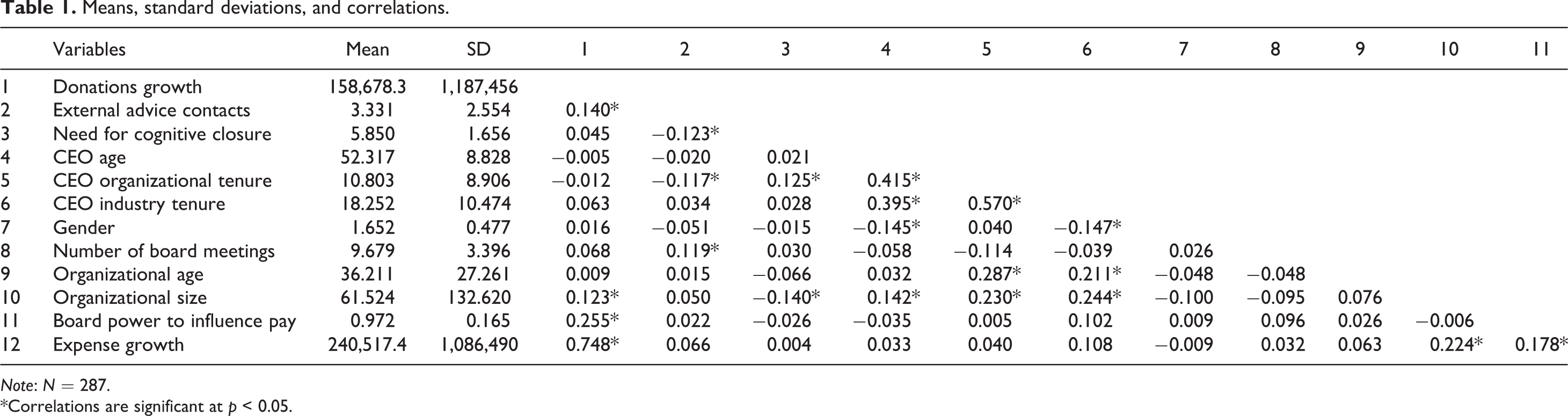
Table 1 reports descriptive statistics and bivariate correlations. As shown, the average age of CEOs in the sample was 52 years, and these individuals had approximately 11 and 18 years of organizational and industry experience, respectively. On average, these CEOs sought strategic advice from approximately three executives at other organizations over a 12-month period.
Means, standard deviations, and correlations.
Note: N = 287.
*Correlations are significant at p < 0.05.
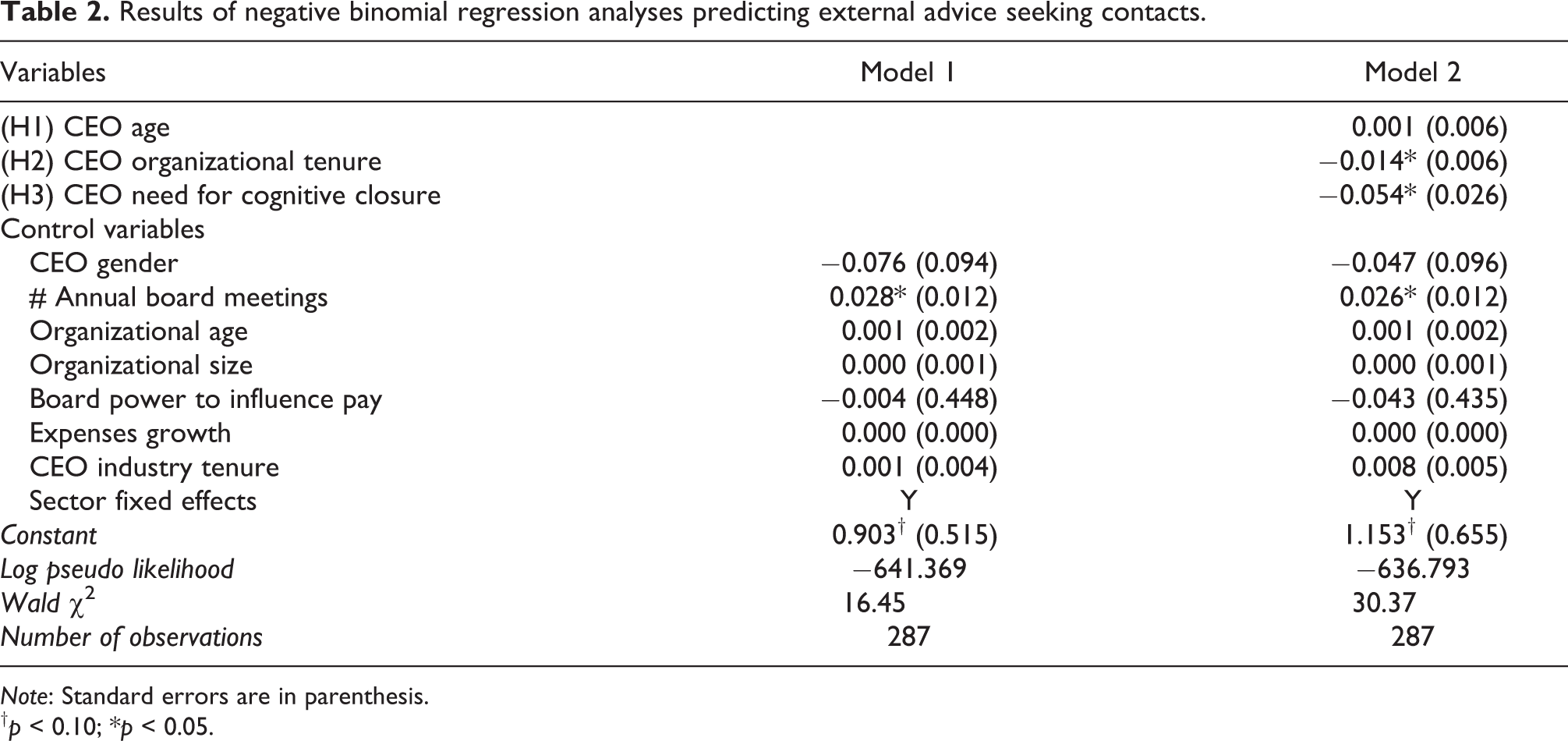
Table 2 reports results from the negative binomial regression analyses of the relationship between individual CEO attributes and the degree of external advice seeking. The control variables were entered in model 1. Model 2 includes the hypothesized predictor variables. Among the control variables, the number of board meetings was positively related to the number of external contacts sought for advice. Hence, the more often a board convenes, the more likely it is that the CEO consults outsiders for guidance on major issues facing their agency.
Results of negative binomial regression analyses predicting external advice seeking contacts.
Note: Standard errors are in parenthesis.
† p < 0.10; *p < 0.05.
H1 predicted that older CEOs prefer security and commitment to the status quo. Accordingly, older CEOs will struggle to integrate new ideas into their existing ways of thinking and thus should seek less advice from executives at other organizations. Contrary to this prediction, results show no significant relationship between CEO age and the number of external advice seeking contacts (b = 0.001, p = ns). Thus, H1 was not supported.
H2 predicted that as CEOs’ organizational tenure increases they prefer well-established and trusted sources of information, as well as seek corroborating rather than contradicting information. Accordingly, these longer tenured CEOs would be less likely to seek advice from executives at other organizations. Results in model 2 show support for this hypothesis (b = −0.014, p < 0.05). This suggests that longer tenured CEOs seek less external advice and instead, may prefer to rely on their expertise or the knowledge of others within their own organization. Quantifying the magnitude of this effect shows that a one standard deviation increase in organizational tenure results in a 11.7% decrease in external advice seeking (0.117 = (e(−0.014 × 10.8) − e(−0.014 × 19.7))).
H3 predicted that CEOs with a high NFCC prefer to rely on well-established heuristics and avoid information that challenges or conflicts with their current mental models. It is also argued that CEOs with a high NFCC prefer to make decisions quickly and decisively, thus avoiding information that creates confusion or ambiguity. Hence, a high NFCC would be inversely related to external advice seeking. As predicted, results show a significant negative effect (b = −0.054, p < 0.05). CEOs with a higher NFCC seek less strategic advice from executives at other organizations. Thus, H3 was supported. An assessment of the magnitude of this effect reveals that a one standard deviation increase in CEOs NFCC results in a 9% decrease in external advice seeking.
Table 3 reports results from the regression analyses testing the hypothesized relationship between the number of external advice contacts and the donations growth. Controls and the variables predicting CEO external advice seeking were entered in model 1. The hypothesized variable was entered in model 2. H4 predicted that CEOs who seek external advice about the challenges they face gain access to a wider variety of ideas and perspectives. Moreover, this external advice should facilitate higher quality solutions to the problems they face at their organizations. In support of H4, results indicate a significant positive relationship between advice seeking and donations growth, even when controlling for the level of expense growth (b = 48,194.69, p < 0.01). This suggests that CEOs who seek strategic advice from executives at other organizations enact practices that improve the organization’s financial performance.
Results of OLS regression analysis predicting donations growth.

Note: OLS: ordinary least squares. Standard errors are in parenthesis.
† p < 0.10; * p < 0.05; **p < 0.01; ***p < 0.001.
Discussion
Overall, findings from the analyses reveal an interesting pattern of results. Hypotheses predicting that CEO demographic and professional attributes would be related to external advice seeking had mixed support. CEOs with longer tenure in their agencies were indeed less likely to engage in external advice seeking when compared to their shorter tenured counterparts. In contrast, findings failed to provide evidence that CEO age would affect the likelihood of seeking external advice. This pattern raises important context-specific questions about how the demographic attributes commonly utilized by upper echelons scholars may have different effects in the context of nonprofit organizations. Future research could work to specify the differences in the nonprofit sector and then systematically examine which demographic attributes are relevant in this context. Support was found for H3, which considered the deeper level individual difference variable, NFCC. Specifically, results show that CEOs with a greater NFCC engaged in less external advice seeking than CEOs with lower ratings on NFCC.
The second set of findings regarding the effects of external advice seeking on organizational performance yielded results that were consistent with this study’s theory. That is, seeking strategic advice from executives at other organizations can increase CEOs’ exposure to diverse perspectives, increase their ability to formulate high-quality solutions, and ultimately, as examined here, increase the performance of their organizations (McDonald and Westphal, 2003).
This study has important implications for researchers and practitioners alike. First, given the organizational-level consequences of CEO advice seeking (cf. Arendt et al., 2005; McDonald and Westphal, 2003), it is critical that scholars develop a broader understanding of the antecedents of CEO advice seeking. Prior research in this area has focused narrowly on factors external to the CEO to the exclusion of examining how CEOs’ personal characteristics shape their advice seeking behavior. To address this gap, this study adopted an upper echelons view to examine the relationship between CEOs’ age, organizational tenure, and NFCC and their willingness to seek strategic advice from executives at other organizations. An additional strength of this study’s hypothesized model is that it provides a systematic and comparative test of the relationship between commonly studied and easily observed demographic attributes (i.e. CEOs’ age and CEOs’ organizational tenure) and a deeper level personality trait (i.e. CEOs’ NFCC) on external advice seeking behavior. Moreover, this study’s empirical results extend recent conceptual work that has suggested CEOs’ attributes such as leadership style and tenure may be predictive of their advice seeking behavior (Arendt et al., 2005).
Second, this study has important implications for research grounded in an upper echelons perspective; a perspective that focuses a great deal of attention on how demographics and professional background influence executive decision-making and behaviors. Specifically, this study extends research on strategic leadership by demonstrating a relationship between widely study demographic variables (i.e. CEO age and organizational tenure) and external advice seeking. Given the importance of external advice seeking, it is critical for scholars and practitioners to understand the factors associated with it. This study suggests that upper echelons theory (cf. Hambrick and Mason, 1984) is a valid framework for examining external advice seeking. Moreover, this study raises some concerns regarding the use of demographic proxy variables to predict executive behavior. Some proponents of the approach have argued that demographic proxy variables are highly reliable, contain little measurement error, and are easily obtainable (Finkelstein et al., 2009). The results reported here, however, echo concerns that research on top executives has overlooked important, deeper, individual-level attributes of executives (Carpenter et al., 2004). Partially due to the difficulty in obtaining personality data on CEOs, prior research has been limited in its ability to assess the impact of trait variables on CEO behavior and strategic choices. Thus, this research contributes to the small number of studies examining CEOs’ personality characteristics on organizational outcomes. Given the findings regarding NFCC and its role in advice seeking, future research may benefit from considering the effects other stable CEO characteristics have such as locus of control (Rotter, 1966) or narcissism (Freud, 1914) on organizational outcomes.
Fourth, this study contributes to research on the consequences of executive advice seeking. Prior research has found evidence that advice seeking is related to improved innovation (Alexiev et al., 2010), less strategic inertia (McDonald and Westphal, 2003), and better financial performance (McDonald et al., 2008). By integrating upper echelons perspectives with the literature on social networks, this study highlights how CEOs’ individual attributes are associated with CEO advice seeking, which ultimately improves their organization’s performance.
Finally, this study applies strategic leadership theories, which are typically tested in for-profit settings, to the nonprofit sector. In spite of calls to do so, few studies have utilized strategic leadership frameworks to examine executive behavior in a nonprofit setting (cf. Short et al., 2009).
For boards of directors, findings suggest that typical governance levers have some ability to encourage external advice seeking. Whereas the ability to influence pay had no effect on external advice seeking, the number of annual board meetings was a significant predictor of CEOs’ likelihood to seek external strategic advice. Perhaps more important than the ability to set CEO pay is the number of board meetings where board members can monitor CEOs and as a consequence, increase CEO accountability for searching for new ideas and information from external contacts.
Findings from this study can also inform boards of directors’ recruitment and selection processes. Specifically, whereas internal succession planning may promote continuity in times of change, promoting a long-tenured executive to the CEO position may limit external search for new ideas. Multiple tools should therefore be utilized including governance levers as well as appropriate recruitment and incentive policies to motivate CEO external advice seeking.
Limitations and future research
As does any study, this work contains several limitations. First, the study relied on data from the nonprofit sector. There are over 1.5 million nonprofits in the United States alone (NCCS, 2016), thereby making the context a worthy one to examine. However, because the results may reflect factors specific to this sector, it is recommended that research replicate this study in other economic sectors to increase generalizability of the results. Concerns over context notwithstanding, the results raise interesting questions about the applicability of particular aspects of the upper echelons perspective to the nonprofit sector. This study’s findings suggest important questions remain unanswered as to how the nonprofit sector differs from the for-profit sector. Given the growing interest in social entrepreneurship, a fruitful area of future research could be to better understand how strategic leadership theories can advance our understanding of which executive characteristics are most effective for creating social value (Short et al., 2009). More generally, researchers should work to identify the peculiarities of the nonprofit sector and develop new theory to explain observed phenomena.
Second, although the study considered the number of external advice seeking contacts, and the effect of these interactions on organizational performance, it was assumed that the advice led to a change in practices and performance. Future research could open up the black box and through a longitudinal study, investigate whether the advice obtained resulted in changes in services offered.
Third, our study is limited in the number of CEO attributes considered. Future research should continue to systematically explore other attributes that could impact the likelihood of external advice seeking. Given the difficulty obtaining data on deep-level trait characteristics of CEOs, researchers could utilize content analysis methods to assess CEOs’ reported cognitions and values (cf. Chatterjee and Hambrick, 2007). With this, more comparative analyses are warranted to establish a known relationship between demographic proxy variables and more direct measures of CEOs’ cognition and values.
Fourth, the findings reported here are limited to the relationship between CEO personal attributes and their advice-seeking behaviors. The findings do not suggest older, long-tenured, or high NFCC CEOs are low performers. Particularly, older and long-tenured CEOs may have more experience and relevant expertise beneficial for addressing strategic issues.
Future work should also examine how CEOs’ personal attributes determine the source of strategic advice. For instance, Heyden and colleagues (2013) distinguished between CEO advice seeking from executives at their organization versus executives at other organizations. Future research could examine individual CEO attributes that predict internal versus external strategic advice seeking. McDonald and Westphal (2003) found that advice seeking from friends led to continued poor performance, whereas advice seeking from CEOs who were not friends improved organizational performance. Future research should explore individual-level CEO attributes that predict CEO advice seeking from friends versus non-friends.
Finally, results in Table 1 suggest another interesting aspect of this study’s context worthy of further exploration. The mean value of CEO gender (1.65) indicates the sample contained approximately twice as many female CEOs as male CEOs. Research by Musteen and colleagues (2006) suggests female CEOs may be more open to change than their male counterparts and thus, may be more likely to seek strategic advice from executives at other organizations. Perhaps the mixed findings reported in this study are the results of confounding effects associated with the large number of female CEOs in the sample. Future research could explore to what extent the widely studied demographic variables derived from upper echelons research yield similar or conflicting results when used to study female CEOs and executives.
In closing, the complexity of today’s competitive environment necessitates a strategic decision-making process whereby organizational leaders gather input and information from many different individuals. In such environments, it is important that these leaders make the most of their network of advisors, both inside and outside of their organizations. It is through such contacts that top executives can acquire new insights, consider alternative perspectives, and develop a broader understanding of the competitive environment, which in turn, can facilitate higher quality decision-making and organizational performance.
Footnotes
Acknowledgements
We would like to thank the editorial team for their constructive comments. We are extremely grateful to Maribeth Kuenzi and to Michael McDonald for their insights in developing our manuscript.
Declaration of conflicting interests
The author(s) declared no potential conflicts of interest with respect to the research, authorship, and/or publication of this article.
Funding
The author(s) disclosed receipt of the following financial support for the research, authorship, and/or publication of this article: This research was funded in part through a Data Analytics grant awarded by the Cameron School of Business at UNC Wilmington.