



Abstract
Volunteers and paid staff frequently work alongside each other in nonprofit organizations. Nevertheless, the possible impact of volunteering on the wages of the paid staff has hardly ever been investigated due to the scarcity of data suited to such research. Based on the matching of two French databases and using several indicators relating to volunteering, this article examines the relationship between volunteering and wages by carrying out investigations that differentiate between employees depending on their position in the socio-occupational hierarchy and the field of activity of their organizations. The results confirm the value of such an approach based on disaggregated data by revealing the diversity of situations. This diversity ranges from some cases where no relationship is observed between volunteering and wages to others where there is a negative relationship and even in a few cases, a positive one.
Introduction
Volunteers frequently work alongside employees within nonprofit organizations. This coexistence has been investigated from the point of view of the conflicts that it might cause between these two types of workforce as well as with regard to its effects on the satisfaction levels and organizational attachment of volunteers and paid staff (for example: Galindo-Kuhn & Guzley, 2001; Netting et al., 2004; Rimes et al., 2017; Rogelberg et al., 2010). It is also regularly mentioned in studies of the influence of organizational context on volunteering (Studer & von Schnurbein, 2013). And of course it is at the heart of research on the existence of complementarity or substitution between voluntary and paid work and their degree of interchangeability (Brudney & Gazley, 2002; Chum et al., 2013; Handy et al., 2008; Mook et al., 2014; Simmons & Emanuele, 2010; Stine, 2008).
Nevertheless, the possible impact of volunteering on employees’ pay levels has remained virtually unexplored despite the development of the economic literature on wages in non-profits (Hirsch et al., 2018; Leete, 2006). This is probably due to the lack of appropriate data, i.e., data that provide information on both paid employees and volunteers. There is a very small number of exceptions to this general observation. Based on the matching of Austrian data from firms and from employees, Haider and Schneider (2010) as well as Pennerstorfer and Trukeschitz (2012) found that the presence of volunteers was correlated with lower wages for the employees of non-profits but that the number of volunteers had no effect. However, the authors had no data on the amount of time given over to volunteering and conducted their study without differentiating between the various fields of activity in which non-profits were involved.
Our article studies the possible correlation between the presence of volunteers and the wages paid within non-profits in France. We first examine the reasons why volunteering might influence employees’ wages. We then successively present the data used, the method of investigation and the results obtained. These results show that the identification of a relationship between volunteering and pay levels is sensitive to the indicator of volunteering that is used and that this relationship tends to vary depending on the position in the wage hierarchy and the organization’s field of activity. After a discussion of these results, the article concludes with a comment on the limitations of our study.
Theoretical Considerations
On a theoretical level, the first hypothesis is to predict that the presence of volunteers in a non-profit has a negative effect on employee wages. Several arguments can be advanced to lend weight to this hypothesis. First, since volunteering is an expression of prosocial behavior (Penner et al., 2005), its intensive use by certain organizations can be considered as an indication that their activities have a high degree of social utility. Consequently, these organizations will tend to attract the most strongly socially motivated employees who may well be inclined to moderate their wage claims in exchange for greater intrinsic satisfaction derived from their work.
This argument represents a continuation of the donative labor hypothesis adopted in research comparing the pay of employees in non-profits with that of their counterparts in for-profits (Leete, 2006). In the context of our study, this hypothesis leads us to predict a negative correlation between salary level and the scale of volunteering, especially among employees in professional occupations who are more likely to accept a reduced wage in exchange for social benefits (Preston, 1989). The mechanisms underlying this correlation may vary. Volunteering may act as an a priori signal, thereby contributing to employee self-selection before recruitment. Subsequent to recruitment, the presence of volunteers may also help to create and maintain an “organizational climate” conducive to the gifting of labor. 1 However, the concerned employees do not always approve the use of the gift behavior in such a climate. Rather they may be “guilt-tripped” or even more or less explicitly forced into accepting it. Falcoz and Walter (2006) refer to these cases as the “imposition of a gift ethic.”
The nature of the division of labor between volunteers and employees may also explain a negative correlation between the pay of the latter and the use of the former by non-profits. The tasks allocated to the two groups may be complementary or, conversely, substitutable. If they are complementary and the skilled tasks are allocated to volunteers while less skilled tasks are performed by paid staff, the wages of the staff will suffer in comparison with those of their counterparts in non-profits without volunteers. If the tasks allocated to volunteers and to paid staff are undifferentiated and substitutable, they can be allocated randomly to volunteers or to paid staff. The latter could see their pay bargaining power weakened compared with their peers who do not face this competition from volunteers (Haider & Schneider, 2010). This hypothesis of a weakening of employees’ bargaining power might be more relevant to employees at the bottom of the hierarchy if it is at this level that the interchangeability between volunteers and paid staff is most probable, as Simmons and Emanuele (2010) maintain. This is also suggested by a report on how the local non-profits have adapted to the Seattle City Council order raising the minimum wage (The Seattle Minimum Wage Study Team, 2017).
Another argument is to see the correlation between lower wages and a larger volunteer workforce as a consequence of the economic fragility of non-profits facing a reduction in certain revenue sources, notably from the public purse. Such situations have been observed on several occasions (e.g.: Baines, 2004; Handy et al., 2008; Mook et al., 2014). In these cases, the increased use of volunteers is likely to go hand in hand with tighter wage restraint policies, which would in turn be reflected in lower wages than those paid by the non-profits not experiencing such economic difficulties.
From a completely different perspective, we can hypothesize that volunteering is a factor conducive to improving employees’ pay. This will be the case if volunteers and paid staff complement each other and the former are given mundane, low-skill tasks to perform while the tasks allocated to employees give them the opportunity to raise their skill level. Another argument can underlie the hypothesis that there is a positive relationship between voluntary work and the wages of employees. By enabling organizations to restrict the recruitment of new paid staff, the use of volunteers frees up financial resources that could be redistributed in the form of higher wages to the paid workers already in post (Haider & Schneider, 2010). This redistribution will be made easier since the weakening of property rights resulting from the non-distribution constraint gives salaried managers a margin of discretion in determining pay policy (Borjas et al., 1983).
Consequently, it would seem that the theoretical arguments do not always lead to unequivocal predictions as to the nature of the relationship between the use of volunteering and employees’ wage levels in non-profits. This makes it necessary to investigate how empirical investigations might help to shed light on this question.
Data
To conduct empirical research on the relationship between volunteering and wage levels in non-profits, it is necessary to have data concerning the extent of volunteering in non-profits as well as the wages of the paid staff. Such databases are very rare. In France, the first official statistical survey of non-profits was carried out in 2014 by INSEE, the French National Statistics Institute, and it offered an opportunity to obtain data on volunteering in these organizations. More specifically, this survey concerned organizations governed by the Association Law of 1901 concerning contracts of associations. 2 These organizations constitute a vast, heterogeneous group in which, to adopt the distinction made by Smith (2015), voluntary agencies and many voluntary associations coexist. This group of organizations constitutes the vast majority of the French nonprofit sector. The only non-profits not included in this survey are foundations, whose economic importance in France remains limited despite a recent upsurge (Nirello & Prouteau, 2018).
The INSEE survey collected information on whether volunteers were present and if so, in what numbers, as well as on their annual contribution measured in hours in 2013. The data from this survey have been matched with another database on jobs and wages compiled from the annual declarations of social data (déclarations annuelles de données sociales or DADS) for 2013. The DADS are files filled in by all employers for various fiscal and social authorities and are used by INSEE to produce statistics on employment and wages. For each job, the DADS provide information on the type of contract, whether the job is full-time or part-time, the number of hours worked per year and the wages paid. They also provide information on some of the jobholders’ characteristics (sex and age) and their qualification and skill levels as determined by their socio-occupational category. Unfortunately, they do not contain any information on their level of education and seniority in the organization. The DADS separate occasional jobs from other jobs. 3 These occasional jobs are not included in the employment statistics published by INSEE and are also excluded from the present study.
The matching of the survey data on non-profits and the DADS data was carried out by using the INSEE-assigned identification number (siren) that all organizations with employees possess. The file thus obtained represents 50.3% of the volume of employment in full-time equivalents and of the wage bill in all organizations governed by the Association Law of 1901. The number of non-profits in the sample represents 9% of all organizations with the same legal status that offer jobs. In its association survey, INSEE allocated a weighting coefficient to each non-profit to ensure the sample’s representativeness. These coefficients, which relate to the organizations, cannot be used for the jobs and the employees who hold them. Consequently, we cannot view the sample we are using as statistically representative of all employees in non-profits. Rather we have what Chum et al. (2013) describe as “a purposive sample.” After eliminating the observations for which certain essential data (notably annual wages and annual working time) are missing and employees whose declared ages are under 16 and over 75, we are left with 985,960 observations.
Method
Our aim is to investigate whether or not there is a correlation between hourly pay and the presence of volunteers in non-profit organizations. To this end, we estimate a wage equation in which the dependent variable is the logarithm of the gross hourly wage. Our independent variable of interest is the use of volunteers in the organization. We have opted for three alternative specifications for this variable.
In model 1, a dummy is adopted that has a value of 1 if the non-profit has volunteers and 0 otherwise. This specification, used by Haider and Schneider (2010), is of limited value in the present case because the share of total employees working in non-profits without volunteers is small (5.9%). However, this share varies considerably from one field of activity to another ranging from a little over 1% in sports to 27.5% in local economic development. Consequently, we consider two other specifications that reflect the share of volunteers relative to paid staff. In model 2, the variable concerning volunteering is the ratio of the volume of hours worked by volunteers to the number of hours of paid work. In model 3, the variable is the ratio of the number of volunteers to the number of paid employees in the organization. These two variables will henceforth be considered as indicators of the extent to which volunteers are used. They are correlated with each other. At the most aggregated level, the Pearson coefficient is 0.565. Nevertheless, they are not redundant. For example, it is possible that it is the presence of volunteers rather than the time they spend on their unpaid activities that helps to create an organizational climate conducive to the gifting of labor. In this case, model 3 may reveal effects that may be absent from model 2 if there are many volunteers in the organization with each one gifting just a short amount of time.
Since we cannot exclude the existence of non-linearity in the relationship between volunteering and the pay of employees, and also to reduce the influence of extreme values on the right tails of the distributions of employees, these variables have been categorized on the basis of equal frequencies. More precisely, in both cases four categories have been constructed by dividing the continuous variables on the basis of the quartiles of their respective distributions. Thus the first category is made up of the 25% of employees working in those non-profits in which the use of volunteering, as measured by the relevant indicator is lowest, and so on until we reach the fourth category, which is made up of the 25% of employees working in those organizations that make the greatest use of this unpaid resource.
Several control variables are incorporated into our wage equation, some of which relate to employees and the jobs they hold and the others to the organizations in which they work. In the former group, we include the employee’s gender and age (introduced in quadratic form). As indicated above, information on employees’ level of education and training is not included in the DADS. This is a limitation that is generally encountered in the files submitted by employers (see for example: Haider & Schneider, 2010). As a proxy, we use the variable indicating an employee’s socio-occupational category, which is correlated with the level of educational qualification (Observatoire des inégalités, 2016). We use four categories: executives, intermediate occupations, white-collar clerical workers and blue-collar workers. With regard to the characteristics of the jobs held by employees, we include working time (full-time vs. part-time) and the type of employment contract (open-ended, fixed-term or subsidized job, etc.).
The control variables relating to the non-profits are size (in number of full-time equivalent jobs), the existence of a collective agreement, location (region), membership of an organizational network and field of activity. We distinguish eight fields of activity: culture, sports, leisure activities, health, social and medico-social action, “defense of rights, causes and interests,” local development and finally, education and continuous training. The social and medico-social field includes residential establishments (for elderly or handicapped people) as well as charitable and humanitarian activities. Local development refers in particular to local development agencies, non-profits managing various services shared by other organizations, groups of employers aimed at sharing employees they could not recruit if they were working alone and organizations managing short or direct distribution channels for agricultural products. The “defense of rights, causes and interests” is a very heterogeneous field. It includes in particular parent/teacher associations, professional associations, trade unions, political organizations, religious associations as well as organizations dedicated to the defence of human rights or the protection of the environment.
Among the variables characterizing the non-profits, we also introduce one indicating a possible increase in the volume of activity over the 3-year-period preceding the survey and another indicating the existence of significant difficulties that non-profits say they have because of competition in their field of activity. Finally, we include the share of donations in the total monetary resources of non-profits and the share of public subsidies.
To estimate the wage equation, we first investigate the data at the most highly aggregated level, i.e., for all employees and for all fields of activity. However, as noted in the section on theoretical considerations, it is possible that the effect of volunteering on wages differs according to the position in the hierarchy of occupational qualifications. Thus, we distinguished two groups of employees. The first includes executives and the intermediate occupations, while the second includes clerical and manual workers. An analysis at the most highly aggregated level may also conceal different situations in the various fields of activity just as the comparison of wages between non-profits and for-profits produces variable results depending on the field in question (Leete, 2001). Consequently, we carried out investigations for each of the fields listed above, both for all the employees in the field and for each of the two groups mentioned above. Since the values taken by the variables relating to the non-profits (particularly those concerning volunteering) are common to all employees in the same organization, the standard deviations of the coefficients are corrected by a cluster-type method. The results of this investigation will now be presented.
Results
For reasons of space, the results for the control variables are only briefly presented in the following. Please contact us directly for the entire results. At the most highly aggregated level, women’s hourly wage is lower than that men’s by almost 4%. The hourly wage rises with age with a convex profile. It is slightly higher for full-time employees than for part-timers and for those on fixed-term contracts than for those on open-ended contracts. The hourly wage also increases when employees move up in the socio-occupational hierarchy. It is higher in the Paris region than in the other regions of France and rises with the size of the organization, at least up to a certain threshold (50 full-time equivalent jobs) above which it becomes more or less insensitive to size. Wages are highest in the health and local economic development fields and lowest in leisure activities and social action. Neither the organization’s membership in a network, the share of public subsidies nor of donations have any effect on employees’ pay. On the other hand, pay is as expected slightly but statistically significantly higher in those non-profits whose volume of activity is increasing and lower in those facing difficulties linked to competition.
With regard to the variables relating to volunteering, the estimated coefficients are listed in successive order of the models. In the commentary, we transpose these coefficients into percentages. 4 Model 1 shows the existence of a relationship between the use of volunteers and rate of pay in three fields: ‘the defense of rights, causes and interests’; “social and medico-social action” and local development (Table 1). However, this relationship holds only for the clerical and manual workers category. Moreover, it is not of the same nature. In the first two fields, the presence of volunteers in an organization goes hand in hand with lower wages. The gap is much greater in the defense of rights, causes and interests (-12.3%) than in the social and medico-social action field (-4.9 %). On the other hand, in local development, the relationship between pay and the use of volunteers is positive; the gap here is significant, since clerical and manual workers employed in organizations with volunteers earn on average 12.8% more than their counterparts in organizations without volunteers. Nevertheless, as already mentioned, this model is fairly rudimentary since the number of employees working in organizations without volunteers is very low in certain fields. Furthermore, the model does not capture the possible effects on wages of the differences in the level of use of volunteering.
Wages of Non-Profit Paid Staff and Volunteering. Model 1.

Source. Insee, Déclarations annuelles de données sociales (2013) and Insee, Association Survey (2014). Authors’ own calculations.
Note. T statistic in parentheses.
p < .05. **p < .01.
And indeed, Model 2, whose indicator of volunteering is the ratio of volunteer hours to paid hours, reveals effects that do not appear in Model 1. This applies particularly to leisure activities where, compared with the reference category of the indicator, wages are lower in the last three categories for all socio-occupational groups (Table 2). In the case of executives and intermediate occupations for example, the wage gap varies from -5.6% to -9.8% from the second to the final category of the variable. In the health field, as well, there is a negative relationship between wages and the level of volunteering but it turns out to be less pronounced than in the previous case. This is particularly true among clerical and manual workers where the effect is limited to the second category of the indicator. In education and training, the negative relationship between pay and volunteering is visible only for the third category of the indicator. In the other fields, the results obtained from Model 1 are generally confirmed, even though in “the defence of rights, causes and interests” and in local development some isolated correlations (negative in the first case and positive in the second) that are absent from Model 1 appear in the executive and intermediate occupations category.
Wages of Non-Profit Paid Staff and Volunteering. Model 2.
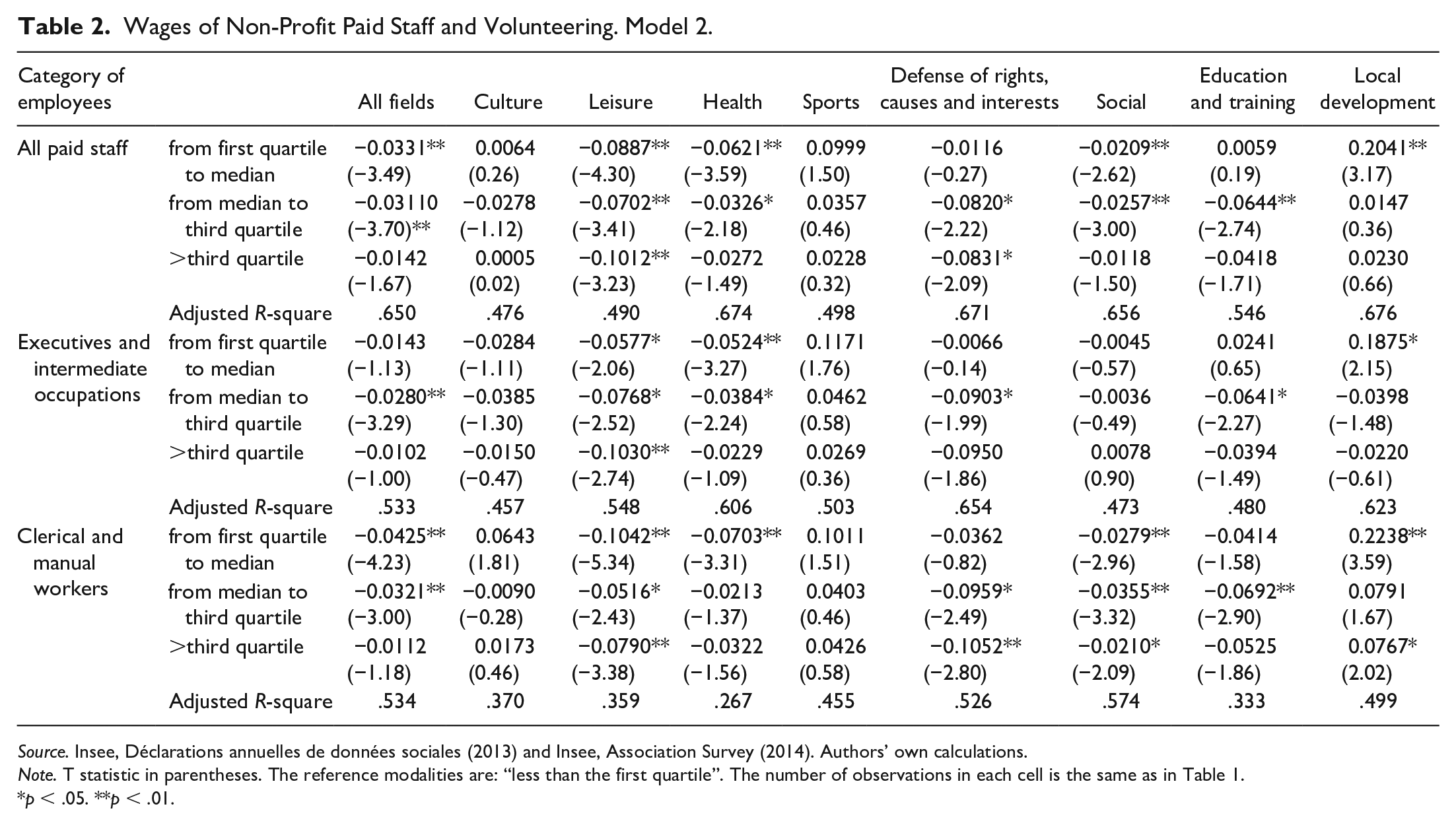
Source. Insee, Déclarations annuelles de données sociales (2013) and Insee, Association Survey (2014). Authors’ own calculations.
Note. T statistic in parentheses. The reference modalities are: “less than the first quartile”. The number of observations in each cell is the same as in Table 1.
p < .05. **p < .01.
The indicator of the level of volunteering in Model 3 is the ratio of the number of volunteers to that of paid employees. The results corroborate those for Model 2 in the social action and “defence of rights, causes and interests” fields and partially in local development, where the positive effect of volunteering is apparent only in the clerical and manual workers category (Table 3). In education and training, the negative relationship between pay and the level of voluntary work is less variable than in Model 2 and only concerns the clerical and manual category. Two significant differences from Model 2 are worthy of note. In the health field, no effect of volunteering on employees can be observed. In sports, the effect is clearly positive for executive and intermediate occupations, even though it remains relatively stable beyond the indicator’s reference category (between +19.2% and 26.1%).
Wages of Non-Profit Paid Staff and Volunteering. Model 3.
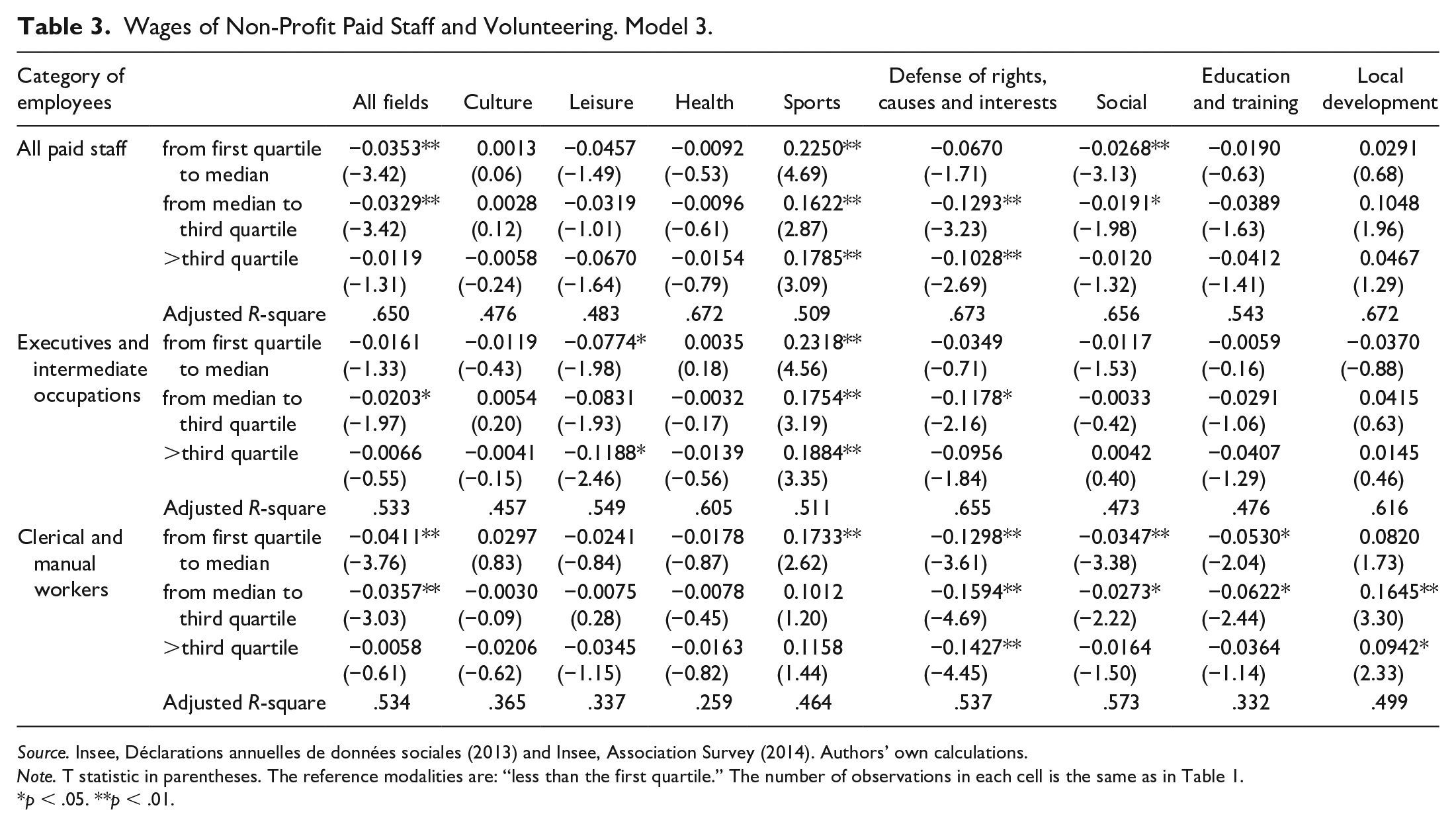
Source. Insee, Déclarations annuelles de données sociales (2013) and Insee, Association Survey (2014). Authors’ own calculations.
Note. T statistic in parentheses. The reference modalities are: “less than the first quartile.” The number of observations in each cell is the same as in Table 1.
p < .05. **p < .01.
Several lessons can be drawn from the estimations of these three models. First, the results are sensitive to the indicator of volunteering that is chosen. From this point of view, it would seem that the indicators of the level of volunteering in Models 2 and 3 are better suited to revealing certain relationships than the indicator in Model 1. The limitations of the estimations performed at a high level of data aggregation are also highlighted. Our study shows the value of dividing the data up by field of activity and position in the hierarchy of socio-occupational categories. The third lesson relates to the relationship between volunteer work and the pay of employees. When such a relationship exists, it is sometimes reflected in higher pay when the level of volunteering is higher and sometimes in lower pay. Thus this relationship is not a one-way street. Moreover, when a relationship is proven, it is often non-linear. In such cases the effects that are identified remain stable beyond the first quartile of the indicator and sometimes disappear for the highest level of volunteering intensity. Can at least some of these results be explained in the light of the hypotheses outlined in the theoretical section?
Discussion
The social and medico-social action field accounts for two thirds of the employees in our sample and this explains why it exerts a strong influence on the profile of the relationship between pay and voluntary work at the aggregated level. This field was the first in the French non-profit sector to have undergone a process of professionalization in the 20th century. For forty years it had had to deal with major changes which were reflected in a strong resurgence in the use of volunteers and a sharp increase in unskilled jobs (Ion, 2005). The differentiation of roles between volunteers and paid staff is not systematic; certain tasks can be performed just as well by the former as by the latter, such as logistics activities, food distribution, collecting goods or sorting clothes in humanitarian organizations (Combes & Ughetto, 2010). This substitutability of tasks weakens the bargaining power of those employees without high-level qualifications or skills. Such situations, already considered in the theoretical section, are undoubtedly one of the factors that help to explain the negative relationship observed between volunteer work and the pay of employees in this field.
In education and training, Model 2 scarcely reveals a clear relationship between wages and voluntary work; Model 3, however, uncovers a negative relationship among clerical and manual workers. Again, the notion of substitution between volunteers and paid staff for tasks that are relatively unskilled seems to offer the best explanation for it. In addition, we have to add the impact of a difficult budgetary situation. After all, 38% of paid employees in this field work in organizations that had declared in the INSEE survey that they had experienced a reduction in their resources, compared with 25% across all the fields. The weakness of the economic situation explains both the extensive use of voluntary work and the concern to control wage costs.
The history of the leisure activities field, like those of the sports or culture fields, has been strongly influenced in France by the “popular education” movement. This movement is a distinctively French phenomenon and the expression is very difficult to translate into another language. “Popular education” had its origins in a “crusade driven by voluntary associations to democratize education with the aim of supplementing the teaching provided in schools and educating citizens” (Poujol, 2000). For a long time, children and young people took part in the activities organized by the popular education movement under the guidance of volunteer activists.
From the 1960s onwards, the leisure activities field underwent a process of professionalization that led to the creation of the profession of sociocultural facilitator (animateur socioculturel), which is classified among the intermediate occupations. The way in which these sociocultural facilitators work remains strongly influenced by a gift culture and commitment inherited from the popular education movement (Lebon, 2009). Moreover, there is a certain fluidity of roles between volunteers and paid workers, with access to paid positions often being preceded by experience as a volunteer. In this field of activity, the negative relationship between the intensification of the use of voluntary work and wage levels is best explained by the donative labor hypothesis. However, in leisure activities as in education and training, the non-profits’ fragile financial situation very probably also plays a role since this is the field in which the share of employees working in organizations that have seen their resources reduced over the previous three years is highest (46 %).
At first sight, it is surprising to observe that the situation in the cultural and sports fields is different from that in leisure activities, even though the former two fields have also been strongly influenced by the popular education movement. They too are deeply imbued with a gift ethos and a fluidity of roles between volunteers and paid staff (Falcoz & Walter, 2006; Langeard, 2010). And yet in cultural activities, none of the three models reveals the slightest relationship between volunteer work and the pay of employees.
As for sports, only Model 3 reveals a relationship, but it is positive rather than negative and essentially observed among the executives and intermediate occupations. The professionalization of this field is a recent phenomenon in France. From the late 1980s onwards, significant numbers of skilled workers were recruited, notably sports trainers and educators, who were classified among the intermediate occupations. This professionalization has led to an expansion of competitive activities by clubs and to a diversification of the services on offer, including profit-making services. This prompted Loirand (2003) to speak of a market-driven redefinition of the sports services provided by associations. Against this background, the positive correlation between wage levels and the level of volunteering is consistent with an approach based on task complementarities, with volunteers freeing paid employees from certain activities and thereby enabling them to make better use of their skills and consequently be more highly remunerated. This argument receives support from Marsault et al. (2016), who observe that in sports organizations with large memberships, the more invisible and less fulfilling tasks are left to volunteers.
The “defence of rights, causes and interests” field has many similarities with that of leisure activities, even though the negative relationship between voluntary work and pay levels is more marked here for clerical and manual workers. Here too, the culture of selfless commitment is widespread and is reflected in the fluidity of roles between volunteers and paid staff, which Dussuet et al. (2010) call “biographical continuity from voluntary work to paid employment” in environmental protection associations. The causes defended are shared by paid staff and volunteers, both groups often being members of the organizations concerned. Once again, the donative labor model is of great relevance here. Moreover, the lack of differentiation between the roles of volunteers and those of paid employees that is typical of some of the organizations in this field gives rise to difficulties in recognizing employees’ skills, which is obviously detrimental to their wages as Flahault et al. (2014) observe in the case of feminist associations.
The two remaining fields, “health” and “local development,” are much less well documented than the preceding ones in the French literature on non-profits with regard to the interaction between volunteers and paid employees. In the case of health, the estimations of Model 2 are consistent with the approach based on time gifting by employees with high-level or intermediate skills. In local development, which makes by far the least use of voluntary work, Models 2 and 3 point rather to task complementarity between volunteers and paid employees, but here the complementarity is favorable to the recognition of employees’ skills and to their pay levels. Nevertheless, this is a matter for further, more detailed research.
In our view, the results presented above are of interest to the actors in non-profits as well as to the wider public. After all, the diversity of the relationships between voluntary work and employees’ pay levels refutes the argument that the presence of volunteers always poses a threat to the paid employees’ situation. At the same time, however, these results highlight certain situations that may feed this suspicion which should lead the organizations concerned to reconsider, if need be, the link between unpaid and paid work, particularly in the field of social and medico-social action.
Limitations
Our study has a number of limitations; consequently, the results should be considered with some degree of caution. These limitations are due in part to the difficulties in interpreting some of these results. Thus on several occasions, the estimations from Models 2 and 3 show that beyond a certain level of use of volunteering, its effect on wages stabilizes. This finding may reflect the existence of threshold effects. For example, if the presence of volunteers is conducive to the creation of an “organizational climate” that favors gifting behaviors, it is possible that as soon as that climate is established, any increase in the share of volunteering has zero additional effect. More confusing are those cases in which a statistically significant relationship is found for employees working in non-profits whose indicator of volunteer usage lies between the first and third quartiles of the distribution but is no longer verified for employees in non-profits where the level of usage is greater. This aspect merits further investigation but requires information not included in the data used here.
The limitations of our study stem also from our data base. First, the sample we use cannot be considered statistically representative of the employee population in the French non-profit sector. The distribution of the workforce in this sample differs somewhat from that of the employee population as a whole because smaller non-profits are underrepresented. Consequently, employees in sectors such as sports and culture are underrepresented since they are much less concentrated in large organizations than their counterparts in social and medico-social action or health care.
Second, some additional information is required to make our study more robust. In particular, it would be necessary to have data on the education levels of employees. However, such a variable is difficult to obtain from the data collected from firms. It would also be invaluable to have some data on the nature of the tasks performed by volunteers. What proportion of them sit on the board of governors and what share work alongside paid employees? What types of tasks are allocated to the volunteers working with the paid employees? Similarly, it would be very useful to have some indicators of the extent to which the tasks performed by volunteers and paid staff are interchangeable. Non-profits could be asked whether tasks previously performed by paid-staff are being assigned to volunteers and vice versa.
Moreover, we have to be aware that the hourly wages calculated on the basis of the data supplied by employers may be biased if employees work additional, unpaid hours. Obviously, information on such situations cannot be acquired by data collected from employers but only by means of employee surveys. The interchangeability of roles between volunteers and paid employees in certain fields of activity often leads employees also to do unpaid voluntary work in their organizations. But is this voluntary work always truly voluntary? Drawing on a survey conducted among sociocultural and leisure facilitators, Farvaque et al. (2007) found that 63% of the respondents said that they did unpaid voluntary work, either regularly or from time to time, but that 44% of them did not find this situation normal. Taking into account these enforced unpaid hours of work, if such information existed, it might lead to a change in our results in one direction or another depending on whether or not the volume of such hours was sensitive to the level of volunteering in the organization.
Finally, we should be wary of hastily generalizing these results beyond the French case. To do so would indeed skate over the differences in contexts and national histories. Thus the influence of the popular education movement is specific to the French non-profit sector. Moreover, the distribution of volunteers and paid employees by sphere of activity within the sector is not necessarily the same as in other countries. INSEE’s Associations 2014 survey estimates that employment in the social and medico-social field accounts for 56% of total employment in organizations governed by the Association Law of 1901 and that sports, culture and leisure activities account by themselves for 57% of the volume of voluntary work. The situation is different in the USA where social assistance plus nursing homes account for 22% of employment in the non-profit sector (Salamon & Newhouse, 2019) and sports, hobbies, cultural and arts activities account for only 3.7% of volunteers (Bureau of Labor Statistics, 2016). From this point of view, our article is an invitation to conduct comparisons with future research on countries other than France.
Footnotes
Acknowledgements
The authors thank two anonymous referees for their valuable comments. This research has benefited from government support managed by the Agence Nationale de la Recherche under the future investment program (Program d’Investissements d’avenir) with reference ANR-10-EQPX-17 (Center d’accès sécurisé aux données—CASD).
Declaration of Conflicting Interests
The author(s) received no financial support for the research, authorship, and/or publication of this article.
Funding
The author(s) received no financial support for the research, authorship, and/or publication of this article.
