



Abstract
In this study, a job characteristics profile is developed to calculate indirect measures of needs–supply (N-S) fit. Two surveys were conducted with employees in Taiwan, to test N-S fit, employee job satisfaction, intention to leave, and job search behavior. The findings show that employee perceptions of indirect N-S fit are significantly related to job satisfaction and negatively related to intention to leave and job search behavior. We find that an individual’s desires, needs, and subjective “fit” perceptions can impact considerably on how the individual thinks and feels about their job and their inclinations to leave. In addition to contributing empirical evidence of how employee perceptions of N-S fit can affect employee intentions to leave, we conclude that it is of practical importance for practitioners to assess the congruence between an employee’s perceptions of what he or she needs in a job and their subjective perceptions of what is supplied.
Introduction
Person–job fit refers to the congruence between a person’s needs and/or abilities (i.e. knowledge, skills, and abilities (KSAs) and the demands and content of his or her job) (Edwards, 1991; Kristof, 1996; Stich, 2020; Tims et al., 2016). Previous research on person–job fit distinguishes between two forms. The first is known as demands–ability fit. Demand–ability fit has been defined as the degree to which an individual’s KSAs are congruent with the demands of their job (Edwards, 1991; Kristof, 1996; Stich, 2020; Werbel and Johnson, 2001). The second variation of person–job fit, known as needs–supply (N-S) fit, focuses on the personal desires, needs, values, and preferences of the individual (Edwards, 1991; Kristof-Brown et al., 2005; Tims et al., 2016). Here, the “fit” between a person and his or her job is dependent upon whether the employee feels the job is compatible with their own personal needs (Edwards, 1991). This study focuses on the N-S fit approach—“the needs of a person and the supplied attributes of a job” (Chuang et al., 2016: 70) to investigate relationships between N-S fit (direct and indirect) and three employee work outcomes: employee job satisfaction, turnover intention, and job search behavior. In this study, we postulate that employees experiencing low levels of N-S fit will also experience a decrease in job satisfaction, an increased intention to leave the organization, and a desire to search for new job opportunities. We build on previous work, such as Morrow and Brough’s (2019) study of person–organization fit, and hypothesize one specific variation of fit, N-S fit, will be negatively related to turnover intentions. For management, the findings of this study highlight the importance of assessing the congruence between an employee’s perceptions of what he or she needs in a job and their subjective perceptions of what is supplied. For managers and practitioners, this study presents a manageable measure of N-S fit and evidence of how both attitudes and behaviors can be affected by employees’ subjective assessments of whether the organization meets their needs.
Q-methodology is an inherently mixed methods approach (Lundberg et al. 2020), described as “a qualitative but statistical approach to enable the discovery of a variety of discourses concerning how individuals understand their behavior, and how they understand the social and environmental worlds in which they live” (Barry and Proops, 1999: 337). Davis and Michelle (2011: 559) argue that, compared to conventional surveys, Q-Methodology provides richer insights into subjectivities. When seeking to understand what motivates humans, Husserl (cited in Lopez and Willis, 2004) argued that subjective interpretations are important. This is because what is perceived to be real affects human actions. In this study, employees own perceptions are quantitatively investigated. The decision to ask employees to reflect on both what they feel is supplied and the extent to which they feel their needs are met permits exploration of employees’ own perceptions of congruence between the needs and supply components of person–job fit. This approach uncovers relationships between employees own assessments of these two dimensions, and the links they make with the attitudinal and behavioral effects investigated. The findings extend our understanding of relationships between employee perceptions (of the needs and supply dimensions of person–job fit) and their self-reported job satisfaction, intention to leave, and job search behavior.
Theoretical background
Person–job fit and N-S fit
During the recruitment process, employers are faced with the challenge of making selection choices on the basis of how well they feel an individual can achieve what is needed to be effective in the vacant role (Cable and Judge, 1997; Saks and Ashforth, 1997). The decision to hire an employee, therefore, depends largely on recruiters’ perceptions of “fit” between the applicant and the job (Cable and Judge, 1997; Kristof-Brown, 2000). Similarly, the applicant’s decision to accept or reject a job offer may depend on their own perceptions of fit. During the recruitment process, Carless (2005) found that perceptions of person–job fit influenced attraction and intentions to accept a job offer. Once in employment, employee perceptions of fit are also likely to affect employees’ attitudes and behaviors, including turnover intentions (Cable and Judge, 1996).
The widely used demand–ability fit approach assumes that the requirements of a job can be satisfied (and good person–job fit achieved) by identifying an employee’s KSAs and selecting candidates or allocating jobs to individuals, who are believed to have the required KSAs (Yu, 2016). In contrast, N-S fit focuses on the perceived needs of the employee (or prospective employee), assessing whether the characteristics of a job meet the needs and desires of the individual (i.e., their goals, values, needs, or preferences). According to Travaglianti et al. (2015: 14), “N-S fit suggests that managers ought to focus much more on work-related needs fulfillment and not only on a good demand-ability fit for successful job performance.” When compared to demand-abilities (D-A) fit, Li et al. (2013: 172) found that N-S fit was a better indicator of employee well-being. Indeed, empirical evidence suggests that the fit between what is needed and what is supplied (i.e. N-S fit) has a positive influence on a number of work-related outcomes, in particular job satisfaction.
N-S fit and job satisfaction
Job satisfaction has broadly been defined as an affective or emotional attitude which reflects how people feel about their jobs and different characteristics of their jobs (Kraut, 1998). A number of studies suggest that N-S fit is a strong predictor of job satisfaction (Cable and DeRue, 2002; Kristof, 1996; Kristof-Brown et al., 2005; Wang et al., 2011). For example, Liu et al. (2015) found that employees have higher job satisfaction when N-S fit is high. Guan et al. (2010) found a positive impact on job satisfaction and a negative impact on intention to leave (Guan et al. 2010). In Tak’s (2011) study, N-S fit (when compared with demand–ability fit) had higher relationships with job satisfaction, organizational commitment, intention to quit, and performance. Gerdenitsch et al. (2017) found that participants perceiving a higher perceived N-S fit not only experienced an increase in workspace satisfaction but also a decrease in distraction and increased interaction with other team members.
As some of the above studies suggest, empirical evidence suggests that N-S fit can relate positively to both employees attitudes and workplace behavior. For example, Wang et al.’s (2011) study showed that perceived N-S fit was positively related to both job satisfaction and job performance. Building on existing literature on N-S fit, we examine the role of N-S fit and argue that once an employee’s job needs are met (N-S fit), this will lead to positive changes in job satisfaction.
N-S fit and intention to leave
N-S fit has been linked with career-related intentions (Cable and DeRue, 2002: 881). In a number of studies, person–job fit and N-S fit have been found to correlate strongly with intention to leave (see Chuang et al. 2016; Choi and Yoo, 2005; Kristof-Brown et al., 2005; Tak 2011; Wang et al., 2011; Yoo and Hyun, 2003). For example, Wang et al. (2011) and Boon and Biron (2016) found that perceived N-S fit was negatively related to turnover intentions. After controlling for person–organization fit and demand–ability fit, Cable and DeRue (2002) found that N-S fit perceptions related to decisions to stay employed in an organization. In this study, it is proposed that N-S fit will have a negative relationship with employees’ turnover intentions.
N-S fit and job search behavior
In addition to turnover intention, employees experiencing low levels of N-S fit may be more likely to actively seek alternative employment. Job search behavior has been defined as specific behaviors through which effort and time are expended to acquire information about labor market alternatives, irrespective of the motives for, or consequences of, the information gathering activity (Bretz et al., 1994). Bretz et al. (1994) note that two forces, called push and pull forces, will motivate job search behavior. The push force represents the dissatisfaction or discomfort caused by a current work situation, causing employees to consider job alternatives. The pull force represents the cost or difficulties of finding an acceptable new job (e.g. the high cost of job searching/changing job or lack of available opportunities). It can be inferred from this that low levels of N-S fit are likely to result in job dissatisfaction, a negative perception of the employee’s job (push force) and a greater degree of perceived fit with other jobs (pull force). Overall, we postulate that as employee perceptions of N-S fit decrease, individuals will experience a decrease in job satisfaction, an increased intention to leave the organization, and a desire to search for new job opportunities. Figures 1 and 2 show the models we test in this study.

The relationship between direct and indirect needs–supply fit (sample 1).
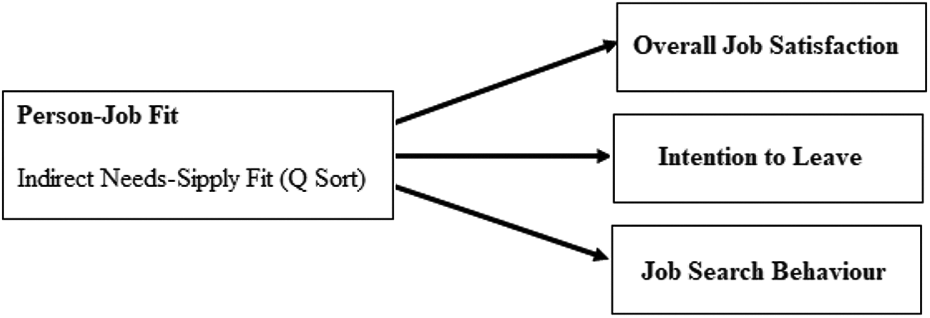
Indirect effects (sample 2).
Methods
Q-methodology
The method of ranking (Q-sorting) items using a 9-point scoring system was established by Block (1978). Q-methodology has been widely applied in a diverse range of studies examining social attitudes and perceptions (Liu, 2015; Watts and Stenner, 2014; van Exel et al., 2015), analyses of learning styles (Hall, 2014), evaluation and development of coaching practices (Bachkirova et al., 2015), and personality differences (Guo et al., 2015; Serfass and Sherman, 2013). In addition, a small number of studies have applied Q-methodology to study person–job fit (see Caldwell and O’Reilly, 1990) and person–organization fit (see Cable and Judge, 1996, 1997; Chatman, 1989; O’Reilly et al., 1991).
Sometimes referred to as Q-sorting, Q-methodology requires respondents to sort (rank) a set of statements, based on whether they agree or disagree. Statements are evaluated in relation to all other statements (Brewer et al. 2000; Hall, 2014; Wigger and Mrtek 1994). As Hall (2014: 190) explains, “this allows Q-methodology to produce an individual’s comprehensive attitude of a topic, while surveys usually only produce separate pieces of information that may contribute to a person’s attitude.” The rankings are correlated and factor analyzed. Q-methodology is an idiographic method (i.e. comparing the relative strength of attributes within a single individual) that requires respondents to rank their subjective experiences, perceptions, and preferences. Correlations between rank orderings are used to manifest the ipsative (intra-individual) significance (O’Reilly et al., 1991).
Procedure
It has been argued that a two-step Q-sort is an effective method to assess content validity for formative constructs (Petter et al., 2007: 639). In this study, we follow a three-stage profile development process. The three stages are described below.
Stage 1: Review of scales
The process began with a literature review of personal and organizational values and cultures to identify descriptors that could be used to characterize job content. Specifically, the identifying principles were that the descriptor should (1) be able to describe any job content, (2) not describe all jobs, and (3) be easy to understand. The most commonly used job characteristic scales in the research literature include Hackman and Oldham’s (1975) job characteristics model, which contains 18 items, and the Michigan organizational assessment questionnaire for measuring task, job, and role characteristics, which consists of 49 items (Seashore et al., 1982). Using these scales, an initial job characteristics profile was created. This included an initial pool of 67 person–job fit descriptors. Although we cannot be certain that we have totally eliminated all social desirability effects, we draw on O’Reilly and colleagues (1991) work, to ensure as much as possible that items were phrased in neutral terms.
Stage 2: Descriptor identification
To screen the item pool in preparation for the pilot study, three criteria were followed: generality, readability, and non-redundancy. In an earlier study of person–organization fit, O’Reilly et al. (1991) used four selection criteria: generality, discriminability, readability, and non-redundancy to assess items. However, the definitions for “discriminability” and “non-redundancy” were judged to overlap. Therefore, this was reduced to three main criteria. To establish the content validity of the profile, a pilot study was conducted (stage 3).
Stage 3: Pilot study
Prior to developing the quasi-normal distribution of the job characteristics profile, as Q-methodology requires, the 40-item pilot study table (from Cable and Judge, 1996) was condensed into a 25-item job characteristics profile to make it more manageable. During this process, 10 experts, six practitioners, and four scholars were invited to participate in a pilot study. The goal was to gather 10 organizational experts’ collective opinions to select the 25 most appropriate job characteristic descriptors for our eventual job characteristics profile. The 25 job characteristic descriptors can be found in Appendix 1. Using a voting system, the 10 organizational experts were asked to identify 25 critical descriptors according to the selection criteria. Using the selection criteria of “generality,” “readability,” and “non-redundancy,” all of the descriptors that received at least five votes were adopted. On the basis of the experts’ votes, a 25-item job characteristic profile measuring N-S fit was established.
Sample and data collection
In total, data were collected from two samples of full-time employees working in 365 companies located in Taiwan. In the first survey (sample 1), data were collected from 99 companies, and in the second survey (sample 2), data were collected from 266 companies. Once companies had agreed to participate in the study, questionnaires were distributed to human resource managers (not respondents’ line managers or department colleagues) who were asked to distribute the questionnaires to employees in their company. Employees completed the questionnaires anonymously and returned them in anonymized envelopes directly to the HR manager. Surveys were then collected from the HR manager by a member of the research team. Respondents were reassured that they would not be identifiable in the reporting of the data.
Data from the first survey (sample 1) were used to investigate the correlations between the direct and indirect measures of N-S fit. In the first survey, 130 questionnaires were distributed across 99 companies, and 102 questionnaires were returned by post and e-mail. There were nine uncompleted questionnaires, resulting in a valid sample of 93. Over 80% of employees in the valid sample were below 40 years of age; 89% of respondents had been employed in the company for 10 years or less; and 55.6% had been employed for between 1 and 5 years. Over 90% of employees in sample 1 are educated to bachelor degree level, and 34.3% hold master’s-level qualifications. More than half of respondents studied business-related subjects. With regards to job position, 63% of the samples were employed in administrative roles, and 26.5% were employed in management positions.
In sample 1, 29% of respondents were employed in companies employing up to 500 employees; 24% were employed in companies employing 501–1000 employees. Almost one quarter of respondents (22%) were employed in companies employing over 5000 employees. Companies included in sample 1 represented a number of different industries. The majority of companies were in manufacturing (25.3%) were in manufacturing or service industries (40.4%); 19.2% of companies in manufacturing report being in hi-tech manufacturing. Of those in the service industry, 29% are in financial services, 20.2% general service, and 11.1% are in the high-tech service sector.
Data from the second survey (sample 2) were used to test the correlations between the indirect N-S fit score and employee outcomes. In sample 2, 573 questionnaires were distributed across 266 companies. Of these, 261 questionnaires were deemed valid, and 20 uncompleted questionnaires were eliminated. Over 61.4% of this sample are female; 66.3% of respondents were between 21 and 30 years of age; and 22.6% were between 31 and 40 years of age. The majority of the sample (43.4%) had 1–5 years of tenure. The majority of respondents (84%) are educated to bachelor level, and 21.7% to master’s degree level; 58% of respondents graduated in business and management-related subjects. Almost half (49.8%) were office based, and 21.8% of sample 2 work in sales and marketing. In sample 2, 21.1% of respondents were employed in companies employing up to 500 employees, and 13.4% were employed in companies employing 501–1000 employees. Over one third (38.3%) of respondents were employed in companies employing over 2000 employees. As with sample 1, companies from different industries were represented. The majority were from the financial services industry (29%) and hi-tech manufacturing (20.7%).
Indirect N-S fit
A profile comparison process was used to examine N-S fit between the individual and their job (Caldwell and O’Reilly, 1990). In accordance with Caldwell and O’Reilly (1990), respondents were asked to sort the 25 descriptors into nine categories. Participants were asked to rate the importance of each job characteristic in terms of how important they felt the characteristic was for successful performance in their job. Using a 9-point scale, answers ranged from “most desirable” to “most undesirable” (O’Reilly et al., 1991: 496). Following this, participants were asked to rate the same characteristics according to their preferences. As before, these were rated on a 9-point scale from “most desirable” to “most undesirable.” Answers were ranked into a normal distribution. According to Caldwell and O’Reilly (1990: 649), asking raters to arrange items into a specified Q distribution “offers substantial advantages over a free, or unforced, rating scheme.” The consistency of the Q-sort rankings was assessed by examining the correlations among the individuals with a variation of the Spearman–Brown normal prophecy formula. After comparing the rankings, indirect N-S fit was calculated using the correlation index of Q-methodology. A single respondent example of a Q-sort profile can be found in Appendix 2.
Survey measures
Direct N-S fit
The original scale for direct person–job fit was created by Cable and DeRue (2002). In this study, N-S fit was measured using 3 items in the direct scale, including “The attributes that I look for in a job is fulfilled very well by my present job.” Cronbach’s α for the direct N-S fit scale was 0.866.
Job satisfaction
This instrument for measuring job satisfaction was developed by Taylor and Bowers (1972) and consisted of 7 items, including the following sample item: “All in all, how satisfied are you with your job.” The scale reliability was 0.854.
Intention to leave
A 4-item instrument adopted by O’Reilly et al. (1991) was used to assess intention to leave, including the following sample item: “How long do you intend to remain with this organization.” Cronbach’s α for this scale was 0.894.
Job search behavior
The Job Search Behavior Index (JSBI) is a validated instrument that is claimed to have superior temporal stability because respondents are less likely to report their “undoing” of behavior rather than changing their intentions (Kopelman and Rovenpor, 1992). The following is a sample item for job search behavior: “Talked to co-workers about getting a job in another organization.” Tests of the reliability of the JSBI found that Cronbach’s α was 0.770.
Results
Tests were conducted to ascertain the content validity of the job characteristic profile. The results of the criterion-related test showed that the job characteristics profile has substantive validity.
Survey 1: Indirect versus direct N-S fit measure
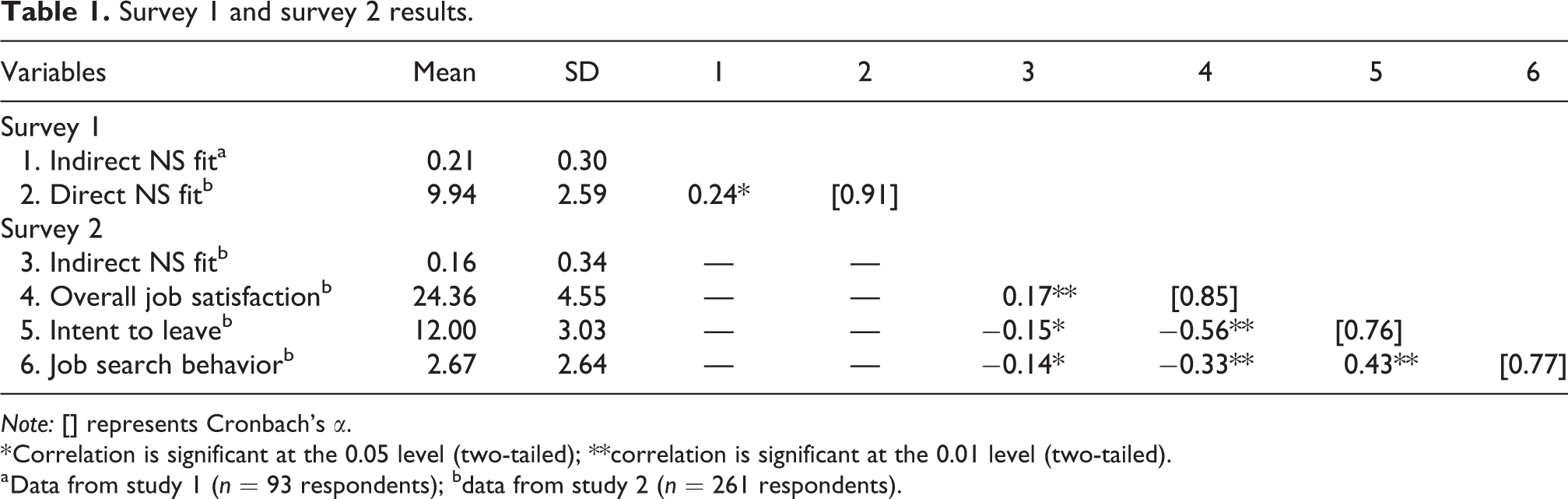
The direct and indirect measures identically assessed the N-S fit of general employees, but from different perspectives. It was anticipated that the correlations between the indirect and direct measures of N-S fit would have a medium effect. Thus, the direct measures of N-S fit were used as the first criterion to confirm the criterion-related validity of the job characteristics profile. As presented in Table 1, the correlation between the indirect and direct measures of N-S fit was moderately significant (r = 0.24*, p < 0.05). This significant correlation indicates that the job characteristic profile had reasonable validity.
Survey 1 and survey 2 results.
Note: [] represents Cronbach’s α.
* Correlation is significant at the 0.05 level (two-tailed); **correlation is significant at the 0.01 level (two-tailed).
a Data from study 1 (n = 93 respondents); bdata from study 2 (n = 261 respondents).
Survey 2: Indirect N-S fit scores versus work-related outcomes
To further strengthen the criterion-related validity of the job characteristic profile, the second correlation analysis tested the relationship between the indirect N-S fit measure and work-related outcomes. The results from Table 1 reveal that the job characteristic profile had reasonable validity. With regards to job satisfaction, previous studies suggest that person-job fit has a positive influence (Cable and Judge, 1996; Kristof, 1996; Kristof-Brown et al., 2005). The results show that indirect N-S fit was significantly associated with overall job satisfaction (0.16**).
Indirect N-S fit was negatively, but significantly, correlated with intention to leave (−0.15**). The results also show that N-S fit influenced job search behavior negatively, but significantly (−0.14**). This strengthens the argument that if an employee cannot successfully fit into his or her work environment, it is highly possible that the employee will feel less satisfied and wish to leave (Becker and Billings, 1993; Kristof, 1996). Intention to leave and job search behavior had moderately significant correlations with N-S fit. This finding implies that an employee is likely to develop intentions to leave an organization and search for another job if the individual does not feel their needs are met by the job. However, it should be noted that other factors that might weaken the influence of person–job fit could also affect intentions or actual behavior (e.g. tenure, age, and payment).
Discussion and conclusions
Overall, the results provide strong support for the content validity of the job characteristics profile and the generalizability of the relationships tested. As Dörendahl et al. (2020) observe, previous studies have found that job satisfaction is enhanced when a fit between need and supply is present. Our findings support this link, showing that indirect N-S fit was significantly associated with overall job satisfaction. This finding confirms what was hypothesized, based on findings in Kristof-Brown et al., (2005), Cable and DeRue (2002), Wang et al. (2011), and Liu et al. (2015). Our findings also support previous studies in which it has been suggested that N-S fit can affect career-related intentions (e.g. Cable and DeRue, 2002). Our findings, in the context of Taiwan, corroborate similar findings in other cultures (e.g. Boon and Biron, 2016; Wang et al. 2011), helping to build knowledge of the generalizability of theory in this area. We also present findings that align with Bretz et al.’s (1994) theoretical argument that two forces, push and pull forces, will motivate job search behavior. In line with this argument, our findings suggest that as employee perceptions of N-S fit decrease, this leads to job dissatisfaction, a negative perception of the employee’s job (push force) and a greater degree of perceived fit with other jobs (pull force). Our findings support the argument that, via push and pull forces, individuals will develop a desire to search for new job opportunities when N-S fit is low.
We make several contributions to the N-S fit literature (and the person–job fit literature in general), including knowledge of how positive perceptions of N-S fit relates to desirable workplace attitudes and behaviors. As mentioned previously, when seeking to understand what motivates humans, Husserl (cited in Lopez and Willis, 2004) argued that subjective interpretations are important, largely because what is perceived to be real affects human actions. In this study, by using Q-Methodology, a mixed methods approach (Lundberg et al. 2020), we show how these subjective interpretations can affect behavior. By asking employees to reflect on both what they feel is supplied and the extent to which they feel their needs are met, we have explored employees’ own perceptions of congruence between the needs and supply components of person–job fit. Our findings suggest that work attitudes and job search behavior has a significant relationship with N-S fit perceptions (held by employees) and a strong correlation with the work-related outcomes tested in this study. These results suggest that employee assessments of N-S fit influence work attitudes and behaviors. While our findings are not conclusively indicating causality, we postulate that poor work attitudes cause employees to spend time and energy searching for alternative jobs, which could lead to the employee eventually leaving the organization. This can result in costs for the organization and disruption. However, if employees feel they have a high degree of N-S fit, they may be more satisfied and stay employed in the organization for longer. This can create more stability and have longer term positive effects, for both the individual’s career and the competitive advantage of the team and organization he or she belongs to. Our findings highlight that, in addition to demand–ability fit (as mentioned in the research literature), it is very important for managers to analyze and closely consider employee beliefs about N-S fit (e.g. during performance reviews). This can also be extended to expectations of prospective employees (e.g. during the recruitment process). An individual’s desires, needs, and “fit” perceptions (regarding the required knowledge, skills, and abilities) can impact considerably on how the individual thinks, feels, and behaves when employed in a job role.
There are several valuable points that can be made with regards to the methodology adopted in this study. The creation of the job characteristics profile deepens the study of N-S fit and associated workplace effects and facilitates research wishing to build on this approach. In contrast to using direct measures, the development of the job characteristics profile and Q-sort ranking method has made the elusive and ambiguous concept of N-S fit more transparent. The original 67-item job characteristics profile was transformed into a 25-item profile and validated, becoming more convenient for both researchers and respondents.
Limitations
Effort was made to reduce the size of the survey (the 67-item job characteristics profile was transformed into a 25-item measure); however, the response rate in survey 2 was lower than anticipated. It is possible that the valid return rate from survey 2 was below 50% (46.77%) because of fatigue. Regarding the geographical location of the study, Guan et al. (2010: 258) observe that, “previous findings on the relations between person-job fit and work-related attitudes have been established mainly among employees from Western cultures.” In their study of Chinese employees, Guan et al. (2010: 258) find empirical evidence to suggest that P-J fit, job satisfaction, and turnover intention relate in similar ways in Asian cultures as they do in western cultures. We encourage future researchers to consider the cultural and geographical factors which may limit or influence the generalizability of the findings presented in this study.
Practical implications
In this study, a new indirect measure of the N-S component of person–job fit is developed and validated. The findings we present suggest it is of practical importance to assess the congruence between an employee’s perceptions of what he or she needs in a job and perceptions of what the job supplies. We would like to highlight that these perceptions may be subjective, may not reflect reality, and may not be obvious. They may even be unexpected. The findings suggest that an employee’s subjective interpretations of what they think they need and what is supplied affect both job satisfaction and job search behavior. We therefore suggest, based on these findings, that managers integrate into day-to-day management and performance management processes close attention to what employees feel they need and what they feel is supplied. Communication on these feelings could help improve perceptions of N-S fit, especially in cases where employees are reluctant to express their feelings without being asked. Sharing knowledge of workplace opportunities, transparent explanations and clear justification when decisions are made, managing and maintaining realistic expectations of what the organization can and cannot provide may help employee stay aware of what the organization is doing to meet their needs. Finally, these findings indicate that it is very important for managers to engage in detailed conversations during the recruitment process about what exactly employees do feel they need and how the organization can or cannot meet these needs. Higher levels of person–job fit and person–organization fit may then be achieved, possibly reducing potential problems relating to unmet needs.
Future research
A number of possible directions for future research are suggested. First, further validation of the job characteristics profile into different languages would be helpful in advancing research in this area. An English version of the job characteristic profile (including 25 job characteristic descriptors) is provided in Appendix 1 to support research by other (non-mandarin speaking) researchers. We also acknowledge that there could be some room to cut down and reduce the 25 items further. Potentially highly correlations may occur between some several pairs of items. We note that “High entry barrier” and “High level of education,” “Clear responsibility” and “Specific Tasks,” “Being specialized” and “High involvement,” and “Variety of skills and abilities” and “Fully using skills.” Further development could be considered.
Second, it is recommended that researchers develop validity tests and apply alternative criteria. In addition to the two types of criteria used in this study, the job characteristics profile can be tested through pre-entry outcomes such as job choice decisions, job application intentions, and recommendations to hiring. Furthermore, while there is evidence to support the assertion that N-S fit can lead to an intention to leave, few studies focus on this rationale. Future research, examining such questions, would be useful in building on the results presented in this study.
Footnotes
Declaration of conflicting interests
The author(s) declared no potential conflicts of interest with respect to the research, authorship, and/or publication of this article.
Funding
The author(s) received no financial support for the research, authorship, and/or publication of this article.
