



Abstract
Bridging government involvement and business sustainability, particularly in manufacturers, is becoming a new research interest. To enrich this knowledge area guided by the Institutional Theory, this study builds a multiple mediation model to investigate the effect of environmental regulation on business sustainability by concerning on the chain mediation effect of green organizational identity and sustainable exploration/exploitation innovations. China’s manufacturers that are a key component of emerging markets have been analyzed by this study because of their significant impacts on climate change, substantial contributions to the boom of industries, and distinctive governance structures. By investigating China’s manufacturers such as shipbuilding, energy, food, and daily necessities manufacturing sectors, we witness that the relationship between environmental regulation and business sustainability could be positively subsequently mediated by green organizational identity and sustainable innovation. While this identity does not exercise a positive mediation between environmental regulation and business sustainability significantly. Furthermore, both sustainable exploration/exploitation innovations exercise a significantly positive mediation between green organizational identity and business sustainability. We therefore conclude that manufacturers of emerging markets need a thoughtful deployment in pro-environmental psychologies and behaviors to closely bridge environmental regulation and business sustainability instead of only concerning on one aspect. This study has significant implications for emerging markets constructing a comprehensive as well as systematic pro-environmental path by using the merit of Institutional Theory to enhance business sustainability with more standardized and professional ways.
Keywords
Introduction
Recent literature indicated that an enduring and situational government involvement could affect firms’ energy use and environmental protection efficiency (Wang et al., 2019; Zhang et al., 2020), while it needs a sustained concern on how much government involvement as an external indicator could be progressively developed into business sustainability. From the perspective of general operations management, the effect of government involvement (e.g. industrial policy) on firms’ total operations management has also not well understood (Spring et al., 2017). For this reason, firms may puzzle about how to use merits of government role to create broader competitive edges, particularly in the business sustainability area where a great effort should be devoted to the ecological sphere. Furthermore, in manufacturing firms and in emerging markets, policy priority in relation to business sustainability was also analyzed and seen as a crucial way to improve such sustainability (Haque and Ntim, 2018; Li et al., 2019).
Worldwide, how to mitigate climate change caused by less environmentally friendly business actions is bothering firms’ decision-makers, policy-makers, and scholars for years (Fernández et al., 2018). Recently, more and more government sectors have made a commitment to achieve a sustainability of pillar industries by issuing various environmental regulations (Carrillo-Higueras et al., 2018). In this context, scholars are reaching a consensus around suggesting multi-stakeholders’ joint efforts for business sustainability. In this proceeding, manufacturers as a backbone of economic boom have been recommended to involve in global sustainable development by adding new ecological knowledge, for example, building a green business organization by enhancing internal stakeholders’ pro-environmental psychology and relevant behaviors (Banerjee and Gupta, 2017; Papagiannakis and Lioukas, 2012; Turkson et al., 2020).
The Institutional Theory, evidenced by above global contexts, provides a new insight into the formation of business sustainability. It could be known that top managers are attempting to deal with the antecedent of business sustainability in an institutionalized way to enhance the standardization of such sustainability. When it comes to an issue relevant to business sustainability such as corporate social responsibility (CSR), the Institutional Theory has been recommended as a sensible guidance in exploring the boundary between business and society in different ways because the institutional feature of business governance is becoming more prominent (Brammer et al., 2012). Inspiringly, we organize the research thinking of the relationship among antecedents of business sustainability that the Institutional Theory could be touched (including the policy/law, psychology behavior, etc.). Business sustainability, which is a system engineering, is a pervasive management concept that incorporates business practices into firm performance indicators in relation to economic, ecological, and social spheres. Different from traditional operations management, the business sustainability requires a unique perspective on the ecological sphere, suggesting firms devoting more time/energies to deal with ecological problems (da Silva et al., 2020; Gimenez et al., 2012; Tang and Zhou, 2012; Turkson et al., 2020). Judging from this, it could be also said that ecological sphere is a watershed between traditional and sustainable operations management. There is a substantial body of literature concentrating on the relationship between environmental policy and manufacturers’ comprehensive performance (Ji et al., 2017; Xie et al., 2019; Zhang and Wen, 2008), and it has also been figured out that the effect of mandatory and voluntary environmental regulation will vary with the urgency of firms in achieving their sustainability (Meng et al., 2013). Although environmental regulation is sometimes seen as a mandatory power targeting at business sustainability, some key internal indicators, for example, green organizational identity, environmental commitment, and dynamic capability, could in turn provide incentives for mitigating this regulation stress (del Río González, 2009; Ramanathan et al., 2017). For example, the conceptual model of Ramanathan et al. (2017) considers environmental regulation, innovation behavior, and financial performance. Moreover, the innovation behavior relevant to business sustainability has been divided into sustainable exploration innovation and sustainable exploitation innovation (Maletič et al., 2014, 2016). Furthermore, it is remarkable that from the perspective of environmental psychology, the subsequent pro-environmental behavior is often deviated from personal environmental attitudes/values/perceptions, which could be also interpreted by the Institutional Theory. As a result of this, this theory is adapting to environmental change and is reshaping and modifying the development venation of environmental governance (Gao et al., 2019; Hotimsky et al., 2006).
Green organizational identity, which is a key concept in the knowledge area of environmental psychology, refers to an interpretation mode established to give a certain profound significance to firms’ environmental governance. This identity embodies internal stakeholders’ understandings of building a green organization based on the perceived reputation, image, and brand that should be in line with the long-term planning on greenization proceeding of business sectors (Song and Yu, 2018; Song et al., 2019). Contrapuntally, green organizational identity motivates organizational members to invest new knowledge area into the ecological sphere, while less literature concerned on the effect of environmental regulation on such identity, and there is still a lack of possible mediation paths of this identity between environmental regulation and sustainable innovation. Recently, sustainable innovation was respected to provide a new insight into niche-regime that proves that firms are in a transition period of coordinating economic–ecological–social spheres. At the same time, the literature guided by the Institutional Theory applied institutional strategies to maximize the value of sustainable innovation (Smink et al., 2015). By separately or concurrently using sustainable exploration innovation and sustainable exploitation innovation, manufacturers will create new competitive edges with a fall of energy/resource consumption and Greenhouse Gas emissions (Maletič et al., 2016). However, the role of these two types of innovations was affected by regional and industrial heterogeneity, and the following literature organized a timely and insightful analysis around the distinctive effect of these two types of innovations on business sustainability. While prior literature was still controversial around what type of innovation could contribute more to business sustainability (Maletič et al., 2018). Furthermore, it has been problematic that if such new innovations have brought manufacturers a robust sustainability performance.
Inspired by the proceeding from personal psychology to his/her climate-friendly behavior guided by the Institutional Theory, this study expands prior literature by organizing a logical thread from environmental regulation (an external actor), green organizational identity (a pro-environmental psychology), sustainable exploration/exploitation innovations (a pro-environmental behavior), and business sustainability (a type of behavioral consequence). This study aims to analyze when environmental regulation emerges, how this external actor could be evolved into business sustainability via internal stakeholders’ green organizational identity and sustainable exploration/exploitation innovations, that is, building a multiple mediation effect test, thereby drawing out how radical and moderate innovations lead to a business outcome with sustainability characteristics.
In doing so, this study will be able to address the aforementioned knowledge gap from following aspects. First, we expand prior literature around how environmental regulation evolves into business sustainability by developing a multiple mediation analysis framework that integrates pro-environmental psychology and pro-environmental behavior. As such, it depicts a progressive behavior evolution process, that is, government involvement → pro-environmental psychology → pro-environmental behavior → behavior consequence with sustainability characteristics, responding to the development trend of the Institutional Theory that adapts to a broad environmental change by issuing a new institutional arrangement. It is seen that prior literature less concerned on this whole proceeding derived from the initial driver of government involvement, which leaves a question around how the green institutional framework will be developed in multi-types of firms. Therefore, this study firstly contributes to the Institutional Theory by adding knowledge of the relationship between policy institution and business institution, thereby proposing a new theoretical construct focusing on firm institution as mediation variables particularly when there are some obstacles for firms to carry out environmental regulations. This contribution brings a new insight into how the manufacturers of emerging markets improve business sustainability in case of policy being issued and then makes a recommendation for enhancing the effect of internal and external institutional architectures. Second, this study contributes to build a dual evolution path targeting at the mediation effect of sustainable innovation, aiming to clarify what type of innovation more significantly enhances business sustainability driven by external policy/law and internal stakeholders’ psychology. As exploration strategy and exploitation strategy have a difference even in opposition in their implementing mode (Luger et al., 2018; Sharma et al., 2018), this study reveals what type of innovation more robustly responds to the driving effect of environmental regulation and green organizational identity. We would like to remind top managers to make a trade-off of these two innovations rather than blindly pursue only one type, which will be extended to general management because: (1) Most firms are looking for a way to reach their business sustainability; (2) The change in external environments triggers internal stakeholders’ psychological reactions that may breed new and groundbreaking innovation behaviors. It is thus clear that in a broad business system, adhering to sustainable innovation in a moderate way will become a normal. Third, to manufacturers of emerging markets, they need to put in more efforts or be more prepared for business sustainability than developed markets in general because of a less-mature market environment and government involvement they are facing (Yao et al., 2020). Because of the global acceptance of business sustainability and a great influence of China’s Belt & Road Initiative (Huang, 2016), systematic practices aiming at the sustainability of China’s manufacturers could set a benchmark for other emerging markets. Furthermore, the right and responsibility of firm and government usually have a tug of war in the ecological sphere, for example, how government involvement responding to the demand of different types of firms. From this point of view, this study contributes to a various and novel business sustainability mode, and therefore explain in emerging markets, what are the necessary conditions for manufacturers where are with a characteristic of environmental pollution to achieve a synergism between government involvement and business sustainability. Aiming at a broad general management, we will figure out what manufacturers should do to enhance the role of external and internal institutional strategies in business sustainability.
The rest of this study is organized as follows. After this introduction, the second section reviews relevant literature and therefore develops our research hypotheses to expand the boundary of existing knowledge. The third section introduces the research methodology. The fourth section shows and analyzes empirical findings. The fifth section proposes theoretical, managerial, and international implications based on our key findings. The sixth section concludes this study and illuminates directions for future research based on possible limitations.
Literature review and hypothesis development
The Institutional Theory as relevant to business sustainability
It has been argued that there needs a trade-off and synergy in the distribution of right and responsibility between public authority sectors and industrial sectors recently so as to efficiently use scarce resources to mitigate the fragmentation of decision-makings (Laspidou et al., 2020). This argument shows that the use of institutional strategy from government and firms should be in a state of harmony. Recent literature, for example, Haque and Ntim (2018), built a theoretical framework linking environmental regulation, governance mode, and environmental performance. These analyses illuminated firms’ institutional strength aiming at a more robust business governance mode. Inspired by recent findings, this study signalizes firms’ total institution design for business sustainability led by green organizational identity as an institutional architecture at the field of vision of personal psychology. Guided by the Institutional Theory, top managers could construct a reasonable channel promoting business prosperous by culture, social change, regulation, tradition/history, and incentive (Glover et al., 2014). In this proceeding, an integral step is pushing an embedment of external factors into firms’ institutional framework.
Environmental regulation, which is defined as using environmental policies to construct a management standard, is to reduce the negative effect of less climate-friendly behavior on ecological sphere (Greenstone and Hanna, 2014; Rubashkina et al., 2015). As the negative effect of firm on climate change is still obvious, environmental regulation as a robust governance tool was figured out to enable the resources input in the sustainable innovation area (Ashford and Hall, 2018; Horbach, 2008). Furthermore, such regulation helps enhance the visibility of environmental governance because firms will be full of passion to take an initiative step in their sustainability by climate-friendly policies (del Mar Alonso-Almeida et al., 2014; Ji et al., 2017).
With respect to green organizational identity as a crucial internal institutional norm at the psychological level, it is usually jointly built by all internal stakeholders and seen as a settlement to improve sustainability performance (Soewarno et al. 2019). Another key piece of evidence to prove the institutional arrangement aiming at green organizational identity is that it affects the innovation via environmental commitment. In other words, such psychology is being brought into a normative institutional framework by top managers, which could be also defined as establishing a legitimacy of environmental governance in firms (Chang and Chen, 2013; Soewarno et al., 2019).
Besides recent literature concerning on the priority of climate change policy in industries (Li et al., 2019), this study also benefits from prior literature regarding the Institutional Theory that reveals the relationship between institutional governance and business sustainability. By this way, external institutional strengths together with firms’ internal governances to inform top managers’ responses at the strategic level were also elaborated (Heugens and Lander, 2009; Oliver, 1991, 1997). Holistically, the Institutional Theory has been seen as a promising guidance to address firms’ sustainability problems by building sustainable governance modes. As such, this theory helps interpret why firms’ behaviors are becoming isomorphic/heteromorphic (Kauppi, 2013). Recent literature also applied this theory to explain the differentiation and conformity of strategic resources, and policy priority in reducing firms’ sustainability risk was clarified as well (Zhao et al., 2017; Zhang et al., 2018). Therefore, the institutional architecture is powerful to lead firms’ operations management to focus on sustainability issues. For this reason, we progress the theoretical expansion based on the Institutional Theory applied in government involvement and personal psychology/behavior norm in firms to emphasize their bridges with business sustainability.
Sustainable exploration innovation and sustainable exploitation innovation
The existing literature theoretically and empirically investigated sustainable exploration innovation and sustainable exploitation innovation following the “exploration-exploitation” research paradigm as well as the theories relevant to business sustainability, aiming to harmonize firm development and environmental governance (Maletič et al., 2014, 2016). Specifically, sustainable exploration innovation tells of a radical innovation mode targeting at creating new business opportunities, for example, intensively carrying out environmental governance actions over products/services’ life cycle. By contrast, sustainable exploitation innovation indicates an incremental innovation mode suggesting moderately and sustainably carrying out innovation actions for business sustainability instead of taking a drastic behavioral change (Brix, 2020; Lennerts et al., 2020; Maletič et al., 2016, 2018).
Both these two sustainable innovations are to build a congenial atmosphere in economic, ecological, and social spheres (Schaltegger et al., 2013), while their relationship and their effect on business sustainability also differ with a volatility of external indicators, for example, market competitiveness intensity, policy orientation, and geographical location (Brix, 2020). Furthermore, the research guided by the Contingency Theory also achieved a similar finding (Maletič et al., 2018). It appears that there exists a controversy in relation to not only the development of sustainable innovations but also their effects on business sustainability. Moreover, adding a contextualization is very wise to accurately define the real value of sustainable innovation because quite a few studies argued that the innovation happening in firms should be reconciled with external actors (Behnam et al., 2018; Brem et al., 2020; Kim, 2015). Accordingly, it requires an insightful investigation for their relationship by embedding different contextual factors. From the perspective of general management, it awakens scholars’ thinking that the rise of sustainable innovation with its antecedents and consequences points out a clear way around how to root the innovation philosophy into firms’ total sustainability, thereby adding the existing literature in the knowledge area of a broader innovation configuration in relation to its likely effect. At the same time, we would like to remind top managers to coordinate the need for these two sustainable innovations to advance theoretical understanding of manufacturers by making a breakthrough in the bottleneck of innovation.
Research hypotheses development
To robustly organize our research hypotheses development and empirical analysis, we firstly summarize recent literature relevant to the relationship between government involvement and business sustainability particularly focusing on the contextual analysis. Following this research clue, it could be seen that clarifying the transmission pathway from environmental regulation to business sustainability is a concern worldwide. Therefore, this study progresses the research hypotheses development aiming at the possible relationship of key variables by the analysis frame as follows. First, we present an overview of government involvement and business sustainability (see Appendix 1). By analyzing Appendix 1, we will learn that recent literature explained how government involvement generates an evolution path to business sustainability. At the same time, these literature clarified several valuable paths interpreting how government involvement evolves to business sustainability where are required to make a significant and practical contribution. Based on these prior literature, this study then examines the possible mediation effect of green organizational identity and sustainable innovation. As explained in the Introduction, it is questionable if an evolution of environmental regulation to business sustainability needs firms to provide a solid safeguard measure in manufacturers of emerging markets whose market status is less-mature. Therefore, this study will interpret if external actors have a substantial effect on business sustainability when manufacturers have a profound understanding as well as a sufficient resources reserve.
The mediation effect of green organizational identity
The progress of firms addressing ecological problems breeds the concept of green organizational identity deriving from the organizational identity. This identity could help firms’ internal stakeholders understand the link between management goal and action taken accordingly, thereby creating a green competitive edge. Green organizational identity incorporates ecological issues into personal psychological cognition that any behavior relevant to environmental governance deserves an energetical encouragement (Chen, 2011; Song et al., 2019). Confronted with a strict environmental regulation, firms are more inclined to alter themselves to avoid the unnecessary environmental cost in general (Situmeang et al., 2016). Therefore, environmental regulations issued by the government will give an insightful understanding of firms’ internal stakeholders around the importance of building a strong green awareness, which is also interpreted by earlier literature (Porter and Van Der Linde, 1995).
Further, the practice in sustainable innovations aiming to address ecological problems not only requires more types of invested resources for improving products/services quality and technical capability but also suggests investing climate-friendly production factors. Green organizational identity, which is an emerging psychological concept appearing in business areas, aims to enhance the acceptance of internal stakeholders in relation to the ecology as well as other sustainability-oriented issues. Furthermore, such identity enables stakeholders to better understand green culture and then involve in supporting actions. As an effective way that could mitigate the dual-pressure in firms’ economic and ecological spheres, sustainable innovation is being embraced by an increasing number of firms (De Roeck and Farooq, 2018; Song and Yu, 2018). Taken as a whole, the stakeholders with a higher level of green organizational identity would take an initiative to improve the greenization of whole organization, and they would also integrate and leverage knowledge and technology into the rise of productivity.
Based on above analysis, we predict that environmental regulation positively affects green organizational identity, and such green propensity then inspires firms to sustainably carry out innovation actions. Further, different types of sustainable innovations are also expected to improve green innovation performance that includes both greenization and innovation aspects, particularly in manufacturers that will also extend to a broader general management that usually more emphasizes the value of firms’ greenization. Therefore, we hypothesize:
The mediation effect of sustainable innovation
Prior literature indicated that green organizational identity enables to enhance members’ understanding in both greenization and innovation issues (Chang and Chen, 2013). Song and Yu (2018) further suggested a higher level of such identity to keep members highly consistent with firms’ operation goals, and therefore enhance their initiative in the ecological sphere. In hence, green organizational identity could drive internal stakeholders to focus more on business sustainability by involving in sustainable exploration/exploitation innovations. Given that these two types of innovations could help enhance firms’ efficiency in the ecological sphere (Maletič et al., 2014, 2018), we acquire that green organizational identity contributes to the green competitiveness even the whole business sustainability via the mediation effect of sustainable innovation. Therefore, we hypothesize:
The multiple mediation effect of green organizational identity and sustainable innovation
According to H1, green organizational identity may be inclined to play a positive mediation effect in the relationship between environmental regulation and business sustainability, which shows that firms could be driven even motivated by environmental regulation with generating a high level of green organizational identity and then evolving to business sustainability. Further, it usually has a positive relationship between green organizational identity and different types of sustainable innovations (Chang and Chen, 2013). It is clear that H2 and H3 jointly tell that these two sustainable innovations may make a significant contribution to link green organizational identity and business sustainability. Therefore, it could be inferred that green organizational identity and sustainable innovation as crucial components of psychological and behavioral institution construction (as stated above) in firms sequentially actually determine the relationship between external institutional involvement and internal business sustainability.
Following above analysis around our hypotheses development, we argue that environmental regulation concurrently exercise pressure and power to stakeholders’ green organizational identity, thereby triggering an innovation initiative by using exploratory and exploitative methods. Therefore, we finally hypothesize:
The theoretical model
This study therefore arrives at the following conceptual model by drawing together essential components of the theoretical development so far (see Figure 1). Guided by this theoretical model, our empirical findings could signalize how environmental regulation evolves to business sustainability performance via members’ pro-environmental psychologies and pro-environmental behaviors. Our theoretical model contributes to a broader general management such as service industries where also focus on greenization and sustainability issues with an increasingly profound insight of stakeholders’ psychology and behavior research in firms.
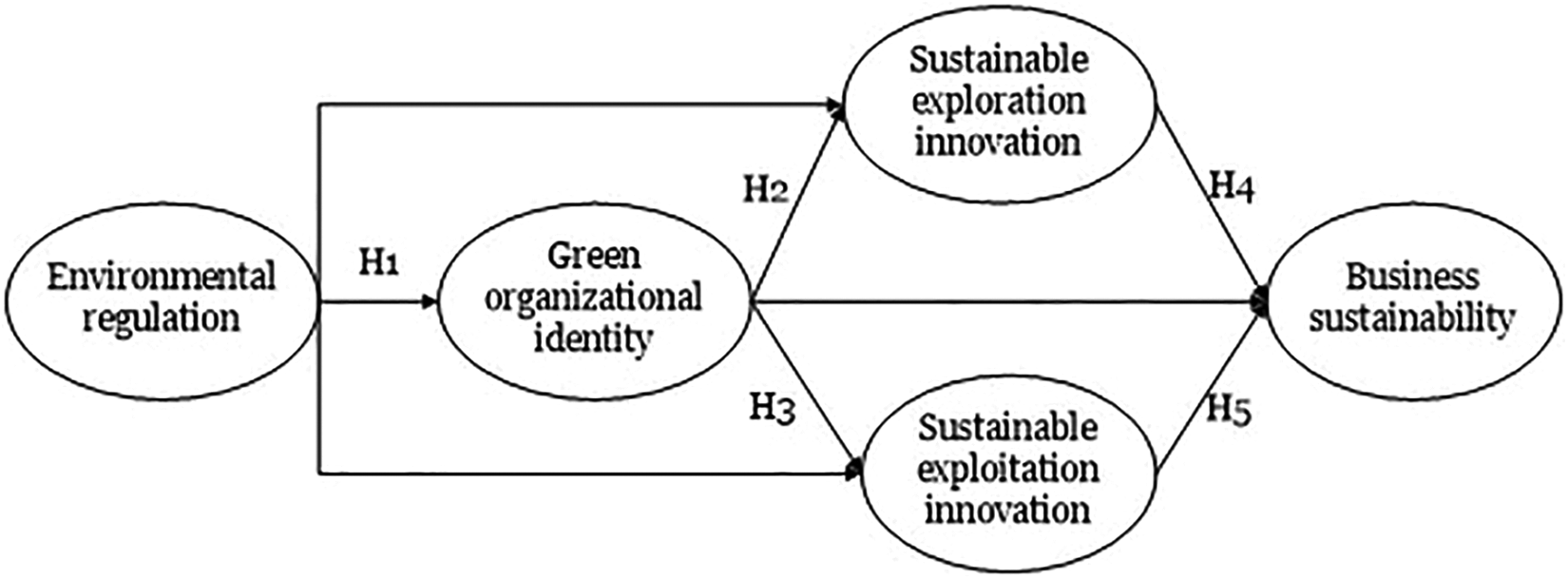
The conceptual model.
Research methodology
Data collection
We survey the data of China’s manufacturing firms that sustainably contribute to global manufacturing network and climate change governance. Motivated by both Made-in-China 2025 and China’s Belt & Road Initiative, there is an increasing focus on the sustainable innovation of China’s manufacturers because of their strong political ties, various channels to resource acquisition, high public concerns in CSR, and a rise of their international status (Maung et al., 2016; Weber, 2014). In such a market, manufacturers’ business sustainability practices may build a bright benchmark for other emerging markets in relation to the ecological sphere. Therefore, our findings strive to provide a robust evidence that aims at the general management around business sustainability, particularly in manufacturing sectors and in emerging markets.
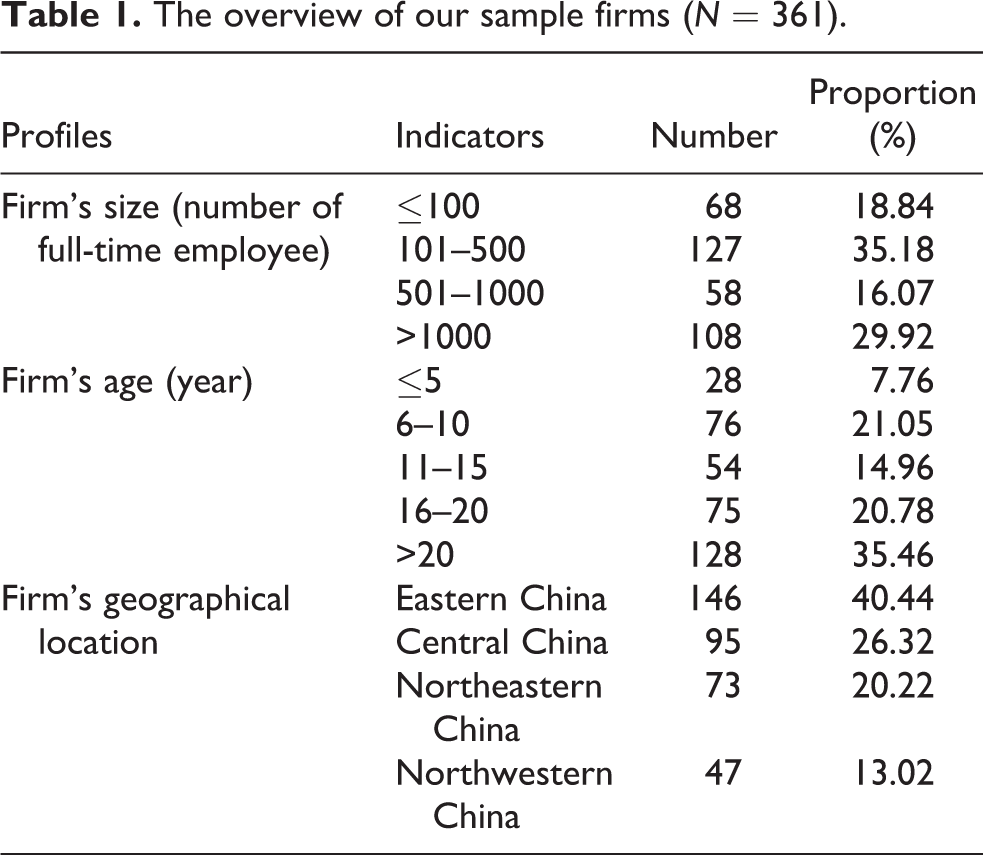
Before our formal survey, we developed a preliminary test targeting at 6 scholars working on the research of industrial sustainability and 10 top managers from China’s manufacturing firms located in Wuxi, Suzhou, and Nanjing, China. Our pretest aims to provide more modifiable spaces for improving the design of formal questionnaire. For normalizing our formal survey, we firstly sent a questionnaire package including a copy of questionnaire, a business card, a personalized letter, a postage-paid envelope with the individually typed return-address label, and a list of research introduction that is available to respondents between September and December 2019. Our surveyed firms are located in Eastern, Central, Northeastern, and Northwestern China. After a careful screening, we selected 700 manufacturing firms and then communicated with their CEOs by phone or email. One key principle we selected the respondent is that he/she enables to answer all our questions smoothly without knowledge barrier. We finally received 552 copies with the collection rate as 78.86%. After screening all collected copies, 191 invalid ones were excluded, and 361 valid copies, which include more than 10 manufacturing sectors (e.g. shipbuilding, energy, machinery, communication device, furniture, food, stationery, and daily necessities, manufacturing), were finally analyzed.
We used the Harman Single test to develop the exploratory factor analysis (EFA) on all possible problem items of our variables and then extracted the factor whose feature value is greater than 1 without a rotation. The EFA results show that the first factors extracted could only interpret 14.63% of all variations (less than 30%), which suggests that our sample data have no significant common method deviation. Table 1 describes the overview of valid sample firms.
The overview of our sample firms (N = 361).
Variables design
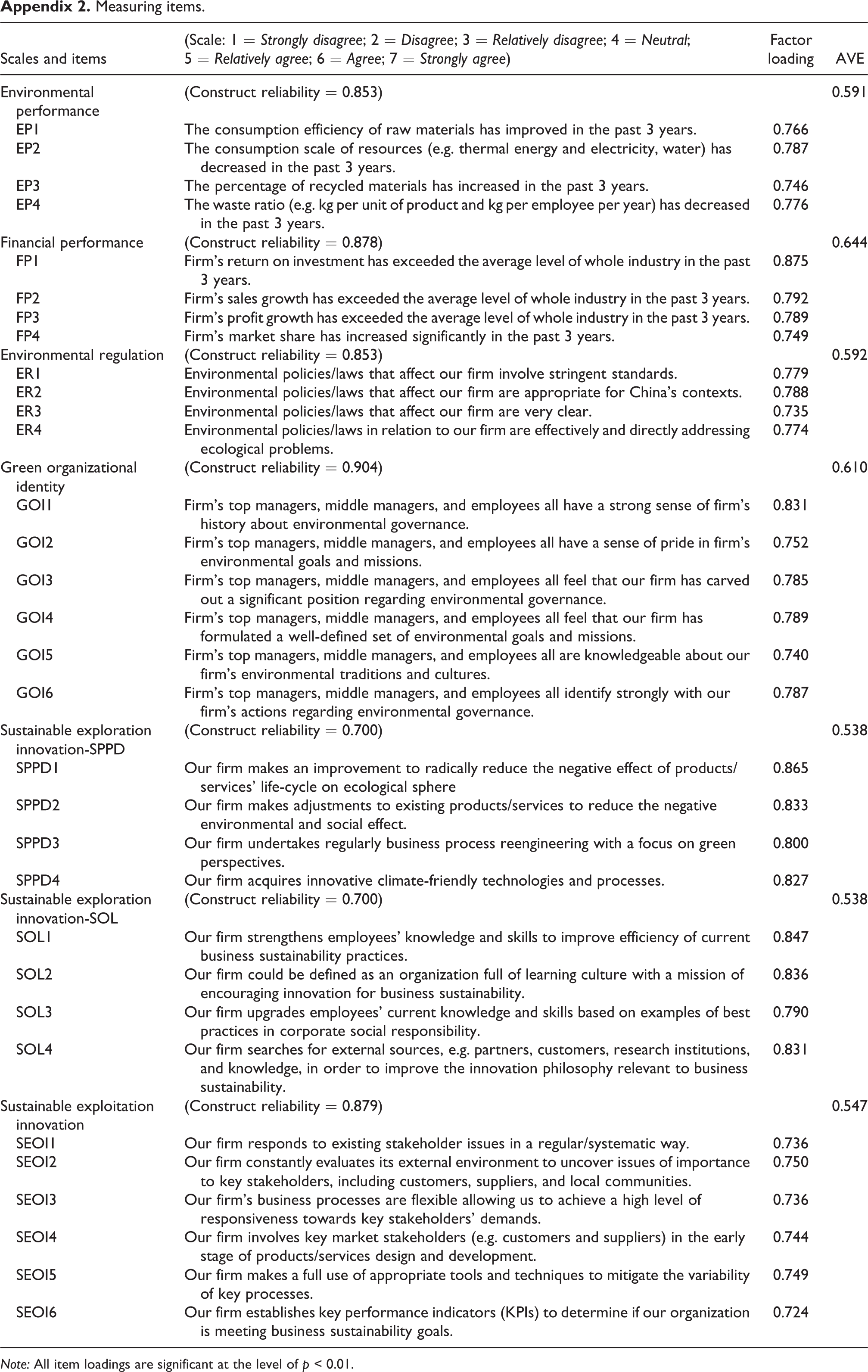
The measuring items of environmental regulation, green organizational identity, sustainable exploration innovation, sustainable exploitation innovation, and sustainability performance were measured by Likert-type scales anchored at 1 = Strongly disagree to 7 = Strongly agree. Following, we introduce the details around the variables design, and all of measuring items are shown as Appendix 2.
Dependent variable
With respect to business sustainability, prior literature has not reached an agreement. Scholars tend to design measuring items contextually because firms’ sustainability goals may be in a state of change. At the same time, a difficulty in measuring this variable is that firms often have their own governance mode with various business streams, functions, and projects (Morioka and de Carvalho, 2016). As the suggestion from Schaltegger and Synnestvedt (2002) and Sueyoshi and Goto (2010), we measure business sustainability from the dimension of environmental performance and financial performance. Specifically, environmental performance was measured by four items based on Maletič et al. (2016) and Maletič et al. (2018). For example, consumption efficiency of raw materials has arrived an increase in the past 3 years. Financial performance was also measured by four items, including the return on investment, sales growth, profit growth, and market share (Danneels, 2008). By the 7-point Likert scale (1 = Very rarely to 7 = Very commonly), respondents were invited to evaluate how successful firms’ financial performance is compared with their major competitors.
Independent variable
Based on the definition of environmental regulation, we measure it by using four items as well. For example, we focus on if environmental laws in relation to our firm are effectively and directly promote the ecological sphere (Eiadat et al., 2008). By the aid of these items, we could clearly demonstrate to what extent China’s environmental regulations on business organizations are highly effective and strict to our knowledge.
Mediation variables
Based on the definition of green organizational identity we mentioned above, it could be measured by six items derived from prior literature. For example, to what extent do top managers, middle managers, and employees all have a strong sense of firms’ history or experience around the ecological sphere (Chen, 2011).
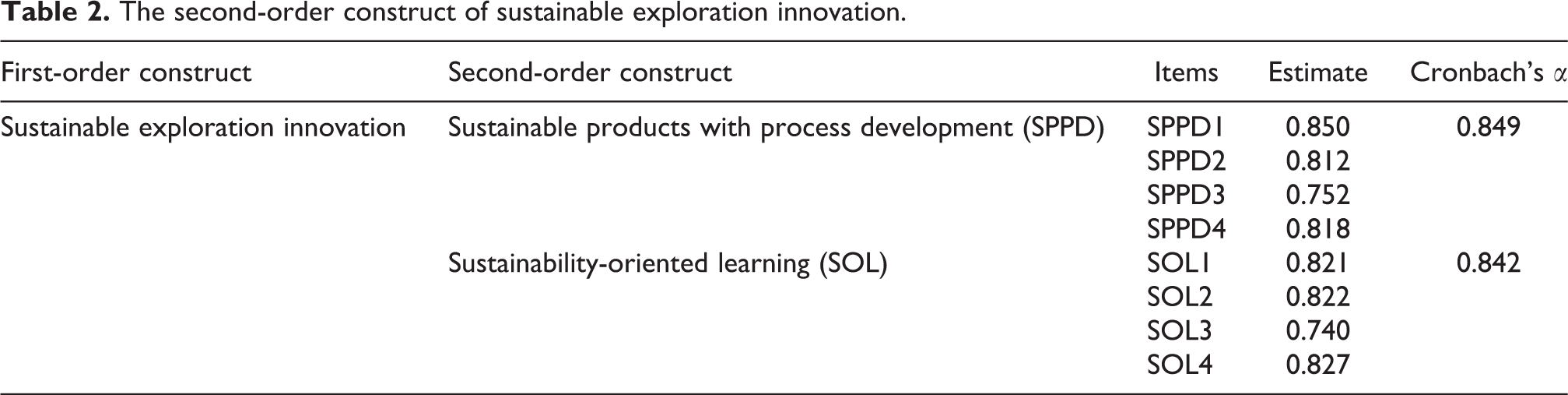
Further, based on Maletič et al. (2016), sustainable exploration innovation is designed as a higher-order construct that is consisted of two sub-indicators, including sustainable products with process development and sustainability-oriented learning. These two sub-indicators are both measured by four items developed by Maletič et al. (2018). Specifically, sustainable products with process development were described as a green process engineering and products innovation with one example of measuring item as “Our firm makes an improvement to radically reduce the negative effect of products/services’ life-cycle on ecological sphere.” At the same time, sustainability-oriented learning refers to a type of developing capability/competence for sustainability-related innovation with one example of measuring item as “Our firm could be defined as an organization full of learning culture with a mission of encouraging innovation for business sustainability.” Therefore, we would like to use all these eight items to measure the level of sustainable exploration innovation. Further, sustainable exploitation innovation is measured by six items with one example as “Our firm makes a full use of appropriate tools and techniques to mitigate the variability of key processes.”
Control variables
Prior literature indicated that both firms’ size and age have a significant effect on their ecological sphere decision-makings. To keep a multiple chain meditation model in our study logically robust, two firm-level variables were added to our model. In general, resources and experiences owned by larger-sized and older firms enable to have a stronger desire in coordinating exploration and exploitation innovations (Jansen et al., 2012). Accordingly, we measured firms’ size by the total number of full-time employees for the year in which the surveyed data were collected (Aguilera-Caracuel et al., 2012; Larrañeta et al., 2013; Sirén et al., 2012; Zahra and Bogner, 2000). Then this study measures firms’ age by the year since their establishment.
Priori analysis
As mentioned before, we measure sustainable exploration innovation by a single second-order construct consisted of two sub-constructs with the second-order reliability test results as Table 2.
The second-order construct of sustainable exploration innovation.
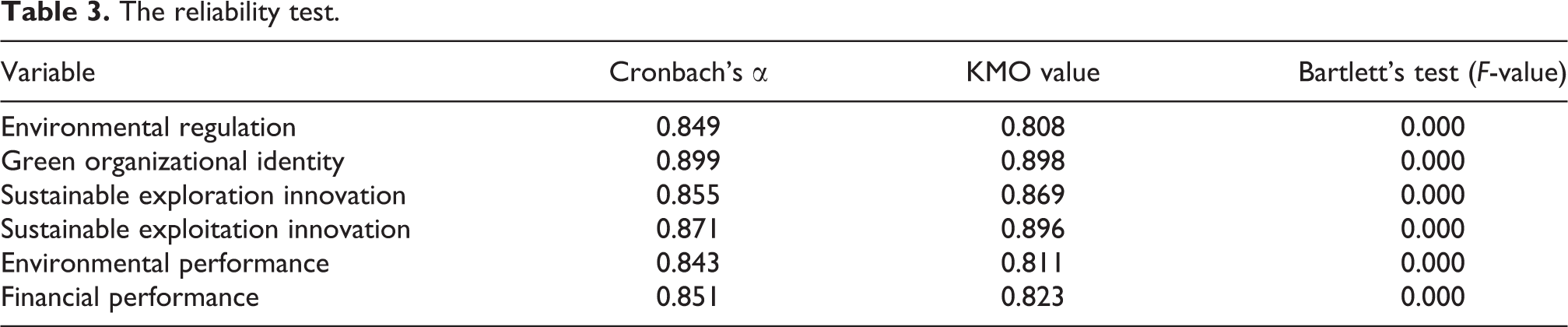
After organizing the reliability test for the second-order construct of sustainable exploration innovation, we examine the reliability of all observed variables. Table 3 illustrates that the Cronbach’s α coefficients of all measuring items range from 0.843 to 0.899 (greater than 0.70), and the KMO values for all measuring items are all higher than the recommended cut-off value that is 0.60 with the Bartlett’s test (F-value) all statistically significant. These confirmatory data prove that all measuring items have a high reliability.
The reliability test.
To examine the validity of measuring items, we develop the confirmatory factor analysis by using the software of Mplus 7.0. The corresponding results indicate that our full model has a good fit (χ2/df = 1.701, CFI = 0.944, TLI = 0.938, RMSEA = 0.044). In Appendix 2, all factor loadings of measuring items range from 0.724 to 0.875 (greater than 0.70), while the composite reliability of all measuring constructs ranges from 0.700 to 0.904 (greater than 0.60). To evaluate the convergent validity of items, we estimate the average variance extracted (AVE) of all constructs (Bagozzi, 1981). As Appendix 2, AVE of all constructs ranges from 0.538 to 0.644 (greater than 0.50). Holistically, such confirmatory data also support that the convergent validity of all measuring constructs is acceptable.
We then examine the discriminant validity by comparing the square root of AVE of each construct. Just like Table 4, the square root of AVE of each construct is higher than their correlations with other constructs, thereby illuminating the discriminant validity of all constructs (Fornell and Larcker, 1981). Table 4 shows the mean, standard deviation (SD), square root of AVE, and correlations of variables. It could be seen that there is a significantly positive correlation among our key variables. Such relevance implies that to the total operations management process of China’s manufacturers, there is a closer relationship among these key indicators. On the one hand, it indicates that their early efforts aiming at business sustainability would not be in vain because these key indicators could derive a sequential transmission path. On the other hand, it is also impressive that business sustainability of manufacturers of emerging markets would be achieved by prior systematic and comprehensive efforts rather than only just in a few ways. When it comes to general management, we should be more confident that business sustainability is driven by multilevels of factors because an exciting fact is that the sustainability of manufacturing sectors, which may encounter ecological risks at any time, has such a perfect driving system. Thus for non-heavy-polluting sectors, there should be hope to identify more indicators relevant to business sustainability.
Descriptive statistics, correlation analysis, and discriminant validity.
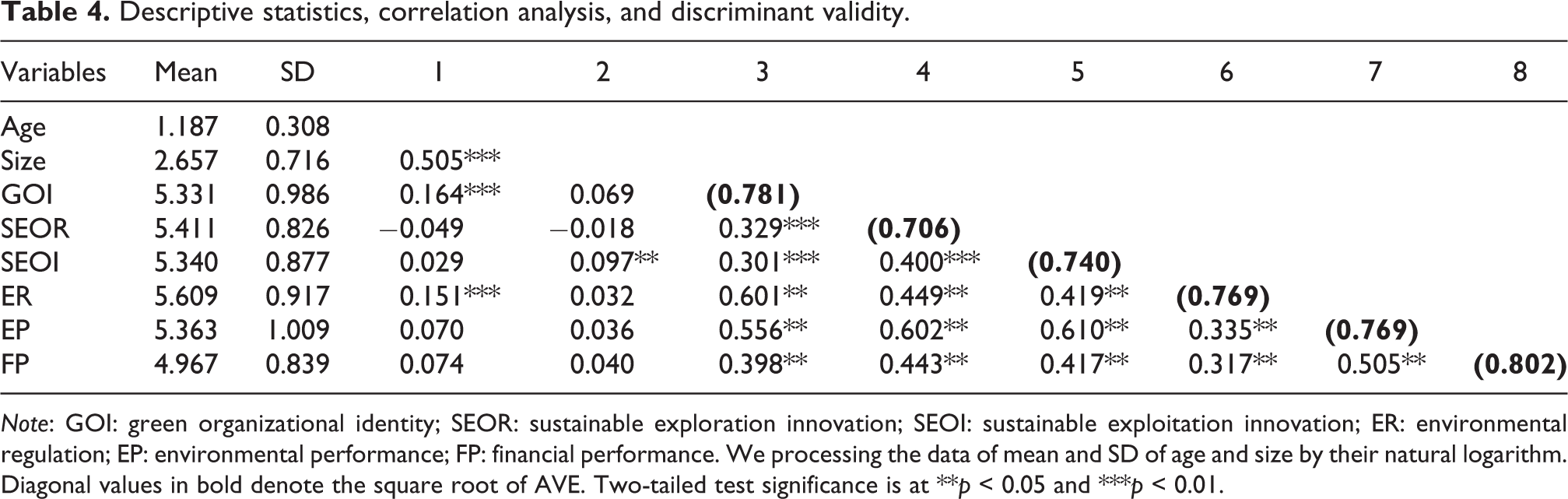
Note: GOI: green organizational identity; SEOR: sustainable exploration innovation; SEOI: sustainable exploitation innovation; ER: environmental regulation; EP: environmental performance; FP: financial performance. We processing the data of mean and SD of age and size by their natural logarithm. Diagonal values in bold denote the square root of AVE. Two-tailed test significance is at ∗∗p < 0.05 and ∗∗∗p < 0.01.
Empirical results
The separate mediation effect of green organizational identity and sustainable innovation
Guided by Hayes (2013), Loock et al. (2013), and Cepeda-Carrion et al. (2016), we plan to further develop a bootstrapping approach (1000 resamples) to verify our hypotheses development with a significance level of 5% at the two-tail. Table 5 witnesses that the 95% bias-corrected confidence interval from environmental regulation to business sustainability with considering the mediation effect of green organizational identity and sustainable innovations. This finding sees that 95% bias-corrected confidence interval for the indirect effect of environmental regulation on environmental performance with the green organizational identity as a mediation variable includes 0 (lower = −0.210, upper = 0.258). At the same time, the 95% bias-corrected confidence interval for the indirect effect of environmental regulation on financial performance via green organizational identity also includes 0 (lower = −0.036, upper = 0.248). Accordingly, H1 could not be verified. Further, 95% bias-corrected confidence intervals for the indirect effect of green organizational identity on environmental performance (lower = 0086, upper = 0.116) and financial performance (lower = 0.070, upper = 0.111) with sustainable exploration innovation as a mediation variable do not include 0. Thus H2 is verified. Following a same analysis thread, H3 aiming at the mediation effect of sustainable exploitation innovation is also supported with the verifiable data in Table 5.
Results around the non-multiple mediation effects.
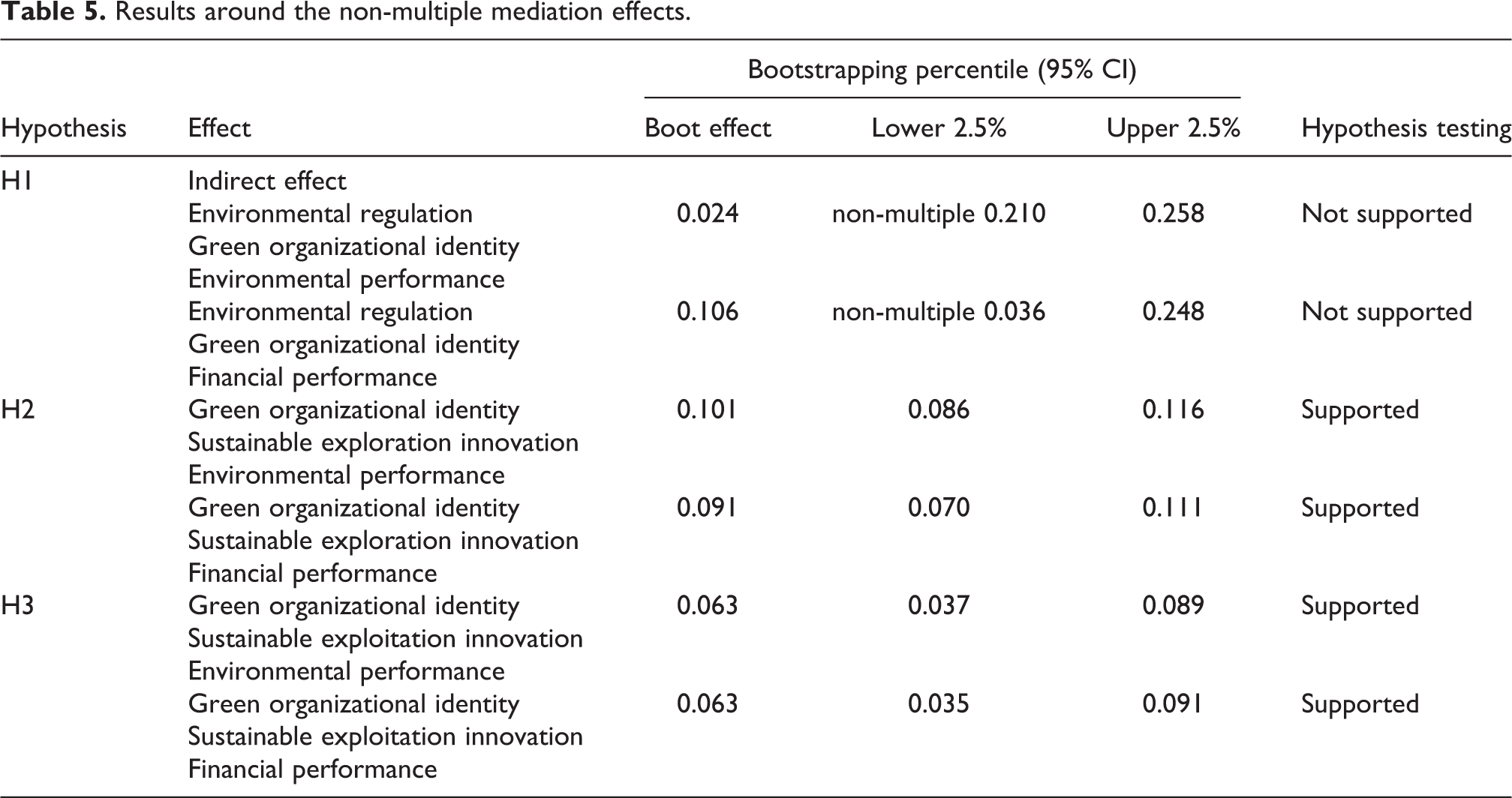
Integrating the separate mediation effects of green organizational identity and sustainable innovations, we could learn following findings. First, for China’s manufacturers, only carrying out green organizational identity is not very robust to promote an energetic evolvement from environmental regulation to business sustainability. It therefore preliminarily sends a powerful message for emerging markets like China whose manufacturers’ green organizational identity has not played the role of an adhesive between environmental regulation as an external actor and business sustainability as an internal outcome. At the same time, it may show that for firms particularly the ones with heavy-polluting characteristic, a pure personal psychological perception would not be able to support a robust as well as lasting relationship between external regulation and internal sustainability. In this situation, the behavior-driven may be particularly valuable. Second, in China’s manufacturers, it could breed a logical analysis framework that personal psychology and behavior with sustainability characteristics and business sustainability performance have all developed into a robust procedure. It thus confirms that a clear combination consisted of personal pro-environmental psychology and pro-environmental behavior could practically improve business sustainability. At the same time, there is no significant difference between two types of sustainable innovations in their mediation effects, which indicates that these sustainable innovations play a similar role in harmonizing personal pro-environmental psychology and business sustainability.
It could be acquired from above analysis that it is hard to achieve a positive evolvement from government involvement to business sustainability by only relying on the power of green organizational identity, while sustainable innovation as a practical behavior could help better straighten out this relationship. It triggers a thought around the antecedent of business sustainability, and the role of green organizational identity in this proceeding as well as the linkage between such identity and sustainable innovation is expected to add the knowledge targeting at the various effects of psychology in sustainable business systems, for example, Klöckner (2013) and Kahsar (2019). Along with this way of thinking, it could generalize the institutional architecture around business sustainability in more industrial sectors.
The multiple chain mediation effect of green organizational identity and sustainable innovation
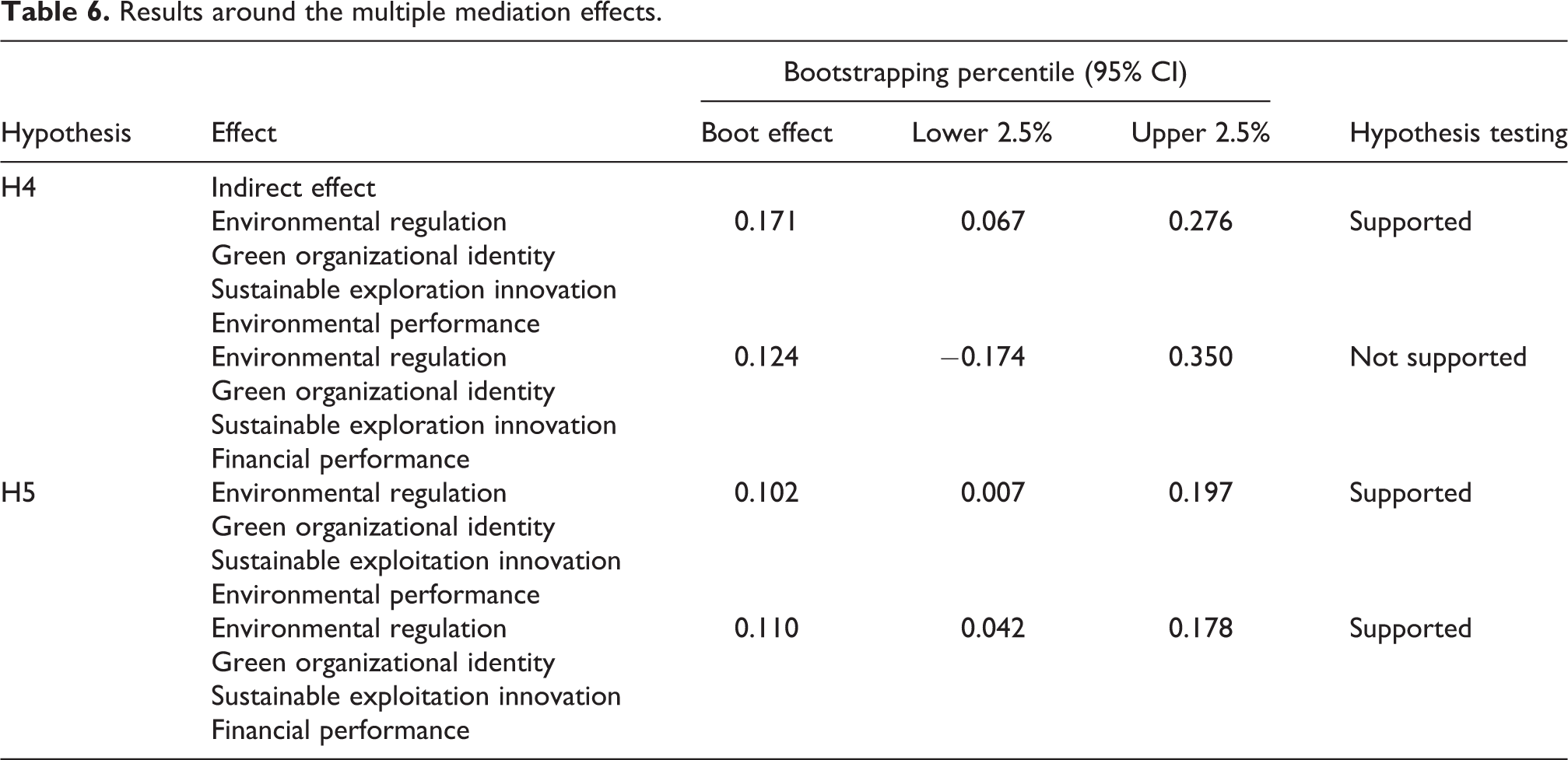
Following, we further examine the probability of H4 and H5 to verify if there is multiple chain mediation path between environmental regulation and business sustainability. We also develop a bootstrapping test for 1000 subsamples with setting a significance level of 5%. Table 6 witnesses the results of multiple chain mediating effect of environmental regulation on business sustainability. Empirical findings corresponding to H4 indicate that 95% bias-corrected confidence intervals for the effect of environmental regulation on environmental performance via green organizational and sustainable exploration innovation in a sequence (lower = 0.067, upper = 0.276) do not include 0. Accordingly, the path coefficient between environmental regulation and environmental performance is quite statistically significant (β = 0.171, p < 0.05). Further, 95% bias-corrected confidence intervals for the effect of environmental regulation on financial performance via green organizational identity and sustainable exploration innovation in a sequence (lower = −0.174, upper = 0.350) include 0, which wakes us up that there is no significant path coefficient between environmental regulation and financial performance (β = 0.124, p > 0.05). Accordingly, H4 could be partially supported. By the same analysis thread as H4, we could know H5 targeting at the mediation effect of green organizational identity and sustainable exploitation innovation could be supported as Table 6.
Results around the multiple mediation effects.
It is also remarkable that Figure 2 shows each transmission path from environmental regulation to business sustainability. Holistically, China’s manufacturers could achieve an energetic growth process from external actors to internal sustainability with the joint efforts of stakeholders if each intermediate link has made a full preparation. Just as Figure 2, sustainable exploration innovation better echoes environmental regulation and green organizational identity compared with that of sustainable exploitation innovation, which is quite an exciting discovery for emerging markets. It is embodied in that external regulation and internal personal perception could be of more benefit to the radical innovation of manufacturers. It therefore promotes such firms to engage in addressing innovation problems aiming at the business sustainability sphere by bravely developing new products/services and technologies. This finding also echoes prior literature that emerging markets should develop the total innovation with an urgent mentality and therefore find out an approach for low-cost innovation (Agnihotri, 2015; Anning-Dorson, 2018; Kumar et al., 2013).
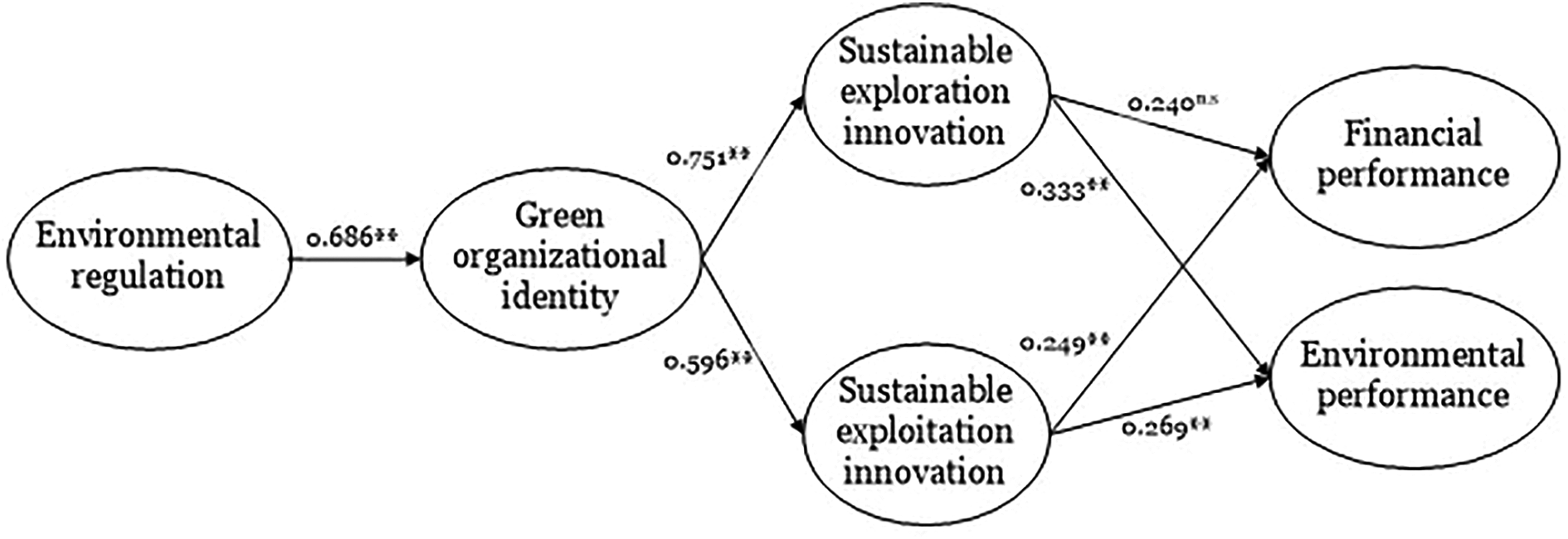
The results of multiple mediation model. Note: n. s denotes no statistical-significance. Two-tailed test significance is at ∗∗p < 0.05 and ∗∗∗p < 0.01.
Robustness test
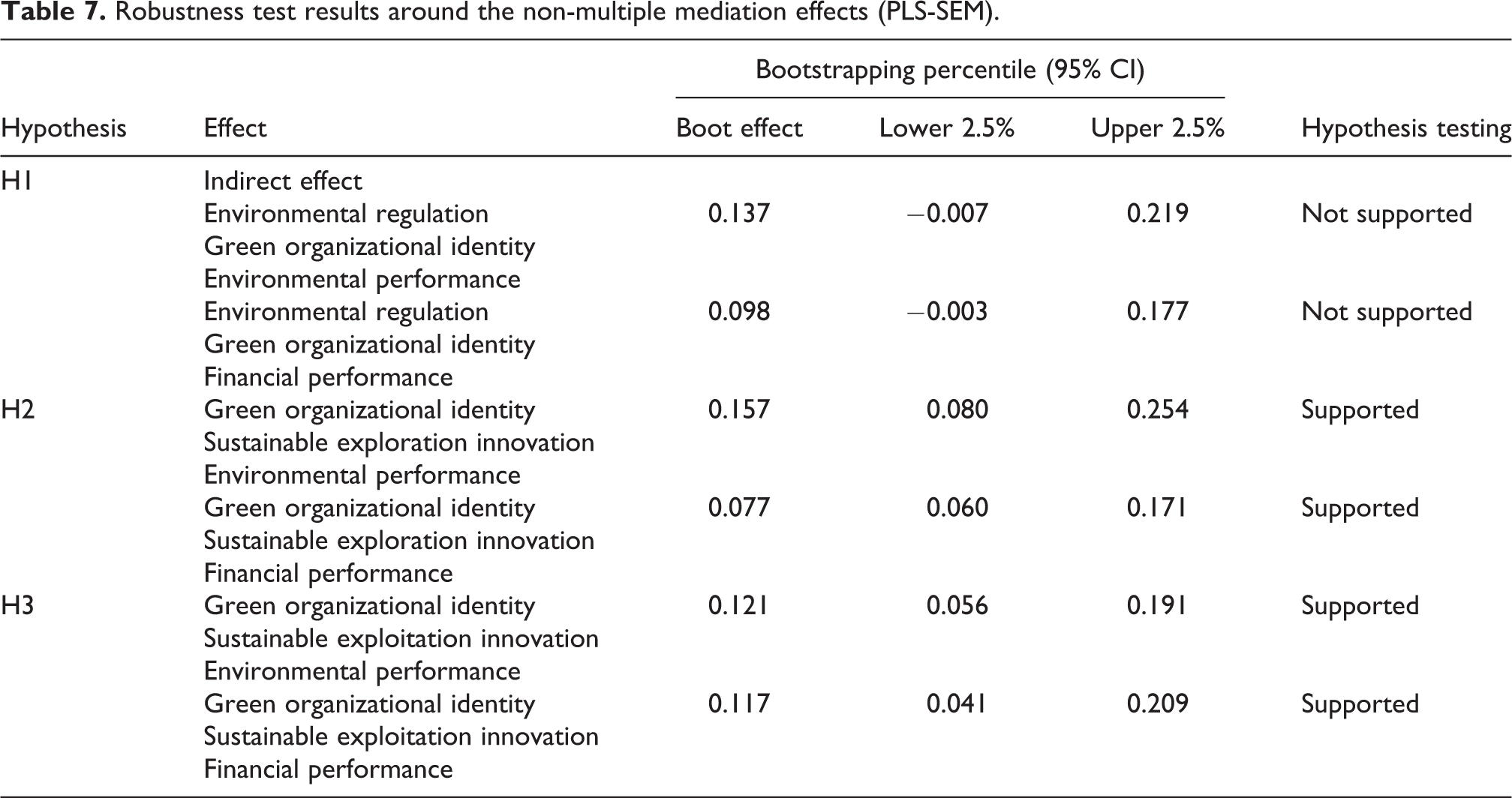
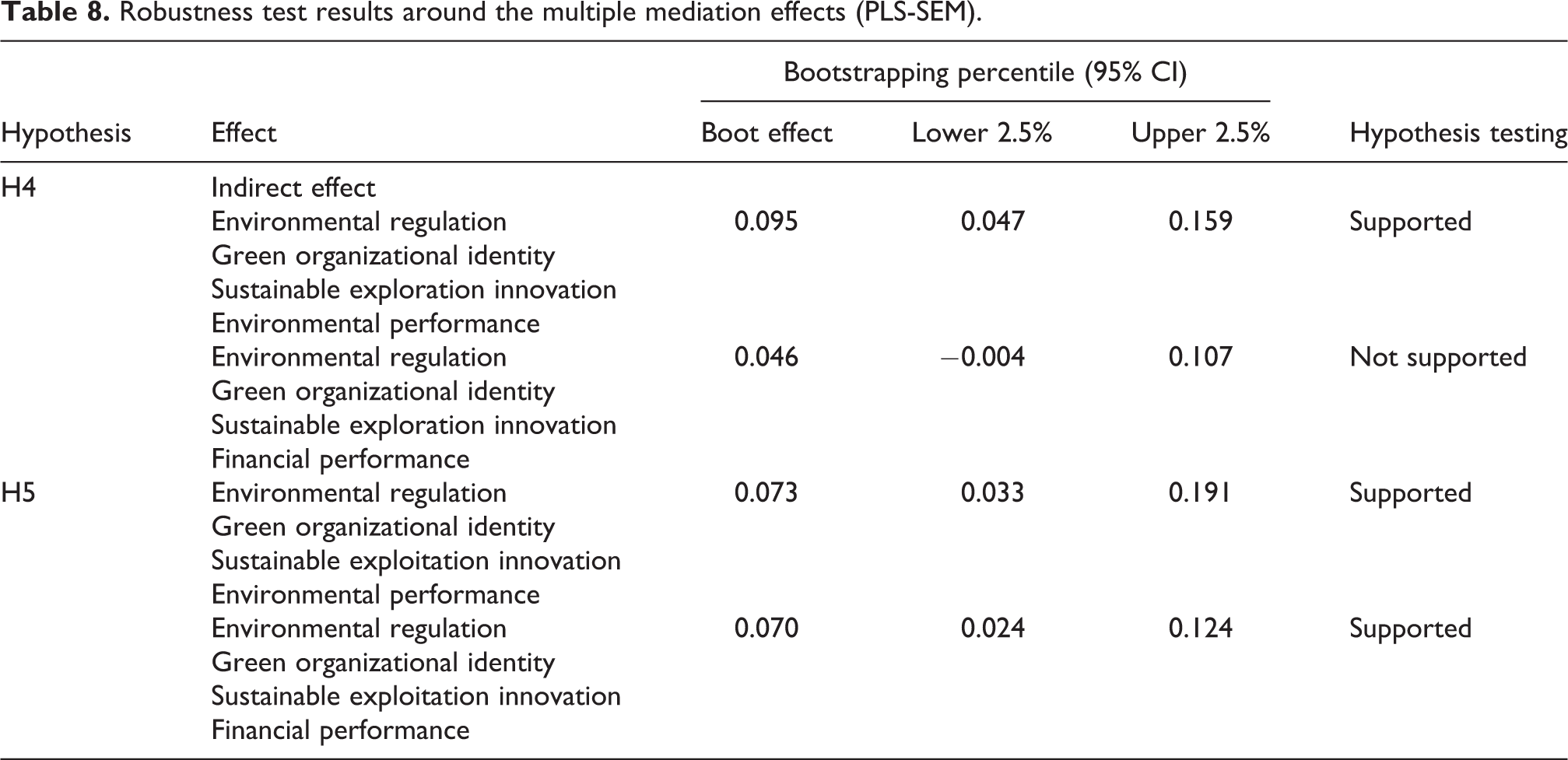
We also develop a regression analysis to examine the robustness of our models by using the partial least square SEM (PLS-SEM). It could be seen that the results performed by Smart PLS 3.0 endorse the results of Mplus 7.0 (see Tables 7 and 8). Therefore, our evaluation method and indicators design are robust, and thus the findings derived from it could robustly explain the development trend of our core variables in China’s manufacturers. More optimistically, our key findings could provide valuable reference for broader emerging markets in relation to expanding the antecedents of their business sustainability.
Robustness test results around the non-multiple mediation effects (PLS-SEM).
Robustness test results around the multiple mediation effects (PLS-SEM).
Further discussions
We also have a wish to extend the generalization value of our study around key findings. Industrial policy literature emphasized the institutional architecture of an economy, and such new institutional exploration was suggested to contribute to industrial competitive edges (Spring et al., 2017). As such, we could more firmly argue that government involvement is a reliable guardian to prevent the failure of firms’ institutional architecture. We therefore need to firstly clarify the significance of environmental regulation for business sustainability. On the one hand, the power of policies/laws enables firms to know why they need to spend their limited time and energy in sustainability issues. On the other hand, such power suggests firms around how to enhance business sustainability. From a broader perspective of general management, our empirical findings would awaken the development of industrial policies of emerging markets where also really need governments to play a stronger role in business sustainability.
We also see that green organizational identity did not have a positively separate mediation effect between environmental regulation and business sustainability. By contrast, there is a positively separate mediation effect for both sustainable exploration innovation and sustainable exploitation innovation between green organizational identity and business sustainability. By integrating the results in Table 6, we could describe following pictures that respond to our discussions in subsection “The separate mediation effect of green organizational identity and sustainable innovation.” First, to reach a positive transmission path from environmental regulation to business sustainability, it really needs to be well prepared for both pro-environmental psychology and pro-environmental behavior of internal stakeholders rather than only fragmentarily focus on one aspect. This result responds to a comprehensive model that could concurrently underscores the crucial effect of such pro-environmental responses in the climate change decision-making developed by prior literature such as Klöckner (2013). In other words, there is a necessity to closely connect green organizational identity and sustainable innovation and then encourage them to play a multiple chain mediation effect in reality, which also has an important implication for manufacturers of emerging markets, particularly in their total environmental governance. Second, both sustainable exploration innovation and sustainable exploitation innovation need the solid antecedents in relation to environmental regulation and green organizational identity. Furthermore, sustainable innovation is contributing more to environmental performance than financial performance, which sends a welcome signal that sustainable innovation plays a solid backing for environmental governance that is also a bright mirror reflecting the value of sustainable innovation. More remarkably, our analysis rouses a call that in emerging markets, only by making a great and all-round effort would manufacturers achieve a sustainability, which is a challenge for key stakeholders at the current stage.
Research implications
The important effect of environmental regulation as well as pro-environmental psychology/behavior in firms on business sustainability issues is being elaborated by more and more scholars evidenced by recent literature. Some recent research focused on the reason of why there is a heterogeneous relationship among environmental regulation, sustainable innovation, and business sustainability based on the driving role of institutional diversity, for example, Xie et al. (2017). Motivated by recent valuable insights, this study constructs an integrated conceptual framework involving external motivation/pressure, pro-environmental psychology, pro-environmental behavior, and business sustainability, which helps expand the transmission path from government involvement to responsible business outcomes. By clearly seeing our key empirical results, we propose following research implications from theoretical, managerial, and international perspectives that aim to extend our knowledge to the general management area.
Theoretical implications
This study contributes to the Institutional Theory, particularly adding the new knowledge in government involvement and sustainable innovation, in two ways. First, we establish a link of environmental regulation and sustainable innovation by analyzing their non-multiple indirect effects. This consideration could help respond to the prospect of future research recommended by prior literature (Rexhäuser and Rammer, 2014; Testa et al., 2011), while the effect of environmental regulation on business sustainability does not reach an agreement. A possible reason for this difference is the influence mechanism of environmental regulation on firm performance is experiencing a contextual change. In the short-term, such regulation may threaten firm growth because of the rise of ecological governance cost. While in the long-term, such regulation could help enhance business sustainability by the power of sustainable innovation (Ociepa-Kubicka and Pachura, 2017). Another reason for such difference is that environmental regulation issued by China’s government lacks an effectiveness in practice compared with the developed markets. Therefore, as suggested by recent literature, for example, Ramanathan et al. (2017), a greater effort needs to be committed to explore more indicators within or out of firms that may moderate/mediate the relationship between environmental regulation and business sustainability. Inspired by this, we suggest future research investigating the relationship between government participation and business sustainability from more dynamic perspectives.
Second, this study contributes to understand the mediation effect of green organizational identity as well. This identity indeed does not have a significant mediation effect in the relationship between environmental regulation and business sustainability at the statistical level, while it derives a chain mediation effect with sustainable innovation. In terms to the theoretical development, we try to expand prior conceptual models by embedding personal green perception into the relationship between government involvement and pro-environmental behavior decision-making (del Río González, 2009; Ramanathan et al., 2017). Furthermore, we also provide a new insight into the heterogeneity around effect of environmental regulation on business sustainability by examining the joint mediation effects of green organizational identity and different types of sustainable innovations, thereby revealing an increasingly complex mechanism aiming at mining more mediation variables, particularly the internal indicators of firms.
Third, this study contributes to the understanding of the role of sustainable exploration innovation and sustainable exploitation innovation. One interesting finding is that the mediation effect of these two types of innovations in bridging environmental regulation and business sustainability is different as the path in Table 2. This case is not only caused by the heterogeneity of country and industry but also the intensity of each type of sustainable innovation. At the same time, this study responds to suggestion of Ramanathan et al. (2017) and You et al. (2019) around the necessity of thinking about different types of innovation modes triggered by government involvement, which is also a new knowledge area worthy of further exploration.
Managerial implications
Some managerial implications are recommended as follows by this study for both policy-makers and top managers of manufacturers for a better coordination around the relationship of our key variables. First, as the effect of environmental regulation on business sustainability is sequentially connected with the level of green organizational identity and sustainable innovations, following two management strategies may need to be deeply concerned. On the one hand, the less-mature institutional architecture around environmental regulation system of emerging markets suggests their manufacturers maximizing the value of government involvement as much as possible because all of these respected administrative tools (including command-and-control tools, market-based tools, voluntary tools, and informal tools) often have their own merits in dealing with the ecological sphere faced by firms (Meng et al., 2013). On the other hand, as a lack of green organizational identity may weaken the initial driving force of environmental regulation, we suggest policy-makers of emerging markets investigating if manufacturers have a high level of such identity, which could enhance the effectiveness of government involvement. This recommendation adds government’s thinking about the pro-environmental psychology of manufacturers and their stakeholders, which makes the policy-making more acceptable to firms.
Second, recent literature showed different types of relationships between environmental regulation and firm performance indicators, and innovation capability, strategic position, and altruistic motivation could all moderate/mediate such relationship (Demirel et al., 2018; Ramanathan et al., 2017). However, it leaves a future research in relation to further dissecting these intermediate variables, that is, investigating the role of subcategory of moderation/mediation variables. Inspired by these suggestions, we separately investigate the mediation effect of two types of sustainable innovations. Given that each type of innovation mode could usually function independently, we suggest top managers of manufacturers being aware of the existence of different types of sustainable innovations to alleviate the pressure of business sustainability. Further, it is necessary to distribute more resources to sustainable exploration innovation that could help firms rapidly get rid of the dilemma of insufficient innovation capability, thereby creating competitive edges in the short-term. This recommendation contributes to firm practices in relation to clearly defining the role of different types of sustainable innovations, thereby enriching the practice of innovation strategy mix.
International implications
Our findings bring significant implications for emerging markets to put in more efforts to deal with the problem in the relationship between government involvement and business sustainability. Qiu et al. (2020) believed that the literature involved in ecological and innovative spheres is stimulating our thinking about the understanding of a new relationship between different types of government involvements and business sustainability. A deepgoing work should be added to expand the research in environmental governance of firms and other adjacent knowledge areas. To manufacturers particularly in emerging markets, a forward-looking policy system is going through a severe challenge because of their earlier less-mature institutional architecture. By surveying China’s manufacturers whose status quo suggests a broader elaboration where emerging markets may benefit from the cross-territory policy and economic cooperation. As we mentioned before, China is ambitiously developing globally influential economic strategies such as the Made in China 2025 and China’s Belt & Road Initiative. Guided by these promising strategies, environmental regulations issued by China’s government and business sustainability practices developed by manufacturers would set a remarkable benchmark for broader industrial sectors of emerging markets. Moreover, bridging external motivation/pressure and internal stakeholders’ green perception also provide an avenue for thinking about the decision-makings around firms’ green culture and governance mode by embedding various contextual factors. Holistically, improving manufacturers’ sustainability of emerging market could provide significant implications for promoting a responsible business worldwide (Bice, 2017).
Conclusions
This study theoretically progresses and then empirically examines the effect of environmental regulation on business sustainability of China’s manufacturers by considering a possible mediation path consisted of green organizational identity and sustainable exploration/exploitation innovations. Our conceptual design reveals a chain mediation relationship dominated by pro-environmental psychology and behavior. Our key empirical findings indicate that only considering pro-environmental psychology is not expected to promote environmental regulation to positively affect business sustainability. By contrast, concurrently working on green organizational identity and sustainable innovation could trigger a transmission from environmental regulation to business sustainability. Overall, our findings suggest China’s manufacturers embedding more types of antecedent factors to keep business sustainability strategies rather than partly even completely cut apart their functions in practice.
There are some limitations to be investigated to further progress the conceptual framework of our study. First, this study focuses on two types of sustainable innovations derived from the ambidextrous innovation mode, while other types of innovations, for example, eco-innovation and open innovation, still could be embedded into a future research relevant to the Porter Hypothesis that suggests that environmental regulation would stimulate technology innovation. Second, besides the research focusing on the multiple mediation effect of green organizational identity and sustainable exploration/exploitation innovations, some another adjacent indicators relevant to firms, for example, stakeholder pressure, strategic position, and customer demand, have been figured out to improve pro-environmental psychologies and behaviors. Furthermore, there are few studies measuring the complicated relationship between environmental regulation and key internal indicators. An insightful work is required to quantitatively reveal the effect of key internal indicators on the relationship between environmental regulation and business sustainability in view of the above. Third, this study does not distinguish command-and-control and market-based environmental regulations. Further, the reasons why there are different transmission paths from environmental regulation to sustainable innovation have not been meticulously discovered. Therefore, future report should investigate the effect of different types of environmental policies on different types of sustainable innovations. Fourth, we position the respondent as the CEOs of firms because we believe that they have enough and comprehensive knowledge capacity to deal with our measuring items. While the leaders in other positions such as board members and managers of R&D department or environmental protection department may also possess such a knowledge structure. Therefore, more types of respondents in different positions should be surveyed in future research to extend the depth of investigation. Above all, we believe that future work in our research area will indicate a useful insight of developing a responsible business.
Footnotes
Declaration of conflicting interests
The author(s) declared no potential conflicts of interest with respect to the research, authorship, and/or publication of this article.
Funding
The author(s) disclosed receipt of the following financial support for the research, authorship, and/or publication of this article: This work received funding supports from Humanities and Social Science Project of the Ministry of Education of China (No. 20YJC790082; No. 20YJC630170), Fundamental Research Funds for the Central Universities (No. 3072021CFW0912; No. 3072021CFW0910), Philosophy and Social Science Research Planning Project of Heilongjiang Province (No. 19JLC117), Chinese Postdoctoral Science Foundation (No. 2020M681537), and Social Science Research Fund of Hainan University (No. kyqd(sk)2103).
Measuring items.
| Scales and items | (Scale: 1 = Strongly disagree; 2 = Disagree; 3 = Relatively disagree; 4 = Neutral; 5 = Relatively agree; 6 = Agree; 7 = Strongly agree) | Factor loading | AVE |
|---|---|---|---|
| Environmental performance | (Construct reliability = 0.853) | 0.591 | |
| EP1 | The consumption efficiency of raw materials has improved in the past 3 years. | 0.766 | |
| EP2 | The consumption scale of resources (e.g. thermal energy and electricity, water) has decreased in the past 3 years. | 0.787 | |
| EP3 | The percentage of recycled materials has increased in the past 3 years. | 0.746 | |
| EP4 | The waste ratio (e.g. kg per unit of product and kg per employee per year) has decreased in the past 3 years. | 0.776 | |
| Financial performance | (Construct reliability = 0.878) | 0.644 | |
| FP1 | Firm’s return on investment has exceeded the average level of whole industry in the past 3 years. | 0.875 | |
| FP2 | Firm’s sales growth has exceeded the average level of whole industry in the past 3 years. | 0.792 | |
| FP3 | Firm’s profit growth has exceeded the average level of whole industry in the past 3 years. | 0.789 | |
| FP4 | Firm’s market share has increased significantly in the past 3 years. | 0.749 | |
| Environmental regulation | (Construct reliability = 0.853) | 0.592 | |
| ER1 | Environmental policies/laws that affect our firm involve stringent standards. | 0.779 | |
| ER2 | Environmental policies/laws that affect our firm are appropriate for China’s contexts. | 0.788 | |
| ER3 | Environmental policies/laws that affect our firm are very clear. | 0.735 | |
| ER4 | Environmental policies/laws in relation to our firm are effectively and directly addressing ecological problems. | 0.774 | |
| Green organizational identity | (Construct reliability = 0.904) | 0.610 | |
| GOI1 | Firm’s top managers, middle managers, and employees all have a strong sense of firm’s history about environmental governance. | 0.831 | |
| GOI2 | Firm’s top managers, middle managers, and employees all have a sense of pride in firm’s environmental goals and missions. | 0.752 | |
| GOI3 | Firm’s top managers, middle managers, and employees all feel that our firm has carved out a significant position regarding environmental governance. | 0.785 |
|
| GOI4 | Firm’s top managers, middle managers, and employees all feel that our firm has formulated a well-defined set of environmental goals and missions. | 0.789 | |
| GOI5 |
Firm’s top managers, middle managers, and employees all are knowledgeable about our firm’s environmental traditions and cultures. | 0.740 | |
| GOI6 |
Firm’s top managers, middle managers, and employees all identify strongly with our firm’s actions regarding environmental governance. | 0.787 | |
| Sustainable exploration innovation-SPPD | (Construct reliability = 0.700) | 0.538 | |
| SPPD1 | Our firm makes an improvement to radically reduce the negative effect of products/services’ life-cycle on ecological sphere | 0.865 | |
| SPPD2 | Our firm makes adjustments to existing products/services to reduce the negative environmental and social effect. | 0.833 | |
| SPPD3 | Our firm undertakes regularly business process reengineering with a focus on green perspectives. | 0.800 | |
| SPPD4 | Our firm acquires innovative climate-friendly technologies and processes. | 0.827 | |
| Sustainable exploration innovation-SOL | (Construct reliability = 0.700) | 0.538 | |
| SOL1 | Our firm strengthens employees’ knowledge and skills to improve efficiency of current business sustainability practices. | 0.847 | |
| SOL2 | Our firm could be defined as an organization full of learning culture with a mission of encouraging innovation for business sustainability. | 0.836 | |
| SOL3 | Our firm upgrades employees’ current knowledge and skills based on examples of best practices in corporate social responsibility. | 0.790 | |
| SOL4 | Our firm searches for external sources, e.g. partners, customers, research institutions, and knowledge, in order to improve the innovation philosophy relevant to business sustainability. | 0.831 | |
| Sustainable exploitation innovation | (Construct reliability = 0.879) | 0.547 | |
| SEOI1 | Our firm responds to existing stakeholder issues in a regular/systematic way. | 0.736 | |
| SEOI2 | Our firm constantly evaluates its external environment to uncover issues of importance to key stakeholders, including customers, suppliers, and local communities. | 0.750 | |
| SEOI3 | Our firm’s business processes are flexible allowing us to achieve a high level of responsiveness towards key stakeholders’ demands. | 0.736 | |
| SEOI4 | Our firm involves key market stakeholders (e.g. customers and suppliers) in the early stage of products/services design and development. | 0.744 | |
| SEOI5 | Our firm makes a full use of appropriate tools and techniques to mitigate the variability of key processes. | 0.749 | |
| SEOI6 | Our firm establishes key performance indicators (KPIs) to determine if our organization is meeting business sustainability goals. | 0.724 |
Note: All item loadings are significant at the level of p < 0.01.