




Abstract
Following the restrictions on movement imposed during the COVID-19 pandemic, the greater demands placed on physicians and many healthcare infrastructures, a large number of health teleconsultation platforms have emerged around the world. The aim of this paper is to obtain a better understanding of the acceptance of teleconsultation platforms by patients. To this end, a survey of 1273 patients was carried out using a teleconsultation platform during the pandemic period in France (from 9 July to 29 October 2020). The questionnaire mobilized existing scales to measure Satisfaction, Perceived Justice and, finally, the intention to disseminate by Word-Of-Mouth (WOM). Data were analysed using a Partial Least Squares approach. The study confirms the impact of Distributive, Informational and Procedural Justice on Satisfaction and the impact of Distributive and Informational Justice on WOM. The findings emphasize the influence of Satisfaction on WOM. The results detect a mediating effect of Satisfaction on WOM and moderating effects of gender, age and long-standing use. This research contributes to both theoretical and practical COVID-19 research and may be used by healthcare professionals to develop teleconsultation services, one of the means of supporting interaction and satisfying patients’ treatment requirements during the pandemic.
Introduction
COVID-19 (COrona VIrus Disease, 2019) has spread throughout the world, infecting millions of people and causing thousands of deaths (Jin et al., 2020). The rapid level of transmission is mainly due to the concentration of populations and the ease of global travel. To avoid being infected by others, individuals modified their behaviour by trying to reduce direct and close contact with others and by adopting Information and Communication Technologies (ICT). For example, retailers increasingly introduced a click-and-collect option during the lockdowns to maintain their sales and continue to deliver to their customers. Healthcare services also introduced changes involving the digital transformation of patient care using e-services, robots and more precise Health Information Technology, which, even without the current health crisis, increased patient satisfaction and patient experiences (Kraus et al., 2021). Electronic health (eHealth) is the network of technological applications relating to health issues such as teleconsultation. According to Catapan et al. (2021), alternatives to face-to-face medical consultation are already being used in many countries. Healthcare is facing the arrival of a new range of systems, services and applications using electronic communication (Van Den Heuvel et al., 2018) implying both a strong platform credibility (Song et al., 2022) and trust in the medical staff (Guan et al., 2018). Many patients tried to avoid going to hospital or visiting their family doctor during the pandemic and preferred to use telemedicine applications or the Internet of Things (Catapan et al., 2021; Lepore et al., 2018). Using these applications, patients and physicians can communicate 24/7 via a smartphone or a computer equipped with a webcam (Hollander and Carr, 2020).
Telemedicine, including teleconsultation, is based on interactive audio-visual communications (Farahani et al., 2018). This concept allows patients and medical staff to interact, exchange information and share documents, such as medical results, to help the physician to carry out a remote diagnosis and suggest an appropriate treatment. In addition, improving patient empowerment should facilitate the patient engagement in medical decision-making to improve the quality of care and patient safety (Fumagalli et al., 2015; Schwappach, 2010). As reported by Okereafor et al. (2020), telemedicine and online health platforms can potentially protect outpatient practitioners and patients from COVID-19 exposure. Indeed, the main advantages of teleconsultation, as raised in previous research, are mainly the avoidance of contamination, time and cost savings (no travel) and the ability to obtain an early appointment online (Baudier et al., 2021). Zheng, Chang and Chen (2022) demonstrate the impact of paid or free teleconsultation on intention to consult when perceived risks are higher for the free group and the influence of trust more important for the paid group. Mainly due to the fact that the paid group before the consultation tends to check the professional capabilities.
The French Government has supported teleconsultation solutions, even before the outbreak of COVID-19, as since 15 September 2018, medical consultations via videoconferencing in France have been reimbursed at the same rate as physical consultations. During the pandemic, medical practices were able to recover 100% of the cost.
Investigating this field of research is important for three major reasons: (1) The contextual importance, since the pandemic breakout the researchers notice the increased use of the teleconsultation and the difference in the acceptance factors of the teleconsultation before sanitarian crisis (Baudier et al., 2021; Tsai et al., 2019) and after (Baudier et al., 2021); (2) Most of the research focussed on particular medical area, such as, diabetes (Banerjee et al., 2020), urology (Pinar et al., 2020) on physicians’ perception (Chen et al., 2020; Guo et al., 2017) or technology acceptance of teleconsultation using the UTAUT, TAM (e.g. Rahi et al., 2020; Shiferaw et al., 2021) but not on satisfaction; and, finally, (3) The sample size is often low around 100 respondents (Pinar et al., 2020; Shenoy et al., 2020) and over-represented (only men over 66 years old) which could be a concern for the generalization of results.
Current research contributes to methodological robustness thanks to the sample size (1273) collected through a teleconsultation platform with a focus on physicians and theory mobilized (Perceived Justice).
The acceptance and use of remote medical consultation are directly linked to the physician–patient relationship (Lega et al., 2018) especially in terms of their level of listening/empathy (Interpersonal Justice) (Ćwiklicki et al., 2020) or the information provided (Informational Justice), the procedure used (Procedural Justice) and, finally, the service/result obtained (Distributive Justice). The Perceived Justice theory is often mobilized by researchers to measure these dimensions such as Meyer and Williamson (2020) to analyse the impact of negative service encounter or the ethical aspect of Distributive Justice in cancer treatment according to cultural, societal and individual norms (Hadler and Rosa, 2018). Others focussed on the healthcare professionals’ perception (Ghasi et al., 2020). Indeed, according to Pérez–Arechaederra (2019: 289) ‘few works consider users’ justice perceptions in healthcare’ (Pérez–Arechaederra, 2019: 289), as research mainly focus on the accesses to resources (hospital, medical care…) rather than user’s experiences. Nevertheless, recent research emerged to develop the doctor–patient paradigm. Indeed, Le et al. (2019), Chang et al. (2019), and Xing et al. (2019) analysed the doctor–patient relationship by demonstrating that the satisfaction is predicted by the Perceived Justice and results in intention of an offline visit. All three papers mobilized the four dimensions of the Perceived Justice; treat the sample from the Chinese platforms, before COVID-19 and without covering the Word-of-Month dimension. McCollough, Berry and Yadav (2000) and Mattila and Patterson (2004) identified two dimensions namely, Distributive and Interactional. Other research has identified four dimensions: Procedural, Distributive, Interactional and Informational (Chang et al., 2019; Le et al., 2019; Mengstie, 2020; Steiner, 2017). Some studies identified three dimensions, named Procedural, Distributive and Interactional that includes the Interpersonal and Informational Justices (Baudier and Ammi, 2016; De Meyer et al., 2013; Ghasi et al., 2020). Thus, the objective of this study is to use the four dimensions of Perceived Justice (Procedural, Distributive, Interpersonal and Informational) to analyse the satisfaction of patients using a teleconsultation platform to contact a physician during the COVID-19 pandemic in France and their willingness to share their experience via Word-of-Mouth (WOM).
The findings highlight the influence of Satisfaction on WOM, the mediating effect of Satisfaction on WOM and the moderating effects of gender, age and long-standing use. These major contributions might be used by healthcare professionals to develop teleconsultation services, one of the means of supporting patient-doctor interactions and satisfying patients’ treatment requirements during the pandemic.
This article is organized as follows: Firstly, a literature review of the constructs mobilized in the study is presented, followed by hypotheses. Secondly, the methodology and the sample strategy are explained. Thirdly, results are analysed and discussed. Fourthly, conclusion highlights the theoretical and managerial implications of the study. Finally, limitations of the study are raised and future research directions are suggested.
Literature review
Perceived justice
Perceived Justice applied to the health context.

Distributive justice
Distributive Justice, based on the principle of equity, refers to the expected results regarding the proposed solution/service (Hocutt et al., 2006). It results from a comparison between the result/solution compared to previous experience (De Pechpeyrou et al., 2019; Klaus and Nguyen, 2013; Orsingher et al., 2010). According to Choma et al. (2018), Distributive Justice mediates the relationship between political orientation and the Affordable Care Act (Obamacare). Some studies have mobilized Perceived Justice in studies of the health sector focussing on medical staff. For example, Mengstie (2020) reports that healthcare workers in public hospitals have low perceptions of Distributive Justice, Procedural Justice and Interactional Justice (combining both the Interpersonal and Informational dimensions). For their part, Ghasi et al. (2020) indicate that although increasing age leads to a high perception of Distributive Justice by doctors, age is inversely related to perceptions of Distributive Justice by nurses.
Procedural justice
Lind and Tyler (1988) define Procedural Justice as the methods by which a service can be achieved, such as the speed of response, clarity and accessibility (Blodgett et al., 1997). Leventhal (1980) defined the procedural principles, including uniformity of application, impartiality, accuracy of information, respect for ethics and the opportunity to be part of the process that allows patients to be heard (Del Rio–Lanza et al., 2009). According to Mehra (2018), an increase in consultation time and expertise had an impact on Satisfaction and Word-Of-Mouth.
Interpersonal justice
Interpersonal Justice can be seen as the degree to which authority figures treat subordinates in a respectful manner (Greenberg, 1990). Indeed, Interpersonal Justice, as indicated by Alikaj and Hanke (2021), focuses primarily on behaviour and represents the degree to which people are treated with politeness, dignity and respect by the authorities. Thus, the interpersonal dimension is important for the avoidance of bad faith or lack of respect and their impact on decision-making processes. (Bahri–Ammari and Bilgihan, 2017; Folger and Cropanzano, 1998).
Informational justice
The informational dimension refers to the content of the communication. Kernan and Hanges (2002) formalized Informational Justice as the provision of accurate information with transparent communication. Ellis et al. (2009) view it as the degree to which information is shared openly. Based on Alikaj and Hanke (2021), Informational Justice, focussing on the degree of veracity and timeliness of the explanations provided to those who transmit information, can positively affect individual’s perception. Therefore, Informational Justice, related to authenticity and clarity of information (Colquitt et al., 2001; Greenberg, 1990), reflects the fair distribution of information related to procedures or communication (Lee and Ha, 2020).
Hypotheses
Perceived justice and satisfaction
Satisfaction is closely related to how the consumer was treated and whether he/she considers the problem was solved (Baudier and Ammi, 2016). According to several studies, the three dimensions of Perceived Justice have a direct impact on Satisfaction (Orsingher et al., 2010; Sabadie et al., 2006). Thus, Perceived Justice is a cognitive antecedent explaining Satisfaction. Many researchers have demonstrated the influence of Distributive Justice on Satisfaction (Homburg and Fürst, 2005; Orsingher et al., 2010; Sabadie et al., 2006; Smith et al., 1999; Van Vaerenbergh and Orsingher, 2016). According to Cohen (1988), only Distributive Justice has a moderate impact on Satisfaction. Nevertheless, Maxham and Netemeyer (2003) demonstrate that both Distributive and Procedural Justice dimensions are the antecedents of Satisfaction in claims processing. However, Procedural Justice rarely represents the most effective means of influencing consumer satisfaction (Muhammad and Rana, 2020). Others suggest that Interactional or Procedural Justice are the most significant factors in consumer satisfaction (Voorhees and Brady, 2005). However, Jung and Seock (2017) confirm the importance of Procedural Justice.
Several studies demonstrate that Informational Justice is positively related to post-recovery satisfaction (Gohary et al., 2016; Kussusanti et al., 2019). Indeed, perceived Informational Justice show positive associations with Satisfaction (Vaamonde et al., 2018). These findings indicate that providing adequate, timely and practical explanations of the decision-making process acts as a motivator for employees (Colquitt et al., 2013; Silva and Caetano, 2016), thereby enhancing job satisfaction. Finally, Interpersonal Justice has been found to be positively related to job satisfaction, organizational commitment, task performance, organizational citizenship behaviour and trust in supervisors (Colquitt et al., 2001, 2013)
Given these earlier results, the authors consider that
Distributive Justice has a positive impact on Satisfaction.
Interpersonal Justice has a positive impact on Satisfaction.
Informational Justice has a positive impact on Satisfaction.
Procedural Justice has a positive impact on Satisfaction.
Perceived justice and Word-Of-Mouth
Word-Of-Mouth (WOM) is generally defined as ‘all informal communications directed at other consumers about the ownership, usage, or characteristics of particular goods and services or their sellers’ (Hennig–Thurau and Walsh, 2004: 51). According to previous research, consumers are prone to rely on WOM information to reduce perceived risks prior to service use (Haywood, 1989). Several researchers found that Perceived Justice has a direct impact on WOM (Jung and Seock, 2017; Setyawati, 2019). Nevertheless, other studies found that Interactional and Distributive Justices are stronger factors in the variance of negative WOM than Procedural Justice Factors (Blodgett et al., 1997). According to Davidow (2003), Distributive Justice has the greatest impact on WOM, results confirmed by Namkung and Jang (2010), who reported that positive perceptions of equity generate more positive WOM.
According to Ogonu and Hamilton–Ibama (2020), there is a direct relationship between Interpersonal Justice and WOM. Aguilar–Rojas et al. (2015) report that there are significant differences in WOM intention to complain to a third party in an environment in which consumers receive Interpersonal Justice. With regards to Informational Justice, researchers suggest that Informational Justice results in more favourable WOM intentions (Blodgett et al., 1997). Moreover, others postulate that higher the perception of Informational Justice is, higher will be positive WOM (Blodgett et al., 1993; Clemmer, 1993). Finally, Bhatti and Khattak (2015) find that Informational Justice is significantly moderating the relationship between consumer relationship proneness and WOM after service failure and recovery.
Thus, the authors postulate that
Distributive Justice has a positive impact on WOM.
Interpersonal Justice has a positive impact on WOM.
Informational Justice has a positive impact on WOM.
Procedural Justice has a positive impact on WOM.
Satisfaction and Word-Of-Mouth
According to Lai et al. (2018), WOM is understood as an active form of advocacy for promoting products or services to friends and relatives. Pandey and Deshwal (2018) actively support the finding that satisfaction emphasizes loyalty and WOM. Research shows that satisfied and dissatisfied customers often informally report their level of Satisfaction via WOM (Jung and Seok, 2017). Indeed, Collier and Bienstock (2006) found that dissatisfied consumers are more likely to be involved in negative WOM than consumers who encounter appropriate services are to engage in positive WOM (Afridi et al., 2018; Al-Daoar and Munusamy, 2019; Yasri and Engraini, 2018). Therefore, the level of Satisfaction and the intention to recommend a service provider are highly correlated (Juliarta et al., 2019). It has been demonstrated that, within the medical community, patients still prefer to rely on subjective information, such as WOM provided by other patients (Varkevisser et al., 2012), and Aljaberi et al. (2018) have tested and proved the positive relationships between service quality, patient satisfaction and behavioural intentions in different healthcare contexts. Based on our literature review, the authors propose the following hypothesis:
Satisfaction has a positive impact on WOM All the hypotheses are summarised in the Figure 1.

Research model with hypotheses.
Methodology
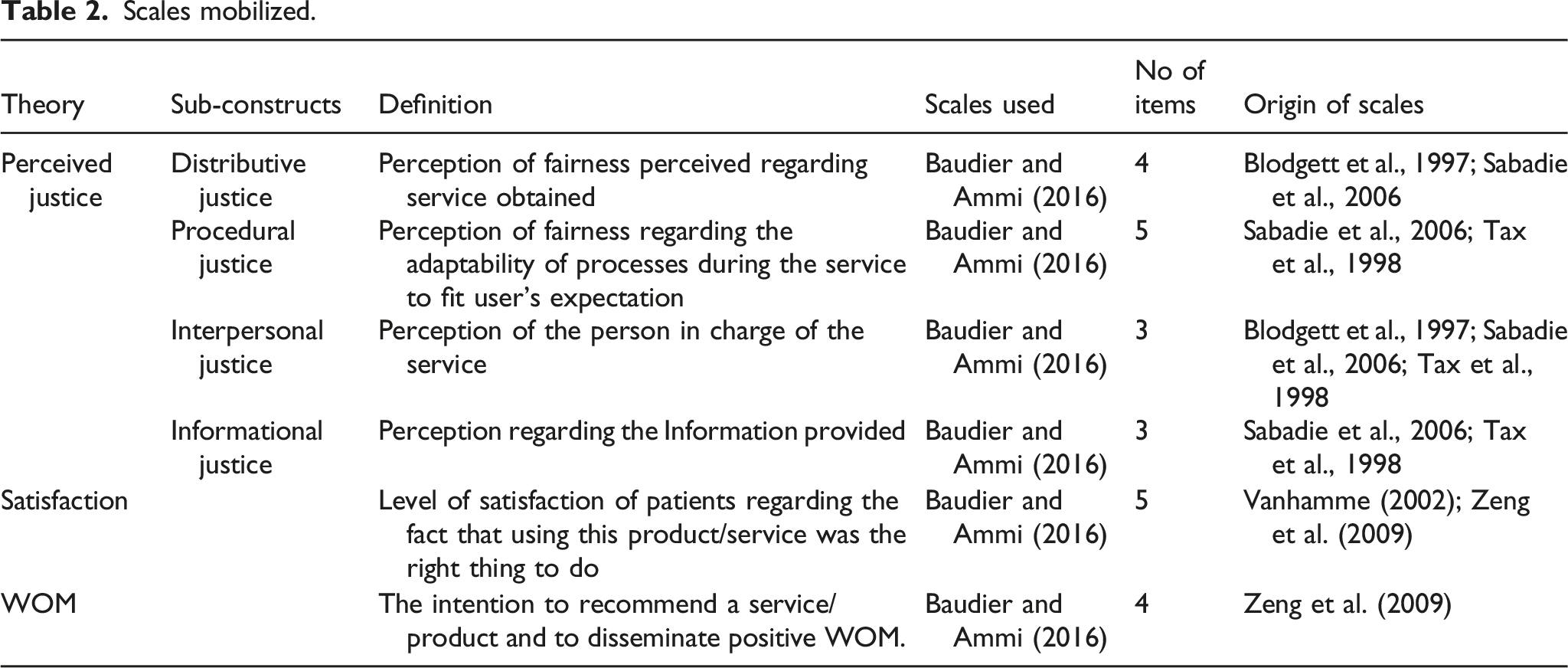
Research design
Scales mobilized.
Population and sample
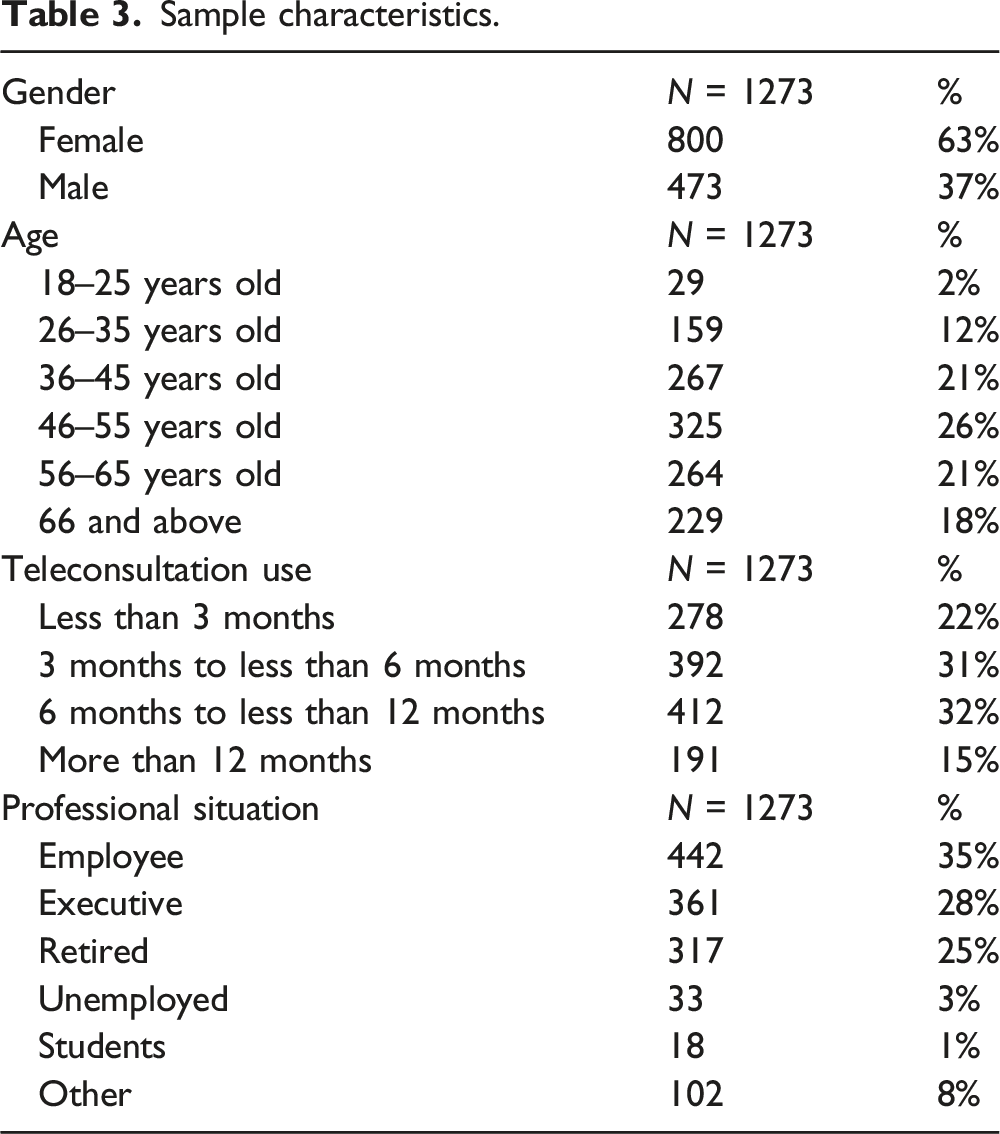
To avoid ethical issues, several elements in the structure and the mode of distribution of this questionnaire have been introduced. Firstly, the survey is not compulsory and is based on the free will of the respondents. Secondly, this questionnaire is anonymous. Thirdly, there is no question concerning the reasons for the teleconsultation and no medical data have been collected. Fourthly, the purpose of the survey was clearly indicated in a short introduction. Finally, the survey was disseminated via the newsletter of a teleconsultation platform to those patients who agreed to receive it, the authors did not access to patients’ e-mail addresses. Data were collected mobilizing a self-administered questionnaire using a Computer-Assisted-Web-Interviewing (CAWI) method. Ex-ante and ex-post tests were run to limit the Non-response Bias. Regarding the ex-ante measures, analyses were done at an item and unit level. For the item level, the responses to all questions were mandatory, so the authors did not have to face a lack of response. For the non-response at a unit level, all respondents were users of the teleconsultation platform and had sufficient experience of the platform to answer the questions. An introduction, including the objective of the survey, the completion time and the name of all researchers involved in the study was added at the beginning of the questionnaire. A first link to the survey was included in the July online newsletter and a reminder was sent beginning of September covering a period of 3 months. Regarding the ex-post measure, the comparison between the two hundred initial and the two hundred late respondents (from 0.09 to 0.23) confirmed the similarity, thus, the consistency of the responses. In addition, as confirmed with the teleconsultation platform, the demographic characteristics of the sample complies with their patient’s profile.
Sample characteristics.
Results
Structural Equation Modelling using a Partial Least Square approach was mobilized to analyse the relationships within the research model and to test the hypotheses using SmartPLS3 software (v3.3.3). This method has become popular in recent decades mainly due to the number of measurements provided for controlling for reliability, validity and the quality of the research (Path weighting Scheme, Maximum Iterations of 300) and for the calculation of moderating effects (Multi-Group-Analysis, Subsamples 5000).
Outer model
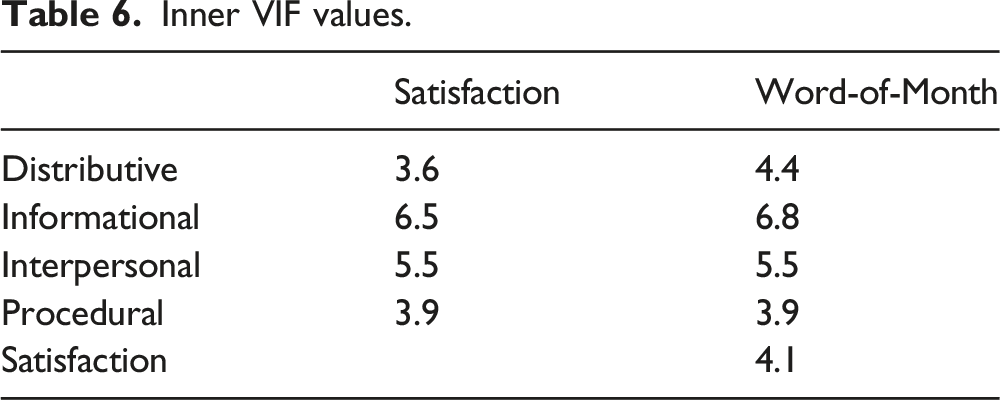
Even when the recommended threshold for the Variance Inflation Factor (VIF) is around 3.3, according to Hair et al. (2014: 200), ‘The suggested cut-off for the tolerance value is .10 (or a corresponding VIF of 10.0), which corresponds to a multiple correlation of .95 with the other independent variables. When values at this level are encountered, multicollinearity problem are almost certain’. A VIF exceeding 10 indicated serious multicollinearity, requiring modification. Thus, the following items (DJ4, PJ1, PJ3, INFJ1, SAT2, SAT3, SAT4, SAT5, WOM1, WOM2 and WOM3) have been removed from the model.
Finally, Satisfaction and WOM are measured using a single item. Previous research demonstrate that the reliability and validity of variables such as Satisfaction or Word-of-Month are similar than when mobilizing multi-items (Cheung and Lucas 2014; Joshanloo and Jovanović, 2020; Jovanović and Lazić 2020; Long et al., 2021).
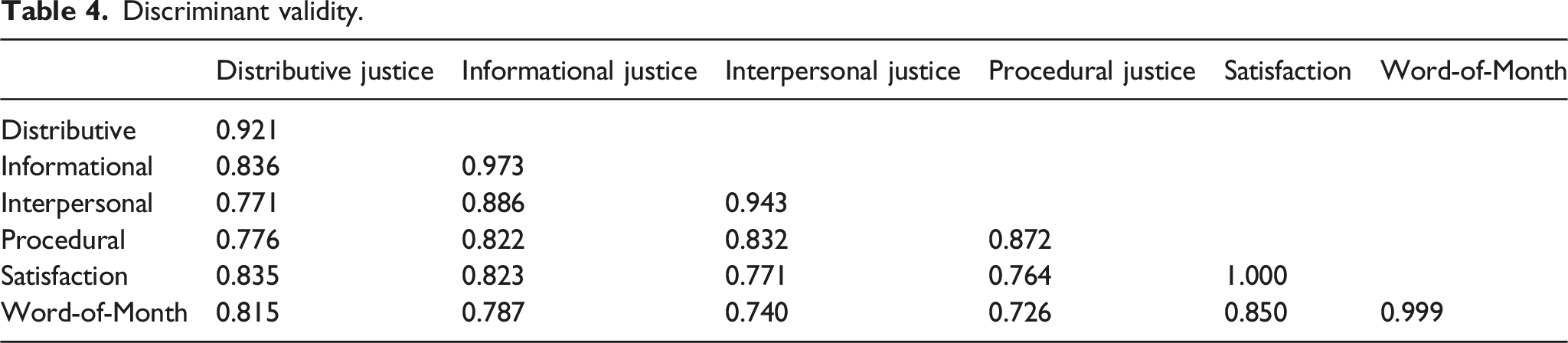
Discriminant validity.
Heterotrait-Monotrait ratio – Confidence Intervals.

Inner VIF values.
These findings confirm the reliability and validity of the outer research model.
Inner model
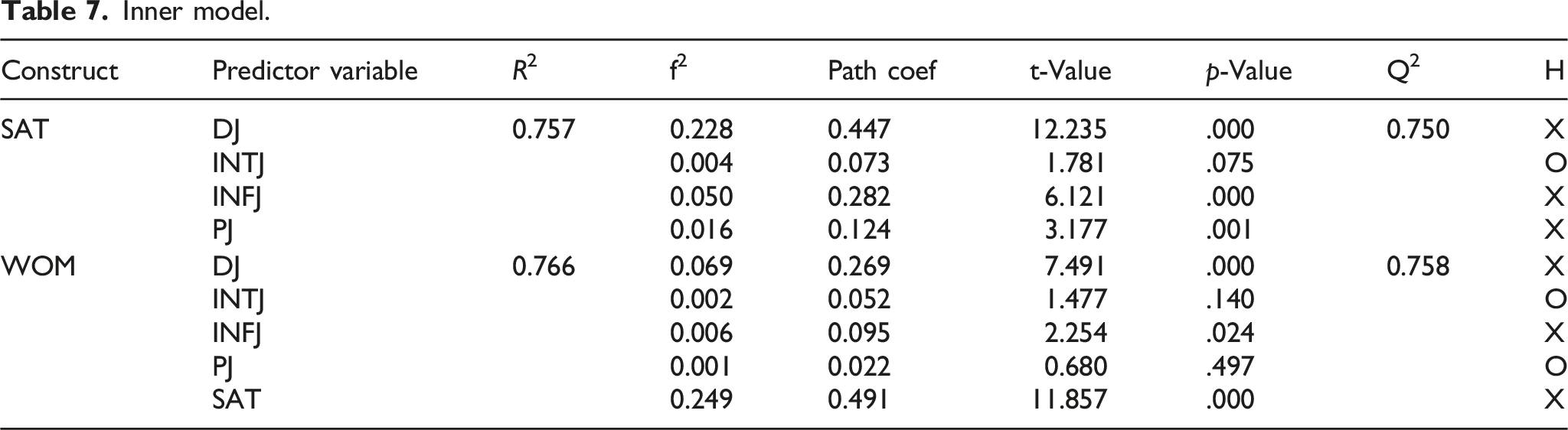
The inner research model was measured by analysing for each of the dependent variables the explained variance (R2) and predictive relevance (Q2). The Q2 were controlled using the Blindfolding procedure (Omission Distance 7). The relationships between variables were analysed (Bootstrapping – Subsamples 5000) by ensuring that the following parameters were above their recommended thresholds: path coefficient (path-coef >at 0.200), t-value (> 1.96) and p-value (< .05) (Figure 2). Then, the size effect of each of the independent variables on the dependent variables was analysed by controlling for the size effect (f2). Inner model. p < .05* p < .01** p < .001***.
Inner model.
Moderating effect
Moderating effect of gender.

Moderating effect of age.

Moderating effect of long-standing use.

Mediating effect
The potential mediating effect of Satisfaction for the four dimensions of Perceived Justice and WOM was analysed using the bootstrapping procedure. The analysis confirms the indirect effects except for Interpersonal Justice. As regards Distributive and Informational Justice, the relationships with both Satisfaction and WOM are direct, positive and significant and the indirect effects are also significant. Thus, based on Hair et al. (2017), a partial mediation is raised. However, the relationship of Procedural Justice to WOM is not significant when the indirect effect is significant. Thus, the authors can state that a full mediation is demonstrated.
Discussion
In this paper, the authors investigated the impact of Perceived Justice on patients’ satisfaction and WOM regarding medical teleconsultation during the COVID-19 pandemic. The concept of justice is often raised in studies of health topics (Jokinen et al., 2020). Telemedicine, which provides equity in access to treatment (Nguefack et al., 2020), involves a triadic relationship known as the 3Ps: patients, physicians and provider of the telemedicine platform (Leone et al., 2021). The investigation of the patient-doctor relationships mobilizing the Perceived Justice impact on satisfaction is in line with previous research (e.g. Chang et al., 2019; Le et al., 2019). Three of the Perceived Justice dimensions, namely Distributive, Procedural and Informational Justice had an influence on Satisfaction confirming other studies regarding medical services (e.g. Lee, 2021). Indeed, Liang et al. (2017) found a direct impact of Distributive and Informational Justice on patients’ Satisfaction when implementing a hospital information system, where Procedural Justice had only an indirect impact through Interactional Justice. During the pandemic, medical teleconsultation was perceived as necessary to prevent transmission of the virus (Baudier et al., 2021; Mustafa et al., 2020). However, in the medical context, the doctor–patient relationship is central, and one of the concerns during COVID-19 was the lack of interaction between the patient and physician because of the risk of contamination. Teleconsultation is one way to support these interactions. Surprisingly the dimension of Interpersonal Justice had no impact on Satisfaction. Chang et al. (2019) also did not support the impact of Interpersonal Justice on Satisfaction. Certainly, the medical professional code requires the treatment of all patients in the equal way, the change of the interaction mode (Teleconsultation instead of physical appointment) did not change the interpersonal interaction quality.
Moreover, the level of Satisfaction in telemedical services increased drastically during the COVID-19 pandemic for diabetes patients and diabetes management (Kanc et al., 2020), ambulatory care (Layfield et al., 2020), or for patients with allergies (Fieux et al., 2020). Mustafa et al. (2020) argue that 97% of patients were satisfied with the service provided by teleconsulting platforms. They also found that patients were as satisfied with teleconsultation as they were with a physical consultation and, in some cases, patients demonstrated even greater Satisfaction (Ramaswamy et al., 2020). Finally, Satisfaction is often seen as a mediator of the relationship between Perceived Justice and Word-Of-Mouth (Homburg and Fürst, 2005; Orsingher et al., 2010; Xing et al., 2019).
Out of four measured dimensions of Perceived Justice, two of them, Distributive and Informational Justice had a significant impact on WOM, and two others, Interpersonal and Procedural, did not have assumed effect. Previous studies analysed the correlation between Perceived Justice and WOM, especially in the hospitality and tourism domain (Cai and Qu, 2018; Chih et al., 2017; Ortiz et al., 2017). However, Setyawati (2019) found the opposite results, that is no effect of Distributive Justice on WOM, but a significant impact for Interactional and Procedural Justice. Chen and Kim (2019) found that first-time users of shopping platforms are more sensitive to negative comments, compared to repeat users. Moreover, a mediation effect (full or partial) of Perceived Justice through Satisfaction on WOM was highlighted. Findings are aligned with other research in the health context, where Satisfaction mediated the relationships between the dimensions of Perceived Justice and final outcomes even if it is not WOM (Chang et al., 2019; Le et al., 2019; Xing et al., 2019).
Finally, this study validated the impact of Satisfaction on WOM, which is aligned with previous findings on health services. Al-Daoar and Munusamy (2019) found a significant effect of patients’ Satisfaction on WOM. Pang and Liu (2020) concluded that Satisfaction motivates patients to leave positive online reviews, while dissatisfaction leads to negative reviews.
This study also investigated the moderating effects of age, gender and experience.
Age is still an important moderator where the use of technology is concerned. Out of all relationships, age moderated only three: between Procedural Justice and Satisfaction, Informational Justice and Satisfaction, and Informational Justice and WOM. Two age groups (36–55 and over 66 years old) supported the relationships between Procedural Justice and Satisfaction. As Procedural Justice mainly describes the used method, that teleconsultation can provide, in this instance, contamination avoidance (Baudier et al., 2021). It is possible that the younger age group is generally less concerned about their health and COVID-19. The second group, representing the 56–65-year-olds, rejecting this relationship might have more health issues but prefer still face-to-face over teleconsultation. Nevertheless, the low impact of Procedural Justice on Satisfaction might be related to the need for personal interaction with a physician, as explained by Bozan et al. (2016); indeed, the positive attitude toward technology of elderly patients related directly to their relationships with the physician. Middle age group of 36–45 years old did not show any relation between the quality of information and teleconsultation satisfaction. Probably, this age has both characteristics, technology self-efficacy and medium level of medical consultation need, therefore, the information is perceived equally fair in teleconsultation as it could be by the physical appointment. Similarly, the effect of Informational Justice on WOM by older group (56–65) is explained by the wow-effect of the informational quality of the teleconsultation, so less comfortable with technology the older patients share their experiences more likely, specifically important during COVID-19.
According to Kempf and Palan (2006), gender plays a significant role in communication and WOM in consumer services or technology acceptance (Venkatesh et al., 2012). In this study, Informational and Interpersonal Justice had different effect on WOM among male and female respondents, unexpectedly supported among men. In older research, Procedural and Interactional Justice is more significant for women satisfaction with services (e.g. Martínez–Tur et al., 2001). However, recent research on information systems in a medical context demonstrated that gender has no impact on health mobile applications, or satisfaction of eHealth (Haluza and Wernhart, 2019; Ramaswamy et al., 2020). Besides, Procedural Justice had more significant impact on Satisfaction by female than by male users of teleconsultation, supported also by previous research stated that women are overall higher satisfied with teleconsultation (Tenforde, et al., 2020).
Finally, these findings demonstrated the impact of the user experience, expressed in how long patients have been using the platform. Less experienced users (less than 6 moths) demonstrated the sensitivity to Informational Justice to share their WOM, and Procedural Justice to their satisfaction. This could be explained by the fact that they are not yet comfortable with the remote medical services and they need to focus more on information and procedure used but they do not really care about the physician’s behaviour. At the same time the more experienced users (more than 1 year) were sensitive to Interpersonal Justice and ready to share their feelings and reactions through the WOM. Since they already used the teleconsultation before the pandemic, the technology including procedure or quality of information were not considered as a new experience, therefore they did not feel the necessity to share. Several authors did not find any moderation effects of age, gender or experiences on overall satisfaction of medical teleconsultation usage during the period of COVID-19 (Jannati et al., 2021; Pinar et al., 2020; Shenoy et al., 2020). Such user perceptions of teleconsultation may be the result of rapid implementation due to the health crisis (e.g. Layfield et al., 2020; Kanc et al., 2020).
Conclusion
During the COVID-19 pandemic, eHealth and teleconsultation solutions were enhanced in order to reduce the risk of transmission of the virus during physician–patient consultations, changing the way of communication between patients and healthcare professionals. These solutions meant to help people in their daily life by maintaining their health and well-being. Findings confirm the impact of the three dimensions of Perceived Justice on patient’s Satisfaction.
Firstly, the impact of Distributive Justice confirms that interviewed patients had a positive experience with the remote physician regarding the answer to their needs. Secondly, the effect of Procedural Justice on Satisfaction validates that teleconsultation solution fits their expectations regarding the implemented processes and the way it is organized. Thirdly, Informational Justice emphasizes the patients’ satisfaction regarding the information provided. Nevertheless, physician’s behavioural (Empathy, courtesy…) do not impact Satisfaction. Indeed, even if the doctor–patient relationship was considered as crucial and central in normal time; during the COVID-19 period the means to avoid contamination, as Teleconsultation, became more important than the relationships even in a medical context. Thus, results suggest that teleconsultation, as a possible solution to replace a physical consultation, satisfied patients before and during the COVID-19 pandemic. Finally, the Distributive Justice and Informational Justice are the only dimensions of Perceived Justice to impact WOM emphasising the idea that patients will not disseminate Positive WOM depending on physician’ behaviour (INTJ) or mobilised processes (PJ) but on obtained results. Lastly, this study identified the moderating effects of gender, age and experience (length of use) in the relationships between (1) Procedural Justice and Satisfaction (Age and Experience), (2) Informational Justice and WOM (Gender and Age) and (3) Informational Justice and Satisfaction (Age).
In the context of the health crisis, the use of teleconsultation could be justified by health authorities. Nonetheless, the physician–patient relationship (listening and empathy) remains essential. Satisfaction with telemedical services grew during the COVID-19 pandemic, and this can be considered as a mediator between Perceived Justice and Word-Of-Mouth.
Theoretical contributions
Pandemic COVID-19 became a trigger for the digitalization of services including in the healthcare sector. This paper analyses through the lens of Perceived Justice the triadic relationships between the patient, the physician and the provider of the platform as a third stakeholder. Some studies have investigated the perception of medical staff regarding e-health solutions mobilizing the concept of Perceived Justice. Perceived Justice is often applied in studies involving services. However, the analysis of patients’ perception is also essential in term of Perceived Justice and as far as the authors know, no studies have been conducted at the patient level. The four dimensions of Perceived Justice, to measure their impact on Satisfaction and WOM, were mobilized the Distributive, Informational, Interpersonal and Procedural Justice to analyse their effect independently. Thus, the major theoretical contribution of this research concerns methodology, research context and results. First strength of this paper is in the quality of collected data and the number of respondents. The respondents, using the teleconsultation before and during the sanitarian crisis, still had the choice of the consultation method, as physicians never stopped face-to-face consultation except in case of suspicion of COVID-19. The second strength of the paper is contextual. The study provides the insights of the teleconsultation Satisfaction during one of the biggest pandemics, the results might be compared with other periods, before and after. The unique situation justifies the results as useful for the future studies.
Managerial and practical contributions
As mentioned above, the current pandemic had a revolutionary effect on health sector by boosting the digitalization process and changing the way individuals can access to healthcare. Even if the concept of teleconsultation is not new and was launched before the sanitary crisis only few patients used it mainly for convenience (e.g. time saving, lack of physicians…) or because it was recommended by medical staff, for example for the patient follow up at home. The raise of Information and Communication Technology (ICT), especially with the advent of smartphones, computers, the internet but also smart technologies such as the internet of things or smart home, made the launch of teleconsultation solutions possible. This paper proposes several practical contributions for two of the identified stakeholders: the platform and healthcare management through physicians. Firstly, the platform managers should motivate physicians to continue to consult online and not to stop after the pandemic period, as patients except to have a quick appointment and this will be possible only if physicians propose time slots. In addition, they should incentivise the patients to share their positive online experience to attract new patients via WOM and also to consider their negative feedbacks to improve the functionalities of the platform or solve the potential issues raised.
For the healthcare management, the relationship between the physician and patients remains central. Indeed, all the dimensions of the Perceived Justice highlight the key role of the physicians for the Satisfaction, regarding the diagnostic and solutions proposed, their ability to consider patients’ opinions and finally their behaviour. Thus, some specific skills such as their ability to listen, their empathy are critical and must be reinforced for remote consultations. Thus, healthcare professionals and health regulators need to adapt and market their services to fit with patients’ expectations when integrating digital solutions.
The implementation of teleconsultation during COVID-19 was the appropriate solution for continuous medical support and should be considered in the future.
Limitations and future research
This study has some limitations, which can be regarded as opportunities for future research. Firstly, the survey focused on users only and it would be interesting to understand the factors predicting behaviour and to identify potential barriers for other patients who have not previously used teleconsultation services. Secondly, the data were collected in France, which is very favourable to teleconsultation in that the government offers 100% reimbursement to practitioners for the service during the COVID-19 pandemic. Hence, extending the study to other countries could produce different results. The third limitation is about obtained analysis running the SmartPLS3 software. Even if the VIF values are below the threshold of 10, some correlations are a little too high between the latent variables and could generate multicollinearity problems and thus, moderate part of our results. In addition, the heterotrait–monotrait ratio of correlations (HTMT) are also below but close to the maximum of 1, even if the two other measures of the discriminant validity are fine. This result could represent a limit. And, finally, the present results represent the situation during this pandemic, but they could change once the health crisis has subsided.
Footnotes
Declaration of conflicting interests
The author(s) declared no potential conflicts of interest with respect to the research, authorship and/or publication of this article.
Funding
The author(s) received no financial support for the research, authorship and/or publication of this article.

Appendix
Measurement items.
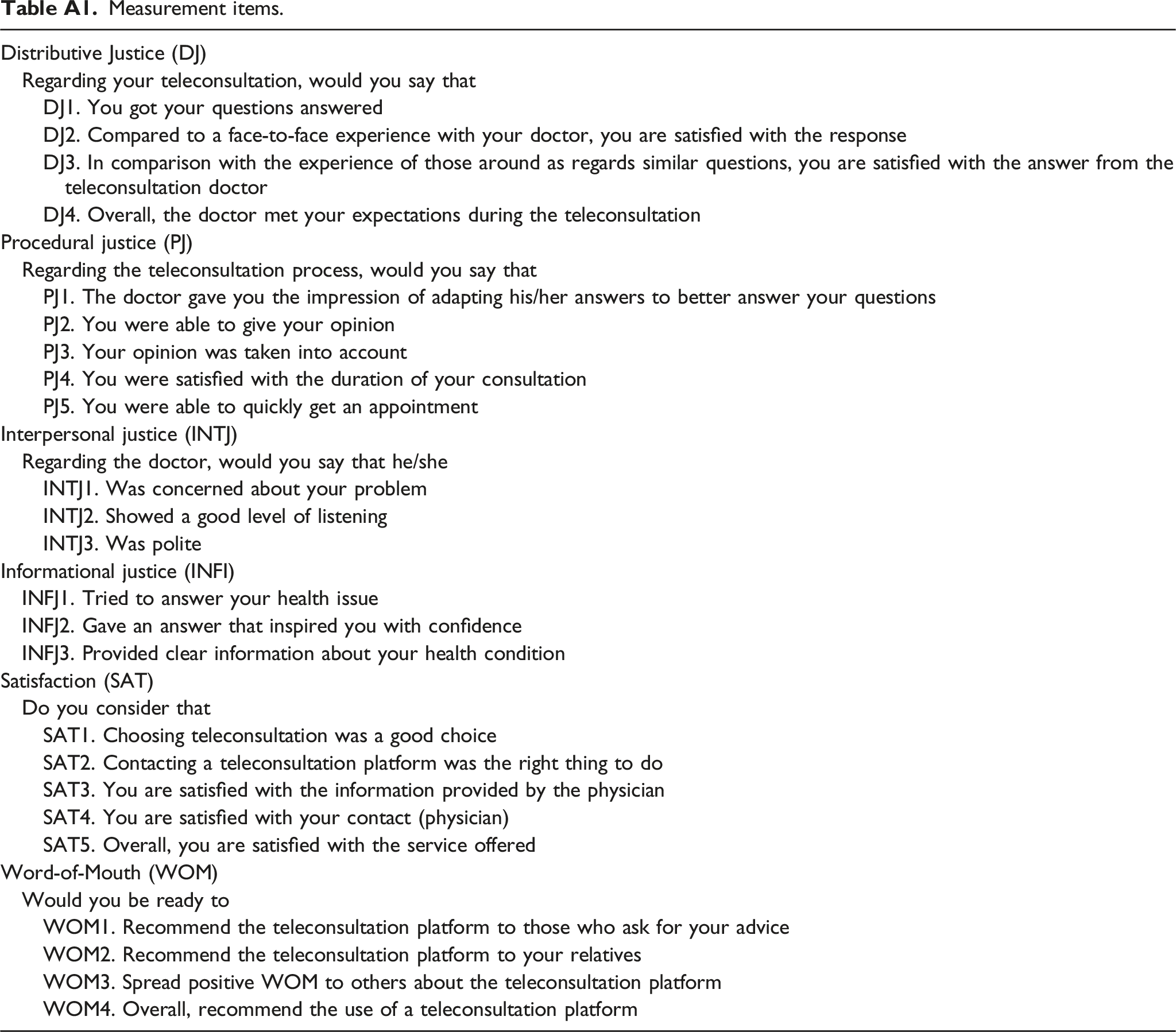
| Distributive Justice (DJ) |
| Regarding your teleconsultation, would you say that |
| DJ1. You got your questions answered |
| DJ2. Compared to a face-to-face experience with your doctor, you are satisfied with the response |
| DJ3. In comparison with the experience of those around as regards similar questions, you are satisfied with the answer from the teleconsultation doctor |
| DJ4. Overall, the doctor met your expectations during the teleconsultation |
| Procedural justice (PJ) |
| Regarding the teleconsultation process, would you say that |
| PJ1. The doctor gave you the impression of adapting his/her answers to better answer your questions |
| PJ2. You were able to give your opinion |
| PJ3. Your opinion was taken into account |
| PJ4. You were satisfied with the duration of your consultation |
| PJ5. You were able to quickly get an appointment |
| Interpersonal justice (INTJ) |
| Regarding the doctor, would you say that he/she |
| INTJ1. Was concerned about your problem |
| INTJ2. Showed a good level of listening |
| INTJ3. Was polite |
| Informational justice (INFI) |
| INFJ1. Tried to answer your health issue |
| INFJ2. Gave an answer that inspired you with confidence |
| INFJ3. Provided clear information about your health condition |
| Satisfaction (SAT) |
| Do you consider that |
| SAT1. Choosing teleconsultation was a good choice |
| SAT2. Contacting a teleconsultation platform was the right thing to do |
| SAT3. You are satisfied with the information provided by the physician |
| SAT4. You are satisfied with your contact (physician) |
| SAT5. Overall, you are satisfied with the service offered |
| Word-of-Mouth (WOM) |
| Would you be ready to |
| WOM1. Recommend the teleconsultation platform to those who ask for your advice |
| WOM2. Recommend the teleconsultation platform to your relatives |
| WOM3. Spread positive WOM to others about the teleconsultation platform |
| WOM4. Overall, recommend the use of a teleconsultation platform |