



Abstract
This study explores the objectives and operations of the diasporic operations of Nigerian banks in the UK. Its aim is to understand why such banks choose to establish a presence in the UK, how they structure themselves, and how they meet the UK’s regulatory standards. By employing a mixed-method approach – a combination of survey data and semi-structured interviews – this research examines the reasons underlying Nigerian banks’ engagement in diaspora banking, their human resources strategies, and the manifestation of their organisational culture within the UK context. The findings illustrate that Nigerian banks utilise either the subsidiary model or the branch model to cater to the financial needs of Nigerian diaspora communities, facilitate international transactions, and support international investment in Nigeria and Africa more broadly. The usually staffing strategy applied involves a mixture of UK-based employees and Nigerian staff seconded from the banks; headquarters in Nigeria, which ensures that the bank are able to adhere to both UK financial regulations and Nigerian compliance standards. The study’s originality lies in its novel contribution to the operational activities of diaspora banking in the UK.
Introduction
In this study, we explore Nigerian banks’ diaspora operations in the UK. The global banking industry has changed rapidly in recent years because of globalisation and technological advances, thus providing opportunities for banks across the globe to expand and establish their presence in foreign countries (Cressey and Scott, 1992; Demirgüç-Kunt et al., 2022; Goldstein and Turner, 2021; Morris, 1986). However, the banking industry is complex and is known for its many regulations. Given the complexity of banking services, governments worldwide have made various efforts to regulate the global financial services industry. Such regulatory measures help monitor and improve banks’ performance (Nayak, 2021). Consequently, banking culture can be considered conservative, as the bank plays the roles of a profitmaking business and as a public service provider (Nayak, 2021), as in the UK banking industry, which has been making a concerted effort to improve market conduct and accountability in the wake of the 2008 financial crisis. Thus, it provides and updates new and existing regulations and regulatory structures to keep pace with the structure of the UK financial market. Such regulatory measures require strict compliance by the banks operating within the country and cover many areas of banking operations, including staffing and corporate culture. Banking regulations in the UK also allow for an overseas branch model, facilitating the inflow of banks from foreign countries to compete with the UK banks.
Overseas banks may attempt to operate in the UK in order to serve diaspora communities from their home countries. They are often established as subsidiaries of their parent banks in their home countries. Therefore, it is imperative for banks operating in the UK to understand the various banking regulations and their implications on banking operations and performance. Nigerian banks participate in global banking operations, as well, with their presence already felt in most African countries and in other parts of the world, including the UK. The competitiveness of the banking industry and the constant changes affecting the sector require banks to be highly creative, adaptable, and innovative, all of which require the banks to have experienced, skilled, and competent employees in order to succeed. Kirby et al. (2022) confirm that the recognition of human input in organisations’ wealth creation has motivated scholars to focus on studying the role of people in banking operations. The achievement of these goals also requires organisations to have a strong corporate culture that can meet the needs and expectations of customers in foreign markets. Staffing and corporate culture are at the heart of Nigerian banking operations in the UK. Corporate culture also significantly improves banks’ overall performance and competitiveness in foreign countries. Such a competitive advantage – having a highly skilled and competent staff – is believed to enable banks’ subsidiaries to compete favourably in the international financial market (Waithaka, 2022).
Meanwhile, prior studies on the staffing of foreign subsidiaries (e.g. Naoki, 2015) provide theoretical and empirical evidence on the staffing procedures of multinational companies in foreign markets. Such studies assume that most multinational organisations’ decisions in relation to staffing are usually influenced by economic considerations, such as cost reduction and profitability (Naoki, 2015). However, some scholars argue that other factors influence staffing decisions (e.g. Barreto and Baden-Fuller, 2006). Accordingly, we adopt institutional theory as the theoretical framework underpinning this study. Institutional theory is adopted herein because prior researchers (e.g. Yang and Hyland, 2012) assert that studies grounded in institutional theory contend that staffing decisions are not usually based on economic considerations alone. Such decisions involve other considerations, such as the foreign country’s regulatory requirements. Therefore, we explore the activities of Nigerian banks operating in the UK, focussing on their staffing procedures, corporate cultures, and regulatory compliance. Although there are many extant publications on banking operations, staffing, and regulations in the UK, none has yet focused on Nigerian banks’ business operations in the UK or on diaspora banking models in general. We therefore seek to fill this gap in the literature. The present study provides empirical evidence on Nigerian banks’ staffing approaches, their corporate cultures, the extent of their compliance with UK banking regulations, and the impact of regulatory compliance on their performance. We give a literature review after this section, and we then outline the methodology adopted in the data-collection process. Subsequently, we present and discuss our findings. In the last section, we conclude the study by highlighting its implications for Nigerian banks in the UK banking sector.
Diaspora banking
The term ‘diaspora banking’ refers to overseas banks’ provision of banking services to people in diaspora communities. Consequently, many large banks are now adopting a model that allows them to serve their diaspora populations (e.g. Nigerians living outside Nigeria) (Alechenu, 2021). The Nigerian banking industry started expanding its operations into other countries in 2002. Two Nigerian banks initiated the cross-border banking expansion by establishing their presence in a few countries, especially in Africa (Abosede et al., 2018). The initiative increased after the 2004 Nigerian banking consolidation exercise, when the minimum capital requirement for banks was increased from USD $17 million to $210 million (Bernard Azolibe, 2022). The industry witnessed an increase in total assets from $23 billion before the consolidation to $127 billion after the consolidation in 2008 (Abosede et al., 2018). After the merger, around ten Nigerian (wholly owned) banks expanded and established subsidiaries in at least one African country, compared to only two in 2002. The United Bank for Africa led the drive for foreign expansion among Nigerian banks, establishing its presence in over 20 African countries and some countries in Europe and America (Bernard Azolibe, 2022). Several factors were responsible for the cross-border expansion of Nigerian banks, some of which were economic and others ideological. However, the expansion drive was motivated mainly by the need to increase profit and the value of shareholders’ funds. Bernard Azolibe (2022) asserts that the main factor driving this expansion into Europe and other developed nations was the banks’ desire to establish their presence in the global banking market and facilitate their customers’ international banking transactions (Abosede et al., 2018). The ideological factors influencing the cross-border expansion of Nigerian banks are associated with many underlying principles and beliefs that guide their global activities (Akinyoade and Uche, 2018), including Pan-Africanism, economic nationalism, financial inclusion, neoliberalism, developmentalism, cultural diplomacy, and globalisation. These ideas shape Nigerian banks’ understanding of their roles as profit-driven entities and agents of national development, regional cooperation, and global influence (Adewumi, 2021; Aremu and Saka, 2020).
An important context is that of Nigerian banks’ operations in the UK. As of June 2021, according to the UK Office for National Statistics, 312,000 people living in the UK were born in Nigeria; which indicates the size of the total diaspora market for Nigerian banks. Consequently, since 2008, many Nigerian banks have entered the UK’s banking market to provide commercial banking services, attracting customers within diaspora communities. Ogbuagu (2013) explores the role of diaspora-remitted earnings in developing the banking sectors in Sub-Saharan African countries. Some remittances may be channelled through African banks with an overseas presence. Such a process is beneficial, as it provides capital and facilitates further business for banks. For example, data obtained via Bloomberg LP (2024) illustrate that in 2021, Zenith Bank PLC reported having received 2.5% of its revenue from its operations in Europe (including the UK). Standard Chartered Bank PLC obtained 13.6% of its revenue from its activity in Europe and the Americas in 2021. These statistics highlight the role and importance of diaspora banking in the economic development of a nation. Meanwhile, existing academic literature has not yet explored the motivations underlying foreign banks’ diaspora operations in the UK, especially Nigerian banks. This study aims to fill the noted gap in the literature by exploring Nigerian banks and their diaspora operations in the UK.
Banking regulations in the UK and diaspora banks’ employee productivity
Overseas banks operating in the UK are subject to UK laws and regulations. They are overseen by UK regulators (Alsharqawi and Younes, 2020) and require a licence to undertake deposit-taking activity. The banking licence is issued following completion of the process outlined in the Financial Services and Markets Act (2000). Once a foreign bank is issued with a banking licence, the Prudential Regulatory Authority (PRA) aims to hold banks to the UK standards regarding prudential regulation (Alsharqawi and Younes, 2020). However, there are specific provisions for overseas banks according to their operational structure. First, a bank with a UK subsidiary is held to UK conduct standards but is overseen by the country in which its headquarters is located in relation to prudential regulation. The conduct of an overseas subsidiary operating in the UK is regulated by the UK Financial Conduct Authority (FCA), and the PRA oversees its prudential regulation. In both cases, the staff members working at the banks’ UK branches and headquarters are subject to regulatory requirements designed to create personal responsibility, including senior management, certification, and revised conduct rules. The senior management vetting process, led by the PRA and FCA, applies equally to the senior management teams in subsidiaries of overseas banks (O’Reilly, 1992).
Recent changes in the banking industry have altered bank practices from operating according to traditional banking principles to new ones. The old banking model is authoritarian, with bureaucratic norms, seeing staff members as costs. In contrast, the new banking model is built on technocratic standards. It is driven by performance and sales, and it considers staff members as resources, valuable assets contributing to the banks’ overall goals. In the UK banking system, as Brubakk and Wilkinson (1996) argue, there has been consistent agitation against the old banking model’s approach to recruiting and managing employees. They insist that the perspective of staff members being costs because of the money involved in paying their wages is outdated, and banks should move away from such an ideology and adopt the new model. Hence, Morris (1986) concludes that the new banking model’s approach, which sees staff members as assets, is most appropriate for current banking operations. This is especially true in this modern era of technology, wherein banks seek to recruit highly skilled workers with the necessary technical and digital competence to manage banking services. Similarly, Storey (1992) asserts that banks should adopt the new model, as it enhances efficiency more than the old model of adopting ‘dualism’, since banking operations have been within the framework of ‘unitarian’ for decades. Accordingly, the role of bank personnel is rapidly changing as banks are shifting from conventional banking models to more digital, automated methods, thereby transforming these jobs into technology-oriented services (Thakor, 2022). McKinsey & Company (2023) agrees that the nature of their contributions and the requisite skills are experiencing substantial transformation, as banks are transitioning to technology-driven service models, necessitating fewer personnel. Similarly, Thakor (2022) contends that the emergence of artificial intelligence (AI), digital platforms, and fintech has resulted in substantial transformations in the delivery of banking services. For example, AI-driven solutions, such as chatbots, deal with consumer enquiries, thus reducing the need for human personnel (Thakor, 2022). This creates new hurdles, as personnel must cultivate competencies in digital technologies, data analytics, and AI. Consequently, Brynjolfsson and McAfee (2022) assert that there is an increasing demand for specialised skills in digital transformation and data science. The authors contend that effective AI integration relies on the collaboration between bank staff members and AI systems, with humans offering supervision, which indicates that human capital remains essential in key banking roles despite the transition to automation. Thakor (2022) adds that employees’ creative and problem-solving skills continue to be valuable notwithstanding the automation of banking transactions.
Meanwhile, Gall (1993) argues that although many banks have embraced the new model, bringing about change in the banking industry, it is too early to conclude that the new model produces excellent outcomes. Banks’ efforts to improve employee productivity have gradually increased. Cooke et al. (2019) demonstrate that for an organisation to be successful, it must be able to attract employees who can perform to a high standard. Gruman and Saks (2019) argue that most organisations are confronted with various challenges and thus need to encourage enhanced employee performance in order to overcome such challenges. Organisations should therefore provide an enabling environment wherein employees are empowered to take charge and design their own jobs and roles in order to enhance their performance and achieve success on behalf of their organisations. Furthermore, Gruman and Saks (2019) suggest that organisational policies and practices should be integrated in order to establish a well-defined standard by which organisations can guide employees’ activities and enhance their performance. However, there are others (e.g. Karatepe et al., 2019) who contend that service organisations, like banks, in which there is a standard interface between the bank’s staff members and the bank’s customers, must invest in their employees in order to enhance their job satisfaction, productivity, and overall profitability (Hur et al., 2022).
The study’s theoretical grounding
Institutional theory and its application to banking
Drawing on Chowdhury and Maung’s (2022) research on the accessibility to external finance from the informal institutional perspective, the present study adopts institutional theory in its exploration of the operations of Nigerian banks’ subsidiaries in the UK. Contemporary institutional theory (neo-institutionalism) suggests that modern organisations rely heavily on their immediate environments (Meyer, 2008). The model demonstrates that different stakeholders and actors (governments, organisations, and individuals) are affected by institutions (Scott, 2002). Similarly, as Scott (2004: 2) suggests, institutional theory ‘considers the processes by which structures, including schemas, rules, norms, and routines, become established as authoritative guidelines for social behaviour’. Accordingly, Bruton et al. (2010: 428) posit that an institutional framework comprises specific ‘regulations, rules, norms, values, and other assumptions on what signifies proper behaviour’. Thus, abiding by institutional rules, regulations, and norms allows organisations to safeguard their positions and legitimise their environmental operations (Scott, 2007).
Therefore, the concept of ‘institution’ can generally be considered a set of formal and/or informal constrictions in an environment (North, 1990). Formal constraints include legal constraints, such as laws and regulations, while informal constraints include societal values and norms (Jepperson, 1991). Similarly, Scott (1995: 33; 2005: 8) defines institutions as ‘cognitive, normative, and regulative structures and activities’. North (1990: 1) adds that institutional regulative structures guide behaviour by creating, monitoring, and enforcing the ‘rules of the game in the financial sector’. It is also understood, however, that normative structures guide behaviour by specifying what could be appropriate (e.g. norms and values) in social and business contexts (Scott, 1995). Therefore, Meyer (2008) concludes that institutional theory considers the regulatory, social, and cultural influences that stimulate an organisation’s legitimacy in any environment. Figure 1 below presents the institutional theoretical framework used in the present study. Source: Currie (2008).
Considering the role of institutional theory in an organisation, it is reasonable to argue that a country’s institutional framework may affect its banking operations in numerous ways (Bruton et al., 2010; Chowdhury and Maung, 2022; Scott, 2007). Chowdhury and Maung (2022) affirm that such an institutional environment limits and defines organisations’ operations and opportunities, including those of banks. Therefore, the institutional factors that impact banking operations in an environment include government rules and regulations as well as social norms and values (e.g. the employee recruitment process and the reimbursement system) (Chowdhury and Maung, 2022). For instance, in the UK banking sector, robust regulations are enforced by the FCA and PRA, and these provide instructional directives to UK and foreign banks’ operations. These regulations dictate the banks’ operating terms and conditions, thus affecting banking operations in the UK financial market.
Furthermore, Bose et al. (2018) note that other institutional factors in the external environment, like favourable market incentives and the availability of capital, influence banking operations. Therefore, a heavily restrictive and highly regulated institutional environment could hinder banks’ establishment and operations as well as lead even to regulatory arbitrage. Bose et al. (2018) argue further that an unfriendly external climate may introduce regulatory barriers, inhibit the level of capital investment, and discourage the establishment of foreign banks. Dunkelberg and Wade (2015) identify both bureaucratic red tape and excessive financial regulations as the two most essential impediments to the establishment and operations of banks in any country, indicating that the formal institutional environment greatly influences banking activities.
However, there are also studies that suggest that informal norms equally affect banking practices (Khanna and Palepu, 1997). Thus, banking activities can also be stifled by normative components. For instance, Bose et al. (2018) explain that banks that lack a strong banking network may need help achieving their objectives, which could affect their competitive advantage.
Therefore, based on these extant studies of institutional theory, we conclude that while an effective regulatory environment and cultural values are vital for banking operations and development, excessive institutional rules and regulations, as well as hostile cultures and poor social norms can impede foreign banks’ diaspora operations in the UK banking industry. In this study, we highlight the relative importance of formal and informal institutional requirements in banking operations in the UK. Although our research shows that one institutional framework may have a higher impact than another, both frameworks are equally essential in supporting the establishment of new banks and their subsequent development.
Methodology
We adopted a mixed-method approach in order to better understand the phenomenon of Nigerian banks’ operations in the UK. A mixed-method approach is a methodological approach that allows researchers to investigate a phenomenon in depth and provide rich data for analysis and interpretation. We chose this approach for the present study to allow for an in-depth exploration of why Nigerian banks operate in the UK and what organisational structures and cultures exist in these operations. The initial survey (Phase 1) was a scoping activity undertaken to establish the critical facts that have hitherto not been considered in the extant literature on this topic. This quantitative part of the study took the form of an online survey – a questionnaire asking closed-ended questions of experienced Nigerian bankers who have worked in UK subsidiaries of Nigerian banks or relevant departments in their Nigerian banks. Furthermore, we applied a quasi-experimental design to test the study’s hypothesis about diaspora banking operations. Our use of a survey with a moderate sample size enabled us to apply a quantitative approach to significance testing. We chose a moderate sample size in order to allow for a degree of confidence in and acceptability of the findings, given the lack of relevant literature. We use an interpretive approach whereby we carried out semi-structured interviews in order to gain a thorough understanding of the phenomenon. Here, we followed Flick's (2022) suggestion of undertaking a qualitative study based on the principles of interpretivism in order to provide in-depth insights into Nigerian banks’ diaspora banking activities in the UK. The sample size here was smaller, because some participants were highly cautious concerning the risk of revealing proprietary information and the time commitment involved. The semi-structured interviews balanced the need for a consensus as well as the ontological assumptions that there would be no singular reality and that the participants would construct their responses from different reference points. The qualitative data that was collected corroborated the initial findings of Phase 1 of the study and provided a thorough understanding of the phenomenon.
Sampling and data collection
We initially used a convenience sampling method, which we followed with a stratified approach to ensure reasonable coverage of the various banks. The sample size for the quantitative part of the present study was 34 participants, and the sample size for the qualitative semi-structured interviews was 6 participants. Ultimately, we undertook an online survey of 34 bankers for the quantitative part of the study, and we conducted 6 semi-structured interviews between July and September 2023 for the qualitative part of the study. Each participant was required to 1 work as a banker in a Nigerian bank or a subsidiary thereof; 2. have at least 2 years of experience working in banking operations; and 3. be familiar with subsidiaries’ operations or foreign banking operations. Participants who did not meet the inclusion criteria or who could not give informed consent to their participation were excluded from the study.
Details of the participants in the quantitative study.

Phase 1: the quantitative study
We began our study with a survey of 34 participants with various levels of experience working in UK subsidiaries of Nigerian banks. The survey was conducted over 5 weeks over the period from the end of July to the beginning of September 2023, 1 and the sample was self-selective. Participants completed the survey virtually via MS Forms, which allowed us to automate single response verification and collect responses on an easily usable platform. A list of the questions used is given as Supplemental Appendix 1 to this study. Given that little has been written on diaspora banking models and given the lack of published data on subsidiary banking units operating in London, it is difficult to estimate the total number of employees working in diaspora banking operations and thus determine an appropriate population size. We analysed the PRA’s List of Banks as Compiled by the Bank of England to ensure that our study would have good coverage of the known operating banks. The sample covers seven individual banks and a variety of work-experience levels: branch staff (12), back-office staff (3), branch managers (15), and senior managers (4).
The primary sample comprised banks that use the subsidiary model and those that use an overseas deposit-acceptance model. Both structures are outlined in a previous section. Subsidiaries are registered banks in the UK and are recognised as banks in their own right by the Bank of England. They are also required to retain staff members who can undertake risk-related activities, as recorded in the UK Financial Services Register. In terms of the subsidiaries, the number of risk-taking staff members is given in Table 1 above. These figures indicate the relative size of diaspora banking operations in terms of the number of banking employees. It is noteworthy that such staff members are highly skilled workers who are likely to have knowledge specific to the UK financial system and its regulatory framework.
Phase 2: the qualitative study
We took a qualitative approach in Phase 2 of the data collection to complement the initial findings of the quantitative study undertaken in Phase 1 and gain yet more insights into the diasporic operations of Nigerian banks in the UK. We interviewed six key bank employees (in either London or Lagos) who were familiar with Nigerian bank subsidiaries’ operations in the UK. The participants were required to meet certain eligibility criteria for inclusion in the semi-structured interviews. All the eligible participants were interviewed online via Microsoft Teams. We carried out a content analysis by means of the frequency technique in order to identify and analyse patterns of words and themes occurring in the interview transcripts.
Results and key findings
In this section, we present the research findings according to the two phases of the study.
Phase 1: quantitative analysis of the reasons for Nigerian banks’ operations in the UK
The questions posed in the survey sought to explore two key areas. First, why do Nigerian banks operate either branches or subsidiaries in London? Second, we sought to quantify responses concerning general perceptions of cultural differences and regulatory knowledge. While we explored these themes in open-ended interviews, we wished to have a general indication from a wider sample size (34 compared to 6) so that we could report the findings based on a greater number of respondents.
The survey contained two questions in order to ascertain the reasons why Nigerian banks possess UK-based and UK-registered subsidiaries. The answers available to the participants were ‘yes’, ‘no’, and ‘don’t know’. Some inconsistency, rather than unanimous answers, among the participants’ responses, meant that statistical hypothesis testing was necessary for us to be able to interpret the results. In plain terms, we are confident that the majority assertion was correct at a stated confidence level, despite erroneous responses. On a bank-by-bank basis, we undertook a single-tailed t-test to confirm the statistical differences from a null hypothesis: The bank does not engage in an activity (when the respondents answered ‘no’).
In order to obtain estimates of statistical confidence arising from the responses, ‘no’, ‘don’t know’, and ‘yes’ were numerically coded −1, 0, and 1, respectively. This enabled the construction of a single-sample, right-side, t-test. The aim here was for each bank, to run a null hypothesis (the bank does not engage in an activity [when the respondents answered ‘no’]) and a corresponding alternate hypothesis (the bank does indeed engage in that activity). After we had computed the t-statistics, we were then able to compare them with t-critical values from a t-distribution, which allowed us to assess statistical confidence. For example, if we can obtain a significant result when assessing the 5% significance level, we can be 95% sure that the bank does engage in a particular activity.
For each bank, and for each measure, to construct a t-statistic, we follow
μ in this context is equal to 1.00, as we are testing the significance of the average response value from 1.00.
Where
The two hypotheses in this test are: H0: μ = −1 - Implying that the sample is indistinct from a unanimous ‘no’ answer H1: μ ≠ −1 - Implying that the sample is statistically different from a unanimous ‘no’ answer
The average responses by the banks to questions concerning the banks’ reasons for operating in the UK.
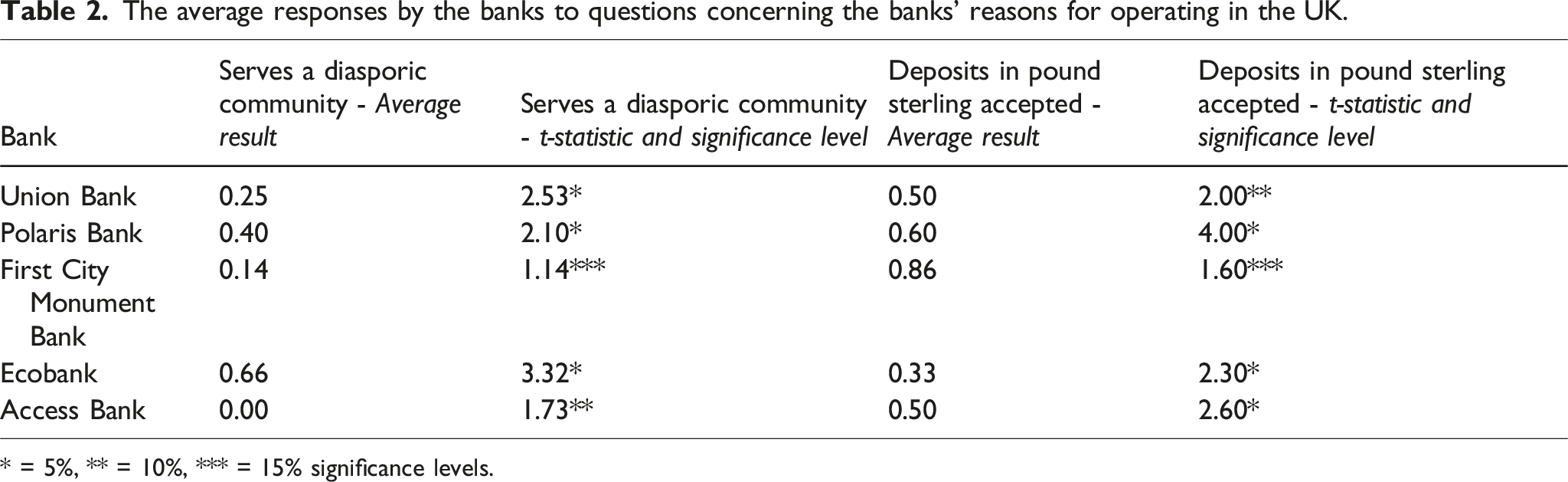
* = 5%, ** = 10%, *** = 15% significance levels.
It is sometimes appropriate to consider results obtained at significance levels lower than the typically sought 5% significance level (95% confidence). According to Kim (2015), it is appropriate to consider working at lower confidence levels, where the power of tests is strong and the probability of type 1 and type 2 errors are approximately equal. In addition, when a study’s sample size is small, the penalty for low degrees of freedom is a higher significance threshold. Hence, it is sometimes necessary to consider lower confidence levels, because of the higher power of outliers.
Variations in experience between staff members and managers
The survey participants were asked to categorise their level of seniority at their banks according to the following options: branch staff, back office, branch management, and management/leadership.
There is a significant variation in the knowledge of regulations and perceptions of the organisational culture among employees with different levels of seniority/experience. We used a single-tailed t-test approach to test for variations among the responses of a particular group of employees and the responses of the sample as a whole. It was impossible to determine any statistically significant variation in the responses at any confidence level of note. Thus, in the sample of surveyed employees, there are no variations in the perceptions of culture or in regulatory knowledge, which is explained by the respondents’ level of seniority/experience.
Testing variations between models of overseas banking
The fact that the two operation models are subject to different regulatory conditions is reflected in the participants’ skills, competencies, and behaviours. In order to explore this idea further, we tested the following hypothesis:
There is significant variation in the knowledge of regulations and perceptions of organisational culture among banks operating as subsidiaries and banks operating as overseas branches. Single-tailed t-tests on the Likert-scale responses indicated no statistically significant variations in the responses given to either question in this regard. In terms of the question concerning regulatory knowledge, the average response suggested an excellent understanding of regulations at the banks that operate according to the subsidiary model. However, the difference only becomes statistically significant when working at the 80% confidence level.
Analysis of culture and regulations
The same 34 respondents were also asked Likert-scale questions about their perceptions of the similarities between Nigerian and UK working practices and their self-reported familiarity with rules and regulations concerning their banks’ operations in the UK (Figure 2). Summary of the participants’ responses to the Likert-scale survey questions.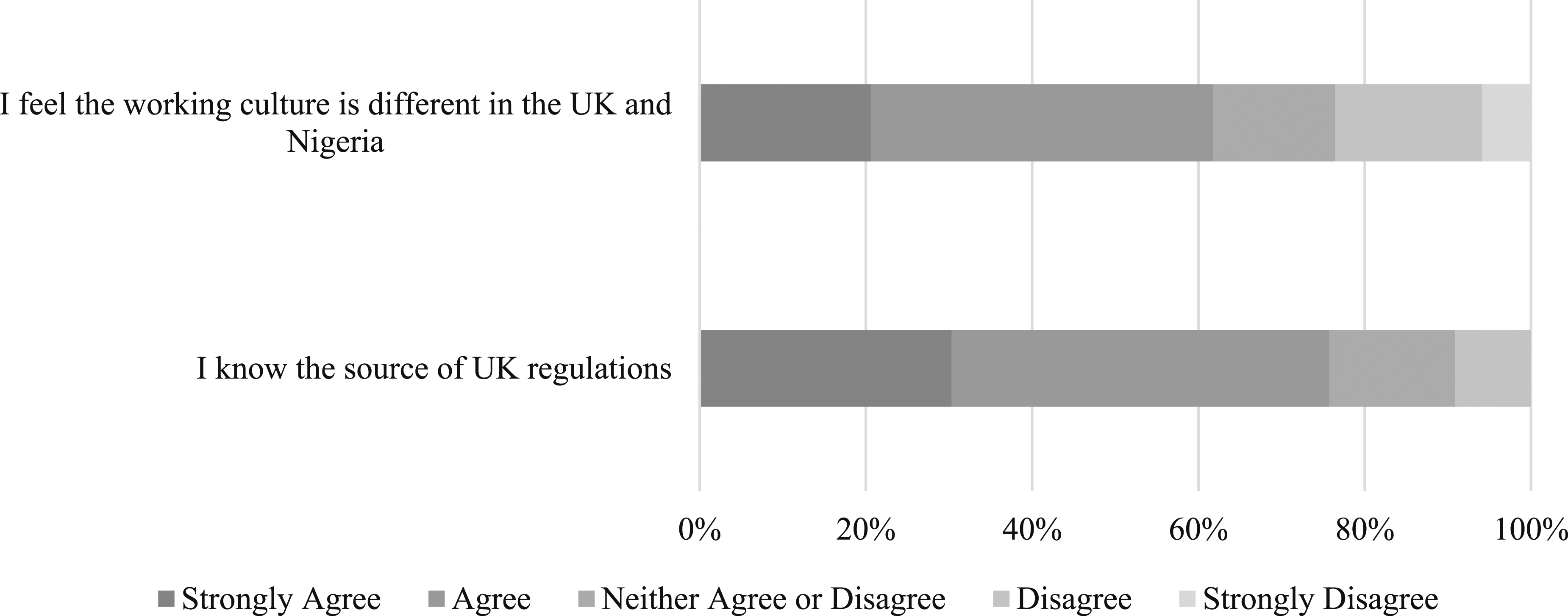
A statistical analysis of the bank- and experience-level responses revealed no statistically significant variations or outliers in the dataset, which suggests that the findings of the quantitative analysis are reasonably generalisable across the six banks in the sample. Furthermore, a statistically significant correlation between regulatory knowledge and working culture is identifiable. As all six banks reported undertaking somewhat similar activities, there are no perceivable variations among the banks in relation to the activities they undertake and their perceptions in relation to culture or regulatory knowledge.
Phase 2: qualitative analysis of the findings
Since Phase 1’s results were inconclusive, Phase 2’s qualitative data analysis complements the results of the quantitative study, providing richer insights into the topic, as presented below.
The operational objectives of diaspora banking in the UK
Although Nigerian banks focus on expanding into other African countries, the study’s findings indicate that their presence in the UK can be seen as a response to demands for global financial services among African and foreign merchants. Thus, this study’s primary findings attributed Nigerian banks’ strong base in the UK to the desire to establish their presence in the global financial market in order to support foreign direct investors and international trade in African countries. Such an approach on the part of the Nigerian banks operating in the UK helps grow international financial services for their parent banks in Nigeria. They strive to achieve this goal through excellent customer service and innovative solutions in international trade finance, commercial banking, and asset management, as authorised by the UK’s PRA and as regulated by the FCA. The following comment of one of the participants exemplifies the overall objectives of Nigerian banks in the UK: My bank’s primary purpose in establishing a subsidiary in the UK is to become a corresponding bank. The Central Bank of Nigeria licenses my bank to carry out banking transactions outside the shores of Nigeria. Correspondence banking allows Nigerian banks to operate outside Nigeria. It offers the opportunity to have a correspondent bank arrangement with other Nigerian banks to help them carry out the business of offshore banking and conduct their foreign transactions. As a subsidiary of my bank in the UK, we have been assisting other banks in Nigeria and Africa in carrying out their international trade and other international banking transactions, like letters of credit, paying school fees, and import and export transactions.
Another participant supported this assertion, adding that Nigerian banks regularly provide banking services to international investors interested in taking their trading activities to Africa: We bring in an African courtesy to enhance British efficiency in the UK banking sector. As a Nigerian bank operating in the UK, we provide efficient, personal service to our personal banking customers from our experienced staff in London. We offer a wide range of products and services that provide excellent value and give customers the flexibility to manage their banking affairs in a way that suits their lifestyles. In doing that, we set standards for sustainable business practices that unleash our talents as employees, deliver superior value to our customers, and provide innovative solutions for the markets and communities we serve.
Another respondent demonstrated that Nigerian banks regularly provide support to their customers in order to grow their businesses in Nigeria and other African countries: As an employee of a Nigerian bank operating in the UK banking industry, I can categorically state that my bank takes pride in helping our UK customers to grow their businesses. My colleagues and I are experienced business banking staff members in our trade finance, lending, and treasury departments. We understand the needs of businesses that operate in the UK, West Africa, or both. We have worked tirelessly over the years to support African and other foreign merchants, willing to discuss their business needs and provide them with the advice and support they need.
A further reason for the presence of Nigerian banks in the UK is to support the flow of investments into Nigerian and African markets. Most participants affirm that Nigerian banks support foreign investors interested in direct investment in Nigeria and other African countries. The following quote from a respondent supports these arguments: My bank is a subsidiary of a Nigerian bank that operates daily banking activities in the UK. I work in the bank’s cross-border trade finance department, which handles large volumes of export letters of credit originating from our headquarters and correspondent banks in Nigeria and West Africa. We provide adequate support for our merchants’ transactions in different parts of the world and ensure that such transactions are expedited efficiently through our global network of banking contacts.
One of the interviewees added that Nigerian banks’ subsidiaries in the UK are mainly established to provide financial services to individuals and corporate organisations with personal or business links in Nigeria and Africa as a whole: We are a Nigerian bank subsidiary operating in the UK, and we offer both retail and wholesale banking products and services to private, corporate, and institutional clients. As a UK subsidiary bank with a Nigerian background, we have been able to design suitable banking products and services to address the needs of individuals and corporate clients visiting the UK or based here who have business or personal connections in Africa and vice versa.
Diaspora banking and the recruitment culture in the UK
Some respondents reported that the recruitment style of Nigerian banks’ subsidiaries in the UK is that they employ staff members who already reside in the UK and staff members who have been transferred from the banks’ headquarters in Nigeria to the UK. Additionally, the banks typically recruit bankers who have many years of banking experience in the UK. Most of such recruitment is conducted independently by the UK subsidiaries, without much involvement from Nigerian headquarters. The second group of employees are bankers transferred from their Nigerian headquarters to the subsidiaries in the UK. Most of these workers are highly experienced Nigerian bankers who have spent much time working in West African and international marketplaces. A participant who worked for several years in Nigeria before being transferred to their bank’s subsidiary in the UK commented: Our bank is a subsidiary of a Nigerian bank, built on the strong and prestigious brand of the parent bank in Nigeria. We primarily recruit highly qualified and experienced bankers within the UK to manage our UK subsidiary. At times, the bank also opens vacancies for internal advertising and recruitment or transfers occasionally from any of the branches in Nigeria to the UK subsidiary. My bank takes this recruitment approach to support talented employees in many ways to achieve their career ambitions. Although our UK subsidiary is small, with a few staff members, we think ‘big’ regarding equality and diversity in our recruitment exercise and career development in Nigeria and the UK.
Similarly, another respondent illustrated that Nigerian banks’ subsidiaries in the UK often recruit over 70% of their staff members from within the UK. Less than 30% are transferred from the bank’s headquarters in Nigeria. The following quote from one of the participants buttresses this point: I work in a Nigerian bank subsidiary here in the UK. Although I moved to the subsidiary branch of my bank through an internal vacancy advertisement – years back – most of the staff members in this London subsidiary were employed from within the UK. Despite the diversity, we work harmoniously as a team to achieve ‘controlled growth’ as we aim to become the bank of choice for businesses wishing to transact on the African continent. So, the bank believes the UK subsidiary can only succeed if the right employees are recruited to deliver excellent banking services to global customers willing to trade in Africa. As a result, we adopt a flexible approach, use our initiative, and work as ‘one team’ to ensure this happens.
Another respondent demonstrated that Nigerian banks recruit employees from within the UK, transfer staff members from their headquarters in Nigeria to the UK, and allow them to serve in the subsidiaries for years. However, they can be redeployed back to the head office in Nigeria years later. Nevertheless, Nigerian banks do send some of their compliance staff to the UK to conduct periodic audits of the banking transactions of the subsidiaries in the UK. As one interviewee commented: We encourage recruitment within the UK to ensure that employees have the requisite knowledge of the UK’s financial market. My bank mostly employs individuals who can take ownership of their duties while fostering a team spirit, including diversity in our workforce. Furthermore, we also send our internal auditors from the bank’s headquarters in Nigeria to conduct periodic checks of their operational activities in the UK. The idea is to ensure compliance with the UK regulatory authority in the parent bank in Nigeria’s quest to achieve its overall goals. In addition, we work closely – in partnership – with the Chartered Institute of Personnel and Development (CIPD) to enhance the skillset and talent pool within the bank.
Diaspora banking: staff training and control in the UK
The study findings further show that Nigerian banks have absolute control over their UK subsidiaries and take full responsibility for their subsidiaries’ operations in the UK. Notably, the subsidiaries are allowed to run independently but are monitored and controlled by their head offices in Nigeria. For example, periodic internal audits are organised mainly by the parent bank in Nigeria, and they send staff members from the head office to carry out the task on behalf of the parent bank in Nigeria, as evidenced in the participant’s comment below: Our bank serves as a Nigerian bank’s subsidiary in the UK. It is run independently and is subject to UK financial regulations such as those of the FCA and PRA. The UK financial regulators license us to undertake financial services in the UK. However, our subsidiary is also subject to monitoring and control by its parent bank in Nigeria. For example, even though recruitment is done independently within the UK, the subsidiary must obtain approval from the bank’s headquarters in Nigeria before such recruitment can occur.
Other participants suggested that most Nigerian bank subsidiaries contribute to the acquisition and development of skills among youths in the UK, mostly through their various apprenticeship schemes, which are designed to support young people interested in pursuing a career in banking. This approach helps prospective bankers develop their skills in financial services. One respondent commented: Although our bank is a subsidiary of a well-established bank in Nigeria, it offers a two-week work-experience programme for UK students hoping to pursue a banking career after graduation. The programme, which is independently organised, allows students access to the bank in order to learn how we operate in the UK, providing an overview of the working environment of a bank. We also have a summer internship programme for university students – a four-week opportunity to work and learn banking services in a specialist business unit or department. This allows them to gain vital experience in real-time business-as-usual situations. Similarly, we run a 12-month placement programme for placement-year students in areas related directly to their degree. It also allows them to work with and learn from the bank’s staff.
Similarly, the study findings indicate that Nigerian banks also have direct control over the management of the banking operations in their UK subsidiaries, including management of training and development: Generally, our managers carry out their job functions independently, without undue interference from the headquarters in Nigeria. However, management still takes directives from the headquarters in Nigeria on critical financial services issues. We are also allowed to undertake training programmes for our staff, but the parent bank in Nigeria must approve this. Nevertheless, as a Nigerian bank subsidiary in the UK, our bank has some autonomy in its operations and recruitment. The parent bank only plays the role of oversight, monitoring our activities and ensuring they align with the overall business objectives of the parent bank in Nigeria.
Other interviewees supported this assertation and concluded that Nigerian banks regularly provide training to their staff in the UK: Although we operate as a Nigerian bank branch in the UK, the parent bank retains the responsibility for training and developing its subsidiary staff members in the UK. In most cases, the contract is out to the top, provided by well-known global training and development organisations like Ernst and Young. The goal of the training and development is to ensure that staff members in the subsidiary develop and update their knowledge and skills regularly in order to meet the changing needs of their customers in the global financial market.
The interviewees’ knowledge and experiences of their parent banks’ subsidiaries shed light on the current nature of Nigerian banks’ diaspora operations in the UK, particularly in relation to their main objectives, mission, and vision. In addition, it also highlights the recruitment process and the autonomous nature of Nigerian banks’ subsidiaries in the UK.
Discussion
This study offers a fresh perspective on what has motivated the establishment of Nigerian banks’ subsidiaries in the UK financial services industry. We chose this research topic to address calls in the extant literature for a more in-depth understanding of the business objectives of Nigerian banks operating in the UK. Our goal has been to explain their business operations, especially why they are crucial for achieving the banks’ long-term goals. Therefore, it is important to understand their objectives in bringing non-Western banking products and services with an African flavour closer to foreign investors who are interested in international trade and foreign direct investment in Africa. Indeed, Kanyeke (2014) argues that diaspora banking should be understood in its culturally appropriate context by considering what diaspora banking operations involve. Similarly, Loginova (2023) examines the diaspora banking of Kenyan banks in the UK, and the study’s results indicate that the primary goal of diaspora banking is to serve the interests of Kenyans in the diaspora. This approach contradicts the objectives of most Nigerian banks, as revealed in the present study: Diaspora banking operations go beyond satisfying the banking needs of Nigerians in the diaspora – they also facilitate deposit-taking in pounds sterling. Their financial services include correspondence banking and supporting the international trade flow between developed nations and developing countries of Africa.
This in-depth investigation into the diaspora banking operations of Nigerian banks in the UK highlights several dimensions in the ongoing debate on diaspora banking. As observed earlier in this study, the objectives of diaspora banking are subjective – they depend on the individual bank. However, the principal motives seem common, reflecting banking activities in the home country, financial regulations, and competition. These various elements drive the objectives of most diaspora banking operations, as we have demonstrated in relation to Nigerian banks’ subsidiaries in the UK. Thus, consistent with the extant literature on diaspora banking (e.g. Chowdhury and Maung, 2022), our research demonstrates that the establishment of subsidiaries to carry out diaspora banking operations in the UK offers opportunities for African banks to promote the smooth and free flow of international trade and investments into African markets. This is essential for supporting the competitiveness of African businesses, merchants, and foreign investors willing to invest in Africa. Similarly, it enables them to compete favourably with multinational companies, as foreign banks dominate most international banking transactions from developed nations. Therefore, the current situation allows African investors to have alternative sources of financial services that support their businesses in Africa. According to Osuagwu and Nwokoma (2017), this approach has reduced the monopolistic nature of foreign banks in the international financial systems. However, there is considerable disagreement about whether Nigerian banks are providing the much-needed alternative financial services compared to banks in developed countries (Alade, 2014). Nonetheless, it is evident from the present study that a more critical argument could be made for the prevalence of Nigerian banks’ subsidiaries in the UK, as their presence provides potential alternatives to international trade targeting African markets.
Additionally, the findings of this study evidence the mixture of human resourcing from the host country (the UK) and the deployment of experienced staff members from the bank’s headquarters in Nigeria to meet the subsidiaries’ needs. While direct regulation appears to be UK-based regulation, there is evidence from multiple respondents that some Nigerian banks are licenced to carry out correspondence banking by the Central Bank of Nigeria and take their compliance culture from the banks’ headquarters in Nigeria.
We applied institutional theory in this study, as it offers a framework for understanding the underlying objectives of Nigerian banks operating in the UK. We chose this theory because the banking industry is subject to various regulatory requirements and institutional pressures that influence its operations – nationally and internationally. Our main goal in using institutional theory was to understand the formal and informal structures (including norms, rules, and routines) affecting the operations of Nigerian banks’ subsidiaries in the UK, as evident in this study’s findings (Bose et al., 2018). Similarly, as we mentioned above in relation to the extant literature on the role of institutional quality on financial inclusion (e.g. Chowdhury and Maung, 2022), institutional theory highlights the impacts of institutional quality on diaspora banking operations, and, as the study’s findings show, Nigerian banks’ subsidiaries in the UK are working harder to improve the quality of their financial services to meet and exceed the expectations of their global customers. This is being done to facilitate correspondence banking services in the context of global financial banking services that support the growing needs of African merchants and individuals for international trade transactions. Thus, this research evidences that Nigerian banks positively impact global trade and investment through diaspora banking operations. However, we also argue herein that there is still much to be done by these Nigerian banks in order to for them compete favourably in the global financial market and to retain their diaspora banking role for years to come, because these banks still struggle to win customers within the UK banking market. Furthermore, most of them focus on correspondence banking transactions and other international trade, paying less attention to retail banking customers in the UK.
By exploring the notion of diaspora banking in the UK from Nigerian banks’ perspective, our research makes critical theoretical contributions to the extant literature concerning the nature and objectives of Nigerian banks’ subsidiaries and their diaspora banking operations in the UK. The research participants expressed various viewpoints on the objectives and operational activities of Nigerian banks’ diaspora banking operations in the UK. Accordingly, the study findings demonstrate why Nigerian banks establish subsidiaries in the UK, their recruitment processes, the control measures they implement, and the impact of regulatory touch on their operations, thereby contributing to the knowledge of diaspora banking operations in the extant literature. However, our study findings contradict the conclusion of prior works (e.g. Alade, 2014; Loginova, 2023) that most diaspora banks’ banking activities in the UK mainly target potential customers in the diaspora. While it is the most visible element of their activities, there is additional activity, principally correspondence banking, which is a significant part of facilitating investment via the parent bank in Nigeria.
Study limitations and areas for further research
This study has shed new light on a critical but underexplored aspect of diaspora banking operations, focussing on Nigerian banks’ subsidiaries in the UK. However, it is acknowledged that the findings have several limitations, which also serve as recommendations for future studies on the topic. The first of these observed limitations is that although a mixed-method approach was used for the data analysis, obtaining a large sample size for the two methods (both quantitative and qualitative) was difficult, mainly because the population appears to be small. Thus, recruiting a significant number of individuals working in these subsidiaries or with experience in foreign banking operations was challenging, partly because most of these subsidiaries recruit few employees to run their UK subsidiaries. As a result, the researchers had to make the most of the relatively small sample size: 34 respondents for the quantitative study and 6 interviewees for the qualitative section. Although we reached data saturation at the fifth interview, the sixth was still conducted in order to enrich the study’s findings and enhance its credibility and reliability. Nonetheless, the small sample size is recognised as one of the study’s limitations. Therefore, it is recommended that future research use a larger sample size to ensure the results are more generalisable. Furthermore, most of the respondents for this study are middle-management staff members, and it is recommended that future research might include upper-management staff from the banks, such as CEOs or MDs of these Nigerian banks and the upper-management team members at their UK subsidiaries. This approach will provide more insights into the objectives underlying the diaspora banking operations of these Nigerian banks in the UK.
Conclusion
Nigerian banks’ diaspora banking operations are becoming popular in the UK banking industry. However, their objectives, visions, missions, business operations, and modus operandi, including employee recruitment, still need to be discovered, which necessitated this study. In this research, we have explored the operations of Nigerian banks in the UK, and our study findings shed light on the diaspora banking operations of Nigerian banks in the UK. The principal finding of this study is that Nigerian banks’ robust presence in the UK is driven by the intention to assert their influence in the global financial sector in order to facilitate foreign direct investment and international trade in African nations. We are able to confirm that most Nigerian banks’ subsidiaries serve as correspondence banks in the UK, not necessarily to serve Nigerians in the diaspora but to facilitate foreign direct investments and international trade between Africa and the rest of the world. By focussing on Nigerian banks’ diaspora banking operations in the UK, our study makes a valuable and original contribution to debates about global diaspora banking operations by considering the objectives of banking operations in foreign countries, as demonstrated by the study’s results. Thus, the relevance of these outcomes lies in the fact that they have provided a more profound understanding of why banks choose to operate in the diaspora. Therefore, this research is an essential first step in shedding new light on how banks from developing nations can leverage global financial centres to facilitate domestic economic progress by establishing and operating in a foreign country.
The study’s research question (Why have Nigerian banks established diaspora banking operations in the UK, and what are the implications thereof for African economies?) is significant for various reasons. Global banking processes are always changing because of globalisation; technological innovations and improvements; and the necessity for cross-border financial integration. Examining the rationale behind Nigerian banks’ expansion from an emerging economy into established financial markets such as the UK reveals the strategic motives of banks from developing nations. The study subject is crucial for the global scientific community, as it enhances the comprehension of how banks from emerging nations operate within and influence the global financial landscape, offering significant insights for forthcoming studies, policy creation, and the formation of banking strategy in international financial markets.
Policy implications
This research underscores the strategic importance of Nigerian banks in the UK, serving as a pivotal bridge for facilitating financial transactions between the UK and Africa. Their role in enabling cross-border trade, investment, and remittance movements is significant, and they are thereby able to contribute to economic development on both sides. Nigerian banks’ diaspora banking operations serve as a strategic bridge for foreign enterprises and investors seeking to tap into Africa’s growing markets. Therefore, our study findings present significant policy implications for Nigerian banks in the UK, UK authorities, and the Nigerian government.
First, Nigerian banks must ensure regulatory alignment and compliance with Nigerian and UK regulatory frameworks. Policy initiatives must ensure that these banks adhere to the rigorous compliance standards of UK financial regulations, encompassing anti-money laundering and know-your-customer mandates while remaining cognisant of the distinct developmental and economic objectives these banks seek to fulfil in Africa. Similarly, Nigerian regulatory authorities should enhance collaboration with their UK counterparts to achieve effective regulatory compliance while advancing the developmental objectives of these institutions.
Second, while Nigerian banks in the UK do not predominantly focus on diaspora consumers, a significant untapped opportunity exists in this segment of the market. Formulating diaspora engagement policies that actively promote the expansion of these banks’ services to address the financial needs of the Nigerian diaspora could be a strategic move. Policy reforms may encourage banks to offer more specialised financial products, like diaspora bonds, remittance-linked savings, and customised mortgage options. This untapped potential presents a significant opportunity for growth and development.
Finally, although Nigerian banks’ diaspora banking operations in the UK facilitate talent transfer and capacity-building in human capital, a primary operational difficulty identified in the study is the absence of a comprehensive, localised recruitment plan. Policy interventions should prioritise the improvement of recruitment and training processes in order to integrate local talent in the UK into these businesses. Nigerian regulatory authorities could partner with UK institutions to promote knowledge exchange and training initiatives and thereby cultivate a varied workforce adept at managing the intricacies of international banking, thus benefitting both countries.
Supplemental Material
Supplemental Material - Managing and resourcing Nigerian banks’ diasporic operations in the UK: An empirical study
Supplemental Material for Managing and resourcing Nigerian banks’ diasporic operations in the UK: An empirical study by Kareem Folohunso Sani, Michael Harrison and Toyin Ajibade Adisa in Journal of General Management.
Footnotes
Declaration of conflicting interests
The author(s) declared no potential conflicts of interest with respect to the research, authorship, and/or publication of this article.
Funding
The author(s) received no financial support for the research, authorship, and/or publication of this article.
Ethical Statement

Supplemental Material
Supplemental material for this article is available online.
Notes
References
Supplementary Material
Please find the following supplemental material available below.
For Open Access articles published under a Creative Commons License, all supplemental material carries the same license as the article it is associated with.
For non-Open Access articles published, all supplemental material carries a non-exclusive license, and permission requests for re-use of supplemental material or any part of supplemental material shall be sent directly to the copyright owner as specified in the copyright notice associated with the article.
