



Abstract
This paper examines the role played by pumps as a technology of water access. In the desert that borders Egypt’s cultivated zone, pumps provide the water vital for reclamation, transforming desert into fields. Using two case studies of agricultural expansion into the desert margins, the paper explores the different ways in which farmers employ pumps to tap into the waters of the Nile. The pump is, as other scholars of science and technology studies have demonstrated, a prototypical nonhuman actor. Yet I argue that we cannot see the pump in isolation, but have to look at the passage of water through the pump and the interaction between multiple pumps in the landscape. Pumps rework the flow of water, redistributing the possibilities of agricultural production. At the same time, the flow of water in one direction shapes the possibilities for pumping in another. As some farmers pump water to irrigate the desert, they divert water away from others. As new fields emerge, old fields are rendered unproductive, generating new points of tension, resistance, and inequality within and between communities. The paper demonstrates, therefore, how situating an artifact in its material context brings to light new relations between that technology and the society that it both shapes and is shaped by.
The geography of Egypt is distinct. A narrow strip of cultivated land hugs the banks of the Nile as the river winds its way north, opening out where the river enters its delta; a band of green in the otherwise yellows of the desert. Only 4 percent of the Egypt’s territory is cultivated. This figure is not, however, static. For centuries, government agencies, private companies, and farmers have been working to expand the cultivated area through land reclamation. 1 Over the last 50 years, the reclamation of desert land has increased the cultivated area by more than 3 million acres (12,000 km2). The government has launched a series of mega-projects targeting huge tracts of land far out in the desert for reclamation, with the goal of creating more land, more production, and more jobs. While these schemes, like so many other state-led, modernist interventions, have so far failed to meet their ambitious targets, all along the borders of the valley and delta, a very vibrant process of desert transformation is underway. 2 In this marginal space, farmers and agricultural investors are working, with varying degrees of government authorization, to pump water up to higher desert land and expand their landholdings. The jagged edge of the cultivated zone is testament to the piecemeal addition of blocks of land to farms: a gradual accretion of agricultural space.
Water is central to this process of landscape transformation. It is not the only thing needed to reclaim the desert; farmers must also level the surface, remove rocks, and develop the fertility and texture of the soil. But whereas fertilizers and other soil treatments can be easily purchased, water cannot. Water is therefore the limiting factor for agricultural expansion. 3 Since the desert margins lie above the cultivated land of the valley and delta and the existing network of water distribution canals, farmers have to use pumps to lift the water. Pumps are therefore the limiting technology for agricultural expansion. This is a story of pumping possibility.
In a seminal paper, Marianne de Laet and Annemarie Mol (2000) examine the Zimbabwe Bush Pump as a technology of water access. 4 Situating their paper within actor-network theory, a body of scholarship in science and technology studies that seeks to transform what it means to be an actor, they argue that the Bush Pump is a particular kind of actor: it is nonhuman, but it is also fluid. 5 Part of this fluidity lies in the pump’s boundaries, which incorporate not only the object, but those who use it. 6 Hence the pump is not just a technology for delivering water, but a technology for building community. (Notably, de Laet and Mol’s argument is specific to this particular pump; they make no suggestion that pumps in different circumstances will display similar virtues.) At the local level, the Bush Pump brings together villagers (or groups of families) as they identify the site for a well, drill the hole, install, operate, and maintain the pump. At the level of the nation, the pump works to promote national community by contributing to the establishment of a nation-wide infrastructure for clean water delivery. Thus the community builds the pump and the pump builds the community. 7
Yet while de Laet and Mol (2000) offer an innovative study of this pump as a fluid technology, the fluid in question – water – does not feature prominently in their paper. 8 They closely follow the Zimbabwe Bush Pump through its invention, development, installation, and maintenance, but the analysis stops at the point where the water comes out of the pump. This leaves open the question of the dynamic interaction between the pump, or rather multiple pumps, and the flow of water, both above and below the surface. Where does the water go when it comes out of the pump? Who gets that water? What impact does the pump have on underground stores of water? What happens if neighboring communities start pumping from the same source? What do people do when a well dries up?
Were we to follow not only the pump but, also, the water that passes through the pump, I suspect that we might start to see spaces where the pump is a little less fluid: times and places of blockage, rigidity, stagnation, or solidity where the pump’s boundaries are less malleable, where they do not morph to incorporate everyone; cases where rather than bringing communities together, the pump pushes them apart. These would be the moments when some receive water while others do not, when the pumping from one well depletes the water coming out of another, or when the pump’s ability to produce water is confounded by the water table falling below the level of the well. The relationship between pump and community is thus, perhaps, more complicated than de Laet and Mol claim. A pump can build community, but it can also fracture community.
This paper therefore takes the technology of interest not as the artifact alone, but as the pump in its material relations to water. Whereas de Laet and Mol (2000: 225) assert that the Bush Pump ‘shapes new configurations in the Zimbabwean socio-technical landscape’, I argue that it is not just a pump but also the shifting patterns of water flow produced by multiple pumps that shape the socio-technical landscape. (The relationship is, of course, reciprocal, since social relations also shape how, where, and when different types of pump are able to operate.) Examining how pumps divert water to create new land in the desert reveals a critical and largely unstudied dimension to the process of land reclamation in Egypt. As some farmers pump from canals to develop new land, they pump water away from other farmers and their existing land. As some cultivate new lines of agricultural profit, others see their land rendered increasingly unproductive. Thus pumps, by reworking the flow of water through the landscape, generate new fissures within and between communities.
This is not, however, just a story of pumps and water. Rather, it is one that ties the pump, through the flow of water, into larger technopolitical networks, networks which integrate numerous human and nonhuman actors. 9 It links the pump to a landscape of multiple pumps, each trying to tap into the Nile – a river whose basin spans 11 countries, whose flows are governed by international treaties, and whose discharge varies depending on precipitation in the East African highlands, the hydro-development projects of upstream nations, and the Egyptian government’s releases through the gates of the Aswan High Dam. It connects the pump to the water management paradigms and agricultural development initiatives of national ministries and international development organizations, which promote pumping in some places to sustain particular forms of production and not in others. It reveals the contested relations between farming communities and government agencies as different parties work to access and control the flow of water. Thus just as Timothy Mitchell (2002), in his powerful analysis of 20th century development in Egypt, shows how construction of the Aswan High Dam linked multiple circuits – hydraulic, electrical, chemical, political, and agricultural – we see how the pump, a smaller, cheaper, more mutable and diffuse technology, mediates multi-scaled networks of hydrology, geopolitics, institutions, and economics. 10
The paper starts by focusing on the pumps, paying close attention to how these pumps operate to carry out their key function of lifting water. 11 Then, since my interest is not in the pumps alone but in the pumps in relation to other pumps and to the water flowing through them, I use two contrasting cases of land reclamation to examine the pumps in situ. The first case is the land reclamation that is taking place on the borders of Fayoum, a province located 80 km south-west of Cairo, just west of the Nile Valley (Figure 1). Here the reclamation is mostly small-scale, carried out by individual farmers reclaiming anything from half an acre to 100 acres (0.002 to 0.4 km2), using pumps placed on open irrigation canals. Access to pumps is mediated by the Ministry of Water Resources and Irrigation (hereafter the ministry), which controls points of offtake from the canal system and requires farmers to obtain licenses for their pumps. But the reality of a landscape dotted with unlicensed pumps, or pumps accessing water in unofficial ways, reveals the absences in this mechanism of control. As some farmers divert water to irrigate the desert, those in other parts of the province see their resource dwindle.
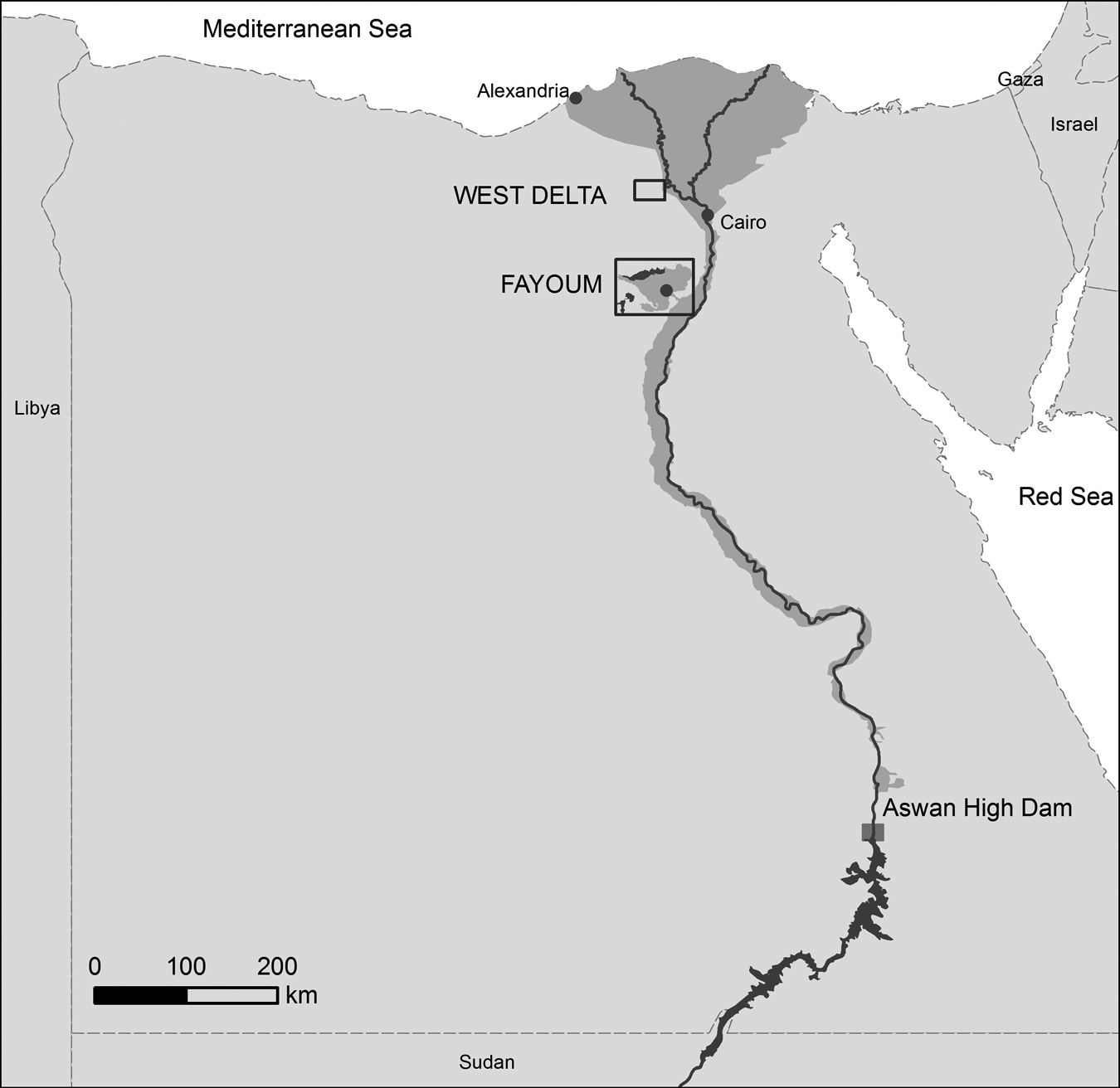
Two cases of land reclamation in Egypt
My second case is the land reclamation that is taking place west of the Nile Delta on a much larger scale, as investors develop vast export-oriented farms in the desert (Figure 1). Here different kinds of pumps are in operation. Attached to deep boreholes, they lift water several hundred meters from an underlying aquifer to bring it to the desert surface. In recent years, falling groundwater levels have led the investors to turn to the government for assistance in harnessing Nile water as an alternative source. The ministry is currently implementing a project, with international financing, to pump water from the Nile to the West Delta. This project is a harbinger of a new era of water diversions. The government’s vision for the flows of the future is to pump water away from the small farmers in the old lands to large desert farms that have proven to be highly profitable.
These two cases involve multiple human actors – farmers, investors, government officials, international donors – engaging with different types of pumps – diesel, electric, legal, illegal – in the project of transforming the desert. What links the marginal reclamation in Fayoum and the new project in the West Delta is that the pumps are seeking to tap into the same flow of water: the waters of the Nile. As these pumps draw on Nile water, they rework patterns of access, allowing some farmers to develop new land in the desert while depriving others of the water they need to cultivate their existing land. The paper demonstrates, therefore, how situating an artifact in its material context, examining how a technology like the pump intervenes in hydraulic circuits (while not detaching it from interrelated social, political, economic, and cultural circuits), brings to light new relations between that technology and the society that it both shapes and is shaped by.
Pumping possibility
Let us first consider the pumps that create new spaces of agricultural possibility. 12 The most ubiquitous is the diesel pump, a cheap, mobile, and easy-to-operate technology. Many farmers own diesel pumps, which can be bought in local towns for about $600. Those who cannot afford to buy a pump rent one, at a rate of about $2 an hour. Squat and simple, the pumps are mounted on a wheeled base. They are too heavy to be lifted by one farmer alone, but can be pulled behind a donkey or a tractor. The pump’s mobility is a function not only of its structure but the ease of its installation and use. Since the pumps lift water from open irrigation canals, there is no need for a well boring device. Concrete headworks are not necessary to protect the water supply, as the water comes from an already impure source and is not destined for drinking. Installation is as simple as pulling the pump into place and dangling its inlet pipe into the water. To start the pump, the user turns a lever to power up the engine. The engine rotates an impeller that creates an area of low pressure at the end of the inlet pipe, causing the water to rise up through the pipe and into the pump. Water spurts out through the discharge pipe into a ditch, from where it is channeled into a field.
Less common, but still significant as a mechanism of lifting water for land reclamation, is the electric pump. These pumps are more expensive (between $1,400 and $3,000, depending on quality), but are preferred by farmers due to their ease of operation and maintenance. Owing to their cost, electric pumps are often owned and operated by groups of farmers. They must be connected to a reliable electricity supply, and so their use is limited to areas with an existing power source or places where farmers are able to lobby for installation of a power line or have the capital to pay for one themselves. Once positioned by the canal and connected to an electric output, their operation is simple. At the press of a button, the motor starts with a low hum, generating a steady stream of water up through the inlet pipe and out through the discharge pipe. Electric pumps are also used above boreholes to lift water from underlying aquifers. Unlike diesel engines, which lose power over time due to wear, electric motors generally maintain their power output level. So where farmers need to lift water a greater distance or pump water over a larger area, they prefer electric pumps.
An interesting story could be told about how society has shaped the emergence of the pump as a technology for lifting water in Egypt. 13 The story would track the movement of the diesel pump from a factory in India, where it was first produced at low cost in the 1980s, to the fields of Egypt. The narrative would describe the construction of networks of power lines and how they have facilitated the installation of electric pump stations in some places and not others. It would examine the shift from farmers using other water-lifting technologies such as the shaduf (a lever system for raising water in buckets) and saqia (water wheel) to adopting the pump. It would explore how the users of the technology modify the pumps, replacing certain parts or using them in ways that their manufacturers did not necessarily envisage. But while the pump is a central character in my story, my focus is not on the pump per se. Instead, it is on the pump’s material relations to water. I reveal how social, economic, and political relations shape where and when farmers are able to pump and how, in turn, the act of pumping, through its work on the flow of water, reshapes those societal relations.
To understand the interaction between the pump and the water, we have to consider where the pump is positioned. Whatever the efficiency of a pump, if there is no water at the base of the well shaft or at the end of the inlet pipe, the pump will not deliver. Location is therefore paramount in setting the pump’s potential. The position of a farmer’s land in relation to the source of water – either surface of subsurface – determines how much water the farmer is able to access and thus the possibilities for expanding that land.
However, it is not only a question of where one pump is positioned but of how it is positioned in relation to other pumps. The act of pumping from any single site has a hydrological impact on the water source from which the pump draws, and, therefore, an impact on other farmers who wish to pump from the same source. Where a pump taps into an aquifer, the resultant flow dynamics depend on the balance between the rate of extraction and the rate of renewal. Where a pump draws from an irrigation canal (as is more common in Egypt since 96 percent of the water comes from the Nile), it decreases the amount of water flowing on down the canal. If water management officials are able to increase the canal’s discharge to make up for the additional withdrawal, then this may not impact downstream farmers. But if the officials only have a limited amount of water to allocate, as is the case for Nile water, then downstream farmers will see their supply decline. 14 Thus, when pumping water to irrigate new fields, farmers channel water away from already-cultivated fields downstream. The water that is diverted to the desert is not all lost from the irrigation system. Any water that is not evapotranspired by crops in the newly cultivated area infiltrates and flows back into drainage ditches, irrigation canals, or the Nile channel, and can be used again by other farmers. But on its way, the water dissolves salts and agricultural chemicals from the soil; some molecules percolate into deep bedrock and others evaporate from the soil. Hence the diversion of water to new fields fundamentally means less water, and water of a lower quality, for other agricultural users. 15
Consequently, land reclamation transforms not only natural and technological landscapes but also social relations. There may be cases where these pumps, like the Zimbabwe Bush Pump, foster communal ties. Farmers sometimes band together to buy an electric pump, for example, each taking a share of the water that comes out of the pump to use for reclamation. But as farmers use pumps to channel water to new land, they rework the patterns of access to water. Some are able to develop new sources of income while others see their land rendered uncultivable. Thus as the pumps start to work on hydraulic circuits, they generate tensions within and between communities. To see how these dynamics play out, I turn now to two contrasting cases of land reclamation.
Farming Fayoum’s borders
We head away from the village in the direction of the main canal, towards the desert hills (al-gabl) that border the agricultural land. We walk through what are now fields of tall leafy maize and short-stemmed onion seedlings, threaded with earthen irrigation ditches, dotted with date palms and some small fields of olive and pear trees, interspersed with fodder grasses. The land is gently sloping upwards, although you would not know it except for the water flowing through ditches in the opposite direction. We pass by scattered houses, with washing hanging on lines and ducks and chickens running around outside.
As we walk, Abu Khaled tells me what the land was like before. 16 ‘It was just desert,’ he says. ‘There was nothing here, it was scary, terrible! There were no houses, no electricity, nothing!’ He paints a picture of a lawless wilderness, telling me that when he and his family first started to reclaim the land someone would sleep with the pump because they were worried it would be stolen. We walk further, crossing some land that has not yet been brought into cultivation. The barren land is rocky, with sparse, scrubby vegetation. We reach the main canal. A diesel pump sits on the far bank, chugging away as its belt rotates and lifts water through a plastic pipe, spurting it out into a ditch that runs into the higher ground on the far side. The strip of cultivated land on the other side of the canal is only two fields wide. Beyond that, the sandy plain rolls into the distance, punctuated by a string of electricity pylons that lead towards a row of trees on the horizon.
In this western corner of Fayoum Province, the sandy plains of the desert and the green cultivated fields meet along a border that is constantly moving in space and time through the process of land reclamation. The pump we see on the far bank of the canal lifts water to channel it into a sandy field, as one of the steps through which a farmer converts this patch of desert into a field of onions that he will plant next year. The trees on the horizon mark the new town of Yusuf Siddique, which the government has developed as part of its ‘graduate scheme’ – a program that distributes 5-acre parcels of reclaimed land to college graduates and other beneficiaries. Just beyond our field of view lies a large electric pumping station, which lifts water from the main canal and pumps it through a pipeline to feed the graduate reclamation area. A short distance downstream are lands reclaimed through an American funded program in the 1950s, now mostly uncultivated due to a shortage of water.
Lying in a depression just west of the Nile Valley, the province of Fayoum is fed by the waters of the Nile through the Bahr Yusuf Canal (Figure 2). The lands at the base of the depression, which covers some 430,000 acres (1720 km2), have been cultivated for thousands of years, irrigated by water flowing out over the fields through gravity. Over the last 200 years, the irrigation bureaucracy and large landowning families have extended the canal system, bringing more land into cultivation. By the late 1980s, almost all the land within the depression that could be irrigated by gravity was being cultivated. The next target for reclamation was the desert hills that border the depression. Water does not flow by gravity to this land. Instead, pumps are needed.

Water flow through Fayoum Province
It is in this marginal zone that the government is reclaiming 14,000 acres (56 km2) through its graduate scheme (Hussein et al., 1999: 24). It is also in these desert hills that individual farmers, like Abu Khaled, are working to expand their land. Both male and female farmers, poor and rich are involved in the process of reclaiming land, from half an acre to tens of acres; the poorer farmers just tend to take longer as they save for the necessary outlay. Also at work in this marginal zone are investors, such as the senior government official who owns a 75 acre farm on reclaimed land downstream of Abu Khaled where he grows grapes for export using drip irrigation, or the doctor from the provincial capital who cultivates 90 reclaimed acres of olives and wheat. 17
The ministry estimates that about 60,000 acres (240 km2) have been brought into cultivation through this informal process of expansion. 18 What has made this reclamation technically possible is the redirection of water to the desert margins. In the next section, I describe how exactly these farmers, graduates, and investors employ pumps to irrigate the desert.
The pump mafia
The Ministry of Water Resources and Irrigation controls the flow of water through the network of main and branch canals. The water moves out of the ministry’s control at the point at which it is taken from the branch canal. Only in the graduate scheme reclamation areas does the ministry provide the infrastructure necessary to transfer water from the branch canals to the newly cultivated lands. Where reclaimed land is immediately adjacent to an irrigation canal, the ministry installs clusters of electric pumps to lift the water up to the fields. Where the reclamation areas are some distance from the canal, the ministry constructs larger pumping stations to divert water through pipelines or concrete channels to the new fields.
For the majority of the land reclamation taking place informally, though, farmers must find their own means of conveying water from the branch canals to the desert margins. Most of these farmers use the widely available mobile diesel pumps. The position of the pump is a critical determinant of how much water it will yield. Sometimes farmers take water from an offtake that is officially authorized. An offtake consists of a plastic pipe or crest (a narrow concrete slit) in the bank of a branch canal. Water flows from the canal, through the offtake into a small collecting pool, which is either dug in the dirt or walled in by concrete or bricks. The farmer’s pump lifts water from this pool and channels it to the fields. By setting the diameter of the pipe or breadth of the crest, the ministry controls how much water leaves the canal and thus how much water the farmer can access. If, however, the farmer wishes to draw additional water through an offtake to feed new lands, there are a number of ways in which he or she can modify the offtake. For example, if the farmer replaces the offtake pipe with a larger one, or breaks down and widens the crest, then he or she can access much more water, especially with the use of additional pumps. At an authorized point of access, therefore, a farmer can obtain an unauthorized amount of water.
In other cases, farmers bypass the ministry’s system of control altogether. If they dangle the inlet pipe from their pumps directly into a branch or main canal, rather than into an offtake, their withdrawal is limited only by how much water is flowing down the canal. Where farmers are more wary of being caught and want to use a more subtle method of accessing water, they install hidden pipes, inserted in the bank and submerged under the water. The pipes lead directly from the canal into the field. At some discrete distance from the canal, the pipes surface in a ditch where farmers use pumps to lift water to the field.
In theory, farmers are required to have a license for each pump. The license specifies the area the pump is allowed to irrigate, the size of the offtake on which it is located, and the pump’s capacity. The ministry uses these licenses to control how much water farmers’ pumps extract from the irrigation network. The reality is quite different, as I saw one day in 2008 when I traveled with Hassan, a former district engineer, around the irrigation district of Quta in western Fayoum. Driving along the canal that skirts the perimeter of the depression, Hassan gestured towards the narrow band of fields on the outer edge of the canal, backed by the desert. Most of that land, he told me, has been reclaimed illegally. The government has not authorized the expansion and the ministry has not authorized the water use. Hassan pointed to one illegal pump, then another, then another, then another. One pump has little impact on the flow of water along a canal; numerous pumps have a considerable impact. There were so many pumps that at one point Hassan joked of a ‘pump mafia’, conjuring up the impression of a pervasive illegality that is deeply embedded within the system of water distribution. Throughout the day, Hassan recounted tale after tale of the various ways in which farmers use pumps to access water to reclaim land. In some cases, a farmer may have a permit to irrigate 20 acres (0.08 km2) but actually irrigate more than 100 acres (0.4 km2).
When he was the district engineer, Hassan would fine farmers, typically about $30, for these violations. If the farmer had installed an illegal pipe, Hassan would bring an excavator to remove it. If the farmer was using an illegal pump, he would come with a police officer to confiscate it, or, if he was on his own, he would bring a knife and slit the pump’s inlet pipe. Yet it was clear that either the current district engineer was not as vigilant as Hassan was or the farmers paid little heed to these penalties. Even to my untrained eye, the illegal pumps were easy to spot.
To access water for reclamation, farmers therefore have to do more than just buy a pump. They have to modify the infrastructure of water distribution so that there is enough water available to pump. They have to obtain a license for that pump or else evade the control of the local government engineer. Thus a pump’s potential lies not only its technological makeup, but in its – and the farmer’s – dynamic engagement with engineering infrastructures and networks of political supervision.
Once a pump starts operating, it exerts an influence on hydraulic circulations. With a pump, a farmer can access water from the canal but at the same time, the farmer also diverts the flow of water away from downstream farmers. Hence, by broadening the scope of the analysis beyond the frame of the pump as a technological object, situating the artifact in its material relations with water, we see some of the ways in which pumps can generate tensions within and between communities.
Pumping poverty
One day in the ministry offices I talked with Ghalib, a farmer from the village of Thania, which lies west of Abu Khaled’s land. This village was one of two new villages created by the Egyptian-American Rural Improvement Service land reclamation and resettlement project. 19 ‘We came from Beni Suef in 1961, I was 16 at the time,’ he told me. On their arrival, Ghalib recounted, ‘we found the land all planted with cotton, peanuts, maize, and sorghum. We began cultivating in the 1961–62 season.’ His face lit up. ‘We grew cotton for seven years, and had the highest production in all the province!’ His expression changed. ‘Then, in 1970, the water started to decline.’
If you drive out to the western edge of Fayoum today, the Quta Canal comes to an abrupt end. Palm trees dot the view and a narrow irrigation channel leads off into a field of onions and a small grove of olive trees, backed, just a short distance away, by desert cliffs. Another channel leads west towards Thania, a remote outpost of sand-blown streets, laid out in a grid, bordered by a few fields of olives and surrounded by the desert on all sides. Nobody grows cotton there today. Even the considerably less water-needy onions struggle to survive. The last time I visited in the company of a ministry engineer, a man came storming up to us in a rage, a bunch of stunted seedlings in his hands. ‘The water is terrible, my onions have been ruined, all the crops are finished!’ he shouted at us.
To understand why this is the case, we have to consider the pumping that is taking place in other parts of Fayoum. Since the early 1960s, farmers have drawn water from the Quta Canal, as well as the canals that feed into it, in order to reclaim new land, with the result that less water flows on to this western region. The fate of Thania and its surroundings was sealed in 1993 when the government allocated land upstream on the south bank of the Quta Canal for reclamation through its graduate scheme. The graduates enlarged their offtake and installed electric pumps to draw as much water as possible from the canal. Then, in 2001, the ministry constructed an offtake further upstream to divert water from the main canal to a large pumping station, which lifts and pumps it through an underground pipeline to the graduate reclamation area of Yusuf Siddique (Figure 3). The pumping station is only meant to operate for 17 hours a day, but the graduates often bribe the operators to run it for longer. Due to all this pumping along the canal, very little water flows on to the tail end. So even if the farmers of Thania and nearby villages own pumps, those pumps are of little use for there is barely any water to lift from the canal.
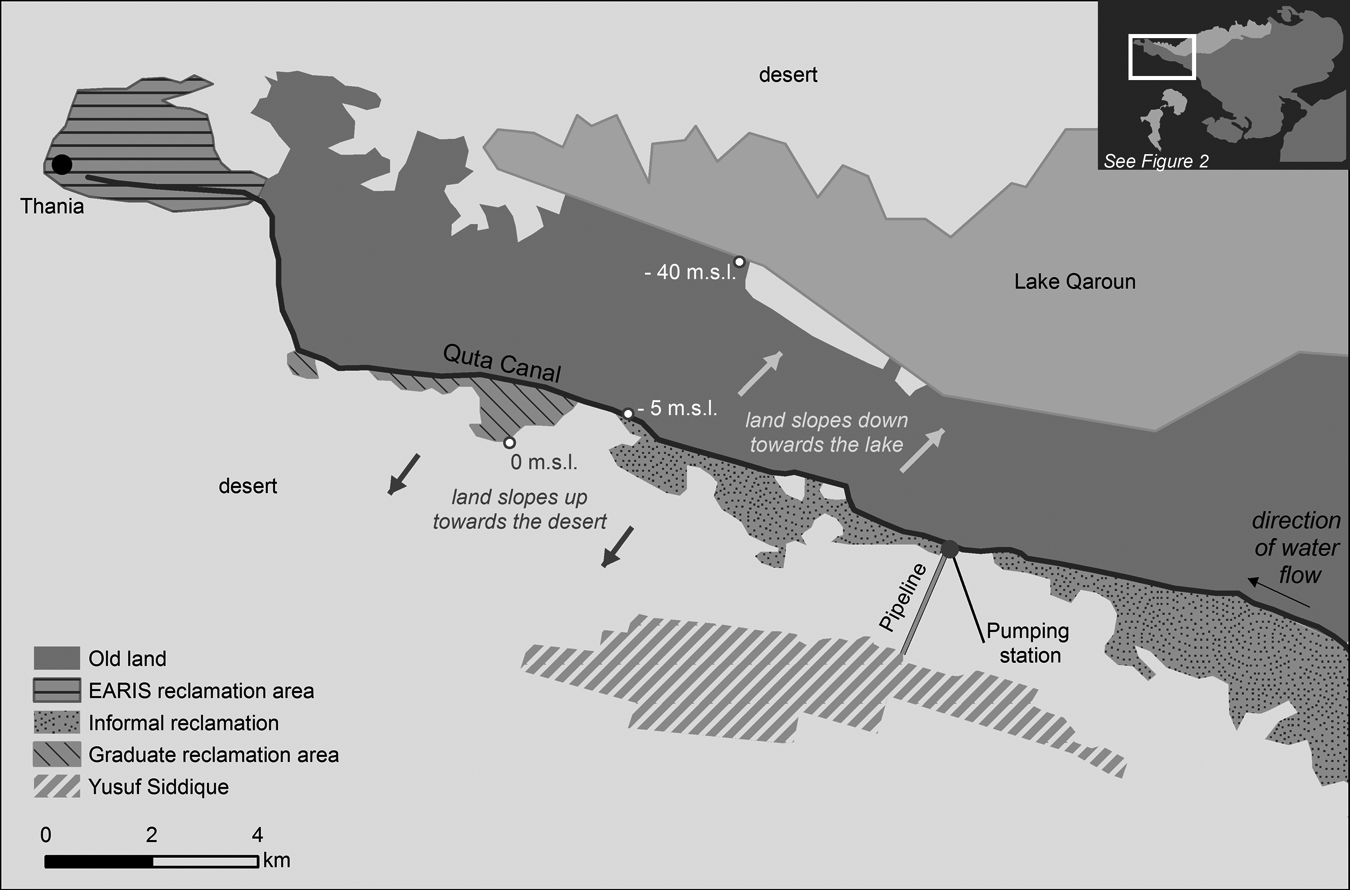
Land reclamation in Quta, Fayoum
Some of those who farm land in the graduate scheme areas are actually farmers from Thania. No longer able to cultivate their own fields near the village due to insufficient water, they have sought land upstream. I talked with one man who rents 4 acres (0.016 km2) in the graduate scheme on the south bank of the Quta Canal. He also has 5 acres in Thania, but is only able to cultivate two of them. The other 3 acres are left barren. ‘It used to be the best land when we arrived in the 1960s,’ he told me sadly. Today things are different. ‘We are at the end, we are tired. The problem is the projects upstream that take all the water … like the new pumping station at Yusuf Siddique, which runs on electricity and takes so much water from the canal.’ Ironically, by renting and farming the land where he does now, this man also becomes one of the upstream users who are taking Thania’s water. Everyone wants to be what they call fowq, ‘above’, meaning upstream, for it is this position that determines how much water they are able to access with their pumps.
Thus each phase of reclamation and each new group of pumps reworks the flow of water through the landscape. All of Fayoum’s water comes from the Nile, in a quantity that is controlled by the central ministry through the regulator on the Bahr Yusuf. Any water that is diverted to the newly irrigated land is therefore water that is taken from previously cultivated lands. The ministry’s policy is to minimize the impact of new diversions by requiring farmers to use sprinkler and drip irrigation in reclaimed lands. The idea is that mandating the use of what are, in theory, more efficient technologies in the new lands will limit the additional water demand generated by agricultural expansion. In practice, however, very few farmers of reclaimed lands in Fayoum (generally only the wealthier investors) use such technologies. Hence the operation of a pump to reclaim land along a canal generates new patterns of access to good quality water. This often exacerbates the head-tail inequality, with those at the downstream end of the canal typically disadvantaged. 20 While wealth and power influence who is able to pump where, as the pumps reorient the flow of water they alter this landscape of socio-economic and political relations. As the desert is irrigated, the land downstream reverts to a hard, parched surface, sprinkled with a layer of salt crystals, or shifts from a field of cotton to a grove of hardy olive trees. Pumping in one place creates poverty in another.
Ghalib is measured in his critique. He has accrued 35 acres (0.14 km2) in addition to the 5 acres that the initial reclamation program allocated to his family. His sons cultivate 10 acres of land in the Yusuf Siddique graduate reclamation area. Clearly, he can still make ends meet. But many farmers are not so lucky. The diversion of water to new lands is a source of considerable anger amongst farmers, particularly during the summer months of heightened demand when scarcity is more pronounced. In one meeting I attended between farmers and ministry officials, the discussion quickly turned to the lack of water. One farmer stood up, saying angrily, ‘The problem is the new lands … they take a lot of the water.’ Another man joined him, ‘The solution is that the water should go to us and not to the new lands.’ 21 A third shouted out, ‘The problem is The Irrigation [this is how farmers refer to the Ministry of Water Resources and Irrigation]. There is enough water, but it’s just a question of unfair distribution!’ A senior official responded, ‘It is true, there is enough water for Fayoum, but some people act illegally and take other people’s water. We have to find those people!’ Local government officials and farmers are therefore in agreement about the problematic ramifications of diverting water for reclamation. They know how it impacts farmers downstream. They differ, though, in their judgment of where the blame lies. To the officials, the fault lies with the farmers for acting unlawfully; to the farmers, it lies with ministry for acting inefficiently.
Hence the relationship between these multiple pumps – positioned in various strategic locations, with contrasting degrees of official sanction – and their community is more complex, and less idyllic, than the situation de Laet and Mol (2000) describe for the Zimbabwe Bush Pump. Whereas de Laet and Mol take for granted the communal nature of the Bush Pump, assuming that the water produced by the pump is equally shared by all, the pumps in this case do not necessarily foster communal ties. There may be instances where the pumps build community, as, for example, when a group of graduates comes together to buy a more powerful electric pump. But there are also cases where the pumps, by entering into a network of multiple human actors (district engineers, graduates, rich landowners, ministry officials, international funders, and smallholder farmers), transform the flow of water and, in the process, act to splinter community. In the second example we will see a similar dynamic of farmers using pumps to tap into the waters of the Nile, but on a larger scale.
Transformations in the West Delta region
The desert road leads out of Cairo from behind the pyramids, cutting through the desert west of the delta up towards the city of Alexandria on the Mediterranean Coast. The villas and mango orchards give way to rocky hills as the road winds steadily up towards the desert escarpment. Over the crest of the hill, past the Pyramid Heights resort, the road starts to descend down to a sandy plain. Billboards alongside nascent housing developments highlight the promise of the future: a space of luxury and clean air, where residents will sit in gardens, swim in pools, and play golf on lush, green turf. So far, the small olive trees in the highway median are the only sign of greenery.
After about 30 km, a row of Casuarina trees in the distance signifies the start of agricultural development. This stretch of the desert road is no longer desert as it was thirty or so years ago. As one expert working for a UN agency commented to me in amazement, ‘The entire ecosystem is changing. You don’t see the desert now. There are foxes and birds. It really is a case of greening the desert!’ 22 On both sides of the road there are farms, the fields bordered by windbreaks of tall trees. Each farm has large gates flanked by high walls with ornate signs stating the name of the owner. Orchards of mangoes, oranges, lemons, peaches, bananas, and grapevines, rooted in a sandy soil, linked by the snaking line of black drip irrigation tubes stretch into the distance. The arched beam of a center pivot irrigation system rotates slowly through a huge field of onions, spraying water in all directions. Scarcely visible from the road are the groundwater wells. With their electric pumps hidden beneath the surface, the wells are marked by the red plastic barrels that hold the pesticide and fertilizer that are added to the water on its journey to the field.
Like the Fayoum case, reclamation in the West Delta has been taking place mostly informally and is not part a government reclamation project. However, it supports quite a different form of agriculture from that taking place on Fayoum’s margins. The farms are large (generally over 100 acres (4 km2), with many over 1000 acres (40 km2)), the levels of investment huge, the irrigation technology expensive, and the production export oriented. One single field in a center pivot system may be ten times the size of Abu Khaled’s land, and 50 times the size of an average Egyptian farm. Some of the investors who own these farms are from wealthy Egyptian landowning families; others have made their money in different sectors and are turning to agriculture for new investment opportunities. A number of multinational agribusiness firms have also developed farms in this area.
The ministry car reaches Helwa Farm. I meet with the farm manager, Engineer Ahmed, in his large office. He tells me that they grow fodder crops, grains, vegetables, and fruits on 10,000 acres (400 km2) of land, which they have reclaimed in phases over the past 20 years. The farm exports fruit and vegetables to Europe and the Gulf; it has a herd of 8000 dairy cows and the first and only milk powder plant in the Middle East. He presses a button by his desk and barks ‘Paper!’ at his office assistant. The paper duly delivered, he starts drawing a cross-section through the Nile Valley. He tells me that whereas on the eastern side of the river valley there is a high desert escarpment, on the western side you have a much more gentle incline, reaching only 30 or 40 m above the level of the valley. Elevation is critical when considering the costs of lifting water for irrigation; each meter matters. The western side of the delta is also rich in groundwater, he says.
Helwa Farm taps water from 200 m below the surface using electric pumps. Ahmed is vague on the details. Hydrogeological studies indicate two stores of water underlying this region, which these pumps are able to draw from – the Quaternary Nile and Moghra aquifers (Dawoud et al., 2005). Both of these aquifers are recharged by infiltration from irrigated fields. They are both also hydrologically linked with the Nile channel, although hydrologists understand little about the nature of the subterranean flow regime (National Water Resources Plan, 2001). When I ask Ahmed if the groundwater that they tap is linked to the Nile, he replies that he does not know. To the new land investor irrigating with groundwater, the key question is whether a pump operating on a borehole of a particular depth will yield water. It is not so important to him (and they seem almost exclusively to be men) exactly where this water is coming from or how this extraction might affect underground patterns of flow.
My interest, though, is in the interaction between the investors’ pumps and the water that passes through them. Up until now, reclamation of this marginal desert has had little impact on the old lands of the delta lying to the east, which have been cultivated for thousands of years. Even though the groundwater that these farms use is hydrologically linked to the Nile system, there is no indication that extraction from the aquifer has affected river discharge. It has, however, affected the aquifer. With only limited recharge from the surface, the high rate of pumping has depleted the groundwater store. In the early 2000s, investors in the West Delta started noticing that the water table was dropping at a rate of about 1 m per year. Each year they have had to lift water 1 m more. Each year, the salinity of the groundwater has increased, impacting potential yields. Several years ago, the investors decided to turn to the government for help.
In 2004, under intense lobbying from the investors who own the farms, the ministry drew up plans for a new project, seeking a solution in the waters of the Nile 30 km to the east. The World Bank and French Development Agency approved loans to help fund the project, and the Embassy of the Netherlands provided a grant. The project will pump Nile water out to the West Delta. The pumping power will be the same – electric motors – but the source of water will be different. Instead of groundwater, the investors will use Nile water to irrigate their desert land.
In his office, Ahmed shows me a large map of the project area. The fields are outlined in black and the farms shaded in various colors. Helwa Farm is one of the biggest in the area. Ahmed points on the map to the Rayah al-Nasseri Canal that draws from the Nile. Through the project, a high-pressure pump will direct water from that canal along an underground pipeline at a rate of 22 m3 per second (Figure 4). This will propel the water towards a distribution point on higher ground, from where it will flow by gravity through four distribution pipes. Along those pipes, booster pumps will distribute water out over 2000 acre (8 km2) parcels, at a pressure sufficient for sprinkler or drip irrigation (Attia et al., 2007; Hoevenaars et al., 2007).
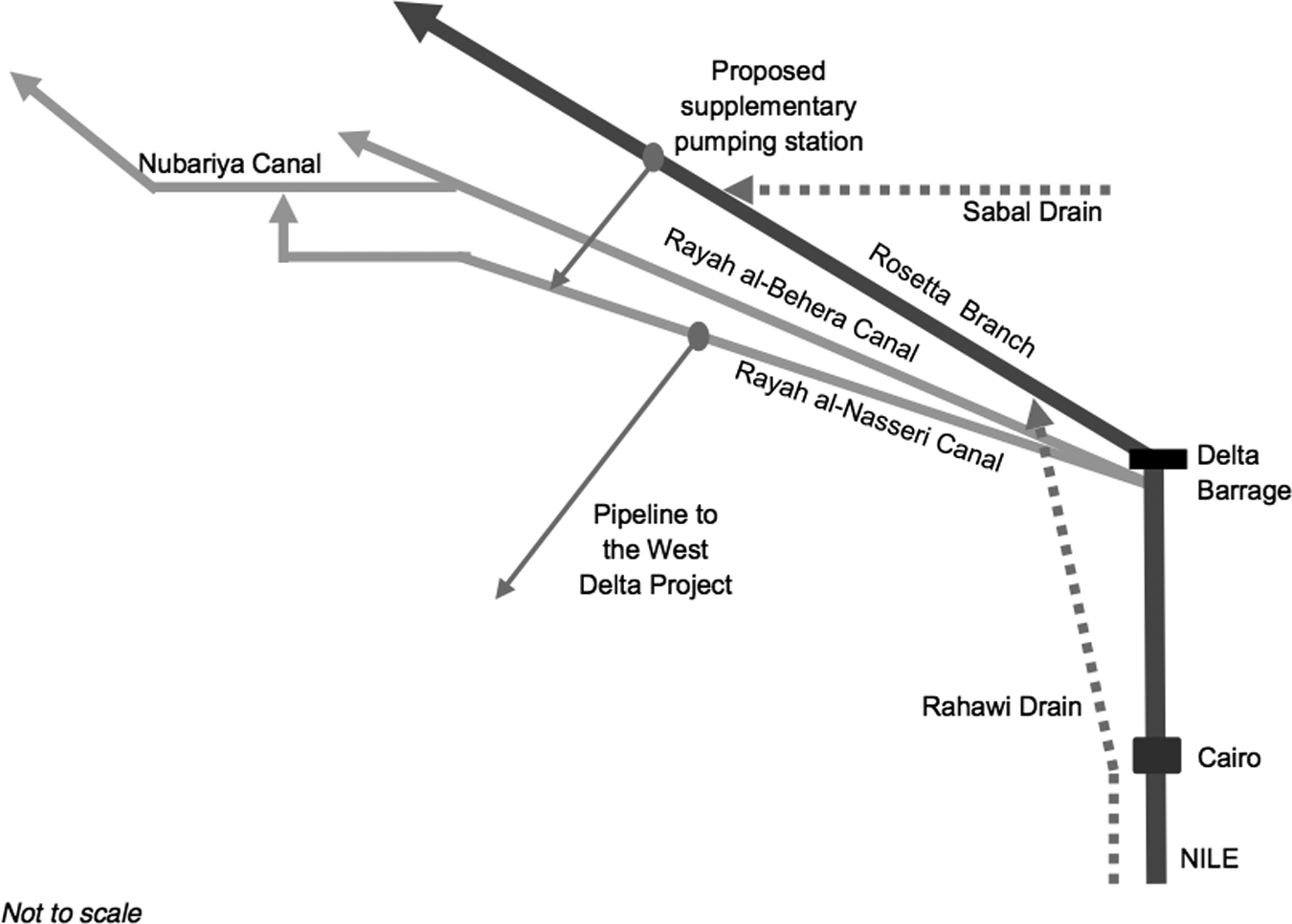
Water flow to the West Delta Project
These pumps and pipelines will redirect the flow of the Nile. Driven by a desire to see water go to the most profitable forms of agricultural production, and eager to curry favor with the influential investors, the government has authorized the extraction of water sufficient to irrigate 190,000 acres (760 km2). Siphoned off to the west, this water will no longer continue on its journey down the Rayah al-Nasseri Canal to feed the fields of downstream farmers. The project will deliver sufficient water to allow the farmers in the target area to irrigate with Nile water alone. Only in particular times of need will they have to tap groundwater through their wells. Ahmed reassures me that they will only use the groundwater pumps at the recovery rate; they will conserve water. The new land investors will, in essence, safeguard their groundwater resources by taking other farmers’ surface water resources.
The ministry recognizes that this diversion will impact farmers downstream along the Rayah al-Nasseri Canal. Its solution? More pumps. The environmental impact assessment report for the project sets out a plan for a supplementary pumping station on the Nile to replenish the canal downstream of the point of extraction (Hoevenaars et al., 2007). This station will pump water from the Rosetta Branch of the Nile to the Rayah al-Nasseri (Figure 4). In theory, the new station will maintain the downstream farmers’ irrigation supply. Whether or not the pumping station will come to fruition, however, remains to be seen. The report tellingly gives no indication of when the ministry will construct the station, nor does it address whether the quality and quantity of water available in this stretch of the Nile will be sufficient (an important consideration given that its proposed location is downstream of a major drain).
Shortly after the plans became public, downstream farmers started to express concern about how the project would affect their ability to farm their long-cultivated land. In September 2009 the Land Center for Human Rights, an Egyptian nongovernmental organization, filed an appeal in the Egyptian courts on behalf of a group of delta farmers. Instead of the project diverting Nile water to the West Delta, they proposed that the ministry construct a treatment plant on one of the major drains and then pump that treated drainage water to the investors’ farms (Land Center for Human Rights, 2009). Another civil society organization sent letters of protest to the World Bank and the Egyptian Ministry in February 2010, urging them to consider different water sources (Bank Information Center, 2010). Not surprisingly, though, under pressure from investors determined to access the best water they can, the project management rejected these alternatives. As one foreign consultant working on a water project commented to me, ‘investors are independent thinkers, they have good ideas, and they are also very influential. Not only do they have the money but they have the connections. If they say they want a project they’ll get it. If the minister doesn’t want to do it they’ll sack the minister!’ 23
At the time of writing, in December 2011, construction on the project has yet to begin. The World Bank closed its project in June, after the government failed to spend any of its approved loan, rating the project as ‘unsatisfactory’ (World Bank, 2011). Progress has been stalled by delays in the government’s selection of a contractor to design, build, and operate the infrastructure. Following the revolution that overthrew President Mubarak in January 2011, two consortia withdrew from the bidding process, further delaying progress. But, despite the delays, the ministry still plans to move ahead with the project, and officials are hopeful that the World Bank will consider financing the project again in the future. In November 2011, a ministry official posted an entry about the project on a web-based platform designed to showcase innovative ‘solutions for water’, as part of the preparations for the forthcoming World Water Forum. The entry describes the project as a ‘new vision promoting water conservation’, although it notes that work ‘is on hold until the political situation in Egypt stabilizes’ (Anwar, 2011).
Thus, here we have a case of multiple pumps interacting with the flow of water through the landscape in ways that are mediated by international streams of funding, the political influence of particular groups, and the prioritization of certain modes of agricultural production over others. The investors pump groundwater from deep wells to reclaim the desert west of the delta. They deplete the aquifer to such an extent that they have to look elsewhere for water. In response, the ministry launches an internationally financed project to provide the investors with Nile water, pumped from a main canal 30 km to the east. To make up for this extraction, the ministry promises to pump more water from a branch of the Nile to replenish the canal. But if that supplementary pumping station is never built, or if it is unable to deliver water of sufficient quantity or quality to replace the water that is being diverted, the farmers downstream will face a much depleted flow. The potential social consequences are profound. By reworking the flow of water through the landscape, pumps recast social relations between those who are able to tap into the flow to develop new lands and those who see the flow diverted away from their farms and the productivity of their land decline.
We see, therefore, some of the spaces where a water pump, far from being fluid as de Laet and Mol propose, may be quite the opposite. The electric pumps that will operate in the new project will incorporate some farms within their boundaries but exclude others. They lack the mobility and adaptability that lie at the heart of the Zimbabwe Bush Pump’s success. The diesel pumps, on the other hand, share the Bush Pump’s flexibility yet also participate in the problem of opening up reclaimed lands at the expense of downstream users. The pumps of downstream farmers along the Rayah al-Nasseri will be able to do little but sit there stagnant, unusable, if the water in that section of the canal dries up.
Pumping the future
The project currently underway in the West Delta actually is only one component of the government’s strategy to foster the development of high-value crop production along the margins of the valley and delta (National Democratic Party, 2008). Rather than try to improve agricultural production in the old lands, many government and business leaders think that it is better to invest in the new lands of the desert margins where profits will be greater. 24 According to an agricultural specialist from the United Nations, ‘The commercial sector says “Let the delta disappear and let’s move to the desert!” Desert agriculture is the future.’ 25 Such a vision is contingent on the redirection of Nile water. Based on the premise that the efficiency of water use in the old lands can be improved, the government’s strategy is to transfer that ‘saved water’ to the borders of the delta for large scale investor-led land reclamation (Al-Bultagi and Abu Hadeed, 2008). This plan is founded on a simple mathematical calculation. The irrigation efficiency of traditional surface irrigation is, in theory, only 45% whereas that of sprinkler irrigation is 75%, drip irrigation 85%. Convert 5 million acres (20,000 km2) to modern irrigation and 13.1 million m3 will be saved to be used for land reclamation. The plan sets out a number of different scenarios for possible agricultural expansion. Assuming that each reclaimed acre with modern irrigation requires 4000 m3 per year, then 3.2 million acres can be reclaimed with this water; assume that a reclaimed acre needs 5000 m3 per year, then 2.6 million acres can be reclaimed with this water (Al-Bultagi and Abu Hadeed, 2008: 25). 26
These calculations are underpinned by certain assumptions about the efficiency of modern irrigation techniques. They are also based on a belief that it would be possible to accomplish such a huge transformation of on-field water management practices. The strategy does not detail exactly how that efficiency increase will be accomplished. Indeed, it seems unlikely that such a widespread shift in technology-use will be feasible in the near future. Changing the way in which farmers use water in their fields is, after all, more complicated than simply substituting one technology with another.
If the efficiency increases are not realized, will water transfers still take place? The fact that the investors in Helwa Farm and its surroundings have managed to persuade the government to divert Nile water to their land suggests that further diversions are likely. This case is therefore a clear illustration of how the socioeconomic and political landscape shapes the pumping potential. Influential groups like the investors have the power to enroll not only government agencies but international funders in their project to pump the Nile. As they do so, they shape the flow of water and, in turn, the social worlds of those reliant on the resource for their livelihood.
When I asked policymakers about what will happen to the old land farmers if their water is diverted to the desert margins, they responded that those farmers will be able to find jobs as laborers on the new desert farms. Pumps can, therefore, at once build and fracture community. By uniting investors of the West Delta with a common source of water, the pumps of the West Delta project may foster a new form of community among the investors. At the same time, though, by diverting water away from downstream communities, the pumps may divide those communities, as some farmers, no longer able to cultivate their land, are forced to move elsewhere to labor on other people’s land. Given the lower labor requirements of these new farms, watered by sprinkler and drip irrigation systems rather than by hand, many farmers may be displaced from farming altogether and will have little choice but to turn to alternative forms of employment in the rapidly growing urban areas.
Conclusion
As Egyptian farmers expand their cultivated land out into the desert, we see how pumps play a central role in sourcing the water vital for this process of landscape transformation. By focusing not on a single pump, but on the interaction between multiple pumps and the water that passes through them, we can begin to understand the complexities of a network that spans beyond Egypt’s borders, linking water users with international funding agencies, governmental institutions, ideologies of modernization, and international negotiations over Nile water allocation. The elements of this network do not precede those connections but, rather, are made in and through those relations. The social, economic, and political terrain shapes where, when, and how different types of pumps are able to operate. The pumps, in turn, rework the flow of water, reconfiguring space both literally, in their impact on the land, and metaphorically, in their redistribution of wealth and possibilities.
This paper demonstrates the significance, therefore, of looking at the material interactions between a technology, such as a pump, and its surroundings. The literature on the social construction of technology has highlighted the importance of placing technologies in the social, political, cultural, and economic contexts that they both shape and are shaped by. But in addition, I argue that we have to attend closely to the material substances that flow in, through, and from those technologies. By highlighting the relationship between the pumps at work in Egypt’s marginal lands and the water that passes through them, we see some of the limits to the fluidity metaphor that de Laet and Mol (2000) deploy in their analysis of the Zimbabwe Bush Pump. These are the moments where the pump excludes rather than includes, deprives rather than supplies, divides rather than unites. Thus rather than building community, as de Laet and Mol propose in the case of the Bush Pump, in many ways the pumps that make desert reclamation possible in Egypt are fracturing community, generating new points of tension, resistance, and inequality.