




Abstract
Women are underrepresented in science, technology, engineering, and mathematics fields, particularly at higher levels of organizations. This article investigates the impact of this underrepresentation on the processes of interpersonal collaboration in nanotechnology. Analyses are conducted to assess: (1) the comparative tie strength of women’s and men’s collaborations, (2) whether women and men gain equal access to scientific information through collaborators, (3) which tie characteristics are associated with access to information for women and men, and (4) whether women and men acquire equivalent amounts of information by strengthening ties. Our results show that the overall tie strength is less for women’s collaborations and that women acquire less strategic information through collaborators. Women and men rely on different tie characteristics in accessing information, but are equally effective in acquiring additional information resources by strengthening ties. This article demonstrates that the underrepresentation of women in science, technology, engineering, and mathematics has an impact on the interpersonal processes of scientific collaboration, to the disadvantage of women scientists.
Introduction
Scientific researchers’ careers chart a trajectory through scientific disciplines, communities of research specialists and professional networks, and formal organizations such as universities, government laboratories, and private firms. However, the institutions, organizations, and occupations of science are not gender neutral, but rather reflect ingrained forms of male domination of the field (Fox, 2001). A large and growing body of research highlights the impacts of the underrepresentation of women in science, technology, engineering, and mathematics (STEM) fields (Fox, 2010; Fox and Stephan, 2001; Gaughan and Corley, 2010). The formal organizations conducting and administering scientific research are largely of the hierarchical and bureaucratically organized type in which, according to Acker (1990: 146), ‘men are almost always in the highest positions of organizational power’. The degree of women’s underrepresentation increases with the level of occupational hierarchy in STEM, with statistical data showing women clustered in low-ranking positions in both the United States (National Science Foundation [NSF], 2012) and Europe (European Commission [EC], 2013).
The underrepresentation of women in STEM peer communities means that women have fewer same-sex peers than men. The underrepresentation of women in positions of authority over STEM resources means that women have less influence over the way these resources are used and by whom. The organizational and institutional contexts of STEM are thus systemically gendered (Acker, 1990), which has significant and pervasive effects on the social processes of working in STEM. The aim of this article is to illuminate how the underrepresentation of women in STEM affects women scientists’ access to information through their scientific collaborators.
Both the NSF in the United States and the EC have expressed concern regarding the systemic problem of underrepresentation of women in STEM. Historically, this has been cast as an issue of equality and fairness, with programs such as ADVANCE in the United States designed to redress women’s exclusion from STEM and the barriers to their career progress (Gaughan, 2005). More recently, women’s underrepresentation in STEM has become seen as an issue of competitiveness and economics: [i]ncreased female participation will improve the quality of research and innovation while helping to address the existing deficit of highly qualified and experienced scientists necessary for enhanced European competitiveness and economic growth. (EC, 2011: 13)
And in the United States, increased gender participation is argued to be essential for maintaining the United States as the global scientific leader with a competitive scientific workforce (Ecklund et al., 2012). The issue of women’s participation in STEM is thus of increasingly broad public policy concern.
This article contributes to the expanding literature on the gendering of STEM by examining interpersonal processes of scientific collaboration in the field of nanotechnology. Understanding scientific collaboration is important, as collaboration relationships provide access to combinations of valuable knowledge and information, research funding and support, technical skills, tacit knowledge, peer networks, and research infrastructures that are essential for scientific work (Beaver, 2001; Boardman and Corley, 2008; Katz and Martin, 1997). Exchanges of knowledge between collaborators always take place within the context of interpersonal relationships of one kind or another (Oliver and Liebeskind, 1997). Thus women must gain access to essential knowledge and resources within the male-dominated social context of STEM. As Fox (2001) describes, [i]f women are constrained within the social networks of science – in departments or in the larger communities of science – this restricts their possibilities not simply to participate in a social circle but, more fundamentally, to do research, to publish, to be cited – to show the marks of status and performance in science. (p. 660)
An improved understanding of the characteristics of the collaboration relationships of women in STEM, and the access to information resources these collaborations provide, can thus make a significant contribution to knowledge about the gendered character of scientific work and careers.
This article uses a social network strength-of-ties approach (Granovetter, 1973) to make three specific contributions to knowledge about collaboration relationships and gender in STEM. First, we assess whether there are differences in the overall tie strength of women’s and men’s research collaborations. Second, we determine whether women and men gain access to different levels of scientific information through their collaboration relationships. Third, we ascertain whether access to information is associated with different tie strength characteristics for men and women and whether strengthening ties is equally beneficial for both genders. This article thus contributes to the literature by showing how the structural underrepresentation of women in STEM has an impact on the interpersonal processes of research collaboration.
Gender, collaboration relationships, and scientific information exchange
One general theoretical proposition about scientific research collaboration is that the know-how and information that researchers accumulate over time constitute their tradable stock of knowledge (McFadyen and Cannella, 2004). Knowledge represents the core accumulated human capital of a scientist, while research collaboration relationships represent the fundamental dyads that structure a researcher’s social capital network (Bozeman et al., 2001). And these work in conjunction, because establishing and maintaining research collaborations thus should expand the research capacities of partners to the relationship.
The available empirical evidence using this framework shows that men experience gains in the number of collaborators through three kinds of collaborative relationships: instrumental (concerned with immediate work factors), experience (previous experience of collaborating), and mentoring (desire to help graduate students and junior faculty) (Bozeman and Gaughan, 2011: 1395). However, women only gain additional collaborators through a mentoring strategy (Bozeman and Gaughan, 2011). Other research also suggests that suitable women mentors (Fox, 2001; Kiopa et al., 2009) and role models (Ecklund et al., 2012) often are not available to women in STEM fields. These factors suggest gender imbalances in the interpersonal processes of research collaboration. In this article, we test the proposition that scientists acquire additional capital through their collaborations, assessing whether gains are equivalent for women and men.
A second general proposition is that knowledge, information, and power are not evenly distributed in a social field (Bourdieu, 1977, 1989). For example, information regarding the strategic direction and priorities of a scientific field (‘the rules of the game’) circulates more freely among scientists who have high levels of prestige and credibility and/or are holders of positions of significant organizational authority (Bourdieu, 1975; Merton, 1973). For this reason, we distinguish between gaining access to two different types of scientific information. General-strategic information relates to advances, discoveries, and research priorities that orient the direction of a scientific field. Specific-instrumental information relates directly to gaining access to the knowledge and resources required to carry out a researcher’s current research activities. Each type of information is therefore less valuable in the absence of the other. Incorporating this distinction provides us with the opportunity to determine whether the underrepresentation of women at senior levels in STEM reduces women’s access to information pertinent to the evolving research agenda of their field.
The study focuses on external collaborations or interorganizational relationships. The dynamics of STEM research increasingly demands the mobilization of extensive resources and capabilities, including large and often diverse teams of interconnected researchers distributed across multiple organizations (Chompalov et al., 2002; de Solla Price, 1963) that reflect increasingly networked forms of organizing science (Powell, 1990; Smith-Doerr, 2004a). In a hybrid field such as nanotechnology, interorganizational cooperation is particularly important. For individual researchers, it is correspondingly vital to develop strong and enduring collaboration relationships with colleagues in other organizations to gain access to additional information and resources.
In developing our hypotheses regarding access to scientific information through collaboration relationships, we build on two bodies of the literature. The first concerns the contexts and processes of scientific collaboration, especially with respect to gender. Due to their underrepresentation in STEM, women researchers tend to find relatively low numbers of other women working in the same research specialization (EC, 2013; Fox et al., 2009), reducing their potential to collaborate with other women. This may affect access to scientific collaboration networks (Etzkowitz et al., 2000; Fox, 1991) and may lead to men having more research collaborators than women (Bozeman and Corley, 2004; Lee and Bozeman, 2005); women tend to have a higher percentage of female collaborators than do men (Bozeman and Corley, 2004), although their networks will still be largely composed of male researchers.
Women scientists who are not tenured are more likely than women who are tenured to have collaborators who are other women (Bozeman and Corley, 2004). Tenured women, on the other hand, tend to collaborate more with tenured men (Bozeman and Corley, 2004). This reflects increased gender heterophily for women’s collaborations at more senior levels and suggests a correlation between lower professional rank and increased gender homophily in collaboration (Homans, 1950). This literature strongly suggests that we can expect to find differences in STEM research collaboration relationships extending from the basis that the organizations and institutions comprising the field are structurally gendered (Acker, 1990; Blau, 1977).
Second, the social network literature suggests that information flows will be shaped by the characteristics of interpersonal ties such as research collaboration relationships. Following Granovetter (1973: 1361), social network analysts have traditionally grouped interpersonal connections into two categories: strong and weak ties. Strong ties are based on trust, friendship, reciprocity, and relatively high frequency of interaction (Levin and Cross, 2004). Weak ties are characterized by infrequent interaction and not based on friendship, trust, or reciprocity. The benefits that can be derived from strong ties include the coordination of joint activities and the reduction in uncertainty, while the benefits of weak ties include the possibility of connecting diverse social groups (Granovetter, 1973; Krackhardt, 1992; Uzzi, 1996).
In this study, we set the threshold of a ‘collaboration relationship’ at a relatively high level, by requesting information on joint activities (projects) or outputs (papers) that would indicate significant shared investments of time and resources (Katz and Martin, 1997; Merton, 1973). Clearly, such complex scientific activities require a strong degree of coordination and planning to reduce future uncertainty (Katz and Martin, 1997; Whitley, 2000), so we expected that the collaboration relationships we investigated would be based on strong ties. Furthermore, it has been shown that the benefits derived from dyadic relationships, such as those we study, may be particularly linked to the development of high levels of trust (McFadyen et al., 2009: 561).
In the context of scientific collaborations, the standard social network analysis measures of relationship tie characteristics overlap considerably with what are considered to be fundamental qualities of collective scientific work. As Shapin (1994) describes, ‘the potency of trust extends to every aspect of the day-to-day processes by which scientific knowledge is held and extended’ (p. 417). For scientific collaborators, ‘taking each other’s claims at face value is normal’ (Shapin, 1995: 269, emphasis in original) and essential for group cohesiveness (p. 270). In asking researchers about the trust characteristics of their relationships with their collaborators, it therefore seems inevitable that our results will reflect strong ties – foundational trust is to an important extent the glue of the dyadic relationships we investigate.
However, as Shrum et al. (2001) point out, it is also important to not take trust as an undifferentiated concept, masking the different aspects of trust involved in formal versus informal and individual versus interorganizational collaboration processes. They found, for example, that projects built from pre-existing social ties did not have higher levels of trust than projects put together by funding agencies (p. 686). In other words, trust in scientific work and organization is complex, and its dimensions need to be carefully demarcated depending on the type of collaboration being studied. In this study, we are interested in foundational trust in dyadic relationships and make no claims about how this aspect of trust might link to wider issues of collective trust within the interdisciplinary nanotechnology field – although this is a very interesting potential topic for investigation.
There are important consequences that flow from this considerable overlap between the methodological construct of tie characteristics and the particular social qualities on which scientific collaborations are known to be built. First, the conceptualization of discrete tie characteristics that bond and bridge between social actors could conceivably be interpreted as epiphenomena of the intellectual and social organization of the sciences (Whitley, 2000). Whether we understand the collectivities of science as normatively oriented fields (Merton, 1973), as discipline-focused epistemic cultures (Knorr Cetina, 1999), or as alliances organized around the generation and use of knowledge (Bozeman and Rogers, 2002), foundational trust can be considered fundamental to the myriad dyadic interpersonal relationships that structure these larger assemblages. The same could also be said for another social network tie characteristic, ‘reciprocity’. It is well understood that the circulation of appropriate and valuable ‘gifts’ (Mauss, 1990 [1950]) and proportionate and well-timed returns (Bourdieu, 1977) of, for example, information, equipment, or infrastructure access are essential to the processes of trade and exchange underpinning scientific collaboration (Ensign, 2009; Vinck, 2010; Ziman, 1994). What the social network literature calls strong ties between individuals may thus, in the context of scientific work, simply reflect professional cultures of collaboration.
A second consequence of this overlap between social network concepts and fundamental trust and reciprocity in scientific work is methodological. In measuring these characteristics within science collaboration dyads, it is apparent that we should be somewhat cautious about the absolute levels of tie characteristics reported. Whereas Shrum et al. (2001: 683) found interpersonal trust to be relatively unimportant in ‘collective trust between social formations’ at the level of large scientific projects, interpersonal collaboration dyads are grounded in foundational trust (Shapin, 1994). We should therefore expect to see indicators of strong trust and reciprocity ties in the assessment of interpersonal professional relations being reported on by our respondents. Fortunately, skepticism toward the strength of the trust ties that may be reported does not present an important problem for our study. In investigating how conditions of women’s underrepresentation affect processes of acquiring information from scientific collaborators, it is the comparison of strength of tie characteristics between women and men that matters for our analyses.
The literature thus suggests that relationships between scientific collaborators will be based on strong ties. However, there are a number of empirical studies of networks that have shown that the predominance of gender heterophilious relationships for women can reduce their likelihood of developing strong ties (Brass, 1985; Brass and Burkhardt, 1992; Ibarra, 1992; Rothstein and Davey, 1995). The moderating effect of the underrepresentation of women in STEM may thus be that the relatively high ratio of women’s gender heterophilious collaborations will reduce the overall strength of ties of women’s collaborations in comparison with men – for whom most collaboration relationships can be expected to be homophilious. This is the ground for our first research hypothesis.
Hypothesis 1. While both women’s and men’s collaborations will be based on ‘strong ties’, the overall tie strength of collaboration relationships will be less for women’s collaborations than for men’s collaborations.
The interchange of information is one of the key resource exchanges structured by social networks (Granovetter, 1973; Nahapiet and Ghoshal, 1998). The literature suggests that strong ties are better for transferring profound or complex information (Hansen, 1999; Uzzi, 1996), that they provide higher quality or more reliable exchanges (Rowley et al., 2000), and that sensitive or confidential information is more likely to be transferred through strong ties (Podolny and Baron, 1997), where confidence about its interpretation already exists (Nahapiet and Ghoshal, 1998). Bouty (2000) found that strong ties such as trust are linked to increased access to resources, including information in academic contexts. We can thus assume that the collaboration ties of our respondents are positively related to the obtaining of information resources.
In the science studies literature, the sharing and circulation of information are a key process in scientific collaboration, organizing the work of science (Ensign, 2009; Merton, 1973; Vinck, 2010). Studies of academic science suggest that some interpersonal professional contexts may not suit women’s preferences, due to their instrumental and antisocial (Etzkowitz et al., 2000) or aggressive and combative styles (Sonnert, 1995). Women scientists who are married (Zuckerman et al., 1991) or who have principal responsibility for child-rearing (Kyvik and Teigen, 1996; Mason and Ekman, 2007) may also have less opportunity to participate in professional networking activities. For various reasons, then, the women who are working in STEM fields may not have as much access as do men in those fields to information acquired through interpersonal professional links (Smith-Doerr, 2004b).
The question of status is also very important here, with Burt (1992) making the general point that the resources available and accessible to an individual will be similar to those available to socially proximate others. Durbin (2011: 99) argues, for example, that a relatively closed informal social system or ‘old boy’s network’ tends to hold and control strategic tacit knowledge and other key resources at upper levels of academia. The lack of women in high-level organizational positions and top professional ranks in STEM may mean that women are largely excluded from the circulation of certain types of information. The problem may be compounded by the relative lack of women in positions of authority reducing other women’s access to such powerful networks (Ibarra, 1992). These factors may reduce the overall amount of information women receive through their collaborations and are the basis of our second hypothesis.
Hypothesis 2. The level of access to scientific information through collaboration relationships will be higher for men than for women.
The literature on professional science suggests that gender significantly affects characteristics of interpersonal interactions (Etzkowitz et al., 2000). In a large study of STEM science careers, Sonnert (1995) found that 55 percent of women and 40 percent of men reported interacting differently with professional colleagues depending on their gender; women could not engage in informal networking interactions with their predominantly male colleagues, for example, in a private space or over a social drink, with the same freedom as other men – in part due to issues related to sexual tension or harassment (pp. 137–138). Interestingly, Rhoton (2011) found that some women scientists also ‘distance themselves’ from women colleagues who may be seen to be challenging, overtly or implicitly, the gendered cultural norms of STEM fields.
The social network literature suggests that there are likely to be gender differences in the specific interpersonal relationship characteristics associated with access to information. This literature often classifies women’s connections as ‘expressive’, in comparison with men’s ‘instrumental’ ties, with expressive ties being characterized by higher levels of friendship (Brass, 1985; Scott, 1996). Qualitative indicators of tie strength (friendship, trust, reciprocity) reflect a requirement to invest significant time and personal attention in social relationships (Granovetter, 1973; Lin, 2001; Uzzi, 1997). There are thus costs associated with developing and maintaining these relationships. Quantitative indicators of tie strength (frequency of contact, duration of relationship) reflect levels and extents of activity in time. However, these indicators do not capture possible intangible differences in the collaboration styles of women and men, and their willingness to pay particular costs in terms of, for example, time or emotional investment, to maintain relationships.
An important dimension of developing ‘expressive’ ties is homophily. As Ibarra (1992) summarizes, ‘similarity of personal characteristics implies common interests and worldviews and best explains the formation of expressive ties based on interpersonal attraction’ (p. 423). For example, Durbin (2011) found that academic men’s relational behavior within the ‘old boy’s network’ is based mainly on two tie characteristics: friendship and reciprocity – ‘friendships are cemented and reciprocity is expected’ (p. 99). Men rely on friendship to assure reciprocity in acquiring and controlling key resources in their profession or organization (Durbin, 2011; Wirth, 2001). On the other hand, women have been shown to form networks with a strong social element, where friendship in itself constitutes the prime motivating factor for joining (Scott, 1996). There are thus two dynamics structuring our expectations about the tie characteristics associated with women’s and men’s access to information. First, women may be more reliant on expressive ties, such as friendship. Second, tie characteristics common to women’s and men’s relationships may not shape information flows in exactly the same ways. These expectations are summarized in our third and fourth hypotheses.
Hypothesis 3. There will be a positive and significant relationship between overall tie strength and access to information, but the individual tie characteristics significantly associated with access to scientific information will be different for women and men: friendship will be the most important tie characteristic for women’s collaborations, and reciprocity will be the most important tie characteristic for men’s collaborations.
Hypothesis 4. Differences in relationship tie characteristics and tie strength mean that men will gain greater levels of additional scientific information, by further strengthening relationship ties, than will women.
Research background
The data analyzed for this study come from a survey of researchers working in 11 publicly funded and administered nanotechnology research centers in Spain. Five are Spanish National Research Council (CSIC, Consejo Superior de Investigaciones Científicas) centers, four are joint CSIC-university centers, and two are university centers. The problem of underrepresentation that women face currently in Spanish scientific organizations is similar in degree to the rest of Europe. Comprehensive European statistics on gender participation in science now available reveal that, while progress has been made toward gender balance, ‘women in research remained a minority, accounting for only 33% of researchers’ in the European Union in 2009 (EC, 2013: 5).
Table 1 shows selected education and occupation data for women working in STEM in Spain, Europe, and the United States. Of course, these data are not perfectly comparable, due to differences in categorizations between countries. Nevertheless, these data make it clear that women are significantly underrepresented in STEM in these countries, and to a broadly similar extent. The level of underrepresentation is most severe in Engineering PhD graduates and senior-level academic positions in science and engineering. The conditions under which women in Spain work in STEM can thus be characterized as quite similar to those in the rest of Europe and the United States in terms of the scarcity of women colleagues, particularly at higher organizational levels.
Women’s participation in science and research in Spain, EU-27, and the United States – selected indicators 2010 (%).

Source: European Commission She Figures 2013 (Spain and EU-27 nos 1–7, United States nos 2–4); US National Science Foundation Science and Engineering Indicators 2012 (United States nos 1, 5, and 7).
EU: European Union; ISCED: International Standard Classification of Education.
US data 2008.
Data and methods
Nano-researchers focus on the development of technologies at the nano-scale
Data collection and respondents
Data were collected using an online survey that was pre-tested through a pilot and interviews with six nanotechnology researchers not included in our sample. 1 The survey was conducted in April 2008 and was available in Spanish and English. 2 The survey received 213 responses, constituting a 25 percent response rate. 3
In order to establish a threshold for what constituted a research collaboration in the study, respondents were asked to specify activities constituting their collaboration relationships. The main collaborative activities reported included research projects (92%) and co-authored research publications (57%). We thus study collaboration relationships that are more developed than simple contacts or informal cooperation and which are sufficiently durable to have resulted in substantive and/or productive joint activities.
The characteristics of the final respondent group (Table 2) appear to conform well to expectations regarding the level of participation of women in STEM and their very low representation at higher organizational levels. If anything, our respondent group may be skewed slightly toward women working in junior positions in STEM, although this might also reflect the specific situation in nanotechnology. Overall, the respondent group appears to be a satisfactory representation of women’s participation in STEM fields, providing a sound platform for producing our analyses and results. It should also be noted that we were unable to analyze men’s and women’s gender homophilious ties by rank, due to the low number of women professors among our respondents (n = 6).
Filtering stages and rejected responses.
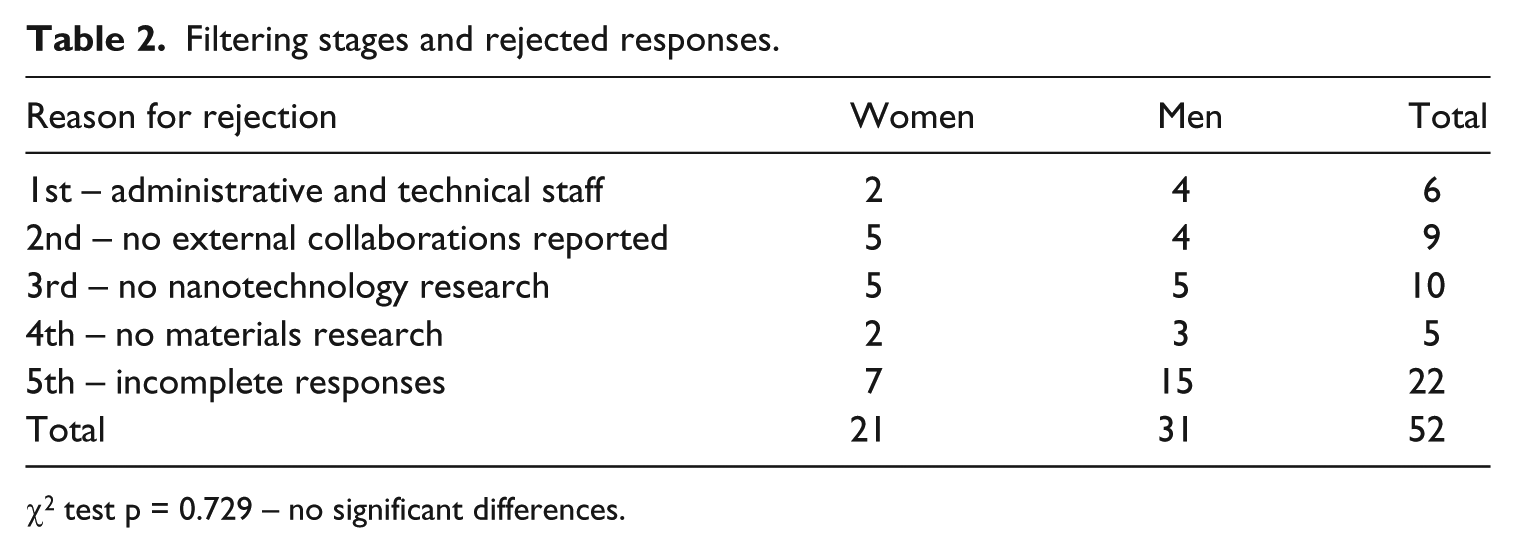
χ2 test p = 0.729 – no significant differences.
Responses with one or more missing values were excluded, as were those where the respondent did not report at least one tie with an external collaborator. To reduce the probability of errors arising from the inclusion of researchers working in other nanotechnology subareas, we incorporated two screening questions to confirm that respondents were working on nano-materials. A total of 52 responses were rejected. Table 2 specifies the filtering stages and the rejected responses by gender.
The final data set included 161 individual respondents of whom 94 were men (58.4%) and 67 were women (41.6%). Table 3 shows the characteristics of the respondents by academic rank, scientific discipline, and type of research activity.
Respondent characteristics.
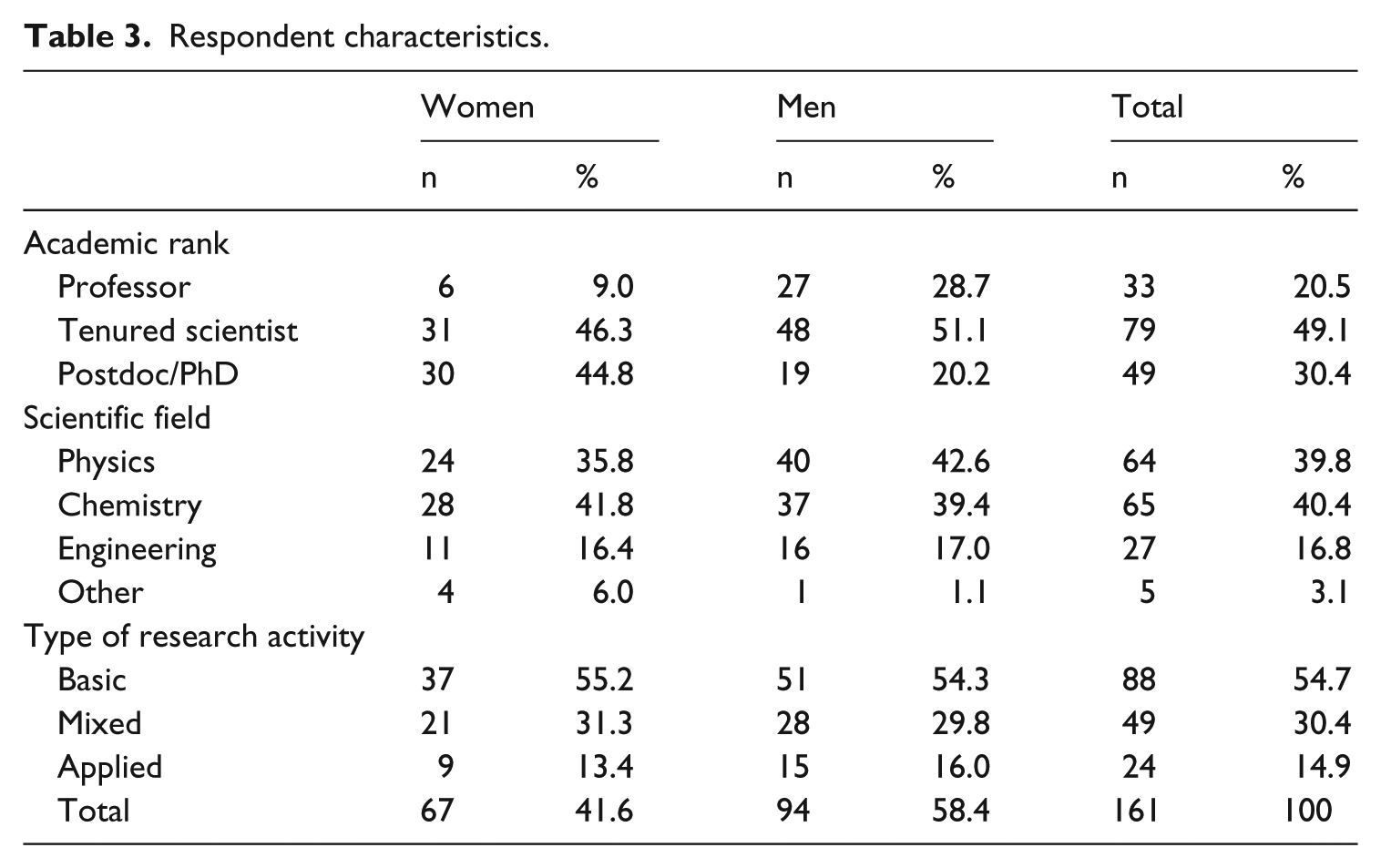
Respondents were evenly distributed by gender in terms of their scientific field and their research activity, but heavily skewed in terms of academic rank. There are just 6 women at the professor level, compared with 27 men. At the junior level, there are more women than men in absolute terms, and more than double the proportion of women respondents (45%) are at the junior level compared to men (20%). Table 4 summarizes the number of collaboration relationships reported by academic rank, the collaborator’s organization type and geographical proximity, and whether the collaboration dyad is a gender homophilious or heterophilious relationship.
Numbers of collaboration relationships.
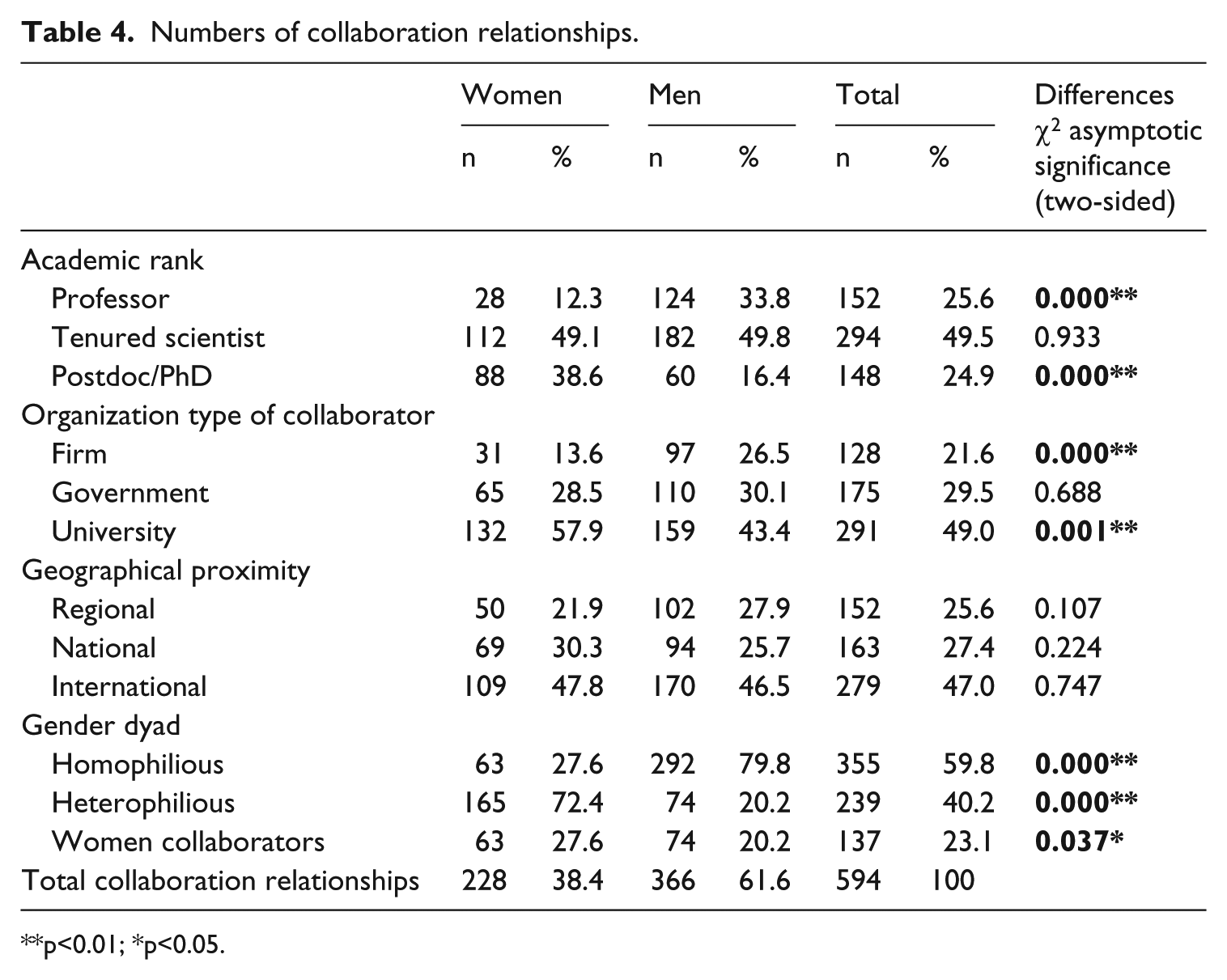
p<0.01; *p<0.05.
The respondents reported a total of 594 collaboration relationships: 366 (61.6%) being links between a male researcher and a collaborator and 228 being links between a female researcher and a collaborator (38.4%). The proportion of collaboration relationships by gender was thus roughly in line with the gender balance of the respondent group. The test of differences in Table 4 confirms that men in top-level positions have statistically higher numbers of collaborations than senior-level women. Women in bottom-level positions have statistically higher numbers of collaborations than junior-level men. Women are more likely to have collaboration relationships with women (27.6%) than are men respondents (20.2%), both with statistical significance. Women also report a significantly greater number of collaborators based in universities, while men have a significantly greater number of collaborators based in firms. Table 5 contains a descriptive analysis of the numbers of reported collaborations per respondent.
Numbers of collaborations per respondent (maximum n = 5).
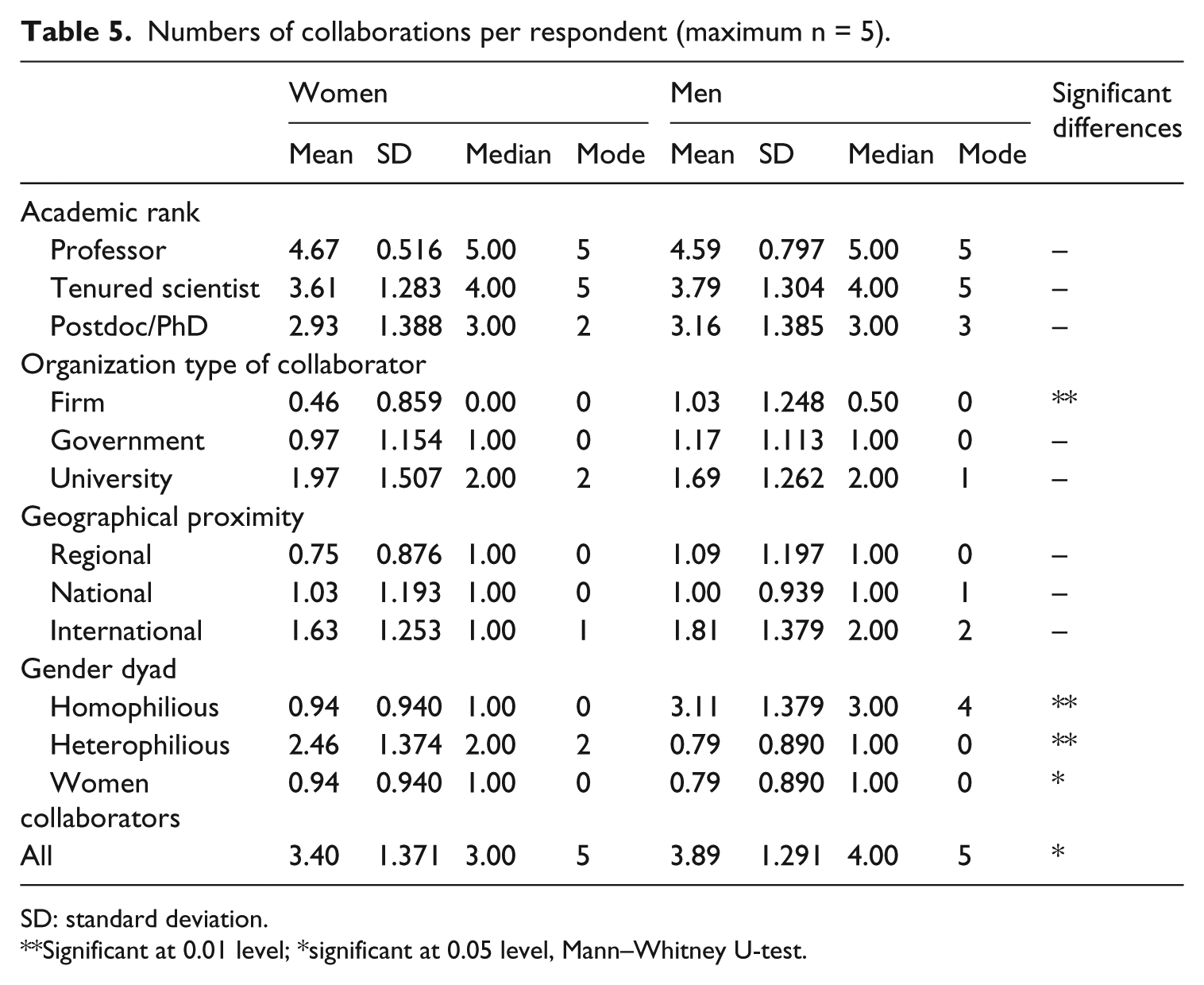
SD: standard deviation.
Significant at 0.01 level; *significant at 0.05 level, Mann–Whitney U-test.
Analysis of the distribution of collaboration relationships reported per respondent shows that collaborations are evenly distributed among women and men, with the exception that men have more ties with collaborators in firms. Women also have significantly more collaborations with other women per respondent (0.94) than do men (0.79).
Measurements
The dependent variables in our regression models are access to general-strategic and specific-instrumental forms of scientific information. Access to these two types of information was measured using 4-point Likert-type scales ranging from ‘completely disagree’ to ‘completely agree’. For general-strategic information, respondents were asked to indicate to what extent they agreed with the following statement about their research collaborator: ‘This person supplies me with information related to advances and discoveries in general’. This statement directed respondents to focus on information relevant to their scientific field. For specific-instrumental information, respondents were asked to indicate to what extent they agreed with the following statement about their research collaborator: ‘This person supplies me with information related to my specific research needs’. This statement directed respondents to think about information relevant to their individual research work. These two statements were included alongside others regarding access to research funds, equipment, and infrastructure, ensuring participants were focused on the provision of scientific information only in their responses to these items. The distributions of scores for the two dependent variables were very similar, including when comparing women and men.
The strength and mix of tie characteristics of respondents’ scientific collaboration relationships were measured using network analysis techniques. Following Granovetter (1973), we measured five dimensions of ‘tie strength’ in relation to the respondent–collaborator relationship. These dimensions are interaction frequency, years in contact, degree of friendship, degree of trust, and reciprocity. Each of these was ranked on a 5-point ordinal scale. As suggested by Granovetter (1973), we constructed an overall measure of tie strength, which combines each of the five dimensions with equal weight. However, we also analyzed the role of each of these dimensions separately. Interaction frequency indicates the frequency of contact between the researcher and each collaborator. It is an ordinal variable with five categories: yearly, quarterly, monthly, weekly, and daily. Years in contact addresses the life-span of the relationship. It is an ordinal variable containing five time ranges: less than 1 year, 1–2 years, 2–5 years, 5–10 years, and more than 10 years. The degree of friendship reflects the emotional intensity of a relationship (Gibbons, 2004; Marsden and Campbell, 1984). In line with Gibbons (2004), we asked respondents to indicate to what extent they agree with the following statement regarding each of their collaborators: ‘I consider this person my friend’. Responses were given on a 5-point Likert-type scale. The degree of trust variable reflects the actors’ mutual vulnerability in terms of taking each other into their confidence (Mayer et al., 1995; Uzzi, 1996). Trust influences the kind of information collaborators are willing to share (Gibbons, 2004). If there is a lack of trust, confidential information is less likely to be shared because of unpredictability regarding how the information is used or shared (Krackhardt, 1992). Alternatively, trust increases the extent to which confidential or sensitive information is exchanged. We asked respondents to what extent they consider each of their collaborators to be trustworthy. Again, we used a 5-point Likert-type scale. Finally, reciprocity is adapted from Friedkin’s (1980) measurement of tie strength; he defined strong ties as ‘those in which both faculty members’ current research activity has been discussed’. We asked whether the respondent seeks ‘personal and professional advice’ from each of his or her collaborators (as we already knew from our screening questions that these research collaborations were ‘productive’ and hence that current research activity had been discussed). We also asked respondents whether their collaborators seek these types of advice from them and then averaged the results of these two questions. The tie strength characteristics of collaboration relationships constitute the independent variables of our regression models.
The models also include two control variables associated with respondents’ research careers. Academic rank refers to the respondents’ hierarchical position and distinguishes between senior (professor), intermediate (tenured and contracted scientists below professor), and junior positions (postdoctoral researchers and PhD candidates). Research activity type controls for differences in the type of research activity (OECD, 2002) respondents conduct, distinguishing between pure fundamental, pure applied, and a combination of fundamental and applied research (mixed). Three dummy variables were included to control for characteristics of the collaborators. Gender dyad is a dichotomous variable that indicates the gender of the collaborator: 1 = woman and 0 = man. Geographical proximity distinguishes whether the collaborator’s location is regional (up to 50 km from the respondent and within Spain), national (all others within Spain), or international (outside Spain). Organization type controls for whether collaborators work in universities, firms, or government organizations. Finally, controls were included for the types of Collaboration activities conducted through each collaboration relationship, including (1) joint research projects or contracts, (2) co-authored publications, or (3) other activities (consultancies, creation of new facilities or spin-off companies, training, etc.).
Analysis techniques
Three non-parametrical statistical techniques were used in our analyses: Mann–Whitney U-tests, ordered logistic regressions, and bootstrapping. The Mann–Whitney U-tests were used to analyze (1) gender differences in the strength of ties between respondents and their collaborators (Table 7) and (2) gender differences in respondents’ access to scientific information through their collaboration relationships (Table 8).
Ordered logistic regressions were used to determine the tie characteristics of collaboration relationships that are related to greater access to general-strategic and specific-instrumental information. Robust estimators (Huber–White sandwich) were used to estimate standard errors. These estimators are considered robust because they provide correct standard errors in the presence of violations (e.g. heteroscedasticity) of the assumptions of the model (Long and Freese, 2001). Working with dyadic data can imply a violation of the assumption that the observations are independent. Since a single researcher can have relationships with different partners, our respondents were allowed to report up to five relationships. As a result, the error terms in the regression could be affected, given that they can be correlated across observations from the same source. To account for this, we used a cluster option in the estimation to indicate that the observations (relationships) were clustered into individuals. Therefore, the ties reported were possibly correlated within the responses given by one particular individual, but would remain independent between the 161 researchers. The robust cluster technique affects the estimated standard errors and variance–covariance matrix of the estimators, but not the estimated coefficients (Long and Freese, 2001).
Finally, we used the non-parametric bootstrapping procedure to compare differences in the estimated tie strength coefficients obtained from the ordered regressions (Angrist and Pischke, 2009). The resulting bootstrapping p-values allow us to check whether or not the tie characteristics of women’s and men’s collaborations result in significantly different outcomes in terms of incremental access to each type of scientific information from strengthening ties (Table 10).
Results
Table 4 shows that just 28 percent of women respondents’ collaboration relationships were with other women. In fact, 25 women respondents (37%) did not report any women collaborators. A total of 80 percent of collaborations reported by men were with other men, and just two men had no collaborations with other men. These data confirm that the structural underrepresentation of women in STEM significantly genders the social process of collaborating on scientific research. Table 4 also shows that women respondents are significantly more likely to have women collaborators than are men respondents (p = 0.037).
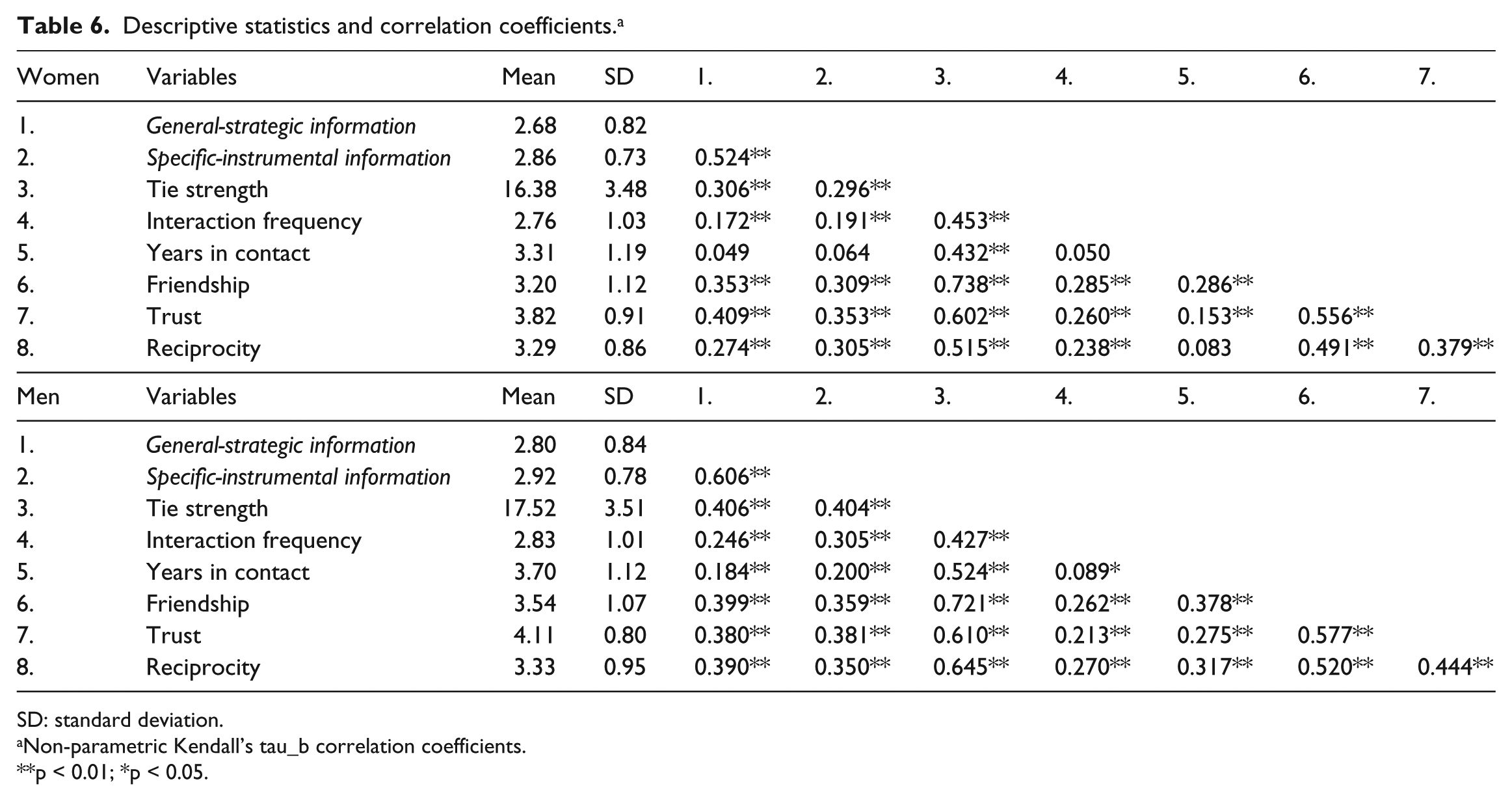
Table 6 displays the descriptive statistics (means and standard deviations) and correlation coefficients for our variables by gender. In the case of men’s collaboration relationships, the results show significant correlations between the dependent variables (access to information) and the independent variables (tie strength characteristics), as well as adequate correlation among independent variables. In the case of women’s collaboration relationships, not all independent variables correlate with statistical significance. Years in contact does not show a significant coefficient with either type of information. Overall, correlation coefficients are generally lower in the case of women’s collaboration relationships than is the case for men’s relationships.
Descriptive statistics and correlation coefficients. a
SD: standard deviation.
Non-parametric Kendall’s tau_b correlation coefficients.
p < 0.01; *p < 0.05.
Table 7 shows results of the Mann–Whitney U-test of differences between the means for the strength of tie characteristics by gender. The measure for overall tie strength between respondents and all collaborators is higher for men, with statistical significance. Hypothesis 1, that the overall tie strength of collaboration relationships will be less strong for women than for men, is thus confirmed (p < 0.01). Of the five individual tie strength measures, interaction frequency and reciprocity are not significantly different between men and women. Years in contact, friendship, and trust are all stronger for the collaboration relationships of men and with statistical significance. For both women and men, trust appears as the strongest tie component of their collaboration relationships.
Mean differences for characteristics of collaboration strategies by gender. a

Non-parametric Mann–Whitney U-test.
p < 0.01; *p < 0.05.
Table 7 also shows that tie strength differences between women and men are much reduced when only gender homophilious collaborations are considered (Column 2). There is no difference in the overall tie strength measure, and the only individual tie difference is in the length of the men’s gender homophilious collaboration relationships. Comparing collaborations with women (Column 3), men respondents have had significantly more time than women respondents in contact with their women collaborators, while women respondents have significantly higher levels of reciprocity with their women collaborators than do men respondents. However, it is collaborations with men that appear to most explain the overall results. Comparing collaborations with men (Column 4), the measure for overall tie strength is higher for men respondents’ collaborations with other men than for women respondents’ collaborations with men. This is also the case for all of the individual tie characteristics except interaction frequency. The confirmation of Hypothesis 1 for all collaborations thus appears to be premised on the strength of ties between men respondents and men collaborators, when compared to women respondents’ collaborations with men.
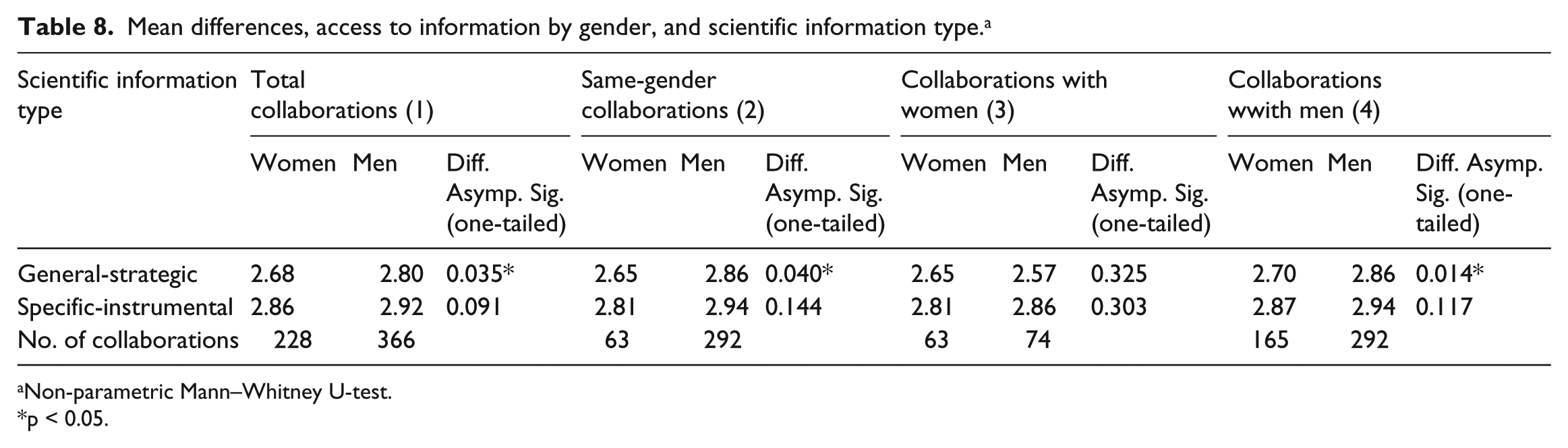
The correlation coefficients for access to both types of scientific information are lower for women than for men (Table 6). Table 8 shows the Mann–Whitney U-test for differences between these coefficients for access to information for all collaborators and for same-gender collaborations. The results show a difference between women and men in relation to accessing general-strategic information (Column 1), and this result is statistically significant (p < 0.05). The difference between women and men in relation to the acquisition of specific-instrumental information is not significant. Hypothesis 2, which posited that men acquire more scientific information through their collaboration relationships than women, is therefore partly confirmed.
Mean differences, access to information by gender, and scientific information type. a
Non-parametric Mann–Whitney U-test.
p < 0.05.
Results in Table 8 for same-gender collaborators are similar to results of all collaborators. There is a difference in the level of access to general-strategic information obtained by women and men through gender homophilious collaboration relationships (Column 2). In the case of collaborations with women (Column 3), there are no differences in access to information for women or men respondents. However, in the case of collaborations with men (Column 4), men respondents acquire significantly more general-strategic information than do women respondents.
The models used to test the interactions between access to scientific information and the strength of collaboration ties are shown in Table 9. The results for all our models show that access to scientific information is positively related to overall tie strength (Models 1, 3, 5, and 7). Working to strengthen ties with collaborators is thus an effective strategy in the interests of acquiring additional scientific information through collaboration relationships.
Results of Ordered Logic Regression (OLR) models, access to scientific information through collaborators, by gender.

p < 0.01; *p < 0.05; †p < 0.1.
Models 2, 4, 6, and 8 show the relationships between access to information and individual tie strength characteristics. Friendship is positively related to accessing greater levels of both types of information for women’s collaborations (Models 2 and 4) and to greater access to general-strategic information for men’s collaborations (Model 6). Trust is related to increased general-strategic information for women’s collaborations (Model 2), but increased specific-instrumental information for men’s collaborations (Model 8). Frequency of interaction is related to increased access to both types of information for men’s collaborations (Models 6 and 8). Finally, reciprocity provides greater access to general-strategic information for men’s collaborations (Model 6). The individual tie strength characteristics associated with access to information for women’s collaborations are different to those of men’s collaborations in relation to both types of scientific information – but not exactly as predicted. Hypothesis 3 is thus partly confirmed. Among the controls, having a woman collaborator is negatively and significantly related to accessing general-strategic information for both women and men. Applied research activity is positively correlated to access to both types of scientific information for women’s collaborations, while collaborating on research projects is positively related to acquiring specific-instrumental information for men’s collaborations.
The coefficients for the relationships between access to scientific information and overall tie strength are higher for men for both types of information (Table 9). To test whether these results indicate that men acquire greater additional information rewards by strengthening ties, we performed a bootstrapping analysis of the coefficients for overall tie strength (Table 10).
Results of bootstrapping of tie strength coefficient differences by gender.
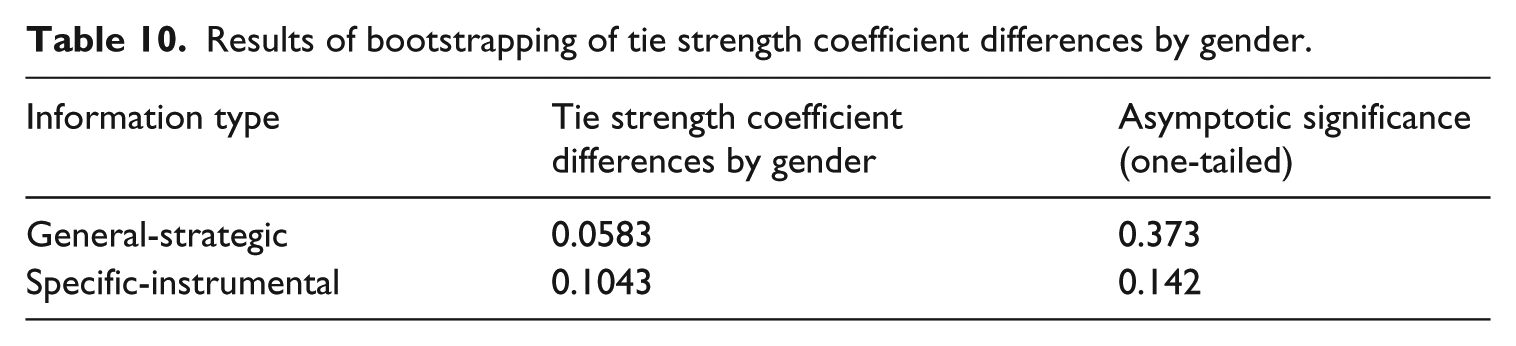
The bootstrapping results showed no significant difference in the relationships between overall tie strength and access to general-strategic information for women and men (Models 1 and 5). Likewise, no significant difference exists between overall tie strength and access to specific-instrumental information for women and men (Models 3 and 7). These results show that strengthening ties with collaborators is an equally efficient strategy for accessing information for both women and men. Hypothesis 4 is thus rejected.
Discussion and conclusion
The literature reviewed at the start of this article suggested strongly that structural factors characterizing STEM fields should have an impact on women’s access to scientific information through collaboration relationships. In particular, this is due to women’s underrepresentation in organizational (university and government research laboratories) and institutional (peer community) contexts of STEM fields. Our first main finding is that men working in nanotechnology have stronger ties with their collaborators overall than do women. This appears to be an effect of relationships with men collaborators: (1) compared with men researchers, women researchers’ relationships with men collaborators are of inferior overall tie strength; (2) at the same time, the strength of women’s and men’s gender homophilious collaborations does not appear to be different; and (c) there is also no apparent gender difference for relationships with women collaborators. This finding reveals how the structural conditions under which women work in STEM can affect the processes of doing science. Despite women being more likely to collaborate with the available women in the field than their male counterparts, women are unable to form a similar proportion of gender homophilious collaborations as men researchers in the field, having no alternative but to collaborate largely with men. This has the effect of reducing the overall tie strength of their collaboration relationships compared to their male colleagues.
Our second finding is that men receive greater access to general-strategic information through their collaborators. This difference persists when comparing the gender homophilious collaborations of women and men and also when comparing women and men researchers’ relationships with male collaborators. This difference may well be explained by the relationship between access to general-strategic information and academic rank. Control over certain valuable information can accrue to holders of organizational power or institutional authority. The holders of this power and authority in STEM are almost invariably men. The fact that women reported lower access to general-strategic information than men, despite almost three-quarters of their reported collaborations being with men, confirms that the circulation of this type of information has a gender dimension. This result is consistent with the findings of Durbin (2011) regarding the persistence of functioning old boys’ networks. A limitation of this study is that, due to the small number of professorial level women respondents, we were unable to test for a statistically significant relationship between rank and access to general-strategic information.
The results also show that a positive relationship exists between accessing scientific information and overall tie strength. However, access to information is increased by strengthening different interpersonal tie characteristics for women and men. Among women researchers, friendship is the only predictor of increased access to both types of information, while trust is also a predictor of greater access to general-strategic information. This is consistent with previous studies that have found ‘expressive’ ties to be an important constituent of women’s professional relationships (Brass, 1985; Scott, 1996). Among men, increasing interaction frequency is the only predictor of greater access to both types of information. Friendship and reciprocity are also predictors of increased access to general-strategic information for men, consistent with Durbin (2011). Trust is the only other predictor of access to specific-instrumental information for men. Finally, the characteristics of women’s collaboration relationships are shown to be equally effective as those of men when it comes to the incremental acquisition of both types of scientific information through strengthening interpersonal ties. This finding is important, signaling as it does that the way women collaborate is equally effective, despite the structural conditions – the underrepresentation of women in STEM and in higher level positions in STEM – that adversely affect women in the intertwined processes of collaboration and information circulation in science.
A number of points can be made in support of a claim that these findings may be generalizable to other STEM fields and science systems. First, the degree of underrepresentation of women in STEM is relatively consistent across the Spanish, European, and the US research contexts. Second, the interpersonal ties that are integral to the micro-social process of collaboration relationships are common to scientific work globally. Third, women in our study had on average 1.63 international collaborators, suggesting our results reflect quite directly the trans-national nature of STEM collaboration. Finally, the results of our tie strength tests are consistent with previous results regarding the strengths of women’s ties and explainable in terms of general theoretical assumptions regarding gendered structures and processes. These points would suggest that our findings may well be replicable in other locations internationally and that their implications could eventually be shown to be globally relevant.
With important exceptions (Shrum et al., 2001), the prior literature on scientific collaborations tends to focus either on factors linked to numbers of scientific collaborators or processes affecting collaboration in specific contexts. Using social network analysis techniques, we developed an understanding of gendered processes of scientific collaboration and access to information at the intermediate level of interpersonal dyads. We have shown that there is gender difference in the strength of ties with men collaborators and that the relative lack of available women collaborators reduces women’s possibilities to form alternative, potentially equally strong and effective, gender homophilious collaborations.
This article also contributes to understandings of the role of ‘trust’ in scientific collaboration. We have confirmed that trust is very important in collaboration relationships, but also found that trust is not undifferentiated: it is associated with acquiring differing types of information for women and men. It may well be that women must inevitably place their trust in men collaborators for access to information about their research field, partly due to men’s dominance over higher level positions in STEM fields. That our control variable for woman collaborators had a negative and significant relationship with accessing general-strategic information, for both women and men respondents, would tend to confirm this interpretation. In contrast, trust was important for men in accessing information related to their own research activities. We also found that while women’s trust was also associated with friendship in the acquisition of knowledge about the field, men’s trust was associated with frequent interaction in acquiring information relevant to their research. The linking of trust to expressive-type collaboration characteristics for women and to instrumental-type collaboration characteristics for men appears to be consistent with the main findings on gender differences in previous studies of relationship ties in other professions.
From a theoretical perspective, our results confirm the impact that gendered organizations and institutions (Acker, 1990) can have on micro-social interpersonal processes such as research collaboration relationships. Women in STEM lack organizational power and institutional authority relative to their male colleagues. Women are also disadvantaged by their underrepresentation in STEM, which a priori genders their research collaboration relationships, entrenching an uneven distribution of information resources. Our empirical results thus strongly support the argument that systems need to change, as gender differences in access to information through collaborations are determined in some respects by structural conditions beyond the agency of individuals.
Research collaborations are arguably the most important interpersonal relationships in science. The results of our study confirm that women are as effective as men within the social processes of scientific collaboration. However, the consequences of the structural underrepresentation of women in STEM mean that women start from a disadvantage in terms of the overall strength of their collaboration ties and in their access to strategic information related to the scientific agenda in STEM fields. Confirmation of our findings by future studies would be a cause for serious concern. As things stand, the importance of the policy push for balanced gender participation within STEM fields is underlined. If fundamental research collaboration relationships are inhibiting the work of women in science in any way, it is the research system as a whole and its public backers that lose in the end.
Footnotes
Acknowledgements
The authors would like to thank three anonymous reviewers and the Editor for their constructive comments and support in developing the article. They would also like to thank Monica Gaughan and Jordi Molas-Gallart for invaluable initial guidance and advice on the article.
Funding
This research received no specific grant from any funding agency in the public, commercial, or not-for-profit sectors.