




Abstract
This article uses historical and ethnographic methods to examine the primarily East-Central European Interoceanmetal Joint Organization (IOM). I ask how and why the IOM has survived as an institution since its inception in 1987, working especially with the personal archive of Vratislav Kubišta. Kubišta was a metallurgist and former Deputy Director General at IOM who after retirement sought to develop a local deep-sea mining museum. This is a story about the work that archives do, but even more about how institutions maintain archives. I draw on recent work in the history and anthropology of time and archival practice to situate IOM’s history and Kubišta’s collection in narratives of ruin, the unbuilt, and the experience of multiple temporalities within spaces of resource speculation and anticipation. I suggest that IOM’s history highlights the contingencies of resources in the temporality of indefinite pause, their attendant data, and scientific labor and life under the shifting political, economic, and scientific circumstances of the ongoing not-yet. In broadening the history of what is once more a hotly contested potential resource, this account speaks to the claims of contemporary would-be seabed miners, who frequently frame the practice in terms of innovation, urgency, and novelty.
It’s just past the peak harvest season in rural Czech Republic. Overripe fruits litter the hillside attached to the home in which I am a guest. I spot Jan on his way towards the doorway of the outbuilding in which I’m seated. He brings me a lager and I pan my gaze across the desks behind me, over the layer of sticky dust that’s rendered all the objects gathered atop them in the same depthless beige tone. It occurs to me that in the few years since someone last touched these materials, when Vratislav was still living and laboring here, that they’ve begun to resemble once more what they must have looked like in the sites where they were formed, millions of years ago, on the Pacific Ocean’s abyssal plain (Figure 1).

A view of the interior of Vratislav Kubišta’s outbuilding, which he turned into a museum of deep-sea mining at the Interoceanmetal Joint Organization. Above the far window are the dates 1987 and 2008—the year IOM was awarded an exploration contract for deep Pacific nodules, and the year Kubišta formally retired, respectively. These dates bookend ‘IOM’ over a stenciled map of the Pacific Ocean, which sits atop the words, ‘Komu patří moře?’ which might translate as ‘To whom does the ocean belong?’
I first found these materials collected under the title ‘Deep-sea mining museum’ on the website for the city hall of Beroun, a formerly industrial city outside of Prague. Several years ago, Vratislav had traveled with his materials and set up a temporary exhibit in the city’s dum kultury. Now, having been invited by his son Jan, I have driven past that town to this village, where those materials in that museum have since been brought home, arranged, and locked in indefinite storage. In this outbuilding behind the Kubišta family home in Sýkořice, Czechia, Vratislav gathered, organized, and displayed material objects that indexed his life and work during his career with an organization called the Interoceanmetal Joint Organization (IOM). IOM, whose logo is hand-painted on the far wall, was founded in 1987 as the fifth pioneer investor registered with the Preparatory Commission for the International Seabed Authority (ISA) to explore the mineral resources—particularly polymetallic nodules, which are concretions of mostly manganese and iron but also cobalt, nickel, copper, and rare-earth elements—of the Deep Pacific Ocean’s Clarion-Clipperton Zone (CCZ). It was the first multi-state consortium to do so. Vratislav retired to Sýkořice in 2000 and passed away here in 2019.
These materials tell the story of a life spent in East-Central Europe as a metallurgical processing technologies expert, working in the field of deep-sea mining between 1987 and 2008. Yet, it is a fact that neither the IOM nor any hopeful deep-sea miner has ever extracted deep-sea nodules on a commercial basis. What then, has IOM been? Observers have questioned with incredulity exactly how and why IOM has survived over the past thirty-six years. Vratislav’s materials also tell a story of what, aside from extraction, the idea of deep-sea mining has meant to its would-be practitioners. What does it mean to assert that someone has had a career in deep-sea nodule mining, a practice that has yet to transpire, or to assert that the same person spent a professional life working with the mineral resources from a patch of sea in an ocean he never visited? What might it mean to claim, for histories of deep-sea mining and of East-Central Europe, that a durable, transnational scientific community has formed around decades’ worth of collectively looking toward a future for deep-sea mining? Here I address these questions through and with Vratislav’s archive-museum of deep seabed mining in landlocked Bohemia.
In this article I elaborate on ethnographic fieldwork undertaken in 2020 and 2021 in Sýkořice and in Szczecin, Poland, where the IOM is headquartered, elsewhere in the Czech Republic, and remotely among East-Central European geologists, to tell a story about what Vratislav Kubišta’s archive reveals; not only of his own life’s work, but also that of others at IOM and beyond. Weszkalnys (2016) writes of her time among anticipators of first oil in São Tomé e Principe that the experience of her ethnographic method resembled most closely an ‘archeology of affect’, where she found herself working backwards from the multivalent Santomean concerns related to oil to uncover the types of affects that offered form to diverse contemporary attitudes. Meanwhile, in the mill lands of Mumbai, Finkelstein (2019) worked to square industrial life and labor in functional mills against their supposedly postindustrial spatial and temporal contexts. Following Burton (2003), Finkelstein found that reading the embodied histories of the mill required expanding archival forms. Moving between museum spaces that archive industrial Mumbai through memorialization, and the working mills themselves, she came to view the mills as ‘an ethnographic archive of the city: semipublic space of documents, artifacts, and stories, held by the workers inhabiting these still-breathing but slowly decaying spaces’ (2019, p. 5).
My own study of Vratislav in relation to the IOM, and of both their orientations toward their larger surrounds, builds upon these methods to parse an East-Central European context of deep-seabed mining. Though this article proceeds chronologically, it also functions archaeologically, working backward by relating the memories of living scientists and others who have worked for or otherwise known the IOM, to the materials assembled in Vratislav’s archive-museum. Reading the IOM archives ethnographically requires suturing those documents to memories, artifacts to emails, assembling composites of what Brown (2015) might call ‘unconventional sources’ to tell the history of a place not-yet forgotten. All this bears unpacking, which begins with the striking realization of abundant activity out of time, what Finkelstein names ‘anachronistic vitality’ (2003, p. 6).
Histories of deep-seabed nodule mining usually begin with the claim that nodules were largely an esoteric scientific curiosity after their late-19th century discovery, only to become a potential mineral resource in the hands of enterprising American geologists during and after the 1957-1958 International Geophysical Year. In 1967, the ambassador of the new state of Malta introduced nodules to the United Nations as the common heritage of mankind; over the late 1960s and 1970s, nodules and potential wealth from their extraction became the site of debates around how a developing international law of the sea would be related to the goals of states newly aligned along largely North-South axes. By the early 1980s, the aspirations of developing states to participate on equal terms with developed states in the mining of deep-sea nodules had been eroded in the final Law of the Sea treaty. This, combined with the fact that key mineral prices became depressed in response to new land-based resources, meant that interest in mining the deep seabed’s minerals fell away.
Yet the East-Central European context suggests that this declensionist history of nodule mining, told to the tempo of Western multinational corporate investment and divestment, misses much. Interest in nodule mining in this region began in the early 1970s and accelerated into the 1990s. Of the twenty-five cruises IOM performed to the CCZ, twenty-one of them took place before 2001. Temporal mismatch between the pace of scientific work at the IOM and how interest in nodules is said to have waxed and waned provokes analysis that departs from a simple question: what has IOM been, for whom? I locate its history within that of deep-sea mining and of East-Central Europe, and in doing so look to the ways that IOM and Vratislav’s entwined stories might enter into dialogue with ongoing conversations on the generative capacities of unrealized or ruined scientific plans, the nature and form of archives, and the role of multiple and alternative temporalities in structuring scientific life and work. In the end, I argue for the particular features of Vratislav’s and IOM’s anachronistic vitality, and suggest this history as one of temporal calibration among economic, political, geological, and human individual cycles of time.
Multiple temporalities, archival practice, and deep-sea science
The items assembled in the outbuilding include: manganese (polymetallic) nodules, fossilized sharks’ teeth and whales’ bones dredged by the IOM from the seabed, nodules partially processed as briquettes and fully processed as constituent metal powders (nickel, manganese, cobalt) in tubes, two kimonos, Portuguese souvenir trivets, Cuban ashtrays, IOM Christmas ornaments, and chronologically ordered poster boards indicating that at one time this was a museum meant for public viewing.
These are the artifacts of projects conceived with and through IOM that were variously completed. They point to notions imagined but never initiated, ideas acted upon but abandoned, or projects completed as steps toward a larger whole whose extractive aims remain unrealized. The history of ‘unrealized projects’ (Keiner, 2020), has conventionally focused its attention on unbuilt mega-infrastructural projects of imperial technocracies or on mid-20th century high modernism to suggest that unrealized dreams can, and might even especially, move across contexts and shape future projects in unexpected ways. Peyton (2017) extends this to how imagined, abandoned, and half-built things not only produce effects in and on the landscape, but also condition orientations in the minds of stakeholders that remain potent, and liable to double-back with new desires and consequences. The historical failure of a mine site to yield hoped-for rewards might, rather than dissuade future prospectors of investment, reinforce the conviction of some that there must be minerals there. These particular resource affects, inherited and elastic imaginations of future mineral wealth, are essential for making sense of IOM’s persistence and Vratislav’s archive of it. IOM has not yet been abandoned, even as dominant histories have overlooked its work. In focusing on affective orientations to scientific work within and beyond the scope of its stated goals, IOM’s persistence and Vratislav’s archive reveal much about cultivating vitality amid ongoing processes of delay and decline.
Sitting among Vratislav’s things, I consider what Khatchadourian (2022) calls the life lived extempore. Situated along political, economic, and social margins, Khatchadourian’s accounts of those who came of age in late socialism frame an orientation to being in the world
Though such a gathering is not unlike Vratislav’s effort, Vratislav did not seek an admissions fee, and he began his curatorial work in retirement. Moreover, there were no great piles of nodules to care for or sell, only a few samples—material data points. Still, his objects and their curation mark kinds of future-making practices, continually squaring dual realities of vitality and decline. Like Khatchadourian’s factory owner, living a life extempore with IOM for Vratislav and his colleagues also centered on devising ways of market entry from the margins. Reading Vratislav’s archive ethnographically, aslant the stated goals of unrealized science, requires attunement to multiple temporalities to understand how he and IOM staked out a marginal, but durable, position at the edges of political and economic forms.
Vratislav’s career at IOM spanned from the twilight of normalization after the Velvet Revolution and the broader end of East-Central European socialism, liberalization, and de-industrialization of Czechoslovakia’s (and the remainder of IOM’s member states) economy, to the dissolution of Czechoslovakia and fiscal austerity as the Czech Republic transitioned into NATO and the European Union. Such a timeline offered up diverse possibilities for ruination and reinvention. Yet this is only one way of periodizing his career. Another temporal organization tracks the gestures tied to anticipated resource extraction. For Weszkalnys (2015), gestures are stepwise devices that, while performed with the intention of realizing extraction, become more gestural when extraction is continually deferred. Gestures, which for her include the contract, the exploration zone, and the test well, ‘keep the pause prised open by materializing an absent potential and promising future gain’ (2015, p. 616). Yet as Weszkalnys shows, though statist development time is sometimes synced to the temporality of resource gestures, it is not always, and especially not as anticipation undergoes trials of ruination. These temporalities, while structuring futural orientations and archival recordkeeping, also encounter one more nonlinear kind of time: that of the life of the individual scientist, working among varied personal and professional preoccupations.
We can find specific histories in the interference generated by these temporalities—East-Central European political-economic time, deep-sea nodule mining’s gestural time, and Vratislav’s lifetime. Contemporary pushes to mine the deep seabed appeal to a sense of time running out, leveraging mirrored narratives about accelerating environmental precarity and decelerating resource availability. But Vratislav’s archive and IOM, situated in their ongoing timespace of the ‘not yet’, offer counterweight to high-velocity stories of the near future (Weszkalnys, 2014). With Vratislav and IOM, nodules amassed in central Bohemia since the late 1980s instead tell stories about how scientists and engineers, but also journalists and the lay public, envision and reimagine resource futures between the future that was expected and the future that became the present. Attesting to how anticipation remains lively, these stories help to interpret the kinds of meaning that fill scientific and other lives lived in expectation.
Archiving the future of deep-sea mining
Seabeds and the ends of socialism
I arrived in Szczecin in late summer, 2021, and was greeted at the entrance to the purpose-built IOM-owned high-rise by a Czech scientist, who showed me to a guest flat. The following morning, I wandered downstairs to meet the Director General of IOM, Tomasz Abramowski.
I had seen photos of the building and offices, which Vratislav had been instrumental in planning, in his museum. The nine-story high-rise complex was imposing, and I expected large offices filled with IOM employees and more paperwork than I could hope to inspect. Instead, IOM was confined to a few rooms on the ground floor, plus the living quarters of staff scattered elsewhere throughout the building. The organization’s offices were particularly sparse, and a search of its library returned only a few clippings from local papers covering IOM activities through the 1990s. I’d learn later that most of the other dozens of flats, which at one time were meant to house the families of at least sixty full-time employees, were now rented to local families, with IOM becoming their landlord. It was difficult to square this reality, of lifts and lobbies filled with children and the elderly and a gym renting the ground-floor corner, with how I had come to see the IOM through Vratislav’s archive.
In my first conversation with Tomasz, though, I was transported to a time at IOM prior to the existence of this building and all these rented flats, prior to this period of interminable waiting. Before IOM, there was Intermorgeo, a coordinating center for mineral utilization under the Council for Mutual Economic Assistance (CMEA, popularly known as Comecon) established by the USSR at the beginning of the 1970s to research geological questions (Erofeev & Slizevsky, 1980). 1 Intermorgeo’s foray into exploring deep-ocean manganese nodules as a potential economic resource was made in response to calls from Comecon members, most vocally Czechoslovakia, which was involved from 1971 onward in a joint enterprise among Comecon countries to explore deep-sea mineral resources. 2
As with other scientific-technological cooperative activities initiated under the auspices of Comecon, Intermorgeo sought to bring specialists together from socialist bloc states to work on scientific questions using infrastructure and technology largely financed by the USSR. 3 Intermorgeo developed relationships with the preparatory commission of the ISA. But by the mid-1980s, as Kochetkova recounts, Soviet officials felt that—as a result of political difficulties and ineffective exchange at the local level—Comecon programs of mutual assistance and scientific cooperation were not working. In response to this ‘technological stagnation’, the USSR redoubled its commitment to integrating science, technology, and socialist cooperation in the name of progress, developing a 15-year plan to intensify these connections. Intermorgeo was out (Kochetkova, 2021). 4
At the same time, programmatic restructuring within Comecon was happening in parallel with negotiations over the text of the UN Convention on the Law of the Sea between 1973 and 1982 (UNCLOS). IOM is composed of states that belong to several regional groups in the UN including the Eastern European, Caribbean, and South American states, as well as landlocked and small island contingents—though Tomasz also reminds me that Cuba does not recognize the developing-developed binary that would award the state special privileges in the context of UNCLOS’s regimes. It was the contingencies of this political milieu, both within the socialist bloc and in the wider international legal setting, which formed an early environment for IOM that was as full of possibility and potential as it was with frustration and hardship.
‘Everything was promising at the beginning’, says Tomasz. Unlike other iterations of Comecon scientific cooperative programming, IOM was managed at the expert level rather than the political level, so experts would arrive at research plans by consensus. This would ensure equity of participation. Following the reformation of stagnating Comecon enterprises, scientific cooperation was freer, more personally directed, and less bureaucratically heavy-handed (Kochetkova, 2021, p. 363). Big plans were developed, on which much money was to be spent. Two cruises to the Eastern Pacific on Russian ships were planned in 1988, the first year of operations. A first-year budget of USD 400,000 promised the initial salaries of seven Poles, five Russians, five East Germans, five Bulgarians, five Czechs or Slovaks, and two Cubans and Vietnamese each, to be based in Szczecin.
There were serious advantages to circulating abroad as a technical expert in a Comecon program near the end of socialism. I remembered a conversation I’d had earlier in the summer with Vratislav’s close friend, Zdeněk Černý, back in Sykoricé. He recalled details of his life during Czech socialism, when going abroad to work as a scientific expert guaranteed a materially better life in an ‘exotic country’. When he took his first post as a geologist at another Comecon project in Mongolia, he earned six times the average Czech salary, and had guaranteed housing during a Czech housing crisis. Kochetkova (2021) found that, in the absence of scientific results in Comecon cooperation, ‘travel abroad was a privilege for specialists who prioritised individual cultural and material, rather than professional and national, goals’ (p. 364). Krátká (2015) offers an IOM-adjacent case in her examination of the Czechoslovak Ocean Shipping Company, which remained in business taking Czech sailors abroad through the end of socialism and facilitated the circulation and exchange of foreign ideas when sailors returned home. Even Tomasz, who was sixteen when socialism collapsed, recalls his early interests in working on ships as emerging from a desire to ‘look beyond the iron curtain’ at a time when going to sea was ‘a gateway to the open world’.
These accounts resonate with Zdeněk’s experience before IOM, but things were different and altogether tougher in Poland by the time he joined IOM as an economist in 1988. Meat and petrol were rationed. Conditions necessitated that IOM workers cooperate well beyond science. Because only East Germans and Czechs could travel to East Germany to shop, Zdeněk recalls shuttling groceries over the border to colleagues back in Szczecin. Because petrol was limited, Zdeněk and Vratislav traded off driving the 600 km home to Prague every weekend to visit family. Aside from science, workers had downtime. Zdeněk recalled tennis matches and trips to the seaside. For him, the memorable is the mundane. Scientists made a difficult life more workable in part by sharing quotidian responsibilities. Lives lived in big science within the ‘habitus of socialist materiality’, per Khatchadourian (2022), encountered dissonances between ‘the condition of both running out of time and being out of socialist and capitalist time [original emphasis]’ (p. 324). IOM Scientists made the gulf between stated goals and lived experience bearable by being at home together, for example at Południowa Street in Szczecin. 5
But more than this, those same scientists navigating the political unevenness of the late 1980s and early 1990s—as their home states mostly left socialism behind—did so together. As grocery prices doubled (and then some) during Poland’s market liberalization over 1990–1991, IOM’s proliferating science should be seen as produced through a real and shared conviction that the exploitation of the Pacific seabed would offer one path through tumult.
While Lorenzini (2014, 2019) finds that socialist technical cooperation was declared a failure by the late 1980s, this broad declaration did not quite penetrate the ethos of IOM, which was oriented to the anticipation of a near future where legal, political, and economic conditions would align, nodules would be raised from the depths, and the work of maintaining the organization would be validated. Politics at home might have been in flux, but East-Central European heavy industry would still need manganese, cobalt, and nickel. By 1984, several tonnes of nodules had already been processed by ferroalloy manufacturers across the Eastern bloc (Babinskí, 1993). There were Russian ships, Czech and Slovak metallurgists, and other highly trained scientists and technicians available for work. UNCLOS was about to come into enforcement, and so long as IOM could manage to stake a claim to a piece of the Pacific seabed, the scientists could guarantee raw material security for the kinds of industry that employed much of East-Central Europe. The concessions granted to landlocked states under UNCLOS, and post-socialist states more broadly, meant that despite the eclipse of the planned economies, East-Central Europe might not be left behind in a forthcoming rush for nodule resources. Some observers even felt that IOM might be just the kind of organization needed to model how industrial cooperation could facilitate co-development (Borgese, 1991).
6
Elisabeth Mann Borgese wrote in 1991 that: A couple of years ago, the Eastern European socialist states established a joint undertaking, under the name of Interoceanmetal, Inc., for the joint exploration of a mine site in the deep seabed and for the development of the requisite technology. Far from being overtaken by centrifugal trends, this venture is now at the point of applying to the Preparatory Commission for the International Sea-Bed Authority and for the International Tribunal for the Law of the Sea for registration as the fifth pioneer investor. Here is another example for the convergence of, and mutual reinforcement between, perestroika and the Law of the Sea. (1991, pp. 22–23)
Looking back on IOM in 1993, a local newspaper columnist would write that ‘those experiences, the first enthusiasm with which the creation of Interoceanmetal was adopted six years ago, are past. The organization has withstood the test of time, however’ (Babinskí, 1993, p. 3). How IOM continued despite shedding its early enthusiasms and despite early attempts to defund the organization in Polish parliament, and despite the nationalization of similar cooperative endeavors like Petrobaltic, hinged on the signing of a document. IOM rushed to lodge an application for nodule exploration with the Preparatory Commission for the forthcoming International Seabed Authority in 1991, and it was approved the following July. Journalists commented that a copy of the document hung between a map of Pacific seabed geology and a topographic map of the Clarion-Clipperton Zone in the office where I sat speaking with Tomasz. Another copy, hung in Vratislav’s museum, shows the coordinates of IOM’s plot, turning points marking the directions that all future ships would follow as they explored and collected the deep seabed.
At the beginning, Zdeněk recalls, IOM scientists were certain that nodule extraction would happen by 2005, reflecting a conviction held since the planning meetings of 1984–1986 that nodules would come shortly; a long-term plan for IOM ended in 2000. Tomasz thinks the estimate was 10–15 years away from 1987. By 1992, Ryszard Kotliński reported to news outlets that nodule mining might not commence until between 2010 and 2020, ‘by no means a distant term’ considering how much work needed doing (Babinskí, 1992). It did not matter though that the horizon of expectation was shifting (Koselleck, 2018). 7 As a registered pioneer investor, IOM now had obligations to fulfill in pursuit of further legal codification in the form of certificates of compliance and an eventual renewable exploration contract.
Writing on the gestural qualities of first oil’s contractual documents, Weszkalnys (2015) remarks that contracts supply the ‘tangible scaffolding’ to the drama of speculative investment, sustaining an anticipatory orientation by signaling what is to come (p. 624). IOM’s certificate of registration, awarded to the organization in a post-socialist landscape marked by market liberalization, meant that scientists were locked into the goal of retrieving nodules for the long haul. By 1994 the IOM’s long-term vision saw pilot extraction occurring in the window between 2008 and 2015. And without collective ascent by mutual cooperation to aspire to, extracting and finding uses for minerals in a changing world would require creativity. Vratislav, as the resident metallurgical processing technologies expert, was poised to become ambassador of the IOM to the world. As seen from the vantage of his archive, life in science took on a new character after 1992.
Life with nodule science between Szczecin and the world
Back in Sýkořice, Vratislav pieced together a timeline of events that followed IOM’s registration as a pioneer investor. The certificate of registration, a gesture marking the first step in a putative series of contracts that all pioneer investors would pass through en route to becoming full-fledged explorers and exploiters of nodules, opened new temporal horizons and spaces of interaction between Szczecin and the world. The period between 1992 and 2001, when IOM was awarded its contract for exploration, was full of activity at IOM, and in Vratislav’s career specifically, that far exceeded his official capacity as a metallurgical processing technologies expert. In early 1993, IOM moved into its present location at Ul. Cyryla i Metodego 9-9c. Vratislav, along with colleagues in the planning department, was instrumental in seeing those plans to fruition through financial hardship and planning setbacks. In the following year, IOM began to fulfill responsibilities set forth for pioneer investors by the preparatory commission, which included mapping their registered seabed area and characterizing it geologically, developing the capacity for processing and a plan for using the nodule resources, conducting environmental baseline and impact studies, and training scientists from developing states in nodule sciences. Vratislav’s archive suggests the large extent to which he played a central role in each of these projects.
In evaluating dispositions toward the potential effects of disastrous oil, Weszkalnys (2014) describes the ‘not-yet’ of oil disasters as cultivating a particular kind of self that is dynamic and responsible, someone who ‘relates to oil in a rational, informed, and non-selfish manner’ (p. 222). Emergent in Vratislav’s account of his scientific life after the end of socialism, concomitant market liberalization, and the codification of IOM’s stake in the seabed, is a self that bears similarity to Weszkalnys’s oil-conscious type. Following Guyer (2007), Weszkalnys articulates this transformation of the self as marking someone who is aware of their individual capacity to impact the realization of collectively desired long-term futures (Weszkalnys, 2014). In the space opened by the first contract, Vratislav’s capacities proliferated beyond his science to match his goals for the long-term future. He executed on these aspirations between IOM’s socialist institutional vestiges and market-oriented demands of nodules as commodities, between ongoing near-term financial hardship and long-term expected financial salvation.
In October 1994, the organization took its first cadre of trainees from developing states for training in nodule-related sciences in IOM countries and at sea. Candidates came from Pakistan, Sudan, South Korea, and Belarus. Vratislav became active in the local experience of these candidates and remained so throughout the 1990s. The correspondence between Vratislav and one candidate, Dr. Kadry Sediek from Alexandria University in Egypt, is illuminating. Vratislav evidently sent photos of their time shared in Poland to Dr. Sediek afterwards, to which Dr. Sediek replied, thanking him and Jan for the memories and inviting them both to visit Egypt. The contractor training program has been part of the mandate of the seabed authority since its formation, but has received relatively little critical attention and has remained overshadowed by discourse on nodule-mining itself. 8 Yet, seen from the perspective of a metallurgical scientist working at IOM in the 1990s, the training program was an important site not only for realizing contractual expectations but also for meeting new people from new places at a time when money was tight and travel opportunities remained limited.
Similarly, the contractual obligations of pioneer investment presented opportunities for Vratislav to go abroad under programs of mutual support, as he and other economic geologists had once done via Comecon. After 1992, Chinese specialists began circulating among Czech and Slovak universities and research institutes, for example, in Prague, Kutná Hora, Panenské Břežany, and the Orava ferroalloy manufacturing plant at Istebné in Slovakia. Then-director Kotliński commenced a program of joint cooperation between IOM and the Changsha Institute of Mining Research (COMRA). Kotliński recognized that China was better situated than IOM to directly access the Northeastern Pacific, and because COMRA’s seabed plot is neighbors with IOM’s, it was figured that collaboration might lead to future access to the CCZ on Chinese ships. New geographies engendered by the staking out of plots under registration agreements helped to reorganize scientific labor and social life back on land, opening avenues for connection and support.
Yet, despite signing an extended cooperation agreement with COMRA in 1996, Czech politicians balked on formalizing cooperative commitments. Perhaps for this reason, though Vratislav had assisted COMRA in working out some pesky engineering questions, it is not science that made its way into Vratislav’s museum. Rather, he recalled in his ordered and captioned photographs from the time the good times he had. When Vratislav visited Xi’an, he met the director of COMRA’s international cooperation division, Zhou Ning, and they became friends. Ning’s wife and daughter played classical piano and liked Czech composers, so Vratislav supplied them with Smetana, Janáček, and Dvorák. In other peoples’ homes, Vratislav bonded with Chinese nationals who had been to Eastern and Central Europe for training; with some he recalled drinking beer and singing (Figure 2).
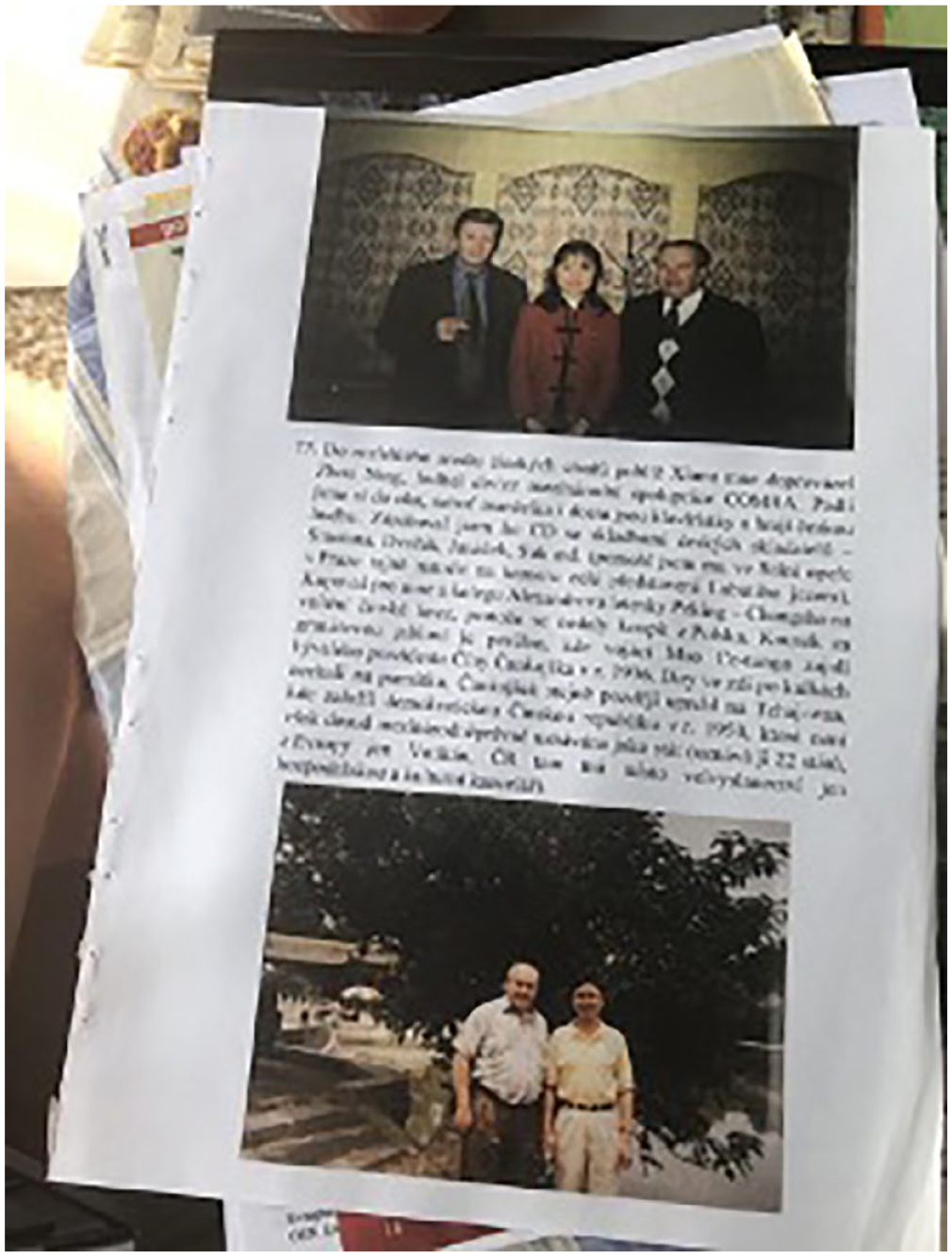
A panel of photographs and text describing Vratislav Kubišta’s time in China during the late-1990s, when he was tasked with completing technical projects under the auspices of joint IOM-COMRA efforts, and where he made several friends.
Still, much of the 1990s in Vratislav’s archive is evidenced by the activity that Jan recalls his father engaged in most thoroughly: advertising the idea of using polymetallic nodules to Czech and Slovak heavy industry. Sitting across the kitchen table from me, Jan tells me that even though ‘heavy industry collapsed, there remained some kind of hope that in the future, industry might recover’. Up until 1993, it was steel manufacturing that interested Vratislav most. He recalled a recent past where Czechoslovak expertise in metallurgy and manufacturing capacity was a significant asset to the Eastern Bloc. In 1993, he spoke to a reporter at Głos Szczeciński of his plans. 9 Zdeněk reiterated at the table that the Czech steel industry really did consider using nodules. Vratislav later succeeded in having a trial volume of nodules processed at Istebné, but already by 1993 there were fears that metallurgical processing plants in the region were becoming unprofitable and would close. When this came to pass in the later1990s, Vratislav turned to automotive and electronics manufacturers in addition to maintaining connections with metals manufacturers and sending samples to Poland, Slovakia, and Czech Republic. Over time though, fewer and fewer nodule hauls made it to industry for experimentation.
Valuing nodules, making futures, and the work of waiting
Sitting across the table from Jan and Zdeněk, surrounded by Vratislav’s things, I am reminded of what it means to be in a time of deferral, to live in the temporality of the not-yet. When Vratislav set out for Xi’an and Havana, or when he shepherded tons of nodules to Istebné or Prague and eventually Sýkořice, he was performing the work of living in this time, the everyday tasks of an anticipatory orientation. This kind of labor has been theorized best by what the semiotician Charles Sanders Peirce called abduction. Helmreich (2009) has seen abduction in the work of oceanic microbial genomicists as joining ‘hope to reason, present texts to future contexts, contemporary life to forms of scientific life yet to come’ (2009, p.172). In living out of time with the context in which work finds its meaning, scientific labor must continuously tack back and forth between the specificities of empirical information and abstractions for thinking about them (Adams et al., 2009).
To continue as a metallurgical processing expert at IOM, Vratislav had to be open to new kinds of work that would make sense of circumstances that bore little relation to a future that still housed an eventuality of technoscientific success. He referred to texts on cooperation and mutual benefit inherited from Comecon to frame new partnerships, and he situated his hopes for nodules in a recent past where metallurgical expertise in Czechoslovakia fueled the anticipatory orientations of not only the bloc but also the USSR. It is in the space of his abductive labor that the tensions between a future cultivated as dynamic, responsible, and ultimately entrepreneurial within East-Central Europe meet a personal history where social and economic ascent were to emerge through direct cooperation and mutual assistance. New contexts reinvigorate older ideas and their attendant hopes with fresh motivations (see Weszkalnys, 2016).
Over the 1990s, Vratislav’s life as a scientist changed as the demands made of IOM changed. The registration certificate, and a certificate of compliance that followed it in 1995, permitted IOM to anchor a position in what many, including Kotlińksi, saw as the shifting geopolitical winds regarding seabed politics as UNCLOS, and with it the Seabed Authority, came into full force in 1994. That year, he took up Borgese’s language of a new world order in the world’s oceans and seas when he framed IOM’s and other pioneer investors’ roles in contributing to those changes (Kotliński & Wilczynskí, 1994). He reiterated these points when speaking at the first ISOPE Ocean Mining Symposium in Japan the following year (Kotliński, 1995a, 1995b, 1995c). But on a pragmatic level, day-to-day operations needed accounting for, and forthcoming resources needed an endpoint of use.
At the close of socialism and the liberalization of East-Central European markets, IOM needed to calibrate a future where nodules could still be resources, where future heavy industry could look how it had recently done, where scientific and financial investment in a patch of Pacific seabed could still mean something. In response, Vratislav moved beyond metallurgy and became a mentor to training candidates, an entrepreneur within industry on behalf of deep-sea minerals, and a diplomat abroad and at home. Jan tells me that when Bulgaria faltered on its contributions to IOM, Vratislav even became a de facto debt collector. His relationship to science, industry, his employer, and his own perceived role in deep-sea mining’s history were in flux. What kinds of records are left in the wake of political-economic time interacting out of phase with the gestural time of science in anticipation?
When these commitments are matched by material traces in his archive, the character of his involvement departs from the exactitude with which IOM has recounted its own institutional history. Vratislav’s museum exhibit-turned-archive appears as an archive of an alternative present; a record of another, as-yet-unrealized, history (Ogden, 2021). Sitting in Szczecin with my own digital facsimile of Vratislav’s archive alongside a copy of IOM’s 35-year celebratory promotional account of work done to date, I can feel how Vratislav’s account of his time departed from the IOM’s, though they were periodized in the same way—by UN contracts (IOM, 2017). His scientific life expanded in scope to include roles beyond his technical remit, beyond even his responsibilities as Czech representative to the organization.
Weszkalnys notes how ‘charters, policies, and campaigns’ fill the near-term with tasks and deadlines, not exactly disavowing a long-term orientation but at least filling the time of not-yet with opportunities for redirection, for surprise, for the advent of new matters of concern (2014, pp. 217–219). These matters punctuate the record of the 1990s tacked to poster boards and printer paper in Vratislav’s outbuilding. What he chose to memorialize for future visitors on what deep sea mineral science had been was less science’s outcomes and industry’s progress than it was friendships formed, travels had, and the hope-heavy ephemera of nodules brought home.
After 1992, market liberalization sometimes made life exceedingly difficult. Zdeněk remembers when everyday goods prices skyrocketed that year, as he left the organization. Economic development proceeded haphazardly over East-Central Europe in the following years. The Czech Republic faced renewed economic precarity over the late 1990s, meeting a 1997 crisis with austerity measures and restructuring packages that posited a better future by 2000. These were among the tests of time that Andrzej Babiński, covering IOM for Głos Szczeciński over the 1990s, referred to the organization as having survived (Babinskí, 1996). Kotliński had to defend IOM against the parliament, but in 1993 Babiński addressed the financial concerns that he supposed the lay public would have. ‘Someone will say’, he wrote in a piece on IOM and deep-sea nodule potential, ‘that … we have to accept the fact that we cannot afford it, and other countries that make up Interoceanmetal are equally entangled [as Poland] in difficult problems of everyday life. Would it be better, to look … for ways out of poverty?’ (1993, p. 3). He had earlier quoted Kotliński in writing that, to date, IOM had not cost very much money, and what had been earmarked was not ‘beyond the possibilities’ (Babinskí, 1992). Kotliński estimated that sizable expenses would not come for at least another dozen years, by which point IOM would be operating its plot. Babinskí (1993) suggested, ‘you can probably count on the fact that our financial possibilities will be better then’ (p. 3). Intermittent crisis had brought the future to the doorstep (Bryant & Knight, 2019). Quelling public (and other) uncertainty around investment in anticipatory projects required faith in the conviction that IOM would extract the deep Pacific and that the economic turn Westward would proceed apace. The two depended on each other to fit future resource extraction into a future that looked different, and better.
The present that Vratislav Kubišta and Ryszard Kotliński imagined for the turn of the 21st century, in its atmosphere of immediacy and urgency, was as thin as it would ever be (see Bryant and Knight, 2019). That nodules would be mined was always certain, and thus the future was always-already conditioned as knowable. The 1990s saw a proliferation of data, and with it, certainty that deep-sea nodules could, should, and would be used. It also saw IOM becoming infrastructurally and socially closer to their plot via intensifying connections with member state Cuba and partnerships with COMRA in China. Where these two accelerative trends met the IOM’s ongoing non-extraction in the space of pioneer investment, a particular anticipatory orientation to the future emerged wherein, for Bryant and Knight (2019), the expectation of the future became the future itself (p. 19). Such an orientation engendered, for Vratislav, good times and good places to live out a scientific life with nodules.
Bryant and Knight (2019) write that ‘anticipation slims the present’, sometimes breaking with the past as a referent as it pulls present and future into the same ‘activity timespace’ (p. 22). Sitting among Vratislav’s memories of the onset of the 21st century, I pored over plans for Ukraine to join IOM that reflected upon Hungary’s and Romania’s one-time aspirations to join and Vietnam’s untimely 1989 departure. I leafed through drafts for new metallurgical experiments in Cuba. I felt past, present, and future coming into conflict with one another, as each timespace clamored to anchor and propel Vratislav’s activities directed toward futures for IOM, for the Czech Republic, for nodules as resources writ large. As Weszkalnys (2014) writes, ‘with the methods of anticipation, any strict distinctions between the present, the near and the long-term future collapse’ (p. 229). As IOM fulfilled its terms as a pioneer investor and lodged an application with the seabed authority for an exploration contract in 2000, the thickness of Vratislav’s and IOM’s present again shifted, this time expanding to accommodate a 15-year timeline full of new responsibilities and outlooks.
Exploration contracts and the generative capacities of non-extraction
The first morning I went to meet Tomasz, I passed a map of the global seabed outside IOM’s ground-floor offices. It was so dense with information synthesized from dozens of monographs, cruise reports, and other documents from IOM and beyond that looking at it—and particularly at the area of the IOM plot—I had the sense that there was no way this map could become any denser with knowledge about seabed minerals (Figure 3).
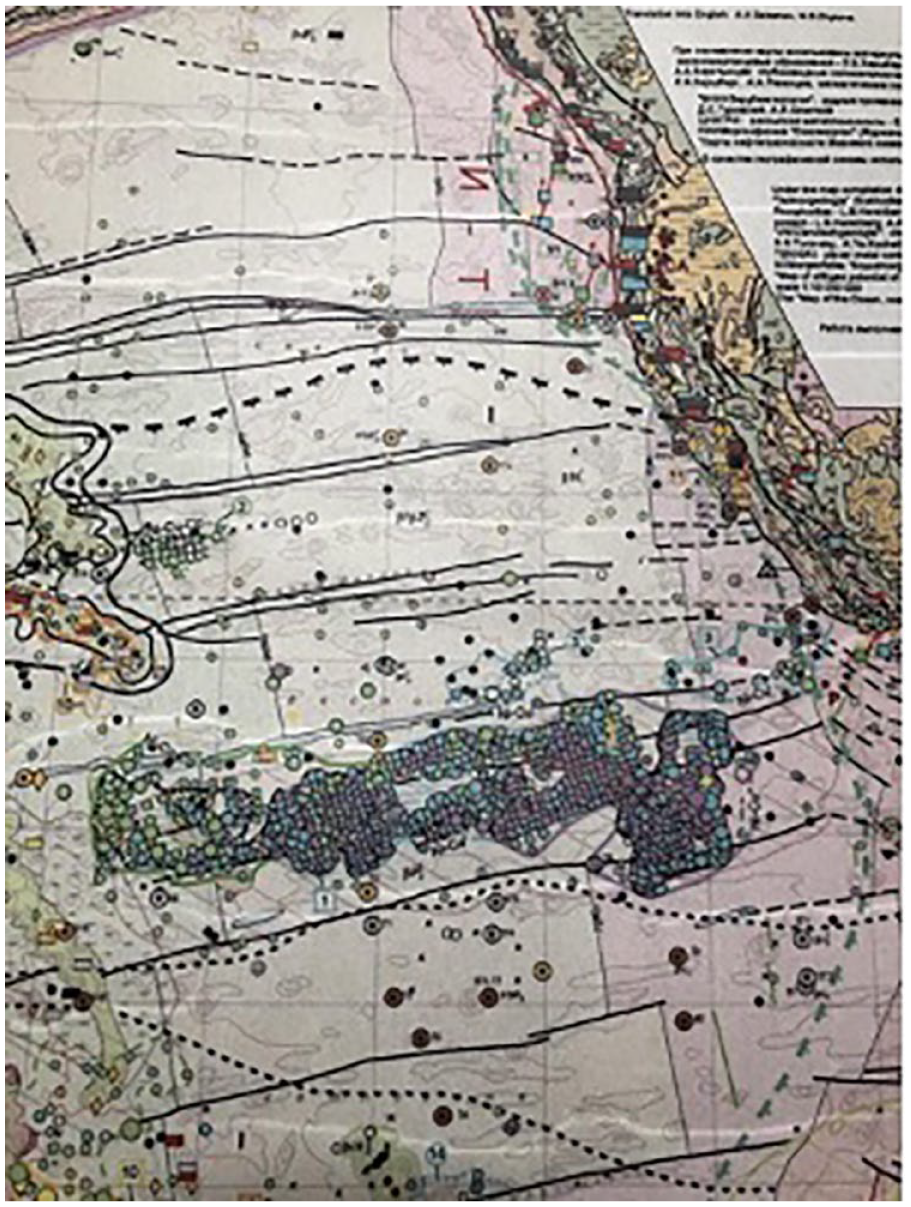
Detail of the map outside of IOM’s Szczecin offices. Dozens of kinds of data — some collected by IOM—are overlaid to produce an image of mineral data richness. Through this overlaying, the deep-seabed Clarion-Clipperton zone emerges as a bounded entity.
At my meeting with Tomasz, I asked him why he thinks IOM persisted to the exploration contract stage and then afterward. After 21 cruises, he tells me, there was such a large volume of valuable data that at a certain point it did not seem sensible to abandon the endeavor, regardless of how far the horizon of extraction moved. IOM’s offices in late summer, 2020, are quiet and still.
Adams et al. (2009), identify the epistemic value of an anticipatory orientation, what they class as an affective state, as emergent in a moment of ‘actuarial saturation’, when sciences of the actual are unseated and displaced by ‘speculative forecast’ (p. 247). Anticipation as a way of being, for them, is a way of knowing the truth of the future that relies upon an abandonment of the virtue of certainty and enacting modes of doing science that adjust to uncertainty. At IOM today, though, there seems to be no real sense of speculation. All the possible information, as denoted by the requirements of the certificate of registration, then the certificate of compliance, and now the twice-extended contract for exploration, seems known. Actuarial saturation arrived a long time ago, with the cruises that predated the exploration contract. There were benthic impact experiments, nodule grading and processing reports, economic geological studies, and bathymetric cruises. There isn’t much to animate an anticipatory orientation when all the boxes have been ticked.
Weszkalnys (2015, p. 614) writes that first oil ‘constitutes an expansive moment in which the circulation of hydrocarbons gets readily overtaken by the circulation of facts about them’. IOM today exists in the wake of this expansive moment, after all the work was done, the future thickened with expectation, deferred to envision mining on a manageable timeline. After actuarial saturation arrived, it was not speculation that flooded the affective dispositions of IOM scientists, but something more like waiting, watching, and searching. Specifically, scientists wait out raw materials crises and low political will to fund complex international organizations, and they wait for a time when the consensus-based structure inherited from IOM’s formation can be updated for modern times, perhaps into a shares-based corporation. They watch as new economic and technological innovations become desirous of minerals found in nodules. And they search for what other kinds of scientific value IOM could derive in the interim, until other futures arrive, from nodules on the bottom of the Pacific Ocean. In the years after the exploration contract was awarded to IOM, as Vratislav’s career wound down, the value of deep Pacific nodules in East-Central Europe proliferated in several new directions.
One morning, I made my way from my guest flat in the IOM building to the University of Szczecin, where Teresa Radziejewska works as a Professor of Biology. She’s a specialist in benthic ecology, and worked in biological research for IOM until 1999, though she consulted for the organization afterward. After leaving IOM, she continued to participate in deep-sea Pacific research, though exclusively in the capacity of academic researcher. In 2014 she was invited by German colleagues to join a cruise to study the effects of hypothetical deep-sea mining on the benthic ecology of the Clarion-Clipperton Zone. Teresa collected seabed-dwelling protists and foraminifera. She earned a grant to compare protists and foraminifera between these fresh samples and material Teresa had retained from Station M, within IOM’s plot. With these comparative data, Teresa was able to furnish a masters student with data to complete what she remembered as a great thesis. This story about deep-sea meiofaunal data is emblematic of what nodule science came to mean for IOM’s scientists after they were awarded the 15-year exploration contract, when the horizon of extraction extended far from the present, when fulfilling exigent contractual demands was left behind.
When over lunch I query Teresa about what, if anything, has resulted from all this time spent working towards the goal of deep-sea mining, she responds: ‘Nothing bad has come out of it. On the contrary, for students to see that Poland is involved in exploration of the wider world, that we’re not just pushed into a corner, and we have a chance to go out and contribute something.’ For her, the accumulated data took on new scientific value when students could complete theses and dissertations that demonstrated capability in deep-sea research. Such uses of data take on the most concrete import when the agency of IOM is diminished or even disappears. As a benthic biologist she knows the risks to deep-sea biodiversity if mining were to finally happen, but she also knows that as technologies develop, some resources and ideas become obsolete. She is aware that metals recycling, though not a panacea, is something that might turn out to diminish recurrent pushes for nodule extraction. Meanwhile, in the time of the ongoing not-yet, deep-sea data is valuable professional currency for students and professors in, at times, precarious and underfunded East-Central European universities.
Later I ask Tomasz what he can reflect upon as the proudest moment of his tenure at IOM. After pausing to think, he tells me that he derived the most professional satisfaction from organizing IOM’s 2014 cruise to the CCZ, saying, ‘it was a realization of all the work I could do… I organized logistics and customs from Panama to Szczecin. From start to end it was satisfying. I could see people doing their theses and papers and defenses and they were cited.’ As their value exceeds their promissory worth as commodities to become useful in the here and now, deep-sea nodules make new futures possible as objects upon which to advance deep-sea biological research.
That in the space of diminished anticipation the meanings of nodules and their data proliferated across different scientific contexts, should not be taken to mean that optimism over the eventual realization of extraction has similarly diminished. Tomasz, trained as an engineer, sees the boundary conditions for IOM’s participation in forthcoming deep-sea mining not as related to technology, technical capacity, or data quality, but most of all related to the legal and decision-making structure of the organization. His entrepreneurial hope is that IOM might be transformed into a traded company, appealing not only to mining companies or steel manufacturers this time around but also car manufacturers or battery producers. Within the structures that drive the renewal of IOM’s contracts and the continuity of its projects, Tomasz is doubly tasked with speculation. In this role he enlists logics of coming energy transitions that arrive from elsewhere to stake the need for IOM’s persistence. IOM leans on the purported needs of plans for infrastructural decarbonization, dually framed as ambiguous yet pressing, and conceived far from Szczecin.
Peter Balaš, a Slovak geologist at IOM, joined me and Tomasz mid-conversation. He is thoroughly optimistic. ‘It sounds unbelievable,’ he tells me, ‘but the shift to the electrification of transport could secure the future for these kinds of deposits.’ The longer the energy transition takes in the vehicle industry, he thinks, to say nothing of the new technologies that make demands of metals markets like carbon capture and other renewable infrastructures, the more of a future there might be for deep-sea nodules. For him, this will take a long time. ‘From this point of view, I’m not afraid this source of minerals will be forgotten.’
After the exploration contract arrived, work didn’t stop. The member states maintained the funding infrastructure, research was written, and the former-seabed authority director Nii Alotey Odunton visited Prague, commemorated by photos in Vratislav’s archive. But work certainly slowed. The fate of nodules seems to be up to other people in other places beyond Szczecin, who might make the economic and geopolitical choices that could propel nodules into relevance again or else condemn them to history as a resource frontier that never was. Still, fresh anxieties about what the future will bring are animated by the slowing or cessation of domestic energy production in the region, which in part motivates the continued funding of IOM. As we spoke, Slovakia was in the process of closing its last coal plants. The kind of optimism instantiated by being a scientist at IOM today, with data piled high and contracts fulfilled, is a durable one where the temporality of the pause is never without important meaning.
‘Our ocean is the Pacific’: Bringing the abyssal seabed home
Kärg Kama examines what Richardson and Weszkalnys (2014, p. 12) termed the becoming of unconventional fossil fuels in Estonia. For Kama (2016, p. 18)), political projects join complex resource histories to plural potential resource futures to remake the physical form of oil shale, such that formulations of its identity and use-value remain available for experimentation. Such work is afoot at IOM. Where Kama locates the driving and disruptive thrust of such projects locally, within Estonia, the creative force of nodules as resources always-in-the-making, when surveyed from within IOM, seems to arrive from elsewhere. From the vantage of East-central European publics, though, a more textured ontology of deep-sea nodules emerges.
Where in the 1990s journalists reporting on IOM’s activities centered the activity of mining—concerns over costs, the region’s technical capacity to make use of nodules, IOM’s cooperative endeavors—reporting in the early 2000s turned to reconceive the IOM plot not as valuable for its recoverable resources, but as a piece of land, territory that had been occupied and that was valuable as a holdfast for future uses (Figure 4). A piece in Vratislav’s collection begins, ‘The Adriatic is our sea’, Czechs often say with exaggeration. If they said: ‘Our ocean is the Pacific,’ it would be more accurate. Few people know that the Czech Republic leases part of the seabed between the Hawaiian Islands and Mexico. From the point of view of the area of the world’s waters, this is a negligible point. Seen through the eyes of a Central European, however, it looks different — the Czech sea is almost as big as the Czech state. (Ondřichova, 2004, p. 1)

A map of the Pacific Ocean inside Vratislav Kubišta’s museum, overlaid with a map of the contractor areas within the Clarion-Clipperton Zone, overlaid once more by the Czech flag and an arrow pointing to the IOM contract area. Here the Czech Republic stands in for the whole consortium on the deep Pacific seabed.
Czechia earns prestige as a landlocked state, without a sea, participating in IOM and producing deep-sea research, regardless of whether or not mining nodules becomes reality.
A 2011 piece kept by Vratislav again places the IOM plot as an extension of East-Central Europe. ‘If we are to take international agreements literally’, Rozmajzl (2011) writes, ‘then the Czech Republic would belong to the littoral states. Part of the bottom of the Pacific Ocean belongs to us’ (2011, p.). In the sense of Weszkalnys, over time the IOM plot took on further gestural qualities for journalists and their readers. For countries in the region, who had become increasingly dependent on raw materials imports over the 2000s and 2010s, representative to IOM Pavel Kavina (2007) positioned the IOM plot as a site that stored security and safety, hedging against a future where IOM member states might be economically disadvantaged by shifting metals markets or even blackmailed by raw metals producers. In 2014, presenter Tereza Burianová (2014) interviewed Vratislav and declared similarly that ‘the Czech Republic has its own piece of the seabed’, and though ‘this area will not serve as a holiday destination, it is still worth it’.
Over the 2000s, a retired Vratislav appeared on television segments and podcasts, and in journalistic accounts of nodule science and IOM. He was, however, increasingly joined by the new Czech representative to the IOM council, Pavel Kavina, or at times left out of accounts entirely. Whether he appeared in an outlet or not, he was busy collecting all of it; clippings, photographs, and mementos to be categorized and displayed back home in Sýkořice and at local lectures around the Czech Republic. Yet his archive doesn’t conclude with retirement. Rather, the final display boards stacked in the back of the outbuilding tell of a man gone in search of new nodules at museums abroad, to photograph and store. They also tell of when Vratislav opened his private history to public visitation, how it was that this archive became a museum meant to be seen by colleagues, friends, and village residents. Valcana Stoyanova, the Bulgarian ecologist with whom Vratislav had worked at IOM, is photographed in front of the outbuilding, he by her side.
And finally, the display boards tell a story of the pride Vratislav had not only for his own work at IOM, but also for his son Jan, who by 2006 had graduated with a law degree and was working in the international law department at the Ministry of Foreign Affairs, specializing inter alia in law of the sea and climate law. Vratislav, despite having never gone to sea on an IOM cruise, and despite never having brought a nodule to market in East-Central Europe or elsewhere, had lived a life in deep-sea mining, filling the displays in his museum with a dense accumulation of facts, photographs, and business cards, in memory of persistent hopes and promised futures.
The morning I am to leave Sýkořice, Jan finds some DVD recordings of his father from the twilight of his career, in formal retirement from IOM but still maintaining a consulting business from home. We watch—Jan, Zdeněk, and me—in the living room. It’s a 2007 clip from daytime Czech television, and shots cycle between gold coins on the seabed and the presenters. Vratislav is accompanied on screen by Pavel Kavina. Vratislav looks excited but nervous, and Pavel does almost all the question-answering, about how nodules form and how they will eventually be used.
Komu Patří Moře: Whose nodules, whose history
Above a window cornice in Vratislav’s outbuilding reads the question, ‘Komu Patří Moře?’ which might translate to ‘Whose ocean is it?’ or ‘To whom does the ocean belong?’ The room does not offer an answer, and I quickly forgot it was asked when I was confronted with the mass of material that needed sifting through.
Getting to grips with this question from Vratislav’s perspective means first returning to the question of what IOM has occupied itself with since its inception. Faced with the reality of ongoing unfulfillment of the organization’s original goal to extract and use deep-sea nodules, science with IOM appears to take on the character of ruination science. For Ureta (2021), ‘[r]uination science [is] creative and flexible, continually adapting practices and devices in order to fulfill its aims’ (2021, p. 48). It is both strong and weak, dexterous in response to political and institutional volatility but rendered precarious by the same circumstances. It works against the clock to avoid that precarity.
Yet, Vratislav’s stories and IOM’s continuities suggest that nothing here is ruined, only slowed and altered in the process. IOM’s story thus runs contrary to much work on the history of the unbuilt that joins ruination with abandonment. 10 Though both creative and flexible, Vratislav’s science, and science still being produced at IOM, is less a ruination science than it is a process of generating new kinds of use value from older programmatic justifications. Nodules once seemed most marketable to the steel industry; IOM scientists now hear that it might be battery manufacturers. Data stand to be revivified with meaning, and this would demand up-to-date studies. Old mining plots and a history of research cruises proliferate in meaning among new public and private entities. A body of data is worth preserving if only for the latent potential in its abundance. Vratislav’s roles multiplied. IOM persists.
The question of whether nodules would be raised from the abyssal Pacific and sold commercially is one that created and sustained anticipatory orientations among IOM scientists. But the question’s import seems diminished. Since 2001, rather than anticipation around extraction heightening over time as IOM reached actuarial saturation of deep-sea data and Vratislav amassed a museum’s worth of memorabilia, concerns of the when and how of extraction have dissipated in scientists’ lives and in public-facing accounts of IOM’s endurance. This is tangible not only in IOM’s Szczecin high-rise, where more resident toddlers pass wall-mounted bathymetric maps than do scientists, but also in Vratislav’s collection, where icons of mining and plans for future metallurgical projects fall away. The long-term might be where meaning ultimately resides, as Guyer suggested, but looking back on things, it’s the near future that fills the archive of the present.
Ogden (2021) asks how time-spaces of the ‘world’s end’ are archived and understood across a wide array of sites, from letters to organisms to landscapes. In some archives, the world’s end presents itself as graspable, thoroughly explicated and predetermined. In others, it figures as a set of absences. In her cousin’s pantry, who was a doomsday prepper, the stacks of cans stored gather dust ‘with the anticipation of the coming apocalypse’ (p. 56). From my own physical and digital meanderings through deep-sea mining’s’ pasts and presents in East-Central Europe, I feel absence and presence emerging into legibility alongside one another: nodules stored, scientific data everywhere, family photos accumulated in here, nothing but some newspaper clippings there, and raucous families upstairs.
And naturally, Vratislav’s outbuilding exceeds itself. If, as Bren (2011) has contended, this period of time at the close of Czechoslovakia’s era of normalization was engineered to be eventless and so without history, then how does Vratislav’s life with IOM square with a time of no time (Sayer, 2022)? When does everyday life being lived lapse into history being made, and who stakes such claims to historicity? Science happens, yes, and time passes, but in hindsight it’s less the plans for nodule extraction and processing that fill Vratislav’s archive of the deep-sea in Bohemia than it is the richly documented mundanity of a life fulfilled not by research outcome but by collegiality, friendship, and family. I take away from Vratislav’s home that when we account for the contributions we’ve made in our lives, we measure them not in terms of the contracts, research agreements, or scientific outcomes that structured those lives, but by the metrics of who we made friends with along the way and whom among them could make the trip out to our home to witness our testimonies to our convictions.
So,’ komu patří moře?’ The question rushes back on my way out of Sýkořice as Jan drives me back to Prague.
Whether deep-ocean nodules will be brought to market or not will be determined in due time, as will the beneficiaries of that potential commodification. But the history of IOM and of Vratislav Kubišta’s life suggests that a better question is, ‘whose ocean is it, and when?’ And perhaps a worthwhile follow-up might be, ‘what effects of anticipating ownership of the ocean or its resources remain when the participants in the race reshuffle?’ Perhaps this history, of individuals and an institution caught between the residues of late socialist political economy and the trappings of market futures, gestures toward an analysis of the seabed that sets aside the language of ownership altogether. Tallied today though, beneficiaries of nodule science must include not only c-suites at conglomerates, investors, and the states who at times tenuously retain rights to one day mine their plot of the Pacific. It must also include Vratislav Kubišta, East-Central European invertebrate zoologists and benthic ecologists, consumers of Czech daytime television, and the combined residents of sixty flats at ul. Cyryla i Metodego, in Szczecin, Poland.
Conclusion: The vitality of anachronism
IOM, as told by Vratislav’s collections, has been at once lively and out of sync with time. In the course of its life, IOM has remained vital and adaptable, sensitive to political and economic changes larger than itself and durable in its responses. This history, set within Finkelstein’s notion of anachronistic vitality, suggests that IOM’s science has been lively because of its being out of step with some paces of dominant time and because it has inhabited alternative timelines. What kinds of vitality inhere in IOM and Vratislav’s anachronisms, and what might it offer in response to the accelerating cyclicity at once general to contemporary market-oriented time and specific to the boom-bust cycles of deep-sea nodule mining ventures.
If vital anachronism and its attendant sciences constitute one organizing form of life in indefinite delay, then what are its features? Khatchadourian’s private owners of formerly Soviet factories in post-socialist Armenia carve out lively encounters with markets from the margins, and like these figures, IOM’s work has tacked consciously between temporalities of late industrial capitalism premised on the ideology of anachronism and those of socialism that identified value in reuse and preservation. As with Ureta’s (2021) Chilean chemical toxicity lab, IOM is strong yet weak, adaptable, and yet trapped out of time. Still, recalling Weszkalnys’s accounts of Santomean first oil, delay permits conceptual elasticity and draws out the idiosyncrasies of valuation practices. Where IOM was once oriented to an expected future, delay means that now, alongside inherited extractive expectations, Teresa sees time-series data on benthic organisms, Vratislav saw a cosmopolitan good life, and Czech publics see land. When viewed as a frame through which to shift the Western corporate narrative of deep-sea mining towards a periodization of resource gestures, vital anachronism demonstrates how resource affects become entangled with attachments to other affective orientations.
Some of anachronism’s vitality can be oriented in terms of market productivity, but also, liveliness exceeds itself and can reorganize along fresh commitments. Uses of old cruise data, samples, and nodules can reference and resonate with established institutional and state narratives. But they also remain poised for reconfiguration, as when Tomasz and Teresa stress how accreted data has taken on collective meaning in itself and especially for benthic biologists. Vratislav’s archive, offered in the register of personal experience, further attests to the creative potential borne from scientific and other practices of ruination in lives timed to nodules. Altogether, deep Pacific nodules in East-Central Europe might best be understood as talismanic objects through which experience of the varied paces of time, and the variably thick pasts, presents, and futures that those paces make, could be synched to one another in the act of foretelling the future.
This history of Vratislav and IOM can be read as a history of calibration, of fitting the times of industries, institutions, markets, personal lives, and nodules together so as to produce value. IOM, particularly as storied by Vratislav, has lived cyclically along multiple overlapping timelines, including ISA contractual time, market and state time, and lifetimes. Nodules have been persistent icons of multiple possible futures. Yet deep-sea mining has been not-happening, in the wake of its potential happening, for decades. In contrast to many stories of mineral resource science in recent history, this history does not betray acceleration, whether of commodity abstraction, environmental degradation, or technical progress. As IOM’s history suggests that the temporality of delay cannot be reduced to time wasted, so too must temporal cyclicity not be taken for granted as an inevitable outcome of identifying mineral potential. For theorizing resource frontier-making in our time, we might learn much about speeding up by thinking beyond waves of boom and bust, by focusing on slowing down.
Once again, deep-sea nodules are making headlines, this time as a potential resource for so-called critical minerals to be used in the forecasted green energy transition. Multinational firms hang in the balance of forthcoming mining regulations that will determine whether large-scale pilot tests—the first conducted in the CCZ since the 1970s—will translate into a profitable economics of scaled-up extraction. Entrepreneurs derive speculative wealth from seed investment, while environmentalists and others lament the biodiversity that stands to be lost in the course of extraction on the nearly pristine abyssal seabed. But growing calls for a deferral on this decision, or a moratorium altogether, combined with political economists’ questioning what exactly is ‘critical’ about so-called critical minerals, remind us that extraction is by no means a foregone conclusion (Riofrancos, 2022).
Attuned to the claims of dominant industry and its regulators, contemporary deep-sea mining appears fully formed and subsumed under one narrative of techno-political progress. Yet the race to begin mining nodules has been one where the playing field has cycled through participants many times over, and where the finish line has been a moving, malleable thing.
As observers have often fit deep-sea mining’s history neatly within a story of capital’s intensifying search for sites from which to derive raw material wealth, and of the transformation of Earth into a ‘planetary mine,’ it has seemed natural to plot the terms of the debate among corporate and state actors (Arboleda, 2020). It can feel further tempting to chalk up IOM’s persistence to the exigencies of recent geopolitics and geoeconomics. Yet, this wandering history of nodule speculation, populated by different people and institutions who have seen IOM’s investment in the CCZ differently, insists against a teleological explanation for why some efforts remain lively and unforgotten. In the meantime, it will all have been worth anticipating, because time has shown that there is more than one kind of durable security to be parsed from rocks at the bottom of the Pacific Ocean. Deep-sea mining’s futures have disappeared only to reappear, but life and its expectations are made tractable by reducing fickle futurities to nodule science in the here and now.
Yet beyond all this, I leave many conversations in Szczecin with the sense that nodules here might always have been about situating and anchoring very human relationships centered around a shared fascination with the great big world. These fascinations inhabit pasts predating late socialism’s aspirations and exceed imagined futures of seabed mining. Teresa grew up on Jules Verne stories, which were re-popularized in postwar East-Central Europe through the immensely successful films of Karel Zeman. Zeman’s 1958 adaptation of Verne’s Facing the Flag (Vynalez Zkazy, or Invention for Destruction), became one of Czechoslovakia’s most successful film exports ever. Tomasz also grew up on Verne in Poland. When sitting with him in Szczecin, he asked me to add to the list of reasons that IOM has persisted that ‘knowledge of the ocean is to some extent very much based on things like mysteries and legends’. So, despite the preponderance of data and the rapid development of the ‘necessary tools to study the ocean’, ‘there will always be mysteries beyond the next fifty years. The deep sea will always provide that point of interest’.
In recent emails, Jan and I exchange updates. Both of us comment on how IOM persists, having held a council meeting in June, despite the Russian invasion of Ukraine in the spring prior. Neither of us expresses surprise that work at IOM goes on. In October 2022, Tomasz and Peter Balaš met with engineers at the Institute of Mining Technology in Gliwice (KOMAG) to discuss a prototype for a nodule-collector head design. In November, Tomasz met with ISA Secretary General Michael Lodge in Jamaica to sign a contract extension, so that nodule research in Szczecin can continue through at least 2027 (Balaz, 2022). Jan tells me that a conversation with a curator at the National Museum in Prague has resulted in an agreement to maintain Vratislav’s archive officially in museum storage outside of the city, ‘for preservation for future generations’. This too, if it comes to pass, will take time, and invites its own period of waiting.
Still, the outbuilding in Vratislav’s backyard remains a monument marking passing time, of histories moving at different speeds through one another. It rescales dreams, of IOM and many others, while narrating the imbricated histories of nodules once growing 12,000 feet below the waves now gathering dust, of mineral resource imaginations dreamt and subsequently arrested, of memories that live and breathe, of family life, of friends who visit and honor our memory even after we pass on, and of a village moving rhythmically in and out of seasons, peaches falling every summer meanwhile.
Footnotes
Acknowledgements
Helpful feedback was provided on previous iterations of this article, and the thinking that led to this article in the first place, by audiences at the World Maritime University-Sasakawa Global Ocean Institute, and the Department of Ecological Anthropology at the Czech Academy of Sciences. In Prague, the author is especially grateful to
Funding
The author received no financial support for the research, authorship, and/or publication of this article.
