



Abstract

“Fake news” has taken off around the world, with political leaders using the catchphrase to plant mistrust in the media, stop stories being published, and even imprison journalists, reports
“Fake news”, the favourite way for US President Donald Trump to insult critical journalism, has become an international political catchphrase. Over the past year more than 20 political leaders worldwide, from authoritarian regimes to European democracies, have used the term to accuse reporters of spreading lies as a way to discredit journalism they do not like. These accusations are being used to justify the closure of critical news outlets, to imprison reporters, to censor content and to block public access to the internet and social media sites.
Jean-Paul Marthoz, author, academic and veteran journalist, believes the attacks are strategic and deliberate, intended to weaken opposition voices and, in particular, legacy media.
“The labelling of prestigious media as ‘fake news’ outlets by those who are the major emitters of fake news is part of a determined attack against the system of checks and balances which define and protect liberal democracy,” he said.
The fake news message reflects current populist anti-elite and anti-establishment sentiment, according to Marthoz, who said: “Many rulers believe the approach taken by Trump surfs on the relatively widespread unpopularity of the media among the public they target with their populist or nationalist messages.
Over the past year, political leaders in Burma, Cambodia, China, Egypt, France, Germany, Hong Kong, Hungary, Kuwait, Libya, Malaysia, the Philippines, Poland, Russia, Singapore, Somalia, Syria, Tanzania, Thailand, Turkey, the USA and Venezuela have publicly accused journalists of reporting, or being, fake news.
Approaches differ between countries, but there is evidence such attacks on media credibility are becoming more widespread. The latest annual prison census released by the Committee to Protect Journalists reveals a sharp increase in the number of journalists imprisoned on false news charges.
People protest in Kansas City, USA, to demand an investigation into President Trump’s constitutional conflicts and ethics violations, 2017
CREDIT: Brian Cahn/Rex
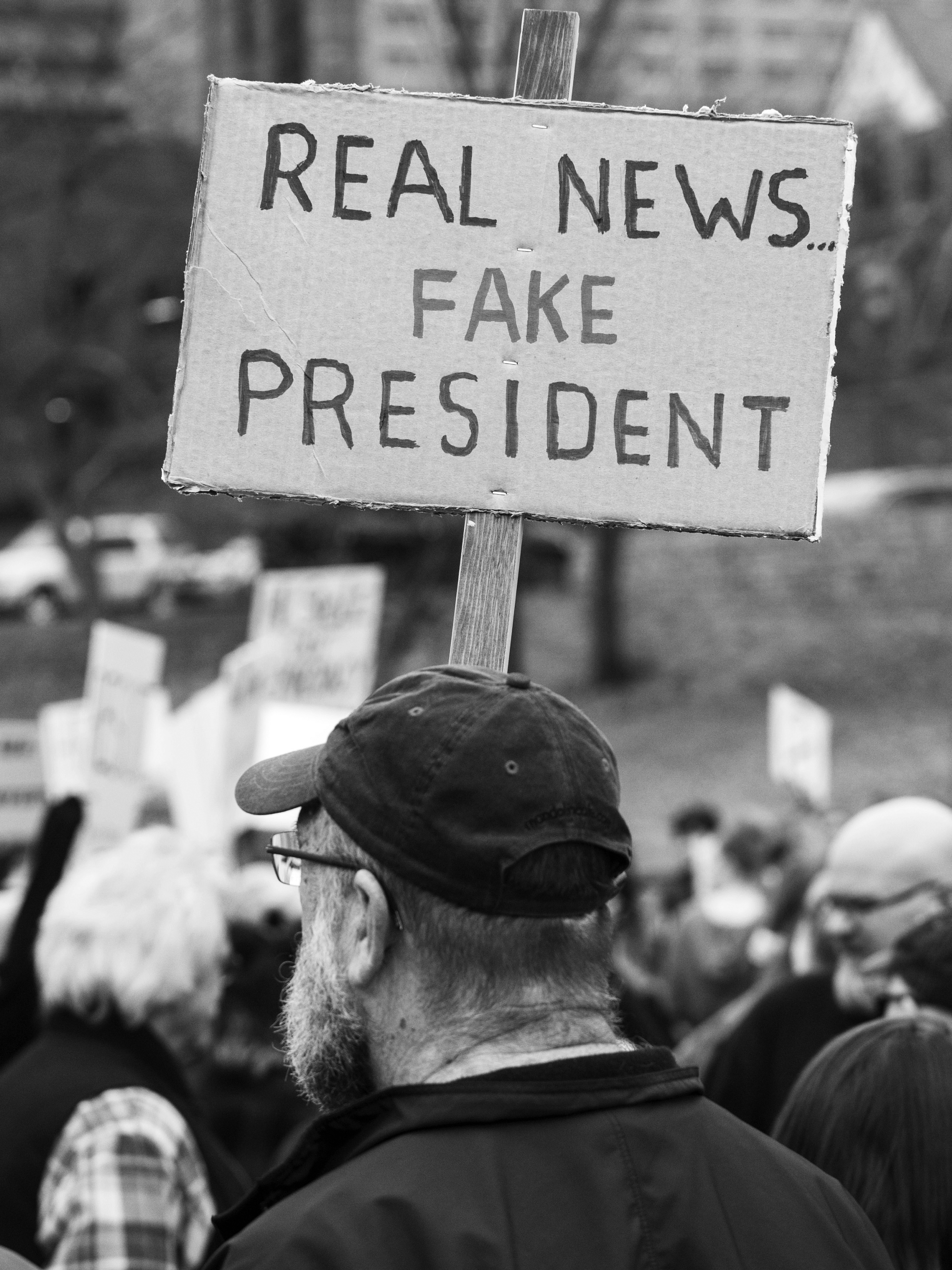
At least 21 are in jail worldwide, in at least six countries. Last year there were just nine journalists jailed on such charges, in two countries. The trend of using fake news as an accusation has taken off globally.
In the Philippines, Duterte has been waging a very public war on particular media outlets, often labelling them “bullshit” and “fake news”. The latest target is Rappler.com, the country’s only digital-born news site. In January this year, the government announced it would revoke Rappler’s operating licence.
Maria Ressa, CEO of online news outlet Rappler, is interviewed at a protest against the outlet’s licence being revoked by Duterte’s administration, Manila, Philippines, January 2018
CREDIT: J Gerard Seguia/ZUMA Wire/Alamy

The day after the announcement, Duterte described Rappler as a “fake news outlet” that published stories “rife with innuendos and pregnant with falsity.”
He added: “Since you are a fake news outlet, then I am not surprised that your articles are also fake.”
Rappler’s founder and editor, Maria Ressa, is fighting back. She accuses Duterte’s government of systematically spreading fake news itself, to “silence and intimidate” opposition.
Courtney Radsch, CPJ’s advocacy director, monitors such attacks on the press. She predicts the term “fake news” will continue to be used against the media in authoritarian regimes, and expects more states to adopt statutes against it.
“I would anticipate that countries that lack democratic safeguards and robust press would be happy to use this as an excuse to restrict journalism,” she said.
In Tanzania, four independent newspapers and two radio stations have been shut down or suspended over the past 12 months because of what President Magufuli has deemed to be “inaccurate” reporting. Most recently, Daima – a newspaper that had previously criticised the government – was closed for 90 days last October after being accused of spreading “false information”.
The president’s moves against the press follow the introduction of a controversial cybercrime law in 2015, which prohibits the publication of “false and misleading information”. It has already led to the arrest of eight opposition party workers for sharing “inaccurate” election results over the messaging service WhatsApp.
Similar measures, ostensibly implemented to stop the spread of fake news, are being taken elsewhere in Africa. During the recent elections in Somaliland, all social media platforms were shut down on the grounds they could spread “inciteful and tribalistic information, in the form of hate speech and fake news”.
Melody Patry, advocacy director for Access Now, a non-governmental organisation campaigning against internet shutdowns, said a number of African countries have used a “kill switch” to block either the internet or individual social media platforms during elections and protests. These countries include Cameroon, Ethiopia and the Democratic Republic of the Congo.
“Using a kill switch to cut off communications is a blunt-force instrument resulting in suppressing free speech and denying access to information,” Patry said.
The instrument used against the media in some European countries is more subtle. Hungary’s government recently announced that, while it supported press freedom, it would not tolerate any outlets considered to be “spreading fake news, misleading the public and limiting the people’s access to real information”. Since coming to power in 2010, the country’s prime minister, Viktor Orban, has been criticised for repressing press freedom. Respected independent media outlets have become openly pro-government after being acquired by Orban’s political allies. One, Hungary’s leading opposition newspaper, Népszabadság, was closed down in 2016.
Poland’s ruling Law and Justice Party (PiS) is also increasing control over the country’s media and regularly uses the platform provided by pro-government media to attack the credibility of independent outlets. Recently, during a live news programme on public channel TVP Info, a government minister criticised a respected online news site, Gazeta.pl, calling it “deceitful, shameful and the worst thing on the internet”.
The site is owned by Poland’s first private independent newspaper, Gazeta Wyborcza, which has been accused by PiS of being an “enemy of the state”.
Attempts to prohibit “disinformation” and “fake news” in liberal democracies have also come under scrutiny. French President Emmanuel Macron plans to allow authorities to block content or close down sites deemed to be spreading “fake news” during election periods.
“When media organs spread slanderous falsehoods, they are no longer journalists,” he said.
But others questioned whether governments should have the right to decide whether a piece of news is fake. In February this year, Macron himself was criticised for allegedly influencing a decision to sack the head of Radio France. He had previously been accused by Macron of spreading “false rumours” about their relationship.
Efforts to undermine trust in independent media is having an impact on audiences, according to Liz Corbin, editor of Reality Check, the BBC’s fact-checking team.
She said: “Seeds of doubt are being sown and that is incredibly dangerous for the future of the free press.”
Trust in the media has significantly declined over the past decade, according to the Reuters Institute for the Study of Journalism.
A 2017 RISJ report – Bias, Bullshit and Lies, Audience Perspectives on Low Trust in the Media – cites a US Gallup poll showing media trust dropping from half (53%) in 1997 to less than a third (32%) in 2016. There has as yet been little evidence to show how far “fake news” claims have directly contributed to the decline, but the RISJ study identifies the way politicians and bloggers use social media to publicly question the motivations of journalists and news organisations as one factor affecting trust.
Another recent poll, asking Americans if they understood the meaning of “fake news”, revealed some public awareness of how the term has become politicised. Nearly half (47%) of respondents said it referred to “sloppy or biased reporting”, while 39% described it as an “insult being over-used to discredit news stories people do not like”.
Marthoz predicts authoritarian governments will continue to deliberately undermine trust in the media. He believes public awareness of the issue is one of the few ways to resist what has become a global threat to media freedom. Legislating against the flow of disinformation is impossible, he said, and it is also undesirable if it means abusive control and government censorship.
But public awareness is unlikely to make much difference in authoritarian regimes around the world, where reporters have been arrested, news outlets have been closed down and journalists censor their own work for fear they will be accused of lying.