




Abstract
Anomie is a highly prominent theoretical construct in macro-social, particularly cross-national, criminological inquiry. Yet despite its prominence, it has proven to be quite elusive with regard to its measurement and, hence, making it nearly impossible to test theoretical hypotheses regarding its predictive efficacy. Although the concept, whether derived from Merton’s classic conceptualization or from its current incarnation in the form of institutional anomie as developed by Messner and Rosenfeld, is multidimensional and complex in its theoretical structure, most researchers have attempted to operationalize it through simple, single-item, often surrogate/proxy measures. The present research note attempts to develop a measure that is more consistent with its multidimensional and complex nature. This more complex operationalization is then examined with regard to its efficacy at predicting cross-national levels of both homicide and theft. Our results suggest that that this new operationalization has considerable predictive efficacy, accounting for approximately one third of the variation in the cross-national level of both homicide and theft.
One of the greatest challenges facing researchers who wish to empirically test Mertonian structural anomie theory or Messner and Rosenfeld’s institutional anomie theory is measuring anomie at the aggregate, particularly the cross-national, level. 1 Previous researchers have been forced to rely on single-item proxy/surrogate measures, typically an indicator of economic strength (gross domestic product [GDP], unemployment rates), absolute economic deprivation (usually via surrogate measures such as infant mortality rates or life expectancies), and/or relative economic deprivation/economic inequality (Gini coefficient) (e.g., Chamlin & Cochran, 1995; Maume & Lee, 2003; Messner, 1982; Messner, Raffalovich, & Schrock, 2002; Messner & Tardiff 1986; Piquero & Piquero, 1998; Savolainen, 2000). Yet both Merton (1938) and Messner and Rosenfeld (1994) have conceptualized anomie as a multidimensional construct (Baumer & Gustafson, 2007). They indicate that anomie is present in economically developed societies that place a cultural emphasis on the goal of economic attainment (i.e., the American Dream) while simultaneously blocking a significant portion of their populace from the legitimate, culturally prescribed means for achieving those goals. Furthermore, both argue that this commitment to the goal of material success should be pursued by all under conditions of open, individual competition (i.e., within a meritocracy). Hence, structural anomie is expected to be especially prominent in situations where an egalitarian ideology does not differentiate between various strata, yet those within these strata are structurally provided with differential access to success (Passas, 1997). In fact, Merton originally hypothesized that it is the combination of cultural universalism (the American Dream), cultural imbalance, and a stratified social structure that leads to anomie.
Finally, Messner and Rosenfeld (2007) reiterate that anomie is produced by cultural pressures to achieve material wealth coupled with a strong economy that reinforces this goal. Therefore, one would expect anomie to be present in (a) a strong economy where (b) monetary achievement and individual economic success is emphasized in a context of open competition, but (c) substantial portions of the population are impeded from achieving success. All three conditions should be present simultaneously to produce high levels of structural anomie (see Bjerregaard & Cochran, 2008a, 2008b). As such, structural anomie is a multidimensional construct that cannot be well represented by single, proxy measures. One would also expect anomie to be highest in situations where noneconomic institutions have been co-opted through the penetration and accommodation of economic values and consequently have lost their effectiveness as control institutions (Messner & Rosenfeld, 1994; Smith and Bohm, 2008, argue that anomie, no matter how multidimensional, is itself a single dimension in the broader theoretical construct of alienation).
To reiterate, all cross-national studies, including the present study, must rely on the available social indicator data that has been similarly measured and systematically collected across nation-states. As such, all measures of theoretical cultural and social-structural constructs such as structural anomie are limited to indirect surrogate/proxy measures. Moreover, nearly all cross-national measures of structural anomie used to date have been restricted to single measures of blocked economic opportunities, economic inequality, and relative deprivation as represented by the Gini coefficient (Chamlin & Cochran, 1995; Maume & Lee, 2003; Messner, 1982; Messner et al., 2002; Messner & Tardiff, 1986; Piquero & Piquero, 1998; Savolainen, 2000). Other studies may have included a measure of the strength of the economy via a measure of the GDP and often when doing so have included the Gini coefficient in their models, permitting an examination of the relative (but not joint) influence of each. Rarely are there any indicators of cultural elements inherent to the conceptualization of structural anomie offered by either Merton (1938) or Messner and Rosenfeld (1994), and very few studies (Bjerregaard & Cochran, 2008b) have attempted to address the multiplicative effects of these proxy measures.
Yet structural anomie, whether as defined by Merton (1938) or by Messner and Rosenfeld (1994), is a complex and multidimensional theoretical construct. Hence, the closer a measure taps into the multidimensional nature of such a construct, the better its content validity and the more superior it is, on its face, relative to what has been used by others thus far. It is our contention that both Merton’s (1938) and Messner and Rosenfeld’s (1994) conceptualizations of structural anomie each stress several common or shared dimensional elements; these are (a) the degree of economic freedom/regulation within a nation (i.e., open or free-market economy), (b) the strength of the economy to sustain opportunities for the accrual of wealth, and (c) the nature of economic conditions (i.e., the extent to which opportunities for wealth accrual are open/blocked for all members of society). As such, attempts to assess the influence of structural anomie on cross-national levels of crime require an operationalization of anomie that stresses the joint/multiplicative influences of each of these three dimensions.
By using a cross-national sample, the present study contributes to this area of inquiry in that it introduces and tests the relative efficacy of such an alternative and more theoretically specified operationalization of structural anomie on both violent and utilitarian offenses. The study examines the influence of this measure on cross-national homicide and theft rates while simultaneously controlling for the strength of noneconomic institutions. Finally, we also examine the interactive effects of structural anomie and the strength of noneconomic social institutions as an indirect and partial test of Messner and Rosenfeld’s Institutional Anomie Theory (1994; see also Chamlin & Cochran, 1995).
Data
The data for this study were collected for 49 nations from a variety of sources including the International Criminal Police Organization (INTERPOL), the World Health Organization, the United Nations, the World Bank, and other international sources identified in the appendix; the data for the independent variables were taken from 1997 where possible and 1996 if 1997 data were not available. 2
Measures
Structural anomie
Messner and Rosenfeld (2001, p. 68) stress that the core values expressed in the American Dream are supported by the economy and that the most important characteristic of the American economy is its capitalistic nature, which is defined by “both private ownership and control of property and free-market mechanisms for the production and distribution of goods and services.” In fact, anomie should be greatest in situations where the goal of the American dream is emphasized under conditions of open, individual competition (Messner & Rosenfeld, 1994). These conditions should have more of an impact when state regulation and control are reduced. This suggests that the impact of the economy on crime at a cross-national level of analysis involves at least three elements: (a) the degree of economic freedom/regulation within a nation, (b) the strength of the economy to sustain opportunities for the accrual of wealth, and (c) the nature of economic conditions (i.e., the extent to which opportunities for wealth accrual are open for all members of society).
The prominence of a free-market economy, unrestrained and unregulated by social or political constraints, is measured by the index of economic freedom developed by the Heritage Foundation (O’Driscoll, Holmes, & O’Grady, 2003). Economic freedom is defined as “the absence of government coercion or constraint on the production, distribution, or consumption of goods and services beyond the extent necessary for citizens to protect and maintain liberty itself” (Beach & O’Driscoll, 2003, p. 2). Each country is rated by examining 50 economic variables classified into 10 broad categories: trade policy, fiscal burden of government, government intervention in the economy, monetary policy, capital flows and foreign investment, banking and finance, wages and prices, property rights, regulation, and black market activity (Beach & O’Driscoll, 2003, p. 2). High scores on this variable are indicative of institutional policies that are most conducive to economic freedom. 3
In a free market economy, one would expect adverse changes in economic conditions to have a direct impact on crime rates. In the present study, economic conditions are operationalized by a measure of relative deprivation or economic inequality. The present study uses the Gini coefficient of household income to measure economic inequality or relative deprivation. This coefficient ranges in value from 0 to 100, with a score of 0 representing perfect income equality and a score of 100 representing a perfectly unequal distribution of income. 4
Finally, one would expect anomie to be present in situations where the strength of the economy was high. The strength of the economy is measured by the GDP per capita in U.S. dollars.
Again, both Merton and Messner and Rosenfeld have conceptualized structural anomie to be present under conditions in which (a) the dominant culture prescribes as legitimate the goal of economic security (i.e., a cultural emphasis on wealth accrual, represented here as the economic freedom index), (b) the structural organization of the economy permits the acquisition of great wealth (i.e., economic strength represented here by the GDP), but (c) the structural organization of society blocks the access of some of its members to the legitimate means to attain this goal (i.e., relative deprivation/economic inequality/blocked opportunities, represented here by the Gini coefficient—readers should note the close conceptual connection that economic inequality has to radical theory as well as anomie theory).
We argue with regard to these three indicators of economic conditions that an examination of their main and/or conditional effects constitutes a theoretical misspecification of the central concept of structural anomie. We believe, instead, that structural anomie is a complex theoretical construct, an emergent social property or social fact in and of itself, and that it is best operationalized, not as a series of additive effects of independent variables and the various two- and three-way cross-product terms among them, but as a single multiplicative function 5 :

Therefore, our current measure of anomie is a single multiplicative function of each of the three measures above. We expect conditions of structural anomie to be highest in situations where one has a strong economy operating on free market principles coupled with high levels of economic inequality or restricted opportunities for some segments of society (i.e., want amid plenty).
Noneconomic Social Institutions
The family
Messner and Rosenfeld (1994) stress that the structural anomie associated with free-market economies will adversely affect crime rates if unregulated by other noneconomic social institutions, and, thus, they stipulate a need to control for the strength of noneconomic social institutions, specifically the family, polity, and education. One of the most consistently used measures of the weakening of the family unit is the divorce rate (Chamlin & Cochran, 1995; Maume & Lee, 2003; Piquero & Piquero, 1998; Schoepfer & Piquero, 2006; studies based on macrosocial units of analysis within the United States have also used Census measures on the percentage of female head of households not readily available for cross-national studies). Although this measure has certain qualifications, including differential definitions of divorce cross-nationally, it is commonly used in macro-level research as an indicator of family disruption (Gartner, 1990; Maume & Lee, 2003). 6 High divorce rates, as a measure of family disruption, indicate a breakdown of the traditional nuclear family as well as a measure of the permeation of economic norms, that is, the extent to which the family has been devalued as economic values have been accommodated.
The polity
As a social institution, the political system is used to promote and attain collective goals, unless co-opted by the economy (Messner & Rosenfeld, 2001). Messner and Rosenfeld further maintain that involvement in the political process can promote a sense of community and lead to a reduction in anomie. They also point to low voter turnout as an indicator that the polity is devalued. Accordingly, the ineffectiveness of the polity was measured by the lack of voter turnout at the latest election. That is, this measure was created by subtracting the percentage of the population that voted at the last election from 100.
Education
Messner and Rosenfeld (2001) point to the importance of the educational system as a socializing agent. They stress that the educational system is also responsible for preparing youth for their occupational roles. Consistent with previous examinations of the theory, the strength of the educational system is measured by educational expenditures as a percentage of the GDP (Maume & Lee, 2003). So that all measures of noneconomic institutions reflect the inability of these institutions to mediate the effects of the economy, the weakness of the educational system is measured by subtracting the educational expenditures from 100 so that high scores indicate weak educational systems.
Crime Rates
Two measures of crime are used to examine the efficacy of our measure of structural anomie. Because anomie theory was originally designed to explain rates of utilitarian crimes, a measure of all theft crimes is used (Chiricos, 1987; Land, Cantor, & Russell, 1995). These data were obtained from the International Crime Statistics published by INTERPOL (1997). Numerous concerns regarding the use of official statistics to measure cross-national crime have been raised (e.g., Newman, 1999). One of the primary issues is the possibility of systematic bias in the reporting practices of various nations. 7 Kick and La Free (1985), however, conclude that offenses such as homicide and theft, which have ancient origins, exhibit a fairly high degree of definitional consistency and are more comparable. Likewise, Krohn and Wellford (1977) and Krohn (1978) also suggest that problems of systematic bias may not be particularly serious. This was also concluded by Bennett and Lynch (1990) who examined the reliability of four cross-national crime data sets, including CCDF, INTERPOL, UN, and WHO data. 8 They concluded that for analytical purposes, all four data sets afforded substantively similar results. They also concluded that analytic studies were “more robust than descriptive studies with respect to error” (p. 157) and that such error did not necessarily affect the substantive findings unless correlated with the independent variables. They also suggest that aggregating these indicators helps to mitigate some of these issues. Therefore, our measure of cross-national theft rates, though not limited to the most serious offenses, provides a more reliable and accurate measure. That is, although definitions of serious and minor theft offenses surely differ cross-nationally, an inclusive measure such as the all theft crimes that we use minimizes the impact of these differential recording practices.
In addition, Messner and Rosenfeld (1994) propose that their theory also explains cross-national differences in the rate of serious crimes; therefore, cross-national homicide rates are used as our second measure of crime (see also Chamlin & Cochran, 2005, 2006). This measure offers the additional advantage of being considered the most reliable and accurate estimate of crime available for cross-national comparisons. Homicide rate data were derived from both the World Health Organization (WHO, 2000) data for 1997 to 1999 and the International Crime Statistics, published by INTERPOL (1997). The primary source of data is the WHO. If data were missing from this source, INTERPOL data were used. Although WHO data are considered by some to be the most reliable estimates of international crime rates (Avison & Loring, 1986; Chamlin & Cochran, 2006; Messner et al., 2002; cf. Krahn, Hartnagel, & Gartrell, 1986; Nalla & Newman, 1994; Savolainen, 2000), both the WHO and INTERPOL measures correlate very highly for the subsample of nations for which complete data are available.
To control for yearly fluctuations, multiyear averages were computed. Logged transformations of these crime rate measures were used as they were highly positively skewed. Initial analyses also indicated potential problems with heteroskedasticity, which were greatly reduced once the measures were logged. Given the ratio level of measurement for most of our measures and their near-normal distributions, we use ordinary least squares (OLS) regression to model the efficacy of our measure of structural anomie on cross-national rates of theft and homicide.
Findings
In Table 1, we present an examination of the effects of this theoretically more properly specified multiplicative function on cross-national rates of both homicide and theft, again with controls for the effects of the strength of non-economic institutions. Across all four models presented in Table 1 this construct is significantly associated with rates of cross-national crime, positively (as expected) with theft but negatively with homicide. The effects of the noneconomic social institutions are also quite mixed: Family disruption is positively associated with cross-national theft, but not with homicide; poor voter turnout is positively associated with cross-national rates of homicide, but not theft; and low expenditures on education are negatively, rather than positively, associated with both the rate of homicide and theft.
Ordinary Least Squares Regression: The Relative Effect of a New Cross-National Measure of Anomie on Rates of Homicide and Theft (Standardized Coefficients in Parentheses)
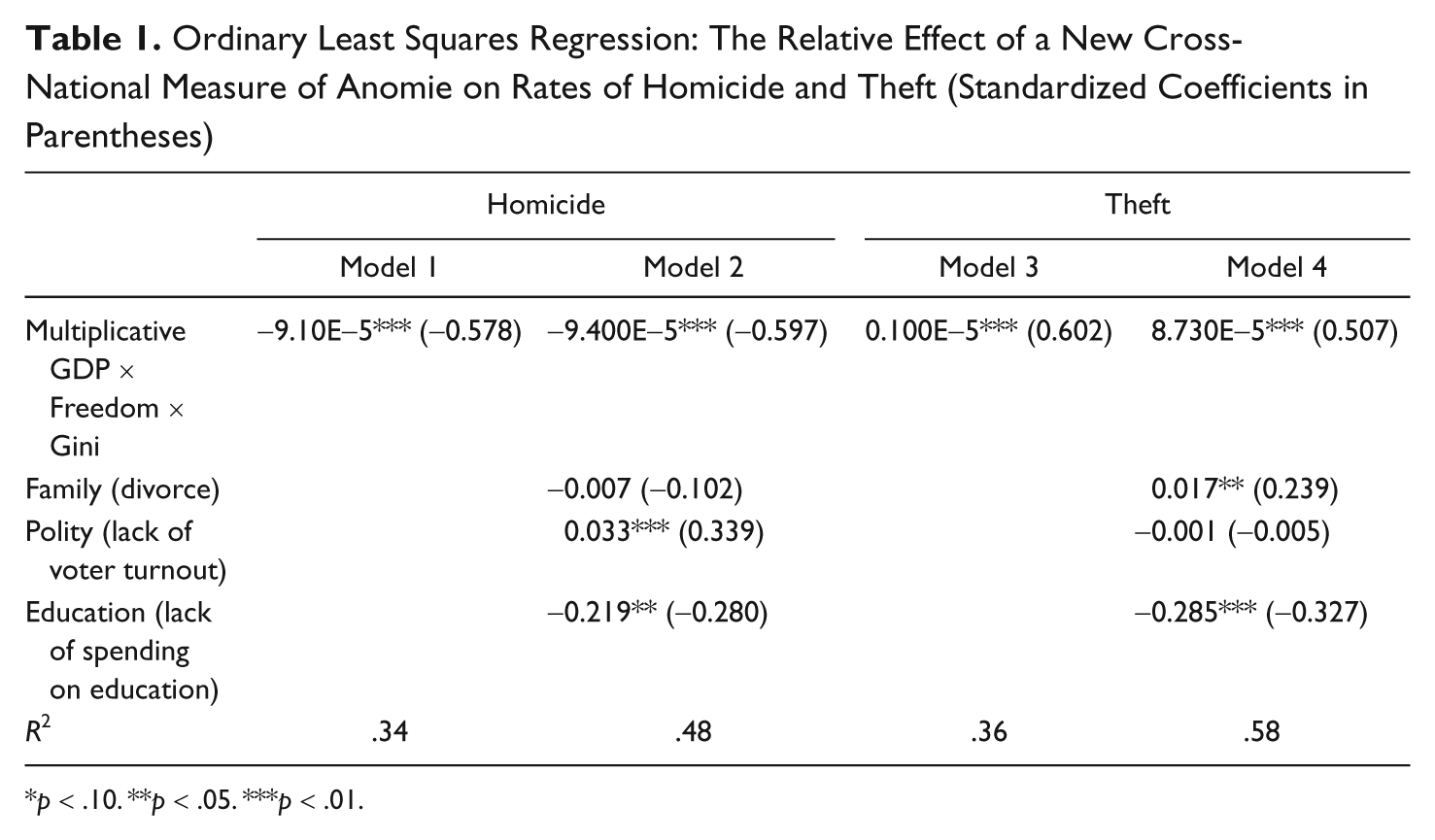
p < .10. **p < .05. ***p < .01.
Figures 1 and 2, respectively, present the predicted rates of cross-national homicide and theft from the equations in Table 1 for four types of societies (high economic freedom and high GDP, high economic freedom and low GDP, low economic freedom and high GDP, and low economic freedom and low GDP), each assessed at high and low levels of economic inequality and at the means of the strength of noneconomic social institutions. High is defined as more than 1.5 standard deviations above the mean and low as more than 1.5 standard deviations below the mean.

Predicted rates of homicide at high and low levels of economic freedom, gross domestic product (GDP), and economic inequality
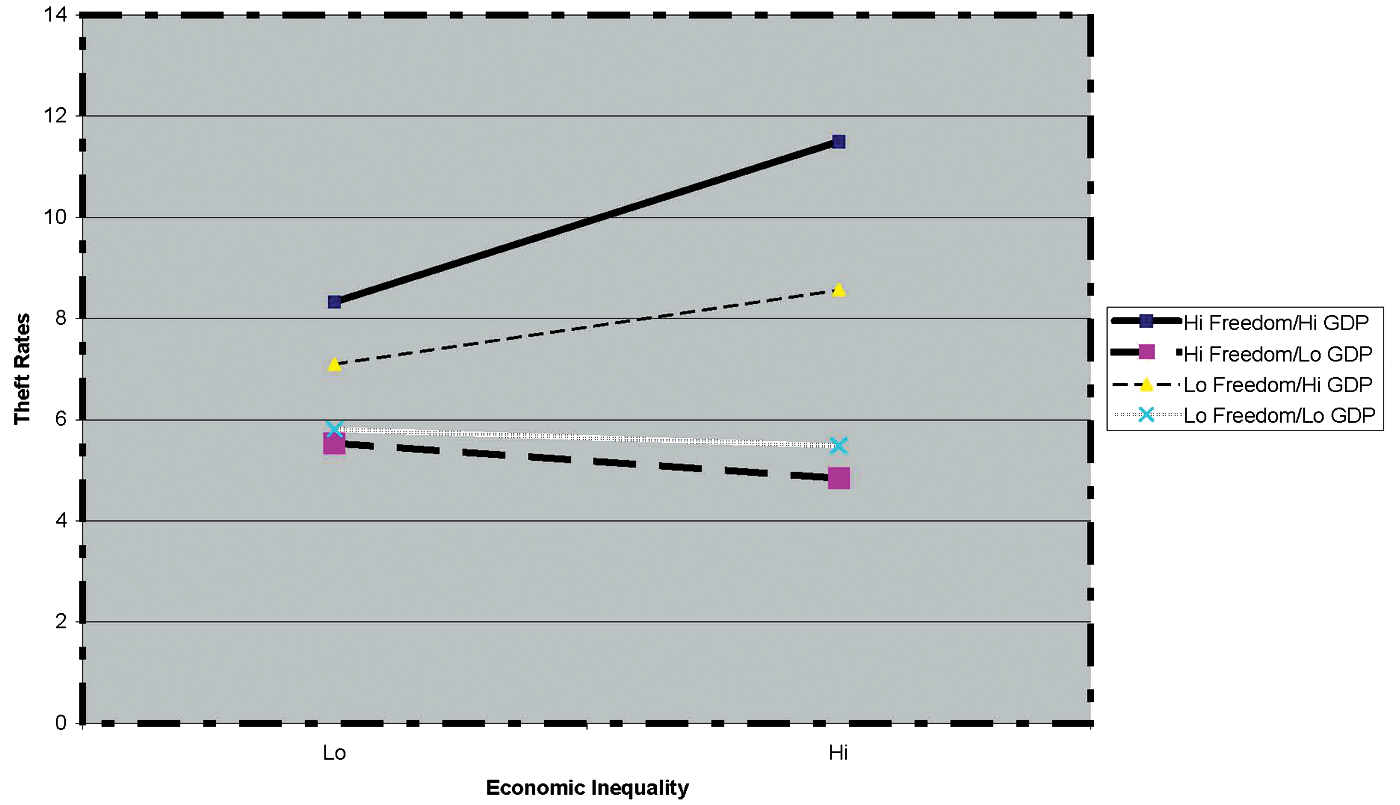
Predicted rates of theft at high and low levels of economic freedom, gross domestic product (GDP), and economic inequality
According to both Mertonian and institutional conceptualizations of anomie, the highest cross-national rates of crime should be evident among those societies high in structural anomie or high on all three indicators (i.e., high economic freedom, high GDP, and high economic inequality). Our data are consistent with this prediction with regard to theft; the highest predicted rates of theft are observed for those nation-states characterized by a strong cultural emphasis on economic accrual (high scores on the economic freedom index), a strong economy (high GDP), and high economic inequality. That is, high rates of instrumental crimes may be most prevalent in those nation-states with an economy strong enough to satisfy the cultural expectations for a substantial portion of the population, but not all. High levels of economic inequality within these countries may inspire those whose legitimate opportunities for economic success have been blocked to “innovate” illegitimate means of economic accrual. Hence, it appears that “want amid plenty” may be the criminogenic force that drives anomic societies toward high rates of instrumental crime, as both Merton and Messner and Rosenfeld have argued.
A different picture emerges with regard to homicide. For homicide, the highest cross-national rates are observed among countries characterized by a strong cultural emphasis on economic success (high scores on the economic freedom index) but with an economy too weak to sustain these desires (low GDP). Within such arrangements, high economic inequality may ignite social-psychological processes of deprivation–frustration–aggression. Rather than “want amid plenty,” under this form of anomie, it is dashed hopes that foster high rates of expressive/violent crime, that is, the combination of high aspirations coupled with low expectations for success.
Conclusion
Without question, one of the most vexing problems facing researchers trying to test structural or institutional anomie theories is the operationalization of anomie. This challenge is magnified in the context of comparative criminology by the data constraints already present. As a result, researchers are forced to rely on indirect tests and often weak surrogate or proxy measures of key theoretical variables. This study offers a unique and, we believe, more theoretically sound operationalization of structural/institutional anomie. We argue that a theoretically sound operationalization of anomie should address the joint societal conditions minimally necessary for structural anomie to operate and under which economic inequality can then lead to increased rates of crime cross-nationally. Both Merton and Messner and Rosenfeld have conceptualized structural anomie to be present when the dominant culture prescribes as legitimate the goal of economic security, and the structural organization of the economy permits the acquisition of great wealth, but the structural organization of society blocks the access of some of its members to the legitimate means to attain this goal (to this, Messner and Rosenfeld add a fourth condition: noneconomic social institutions are not sufficiently strong to offset these anomic and criminogenic conditions). We have argued with regard to these three necessary elements of an anomic society that an examination of their independent or relative effects, which is normative for this area of research, constitutes a theoretical misspecification of both Mertonian structural anomie and Messner and Rosenfeld’s conceptualization of institutional anomie. We believe structural anomie is best conceptualized as a multiplicative construct:

We tested the efficacy of such a construct to explain cross-national variation in the rates of both homicide and theft while controlling for the strength of several noneconomic social institutions. We used the Economic Freedom Index developed by Heritage Foundation (O’Driscoll et al., 2003) as our measure of a cultural emphasis on economic accrual, the GDP as our measure of the economic strength of a nation-state, and the commonly used Gini coefficient as our measure of blocked opportunities. Our results are supportive of the efficacy of this construct to explain cross-national variation in the rate of instrumental crime. That is, our multiplicative function was (as expected) significantly and positively associated with rates of cross-national theft but negatively associated with homicide.
More importantly, graphic representations of this complex joint or multiplicative effect revealed (see Figures 1 and 2) what may very well be two different forms of structural anomie, each of which has its own criminogenic force. One form of the anomic condition mirrors that specified by both Merton and Messner and Rosenfeld and stresses the joint effects of a powerful cultural force that elevates aspirations for economic success, and a strong economy that can both convert these cultural aspirations into expectations and can, in turn, satisfy these expectations for a significant portion of the population. In such societies, where there is “want amid plenty,” those for whom high levels of economic inequality have foreclosed the legitimate expression of economic attainments may be inspired to find alternative means to attain economic security—innovation. It is these societal arrangements that lead to high cross-national rates of instrumental or property crimes. Interestingly, this view was expressed more than 25 years ago by Bailey (1984), who suggested that relative economic deprivation would be primarily related to property crimes, not crimes of violence.
A second anomic force is most evident in those nation-states in which cultural forces also elevate aspirations for economic success, but the economy is not strong enough to sustain such aspirations. Within these societies, a weak economy circumscribes expectations for success and, especially for those at the bottom of the social structure, replaces them with frustration (Blau & Blau, 1982). From this widespread frustration come high levels of expressive or violent crime. These findings are also consistent with Agnew’s (1999) macro-level conceptualization of strain/anomie in which he proposes that goal blockage creates frustration, which, in turn, can lead to high rates of aggression.
These graphic representations of the effects of this complex multiplicative construct suggest that other anomic forces may be operative as well. One societal type represented in these figures is characterized by a culture that clearly does not stress economic attainment (low values of the economic freedom index) and a weak economy (low GDP). Here the causal mechanisms conducive to crime may simply be associated not so much with relative deprivation but absolute (i.e., poverty). This societal type evidences the second highest rates of homicide, but the second lowest rates of theft. The final societal form represented in these figures is characterized by a strong economy but a culture that does not emphasize economic attainment. For both homicide and theft, this societal form has very modest rates of crime, neither unusually high nor low.
It is important to note that this research is not immune to the criticism leveled at either other aggregate tests of structural or institutional anomie theories or cross-national research in criminology. Missing data on key concepts necessarily restricted the number of nation-states that could be examined. Likewise, the analysis fails to control for other measures known to influence theft and/or homicide rates (e.g., absolute deprivation/poverty, urbanism). Finally, this study is limited by the cross-sectional nature of the data used; without longitudinal data, we are unable to establish the temporal order of effects and, thus, cannot make a compelling case for the causal effects of structural anomie on cross-national levels of crime. This research, however, does underscore the importance of refining our operationalization of key theoretical constructs and of the need to disaggregate the study of anomie by crime type. We need to continue our focus on developing appropriate measures of our theoretical concepts and more directly testing our theories to gain a better understanding of the variation in crime rates cross-nationally.
Footnotes
Appendix
Measures and Data Sources
| Measures | Data source |
|---|---|
| Crime: | |
| Homicide & Theft Rates | International Crime Statistics, International Criminal Police Organization. |
| World Health Statistics Annual, 1997-1999, Online Edition. World Health Organization. | |
| Economic conditions: | |
| Economic freedom | Heritage Foundation |
| Gross domestic product and annual % growth | World Development Indicators, 2001. CD-ROM. World Bank. |
| Gini coefficient | World Inequality Database. World Institute for Economic Research. |
| World Resources Institute Facts and Figures: Environmental Data Tables. World Resources Institute. | |
| Family: | |
| Divorce rates | International Marketing Data and Statistics, 2001. |
| Education: | |
| Public Expenditures on Education as a % of GNP | World Development Indicators 2001. CD-ROM. World Bank. |
| Polity: | |
| Voter Turnout | Human Development Report, 2000. United Nations. |

The author(s) declared no conflicts of interests with respect to the authorship and/or publication of this article.
The author(s) received no financial support for the research and/or authorship of this article.