




Abstract
The study of narrative processes as part of the immediate factors that shape criminal action is limited by the lack of a methodology for differentiating the narrative themes that characterise specific crime events. The current study explores how the roles offenders see themselves as playing during an offence encapsulate their underlying crime narratives and thus provide the basis for a quantitative methodology. To test this possibility, a 33-item Narrative Roles Questionnaire (NRQ) was developed from intensive interviews with offenders about their experience of committing a recent offence. A multidimensional analysis of the NRQ completed by 71 convicted offenders revealed life narrative themes similar to those identified in fiction by Frye and with noncriminals by McAdams, labelled The Professional, Victim, Hero, and Revenger offence roles. The NRQ thus is a first step in opening up the possibility of empirical studies of the narrative aetiological perspective in criminology.
The narrative framework offers criminology a causal process that can inform understanding of the immediate and direct influences on specific patterns of offending action. This possibility of an immediate narrative intent arises from the dynamic, self-awareness/experiential, and agency-focused qualities of the narrative that are well recognised within psychological thinking (e.g., Bruner, 2004; Canter, 2008; Crossley, 2000). Proponents of this paradigm draw attention to the naturally storied quality of human memory and thought, highlighting the ability of the narrative to “vivify and integrate life and make it . . . meaningful” (McAdams, 2001, p. 101).
In the criminal context, Canter (1994) draws on the narrative approach to show how offenders’ narratives provide a richer understanding of the meaning of their offending than dispositional or social theories. He argued that as part of a story or narrative form, motivation and meaning necessarily become the intention to act; the dynamic process that is required to move the drama forward. By understanding the narrative then, we get closer to understanding the action. In this way, it is clear that the offenders’ narratives can operate as what Presser (2009) calls “key instigators of action,” contributing to explanations of “the neglected . . . here and now of crime” (p. 179).
Canter’s (1994) point that offenders will also draw on the finite set of narrative themes generally available within any culture finds support in investigative psychology studies of offending style (for a review, see Canter & Youngs, 2009). These studies have been able to apply particular narrative interpretations that have their origins in the work of Frye (1957) and McAdams (1985, 1993) to specific criminal action patterns. Four narrative themes have been derived from the detailed consideration of offence actions and labelled: Adventure, Irony, Quest, and Tragedy. Such themes have now been proposed for crimes including rape, stalking, homicide, robbery, burglary, and arson (Canter & Youngs, 2009).
Indications that actual criminal behaviour patterns can be distinguished in terms of coherent narrative themes does support the suggestion that the narrative, whether operating explicitly or implicitly, is significant in driving and shaping the action. It implies, as Toch (1993) argues in relation to the violent men’s stories he studied, that the offending is the enactment of the narrative rather than the narrative simply being an interpretation of the context out of which the offence has emerged. This utilisation of narrative ideas is consistent with Presser’s postpositivist conceptualisation of narrative as one “that effectively blurs the distinction between narrative and experience by suggesting that experience is always known and acted upon as it has been interpreted symbolically” (Presser, 2009, p. 184), rather than the narrative operating as a post hoc, interpretative device that only provides insight into an individual’s subjective understanding of factors that motivated behaviour.
Understood in this way, it becomes clear that the narrative framework has the potential to explain what Presser (2009) calls “dynamic factors at the point of behaviour” in her call for a narrative criminology. This is an application that represents a clear development from McAdams’s important work which showed the usefulness of a narrative perspective in providing an underlying coherence to human experience over time, whether by explaining how events have unfolded in a life story or as a psychological form for recognising consistencies in personality and identity (McAdams, 1985, 1993, 1999). Maruna (2001) draws attention to this potential for a general causal role, showing that different self-narratives are themselves implicated in whether offenders desist from crime or not.
To demonstrate a further direct, immediate, and specific effect of narrative processes in shaping criminal action requires the development of an approach to measuring these. It is suggested that one particularly powerful approach to operationalizing narratives is the consideration of the roles that the offender adopts and enacts during specific offence events.
These narrative offence roles would capture narrative processes as they are brought to bear on a specific crime event. They will elicit core psychological themes that represent a redaction or distillation of full unfolding life-story narratives, capturing only those themes that are activated in the particular event form within the individual’s overall narrative framework.
This concept of the “role” extends previous thinking on cognitively focused scripts of how one will act and react in violent scenarios (Huesmann, 1988). More generally, roles and role-taking are at the heart of the symbolic interactionist perspective on criminality (e.g., Matsueda, 1992). In developing his explanation of delinquency, Matsueda extends Mead’s (1934) thesis on social control as mediated by role-taking. For Mead, self-appraisal occurs when the individual’s approach to dealing with problematic situations is interrupted by others causing him or her to view himself or herself from the standpoint of the other. Matsueda proposes a process through which delinquency develops out of these reflected appraisals of the self in the role of a rule violator.
The narrative perspective highlights the need to develop our understanding of the nature of this generalised violator criminal role. It draws attention to the internal processes that may support and shape a criminal role within the individual. It highlights the possibility that there will be a number of different qualitative forms that this generalised criminal role can take. Furthermore, the narrative form offers a coherent framework for conceptualising and elaborating the significance of the other in self-identity at the centre of symbolic interactionism. In narrative terms, the other becomes an antagonist in the protagonist’s story. Within that story, the relationship between the two is elaborated and given substance.
One of the key processes implied by Mead’s (1927/1982) perspective is the notion that “delinquent behaviour can occur in the absence of reflective thought, via habitual or scripted responses established through previous experiences” (Heimer & Matsueda, 1994, p. 368). Thus, although the symbolic interactionist perspective emphasises awareness of the other in establishing a delinquent self-identity, it recognises that the detailed offending activity may be underpinned by a lack of other awareness. The narrative perspective, in its focus on the personal story of the individual, takes this self-focus as its starting point. Alongside Huesmann’s important work on cognitive scripts, narrative offence roles offer an approach to articulating the psychological form of the self-focus at the heart of offending.
The idea that individuals take on externally imposed roles that shape their continued involvement in criminality is also central to labelling perspectives (Becker, 1963; Lemert, 1951; Tannenbaum, 1938). Tannenbaum in particular discusses the dramatization of evil, drawing attention to a storied understanding of crime within which role-taking will be central. Other authors discuss criminal desistance in terms of role transition (Massoglia & Uggen, 2010). Indeed, Maruna, Immarigeon, and LeBel (2004) define a secondary level of desistance that is “the assumption of the role . . . of the changed person” (p. 19, italics added). The idea that narrative processes may be activated as offence roles builds then on a diverse range of previous perspectives on crime.
The Challenge of Measurement: Roles as an Operationalization of Narrative
The possibility of direct narrative influence on what offenders do assumes that these processes can be distilled into a coherent form that implies specific patterns of action. Yet it seems likely that the narrative framework that underpins an individual’s life will be an implicit and complex one rather than explicit story lines being readily identifiable by the protagonist. Moreover, although narrative researchers would anticipate some overall coherence over a lifetime, it is widely held that within this will be multiple and fleeting narrative themes influencing action, that as Presser (2009) argues may change too quickly to measure.
The implicit quality and fleeting form of narrative processes suggests that to discern themes and psychological meaning, these need to be given concrete form and examined in specific contexts. Offence event roles provide a medium through which implicit narrative processes are given tangible form and can be related to a given context through descriptions that capture the quality of the agency that is underpinning the action in that event.
It is proposed further that a measure that focuses on the role experienced within an offending event may operate as a nonthreatening summary of a criminal narrative theme. The focus on the direct descriptions of an offender’s experience of the event does not require personal justification or even readily allow the respondent social desirability interpretation or conscious positioning across items. Such techniques, rather than an overt life-story interview, may be particularly useful in narrative research as they do not require the individual to make explicit the underlying themes within their narrative to provide a coherent “life story” account. Indeed, the roles technique may help reduce the rewriting of narratives and reveal the presence of narrative themes of which the individual may not be aware. Such techniques may prove particularly powerful with narrative themes that are socially unacceptable. The techniques may also prove useful where respondents cannot articulate the relevant themes.
What Underlying Psychological Dimensions of Narrative Roles for Criminal Action?
In the context of life narratives or self-stories, McAdams (1993) argues that personal myths are organised according to two themes that he terms agency and communion, where agency is concerned with power and achievement and communion with love and intimacy. These narrative themes of agency and communion advanced by McAdams map onto the two primary psychological dimensions underpinning the differences in human functioning that have emerged across a range of areas of psychological study, from considerations of interpersonal tendency to explorations of life-story identity themes and theories of self-strivings or motivational trends. In Leary’s (1957) consideration of interpersonal personality that captures the individual’s approach to dealing with others, these two dimensions are described in terms of Dominance/Submission and Love/Hate. Dimensional analyses of Schutz’s (1992) widely used Fundamental Interpersonal Relations Orientation-Behavior (FIRO) theory of interpersonal tendency (e.g., L. J. Dancer & Woods, 2006) suggest that his original three dimensions of behavioural orientation may be better conceptualised as the two dimensions of Control and Openness/Inclusion that clearly echo Leary’s personality dimensions. Herman’s (1996) ideas on the self, its strivings, and meaning in life, as McAdams (1999) notes, identify two very similar motivational trends that distinguish between “S” motives, which are strivings for superiority, power, and expansion, and “O” motives, which are strivings for contact and intimacy with others. Thus, whether we are considering differences in interpersonal disposition, the forms of personal myth that run through individuals’ life stories, or the basis for human meaning and self-strivings, the variations can be related to two fundamental psychological constructs that concern potency and intimacy.
One key challenge in developing these ideas as the basis for distinguishing particular narrative offending roles is to understand how the psychological processes of intimacy and potency may manifest in the criminal context. Youngs and Canter (2011) argue that in criminal terms, rather than as concern with love and warm interactions with others, intimacy may be better understood as a measure of the relevance for the offender of the victim and the significance of the impact of the offending on the victim in allowing him to attain the objectives he seeks. High levels of intimacy would produce an overall approach to offending that revealed an acute awareness of the victim and an explicit desire to affect him or her. For those high on intimacy then, the criminal activity would be conceptualised by the offender as some form of interpersonal transaction between him and the victim.
In the criminal context, Youngs and Canter (2011) argue that potency can be understood as the imposing of the offender’s will rather than as a productive strength and agency. High levels of potency would produce an approach to offending then where the offender sees himself or herself as taking charge and is focused on maximising his gains. For those offenders high on potency, the criminal activity would be conceptualised as the conquering or mastery of the environment and/or victim necessary to achieve his or her aims.
Interestingly, when understood in these terms, support for intimacy and potency as the basis for distinguishing offenders’ approaches to or conceptualisations of the offending activity can be found within empirical work on behavioural patterns within offenders’ activities. Studies of criminal specialisation and modus operandi or offending style (Canter & Fritzon, 1998; Salfati & Canter, 1999; Youngs, 2004) have consistently interpreted the different behavioural patterns they reveal in terms of two underlying distinctions between Instrumental/Proactive offending and Expressive/Reactive offending and between an Object or Property target for this activity and a Person-focused target. These distinctions in the actual activities of offenders can be mapped on to variations in potency and intimacy. The focus on either property or person-focused offending patterns picks up differences in the desire and willingness to interact with others that would be produced by different levels of intimacy. Similarly, offending activities that are initiated by the offender or “instrumental” capture the tendency to dominate and take charge that is produced by high levels of potency. These criminal actions that are the offender imposing his will contrast with those acts that are forms of expression without any attempt to take control.
Identifying Components of Offence Narrative Roles: Development of a Preliminary Narrative Roles Questionnaire (NRQ)
The offence narrative role is proposed to be then the distillation of an underlying story line or narrative theme into a form that captures the protagonist’s agency and intent in relation to the specific crime event. To capture the quality of this agency and intention that will allow us to characterise the core theme that defines an offence narrative role requires the development of an approach to measuring the components of the roles.
Any such measure has to draw on concepts and ideas that are meaningful to offenders and to present these in language and words used by offenders to describe their crimes. The starting point for the development of a NRQ has therefore to be offenders’ own accounts of their experiences of committing a crime.
To this end, a series of intensive, open-ended interviews were conducted with 38 offenders convicted for a variety of offence types that ranged from burglary to violent offences, in which the offenders were asked to describe the experience of committing a recent offence. The interviews were transcribed and subjected to a detailed content analysis to elicit core themes within the material. Following and expanding on Presser (2009), it was argued that a particular narrative may have the following components:
The offender’s interpretation of the event and his or her actions within that event
The offender’s self-awareness or identity in the interpersonal crime event
The emotional and other experiential qualities of the event for the offender
Each interview was therefore content analysed to derive content on these aspects. This content was grouped into themes and a representative verbatim statement from the interviews selected to capture each theme.
The resulting set of 33 statements drawn from the interviews is listed in Table 1. These statements capture in the interviewees’ own words, the key descriptions of the interpretation of the event and justification of the offending actions (e.g., It was the only thing to do; I was doing it because I had to; I found I couldn’t help myself; I was doing a job), the offender’s self awareness/identity (e.g., I was a victim; I was like a professional; I was in control; It was a manly thing to do), and emotional state during the offence (e.g., It was fun; It was like I wasn’t part of it; I just wanted to get it over with). These statements comprised the first version of the NRQ.
Narrative Roles Questionnaire (NRQ) Used to Indicate Roles Criminals Saw Themselves as Playing While Committing a Crime.
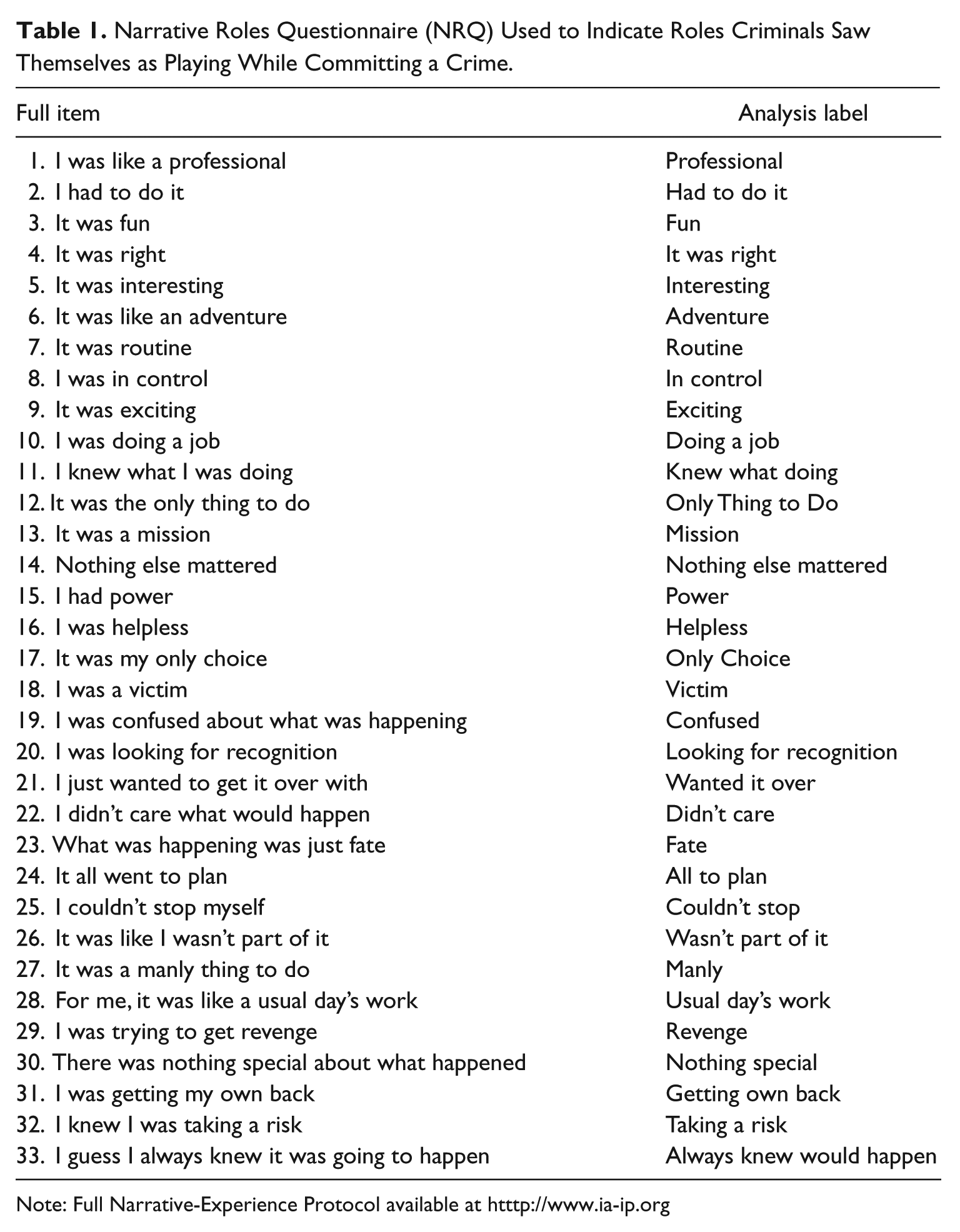
Note: Full Narrative-Experience Protocol available at http://www.ia-ip.org
It should be noted that these statements are postoffence verbalizations. As such, they may be distorted by memory issues as well as postoffence developments such as conviction. It is possible, for example, that people may report more positive affect in their remembered experiences of offences which remain undetected. However, more global shifts in the integrated set of component parts that comprise one coherent role to a different overall role form seem unlikely. In the present study, all participants described an offence for which they had been convicted so that variations in themes cannot be attributed to this. However, future research should explore the impact of different offence outcomes.
The issue of postoffence rewriting raises a broader issue about the validity of self-reported narrative accounts generally. The phenomenological approach takes the stand that a person’s account is their subjective perception and should be taken at face value. It does not have to be believed as objective fact but can be taken to indicate the constructs and related perspectives the individual brings to the issues at hand. It shows how they wish to be seen, which is relevant, for example, to setting up interviews (see Youngs & Canter, 2009) and therapeutic interventions. We accept that all the narratives we observe in personal accounts have an element of justification, but we are exploring the particular form of the justification. However, this does show the value of also looking for narratives implied by the offence actions of the offenders (e.g., Canter, 1994) and where possible comparing declared (explicit) narratives with these implicit narratives.
An Empirical Examination of Offenders’ Narrative Roles
To determine its underlying structure and identify the narrative roles that might be operating, the NRQ was then completed by a larger group of offenders (n = 71; see below). The responses were subjected to multivariate statistical analysis.
Sample
The NRQ was completed by 71 convicted and incarcerated offenders from a large prison in the north of England. Interviewees were recruited on a voluntary basis and participants reminded that their involvement was entirely voluntary at all times. These offenders were all male between the ages of 21 and 61 years with a mean of 34.5 years (SD = 9.5). The most recent convictions for which these offenders were incarcerated covered a range of offence types: Murder, n = 4; Other violence, n = 15; Robbery, n = 4; Theft, n = 15; Drugs, n = 10; Criminal damage, n = 1; Arson, n = 5; Fraud/deception, n = 4; Driving offences, n = 2; Other, n = 1; Denied most recent conviction offence, n = 5; Missing data on recent conviction, n = 4.
Participants were given a brief explanation of the study and asked to give an honest account of their experience of committing the offence. Participants were assured that all responses would be treated as confidential, with no individuals being identified within the prison context or in subsequent publications. Completed questionnaires were placed in a sealed envelope at the end of the interview with no identifying information attached.
Data
The NRQ comprised 33 items drawn from intensive interviews with offenders, describing the experience of committing the crime. The NRQ had a high internal reliability with the current sample (α = .85).
The interviewees used the NRQ to describe how they felt when committing a crime they could remember well, indicating the extent to which they agreed with each statement (not at all, just a little, some, a lot, very much). The offences described covered a broad range of crime types (Violence, n = 26; Sexual, n = 1; Theft/Burglary, n = 11; Robbery, n = 7; Fraud, n = 5; Arson, n = 1; Drug offences, n = 11; Driving offences, n = 3; Other, n = 6).
Analyses
Data generated from the questionnaire responses were intercorrelated (using Pearson’s r coefficient) and subjected to a Smallest Space Analysis (SSA-I). SSA-I is a member of the family of nonmetric multidimensional scaling (MDS) procedures developed by Guttman and Lingoes (Lingoes, 1973, 1979). The procedure is a well-established technique, having been used for more than 50 years to identify structure in phenomena as diverse as intelligence (Guttman & Levy, 1991) and self-esteem (L. S. Dancer, 1985). SSA-I is a “data reduction” methodology that, in mathematical terms, operates from the same starting point as a principal components analysis. The procedure differs from factor analytic approaches in that it makes fewer assumptions about the underlying structure of phenomena. Rather than assuming a dimensional structure, SSA allows the emergence of systemic models that tend to be particularly suited to the understanding of variation in human behaviour given the complex, multifaceted range of influences on this. Certainly, SSA has been the methodology of choice for the majority of studies of stylistic variation in offending conducted within the Investigative Psychology and Offender Profiling tradition (e.g., Canter, Bennell, Alison, & Reddy, 2003; Canter & Heritage, 1990).
Like all the MDS procedures, SSA-I presents the underlying structure of a set of variables as a spatial representation of the relationship of every variable to every other variable. SSA-I is a nonmetric MDS procedure in that it bases the representation on the rank order of some index of similarity between variables, typically their intercorrelations. The variables are plotted as points in space such that the relative magnitude of the correlations between two variables is inversely related to the relative distance between the points. In short, the closer two points representing two variables, the higher is the likely correlation between those variables. In this way, the multivariate structure of the relationships among variables can be readily examined through consideration of the configuration of points.
The first projection (Vector 1 by Vector 2) of the three dimensional solution from the SSA-I is presented in Figure 1. The labels are brief summaries of the full behaviours. For ease of interpretation, these are presented in Table 1. The Guttman–Lingoes coefficient of alienation obtained for this solution is 0.25 in 10 iterations indicating an acceptable level of fit between the Pearson’s coefficients of the behaviours and their corresponding geometric distances in the configuration. The three-dimensional solution was considered to describe the pattern of relationships better than the two-dimensional solution. The plot was generated under conditions of global monotonicity. Missing items were excluded on a pairwise basis.
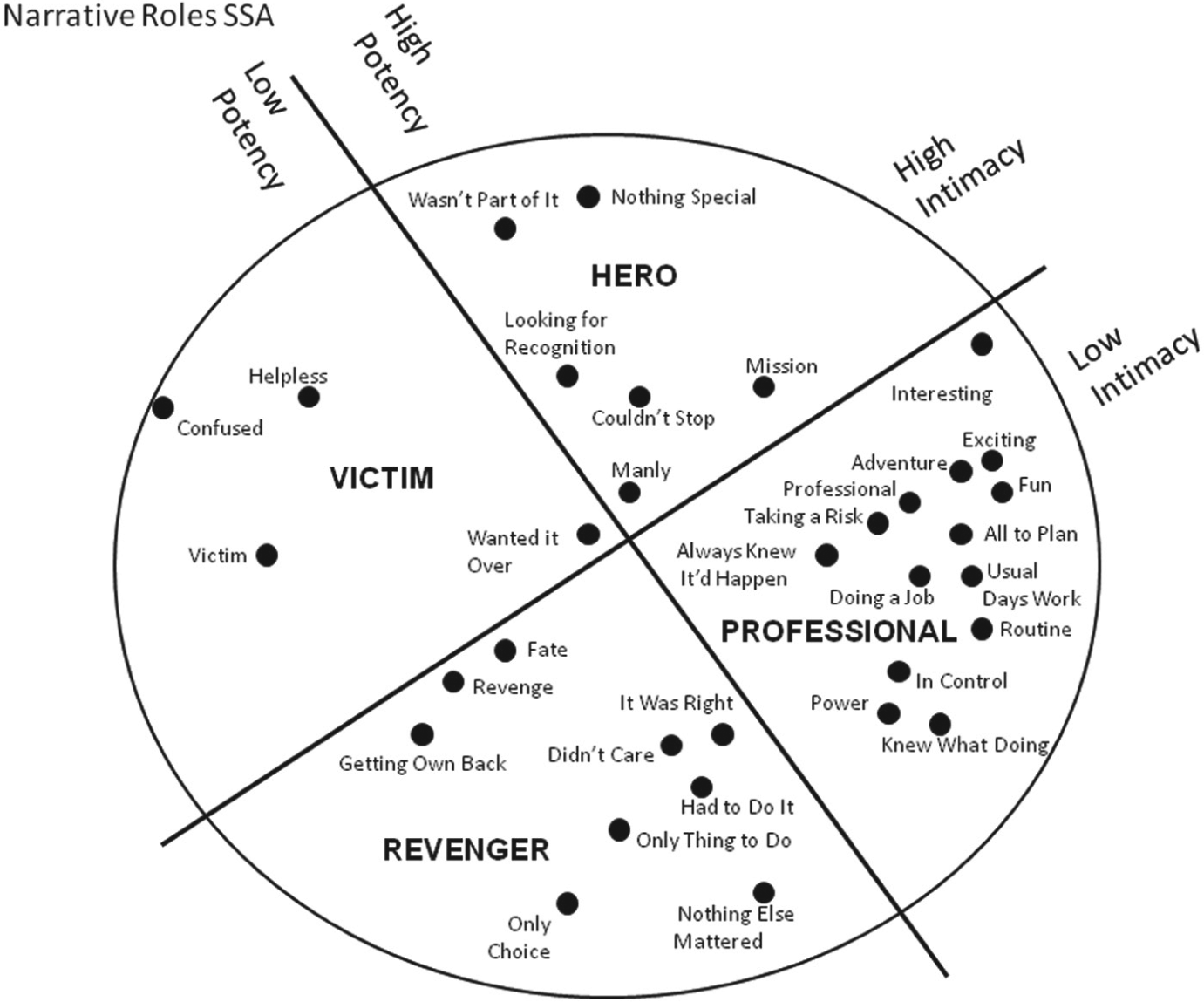
SSA-I Results for 71 offenders’ responses on Roles Questionnaire.
The structure of the interrelationships between the items was explored using the facet theory approach to research (Canter, 1985). Within the facet approach, regions are drawn on the SSA-I on the basis of the contiguity of the items on the plot. Lines are positioned on the plot to distinguish between regions of substantively equivalent, contiguous items. Consistent with the notion of systemic rather than sharply demarcated structures for human phenomena, there is no mathematically precise position for these lines because they are taken to indicate boundary conditions between defined regions. Items nearer the boundary would be expected to share more of the qualities of the adjacent region than items centrally placed within a region.
Narrative Roles in the Offence: The Hero, the Victim, the Professional, and the Revenger
Distinct regions of items are revealed within the SSA-I analysis (Figure 1). This suggests particular patterns of co-occurrence of the components of the offence experience, as measured by the 33-item NRQ (see Table 1). The underlying coherence to the descriptions of the experiences can be readily understood in terms of roles within a particular narrative. The narratives implied by the combination of NRQ items in each region of the SSA bring together the offenders’ cognitive interpretations of the offence, his or her self-awareness and emotional state during its commission. By recognising the existence of an unfolding personal story line, these constructs can be elaborated in ways that reveal the latent intentions of the criminal actions.
The items in the top area of the plot depict an experience of offending as an opportunity to prove oneself (Looking for Recognition), to demonstrate prowess (Manly). They paint a picture of someone who sees himself or herself as caught up in something highly significant (Mission) and overtaken by this all-encompassing assignment (Wasn’t Part of It; Couldn’t Stop). In this context, it seems likely that it is a sense of bravado that is indicated by the “Nothing special” description. In overall terms, then, this area of the plot describes an offending experience in which the individual sees himself or herself and the role she or he is playing as that of a Hero. This Hero role, in its focus on proving oneself and being part of a greater mission, can be readily understood as a role that would emerge from an underlying life narrative of quest, such as Frye’s “comedic” narrative (Frye, 1957). This narrative is a story of overcoming obstacles in pursuit of pure and joyful objectives.
In the left area of the plot are descriptions of the offending experience as being against the protagonist’s will (Wanted It Over), out of their control (Helpless), and beyond their understanding (Confused). As captured by the centrally located item, Victim, these are offenders who see their role within the offence as that of a Victim. The Victim role, in its impotency and disengagement, is consistent with Frye’s broader Irony narrative (Frye, 1957). The Irony narrative is a life story underpinned by a sense that nothing makes any sense, there are no rules and nothing matters.
The descriptions in the right area of the plot are those of an individual who sees himself or herself as simply carrying out a task (Doing a Job; Usual Day’s Work) and who feels a sense of satisfaction in that (e.g., Interesting; Fun). The items here reflect a pragmatic, methodical approach to the offence (All to Plan; Routine). Central to this role is a keen sense of competency (e.g., In Control; Knew What Doing). Competency extends to an acute awareness of the potential risks associated with the activity being carried out (Taking a Risk). It suggests an overall understanding by the offenders of the role they were playing during the crime as that of a Professional. It is a role that can be readily understood as one that would emerge from an underlying life narrative of adventure (Frye uses the term romance generically). This is a story of the protagonist’s victorious mastery of his or her environment.
In the bottom area of the plot are items that suggest a perception of the offending activity as having a very specific purpose (Had to Do It) that it was a justified response (It Was Right) to a wrong (Getting Own Back; Revenge). Central to this offending experience is a sense of singular commitment to and obligation in this purpose (Only Choice; Nothing Else Mattered; Only Thing to Do), whatever the consequences (Didn’t Care; Fate). Taken together, these descriptions of the offending experience suggest the core role that the offender sees himself or herself as acting out here is that of a Revenger. Such a role would have its roots in Frye’s Tragedy narrative. The Tragedy is a story of an “extraordinary victim,” an individual unfairly targeted who must respond to the wrong or deprivation they have suffered.
An Integrated Model of Narrative Offence Roles
As predicted, the SSA shows that this empirical structure of Narrative Roles is organised by the joint action of the underlying psychological processes of intimacy and potency. Variations in potency as revealed in the situational interpretations, emotional experience, and self-awareness aspects of the interviewees’ descriptions of their crimes run broadly from the lower left half of the plot to the top right half. Intimacy is higher in the top left half and lower in the bottom right of the plot. The Narrative Offence Roles show how the separate cognitive, affective, and identity constructs that researchers have related to criminal behaviour more broadly are drawn together into four particular patterns or combinations of crime-shaping processes.
Cognitive Components: The Offender’s Interpretation of the Event and His or Her Actions Within That Event
The extensive research establishing the significance of criminal thinking styles, biases, and distortions provides a rich source of ideas about offenders’ interpretations of criminal situations and their actions (see Maruna & Copes, 2005, for a review). Sykes and Matza (1957) propose a number of techniques of neutralization from their work on offenders’ verbalizations: denial of injury, denial of responsibility, denial of the victim, condemnation of those who condemn, and an appeal to other, higher loyalties. Further important ideas were developed within Bandura’s (1990) strategies for “moral disengagement” in which he specifies interpretations of criminal action that displace responsibility, diffuse responsibility, dehumanise the victim, assume the role of victim for oneself, and distort the consequences of the action.
As Maruna and Copes (2005) argue, one of the key challenges in specifying criminal narratives is understanding how these different neutralizations will connect with different forms of narrative. In the introduction to this article, Intimacy was identified as one key psychological organising process. It was defined in the criminal context as relating to the significance for the offender of the impact of the offence on the victim. Youngs and Canter (2011) argue that one hypothesis will be that those interpretations that are less focused on this impact, dismissing or minimising the harm to the victim (e.g., Sykes & Matza’s [1957] denial of injury or denial of the victim and Bandura’s [1990] dehumanising of the victim or assuming the role of the victim oneself), will be part of rather different roles than will be cognitions that are centrally concerned with the impact. Within these latter roles, we may anticipate a form of interpretation that, rather than minimising the impact on the victim, reinterprets the offending so that the salient issue is the impact in terms of the offender’s objectives. In other words, when intimacy is high and the offender is highly aware of the impact on the victim, the justificatory distortions in the interpretation of events will not minimise the harm but instead take the form of focusing on the offender’s objectives.
The underlying potency dimension, defined by Youngs and Canter (2011) in the criminal context as the imposing of the offender’s will, would suggest further key differences between roles relating to the interviewees’ interpretation of the responsibility for the actions. Youngs and Canter advance the hypothesis that low levels of potency would produce a tendency to attribute the responsibility for the situation and the actions to others, for example, Sykes and Matza’s (1957) denial of responsibility; Bandura’s (1990) displacement of responsibility; Bandura’s diffusion of responsibility. In contrast, high levels of potency would delineate a role within which the protagonist not only owns the actions but also the evaluation of them, refusing to submit to the judgements of others (Sykes and Matza’s condemnation of the condemners; Sykes and Matza’s appeal to higher loyalties; Bandura’s distortion of the consequences).
Items reflecting the hypothesised potency-based differences in the forms of distortion in the offenders’ interpretations of the offence are clearly separated on the SSA plot. The low potency tendency to not accept responsibility and/or to attribute responsibility to others underpins items such as “I was helpless” (Helpless), “I was confused about what was happening” (Confused), “What was happening was just fate” (Fate), and “It was my only choice” (Only Choice) in the lower left area of the plot. Distinct from these in the top right area of the plot are the higher potency distortions in which the offenders do take responsibility for the actions but present alternative evaluations. These items, in which the actions are presented as part of a larger scheme, for example, “It was a mission” or, more prosaically, “I was doing a job” (Doing a Job) are clearly part of a rather different overall offending role.
Items capturing the proposed intimacy-based distinctions in the interpretations are also separated spatially in the analysis. As predicted, the tendency to minimise the impact on the victim characterises the descriptions in the lower intimacy region, as indicated by, for example, the item that implies the action was not targeting them, “Doing a Job” (Job). The item “Getting Own Back” is also consistent with a harm minimisation strategy; harm to the victim is minimised by the suggestion that they deserved it in some way. A high-intimacy concern with the impact in relation to the offender’s objectives may be argued to underpin items such as “It was a mission” (Mission) and “I was looking for recognition” (Looking for Recognition) in the top of the plot.
Affective Components: The Emotional and Other Experiential Qualities of the Event for the Offender
Within general research on affect, there is agreement that emotional experience is underpinned by two major bipolar dimensions, such that the range of emotional states are produced by the combination of arousal/activation–nonarousal and pleasure–displeasure (Russell, 1997). Four broad classes of mood are described: Elation (High Arousal, High Pleasure), Distress (High Arousal, High Displeasure), Depression (Low Arousal, High Displeasure), and Calm (Low Arousal, High Pleasure). Katz (1988) argues for the central relevance of affective states to crime. He offers in-depth descriptions of “sneaky thrills,” humiliation, feelings of righteousness, and cynicism as enticements to offend. Drawing on the potency and intimacy concepts, two specific hypotheses can be advanced about the emotional states that may be associated with differences in roles offenders adopt during offending.
In the criminal context, intimacy was defined earlier as the degree of significance of the impact of the offending on the victim in allowing the offender to obtain the objectives he seeks. Given that direct contact with a victim during a crime can, with a few exceptions, be expected to be displeasurable, the hypothesis therefore follows that, in the criminal context, a higher tendency toward intimacy will tend to be associated with greater displeasure derived from the offending. However in some cases, the desire for impact on others associated with higher levels of intimacy may be targeted more generally taking the form of seeking recognition rather than affecting an individual. With this lack of direct contact, an actively negative state of displeasure would not be predicted. So, direct contact may mediate the generation of displeasure, such that displeasurable states occur only where there is direct contact with a victim. Rather, other aspects of the offending may generate some mildly positive affect. The central proposed distinction in the quality of emotional state across roles is therefore between a negative state of displeasure and a mildly pleasurable state.
A second distinct hypothesis would be that less aroused or activated states during a crime are associated with higher levels of criminal potency where the offender is simply imposing his will. Where the offender does not feel in control, this lower potency would be hypothesised to produce a more aroused emotional state.
The SSA plot shows that these proposed variations in emotional state do provide a further basis for distinguishing the offenders’ descriptions of their offending experiences. Most clearly, the differences in the Displeasure–Pleasure dimension of the emotional state separate the items with the more positive descriptions (e.g., Interesting, Exciting, Fun), positioned toward the right of the plot, from the items that reflect a negative mood and feelings of displeasure “I was helpless” (Helpless) and “I just wanted to get it over with” (Wanted It Over).
The plot also points to the relevance of further distinctions in the emotional features of the offenders’ accounts. The hypothesised lower levels of arousal associated with high potency underpins items located in the right and top area of the plot, for example, “There was nothing special about what happened” (Nothing Special) and “It was routine” (Routine). These contrast with items in the bottom and left area of the plot that reveal a more aroused emotional state during the crime, for example, “Nothing else mattered” (Nothing Else Mattered) and “I was confused about what was happening” (Confused).
Identity Components: The Offender’s Interpersonal Self-Awareness
For psychologists, identity has been linked with group membership whereas criminologists have emphasised the significance of identity in perpetuating criminal behaviour through labelling perspectives or subcultural allegiance (e.g., Cloward & Ohlin, 1960; Turner, Hogg, Oakes, Reicher, & Wetherell, 1987). There is rather less understanding of the forms of identity within a specific criminal context. The proposition that all offending may be conceptualised as a form of interpersonal transaction, whether implicit or explicit (Canter, 1994), leads to the view that during an offence, the salient components of identity will be those that concern the offender’s self-awareness relative to the victim or target of his actions.
One very useful source of ideas on identity is McAdams (1993) noncriminological work on imagoes, which he defines as “the characters that dominate our life stories . . . a personified and idealised concept of the self” (p. 124). McAdams organises the character types according to his two central personal myth themes of agency and communion, specifying 15 imagoes across combinations of agency and communion, agency, communion, and low agency/low communion myths.
For McAdams, agency and communion are highly positive themes unlike the proposed processes of criminal potency and criminal intimacy, so where both these themes are emphasised imagoes such as the Healer, the Teacher, the Humanist, and the Counsellor emerge that are difficult to relate to offending activity. Nonetheless, some of the varieties of agency-only characters he advances are useful in elaborating the possible different identities offenders may rely on in enacting different roles during a crime event. For example, the agentic images of the Warrior, the Traveller, the Maker, and the Sage, draw attention respectively to concepts of being in battle (Warrior), overcoming obstacles (Traveller), being productive (Maker), and being expert (Sage) that may all be captured aspects of the self-awareness that contributes to high-potency criminal roles. The common theme to all these potential offence identities is psychological strength and dominance. At a fundamental level, then one prediction would be that roles will be delineated in terms of the extent to which the offender sees himself or herself as stronger rather than weaker than his or her victim, having the ability to dominate the commission of the offence.
The Escapist and Survivor imagoes McAdams (2001) describes under conditions of low communion and low agency may also be relevant to the criminal context. The sense of disconnectedness (the Escapist) and feelings of being put on and having no choice (the Survivor) that McAdams describes may be components of the self-awareness that delineates criminal roles produced by different levels of intimacy. These imagoes draw attention to the relevance of feelings of social distance or closeness in defining identity. Given the fundamentally interpersonal nature of offending (cf. Canter, 1994), it may be predicted that these differences in the significance or importance of others are a second key basis for delineating the roles offenders adopt during an offence.
These distinctions in self-awareness during the offence are also particularly clear on the plot. The hypothesised potency-based distinctions in how strong the offenders see themselves as being do separate the identity-focused items out such that those who see themselves as weak (e.g., “I was helpless”—Helpless) are to the left, distinct from those who see themselves as strong (e.g., “It was a manly thing to do”—Manly; “I had power”—Power).
The hypothesised intimacy-based differences in the significance of others to the offender’s self-awareness during the crime can also be seen in the SSA structure. Self-awareness descriptions that reference others in some way, whether the offender is “Looking for recognition” (Recognition) from others or sees himself or herself as the Victim (“I was a victim”) of others, are found in the upper left high-intimacy area of the plot. In contrast, in the bottom right, low-intimacy area, others do not seem to be relevant to the offender’s crime event self-awareness (e.g., “I was like a professional”—Professional).
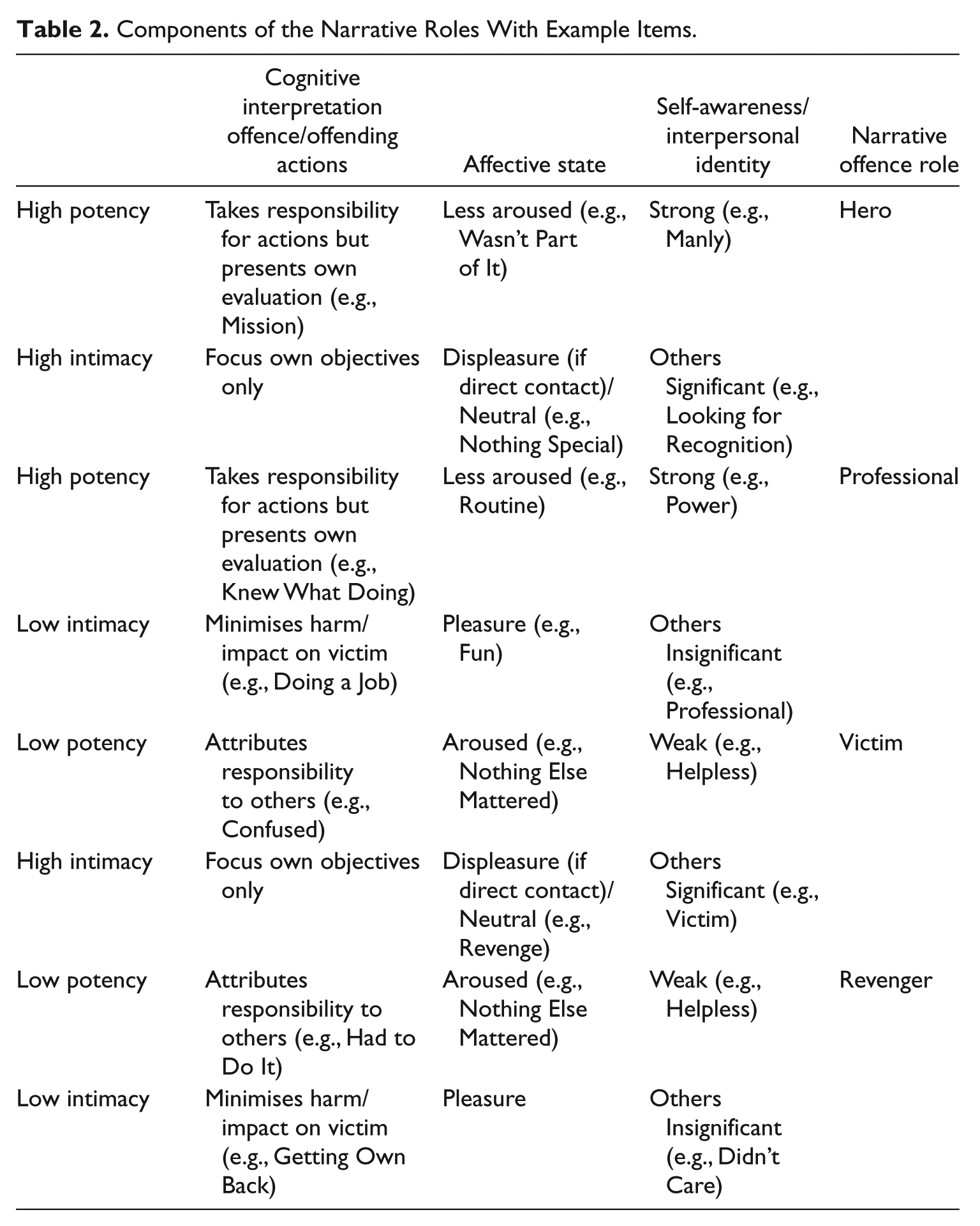
In sum then, the joint action of the criminal intimacy and potency dimensions across the facets produces four major distinguishable regions on the plot from the range of 16 possible combinations (see Table 2). These combinations are produced by variations in cognitive interpretation, (a) not accepting responsibility versus alternative evaluation and (b) minimising victim impact versus offender impact salient; emotional experience, (a) high arousal versus low arousal and (b) displeasure versus neutral/mild pleasure; and self-awareness, (a) strong versus weak and (b) others significant versus others insignificant. This does imply that, across emotional, cognitive, and identity aspects of the offenders’ accounts, psychologically meaningful approaches to carrying out an offence can be identified. As described above, these four regions can be interpreted in terms of the adoption of particular Hero, Victim, Professional, or Revenger narrative roles.
Components of the Narrative Roles With Example Items.
While the poststructuralist agenda that dominates the psychological narrative literature often eschews the possibility of underlying commonalities across individuals, the approach taken here recognises diversity against a background of a finite set of themes drawn from common experiences embedded within a given culture. These narrative roles capture four different emphases within a systemic model of variation rather than discrete categories as might be implied by a typological classification model. Within this thematic structure, individuals’ narrative roles will reflect unique combinations of these emphases much as individual shades/hues within the colour spectrum are the product of different combinations of the primary colours. This framework for accommodating the full range of individual variation against a standardised set of core themes was first outlined in Canter’s (2000) Radex Model of Criminal Differentiation. In the narrative context, given the poststructuralist nature of narratives that are derived from more open-ended material, the identification of a standard set of core themes is particularly important in facilitating the development of approaches to measurement.
The NRQ
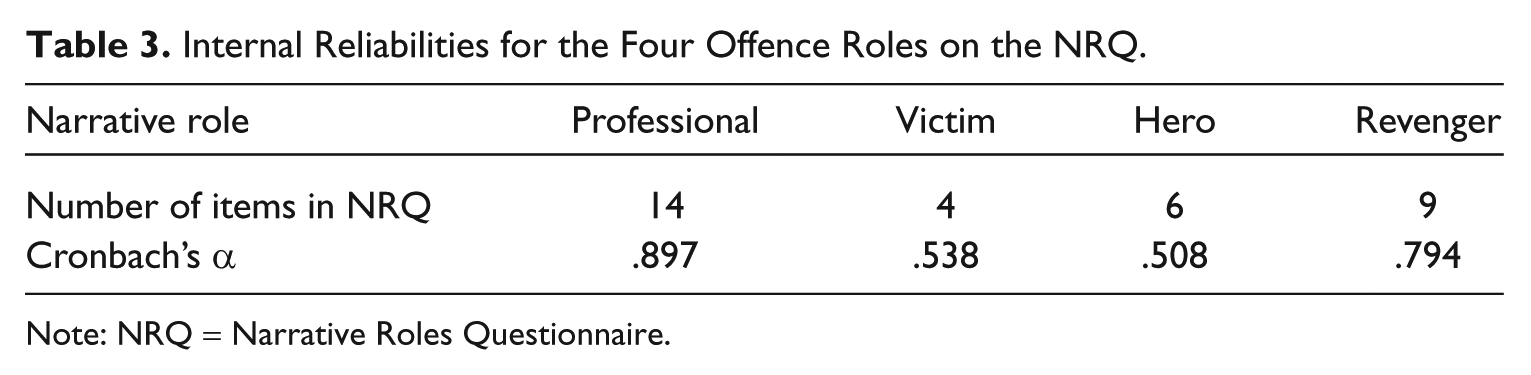
The internal reliabilities for the items measuring each of the Hero, Professional, Victim, and Revenger Roles and the mean scores from the 71 offenders on the four roles are shown in Table 3.
Internal Reliabilities for the Four Offence Roles on the NRQ.
Note: NRQ = Narrative Roles Questionnaire.
Consideration of the 33 items in relation to the conceptual possibilities specified within the mapping sentence allows us to hypothesise further elaborations of the Hero, Revenger, Professional, and Victim roles (see Table 2) that were not offered within the offender interviews. For example, there are few items that pick up the predicted Victim or Hero role tendency for the offender to focus on his or her own objectives only, perhaps because such a focus is in fact indicated by an absence of other descriptions.
Table 2 does then draw attention to areas where the interviewees did not generate statements that it may be appropriate to explore in further study. It is noteworthy that these omissions relate to the expression of positive descriptions of the crime. For example, offenders do not seem prepared to offer up descriptions of their own objectives for the crime (anticipated within the Hero and Victim roles). There is also a reluctance to articulate the positive affect anticipated to characterise the Revenger role. The absence of such descriptions does suggest an inhibitory social desirability effect. Future versions of the NRQ need to address the gaps in this pilot version if it is to capture the full range of the offending experience.
The NRQ could also be elaborated by exploring combined aspects of the experience. In questionnaire construction, the mapping sentence is used such that items are generated that reflect one element of every facet of the mapping sentence. In this context, statements covering an element of all six facets that readily and authentically capture the offenders’ experiences are challenging to construct but further items for exploration could be generated by combining some different concepts, for example, degree of arousal and feelings of strength.
Implications
Narrative approaches have potential application within criminology that goes beyond the analysis of post hoc accounts derived to inform understanding of the offender’s subjective interpretation of his or her involvement in crime. Rather, narrative processes may have explanatory power, themselves acting to generate and direct criminal action; the distinct narrative themes providing a basis for differentiating offenders and their action patterns. Indeed from the postpositivist, constitutive view of narrative that Presser (2009) recently articulates, the behaviour is the enactment of the narrative; pursuit of the narrative itself the motivation. The challenge to exploiting this explanatory potential is clear in Presser’s assertion that narratives “change too quickly to be captured and measured by the researcher . . . the offender’s life story, including its affective dimensions, has no fixed or necessary essence” (p. 179). For Presser then, the narrative themes in an individual’s experiences are multiple, evolving, and too fleeting to capture and measure.
The proposed operationalization of narratives within crimes as the roles offenders assign to themselves and see themselves as acting out through the offending may allow these processes to be captured. By considering them in the specific context of a given crime, the narrative themes are given concrete, explicit form as egocentric statements of the offender’s experience and understanding of the situation and his actions within that situation. The offenders’ reports of the diverse aspects of their experience did co-occur in distinct patterns that could be meaningfully interpreted as offence roles, one or more of which an offender may adopt during a crime. The suggestion is then that offence narrative roles distil and reflect the quality of the agency that characterises a life narrative theme and the intention that drives an unfolding story line, as it is brought to bear on the specific crime event. Certainly, the four offence roles measured by the 33 items in the questionnaire presented here could be understood in terms of the major narrative themes that have been delineated in the works of Frye (1957) and McAdams (1985).
The Professional (Adventure narrative) role is one of calm, competency, and mastery of the environment that contrasts with the Revenger (Tragedy) role of distress and blame. The Victim (Irony) role is one of disconnectedness and despair that contrasts with the Hero (Quest) role of hubris, of taking on and overcoming challenges.
The particular combinations of the components that interact to produce these roles provide interesting insights into the potential relationships between distinct constructs that come from fundamentally different criminological schools. They draw together aspects of the emotional experience of crime emanating from Katz’s (1988) innovative writings on the affective seductions of crime, with the cognitive focus of Sykes and Matza’s (1957) techniques of neutralization and Bandura’s (1990) theory of moral disengagement, as well as aspects of criminal identity that can be tied into the subcultural perspectives of Cloward and Ohlin (1960) and others. The roles described here draw attention to the distinctions that are key within these constructs and suggest some specific relationships between the cognitive, affective, and identity concepts that have previously been studied in isolation. They suggest, for example, that through the Hero role, a tendency to distort cognitive interpretations of crime by focusing on one’s own objectives only and presenting one’s own evaluation of events rather than attempting to minimise the harm, will tend to co-occur in criminal activity. The Hero role implies that these particular cognitions will tend to be underpinned by an emotional state that is negative and nonaroused. In terms of identity, the Hero role further implies an offending experience characterised by a strong sense of self-awareness and in which others do have significance for the offender.
By being able to measure specific narrative themes, we open up an as yet unexploited approach to exploring criminal action. The Professional, Victim, Hero, and Revenger roles, because they capture the intention to act that is the essential component that drives a narrative construction (rather than less immediate motivational factors and influences), get us closer to understanding the processes through which the action is instigated and sustained through the offence (Canter, 1994). This is the issue that Presser (2009) summarises as a question of “why this action here and now?” (p. 189). This is an application of the narrative framework to criminology that goes beyond work exploring post hoc interpretations of circumstances and unfolding events within offenders’ life stories to propose that particular narratives, operating through offence roles, act positively to drive specific criminal action patterns. The development of a methodology for measuring narrative roles building on the current preliminary work, will allow direct exploration of questions about which narratives will underpin which criminal actions and which types of offenders will report which narratives, opening up aetiological questions about why particular roles are adopted that will be most fruitfully explored through conventional life-story interview approaches.
Maruna’s (2001) work highlighted the value of a general narrative perspective for criminology, drawing attention to a general “victim of circumstance” narrative in offenders’ overall life-story accounts. Presser (2009) and Canter (1994) go further. They argue for the potential of narrative in understanding the instigation of specific patterns of criminal action. The present article builds on these authors’ perspectives offering a framework for specifying and differentiating the narrative themes that may drive and shape offending actions.
Footnotes
Acknowledgements
We are grateful to Maria Ioannou for her assistance in developing some of the items in the version of the NRQ used in this study.
Declaration of Conflicting Interests
The authors declared no potential conflicts of interest with respect to the research, authorship, and/or publication of this article.
Funding
The authors received no financial support for the research, authorship, and/or publication of this article.