



Abstract
Prisons worldwide operate under crowded conditions, in which prisoners are forced to share a cell. Few studies have looked at the relationship between cell sharing and the quality of prison life in Europe. This study aims to fill this gap with a multilevel analysis on the link between cell sharing and quality of prison life, using results from a Dutch prisoner survey. Findings show that cell sharing is associated with lower perceived prison quality, which is partially mediated by reduced quality of staff–prisoner relationships. Cell sharing thus undermines the Dutch penological philosophy, which considers staff–prisoner relationships to be at the heart of prisoner treatment and rehabilitation. It is recommended that prisoners are held in single rather than double cells.
Introduction
In 2004, double occupation of prison cells was introduced into the Dutch prison system, with the intent to increase capacity. Single cells 1 were converted into double ones by replacing a single bed with a bunk bed, while the cell size remained the same. According to an inspectorate report, the introduction of double cells has not led to a decrease in officers’ feelings of safety (Inspectie voor de Sanctietoepassing, 2011). However, prison officers noted more crowded prison conditions and reduced oversight. Prisoners only reported feeling less safe if they had not been involved in the choice of their cellmate (Inspectie voor de Sanctietoepassing, 2011). There is no regulation about the maximum duration of double cell arrangements and it is possible that prisoners serve their entire sentence in a shared cell. There are several reasons why prisoners may be excluded from cell sharing, e.g. mental, behavioural or physical health problems. Although initially a demand for increased capacity led to these measures, the Netherlands was left with an excess of cells a few years later. Nonetheless, the practice of cell sharing has continued. What is more, the government has announced plans to increase cell sharing in the next few years to 50% to meet budget cuts introduced by the government (Dienst Justitiële Inrichtingen, 2013).
There is scant solid empirical research on the effects of cell sharing, even though it is a common practice in many countries, such as England and Wales and the United States (Guerino, Harrison, & Sabol, 2011; Prison Reform Trust, 2011). According to Council of Europe statistics, prisons in 21 member countries suffer from overcrowding 2 (Parliamentary Assembly, 2013). The widespread practice of cell sharing calls for an understanding of the consequences for the penological philosophy underlying Western European prison policy and its impact on prison life. This article examines the link between cell sharing and the quality of prison life, as well as the association between these variables and the quality of staff–prisoner relationships, on the basis of Dutch prison survey data.
Effects of Prison Crowding
Due to the lack of research on cell sharing, this literature review focuses on the potential effects of prison crowding. It needs to be recognised, however, that cell sharing and crowding cannot be treated interchangeably, which makes research on the potential effects of cell sharing especially timely. Furthermore, the majority of studies on crowding are based on U.S. prisons, where circumstances of imprisonment are different from those in the Netherlands. For example, Dutch prisons do not have similar problems with overcrowding. Nonetheless, overcrowding often results in cell sharing and can therefore give an indication about potential effects. The current study is a first step toward disentangling the effects of crowding and cell sharing. While perceptions of prison quality have not been previously studied in relation to cell sharing or crowding, the literature review covers a diverse range of indicators that are expected to be related to perceived prison quality, such as physical health, psychological well-being, and misconduct.
Previous research has used different definitions and measures of crowding. According to Steiner and Wooldredge (2009), the degree of crowding has most often been operationalized as the ratio of a prison’s population to its capacity; a measure of spatial density. In contrast, social density refers to the number of inhabitants, irrespective of the amount of space. Stokols (1972) further distinguished between the physical condition of density and the experience of crowding as density-related discomfort. Researchers have not only used a variety of definitions and measures of crowding, they have examined a myriad of outcomes as well.
Early studies have found a relationship between crowding and cell sharing and indicators of physical health, possibly due to increased stress levels. For example, prisoners in dormitories have been found to suffer from higher blood pressure and more illness complaints (D’Atri, Fitzgerald, Kasl, & Ostfeld, 1981; Paulus, 1988). Another potential health risk of cell sharing is related to infectious diseases, which may be contracted through the shared use of razor blades and through consensual and non-consensual sex (Restum, 2005). Bonta and Gendreau (1990) conducted a meta-analysis and found a positive medium effect size for the relationship between crowding and physiological indicators of distress.
The same meta-analysis found a mean effect size of .44 for the psychological effects of crowding (Bonta & Gendreau, 1990). Huey and McNulty (2005) demonstrated that high levels of overcrowding were predictive of suicides in U.S. prisons. A small-scale, qualitative study of female prisoners who had engaged in self-harming behaviour revealed the negative impact of cell sharing (Sharkey, 2010). In particular, 3 out of the 10 women said that sharing a cell was a source of stress, even when their cellmate was a close friend. This suggests that cell sharing negatively affects perceived prison quality; however, this study focused only on especially vulnerable female prisoners, so the findings may not be generalizable.
The evidence of an effect of crowding on prisoner misconduct is mixed. Several studies have found a positive correlation between crowding and prisoner misconduct (Gaes & McGuire, 1985; Megargee, 1977; Nacci, Teitelbaum, & Prather, 1977; Wooldredge, Griffin, & Pratt, 2001). Crowding may intensify the pains of imprisonment, which could lead to oppositional behaviour of the prisoners. Alternatively, crowding may increase frustration and irritability, which could lead to misconduct (Zillman, 1979, as cited in Paulus, 1988). In contrast, other studies found no substantial effect (J. L. Bonta & Nanckivell, 1980; Camp, Gaes, Langan, & Saylor, 2003; Ekland-Olson, Barrick, & Cohen, 1983; McCorkle, Miethe, & Drass, 1995) or even effects in the opposite direction (Tartaro, 2002; Walters, 1998). It is likely that these contradicting results are partly due to different research methodologies (Steiner & Wooldredge, 2009) and divergent definitions (Gaes, 1985). A meta-analysis by Franklin, Franklin, and Pratt (2006) found a very small—but significant—mean effect size (.07) for the relationship between prison crowding and prisoner misconduct. However, a substantially larger effect size (.34) was found for younger prisoners. It has been suggested that successful management of the prison can protect against prisoner misconduct in the face of inevitable deprivations (McCorkle et al., 1995). Thus, crowding (and potentially cell sharing) may influence perceptions of prison quality, which affects prisoners’ behaviour.
Few studies have considered the potential effects of crowding on behaviour after release from prison. A scarce example is a study by Farrington and Nuttall (1980), who demonstrated a positive relationship between overcrowding and recidivism in England and Wales. The relationship between overcrowding and recidivism was not replicated in a study with U.S. prisons (Clayton & Carr, 1987). What is more, this area of study is fraught with methodological difficulties (see Gaes, 1983, 1985).
Various theoretical mechanisms have been used to explain effects of crowding on the well-being and behaviour of prisoners (see Gaes, 1985, for an overview). Crowding and cell sharing may have an effect on the individual level, through producing stress, for example, as a result of unwanted noise, lack of privacy, or behavioural interference (Schopler & Stockdale, 1977; Toch, 1977). Cell sharing may also increase the risk of victimization, due to interpersonal tension (e.g., racial or cultural). This concern came to the forefront of the discussion about prison management in England and Wales, after Zahid Mubarek was killed by his cellmate (for details see Keith, 2006). There may also be health risks in the case of poor ventilation, in-cell smoking, and hygiene problems with in-cell toilets (HM Inspectorate of Prisons, 2007). In addition, crowding may affect institutional variables, such as the staff to prisoner ratio, and access to and quality of the prison’s facilities (e.g., activities, medical care). These variables may, in turn, have individual effects. For example, if overcrowding is not accompanied by an increase in resources, the prison may not be able to offer adequate programming, which could result in boredom, which may then trigger misconduct and affect prisoners’ psychological well-being.
A further consequence of cell sharing may be reduced contact with staff, because prisoners interact more with their cellmate instead of with prison staff; 3 this may produce welcome social opportunities, but could also result in tension or illicit activities. In Dutch penological philosophy, the “meeting” with “the imprisoned person” (the “I–Thou relationship”) is the central theme in the treatment of prisoners. Respect for “the fellow-man, the criminal included,” would lead to respect of the criminal “for his fellow-man” (Pompe, as cited by Franke, 1995, p. 253). Based on this philosophy, “treatment” became an essential task of prisons, which essentially refers to staff–prisoner interactions as the main vehicle for accomplishing rehabilitation, education, and well-being of prisoners (Franke, 1995). Reduced contact with staff undermines this philosophy (see Franke, 2007, for a more detailed discussion of the penological underpinnings of the Dutch prison system). In general, cell sharing could change the prison culture and dynamic security (i.e., good prisoner–staff relationships in the interest of maintaining order).
Still today, staff–prisoner relationships are considered important and perhaps even “at the heart” of prison life (Liebling, 2011). “Right” staff–prisoner relationships are not too close and not too distant, they are characterized by respect and a fair use of authority (Liebling, Price, & Shefer, 2011). Especially in the current prison culture of responsibilization, prison officers hold significant power over prisoners’ progress in the system (Crewe, 2011). When staff–prisoner relationships are considered “right,” they can contribute to better quality of life in prison (Liebling, 2004). “What goes on” in a prison is mediated through relationships between staff and prisoners; key aspects of these relationships are peacekeeping and the use of discretion (Liebling, Price, & Elliott, 1999).
A Dutch study showed that staff perceptions of prison conditions corresponded to those of prisoners, and that more supportive staff–prisoner relationships were linked to more positive attitudes of prisoners about their prison conditions (Molleman & Leeuw, 2012). Furthermore, Belgian prisoners in a Dutch prison evaluated their contacts with the (Dutch) staff as follows:
Staff have an open attitude and are prepared to listen to the prisoners. They attempt to communicate as directly as possible and respond to prisoners’ questions, which is an important aspect of organizational respect. They also make an effort to approach prisoners as individuals, for example by responding to situations of stress with regard to their conditional release. (Beyens et al., 2013, p. 209)
This describes the main role of staff in their daily (informal) contacts with prisoners in the Dutch prison system. We expect that cell sharing negatively affects perceptions of prison quality, because it threatens the interactions between prison officers and prisoners: According to the convict code described in previous research, prisoners are not expected to socialize with prison staff (e.g., Hayner & Ash, 1940; Sykes, 1958). Cell sharing may place an emphasis on the convict code (and the need to maintain a tough image), rather than on the best interests and personal needs of prisoners.
Despite the number of potential negative effects discussed above, cell sharing may also have advantages. In particular, previous research has identified single cell occupancy as a consistent risk factor of suicides (Anno, 1985; Fazel, Cartwright, Norman-Nott, & Hawton, 2008; Huey & McNulty, 2005; Kupers, 1999; Tatarelli, 1999). The protective effect of cell sharing may operate through various mechanisms. First, prisoners in shared-cells may experience more social interaction and emotional support, which could potentially alleviate feelings of distress. Second, in single cells there is a lack of guardianship, which decreases the likelihood of intervention in the event of a suicide (attempt). Third, prisoners who commit suicide may have been placed in a single cell, because they had been identified as mentally ill, which is a significant predictor of suicide (Dooley, 1990; Fazel et al., 2008). In general, people who attach less value to privacy may enjoy the company of a cellmate, because it could reduce the feeling of isolation and constitute a form of social support.
On the basis of the literature review above, we conclude that there is no definite clarity about the effects of crowding and cell sharing in particular. While much of the previous research has looked at rather specific physiological and behavioural effects of crowding, we investigate the link between cell sharing and prisoners’ more general perceptions of the quality of prison life. Perceived quality of prison life most likely affects the experience and effectiveness of imprisonment (Liebling, 2004). Given the mostly negative effects of crowding and cell sharing established in previous research (with exceptions apparently related to emotionally vulnerable prisoners), we expect that sharing a cell is associated with a lower evaluation of prison conditions. In addition, we examine the relative importance of other crowding measures (e.g., unit size). We further hypothesize that cell sharing has a direct negative effect on the quality of prison life, and also an indirect negative effect, through staff–prisoner relationships. While the importance of staff–prisoner relationships in relation to prison quality has been brought forward in qualitative research (Crewe, Liebling, & Hulley, 2011; Liebling, 2004), this dimension remains underexplored in quantitative research. The importance of prisoner well-being for the sake of well-being is debatable; however, a negative prison experience has been found to predict recidivism (Listwan, Sullivan, Agnew, Cullen, & Colvin, 2013), so the wider implications of well-being and good staff–prisoner relationships should be recognised.
Method
Data
The data used for this study were derived from a prisoner survey, which was conducted in June 2011 in all Dutch prison facilities. The questionnaire’s items have been adapted from the Prison Environment Inventory (Wright, 1985) to the Dutch situation and tested on their psychometric properties (Dienst Justitiële Inrichtingen, 2007; Molleman, 2008). The Dutch version of the Prison Environment Inventory contains 147 items divided over 22 scales. Each item (statement) can be rated on a 5-point Likert-type scale, ranging from strongly agree (1) to strongly disagree (5). The reliability of the scales is good (Cronbach’s αs all above .73). The scales of the questionnaire cover several issues to assess prison quality; here, we use safety, rights, prisoner relationships, health care, programming, daytime activities, autonomy, rehabilitation, and staff–prisoner relationships. 4 This operationalization is in line with several earlier studies (e.g., Irwin & Owen, 2005; Molleman & Leeuw, 2012; Toch, 1977). Furthermore, the questionnaire asks for a general rating of the prison facility, called “prison quality” here. Each scale of the above-mentioned scales is correlated with prison quality with a middle or large-sized coefficient. Finally, some questions regarding demographics of the respondent are included.
Procedure and Sample
The objective was that every prisoner in the Dutch prison system had the opportunity to fill in the questionnaire. Participation in the surveys was voluntary and anonymous. Questionnaires were distributed by prison staff in each prison cell before locking the doors at night and collected the day after. No rewards were given for filling them out. The prisoner survey was available in eight languages.
The survey’s response rate was slightly below 40%. We also controlled for outlying effects by erasing all units with less than three responding prisoners. Having applied this criterion, 4,046 prisoners (36.8% of the population) are included. Prisons vary from 2 to 20 units and house 55 prisoners on average. The respondents are nested in 253 units, which fall under 45 prisons (with a mean capacity of 235 prisoners per prison). Tests were carried out concerning the representativeness of the respondents. This was done extensively as the response rate is quite low. Responding prisoners were examined on regime, time served, time left to serve, legal residency, age, ethnicity, and gender. Except for ethnicity, the respondents were representative of the population. The response group did not deviate significantly from the population for most of the background variables. In case the difference between sample and population showed significance (this was only for ethnicity because immigrants were somewhat under-represented), we analyzed the effect size of the deviation (see Cohen, 1988). None of the differences had an effect size larger than 0.2 and we therefore concluded that the sample is representative. Furthermore, the missing values on the dependent and independent variables were checked for systematic differences regarding background variables such as “cell sharing,” but no such differences were found.
Measures
Dependent variables
Because of the extensive amount of topics in the survey, we tested the relationship between the relevant quality of prison life scales and a statement on overall satisfaction with the prison (“In general, I am satisfied about this institution”). We checked whether this item was suitable for use as a dependent variable, measuring prisoners’ perceptions of their prison conditions (“prison quality”). A regression analysis showed that the scales (safety, rights, prisoner relationships, health care, programming, daytime activities, autonomy, rehabilitation, staff–prisoner relationships) explained 59.7% of variance in prison quality. Therefore, we decided that this item is an appropriate proxy for prisoners’ perceptions of the quality of prison life. The variable is normally distributed on a scale from 1 to 5, which makes it suitable for linear regression.
Independent variables
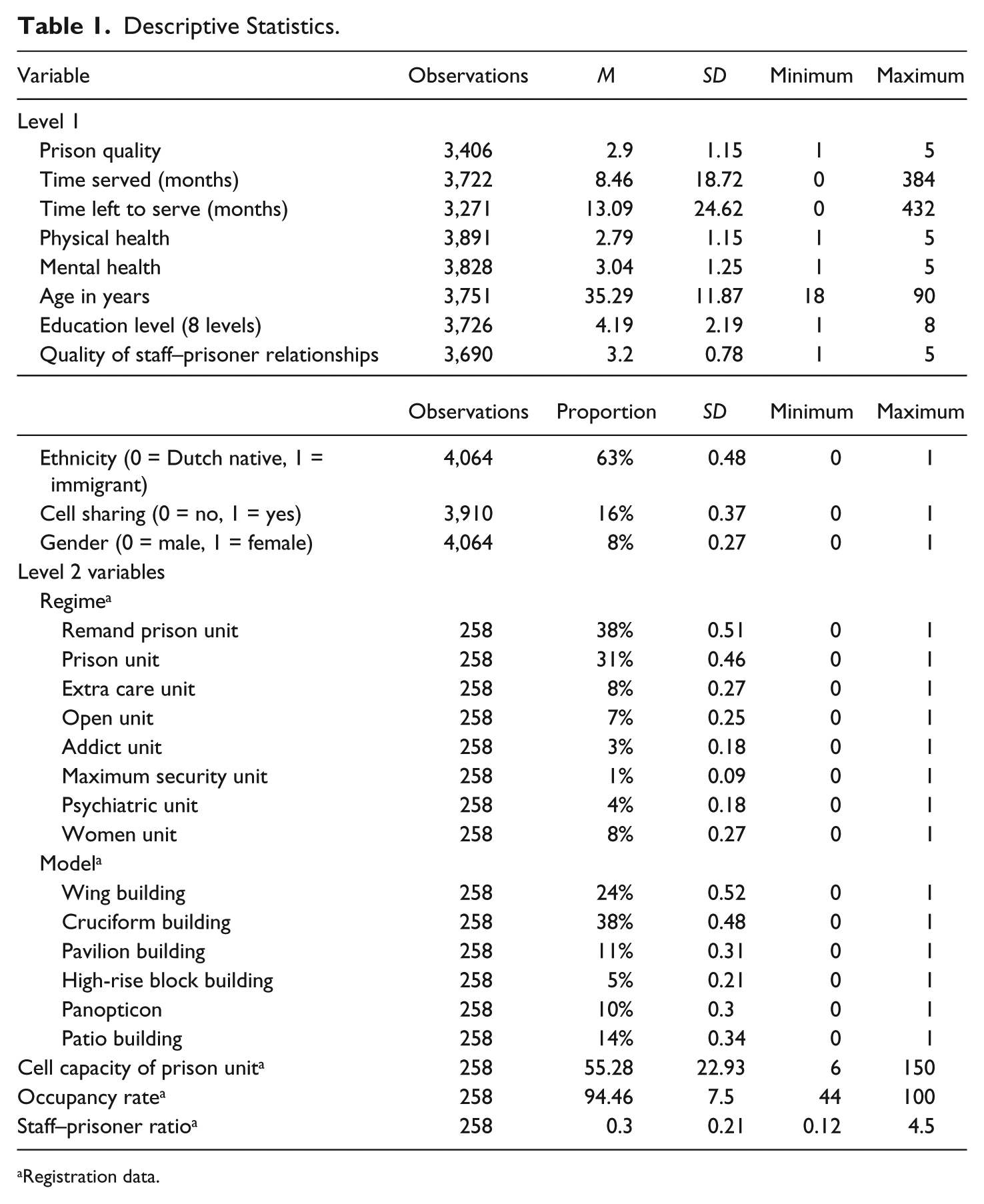
The variables in this study are listed in Table 1, along with their mean, standard deviation, and minimum and maximum values. Different measures are included to examine the potential effects of social and spatial density. A prison unit has on average 55 prisoners, with the largest unit housing 150 prisoners. Occupancy rates differ between 44% and 100% per prison unit. It is not a common practice nor is it necessary in the Netherlands to operate prison units above their capacity. Cell sharing is considered part of formal capacity, since the cells were refurbished. As a result, the introduction of cell sharing enlarged the formal capacity. Assignment to double cells is not random; some care is taken to avoid situations that could cause conflict. Various factors are taken into account, as required by law, to determine suitability for cell sharing (e.g., health, behavioural problems, and offence background). According to an inspectorate report, these rules are indeed applied in practice (Inspectie voor de Sanctietoepassing, 2011). This inspectorate report also identifies other factors which are considered, such as smoking, language, and cultural background. It is possible that this non-random assignment influences the relationship between cell sharing and prison quality. We have therefore included the following control variables: time served, time left to serve, physical health, mental health, regime type, architectural design of the prison, age, ethnicity, and education level. However, given that prisoners who share cells are selected on the basis of suitability for cell sharing itself and compatibility with their cellmate, we expect any confounding influence to be a positive one. That is, prisoners who share a cell are considered well-behaved and lacking of obvious problems, which might be related to higher ratings of prison quality. Therefore, we argue that a negative relationship between cell sharing and perceived prison quality is attributable to the experienced circumstances rather than selection effects.
Descriptive Statistics.
Registration data.
On average, there are 3 prison officers per 10 prisoners (staff–prisoner ratio = 0.3), taking into account that prison officers work in shifts. A total of 16% of the respondents share a cell. The quality of staff–prisoner relationships is measured by a scale comprised of 12 items (e.g., “The officers are friendly to me”; “If I feel down, I can talk to the officers”; Cronbach’s α = .92).
Control variables
In the rest of Table 1, the descriptive statistics of the control variables are reported. These include the regime, the architectural design of the prison building (model), time served, time left to serve, self-reported physical and mental health (1 = bad, 2 = moderate, 3 = sufficient, 4 = good, and 5 = excellent), age, ethnicity, and education level (1 = primary school ascending up to 8 = academic degree, with 4 = lower level secondary education, similar to year 11 in the United Kingdom).
All variables were derived from the prisoner survey except for the variables marked with an ‘a’. These are registration data from the Dutch prison system, which are on the unit level in the data set. The “observations” column shows that there is some missing data, because not every prisoner answered every question. To prevent loss of respondents, multiple imputations were used (M = 5 imputations) with the Stata12 xtmixed multiple imputation module (full long). Furthermore, the variables were tested for collinearity and multicollinearity. Correlations between all independent variables were far below the maximum accepted value of r = .65. Following Klein’s Rule of Thumb, auxiliary regressions showed lower R2 scores than for the original regression, which indicates that there is no multicollinearity. Additional 1/Variance Inflation Factor (VIF) tests support this. We therefore assume that each of our variables represent different constructs.
Analytic plan
Prisoners are housed in prison facilities which are divided in units; therefore, respondents within a unit are more likely to respond in the same way than prisoners from different units. The hierarchical structure of prisoners belonging to a unit within a certain facility makes the use of multilevel analysis an obvious choice of method (Snijders & Bosker, 1999). Multilevel analysis is a regression method that accounts for group-level dependence; that is, part of the variance in the dependent variable can be attributed to unit-level characteristics.
The dependent variable is based on a 5-point Likert-type scale. This is strictly speaking an ordinal scale; however, it is general practice to treat Likert-type scales as interval variables, as we assume that the increments are equally spaced, so that parametric tests are allowed. The analyses used in the present article allowed for random intercepts for each prison unit, as we expected them to differ. Fixed slopes were applied to the model, as effects were not expected to differ between facilities. The statistical analyses of the data were performed with Stata 12, using multilevel mixed effects linear regression models.
To check whether the results for “prison quality” represent general quality of prison life, we also conducted the same analyses for the quality of life scales (safety, rights, prisoner relationships, health care, programming, daytime activities, autonomy, rehabilitation, staff–prisoner relationships). However, these results are presented in less detail in the next section, so as to preserve clarity and avoid confusion.
Results
We used the random effects ANOVA model which has no covariates (“empty model”) to decompose the variance into between- and within-prison units. Regarding the dependent variable “prison quality,” the empty model reveals that 29.9% of the variance is attributed to between-unit variance. The use of multilevel techniques is therefore appropriate.
In Table 2, three models are presented to see the additional explanation in “prison quality” when more independent variables are added to the model. The first model shows which control variables are related to prison quality. Prisoners who rate their health higher are more positive about their prison experience. Age and education level also have significant coefficients, although the effects are small. Furthermore, the results show notable contributions of regime and architectural design. Extra care, open, and psychiatric units are associated with a higher appreciation of the prison. These regimes have a relatively extensive daily program, a higher staff–prisoner ratio and higher educated personnel, which could explain the relationships found. Female prisoners rate their quality of prison life higher than their male counterparts. Regarding architectural design, prisoners in patio facilities are more positive about the prison in comparison to prisoners in a wing-design prison. The patio design has inner gardens which may positively influence the perception of space.
Predictors of Prison Quality.

Note. b-coefficients are reported.
p < .05.
In the second model, density measures are included. The main finding is that cell sharing has a negative association with prison quality; prisoners who share a cell rate their satisfaction with the prison on average 0.32 points lower on the 5-point Likert-type scale. Although a prison unit’s cell capacity and occupancy rate are significant in the model, the coefficients are very low and the effects are therefore considered negligible. Staff–prisoner ratio has a more substantial coefficient, but is non-significant.
In Model 3, the variable that represents “quality of staff–prisoner relationships” is added, to see if it (partially) mediates the effect of cell sharing on prison quality. These are the final two steps in the four-step plan outlined by Baron and Kenny (1986) to establish mediation. 5 The results show a strong coefficient for “contact with prison officers” (0.85). This means that, other things being equal, when the appreciation of prisoners about their contact with prison officers rises with 1 point on the (5-point) Likert-type scale, then prison quality increases with 0.85 on the 5-point scale. Furthermore, the addition of “quality of staff–prisoner relationships” substantially reduces the main effect of cell sharing on prison quality (i.e., partial mediation) to a coefficient of −0.14. This suggests that cell sharing has a direct negative effect on prison quality, but also an indirect effect through a perceived reduction in quality of contact with prison officers.
Model 3 also shows a lower value for a few other coefficients. In particular, the relationships between specific regimes and prison quality are reduced, which suggests that the quality of contact with staff may have an impact on the quality of life in these regimes. Moreover, the measures of density are insignificant. This indicates that measures of density which are equal for all prisoners in a unit do not affect prison quality as much (if at all) as individual experiences with crowding (i.e., sharing a cell) and the perceived quality of staff–prisoner relationships. While cell capacity is a measure of social density, occupancy rate is a proxy for spatial density. However, as we have described in the methodology section, there are no prisons in the Netherlands which operate above their capacity (remember that the introduction of double cells has increased capacity without an increase in available space). Cell sharing, therefore, increases spatial and social density. As a consequence, it is difficult to disentangle the differential effects of spatial and social density. The results further show no significant main or interaction effect of gender (and cell sharing) on prison quality, which indicates that the effect of cell sharing is the same for men and women. The same is true for Dutch native and immigrant prisoners.
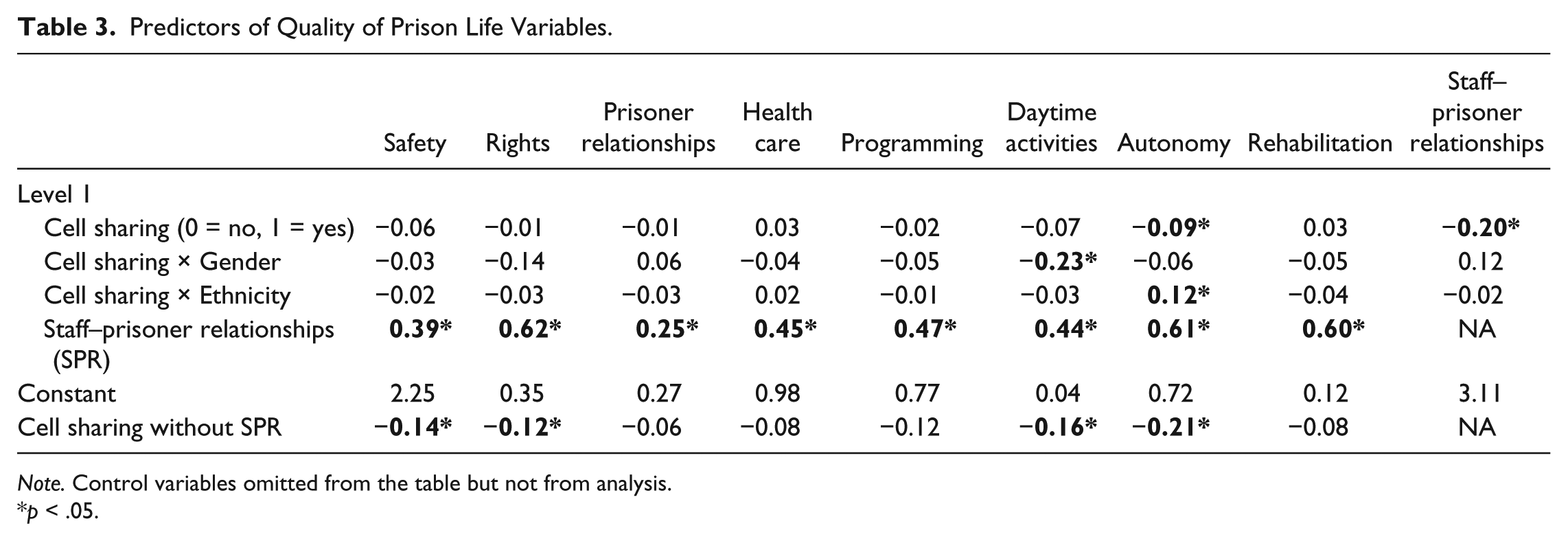
As mentioned before, similar analyses were conducted for the other quality of prison life variables (safety, rights, prisoner relationships, health care, programming, daytime activities, autonomy, rehabilitation, staff–prisoner relationships). Results (see Table 3) show that cell sharing has a small but significant, negative effect on the variables “safety,” “rights,” “daytime activities,” and “autonomy,” when staff–prisoner relationships is not included as an independent (mediator) variable. When staff–prisoner relationships is added to the equation, the effect of cell sharing is reduced and becomes non-significant for all dependent variables, except autonomy. These results further show that cell sharing is indeed negatively related to staff–prisoner relationships; that is, sharing a cell decreases prisoners’ rating of the quality of staff–prisoner contact—other things being equal—with 0.20 on a 5-point Likert-type scale. This confirms that cell sharing tends to negatively affect prisoners’ perceptions of the quality of prison life, which can for a large part be explained by a perceived decrease in the quality of contact between staff and prisoners.
Predictors of Quality of Prison Life Variables.
Note. Control variables omitted from the table but not from analysis.
p < .05.
Discussion
Although research on the effects of crowding has developed significantly over the last few decades, many questions still remained, especially with respect to the differential effects of different types of crowding. Moreover, much of the previous crowding research has been conducted in the United States, where prison conditions are notably different from those in many European countries. This article has examined whether effects of crowding can also be observed in prisons in the Netherlands.
Three key findings emerged from our analyses. First, sharing a cell was negatively related to prisoners’ perceived quality of prison life. The results for a one-item dependent variable measuring “prison quality” were generally in line with results for more extensive quality of prison life scales. The non-random assignment of prisoners to cell sharing possibly influenced the relationship between cell sharing and perceived prison quality. The selection process targets well-adjusted prisoners, who may rate the prison quality more positively than prisoners with behavioural or mental health problems. This would suggest that the negative relationship between cell sharing and perceived prison quality may have been mitigated by the selection process. To rule out any confounding influence in either direction, one would have to conduct an experiment.
Second, other indicators of crowding (i.e., social and spatial density on a unit level) did not appear to have an impact on prison quality. We therefore concluded that the experience of crowding on an individual level plays a more important role in perceptions of prison conditions than crowding on a unit level. This could be explained by the continuous immediate vicinity of a cellmate, as compared with the total number of prisoners or occupancy rate on a unit level. Furthermore, crowding in the Netherlands is very different from crowding in the United States, where cells are smaller, sentences longer, prisons larger, and crowding problems more serious. Material and crowding conditions in the United Kingdom are considerably different from the Dutch situation as well (Kruttschnitt & Dirkzwager, 2011). For instance, prisons in the United Kingdom suffer from overcrowding, which means that cell sharing may be accompanied by other capacity-related problems, such as lack of meaningful activities.
Finally, the quality of contact with prison officers appears to largely explain the effect of cell sharing on prison quality and other quality of prison life variables. Cell sharing appears to undermine staff–prisoner relationships, which could decrease the intended benefits of good relationships and staff treatment. The presence of a cellmate likely reduces the number of opportunities for contact with prison officers. Prisoners may be less inclined to discuss problems with an officer in the presence of another prisoner; instead, they may choose to uphold an image of a “real man” (Sykes, 1958); undisturbed, tough, and emotionally balanced. However, as a result, problems may go undetected. This could negatively affect a prisoner’s well-being, his or her prison experience, and potentially also safety in the prison and rehabilitation outcomes. In general, it was found that the quality of staff–prisoner relationships is the most important predictor of quality of prison life. This corresponds with findings from prison research conducted in England and Wales (Liebling, 2004; Liebling et al., 2011). The negative effect of cell sharing mostly operates through its impact on staff–prisoner relationships.
The results from this study suggest that housing prisoners in a single cell is preferable with respect to their welfare. In addition, cell sharing may pose a threat to the order and security of a prison, as it appears to decrease the quality of staff–prisoner relationships. This supports the main recommendation from the Mubarek Inquiry, namely, that enforced cell sharing should be eliminated (Keith, 2006). The findings also add weight to the European Prison Rules (Council of Europe, 2006), which state that “Prisoners shall normally be accommodated during the night in individual cells except where it is preferable for them to share sleeping accommodation” (Part II, 18.5). Cell sharing may be preferable when a prisoner is at risk of suicide, but only if it does not cause additional stress. In any case, prisoners should be given a choice and paired up only if they are deemed suitable to associate with each other. The negative impact of cell sharing on the prison experience and staff–prisoner relationships may also extend beyond the prison experience and increase the risk of reoffending (Listwan et al., 2013).
We therefore recommend that politicians and policy makers should minimise the use of cell sharing. They must be aware that cell sharing complicates the achievement of some central goals of imprisonment, for instance, the realization of humane conditions and safety. They should also understand that cell sharing goes against the Dutch penological philosophy, as cell sharing is negatively related to good staff–prisoner relationships, which are considered to be at the heart of prisoner treatment and rehabilitation. Prison governors may not be able to avoid cell sharing, but they may take measures to counterbalance or compensate for the negative effects of cell sharing. For example, they could provide extra amenities and schedule daily activities in such a way that the time that prisoners are both in their cell at the same time is reduced. Furthermore, where possible, prisoners should have a voice in the assignment to single and double cells, and be moved to a different cell if there are any problems.
The use of self-report data as dependent variables could be criticized on the basis of potential bias, due to social desirability or a tendency to convey a general sense of dissatisfaction with being imprisoned. However, there is no reason why this tendency would differ substantially between individual prisoners (Camp, 1999), although we cannot exclude the possibility that the presence of a cellmate or collusion with other prisoners prevented some participants from honestly answering the questionnaire. Some independent variables were crudely measured; for instance, the assessment of physical and mental health may be improved in future. Another well-known problem with survey-based data is high non-response, which threatens the generalizability of any findings. Reading ability may have played a role in the choice to participate or not, as this was a written survey rather than a face-to-face interview. Although we have no reason to believe that the sample is substantially different from the population, it is important to keep in mind that the effects of cell sharing are unlikely to be the same for every member of the population. Furthermore, while we controlled for a wide variety of variables that may affect the relationship between cell sharing and prison quality, we cannot rule out the possibility of other confounding factors, such as offence background and character of prisoners.
This study made a contribution to research on the effects of crowding on prisoners’ perceptions of the quality of prison life in Western Europe. However, little is still known about the prison conditions in other countries besides the United States and Western Europe (England and Wales in particular), and how these conditions affect the quality of prison life. Further research should focus on broadening the scope of data sources, such as records of misconduct in prison, quality ratings by staff, and recidivism rates. What is also currently lacking is qualitative research on prisoners’ perspectives regarding cell sharing. This could improve insight into the subjective experience of crowding, the reasons why prisoners prefer single or double cells and whether cell sharing places more emphasis on the convict code, which could explain reduced contact with prison officers.
Overall, this study confirms that staff–prisoner relationships make an important contribution to perceptions of prison quality. Cell sharing appears to have a negative effect on these relationships and also a small independent negative effect on prison quality. Further research should investigate whether these findings can be generalized to prison populations elsewhere.
Footnotes
Acknowledgements
The authors would like to thank Dr. Gerald G. Gaes, Dr. Adrian Grounds, and three anonymous reviewers for helpful comments on an earlier version of the manuscript.
Declaration of Conflicting Interests
The author(s) declared no potential conflicts of interest with respect to the research, authorship, and/or publication of this article.
Funding
The author(s) received no financial support for the research, authorship, and/or publication of this article.