



Abstract
The National Incident–Based Reporting System (NIBRS) is an important data set serving social scientists, policy makers, the business community, and the press. However, it is hampered by low participation rates among the nation’s police agencies. This article outlines a strategy for enhancing NIBRS by (a) providing police agencies free and supported software to extract and transmit an agency’s Record Management System (RMS) data in NIBRS format (or a data-entry system if an RMS does not exist), (b) including personal identifiers of arrestees, and (c) allowing police agencies to access the national data for routine police work. The article describes how taking these steps would decrease the costs of implementing and maintaining NIBRS, encourage widespread adoption, and increase data quality. These enhancements could foster substantial improvements in policing as well as other aspects of the criminal justice system. These changes would also open up new and exciting areas for academics and analysts, including the ability to study criminal careers over time as well as criminal networks within NIBRS.
The true challenge to NIBRS lies in promoting the collaboration and alliance with local law enforcement or the provision of incentives for accurate and complete compliance with the data collection requirements.
The National Incident–Based Reporting System (NIBRS) is an important tool supporting research on crime and justice. It is the foundation on which most national statistics on crime are generated (supplemented by Summary Statistical Report [SSR] in jurisdictions that do not contribute to it), and it is used in myriad applications in the government and private sectors. The value comes from the thoughtful design of the system (data organization), the breadth of information measured (i.e., data on offenders, victims, and situations in criminal incidents), and its size: NIBRS contains information on millions of criminal incidents over multiple decades and across thousands of police agencies. There are few, if any, crime data systems which are as large and detailed as NIBRS. Yet, the system has encountered major challenges in reaching its full potential. Although it was intended to be used by all police departments in the nation, fewer than 33% of departments currently participate. 1 Without question, NIBRS would be far more useful if it had wider or universal adoption.
NIBRS was designed in a series of meetings held between 1980 and 1985, piloted in 1987, and launched as a national data collection system in 1992 (Maxfield, 1999; Poggio, Kennedy, Chaiken, & Carlson, 1985). It is managed by the Federal Bureau of Investigation (FBI) and operated through their Uniform Crime Reporting (UCR) program. 2 It was created in response to widespread calls for increased quality and quantity of national data used to generate statistics on crime and support social science research (Maxfield, 1999; Poggio et al., 1985). NIBRS was designed to address four problems with the national research and reporting capacity in particular.
First, national statistical reporting only covered a small number of crime types. The most comprehensive statistical reporting program at the time was the UCR’s Summary Statistical Report (SSR), 3 an annual count of a small number of crime types in each jurisdiction (i.e., Homicide, Rape, Robbery, Assault, Burglary, Motor Vehicle Theft, Larceny, and Arson). 4 While important, these offenses made up a far from complete list of crime types of interest to researchers and policy makers (Maxfield, 1999; Poggio et al., 1985). The NIBRS system (a) expanded the scope of crimes covered to 59, and included additional violent crimes (e.g., carjacking) as well as victimless or public order crimes (e.g., drug possession or sales, prostitution, bribery, criminal enterprise, gambling). Importantly, NIBRS also (b) corrected for measurement or definition problems in the SSR. For example, the SSR defined a sexual assault as the vaginal penetration of a female victim by a penis—a definition which failed to account for many other forms of sexual assaults such as same-gender victimizations (U.S. Department of Justice, 2012). 5 NIBRS, in contrast, recorded all sexual assaults regardless of offender or victim gender or other factors previously used to exclude sex offenses. It therefore allowed far more precision in specifying the volume of sexual assault in the United States and patterns among subtypes such as assaults involving sodomy, female offenders, male victims, and so on (Bierie & Davis-Siegel, 2014).
Second, the SSR only recorded the most serious charge in a criminal incident. This data organization strategy, often referred to as “hierarchy rules,” is widely recognized as a major limitation to the SSR (Maxfield, 1999; Snyder, 1999). For example, an incident which included 10 acts ranging from larceny to rape and murder would merely be counted as a “homicide,” just as an incident involving a single act of homicide but no concomitant criminal behavior. In contrast, NIBRS captures as many as 10 criminal acts in each incident. 6 Statistical analyses suggest the error rate generated by the hierarchy bias of the SSR is only marginal in some cases. For example, comparison of SSR and NIBRS for the generation of aggregate crime rate statistics generates errors of between 1% and 5% on index crimes (Rantala & Edwards, 2000). However, the error rate would be substantially greater for other types of questions, such as research focused on diversity of offending during criminal incidents (e.g., Bierie, Detar, & Craun, 2013).
Third, the SSR lacked information about incidents to support more than minimal research or reporting. The SSR recorded the date, locality (state or county), and most serious charge—but essentially no other data about the crime, victims, or offenders (Poggio et al., 1985). There are myriad questions that simply cannot be answered in the absence of this information. Also, the omission could easily lead to error in estimations using that data. In as much as unmeasured variables were correlated with crime and also varied over time or across geography, patterns as observed in SSR data could suffer from omitted variable bias.
Finally, the SSR did not easily facilitate individual-level research. In theory, one could conduct individual-level research via the data set underlying SSR. That underlying system, the Interstate Identification Index (III) contains approximately 10 columns of information about each arrest event (the number of columns has changed over the years) such as the date of arrest, the unique Originating Agency Identifier (ORI) of the police agency making the arrest, the Original Case Number (OCA) which is a unique identifier of a given case at an ORI, personal identifiers of the arrestee (name, date of birth, FBI number), and charges via an open text field. 7 A number of studies have used the underlying III data in smaller projects to measure criminal history or recidivism in samples of offenders. Few, if any, have attempted to use the data set to examine arrest patterns in the nation as a whole. 8 Rather, people have tended to use these data for national or large-area research by accessing the aggregated form (SSR).
Collectively, these limitations regarding what was being measured, how well it was measured, and how the data were organized presented serious limitations for researchers and policy makers. As a result, there were myriad basic and important questions left unanswered regarding police effectiveness, offenders, victims, criminal incidents, offending patterns, injury, etiology, and other aspects of crime and justice at a national level. NIBRS corrected these limitations by providing a platform for recording information about each offender in an incident, arrest (if made), victim, criminal act committed against each victim, and situation (e.g., alcohol or drug use by offenders, the number of offenders, types of relationships between the offender and victims, type of location, weapon use, gang involvement). The success of NIBRS is derived from several important strategic choices made in creating, launching, and managing the system.
Strategic Success
Several aspects of the technical and strategic planning of NIBRS were significant improvements over the SSR. First, the data architecture was modified and improved. The SSR pursued a single-table strategy for storing information. This meant information about a given incident was aggregated up to the incident level before being stored, which often resulted in a loss of information (e.g., only recording the most serious crime in the incident). NIBRS, in contrast, was built as a set of relational tables. Relational tables allow data to be recorded and stored at the most effective level (unit of analysis) for each category of information. For example, NIBRS includes a victim-level data set that contains a row of information about each victim in a given incident. Likewise, it contains a crime-level data set with a row of information about each criminal act in an incident, and so forth. An incident identifier attached to each data set allows each relational table to be matched to any other and aggregated to whichever level ultimately serves the purpose of a given study. Thus, no data are deleted. 9
Second, the NIBRS team incorporated a strong training element to the program. Experts are sent to police departments to give presentations and hands-on instruction, which increases data quality, eases implementation for departments, and reinforces the perception that UCR is invested in the system. UCR also engages in routine audits of local police agencies to ensure compliance, answer questions, and offer additional training. While the audit system was a strategic choice intended to improve data accuracy; the reviews also serve the secondary purpose of building legitimacy for the system.
Third, UCR directly engaged the academic community, law enforcement, and policy stakeholders. For example, they involved a NIBRS advisory board (referred to as SEARCH) consisting of members of law enforcement agencies and academic scholars to discuss and implement NIBRS. Perhaps more important, they placed annual data dumps of the relational data sets on the website of the Interuniversity Consortium for Political and Social Research (ICPSR). ICPSR is the premiere repository for social science data, and the placement of data there ensured broad access as well as high-quality support materials (e.g., labels, codebooks, description). As a result, the data are well-documented, easily available for researchers, and consistently constructed over time. Placing the data on the ICPSR website generated enormous value—It is a key reason why the data have become a critical and pervasive tool in criminology as well as other fields (e.g., city planning, business development, finance, public health). 10
When NIBRS was launched in 1992, it was hailed as a revolutionary investment in national statistical reporting—an advance so profound it promised to reshape what the academic and policy communities could and would know about policing, victimology, and criminal behavior (Maxfield, 1999). Yet, in the 20 years since its inception it has spread across the nation’s police departments at glacial speeds—slower than anyone could have imagined (Maxfield, 1999; Roberts, 1997). An important question to ask is, Why?
Glacial Adoption of NIBRS
As of 2011 (the most recent NIBRS data available), more than 6,159 police departments across 37 states participate in NIBRS. Although this is a substantively large number of agencies and broad representation across the United States, it only constitutes approximately 30% of the nation’s more than 18,000 police agencies. There is no participation from states with the greatest frequency of crime (Florida, California, and New York), and there is only marginal participation in others (e.g., 59 jurisdictions participated from Texas in the 2011 data). No federal law enforcement agency (including the FBI) reports to NIBRS. 11
NIBRS contains meaningful and important data, and it is by far the largest “actionable” data set for jointly analyzing crime, victims, and offenders. The features that make it useful include its organization, the number of substantively important data elements measured, and its sheer size. For example, there are well over 60 million incidents in the data. Yet, the participation rate is troubling. It implies there is likely meaningful selection bias. It is also troubling because of the seeming paradox of disinterest. How can police agencies turn down a system that has been hailed for 20 years as the system for providing widespread benefits to law enforcement, public safety, science, and policy?
Lowering Costs and Increasing Returns
The single most important reason for low participation, according to surveys of police agencies and focus groups on the adoption of NIBRS, is the “general and widespread perception that implementing NIBRS is very costly for local law enforcement agencies” (Roberts, 1997, p. 9). Currently, each agency must buy or create and maintain their own software package to facilitate data-entry and transmission of data to NIBRS. UCR provides police departments a several-hundred-page list of technical specifications regarding the exact format of each data element they are required to transmit to the FBI. This strategy generates a nontrivial expense for each department, and it often requires computer programmers to create and maintain the data-entry and data-extraction systems. 12
NIBRS (2002) estimated that the cost of implementing NIBRS varies by agency size and whether the agency already has a Records Management System (i.e., integration costs). Medium-sized agencies saw estimates ranging from US$125,000 to US$197,000 for implementation, plus an annual maintenance cost of US$11,000 to US$25,000. Large police departments (those least likely to participate in NIBRS) saw estimates ranging from US$242,000 to US$640,000 for implementation, and US$63,000 to US$128,000 for annual maintenance. Recall that these are reported in terms of 2001 dollars. It is unclear whether costs would have come down with newer innovations in technology, but it is clear that implementation costs are still seen as a major impediment to participation (Bureau of Justice Statistics [BJS], 2012). For many police departments, this expense makes NIBRS prohibitive—There is no way for them to find the money to implement or maintain the system.
This problem is magnified when interpreted to scale. At the national level, the costs for each non-participating agency to create its own systems would be astronomical. Assuming an unreasonably low implementation cost of US$150,000 for each of the approximately 12,500 additional police agencies, adopting NIBRS would imply a total cost of nearly US$2 billion plus US$160 to US$320 million for maintenance. The direct and opportunity cost would be hard to justify regardless of the estimated indirect benefits. This problem of cost is a fundamental reason for the lack of adoption of NIBRS (Roberts, 1997).
The second most important reason for low adoption of NIBRS is a lack of direct value for participation to police departments (Roberts, 2000). Research with police agencies found police executives clearly “felt that NIBRS [was] of more value to researchers than to law enforcement agencies, and had a general concern that NIBRS is only of value in macro-level analyses” (Roberts, 2000, p. 8). NIBRS was designed for national research and not for direct support of law enforcement. Police chiefs who participate may maintain involvement for any number of reasons, including an interest in supporting science (which may result in new insights for policing), wanting to be cutting edge, or mere altruism. The one thing participation in NIBRS does not derive from is direct utility to officers in the field. This is because NIBRS is not accessible to police once their data enter the system—officers cannot retrieve information about an arrestee or case once the data is sent to UCR.
Some agencies have addressed this by also creating a “Local” Incident–Based Reporting System (LIBRS)—dumping data both to UCR (to become part of NIBRS) as well as their own network to be used by crime analysts. Many have added fields to the system to make it more relevant to their locality (Faggiani & McLaughlin, 1999). Still others have created systems that are similar to NIBRS which they use for statistical reporting or crime analysis but do not upload to become part of NIBRS. The critical difference between these alternate systems and NIBRS is one of scope—The local systems are not national incident-based reporting data. They cannot be used to do routine policing tasks such as running criminal history checks during or prior to a citizen contact. LIBRS would add some value for such tasks because of the relatively greater level of detail on criminal behavior, but it would miss all offenses recorded in other jurisdictions. This is a severe limitation from the perspective of officers and a central reason why LIBRS are unlikely to be used in routine police work.
These problems could be mitigated by enhancing NIBRS in ways that significantly reduce costs and substantially increase operational value of the data in routine police work. If this were to occur, police departments may be far more willing to participate—perhaps even universally. One path to accomplishing this would be to enhance NIBRS by
providing a free and supported data extraction to NIBRS for any RMS,
recording personal identifiers of arrestees, and
offering access to nationwide arrestee information for law enforcement.
Broader adoption would likely emerge as a result not only because it would remove the cost barriers, but because the system would deliver tangible returns for police—the kind of value police executives have expressed interest in. Research shows police executives “consistently expressed an interest in understanding the potential value of incident-based offense and arrest data at the local level, beyond what use is currently made for crime analysis” (Roberts, 2000, p. 8). Unable to identify examples of this kind of use has generated skepticism and disinterest in participation—because NIBRS truly does not offer “operational value” (p. 8). These enhancements would change that by making the system useful (and perhaps even central) to everyday police work.
There are myriad applications of an enhanced NIBRS (e-NIBRS) for police work. Several applications are outlined in the “Discussion” section. However, one operational use is described below in more detail to more fully illustrate the value of these changes: increasing the quality of criminal background checks conducted by police in the field.
Criminal History in the Field: An Example of the Value of Enhancing NIBRS
A central task of police officers is responding to calls for service or otherwise making contact with citizens—work for which knowledge regarding criminal history is often important (Reis, 1971; Skogan & Frydl, 2004). Whether officers contact a citizen while responding to a call for service, administering a warrant, or investigating suspicious activity, a criminal history check is often a core step toward making sense of the situation. In almost every case, officers use criminal history as a starting point to understand the risk they are facing, to corroborate stories being told, and to guide their attention in looking for crime or a danger to the public. When officers check criminal history, they are generally accessing the national III system to identify prior charges as well as the jurisdiction and date of arrests. Although this is useful as an investigative tool, there are limitations. The information is not detailed enough to guide officers in making important distinctions that could inform risk assessment and investigative strategies. These limitations are best illustrated by comparing III with the guidance offered by a potential e-NIBRS criminal history check.
Consider, for example, a call for service regarding a domestic dispute. From III, the officers dispatched might learn one of the subjects has been involved in a prior assault. While this information might be somewhat helpful, the officers would not know what this “prior assault” means. The individual may have been in a fight unrelated to domestic situations, or he could be a chronic domestic batterer. An experienced officer would probably keep both possibilities in the back of his or her mind. This is appropriate and reasonable. NIBRS, however, could easily provide the officer with more definitive information as it contains fields describing the relationship between victims and offenders. In addition, it could tell the officer about completely different but important alternate interpretations of the prior assault. Suppose the e-NIBRS report showed the prior assault was perpetrated against a 9-year-old female victim, involved sexual penetration with an object, and was computer facilitated. Furthermore, suppose e-NIBRS recorded that the offender was the stepparent of his prior victim. That is, the subject’s “assault” is signaling that he is a sex offender who has produced child pornography by victimizing a family member. Each of these data elements already exists in NIBRS.
The information NIBRS could provide would clearly be important to the responding officer in this scenario. It would give clues regarding the potential source of the current dispute and would directly inform what questions the officer might ask to ascertain if there is a new child victim. It may prompt the officer to scan the house for signs of filming. It may suggest the dispatcher route an officer with specialized skill in child abuse investigations to the scene to potentially interview a new sexual assault victim and be prepared to contact social services. The critical point is that information not only matters, but in fact changes the response paradigm. It changes the “filter” the officer brings to the scene, which contributes to better investigative efforts and public safety.
In this scenario, III may or may not contain a charge that referred to a sex crime or child victim. Charges as represented in III are legal concepts. Sexual offenders are often arrested for assault generally, or have their charge re-classified as an assault as part of a plea process to keep themselves off the sex offender registry (Letourneau, Levenson, Bandyopadhyay, Armstrong, & Sinha, 2010). This scenario of missing sex offense information is not uncommon when relying on III. The same can be said of many other crime types or offender profiles that are important for police to know about but cannot be ascertained through III. In contrast, NIBRS describes the actual incident itself—both in more detail and without this legal filter in place.
Can’t Police Already Access Substantive Information? Why e-NIBRS?
Police usually have access to additional information about past criminal charges above and beyond a rap sheet. For example, they might have access to an actual police report from a prior crime. In that case, an officer may obtain useful information commensurate with NIBRS. However, three limitations would still be pervasive.
First, agencies vary in the technology present to facilitate access to old police reports. Some police agencies have very effective access for officers in the field. For example, many large-city police officers have a computer system which displays old police reports from their jurisdiction (and often these systems can be accessed from computers in police vehicles). Officers in smaller police departments are less likely to have these systems, but likely have access to paper files or electronic copies of police reports at their station. If that officer is in the field, they can call support staff at the station to find and read old police reports, then radio the officer with important details. 13 Jurisdictions that rely on the latter strategy would likely find the information arriving far too late to be useful during a contact.
Second, data in field reports are often poorly organized for consumption—information is not presented in a consistent way that allows details, and combinations of details, to be quickly assessed. Police reports record case management information fairly well (e.g., names, dates, times, and locations). They also record legal evidence, such as statements by witnesses, well. However, they are generally designed for use in building cases for court. They are written in text rather than closed fields; the style of writing, detail of recording, and where officers place critical details can vary between officers and agencies. This makes it easy to miss important information—it is a poor design for consistent and quick consumption of data and especially when synthesizing information from various jurisdictions in a short time frame.
This latter point is critical because merely having access to information is often not enough. Officers also need meaningful access—the ability to consume relevant information in a timely manner. For example, consider the earlier domestic dispute scenario. Suppose the responding officer had access to old police reports while en route (via a dispatcher or computerized access in the vehicle). In either case, pulling these police reports might generate dozens or hundreds of pages of text to review to identify behavioral details from prior arrests. The officer/dispatcher may have time to do this if there are no other demands on his or her time, and if the offender only has a few prior arrests. But suppose there are 5 prior arrests, or 10, or 20. Would an officer or dispatcher have time to read all of them while en route or after pulling up to the residence? In our hypothetical domestic dispute, there may not be sufficient time to learn of the prior sexual assault case, and as a result the officer would be unaware of the type of risk presented and the type of preliminary investigation the call may require. The issue of limited access to prior offending behavior is especially problematic in terms of high-frequency offenders because these criminals would have the greatest number of police reports to sift through. Ironically then, high-frequency offenders have the most information available for exploiting yet, with the current technology, may be the least likely to have that information made meaningfully available to the officer on scene.
Third, police reports are often available only within that officer’s jurisdiction. There are likely a nontrivial number of offenses which occur in “other” jurisdictions (especially for high-frequency offenders). While there are certainly avenues for eventually gaining access to information from other jurisdictions, current organizational and technological constraints prevent consistent and fast access.
An e-NIBRS system would solve these three problems and, in doing so, increase the ability of police to spot danger and improve investigations in the field. It would do this in part because of the increase in quality and completeness of the data. It would also emerge because of the ease by which that machine readable data could be leveraged to create comprehensive display modalities that are easy to navigate and consume. This might include a dashboard with drill-down features or other visual communication strategies. The specifics of the display are not as important as the point that visually appealing dashboards are useful and possible with NIBRS; they could offer a comprehensive survey of risk and investigative guidance in a single glance as an officer arrives at a location. This potential for flexibility in display and systematic organization of data means enhancing NIBRS is likely even more desirable than alternate systems one could imagine (e.g., a national system of police reports displaying electronic copies of old police reports).
Adding Future and Historic Identifiers
Creating a structure to record identifiers into NIBRS on future incidents would be fairly simple. One only needs to add fields to capture arrestee identity (i.e., name, date of birth, and FBI Number for each arrestee). The system already has more than enough empty fields to support this—the difficulty of facilitating this is minimal. Accessing the data could likely be facilitated through National Criminal Information Center (NCIC) terminals or similar infrastructure already providing the technical and legal infrastructure guiding access to national criminal history information in nearly all police agencies in the United States. Likewise, adding personal identifiers does not mean the data can no longer be shared with researchers. A transactional data system could be kept for police use, and a copy of this data for public use could include code to strip personal identifiers off the data before uploading to ICPSR. This is exactly the same process as already occurs—An operational data set is kept at FBI while one field (the agency case number) encrypted before transmitting the data to ICPSR.
But what does one do with the 60 million incidents already in NIBRS which have no personal information regarding who the arrestee was? Certainly, we do not want to lose this information in creating an e-NIBRS. There is a relatively simple solution to this problem, as well. As just noted, agencies using NIBRS already enter two pieces of identifying information on each case: the police agency identifier (ORI) and the local case number for the incident (OCA). The FBI retains a pre-encryption copy to facilitate audits of agency data-entry. This auditing detail provides the solution to adding historic identifiers. The same information (ORI and OCA) is contained in the III file listing the charges, dates, and agencies making each arrest in the nation. That file, in turn, connects each incident to the actual name, date of birth, and FBI Number of an arrestee. In short, a single merge of the two data sets (III and NIBRS) on the ORI and OCA numbers would bring personal identifiers into the NIBRS data. In the case of multiple arrestees, this list of offenders has to be matched within the incident to arrestee details (gender, race, and age).
Would this work? As a proof of concept, the author of this article linked the full, un-encrypted file for NIBRS (2006-2009) with a data set similar to III. This similar data set, referred to as Wanted Persons, lists all active warrants in the nation along with the ORI and OCA of the agency generating that warrant (if applicable). The Wanted Persons data set only overlaps with NIBRS in a fraction of cases. This is because many of the underlying crimes that generate warrants are not NIBRS crime (e.g., most warrants are for a probation, parole, or court order violation; Bierie, 2012). However, there is enough overlap to demonstrate the concept of linking NIBRS to other data systems. In all, more than 5,000 arrests in NIBRS could be linked to a personal identifier using the Wanted Persons file. If III were used, we might expect nearly perfect matching (because all NIBRS arrests should be contained in III; Figure 1). 14
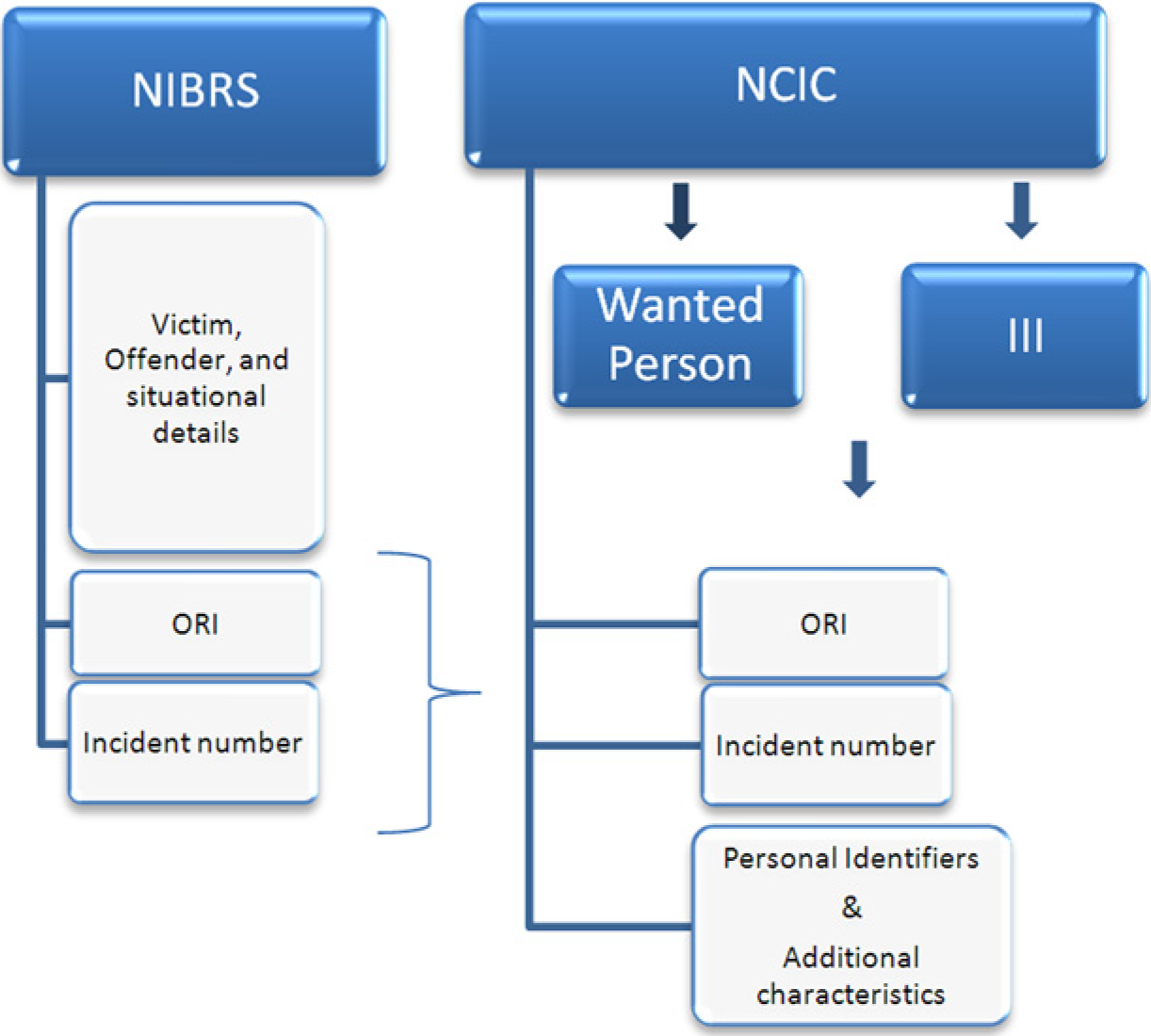
Matching process to retroactively add personal identifiers to NIBRS.
Adding identifiers into historic data may be an important first step to enhancing NIBRS. In part, this is because it is important to avoid losing millions of pieces of information that officers may need in the field—20 years’ worth of arrests and 60 million incidents. Also, it would allow a data repository to be created immediately that could serve as a platform for designing the technical aspects of an e-NIBRS and developing dashboards, displays, and other aspects of a national system. Adding in historic identifiers would provide an immediate data set which could be used to articulate and describe the eventual value of the national system to policy makers as well as researchers. This broad and diverse value is worth pausing to consider.
Policy Value to an e-NIBRS
A free, widely used e-NIBRS system, accessible to law enforcement and including personal identifiers, would generate far more value than the application described above (enhanced criminal history checks by police in the field). 15 Co-offender information could be used to generate leads in missing person cases or fugitive investigations. It could be integrated with COMPSTAT or other smart policing strategies. 16 For example, police analysts could use the data to understand networks of offenders in their cities and how they link to other networks in other areas. NIBRS could be used to help write faster and better pre-sentencing reports. It could be used by prison admissions offices to generate more accurate risk assessment tools and thus make more accurate security-level placements. It could be used to supplement the large amounts of missing data in the National Sex Offender Registry—data that would facilitate risk prediction of sexual recidivism for use by law enforcement enforcing the registry or pursuing sex offender fugitives. Law enforcement could apply the system to generate suspect lists in cold or current cases (e.g., who in the nation has been arrested for a similar sexual homicide as the one being investigated?). And the list goes on. Any one of these uses would likely generate meaningful reductions in direct and indirect costs to law enforcement agencies and increase public safety.
The potential of costs savings to any agency which would use e-NIBRS is important to be considered—particularly because those savings would likely dwarf the investment costs of creating an e-NIBRS. For example, consider just one of the potential uses: a better repository of data on which to ground prison security-level designation tools. The Federal Bureau of Prisons (BOP), the nation’s largest prison system, uses the III derived criminal history data within their risk prediction tool to determine the security level of an incoming inmate. Their tool has a large number of false positives; a tendency toward over-classification of inmate risk (Shermer, Bierie, & Stock, 2012). The difference in per-day cost for a single inmate is US$10 for each security level increased (Lappin, 2007). If better criminal history data could improve their risk prediction tool such that even 5% of the 200,000 inmates in custody could be moved down one security level, the improvement would save the BOP more than US$36 million annually. Extended over 10 years, the improved process could yield over a quarter billion dollars in direct budget savings to BOP. The value would be even greater if one considers the indirect savings that emerge from having safer prisons (for staff as well as inmates). If the same value was achieved by the rest of the U.S. prisons (housing the other 90% of the nation’s inmates), these savings would grow enormously.
Research Value to an e-NIBRS
Enhancing NIBRS would also lead to important advances for scholarship. The true personal identifier that would be added into the e-NIBRS (e.g., FBI number) could not be included in the public dissemination data sets. However, an encrypted personal identifier could be transmitted to ICPSR—creating a unique identifier of arrestees for researcher purposes without violating privacy. That is, all crimes associated with each person could be linked—Entire criminal careers could be identified and studied. This would create new value to science in at least four ways.
First, e-NIBRS could contribute to research on criminal-careers and life-course paradigms, helping shed new light on the process by which offending emerges, persists, and declines (Blumstein, Cohen, & Farrington, 1988; Laub & Sampson, 2003; Nagin & Land, 1993; Piquero, Farrington, & Blumstein, 2003). NIBRS currently does not allow this type of research because there is no way to identify whether any two incidents involve the same offender. If the data set allowed the identification of unique offenders, researchers could study how offending behavior changes over time, create new and more nuanced measures of acceleration versus desistance, study specialization versus diversity in offending, spree or serial offending, and other concepts from this arena of scholarship.
Second, and related, an e-NIBRS would allow some correction for a current statistical limitation in the data. Clustering of crime within person over incidents violates the independent-observation assumption in many potential uses of these data. It is unclear how much bias results; it would be proportional to the prevalence and importance of that clustering. As a large portion of offending is a function of a small number of people (Moffitt, 1993; Wolfgang, Thornberry, & Figlio, 1987), the error is unlikely to be trivial. Adding unique identifiers to NIBRS would allow researchers to solve this problem.
Third, criminologists have long suggested studying offender networks to better understand the emergence and character of offending or desistance (Giele & Elder, 1998; Laub & Sampson, 2003; McGloin & Shermer, 2009; Shover, 1996; Sutherland, 1939; Warr, 2002; Weerman, 2011). NIBRS currently allows examination of all arrestees or offenders in an incident, but it does not allow studies of the way groupings change over time or place. An e-NIBRS data set would allow the study of the same offender(s) across time and space as well as the way those networks link to one another.
Fourth, it would improve theoretical and policy evaluations. Hundreds of program evaluations, theoretical tests, actuarial tool validation studies, and other research studies have used arrest rates (SSR) for aggregate evaluations, or arrest history (III) to create measures of criminal history or recidivism at the individual level. These studies tend to look at crime overall (did it occur or not), timing (e.g., time to first arrest after release from a program), or whether a certain type of offense (e.g., violent crime) occurred. These studies usually do not measure criminal behavior with any more depth—what was done to a victim, how much injury, what kind of victims were targeted, where offending occurred, how many criminal acts occurred, and so on. This is not always the desired methodological choice, but one of necessity. These other details are not available in III or SSR. This means theory with more nuanced hypotheses regarding criminal behaviors are less often tested and potentially underdeveloped. Or, perhaps more interesting, it may imply the empirical tail is left wagging the theoretical dog. How much of the field’s theoretical thinking has conceptualized the world of crime, offending, and criminal careers in terms of a binary outcome because there was no other picture of crime to draw on? Where might theory go, if the picture available was in color rather than black and white?
Conclusion
NIBRS is a useful tool and will continue to be so even if no changes are made. It has generated valuable research and is the foundation on which most national statistics on crime are generated (supplemented by SSR in jurisdictions that do not contribute to it). The research potential and statistical reporting make the system itself likely to continue contributing to criminal justice planning, policy evaluation, and other endeavors (e.g., facilitating research and planning in other sectors apart from crime—such as finance, real-estate markets, and business development). The nation cannot afford to be without a system like NIBRS. Ironically, however, creating a tool focused exclusively on supporting research has led to a system less able to meet that application than if NIBRS had been designed to serve law enforcement.
The key obstacles facing NIBRS are the high cost and low returns for participation. It is extraordinarily expensive to implement and maintain a software system allowing the extraction of data from an RMS which can be delivered to NIBRS. It is especially expensive given the lack of direct utility to officers or agencies in completing routine police work. NIBRS can be enhanced by creating (a) a single useful and elegant software package to handle the data extraction (and entry if no RMS exists) and (b) an identified national NIBRS data set that is accessible to law enforcement. These two strategic choices would need to be made together to create a system that is enticing to all police agencies. Making it free, but not offering police access to the national system would likely only spur marginal increase in use. Offering access to officers in the field but leaving the prohibitive costs for participation would also likely only generate marginal increase in use. Making these two changes in unison would likely produce a tidal shift in the adoption of NIBRS.
This strategy is not without challenges. There are legal questions regarding police access to detailed criminal behavior histories. The data in NIBRS are less detailed than police reports each agency already possesses, implying there are no special privacy concerns that would be introduced. And police already have access to the same records and elements of Personally Identifiable Information (PII) as would be found in e-NIBRS via III—a system which is governed by carefully crafted and tested legal structures. As e-NIBRS would add no additional PII above and beyond III, it is likely that the same legal structures could govern access to both systems. Still, it may be that the additional details on criminal behavior invoke new legal requirements to consider.
There are also issues of funding. The cost of developing a software patch to extract data and deliver it to FBI is expensive. A national approach would be orders of magnitude cheaper because a single solution for each unique RMS provider could be recycled at thousands of police departments using that same RMS. But creating this series of templates, and tailoring them to each agency, is still expensive. The U.S. Department of Justice is currently engaged in a project to do this in a representative sample of police departments (discussed below), a program which is estimated to cost up to US$2 million for 400 agencies. A nation and universal program would likely cost even more. Despite being relatively less expensive as a national strategy, the cost would be far from trivial for the U.S. Department of Justice. 17
Finally, there are important technical challenges in implementing an accessible e-NIBRS system. How much storage and bandwidth is needed to deliver these data into and out of police agencies? How much computing power is needed to operate the system? These are difficult questions. Certainly FBI has templates in place to do so, such as the NCIC terminals which already exist in nearly every police department, as well as the infrastructure built to allow police to access pdf copies of police reports from across the nation (N-Dex). It is unclear whether there is room for an e-NIBRS on these networks, or whether new infrastructure would be required.
These technicalities imply a great need for experience, expertise, and leadership. Considering this, it seems clear that the success of such an endeavor is fundamentally tied to the involvement of the FBI’s Criminal Justice Information Services (CJIS) division. CJIS, which houses the UCR program, contains several thousand staff members who maintain and deliver national law enforcement data systems. Apart from vast and robust programming expertise, CJIS already has the basic infrastructure in place to deliver and maintain law enforcement data. CJIS operates most of the national criminal justice data systems, including those tracking the nation’s warrants, arrests, firearm purchases checks, and others. In each case, they have created a front-end data-entry mechanism to upload information from all law enforcement agencies to the national repository, obtained the storage space, and implemented a hardware and software structure to export that information to each agency in real time for use by officers in the field. It is hard to imagine another private or federal entity with as much potential to enact these changes as CJIS. The current state of NIBRS presents a golden opportunity for the field and CJIS to collaborate in a way forward that would eliminate the enormous local cost of participation in NIBRS, increase data quality, and reinforce the FBI’s mission of service to state and local police.
Finally, it is important to note that there are other options available which may move NIBRS forward. Currently, the U.S. Department of Justice is pursuing a strategy designed by FBI and the BJS which uses a grant-based process to generate a fully supported NIBRS system within a random sample of police departments. This strategy, referred to as the National Crime Statistics Exchange (NCS-X) Project, was launched in 2012 with a projected completion date of 2016 (BJS, 2012). The project offers intensive technical and administrative support to a representative sample of police agencies in adapting their RMS to generate NIBRS data and upload it to UCR. The project bears important similarities to the original blueprint for NIBRS—a plan which also called for NIBRS to be implemented in a representative sample of agencies to accomplish the major goal of NIBRS (i.e., generating national statistics on crime; Poggio et al., 1985; Snyder, 2010). The plan will likely generate a substantial improvement in NIBRS for researchers because of the intensive effort that will go into automated extracts (near zero costs for agencies) and increased generalizability of the data (Snyder, 2010).
The strategy, however, does not attempt to increase the operational utility of the system (e.g., add offender identifiers), and it is not intended to spur universal participation. Thus, it will not move NIBRS toward delivering the operational benefits mentioned above, such as enhancing officer awareness at crime scenes, solving investigations, facilitating courts in writing pre-sentencing reports, or helping with prison classification. And it will not move NIBRS toward the academic benefits described above, such as the ability to study criminal careers or networks. In this sense, there is a risk of history repeating itself—of pursuing a vision for NIBRS which prioritizes statistics over policing and (ironically) limits the statistical potential of NIBRS for that reason.
That being said, the NCS-X Project is not in conflict with an e-NIBRS strategy. Rather, NCS-X is a necessary first step toward an e-NIBRS. It will solve what is likely the most expensive and complicated problem in pursuing an e-NIBRS: creating an efficient front-end data-capture system for police agencies. It will also serve to demonstrate the feasibility of an e-NIBRS. If it is possible to deliver a free and supported NIBRS front end to a large sample of police agencies, then it is likely possible to do so for the whole nation.
The question, then, is whether the current vision of revitalizing NIBRS can be expanded. Can the field seize this period of motivation and momentum toward improving NIBRS to invoke an even bolder vision: a universal and operationally relevant NIBRS? By embracing a bolder vision, the field would move from an incremental step forward in NIBRS to a truly historic leap in the ability of this system to support science and the practice of law enforcement.
Footnotes
Declaration of Conflicting Interests
The author declared no potential conflicts of interest with respect to the research, authorship, and/or publication of this article.
Funding
The author received no financial support for the research, authorship, and/or publication of this article.