



Abstract
General theory attributes criminal behavior primarily to low self-control, whereas evolutionary neuroandrogenic (ENA) theory envisions criminality as being a crude form of status-striving promoted by high brain exposure to androgens. General theory predicts that self-control will be negatively correlated with risk-taking, while ENA theory implies that these two variables should actually be positively correlated. According to ENA theory, traits such as pain tolerance and muscularity will be posi-tively associated with risk-taking and criminality while general theory makes no predictions concerning these relationships. Data from Malaysia and the United States are used to test 10 hypotheses derived from one or both of these theories. As predicted by both theories, risk-taking was positively correlated with criminality in both countries. However, contrary to general theory and consistent with ENA theory, the correlation between self-control and risk-taking was positive in both countries. General theory’s prediction of an inverse correlation between low self-control and criminality was largely supported by the U.S. data but only weakly supported by the Malaysian data. ENA theory’s predictions of positive correlations between pain tolerance, muscularity, and offending were largely confirmed. For the 10 hypotheses tested, ENA theory surpassed general theory in predictive scope and accuracy.
Keywords
Theories are important for any discipline seeking to establish a firm scientific footing. Criminology is certainly still developing in this regard. Assessments of scientific theories are primarily based on how well they generate accurate predictions, the more predictions the better (Forster & Sober, 1994; Suppe, 1977; Trout, 2002). The present study compares the predictive accuracy and predictive scope of two contemporary criminological theories.
General Theory
Since its debut a quarter of a century ago, Gottfredson and Hirschi’s (1990) general theory (also called self-control theory) has become the most popular theory in criminology (Ellis, Cooper, & Walsh, 2008). By 2014, Google Scholar had registered nearly six and a half thousand citations to the book in which Gottfredson and Hirschi’s (1990) general theory was first advocated.
The thrust of general theory is as follows: Due to inappropriate parental management practices early in a child’s life, some children fail to develop a strong degree of self-control. As a result of low self-control, these individuals often become extensively involved in delinquency and crime by the time they reach young adulthood (Gibbs, Giever, & Higgins, 2003).
General theory has been subjected to empirical scrutiny by many researchers (e.g., Cauffman, Steinberg, & Piquero, 2005; Evans, Cullen, Burton, Dunaway, & Benson, 1997; Gibbs et al., 2003; Grasmick, Tittle, Bursik, & Arneklev, 1993; Nakhaie, Silverman, & LaGrange, 2000; Perrone, Sullivan, Pratt, & Margaryan, 2004; Turner, Livecchi, Beaver, & Booth, 2011). Over a hundred such studies have focused attention on general theory’s assertion that delinquents and criminals are deficient in self-control (Engel, 2012). Meta-analyses of these studies have concluded that the evidence overwhelmingly supports this central component of the theory (Engel, 2012; Pratt & Cullen, 2000).
An important caveat to the support general theory has received regarding self-control involves how the theory’s pivotal variable—self-control—has been operation-alized (Marcus, 2004). In particular, nearly all efforts to measure self-control as proposed by Gottfredson and Hirschi (1990) have asked respondents to rate the extent to which they are risk-takers, impulsive, and shortsighted in making judgments about the future (Grasmick et al., 1993; Longshore, Rand, & Stein, 1996). The present study will reveal that this approach to measuring self-control may actually be inappropriate, especially regarding the issue of risk-taking. We will demonstrate that simply asking respondents how much self-control they perceive themselves having could provide a truer measure of the concept than asking them anything about risk-taking.
Evolutionary Neuroandrogenic (ENA) Theory
A decade ago, a biosocial theory of criminal behavior called ENA theory was proposed by Ellis (2003, 2004, 2005). The theory is based on two interlocking arguments, one evolutionary and the other neurohormonal. Evolutionarily, the theory asserts that females have evolved tendencies to choose mates who are reliable resource provisioners (because females who do so will leave more offspring in subsequent generations than females using other criteria to choose mates). Over countless generations, such a female mating bias is thought to have sexually selected for males who are prone to engage in a wide range of competitive/victimizing forms of behavior, including those that societies nearly always criminalize.
Neurohormonally, ENA theory asserts that “male hormones,” called androgens, have evolved tendencies to alter brain functioning in ways that promote most forms of criminal behavior along with other forms of resource provisioning and status-striving behavior (Edwards, 2006; R. T. Johnson, Burk, & Kirkpatrick, 2007; Mazur & Booth, 1998). These neurohormonal factors interact with variations in basic learning ability to guide individuals through increasingly effective expressions of competitive and victimizing behavior. The greater one’s learning ability (and opportunities to learn), the faster one will move from exhibiting mainly “crude” forms of competitive/ victimizing behavior (such as most delinquent and criminal acts) to more “sophisticated” forms (such as those that are manifested in legal labor, business, and commerce activities; Ellis, 2003, 2005).
Among the evidence bearing on ENA theory is research indicating that androgens enhance feelings of strength and self-control. This can be explained by noting that brain exposure to androgens appears to increase feelings of power over one’s environment, sometimes to the point of near-invincibility (Sicard, Jouve, & Blin, 2007). Furthermore, an experiment indicated that men treated with synthetic testos-terone reported feeling enhanced self-control (Daniell, Lentz, & Mazer, 2006). Similarly, when a biochemical precursor to testosterone—known as dehydro-epiandrosterone sulfate (DHEA-S)—was administered to women, their ratings of self-control increased (Valtysdottir, Wide, & Hallgren, 2003).
Many studies have found positive correlations between circulating testosterone and involvement in crime and delinquency (Booth & Osgood, 1993; Maras et al., 2003; van Bokhoven et al., 2006), although some failures to replicate have been reported (Granger et al., 2003; Vermeersch, T’Sjoen, Kaufann, & Vincke, 2008). Both criminal and non-criminal forms of aggression have also been linked to elevated levels of testosterone (Björkqvist, 1994; McDermott, Johnson, Cowden, & Rosen, 2007), although again exceptions have been published (Schaal, Tremblay, Soussignan, & Susman, 1996; Susman et al., 1987).
The above findings of positive correlations between circulating testosterone levels and criminality bear only tangentially on ENA theory because these studies pertain to androgen levels that are present in the blood or saliva at some point in time following the onset of puberty. ENA theory asserts that it is long-term androgen exposure (especially prior to and shortly after birth) within the brain that is most crucial in elevating offending probabilities (as well as other forms of status-striving behavior; Ellis, 2005).
Thus far, three studies have specifically tested ENA theory’s predictions regarding criminality. Their central findings are as follows:
First, a study reported that even within each gender, numerous small but significant positive correlations exist between self-reported offending and various physiological indicators of high androgen exposure (e.g., physical strength, low-deep voice, and strength of sex drive; Ellis, Das, & Buker, 2008).
Second, a study found that androgen-promoted physiological traits were statistically linked to criminal offending and that these traits were also associated with poor parent/offspring relationships (Ellis & Das, 2013). Such evidence brought the research- ers to conclude that roughly a third of the association between delinquency and poor parent–child relationships was attributable to the influence of androgens on both traits. In other words, individuals with highly androgenized brains are not only more involved in delinquency but they are also less likely to get along well with their parents.
In the third study, a reputed measure of prenatal androgen exposure involving the relative length of the 2nd and 4th digits of the right hand (termed r2D:4D) was found to predict involvement in delinquency and crime later in life (Ellis & Hoskin, 2013). Of course, because males experience considerably higher androgen exposure than do females, it is possible that the association between the androgen-offending relationship as actually due to the influence of gender roles and norms. This possibility, however, was eliminated by reanalyzing the data for males and females separately. Doing so revealed that many significant (albeit somewhat diminished) positive correla-tions remained.
Diagrams of Predictions by the Two Theories
In the present study, we will directly compare the predictive power and scope of general theory and ENA theory. To facilitate this comparison, Figure 1 presents separate diagrams for these two theories regarding the variables to be herein examined.
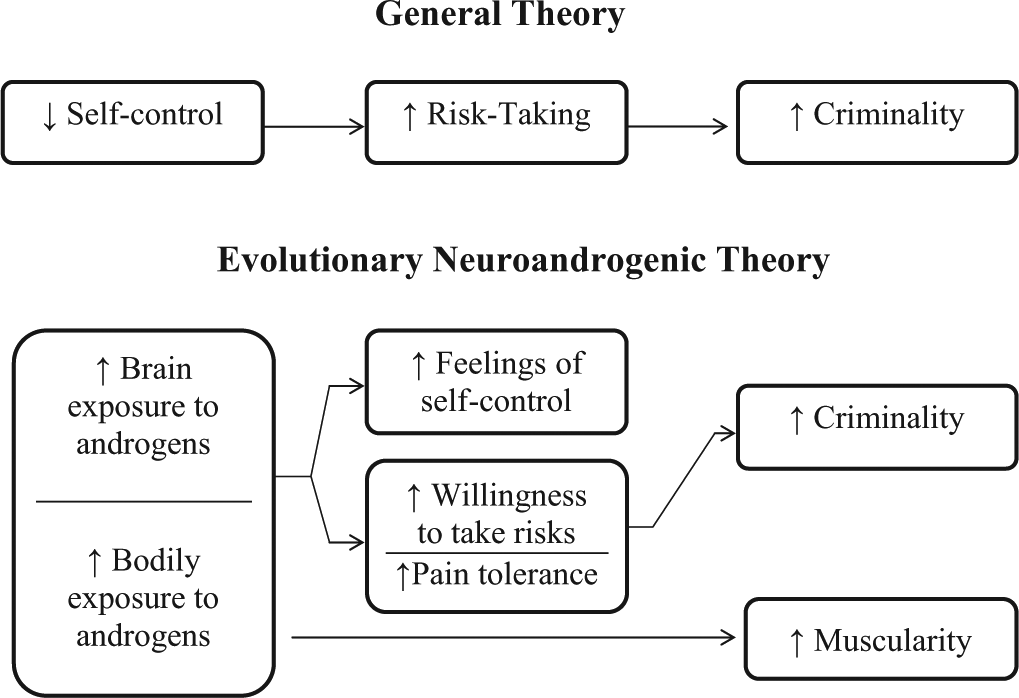
Diagrams comparing predictions of general theory and evolutionary neuroandro-genic theory.
At the heart of general theory is the concept of self-control, which Gottfredson and Hirschi (1990) identified as “the [emphasis in original] individual-level cause of crime” (p. 232). General theory maintains that individuals with low self-control will be prone to act impulsively, recklessly, and with little planning, thereby taking inordinate risks to themselves and others. As a result, individuals with low self-control tend to commit more than their share of delinquent and criminal acts. The diagram for general theory shows that low self-control leads to high risk-taking, which in turn leads to criminal behavior (for a similar diagram, see Gibbs et al., 2003, p. 442).
In contrast, Figure 1 shows that ENA theory envisions brain exposure to high levels of androgens having multiple effects on personality and behavior patterns, including self-control and risk-taking. Note that according to this theory, androgens promote feelings of self-control as well as risk-taking. The positive effects of androgens on self-control comes from several studies demonstrating that androgens enhance (a) feelings of self-confidence (Carre, Muir, Belanger, & Putman, 2006; D. D. Johnson et al., 2006; Mazur & Booth, 1998), (b) a sense of well-being (Goldstat, Briganti, Tran, Wolfe, & Davis, 2003), and (c) self-esteem (Flöter, Nathorst-Böös, Carlström, & Von Schoultz, 2002).
Elevated levels of testosterone have also been found associated with increased desires to compete and to take risks (Apicella et al., 2008; Coates & Herbert, 2008; Edwards, 2006; Ronay & von Hippel, 2010). Furthermore, high androgen levels have been associated with diminished fear in the face of danger (Hermans, Putman, Baas, Koppeschaar, & Van Honk, 2006). Theoretically, the cumulative effect of brain exposure to androgens should be to produce individuals who are emboldened and self-assured (George, 1997), especially when their power and sense of control are being challenged (Ronay & von Hippel, 2010).
In light of the above research, ENA theory leads one to expect individuals with high testosterone to regard themselves as possessing relatively high degrees of self-control and to be willing to take greater risks than individuals with low testosterone. Such an expectation is clearly contrary to general theory’s assertion that risk-taking is reflective of low self-control (Figure 1).
Limited evidence bearing on testosterone’s relationship to self-control has been published and the findings have been mixed. One study reported an inverse correlation (Daitzman & Zuckerman, 1980), whereas two others reported that it was positive (Ehrenkranz, Bliss, & Sheard, 1974; Valtysdottir et al., 2003). An experimental study of women diagnosed as being severely androgen-deficient showed that those given testosterone over several weeks experienced a significant rise in feelings of self-control compared with women given a placebo (Miller et al., 2006; Table 2). Similarly, an experiment in which men were treated with a synthetic testosterone reported that their feeling of self-control were significantly enhanced (Daniell et al., 2006). In another study, when DHEA-S, a biochemical precursor to testosterone, was administered to women, their ratings of self-control rose (Valtysdottir et al., 2003). However, another experiment reported no significant effect of testosterone on feelings of self-control (Shifren et al., 2000).
Although most of the evidence currently available supports the idea that feelings of self-control are enhanced by exposing the brain to androgens, important caveats need to be made. First, all of these studies are only indirectly pertinent to ENA theory, because they pertain to circulating (postpubertal) androgens, not prenatal androgens. Second, the way that self-control is neurologically regulated appears to be complex and far from fully understood (Denson, von Hippel, Kemp, & Teo, 2010). For example, executive functioning, which is performed primarily by the brain’s prefrontal lobes, appears to play a central role in self-control regulation (Hare, Camerer, & Rangel, 2009; von Hippel & Ronay, 2009). In this regard, ENA theory asserts that diminished executive functioning increases the probability of criminality (Ellis, 2005). Along these lines, androgens appear to disrupt “top-down” control of the emotion-controlling functions of the brain (Blakemore & Choudhury, 2006; Giedd, Kashavan, & Paus, 2008; Mehta & Beer, 2010; Raine, 2002). Third, high brain exposure to androgens appears to lower an individual’s sensitivity to emotional responses by others (Volman, Toni, Verhagen, & Roelofs, 2011). This diminished sensitivity could in turn increase tendencies to victimize others at the same time brain exposure to these hormones are bolstering an individual’s sense of power and self-control.
Numerous studies have assessed the relationship between circulating testosterone and risk-taking. Most of these studies have concluded that the relationship is positive for taking both physical risks (Booth, Johnson, Granger, Crouter, & McHale, 2003; Mazur, 2006) and financial risks (Coates, Gurnell, & Sarnyai, 2010; Stanton, Liening, & Schultheiss, 2011). However, as noted earlier regarding links between testosterone and crime and/or aggression, studies suggesting an association between testosterone and risk-taking are pertinent to ENA theory only to the extent that short-term circulating testosterone levels are indicative of long-term exposure, especially prior to birth.
According to Rosenbaum (1980), a key aspect of self-control is the ability to tolerate noxious stimuli. In this regard, experiments were recently undertaken to deplete people’s self-control tendencies with repeated exposure to experimentally induced pain (Muraven, Shmueli, & Burkley, 2006). Such an association between self-control and pain tolerance prompted us to include a pain tolerance measure in the present study. An additional reason for including pain tolerance was that ENA theory envisions androgens as promoting the ability to tolerate pain (Ellis, 2005).
Lastly, we included muscularity and strength in the present study because recent research has suggested that self-control is analogous to muscular strength in that both can eventually become exhausted if exerted over long periods of time (Baumeister & Exline, 1999; Baumeister, Vohs, & Tice, 2007; Muraven et al., 2006). Also, a study by Haavio-Mannila and Purhonen (2001) indicated that people closely associate muscularity with high degrees of self-control and willpower. Furthermore, muscular strength is highly responsive to exposing muscle tissue to testosterone (Federman, 2006; Gordan, 1957).
Putting the above lines of evidence together brings us to predict that self-control and risk-taking will be inversely correlated if general theory is correct. However, these two variables should be positively correlated with each other and with pain tolerance, muscularity, and physical strength if ENA theory is correct. Furthermore, both theories predict that risk-taking will be positively associated with criminality, albeit based on different theoretical reasoning.
Regarding a possible relationship between self-control and criminality, general theory predicts these two variables will be inversely correlated while ENA theory is essentially ambiguous regarding a self-control/criminality association. As noted earlier, the ambiguity comes from evidence that brain exposure to androgens promotes a sense of confidence and self-control as well as promoting tendencies to victimize others. In addition, highly androgenized brains appear to be more resistant to social influences (Harris, Rushton, Hampson, & Jackson, 1996; Knickmeyer & Baron-Cohen, 2006). Such resistance could actually prevent individuals from engaging in most peer-promoted criminal activities. Because of the opposing aspects of androgenic effects on self-control, about all ENA theory would predict with certainty is that any relationship between self-control and criminality should be modest and perhaps culture-specific.
Hypotheses
From the above theoretical arguments, 10 hypotheses were derived from general theory and ENA theory for empirical testing. As shown in Table 1, the first 6 hypotheses simply pertain to how the four independent variables should be related to one another, while the last four hypotheses have to do with how each independent variable should be related to criminality.
Ten Hypotheses Derived From General Theory and/or Evolutionary Neuroandrogenic Theory.

Method
Data for this study were obtained from undergraduates in Malaysia and the United States. The Malaysian sample consisted of 2,059 students attending the University of Malaya in Kuala Lumpur. The U.S. respondents were undergraduates from the following seven universities: Boise State University (76 respondents), California State University at Fullerton (251 respondents), Evangel University (269 respondents), Minot State University (149 respondents), Pennsylvania State University (110 respondents), University of Missouri (258 respondents), and University of Texas at San Antonio (178 respondents), for a total of 1,291 respondents.
Basic demographic characteristics of the two samples appear in Table 2. The table shows that the gender and age distributions for the students in both countries were very similar. The greater proportions of females at least partly reflect the fact that substantially more females than males are currently attending college in both countries (DiPrete & Buchmann, 2006; Firebaugh & Dorius, 2010).
Sample Demographics and Means for the Independent and Delinquency Variables.

Ethnically, the Malaysian and U.S. student samples were strikingly different. For example, whereas 67% of the U.S. students were Whites (i.e., of European ancestry), none of the Malaysian students were. Instead, the majority of the Malaysian respondents described themselves as native Malay (including Bumiputeras, roughly translated to mean “sons of the soil”). Nearly all of the roughly 30% who did not classify themselves as native Malay stated that they were of either Chinese or Indian ancestry.
The data were derived from a questionnaire developed and refined in English. Thereafter, it was translated into the native Malay language, Bahasa Malaysia. To ensure that the translation carried the same meaning as the original English version, the latter questionnaire was back-translated into English until all detectable discrepancies were eliminated. Both questionnaires were four pages in length and covered a wide variety of topics, only some of which are the focus of the present study.
Self-Control, Risk-Taking, Pain Tolerance, and Muscularity Measurement
As noted earlier, tests of general theory have always included a measure of self-control, but ours is the first to do so by simply asking respondents for a self-rating. Following the work of Grasmick et al. (1993) and Longshore et al. (1996), most prior studies have asked respondents to report the extent to which they exhibit traits such as risk-taking, impulsiveness, and a lack of long-term planning. From the responses obtained from these questions, a total score for self-control is derived (Engel, 2012, p. 17). Based on Gottfredson and Hirschi’s (1990) theory, to the extent that individuals state that they exhibit these traits, they are assumed to lack self-control.
Another approach to self-control measurement has been used recently in criminological research. It has entailed asking young respondents multiple questions about their tendencies to pay attention to and obey teachers and parents (Beaver, DeLisi, Vaughn, & Wright, 2010, p. 31; Boisvert, Boutwell, Barnes, & Vaske, 2013; Boisvert, Wright, Knopik, & Vaske, 2012).
Yet another method used to measure self-control has been adopted in clinical psychology studies. This method may be considered similar to the one employed in the present study. It simply asks respondents for their own self-assessment. Such a self-assessed method has been frequently employed in the Psychological General Well-Being Index (PGWB), first developed in the 1980s (Chassany, Dimenas, Dubois, Wu, & Dupuy, 2004; Daniell et al., 2006; Dupuy, 1984; Shifren et al., 2000; Valtysdottir et al., 2003).
In the present study, respondents were asked to rate themselves on a variety of traits with the following instructions: Being as objective as possible, rate yourself relative to others your own age on the following traits with responses ranging from 0 meaning “not at all” to 10 meaning to “the most extreme degree possible.” Included in the list of traits were the following: (1) having a great deal of self-control, (2) being a risk-taker, and (3) enjoying taking risks. For both countries, the two latter items having to do with risk-taking were found to be highly correlated with one another (Malaysia, r = .691; United States, r = .798). Therefore, their scores were summed to make a single variable of risk-taking with responses ranging 0 to 20. Within the same list of self-rated traits, respondents were also asked to identify (4) their ability to tolerate pain, (5) their muscularity, and (6) their physical strength. As explained earlier, pain tolerance and muscularity were included because ENA theory specifically predicts that (a) pain tolerance and muscularity should be positively correlated with criminal behavior and (b) because past research has linked these traits with high risk-taking, a strong sense of self-control, and high brain exposure to androgens.
Our inclusion of physical strength was due to its being considered a backup proxy for muscularity. In other words, while reported muscularity should be the most direct measure of this variable, reported physical strength was included as a “backup” measure of muscularity.
Criminality Measurement
To measure delinquent and criminal behavior as dependent variables, respondents were asked to report how many times they had ever committed each of the following 14 acts:
Serious assault or beating (needing medical treatment)
Minor assault or beatings (not needing medical treatment)
Sexual assault (including attempted sexual assault, molesting, rape)
Domestic or courtship violence
Reckless driving (e.g., road bullying)
Illegal auto racing
Serious theft or robbery (including motor vehicle theft)
Minor theft or robbery (including shoplifting, purse snatching, pickpocketing)
Serious damage to property (major vandalism and arson)
Minor property damage (minor vandalism such as breaking windows in houses or cars)
Bribery, fraud, or other finance-related offenses
Distribution of illegal drugs (excluding alcohol)
Use of illegal drugs (excluding alcohol)
Illegal gambling
The actual number of times that each respondent reported having ever committed an offense in each of these offense categories was recorded unless the number was greater than 10; then the number was simply recorded as 10.
As over half of the respondents reported committing very few if any offenses, for analysis purposes we consolidated the above 14 offenses into the following three categories: four violent offenses (major assaults, minor assaults, sexual assaults, and domestic violence), five property offenses (major thefts, minor thefts, major vandalism, minor vandalism, and other finance-related crimes), two endangerment offenses (reckless driving and illegal auto racing), and three victimless offenses (illegal drug distribution, illegal drug use, and illegal gambling).
One can see the average scores (and standard deviations) for all five independent variables and all five offense variables at the bottom of Table 2. From this table, it is obvious that U.S. respondents scored considerably higher than their Malaysian counter-parts regarding all but one of the independent variables—that is, that of physical strength (where the Malaysian students had higher means than did the U.S. students). In the case of the offenses, U.S. respondents reported engaging in all of the five categories to a significantly greater degree than did the Malaysian respondents. More will be said about these patterns in discussing gender differences in the independent and dependent variables for both countries in the “Results” section.
Data Analysis
Except for country and gender, all of the variables used in this study were measured at interval levels. The analyses performed utilized t tests to assess gender differences, Pearson correlations to compare the independent variables with one another, and both Pearson correlations and partial correlations to assess the relationships between the independent variables and the dependent (criminality) variables.
Results
Before examining the 10 hypotheses, attention is given to the issue of gender differences in both the independent and dependent variables. As one can see in Table 3, in all but one case, all of the independent and dependent variables were significantly different for males and females in both Malaysia and the United States. The lone exception involved the variable of self-control, where no significant gender difference was found for the U.S. sample. In the Malaysian sample, however, males self-reported having greater self-control than did females. For every other independent variable—risk-taking, pain tolerance, muscularity, and physical strength—average self-ratings by males were significantly higher than the average female self-ratings in both countries. Predictably, males in both countries reported their involvement in all five categories of offending to be higher than did females.
Means (and Standard Deviations) for the Main Study Variables According to Gender and by Country.
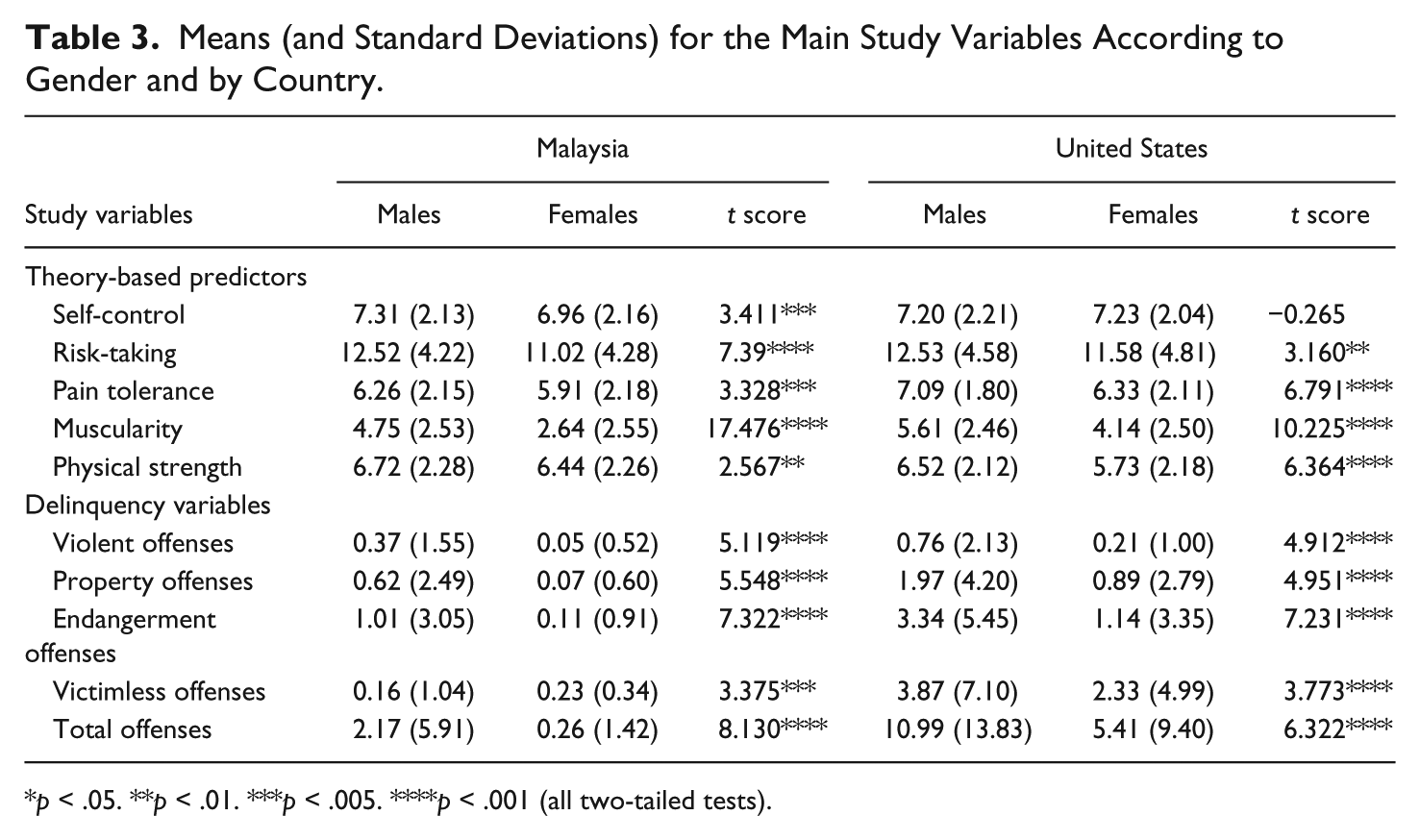
p < .05. **p < .01. ***p < .005. ****p < .001 (all two-tailed tests).
The 10 hypotheses considered in this study can be separated into two groups. The first 6 have to do with how the independent variables should be associated with one another; the last 4 are concerned with how the independent variables are associated with offending. These two groups of hypotheses are considered separately. Concerning the first 6 hypotheses, special attention is given to Hypothesis 1 because general theory and ENA theory make contrary predictions regarding how self-control and risk-taking should be related. Specifi-cally, general theory asserts that self-control and risk-taking should be inversely correlated, whereas ENA theory asserts that these two variables should be positively correlated (Figure 1).
Interrelating the Independent Variables
Hypothesis 1 through Hypothesis 6: Intercorrelations between self-control, risk-taking, pain tolerance, and muscularity/strength
As already noted, general theory is unequivocal in asserting that self-control and risk-taking are inversely correlated, that is, risk-takers generally lack self-control (Figure 1). In fact, as noted earlier, many researchers who have tested general theory have actually used measures of risk-taking as an indicator of low self-control.
ENA theory, however, leads one to expect that the relationship between self-control and risk-taking should be positive rather than inverse (Figure 1). This is because ENA theory envisions brain exposure to androgens as increasing people’s tendencies to be self-assured, bold, and confident. Such a characterization of the effects of androgens conforms with findings from several research reports (Aloisi, 2003; Craft, Mogil, & Aloisi, 2004; Stanton, Wirth, Waugh, & Schultheiss, 2009; Tall, Stuesse, Cruce, & Crisp, 2001).
As an initial step in determining the true relationship between self-control and risk-taking, one can refer to Figure 2. It shows an unmistakable upward slope for both countries although the curve is steeper for the Malaysian sample than for the U.S. sample. This means that on average in both countries, individuals who were low in self-control were also low in risk-taking and those who were high in self-control were high in risk-taking, with the pattern being especially pronounced in the case of the Malaysians.

The mean levels of self-control expressed by respondents according to their combined mean score on two questions regarding risk-taking for the Malaysian and the U.S. respondents.
The pattern shown in Figure 2 is reinforced in Table 4. In this table, one can see that in both countries and for both genders, individuals who rated themselves as being high in self-control considered themselves to be significantly higher in risk-taking than those who were low in self-control. Therefore, regarding Hypothesis 1, findings from this study confirm ENA theory and contradict general theory.
Correlations between Self-Ratings of Self-Control, Risk-Taking, and Pain Tolerance According to Gender and Country.

Note. Results for the Malaysian sample appear in the upper right and results for the U.S. sample are in the lower left.
p < .05. **p < .01. ***p < .005. ****p < .001 (all two-tailed tests).
Regarding Hypothesis 2 and Hypothesis 3, Table 4 also shows that individuals high in self-control considered their degree of pain tolerance and muscularity (as well as physical strength) to be relatively high. General theory is silent to any associations between these variables, but the findings do conform to predictions by ENA theory (given its assertion that brain exposure to testosterone increases all three of these traits). Furthermore, the findings are in line with research showing that bodily exposure to testosterone is associated with increased pain tolerance (Daniell et al., 2006; English, Steeds, Jones, Diver, & Channer, 2000; Federman, 2006; Hau, Dominguez, & Evrard, 2004; Mintaz et al., 2002) and muscularity (Federman, 2006; Gordan, 1957). Also, another study indicated that neurological exposure to testosterone promotes a sense of self-control (Miller et al., 2006). Therefore, the first three hypotheses all support ENA theory.
In the case of Hypotheses 4, 5, and 6, the correlations presented in Table 4 are also in accordance with ENA theory by indicating that risk-taking, pain tolerance, and muscularity (and strength) are positively correlated with one another to a high degree. General theory makes no corresponding predictions.
Correlating the Independent Variables with Criminality
Of course, no matter how the independent variables are associated with one another, the main theoretical issues have to do with how these independent variables are related to criminal behavior. To investigate these issues, we correlated all five independent variables with the following four groupings of offenses: violent offenses (major assaults, minor assaults, sexual assaults, and domestic violence), property offenses (major thefts, minor thefts, major vandalism, minor vandalism, and finance-related crimes), endangerment offenses (reckless driving and illegal auto racing), and victimless offenses (illegal drug distribution, illegal drug use, and illegal gambling). Also, we combined all 14 types of offenses into a total count of offending. The results are shown in Table 5. In addition to presenting separate results for Malaysia and the United States, we also show the results with and without controlling for gender as a dummy variable.
Correlations between Self-Control, Risk-Taking, Pain Tolerance, and Muscularity, on the One Hand, and Involvement in Violent Offenses, Property Offenses, Endangerment Offenses, Victimless Offenses, and Total Offenses, on the Other Hand, According to Country.

Note. Coefficients in parentheses indicate the correlations when gender is controlled. H = hypothesis.
p < .05. **p < .01. ***p < .005. ****p < .001 (all two-tailed tests).
Hypothesis 7: Self-control and offending
General theory hypothesizes that self-control and offending should be inversely correlated. Examination of Table 5 reveals support for general theory in the United States data for property crimes and for victimless crimes as well as for the total offenses. In the case of violent offenses and endangerment offenses, however, no significant correlations were found. The patterns were the same regardless of whether or not gender was controlled.
For the Malaysian sample, however, almost no support was found for general theory. Only in two cases—property offenses and victimless offenses when gender was controlled—were significant inverse correlations found between self-control and criminality. It should also be noted that there were actually significant positive correlations between involvement in violent offenses and self-control in the Malaysian sample, which is contrary to general theory.
As noted in the introduction, unlike general theory, ENA theory is rather ambiguous regarding how self-control should be associated with offending. ENA theory predicts that androgens will promote feelings of self-control as well as tendencies to take risks. Therefore, the effects of risk-taking on criminality should be positive. The effects of self-control on criminality, however, should be situationally dependent. Overall, the present study’s findings conforms to ENA theory regarding Hypothesis 7 fairly well in as much as the relationships vary depending on gender, type of crime, and country.
Hypothesis 8: Risk-taking and offending
Table 5 shows many significant positive correlations between risk-taking and involvement in offending, thereby providing support for both general theory and ENA theory. The associations were stronger for the U.S. sample than for the Malaysian sample, perhaps because of considerably higher self-reported involvement in offending among the U.S. students (as shown in the bottom portion of Table 2). Regarding the Malaysian sample, most of the significant correlations between risk-taking and offending are eliminated by controlling for gender. In the U.S. sample, however, controlling for gender still left the correlations between risk-taking and all forms of offending statistically significant.
Hypothesis 9: Pain tolerance and offending
Turning to pain tolerance, Table 5 indicates that it was significantly and positively associated with three of the four forms of offending in the U.S. data, at least before controlling for gender. However, for Malaysia, only violent offending was significantly and positively correlated with pain tolerance.
The associations between pain tolerance and violent and endangerment offenses in the U.S. sample were substantial, but no corresponding associations were detected in the Malaysian sample. The U.S. finding seems similar to a Canadian study, which reported unusually high pain tolerance among physically aggressive adolescent boys (Séguin, Pihl, Boulerice, Tremblay, & Harden, 1996). Overall, ENA theory’s prediction that pain tolerance would be positively correlated with offending was fairly well supported by the U.S. data but only weakly supported by the Malaysian data.
Hypothesis 10: Muscularity/strength and offending
The last two columns in Table 5 provide the correlations between muscularity/physical strength and involvement in crime. Muscularity is considered a good biomarker for bodily exposure to testosterone (Gettler, Agustin, & Kuzawa, 2010; Malkin, Channer, & Hugh, 2010). Physical strength is probably less so, but it was included in the present analysis as a secondary indicator of testosterone’s influence on muscularity. In any case, one should bear in mind that both measures are self-reported and that both variables have to do with “peripheral” androgen exposure, not brain exposure (Seidman, 2003; Wespes, 2002). Nevertheless, it is reasonable to assume that peripheral measures have at least some association with brain exposure.
One can see that in the last column of Table 5 only two significant correlations between offending and physical strength were found, one positive and one negative. Both of these correlations become non-significant once gender was controlled. Similarly, except for victimless offenses, one finds all of the significant positive correlations between muscularity and offending disappearing once gender is controlled. These results suggest that any associations between muscularity/physical strength and offending are largely dependent on the fact that males are more muscular and physically stronger than females (as shown in Table 3).
The overall conclusion regarding Hypotheses 7 through 10—the four hypotheses bearing on how the independent variables are predictive of offending—is that both theories receive some support. General theory correctly predicted Hypothesis 7, at least for most types of offending in the U.S. sample. Both general theory and ENA theory correctly predicted Hypothesis 8. Regarding Hypotheses 9 and 10, having to do with pain tolerance and muscularity/strength being associated with criminality, only ENA theory made any predictions. Hypothesis 9 was empirically supported in the U.S. sample for all but victimless offenses even after controlling for gender. Contrary to ENA theory, Hypothesis 10 was only modestly supported when gender was left uncontrolled and almost totally unsupported when gender differences in muscularity were set aside.
Discussion
A large data set from Malaysia and the United States was used to compare the predictive accuracy and scope of two contemporary theories of criminal behavior: general theory and ENA theory. The questionnaire that was utilized measured self-control in a new way as far as criminological research is concerned. Respondents were simply asked to self-rate their own degree of self-control.
Due to the relative uniqueness of our self-control measure and the fact that it obtained findings at odds with most prior studies using other self-control measures, we will begin this discussion by (a) identifying the main self-control measures used in other studies. Thereafter, we (b) summarize what is currently understood regarding the influence of androgens on both risk-taking and a sense of self-control, (c) reiterate the main differences between general theory and ENA theory, (d) make Malaysian–United States comparisons regarding both the independent and dependent variables, and (e) identify the present study’s limitations.
Conceptualizing and Operationalizing the Concept of Self-Control
Duckworth and Seligman (2006) recently observed that “the construct of self-control is often loosely defined . . . and measurement approaches vary widely” (p. 198) Likewise, Beaver et al. (2010) noted that “there is dissension over the most reliable and valid way to measure individual variation in self-control” (p. 31). We believe that the question of how best to measure self-control still needs to be considered open. Obviously, it would have been better to have dealt with this measurement issue more thoroughly long before now given that well over a hundred studies of how self-control is related to delinquency and criminality have already been published (Engel, 2012)!
There are various ways that the concept of self-control has been operationalized (Duckworth & Kern, 2011). These methods boil down to the following four:
Risk-Taking and Impulsiveness. Gottfredson and Hirschi (1990) emphasized that risk-taking and impulsivity—which they assert both reflected low self-control—lead to criminality. Accordingly, the most widely used multi-scale operational measure for self-control in criminological research contains questions about risk-taking and impulsiveness (Arneklev, Grasmick, & Bursik, 1999; Grasmick et al., 1993; Longshore et al., 1996). We believe that there is a glaring problem with this approach and possibly the theory behind it. The problem is that high risk-taking actually appears to be associated with high self-control (Figure 2).
Delayed-Immediate Gratification. Much of the psychological literature on self-control pre-dates Gottfredson and Hirschi’s theory. In a review of this psychological literature, Logue (1988) noted that self-control was primarily used to refer to the behavior of children in experiments where they were allowed to choose between a small reinforcement (e.g., a toy or candy) immediately after performing a task or wait until the following day for a bigger reward (e.g., two toys or twice as much candy). In accordance with Logue’s review, Madden, Petry, Badger, and Bickel (1997) actually defined self-control as “choosing the large delayed reward while forgoing the small immediate alternative” (p. 256). In the field of economics, the concept of self-control has been similarly operationalized (Gul & Pesendorfer, 2001). To our knowledge, no criminological study of self-control has ever employed this sort of operational measure.
Paying Attention and Obeying Authority. Recently, a number of criminologists have operationalized self-control in terms of responses to questionnaire items about the degree to which respondents have trouble (or had trouble as children) getting along with parents and teachers, paying attention in class, keeping their mind focused, and finishing their homework (Beaver et al., 2010, p. 31; Boisvert et al., 2013; Boisvert et al., 2012). At the extreme, individuals who answer positively to these sort of items would be clinically defined as suffering from attention deficit disorder (ADD) or oppositional defiant disorder (ODD). Without questioning that these items are predictive of later delinquency and crime as the above researchers have all reported, one can still question whether they provide a valid measure of self-control. In other words, individuals who are unusually strong willed and inclined to do as they please despite efforts by parents and teachers to “bring them into line” may actually be unusually high in self-control rather than low.
Simple Straightforward Self-Ratings. As explained in the method section of the present study, we simply asked each respondent to provide a self-rating of their own degree of self-control on a 10-point scale. This is similar to the methods used in a small number of other studies of self-control (Chassany et al., 2004; Dupuy, 1984; Hines, Ahmen, & Hughes, 2003; Shifren et al., 2000), none of which involved the study of crime or delinquency.
One can certainly question the validity of this fourth measurement approach. However, who would know better than an individual himself or herself whether he or she has little or a lot of self-control? In this sense, our measure at least has face validity. Nevertheless, asking questions about traits such as risk-taking, impulsiveness, delayed gratification, and paying attention to or obeying parents and teachers to infer self-control may be more valid than an individual’s own rating of his or her self-control. At this juncture, we recommend withholding judgment until more evidence is presented, especially in light of this study’s findings that risk-takers rated their degree of self-control higher than non-risk-takers.
Contrasting General Theory and ENA Theory
While the present study was primarily undertaken out of a desire to compare contradictory predictions made by general theory and ENA theory regarding the relationship between self-control, risk-taking, and offending probabilities, there are obviously other differences between the two theories. The most fundamental difference is that general theory limits its explanations of criminality to social environmental influences on personality traits (Buker, 2011; Pratt, Cullen, Blevins, Daigle, & Unnever, 2002; Wright, Beaver, DeLisi, Vaughn, Boisvert, & Vaske, 2008). On this point, Gottfredson and Hirschi (1990) state that “the magnitude of the genetic effect [on self-control] is near zero” (p. 60). In contrast, ENA theory explicitly incorporates biological concepts, particularly ones having to do with evolution, hormones, and brain function-ing into its explanation of variations in criminality (Ellis, 2003, 2005).
General theory’s anti-biological position is undermined by growing evidence that genetic and other biological factors are contributing to varying tendencies to engage in criminal and anti-social behavior (Barnes & Boutwell, 2012; Brennan & Mednick, 1993; Lowenstein, 2004; Moffitt, 2005; Rhee & Waldman, 2002; Rowe, 1986). In this regard, Cauffman et al. (2005) recommended that “proponents of Gottfredson and Hirschi’s theory may wish to revisit the role of neurobiology in the determinants of self-control” (p. 159).
One can also question Gottfredson and Hirschi’s (1990, p. 60) assertion that genetic influences on self-control are “near zero” by noting the following:
Genes located on the Y chromosome guide conversion of would-be ovaries into testes instead (Saxena et al., 1996; Vergnaud et al., 1986). This conversion in turn greatly increases the production of androgens (Imperato-McGinley & Zhu, 2002; Lau & Zhang, 2000).
Genes located on the X chromosome control the proliferation of so-called androgen receptors (Allen, Zoghbi, Moseley, Rosenblatt, & Belmont, 1992; Giovannucci et al., 1997), which in turn affect the uptake of androgens into the brain and most other parts of the body. By so doing, genes on both the Y and X chromosomes affect brain exposure to androgens.
If androgens promote a sense of self-control—as considerable evidence suggests (Daniell et al., 2006; Miller et al., 2006; Valtysdottir et al., 2003)—it follows that genes must be having a substantial effect on self-control (i.e., the “near zero” effect stipulated by Gottfredson and Hirschi, 1990, p. 60 is incorrect).
Of course, demonstrating that general theory is probably incorrect regarding genetic influences on traits such as self-control and criminality does not validate ENA theory. Before reaching conclusions about the merit of ENA theory, the role of androgens on brain functioning in connection with victimizing forms of competition over resources and status needs greater research attention.
Androgenic Effects on Self-Control and Risk-Taking
Given that the present study mainly supported ENA theory, future research should more thoroughly explore the neurology underlying any influences that androgens have on both self-control and risk-taking. In this regard, several studies have indicated that high androgen exposure promotes risk-taking in part by enhancing an individual’s sense of confidence, power, and feelings of self-control (Apicella et al., 2008; Carre et al., 2006; Coates & Herbert, 2008; D. D. Johnson et al., 2006). One study showed that these effects were especially pronounced when an individ-ual’s sense of control over a situation was being challenged (Ronay & von Hippel, 2010). In other words, when individuals with a highly androgenized brain perceived that their ability to control a situation is in jeopardy, they respond in especially forceful ways.
At a neurochemical level, testosterone has been shown to promote dopamine transmission within the brain (Dominguez & Hull, 2005; Liening & Josephs, 2010; Szczypka, Zhou, & Palmiter, 1998). Dopamine activity in turn may enhance an individual’s willingness to take risks and tolerate pain in the course of doing so (Carney, Cuddy, & Yap, 2010; Mintaz et al., 2002). As noted earlier, high levels of testosterone may promote feelings of self-control (Miller et al., 2006; Valtysdottir et al., 2003) and a willingness to take risks (Sapienza, Zingales, & Maestripieri, 2009). In both cases, androgens may operate through the same or similar dopaminergic channels (Carney et al., 2010; Stanton et al., 2011).
National Comparisons
The vast majority of criminological studies come from Western populations. Only rarely has research been conducted using large samples from both a Western and an Asian country. While far from being this study’s focus, it is interesting to note some of the national differences and similarities.
Examination of Tables 2 and 3 reveals that U.S. students self-reported much greater involvement in crime than did the Malaysian students. In terms of total offenses, U.S. males self-reported engaging in more than five times as many crimes as Malaysian males, and U.S. females surpassed their Malaysian counterparts more than 20 times (Table 3)! The most extreme difference had to do with victimless offenses where the mean number of offenses reported by U.S. students was 2.92 compared with a mean of 0.07 for Malaysian students. This difference in victimless offenses is no doubt due in part to much stricter enforcement of anti-drug laws in Malaysia, but the influence of other factors call for research attention.
It is also interesting to compare the two countries regarding the independent variables. Notice in Table 3 that males and females from these two countries are similar regarding their self-ratings of self-control, risk-taking, pain tolerance, muscularity, and physical strength. These similarities suggest that none of these variables are responsible for the tremendous Malaysian–United States differences in offending.
Even though respondents from both countries exhibited similar average self-control and risk-taking scores (Table 3), the extent to which these two variables were associated with each other was noticeably greater for the Malaysian students. In Figure 2 as well as in Table 4, one can see that the positive relationship between self-control and risk-taking tendencies were substantially stronger for the Malaysians. We have no explanation to offer for this finding.
Limitations
This study has several noteworthy limitations. One is that it relied on responses to a single question designed to assess variations in self-control. In fact, a multi-item measure would have been utilized except that a consortium of researchers in two countries agreed to limit the questionnaire to four pages. Doing so necessitated eliminating quite a few questions in the questionnaire’s final version. Only a few members of the consortium were interested in the variable of self-control; thus, the multi-item measure was sacrificed. Nevertheless, because the sample sizes in both countries were quite large and the findings regarding the relationship between self-control and risk-taking were so unambiguous (Figure 2), we believe that this study’s findings still warrant attention.
To verify our findings, we recommend that a questionnaire be developed that measures all four conceptual definitions of self-control (i.e., lack of risk-taking and impulsiveness, delayed gratification, paying attention to and obeying authority, and self-assessed self-control). By administering this questionnaire to a diverse sample of respondents (preferably multi-cultural) and subjecting the results to factor analysis, it should be possible to better determine how different these four conceptual measures are from one another and which one is the most valid for assessing variations in self-control.
A second limitation of this study involves the fact that all of the variables examined, including those of pain tolerance, muscularity, and physical strength, were based on single item self-reports. Obviously, multi-item self-reports and/or actual physiological measurement of these traits would have been preferable from the standpoint of reliability.
Third, as one can see at the bottom of Table 2, the mean numbers of offenses self-reported by respondents were low, especially in the case of the Malaysian students. Obviously, the medians were even lower than the means due to most respondents answering “0” and only a minority reporting having committed most of the various types of offense more than once or twice. Nevertheless, this limitation is inherent in all self-report measures of delinquency and crime, especially regarding involvement in the most serious types of offending.
Fourth, it goes without saying that the present study did not test all aspects of either general theory or ENA theory. For example, we made no attempt to determine if general theory is correct in attributing an individual’s low self-control to poor parental training and supervision early in life (Gottfredson & Hirschi, 1990; Hirschi, 2004; Hirschi & Gottfredson, 1993). ENA theory’s counter-argument that hormonal and other genetic-ally influenced traits are more consequential than parental rearing as a cause of criminal-ity (Ellis, 2005) was also not examined. Nonetheless, it is worth mentioning that two studies have indicated that delinquency is only negligibly affected by parenting practices once genetic influences are statistically eliminated (Cleveland, Wiebe, Van Den Oord, & Rowe, 2000; Wright, Beaver, Delisi, & Vaughn, 2008). Furthermore, Ellis and Das (2013) reported that roughly one third of the variation in the inverse association between offspring delinquency and “good” parent–child relationships was attributable to androgenic factors. In other words, children with unusually high androgen levels usually had parents with similarly high androgen levels (resulting from their sharing genes in common). These shared genes appear to partly explain why relationships between parents and their offspring are more strained among highly delinquency offspring than among offspring who are largely law abiding.
Several aspects of ENA theory were also not explored in the present study. For example, it asserts that evolutionary forces have created variations in criminality and that androgens promote criminality by making any of at least three specific alterations on brain functioning (Ellis, 2005, p. 296). Furthermore, the theory asserts that learning ability and executive functioning have important effects on how quickly individuals “mature” from crude (criminal) forms of competition to sophisticated (non-criminal) forms of competition. None of these hypotheses was tested in the present study.
Finally, all of our data were based on student responses to a single questionnaire. Therefore, it is reasonable to believe that the results underestimate the true degree to which populations in general vary regarding the traits that were measured, especially regarding criminality. If so, the analyses provide a conservative estimate of the actual relationships between the variables that were studied.
Conclusion
A recent meta-analysis indicated that there is only a moderate degree of convergence (r = .27-.34) between the various methods that have been utilized in recent decades to measure self-control (Duckworth & Kern, 2011). This suggests that more effort should be devoted to identifying the most valid methods for measuring this variable.
In the present study, self-control was measured in the most straightforward way possible, that is, by simply asking respondents to rate their own degree of self-control. To our knowledge, such a method has never been used before in the field of criminology, although it is similar to methods used by researchers in other fields of study (Chassany et al., 2004; Dupuy, 1984; Hines et al., 2003; Shifren et al., 2000). Regarding the association between self-control and offending, after controlling for gender, three of the five comparisons revealed significant inverse correlations in our U.S. sample, just as general theory predicted. However, in our Malaysian sample, after controlling for gender, only two of five correlations were significant and inverse (as general theory predicted), while one significant correlation was actually positive (i.e., between violent offenses and self-control). Thus, unlike nearly all earlier studies (reviewed by Engel, 2012; Pratt & Cullen, 2000), in our Malaysia sample, only weak support was found for general theory’s most central hypothesis.
ENA theory makes predictions about both biological and social factors that should be associated with criminality, which makes it more vulnerable to being disproven than general theory. For example, ENA theory asserts that gender differences in criminality have been naturally selected, thus leading one to expect these differences to be pan-cultural. This deduction has received considerable empirical support (Campbell, 2006; Ellis, Beaver, & Wright, 2009; Lorber, 2004). General theory, on the other hand, implies that higher offending rates by males are the result of greater parental monitoring of girls during childhood (Gottfredson & Hirschi, 1990, p. 145). If so, societies (or at least subcultures within societies) should be found in which gender differences in offending are minimal and possibly even reversed. This hypothesis has so far received mixed support at best (Botchkovar & Broidy, 2013; Gibbs, Giever, & Martin, 1998).
In conclusion, 10 hypotheses were tested in the present study. Our analyses suggest that despite general theory’s popularity among today’s criminologists, it led to fewer correct hypotheses than did ENA theory. Nevertheless, this study’s findings need to be verified, and, of course, additional hypotheses should be derived from both theories for careful testing. Another implication of this study is that the operationalization of self-control deserves more attention.
Footnotes
Acknowledgements
We thank Drew H. Bailey, David Geary, Richard Lippa, Emi Prihatin, and David Puts for helping to recruit research participants for this study.
Declaration of Conflicting Interests
The author(s) declared no potential conflicts of interest with respect to the research, authorship, and/or publication of this article.
Funding
The author(s) disclosed receipt of the following financial support for the research, authorship, and/or publication of this article: A grant from the University of Malaya to the Department of Anthropology and Sociology (RG143-10HNE) provided partial funding for this research project.