



Abstract
Conceptualizing adolescent drinking and delinquency as adaptations to strain, we explore whether they (a) decrease or increase the probability of feeling depression and anxiety later and (b) ameliorate or aggravate the effect of strain on the negative emotions over time. These relationships are also examined for gender differences by analyzing data separately for males and females as well as both combined. We conducted ordinary least squares regression analysis of panel data from the first two waves of the National Longitudinal Study of Adolescent to Adult Health. Heavy drinking and serious delinquency were found to increase the probability of feeling depression and anxiety later, whereas they tend to ameliorate the emotionally deleterious effect of strain for males and, to a lesser extent, females.
Agnew’s (1992) general strain theory (GST) conceptualizes crime and deviance as an adaptation to strain and its resultant negative affect. While the notion of crime and deviance as coping behavior is essential to GST, whether they actually help the person who committed the act cope with strain and/or its emotional consequences is not the theory’s focal interest (Brezina, 1996). As a result, despite some effort (e.g., Brezina, 2000b), research on the efficacy of criminal and deviant coping continues to remain scant (Agnew, 2006).
To address this understudied issue in GST research, we first examine whether adolescent drinking or delinquency decreases or increases the probability of experiencing negative emotions later. Specifically, we examine whether adolescents who engaged in heavy drinking, violent offending, or property offending are less or more likely to feel depression and anxiety later than those who did not. Second, we examine whether drinking and delinquency function as emotional coping (or liability) by reducing (or amplifying) the deleterious effect of strain on negative emotions. Finally, we examine gender differences in these relationships, specifically, whether boys are more likely to reap the emotional benefits from drinking and delinquency than girls. To empirically examine these relationships, we apply ordinary least squares regression to analyze the first two waves of data from the National Longitudinal Study of Adolescent to Adult Health.
GST and Coping Efficacy
Defining strains as “events or conditions that are disliked by individuals” (Agnew, 2006, p. 4), GST proposes three major types of strain: strain as the failure to achieve positively valued goals, strain as the removal of positively valued stimuli, and strain as the presentation of negative stimuli (Agnew, 1992). GST then posits that strains generate negative emotions, which in turn create pressure for corrective action. Crime is one way to cope with strains and strain-generated negative emotions, such as anger and depression. Thus, while not all strained individuals turn to crime, the conceptualization of crime as a coping or problem-solving strategy is essential to the GST explanation of crime. As a coping strategy, crime is likely to be either behavioral or emotional coping (Agnew, 1992), whereas noncriminal deviance could also be cognitive coping, like Merton’s (1938) ritualism and retreatism.
According to Agnew (1992), crime as behavioral coping “seek[s] to minimize or eliminate . . . strain and . . . to satisfy the need for revenge” (p. 69). For example, it intends to address strains by illegally achieving positively valued goals (e.g., stealing), protecting or retrieving positively valued stimuli (e.g., fighting over a boyfriend or girlfriend), and/or terminating or escaping from negative stimuli (e.g., beating up a bully or skipping school). It may also involve a vengeful act without necessarily seeking to end the adversity per se (e.g., vandalizing school property as revenge for teachers’ unfair treatments). The other coping strategy, crime as emotional coping, focuses on the negative emotions that are the result of strains and subsequent emotional states (e.g., using alcohol to alleviate depression). Thus, to the extent that crime and drug use efficaciously “fix” a problem, whether material, relational, or emotional, they might subsequently reduce negative emotions caused by the problem.
Even though some criminal acts are more purposeful or goal oriented (e.g., burglary for money or vengeful behavior), the notion of crime as a strategy of emotional coping is crucial to GST. However, the theory provides little discussion of what to expect about the efficacy of crime as coping. As a result, it has rarely been studied whether or not criminal coping tends to achieve its intended goal—addressing strains and negative emotional consequences. Without addressing this issue, research on GST would remain incomplete.
Thus, we intend to fill this gap in GST research by exploring the efficacy of adolescent drinking and delinquency as emotional coping. For example, would a teenager who drinks alcohol to cope with depression be less likely to feel depressed later? If violence was committed out of anxiety caused by criminal victimization, would the criminal act weaken the impact of victimization as strain on anxiety? Furthermore, if drinking and delinquency reduce negative emotions over time, would their efficacy be more likely to be observed for some individuals than others? For instance, are boys more likely to reap the emotional benefit of criminal coping than girls given the differential societal expectations about appropriate gender roles?
Prior Research
Coping Efficacy of Delinquency
The notion of criminal coping efficacy was implied in the original GST (Agnew, 1992), but it was Brezina (1996) who first formalized it. Analyzing data from the second and third waves of the Youth in Transition survey, he tested whether delinquency weakened the effect of strain on negative affect although the test was conducted only for boys due to data constraints. First, cross-sectional analysis of the second wave of data showed that strain was positively associated with trait measures of depression and anxiety, as expected. More importantly, interactions involving strain and delinquency (i.e., strain × delinquency) were found to be negative in direction, indicating that delinquency reduced the influence of strain on concurrent depression and anxiety, as hypothesized. Second, his longitudinal analysis (where the third wave’s negative affect was regressed on the second wave’s interaction term, controlling for the previous measure of negative affect), however, revealed no significant interactions for lagged depression and anxiety measured 1 year later.
Brezina (1996) speculated that the difference between cross-sectional and longitudinal findings could be attributed partly to a long lag between the waves, 1 year, as opposed to “three months” (Agnew, 1992, p. 65) or shorter:
. . . in the long run, delinquency may ultimately prove to be maladaptive . . . exacerbating interpersonal problems and creating additional strain. Yet to the extent that delinquent attempts to manage strain are effective in the short term, delinquency may still be experienced by the offender as an immediate solution to interpersonal problems. (Brezina, 1996, p. 44 [emphasis added])
That is, the cross-sectional results may indicate short-term effectiveness of delinquency, whereas the longitudinal findings may show their limited efficacy or inefficacy over a longer period of time.
Later, Brezina (2000b) elaborated the proposition in an interpretive framework of delinquency. From a problem-solving (as opposed to psychopathological) perspective, he argued that GST and other dominant theories of crime, including control and social learning theories, implicitly assume rationality of delinquency as a goal-oriented and self-regulating behavior. Specifically, the problem-solving perspective applies to what Moffitt (1993) labeled as “adolescence-limited” delinquency, conceptualized as a short-term adaptive response to adolescent problems. Brezina posits that such delinquency is a successful adaptation, at least in the short run, because it is often an immediate and effective solution to adolescent problems associated with self-efficacy, self-esteem, and negative affect.
After reporting empirical support for the stress-buffering function of delinquency (Brezina, 1996), Brezina (2000a) found further evidence of delinquent problem solving when he tested a hypothesis that delinquency functions to maintain a sense of personal control. Specifically, he found delinquency to negate or neutralize the effect of adult constraints decreasing self-efficacy (or increasing fatalism) among adolescent boys. Also, as evidence of delinquent adaptation to negative self-evaluation, Brezina (2000a) discussed previous findings in support of Kaplan’s (1980) self-enhancement thesis (Kaplan & Liu, 2000; Rosenberg, Schooler, & Schoenbach, 1989) that self-derogating adolescents commit delinquency to counter negative evaluation of self-worth and enhance self-esteem (but see Jang & Thornberry, 1998). 1 However, Brezina (2000b) points out that delinquency tends to exacerbate problems in the long run and that persistent delinquency is “ultimately maladaptive or self-defeating” (p. 17).
Coping Efficacy of Drinking
Both adolescents and adults often consume alcohol to regulate their emotional experiences, whether to enhance positive emotions or to cope with negative emotions (Cooper, Frone, Russell, & Mudar, 1995; Shiffman & Wills, 1985). As a psychotropic depressant, alcohol not only lowers arousal and reduces excitability, decreasing negative emotions, but it also impairs mood, causing elation as one gets drunk or “high” on alcohol. So, when strains lead adults and teenagers to use alcohol as an emotional coping strategy, drinking is expected to subsequently reduce negative emotions (Kushner, Abrams, & Borchardt, 2000; Pentz, 1985; Quitkin, Rifkin, Kaplan, & Klein, 1972).
However, the opposite relationship is also expected based on the observed comorbidity of alcohol use and negative emotions. For example, heavy drinking is found to be positively associated with depression, anxiety, and anger among adolescents (DeSimone, Murray, & Lester, 1994; Deykin, Levy, & Wells, 1987; Eftekhari, Turner, & Larimer, 2004; Musante & Treiber, 2000; Torikka, Kaltiala-Heino, Rimpela, Rimpela, & Rantanen, 2001), and frequent and occasional teenage drinkers tend to have higher rates of emotional distress than nondrinkers (Crosnoe, Muller, & Frank, 2004).
These studies indicate that using alcohol, which is a biphasic drug, to cope with negative emotions is likely to generate two distinct outcomes among adolescents (Pentz, 1985) as well as adults (Freed, 1978). That is, in the short term, drinking may accomplish the desired goal, reducing negative emotions because alcohol intoxication has neurochemical properties that affect the gamma-aminobutyric acid (GABA) receptors in a way similar to the antianxiety drug benzodiazepine (Kushner et al., 2000; Liljequist & Engel, 1984; Nestoros, 1980). Alcohol also has the antipanic effect that inhibits the norepinephrine systems in the brain (Kushner et al., 2000) and thus can decrease depressive symptoms in the short term (Aneshensel & Huba, 1983).
Yet alcohol may actually exacerbate the original negative affect in the long term. For example, while observing a slight decrease in depression 4 and 8 months after drinking in a sample of adults, Aneshensel and Huba (1983) found alcohol use to have a direct, positive relationship with depression 1 year later. Similarly, drinking alcohol was found to increase guilt and sadness as well as hostility among college students (Hussong, Hicks, Levy, & Curran, 2001). This, in fact, is likely to cause the individual to drink more alcohol to help minimize negative emotional states. The reason for this cycle may be within the neurochemical processes during alcohol withdrawal. For instance, while alcohol use may acutely decrease norepinephrine activity in the brain (and thus decrease anxiety in the short term), norepinephrine activity actually increases during withdrawal (Kushner et al., 2000). Consequently, a cycle of negative affect and alcohol consumption occurs as the individual tries to regulate emotions.
Furthermore, like serious criminal offending, heavy use of alcohol is likely to cause cumulative disadvantage (Sampson & Laub, 1997), which in turn contributes to later negative emotions, as excessive drinking results in social impairments (Aneshensel & Huba, 1983). That is, heavy drinking is likely to decrease social bonds, alienating an individual from the networks of social support (e.g., the family), and to increase associations with deviant friends, making himself or herself vulnerable to strains, such as mistreatment by others or getting into trouble with the law (Agnew, 1997). These negative social consequences then would lead the individual to experience increased negative affect over time.
Previous studies on adolescent drinking tend to report findings consistent with the cumulative disadvantage thesis. While focusing on other emotions than depression/anxiety, for example, Weiner, Pentz, Turner, and Dwyer (2001) found that adolescents who began to drink early in their teenage years were more likely to be angry than their peers who did not. This might be partly because an early onset of drinking is more likely to set a stage for longitudinal processes of interpersonal problems with friends/parents, academic impairment, and poor performance at school (Crosnoe et al., 2004; Way, Stauber, Nakkula, & London, 1994), which in turn would increase anger.
Gender and Deviant Coping Efficacy
Previous studies indicate that males and females tend to cope with strain differently (Broidy & Agnew, 1997; Higgins, Piquero, & Piquero, 2011; Jang, 2007; Kaufman, 2009; Nolen-Hoeksema, 2001; Piquero, Fox, Piquero, Capowich, & Mazerolle, 2010; Rebellon, Manasse, Van Gundy, & Cohn, 2012; Shippee & Owens, 2011). Men are more likely than women to rely on coping mechanisms that are deviant and/or illegal, such as drug use or interpersonal aggression, while females are socialized to rely on more conventional coping strategies (e.g., Broidy, 2001; Jang, 2007). These differences stem in part from the emergence of classical Western gender roles, in which men are expected to be tough and independent, while women are expected to be dependent and nurturing (Eagly, 1987; Heimer, 1996). As a result, the delinquent behavior of women is more likely to be seen as a violation of gender norms than the delinquent behavior of men (Broidy & Agnew, 1997; Shippee & Owens, 2011).
Because boys are more likely than girls to commit acts of deviance and do so more frequently, the girls who violate norms may be more visible than the boys, and may be subject to greater scrutiny and sanction (Davies & Tanner, 2003; Hagan, McCarthy, & Foster, 2002). Formal and informal sanctions that result from the violation of gender role expectations are applied more strongly to girls, as the delinquent behaviors of girls are seen as a greater violation of gender roles than those of boys. Therefore, the short-term, self-enhancing effect of delinquent coping is likely to be small and short-lived among girls, who also experience negative emotions as a result of societal reactions to their gender-inappropriate coping strategies.
Similarly, the National Comorbidity Survey reported that the comorbidity rate between alcohol use and affective disorders was higher for women than men (Kessler et al., 1997). Being consistent with this finding, heavy drinking was found to be a risk factor for later depressive symptoms among adolescent girls but not among adolescent boys (Locke & Newcomb, 2003; Poulin, Hand, Boudreau, & Santor, 2005). Perhaps this was partly because female teenagers were more likely to be socially stigmatized for underage use of alcohol than their male counterparts as heavy drinking would not have been considered to be within normal female gender roles (Way et al., 1994). Thus, the dissonance between gender roles and heavy drinking must have been more likely to result in depression among adolescent girls than boys.
The Present Study: Exploratory Research
Alcohol researchers have studied the influence of adolescent drinking on negative emotions, but few of them incorporated major criminological theories into their research. Criminologists, however, have rarely examined the efficacy of nondrug delinquency as emotional coping with one exception (Brezina, 1996, 2000a, 2000b). The present study intends to fill this gap in research by exploring emotional consequences of adolescent drinking and delinquency, specifically, the influence of heavy drinking and violent and property offending on state depression and anxiety in the context of GST and gender (Broidy & Agnew, 1997). 2
Specifically, we first examine whether adolescent drinking and delinquency decrease the probability of feeling depression and anxiety over a 1-year period, reflecting the “short-term” efficacy of deviant and criminal coping behavior; or increase the probability, being consistent with the “long-term” effects of alcohol use and crime on negative emotions. Second, we examine whether drinking and delinquency ameliorate or aggravate the effect of strain on the negative emotions over time. Finally, we examine gender differences in these relationships, specifically, whether boys are more likely to reap the benefits from drinking and delinquency than girls. For example, if drinking and depression/anxiety are found to be negatively (positively) associated over time, is it more (less) likely for boys than girls due partly to a society’s double standards for male and female criminality and deviance? Also, is delinquency more likely to ameliorate (aggravate) the effect of strain on depression and anxiety for boys (girls)?
A caveat: The present study intends to be exploratory rather than confirmatory because prior research and GST do not inform us on how to distinguish between the short-term and the long-term effects of emotional coping in terms of length of time. In addition, our data (described in the next section) do not provide measures of drinking and delinquency tied to particular strains, so we examine the effects of heavy drinking and serious delinquency on negative emotions and interactions with strain, assuming that they are, at least, in part caused by strain.
Method
Data
The present data come from the restricted-use sample of the National Longitudinal Study of Adolescent to Adult Health (Add Health), a nationally representative survey of more than 20,000 students, all of whom were in Grades 7 through 12 when the first wave was collected during the 1994-1995 school year. Add Health contains an exhaustive array of survey items measuring the respondents’ social, economic, psychological, and physical well-being, including an extensive battery of questions asking about delinquency and drug use. Respondents were selected using a multistage, stratified, school-based cluster sampling procedure. Eighty high schools, drawn from the Quality Education Database, were stratified by region, urbanicity, sector, racial composition, and size. Attempts were made to match each of these 80 schools with a feeder school, usually a middle school or junior high school. A total of 52 feeder schools were added to the sample of schools, resulting in a sample of 132 schools.
From September 1994 through April 1995, all available students in these 132 schools (n = 90,118) completed an In-School Survey. A representative sample of these students then participated in the In-Home Interview at Wave 1, using laptop computers, headphones, and audio recordings to encourage accurate and honest answers to many of the survey’s most personal questions. Wave 2 data were collected from those who had not yet graduated from high school from April through August of 1996, and two more waves of data were collected afterwards. 3 This study focuses on the first two waves, conducted when respondents were in adolescence. Specifically, Waves 1 and 2 of the data were collected from 18,924 and 13,570 participants, respectively, while their combined data come from 13,568 participants who participated in both surveys.
Measurement
The dependent variable, state depression/anxiety, was measured by the mean of 13 items asking a respondent how often during the past week prior to survey (0 = never or rarely, 1 = sometimes, 2 = a lot of the time, 3 = most of the time or all of the time) he or she (a) was bothered by things that usually don’t bother him or her; (b) didn’t feel like eating; (c) felt that he or she could not shake off the blues, even with help from his or her family or friends; (d) had trouble keeping his or her mind on what he or she was doing; (e) felt depressed; (f) felt that he or she was too tired to do things; (g) thought his or her life had been a failure; (h) felt fearful; (i) talked less than usual; (j) felt lonely; (k) felt sad; (l) felt it was hard to get started doing things; and (m) felt life was not worth living. The items’ factor loadings were mostly high, ranging from .373 to .790 (α = .852) and from .412 to .781 (α = .859) at Waves 1 and 2, respectively. As this dependent variable was found to be positively skewed at both waves (1.390 and 1.307), we log-transformed it, which reduced skewness (.647 and .599).
Four variables measuring Agnew’s (1992) three ideal types of strain, likely to affect adolescents, were constructed using Wave 1 data. 4 First, educational strain, a potential failure to achieve a positively valued goal (going to college), was created as a gap between a respondent’s aspiration of college education (“On a scale of 1 to 5, where 1 is low and 5 is high, how much do you want to go to college?”) and his or her expectation (“On a scale of 1 to 5, where 1 is low and 5 is high, how likely is it that you will go to college?”). Second, health/emotional problem, a removal of positive stimuli (physical and emotional health), is a sum of two items asking how often a respondent had a health or emotional problem that caused him or her to miss (a) a day of school or (b) a social or recreational activity in the last month prior to survey (0 = never, 1 = just a few times, 2 = about once a week, 3 = almost every day, 4 = every day).
Third, a two-item index was created by combining items about a suicide attempt made by any of a respondent’s (a) friends or (b) family, a potential removal of positive stimuli—someone of great worth, during the past 12 months before survey (0 = no, 1 = yes). 5 Fourth, a respondent’s criminal victimization as a presentation of negative stimuli—vicarious (he or she saw someone shoot or stab another person) as well as experienced (someone pulled a knife/gun on him or her; someone stabbed him or her; and he or she was jumped)—was measured by four items about whether and how often each incident happened during the last 12 months prior to survey (0 = never, 1 = once, 2 = more than once). Based on the items’ acceptable-to-high factor loadings, ranging from .336 to .727, and interitem reliability (α = .673), we calculated their mean for a scale.
Three measures of delinquency and drinking at Wave 1 were constructed. First, violent offending consists of four items, asking how often a respondent (a) got into a serious physical fight, (b) hurt someone badly enough to need bandage or a care from a doctor or nurse, (c) used or threatened to use a weapon to get something from someone, and (d) took part in a fight where a group of his or her friends was against another group during the last 12 months before the survey (0 = never, 1 = 1 or 2 times, 2 = 3 or 4 times, 3 = 5 or more times). Based on high factor loadings, ranging from .418 to .756, and interitem reliability (α = .729), they were summed. Second, property offending also includes four items that asked how often a respondent (a) deliberately damaged property that did not belong to him or her, (b) stole something worth less than US$50, (c) stole something worth more than US$50, and (d) went into a house or building to steal something during the past 12 months, using the same response categories as violent offending. The items were summed based on their factor loadings, ranging from .504 to .684, and reliability (α = .670). Third, heavy drinking was measured by the mean of two items asking on how many days a respondent (a) drank five or more drinks in a row (i.e., binge drinking) and (b) had gotten drunk or “very, very high” on alcohol during the last 12 months (1 = never, 2 = 1 or 2 days in the past 12 months, 3 = once a month or less, 4 = 2 or 3 days a month, 5 = 1 or 2 days a week, 6 = 3 to 5 days a week, 7 = every day). 6 Their reliability was found to be very high (α = .901).
While focusing on GST, we controlled for variables of two alternative theories of delinquency, social bonding and social learning, at Wave 1. 7 For the former, we focused on three concepts: an adolescent’s family bonds, school bonds, and academic performance. Family bonds was measured by six items, five of which asked how much a respondent felt that (a) his or her parents cared about him or her, (b) people in his or her family understood him or her, (c) he or she and his or her family had fun together, (d) his or her family paid attention to him or her, and (e) how close he or she felt to his or her mother/father (1 = not at all, 2 = very little, 3 = somewhat, 4 = quite a bit, 5 = very much). The sixth item, “Most of the time, your mother/father is warm and loving toward you,” also had a 5-point scale (1 = strongly disagree, 2 = disagree, 3 = neither agree nor disagree, 4 = agree, 5 = strongly agree). We took the average of the six items that had high factor loadings, ranging from .566 to .755 (α = .839).
School bonds was measured by the mean of four items, asking whether a respondent (a) felt close to people at his or her school, (b) felt like he or she was part of his or her school, and (c) he or she was happy to be at his or her school (1 = strongly disagree, 2 = disagree, 3 = neither agree nor disagree, 4 = agree, 5 = strongly agree). The fourth item was “How much do you feel that your teachers care about you?” (1 = not at all, 2 = very little, 3 = somewhat, 4 = quite a bit, 5 = very much). Factor loadings were acceptable to high, ranging from .389 to .816 (α = .738). Next, academic performance was measured by four items of grades in English, mathematics, history or social studies, and science (1 = D or lower, 2 = C, 3 = B, 4 = A). The items’ factor loadings were high, ranging from .559 to .711 (α = .748), so their mean was calculated.
For social learning theory, we used two measures of peer deviance, peer drinking and peer fighting: the mean of a respondent’s “closest” friends’ self-reports on how often they got drunk (0 = never, 1 = once or twice, 2 = once a month or less, 3 = 2 or 3 days a month, 4 = once or twice a week, 5 = 3 to 5 days a week, 6 = nearly every day) and had gotten into a physical fight (0 = never, 1 = 1 or 2 times, 2 = 3 to 5 times, 3 = 6 or 7 times, 4 = more than 7 times) during the last year prior to Wave 1 in-school survey. In the survey, every student was asked to nominate up to 10 “closest friends,” 5 males and 5 females, from the roster of all students enrolled in the respondent’s school and the sister school so the identification numbers of the nominated friends could be linked to each respondent. Using the nomination data, the Add Health created various peer network measures (Carolina Population Center, 2001), among which we employ two of them based on a respondent’s send (i.e., those whom the respondent nominated as friends) and receive networks (Haynie, 2001; McGloin & O’Neill Shermer, 2009).
Finally, we constructed four sociodemographic controls: gender (1 = male, 0 = female), age (the year of the interview minus the respondent’s birth year), race (1 = White, non-Hispanic, 0 = all others), and social class (the respondent’s parental education; 0 = never went to school, 1 = eighth grade or less, 2 = more than eighth grade but less than a high school diploma, 3 = high school diploma or General Educational Development [GED], 4 = completed some college or went to a vocational training program after high school, 5 = college graduate, 6 = professional training beyond a 4-year college/university). These characteristics need to be held constant given prior research that shows significant gender, age, race, and class differences in delinquency and drug use (Agnew & Brezina, 2012). In addition to the sociodemographic controls, we also included a methodological control measuring whether anyone besides the respondent and the interviewer was present (= 1) or not (= 0) when the survey was being conducted to adjust for any reporting bias caused by reactivity.
Analytic Strategy
To examine the proposed relationships, we conducted ordinary least squares regression analysis, using the SAS procedure, PROC SURVEYREG. This procedure enabled us to analyze the Add Health’s “complex survey” data, applying not only sampling weights but also adjustments for sampling design (i.e., 132 sampling units and four strata) so standard errors of coefficients might not be underestimated (Chantala, 2006).
We first estimated a model regressing state depression/anxiety at Wave 2 on drinking or delinquency as well as the other independent variables, holding depression/anxiety at Wave 1 constant. We then examined an interactive model to see whether drinking or delinquency moderated the expected positive association between strain and negative emotions, estimating multiplicative interaction terms of the two centered predictors. Finally, to examine gender differences in the above relationships, we estimated both models, separately for males and females.
For statistical significance (α = .05), we conducted two-tailed test, while also reporting one-tailed significance for coefficients whose directional signs were anticipated (e.g., positive coefficient of strain) when they failed to reach two-tailed significance.
Results
Table 1 summarizes the descriptive statistics of the variables included in the present study. First, the mean of depression/anxiety changed little between Waves 1 and 2 (.359 and .360), while it does not necessarily show intraindividual change between the waves. The table shows that adolescents in the present sample (whose average age was 15.963 years at Wave 1) reported relatively low levels of heavy drinking, on average, less than “1 or 2 days in the past 12 months” prior to the first survey (.668). To put this in perspective, we compared the percentages of respondents who had gotten “drunk or very high” on alcohol during the last 12 months before survey was conducted in 1994 and 1995, with the corresponding annual prevalence rates of drunkenness from the national sample of the Monitoring the Future survey (Johnston, O’Malley, Bachman, & Schulenberg, 2013). 8 Our rates were about 2% to 10% lower than the Monitoring the Future survey’s rates for 8th, 10th, and 12th grades (16.0%, 31.4%, and 41.8% compared with 18.2%, 38.0%, and 51.7% in 1994 and 18.4%, 38.5%, and 52.5% in 1995). The table also shows that the present sample is 50.9% male and 64.8% White, and the mean of the respondent’s parental education is between a high school diploma and a college degree (3.573).
Descriptive Statistics of Variables Included in Analysis.

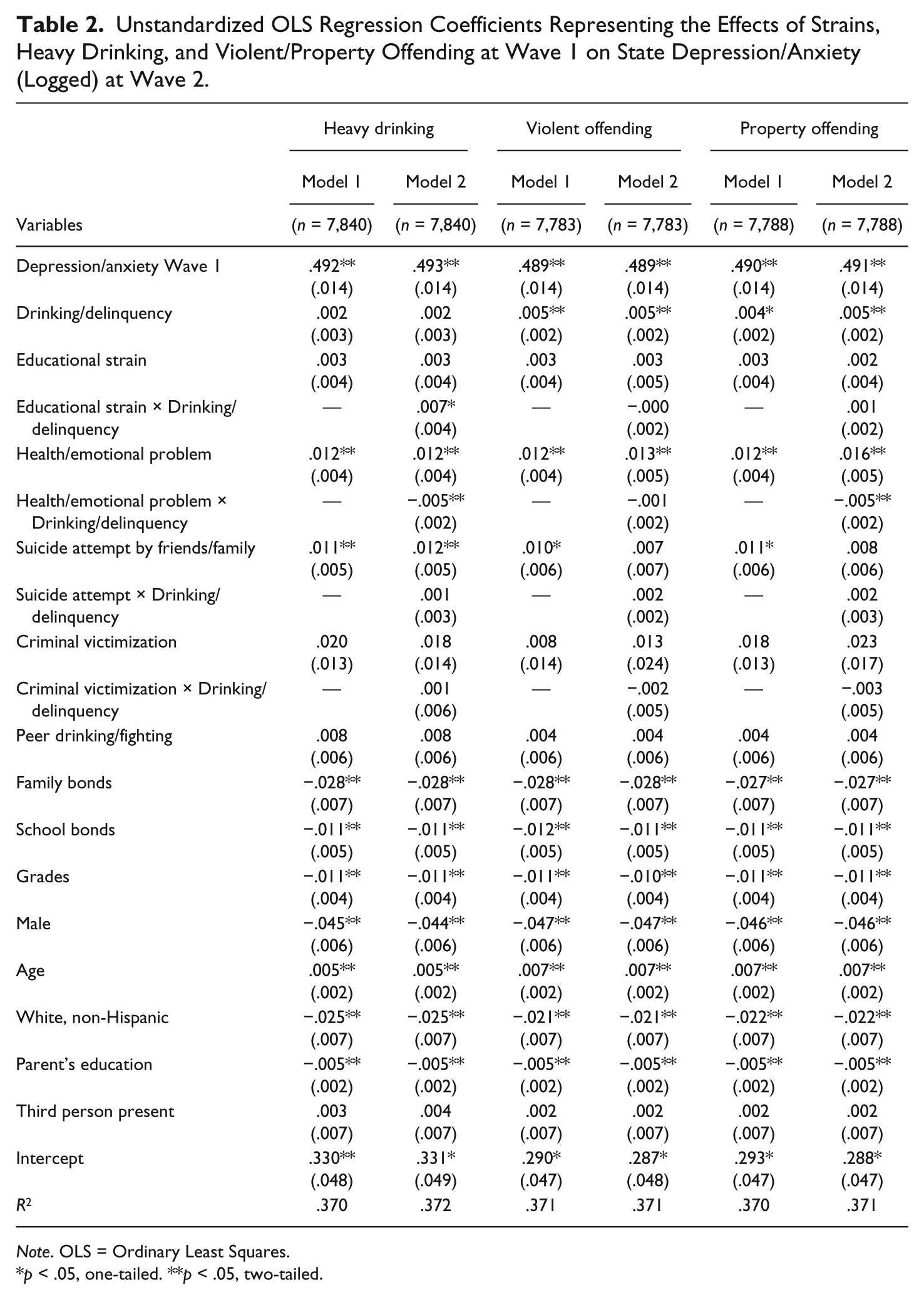
Table 2 shows results from estimating three separate models, each of which regresses state depression/anxiety at Wave 2 on heavy drinking or delinquency (i.e., violent or property offending), strain, social bonding, and social learning (peer drinking for heavy-drinking model and peer fighting for violent- and property-offending models) as well as sociodemographic variables at Wave 1. In addition to these controls, the previous measure of depression/anxiety at Wave 1 was held constant, so regression coefficients estimate the effects of independent variables on change in the dependent variable between Waves 1 and 2. 9 Thus, the coefficients can be interpreted as measuring causal influence of the independent variables on state depression/anxiety—particularly, whether heavy drinking or delinquency increased or decreased the negative emotional state—over the 1-year time interval. We discuss results below in terms of unstandardized regression coefficient (b) because the three models of different emotional coping are presented for comparative purposes.
Unstandardized OLS Regression Coefficients Representing the Effects of Strains, Heavy Drinking, and Violent/Property Offending at Wave 1 on State Depression/Anxiety (Logged) at Wave 2.
Note. OLS = Ordinary Least Squares.
p < .05, one-tailed. **p < .05, two-tailed.
The estimated additive models (Model 1) show that violent (b = .005) and property offending (b = .004) both had positive effects on depression/anxiety, whereas heavy drinking had no significant effect (b = .002). 10 That is, committing serious delinquency at Wave 1 was likely to increase, rather than decrease, the probability of feeling depressed and anxious at Wave 2, although heavy drinking was not. Also, two of the four strain variables, health/emotional problem (b = .012, .012, .012) and suicide attempt by friends/family (b = .011, .010, .011), were found to increase the probability across the models, whereas all three social bonding variables (family bonds, school bonds, and grades) decreased it as anticipated. However, the effects of deviant peer variables of social learning on negative emotions remained nonsignificant across the models. Controls, however, were significant in the expected direction with one exception (i.e., third person present at interview). Specifically, boys, Whites, younger students, and respondents from higher social class (parent’s education) were less likely to report a negative emotional state than girls, non-Whites, older students, and those from a lower class (Mirowsky & Ross, 2003).
Turning to the interactive models (Model 2), we found one interaction term involving educational strain to be positive in the heavy-drinking model (b = .007), whereas two involving health/emotional problem were negative in the heavy-drinking and property-offending models (b = −.005 in both). Specifically, heavy drinking was found to increase the emotionally unhealthy effect of educational strain, whereas heavy drinking and property offending at Wave 1 tended to weaken the deleterious effect of health/emotional problem at Wave 1 on depression/anxiety at Wave 2 (b = .012 and .016). No other interaction term was found to be significant. 11
Next, Table 3 presents results from estimating the additive and interactive models separately for males and females. 12 First, in the additive models, the depression/anxiety-causing effect of violent offending, observed in the total sample (b = .005; see Model 1 of violent offending in Table 2), was found for girls (b = .014) but not for boys (b = .000), being consistent with our expectation that females are less likely to reap the emotional benefit from engaging in delinquency than males. However, we found no evidence of gender differential in the distress-increasing effect of property offending (b = .004; see Model 1 of property offending in Table 2) as it turned out to be nonsignificant for both females (b = .002) and males (b = .005). 13
Unstandardized OLS Regression Coefficients Representing the Effects of Strains, Heavy Drinking, and Violent/Property Offending at Wave 1 on State Depression/Anxiety (Logged) at Wave 2 by Gender.

Note. OLS = Ordinary Least Squares.
p < .05, one-tailed. **p < .05, two-tailed.
Second, the gender-specific interactive models show that heavy drinking reduced the deleterious effect of health/emotional problem on depression/anxiety only for girls (b = −.009), whereas property offending did so only for boys (b = −.007). In addition, the effect of (Suicide attempt by friends/family × Violent offending) interaction term, which was nonsignificant in the total sample (b = .002; see Model 2 of violent offending in Table 2), was found to be significant for both females and males but in the opposite direction (b = .009 and −.005, respectively). This indicates that violent offending is likely to aggravate the strain’s deleterious effect on negative emotions among girls but to ameliorate the effect among boys as anticipated. However, heavy drinking aggravating the effect of educational strain on negative emotions, significant for the total sample (b = .007; see Table 2), was not for either females (b = .010) or males (b = .006). Finally, the variables of family bonds and, to a lesser extent, school bonds and grades were generally significant in the expected direction, while the deviant peer variables remained nonsignificant across the models.
Discussion and Conclusion
Although a large, increasing number of studies on GST have been conducted for more than 20 years, research on behavioral or emotional outcomes of criminal coping continues to remain scant. While this may be partly because the theory does not focus on the consequences as much as the causes of crime and delinquency, it is still puzzling to see that GST researchers rarely examined whether crime and delinquency as adaptations to strain would result in what they were presumably intended: that is, coping with strain and its associated negative emotions. This study intended to fill this gap in research by exploring three questions: (a) Does an adolescent’s heavy drinking or delinquency tend to decrease the chance of his or her feeling depressed and anxious later or does it rather increase? (b) Does it ameliorate or aggravate the emotionally unhealthy effect of strain over time? and (c) If heavy drinking or delinquency turns out to help adolescents cope with negative emotions, are boys more likely to reap the benefits than girls?
First, we found adolescents who committed violent and property delinquency to be at higher risk of experiencing depression and anxiety later than those who did not, although heavy drinking did not necessarily increase the risk. This finding is consistent with the anticipated long-term (e.g., cumulative disadvantage) rather than short-term effect of crime on subsequent state of negative emotions (Brezina, 1996; Sampson & Laub, 1997). Second, overall findings showed that adolescent drinking and delinquency may buffer or weaken the distress-producing effect of strain, but may have the opposite effect as well. Specifically, heavy drinking and property (but not violent) delinquency were found to ameliorate the deleterious effect of emotional and health problems on the negative emotional state, but heavy drinking was also found to aggravate the effect of educational strain. Although we could not further investigate reasons for the differential coping efficacy of heavy drinking due to data constraints, future research should examine whether the types of strain and deviant coping make such difference.
Finally, gender-specific results indicated that boys were more likely to reap the emotional benefits from drinking and delinquency than girls perhaps because male deviance was more likely to be tolerated by society than female deviance, particularly, deviation from conduct norms based on traditional gender roles (Eagly, 1987; Heimer, 1996; Shippee & Owens, 2011). While an exception was found that heavy drinking reduced the emotionally deleterious effect of health/emotional problem 14 for girls, this might have been due to female drinking becoming less intolerable than violent and property delinquency committed by girls. These findings also confirm the importance of gender factor in GST research (Broidy & Agnew, 1997; Jang, 2007).
While this study is one of the few examining the efficacy of adolescent drinking and delinquency as emotional coping, we need to acknowledge key limitations of our exploratory study for future research to address. First, we could not examine separately for the short-term and long-term effects of emotional coping because when drinking and offending occurred was not available in our data. Second, our data did not allow us, either, to measure an adolescent’s drinking or delinquency as a behavioral response to any particular strain, so we had to assume it to have been done to cope with strain, not unrelated to strain. 15 While this data constraint is not unique to our study but rather common to previous studies on GST (but see Broidy, 2001; Jang, 2007; Jang & Johnson, 2003), this limitation should be kept in mind when our findings are interpreted.
Third, while we included measures of all three types of strain (Agnew, 1992) in our analysis, future research should examine other “strains most likely to cause crime” that affect mainly juveniles than what we examined (Agnew, 2006, pp. 70-75), such as parental rejection and child abuse and neglect. 16 Another data-related limitation concerns the type of negative emotions. That is, we could not examine the relationships for anger because the Add Health data had no measure of state anger. 17 Thus, future research should examine the efficacy of adolescent drinking and delinquency as coping for angry emotion. Finally, while the Add Health offers one of the best national survey data available for research on adolescents (and emerging adults), the data we analyzed were collected about 20 years ago and thus might have limited generalizability to the present adolescent population due to generational differences (e.g., Jang, Johnson, Kim, Polson, & Smith, 2014).
In conclusion, despite these limitations, we believe that this exploratory research contributes to criminological literatures on GST by making a case for the importance of studying the efficacy of adolescent drinking and delinquency as emotional coping, which has generally been neglected by previous researchers. Does heavy drinking or serious delinquency help adolescents feel better over time? The answer is, “it depends.” That is, if we focus on the association between adolescent drinking or delinquency and negative emotions, the answer is no because we found drinking and delinquency to increase, rather than decreasing, the probability of feeling depression and anxiety later. However, if we focus on drinking and delinquency as moderator, the answer tends to be yes for boys but no for girls as we found that males are more likely than females to reap the benefits from drinking and delinquency buffering the emotionally deleterious effect of strain.
Footnotes
Declaration of Conflicting Interests
The author(s) declared no potential conflicts of interest with respect to the research, authorship, and/or publication of this article.
Funding
The author(s) received no financial support for the research, authorship, and/or publication of this article.