




Abstract
This study investigated gender differences regarding young people charged with murder in England and Wales. A sample of 318 cases was collected from the Home Office’s Homicide Index and analysed. Of these cases, 93% of the offenders were male and 7% female. The analyses explored gender differences in terms of the offender’s race, offender’s age, victim’s age, victim’s gender, weapon used, offender–victim relationship, and circumstances of the offence. The study found that a female offender was significantly more likely to murder a family member than a male offender, and a male offender was significantly more likely to murder a stranger than a female offender. In addition, a female offender was significantly more likely to murder a victim below the age of 5 than a male offender. Implications for interventions with young people who are charged with murder are discussed.
Despite the relatively rare occurrence of murder committed by young people, the phenomenon has increasingly been making media headlines. In 1993, in the United Kingdom, James Bulger (aged 2) was abducted in Liverpool and tortured to death by two young boys, Jon Venables and Robert Thompson (both aged 10). A public debate followed on the influence of nature versus nurture in terms of the upbringing of young people charged with murder. Fifteen years later, in 2007, the killing of Rhys Jones (aged 11) by Sean Mercer (aged 16), in Liverpool again highlighted young people committing murder.
This study aims to explore gender differences regarding young people charged with murder in England and Wales. It will do so in a similar way as that of Heide, Roe-Sepowitz, Solomon, and Chan (2012), who used a national database from the United States, namely, the Supplementary Homicide Report. Heide et al. (2012) examined more than 40,000 murders committed by male and female juvenile offenders (aged 7-17) between 1976 and 2005. However, the present study is not simply about replication, as it compares male and female offenders aged 21 years and below. In addition, it was not possible to assess exactly the same variables as those in the study by Heide et al. (2012). Efforts will also be made to assess which variables can be used to predict the gender of the offender. According to Heide et al. (2012), research concerning young females who commit murder is limited, as is research concerning how females differ from males at a national level. The present study marks the first time that these differences will be tested on an English and Welsh sample.
Murder Committed by Young People
The existing studies on young people who commit murder vary with regard to their content, as inconsistent definitions of murder are used across the literature. Indeed, there are instances where the terms murder and homicide are used interchangeably in the same study. In England and Wales, homicide includes the offences of murder, manslaughter, infanticide, and causing death by dangerous driving. Murder is defined as the unlawful killing of a human being while being of sound mind and with the intention to kill or cause grievous bodily harm (Crown Prosecution Service [CPS], 2013). In the United States, Heide et al. (2012) adopt the FBI’s definition of murder, which is “the wilful (non-negligent) killing of one human being by another” (FBI, 2008, cited in Heide et al., 2012, p. 361). Although the definitions used across studies may differ, similar features are apparent, namely, an individual has been killed, there was intent for the offence to take place, and the offence was committed by another person (Smit, De Jong, & Bijleveld, 2012).
Approximately 6% of homicide cases in England and Wales are committed by young people (below the age of 18) per year, as opposed to 10% in the United States (Rodway et al., 2011). In a study using the Home Office’s Homicide Index for England and Wales, 2,145 homicides committed between 1995 and 2000 were investigated (Francis et al., 2004). In total, 386 homicides were committed by offenders below the age of 21, which represents 18% of the sample. Of these 386 cases, 150 were committed by children aged 10 to 17 (an average of 30 cases per year), and 236 were committed by young people aged 18 to 20 (an average of 47 cases per year). No further results relating to homicide committed by young people were reported (Francis et al., 2004). However, in terms of the overall data set (i.e., all ages), Francis et al. (2004) identified that the majority of cases (98%) involved a single victim, with only 2% of cases having more than one victim (in these cases, there were between two and seven victims). In contrast, 20% of the cases involved more than one offender (i.e., between 2 and 11 offenders). In addition, in 32% of the cases the victim was female, yet females accounted for less than 10% of the offenders.
According to the Ministry of Justice (2008), between 2003 and 2006, there were 71 young offenders aged 10 to 17 who were given life imprisonment for homicide in England and Wales. Of these individuals, 97% were male offenders, and 3% were female offenders. In addition, 179 young people aged 18 to 20 were sentenced to life imprisonment for homicide. Of these offenders, 93% were male, and 7% were female. In many of these cases, knives and other sharp instruments were used, while firearms were employed less often. Indeed, more than a third of homicides involved a knife or sharp instrument (Home Office, 2008a, 2008b; Povey, Coleman, Kaiza, Hoare, & Jansson, 2008). When considering all homicide cases in England and Wales (i.e., all ages and both genders) during 2011, firearm offences account for approximately 60 (11%) cases. This is 19 more cases than the previous year but includes the 12 cases from the shootings in Cumbria, which took place in June 2010 (Smith, Osborne, Lau, & Britton, 2012).
There is cause for concern regarding young people and their use of weapons. Roe and Ashe (2008) report that 6% of boys (aged 14-17) carry a knife, while the House of Commons Home Affairs Committee (2009) claim that 31% of children (aged 11-16) in mainstream education carry a weapon (17% have a knife and 15% carry a pellet gun). According to Povey et al. (2008), the most common method for offenders of all ages when committing murder is to use a sharp instrument, followed by physical violence (e.g., hitting or kicking). In terms of female victims in particular, strangulation or asphyxiation is commonly employed.
In the United States, the circumstances of homicide often have been found to differ depending on whether the young offender is male or female. Male offenders tend to commit homicide for instrumental reasons (e.g., during the commission of a crime), while female offenders tend to do so for expressive reasons (i.e., in relation to emotions experienced; Heide et al., 2012; Heide, Solomon, Sellers, & Chan, 2011; Loper & Cornell, 1996; Sellers & Heide, 2012). However, the rate of murder committed by males and females (below the age of 18) appears to remain stable across studies, with 92% of murders being committed by male offenders and 8% by female offenders (Heide et al., 2012; Heide et al., 2011; Loper & Cornell, 1996; Sellers & Heide, 2012). Evidence of male offenders being more prevalent were also found in several U.K. studies, with 91% of offenders being male and 9% female (Bailey, 1996; Dolan & Smith, 2001; Rodway et al., 2011).
A number of characteristics have been identified in relation to both male and female young people who commit murder. These include characteristics relating to their background (e.g., low socio-economic status, harsh or negligent parenting style, and exclusion from school) and their environment (e.g., availability of weapons, family disorganisation, abusive home environment, and violent family life; Darby, Allan, Kashani, Hartke, & Reid, 1998; Dolan & Smith, 2001; Heide et al., 2011; Hill-Smith, Hugo, Hughes, Fonagy, & Hartman, 2002).
Gender Differences Regarding Murder
National studies in the United States that compared male and female young offenders who committed murder found significant differences in terms of the victim’s age, victim’s gender, weapon used, relationship between victim and offender, and circumstances of the offence (Heide et al., 2012; Heide et al., 2011; Sellers & Heide, 2012).
According to Heide et al. (2011), studies comparing gender differences among juvenile homicide offenders in the United States (Heide, Roe-Sepowitz, & Solomon, 2008; Loper & Cornell, 1996; Rowley, Ewing, & Singer, 1987; Snyder & Sickmund, 1999, 2006) found that male offenders were more likely to murder strangers, while female offenders were more likely to murder family members. In terms of the weapons used, male offenders were more likely to use firearms, while female offenders were more likely to use knives or other weapons (Heide et al., 2008; Loper & Cornell, 1996; Snyder & Sickmund, 1999, 2006). The age of the victim tended to vary depending on the offender’s gender, as male offenders were more likely to murder adolescent or adult victims, and females were more likely to murder young victims. Female offenders were also more likely to target other females as victims (Heide et al., 2008; Snyder & Sickmund, 1999). In terms of the circumstances of the offence, male offenders were more likely to commit crime-related homicides, while female offenders were more likely to commit conflict-related homicides (Heide et al., 2008; Heide et al., 2012; Heide et al., 2011; Loper & Cornell, 1996; Roe-Sepowitz, 2007; Sellers & Heide, 2012).
The study by Heide et al. (2012) tested eight hypotheses regarding the differences between male and female juveniles arrested for murder in single-victim incidents. They found significant differences in terms of the victim’s age, victim’s gender, weapon used, relationship between victim and offender, circumstances of the offence, and number of offenders present. Female offenders were four times more likely to murder children below the age of 5 than male offenders, and twice as likely to murder female victims. In terms of the weapon used, male offenders were more likely to use firearms, while female offenders were more likely to use knives or other weapons and methods (e.g., blunt objects, poison, drugs, explosives, physical violence, strangulation, asphyxiation, drowning, or arson). With regard to the offender–victim relationship, male offenders were more likely to murder strangers, acquaintances, or other individuals known to them. Relative to male offenders, female offenders were nine times more likely to murder intimate partners, four times more likely to kill children below the age of 5, and twice as likely to murder family members (e.g., parents, siblings, step-parents, and other family members). In terms of the circumstances of the offence, male offenders were more likely to commit crime-related homicides, while female offenders were more likely to commit conflict-related homicides. Female offenders were also more likely to commit the offence on their own.
Heide et al. (2011) also explored gender and age differences in relation to juvenile homicide offenders. They divided the offenders into two age groups: younger (i.e., below the age of 13) and older (i.e., aged 13-17). The results of the study showed that when controlling for the effect of the offender’s age, there were significant gender differences in terms of the victim’s age, victim’s gender, weapon used, relationship between victim and offender, and circumstances of the offence. Across both age groups, female offenders were more likely to murder young victims or adults aged 35 to 64. They were also more likely to murder female victims. With regard to the weapon used, male offenders were more likely to use firearms and female offenders were more likely to use knives. In addition, female offenders in both age groups were more likely to use physical violence (e.g., hitting, kicking, or asphyxiation) than male offenders. In terms of the offender–victim relationship, male offenders across both age groups were more likely to murder strangers, while female offenders across both age groups were more likely to murder family members. When the circumstances of the offence were analysed, male offenders were found to commit murder more often during the commission of other crimes, while female offenders were found to primarily commit murder during conflict-related situations. Older male offenders were also more likely to be involved in gang-related murders than older female offenders. No young female offenders were involved in gang-related incidents.
Sellers and Heide (2012) investigated gender differences in a national sample of 226 children (aged 6-10) who were arrested for murder or non-negligent homicide over a 32-year period. All of the incidents involved a single victim. Their results were consistent with previous research and showed gender differences in terms of the victim’s age, weapon used, relationship between victim and offender, and circumstances of the offence. Female offenders were more likely to murder a victim below the age of 5, use a knife, and target a family member. Although there were no gender differences with regard to multiple offenders, girls below the age of 11 were significantly more likely than their male counterparts to have an accomplice during the murder of family members. This study also indicated that young offenders (below the age of 11) who commit murder or non-negligent homicide in the United States tend to target young victims (aged 5-13). Nearly 90% of the offenders selected victims who were known to them (46% of the offenders murdered family members and 42% murdered friends or acquaintances), while only 11% of the victims were strangers. A firearm was used in half of the cases, and approximately 80% of the offenders acted alone. The majority (73%) of the offences took place in conflict-related circumstances.
Loper and Cornell (1996) focused their research on female juvenile offenders (17 years and younger) who were arrested for committing homicide between 1984 and 1993 in the United States. They found that these offenders predominantly used sharp objects as their weapon, frequently targeted family members, and often committed the offence during an interpersonal conflict. When a firearm was used, it was usually against older victims (possibly indicating a need to overpower the victim). In addition, a considerable proportion of their victims were below the age of 3 (e.g., concealed pregnancies or unwanted children). Loper and Cornell’s (1996) findings support Campbell’s (1993) theory regarding gender variation in aggression, where males tend to act violently for instrumental reasons and females do so for expressive reasons. This suggests that female offenders are more motivated by expressive needs in conflict-related incidents. Indeed, the intra-familial murders in this study were primarily committed by female offenders acting without an accomplice, which suggests stress and conflict within the parent–child relationship.
Roe-Sepowitz (2007) examined the individual and family characteristics of 29 females below the age of 18, who were charged with homicide or attempted homicide in one U.S. state, Florida. The results of the study showed high rates of reported substance abuse, delinquent peers, early indications of mental health problems, and limited control or supervision by parents. In addition, the most common victim tended to be someone known to the offender. When comparing the incidents committed during a conflict versus those committed during the commission of another crime, the victims were more frequently friends and family members during the conflict-related offences. However, in the crime-related offences, there was a higher use of alcohol and drugs, a firearm was more likely to be used, and there was a higher rate of the offender acting with an accomplice.
In a subsequent study, Roe-Sepowitz (2009) compared 136 male and female juvenile offenders who had been charged with homicide or attempted homicide over a 5-year period. Male offenders were found to have a higher substance abuse rate and were more likely to murder strangers than female offenders. Female offenders had experienced a higher rate of child abuse, mental health issues (e.g., anxiety, depression, or suicidal ideation), and were more likely to target someone they knew than male offenders.
The aim of the present study is to explore gender differences regarding young people charged with murder in England and Wales. In contrast to the U.S. studies described above, the weapons used by the offenders in England and Wales are expected to be different, as there are strict laws controlling the availability of firearms in the United Kingdom. The present study will adopt a similar methodology as that of Heide et al. (2012) when comparing male and female young offenders charged with murder.
Method
Sample
This study defined “young people charged with murder” as those individuals aged 21 or below who had killed someone, and were subsequently indicted and charged with murder by the police. The Home Office’s Homicide Index was used to identify 318 cases of offenders who were charged with murder, including infanticide (killing a child below the age of 1), between January 1, 2007, and March 31, 2011. Cases of manslaughter, attempted murder, and attempted infanticide were not included in the data set. This is because the study aimed to focus on cases where there was both a fatal outcome and no partial defence or negligence applies (the latter two factors suggest manslaughter as opposed to murder; CPS, 2013).
Eight of the offenders were charged with murder after killing a child below the age of 1. Three of these offenders were below the age of 18, while 5 were aged 18 to 21. Among all the offenders charged with murder, 102 were convicted of manslaughter, and the rest were convicted of murder (and 8 of infanticide). None of the offenders were acquitted in court.
Hypotheses
In an effort to replicate the study of Heide et al. (2012), the present study aims to test the following hypotheses:
Data Collection
The Home Office’s Homicide Index includes details regarding all homicide offenders over the age of 10, as this is the minimum age of criminal responsibility in England and Wales (CPS, 2013). It includes demographic information about the offender and victim, as well as data regarding the offence, sentence, and outcome in court. All the cases used in the study involved a single offender and single victim.
Each variable in the Home Office’s Homicide Index was recoded dichotomously (where 1 = present and 0 = absent). This dichotomous approach has been applied to previous studies, as it ensures better clarity and reliability with data that were not initially recorded for research purposes (Canter & Fritzon, 1998; Salfati, 2000).
Data Analysis
Where the data were nominal, Pearson’s chi-square test (Pearson, 1900) was used to explore gender differences in terms of the offender’s race, victims below the age of 5, victim’s gender, weapon used, relationship between victim and offender, and circumstances of the offence. If the expected frequency in a cell was five or less, Fisher’s exact test (Fisher, 1922) was utilised instead. However, when a contingency table was greater than 2 × 2, the Fisher-Freeman-Halton exact test (Freeman & Halton, 1951) was used. To measure the strength of association between the variables, ϕ and Cramer’s V were employed: ϕ was used for 2 × 2 contingency tables, while Cramer’s V was used if one of the variables had more than two categories (Field, 2009). The interpretation standards used for ϕ and Cramer’s V are those proposed by Cohen (1988, as cited in Sellers & Heide, 2012), where 2 × 2 contingency tables should have a value of .50 to be considered a strong association, 2 × 3 tables should have a value of .35 or higher, and 2 × 4 tables should have a value of .29 or higher. In instances involving both a nominal and a scale variable (i.e., offender’s gender and offender’s age or victim’s age), the Mann–Whitney test (Mann & Whitney, 1947) was employed to explore gender differences.
After completing these analyses, binary logistic regression was conducted to develop a model that would determine which variables might distinguish female from male charged with murder. This specific type of regression was employed as it predicts a dichotomous dependent variable (i.e., gender) based on several independent variables (Field, 2009). The independent variables included in the analysis were informed by the results of a series of Pearson’s chi-square tests (Pearson, 1900), which were performed using the offender’s gender and every other nominal variable in the data set. Only those variables that were significantly associated with the offender’s gender were included in the analysis. This was so as to make certain that no arbitrary variables were placed in the regression model.
The statistical significance level across all the tests was originally set at p < .05. However, as nine tests were performed on a single data set, the Bonferroni correction was used to adjust the level of significance, such that p < .005 was considered statistically significant across all the tests.
Results
Demographics
There were 297 male offenders (93%) and 21 female offenders (7%). The offenders’ age ranged from 13 to 21 years, with a mean age of 18.4 years (standard deviation [SD] = 1.89 years). The majority of offenders were aged 18 and above (68.9%). In terms of the offenders’ age, 8.2% of the offenders were 15 years or below, 9.1% were 16 years old, 13.8% were 17 years old, 17.6% were 18 years old, 16.4% were 19 years old, 19.5% were 20 years old, and 15.4% were 21 years old. However, there was no significant difference between males and females in terms of their age (U = 2,587.5, z = −1.32, p = .19).
With regard to the offenders’ race, the majority of the offenders were White (64.7%), followed by Black (18.2%), Asian (11.9%), and Other/not known (5.2%). There was no significant difference between male and female offenders with regard to their race (Fisher’s p = .23).
Relationship Between Offender’s Gender and Victim’s Age
There were 277 male victims (87%) and 41 female victims (13%). The victims’ age ranged from 0 to 89 years ( SD = 16.60). Table 1 shows the age of the victims and the offenders’ gender. Eighteen of the victims were below the age of 14, of whom 15 were below the age of 5.
Age of Victims and Offenders’ Gender.
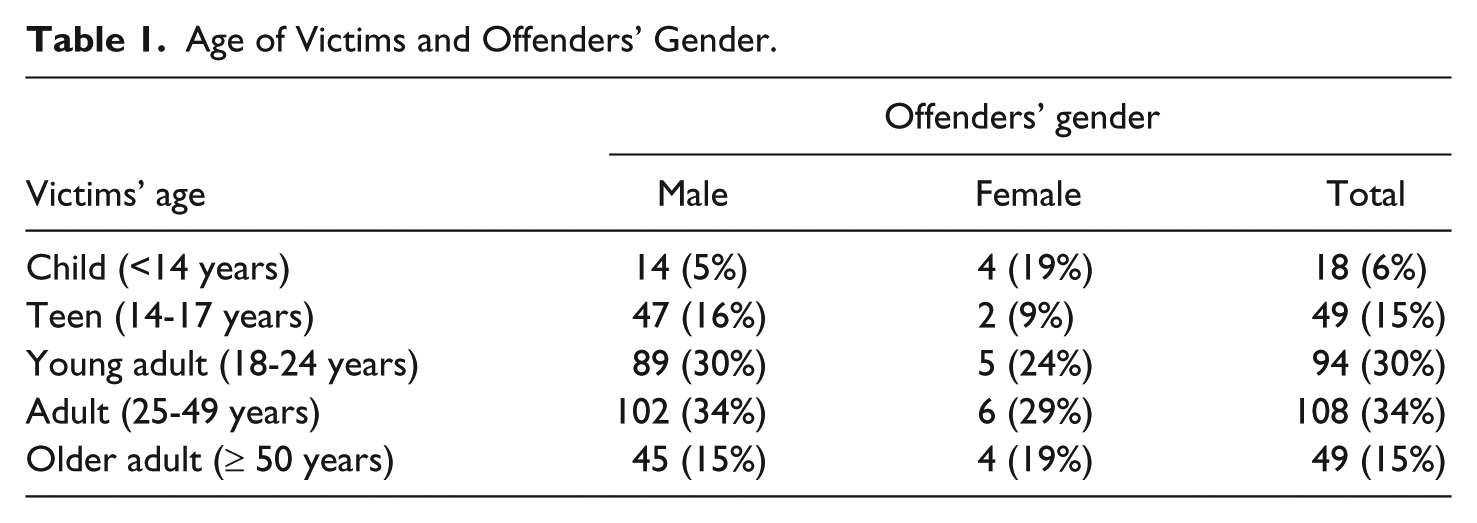
As shown in Table 1, there was no significant difference between male and female offenders in relation to the victim’s age (Fisher’s p = .14). Based on this result, there is insufficient evidence to accept Hypothesis 1. As there was a wide range in victims’ age (i.e., less than 12 months to 89 years), any significant differences relating to younger victims could potentially be hidden. Thus, when specifically considering victims below the age of 5, it was found that a female offender was significantly more likely to murder a victim below the age of 5 than a male offender (19% vs. 3.7%; Fisher’s p = .01,ϕ = .18); ϕ suggests a small effect size. However, when the Bonferroni adjustment is applied, this relationship does not remain significant. There is thus insufficient evidence to accept Hypothesis 1.
Relationship Between Offender’s Gender and Victim’s Gender
There was no significant difference between male and female offenders in terms of the gender of their victims (Fisher’s p = .14). Fourteen percent of female victims and 86% of male victims were killed by female offenders while 13% of female victims and 87% of male victims were killed by male offenders. As such, there is insufficient evidence to accept Hypothesis 2.
Relationship Between Offender’s Gender and Weapon Used
Table 2 indicates the weapons used during the offence and the offender’s gender. Both male and female offenders tended to favour the use of a knife when committing the offence, followed by physical violence (which included strangulation). However, there was no significant difference between males and females with regard to their choice of weapon (Fisher’s p = .50).
Weapons Used During Offence and Offenders’ Gender.

As a result of the findings described above, there is insufficient evidence to accept Hypothesis 3.
Relationship Between Offender’s Gender and Offender–Victim Relationship
Data relating to the relationship between victim and offender were divided into three categories: family (including child, parent, and other family member), friend or acquaintance (including partner and ex-partner), and stranger. Table 3 shows the offender–victim relationship and the offender’s gender. It was found that female offenders were significantly more likely to murder a family member than a male offender (43% vs. 9%), and male offenders were significantly more likely to murder a stranger than a female offender (48% vs. 19%; Fisher’s p < .001, Cramer’s V = .27). Cramer’s V suggests a medium effect size. This supports Hypotheses 4 and 5. The relationship remained significant after the Bonferroni adjustment was made.
Offender–Victim Relationship and Offenders’ Gender.

Relationship Between Offender’s Gender and Circumstances of the Offence
Data concerning the circumstances of the offence were divided into two categories: crime and conflict. Crime-related murders were associated with theft, while conflict-related murders were connected to a quarrel, revenge, or loss of temper. These categories follow the typology proposed by Cornell, Benedek, and Benedek (1987). In terms of the offenders, 197 committed a conflict-related murder, 37 committed a crime-related murder, and the remainder could not be classified. Of those offenders who could be classified, 83% of the male offenders were involved in conflict-related offences, while 17% committed crime-related murder. In addition, all the female offenders were linked to conflict-related offences. There was no significant difference between male and female offenders with regard to the circumstances of the offence (Fisher’s p = .14). Based on the results described above, there is insufficient evidence to accept Hypothesis 6.
Determining the Offender’s Gender
Binary logistic regression was used to generate a model that would determine which variables might distinguish female from male charged with murder. Based on the results from the hypotheses tested in the present study, two variables were considered: victim was a family member and victim was a stranger. The regression diagnostics (tolerance and variance inflation factor) did not indicate any issues in terms of collinearity between the two variables.
The findings of the binary logistic regression reveal a model that significantly fits the data, χ2 (2) = 16.582, p < .001. In addition, Nagelkerke’s pseudo-R2 estimates that the model accounts for 13% of the variance in gender difference and correctly classified 93.4% of cases. The variables used in the analysis are presented in Table 4, which also provides measures of each variable’s contribution to the model.
Results of Binary Logistic Regression.

Note. SE = standard error.
p < .01.
As can be observed by the values presented in Table 4, only one variable was significantly related to the gender of the offender at the .01 level, namely, the victim is a family member. This variable remained significant when applying the Bonferroni correction (p < .005). The odds ratio shows that a female offender is 5.4 times more likely than a male offender to murder a family member.
Discussion
This study is the first to compare male and female young people charged with murder in England and Wales. With regard to all the offenders in the sample, no significant differences were established between male and female offenders in terms of age or race. As observed by Heide et al. (2012), only weak relationships with respect to these two variables appeared in their study. This fact they attributed to the absence of reasons from previous research to suspect any such relationship.
It was expected to find similar results as those in the study carried out by Heide et al. (2012). Their results suggest that a female offender is significantly more likely than a male offender to murder young victims, female victims, and family members. In comparison, a male offender is significantly more likely than a female offender to use a gun as a weapon, murder strangers, and act in conflict-related situations. However, in the present study, the only significant difference between male and female offenders was with regard to the relationship between the victim and offender. In terms of these offenders, a female offender was significantly more likely than a male offender to murder a family member, and a male offender was significantly more likely than a female offender to murder a stranger. It should be noted that when Heide et al. (2012) considered the relationship between victim and offender, they had 11 categories for this variable, namely, parent, offspring, sibling, step-parent, intimate partner, other family members (e.g., in-laws), neighbour, acquaintance, friend, other known individuals (e.g., employer), and stranger. Their larger sample enabled them to make finer comparisons, whereas in the present study, this was not possible.
When specifically considering victims below the age of 5, the present study found that a female offender was significantly more likely to murder a victim below the age of 5 than a male offender in this age group. This lends partial support to the findings of Heide et al. (2012), who suggest that a female offender is more likely to murder a young victim than a male offender.
No significant difference between male and female offenders was found in terms of the gender of their victims. As such, the hypothesis that females charged with murder will be more likely to kill female victims than males charged with murder could not be supported. Similar results have been presented by Loeber and Farrington (2011), who found that female offenders target male victims more frequently than female victims. They also observed that, with regard to juvenile homicide, males tend to commonly become victims of both male and female offenders. According to Blackburn (2002), there is little consensus when explaining why males are over-represented as victims of crime. It could be due to gender differences in terms of dominance, aggression, physical appearance, or hormonal balance. In addition, it could be because of the instrumental versus expressive reasons behind an offence (Loper & Cornell, 1996).
In the present study, both male and female offenders favoured the use of a knife when committing the offence. Physical violence (including strangulation) was also commonly employed. Very few male offenders used a firearm (6%), while this weapon was not used by any female offenders. In the study conducted by Heide et al. (2012), firearms were used in 69% of the cases. Previous studies have found that easy access to firearms is a problem in the United States (DiCataldo & Everett, 2008; Sellers & Heide, 2012). According to Heide and Petee (2007), the rate of juvenile homicide in the United States could be reduced if access to firearms in the home was restricted. The low percentage of offenders who used a firearm in the present study compared with the results of Heide et al. (2012) can be explained by the differences in legislation between the United Kingdom and the United States. In England and Wales, ownership and access to firearms is tightly controlled, while automatic and semi-automatic firearms are illegal (Firearms (Amendment) Act, 1988). The difficulty regarding access to firearms in England and Wales could be why the majority of offenders in the present study elected to use a knife or physical violence instead. The high use of knives corroborates media reports on the epidemic of knife use among young people in England and Wales (Rodway et al., 2011). In addition, the use of knives in particular fits in with the physical strength hypothesis, which was proposed by Chan and Heide (2008) when examining sexual homicides. These authors suggested that young people favour knives and firearms to overpower their victim when he or she is of a similar strength and build. This could also explain why 70% of the female offenders in the present sample used a knife or blunt instrument when committing their offence. Further research looking specifically at juvenile homicide outside of the United States is needed in this area, as it would be interesting to know more about the physical build of the young offenders and victims to confirm the physical strength hypothesis.
The binary logistic regression results show that only one variable was related to the gender of the offender (i.e., the victim is a family member). Indeed, the findings suggest that a female offender is 5.4 times more likely than a male offender to murder a family member. Several studies conducted in the United States have found similar significant results (e.g., Heide et al., 2008; Heide et al., 2012; Heide et al., 2011; Loper & Cornell, 1996; Snyder & Sickmund, 1999, 2006), and the present study lends some support to the applicability of these findings in England and Wales. As suggested by Loper and Cornell (1996), these results might be explained by female offenders’ susceptibility to carry out violence in response to domestic stress or conflict in relationships.
Implications of the Current Study
The implications of the present study primarily relate to prevention and treatment. A female offender was found significantly more likely to murder a victim below the age of 5 than a male offender. This could be due to unwanted pregnancies, denial of pregnancies, failure of the relationship with the child’s father, or failure to cope with a new-born baby. These issues should be further investigated, as they potentially precede a murder being committed and can assist with prevention. Although it is not possible to determine cases of neonaticide in the present study, three female offenders murdered victims less than 12 months old. According to Riley (2005), neonaticide is not a premeditated act of rage against a new-born child, but rather the result of months of concealing a pregnancy and an impulsive response once the child is born. The fear of rejection, abandonment, or stigmatization from relatives can influence a mother to murder her child. As such, according to Heide et al. (2012), “Intervention programs targeted to help girls cope more adaptively to prevent such tragedies are needed” (p. 375), for example, new mother classes or psychoeducation. Interestingly, the present study found that five male offenders murdered victims less than 12 months old. Further research is required to understand the reasons behind these offences.
In addition, female offenders were significantly more likely than male offenders to murder a family member, and male offenders were significantly more likely than their female counterparts to murder a stranger. Taking these findings into account, empathy training would be useful to help these individuals identify with others. Roe-Sepowitz (2009) showed that male offenders would benefit from treatment targeting impulsivity and substance abuse, while female offenders would benefit from interventions focusing on substance abuse, child abuse, mental health and anger issues, depression, and suicidal ideation.
Conflict-related murder was committed most frequently by both male and female offenders in the present study. As such, interventions that improve young people’s ability to cope during conflicts and resolve arguments peacefully would be useful. Young people who use a firearm to resolve an argument tend to lack adequate social skills, self-control, and good judgement (Agee, 1995, as cited in Heide, 2003). As such, alternative responses that are appropriate to the situation should be taught, as well as how to resolve the conflict. Family counselling is another possible intervention that could help prevent murder being committed. This would need to be implemented soon after signs of violence are observed within the family (Sellers & Heide, 2012). In addition, abuse history should be taken into account, as it will influence the choice of appropriate treatment for the young person.
Limitations of the Current Study
One of the aims of this study was to determine which crime-scene variables could differentiate male offenders from female offenders in juvenile homicides. Few relationships were found to be significant and therefore the regression has not brought a very useful result from an investigative perspective. This may be due to the small sample size or this may be due to a cultural difference. This is why this study should be reproduced with a bigger sample from non-U.S. countries.
Despite being a national study, the sample size of the present research is small, and the number of female offenders is very limited. Future research should look toward increasing the size of the sample if the data were to become available. One way of doing this is to expand the period during which cases were collected (i.e., use cases that occurred prior to January 1, 2007). However, this is currently difficult given that the Home Office’s Homicide Index is only available electronically with cases dating from 2007 and onward. Access to archival paper versions of data prior to 2007 is both difficult and restricted.
Similar to a limitation in the study by Heide et al. (2012), the Home Office’s Homicide Index is also limited to basic demographic and crime-scene data. Variables that could assist with explaining how and why young people engage with committing these offences are not recorded. Future research should aim to include variables relating to risk factors (see Gerard, Jackson, Chou, Whitfield, & Browne, 2014) and prior criminal history, which were found to be relevant in previous studies (Heide, 1999; Loeber & Farrington, 2011). Such future endeavours are essential to understanding gender differences at a national level, which is crucial in the design of effective gender-appropriate prevention and treatment measures.
Footnotes
Acknowledgements
The authors would also like to acknowledge the anonymous reviewers for their very helpful comments.
Authors’ Note
The original work was part of the first author’s PhD thesis at the University of Nottingham, which was completed under the supervision of the second and third authors at the University of Nottingham. The article has since been revised at Coventry University where F. Jeane Gerard now works as a research associate at the Research Centre in Psychology, Behaviour and Achievement, Coventry University, Priory Street, Coventry, CV1 5FB, United Kingdom. Dr. Kate C. Whitfield contributed to revisions while working at Birmingham City University and now Sheffield Hallam University.
Declaration of Conflicting Interests
The author(s) declared no potential conflicts of interest with respect to the research, authorship, and/or publication of this article.
Funding
The author(s) disclosed receipt of the following financial support for the research, authorship, and/or publication of this article: This work was supported by the Fondation Belge de la Vocation (Belgique) under a grant to the first author to undertake a PhD.