




Abstract
Developmental and life-course (DLC) theories of crime aim to identify the causes and correlates of offending over the life span, focusing on the within-individual variations that result in criminal and delinquent behavior. Although there are several notable theories in the field, few contain both developmental and situational factors related to offending, and none explain why individuals commit crimes in different ways. This study aims to address these issues by developing typologies of burglars based on developmental and situational characteristics to help identify the various criminal career paths of the offenders, and how these different criminal careers may relate to the commission of offenses. Results of this study indicate that there are five different criminal career paths among the sampled burglars and four different styles of committing the same offense, and that burglars with certain criminal career features tend to commit a specific style of burglary. Through this research, we aim to extend DLC theories to create a more practical and contextual explanation of the relationship between criminal careers and the commission of offenses, and increase the level of within-individual explained variance in criminal behavior.
Keywords
The primary goal of developmental and life-course (DLC) criminology is to document and explain within-individual variations in criminal and deviant behavior from childhood through adulthood (Farrington, 2005; Nagin, Farrington, & Moffitt, 1995). To do this, many DLC theories propose trajectories of offending over the life-course (e.g., Lahey & Waldman, 2003; Sampson & Laub, 2003; Thornberry & Krohn, 2005), whereas some theories suggest specific typologies of offenders (e.g., Le Blanc, 1997; Moffitt, 1993), and others do not propose types of offenders at all (e.g., Farrington, 2005; Catalano & Hawkins, 1996; Wikström, 2005).
Despite these differences, each of the DLC theories covers some combination of three main issues: the development of offending and antisocial behavior over the life-course, risk and protective factors for crime at different ages, and the effect of life events on the course of criminal development (Farrington, 2003). In short, each theory aims to identify the causes and correlates of crime from “crib to coffin,” with the main focus on within-individual variations as strategies of prevention and treatment all require within-individual change (Farrington, 2005).
To describe the development of individual differences in criminal behavior over the life-course, DLC theories generally utilize data on individual-level developmental, psychological, social, biological, environmental, and behavioral risk features such as age, gender, race, age of criminal onset, offending rate and versatility, criminal career length, aggression, low self-control, delinquent peer association, socioeconomic status, childhood trauma/abuse, autonomic arousal and neurological issues, and more (Farrington, 1992; Fox, Jennings, & Piquero, 2014). Using this individual-level information, criminologists have begun to explore and explain why individuals may or may not commit crime, and at different rates, over the life-course.
However, one critical element of offending that DLC (and other individual-level) theories cannot yet explain is the variation in actual offending behaviors, or why certain offenders commit crimes in certain situations, and in certain specific ways (Farrington, 2013). As Mokros and Alison (2002) noted, “there must be something about the person that strongly influences the way in which the offence is carried out” (p. 40). Unfortunately, this relationship between developmental and situational factors and how, or in what scenarios, crimes are committed has not been thoroughly explored.
Situational Factors and Crime-Specific Typologies
Theorists who focus on situational features of crime and crime prevention (e.g., Clarke & Cornish, 1985; Cornish & Clarke, 2003) have argued that, to properly account for the unique circumstances surrounding a crime, different models are needed for different offenses. For instance, the situational factors relating to burglary may be very different from situational factors for violence (Farrington, 2005). Although the motivation for robbery is typically utilitarian (e.g., monetary gain) or excitement based, whereas murder is often motivated by revenge, sexual desire, and only occasionally by utilitarian considerations (Trojan & Salfati, 2011). Similarly, co-offending is quite rare among sex offenders and forgers, although it is much more common among young arsonists and burglars (van Mastrigt & Farrington, 2009).
Some DLC researchers have already taken note of this and begun to create crime-specific typologies, instead of general typologies intended to cover all forms of crime. Sampson and Laub (2003) did this for violent crime as well as alcohol and drug offending, identifying five distinct offender trajectory groups within both offense types. Piquero, Brame, Mazerolle, and Haapanen (2002) found four trajectories of both violent and non-violent offending in early adulthood, noting that developmental patterns of criminal activity differ with regard to crime type. Although the individual crime typologies each represent only one part of all offenders in general, there is no DLC theory that suggests the developmental mechanisms should significantly differ among crimes, as the differences mainly arise from situational influences surrounding the various crime types (Farrington, 2005).
Furthermore, though situational crime prevention research generally suggests that immediate situational and opportunity factors such as the perceived risk, rewards, level of guardianship, required effort, and so forth in a given scenario are responsible for an individual’s decision to commit a criminal act (Clarke, 2009; Cornish & Clarke, 2003), it has been suggested that situational factors and criminal opportunity are only “half of the situational crime prevention story” (Wortley, 2001, p. 63). Specifically, situational crime prevention implies only that certain situational factors may make it easier or harder for an individual motivated to commit crime to act, but it does not account for why certain individuals commit certain crimes in certain situations, whereas other individuals do not. This has led some researchers to believe that an individual’s “criminal propensity” could play a significant role in his or her evaluation of situational factors, and may lead some to commit crime when encountering less “opportunistic” or “rational” criminal opportunities, whereas other individuals commit crime only when significant opportunity presents itself (Farrington, 2013). In other words, the situation matters when deciding to commit a crime, but so does the individual.
Developmental and Situational Predictors of Crime
Farrington’s (2005) integrated cognitive antisocial potential (ICAP) theory is one of the few theories in DLC 1 to incorporate both situational and developmental factors into one theoretical model. ICAP is unique in that it integrates ideas from several criminological theories, including strain, control, learning, labelling, and rational choice into a single, straightforward model to provide a more accurate explanation of the complex and dynamic elements that make up criminal behavior (Farrington, 2005). This theory is unique in that it not only focuses on between-individual differences in the development of criminal behavior but also accounts for within-individual differences in the commission of crimes, or why someone is more likely to commit crimes in some situations than in others (Farrington, 2005). This combination of inter- and intra-individual differences in a single theory makes ICAP an ideal model to simultaneously evaluate the developmental and situational causes of criminal behavior.
The key construct in ICAP is the antisocial potential (AP) of an individual in a situation, with criminal behavior resulting from the combination of an individual’s long-term AP, or their cognitive and developmental features, and short-term AP, which is influenced by situational factors and varies according to the type of crime committed (Farrington, 2005). This dynamic between long-term and short-term AP suggests that the commission of crimes depends partly on the individual, partly on the situation, and partly on the interaction between the individual and the situation (Farrington, 2005).
One study that has tested this interaction (van der Laan, Blom, & Kleemans, 2009) found that the long-term risk factors specified by the ICAP theory were able to successfully predict serious delinquency among 10- to 17-year-olds in a Dutch sample. However, the addition of situational factors, such as the presence of tangible guardians or co-offenders, significantly improved the model’s ability to predict serious delinquency. Although we know that developmental factors are crucial in forecasting criminal behavior, this research indicates that situational factors are extremely relevant in the commission of crimes as well.
Consequently, both developmental and situational factors should be taken into account when determining typologies of offenders, as some people may commit crimes mainly due to high long-term criminal potential (e.g., chronic/persistent offenders), whereas others may commit crimes primarily because of situational influences and high short-term criminal potential (e.g., opportunistic offenders). Although long-term AP is more general, as it is a propensity to commit any form of criminal behavior, short-term AP is more specific, as the “energizing” factors that increase short-term AP will vary by the type of crime opportunity (Farrington, 2005, p. 77). In other words, by recognizing that different crimes have different situational contexts with varying implications and importance, the explanatory power of offender typologies increases.
Linking Developmental Factors and Crime Scene Behavior
Taken a step further, different types of offenders with specific backgrounds and levels of AP may interact with different situational influences and opportunities to commit crime in different situations and ways. For instance, Moffitt’s (1993) taxonomy of deviant behavior outlines how different groups of offenders possess different levels of AP, and may therefore react to differently to different situations and criminal opportunities. Specifically, Moffitt’s taxonomy consists of two groups of offenders based on variations in offending frequency and duration along the age–crime curve (Moffitt, 1993). Adolescence-limited (AL) offenders begin offending during adolescence, have a short criminal career of moderate offending, and desist by the start of adulthood. Conversely, life-course persistent (LCP) offenders have a criminal onset much earlier in life, and their offending persists well into adulthood, as they commit high rates of crime throughout most of the life-course (Farrington, 2003; Moffitt, 1993). According to Moffitt (1993), AL offenders are more socially influenced offenders, committing crimes of opportunity such as underage drinking, petty theft, and burglary as a means of bridging the “maturity gap” between adolescence and adulthood, whereas LCP offenders are presumed to have a stronger criminal propensity due to psychological, neurobiological, and developmental issues, and therefore tend to offend more often, more violently, and in less “tempting” circumstances than AL offenders (Moffitt, 1993). In other words, though different types of offenders (i.e., ALs, LCPs) have been found to commit different types and rates of crime over the life-course, there is reason to believe that these offenders may also be included to commit the same types of crimes in different ways, and for different reasons.
Unfortunately, Moffitt’s hypothesis regarding the relationship between the two developmental typologies and their motivation/commission of offenses in specific situations remains untested. However, studies have aimed to establish links between situational crime scene factors, such as opportunity, guardianship, and other features of a crime scene to developmental features of the offenders, although very few have done so for specific types of crime, and none for burglary in the United States, which is the focus of this article.
In their principal components analysis of 244 urban burglars in Finland, Santtila, Ritvanen, and Mokros (2004) found that certain styles of offenses, such as “basic” and “spontaneous” burglaries related to certain offender traits such as age, employment, previous theft arrests, and living in the city of the offense. Although this study set the stage for relating styles of burglary crime scene behavior to various developmental features, several key measures of offending history, such as criminal onset, offending rate, and criminal career span, were excluded from the analysis.
Blokland and Nieuwbeerta (2005) were among the first to assess the relationship of offending behaviors with life circumstances among four sub-groups identified during a previous analysis of more than 5,000 Dutch offenders ranging in age from 12 to 72 years. They found that factors such as work, marriage, and parenthood all influenced the occurrence of criminal behavior, and that the effect of these life circumstances differed in strength among the various offender groups. For instance, high-rate offenders were the least affected by life circumstances, whereas low-rate and late onset offenders showed a drop in convictions by as much as 45% when they became married, employed, or parents. Still, offending behavior was related only to life circumstances, or “turning points,” and no features of the offenses committed were taken into account.
Farrington and Lambert (2007) statistically derived profiles of 400 British burglars and violent offenders based on an array of features including previous criminal activity. These profiles were then tested for their association with certain situational offense and victim characteristics including crime location, time and season of offense, type and method of entry, and reason for the offense. The results of this analysis indicate that certain offender traits, such as age, ethnicity, prior criminal acts, and certain physical features, were significantly related to certain offense features and traits of the victims. This relationship illustrates the important, but understudied link between offender traits and situational crime factors and victimology.
The present study will expand on these studies by evaluating the association between long-term developmental factors and offender traits, and more short-term situational aspects of an offense. Through this study’s unique methodological approach, we can identify crime-specific sub-types of offenders and offense situations, and link certain styles of offenses to types of offenders. Using this method, we aim to advance knowledge about the interaction between long-term and short-term criminal potential, and expand DLC theories in general.
Method
Sample and Data
Data were obtained for 405 solved burglary cases, randomly selected from those that occurred in one county of Florida between 2008 and 2009. The sampled county covers more than 1,200 square miles on Florida’s eastern coast, and is home to over a half million residents in 15 towns and a major city. Within the 405 burglary cases, there were 380 unique offenders and 400 unique burglary locations, indicating that some burglars were repeat offenders, and some locations were repeat targets.
Data on these burglaries were acquired from official law enforcement records, obtained from several agencies within the state and county. A great deal of information was available on the police files, as the burglar had been identified and arrested in each case and details of the offender were included. All reports also described key features of the offense, including the type of dwelling burglarized, method of entry, use of tools, state of the crime scene, occupancy at time of offense, if a theft was attempted and successful, motivation for the offense, evidence found at the crime scene, characteristics of the victim, and more. (For a full list of measures and descriptive statistics, see Table 1.)
Descriptive Statistics for All Developmental and Situational Factors Relating To Burglary Offenders and Offenses (N = 380).
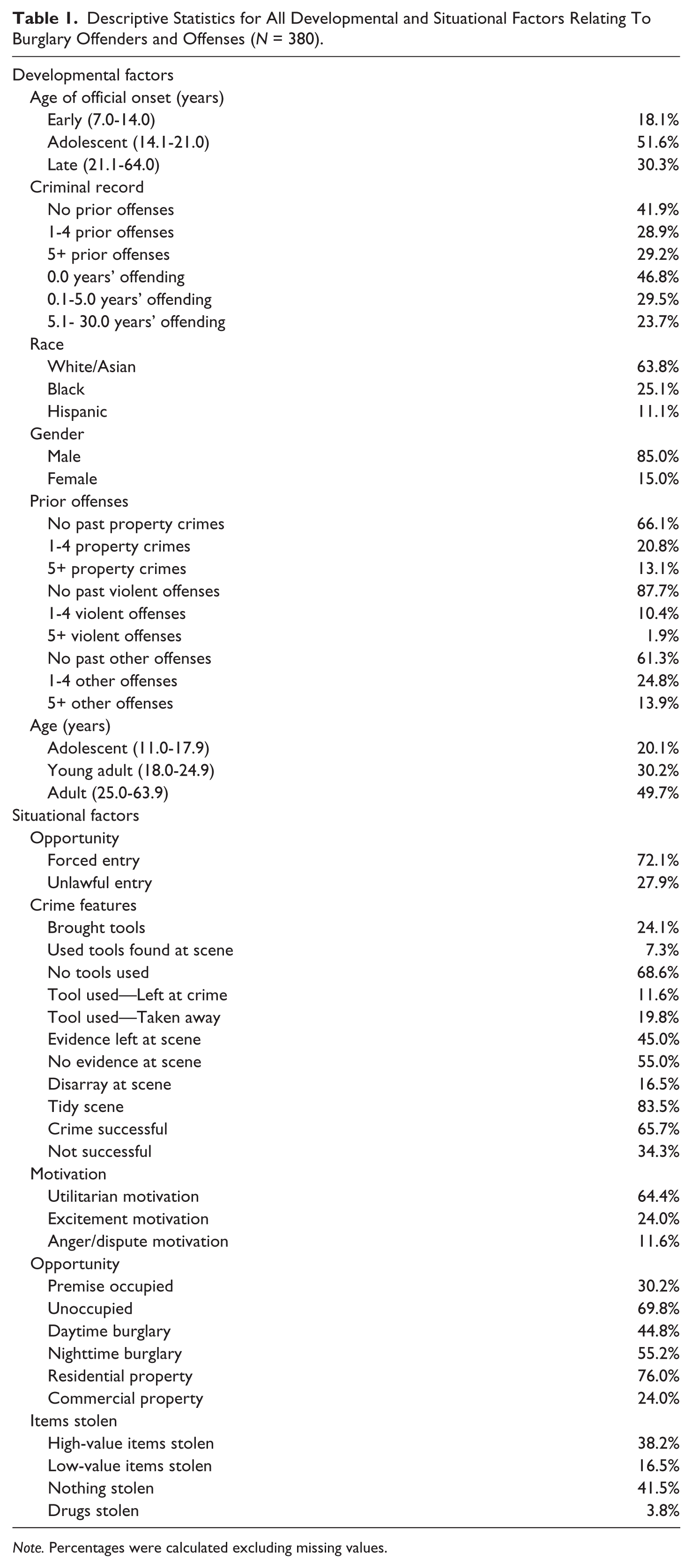
Note. Percentages were calculated excluding missing values.
To determine the criminal histories of the 380 unique offenders, records on the arrested offenders were obtained by permission from three law enforcement agencies in central Florida. After gaining approval to obtain the arrest and criminal history records for each offender, the information was obtained by querying the Florida and local county’s Department of Corrections databases, as these databases contain information on all offenders who commit a misdemeanor or felony offense within the state. As the county is over 150 miles from the nearest neighboring state, it is unlikely that the offenders would have committed crimes in other states. From this search, it was possible to determine each offender’s full criminal history, to assess the rate, type, and specialization in offending behaviors across each burglar’s criminal career.
Offender Features
Criminal record and prior offenses
Offender criminal histories were collected to determine the level of specialization or versatility in prior offenses. Past research on crime specialization tends to classify offenses into three categories—violent crimes, property crimes, and all other offenses—as there is a clear and conceptually meaningful delineation between crimes against persons, crimes against property, and all other offenses (Piquero, Paternoster, Brame, Mazerolle, & Dean, 1999; Spelman, 1994). The number of offenses committed by the burglars led to classification into the non-offending (zero arrests), low-rate offending (one to four arrests), or chronic offending (five or more arrests) groups within the three categories of crime, as well as for their total career up to that point. These offending classifications align with DLC and official government definitions of non-offenders, low-rate, and chronic offenders in specific crime types and across the individual’s criminal career. For instance, committing five or more violent felonies qualifies an individual as a serious, violent, and chronic offender in both DLC and official definitions (see, for example, Fox et al., 2014; Fox, Perez, Cass, Baglivio, & Epps, 2015).
It should be noted that some past offenses were contemporaneous, or committed at nearly the same time as one another. This is particularly relevant for burglary, as most states, including Florida, define the crime as the “unlawful or illicit entry of a dwelling with the intent to commit another offense therein” (Fla. Stat. § 810.02(1)(b)). Although the second offense committed during a burglary is often theft, it need not always be. Burglary can occur if an offender enters a home to commit a sexual offense, destroy property, live illegally, or start a violent altercation. Although this can inflate offenses in the criminal history, when compared with the number of “crime events,” these distinct and often quite severe offenses are important not to disregard simply because they occurred at the same date as another offense.
The number of years of offending prior to the burglary was also recorded for each offender. Together these measures give an indication of the length and versatility of the criminal career for each burglar in the dataset.
Age of official criminal onset
Age of criminal onset was calculated using the offenders’ birth dates and date of the earliest arrest in official police records, as is standard practice for research using official versus self-reported offending data (see, for example, Joliffe et al., 2003; West & Farrington, 1973). The official age of criminal onset was then trichotomized into early (7.0-14.0 years), adolescent (14.1-21.0 years), and late onset (21.1 years and over) classifications for use in the analysis, and to align with meaningful developmental and social age divisions as specified in prior DLC and psychological research (Farrington & Hawkins, 1991; Patterson & Yoerger, 1993; Simons, Wu, Conger, & Lorenz, 1994).
Gender and age
Among the most tested and verified “facts” in criminology is that males offend at higher rates than females, although this discrepancy is even more pronounced for more serious and violent offenses (Blumstein, Cohen, Roth, & Visher, 1986; Steffensmeier, 1993). Age is also a key aspect in the classification of offenders, as the prevalence and motivation for offending can change drastically between developmental periods (Farrington, 2005). For instance, the age–crime curve shows that crime is considerably more common during adolescence, but far less prevalent during childhood and adulthood (Moffitt, 1993). Furthermore, offenses at younger ages (under 17.0 years) are more likely to be committed for hedonistic reasons such as thrill-seeking, whereas offenses at older ages (17.1 years and older) are relatively more likely to be committed for utilitarian reasons (Farrington, 2005).
The age of the burglars at the time of the offense ranged from 11.9 to 63.3 years, with the mean occurring at 28.3 years of age. Although this is older than average for many other offenses, for burglary, the mean age of offenders is typically around 27 years (Bache, Crestani, Canter, & Youngs, 2010; Santtila et al., 2004). Each burglar was assigned to one of three categories depending on the age at the time of the offense, which contemporary research classifies as adolescent (under 18.0 years), young adult (18.0-24.9 years) and adult (25.0 years and over), to reflect the “protracted adolescence” of modern generations (Arnett, 2000; Moffitt, 2006). Again, it is important to note that the classifications of age and age of onset differ, as the distinguishing points for these measures are not the same (see Farrington, 2010).
Race
Racial group membership has been shown to relate to the prevalence of offending in several ways. Although research has shown that the crime rate for Black Americans is higher than the crime rate for Whites (Piquero & Buka, 2002), it has also been found that certain criminal patterns such as LCP and AL sub-types exist within all racial groups (Moffitt, 2006). Race/ethnicity was coded trichotomously as White, Black, or Hispanic, as 63% of the burglars in the sample identify as White, 11% are Hispanic, and 25% are Black. Less than one half of a percent of the burglars in the sample identified as Asian, and these offenders were aggregated with White offenders. 2
Offense Features
Opportunity
Many studies investigating situational factors relating to property offenses take into account opportunity, such as the presence of a capable guardian and likelihood of being seen, in an offender’s decision to commit a crime (Cohen & Felson, 1979; Wilcox, Madensen, & Tillyer, 2007). In this study, opportunity was measured based on the occupancy of a premise at the time of the offense, as a guarded premise obviously allows less opportunity to offend than one that is unguarded. The method of entry was also used in studying criminal opportunities as unlawful entry (i.e., finding a door unlocked, window open) indicates a greater opportunity to offend than a premise where the entry must be forced.
The time and place of the offense is also important in understanding opportunity, as certain places are more secure or desirable in certain situations, or at certain times. Although most burglaries are committed at residential properties, many are committed against commercial dwellings as well (Federal Bureau of Investigation, 2008). Most residential properties have less security than commercial ones, although the potential “gain” from burglarizing a warehouse, restaurant, store, or office building is often much greater than a family home (Mayhew, 2003). The time of day makes a difference to this, however, as commercial premises are often known to be unoccupied during the night, whereas the rise of dual-income families has left many residential properties vacant during the daytime (Cassel & Bernstein, 2001). These situational features relating to the opportunity to commit the offense were coded from the police files. For example, daytime was defined as the hours between sunrise and sunset on the date of the offense, and night time corresponds to all other hours without sunlight. The burglarized property type was recorded using the Uniform Crime Reports coding of residential or commercial dwellings listed on the police files.
Crime features
Several situational factors relating to the level of planning and foresight were recorded to assess the prudence, sophistication, and care put into the crime. This offense information was taken directly from the police records, as each report detailed whether the burglar used tools (e.g., evidence of pry marks from a crowbar), the type and value of items stolen, the state of the crime scene (e.g., if the burglar “ransacked” the scene or left it intact), if forensic evidence or burglary tools were found at the scene, and whether the initial burglary was successful (e.g., if the burglar was interrupted and caught at the scene, or captured later through police investigation). As all burglaries in this sample were solved, the success of the burglary indicates whether the burglar was caught red-handed on scene, or apprehended later using more sophisticated policing techniques and investigations.
Through this information, it can be determined whether a crime was conducted in a methodical manner, well prepared for, deliberately executed, and with any evidence destroyed or concealed to prevent detection, or alternatively whether the burglary was impetuous and reckless, done with little planning, and with little effort to conceal the crime after it was committed (Kocsis, Irwin, & Hayes, 1998). Taken together, these factors provide an indication of an offender’s “preparedness” to commit the offense, or if the crime was perceived opportunistically during the course of the offender’s routine activities (Clarke & Cornish, 1985).
Motivation and items stolen
The motivation for a burglary may be used to differentiate offenses, as burglary is known to be a crime with very different purposes often varying by the age of the offender. For instance, most adult burglars (46%-90%) engage in burglary for utilitarian purposes, stealing money or valuable goods to support expensive lifestyles or drug and alcohol addictions (Bennett & Wright, 1984; Santtila et al., 2004; Wright & Decker, 1994), whereas 7% to 14% of offenders, who are generally juvenile or adolescent aged, tend to burglarize for the thrill and excitement, and tend to steal less valuable items, or nothing at all (Bennett & Wright, 1984; Bernasco 2006; Cromwell, Olson, & Avary, 1991; Farrington, 2005; Fox & Farrington, 2012; Vaughn, DeLisi, Beaver, & Howard, 2008; Wright & Decker, 1994). The remaining offenders, who are generally older adult males, tend to commit burglary for revenge or anger-motivated reasons surrounding an interpersonal issue with the victim (Cromwell et al., 1991). This relationship between age and motivation is predicted by the ICAP theory, as the exact situational factors that alter short-term AP often depend on age-related long-term factors such as financial status, impulse control, and life circumstances.
The motivation for an offense may also shed light on the offender’s professionalism and mind-set prior to committing an offense, as instrumental burglaries are more deliberate, planned, and involve careful searching and selection of targets by offenders, whereas high-affect crimes such as dispute- or anger-motivated burglaries involve minimal planning, consideration of opportunity, and apprehension foresight (Brantingham & Brantingham, 1978).
Based on information set out in the arrest reports such the secondary crime associated, the burglary (i.e., theft, vandalism, assault), the type of items stolen (or lack thereof), damage and vandalism, and reported conflict between burglar and victim, each of the offenders were categorized as having one of three motivations for the offense: utilitarian, excitement, or interpersonal. A utilitarian motivated offender would commit theft of cash or valuable goods, excitement-motivated offenders were more thrill-seeking and would steal low-value or no items but often commit vandalism, whereas interpersonal-motivated offenders usually stole no items or a personal item from a known victim, and would engage the victim in an argument or assault, and claim anger or revenge as the reason for their burglary. To assess the reliability of the motivations of the burglars as determined by police at the time of the offense, the original motivations (based on the type of crime committed inside the dwelling, type and number of items stolen, relationship between the burglar and victim, etc.) were compared with those reported by the offenders in the arrest narratives, although there were no variations found in any of the cases.
The type of item stolen during a burglary is recognized as being a potential differentiating factor among various types of offenders. Although the motivation for offending for most burglars is often utilitarian, the specific items targeted by these offenders have been shown to vary. For instance, young and inexperienced burglars tend to steal lower value goods that momentarily catch their eye, whereas older and more experienced burglars steal more valuable items that are typically in demand at the moment (Shover, 1991). The dividing line used to distinguish above- and below-average losses resulting from the burglary was if the theft was recorded by police as petit theft, totaling less than US$300 in losses, or grand theft, if the items stolen were valued at US$300 or more. These are highly meaningful distinctions, as petit theft is a misdemeanor with a maximum penalty of less than 1 year in jail, whereas grand theft is a felony, carrying a minimum 1-year sentence in prison, and the requirement to report being a felon for the rest of the offender’s life. Whether the burglar stole prescription or illegal drugs from the victim, or if no items were stolen, was also recorded for all burglaries in this sample.
By taking into account these situational factors surrounding the preparation and commission of the burglary, a clearer picture of the short-term criminal potential for a given offense may be determined.
Analytical Technique
This study aims to explore a possible alternative to group-based trajectory modeling (GBTM) to test DLC theory, and offset some of GBTM’s limitations. Although GBTM offers a means of determining offending trajectories based on varying group rates of offending over the long term (e.g., D’Unger, Land, McCall, & Nagin, 1998; Nagin & Land, 1993), it is not possible to utilize multiple individual short-term situational factors to determine the number and composition of trajectories in GBTM. For instance, in a simulation experiment utilizing data of persistent heterogeneity combined with state dependence (i.e., developmental factors) and random events (i.e., situations at a crime scene), the GBTM method produced aggregate patterns of distinct trajectory groups that were known not to exist (Skardhamar, 2010). Consequently, the analysis of both long-term offending behaviors and situational factors influencing the commission of an offense is not available in the GBTM method.
Furthermore, the number of groups identified in GBTM is known to be variable depending on sample size, length of observation period, and method of data collection (Piquero, 2008). For example, in the first analysis of the Gluecks’ Boston cohort of males aged 7 to 32, four trajectories were identified (Laub, Nagin, & Sampson, 1998), but when the data were extended up to age 70, six trajectories were uncovered (Sampson & Laub, 2003). This again occurred in Piquero et al.’s (2002) analysis of paroled offenders, where four trajectories were identified, but in Ezell and Cohen’s (2005) follow-up analysis, a six-group model was now preferred. This limitation has been discussed in the literature, with the method’s creators stating that “more data allows for more refined statistical inferences” (Nagin & Tremblay, 2005, p. 892).
The lack of consensus on both the number and composition of these groups leads us to consider whether criminal behavior is simply too complex to identify offending sub-types over the life-course without considering situational factors that also influence criminal decision making and offending behavior in the moment (Farrington, 2005). Moreover, the trajectories may only be created using rates of offending over a period of time, without consideration of varying types of offenses in the criminal career or the situational factors surrounding the offenses committed. So though research and findings utilizing GBTM have been beneficial to DLC, there are a number of limitations surrounding this technique that lead us to question its status as the “methodological staple” within DLC research (Piquero, 2008, p. 27; Skardhamar, 2010).
Therefore, we will use a latent class analysis (LCA), which is a “person-focused” method designed to identify latent classes within a group of individuals based on two or more indicator measures (McCutcheon, 1987). The goal of LCA is to group persons into categories where individuals within a group are similar to each other, but qualitatively different from individuals in other categories (Muthén & Muthén, 2000). LCA has many advantages over related statistical techniques, including cluster, factor, and k-means analyses, as the models rely on person-based case probabilities as opposed to distance or ad hoc probabilities when forming maximum likelihood derived classes and the subsequent goodness-of-fit indices (Vaughn, DeLisi, Beaver, & Howard, 2009). LCA also does not rely on common assumptions that are easily violated in this type of research, such as normality and linearity of the data. However, just as with cluster analysis, the final class solutions of LCA depend entirely on the indicator measures selected to be used in the analysis (Vaughn et al., 2008).
Although it is common practice to correlate trajectory groups with developmental covariates in GBTM, LCA enables the groups to be formed on the basis of these covariates, and not just correlated with them. Furthermore, unlike GBTM, which “will always identify groups of cases in accordance with the number of groups specified” as it is a group-based analysis, LCA may not always support classification into two or more groups, as a one-class solution may be found to be the best fit to the data if the data are continuously distributed (Brame, Paternoster, & Piquero, 2012, p. 478).
Consequently, several limitations of GBTM are overcome through the use of LCA, suggesting that additional methodologies beyond GBTM may be used to statistically identify sub-categories of offenders. This method has grown in popularity in criminological research (see, for example, Besemer, 2011; Deslauriers-Varin & Beauregard, 2010; Fox & Farrington, 2012; Vaughn et al., 2008; Vaughn et al., 2009; Vaughn et al., 2011) and has been utilized extensively in fields such as neurology, demography, biological psychiatry, and market research (Uebersax, 2009). However, LCA has yet to be used in a DLC context. Therefore, this article utilizes LCA to identify sub-types of offenders based on long-term developmental factors, and sub-types of offenses based on short-term situational features. These offender and offense sub-types are then interrelated, to gain a better understanding of which offender sub-types are associated with which types of offenses. Although this method does not aim to predict criminal or delinquent behavior, it does take the first step by identifying the relationship between developmental and situational criminological factors, allowing both to be integrated in a DLC theoretical framework.
LCA models were run using Latent Gold v.4.5 software (Vermunt & Magidson, 2005) with two sets of indicator variables, comprising the aforementioned developmental and situational measures, entered into two separate models for exploratory analysis. The goal was to find the optimal class solution for each model, where “all classes are distinct, but where adding an additional class to the model provides no extra explanatory power” (Francis, Soothill, & Fligelstone, 2004, p. 57).
Final class solutions were determined using several goodness-of-fit criteria, including the Akaike information criterion (AIC), Bayesian information criterion (BIC), and consistent Akaike Information Criterion (CAIC). These measures are based on maximum likelihood estimations, providing a test of the difference between an estimated model and the data observations, much like a chi-square test. However, in LCA, lower values indicate model improvement, and favor model parsimony. This is particularly true for the BIC and CAIC measures, which tend to favor fewer classes rather than more. Although there is no definitive statistic for determining the optimal number of classes to select, the model with the lowest values is often chosen (D’Unger et al., 1998; Keribin, 2000). As one model will often not have the minimum values on all three criterion measures, the one with the majority of measures in its favor is typically selected. The goodness-of-fit values, as well as the log likelihoods (LLs), for all potential class solutions are listed in Table 2.
Fit Indices for All Potential Class Solutions Using Latent Class Analysis.
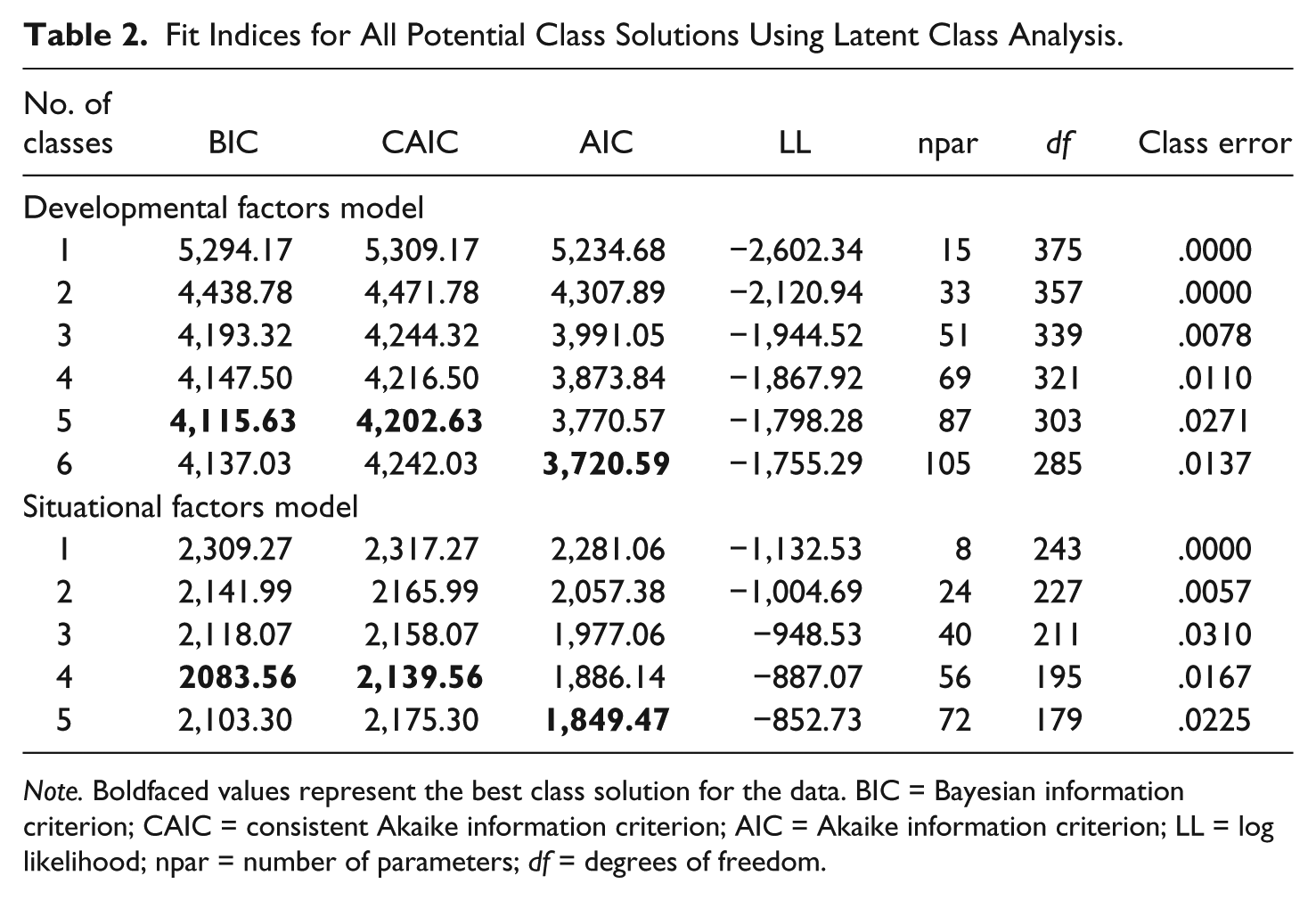
Note. Boldfaced values represent the best class solution for the data. BIC = Bayesian information criterion; CAIC = consistent Akaike information criterion; AIC = Akaike information criterion; LL = log likelihood; npar = number of parameters; df = degrees of freedom.
After testing various models for both sets of variables, final class solutions were chosen in light of the agreement between the BIC and CAIC goodness-of-fit test results. The first model, comprising the more stable developmental features, favored a five-class solution, whereas the second model, made up of the situational factors, indicated a four-class solution.
To verify these outcomes, a second test was conducted to assess improved fit between the identified final class solutions and alternative class solutions. Bootstrapping, a Monte Carlo re-sampling technique, serves to increase validation with respect to the number of classes selected performs a large number of random iterations to estimate model improvement through the addition of an extra class (Vaughn et al., 2009). In this case, the bootstrapping procedure verified the class solutions identified by the model fit criteria, as both of the class solutions showed a statistically significant improvement in the fit to the data, whereas adding more classes did not provide a significantly better fit to the data.
After evaluating the model criteria and selecting the optimal number of classes, the content of the classes was inspected using the conditional item probabilities, which are comparable with factor loadings in factor analysis. The conditional item probabilities, or the likelihood of individual cases falling into a certain class, also help to determine the composition of each group within the models. It should be noted that individual cases must have a 95% probability of membership in a class for them to be assigned to it. The resulting class compositions are illustrated and discussed in the Results section. Conditional item probabilities for the individual subjects in the dataset are available from the authors on request.
Relating Offense and Offender Typologies
After assessing each model and the conditional item probabilities for each of the classes, it is possible to assign individuals to the latent classes (Besemer, 2012). The relationship between the more stable, developmental factors and the situational characteristics of the offense were examined using a chi-square test of association (in a 5 × 4 contingency table).
To determine the extent in which the observed frequency in a specific cell within the table significantly differed from the expected frequency, adjusted standardized residual (ASR) tests were also conducted. ASR values indicate how many standard deviations above or below the expected count an observed count is, and signify the importance of the cell to the table’s chi-square value. ASR differs from similar tests of this nature in that it takes into account the overall size of the sample, and gives a fairer indication of how much the observed count differs from the expected count (Farrington, Snyder, & Finnegan, 1988). ASR is calculated using the following formula:
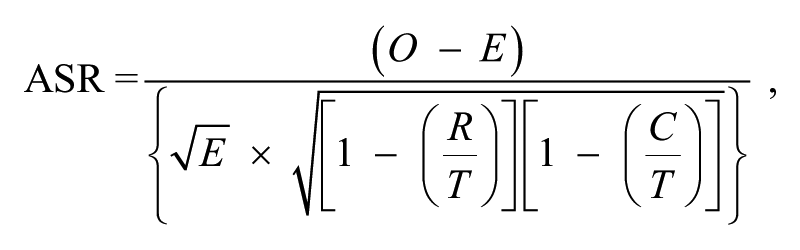
where O = observed number in cell, E = expected number by chance, R = row total, C = column total, T = grand total, E = R × C/T. ASR values greater than 1.96 or less than −1.96 are significant at the p = .05 level. 3 A statistically significant ASR indicates an individual cell that is significantly different than chance expectation (Farrington et al., 1988).
Results
Classes of Offenders
The composition of the five classes of offenders, along with the percentage of different characteristics within each class, is shown in Table 3.
Comparison of Burglars’ Developmental Features Across LCA Classes.
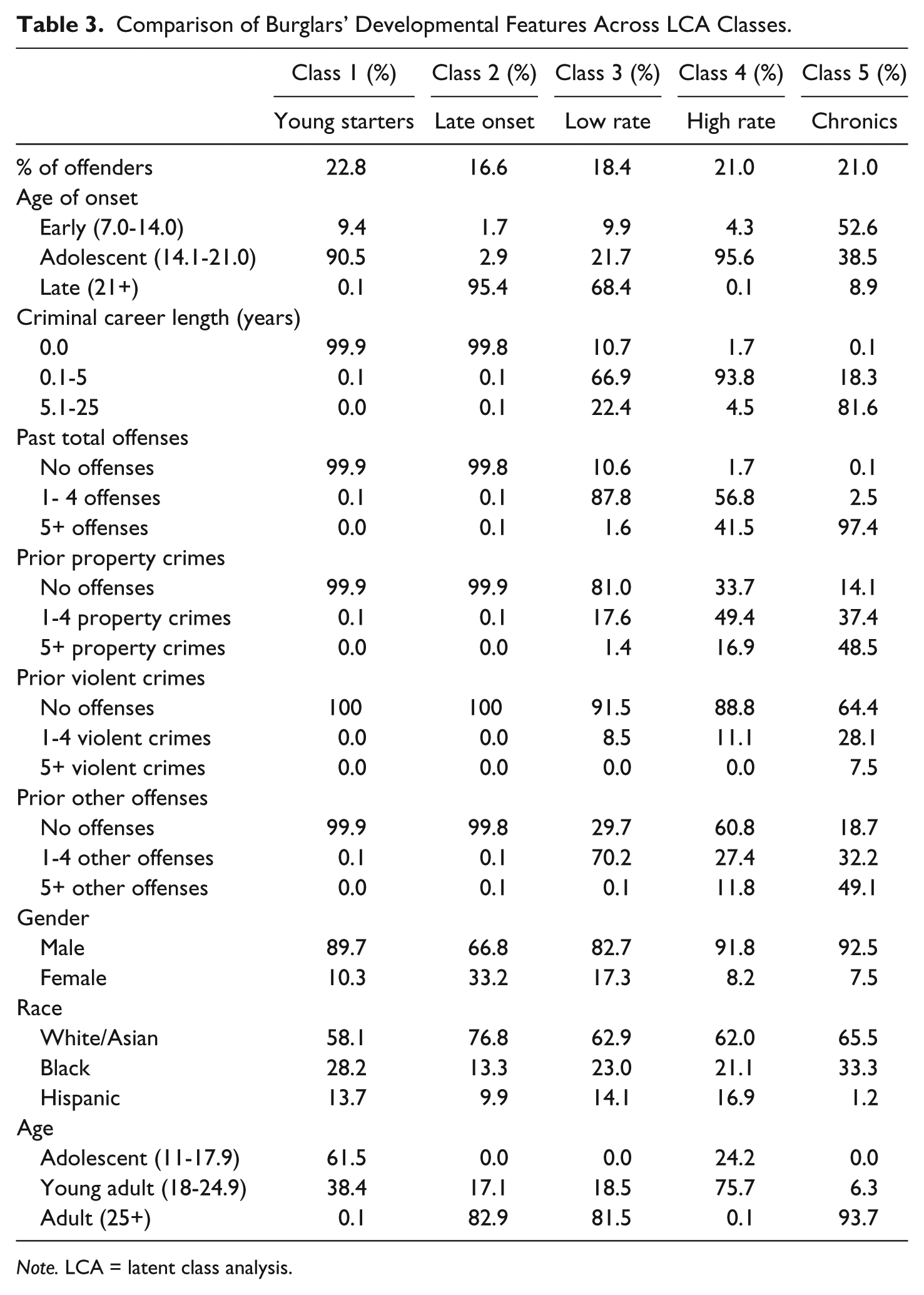
Note. LCA = latent class analysis.
The first class to emerge among the offender traits is labeled the young starters. This group is made up almost entirely of adolescents and young adults, practically all of whom have no criminal record, indicating that the burglary was their first known offense. Consequently, the criminal onset for the young starters group is almost entirely during adolescence (92%), with a few occurring during childhood (9%). Nearly all young starters are male (90%), and 58% are White or Asian. Approximately 28% of the young starters are Black, and 14% are Hispanic. Young starters make up 23% of all offenders.
The second group is quite similar to the first in that nearly all offenders in it have no criminal history, and this is their first recorded arrest. However, unlike the first class, 83% of the offenders in this group are older adults. This group, the late onset offenders, also has the highest concentration of White or Asian members of the five groups (77%), as well as the most females (33%). The late onset group comprised approximately 16% of the burglars, mirroring the percentage of “adult starters” or “late onset” offenders found in previous research (Dilalla & Gottesman, 1989; Kratzer & Hodgins, 1999). Although the existence of true late onset offenders has been debated in criminology (see Farrington, Ttofi, & Coid, 2009; Zara & Farrington, 2009), these results align with research from other states and nations (McGee & Farrington, 2010), and suggest that offenders who have their first official arrest after age 21 may comprise a considerable proportion of burglars.
Class 3 comprises offenders with experience, as nearly 90% have at least one prior arrest on their record. Still, the vast majority have been committing crimes for 5 years or less, although 22% have been offending for more than 5 years. In this time, the vast majority have only committed one to four offenses, with less than 2% committing more than five. Of the three crime types, only 9% had a violent altercation on record, and only 19% had committed more than one property crime. However, 70% of the offenders committed one to four crimes of other categories, such as drug crimes, public disturbances, or driving under the influence of alcohol. Interestingly, the age of onset for this group is older than expected, as 22% started during adolescence but 68% began offending later in life. The average age of these offenders is older as well, as 82% are adult aged (25 or older), and 18% are young adults. The offenders tended to be male, although 17% were female, and most often were White, and 37% were Black or Hispanic. As this group displayed low levels of offending over their relatively short, mostly adult criminal career, they are labeled low-rate offenders (see Piquero et al., 2010). The low-rate offenders make up 18% of all burglars.
In comparison, the next group of offenders, who also have a criminal career that covers less than 5 years, already includes a high proportion (42%) of those who have committed five or more offenses. These short-term but high-rate offenders (see Piquero et al., 2010), began their careers as adolescents, and they tend to be young adults (76%) at the time of the current burglary. Nearly half of high-rate offenders committed one to four prior property crimes, whereas 17% committed five or more. The vast majority of high-rate offenders did not have any violent offenses on record, but 39% had at least one of another type of offense. This group was substantially White and male, although it did have the highest proportion of Hispanics of all five groups (17%). High-rate offenders comprised approximately 21% of the sample.
The final class is distinctive due to the high levels of offending and substantial criminal histories of the offenders. Over 81% have been offending for over 5 years, and in that time 97% have committed five or more crimes. Nearly half have committed five or more property crimes, and almost half have committed five or more other types of offenses. Nearly 8% have committed five or more violent crimes, and 28% have committed between one to four violent crimes. Criminal onset was the earliest for this group, as 53% started during childhood, whereas approximately 38% began during adolescence. Although this group was again made up predominantly of White or Asian members, it had the highest proportion of Black offenders (33%) and the lowest proportion of Hispanics (1%). Almost all of the offenders in this group were male, and nearly all were currently adults. This group, labeled the chronic offenders, made up 21% of the sample.
Classes of Offenses
In the offense-specific situational factors model, four latent sub-types were identified, and these are listed in Table 4. These four classes are characterized by unique characteristics which refer to the impulsivity, planning, professionalism, and disorder relating to the commission of the crime.
Comparison of Burglary Situational Factors Across LCA Classes.

Note. LCA = latent class analysis.
In the first class, there was little planning prior to the crime, but it did not unfold in a totally chaotic manner. Nearly half of the burglaries in this style had unlawful entry, meaning that the burglars found a door, window, or garage open to enter without force. These offenses occurred mainly at unoccupied residential dwellings, and most had utilitarian (73%) or excitement (27%) motivations for offending. No tools were brought along to commit the offense, and nearly 40% of these offenses were not successful, indicating that the offenders were interrupted, scared off, or apprehended at or near the crime scene. These features are consistent with opportunistic offending, as the burglars show little evidence of preparing for the offense, and most had taken reasonable cautions to prevent detection and successfully escape from the premises. This class of situational characteristics, labeled opportunistic offenses, makes up 48% of all offenses.
The second class of situational characteristics indicates that a substantially higher level of care was taken to reduce risks and increase the gains of the offense. Almost every offender in this group brought a burglary tool with them to the crime, indicating preparation and planning by the burglars, and 77% offenders took their tools away with them after the offense. The motivation for this offense was mainly utilitarian, with high-value items stolen in the majority of cases. This type of burglary most often occurred at unoccupied residential dwellings during the daytime, and the offenders were successful 72% of the time. This group, the most careful and planned style of burglaries warranting the title of organized offenses, encompassed 27% of the cases.
In comparison, the third class is characterized by the lack of organization and preparation displayed in the burglary. This group almost always left the crime scene in a state of disarray, had the highest likelihood of leaving evidence behind, and was often motivated by excitement with no items stolen in many cases. Forced entry was most likely to be used on unoccupied targets during the day, and a large number also occurred on commercial targets. This group of situational factors, comprising nearly 14% of the burglaries, is titled the disorganized offenses.
The final group, called the interpersonal offense, is unique in that almost every target was occupied during the burglary and nearly 90% of the offenses were anger or dispute motivated. As the burglaries often occurred at occupied residential premises during the night, and in most cases nothing was stolen, this indicates the offense was more personal in nature. This was the smallest of the four groups, making up about 12% of the burglaries.
Developmental Classes Versus Situational Factor Types
The chi-square test shows a strong and statistically significant overall relationship between the four situational types and the five classes of offenders (χ2 = 24.32; df = 12; p = .018). A visual inspection of the contingency table shows that there are several strong associations among specific developmental and situational classes as well. Results of these tests are presented in Table 5.
Relationship Between Developmental Types of Offenders and Situational Burglary Offense Style.

Note. ASR values and row percentages are shown below observed cell counts. χ2 = 24.32, p = .018, n = 342, df = 12. ASR = adjusted standardized residual.
A significant ASR value at the p < .05 level.
Opportunistic offenses were committed in highest proportion by the high-rate offenders, as 27% of high rates were in the opportunistic offense category. A significant, but negative, ASR value was found for the chronics in the opportunistic category, meaning that there are less opportunistic offenses committed by chronic offenders than expected (ASR = −2.18, p < .05). The high-rate offenders also had the highest individual proportion within the opportunistic style (27%) further indicating the association between the opportunistic burglaries and high-rate offenders.
Among the organized offenses, chronic offenders committed the majority of this offense type, at nearly 28% of the total. Of the disorganized crimes, only 10% were committed by the late onset offenders, while 29% were committed by the young starters. However, interpersonal offenses were committed most often by the late onset offenders, with the positive and significant ASR value indicating that there were substantially more interpersonal offenses committed by the late onset group than expected by chance (ASR = 3.04, p < .05). The significant and negative ASR for high-rate offenders committing interpersonal offenses shows that fewer crimes of this type were committed by the high-rate offenders than expected by chance (ASR = −2.77, p < .05).
Discussion
The results of this study suggest that developmental offender types may be related to certain situational offending behaviors. This suggests that an individual’s offending behavior may not depend on developmental, social, or personality factors alone, as the decision to commit offenses may arise out of the interaction between a person’s degree of criminal potential (resulting from one’s developmental history) and the criminal potential of the situations the person encounters. Figure 1 illustrates the five offender and offending groups identified in this study, and the relationship uncovered among the offender and offense sub-types.
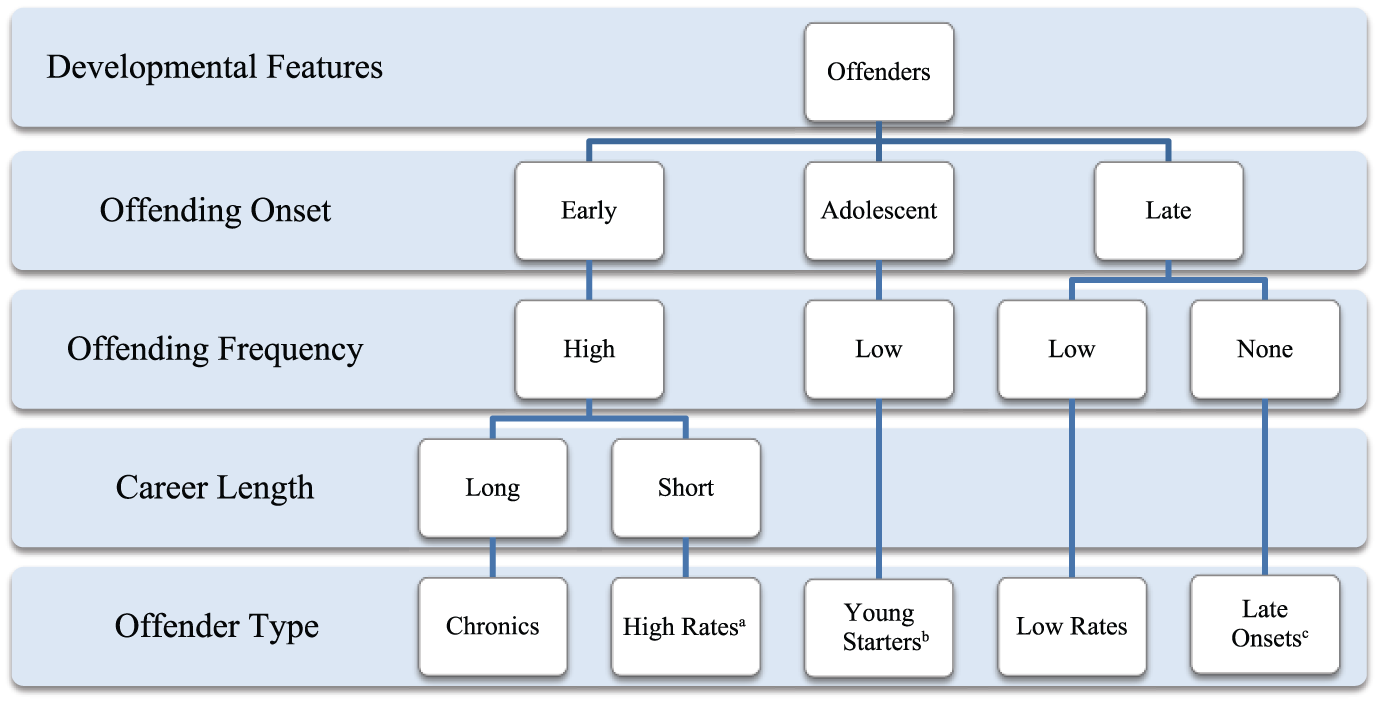
Diagram of burglar developmental typologies.
Theoretical Implications
The relationship between specific offender types and offense styles also occurred in the manner predicted by the ICAP theory, and when applicable, by Moffitt’s theory as well. For instance, Moffitt’s (1993) theory suggests that AL offenders, who generally commit crime only during adolescent years, are more rational in criminal opportunities than LCP offenders, who are more instinctive and opportunistic (Farrington, 2008). However, situational factors are not taken into account in Moffitt’s theory, as it aims to explain the development various types of criminal behavior over the life-course, not predict the style or type of crime a certain person is likely to commit. It was therefore far from clear how much influence an offender has over the choice of situation and environment, how often individuals offend in similar contexts, and how much influence context has on offenders and the style of offense that they commit. This study aimed to address this issue, by associating various situational and environmental factors relating to the burglary with the developmental and criminal background of offenders most likely to offend in those situations.
Results of this research indicate that more planned organized offenses were committed by the high-rate offenders, who commit high levels of crime over a short time frame, similar to Moffitt’s AL group. This supports Moffitt’s hypothesis that decision making is more rational for ALs who likely weigh costs against likely benefits in a criminal opportunity (Farrington, 2008). The chronic offenders, who were shown to offend at a rather high level over a period spanning from childhood to adulthood, are similar to Moffitt’s LCP offenders in many ways. In addition to the majority of the group starting their criminal careers very early, and committing a high number of crimes well into their adult years, the versatility exhibited in their offending is consistent with LCP offenders (Kratzer & Hodgins, 1999; Moffitt, 1993). This suggests that the chronic/LCP offenders may be influenced by automatic and instinctual behavior related to neuropsychological deficits as predicted by Moffitt, and therefore be more likely to commit very impulsive crimes in risky and less than ideal situations (Farrington, 2008).
The most affect-motivated of the four offense situations, the interpersonal style, was committed most often by the late onset offenders—the group who avoided criminality in their entire lives until the moment of the victim-focused burglary. Why these offenders would begin to engage in criminal activity may be explained by the ICAP theory, as this group with relatively low long-term AP was lured into criminal behavior by the extremely strong short-term AP the group encountered in the situation. This group is not accounted for in Moffitt’s original AL-LCP theory, though DLC research has found that “late onset” or “adult starters” generally make up between 10% and 16% of offenders (Bergman & Andershed, 2009; Bushway, Thornberry, & Krohn, 2003; Dilalla & Gottesman, 1989; Farrington et al. 2009; Pulkkinen, Lyyra, & Kokko, 2009), though some have found that they comprise an even larger proportion of offenders than the AL offenders (Kratzer & Hodgins, 1999). Although additional research using self-reported offending data is needed to further examine this sub-type, the current results provide at least some support for an adult onset offending group.
Disorganized offenses were committed most often by the young starters group, presumably because their lack of experience in offending inhibited the apprehension foresight that more experienced criminals often acquire. Similarly, the young starters also committed the most opportunistic offenses of the five offender types, which ICAP would again suggest is the result of a moderate long-term AP combined with a high short-term AP provoked by the criminal opportunity.
Although these associations indicate that there is a relationship between certain developmental sub-types and situational factors, these relationships are not necessarily causal and the mechanisms underlying the relationships are not entirely clear. Still, it is becoming more apparent that an individual’s offending behavior does not depend on their developmental factors alone. Instead, the decision to commit offenses arises out of the interaction between a person’s degree of criminal potential (resulting from their developmental history) and the criminal potential of the situations they encounter. In other words,

Although there have been calls for a so-called “theory of offending,” or a framework to understand the way in which certain types of offenders will commit certain types of crimes, no criminological theory currently outlines how or why certain offenders tend to commit crimes in certain situations and in certain ways (Farrington, 2013). In other words, most DLC theories aim only to explain the development of criminal behavior over the life-course, not predict the style of crime a certain person is likely to commit. As this research suggests that more goes into the creation of a criminal act than just the developmental features of the offender, DLC theories should strive to incorporate situational factors of the offenses into future offender typologies.
Furthermore, this study outlines an additional method for research on DLC theories to be conducted, particularly when GBTM analyses are not possible or preferred to be utilized. To summarize Brame et al. (2012), if any method of placing individuals into a group is used to test a theory, and a group emerges that is consistent with what is predicted by the theory, that must be taken as evidence that supports the theory. In their view, “this is simply deductive science” (p. 479).
Therefore, LCA offers a smart, sophisticated, and simple method for DLC researchers to evaluate the existence and composition of offender typologies using retrospective criminal history details, along with a host other covariates such as situational factors, life circumstances, personality traits, and more. Although LCA is not a perfect method by any means, it is certainly a method that warrants exploration as an additional analytical tool for DLC researchers to embrace.
Practical Implications for Policing and Crime Prevention
This study aimed to evaluate the relationship between situational offense styles and the types of offenders who tend to commit each style of offense. Although the stated goal of this study was to shed light on how individual developmental factors relate to the situational and contextual behaviors witnessed at a crime scene, and vice versa, there are also several important practical implications for policing and crime prevention. Specifically, if police are now able to better understand the criminal history and developmental features of an offender based on the crime style and situation surrounding the crime that was committed, it is possible that police may be able to use this information to prioritize suspects or link together cases that appear to be reflecting similar situational and crime scene behaviors (see Fox & Farrington, 2012, 2014).
Both researchers and practitioners have aimed to reduce burglary through deterrence and rehabilitation of the offenders. However, these strategies have had little success to date (Piquero & Rengert, 1999). Therefore, a new strategy to prevent burglary or help police catch offenders by identifying the types of situations/crime scenes certain offenders are most likely to commit burglary in may be useful for prevention and practice. The link between situational behaviors (such as being an interpersonal offender) and certain offender traits and developmental features (such as being a late onset offender) highlighted in this study may also have use as an actuarial or threat-assessment tool to prioritize cases, so the most dangerous or prolific types of offenders are put in police cross-hairs first, and potentially prevent those crimes from occurring in the future.
Limitations
Although official records such as those used in this research are a reliable means of collecting data, there are also limitations to any dataset resulting from their exclusive use (see, for example, Bernasco, 2006). For instance, no crimes that went undetected by police are included in official reports, and therefore some burglars may be more prolific, or have an earlier age of onset, than the official data reflect. Nevertheless, prior research has shown that the most prolific offenders according to official records are highly similar in many respects to the most prolific offenders according to self-reports (Farrington et al., 2014; Joliffe et al., 2003) and that similar conclusions regarding predictors and correlates of offending may be drawn from both official records and self-report data (West & Farrington, 1973).
Furthermore, not all data and measures that would ideally be included in this study were available for access in police records and environmental surveys. Specifically, psychological traits and details of the burglars’ personal lives, such as level of impulsivity, marital and employment status, education level, income, psychopathy scores, and more, were not available in police records, but could be obtained in future research using structured interviews. Nevertheless, official data are among the most reliable and practical methods of obtaining information on offending and crime scene behavior. For example, using questionnaires or interviews of police officers and known burglary offenders and victims may overcome some of the limitations with police records data, but missing or inaccurate data are more likely to occur when police, offenders, and victims cannot recall specific situationsand circumstances as the event occurred months or years prior. However, when using official records police are prompted to include all relevant information regarding the offender, victim, and crime scene circumstances in order to submit a report in the electronic Records Management System at the time of the offense. Therefore, utilizing official records often results in more accurate and complete data, for all information collected through official channels. In the current study where official records and environmental surveys were used, there were less than 2% missing data for all variables.
Finally, it may be of concern that this study examines one specific crime type, when DLC theories generally refer to criminal behavior in general. As the most significant situational influences are unique to each crime (e.g., burglary vs. rape) or crime type (e.g., person vs. property), the results will be most accurate and beneficial when analyses are conducted on a specific crime or crime type, rather than crime in general. Although this is a limitation to generalizing the results of this research to offenders as a whole, the findings will still have important theoretical implications by examining developmental and situational measures in a single model. Furthermore, as one crime is part of crime in general, which DLC theories seek to explain, the theories cited in this article are all expected to apply to a given crime type as much as crime in general. However, these results must still be replicated for other crimes and their unique situations to fill in the rest of picture for DLC research.
Future Research
Future research on sub-types of offenders should test the replicability of the results using self-reported offending data, to determine if self-report typologies differ from typologies derived from official records. Although self-reports have been shown to be generally reliable (Joliffe et al., 2003; West & Farrington, 1973), self-reported offending may shed more details on the late onset offending group members, who had their first known arrest as adults.
Although a key benefit of this research is the “snapshot” rather than longitudinal design, as it enables situational details to be included in the broader framework of DLC theory, additional follow-up on the burglars’ criminal careers would aid in determining the future paths of the groups uncovered in this study, and whether offenders graduated from one type to another over time. Even though the ideal situation is to have a prospective longitudinal dataset that includes both nuanced information on the situational, environmental, and criminal behaviors committed at offense in each subject’s criminal career, and a host of developmental, social, psychological, and biological factors over the life-course, such a dataset is not in existence and would be very costly and time intensive to assemble. Furthermore, as this study was based on single rather than serial offenses over a criminal career, and a significant relationship was still found between certain offender traits and offense styles, there is reason to believe that cross-sectional research may be utilized to evaluate the relationship between offender types and offending behaviors in future research. Still, much more is needed before a more thorough understanding of the interaction between developmental and situational factors can be determined. As Farrington (2013) noted,
It is particularly important to study situational factors in longitudinal studies, to explain both the development of offenders and the commission of offenses. . . . It is important to design longitudinal studies not only to explain how offenders develop but also to explain how and why the potential offender commits the actual crime in the situation. (p. 503)
As there is little or no knowledge on the relationship between situational and developmental factors currently available in the criminological literature and DLC theories, we hoped to lay the foundation with this research, and encourage researchers to build on these findings with future studies utilizing cross-sectional or prospective longitudinal designs.
Finally, future research should apply the analysis utilized in this work to additional types of crimes, to test the method’s success with a different group of offenders, and compare the resultant offender classes and offense styles from one crime with another. Adding measures of psychological traits and details of the burglars’ personal lives, such as marital and employment status, education level, and income, could also shed more light on features of the offender groups derived in the current study.
Conclusion
In sum, this study examined the crime-specific context of American burglars, using a unique new approach to create typologies (i.e., LCA). This analysis produced findings that suggest the diverse and complex population of offenders is currently oversimplified by most DLC theories, and that typologies relating situational factors to various developmental features significantly aid in the understanding of the criminal career, and the decision to offend. This study provides new support regarding the number of offender sub-types that exist, demonstrated a new method to derive the latent offender types, and related the resultant offender groups to situational characteristics surrounding the offense.
Footnotes
Declaration of Conflicting Interests
The author(s) declared no potential conflicts of interest with respect to the research, authorship, and/or publication of this article.
Funding
The author(s) received no financial support for the research, authorship, and/or publication of this article.