



Abstract
Aggression and callous-unemotional (CU) traits are common problems in incarcerated delinquent youth. The present study was conducted to examine whether living group climate was associated with aggression and CU traits in late adolescent male offenders (N = 156) in a German youth prison. A structural equation model was fitted to the data and showed associations between repression and reactive aggression and CU traits, but no associations between an open and supportive living group climate and aggression and CU traits. Previous research in Dutch youth prisons did not find a relation between repression and aggression, buta relation between a positive living group climate and less aggression. These different findings may reflect differences in the German and Dutch prison system. Implications for practice are discussed.
Aggression and criminal behavior by adolescents constitute a major social problem. While a decrease in youth crime in Europe is evident, there are still problems with the severity and violent nature of it (Blumstein, 2002; Centers for Disease Control and Prevention, 2013;; Stelly & Thomas, 2013). A subgroup of young delinquents, up to 18 years old, are often described as “callous” and “unemotional” (Asscher et al., 2011), and show high rates of aggression and conduct disorder (Fazel, Doll, & Långström, 2008).
Callous-unemotional (CU) traits are characterized by a persistent pattern of behavior that reflects a disregard for others, lack of empathy (Frick & Ray, 2014), and an increased risk for (severe) aggression (Frick & White, 2008; Frick, Ray, Thornton, & Kahn, 2014; Kimonis et al., 2014). Previous research reported the importance of distinguishing between reactive aggression (e.g., in response to provocation, threat, or other adverse social risks), which is based on the frustration-aggression model (Dollard, Doob, Miller, Mowrer, & Sears, 1939), and proactive aggression, which is goal directed and instrumental (Dodge, 1991; Polman et al., 2007) and considered to be a product of social learning (Bandura, 1973). The difference between reactive and proactive aggression is apparent in different causes (etiology) and effects (Raine et al., 2006). Reactive aggression is related to internalizing problems (Card & Little, 2006), deficits in information processing (Crick & Dodge, 1996; Raine et al., 2006) and executive functioning ( Raine et al., 2006) and is associated with negative emotionality and anxiety (Fite, Raine, Stouthamer-Loeber, Loeber, & Pardini, 2009), whereas proactive aggression is driven by relatively positive outcome expectancies (Bandura, 1973) and is more common in delinquents (Card & Little, 2006) and individuals with poor peer relationships or antisocial personality traits (Cima & Raine, 2009; Raine et al., 2006). Youth high on CU traits tend to demonstrate both more reactive and proactive aggression (Frick, Cornell, Barry, Bodin, & Dane, 2003), which is not only associated with the development of criminal behavior but may also form a problem during incarceration (Frick & Dickens, 2006; Marsee, Silverthorn, & Frick, 2005; Ros, Van der Helm, Wissink, Stams, & Schaftenaar, 2013).
When entering the juvenile justice facility, juveniles take along several difficulties, such as aggression, criminal behavior, substance abuse, and psychiatric problems, often related to mild intellectual disabilities (importation hypothesis: Cline & Wheeler, 1968; Gover, MacKenzie, & Armstrong, 2000; Kaal, Negenman, Roeleveld, & Embregts, 2011; Kaal, Overvest, & Boertjes, 2014). Problems often start in early childhood and are related to stress, neglect, maltreatment, or deprivation (Asscher, Van der Put, & Stams, 2015), resulting in failure of treatment and social isolation (Spinhoven et al., 2010; Van Vliet & Oei, 2006). At present, research is conducted to examine the degree to which CU traits are stable personality characteristics (Frick & Moffitt, 2010; Frick, Stickle, Dandreaux, Farrell, & Kimonis, 2005) and if they can be influenced by the environment (Viding, Blair, Moffitt, & Plomin, 2005). Van der Helm, Stams, van der Stel, van Langen, and van der Laan (2012) argue that an open living group climate in youth prison, especially positive contact between staff and inmates (see also Listwan, 2013), a structured and safe environment and possibilities for personal development and growth, can stimulate empathy and subsequently reduction of CU traits (De Waal, Smith-Churchland, Pievani, & Parmigiani, 2014; Viding et al., 2005).
Research has shown that juvenile prisoners can change their behavior if they gain more positive perceptions of the setting they live in (Schubert, Mulvey, Loughran, & Losoya, 2012). In Europe, young prison inmates often live in so-called living groups of eight to 12 juveniles under supervision of group workers. Those group workers play a central role in the creation of the living group climate, which can be defined as open (responsive) or closed (repressive; Van der Helm, Klapwijk, Stams, & van der Laan, 2009; Van der Helm, Stams, & Van der Laan, 2011). In fact, it is most likely a continuum between these two extremes. An “open” living group climate is characterized by support, clear opportunities for growth, safety, structure, and flexibility, and can increase treatment motivation, internal locus of control and decrease criminal cognitions (Van der Helm, Stams & Van der Laan, 2011). Especially if group workers offer support and good possibilities for growth (i.e., going back to school), aggressive incidents can decrease (Ros et al., 2013). An open climate can also result in advanced social cognition, social learning, and more empathy (Groeneweg, Van der Helm, Stams, & Asscher, 2013; Iacoboni & Dapretto, 2006; Van der Helm et al., 2012).
The living group climate is defined as “closed” if there are few opportunities for growth, if support by prison staff is almost absent, and if group atmosphere is negative (Liebling & Maruna, 2005; Ross, Diamond, Liebling, & Saylor, 2008; Ross, Liebling, & Tait, 2011; Van der Helm, stams & Van der Laan, 2011). A closed living group climate is highly repressive, can damage the therapeutic alliance and treatment motivation during detention, but can also lead to more aggressive behavior of juveniles and increased stress levels (Van der Helm & Stams, 2012; Van der Helm, Boekee, Stams & Van der Laan, 2011).
Several authors (Popma & Raine, 2006; Sato, Uono, Matsuura, & Toichi, 2009) have argued that prolonged stress can lead to a shift in the stress hormone cortisol, released by the Hypothalamic Pituitary Adrenal (HPA) Axis, resulting in less empathy and more callousness. A closed living group climate in youth prison, characterized by few opportunities for growth, lack of support by prison staff, and a lack of safety, has been shown to result in stress and violence among inmates (Liebling & Maruna, 2005; Ross et al., 2008; Ross et al., 2011; Van der Helm, Stams & Van der Laan., 2011).
To date, there has been no study investigating the relation between living group climate and CU traits. Because high levels of CU traits in combination with aggressive behavior are a common problem in youth detention and create a central component of violent behavior in young prisoners, the present study focuses on how living group climate is related to the behavior of delinquent youth in residential care.
The following hypothesis will be investigated: A positive and open living group climate is associated with less aggressive behavior and less CU traits in detained youth offenders. As the present study was conducted in a diverse sample of young prison inmates, we will account for the effects of age, ethnicity, and type of offense on living group climate, aggression, and CU traits.
Method
Participants and Procedure
The present study was conducted in a German youth prison. An opportunity sample of 156 delinquent, adolescent, male prisoners was selected from the prison population that was accessible at the start of our study. All prisoners lived in groups of 15 to 20 young inmates. Participants were aged between 17 and 25 years (M = 20.44 1 ; SD = 1.64). In the participating prison, delinquents between the ages of 14 and 27 were incarcerated. The main reason for detention was “inflicting personal injury” (62%). Most respondents had a German nationality (73%), and 13% had Turkish and 14% other nationalities. Education levels were generally low: 33% had not completed any formal education, 45% had completed the lowest level of education (secondary school/Hauptschule). The age range, reasons for detention, education levels, and ethnical diversity of the present sample largely concur with characteristics of the German youth prison population (see Dünkel, 2006). All adolescents voluntarily agreed to participate in this study, signed an informed consent declaration, and were told that their answers would be treated confidentially and anonymously and would be accessed only by the researchers. Participants received a compensation (chocolate, cigarettes, or coffee) worth of 5€ as a token of gratitude. Participants completed the Prison Group Climate Inventory (PGCI), Inventory of Callous-Unemotional traits (ICU), and the Reactive–Proactive Aggression Questionnaire (RPQ).
Instruments
PGCI
The PGCI (original version: Van der Helm, Stams & Van der Laan, 2011) consists of 36 questions with a 5-point Likert-type scale ranging from 1 = don’t agree to 5 = fully agree. Each question belongs to only one of the four aspects of living group climate: support, growth, atmosphere, and repression. The scale for “support” assesses the professional behavior of group workers and describes juvenile’s experience of support by staff. An example of an item from the “support” scale is “Group workers treat me with respect.” The “growth” scale assesses developmental possibilities, hope for the future, and feelings and thoughts about detention. An example of a growth scale item is “I learn the right things here.” The “repression” scale assesses repression, strictness of rules, and the control prisoners experience during their imprisonment. An example of a repression item is “You have to ask permission for everything.” Finally, the “atmosphere” scale assesses group atmosphere related to prisoners’ own feelings of safety and trust. An example of an atmosphere item is “We trust each other here” (Heynen, van der Helm, Stams, & Korebrits, 2014; Van der Helm, Stams & Van der Laan, 2011). The questionnaire measures whether the living group climate in a group setting is open and therapeutic or closed and repressive. An open group climate is defined by high levels of support, ample opportunities for growth, minimal repression, and a clean, safe, and structured environment (Heynen et al., 2014; Van der Helm Stams & Van der Laan, 2011). In the present study, the German version of the PGCI was used (Heynen et al., 2014). For the German version, a confirmatory factor analysis with four factors (support, growth, repression, atmosphere) indicated construct validity. Preliminary support was found for convergent validity. Internal consistency, measured by Cronbach’s alpha, of the German questionnaire was good for “support” (α = .85) and “growth” (α = .85), and sufficient for “repression” (α = .67) and “atmosphere” (α = .66; Heynen et al., 2014). Cronbach’s alpha internal consistencies for the present study were also good for growth (α = .86) and support (α = .84), and sufficient for repression (α = .61) and atmosphere (α = .63).
ICU
The ICU scale developed by Frick (2003) is a 24-item self-report measure, with four response categories ranging from 0 = not at all true to 3 = definitely true. In the present study, the German version of the self-report questionnaire was used. This self-report scale has been shown to be a reliable and valid instrument to investigate CU traits in adolescent offenders. Confirmatory factor analysis resulted in three subscales: Callousness (e.g., “The feelings of others are unimportant to me”; α = .70), Unemotional (e.g., “I hide my feelings from others”; α = .64), and Uncaring (e.g., “I try not to hurt others’ feelings”; α = .73, this item is reversely coded; Kimonis et al., 2014) and indicated construct validity. The present study showed good internal consistencies for Callousness (α = .72) and Uncaring (α = .76), and a sufficient internal consistency for Unemotional (α = .60).
RPQ
The RPQ, a self-report questionnaire, developed by Raine and colleagues in 2006, consists of 23 items ranging on a 3-point scale (from 0 = never, 1 = sometimes, to 2 = often) and makes a differentiation between reactive (11 items, “gotten angry when frustrated”) and proactive (12 items, “vandalized something for fun”) aggression. The RPQ assesses both physically and verbally aggressive behaviors, and in the case of reactive aggression assesses anger generated in response to external stimuli (Raine et al., 2006). The RPQ has shown to be a valid and reliable instrument to investigate reactive and proactive aggression with a significant proactive-reactive intercorrelation (r = .67, N = 334, p < .0001) and good internal consistencies (Raine et al., 2006; see also Cima, Raine, Meesters, & Popma, 2013). In the present study, we administered this questionnaire during the last month. As there was no translated German version of the RPQ, the first author of this study, a bilingual native Dutch and German speaker, translated the Dutch version of the test into German. The German version was then back-translated by another Dutch and German native speaker. In the present study, the scale has a good internal consistency for reactive aggression (α = .80) and proactive aggression (α = .84).
Statistical Analysis
Pearson’s correlation analyses were conducted using SPSS 21.0 to examine associations between the different dimensions of living group climate, reactive and proactive aggression, and CU traits. Subsequently, structural equation modeling (SEM) was conducted using Mplus (version 6.11) to test a model (maximum likelihood) with direct paths between the latent variable living group climate (support, growth, repression [reversed], and atmosphere), reactive and proactive aggression, and CU traits (callousness, uncaring, and unemotional). The model also included the effects of age, ethnicity, and type of offense on living group climate, reactive and proactive aggression, and CU traits, and accounted for associations among reactive and proactive aggression and CU traits. The sample size was considered to be sufficient to conduct reliable SEM, given the favorable ratio between the sample size and free parameters to be estimated of 5 to 1 (Bentler & Chou, 1987), because a reasonable sample size for a simple SEM model is estimated to be N = 150 (Muthén & Muthén, 2002), and because the sample size of our study guaranteed sufficient statistical power (.80) to detect small effects at p < .05 (Cohen, 1988; Westland, 2010). Moreover, SEM results were largely consistent with simple correlation analyses (see below).
Both the fit indices (comparative fit index [CFI], Tucker–Lewis index [TLI], and root mean square error of approximation [RMSEA] 2 ) and the model chi-square statistic, also designated as the generalized likelihood ratio, were used to evaluate model fit (Kline, 2005). The following cut-off values are indicative of a close model fit: CFI > .95, TLI > .95, and RMSEA < .06, whereas a non-significant chi-square indicates exact model fit (Arbuckle, 2007; Hu & Bentler, 1999; Kline, 2005). Modification indices (MIs) were used to guide improvement of model fit between the hypothesized and alternative (modified) model.
Results
Preliminary Analyses
Table 1 presents the means and standard deviations of the sub(scales) for living group climate (support, growth, repression, atmosphere), reactive and proactive aggression, and CU traits (callousness, unemotional, uncaring) as well as the correlations among these variables. Significant and positive (two-tailed) correlations were found between repression and callousness (r = .229, p = .001), atmosphere and unemotional traits (r = .159, p = .05), and also between repression and reactive aggression (r = .275, p = .01). There were also significant and positive correlations between all subscales of the ICU and proactive aggression (callousness: r = .468, p = .001; uncaring: r = .285, p = .001; unemotional: r = .214, p = .01). Furthermore, there were significant correlations between reactive aggression and callousness (r = .488, p = .001), uncaring (r = .213, p = .01) and support (r = −.172, p = .05). Finally, there was a significant and positive correlation between reactive and proactive aggression (r = .734, p = .001).
Means, Standard Deviations, and Correlations Among the PGCI, ICU, and RPQ.
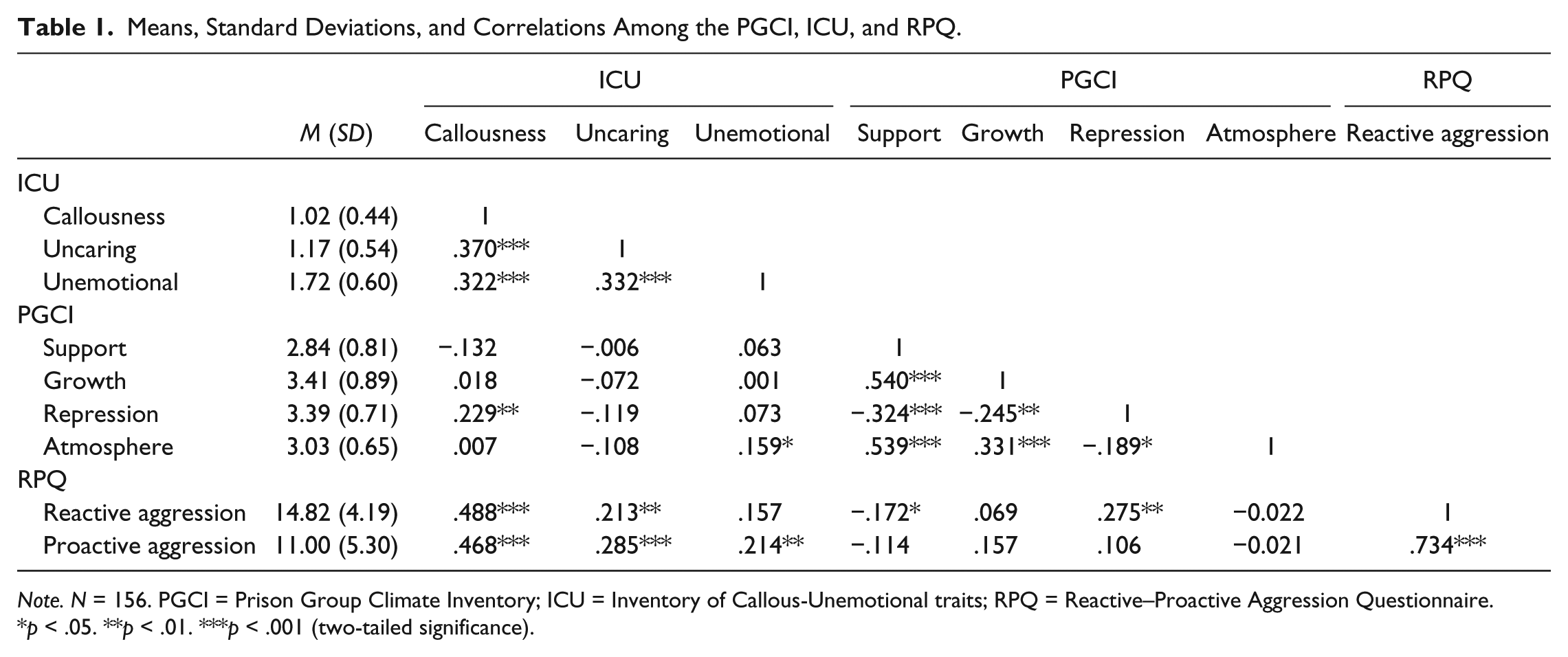
Note. N = 156. PGCI = Prison Group Climate Inventory; ICU = Inventory of Callous-Unemotional traits; RPQ = Reactive–Proactive Aggression Questionnaire.
p < .05. **p < .01. ***p < .001 (two-tailed significance).
SEM
To investigate the relations between living group climate, reactive and proactive aggression, and CU traits, a structural equation model was fitted to the data (N = 156), accounting for the effects of age, ethnicity, and type of offending on living group climate, aggression, and CU traits, and allowing correlations among reactive aggression, proactive aggression, and CU traits. The initial model did not show a good fit to the data: χ2(38) = 73.893, p = .000, CFI = .902, TLI = .838, and RMSEA = .078. Therefore, a second model was fitted to the data, with changes made on the basis of MIs. However, no valid model could be fitted to the data including paths from the latent variable open living group climate to aggression and CU traits. Because the model only became satisfactory when paths were included from repression to other indicators of latent variables, we fitted a model that only incorporated repression as a manifest variable. The alternative model showed a good fit to the data: χ2(11) = 15.283, p = .169, CFI = .982, TLI = .945, and RMSEA = .050. It can be derived from Figure 1 (showing standardized coefficients, dashed lines representing non-significant paths, and solid lines representing significant paths) that repression was positively related to reactive aggression (.274, p = .000) and CU traits (.240, p = .004). Furthermore, reactive and proactive aggression were positively associated with CU traits (both .503, p = .000), reactive aggression was positively associated with proactive aggression (.746, p = .000), and uncaring was positively associated with unemotional (.221, p = .007). The control variable “age” showed a borderline-significant association with CU traits (−.154, p = .082), indicating that CU traits were more common in younger inmates (the appendix shows all standardized coefficients, standard errors, z values, and p values).

Structural equation Model of living group climate, aggression and CU-traits
Discussion
There is accumulating empirical evidence showing that the social environment can be more influential than individual factors in explaining both antisocial (Pinker, 2011; Raine, 2013; Zimbardo, 2004) and prosocial behavior (Van IJzendoorn & Bakermans-Kranenburg, 2014). Also, juvenile offenders change their behavior in response to the social environment, that is, perceived environmental demands and pressures (Steinberg, 2009; Schubert et al., 2012; Van der Helm & Stams, 2012). Research has shown that an open living group climate could influence successful rehabilitation and secure institutional treatment (Van der Helm et al., 2012; for an overview, see Souverein, Van der Helm, & Stams, 2013). Although the rate of violent delinquency has been declining during the past three decades, serious and violent (juvenile) offending remains a significant problem (e.g., Clarke, 2013; Hanslmaier, Kemme, Stoll, & Baier, 2014; LaFree, Curtis, & McDowall, 2015; Office of Juvenile Justice and Delinquency Prevention [OJJDP], 2011; Snyder, 2012). The most violent offenders often show high levels of aggression and CU traits (Frick & Dickens, 2006; Salekin, Rogers, & Sewell, 1996). The present study is to our knowledge the first to examine the relation between living group climate and both aggression and CU traits in a juvenile justice institution. Results of this study show that perception of a more repressive living group climate is associated with higher levels of CU traits and reactive (but not proactive) aggression in incarcerated juvenile offenders, which is consistent with the deprivation hypothesis, indicating that a repressive climate is related to more antisocial behavior within prison (Harer & Steffensmeier, 1996). Our study results are also in line with research showing the distinctiveness of reactive aggressive behavior in response to perceived adverse environmental circumstances, including repression (the present study), and proactive aggressive behavior, which is instrumental and anticipates reward (Card & Little, 2006; Kempes, Matthys, De Vries, & Van Engeland, 2005; Polman, Orobio de Castro, Koops, Van Boxtel, & Merk, 2007; Raine et al., 2006). However, outcomes of this study are not in line with previous research on living group climate in Dutch youth prisons, which showed that an open and supportive living group climate was associated with less aggression, whereas repression was unrelated to aggression (Ros et al., 2013; Van der Helm, Boekee, Stams & Van der Laan, 2011). In the Netherlands, juvenile delinquents receive structured clinical treatment during detention to reduce the risk for criminal offense recidivism (Hoogsteder et al., 2014). As the present study was carried out in a German youth prison, it seems plausible to suggest that the relation between living group climate and aggression might be affected by differences in the juvenile prison system between Germany and the Netherlands, and the respective goals of retribution, deterrence, or rehabilitation.
The German juvenile prison system particularly focuses on formal education, reduction of drug use and aggression (Bundesministerium der Justiz, 2009; Walter, 1999) but does not target reduction of aggression of juvenile offenders by means of psychiatric care, evidence-based offender rehabilitation programs, such as Equip (Helmond, Overbeek, & Brugman, 2012) and responsive aggression replacement therapy (Hoogsteder et al., 2014). The recent 2013 vision of the nine Dutch youth prisons (Van der Helm, Van Tol, & Stams, 2012) explicitly states that an open living group climate and psychiatric help are the two main pillars of the system.
De Swart et al. (2012) conducted a meta-analysis on the effectiveness of residential care and showed general group care to be ineffective without the delivery of evidence-based treatment. Another review of young offenders (Koehler, Loesel, Akoensi, & Humphreys, 2013) showed that purely deterrent and supervisory interventions even slightly increased juvenile recidivism. When treatment was the main goal, results were more positive in terms of recidivism reduction, especially when cognitive behavioral therapy was applied. Given that the Dutch forensic juvenile justice institutions deliver evidence-based treatment and psychiatric care, an open and supportive living group climate may reduce aggression problems and eliminate the negative effects of repression. In Germany, however, an open and supportive living group climate may possibly have no positive effects on CU traits and aggression because evidence-based treatment is lacking, while the negative effects of repression are not dampened by the use of evidence-based treatment.
Other explanations for different results in Germany and the Netherlands may be found in measurement issues. The Dutch study by Van der Helm et al. used the Buss Durkee Hostility Inventory (BDHI; Buss & Durkee, 1957) to assess self-reported aggression, whereas the present German study used the RPQ. The BDHI is more focused on trait-like features of aggression, whereas the RPQ is more focused on state-like features of aggression. We suggest that a repressive prison environment may have negative effects on state-like features of aggression but less on trait-like features of aggression. Notably, the repression experienced by incarcerated juvenile delinquents may partly be a continuation of their aversive child-rearing experiences, as was recently demonstrated by Asscher et al. (2015), which may explain why repression did not show a significant association with trait-like aggression. However, such an explanation does not seem in agreement with the significant relation between repression and callousness in the present study. However, Baron-Cohen (2011) has argued that empathy, which is difficult to combine with CU traits, can be “shut on or shut off,” depending on the quality of the environment. In prison, where the environment is thought to have a great (or even extreme) impact on the behavior of inmates (Van der Helm, 2011), callous and unemotional behavior can therefore be more state- than trait like. This may particularly be the case for adolescents whose brain is still maturating and personality is still developing (Lenroot & Giedd, 2006).
Although the PGCI has been shown to be a valid and reliable measurement instrument to assess living group climate in juvenile justice institutions in Germany and the Netherlands , measurement invariance for the German and Dutch versions of the PGCI has never been demonstrated, which means that the size of the factor loadings may differ across the German and Dutch versions. Notably, the Repression scale of the PGCI consists of items measuring both repression and deprivation. Deprivation items load relatively high on the German Repression scale of the PGCI, whereas repression items load relatively high on the Dutch Repression scale of the PGCI. It can therefore be concluded that the association between repression and aggression particularly signals the negative effects of deprivation in the German youth prison, interpretation of which is in line with the lack of attention paid to psychosocial development in the German prison system.
The present results have to be considered in light of some limitations. A first limitation is that the PGCI does not distinguish between repression and deprivation. We therefore argue that the PGCI needs further development to account for repression and deprivation in separate scales, which facilitates research on the unique effects of repression and deprivation and their combination. A second limitation is that living group climate and aggression were assessed using adolescent self-report only, which was not supplemented with independent objective observations or assessment of the perspective of prison staff and group workers. A third limitation pertains to the cross-sectional nature of this study, which does not permit testing the transactional relation between environment and individual characteristics, and sets limits to the causal interpretation of the results. While the present study showed that a hard prison environment may have adverse effects on (reactive) aggression and callous and unemotional behavior, the opposite could also be true: Prison staff or group workers may resort to a stricter schedule if confronted with inmates who are both callous/unemotional and prone to show aggressive behavior. As the analysis is correlative, based on self-reports of inmates only, and does not compare various institutions (and living groups) with each other that differ in terms of climate (e.g., using multilevel analysis), it cannot be excluded that juvenile delinquents with pronounced CU traits and a greater propensity toward aggression may be more inclined to view their surroundings as hostile. Hence, hostile attribution bias (Orobio de Castro, Veerman, Koops, Bosch, & Monshouwer, 2002) could be an alternative explanation for the results of our study, at least in part. A fourth limitation is that subjects were selected using convenience sampling, which may restrict generalizability, although the age range, reasons for detention, low educational levels, and ethnic diversity of the sample did largely concur with characteristics of the Germen youth population in secure juvenile justice institutions (Dünkel, 2006). Finally, the sample consisted of male offenders only. It would be interesting to compare a sample of boys and girls because of the expected differences in the development of aggression during detention (Asscher et al., 2015; Crick, Bigbee, & Howes, 2008). Future research should examine the longitudinal relations between living group climate, aggression, and CU traits in a more diverse sample of detained juvenile offenders.
Despite these limitations, the present study is the first to investigate whether there is a relation between living group climate and both aggression and CU traits, showing that repression is associated with aggressive behavior and callousness in detained youth. This study provides empirical support for the association between repression and antisocial behavior in a context where social support from professional staff appears to be low, the group atmosphere among inmates is relatively negative, and evidence-based treatment for detained youth is lacking. The prevalence rate of any mental disorders among detained male adolescents is high (almost 70%; Colins et al., 2010), a negative climate could worsen psychiatric problems, and the longitudinal relation between on one hand externalizing and comorbid disorders and on the other hand criminal offense recidivism is substantial (Wibbelink, Hoeve, Stams, & Oort, 2015). The outcomes of this study also raise doubts about “get tough” approaches in prison in general (Collier, 2014; Gendreau, Goggin, French, & Smith, 2006) and call for a more effective and rehabilitative prison management (Lipsey, 2009; Listwan, 2013; Parhar, Wormith, Derkzen, & Beauregard, 2008).
Footnotes
Appendix
SEM Results Estimates From Mplus.

| Estimate | SE | z | Two-tailed p value | |
|---|---|---|---|---|
| CU-traits BY | ||||
| Callous | .914 | 0.113 | 8.080 | .000 |
| Uncaring | .405 | 0.087 | 4.686 | .000 |
| Unemotional | .351 | 0.084 | 4.185 | .000 |
| CU-traits ON | ||||
| Repression | .240 | 0.082 | 2.912 | .004 |
| Age | −.154 | 0.088 | −1.739 | .082 |
| Ethnicity | .085 | 0.084 | 1.007 | .314 |
| Type of offense | .040 | 0.085 | 0.476 | .634 |
| Reactive aggression ON | ||||
| Repression | .274 | 0.074 | 3.691 | .000 |
| Age | .011 | 0.077 | 0.144 | .885 |
| Ethnicity | .079 | 0.077 | 1.027 | .304 |
| Type of offense | −.015 | 0.077 | −0.198 | .843 |
| Proactive aggression ON | ||||
| Repression | .108 | 0.079 | 1.364 | .172 |
| Age | −.108 | 0.079 | −1.376 | .169 |
| Ethnicity | .022 | 0.079 | 0.279 | .781 |
| Type of offense | −.008 | 0.080 | −0.094 | .925 |
| Repression ON | ||||
| Age | .021 | 0.080 | 0.259 | .795 |
| Ethnicity | .028 | 0.080 | 0.350 | .726 |
| Type of offense | −.0114 | 0.079 | −1.440 | .150 |
| Reactive aggression WITH | ||||
| CU traits | .503 | 0.092 | 5.441 | .000 |
| Proactive aggression WITH | ||||
| CU traits | .503 | 0.099 | 5.081 | .000 |
| Reactive aggression | .746 | 0.036 | 20.968 | .000 |
| Unemotional WITH | ||||
| Uncaring | .221 | 0.082 | 2.682 | .007 |
Note. SEM = structural equation modeling; CU = callous-unemotional.
Declaration of Conflicting Interests
The author(s) declared no potential conflicts of interest with respect to the research, authorship, and/or publication of this article.
Funding
The author(s) received no financial support for the research, authorship, and/or publication of this article.