



Abstract
This article presents public discourses on compensated dating of adolescent girls in Chinese society. Data are obtained from eight focus groups comprising 50 guardians at private, parochial, and public levels (i.e., social workers, police officers, parents of students, and community representatives). Qualitative data are used to demonstrate how the guardians conceptualize and contextualize compensated dating as an outcome of the dynamics of societal features. Social features such as contemporary ideologies, Internet technology advancement, commercialization of human relationships, and ambiguity between “right” and “wrong” motivate the service providers and customers of compensated dating, and accelerate their convergence and weakened levels of guardianship in society. This study is the first to connect the features of compensated dating of adolescent girls with recent societal changes using the routine activity approach. The findings confirm the application of the routine activity approach in the phenomenon of girls’ compensated dating, and also offer theoretical and practical implications.
Introduction
Compensated dating has received increasing global attention, particularly when teen prostitution or commercial sex among teenagers is involved. A recent report of the U.S. Institute of Medicine and National Research Council (2013) indicated that the commercial sexual exploitation of minors is an unaddressed form of child abuse, which requires prompt social responses. Article 34 of the Convention on the Rights of the Child requires governments to protect children from all forms of sexual exploitation (UNICEF, 2014). Thus, governments and related parties should identify and implement possible interventions to resolve such issues.
Compensated dating and similar phenomena occur in numerous cities globally and are widespread in Asia. A study based on a random sample of 600 female high school students aged 15 to 18 from eight Japanese neighborhoods reported that 2.3% of these girls admitted that they had engaged in compensated dating with sex and 4.8% had provided compensated dating services without sex (Fukutomi et al., 1998, cited in Kinsella, 2012, pp. 62-63). A survey study in Taiwan using stratified random sampling invited students from three cities (i.e., Taipei, Taichung, and Kaohsiung) to complete self-administered questionnaires. Of the 1,232 Taiwanese high school students who responded, 1.8% admitted that they had engaged in compensated dating as customers and 2.1% had provided compensated dating services (Yeung, Wu, & Chen, 2002). A recent Hong Kong survey using a purposive sample of 387 delinquent youngsters (259 girls and 128 boys) referred by social service agencies revealed that 25.3% of these teenagers had engaged in compensated dating with or without sexual relationships while below 18 years old (Cheung, Lee, & Li, 2011).
The factors contributing to compensated dating or commercial sex (e.g., Cheung et al., 2011; Ho, 2003; Lam, 2003) and the involvement of adolescents in this phenomenon (Li, 2015) have been previously investigated. However, the public perception of the activity has not been fully explored. In the routine activity approach of Cohen and Felson (1979), the general public assumes the role of guardians who can protect vulnerable targets from attacks by offenders.
The current study echoes the view of Felson (1986) and Reynald (2011) that the routine activity concept of guardianship is subsumed under the umbrella of informal social control, where supervision by the guardian over the target is enhanced by social bonds and informed by social norms, which ultimately leads to crime control. “Guardianship” is defined as “the process by which citizens function as effective informal crime prevention and control agents” (Reynald, 2014, p. 2480). Clarke and Eck (2005) divided up the informal crime control agents into “guardians” (those who protect the target/victim, such as family members, police officers, or private security officers), “handlers” (individuals who have some control over the offender’s actions, such as parents, teachers, friends, and probation officers), and “place managers” (owners or designees who are liable to control the behavior of people in specific locations, such as schoolteachers, bus drivers, or residential landlords). Participants in this study, including parents, social workers, police officers, and community leaders, assume guardianship responsibility to protect young people from the harm of compensated dating, so the current article focuses on their guardian role for analysis and discussion. Guardianship exists when “the presence of a human element which acts—whether intentionally or not—to deter the would-be offender from committing a crime against an available target” (Hollis, Felson, & Welsh, 2013, p. 76). Guardianship can be observed through the guardians’ “availability,” “supervision and monitoring,” and “intervention activities” (Reynald, 2009, 2010). Seemingly, guardians can take some action for preventing a crime. Our understanding of the contextual factors determining guardianship intensity can be further enhanced (Reynald, 2014).
To different degrees, guardians are essential in tackling problems of crime in society, but their views have not been examined adequately, though some work has been done by Reynald (2010, 2015) through questionnaire interview and online survey. Recent studies have examined the concept of guardianship in the routine activity approach through field observation (Reynald, 2009), panel study (Miethe, Stafford, & Sloane, 1990), cross-sectional data analysis (Garofalo & Clark, 1992), and neighborhood surveys (Wilcox, Madensen, & Tillyer, 2007); however, the use of qualitative method like focus group interview is rare. The current study uses a routine activity approach to fill this gap in the literature, examining the guardians’ perception and narratives of compensated dating and focusing on how the macro social context of Hong Kong hinders the guardianship intensity to prevent compensated dating.
Background
Origins and Features of Compensated Dating
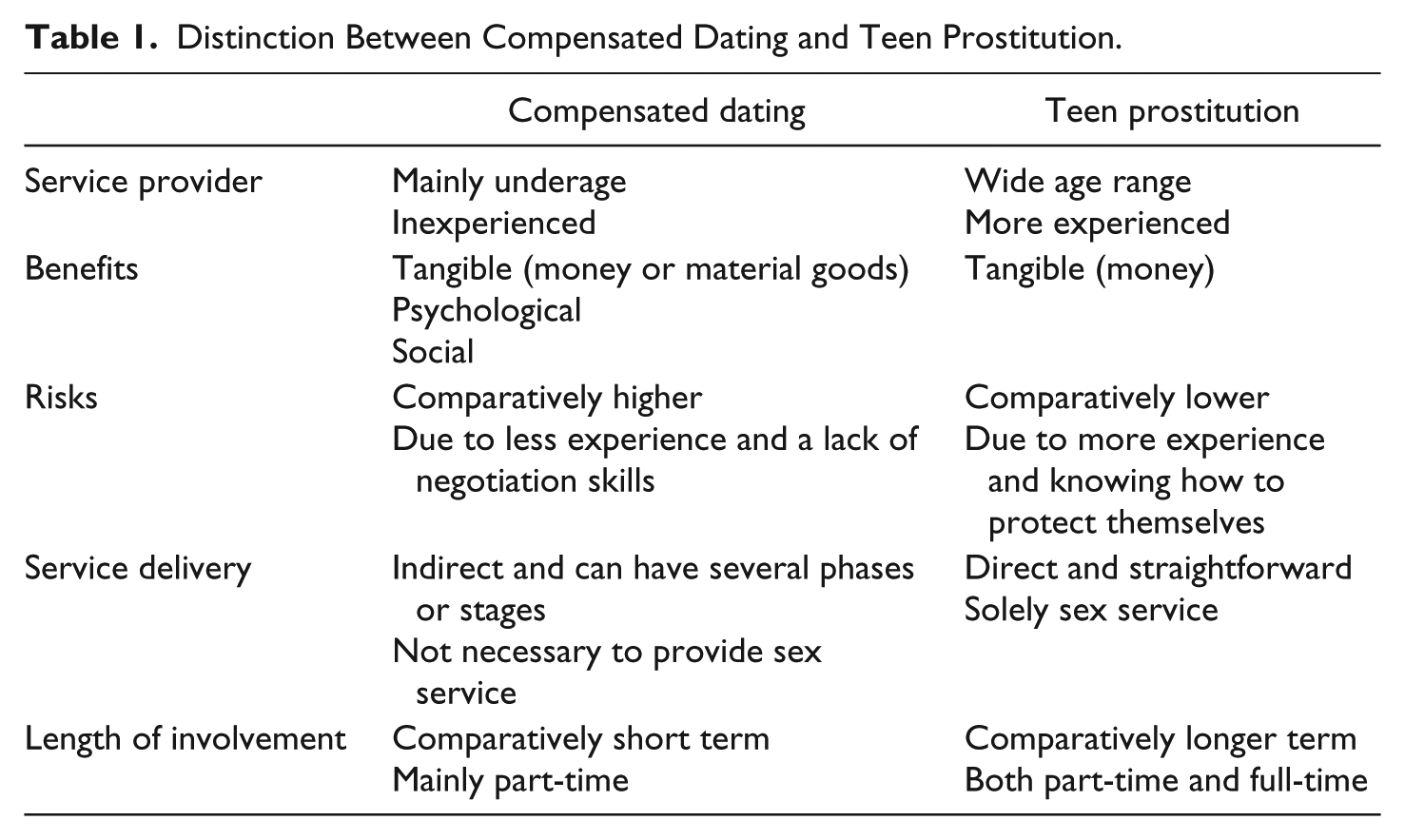
Compensated dating (enjo-kosai in Japanese) originated in Japan in the 1970s, and subsequently became prevalent in Korea (e.g., Kim, 2003; Kong, 2003), Thailand (Lau, 2008), Taiwan (e.g., Li, 2006; Yeung et al., 2002), Hong Kong (e.g., Cheung et al., 2011; Chu et al., 2009; Li, 2015), and Shanghai (Clem, 2011). Similar phenomena in the United States are referred to as “sugar daddy” relationships (Barthelemy, 2004) and in Africa as “transactional sex” (Williams, Binagwaho, & Betancourt, 2012). Enjo in Japanese means “assistance” in the business realm, whereas kosai implies “socializing and entertaining” in the context of society and culture (Lam, 2003). Wakabayashi (2003) asserted that enjo-kosai may consist of various nonsexual services, including having dinner, watching a movie, or visiting an amusement park. Therefore, compensated dating among teens does not always involve prostitution (see Table 1), but in most cases, sex services are provided (Li, 2015). After conducting an expert group meeting with various parties and consulting previous studies, this study’s research team defines compensated dating as any behavior involving subsidized dating and freelance teenage prostitution. This definition simply indicates that a person purposively dates others for compensation and often in the form of payment. Compensated dating is a commercial intimate act realized out of necessity and, compared with prostitution, appears to be ambiguous. Young people who provide compensated dating services are amateurs, generally less capable of negotiating with customers in terms of service fees and condom use, and may therefore be at higher risk than prostitutes (Li, 2015).
Distinction Between Compensated Dating and Teen Prostitution.
Public Attitudes and Responses to Compensated Dating
The nature of compensated dating is contentious, and the responses of communities to it are diverse. Some believe that commercial sex (including compensated dating) is harmful and should be regulated or criminalized, as it is often associated with violence, organized crime, and challenges to traditional structures such as family, marriage, and procreation (Hayes, Carpenter, & Dwyer, 2012). Chinese people, particularly those who value the ideals of family, generally perceive prostitution as unjustified and unacceptable (Cao & Stack, 2010). In this context, both the service providers and purchasers of commercial sex face legal consequences. Purchasing sex from underage individuals is illegal in Hong Kong. In many cases of compensated dating, sexual intercourse takes place between a male adult and an underage girl (Cheung et al., 2011). In Hong Kong, a man who engages in unlawful sexual intercourse with a girl below age 16 is guilty of an offense and faces up to 5 years imprisonment (Crime Ordinance, Cap. 200, s124). Similarly, the crime of “statutory rape” 1 in the United States imposes an age limit on the legal consent for sexual intercourse. In Hong Kong, girls below 16 have no right of consent to intercourse. An individual found guilty of soliciting compensated dating may be subjected to maximum penalties of HK$10,000 (US$1,280) in fines and 6 months imprisonment (Crime Ordinance, Cap. 200, s147).
Nonetheless, society perceives compensated dating as a type of exploitation instead of a harmful act. Adolescents are considered victims of sexual exploitation, are stigmatized (e.g., Van Hook, Gjermeni, & Haxhiymeri, 2006), suffer from violence in the course of compensated dating (e.g., Li, 2015), exhibit higher rates of fear and anxiety, experience altered relationships with others including the inability to trust others, and develop self-destructive behavior (Willis & Levy, 2002). Adolescents involved in compensated dating must therefore be protected from any sexual exploitation or abusive activity. In Hong Kong, for example, below 18s are protected from moral danger through custodial treatment (Protection of Children and Juvenile Ordinance, Cap. 213, s34).
There is, in contrast, a more positive perspective toward compensated dating where it is considered as a representation of sexual revolution among youth and a normal adolescent developmental process (Ho, 2003; Hwang & Bedford, 2004). In this context, compensated dating is perceived not as an outcome of moral decay but as a new sexual revolution explored by adolescent girls to “[forge] their own sexualities out of limited social means” (Ho, 2003, p. 326). This viewpoint implies the need to respect the choices of adolescents and to uphold their rights regarding sex-related issues.
Public views of this problem vary and can be contradictory. The current study aims to clarify these views by analyzing the discourses of various parties who are considered “guardians” at different levels. Public perception of a particular problem is generally determined by the societal context. In this study, the views of focus group participants who exercise control over and protect young people are collected and analyzed.
Routine Activity Approach
In 1979, Cohen and Felson proposed a theory that presents different views toward criminal behavior. Instead of solely considering the behavior of offenders or victims, they suggest that crime occurs when the motivated offender, a suitable target, and a capable guardian converge in time and space. According to Clarke and Felson (2004), a “motivated offender” refers to “anybody who for any reason might commit a crime,” a “suitable target” of a crime is “any person or object likely to be taken or attacked by the offender” (p. 2), and a “capable guardian” includes “neighbors, friends, relatives, bystanders, or the owner of the property targeted” (p. 3). Changes in routine activities may essentially affect this convergence and the occurrence of crimes (Felson, 1998).
There are several reasons the present study takes the routine activity approach to further understand the involvement of adolescent girls in compensated dating. First, previous studies have applied this approach to investigate sexual victimization or offenses (e.g., Jackson, Gilliland, & Veneziano, 2006; Kavanaugh, 2015; Kenyon & Schanz, 2014; Tyler & Beal, 2010). However, these studies were based on non-Chinese samples, and their conclusions cannot be generalized to Chinese societies. Second, this approach comprehensively examines crime occurrence at micro- and macrolevel. At the microlevel, this approach proposes that crimes occur when the aforementioned minimum elements converge in time and space (Cohen & Felson, 1979). At the macrolevel, routine activities, often shaped by the societal context, may affect the convergence of the elements and the occurrence of crimes (Felson, 1998). This study assumes that in compensated dating, customers or pimps (motivated offenders) and adolescent girls (suitable targets) easily converge because of inadequate supervision and monitoring (in the absence of a capable guardian). The cultural and structural characteristics of Hong Kong are believed to facilitate the motivation of customers, the availability of service providers, and the incapability of guardians. Third, Felson (1995) identified the four levels of guardianship responsibility as the “personal level,” the “assigned level,” the “diffused level,” and the “general level,” but little research has been found on the operation and process of guardianship at different levels. This study attempts to address this issue by asking the following questions:
Method
Participants
The use of focus groups is a common method of collecting public views of particular social problems, and gaining insights into corresponding policies and practices. The current study analyzed the responses of 50 participants (18 males and 32 females) who are guardians at the private, parochial, and public (including criminal justice and helping professions) levels in Hong Kong (see Table 2). They were invited to participate in the investigation, as they supervise and monitor young people. Participants at the private level included 15 parents residing in the city center and periphery who were recruited through the parent–teacher associations of two high schools. Participants at the parochial level included 10 community leaders from the city center and periphery who were recruited by the district fight crime committees. Participants at the criminal justice level consisted of 12 police officers from the crime prevention, juvenile protection, and missing persons units of the Hong Kong Police Department. These respondents were recruited through the Police Research Unit. Participants at the professional level were 13 social workers serving in the outreach social teams or teams providing services to adolescents engaged in compensated dating. After the units gave their consent and support, an invitation letter detailing the research objectives, procedures, and possible risks and rewards was sent to the target respondents.
Focus Group Participants and the Frequency of Each Theme Appearing in Each Focus Group (N = 50).
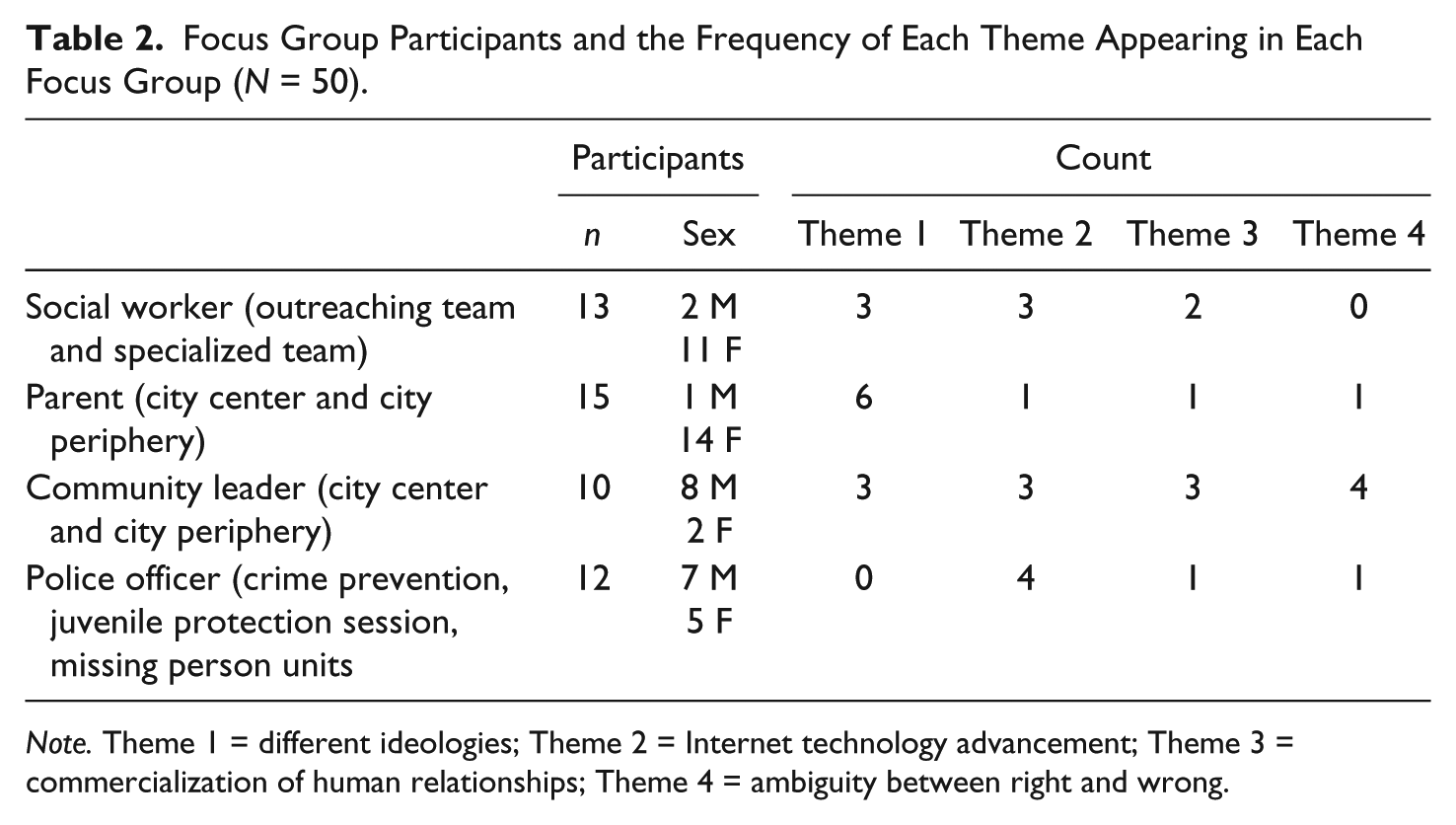
Note. Theme 1 = different ideologies; Theme 2 = Internet technology advancement; Theme 3 = commercialization of human relationships; Theme 4 = ambiguity between right and wrong.
Procedure and Protocol
Eight focus group discussions were conducted by the first author and her research assistant in a conference room of a local institution in the summer of 2013. One advantage of using focus groups for data collection is that open-ended questions allow researchers to explore the views of participants deeply and freely, and acquire rich and detailed perspectives (Asbury, 1995; Linhorst, 2002; Patton, 1990). The focus group method can also highlight cultural values or norms (Kitzinger, 1995), less-inhibited participants can initiate the focus group discussion, and mutual support can then be spontaneously provided to the rest of the participants by expressing feelings that are perceived as common in their group but deviate from mainstream culture (Kitzinger, 1995). The focus group meeting method has been used to gather public opinion on violence prevention (e.g., Payne & Button, 2009) and financial fraud prevention for the elderly (e.g., Li, Yu, Wong, & Ngan, 2015). The current study aimed to capture the attitudes and values of different guardians regarding a sensitive topic, and to collect rich and detailed data. The outcomes of focus group discussions helped achieve this aim.
This study was approved by the Research Committee of the City University of Hong Kong. Prior verbal and written consent was obtained from the participants. Before the meeting began, the participants were reminded about the background, possible risks, the data collection procedures of the study, and the measures for protecting their identity. Each focus group meeting lasted roughly 2 hr. The interviews were primarily in Cantonese and were audio recorded and transcribed. The interviewers used a one-page interview guide, based on the theoretical framework of the study, to collect data on (a) the perceptions of the respondents regarding compensated dating (e.g., definition, prevalence, and trends), (b) the perceived nature and facilitating factors for compensated dating, (c) the perceptions of adolescents engaged in compensated dating, and (d) the extent to which individuals/guardians respond to the compensated dating problem. The interview process was interactive and collaborative.
Analysis Strategy
All of the interviews were audio recorded and transcribed in Chinese. The quotations in this article were translated verbatim from Chinese into English, with several grammatical amendments. The first author, whose interdisciplinary background is in social work and criminology, specifically developed the coding framework by creating themes based on the items of the interview guide and on the new categories derived from a review of all scripts (Alhojain, 2012). The scripts of the interviews were coded by a research assistant using the NVivo software package (QSR International, version 10). The data were confirmed and analyzed, and conclusions were drawn. The triangulation of the data analysis of different researchers kept individual bias to a minimum, and allowed comprehensive conclusions and perspectives to be reached.
Results
The data from the focus groups yielded the following themes, which help explain the occurrence of compensated dating with the routine activity approach. First, compensated dating emerges from a synthesis of different ideologies: gender ideology about the submissive role of women, materialistic consumerist ideology, and fast-food ideology. Second, the practice is influenced by the advancement of Internet technologies, which can accelerate the level of convergence between service providers and purchasers; convergence of a chain of risks; and convergence of online peers. Third, compensated dating represents the commercialization of human relationships that have evaded guardianship. Fourth, it conceptually maintains ambiguity between right and wrong, which in turn impedes effective guardianship. Each focus group meeting was transcribed verbatim and coded by a research assistant using the NVivo software according to the themes set by the researcher in the interview guide.
The themes emerged after the researcher studied the relevant literature and read all the scripts. Table 2 shows the frequency of each theme coded across eight groups. For example, of the 12 dialogues or statements from the three groups related to social ideologies in Hong Kong (Theme 1), six were observed in the parent group. Table 2 demonstrates that the participants of the focus groups who represent guardians at different levels (i.e., private, parochial, criminal justice levels, and helping professionals) held both common and different perceptions of compensated dating.
Motivation and a Synthesis of Different Ideologies
Compensated dating is a product of the combination of traditional and contemporary ideologies in Hong Kong. The merging of these ideologies has motivated adolescent girls to engage in compensated dating. Hong Kong is a Chinese coastal city that was under British colonial rule for nearly 100 years until 1997. Understandably, the views of Hong Kong citizens are formed and influenced by the interaction of Eastern and Western cultures.
Gender role ideology on the submissive role of women
A social worker found that some girls hold the gender role–stereotyped belief that females rely on males for survival and need to please them by appearing attractive in exchange for financial support. Providing compensated dating services appears to be simply a normal way for them to get this support. Two social workers elaborated this observation:
I think compensated dating is not only about commercialization, but also related to gender issues. This activity is a type of gender culture. I talked with a girl who said that, “If boys and girls are truly dating, or if he is my real boyfriend, he should pay when we are on a date.” This view implies that if a girl meets a boy through normal channels and they develop a relationship, then the boy must pay for every aspect of their dates, including shopping, movies, and dinners. This behavior is part of the Hong Kong culture. In terms of gender, I think the traditional culture expects men to support women. Therefore, these young girls contend that the idea of males paying for their needs is quite reasonable.
From another perspective, I find these girls are eager to be appreciated [by men]. This appreciation can come from how they use their appearance and shape. In my case experience, this is very common.
Materialistic consumerist ideology
Materialism encourages many young people to acquire luxury goods, such as branded mobile phones and fashionable clothes. Involvement in compensated dating can be considered by some participants in the focus group as an alternative means of earning money quickly.
I think the current society highly values the use of branded mobile phones. People believe that they should not own mobile phones of unpopular brands or if they are worth less than HK$5,000 to HK$6,000, or you will be laughed at. The mobile phone I currently use is the one that my son has used for a long time.
I heard of a case involving a young girl who received a prepayment of HK$5,000 by providing masturbation services to a man. The girl subsequently used the money to buy a Samsung Galaxy S4, a type of mobile phone. Before the smartphone was launched in the market, this young girl provided a masturbation service to her customer and quickly received the money. She then decided to provide several masturbation services every week before she went to school to increase her savings.
Fast-food ideology
Young people believe that acquiring compensated dating services is an easy and quick means of obtaining company and affection. A social worker described this phenomenon as follows:
I wonder about the emergence of compensated dating. I know a case in which girls often meet a man online. The man is very aggressive and will meet two or three girls at the same time. The girls believe that they can easily perform sexual intercourse with the man after three dates. If such an encounter involves money, then these girls will continue their behavior. Perhaps these girls do not care and do not hesitate to give their virginity to a stranger. I think the Internet is too appealing, so online casual sex results in compensated dating.
The above illustration shows that guardians at different levels believe that adolescent girls become involved in compensated dating to sustain their materialistic lifestyle. In this study, the concept of “suitable target” proposed by the routine activity approach can be extended to “available target”; that is, compensated dating providers make themselves available to engage in the act.
Convergence and Internet Technology Advancement
Marcum, Ricketts, and Higgins (2010) suggested that “the more time that youth spend on the Internet, especially using social network sites, may increase their likelihood of being exposed to a motivated offender” (p. 386). Guardians across groups in this study identified that the influence of digital technology on the daily life of youths increases the opportunities they have to engage in compensated dating.
Convergence of service providers and purchasers
Apart from the existing compensated dating websites, MSN, WhatsApp, WeChat, and Line are also used by young people to negotiate compensated dating businesses, in addition to developing new friendships. Based on her qualitative study, which involved 30 young people engaged in compensated dating, Li (2015) introduced a five-step process model (i.e., search, social chat, sell, see, and sold) for compensated dating. Li affirmed that Hong Kong teenagers conduct this kind of business with potential customers through the Internet. Therefore, the Internet accelerates convergence between the service providers and potential customers of compensated dating.
I think the Internet culture is quite powerful and fast. Facebook did not exist 10 years ago. Nowadays, many young people have numerous friends on Facebook, some as many as 1,000. This is particularly true for those who organize parties. Having a wide network of friends facilitates the organization of parties. Being a small city, it is easy to get around Hong Kong by transportation. Friends and acquaintances can quickly and easily meet up anywhere in Hong Kong.
Before, people make social acquaintances based on their common interests. The approach today differs—“I know you, and you know him. I will know him soon. Then, he knows someone else, and I will get to know this other person quickly.” Aside from Facebook, WhatsApp, a mobile app that delivers information quickly, is nowadays widely used to make friends. Similarly, WeChat is a prevalent tool that enables integration. The prevalence of the Internet allows the rapid broadcast of any phenomenon occurring anywhere in the world.
Have you heard of the dating sites HR, Yes, and Shout? These sites are advertised as dating sites, but they covertly operate as compensated dating sites. “Yes” app is designed for making friends. However, most Yes users are compensated dating girls, who use the app to solicit customers. The pictures these girls post give the impression that they are engaged in compensated dating. Such an app is also used to lure others to chat.
At present, information can be easily accessed through the Internet. Young girls in particular can also contact customers through the Internet.
The above comments from participants describe how providers of compensated dating services connect with their customers through online activities.
Convergence of various risks
Young people become vulnerable to various risks when they start to engage in compensated dating through the Internet. These risks include victimization through fraud and blackmail. Young people might encounter the risk of blackmail when they initiate an intimate relationship with online friends through online “naked chat.” These kinds of risk were identified by young people involved in compensated dating (Li, 2015). A police officer provided an example to illustrate this risk.
For example, a male meets a female on the Internet. She wants to meet him and see a part of his body. Then, both undress gradually. The male believes he is taking advantage of the female. The female asks the male to do some poses for viewing. At the same time, she also does some poses according to the male’s requests. However, unknown to the male, the female records his behavior. After their online encounter and email exchange, the female initiates a crime by asking the male to remit US$2,000 to her account or risk the exposure of the video tape.
According to the guardians in this study, some young people believe that they have no responsibility for their online (mis)behavior because the cyber world is unreal and they can maintain anonymity. Under these circumstances, some of them have even fewer reservations and more motivation to commit crimes. The involvement of adolescent girls in these types of crimes exemplifies this situation. A police officer provided a specific example.
We found out that many young people believe that the Internet world is unreal. Anyone can assume a virtual identity and carry out his or her thoughts and plans. For example, people can freely express on the Internet that they are the heads of triads, have many female companions, and have access to drugs. This Internet behavior is typically perpetrated by adolescents.
Convergence of online peers
With adequate guardianship, an individual is inclined to follow the social norms and rules of contemporary society, as deviant behavior is less likely to gain the approval of social groups. The prevalence of Internet communication has transformed the Internet into a venue with limited monitoring by guardians. People with deviant thoughts, including involvement in compensated dating, can easily gain the support of others. Hampton (2007) found that the longer people use the Internet, the weaker their ties at neighborhood level. The guardianship of parents, teachers, and adults in the community over young people therefore becomes less available.
People who engage in compensated dating are minors. These minors claim that people who do not engage in compensated dating are stupid, and they boast how easily they earn money. However, these thoughts are expressed by the minority, and they are wrong in most people’s eyes. After the advent of the Internet, the minority found their niche in life, which helped them ignore the views of the majority.
Weakened Guardianship and Commercialization of Human Relationships
The group of youngsters in the study regarded adolescent girls involved in compensated dating as “part-time” lovers. This basic human relationship, which is originally spontaneous in nature, has become a commodity. Guardianship, in the form of supervision or monitoring by adults, cannot be imposed if the norms and values of the mainstream society, such as self-dignity and respect, cannot be sustained. Guardians at various levels offered their explanations as follows:
The Internet has transformed prostitutes into commercial goods. I think the problem is that the Internet engenders not only the assumption of multiple identities, but also the promotion of wrong values. The decision to pursue and live by the right values is a choice that people on the Internet have to make.
Morally, compensated dating involves the commercialization of the body. I believe that those who engage in compensated dating are too casual and view themselves as part of the service industry, such as saleswomen.
They promote and sell their bodies.
Those who engage in compensated dating commercialize their bodies.
Therefore, they sell themselves. As you say, they are engaged in commercialization. They sell their bodies and declare that they can do particular things such as SM [sexual mistreatment]. They would not charge an extra fee and they would provide the props. These acts are small transactions, but these deals already include props and allow sexual trade with SM.
Weakened Guardianship and Ambiguity Between Right and Wrong
A lack of consensus on a clear definition of compensated dating was found in a majority of participants in the focus group study, and their answers to the question of whether or not compensated dating was illegal were ambiguous. Under these circumstances, guardians may find their intervention unjustifiable, and young people then receive no direction for appropriate thinking or behavior. Parents and community leaders in this study expressed their concerns:
I think our society lacks moral determination. For instance, criticizing people will not resolve problems. People rely on social workers to solve social problems. They also rely on the police to solve unfairness. If the media can engage in a more aggressive publicity campaign to help people distinguish between right and wrong and to promote good values, then young individuals and even adults will understand the justification and consequences of their acts and perhaps think twice about committing a crime.
Years ago, the Security Bureau emphasized that prostitution is illegal because of its moral implications. The Bureau aimed to discourage those who receive financial support to justify prostitution. Although compensated dating and prostitution do not violate the law, both acts are morally wrong. However, citizens are afraid to criticize such acts. People who earn from these acts, such as compensated dating girls, neutralize this criminal behavior. They mask such behavior as a means to cope in life and reduce the severity of their living conditions.
I think the development of information technology is a problem. In the past, young people received moral education from parents and schools, and were unable to obtain information from the Internet. Nowadays, the Internet is prevalent. The information from the Internet may not always be true. Sometimes, the Internet conveys wrong messages, which many young people consider as true and correct.
I think we should discuss the legal definition and penalization of compensated dating. Indeed, no law deals specifically with compensated dating behavior. Regarding the penalization of compensated dating, the situation is similar to what has been previously reported. First, the perpetrator may not be convicted. Second, the punishment for the convicted perpetrator is not severe. In fact, before these girls start such work, they entertain the idea that they would not be arrested. If they do get arrested, they may not be convicted. If they are convicted, they will not be punished severely. The aspect of deterrence in the law is weak. To some degree, the weakness in the law even becomes an incentive to engage in compensated dating.
A social worker indicated that some youngsters also used job titles such as “party manager” to neutralize the negative labels of youth sex work and compensated dating. Given the ambiguity between normality and deviance, young people seem to accept compensated dating easily and shamelessly.
The above results suggest that guardians at different levels (private, parochial, and public) unanimously indicated that contemporary ideologies, Internet technology advancement, commercialization of human relationships, and ambiguity between “right” and “wrong” motivate the service providers and customers of compensated dating, and also accelerate their convergence and even weaken guardianship in society. Nevertheless, similarities and variations emerged among groups (see Table 2). The influence of Internet growth on young people’s engagement in compensated dating is acknowledged by different guardians. Parents and social workers seem to pay more attention to the connection between compensated dating and social ideologies and values (e.g., gender stereotyping and materialism). Community leaders demonstrated their concern about guardianship in neighborhoods. Police officers focused on crime and the victimization risks confronting young people. Isolating young people from social changes is an impractical approach. One realistic solution is to strengthen their guardianship at different levels amid unfavorable environments. In this study, guardians at different levels described how they addressed the issues of compensated dating and their expectations regarding intervention.
Guardianship at the Private Level
According to Felson (1995), the highest level of guardianship responsibility is the personal. Understandably, parents are primarily responsible for supervising their children. A majority of parents in the study pointed out that maintaining proper communication is essential for effective guardianship. Two of them shared their experiences:
My husband maintains frequent communications with our children in a nonauthoritative style. Instead of manipulation, parents can allow their children to express their thoughts and autonomy if they make the right choice.
Text messages like “I miss you. Where are you now?” are good ways to show our concern as parents. My daughter could always reply and disclose her location. I can also remind her of the time to return home.
By contrast, a social worker described a social context unfavorable for parental supervision and monitoring. This description is consistent with that of Felson (1994): “With increasing numbers of households unsupervised in the daytime, teenagers have many more opportunities to escape parental controls, both when using home for their own purposes and when going elsewhere” (p. 105).
The parents whom we contact are generally from the grass-roots class. Most of them have long working hours, such as 12-13 hours per day in a restaurant. In most cases, their kids return home before their parents after engaging in compensated dating. Most kids involved in compensated dating come from families with complicated backgrounds. For example, their parents are divorced, have remarried, or cohabit with another partner.
Guardianship at the Parochial Level
At the neighborhood level, the district fight crime committees of 18 Hong Kong districts are responsible for designing and implementing initiatives to address local crime issues. Local leaders have a designated role in providing guardianship to at-risk youths. Participants in this study supported the idea of interagency collaboration to deal with the compensated dating problem. One community leader elaborated his view:
Have you ever tried any program with the joint venture of different parties to solve the local youth problems?
Yes, we often have.
How was it? Does it require consensus among the different parties involved? Any obstacles for collaboration?
The Home Affair Office assumes a coordinating role to locate the right party to participate in a program. Often, the Office can successfully obtain assistance from social workers. Social workers can always offer valuable suggestions on how to deal with local social problems. Therefore, interagency collaboration is really helpful. Through this collaboration, we gain a thorough understanding of the community and know how to solve the problems.
Encouraging the community to attend these community education programs is not that difficult. The most difficult part is setting the target participants. In addition, locating a suitable site for a program is a challenge. We noted that a poor location will not attract much attendance for the program. Fortunately, our Chair is willing to listen to our ideas and we selected a good venue. Our program ran successfully.
Yes, the choice of venue is essential. We need to consider the sound system and accessibility of the venue for pedestrians.
Community leaders mostly consider the logistics of community programs, such as location and manpower, instead of the effectiveness of the program in preventing a social problem or a crime issue.
Guardianship at the Public Level
In Hong Kong, social workers from outreach programs and teams dedicated to compensated dating provide individual counseling, group training, and community education to service providers and customers of compensated dating. Their guardianship responsibility, as described by Felson (1995), is at the “assigned level,” which is slightly below that of parents. The focus group participants revealed that their collaboration with the police was limited, but they cooperated relatively well with the mass media over the issues of compensated dating. In their view, teachers can be better prepared for sex education.
Our cooperation with the police remained on the level of information exchange, with no actual tasks. However, some years ago, our colleagues assisted on a TV program that featured stories of youth compensated dating. We also assisted on a phone-in radio program to answer the queries of citizens following the airing of the TV program.
I saw a junior student who raised questions, such as “What is dating?” and “What is falling in love?” with a teacher. At that time, the teacher was not prepared to answer the questions and had little discussion with the student. At school, students will be punished for romance or intimate behavior like holding hands in public.
Similar to social workers, police officers share the guardianship responsibility at the “assigned” level. Police officers involved in this study were from the crime prevention units, juvenile protection section, and missing persons units and were specifically tasked to intervene in various youth problems, including compensated dating. Officers in the focus group also had some experience in working with social workers and teachers on the problem of adolescent compensated dating. They showed concern over the adequate level of resource necessary to deal with this problem.
To resolve the compensated dating problem in Hong Kong, our Office has been providing seminars for parents of school kids. Some schools invited our officers to provide information on the prevalence and patterns of adolescent compensated dating. However, we observed that compensated dating involves a chain of complicated problems. We have virtually collaborated with some NGOs [nongovernmental organizations] in case referrals. However, we noted that those compensated cases detected by officers have become more complicated and serious. Those cases referred to social workers for follow-up require extra professional effort.
In summary, resource is the key to success. Social workers and police officers can only rely on activities to connect with young people. It is all about resources.
In summary, Hong Kong guardians at different levels have demonstrated their efforts to respond to the problem of adolescent compensated dating through their particular concerns and focus. Their responses, preferences, and perceived difficulty in handling compensated dating provide insights useful in formulating corresponding measures and practices. To have effective guardianship over a particular crime problem, the views of the guardian are truly indispensable.
Discussion
The results of the current study have a number of theoretical and practical implications. Theoretically, the responses generated from the focus groups not only support the core assumption of routine activity approach but also extend its concepts.
First, Wilcox et al. (2007) suggested that our understanding of micro–macro interactions with regard to the key elements of the routine activity approach could be strengthened. The present study addresses this by connecting Chinese ideologies and the motivation of youngsters to get involved in compensated dating. The data in this study indicate that adolescent girls with gender stereotypical beliefs tended to be more easily engaged in compensated dating. The population of Hong Kong was close to 7.2 million in 2013, and 95% were of Chinese descent (Hong Kong Census & Statistics Department, 2014). Traditional Chinese beliefs dominate in the city. Women in Chinese society are generally viewed as dependent and dominated by men. Chinese women during the feudal period were required to be housebound and submissive (Higgins, Zheng, Liu, & Sun, 2002). An old adage stated that women lived with three forms of obedience: to the father, to the husband, and to the son. Therefore, some women believed that men should support the entire family, particularly their mate(s), and women could reasonably rely on men financially. Under this principle, girls who engage in compensated dating felt comfortable that a man would provide for them. Another driving force in the involvement of adolescent girls in compensated dating is the culture of materialistic consumerism in Hong Kong. Young people may require assistance to remove this ideology. Materialism is understood as a value associated with possessiveness, jealousy, and greed (Belk, 1983). Materialistic consumerism is prevalent in Hong Kong and is facilitated by the Chinese value of “social face” (mianzi), which indicates the status and success of an individual (Wong & Ahuvia, 1998). The social comparison of consumption between friends and media is one of the most significant predictors of materialism endorsement among Hong Kong and Macao adolescents (Chan, 2013; Chan & Prendergast, 2007).
Second, the current study supports the proposition that “one crime can feed into another” (Felson & Boba, 2010, p. 129). In the current study, the responses from the police officers confirmed that some cases of compensated dating involved other types of offense, such as assault, fraud, and blackmail. Some purchasers extorted money from a number of girls engaged in compensated dating and threatened that they would broadcast video clips of their sex deal online. In some cases, purchasers were asked to pay for the compensated dating service in advance, and the girls who transacted the deal failed to appear (Lo, 2012). It is therefore reasonable to assume that a chain of issues can be resolved if there is effective intervention in adolescent compensated dating.
Third, the data in this study echo Reynald’s (2010) previous study on guardianship, which stated that social context affects the availability, supervision, and intervention of guardians. Here, one of the changes in the routine of young people is that they spend more time on the Internet and less time with people. The Internet has become increasingly popular in recent times. According to the Census and Statistics Department (2013), 49.7% of the Hong Kong population in 2000 had home computers connected to the Internet. This increased to 80% in 2012. Adolescents have enjoyed more Internet access in recent years. A total of 43.1% of children aged between 10 and 14 gained Internet access in 2000, and nearly all can easily connect to the Internet today (99.4% in 2012). With the increased accessibility to social ties through the use of mobile phones and other technologies, young people may spend a considerable amount of time communicating with Internet friends, and have less time with parents and teachers who assume guardianship responsibility. Young people often have a sense of facelessness or anonymity in the cyber world (Kenyon & Schanz, 2014), so they readily believe they are beyond the surveillance of guardians, and get involved in selling and purchasing compensated dating services.
Fourth, the data in the current study supported the proposition that a crime (compensated dating) occurs as a result of the convergence of motivated offender (customers) and suitable target (service providers). This study found that the increase in Internet use expanded social networks via Facebook, WeChat, or WhatsApp, increasing the vulnerability of adolescents to customers or pimps. More importantly, their interaction is unsupervised and unstructured. Unstructured routine activities facilitate the influence of delinquent friends on adolescents (Haynie & Osgood, 2005; Svensson & Oberwittler, 2010).
Fifth, the literature does not clearly delineate “guardianship” and “social control.” It has been suggested that guardianship is not social control, as it only refers to the physical presence of a guardian in a location at a given time, which is good enough to deter potential offenders (Hollis et al., 2013). However, other studies used formal social control (Stahura & Sloan, 1988) and informal social control (Wilcox et al., 2007) as a proxy for guardianship. Reynald (2011) proposed that the concept of guardianship is subsumed under the umbrella of informal social control although social bonds and social norms may affect the guardianship intensity. Data in this study echo Reynald’s view and demonstrate that effective supervision and monitoring by guardians depends on social control elements, that is, proper social values and norms, although intervention in compensated dating cases needs legal justification. Therefore, we proposed that guardianship and social control are two different but interrelated concepts.
It is impossible to change the social context and reduce the probability of young people’s engagement in compensated dating within a short period of time. Instead, correspondent measures that regulate adolescents’ routine activities, reduce their convergence with motivated offenders (e.g., customers and pimps), reduce their motivation to engage in compensated dating, and strengthen the guardianship at various levels should be implemented.
First, individual guardianship (Ahlin & Antunes, 2015), in addition to guardianship by adults, is important in preventing the victimization of young people. To reduce young people’s motivation to engage in compensated dating, they should be advised on how to conduct courtship safely and appropriately. In this regard, community education targeting adolescents is one possible approach. They should also be reminded that there are no “shortcuts” in developing human relationships. Fast-food ideology (i.e., an entrenched preference for time efficiency and instant gratification [House, DeVoe, & Zhong, 2014]), compensated dating in the forms of “speed dating” or “holiday lovers,” and “one-night stands” are pervasive in this city.
Second, within the education context, parents should strengthen their supervision or monitoring of their children’s Internet use. For example, the South Australian government proposed to the federal prosecutor an ordinance that would provide parents with “knowledge of” the Facebook accounts and passwords of their children, and to give them the right to delete inappropriate pictures and words posted on websites based on the principle of protecting their children from violation (Ching, 2011). Thus, both parental control and care are required to protect young people from undesirable online influence.
Third, strengthening the role of the place manager may help discourage compensated dating among young people. A report on the sexual exploitation of minors in the United States proposed multiple levels of intervention that are worthy of consideration (Institute of Medicine and National Research Council, 2013). Some of the proposed measures can be applied in Hong Kong. For example, hotels can adopt policies and train employees to help prevent commercial exploitation of minors by conducting identity checks at the reception counter.
Finally, to prevent the sexual exploitation of minors through compensated dating, certain legal terms should be clarified. The community leaders and police officers involved in this study were reluctant to intervene in some compensated dating cases, as they involved an ambiguous legal definition. There is no specific law in Hong Kong preventing individuals from seeking this type of online dating. Therefore, the police have attempted to prosecute offenders through Section 147 of the Crimes Ordinance, which classifies the solicitation of dates for an immoral purpose in a “public place” as a crime. Nevertheless, the law does not explicitly state whether a “public place” includes Internet forums and smart phone apps (Cheung, 2012). This ambiguity may induce minimal neighborhood control, and citizens may become more tolerant of delinquency and criminal behavior among youths, including sexual exploitation (Popkin, Leventhal, & Weismann, 2010). The failure of law enforcement personnel to recognize the sexual exploitation of minors as a serious criminal offense can also hamper effective prevention (Clawson, Dutch, Solomon, & Goldblatt, 2009).
Conclusion
This study is the first to connect the features of compensated dating of adolescent girls with recent societal changes using the routine activity approach. Data in this study provide conceptual and practical implications. Conceptually, the process and details of how societal characteristics facilitate the convergence of service providers and customers of compensated dating and weaken guardianship in a given society are explained. Practically, this study offers alternatives to develop guardianship over young people in Hong Kong.
Notwithstanding the potential contributions of this study, four limitations together with suggestions for improvement should be noted. First, the study is exploratory in nature and is limited by its sample size (N = 50). Thus, the generalizability of its findings to other Chinese societies (e.g., Taiwan and mainland China) remains questionable. A comparison of different Chinese societies can generate more valuable findings. Second, this study focuses on compensated dating initiated by girls but not by other groups, such as syndicates and gangs engaged in organized criminal activity, which may result in different features and forms of exploitation. Gang members may operate as pimps and use coercive methods to force young people into prostitution (National Gang Intelligence Center, 2011). Therefore, the role of crime syndicates or gangs in compensated dating is worthy of investigation. Third, the responses generated from the focus group participants may contain individual bias because of their various backgrounds, roles, and personal interests. Hence, they were treated as interested parties instead of cultural experts. Data interpretation was conducted with caution. Finally, the findings in this study are only relevant to Chinese girls in Hong Kong, and the need to understand the sexual exploitation of boys and sexual-minority youths, such as lesbians, gays, bisexuals, and transgender, is well recognized (Institute of Medicine and National Research Council, 2013).
Footnotes
Acknowledgements
The authors are very thankful to the anonymous reviewers for their valuable and thoughtful comments made on the earlier version of this article.
Declaration of Conflicting Interests
The author(s) declared no potential conflicts of interest with respect to the research, authorship, and/or publication of this article.
Funding
The author(s) disclosed receipt of the following financial support for the research, authorship, and/or publication of this article: The research project was supported by a grant awarded by the Research Grants Council of the Hong Kong Special Administrative Region (Project No. CityU155712).