



Abstract
Ethiopian immigrant women in Israel are overrepresented as victims of femicide; they are killed at more than 16 times the rate of the general population. This article suggests integrating current theoretical and empirical models to explain Ethiopian femicide, and stresses that considering psychological or sociocultural explanations as risk factors alone is not enough to understand this phenomenon. We distinguish between risk factors and triggers for femicide against Ethiopian women. While sociocultural and even psychological changes are risk factors for femicide, one, two, or three main triggers may activate such potential risk factors, such as the woman’s willingness (WW) to leave the intimate relationship, sexual jealousy (SJ), and formal complaints against the abusive partner. The first two triggers are jealousy oriented. To analyze this phenomenon in Israel, we examined all court decisions on intimate partner homicide (IPH) from 1990 to 2010. After reading former studies on IPH and identifying important variables that could explain the phenomenon, we first catalogued the data in every decision and verdict according to main independent variables mentioned in the literature. The study population consists of first-generation immigrants, N = 194: native Israelis (47%), new immigrants from the former Soviet Union (FSU; 31%), and Ethiopians (16%). Our analysis of court decisions reveals that triggers containing jealousy components are responsible for 83% of femicide cases committed by Ethiopian men, in comparison with native Israelis (77%) and immigrant Russian men (66%) who murdered their intimate partners. In addition, there is a significant correlation among motive (jealousy), method of killing (stabbing), and “overkilling” (excessive force).
Introduction
Intimate partner homicide (IPH) is a troubling social problem. Whereas women tend to kill their intimate male partners in self-defense, men tend to murder their intimate female partners because of their own damaged self-esteem and jealousy (Aldridge & Browne, 2003; Ben-Ze’ev & Goussinsky, 2008; Jin & Keat, 2010; Liem & Roberts, 2009). Many articles and books attempt to explain the phenomenon of intimate partner violence (IPV), especially among immigrants (Bent-Goodley, 2007; Carrillo & Zarza, 2006; Jin & Keat, 2010; Kasturirangan, Krishnan, & Rieger 2004; Kim, Lau, & Chang 2007; Klevens 2007; Lee & Hadeed, 2009; Morash, Bui, Zhang, & Holtfreter, 2007; Raj & Silverman, 2002; Rodriguez, Valentine, & Muhammad, 2009; Vatnar & Bjorkly, 2010). The literature on femicide mentions as many as 20 risk factors in the general population, such as age differences between men and women, pregnancy, and prolonged conflict (PC; Bailey et al., 1997; Campbell, Webster, Kozio-McLain., Block, Campbell. & Curry, 2003). Risk factors may provide the necessary backdrop for femicide, but something must trigger these potentials into action. Research finds three main triggers that may lead to femicide: women’s willingness to leave their intimate relationships, sexual jealousy (SJ), and formal complaints against a violent partner (Campbell, 2007).
In comparison, very little literature deals with IPH or femicide among immigrants (Edelstein, 2014; Websdale, 1999). Immigrants, especially those from patriarchal cultures such as the Ethiopian, have unique characteristics that distinguish them from other low-socioeconomic–status populations, and thus can benefit from examination that seeks to explain the much higher rates of IPV and femicide among them. These crucial differences relate to their original cultural norms, the acculturation process these immigrants must undergo, and the language barriers they must surmount (Carrillo & Zarza, 2006; Kim et al., 2007; Klevens, 2007; Rodriguez et al., 2009). Among women who have emigrated to a modern society from a more traditional, patriarchal culture, Ethiopian immigrant women in Israel are overrepresented as victims of femicide; they are killed at more than 16 times the rate of the general population (Kacen, 2006; Kacen & Keidar, 2006). Although literature on femicide focusing on violence committed against immigrant women from patriarchal societies entering modern ones offers general explanations of this phenomenon (Gal, 2003; Wallach, Weingram, & Avitan, 2010), other more specific questions can be raised: Are there unique risk factors and triggers among Ethiopian immigrants who have relocated from a patriarchal culture to a modern one that lead to their significantly higher rate of IPH?
Explanations of IPH emphasize the unique role that conflict plays in acculturation and acculturation stress, in which immigrant partners often achieve different levels of acculturation and assimilation in their newly adopted culture (Berry, Kim, Minde, & Mok, 1987). As a result, immigrant men from patriarchal cultures, who may find it hard to acculturate, are sometimes more prone to anger, frustration, jealousy, depression, and despair. These feelings may eventually result in femicide and homicide-suicide (Caetano, Ramisetty-Mikler, Caetano-Vaeth, & Harris, 2007; Carrillo & Zarza, 2006; Kim et al., 2007; Klevens, 2007; Lee & Hadeed, 2009; Morash et al., 2007; Raj & Silverman, 2002; Rodriguez et al., 2009). Although the literature considers that issues related to acculturation stress can explain femicide among immigrants, such issues should be viewed only as risk factors. Otherwise, one should expect to find much higher rates of IPH among immigrants, sometimes twofold or threefold than natives. These risk factors might remain permanently latent unless triggers emerge, as mentioned in the international literature on IPH (Aldridge & Browne, 2003; Bailey et al., 1997; Caetano et al., 2007; Chan, 2007; Hakanen, 2007; Jin & Keat, 2010; Liem & Roberts, 2009; Morash et al., 2007). Therefore, in contrast to the more traditional models that address femicide on a sociocultural level alone, to understand femicide against immigrant women, an integrative model that includes social, cultural, and psychological observations should be adopted.
The question that arises is whether the triggers that act on immigrants are the same as those acting in cases of femicide in the general population. If the answer is yes, then it may be asked whether femicide in the immigrant population stems from jealousy resulting from the psychological and sociocultural changes that occur with immigration.
Literature Review
Sexual or Romantic Jealousy
Jealousy has many definitions. In this study, we concentrate on definitions that see jealousy as including a negative assessment of the possibility of losing something or someone to somebody else (Pines, 1998). Sometimes we use the term jealousy when someone else already possesses something we want. When defining jealousy, Spinoza (1677/1948) places anger and aggression at its center: “This hatred towards an object of love joined with envy is called Jealousy” (p. 1677).
Empirical research finds that jealousy is a prominent trigger for femicide. The explanation for these findings is that two out of three main triggers, that is, sexual possessiveness and women’s desire to leave their relationships, provoke jealous feelings and thus anger (Ben-Ze’ev & Goussinsky, 2008; Daly & Wilson, 1988; Dutton & Starzomski, 1994; Pines, 1998; Sonkin, Martin, & Walker, 1985; Walker, 1979). Another important trait of jealousy is that it contains sociocultural and psychological characteristics such as low self-esteem, neuroticism, feelings of dependency and possessiveness in relation to the partner, and anxious attachment (Pines, 1998). The way one experiences and expresses jealousy is culturally dependent and mainly includes anger and fear (Spinoza, 1677/1948). Anger can arise from the fear that someone close to people may be unfaithful and hurt them. This fear may result from the feeling that things that were taken for granted in the past are no longer secure. Anger and fear are two characteristics of jealousy (Pines, 1998), which may result from the feeling that the relationship was taken for granted and is no longer secure. These two feelings, fear and anger, might express themselves in IPH in two dramatic ways. The first is that men may prefer to use manual killing methods such as stabbing and strangling. These methods are more “personal” and even intimate, as opposed to violence committed with weapons. The second is that anger and rage, and even despair, might express themselves in “overkilling,” that is, once the killer has already killed the victim, he continues to inflict gratuitous violence (Hakanen, 2007).
Ethiopian Culture in Transition
More than 150,000 Ethiopian Jews have immigrated to Israel since 1984. Ethiopian Jews were in danger in a Muslim and Christian country after a revolution took place in Ethiopia. The Israeli government brought them to Israel through Sudan in three rescue operations from 1984 to 1992. The Ethiopian community in Israel experiences three fundamental changes that further increase the level of stress already inherent in the immigration process. These changes can be considered significant risk factors for IPV or femicide against wives.
First, upon their arrival, Ethiopian extended families are broken into nuclear ones; they must live in small apartments, which are unsuitable for a large number of residents. In Ethiopia, the extended family aids and supports couples. In Israel, the dismantling of this large social unit results in the loss of control, regulation, and support mechanisms for men and women alike. The forced transformation of extended families into unsupported nuclear families causes many problems; for example, women lose their family’s support and/or cannot flee spousal violence to seek refuge with their original families. However, Ethiopian men, never before facing situations that would cause them to feel jealous, find themselves in new, unknown situations, where their wives work outside the home and meet other men in the workplace (Gal, 2003; Kacen, 2006; Kacen & Keidar, 2006; Sela-Shayovitz, 2010; Sullivan, Senturia, Negash, Shiu-Thornton, & Giday, 2005).
The second change involves the loss of traditional institutions for help. After immigration to Israel, the status of the community’s religious leaders and elders decrease significantly, until their ability to maintain the “old order” in Israeli society becomes very complicated. This phenomenon occurs in most of the ethnic enclaves where Ethiopians live, despite their many attempts to preserve their original culture (Edelstein, 2011). Traditional institutions, within which both the extended family and elders have authority to intervene in marital conflicts, break down during the absorption process in Israel. As a result, the nuclear unit is more affected by each spouse and more influenced by general Israeli culture than it would have been in Ethiopian society (Gal, 2003; Kacen, 2006; Kacen & Keidar, 2006; Sela-Shayovitz, 2010; Sullivan et al., 2005).
The third and main change relates to the integration process in Israeli society. Acculturation has implications not only for the individual but also for his or her relations with others who have not yet acculturated and/or are at a different stage in the process. In particular, among many Ethiopians, women have been able to acculturate more quickly into Israeli society than men. As a result, women often change their behaviors according to Israeli cultural norms, while their intimate partners, in accordance with their native culture, see such behavioral changes as deviant (Edelstein, 2009).
Immigrants from Ethiopia often lack formal education and professional skills. As a result, their unemployment rate is very high. Ethiopian men are unemployed for other reasons: For example, some are at an advanced age, and many are unwilling to work at what they consider shameful jobs or “women’s work” (Ben Ezer, 1989). As a result, the chances for Ethiopian men to successfully acculturate into Israeli society are lower than those of Ethiopian women (Israel Association for Ethiopian Jews, 2010; Israel National Social Security Institute, 2010). Israel makes great efforts to empower Ethiopian women by encouraging them to learn Hebrew and to find jobs, yet no such efforts are made with Ethiopian men (Ben Ezer, 2002).
The Israeli sociocultural and socioeconomic reality significantly changes the division of gender roles in relation to the different acculturation paths that Ethiopian men and women take, and/or their being at different stages in the acculturation process. The acculturation process that these women undergo puts them in contact with a more attractive sociocultural reality than in Ethiopia. They are the ones who receive child and other welfare benefits. They meet successful Israeli professional women who become role models. Israeli women “open the Ethiopian women’s eyes,” as it were, by explaining to them that spousal violence against them is a punishable crime (Kacen, 2006; Kacen & Keidar, 2006; Sela-Shayovitz, 2010; Shuval, 1993).
In the acculturation process, Ethiopian women of higher socioeconomic status experience the greatest exposure to egalitarian sociocultural norms in relation to gender roles and interpersonal relationships in Israel. These new revelations can seem far more preferable to their situation in the traditional patriarchal enclaves. The speedy and successful integration of Ethiopian women into Israeli society also can create cases of men’s dependence on their wives, who serve as mediators between their husbands and Israeli society. For Ethiopian couples, this is a profound cultural upheaval, creating negative consequences for men’s status and women’s safety, evoking a jealousy nonexistent in their culture of origin (Edelstein, 2009).
For a husband raised in a “machoistic” culture—in which he is the sole provider and the one who sets the family budget—the transfer of these functions to his wife significantly threatens not only his status as the man of the house but also his own self-perception and public image (Edelstein, 2009). An Ethiopian man fears the loss of status not only within his own nuclear family but also among other Ethiopian men, who may treat him with disrespect or label him as “impotent,” although they suffer from the same problem. The resulting sense of insecurity causes a significant decline in the ability of Ethiopian men to make decisions. Many become the “passive” partner in the couple, who simply wait for their wives to come home from work (Bodowski, David, & Eran, 1990; Kacen, 2006). This unfamiliar situation may also evoke feelings of jealousy and anger.
The familiar way for Ethiopian men to preserve their traditional status and to “put women in their place” is to use the tools they learned in their original culture, that is, violence. IPV is accepted among Ethiopian Jews unless it poses a risk to a woman’s life. Although violent wife abuse is generally underreported to the police in Israel, reports made by Ethiopian women are overrepresented in relation to those made by native Israelis (Sela-Shayovitz, 2010).
Because acculturation means giving up their superior status to women in several areas and a significant loss in personal and social power, Ethiopian men are not sufficiently motivated to enter Israeli society, and their process of acculturation is profoundly damaged. That is, the choice not to begin the acculturation process among Ethiopian men is a rational choice, according to the norms of their original culture, where the men have many more benefits of social and personal power (Ben Ezer, 2002).
Acculturation Stress Among Ethiopian Males in Israel
The three changes mentioned above (breaking up extended families, immigration, and integration) are risk factors for IPV and femicide against Ethiopian women, mainly because of the severe psychological and sociocultural stress they cast on Ethiopian men. In general, with regard to the Ethiopian community, it can be said that the objective intercultural differences, which increase during immigrant absorption, together with the ethnocentric treatment of immigrants by “absorbers,” lead to traumatic culture shock and acculturation stress, manifesting as multiple health problems in general and psychological problems in particular (Arieli, Gilat, Aycheh, 1994) Finkelstein & Solomon, 1995; Hodes, 1997; Ponizovsky et al., 1998; Youngmann, Minuchin-Itzigsohn, & Barasch, 1999; Youngmann, Pugachova, & Zilber, 2009). This vulnerability, at times, even results in psychiatric hospitalizations.
On the community level, the hierarchical religious leadership loses its power and control over the community, and, as a result, women are unable to seek help against their violent husbands. On the extended family level, the extended family members’ relocation to different areas in Israel and the crowded living conditions prevent their ability to offer safe shelter for battered women, as is the norm in Ethiopia. On the nuclear family level, the role and status reversals between men and women cause some men to use violence to regain status and control. On the individual level, as noted, women experience gender norms far more egalitarian than those in Ethiopia. They understand their lives can improve through employment and that they can control the family’s finances; they also have the right to complain formally about a violent husband. However, men find themselves in an unfamiliar and threatening situation. Women, with their new independent status, take traditional roles away from men. When Ethiopian men turn to traditional means (violence) to regain their status, they find themselves in jail or under investigation. These changes have fundamental effects on personality, behavior, and feelings on the individual level (Barahani, 1990; Dolev-Gendelman, 1989; Kaplan & Salamon, 1998).
Explanations for IPV and Femicide Against Ethiopian Immigrant Women
Self-Consistency Theory
As with other cases of immigrants from patriarchal societies integrating into modern ones, the reversal of status and gender roles between husbands and wives in the host society is the usual explanation for IPV and femicide. One of the main psychological reasons for violence and femicide against women results from the offender experiencing “self-inconsistency” (Higgins, Bond, Klein, & Strauman, 1986). This phenomenon can result from interaction with the host society, or from changes in gender roles and the decline of the man’s status (Kacen, 2006; Kacen & Keidar, 2006; Sela-Shayovitz, 2010; Sullivan et al., 2005).
Psychological theories (Abelson, 1968) consider self-consistency to be a major factor in mental well-being. In the case of immigrants from cultures that are very different from the host’s culture, this problem is profound and must be mentioned, even if it is not being tested here. If a person (e.g., an Ethiopian male) feels that everything that was once familiar and taken for granted has changed, he becomes aware of a decline in his personal status and, for the first time, experiences self-inconsistency together with feelings of jealousy. He has difficulty identifying himself in his new situation, where he is passive and dependent, having lost his traditional role and self-perception. Well documented in the literature, these feelings may motivate violent reactions to regain the former status and self-image (Edelstein, 2014; Zaharna, 1989). In extreme cases, self-inconsistency may also provoke suicidal thoughts, intentions, and actions, which explain why, in Israel, a significant percentage of perpetrators of femicide, mostly Ethiopian husbands, attempt or commit suicide after murdering their wives (Edelstein, 2014; Zaharna, 1989).
Among immigrants in general and Ethiopian immigrants in particular, there is documentation of psychological disturbance after immigration, manifested as clinical depression, culture-related psychosomatic illness, suicidal behavior, and even sexual impotence (Anderman, 1996; Edelstein, 2000; Fabrega, 1992; Giel, 1986; Grisaru, 2010; Grisaru, & Witztum, 1995; Paz & Almog, 2010; Williams, & Berry, 1991). The theoretical and empirical literature links acculturation stress to different psychological phenomena. Often, cultural differences prevent immigrants from believing in and receiving conventional treatment from mental health clinics (Bent-Goodley, 2007; Caetano et al., 2007; Lee & Hadeed, 2009; Ponizovsky et al., 1998; Rodriguez et al., 2009; Youngmann et al., 1999; Youngmann et al., 2009). Therefore, IPH among Ethiopians cannot be explained by relying on the social-cultural explanation alone. Rather, psychological and situational explanations that might provoke fatal jealousy must be taken into account (American Psychiatric Association, 1993)
To explain femicide among Ethiopians, several risk factors are considered: changes in behavior and attitude in Ethiopian women and Ethiopian men, changes in couple relations, changes in or loss of traditional institutions, the dependency of men on their wives in most areas of daily life, and mental health problems that may ensue from all these changes, such as decreased self-esteem and vulnerability. These feelings can be followed by frustration, anger, and depression. The current study rests on the theoretical assumption that mental health problems together with triggered jealousy are the direct causes of femicide.
It is important to note that, even when serious risk factors or homicidal triggers exist, there are normative barriers in the Ethiopian community against the taking of another’s life. Hence, these triggers function not only to provoke a decision to murder but also to enable the murderer to neutralize his guilt or shame while “settling his accounts” (Edelstein, 2009; M. B. Scott & Lyman, 1990).
The study focuses on the main differences in IPH among three groups in Israeli society: Ethiopian immigrants, former Soviet Union (FSU) immigrants, and Israelis. The first hypothesis is that IPH will be more salient among Ethiopian immigrants than in the other groups. The second hypothesis is that the two components of jealousy (sexual possessiveness and women’s willingness to leave the relationship) will be more salient among Ethiopian men who murder their intimate partners than in the other groups. As mentioned above, both Israeli culture and the original culture of FSU immigrants are fairly egalitarian, and therefore, FSU immigrants experience fewer cultural changes, particularly those involving gender roles and norms, during their acculturation process. The third hypothesis is that IPH among Ethiopians will express more rage in committing IPH, and thus instances of IPH will include more manual killing and overkilling than in the other groups. The fourth hypothesis is that among Ethiopians, more intimate partner murderers will commit suicide after their intimate partner’s death than in the other groups.
Method
To study femicide of Ethiopian women in Israel, and to compare it with femicide in the Israeli population in general, we sampled all court decisions on IPH from 1990 to 2010. In these years, there was a dramatic increase in IPH among Ethiopians who immigrated to Israel during the 1984-1985 and 1992 rescue operations. There are many data resources on IPH, but the most accurate from a legal point of view are court files. These files are very detailed and include a large amount of information about the incident, former complaints about violence, and psychological descriptions of the killer and his deeds.
We first catalogued the data in every decision and verdict on Ethiopian, former Russian, and Israeli natives according to main independent variables mentioned in the literature (Aldridge & Browne, 2003; Bailey et al., 1997; Caetano et al., 2007; Chan, 2007; Hakanen, 2007; Jin & Keat, 2010; Liem & Roberts, 2009; Morash et al., 2007). That is, for each case, the variables found in the court decision were listed according to those described and studied in the literature. Variables include cultural origin, previous instances of IPV, previous complaints to the police, and murder characteristics, such as motive, method (e.g., weapon use or manual method such as strangulation), and overkilling. Not all cases of IPH end in court or with a verdict, however. Sometimes the killers are not found, sometimes there is not enough evidence, and sometimes there is a plea bargain that decrees the accusation from murder to attempted murder or manslaughter. For these reasons, our study is a sample of the phenomenon.
Cases
The study population consists of N = 194 people: native Israelis (47%), new immigrants from the FSU (31%), and immigrant Ethiopians (16%). All immigrants were first generation. There is no sample of women who were murdered, per se, because the entire Israeli population is small enough for testing. We used SPSS (Version 21.0) as a quantitative method to compare the three groups of murderers: native Israelis, FSU immigrants, and Ethiopian immigrants. The main tests were chi-square analyses, testing whether the killer used a handgun, knife, or other means. It should be noted that the verdicts show data only on men who succeed in killing their intimate partners. In other partners, Cases which are not included in the data, are those called attempted homicide, in which men have both intention and motive, but for the women survive, perhaps due to medical care or because of some disruption during the attack. Other cases not included in this research are those who could not be charged with murder due to lack of forensic evidence. In addition, it is difficult to study cases of attempted murder because plea bargaining is very common in the Israeli legal system.
Results
The main statistical test that fit numerical variables is the chi-square. The results indicate a significant relationship between the place of origin and reason for murder. The main reason for murder among all participants is separation, but this is highest among Israeli-born participants (61%). We find a higher percentage of PC among FSU participants, while for Ethiopians, we find a higher percentage of SJ when compared with other groups (Table 1). The two categories of jealousy (sexual possessiveness and women’s willingness to leave their relationships) are highest among Ethiopians and garner 87% of motives among them, as compared with Israelis (77%) and Russian immigrants (66%). Table 2 shows that the differences between the groups are statistically significant, mainly in the two variables of jealousy.
Origin and Reasons for Murder.
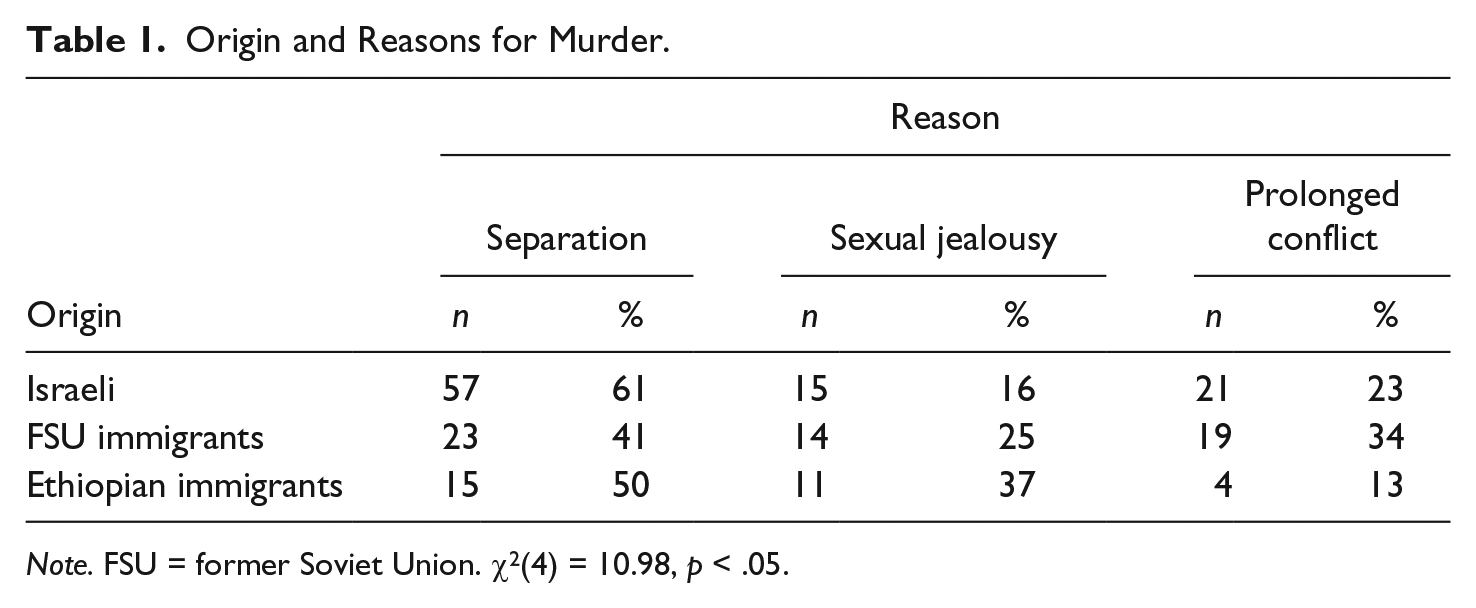
Note. FSU = former Soviet Union. χ2(4) = 10.98, p < .05.
Post Hoc Test Between Groups.
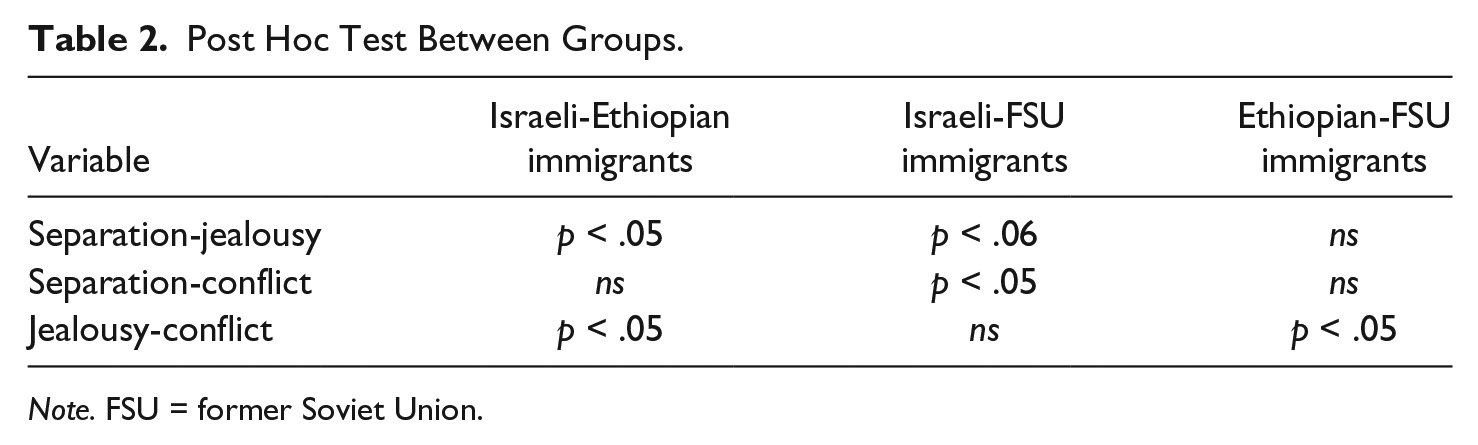
Note. FSU = former Soviet Union.
The results point to a significant association between the murder method and the reason for murder (Tables 3, 4, and 6). A higher percentage of stabbing exists in jealousy murder cases (SJ and separation), as compared with other reasons. Results indicate that most Ethiopian immigrants stab their victims (67%), while there is a higher percentage of shooting incidents among Israelis (Tables 4 and 6). Stabbing is higher among jealousy-motivated murderers, mainly among Ethiopians (Tables 3, 4 and 6). Table 5 shows that the differences between Ethiopians and Israelis are statistically significant. While Israeli murderers tend to shoot their intimate partner, Ethiopian murderers are more likely to stab their intimate partner.
Reason for Murder and Other Variables.
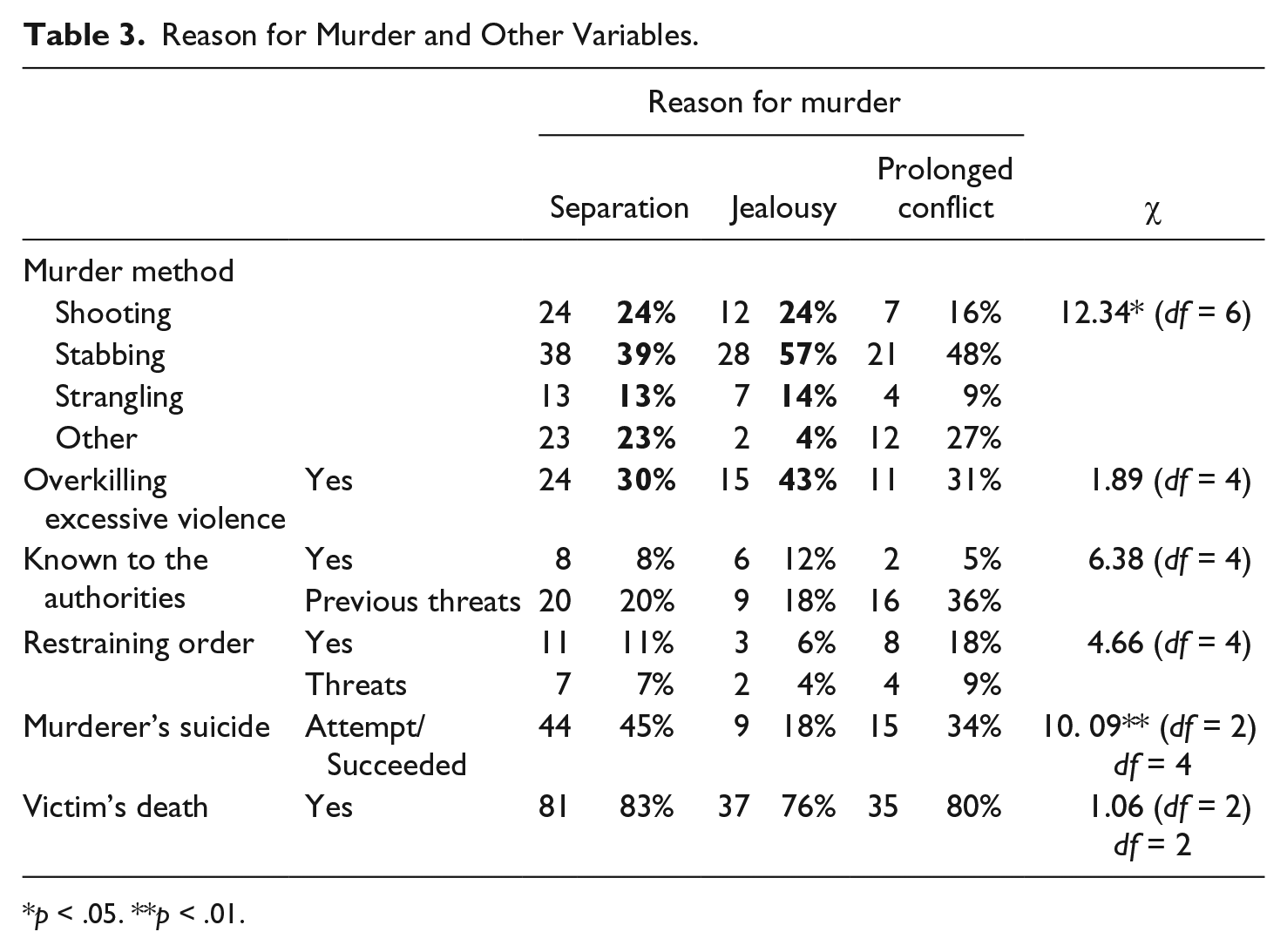
p < .05. **p < .01.
Origin, Murder Method, and Suicide Attempt.

Note. χ2(6) = 14.42, *p < .03.
Post Hoc Test Results.
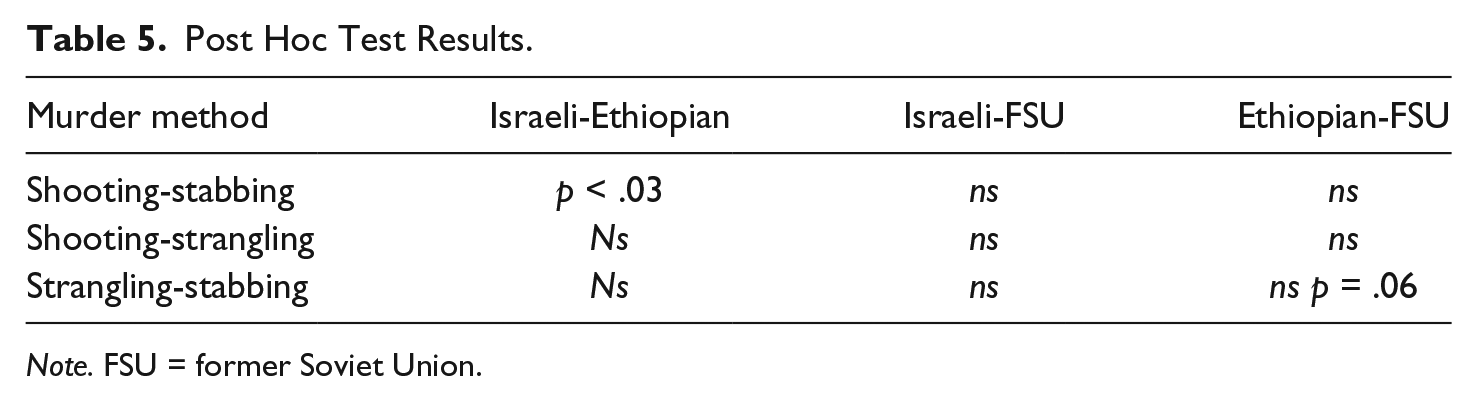
Note. FSU = former Soviet Union.
Origin and Murder Method.

Note. FSU = former Soviet Union. χ2(6) = 14.42, *p < .03.
The verdicts show that suicide among murderers is significantly higher among men whose intimate partner wanted to leave the relationship (jealousy component). A significant relationship between the reason for murder and the murderer’s suicide attempt is seen. Higher percentages of successful suicide attempts among those who murder because of separation (34%) is noted, compared with 8% of successful suicides among those who murder because of jealousy, and 25% among those whose reason stems from a PC. Results show that Ethiopians are significantly more prone to commit suicide after the killing than are the other two groups (Table 8). The main reason for homicide-suicide among Ethiopians is separation (Table 8).
In addition, results point to higher overkilling percentages when SJ is the motive. The results show a significant correlation among Ethiopian immigrants between the reason for the murder and overkilling (Table 7). Among Ethiopians overkilling is present in all cases of SJ, 38% in separation cases (i.e., jealousy cases), and 67% of cases involving a PC between the couple. Among Israeli and FSU immigrants, the percentage of overkilling is lower and similar for each reason (Table 7).
Reason for Murder and Overkilling, According to Origin.

Note. FSU = former Soviet Union.
p < .05.
To understand and apply the results, the implication of these triggers, mainly those that provoke jealousy in the daily lives of Ethiopian men, should be understood.
Murder method
Regarding the question of which killing method the killer would choose in intimate partner jealousy (IPJ; WW and SJ), the results show significantly that in IPJ murders, stabbing the victim is the preferred killing method and is responsible for 96% of the cases (Table 3). Stabbing is much higher among Ethiopians (67%) than in the other two groups (Table 4).
Overkilling
Overkilling is typical among Ethiopians in all three categories of IPH, but it is more salient in cases of SJ (Table 7). Overkilling explains 73% of the variance than SJ and WW combined (i.e., jealousy). Among Ethiopians, WW is perceived as a betrayal similar to that of infidelity (real or imagined; Edelstein, 2014).
Homicide-suicide
In this study, looking at the IPJ categories, 66% of homicide-suicides occur when the killer acts from jealousy, mainly because of WW (Table 8). Ethiopians commit the most homicide-suicides (50%) among the three groups (Tables 4 and 6). Table 3 shows that the main reason is WW, which is part of jealousy.
Reason for Murder and Suicide Attempt.

p < .01.
Discussion
Triggers or Reasons for IPH
Together with escalating violence, international studies find three triggers for IPH: the willingness of women to leave their intimate relationships (WW), SJ, and PC between intimate partners (Ben-Ze’ev & Goussinsky, 2008; Dobash, Dobash, & Medina-Ariza, 2007; Edelstein, 2014; Hannawa, Spitzberg, Wiering, & Teranishi, 2006). In addition, most cases of IPH discussed in the literature (80%) stem from jealousy, which may indicate men’s loss of dominance and control because of SJ and/or WW (Mize & Shackelford, 2008; Sebire, 2013).
The literature emphasizes some of the characteristics of the killers, which support the results of this study: unemployment, low economic status, and social disorder (Sebire, 2013; Willis, 2009; Wilson, 2003). Whereas other studies focus on Black, White, and Latino men, this research focuses on Ethiopian men. Each analysis of origin looks at the social, cultural, economic, and political contexts surrounding acts of violence. In other words, the analysis must take into account changes in traditional gender roles such as women becoming earners, the ability of women to leave a violent partner, and so on (Sebire, 2013). The results of the research are in accordance with the results of studies in other Western countries. A woman’s willingness to leave her intimate partner is found to be the main reason for IPH in Israel, as has been found in other countries (Dobash et al., 2007; Edelstein, 2014; Hannawa et al., 2006). Among Ethiopians, WW is responsible for half of the IPH cases.
A high IPH rate among Ethiopians due to WW may occur for several reasons. As they become more acculturated than their husbands, Ethiopian wives may no longer want to stay with a violent or unemployed husband, who is dependent on them and even socially limited. The women know that the IPV against them is criminal, and they now understand they have an option that they did not have before, that is, divorce (Sela-Shayovitz, 2010; Shuval, 1993). For the husbands, fear of their wives’ leaving them symbolizes disaster and evokes abandonment anxiety. Not only would the woman leaving her husband damage his personal honor, making him an undesirable man, but it would also damage his “social honor” among his peers, because he becomes someone whose wife threw him out, does not want him anymore, and rebelled against him. In addition, unemployed husbands who do not know Hebrew feel abandoned, left alone in an incomprehensible, alien world (Ben Ezer, 1989; Gal, 2003; Kacen, 2006). Thus, some Ethiopian femicide perpetrators may act out of rage against women who, as they see it, mean to do them great harm.
Previous theoretical and empirical research considers the three triggers as a whole, and does not try to differentiate among them on the empirical level. The innovation of this research is that it combines two reasons for IPH theoretically, which express jealousy: WW and SJ (Ben-Ze’ev & Goussinsky, 2008; Daly & Wilson, 1988; Pines, 1998; Spinoza, 1677/1948). It is also relevant to look at these two variables as an expression of the men’s loss of dominance and control over their intimate partner (Sebire, 2013). The results show that among Ethiopians, IPJ is responsible for 87% of all IPH cases, which is significantly higher than in cases involving Israeli-born and FSU perpetrators (Table 1). Jealousy is a major trigger in femicide among immigrants from patriarchal cultures in general (Brownridge & Halli, 2003), and among Ethiopians immigrants in particular. The simple fact that femicide does not exist among Ethiopian Jews in Ethiopia can be explained by tradition and social control, but it is also due to the fact that in the villages in Ethiopia, jealousy does not exist because there are no triggers for it (Ben Ezer, 2002). Women stay at home, and their husbands know exactly where they are and what they are doing; it is forbidden for women to speak with one another about their husbands and their relationships; women do not encounter men other than their husbands alone; and divorce is very rare.
These conditions are reversed for Ethiopian immigrants in Israel. Women work outside the home, and their husbands do not know their exact whereabouts. Sometimes women work afternoon or evening shifts, talking and gathering with fellow colleagues, some of whom are men. These changes can generate potential IPJ and envy, especially among men with tendencies toward violence or with abandonment anxieties (Edelstein, 2014). The fact that many Ethiopian men are unemployed, do not know the local language, and are more dependent on their intimate partners contributes to feelings of jealousy and impotence, which are triggers for violence against female intimate partners, who are blamed for such feelings (Grisaru & Witztum, 2014). The men feel their intimate partners must be responsible in all cases and must be punished for their deeds, even by lethal violence (Edelstein, 2009).
The results of this study empirically confirm previous theoretical and descriptive insights concerning conflict, IPV, and IPH among Ethiopians in Israel. Combining the explanations enables the understanding of the higher incident rates and overrepresentation of Ethiopian men in IPH statistics.
Murder Method
Recalling the results presented above, which indicate that jealousy motivates Ethiopians more than other groups, then the connection between the motive and method of IPH is clearer among Ethiopians than it is in the other groups. Stabbing, as a “hands-on” method for killing, can show the psychological state of the killer. His rage may drive him to eliminate the intimate partner as the cause and reason for his rage. At the same time, their intimate partner chooses to “betray” them by WW or SJ (Edelstein, 2014).
The literature on IPH does not compare methods of killing according to the three triggers. Research literature finds salient differences between IPH in the United States, where a handgun is the preferred weapon (because laws permit gun licenses), and other countries such as the United Kingdom, Finland, and Australia, in which stabbing is the preferred method (Aldridge & Browne, 2003; Mize & Shackelford, 2008; Sabri, Campbell, & Dabby, 2015; Sebire, 2013; Willis, 2009). However, it is not just access to handguns that makes a difference, as even in the United States, 34% of IPH cases are manual (stabbings, beatings, and suffocation). Hence, the killing methods may be symbolic, and forms of “intimate, hands-on” (Mize & Shackelford, 2008) revenge may allow the killer to feel that he can literally regain control over a wife who has been unfaithful or willing to leave him.
Overkilling
Overkilling is an irrational behavior, which is salient in murders when the motive is psychological or mental, rather than material, as in the case of IPH (Edelstein, 2014). Stabbing a woman dozens of times, although she is already dead, may express rage and not practicality. The literature on IPH is familiar with the phenomenon of overkilling. For example, Sebire (2013) claims that overkilling is common in IPH, whose rates are 83% to 90% in the United States and Canada. Overkilling is common in IPH, mainly in cases of SJ and/or WW (Aldridge & Browne, 2003; Mize & Shackelford, 2008).
Homicide-suicide
Homicide-suicide is well documented, mainly in cases of IPH. This study’s results show that homicide-suicide occurs in almost half of WW cases, in one fifth of SJ, and in one third of PC cases.
The results of this study are similar to those reported in theoretical as well as empirical literature. Half of all homicide-suicide cases occur between intimate partners (Chan, 2007; Liem, Barber, Markwalder, Killias, & Nieuwbeerta, 2011; Liem & Roberts, 2009; Marzuk, Tardiff, & Hirsch, 1992; Riedel, 2010; Saleva, Putkonen, Kiviruusu, & Lonnqvist, 2007; Scott, 2009; Stack, 1997). Homicide-suicide is more prevalent when the victim has allegedly done something to upset the killer, such as being unfaithful or attempting to end a long-term relationship against the killer’s will .
It appears that the decision to commit suicide occurs before the murder takes place. Among Ethiopians, there are two reasons for homicide-suicide. The first reason for committing homicide-suicide is that the intimate partner’s betrayal is so dramatic to the personality of the killer that he thinks he cannot survive without her. He kills the woman to point to her, in a symbolic manner, as the reason for his own death. He is looking for revenge, knowing he could not live with the outcome because there is nothing left for which to live. The second reason for committing homicide-suicide is even more symbolic. In cases of WW, the man wants to freeze or preserve the relationship before his intimate partner leaves. The only way to do so, according to his troubled personality, is with the death of both of them (Edelstein, 2014; Manning, 2015; Sela-Shayovitz, 2010).
In sum, it can be seen that certain groups of women’s intimate partners are more prone to acting with lethal violence. The sociocultural changes among immigrants and/or minority groups, when traditional norms concerning the roles and status of men and women have fallen, place women in an ambiguous trap. On one hand, they can become sole earners, develop a career, receive legal protection against a violent husband, and divorce without economic difficulties. On the other hand, these changes could put these women at risk for IPH. Men who feel they are losing dominance and control over their intimate woman partner may feel betrayed by the partner, developing a jealousy they have never felt before. To save their humiliated honor or to hold onto their traditional norms, some men may act lethally against their intimate partner.
Conclusion
The present study finds that among Ethiopian immigrants, IPH is more prevalent than among other groups in Israeli society. In addition, most IPH cases among Ethiopians are committed by manual methods and not by weapons, as opposed to the other groups. The three main triggers cited by the literature are the same for Ethiopian, FSU, and Israeli perpetrators, but the jealousy trigger is more dominant among Ethiopians. The theoretical explanations for these findings are well documented in the literature, not only in Israel but also in other countries that absorb immigrants from patriarchal cultures. The unique sociocultural and psychological factors that we describe and explain throughout this article show that these traits, in contrast to the other groups in the study, put Ethiopian woman at greater risk for IPH than any group of women in Israeli society.
One of the conclusions is that sociocultural and psychological factors cannot be separated. Ethiopians who immigrate to Israel are not different from immigrants from other patriarchal cultures. For this reason, they provide an empirical example of the various processes experienced by many similar immigrants. Although Ethiopian culture is unique, and Ethiopians have special traits as Jews in Israel, they still exhibit the same problems documented in the literature regarding other immigrants to the United States and Europe.
Recommendations
It is very difficult to suggest ways of surmounting the many difficulties Ethiopians and other immigrants face during their absorption process. There is no doubt that femicide, in at least 40% of the cases among Ethiopians in Israel, is an expression of jealousy and despair. The statistics show that almost half of the Ethiopian men who murdered their wives commit suicide after the act, though not due to a sense of guilt; they are suicidal even before they act lethally. Therefore, the first recommendation is that mental health professionals should work more closely with this community.
In Israel, many projects work toward empowering women in general and immigrant women in particular. These efforts should be supported because they are very important and give Ethiopian woman many useful tools, especially for their successful absorption process. However, no comparable projects are available to immigrant men. Therefore, the authors recommend the creation of new projects intended specifically to enable Ethiopian men to learn Hebrew, find jobs, and overcome their feelings of uselessness and impotency. Some projects need to be created that will work with couples, helping them to help themselves. When each spouse/partner is employed, speaks Hebrew, and attains the same level in their acculturation process, only then will their socioeconomic situation improve and occurrences of violence greatly reduce.
To date, there are few shelters for either battered Ethiopian women or Ethiopian husbands removed from their homes under restraining orders. It is recommended that more shelters be opened in the near future for both men and women, particularly to ensure better safety for women. Temporary housing for angry, often violent, displaced (homeless) men may keep them off the streets and perhaps out of trouble.
The main trigger for femicide (i.e., jealousy), however, requires a completely different perspective to understand and overcome it. One of the solutions to the problem may be an Ethiopian traditional ritual called the “coffee ceremony.” In this ceremony, the wife wakes up early to prepare her husband fresh coffee. The husband can see that his wife appreciates and honors him. The couple communicates by talking about their plans for the day. In this way, the husband knows when his wife is working, when she plans to come home, and so forth. Through mutual communication some jealousy may decrease. In cases in which wives want to leave their intimate relationship, the risk is higher and new ways should be found, together with the Ethiopian religious leadership, to decrease jealousy and feelings of abandonment.
Further research to study the phenomenon of IPJ and its results in other countries that absorb immigration from patriarchal cultures is needed. This will aid in ascertaining if the phenomena presented in this study are common to these immigrants as well.
Limitations
This study is the first of its kind and is based on the protocol and legal documents of each IPH case included in it. It must be noted that while these protocols express facts or evidence, some of the facts are the result of a negotiation between attorneys (mainly in Israel), and do not necessarily or essentially reveal the whole truth or reality of a case.
In addition, the motives catalogued are deduced from the protocols and are not otherwise verified. In the future, a more comprehensive study should focus on some of the IPH perpetrators to test the deductions presented here. Quantitative studies have their limits. For this reason, future studies should include interviews with a focus group to better understand the sensitive topic of jealousy and IPH.
Footnotes
Declaration of Conflicting Interests
The author(s) declared no potential conflicts of interest with respect to the research, authorship, and/or publication of this article.
Funding
The author(s) received no financial support for the research, authorship, and/or publication of this article.