



Abstract
In a climate in which stigmatic shaming is increasing for sex offenders as they leave prison, restorative justice practices have emerged as a promising approach to sex offender reentry success and have been shown to reduce recidivism. Criminologists and restorative justice advocates believe that providing ex-offenders with social support that they may not otherwise have is crucial to reducing recidivism. This case study describes the expressive and instrumental social support required and received, and its relationship to key outcomes, by sex offenders who participated in Circles of Support and Accountability (COSAs), a restorative justice, reentry program in Minnesota. In-depth interviews with re-entering sex offenders and program volunteers revealed that 75% of offenders reported weak to moderate levels of social support leaving prison, 70% reported receiving instrumental support in COSAs, and 100% reported receiving expressive support. Findings inform work on social support, structural barriers, and restorative justice programming during sex offender reentry.
Keywords
Introduction
Recent punitive policy mandates as well as changes in the philosophies of the criminal justice system have virtually separated the sexual offender from every other type of criminal (Edwards & Hensley, 2001). Predicated on increased community concerns over the dangerousness of sexual offenders, policy changes include legislation mandating sex offender registration, community notification, DNA collection, and civil commitment (Sample & Bray, 2003). In 2004, the Federal government passed the Jacob Wetterling Crimes Against Children and Sexually Violent Offender Registration Act (42 USC 14071) that mandated community registration for sex offenders. This act was originally amended to include mandatory dissemination of registry information (Megan’s Law), lifetime registration for serious offenders and recidivists (Pam Lychner Act); this act was eventually replaced by the Adam Walsh Act.
One outcome of this new legislation is that the reentry process has become increasingly complicated and stigmatizing for sex offenders. Rules regulating both where offenders live and their access to phone and Internet compound the stigma related to being identified as a sex offender by requiring notifications to neighbors and community members; these exact a toll on an offender’s ability to both obtain employment and meet other demands of reentry and life in general. For example, Levenson (2008) found that commonly reported consequences of being publicly identified as sex offenders include both exclusion from housing and experiences of job loss. In addition, this research showed that the majority of offenders reported negative psychological consequences such as stress, shame, hopelessness, and loss of social supports. Against this backdrop, social support has been found to mediate some of the effects of these collateral consequences (Hochstetler, DeLisi, & Pratt, 2010; Maruna & Toch, 2005). In a recent study by Lussier and Gress (2014), adult sex offenders were more likely to successfully complete community supervision when they had positive, as opposed to negative, social influences.
In a climate where stigmatic shaming is increasing, restorative justice practices using reintegrative shaming have emerged as a promising approach to sex offender reentry success; these approaches, which provide social support, have been shown to reduce recidivism (Duwe, 2013). Important to restorative justice and reintegrative shaming is the involvement of community members (Zehr, 2002). Yet research is just beginning to explore the mechanisms by which participation in restorative justice programs and community involvement impact recidivism (Höing, Bogaerts, & Vogelvang, 2014; Höing, Vogelvang, & Bogaerts, 2015; McCartan & Kemshall, 2015). Building on this work, to better understand one mechanism, there is a need to further examine two features of social support, provided by community members to offenders: What it looks like and what its potential impact is on reentry success.
Restorative Justice
Restorative justice practices, as an alternative to the traditional, legalistic model of justice, are increasing in popularity across the United States. And, although it is not likely the U.S. judicial system will utilize restorative justice as an alternative to incarceration for sex offenders, restorative justice practices can be used in conjunction with prison sentences (Zehr, 2002). Restorative justice practices recognize the victim and make a pronounced effort to recognize and involve him or her in the justice process. Examples of restorative justice practices include victim–offender mediation, reparative boards, family group conferences, and sentencing circles. The principles of restorative justice can be traced back to indigenous populations in both North America and New Zealand with more modern influences stemming from North American Mennonites (Zehr, 2002).
Building on these important works, Braithwaite’s (1989) Reintegrative Shaming Theory posits both the type of shaming, as well as the people responsible for shaming, are crucial to the successful reintegration of offenders. Braithwaite (1989) distinguished between two types of shaming: stigmatic shaming, which deteriorates the bond between offenders and society, is less preferable than reintegrative shaming, which aims to bring the offender back into the community as a productive member. Reintegrative shaming works by simultaneously imposing sanctions while accepting offenders “back into society,” allowing them the chance to participate as productive members. The work of imposing these sanctions is most effectively accomplished by family, friends, or other support networks—not by anonymous criminal justice authorities; individuals are more concerned about severing social ties or being informally sanctioned by those with whom they are closely bonded (Bouffard, 2007).
Social Support
Providing ex-offenders with social support that they may not otherwise have may impact recidivism. The concept of social support was first introduced to the fields of criminology and criminal justice in 1994. Borrowing from other scholars such as Nan Lin and Alan Vaux, Francis Cullen (1994) explained that there are several dimensions to social support. First, social support can be both expressive and instrumental. Expressive support is used to refer to the emotional support that one receives from relationships. An example of expressive support is when volunteers listen to an offender talk about the stresses he has experienced looking for jobs or housing. Instrumental support refers to support from a relationship that leads the individual to achieve a goal. An example of instrumental support would be when volunteers help an offender polish his resume or provide transportation to a job interview. Second, social support can occur at different social levels (individual, community, or society). Third, it can be given formally, by institutions or agencies, or informally, by friends and family; and, fourth, the perception of support received may vary from the objective support given (Cullen, 1994).
Cullen (1994) provided theoretical and empirical justification for each of the 13 propositions on how social support impacts crime. For example, he explains that “(a) the more social support in a person’s social network, the less crime will occur, and (b) anticipation of a lack of social support increases criminal involvement” (Cullen, 1994, pp. 540-543). Research has tested some of these propositions and is generally supportive of the idea that social support reduces factors related to crime at a variety of levels (Pratt & Godsey, 2003; Wright & Cullen, 2001). For example, Maruna and Toch (2005) found that social support positively influenced desistance from crime after inmates were released from prison. Furthermore, Hochstetler et al. (2010) studied the mediating and moderating influences of social support on reintegration for 208 male inmates. They found that social support reduced the negative influences of incarceration (e.g., increased feelings of hostility), thereby improving offenders’ reentry experiences.
Circles of Support and Accountability (COSAs)
COSAs were developed in Canada as an alternative approach to deal with high-risk sex offenders. Rooted heavily in the tenets of restorative justice and community justice philosophies (Bazemore & Griffiths, 1997; Bazemore & Umbreit, 2001; Menkel-Meadow, 2007) and similar to peacemaking circles (see, for example, Stuart, 2001), the COSA model attempts to help sex offenders successfully re-enter the community and, thus, increase public safety by providing them with social support, which lessens the effects of rejection, loneliness, and social isolation. In addition, by focusing on offender accountability, COSA emphasizes compliance with supervision while also attempting to target criminal thinking patterns. Each COSA consists of anywhere between four and six community volunteers who meet with one sex offender, the Core Member, on a regular basis to respond to reentry needs. Although the duration of a COSA varies, they generally meet on a weekly basis for up to 12 months.
Although the research is limited, studies show social support leads to lower recidivism rates among violent sexual offenders (Gutiérrez-Lobos et al., 2001). Given the relatively recent emergence of COSAs, the existing research on COSAs is small but growing. In 2005, Wilson, Picheca, and Prinzo completed process and outcome evaluations of the pilot project that originated in South-Central Ontario in 1994. The first part of this study examined the experiences of COSA members, both offenders and volunteers. The survey results revealed that although offenders initially had mixed feelings about participating in COSAs, their appreciation for the support they received grew over time. In fact, had COSAs not been available, 90% indicated they would have had difficulty re-entering society and about two thirds reported they would have returned to crime.
The second part of the study examined recidivism. Researchers compared 60 sex offenders with a matched control group looking at whether the ex-offenders committed a new sexual offense or violated a court-imposed condition. Results showed that offenders who participated in a COSA had significantly lower rates of recidivism rates (Wilson et al., 2005). In another study, researchers followed 44 high-risk sexual offenders for 35 months post-release. Ex-offenders who participated in COSAs demonstrated an 83% reduction in sexual recidivism when compared with the matched offenders. Recidivism was defined as having a charge or conviction for a new offense (Wilson, Cortoni, & McWhinnie, 2009).
In research on a COSA project in the Netherlands, Höing et al. (2015) explored the processes by which circles may lead to desistance for Core Members. They found that Core Members reported improvements in a number of areas, including agency, self-esteem, coping skills, social skills, problem solving, and emotional and self-regulation. In another study reviewing the effects on volunteers, Höing et al. (2014) reported a number of benefits for COSA volunteers, too. In particular, Höing et al. (2014) indicated that, despite the emotional and psychological demands of working with sex offenders, COSA volunteers may experience improvements in personal growth and physical and mental health.
COSAs in Minnesota (MnCOSAs)
In 2008, the Minnesota Department of Corrections (MnDOC) implemented Minnesota Circles of Support and Accountability (MnCOSAs), a sex offender reentry program based on the Canadian COSA model. The impetus for starting MnCOSAs was rooted not only in the promising results reported in the initial evaluation completed by Wilson and colleagues (2005) but also in the findings from a study conducted by Duwe and Donnay (2008) that examined the impact of broad community notification on sex offender recidivism. In determining that broad community notification significantly reduces sexual recidivism for Level 3 sex offenders (i.e., those determined to be high risk), the Duwe and Donnay (2008) study found that sexual recidivism rates were highest among Level 2 sex offenders (i.e., those determined to have moderate risk). Therefore, when it began in 2008, MnCOSAs targeted Level 2 sex offenders as part of a risk-management strategy to reduce sexual recidivism.
Using a randomized controlled trial (RCT), Duwe (2013) reported preliminary findings from an outcome evaluation of MnCOSAs. During the 2008-2011 period, 31 sex offenders participated in MnCOSAs and were released from prison. Recidivism outcomes for these offenders were compared with those of the 31 sex offenders in the control group. Recidivism data on all 62 offenders were collected through the end of 2011. The MnCOSA evaluation also assessed whether the program is cost-effective by comparing program operating costs with the costs resulting from recidivism. To determine whether MnCOSA has produced a benefit resulting from reduced recidivism, the study compared the number of offenses committed by offenders in the MnCOSAs and control groups. The costs of these offenses were then monetized based on cost of crime estimates developed through prior research.
The results from Cox regression analyses, which controlled for time at risk and other observed differences between the two groups, showed that participating in MnCOSAs had a statistically significant effect on three of the five recidivism measures. MnCOSA participation significantly lowered the risk of recidivism by 62% for rearrest, 72% for technical violation revocation, and 84% for any return to prison. Due mainly to the small sample size and short follow-up period, MnCOSAs did not have a statistically significant effect at the .05 level for reconviction or new offense reincarceration. The results further showed that, within its first 4 years of operation, the program produced an estimated benefit of US$363,211, which amounts to US$11,716 per participant. The cost-benefit ratio indicates that for every dollar spent on MnCOSAs, the State of Minnesota has seen an estimated benefit of US$1.82, which results in an 82% return on investment (Duwe, 2013).
Present Study
The purpose of this case study is to describe the types and amount of social support provided to MnCOSA participants in the Twin Cities (i.e., Minneapolis and St. Paul), from 2008 until 2010. In accordance with social support theory (Cullen, 1994), social support is broadly defined as any instrumental assistance (e.g., material or financial) or expressive help (e.g., emotional or psychological) provided to offenders by volunteers. The following research questions are examined:
The answers to these questions enhance understanding of the role of social support to reentry, the value of restorative justice COSA programming, and the reentry experience for sex offenders.
Method
This study focused on the first 2 years the MnCOSA program was operating. A larger randomized control study is ongoing and, by the end of 2015, more than 48 offenders had entered COSAs. During the study, the MnDOC placed 18 Level II sex offenders into COSAs by early 2010 and recruited and trained 70 volunteers.
Volunteer Training
Greater fidelity to the theoretical foundations of both restorative and procedural justice leads to less reoffending (Hipple, Gruenewald, & McGarrell, 2014, 2015). Because MnCOSA is a restorative justice program, to educate volunteers on its principles, volunteers attended five 3-hr training sessions. These sessions covered the tenets of restorative justice (e.g., reintegrative shaming), the thought and behavior patterns of offenders, relapse prevention, group functioning and support, and maintaining healthy boundaries. Another major component of the training was learning the restorative justice process of circle process (Pranis, Stuart, & Wedge, 2003). Finally, volunteers were educated about the Minnesota criminal justice system, it sex offense laws, and its policies. Training in all these areas was provided by the MnDOC and took place both in the prison and community. For more information about program implementation, see Duwe (2013). Once selected to participate in MnCOSAs, volunteers initially met with their Core Member (i.e., the sex offender) in prison and then, after release, in the community.
Offender Recruitment
The recruitment of offenders into COSAs was handled differently than that of COSA volunteers. When enough volunteers to form a COSA completed training, eligible sex offenders (i.e., Level II and being released to eligible counties, 2 to 3 months from release) were invited to a meeting where MnCOSA program administrators explained the program. Offenders were given the opportunity to ask questions and instructed that, if they wanted to participate, they could contact their case managers. Based on the number of COSAs that were trained and ready at that time, offenders were chosen randomly from all those who wanted to participate. The unmatched offenders were placed into a control group. This process was repeated as volunteers completed training.
Sample
Purposeful sampling (Coyne, 1997) was used to recruit participants for this study. Lists of MnCOSA volunteers and offender participants were obtained from Amicus and the MnDOC program administrators. This yielded a sample of approximately 70 MnCOSA volunteers and 18 sex offenders who were active from June 2009 through June 2010. We invited all MnCOSA volunteers and offender participants to participate in this study, even if they were no longer meeting with their groups. Individuals were contacted initially by email to set up an interview time. If participants did not respond to the email invitation, interviewers contacted them by phone.
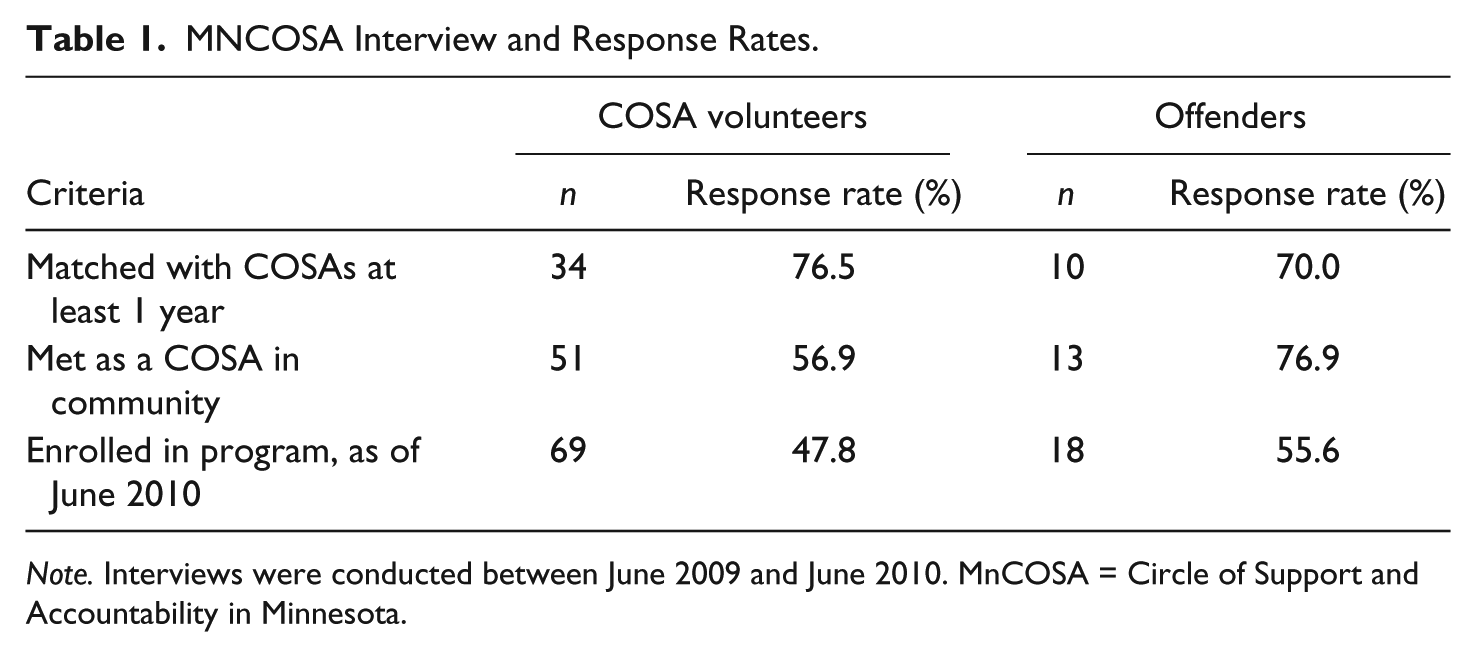
Table 1 shows three response rates calculated using different metrics. For purposes of program evaluation, it made the most sense to interview those who participated in the program for a reasonable amount of time. For example, COSAs who only met one time may not be able to provide the same quality of feedback as those who participated for a year or more. All response rates are reported below; however, interviews were primarily sought with those individuals who participated for 1 year.
MNCOSA Interview and Response Rates.
Note. Interviews were conducted between June 2009 and June 2010. MnCOSA = Circle of Support and Accountability in Minnesota.
As shown in Table 1, almost 70 volunteers and 18 offenders participated in the MnCOSA program. However, many of these participants did not meet with their COSAs for the recommended length of 1 year. In fact, only 34 COSA volunteers and 10 offenders had met with their groups for 1 year or more at the time interviewing ended in June 2010. Of this group, 76.5% of volunteers agreed to participate and 70% of offenders agreed to participate in the study. The most common reason given when volunteers declined to participate was that they did not have extra time. With offenders, the lower response rate is attributed to challenges in locating offenders. Only one offender declined to be interviewed; several more either did not receive or did not return phone calls or letters sent to their address in the file.
Data
Interviews were conducted, face-to-face, in locations selected by respondents often due to convenience, such as at their homes, coffee shops, or the MnDOC offices. A few offender interviews were also conducted via phone. Two offender interviews were conducted in a Minnesota prison. In compliance with MnDOC requirements, no compensation was offered to either offenders or COSA volunteers for participating in the interviews. At the beginning of the interview, after consent was provided, interviewers asked participants to complete a demographic questionnaire (e.g., age, education, and occupation) followed by an attitude questionnaire to gauge their attitudes toward sex offenders and the criminal justice system before and after joining MnCOSAs. Then, the open-ended questions began. Each interview was recorded with participant consent and lasted, on average, 1 to 2 hr. Only two participants requested not to be recorded. In these cases, the interviewer took notes by hand and transcribed those notes immediately following the interview.
The survey questions were modeled after Wilson et al. (2005) to provide a means of comparison with the Canadian COSA evaluation and also included additional items, such as demographic characteristics (e.g., age, gender, and education), favorite and least favorite aspects of the program, and suggestions for changes to the program. Offender interviews contained questions about their motivation for entering a COSA, their relationships with COSA volunteers, how they adjusted to the community when they were first released, how and whether they benefited from the COSAs, and what they think might have happened if the program did not exist. COSA volunteer interviews, however, contained questions about why they volunteered, how they became aware of the MnCOSA program, their attitudes and feelings about participating in a COSA, their relationship with the offender, their perceptions about the training they received, and what they think might have happened to the offender if MnCOSAs did not exist.
Sample Characteristics
As Table 2 indicates, the typical MnCOSA offender participant was an unmarried 38-year-old male with a secondary degree. Compared with offenders, volunteers were evenly split among males and females, older (45 was the average), more likely to be married, and more highly educated. MnCOSA volunteers represented a wide variety of professions such as college students, attorneys, actuaries, engineers, and teachers. Offenders worked mostly in manual labor professions such as carpentry, landscaping, and meat processing. The majority of MnCOSA volunteers (94%) reported that they had volunteered before.
Demographic Information for Interview Participants.

Data Analysis
The main data source was in-depth, face-to-face interviews conducted from May 2009 through May 2010 with sex offenders (n = 10) and volunteers (n = 33). Interviews were audio recorded and transcribed. The first author then coded the interviews using NVivo, a software program that allows for systematic analysis of interviews. The analysis focused on what kinds of social support offenders possessed prior to exiting prison, what forms of social support were most commonly provided in the COSAs, and whether that social support significantly impacted the lives of offenders. Credibility was established by comparing the interviews of offenders with those of MnCOSA volunteers.
Results
Research Question 1: What Type of Social Support Needs Did Offenders Have When They Left Prison?
Offenders reported varying levels of support. For example, according to one of his COSA volunteers, Eric
1
had “his act together. He [quickly obtained] a job driving recycling trucks and he had housing with his girlfriend and sister.” Similarly, George reported a significant amount of social support when he left prison:
Uh, well, I had a place to live. I had a vehicle. Um, I had pretty much everything set in place when I got home . . . I have a mentor that is from [prison faith-based program] . . . and you know, I have a good support group. I’ve got family.
Yet, other offenders left prison with fewer resources and, presumably, in greater need of assistance from their COSA volunteers to navigate reentry. For example, it is clear that Freddy expected to receive limited support from his two brothers and mother who all had troubled histories and were, therefore, unable to support him:
I have two other brothers. One is incarcerated and the other one is just gone. He’s just gone. He’s out there on the drugs, real tough, and just never got away from it. I tried talking to him but there’s really no talking to him. He’s been out there for the past ten years . . . Well [my mother] is disabled. She stays in an elderly home; she’ll be sixty in March. She’s been disabled for about fifteen years. [My mother] is tired. She’s worn down and disappointed. It hurts me to see her suffer—having three good healthy men and not having really produced no happiness or joy or bringing her anything she could be proud of . . . She tries. She didn’t have the best upbringing. Crime was an element within her family too. Dysfunctional drinking—my granddad was killed, died with a bottle in his hand. My biological father OD’ed. I had a stepfather, who my mom is still married to, been married to for the last 38 years. But they’ve been off and on because of his drinking and abuse and stuff like that.
Similarly, Hammond had perhaps the greatest amount of need. He was a middle-aged, divorced male, who had been diagnosed HIV positive, a paranoid schizophrenic, and admitted struggling with drug addiction, “You know, not a day goes by that I don’t think about smoking weed, you know . . . ” Hammond did have family in the area but, as his narrative explains, they were not able to provide significant or positive support:
My mom is too old to come and see me. My sister stays too far away. And that’s the only two people I really socialize with. My mom adopted me when I was 5. She’s 102. Um, she adopted nine of us.
Hammond went on to explain that his seven surviving siblings were spread across the Midwest within the United States. Although three siblings resided in the same metro area, Hammond did not expect to receive support from them. His description of his family provides further detail of his limited social capital:
[My brother]—he’s into drugs; he’s into breaking into peoples’ houses and stuff like that . . . He’s a deadbeat dad; he ain’t tryin’ to take care of his kids and that’s bad . . . But he’s the type of person. He’s too lazy to get out there and be responsible. So he’s depending on people to take care of him. Same thing with my baby brother. So I try to stay away from both of them. I don’t talk to them that much. I haven’t talked to my baby brother . . . since about 6 months now.
Because he did not have family to lean on, he was living in a housing situation that was detrimental to his addiction recovery efforts:
I got a roommate that sells drugs, I got a roommate that uses drugs—in my house. So, I stay in my room a lot. I do. I stay in my room a lot . . . I’ve been doing, I’ve been really just trying to stay out of that house as much as possible.
Another reason he was unable to move to better housing was that he was unemployed, living off Social Security checks and waiting to see if he would be approved to receive additional disability income. Despite all these personal and structural challenges, he remained hopeful that he would find employment and turned to his volunteers for employment assistance.
To examine the impact of social support provided to offenders (the third research question), we first established the offenders’ beginning levels of social support. Most offenders’ level of need fell between the two extremes portrayed in the narratives presented above. Most had at least one person in his life who could provide him with some sort of social support but few had housing and none had employment upon release.
Research Question 2: What Type of Social Support Did Offenders Receive From Volunteers?
Types of social support provided
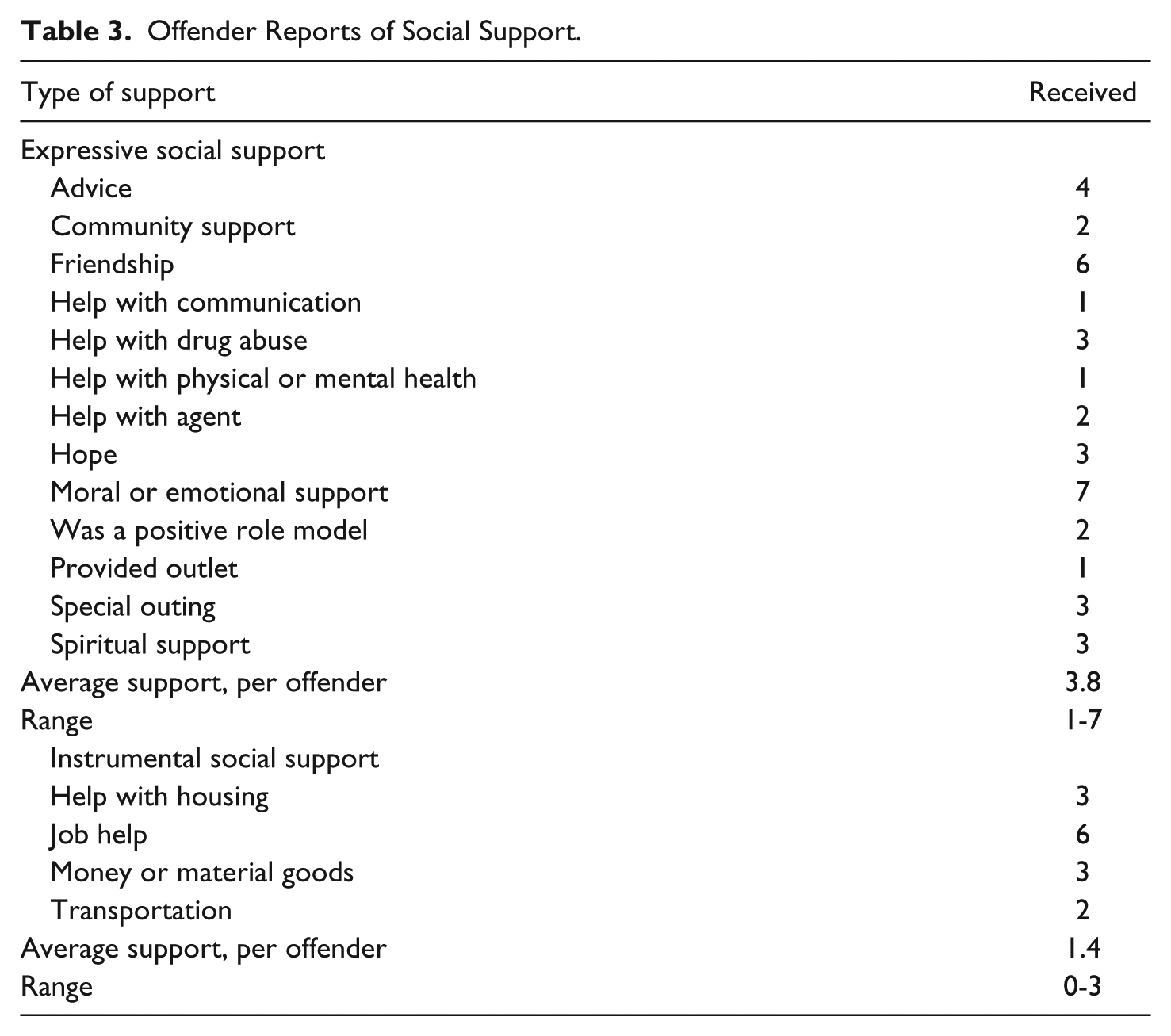
Consistent with social support theory (Colvin, Cullen, & Vander Ven, 2002), interviews were read and coded to reflect each type of social support an offender reported receiving. We then grouped each type of social support into one of two categories, instrumental (i.e., finding housing, searching for jobs, providing money, material goods, or transportation) and expressive (e.g., providing advice, friendship, special outing, or helping with drug abuse). Table 3 shows how many offenders received each type of social support; that is, it highlights the most common types of social support provided to offenders. For example, seven offenders reported receiving moral or emotional support, the most commonly cited type of expressive support. Other common forms of expressive support reported were friendship (6) or advice (4). Looking at instrumental support, Table 3 shows that, on average, offenders reported receiving between one to two different types of instrumental support (i.e., the average was 1.4). The most common form of instrumental support was employment assistance; six offenders reported receiving job help.
Offender Reports of Social Support.
Amount of social support provided
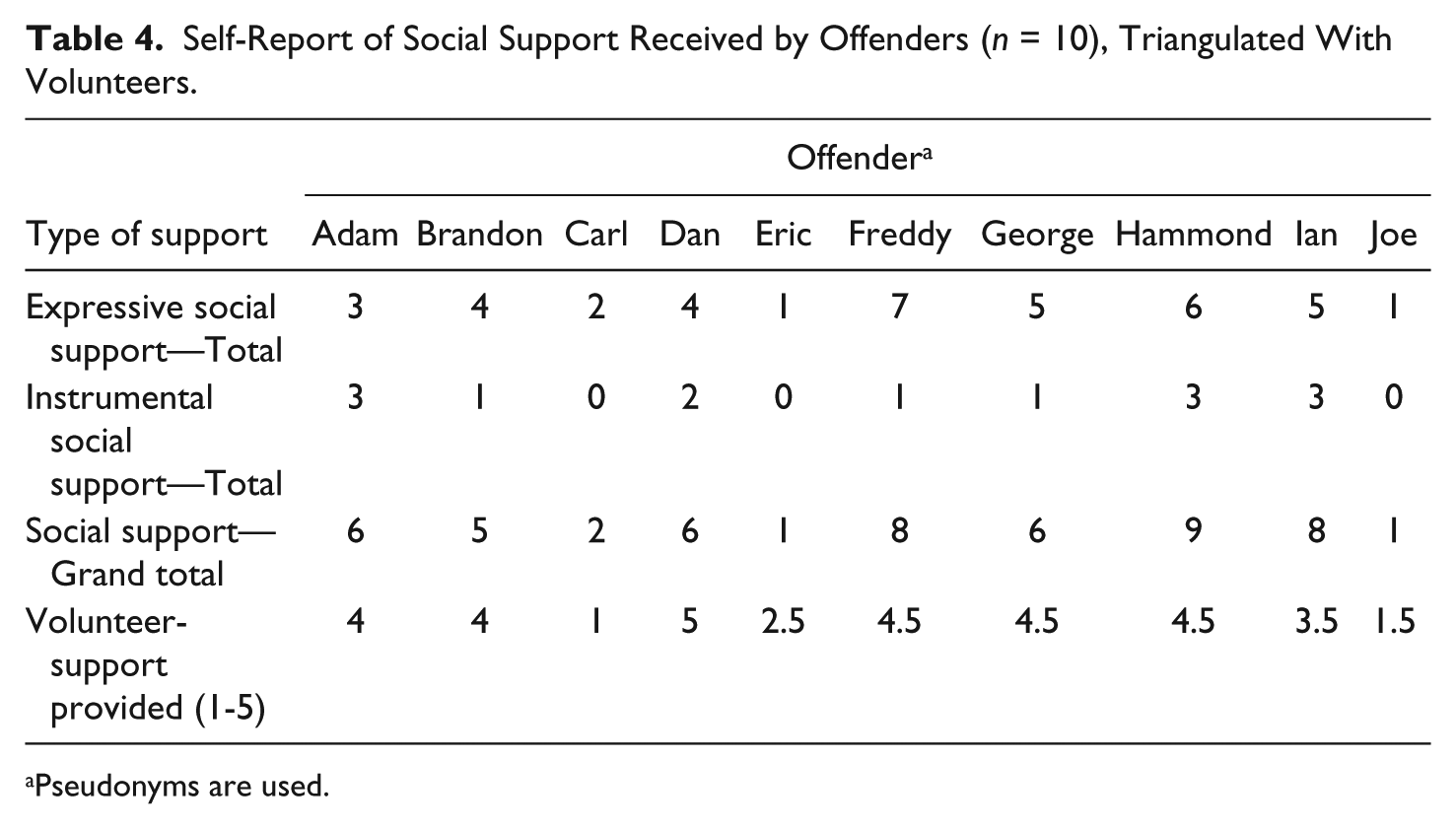
Table 4 shows the amount of expressive and instrumental support each offender received. For example, two offenders (Eric and Joe) reported receiving only one form of expressive support whereas Freddy recalled as many as seven different types of expressive social support received.
Self-Report of Social Support Received by Offenders (n = 10), Triangulated With Volunteers.
Pseudonyms are used.
On the low end of receiving support (zero instances of expressive support), Carl met with his volunteers a very limited number of times and abandoned the meetings once he was released from prison to the halfway house. As a result, the COSA was not able to provide much support to him. He reports two types of expressive help and no instrumental help. On the other end of the support spectrum, Hammond reported receiving six types of expressive support and three types of instrumental support. He recounts that he did not have many resources on his own leaving prison but found support and a warm relationship within his COSA:
I’d consider them family. And that’s something that I don’t really have that much of. Um, but I can call on them any time I need some help. Anytime I need somebody to talk to, you know, the help I’m talking about is just being there to help me out. To help me get through the situations that I’m going through—struggles, worries, anything.
He received several meaningful types of support from his COSA, and, explains how it helped him learn responsibility:
This is the first time being responsible, I am. I’ve never paid rent before. I never paid a phone bill before. This, being responsible, is hard work. And MnCOSA is helping me do that . . . The most important part is showing me how to be a responsible adult.
At another point in the interview, he shared a story about the prior weekend when a volunteer came to his house because he was feeling suicidal and provided expressive support:
Just like, Saturday, last Saturday, I was thinking about committing suicide. And I was depressed. You know, things wasn’t going right for me. I’ve been trying to find a job and things wasn’t going right. And I was thinking about using versus selling drugs and things like that and I called Jerry (COSA volunteer) instead of going to do that. And he came over and he talked to me and we sat down and we had a long talk . . . He was there to comfort me and listen to me. You don’t have that out here, you know? And to find somebody that cares about me, that’s something that I look forward to . . . When you need somebody to talk to, they’re there. When you need somebody, just for a shoulder to cry on, they’re there. I was crying Saturday and Jerry patted me on my back. You know, that’s something my dad used to do. You know, so. And just having him there was the most important thing. If I wouldn’t of had nobody there I don’t know what I might have done.
He also shared other activities the COSA did together. For example, the COSA helped him cook Thanksgiving dinner for his family and went fishing on his birthday:
They took me out for my birthday. And that was the first birthday I had sober, since I was 16 years old. So, that was a blessing . . . we all went out fishing . . . That was the most fun I’d ever had. Nobody catch nothin’. Doesn’t matter though because I did it sober and I was with friends. So that’s all I cared about. You know what, it’s just the peace and quiet. It’s the calmness. And that’s what we had. Peace and quiet. There was no arguing, no disputes, everybody was enjoying themselves. And that’s the best thing in life right there. It’s just being with somebody that you really care about. And spending time with them, that’s something I really cherish a lot. I know that everybody’s so busy. And sometimes I wish they wasn’t. Because I would like to spend a lot more time with them.
Although the amount, and type, of aid received by each offender varied, and because offenders were not asked directly whether they had received each type of support (i.e., they self-reported), it was possible that certain offenders received support they did not discuss during the interview. For example, Freddy and Ian talked about eight different types of social support he received from his volunteers whereas Joe only mentioned one type of social support.
To increase validity and raise confidence that we are actually measuring “amount of social support” self-reported by offenders, offender interviews were triangulated with interviews from all COSA volunteers. To triangulate, we read all volunteer interviews and assigned a rating of overall support on a five-point scale, with five indicating high levels of support and one indicating low levels of support. The individual ratings of support were averaged across volunteers to create the “support provided” measure. This amount of support provided (shown in Table 4) is highly consistent with the amount of support offenders reported receiving (correlation coefficient = .81). Therefore, we are more confident that they captured an accurate metric of how much help was provided to each offender.
As another validity check, we rated the quality of the COSA relationship based on reports from COSA volunteers. We examined whether COSAs that were more closely bonded provided greater social support to their offenders. These ratings were based on (a) how much time COSAs spent together in meetings and other social outings and (b) comments about social bonding. The COSA relationship-quality ratings and the amount of support provided are highly correlated (correlation coefficient = .89) but note that causal order is not implied.
Research Question 3: Were Greater Levels of Social Support Related to Better Outcomes?
According to their narratives and the triangulation with their volunteers, six offenders received greater levels of social support from their volunteers: Adam, Brandon, Dan, Freddy, George, and Hammond. This section focuses exclusively on the six men who received the most support from, and therefore should have the greatest gains from, the program. Of these six, four went back to prison: Adam, Brandon, Freddy, and Hammond. Yet two, Dan and George, received substantial support and stayed out of prison. This section explores the constellation of reasons why the positive impact of social support on the reentry process was most often (n = 4) suppressed by other factors such as drug addiction, lack of housing, employment, or medical care. An important consideration, however, is that a single return to prison, especially for a technical violation revocation, is not necessarily tantamount to reentry failure. Rather, on the whole, MnCOSA participants have returned to prison less often (either for a new offense or a technical violation) and have been less likely to commit new offenses than the matched offenders who did not participate in the program. This section also discusses the cases (n = 2) in which substantial social support did contribute to the positive outcome for Dan and George who were able to combat his drug addiction.
Even when the COSA provided offenders with significant amounts of expressive and instrumental social support, sometimes it was not enough to overcome personal or structural barriers. In the end, the support Hammond received from his COSA was not enough to keep him out of prison. A few weeks after his interview, he learned he had been denied future government assistance. Without this income, he would not have enough money to pay rent and thought he would become homeless. Shortly after receiving this information, Hammond began using drugs and subsequently committed a crime to obtain money for more drugs. Due to the violation of the terms of his parole, he went back to prison for several years. His COSA was unable (and not expected) to provide for his financial security. Without money to pay rent, buy food, and pay for medications, the social support his COSA had provided (i.e., help finding housing, employment, and transportation to medical appointments) was simply not enough to combat both his constellation of personal and structural challenges.
Brandon also received a lot of support from his COSA. He is the first to admit, however, that his drug addiction was too powerful to be overcome by the best of efforts.
. . . when I started drifting off toward the end, I didn’t feel as comfortable bringing my thoughts of using up. And that wasn’t about them, that was me. You know, because I had been doing well. So, I didn’t want to let them down maybe . . . So, I mean I guess the bottom line is that I failed the group, in a sense, I believe . . . If I had been open and honest 100% all the way through I know the group would’ve stayed together and whatever I wanted to discuss with them or put on the table, they would’ve been there for me with it.
Without MnCOSAs, Brandon explains he would have likely used drugs sooner than he did. This account suggests that delaying time until a drug relapse signifies a positive impact of MnCOSAs though not a complete abstention from drug use.
Housing was also an insurmountable structural barrier for some. As mentioned in the “Introduction” section, the community supervision requirement that sex offenders both have suitable housing and register that housing with law enforcement increases the odds of violating the conditions supervision. Adam received a lot of assistance from his COSA after leaving prison (see Table 4). However, when he moved a few hours away for a new job, his COSA ended. Soon thereafter, he lost his housing and became homeless. Because the conditions of his supervision required that he have a residence, and register that residence, he was revoked to prison for violation of his supervision.
Finally, although it is unclear how, Freddy violated the terms of his supervision; he was then given the choice to return to prison or return to a higher level of supervision. He chose to return to prison until the end of his (brief) remaining sentence expired. At that point, he could live in the community with fewer structural barriers restricting his employment and housing options. While in prison, Freddy continued to work with his COSA for several months. In prison at the time of his interview, he said that one of the biggest benefits he received from MnCOSA was being involved with positive role models for the first time:
Because all my association and affiliations have been with people who are criminal-minded and just, not really working class people. [MnCOSA] gave me an out where I could develop positive relationships and have positive support, you know . . . I’ve never really had an opportunity to sit down with a group of working class people in society and gain perspective from their lifestyles. I could gain their trust and be able to interact with them. The interaction was great. To know that I was able to create a connection and have them work with me, at such a close level.
In the end, this was not enough.
However, two MnCOSA offenders who received a lot of support from their COSAs were able to successfully navigate the various demands of reentry. These men were living in the community when they were interviewed. Dan explained that with regard to emotional support, he reports that the COSA gave him hope.
It gave me hope. Hope, as far as, you know, you have people out here in society that look at you like you’re some kind of animal or beast because of the case. I mean, put it like this, if the shoe was on the other foot, I probably would look at a person different. I’m not sittin’ here and lyin’ in your face. I came from Chicago and you hear a sex offender, my immediate thought was, “Oh, you mess with kids right?” You know, so . . .
George spoke more directly to how the COSA helped him stay out in the community. Although George had a significant amount of social support (i.e., a house, a vehicle, supportive family) when he left prison, he credits the additional help from MnCOSAs as being central to his success. In the past, he had relapsed after he stopped attending Alcoholics Anonymous (AA) meetings. One important way MnCOSA volunteers supported him was through increasing accountability to attend AA. He said, “I think that’s a big thing. I may not be doing everything I’m doing if I didn’t have them.” Furthermore, he reported the COSA helped him look for jobs, offered him part-time employment at a COSA volunteer’s bike shop, provided help with his crack cocaine addiction, and offered lots of advice. But the greatest source of support he has received has been the friendship of his COSA volunteers.
I think just the friendship, sober friendship, has been the best part of it. You know, it’s hard to go to an AA meeting and kind of figure out who you want to associate with. You don’t know what’s really going on with a person. And these guys, my circle, I’ve got to know them real well. You know, I mean, to know their lives and what’s going on in their life, has been a big support for me . . . The thing with my circle is that they don’t look at me as a sex offender; I’m a core member. We started out as equals you know. So that really helps.
There are many reasons why the social support provided in MnCOSAs was not associated with positive outcomes for all Core Members. Many offenders released from prison struggled with drug and/or alcohol addiction, at least one suffered from significant medical problems. Others struggled with structural barriers; few had housing and none had jobs waiting for them when they left prison. However, for some offenders, the positive support they received enabled them to battle their drug addiction, secure employment, and have sober friendship—satisfying a variety of emotional and financial needs.
Discussion
Upon release, few offenders in this study had housing and none had employment. Research on social support has found that it eased their reintegration process (Hochstetler et al., 2010; Maruna & Toch, 2005). The types and amounts of social support provided to the offenders varied across COSAs in this study. Overall, offenders expressed great satisfaction with the social support they were provided and report gains especially in the areas of moral and emotional support, friendship, help with employment, and advice.
Consistent with existing restorative justice research, we found that expressive social support is critical to program success. Although expressive support is not easily operationalized (Robinson & Shapland, 2008), Presser and Van Voorhis (2002) asserted that values such as healing and social well-being are appropriate outcome measures in determining success in restorative justice programs. Braithwaite (2002) has described respectful listening, one form of expressive support, as a critical restorative justice component; at a minimum, it seems all offenders received this through their COSA. Offenders, in this study, overwhelmingly reported greater social well-being as a result of participating in COSAs.
Also important, however, is the instrumental support (e.g., help finding housing, jobs, getting rides to places, clothes for interviews) to offenders. Recent studies show, for juvenile sex offenders, structural resources such as employment significantly lower recidivism (van den Berg, Bijleveld, Hendriks, & Mooi-Reci, 2014). Although MnCOSA volunteers, unable to provide housing or jobs, did provide other job-seeking assistance such as rides to interviews, rides to stores to buy clothes, and provided personal recommendations. In these ways, MnCOSA “worked” for its participants. Yet, the support provided was, in many cases, not enough to overcome the substantial stresses created by structural barriers such restricted access to housing or loss of social security income.
Variations in restorative justice processes may affect the “success” of offenders—most commonly measured by recidivism. There is a building body of research which examines the varying degrees of restorative values and principles that are indicated in restorative justice interventions and how they affect recidivism (Hayes, 2005; Hayes & Daly, 2003; Hipple et al., 2014, 2015; Maxwell & Morris, 2001). It could be observing the COSAs and examining the underlying dimensions might reveal differences that are associated with offender success or failure.
It is important to interpret the study findings with caution as this study utilized a small sample of male sex offenders (n = 10) from one metro area. Also, the MnCOSA program was in its first year of operation and that may also have impacted the effectiveness of the program. Simply put, this may not be enough time for lasting effects. And, although not a one-time intervention, there is evidence that the benefits of the restorative justice processes may decay over time (McGarrell & Hipple, 2007). This would suggest a need for more COSA meetings over a longer period of time.
In summary, the MnCOSA program succeeded insofar as it followed best practices and, in many cases, provided significant amounts of support to offenders. The interview data suggest that offenders were provided three times as much expressive social support as instrumental support; it may be possible that COSAs would further benefit from greater focus on the instrumental support, which focuses on structural factors such as job seeking, housing, or bridging the gaps in services (e.g., getting rides to drop off job applications) elsewhere available to offenders. These are common offender reentry barriers that prevent full reintegration into society and leave offenders stigmatized.
Footnotes
Declaration of Conflicting Interests
The author(s) declared no potential conflicts of interest with respect to the research, authorship, and/or publication of this article.
Funding
The author(s) received no financial support for the research, authorship, and/or publication of this article.