



Abstract
Circles of Support and Accountability (CoSA) are comprised of approximately five trained Circle volunteers who provide support during reentry to one core member previously convicted of a sexual offense. In 2008, the Minnesota Department of Corrections implemented the Minnesota Circles of Support and Accountability (MnCoSA). In-depth interviews were conducted with 33 MnCoSA volunteers and 10 core members to gain an understanding of (a) what makes volunteers desirable to core members, as well as (b) what makes CoSA desirable to volunteers. The study finds core members express a desire for the availability and consistency of volunteers, a preference for certain types of volunteers, and consistent with volunteers’ perceptions, a belief that CoSAs offer particular benefits for volunteers. Implications for recruitment of volunteers and optimal structuring of CoSAs are discussed.
Individuals convicted of sex offenses are some of the most feared and therefore most punished offenders in our society. In fact, these justice-involved individuals receive greater amounts and intensity of public condemnation and stigmatization than individuals who commit other types of crimes (Harris & Socia, 2016; Lancaster, 2011; Levenson et al., 2007; Zilney & Zilney, 2009). The media portrays almost all individuals convicted of a sex offense as cruel, dangerous, remorseless, and untreatable monsters (Blanchard, 1995; Cheit, 2003; Corabian & Hogan, 2012; Ducat et al., 2009; Frei, 2008; Gakhal & Brown, 2011; Marshall, 1996; Pickett et al., 2013). Expressing a similar disdain, the public has referred to these individuals as “the most despised members of our society” (Geraghty, 2007, p. 514) and as “. . . modern-day monsters” (Simon, 1998, p. 456). Punitive policies continue to have support even without evidence of a reduction of sexual abuse (Koon-Magnin, 2015; Levenson et al., 2007; Socia & Harris, 2016). As a result, recent policy decisions regarding justice-involved individuals have resulted in stigmatic shaming. However, research increasingly suggests that it is best to avoid these types of effects through restorative justice practices (Braithwaite, 1989; Mingus & Burchfield, 2012; Robbers, 2009; Schultz, 2014; Tewksbury, 2012). As such, new programs have been implemented in the past few decades, the most promising of which is known as Circles of Support and Accountability (CoSA).
Despite recent strides in CoSA research, a gap remains in understanding the characteristics of CoSA programming and volunteers that Circle participants perceive as most beneficial. To address this gap, this study examines any overlap in articulated perspectives of CoSA core members and volunteers in two major areas: most valued aspects of the program and program benefits to volunteers. In addition, this study examines core members’ perceptions of which volunteers supported them the most.
Literature Review
The current state of sex offense legislation has made the reentry process for individuals convicted of a sex offense difficult and stigmatizing. In response to this stigmatic shaming, restorative justice practices have been utilized to improve reentry success of those convicted of sex offenses. Restorative justice approaches all take the perspective that violations of law create negative consequences, or harm, beyond those directly to the victim (Koss, 2014; Koss & Achilles, 2008). It is the intention of restorative justice programs to be utilized by offenders who acknowledge they have created harm and wish to rectify that harm.
Braithwaite’s (1989) Reintegrative Shaming Theory labels two types of shaming: reintegrative and disintegrative. Disintegrative shaming is when an individual is stigmatized and excluded by society. Exclusion, labeling, and stigma have negative consequences for individuals not only in terms of emotional and psychological well-being (Tewksbury, 2012), but also in terms of risk to commit further criminal behavior (Braithwaite, 1989; Chiricos et al., 2007; Mingus & Burchfield, 2012; Robbers, 2009; Schultz, 2014). Braithwaite emphasizes that communities should avoid disintegrative shaming in responding to harm. Instead, Braithwaite (1989) explained that communities should utilize reintegrative shaming which he conceptualized as a harmful act that initially evokes community disapproval, and is then followed by attempts to reintegrate the offender back into the community. Community disapproval may be expressed as calls for arrest, mandatory public registration, and social isolation of the stigmatized individual. Attempts to reintegrate the offender may be expressed as programs designed to help the individual receive treatment and support once out of prison, such as CoSA. Reintegrative shaming therefore occurs when community condemnation is followed by community responses geared toward helping the individual adhere to the agreed upon social contract. More recently, research has found an increasingly positive response to the use of restorative justice practices with individuals convicted of a sexual offense (Marsh & Wager, 2015).
Restorative Justice Programs
Reintegrative shaming can be achieved through the use of restorative justice practices—which provide opportunities both to express harm and its consequences as well as opportunities to remedy that harm, apart from adversarial legal system models. However, research has found that restorative justice practices are effective for many reasons beyond reintegrative shaming, such as procedural justice theories (Tyler, 1990; Tyler & Huo, 2002), social bond theory (Hirschi, 1969), and interaction ritual theory (Collins, 2004; Durkheim, 1912/1995; Rossner, 2011, 2013). Restorative justice practices take many forms, such as sharing Circles, sentencing Circles, Circles of support, victim–offender dialogues, victim impact panels, conferencing, and community reparation boards (for an excellent review, see Zehr et al., 2015). Restorative justice practices can complement traditional legal system processes; they can be implemented at multiple time points within the criminal justice system, whether immediately following the completion of the police investigation all the way through the reintegration of the offender into the community.
Inside prison settings, very few restorative justice programs have focused specifically on sex crimes involving adult victims and offenders (Koss, 2014). However, Koss (2014) noted that restorative justice interventions involving adult individuals convicted of a sexual offense usually involve victim–offender dialogue models in which victims have voluntarily requested a meeting with their offender. Outside prison settings, a few states have implemented restorative justice programs. One type of restorative justice program that has been tried with the sex offense population is CoSA.
Central to the success of CoSAs, and other restorative justice programs, are the community volunteers who provide resources and/or support to justice-involved individuals who have committed sex offenses. Research has explored the role of social support provided by community members volunteering in restorative justice programs (Höing et al., 2015, 2016; Northcutt Bohmert et al., 2016). Based on semi-structured interviews with 17 core members (i.e., individuals convicted of sexual offenses who are exiting prison and reintegrating into the community) and 29 professionals in a CoSA, Höing and colleagues (2015) found improvements in justice-involved individuals’ sense of agency, openness, self-regulation, problem-solving skills, reflective skills, and social skills. In addition, their quantitative analysis based on a self-report questionnaire filled out by the core members following interviews, revealed improvements in emotion regulation, internal locus of control (i.e., the ability to influence events and their outcomes), and positive trends in coping skills and self-esteem (Höing et al., 2015). Although many benefits to core members were noted in their 2015 study, later work identified and explored the positive and negative psychological and social effects of volunteering from the perspective of CoSA volunteers (Höing et al., 2016). Northcutt Bohmert and colleagues (2016) explored the instrumental and expressive social support volunteers provided to 10 participants of a CoSA in Minnesota; they found social support was helpful to justice-involved individuals who committed sex offenses in gaining employment, housing, and with emotional well-being. However, there is limited research focused on the volunteers of these social support programs. The few existing studies on CoSA volunteers have offered a more thorough understanding of the motivations of a New Zealand CoSA’s volunteers (Lowe et al., 2019), compared CoSA volunteers’ attitudes about sex offenders with those held by the general population (Kerr et al., 2018), and the impact of volunteering with CoSAs (Höing et al., 2016).
The CoSA Model
In an effort to create an alternative approach to handling high-risk individuals convicted of a sexual offense, and help the offender return to society, CoSAs were developed in Canada in 1994. The CoSA model helps individuals previously convicted of a sexual offense reintegrate into the community by providing social support, in hopes of offsetting risks to public safety. By concentrating on the accountability of the offender, CoSA also underscores the importance of complying with community supervision procedures. The benefits are twofold: former offenders are successfully reentered into the community and public safety is increased, given that the offenders’ social needs are being met.
A major area of CoSA research explores their effectiveness. Findings suggest that CoSAs are effective at significantly reducing general recidivism (Duwe, 2013; Wilson et al., 2009). Recently, Clarke et al. (2017) conducted a systematic review of CoSA effectiveness through 15 outcome studies. While far-reaching results regarding the overall CoSA effectiveness at reducing recidivism are unavailable without long-term follow-up data, there was no evidence of Circle participation in any adverse outcome effects (Clarke et al., 2017). In addition, the systematic review revealed that Circles resulted in positive financial benefits for those participating and the community at large. Furthermore, CoSA research has found that the positive psychosocial outcomes from the support provided by CoSAs were also a consistent result in the 15 outcome studies. Utilizing a novel approach to CoSA evaluation, dynamic risk review, Bates and Wager (2017) found evidence of a positive protection effect as CoSA volunteers were able to identify and reduce risk attitudes and behaviors of Circle Members and provide them with positive support.
CoSAs target social support
CoSAs operate by targeting social support, which has been found to have many benefits for reintegrating offenders. Social support is provided to core members (i.e., individuals who have committed sex offenses) by volunteers (i.e., usually community members who have gone through training and agreed to meet weekly with core members). The support provided to core members may be expressive or instrumental. Expressive support is the emotional support one receives from a relationship, whereas instrumental support is more attuned to aiding with goal achievement. Social support can be given formally or informally and can be given by individuals, communities, or society (Cullen, 1994). If an individual is surrounded with positive social support within their social network, they will be less likely to commit crime (Cullen, 1994). Thus, social support may be important for people convicted for sex offenses as they reenter society.
With foundations in Cullen’s (1994) empirical work, numerous studies have linked social support to reduced recidivism and positive reintegration outcomes (see Bales & Mears, 2008; Cullen et al., 1999; Höing et al., 2015; Northcutt Bohmert et al., 2016; Panuccio et al., 2012). Panuccio and colleagues (2012) found that desistance from juvenile criminal activity was dependent upon not only internal motivation, but also upon support from friends and family. Bales and Mears’ (2008) found that various measures of visitation (e.g., frequency of visitation, type of visitor, and how recent visitation occurred), in the Florida Department of Corrections institution, reduced and delayed recidivism for individuals reentering society. Höing and colleagues (2015) found that formalized social support groups led to positive reintegration outcomes in areas such as self-esteem, agency, emotional and self-regulation, and improvement in problem-solving and social skills.
Previous research on CoSAs is limited to a handful of outcome evaluations examining the impact of the program, given its introduction in the past 25 years. Given that providing social support is a major tenet of CoSA, it is not surprising that research has found CoSA to be effective in reducing recidivism rates. The first, in 2005, conducted by Wilson, Picheca, and Prinzo, focused on completed process and outcome evaluations of the original project in Ontario, Canada, finding a 70% reduction in sexual recidivism among high-risk offenders who participated (Wilson, Picheca, & Prinzo, 2007). Strikingly, all types of recidivism were lower for these participants when compared with similar offenders who did not participate (Wilson, Picheca, et al., 2007). Wilson et al. (2009) conducted a follow-up of that study, examining all the Circles that had been created throughout Canada. Wilson and colleagues (2009) contended that CoSA was effective in reducing recidivism as a result of the presence of sources of support to mitigate any negative effects of stigmatization (e.g., isolation, loneliness, and rejection) and promoting balanced lifestyles and stressing compliance with supervision requirements. Similarly, in a preliminary outcome evaluation of MnCoSA, Duwe (2013) found that MnCoSA was an effective program for individuals convicted of a sexual offense as three out of the five recidivism measures examined were significantly reduced. Most recently, Duwe (2018) found that MnCoSA operating from January 2008 to June 2016 significantly reduced sexual recidivism, decreasing the risk of rearrest for a new sex offense by 88%. In addition, MnCoSA decreased on four measures of general recidivism and resulted in an estimated US$2 million costs avoided by the state (Duwe, 2018).
Northcutt Bohmert and colleagues (2016) sought to extend research beyond program evaluation and examined the types and amount of social support offered to MnCoSA participants from 2008 until 2010. This study included both types of social support explained by Cullen (1994): instrumental and expressive. Instrumental social support included help finding housing, employment, providing monetary assistance, transportation, or other material goods. Expressive social support involved offering advice, friendship, or assistance with personal issues (e.g., substance abuse). The analysis of in-depth interviews from approximately 33 MnCoSA volunteers and 10 individuals previously convicted of a sexual offense, who continued the program for the recommended length of 1 year, revealed that 75% of offenders reported weak to moderate levels of social support upon leaving prison. Seventy percent of participants also reported receiving instrumental support in CoSAs, most commonly employment assistance. Finally, 100% reported receiving expressive support, frequently in the form of moral or emotional support. However, one limitation of this study is that it does not expound on how participants perceived the help they received or the people providing the help. Understanding participants’ perceptions of volunteers and the help they provide—in essence, what makes a good match—is important for ensuring the program’s effectiveness.
CoSA structure
Each CoSA comprises four to six community volunteers (i.e., the “inner Circle”) who meet with one core member, generally on a weekly basis for up to 1 year, to respond to the reentry needs of the offender (Wilson, McWhinnie, et al., 2007). Initially, the primary volunteer meets with the core member on a daily basis for the first 60 to 90 days. In addition to the “inner Circle,” there is also a group of community-based professionals (e.g., law enforcement, psychologists, and probation/parole), referred to as the “outer Circle,” who also volunteer and help the inner Circle to achieve these social needs (Wilson, McWhinnie, et al., 2007). Recent research has suggested that certain structural components are key for producing an effective Circle. Lowe and Willis (2018) interviewed 18 volunteers and received completed questionnaires from 23 volunteers of a New Zealand CoSA, regarding their perceptions of the training and support received. Their findings indicated that to have a successful and effective Circle, factors such as access to a Circle coordinator, adequate training, clear communication, defined boundaries, and proper volunteer and core member selection were necessary (Lowe & Willis, 2018).
Volunteerism
Volunteerism research has been devoted to understanding the antecedents or motivations of volunteerism (Wilson, 2012). Many scholars have used a functional analysis approach and suggested that people volunteer to fulfill certain needs or motives (Clary et al., 1998; Clary & Snyder, 1991, 1999; Lowe et al., 2019; Omoto & Snyder, 1995, 2002). For example, Clary and colleagues (1998) classified six motives for volunteering: career (obtain career-related experience and improve job prospects), enhancement (increase self-esteem and grow psychologically), protective (address personal problems), social (improve social relationships), understanding (gain new learning experiences and/or utilize unused skills), and values (expression of altruistic and humanitarian concern for others). Similar to these notions of functional motives, Lowe et al. (2019) identified three key themes of motivation for CoSA volunteers: altruistic, faith-based, and restorative and justice-based motivation. In their review, CoSA volunteers were motivated by straightforward notions of altruism, the desire to put their Christianity into practice, and reduce reoffending and increase community safety in programs that shift away from more punitive ideals (Lowe et al., 2019). Recently, some have drawn attention to the psychological impact that CoSAs could have on volunteers (Höing et al., 2016). These findings suggest that, among other things, personal characteristics of volunteers such as prior volunteer experience, previous employment in social work, a personal social support network, or high levels of emotional intelligence, self-esteem, and self-efficacy can lessen the impact of negative psychological consequences, such as emotional stress, irritation, frustration, and hopelessness (Höing et al., 2016).
Other research puts integrated functional analysis and role identity perspectives into a conceptual framework of the volunteer process (Penner, 2002; Penner et al., 1997). In essence, they suggested that, although individual motives comprised the antecedent to the decision to volunteer, the extent to which the motives to volunteer are satisfied, in conjunction with strength of a volunteer role identity, determined whether they continued to help (Penner, 2002; Penner et al., 1997). Finkelstein’s (2008) study found that this integrated model of functional analysis and role identity theory was successful in explaining long-term prosocial behavior of hospice volunteers.
Taken together, research on volunteerism has told us what motivates individuals to volunteer (Clary et al., 1998; Clary & Snyder, 1999) and the extent to which their motives to volunteer are satisfied (Penner, 2002; Penner et al., 1997). Specifically, regarding involvement in CoSAs, research has identified both the major drains and gains of being a CoSA volunteer (Höing et al., 2016). Although Höing and colleagues’ (2016) findings helped identify positive individual characteristics for CoSA volunteers to minimize risk of burnout, research has not been able to tell us how to better recruit and sustain volunteers for CoSA programs that also helps to establish a good match between core member and Circle volunteers, with the goal of better successful outcomes for participants. Prior research has found that volunteering is an opportunity for older adults to share skills, wisdom, and experiences with others (Rouse & Clawson, 1992) and CoSAs provide younger volunteers an opportunity for personal growth and civic engagement (Höing et al., 2016). As such, we seek to determine whether MnCoSA provides similar opportunities. We also ask whether core members value these aspects of the MnCoSA program and whether specific volunteer characteristics are preferred.
Current Study
The purpose of this case study is to describe desires of volunteers, as well as what makes them desirable to core members, in the MnCoSA program, located in the Twin Cities (i.e., Minneapolis and St. Paul) from 2008 until 2010. Specifically, the following research questions are examined:
Researchers have found CoSA programs to be successful but heavily reliant on volunteer labor; researchers do not yet understand how to maintain the success of CoSA in terms of recruiting or sustaining volunteers. Findings are expected to help practitioners understand what makes CoSA desirable to participants as well as what makes volunteers more desirable to the program and core members. This enables them to better recruit and retain future CoSA volunteers. Targeting (and hopefully increasing the supply of) volunteers, whom core members identify as most helpful, are expected to contribute to better success for core members.
Method
The MnCoSA Model
Based on the Canadian CoSA model, the Minnesota Department of Corrections (MnDOC) implemented MnCoSAs in 2008 as a reentry program for offenders with a sexual offense conviction. Prior to their prison release, individuals convicted of a sexual offense in Minnesota are assigned a risk level between one and three (low, moderate, and high risk, respectively), which defines the level of community notification (Duwe, 2013). Duwe and Donnay’s (2008) study reported between 1997 and 2002 that Level 2 offenders had the highest sexual recidivism rate, approximately twice that of those in Level 3. As a result, MnCoSAs originally targeted Level 2 sex offenders (i.e., those determined to be moderate risk), with the goal of reducing sexual recidivism.
Recruitment and Sampling
This case study utilizes data obtained during the first 2 years of program operation. Case study is a qualitative research approach used to investigate a real-life, present-day bounded system (a case) or multiple bounded systems (cases) over time (Creswell, 2013; Yin, 2009). It is particularly good at providing an in-depth examination of a particular event or group, which makes it an ideal research design for this study. Using purposeful sampling (Coyne, 1997), individuals were recruited for the MnCoSA program by first being invited to a meeting held by MnCoSA program administrators. This meeting provided the potential members with an opportunity to hear what the program was about and ask questions. If they wanted to participate, individuals were instructed to contact their case managers. From there, participants were randomly chosen based on the number of CoSAs that were properly trained and prepared at that time. The remaining individuals, who wanted to participate, were placed into a control group.
The final population, from which the sample was drawn, consisted of approximately 70 MnCoSA volunteers and 18 core members, which included everyone who was active in MnCoSA from June 2009 through June 2010. This group of individuals, whose Circles began over a year prior, was selected so as to have allowed enough time to pass for some change or recidivism to occur. Individuals were contacted first through email, letter, and then by phone if there was no response to the first attempt, to set up an interview time. However, at the conclusion of interviewing (June 2010), of the original set of volunteers and core members, only 33 volunteers and 10 core members were interviewed.
The archetypal MnCoSA core member was a 38-year-old unmarried male with a high school degree. MnCoSA volunteers were more evenly split among females and males, more highly educated, with an average age of 45 years. Many of the volunteers also had much more varied professions such as civil engineering, corrections officer, and retirees, compared with the core members who mostly worked in labor professions such as construction, carpentry, or landscaping. Full demographic information for both the core members and the volunteers can be seen in Table 1. In addition, Figure 1 provides a visualization of CoSA membership and organization of each Circle.
Demographics of Core Members and Volunteers.

Note. CM = core member; V = volunteer.
Pseudonyms.

Circle configuration of core members and volunteers.a
Data
Data for this study included narratives from face-to-face interviews conducted by one of the coauthors either in locations selected by respondents (e.g., MnDOC offices, their homes, or coffee shops) or through telephone. After obtaining informed consent, and before the interview began, the interviewer first asked participants to complete a demographic (e.g., age, education, and occupation) and attitude questionnaire. These questionnaires were given to measure attitudes toward the criminal justice system and individuals convicted of a sexual offense, both before and after joining MnCoSAs. The responses to the attitude questionnaires were not included in the analysis as they were not relevant to the current study. Overall, each interview comprises open-ended questions lasting, on average, for 1 to 2 hr.
Using Wilson and colleagues (2005) survey questions as a guide, both core members and volunteers were asked about their motivations for joining the CoSA, what they liked most about the program, and what they would change about the program. Both were also asked what they got, or thought others got, from participation in the CoSA. In addition, core members were asked to describe the relationships with other members of the CoSA and asked to which members they felt closest.
Interviews, which took place from May 2009 through May 2010 with core members (n = 10) and volunteers (n = 33), were audio recorded and transcribed. Only two of the participants requested that the interview not be audio recorded. For these two cases, the interviewer took notes by hand during the interview and transcribed those notes immediately upon completion of the interview.
Data Analysis
Transcribed interviews (n = 43) were coded using NVivo12, a software program that allows for systematic analysis of interviews. NVivo12 assists with managing data and ideas, querying data, visualizing data, and reporting from the data (Bazeley & Jackson, 2013). The use of computer software analysis, such as NVivo12, helps ensure an extremely rigorous analysis process of qualitative data (Bazeley & Jackson, 2013). Coding was completed by multiple coders using a shared codebook and iterative coding consistent with Deterding and Waters’s (2018) flexible coding procedures. In short, the interview transcriptions for the selected questions, were read, reread, and independently coded and subcoded to develop common themes by two authors. Codes were compared and any differences were resolved and resulted in the final themes identified in Tables 2 and 3.
Major Themes Identified and Coding Scheme: Volunteers.

Note. MnCoSA = Minnesota Circles of Support and Accountability.
Major Themes Identified and Coding Scheme: Core Members.
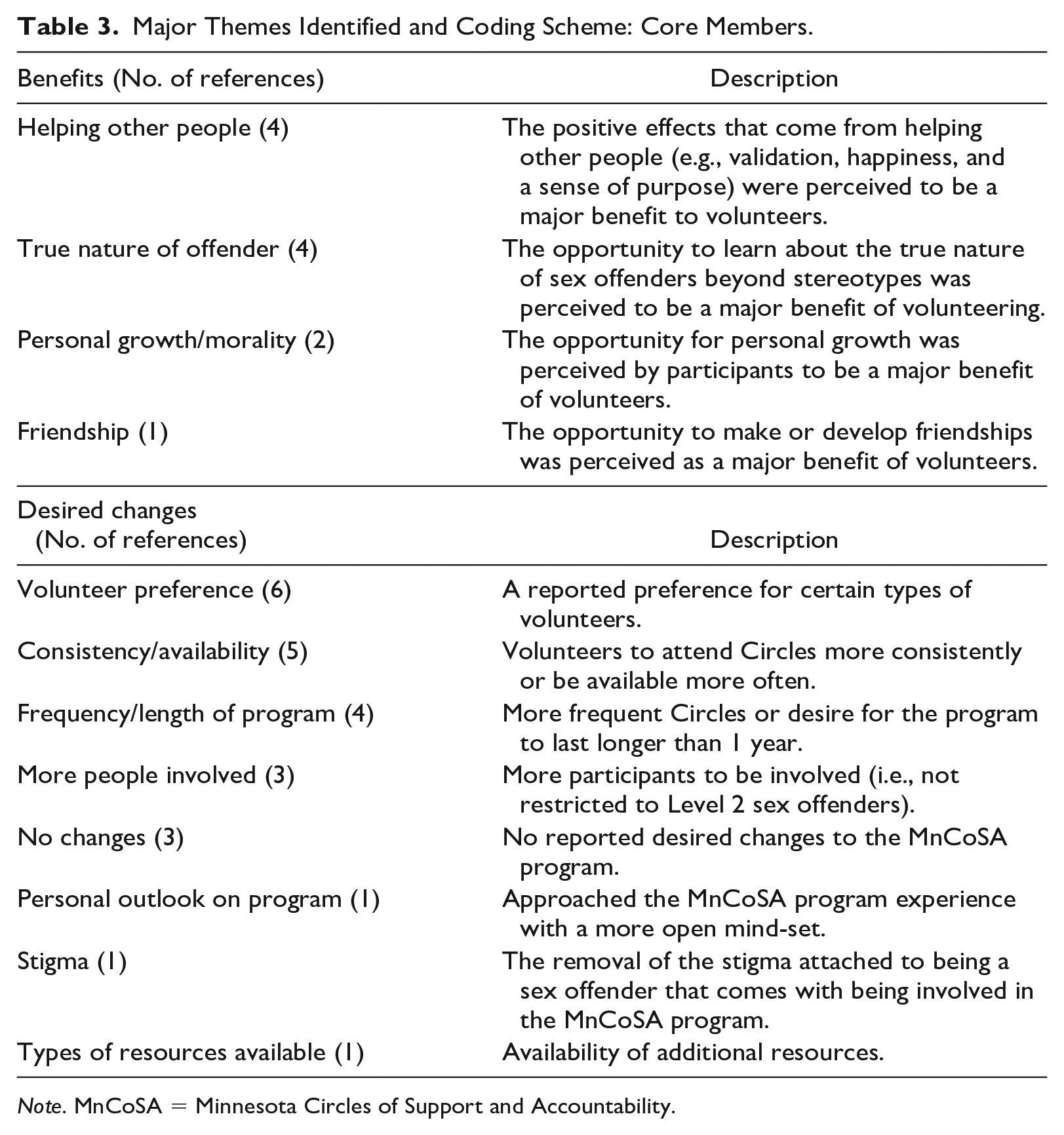
Note. MnCoSA = Minnesota Circles of Support and Accountability.
Results
We were first interested to learn what volunteers considered most beneficial about the CoSA program—what drew them to the program as well as what kept them involved in the program. To answer this question, we analyzed responses to what the volunteers saw as the biggest benefit of the MnCoSA and what they would have changed. Table 2 provides all of the reported benefits of program participation by volunteers. It should be noted that these subthemes were not mutually exclusive ideas. In essence, a single participant could report overlapping interests for either of the major themes.
Perceived Benefits of Volunteers’ Participation
Volunteers
Volunteers told us about how program participation was beneficial in numerous ways, such as broadening their education, personal satisfaction, personal growth, increasing their socialization skills, and participating in formalized training. The word clouds presented in Figures 2 and 3 are a visualization of a lexical analysis that counts words in a transcript. The bigger the word appears, the more frequently it appeared in the transcript. Figure 2 identifies the most frequently used words in describing the major benefits of program participation for volunteers. To the volunteers, education or the opportunity to learn about new concepts was a major benefit of program participation (n = 19). For Mike, it was beneficial to obtain, “a better understanding of, like, the whole process of people in prison to those who need, you know, restoration in their lives.” Another volunteer, Ulises described the benefits of his expanded knowledge:
The MnCoSA program has provided me knowledge on pre-judging sex offenders. Before, hearing about MnCoSA, I did not come to realize that majority of the offenders have been victims that did not get the proper attention or treatment. Through MnCoSA, I’ve realized to think about the detrimental effects of being a victim and why some sex offenders offend. Through MnCoSA if I’ve became more aware of and is educating my friends about sex offenders and telling them that as a community, we cannot always blame the offenders.

Perceived benefits to volunteers: Volunteer perspective.

Perceived benefits to volunteers: Core member perspective.
The second most frequently referenced benefit to volunteers was the feeling of satisfaction that accompanies helping other people (n = 11). Numerous volunteers described how the opportunity to help others and feel as though they were making a difference on an individual and community level, was a major benefit for them. One volunteer, Alex, described his reasoning for volunteering:
I would love to be . . . a help to these people . . . and I think that’s definitely a reason why I get involved in any kind of volunteering because you feel like you can make a difference on a very small scale and obviously if lots of people make a difference on a very small scale, it becomes very big.
Alex believed that he benefited from that positive feeling of making a difference, even on an individual level. Another volunteer, Scott, described a sense of “fulfillment” that came with helping these individuals.
Finally, there were nine instances in which volunteers referred to socialization with other people as a benefit of program participation. One volunteer, Tyler, explained that his decision to volunteer provided him with four new friends and a “safe place” to discuss topics that can be considered taboo in general society, such as sex or drug addictions. Another volunteer, Kristin, simply viewed this as an opportunity to meet new people and become a productive member of the community.
Core members
Because core members were also asked about what they viewed as benefits to volunteers, we examined their responses. As you can see in Figure 3, core members frequently discussed their perceived reasons for volunteers’ participation in Circles. Core members talked at great length about involvement being a benefit to the volunteers. They also talked about learning, family, and friends. Conversation, sharing, change, helping, improving are also words that are commonly used by core members to explain the benefits they believe volunteers gain from participation. This supports what we found in our thematic analysis. From the core member perspective, four types of benefits were identified: friendship, helping other people, personal growth/morality, and understanding or learning about the true nature of offenders. Friendship, which occurred when a participant explicitly noted that their friendship was a benefit for volunteers, was only referenced once in this instance. Two participants perceived a major benefit of volunteers’ participation was their own personal growth (n = 2). For example, George said, “I think to see me be successful has been a big reward for them. To see that everything is okay. And what they put into it and to see that they’re getting something out of it too.”
Another major type of perceived benefit to volunteers by core members is the positive effects that come from helping other people. For example, Freddy noted,
I would hope their benefit would be that they help somebody improve their lives and that, in helping that individual, help change the risk of somebody else becoming a victim. That they helped somebody get on the right path—take them away from the negative lifestyles—and increase the safety of the community.
This was a common theme that was referenced by four separate participants. In describing this idea, George explained that his volunteer and mentor wanted to help so much that when he relapsed, this volunteer took it “real hard” and believes that “he kind of carries that on his shoulders that there was something he could’ve done or something.” In general, it appears that core members believe a common benefit for volunteers to participate in such a program is the good feeling that comes from helping other people.
The last perceived benefit to emerge from the analysis was the opportunity to learn about offenders and the criminal justice system outside of crime reports and really examine the true nature of these people (n = 4). For Joe, this was as simple as “insight from a person that’s experiencing criminal justice from the other side.” Some of these participants (i.e., Dan, George, and Joe) believed that volunteers benefit from the opportunity to interact and learn about people from “the wrong side of the law,” and their families, that they likely would not have interacted with otherwise. For Adam, however, it was far more complex:
. . . a sense that, you know, a person who has omitted a crime like myself can change. And that we’re not . . . we are treatable and that we are capable of loving and not hurting. That we’re human and that God allows us all to take one breath every day just like everybody else.
For this participant, they viewed this program as an opportunity for volunteers to benefit by learning that these people exist beyond their identity as an offender.
Valued Program Aspects
Volunteers
To explore what aspects of the MnCoSA program volunteers valued most, we analyzed responses to what the volunteers wanted to see changed about the program. Table 2 includes eleven categories of all desired changes articulated by volunteers to the MnCoSA program. It should be noted that these subthemes were not mutually exclusive ideas. In essence, a single participant could report overlapping interests for either of the major themes.
Volunteers told us about what changes they would have made to the MnCoSA program such as more consistent attendance among volunteers, more frequent and longer Circles, better communication with all those involved with the program, more alternative locations and times to meet with Circle participants, and even some spontaneity with the Circles. Other volunteers described wanting changes to be made before the Circles ever begin, such as improved and greater amounts of training, more information on the core member prior to the first meeting, and generally being given a more defined purpose or job description. Some volunteers also told us about wanting improved outcomes for the MnCoSA participants and continued contact, even following the completion of the Circle Process. There were only eight instances where volunteers reported no desired changes to the program.
The most frequent desired change (n = 13) was linked to the availability and consistency of the volunteers (see Table 2). Volunteers overall expressed a desire to ensure greater consistently and availability by those involved with the Circles. Specifically, volunteer Jared explained his most desired change was to have both volunteers and core members more regularly on time and attend their Circle meetings. He explained,
[ . . . ] some members were maybe not quite as committed as they should’ve been. In terms of coming, you know and if you couldn’t then make sure you let everyone know ahead of time that you can’t, something’s come up. I think that’s real important.
Poor attendance for Circle meetings could make it difficult to establish trust among CoSA participants and might even undermine the Circle’s objective to provide social support.
Another volunteer, Samuel, described a desire for more volunteers to be involved in the program overall, but fewer per Circle, so as to help a greater number of people reentering the community. However, Samuel also elaborated on the reason he believed there were so few volunteers that would consistently attend, especially given the nature of the program:
The truth of the matter is that there aren’t enough people willing to, or able to, volunteer with the knowledge, skills, and abilities. [. . .] People are busy, and um . . . the idea going up to prison and volunteering doesn’t appeal . . . or doesn’t appear to appeal to a lot of people. I mean you don’t have a lot of people knocking at your door do you?
Other volunteers (n = 12) also reported a desire for overall changes to the Circle process itself. For example, Preston, a volunteer, expressed frustrations at providing a lot of manpower for a single core member Although Samuel, who volunteered in the same Circles as Preston, expressed a desire for more volunteers in the program overall, he believed that four to five volunteers for a single core member was too much, which led to ongoing disagreements among those involved. Samuel explained, “you’re putting four guys with one and if you made one-on-one matches you could do four times as many people.” This theme also included volunteers’ references desiring increases in the frequency and length of the programs.
There were six references by volunteers to a desire for greater or more detailed training prior to the start of the Circles. Alex, a volunteer, reported a desire for “more practical application of how a Circle works, rather than have an awful lot of theory thrown at us.” Another volunteer, Patty, reported that she wished the training had included a portion geared at “working with each other, or building any kind of group identity.” There seemed to be a consensus that while the information provided was helpful and interesting, there were gaps that made the application of the Circles more difficult.
Core members
In addition to the volunteer perspective, we wanted to identify what core members valued most about the MnCoSA program whether there was any overlap between volunteer and core member perspectives. These questions were answered analyzing core members’ responses to what they would change, if anything, about the MnCoSA program. As previously noted, Table 3 provides a brief explanation of the various subthemes identified from the core members’ perspective. Core members described a desire for certain types of volunteers, greater consistency and availability of volunteers, more frequent meetings and a longer program, expansion of the program for more participants, and a wider variety of resource availability. Others revealed wishing that they’d entered the program with a more positive mind-set or that there was no stigma attached to being involved with the MnCoSA program. There were only three instances of participants desiring no change at all to the program.
A common response to desired changes for core members was related to the availability and consistency of the volunteers (n = 5). One participant conveyed frustrations with how busy volunteers were. When asked what about the program he would like to change, Hammond said, “that they’re always busy. I wish they wasn’t so much. I understand they’ve got a life. But I wish they wasn’t so busy. I wish they would spend more time with me.” Brandon described volunteers who would not participate, did not show interest, or even did not regularly show up. He also noted “one thing that I didn’t like is when people wouldn’t show up. Or wouldn’t call maybe or if they just didn’t show up a few times in a row.”
Other responses were related to the program itself. Four participants reported wanting changes regarding the length of the program and the frequency of meetings during the program. In fact, Adam stated, “it should be a whole parole issue. I think the entire time while a person is on parole, whether it be for one year, two years, three years, his circle should be the same.” Another participant, Freddy, wanted to meet more frequently, such as once a week. Moreover, George reported the following desire:
Just knowing what’s going on and how the program’s working—like I said, I’d like to see it available to everybody. And now Rob brought me a newsletter and I have access to those. So, I mean, it’d be nice, some information on how things are going, is the program moving forward or what’s going on with it?
Three core members disclosed a desire for more people being involved in the program itself. Some responses also included a desire for more inmates and the inclusion of all offenders, not limiting program entry to only Level 2 offenders. In addition, although it may not be a plausible change, Freddy noted an interest in obtaining alternative perspectives by including volunteers from different racial backgrounds.
A major subtheme that emerged in core members’ responses to desired changes to the MnCoSA program was related to preferential requests for certain types of volunteers. Beyond consistent attendance and participation, there were six references to a preference for particular characteristics in a volunteer. Of the six references to a preference for a certain type of volunteer, four of them noted a preference for older volunteers. Freddy reported a preference for older volunteers due to their different life experiences. Adam also alluded to a preference for older volunteers through his mentioning of how he’s closer to these particular members compared with others. Later in the interview he stated, “I would have preferred older people, like I had. I had older people and I was grateful.” Perhaps this preference for older volunteers is related to their greater likelihood of being retired, and therefore having a greater amount of time available to volunteer in the program:
David is really the only one that’s not working, so it’s easier for him to move around than the rest of them because they all have employment. David is retired so it’s easier for him to move around than the rest of them.
The other two participants referencing volunteer preference both made mention of the female volunteers. The analysis revealed that participants appear to truly value their female volunteers. In Dan’s interview, he only made mention of the female members of his Circle. In fact, he noted that “they’ll always be my friends because we made a peace bond at the beginning. And I really respect every last one of them women . . . they’ll tell you.” Moreover, Carl specifically referenced the courageousness of women entering a facility and talking about difficult and potentially disturbing issues:
I thought that took a lot of courage, especially for the women, to come talk to me about that. Everyone has a preconceived notion about rape or attempted rape. I know that there’s people out there that know there’s different dynamics to every situation but being a woman coming into a facility, you got to go through a lot [. . .] And then, if you’re talking openly, because I live in a prison setting and there’s a lot of things that disturb me throughout the day and then I have to come there—as easy as it was for me to push it aside, a lot of times people don’t know how to push those issues aside and come in.
These female volunteers were viewed by participants as especially brave and impressive for volunteering with this particular population. Given their perceived vulnerability, it seems as though the core members were more likely to open up and respect their presence in the Circles.
Discussion
Recent research has begun to examine the social support offered to offenders in restorative justice programs (Duwe, 2013; Höing et al., 2015; Northcutt Bohmert et al., 2016) and the impact on those who volunteer (Höing et al., 2016). However, gaps remained in understanding program volunteers’ motivations and what makes a good match between volunteers and participants. Using narratives collected from interviews with 10 core members and 33 volunteers in the MnCoSA program, we identified the perceived benefits of volunteering in the MnCoSA program, as well as several aspects of MnCoSA most valued by volunteers and core members. This information could potentially help justice-involved individuals in three ways. First, it can help CoSA programs target their recruitment of future volunteers, to those whom core members have identified as most effective and beneficial to their success in the program. Next, this information can help programs match volunteers to core members with similar outlooks on the program, to better improve their chances at successful reintegration into the community. Finally, understanding which aspects of CoSA programming are perceived as most beneficial by program participants can inform future CoSAs on how best to model their programs.
Perceived Benefits for the Volunteers
Our analysis revealed three major perceived benefits of volunteers’ participation. First, volunteers in our study commonly noted the education received through their participation in the MnCoSA program to be a benefit. Next, we found that volunteers gained satisfaction from helping others and found their service to be beneficial to their own personal growth. Interestingly, core members also perceived education and the satisfaction of helping others to be major volunteer benefits. Finally, volunteers perceived socialization with other people as a benefit of program participation.
Overall, our results regarding the perceived benefits of volunteering are consistent with previous literature. Clary and colleagues (1998) proposed six functions that can be achieved through volunteering, almost all of which can be used to explain our findings of the perceived benefits to volunteers. The perceived benefit of gained knowledge is consistent with previous literature establishing the opportunity to learn new concepts as a key function of volunteerism (Clary et al., 1998). Also, the finding of friendship as a perceived benefit to volunteers embodies the social function which facilitates interpersonal relationships (Clary et al., 1998). Related to our finding of the perceived benefit of personal growth is the enhancement function which allows for personal development or mood enhancement (Clary et al., 1998). Furthermore, our finding that helping other people is a perceived benefit can be explained by the values function which is centered on humanitarian concerns for others (Clary et al., 1998). Relatedly, prior research has found that altruism is a common characteristic in volunteers (Anderson & Moore, 1978; Lowe et al., 2019). Clary and colleagues’ (1998) understanding function facilitates the opportunity for new learning experiences, which supports our study’s finding regarding the perceived benefit of learning about the true nature of offenders. Finally, the perceived benefit of socialization revealed by our analysis is consistent with other review studies that have identified positive associations between volunteering, social relations, and social capital (Höing et al., 2016; Wilson, McWhinnie, et al., 2007), as well as previous research that links volunteering to increased size and improved quality of one’s social network (Onyx & Warburton, 2003; Wilson, 2012) and overall greater social support and interaction for the volunteer (Casiday et al., 2008). Interestingly, and inconsistent with Lowe et al.’s (2019) research on volunteers in a New Zealand CoSA, we did not find evidence that explicitly supported the idea of religious fulfillment as a perceived benefit of volunteers’ participation.
Our study also examined the overlap of volunteers’ and core members’ perceptions of the benefits of CoSA participation for volunteers. In general, the perceived benefits to volunteers appear to be very similar between volunteer and core member perspectives. Both parties considered education or learning about offenders and the criminal justice system to be the most frequent benefit for volunteers. In addition, both parties also considered the satisfaction that comes with helping other people, personal growth, and socialization (e.g., friendships) to be major benefits of MnCoSA volunteerism. These findings are consistent with what was previously reported in Northcutt Bohmert et al.’s (2016) article emphasizing the types of expressive social support provided to MnCoSA core members such as friendship and a source of moral or emotional support, as well as other literature that highlights the important role altruism plays in volunteerism (Clary et al., 1998; Höing et al., 2016; Lowe et al., 2019). The only difference in perceived benefits was that the volunteers also considered the training they received to be a major benefit as well. Understanding the overlap between volunteer and core member expectations can help identify foster cohesion and encourage the sustainability of the Circle.
Valued Program Aspects
In addition to supporting conclusions drawn in previous literature, our findings also expand the current understanding of CoSAs as an effective means of social support and restorative justice. We found that core members often discussed a preference for a specific type of volunteer. This finding is important as no previous literature has examined volunteer preferences in this type of program. Notably, core members communicated a desire for older volunteers. This is fortunate as previous literature notes organizations will often seek older individuals during the recruitment process (Huber, 1988). In fact, volunteering has been described as an opportunity for older adults to share their experiences, skills, and wisdom with others (Rouse & Clawson, 1992). The match between volunteer recruitment efforts aligns well with core members’ preference for older volunteers.
Interestingly, the results of the analysis found thematic overlap between the volunteer and core member perceptions of what is valued in the MnCoSA program. One thematic overlap between volunteers and core members was related to the frequency and length of the program. Both parties expressed a desire for more frequent meetings and for contact to extend beyond the originally planned year. The core members’ reasoning was linked to a desire to maintain the friendships that had formed throughout the program. Whereas for the volunteers, their desire was connected to being able to touch base and see how the core member is doing in the future.
In addition, our study found that both volunteers and core members often expressed a desire to change the Circle process itself (e.g., shift toward a more individualized process). Like others (Finkelstein, 2008; Gottlieb & Gillespie, 2008; Lowe & Willis, 2018), we found that volunteers most commonly valued the availability and consistency of their colleagues. However, some dissatisfaction with the Circle process stemmed from a need for more detailed training prior to the start of the program. Like their counterparts, we found that core members valued volunteers who were available and consistent. It appears that solid attendance and effort from all parties involved makes for a much better Circle.
Limitations
Still, there are limitations one should consider. Our study focused on a very specific population of individuals who were convicted of a sexual offense—Level 2 offenders released to Minnesota communities around 2007 or 2008. As such, the sample may not be representative of males who have committed less serious sex offenses (e.g., status offenses), females, or individuals in states with different policies and practices governing people who have committed sex offenses. Furthermore, the data were collected over 10 years ago, when the program was in its infancy. Future analysis should consider how these findings align with current program practices. Finally, interviews were not conducted with every core member or volunteer thus limited some data available for our analysis; however, we have no reason to believe that the individuals unavailable for interviews were systematically biased in any way.
Implications
Limitations notwithstanding, the findings of this study have implications for how CoSAs similarly situated to MnCoSA might better recruit the best volunteers, structure their program, and match volunteers to core members. As revealed by this study’s findings, the importance of volunteers’ commitment to and availability to participate in the Circle Process suggests that targeted recruitment of the best volunteers is crucial. A major operational challenge for CoSAs has been the recruitment of volunteers (Van Rensburg, 2012; Wilson et al., 2005). Our findings suggest that programs should spend considerable time selecting and training volunteers for participation in the program. Older volunteers should be targeted as they are both most likely to participate and to be preferred by core members.
During recruitment, programs should emphasize that volunteers serve to gain a wealth of knowledge and the satisfaction of helping others through their participation in the program. Moreover, it would be helpful to explicitly outline and explain the goals of the CoSA. Furthermore, volunteer roles and responsibilities should be made known to all Circle members so as to minimize any unrealistic expectations on behalf of the core members and establish proper behaviors for volunteers. However, it is important to note that not all Circles will operate in the same fashion. For instance, in Circles with an uncooperative core member, volunteers should be aware that this Circle may require more than the average amount of supervision and support. In addition, our findings suggest that both, volunteers and core members, would value alterations to the structure of the Circle. In CoSAs with limited volunteers, reducing the number of volunteers assigned to each core member might be preferable to filling spots with unreliable, inconsistent volunteers, and might provide more flexibility for Circles to meet more often or for longer periods of time.
Footnotes
Declaration of Conflicting Interests
The author(s) declared no potential conflicts of interest with respect to the research, authorship, and/or publication of this article.
Funding
The author(s) received no financial support for the research, authorship, and/or publication of this article.
