



Abstract
Burglary is serious property crime with a relatively high incidence and has been shown to be variously associated with other forms of criminal behavior. Unfortunately, an epidemiological understanding of burglary and its correlates is largely missing from the literature. Using public-use data collected between 2002 and 2013 as part of the National Survey on Drug Use and Health (NSDUH), the current study compared those who self-reported burglary arrest in the prior 12 months with and without criminal history. The unadjusted prevalence estimates of self-reported burglary arrest were statistically different for those with a prior arrest history (4.7%) compared with those without an arrest history (0.02%) which is a 235-fold difference. Those with an arrest history were more likely to report lower educational attainment, to have lower income, to have moved more than 3 times in the past 5 years, and to use alcohol, tobacco, illicit drugs, and engage in binge drinking. Moreover, those with prior arrest histories were younger and more likely to be male. There is considerable heterogeneity among burglars with criminal history indicating substantially greater behavioral risk.
Introduction
Burglary, the unlawful entry of a residence or business to perpetrate theft or some other felony, is a serious property offense that commonly is punished by prison confinement and produces tens of millions of dollars annually in direct, indirect, and intangible costs (Wickramasekera, Wright, Elsey, Murray, & Tubeuf, 2015). In the United States, burglary is a moderately common crime with an official incidence of nearly two million incidents annually according to the Uniform Crime Reports (Federal Bureau of Investigation, 2014) and three million victimizations according to the National Crime Victimization Survey (Truman & Langton, 2015). Arrest and victimization data on burglary are a fraction of the true incidence of burglary incidents given that most crimes are not reported, do not result in arrest, and are not cataloged by national survey. Burglary is associated with a range of negative consequences for burglary victims including loss of property and damage to one’s home, emotional trauma, stressful hypervigilance due to the violation of privacy, increased anxiety, depression, fear of crime, and others (Angel et al., 2014; Brown & Harris, 1989; Chon & Wilson, 2016; Maguire, 1980; Maguire & Bennett, 1982). 1
Like all criminal offenses, there is substantial heterogeneity among burglary offenders in terms of their broader criminal career (Bouhana, Johnson, & Porter, 2016; Hargreaves & Francis, 2014; Shover, 1996), motivation for perpetrating burglary (Maguire, 1988; Wright, Logie, & Decker, 1995), geographic and temporal issues relating to burglary (Johnson, 2008; Johnson & Bowers, 2004; Kocsis & Irwin, 1997), and the association of burglary to other forms of crime (Fox & Farrington, 2012; Shover, 1996; Snook, 2004; Steffensmeier, Harris, & Painter-Davis, 2015). 2 Thus, burglary can denote a one-off adolescent prank by a juvenile offender, an opportunistic offense by an offender enmeshed in an antisocial lifestyle, or a carefully planned instrumental crime (Shover, 1973). Notwithstanding this variance; however, the typical burglary is part of a constellation of criminal offenses that center on property violations (e.g., theft; auto theft; possessing, receiving, or selling stolen property; fencing) that are instrumentally related to substance use (Cromwell, Olson, Avary, & Marks, 1991; Hochstetler, 2001; Roach, 2007; Schneider, 2003; Wright & Decker, 1996).
Prior research has identified several characteristics of burglars and their burglary offense behavior utilizing diverse sources of data and analytical techniques. First, there are reciprocal relationships between drug use and burglary with qualitative studies showing that burglars sometimes instrumentally perpetrate burglary to obtain goods to sell or trade for drugs and sometimes consume drugs to prepare themselves for burglary (Bennett & Wright, 1984b; Cromwell, Olson, & Avary, 1991, 1993; Cromwell, Olson, Avary, & Marks, 1991; Hochstetler, 2001; Shover, 1973; Tunnell, 1992). Although drug use is a risk factor for all sorts of crimes (Bennett, Holloway, & Farrington, 2008; DeLisi, Vaughn, Salas-Wright, & Jennings, 2015), violent crimes cannot usually yield material gain in the same way that burglary can.
Second, although burglars decide to perpetrate the criminal act prior to entering a home or business, the motivation to do so has been shown to be influenced by peers and informal socializing and by the immediate need for property or money (Bennett & Wright, 1984a; Hochstetler, 2001; Wright & Decker, 1996). Similarly, burglary has been shown to be relatively easy to deter in part due to the spontaneous nature of the circumstances that lead to a burglary offense (Hochstetler, 2001). For instance, Bennett and Wright’s (1984a) study of approximately 300 convicted burglars in England and Wright and Decker’s (1996) study of 105 burglars in Saint Louis, Missouri, found that most would simply decide against committing burglary if there were preventive measures in place, such as a home security system or alarm, a barking dog, or observant neighbors (see also Bennett, 1995; Decker, Wright, Redfern, & Smith, 1993; Robinson, 1999). 3
Third, although informal socializing is often a proximate “cause” of many burglary offenses, there is also evidence that burglary is a highly rational criminal offense where the risks of getting caught tend to be minimized in favor of the potential rewards inherent to the crime (Buck, Hakim, & Rengert, 1993; Coupe & Blake, 2006; Decker, Wright, & Logie, 1993; Nee, 2015; Nee & Meenaghan, 2006; Piquero & Rengert, 1999; Shover, 1996; Tunnell, 1992). An assortment of behaviors, including targeting houses or businesses that are close and familiar to the offender, using first-floor points of entry, using surveillance to determine when victims are not home, and others speak to the rationality of burglary.
Fourth, extensive research has shown that burglary is usually embedded within a broader offending career constituted by a mix of property, violent, drug, and public-order crimes and criminal justice system involvement and noncompliance. For instance, Wright and Decker (1996, p. 15) found that a minority of offenders in their sample had not engaged in other forms of crime and the burglars themselves did not identify as burglars per se, but instead saw themselves as “hustlers” who were immersed in a criminal lifestyle that included all sorts of offending (see also Cromwell, Olson, & Avary, 1991). Several studies have shown that specific features of burglars are indicative of greater behavioral risk which translates into burglary being part and parcel of a severe antisocial career. These include early onset of burglary (Hodgson & Costello, 2006), perpetrating burglary without a codefendant (Hodgson & Costello, 2006), motivation and amount of planning involved in burglary (Fox & Farrington, 2012; Rengert & Wasilchick, 1985), and perpetrating burglary along with robbery (Hochstetler, 2001) and other serious felonies. In other words, a consideration of burglary along with other criminal activity or criminal history is important for understanding the nature of the burglary offense, potential motivations for committing burglary, and the association between burglary and other crimes.
Largely missing from the study of burglary offenders is research from an epidemiological perspective. In recent years, scholars (Akers & Lanier, 2009; Lanier, 2010) formally called for epidemiological criminology to bring the methods and concepts from epidemiology which is primarily concerned with health and illness in the population in the interests of public health and preventive medicine to the study of criminal offenders who often display serious health-compromising behaviors and impose a substantial public health burden. Epidemiological studies are very large—containing tens of thousands of cases—and frequently include hundreds of validated measures of antisocial behaviors and various forms of psychopathology that are correlated with drug use and assorted behavioral health issues. In this way, criminologists can utilize these large data sources to investigate criminological phenomena that are usually not studied by epidemiologists who instead focus on alcohol use, drug use, and other health-related problems and provide new insights into correlates and subtypes of diverse forms of antisocial behavior.
Current Aim
Unfortunately, most of what is known about burglary offenders is derived from studies based on very small samples of qualitative data or surveys from usually a single geographic area. What is missing is an epidemiological understanding of burglary and the potential heterogeneity of the burglary offender population. Using a large data source of more than 400,000 cases, the current study sought to examine self-reported arrest for burglary in the prior 12 months in epidemiological context and provide information on the covariates of those who self-reported an arrest for burglary in the prior 12 months with and without criminal history.
Method
Sample and Procedures
This study examines public-use data collected between 2002 and 2013 as part of the National Survey on Drug Use and Health (NSDUH). The NSDUH provides population estimates for an array of substance use and health-related behaviors in the U.S. general population. NSDUH participants include household residents, civilians residing on military bases, and residents of shelters and group homes. Multistage area probability sampling methods are used to select a representative sample of the U.S. civilian, noninstitutionalized population aged 12 years or older for participation. 4 NSDUH study participants are interviewed in private at their places of residence using a computer-assisted interviewing (CAI) methodology to increase the likelihood of valid respondent reports (Substance Abuse and Mental Health Services Administration [SAMHSA], 2014; Turner et al., 1998). The design and methods are summarized briefly here; however, a detailed description of NSDUH procedures is available elsewhere (see SAMHSA, 2014). Since 2002, a total of 668,012 respondents have completed the NSDUH survey; however, the current study restricted analyses to adult respondents ≥18 years old (n = 443,081) who had a response for the outcome variable.
Measures
Burglary
Burglary was measured on the basis of the following question: “In the past 12 months, were you arrested and booked for burglary or breaking and entering?” Adults who responded “yes” (n = 849; 0.02%) were coded as 1 and all other adults coded as 0.
Substance use
We examined past 12-month use of tobacco, alcohol (any [1+ drinks] and binge [5+ drinks at the same occasion] use), and any other illicit drug (including marijuana/hashish, cocaine/crack, methamphetamine, hallucinogens, inhalants, tranquilizers, ecstasy, and/or stimulants). For each of these items, participants reporting one or more instances of use were coded as 1 and all others coded as 0.
Prior arrest history
Prior arrests were examined based on self-reports of being arrested and booked for any crime (excluding burglary or breaking and entering) during the past 12 months. Prior arrests included self-reports of (a) motor vehicle theft; (b) larceny/theft; (c) serious violent offenses (i.e., aggravated assault, forcible rape, murder, homicide, or negligent manslaughter); (d) other assault (i.e., simple assault or battery); (e) arson; (f) driving under the influence of alcohol or drugs; (g) drunkenness or liquor law violations; (h) possession, manufacture, or sale of drugs; (i) sex offenses excluding rape (including prostitution, commercialized sex, and other sexual offenses); and (j) fraud, possessing stolen goods, or vandalism. For all items, adults reporting one or more instances of involvement were coded as 1, and those reporting no prior arrests were coded as 0.
Probation and parole
Probation and parole were measured based on responses to the following question items: “Were you on probation at any time during the past 12 months?” and “Were you on parole, supervised release, or other conditional release from prison at any time during the past 12 months?” Adults who reported instances of either probation or parole were coded as 1, whereas all others were coded as 0.
Prior theft
We also examined self-reported theft for which adults were not arrested. This was based on the following item: “During the past 12 months, how many times have you stolen or tried to steal anything worth more than $50?” Adults who reported any instance of stealing or attempting to steal >US$50 were coded as 1 and those reporting no instances as 0.
Moving history
We also examined the number of times that adults had relocated or moved residence in the past 5 years. This was based on responses to the following item: “How many times have you moved in the past 5 years?” Adults who reported moving 3 or more times during the past 5 years were coded as 1, with all others coded as 0.
Sociodemographic factors
The following sociodemographic variables were used: age (18-20 years, 21-25 years, 26-29 years, 30-34 years, 35-49 years, and ≥50 years), gender (female, male), race/ethnicity (non-Hispanic White, African American, Hispanic, and Other), total annual family income (<US$20,000, US$20,000-US$49,999, US$50,000-US$74,999, and ≥US$75,000), and education (less than high school, high school graduate or graduate equivalence diploma [GED], some college, or college graduate). In addition, participants were asked about their participation in any government assistance programs, including Supplemental Security Income, food stamps, cash assistance, and noncash assistance. Adults participating in one or more government assistance programs were coded as 1 and adults who did not participate in any of these programs as 0.
Statistical Analyses
We used the aforementioned measure of burglary as the dependent variable for all analyses in the current study. We used logistic regression to examine the significance of the associations between burglary, prior arrest history, substance abuse, theft, frequent moving, and sociodemographic measures, and survey year. We fit separate logistic regression models for all adults in the United States, adults with a prior arrest history (within the past 12 months), and adults with no arrest history (within the past 12 months). We included survey year as a continuous independent variable to assess potential trend changes in burglary from 2002 to 2013. This approach follows the trend analysis method outlined by the Centers for Disease Control and Prevention (2014). Our approach is also consistent with high-cited trend studies (Ogden et al., 2006) as well as recent trend studies that utilized NSDUH data (Salas-Wright, Vaughn, Todic, Córdova, & Perron, 2015). Prevalence estimates and their corresponding 95% confidence intervals were computed using functions from the “survey” package in R. Specifically, these functions implement a Taylor series linearization to adjust the standard errors of estimates to account for the complex survey sampling design effects (including clustered multistage data) that are part of the NSDUH sampling scheme (Lumley, 2015).
Results
The Prevalence of Burglary Among Adults
Characteristics of the adults in this study are presented by prior arrest history in Table 1. Several important differences across arrest history groups are worth mentioning. First, the unadjusted prevalence estimates of burglary were statistically different for those with a prior arrest history (4.7%) compared with those without an arrest history (0.02%). That is a 235-fold difference. Those with an arrest history were more likely to report lower educational attainment (66.6% vs. 46.3% received a high school degree or less), to have lower income (33.2% vs. 18.6% had incomes <US$20,000), to have moved more than 3 times in the past 5 years (19.3% vs. 6.2%), and to use alcohol, tobacco, illicit drugs, and engage in binge drinking. Moreover, those with prior arrest histories were younger (54.3% vs. 21.6% were below age 30) and more likely to be male (73.7% vs. 47.8%).
Characteristics of Adults in the United States by Prior Arrest History, 2002-2013.
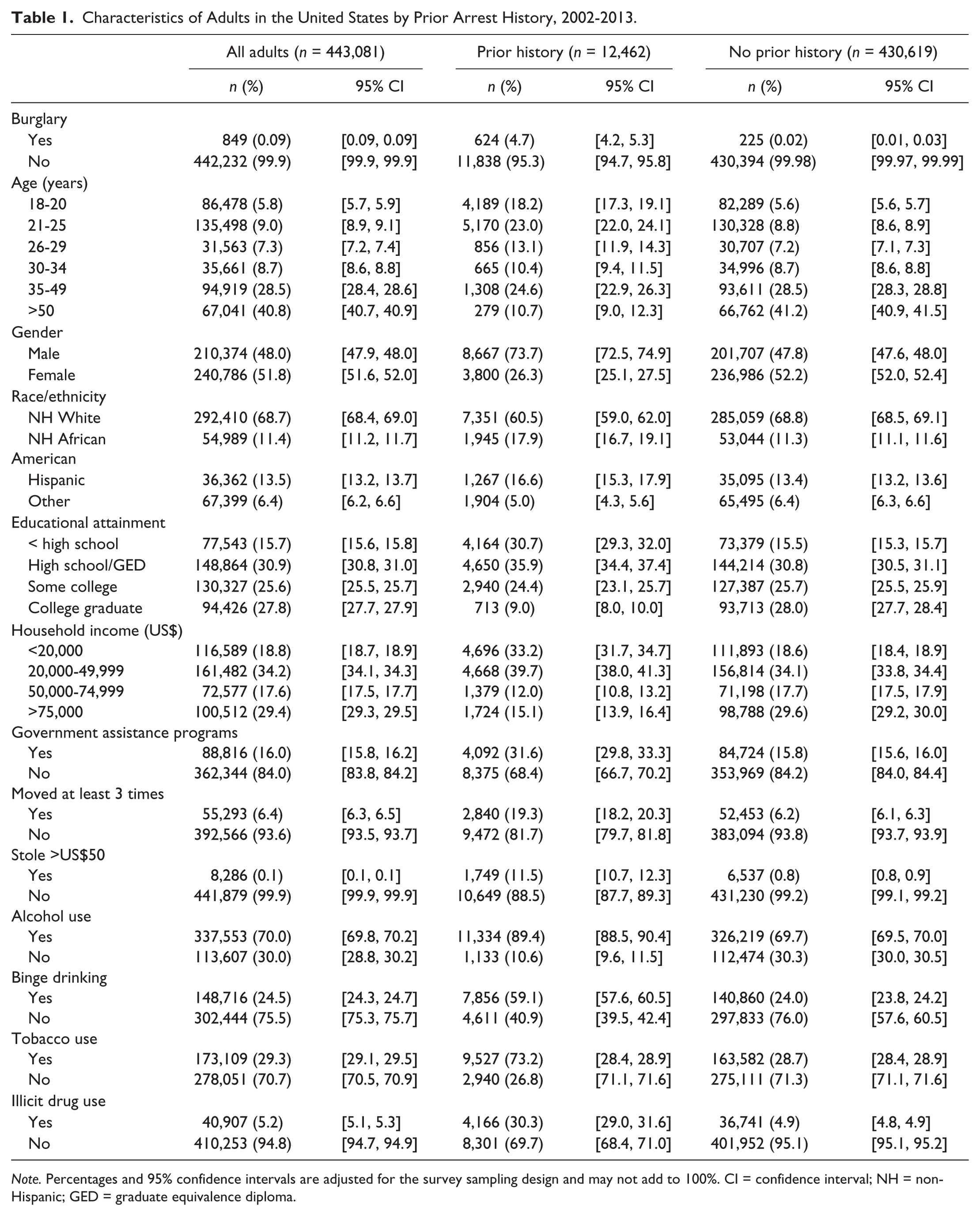
Note. Percentages and 95% confidence intervals are adjusted for the survey sampling design and may not add to 100%. CI = confidence interval; NH = non-Hispanic; GED = graduate equivalence diploma.
Results from the logistic regression analysis are presented in Table 2. Overall, we see that the prevalence of burglary increases significantly for adults who are male, utilizing government assistance programs, who have moved >3 times in the past 5 years, who were on probation/parole, and who had been previously arrested for larceny/theft, serious violent offenses, or robbery. Across all groups, males reported significantly higher odds of burglary compared with females. Irrespective of arrest history, burglary was negatively associated with age ≥21; however, this result was not statistically significant among those with a prior history of arrest. Among those with an arrest history, the highest odds of burglary was associated with previous criminal acts, even after accounting for sociodemographic factors. In particular, adults who had a history of committing larceny/theft, robbery, motor vehicle theft, or serious violent offenses had higher odds of being arrested for burglary after accounting for sociodemographic factors and substance abuse. Among adults without prior arrest histories, higher odds of burglary was associated with utilizing government assistance programs, stealing > US$50, and tobacco and/or illicit drug use, after accounting for sociodemographic factors.
Associations With Burglary Among Adults in the United States, 2002-2013.

Note. ORs for burglary with a prior arrest history are mutually adjusted for age, gender, race/ethnicity, educational attainment, household income, participation in government assistance programs, moving ≥3 times in the past 5 years, stealing >US$50, alcohol use, binge drinking, tobacco use, illicit drug use, probation/parole, being arrested for selling drugs, larceny/theft, serious violent offenses, other assault, robbery, driving under the influence of drugs and/or alcohol, fraud, public drunkenness, sexual offense, arson, and survey year. ORs for burglary without prior arrest history are mutually adjusted for age, gender, race/ethnicity, educational attainment, household income, participation in government assistance programs, moving ≥3 times in the past 5 years, stealing >US$50, alcohol use, binge drinking, tobacco use, illicit drug use, and survey year. ORs and 95% CIs in bold are statistically significant (p < .05). OR = odds ratio; CI = confidence interval; NH = non-Hispanic; GED = graduate equivalence diploma.
Trends in Burglary by Arrest History
Examining the trends in burglary among adults between 2002 and 2013 reveals several important findings (see Table 2 and Figures 1 and 2). The clearest finding is that the prevalence of burglary was constant across the 12-year study period for both prior offenders and those without an arrest history. It is worth noting that prevalence estimates for prior offenders appear to increase after 2010; however, these estimates were not statistically different from the overall mean (represented as a dashed line in Figure 1).
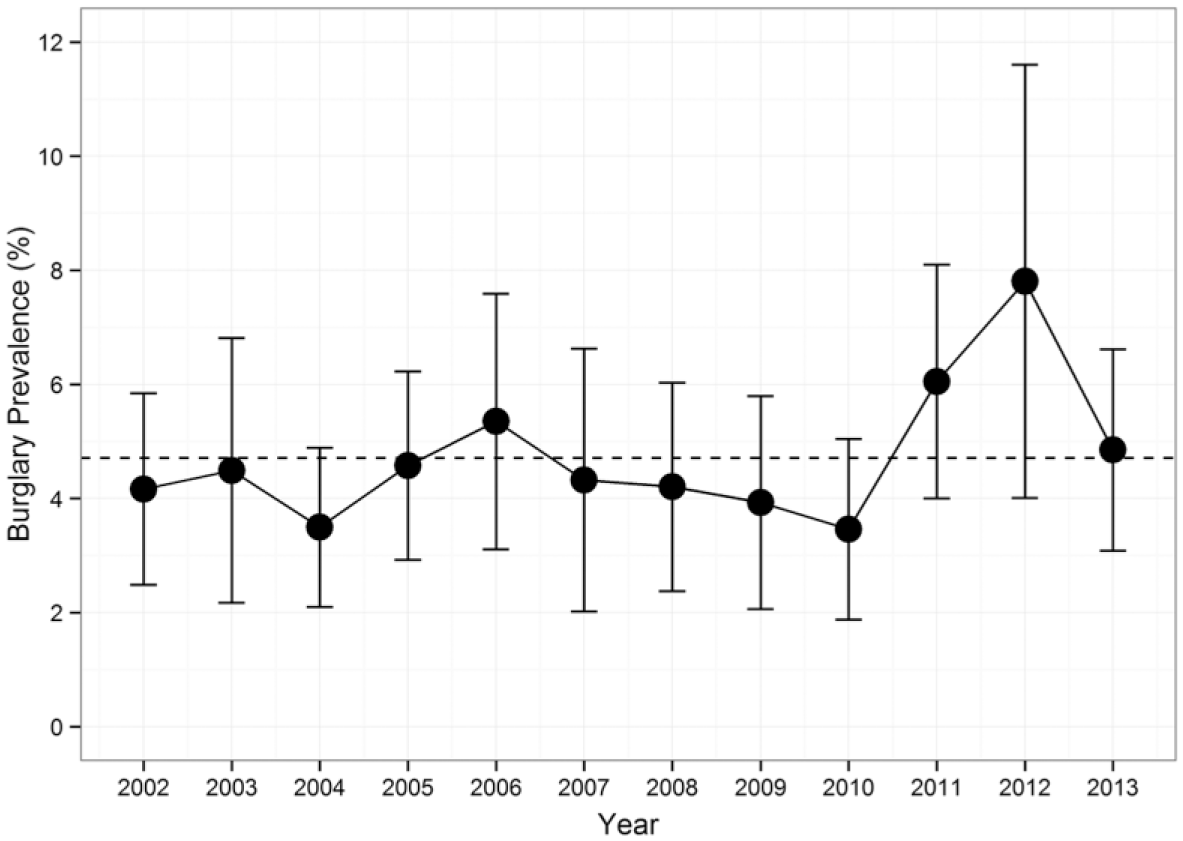
Prevalence estimates and 95% confidence intervals for prevalence of burglary among those with an arrest history in the past 12 months, 2002-2013.
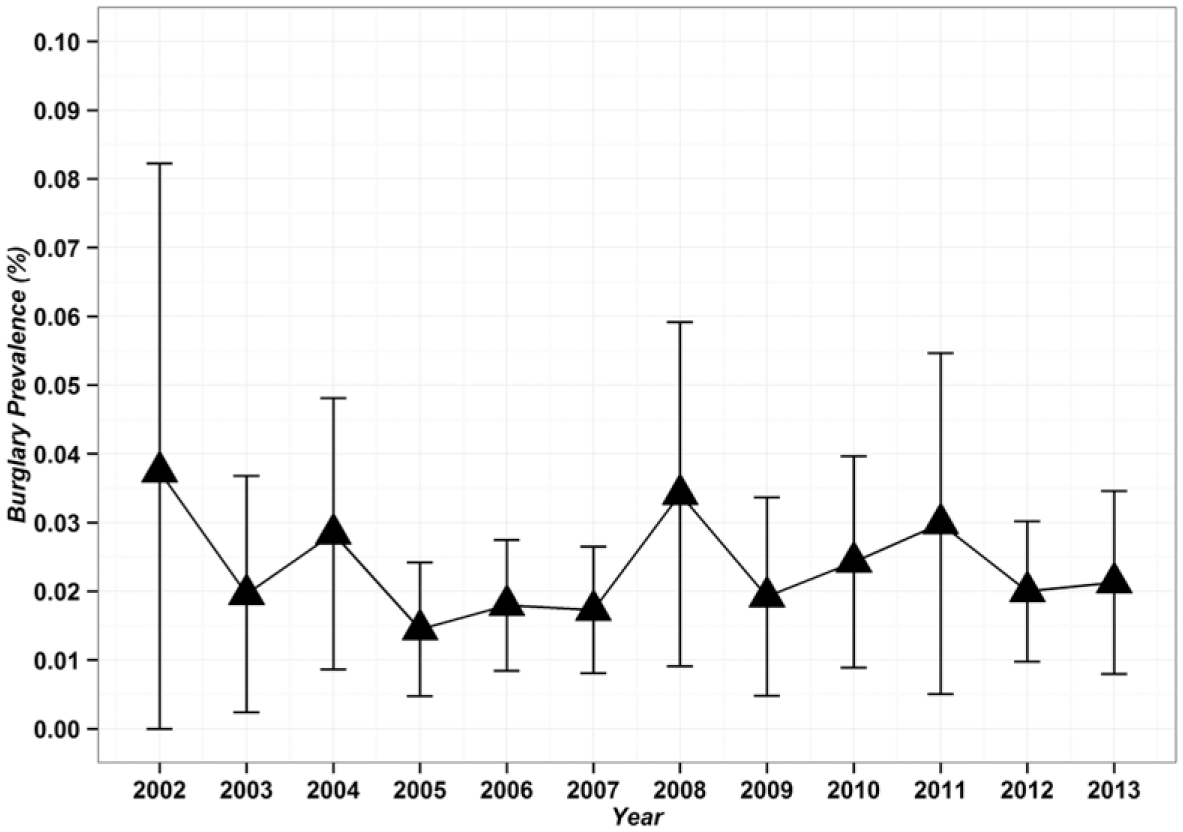
Prevalence estimates and 95% confidence intervals for prevalence of burglary among those without an arrest history in the past 12 months, 2002-2013.
Discussion
Although burglar is a common and serious criminal offense that has been extensively studied, most criminological knowledge on this offense is based on small samples that preclude an epidemiological understanding of burglary. The current study employed data from 443,081 participants from the NSDUH collected between 2002 and 2013 to compare self-reported arrest for burglary in the prior 12 months among those with and without criminal history. To our knowledge, this is the first epidemiological study of burglary ever conducted.
Four important findings emerged. First, the prevalence of self-reported arrest for burglary in the prior 12 months varies dramatically as a function of criminal history. The prevalence of self-reported arrest for burglary in the prior 12 months among participants with criminal history was 4.7%, and the prevalence of self-reported arrest for burglary in the prior 12 months among participants without criminal history was 0.02%. This is a 235-fold difference. The trend data shown in Figures 1 and 2 also indicate that self-reported arrest for burglary in the prior 12 months is relatively consistent among both groups ranging from about 3.5% to 8% among those with criminal history and from 0.01% to 0.04% among those without criminal history. Although the measure of self-reported arrest for burglary in the prior 12 months is admittedly imperfect compared with a continuous self-report count of burglary events or official arrest data, it is also clear that burglary is more common among those with than without criminal history.
Second, the burglary offender is characterized by a host of sociodemographic and behavioral risk factors that are suggestive of a broad and versatile involvement in antisocial behavior. In the United States, the burglar is young and the likelihood of burglary perpetration becomes significantly less likely as a function of age. Males have a nearly threefold greater involvement in burglary, and educational attainment is inversely associated with self-reported burglary arrests in the past 12 months. Indeed, college graduates are 86% less likely to have self-reported burglary arrests in the past 12 months. Burglars are significantly more likely to receive governmental assistance and have generally unstable residency characterized by frequent moves. Criminal career research indicates that although offenders are primarily versatile in their offending (DeLisi, 2015; Lussier & Cale, 2013; Piquero, Farrington, & Blumstein, 2003; Roach & Pease, 2014; Yonai, Levine, & Glicksohn, 2013), there is also evidence for relative specialization in their criminal offending (Adams & Pizarro, 2014; Britt, 1996; DeLisi et al., 2011; Jennings, Zgoba, Donner, Henderson, & Tewksbury, 2014). As a whole, burglar offenders display behaviors consistent with both perspectives as they are more likely to use tobacco, to commit a serious violent offense, to be on probation or parole, and to commit robbery which are suggestive of versatility, and to steal something with a value more than US$50, commit motor vehicle theft, and commit larceny/theft which are suggestive of specialization. Indeed, the odds ratio for larceny/theft is nearly 30-fold higher.
These epidemiologically based findings of simultaneous behavioral versatility and specialization comport with qualitative studies that similarly found that active burglary offenders did not consider themselves as such, but instead evinced a general involvement in antisocial conduct (Cromwell et al., 1991; Hochstetler, 2001; Wright & Decker, 1996), but that some active burglary offenders effectively specialize in this form of crime or at the very least prefer it to other forms of criminal behavior (Shover, 1973, 1996).
Third, those who self-reported an arrest for burglary in the prior 12 months without criminal history are epidemiologically distinct from those with criminal history. Among persons without criminal history, a self-reported arrest for burglary in the prior 12 months is exceedingly less likely as a function of age and is disproportionately committed by males and by persons receiving governmental assistance. The criminal repertoire of self-reported arrest for burglary in the prior 12 months without criminal history is also more circumscribed and characterized by stealing, tobacco use, and illicit drug use but scant involvement in other forms of crime. A strong effect for stealing something with a value more than US$50 was found with an odds ratio of nearly 11. The large odds ratio for theft is indicative of the highly correlated property offenses involved theft, larceny, and burglary that have been shown in multiple prior studies (Cromwell et al., 1993; Decker, Wright, & Logie, 1993; Maguire & Bennett, 1982).
Fourth, those with self-reported arrest for burglary in the prior 12 months with prior criminal history are the most severe and display involvement in multitudinous forms of antisocial conduct. Those with criminal history have data for all forms of crime including drug use, drug selling, assault, driving under the influence, fraud, public drunkenness, sexual offenses, and arson; however, perpetration of motor vehicle theft, larceny/theft, serious violent offending, and robbery was significantly associated with this group. This epidemiological profile is consistent with burglars who are serious, versatile criminal offenders and are supportive of both qualitative (Alarid, Burton, & Hochstetler, 2009; Hochstetler, 2002) and quantitative (Almond, McManus, Worsley, & Gregory, 2015; Fox & Farrington, 2016a; Harris, Pedneault, & Knight, 2013) investigations of criminological samples of burglars. In sum, it is critical to examine burglary within the context of criminal history to understand the severity of the burglary offender and the assorted risk factors that are associated with that status.
Study Limitations
The current findings should be considered in light of some study limitations. Adolescents were not asked to self-report burglary in the current data which is a limitation given that prior studies have shown that a significant proportion of burglary offenders are juveniles (DeLisi, Angton, Behnken, & Kusow, 2015; Federal Bureau of Investigation, 2014; Harris et al., 2013; Wright & Decker, 1996). The criminal activity information is based on self-reports of arrest in the preceding 12 months. Unfortunately, these data were not validated by official arrest records. This can be problematic especially for the most active, chronic criminal offenders who accumulate many arrests in a single year (DeLisi & Piquero, 2011; Dunford & Elliott, 1984). However, it is important to note there is moderate to high convergence between self-report and official records of arrest (Pollock, Menard, Elliott, & Huizinga, 2015) especially when the recall period is relatively discrete such as 1 year as opposed to lifetime recall. 5 Moreover, the burglary item is whether the respondent was arrested and booked for burglary; thus, it did not measure how many times the person was arrested. It was limited to one. Clearly, offenders commit far more burglaries than arrest data would indicate. For instance, a recent study found that the mean self-reported burglaries was more than 2 times greater than the mean arrests for burglary (Payne & Piquero, 2016). Other researchers reported far greater discrepancies between self-reports and official arrests for burglary. For instance, Farrington, Auty, Coid, and Turner (2013) found that the ratio of self-reported burglary to convictions for burglary in early adulthood is 5.1 to 1.
Despite the size of the data set, it is also important to note that the NSDUH is a nationally representative sample of the general population which is distinct from clinical or correctional samples of burglars. It is also important to note that despite the size of the NSDUH, only 849 persons or (0.09%) of the sample had a self-reported arrest for burglary in the prior 12 months. For instance, prior investigators have shown that although most burglars are essentially property offenders who engage in diverse forms of crime, there is also a subset of burglars for whom burglary is a sexual offense in that it provides the opportunities for access to victims for rape, child molestation, and sexual abuse (Pedneault, Beauregard, Harris, & Knight, 2015; Pedneault, Harris, & Knight, 2012, 2015; Vaughn, DeLisi, Beaver, & Howard, 2008). No significant effects were found for sexual offenses in the current data although the direction of the relationship was that sexual offenders were less likely to engage in burglary. Thus, it is doubtful that the current data contained any sexual burglars.
Regretfully, the NSDUH did not contain prior measures of burglary offending. This precluded analyses that could potentially show continuity in burglary offending across the criminal career and that could potentially show evidence of specialization if prior burglary offending had large odds ratios showing an association with current arrest for burglary.
It is our hope that other criminologists look to epidemiological data sets such as the NSDUH, the National Epidemiologic Survey on Alcohol and Related Conditions (NESARC), and others to mine their risk assortment of measures that are importantly associated with diverse forms of antisocial behavior. As the data are already collected and accessible by researchers, criminologists can both broaden their study of specific criminological phenomena using very large samples and refine their study using the array of covariates that are available in the data. In terms of burglary, epidemiological studies can provide a panoramic perspective to complement the in-depth qualitative insights of prior research (e.g., Bennett & Wright, 1984a; Cromwell et al., 1991; Hochstetler, 2001; Wright & Decker, 1996).
Conclusion
Burglary is serious property crime with a relatively high incidence and has been shown to be variously associated with other forms of criminal behavior. The heterogeneity of burglary shown in qualitative and survey research using small samples was supported with the current analyses of 443,081 cases from the public-use data collected between 2002 and 2013 as part of the NSDUH. The unadjusted prevalence estimates of burglary were statistically different for those with a prior arrest history (4.7%) compared with those without an arrest history (0.02%) which is a 235-fold difference. Those with an arrest history were more likely to report lower educational attainment, to have lower income, to have moved more than 3 times in the past 5 years, and to use alcohol, tobacco, illicit drugs, and engage in binge drinking. Moreover, those with prior arrest histories were younger and more likely to be male. There is considerable heterogeneity among burglars with criminal history indicating substantially greater behavioral risk.
Footnotes
Declaration of Conflicting Interests
The author(s) declared no potential conflicts of interest with respect to the research, authorship, and/or publication of this article.
Funding
The author(s) received no financial support for the research, authorship, and/or publication of this article.