



Abstract
Symbolic interactionism argues that the effect of informal labeling by general others, such as family and friends, on behavior depends on the social context under which labeling takes place. Despite abundant research on informal labeling, little effort has been made to contextualize its impact on adolescent reoffending. Also, compared with other theories, only a few studies have been conducted among youths in Asian population. Using three consecutive waves of self-reported survey data from a nationally representative sample of 2,406 Korean adolescents, this study examined an interactional model for the informal labeling effect. Findings suggest that informal labeling, as well as school commitment and delinquent peer association, has an independent effect on delinquency. Also supported is the symbolic interactionist hypothesis that adolescents with greater involvement in delinquent subcultures were less susceptible to informal labeling. Implications of the findings are discussed.
Introduction
A close look at the Uniform Crime Report (Federal Bureau of Investigation, 2014) illuminates a pronounced trend of juvenile offending by volume. Frequency reports on the most serious interpersonal crimes show a rapid escalation between ages 18 and 20. For example, the number of forcible rapes, robberies, and aggravated assaults committed by adolescents aged 18 to 20 years is greater than the total number of crimes committed by those between ages 15 and 17 years. A similar age-graded trend holds true for both property crimes and drug-related crimes. Particularly for drug abuse and liquor law violations, crimes committed by adolescents aged 18 to 20 years were more than twice the number as those committed by adolescents younger than 18 years.
The rapid increase in offending in late adolescence may be attributable to the late onset of criminal behavior, increase in physical development, or general life events in later adolescence, among others (Gottfredson & Hirschi, 1990; Kubrin, Stucky, & Krohn, 2009; Moffitt, 1993; Sampson & Laub, 1995). However, a direct and substantial impact on the volume of crime committed by adolescents in this age range may come from recidivism. Although the operational definition of recidivism varies by tracking period (e.g., 6 months, 12 months, and 24 months) or by type of processing by the criminal justice system (e.g., rearrest, reconviction, and reincarceration), Snyder and Sickmund (2006) estimated the adolescents’ reoffending rate within 1 year of release to be 55%. 1 This rate can reach 80% when the tracking period is extended to 3 years (Forgays, 2008; Frederick, 1999). These estimates are limited to the cases reported to the authorities such that the actual volume of reoffending may be larger in quantity. In fact, a number of studies on self-reported delinquency observed a strong correlation between past and future delinquency, which suggests a higher rate of adolescent recidivism than official data indicate (e.g., Cottle, Lee, & Heilbrun, 2001; J. Lee, Jang, & Bouffard, 2013; van der Geest, Blokland, & Bijleveld, 2009). The magnitude of recidivism among adolescents warrants a theoretical discussion with a particular focus on understanding the link between prior and future delinquency.
Labeling theory is built upon symbolic interactionism and specifically explicates causal paths from prior deviance to later deviance (Lemert, 1967; Matsueda, 1992; Paternoster & Iovanni, 1989). It suggests that being labeled as delinquent increases the risk of future delinquency. It has been relatively underexplored compared with other theoretical perspectives, such as control or strain theory (Lee, Menard, & Bouffard, 2014). One barrier to more empirical testing is a diverse conceptualization of labeling. That is, most studies presumed that justice intervention would inevitably lead to a labeling effect. These studies examined formal labeling that is typically imposed by the justice system (e.g., Douglas, Epstein, & Poythress, 2008; Downs, Robertson, & Harrison, 1997; Gibbs, 1974; Morris & Piquero, 2013). However, recent literature underscores the relative importance of informal and perceived—as opposed to intended—labeling. Particularly for the adolescent population, informal labeling by family and peers turned out to be just as or more impactful on recidivism when compared with formal labeling through the justice system (Lee et al., 2014). Also, a stigmatic label would only be valid when the person perceives it as stigmatic (Adams, Johnson, & Evans, 1998). Another barrier to empirical studies of labeling theory is a methodological issue. The tenets of symbolic interactionism suggest that a research design that is longitudinal and integrative is necessary to properly address both repeat offending and the context-specific labeling effect (Bernburg & Krohn, 2003; Paternoster & Iovanni, 1989; Sampson & Laub, 1997). Although only few studies have attempted integrative and longitudinal modeling to test informal labeling theory (e.g., Bernburg, Krohn, & Rivera, 2006; Heimer & Matsueda, 1994), fewer have examined a differential informal labeling effect that is contingent upon varying social contexts (e.g., Hirschfield, 2008; Liu, 2000).
Although the use of appropriate conceptualization and methodology is important, this study addresses those concerns while also considering another void in the scholarly literature. Most of the research on the informal labeling effect on delinquent behaviors have been conducted in Western societies, resulting in insufficient generalizability to other societies such as those in Asia (Lee et al., 2014). In fact, Korea experiences a somewhat different pattern of adolescent delinquency where adolescents account for just about 10% of violent crimes, while they account for the largest portion (27.2%) of theft crimes (Korean National Police Agency, 2015). Interestingly, theft in Korea also records the highest same-offense recidivism rate at 23.3%. In addition, Korea, like most other Asian countries, is highly homogeneous in terms of race-ethnicity and has long been culturally conservative (M. Lee, Ulmer, & Park, 2011). These structural and cultural characteristics constitute a context quite different from those of Western nations. Moreover, the increasing Asian population in the United States further suggests the need for research on the Asian context. With these considerations in mind, this study contributes to the literature by developing an informal labeling model for adolescent reoffending using self-report data from South Korea.
Literature Review
Fundamental Tenets of Labeling
The symbolic interactionist perspective, developed initially by Cooley (1902) and elaborated by Mead (1934), laid the philosophical foundation for the labeling theory of deviance. According to this perspective, a person’s wrongdoing is driven by self-identity, which is subject to others’ appraisals. Self-identity may not fully acknowledge the culpability, whereas others show a reprehensive attitude toward the wrongdoing. This discrepancy and conflict between self-identity and others’ appraisal would generate discomfort within the person. Rather than refraining from misconduct and change others’ appraisal, one may reconstruct the self-identity to match the stigmatic appraisal, hence dispelling the discomfort (Curra, 2000; Matsueda, 1992). Ultimately, the self-identity transforms from a mischievous youngster into a chronic offender. Since deviance is often a social activity in its own right, the individual may develop bonds with a different social group that does not condemn his wrongdoing, potentially perpetuating the offending behavior and the label. 2
Informal Labeling
Advancements in the literature highlight the subjective nature of the labeling dynamics (Adams et al., 1998; Matsueda, 1992; Uggen, 1993). Occasionally, a person may not perceive the label as negative or misinterpret the intent of the label. When discrepancy exists between the intended label and the perceived label, the primary research interest should be the latter rather than the former (Liu, 2000). In addressing the issue concerning the relative value of the perceived label to the intended label, Wellford and Triplett (1993) have asked, “[i]f a child is labeled ‘good’ but perceived with a different label, ‘criminal,’ which one will have the effect?” (p. 12).
Another emphasis is placed on stigmatization by general others (e.g., family, school, peers, and coworkers) rather than the formal justice system (Brezina & Aragones, 2004; Downs et al., 1997; J. Lee et al., 2014). In this regard, Glaser (1956) has suggested that the effect of a reflected appraisal on one’s sense of self may be a selective process, contingent on perceived value of the reference group doing the appraising. Generally speaking, most adolescents experience a relatively small amount of contact with the justice system when compared with their adult counterparts. Also, considering the importance of general others in adolescence for the development of the self, informal labeling is as much, if not more, important than formal labeling (Kubrin et al., 2009; Wellford & Triplett, 1993). Using data on problem adolescents in Mississippi, for example, Adams, Robertson, Gray-Ray, and Ray (2003) found informal labeling has a stronger effect on subsequent delinquency than formal labeling.
Social Contexts and Labeling
In developing the term segmental organization of society, Quinney (1970) applied the conflict perspective to symbolic interactionism to illuminate the relativity in the definition of crime. He argued that society is diversified and stratified into subgroups, subcultures, or segments. Each subgroup, or segment, has their own standards and norms for behavior, and “that which is defined as criminal in any society is relative to particular behavior patterns within the society and to the segments of society that formulate and apply the criminal definitions” (Quinney, 1970, p. 207). Put simply, a behavior is differently construed and responded to across different social contexts. 3 This perspective justifies a need to identify a particular context in which a wrongdoing is more (or less) likely labeled deviant. In fact, a few recent studies have suggested a differential labeling effect that is contingent in part on one’s social context (see Morris & Piquero, 2013; Sherman, 1993; Sherman, Smith, Schmidt, & Rogan, 1992). Although little of this work is empirical, Hirschfield (2008) concluded from face-to-face interviews of Chicago youth that those affiliated with a delinquent subculture are indifferent to labeling by general others. However, this finding deserves further discussion for its stark contrast to the previous findings. In her study using the New York State (NYS) sample, Liu (2000) found a positive interaction effect between labeling and delinquent peer association on delinquency, thereby suggesting that higher exposure to delinquent subcultural norms and values would escalate the labeling effect on subsequent delinquency. Morris and Piquero (2013) also reported similar findings from the NYS sample, noting that arrest has a stronger labeling effect for youth involved in a criminal subculture than those with less involvement. These conflicting findings warrant an extended discussion on the two perspectives on deviant peer association.
Liu (2000) and Haynie and Osgood (2005) have elaborated on how exposure to a deviant subculture through associating with delinquent peers can function either as a venue for normative rationalization or a pool of delinquent opportunity (or both). Delinquent peer association may provide adolescents with norms and referents that would prompt an adolescent to further identify with a deviant role. This change in one’s self-view would then promote further involvement in delinquency. However, the same adolescent may find increased opportunities for delinquent behavior because delinquent peers provide materials, skills, and knowledge for crime. Although both perspectives assert that association with delinquent peers facilitates delinquent involvement, the normative perspective particularly resonates with labeling theory (Haynie & Osgood, 2005). Identifying one’s self with the role of others in the affiliated subgroup is a fundamental tenet of the symbolic interaction perspective. Once the identity change occurs, it would lessen the discomfort originating from stigmatic labeling by those outside the subculture, such as family, teacher, or decent friends. Also, the support from members of the subculture may further aid the adolescent in rationalizing their own deviance and become callous to labeling by general others (Liu, 2000). Accordingly, the normative perspective suggests that the informal labeling effect on behavior diminishes at higher levels of delinquent subcultural association.
While subcultural context has its own influence, adolescents in the same subgroup may still vary in their mental capacity to cope with informal labeling. Heimer and Matsueda (1994) elaborated on the efficacy of group regulation to highlight the importance of a person’s subcultural commitment. Even if an adolescent is in a conventional family circumstance, for example, his or her lack of attachment to parents may mitigate parental control over their behavior. In this regard, Scheff and Retzinger (1991) and Sherman et al. (1992) introduced the concept of differential vulnerability in reference to varying degrees of stakes in conformity. Of particular note is “the hypothesis of greater vulnerability to labeling of persons with informal controls because they feel stigma more intensely” (Sherman, 1993, p. 457). Stated differently, adolescents with a high level of family attachment or commitment to schooling may be more susceptible to informal labeling than their counterparts with low stakes in conformity.
In sum, informal and perceived labeling by general others is likely to increase deviance as well as deepen deviant subcultural affiliation for adolescents. Also, the informal labeling effect may hinge on both varying contexts in terms of one’s subcultural affiliation and/or their personal stakes in conformity. In this regard, it is unclear whether the informal labeling effect would be strong in Korean society where collectivism is relatively dominant when compared with Western society. Collectivist populations tend to have close ties between members and embraces high interdependency (Braithwaite, 1989). While it may reinforce reintegrative attitudes toward adolescent wrongdoers, it may also promote a sense of belonging, resulting in a great deal of influence of deviant subculture on behavior. In addition, adolescents in a collective society have a relatively high chance of their delinquency being detected and reprehended by general others, escalating the volume of informal labeling. All of these would provide a unique set of circumstances for an informal labeling effect on adolescent misbehavior. This study is set to examine whether and how informal labeling can be contextualized in the Korean society in accordance with symbolic interactionism.
Method
Sample
In 2003, the National Youth Policy Institution of South Korea initiated a Korean Youth Panel Survey (KYPS) of over 2,000 nationally representative eighth-grade students and their parents. The survey used as a sampling frame the national population of middle school students in 2003, which included approximately 618,100 eighth graders across 2,808 middle schools. The number of sample students for each of 12 counties and metropolitan cities was determined using proportionate probability sampling based on the number of total middle school students for each county or metropolitan city. Through stratified multistage cluster sampling in late 2003, 3,449 students from 104 middle schools participated in the initial survey. Trained interviewers revisited the original participants for follow-up self-report surveys. The panel survey of both students and parents followed the initial sample for six consecutive years. The survey inquired about demographic characteristics, attitudes/perceptions, schooling, nonacademic activities, and problem behaviors, among other items.
This study highlights multi-wave structural equation modeling for temporal order between theoretical variables and delinquency. After screening out incomplete cases for the indicators, 2,406 adolescents were available for three consecutive years. Specifically, Waves 3 through 5 were selected for a complete longitudinal model with most likelihood of detecting criminal behaviors at mid- to late adolescence. Those three consecutive waves correspond to age 15 through 17 for the panel students.
Measurement
Table 1 shows descriptive statistics for all variables at Wave 3. Outcome variable in this study is a composite scale of various illegal activities among adolescents in the last 12 months. Considering relatively few cases for each type of offense, this study used a general delinquency scale that includes not only serious crime but also status offenses. Status offenses encompassed behaviors such as underage drinking, underage smoking, unexcused absence at school, having sex, and running away from home that have occurred in the last 12 months. Serious crimes were battery, gang fights, robbery, theft, physical and verbal assault, bullying, and sexual assault. Although the initial approach was to examine status offenses and serious crimes separately, low frequencies for crime and delinquency in this adolescent sample led to merging the two types into a composite scale. This is not a scale in the psychometric sense of multiple questions measuring a single concept, but is instead an additive scale of counting behaviors that are analogous legally rather than conceptually similar. A general delinquency scale was transformed with a natural logarithm due to the severe skewedness in its frequency distribution.
Descriptive Statistics at Wave 3 (N = 2,406).
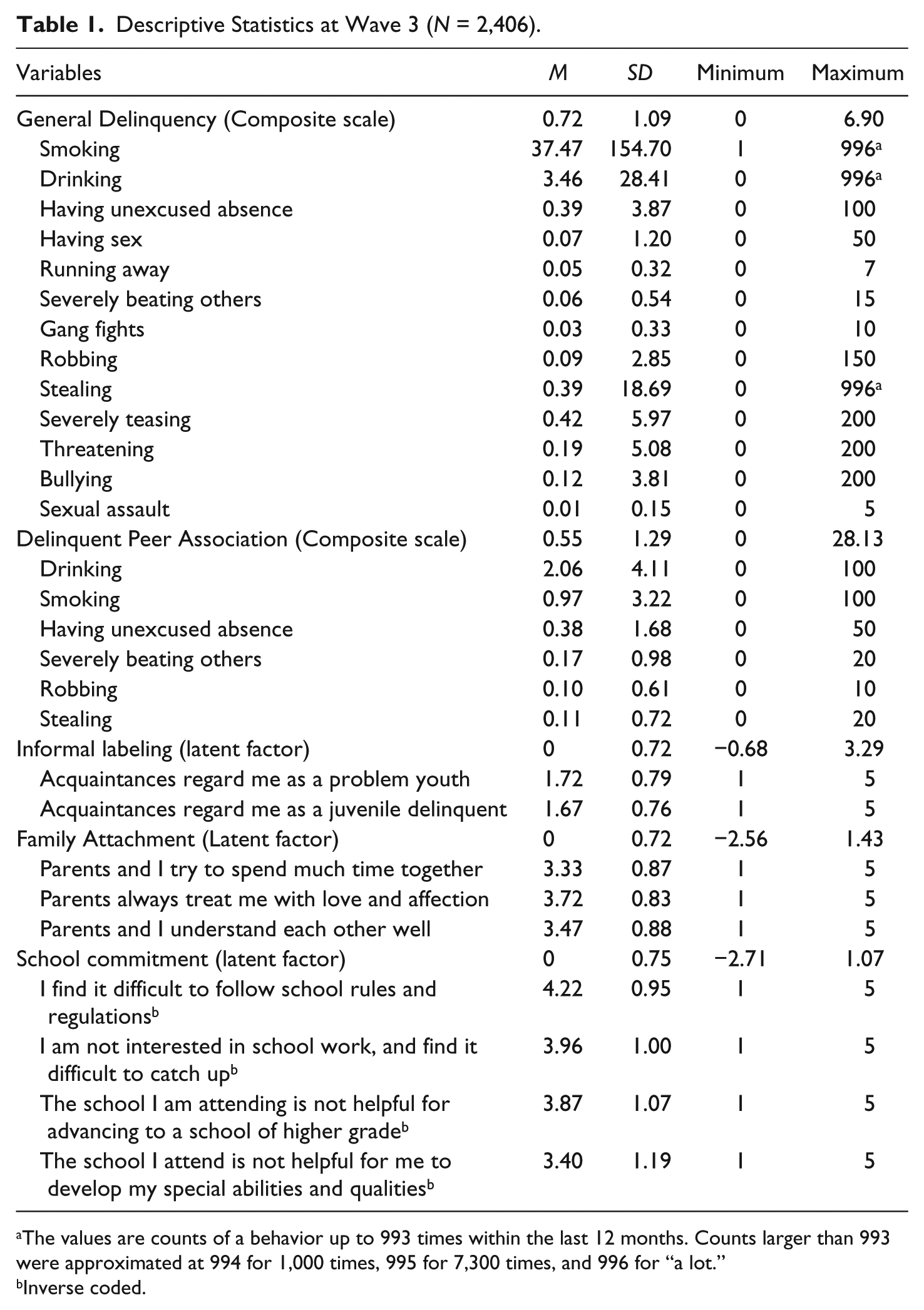
The values are counts of a behavior up to 993 times within the last 12 months. Counts larger than 993 were approximated at 994 for 1,000 times, 995 for 7,300 times, and 996 for “a lot.”
Inverse coded.
As a proxy measure for subcultural affiliation, a composite scale of delinquent peer association was created with eight indicators for the prevalence of close friends’ status offenses and serious crimes. Similar to the general delinquency scale, this is an additive scale and counts the number of friends who were involved in either status or serious offense (see Table 1).
Measurement model with cognitive indicators, as opposed to behavioral indicators, was administered for corresponding latent variables including informal labeling, school commitment, and family attachment. Three indicators of closeness with parents were used for family attachment, while school commitment was measured with four indicators of how likable or beneficial schooling is to a respondent. For informal labeling, two indicators measured reflected appraisal of self as a delinquent. All of the indicators for informal labeling, family attachment, and school commitment were measured in Likert-type scale, ranging from 1 (very untrue) to 5 (very true). This study utilized confirmatory factor analysis. Because some of the indicators deviated from the normal distribution in frequency, an asymptotic variance-covariance matrix was additionally used for robust maximum likelihood estimation (see Joreskog, Sorbom, du Toit, & du Toit, 2003). Table 2 presents factor loadings, communalities, and reliability statistics for a measurement model at Wave 3 of KYPS. 4
Parameter Estimates for the Measurement Model for Wave 3 (N = 2,406).

Note. All estimates were significant at p = .05.
Regarding informal labeling, the relative factor loading for reflected appraisal as a problem youth was 0.953, when fixing the loading for reflected appraisal as a juvenile delinquent at 1. The model explained at least 86.6% of the variance for any indicator. Cronbach’s alpha statistics were generated as a reliability measure and was .93 for the two indicators of informal labeling. With regard to the context-dependent labeling effect, family attachment and school commitment were included as dimensions of stakes in conformity (cf. Steiner, Makarios, Travis, & Meade, 2012). The three indicators of family attachment showed high factor loadings, and the model accounted for their variance at the minimum of 45.7%. The Cronbach’s alpha statistic was .80. The four indicators of school commitment showed high factor loadings as well, but two of them were relatively unaccounted for by the model. For example, the indicator of “how helpful schooling is for advancing to a higher grade school” had 27.7% of its variance explained by the model. The Cronbach’s alpha statistic was .71. Overall, the fit indices for the measurement model appear to be within acceptable ranges. 5 In addition, the bivariate correlations among the three identified latent variables were significant and in theoretically expected directions. That is, while school commitment was positively associated with family attachment, both family attachment and school commitment were negatively associated with informal labeling.
Next, the latent structures for family attachment, school commitment, and informal labeling were extracted. Separation between measurement and structural models was necessary to extract latent variables and, in turn, create their interaction terms. 6 Also, operating the measurement and structural models simultaneously with nearly 20 variables would produce imprecise parameter estimates (see Schumacker & Lomax, 2010 for details). Once the measurement model extracted the standardized latent variables, the interaction terms were generated using a simple multiplication method. 7 Since delinquent peer association was not a standardized latent variable, it was centered at the mean level to avoid a multicollinearity issue in subsequent regression analysis.
Hypotheses
A structural model was built upon the hypotheses identified from the literature review. As seen in Figure 1, the model begins with general delinquency and delinquent peer association at the initial waves as exogenous variables. 8 Informal labeling, family attachment, and school commitment were regressed on the prior general delinquency and delinquent peer association. Their individual effects on both later general delinquency and delinquent peer association were estimated simultaneously. Based on the principle argument in labeling theory, the model hypothesized positive paths from prior delinquency and delinquent peer association to labeling, from labeling to subsequent delinquent peer association, from labeling to subsequent delinquency, and from delinquent peer association to later delinquency. Concerning the context-dependency, later general delinquency was regressed on the labeling interactions with delinquent peer association, family attachment, and school commitment. Those paths were nondirectional hypotheses as the vulnerability to informal labeling for varying degrees of subcultural affiliation (i.e., peer association) or stakes in conformity has not been empirically tested in the literature.
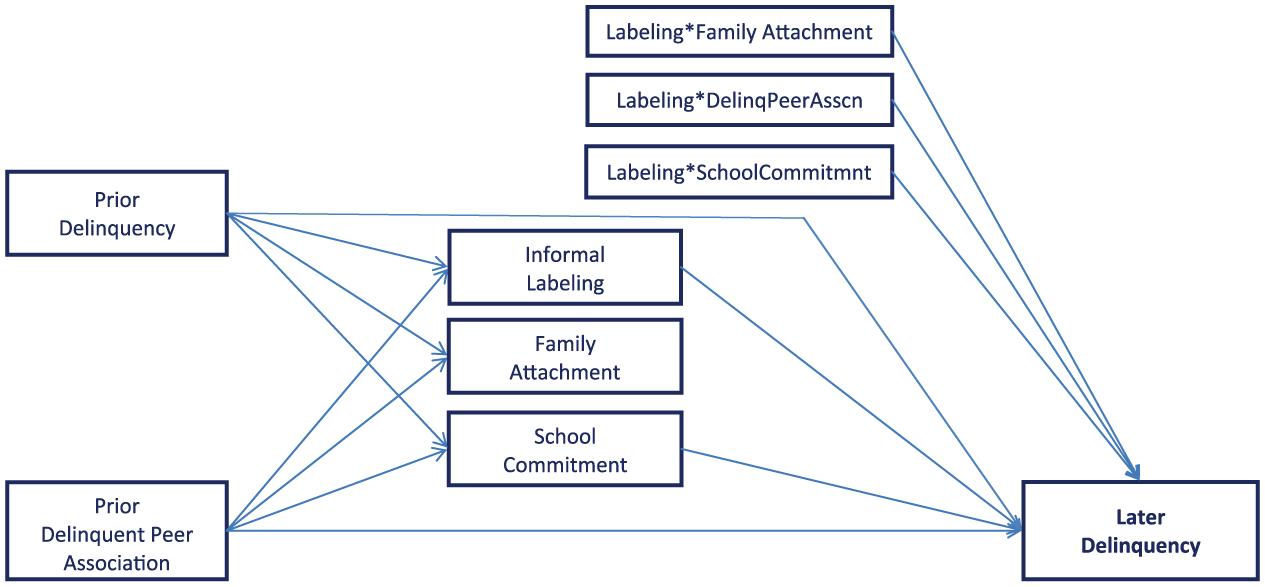
Analytic modeling.
In particular, Thornberry (1987) argued, and J. Lee et al. (2014) and Hoever et al. (2012) reported, that the effect of parental attachment on delinquency appears strongest at early adolescence and then diminishes as one enters middle adolescence and becomes exposed to various subgroups. In comparison, commitment to school is likely to peak in middle adolescence (Thornberry, 1987). Because the sample students were in late adolescence, family attachment was hypothesized to have no significant net effect on general delinquency, whereas school commitment may have a direct effect on both general delinquency and delinquent peer association. The structural model, however, designated the path from family attachment to general delinquency, which was a technical necessity to assess the interaction between family attachment and informal labeling.
This study further hypothesized that the best predictors of the current perception of labeling and behavior are past perception of labeling and behavior, respectively. Thus, a stability (lagging) effect between prior and later variables was included. In further considering the conceptual relevance and temporal concurrence of variables, analyses also included contemporaneous binary correlations between informal labeling, family attachment, and school commitment, and between delinquency and delinquent peer association. 9
Findings
Table 3 reports the findings from the structural model. At both waves, informal labeling promoted both general delinquency (e.g., b = 0.172, SE = 0.070, p < .05 at Wave 3) and delinquent peer association (e.g., b = 0.198, SE = 0.088, p < .05 at Wave 3). It also appeared to deteriorate school commitment (b = −0.076, SE = 0.041, p < .10), but has no significant effect on family attachment. As was hypothesized, family attachment had no significant effect on general delinquency at either wave. In contrast, it had a significant diminishing effect on informal labeling at Wave 4 (b = −0.111, SE = 0.046, p < .05). At both Waves 3 and 4, school commitment had diminishing effects on general delinquency (e.g., b = −0.146, SE = 0.057, p < .01 at Wave 3), while it had no significant effect on delinquent peer association or informal labeling.
Regression Coefficients in the Structural Model.
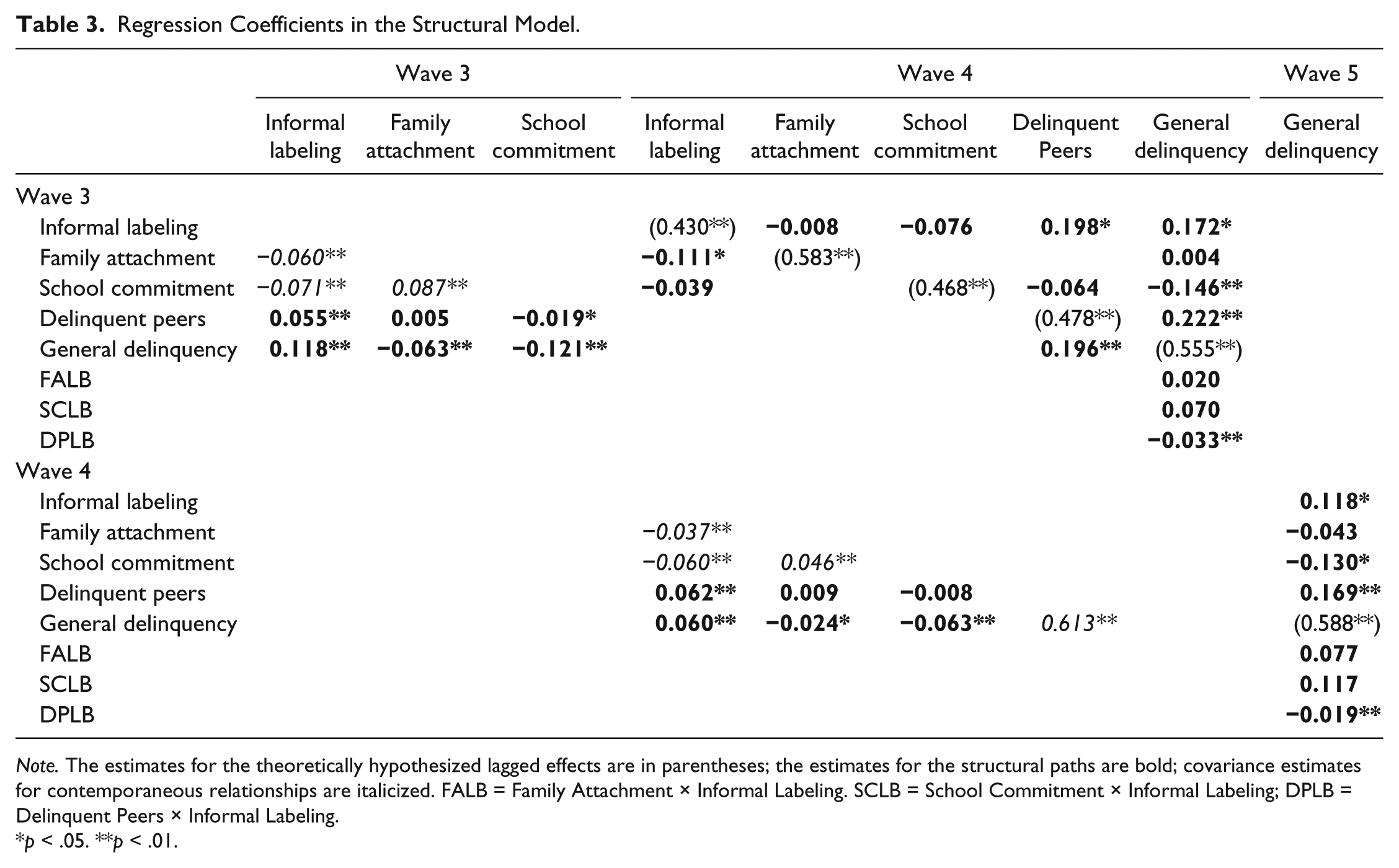
Note. The estimates for the theoretically hypothesized lagged effects are in parentheses; the estimates for the structural paths are bold; covariance estimates for contemporaneous relationships are italicized. FALB = Family Attachment × Informal Labeling. SCLB = School Commitment × Informal Labeling; DPLB = Delinquent Peers × Informal Labeling.
p < .05. **p < .01.
Next, delinquent peer association promoted both informal labeling (e.g., b = 0.055, SE = 0.010, p < .01 at Wave 3) and general delinquency at both waves (e.g., b = 0.222, SE = 0.029, p < .01 at Wave 3), whereas its deteriorating effect on school commitment was significant only at Wave 3 (b = −0.019, SE = 0.009, p < .05). It did not have a significant effect on family attachment at either wave. General delinquency attenuated both school commitment (e.g., b = −0.121, SE = 0.016, p < .01 at Wave 3) and family attachment (e.g., b = −0.063, SE = 0.014, p < .01 at Wave 3), while fueling informal labeling (e.g., b = 0.118, SE = 0.015, p < .01 at Wave 3) and delinquent peer association (e.g., b = 0.196, SE = 0.034, p < .01 at Wave 3).
The primary interest of this study was to examine the interaction between informal labeling and the social context, which was approximated by subcultural affiliation and stakes in conformity. The findings did not indicate any interaction effect of informal labeling and the two variables assessing stakes in conformity (i.e., family attachment and school commitment) on general delinquency. In contrast, at both waves, the interaction between informal labeling and delinquency peer association was significant for general delinquency (e.g., b = −0.033, SE = 0.008, p < .05 at Wave 4). Considering the temporal gap in the measures between delinquent peer association and informal labeling, a logical interpretation is that the informal labeling effect on general delinquency was weaker at a higher level of delinquent peer association. 10 Mathematically, the estimated regression equation for general delinquency at Wave 5 appeared as follows:

where delinquent peer association ranges from −0.6 to 21.9 with mean of 0 and standard deviation of 1.32. Computation of the labeling effect using two standard deviations below the mean, and two standard deviations above the mean of delinquent peer association level resulted in 0.168, 0.118, and 0.068, respectively, indicating a decreasing trend.
The findings corroborated a stability effect for all variables between the consecutive waves, and all contemporaneous correlations between relevant variables. In particular, the high stability effect of delinquency is congruent with the aforementioned state of adolescents’ reoffending (e.g., b = 0.588, SE = 0.019, p < .00, for the regression path from general delinquency at Wave 4 to Wave 5). Concerning the structural model fit, the indices appear to be within acceptable ranges. 11
Discussion
Labeling theory illuminates both the dynamics of deviance amplification as well as the contexts under which adolescents are more (or less) likely to recidivate. A wrongdoing is appraised by others, and the others’ appraisal dominates one’s self-identity over time. The process may lead to involvement in a deviant subculture who further support the wrongdoing and eventually become more influential than general others during the period of mid- and late adolescence. The level of the labeling effect may also depend on a person’s commitment to their group or culture. Put differently, there may be a moderating effect of subcultural association and stakes in conformity on informal labeling. This study also points out the dearth of empirical studies of informal labeling in Asian context. Therefore, South Korean youths’ self-report survey data were used for the structural modeling.
The current findings suggest that neither family attachment nor school commitment interact with labeling processes. Moreover, a lesser magnitude of delinquent peer association, which may reflect higher bonding to conventional institutions, appears to strengthen the informal labeling effect on delinquency. These findings resonate with Hirschfield’s (2008) findings that those with greater association with delinquent peers tend to be impervious to stigmatization, while contradicting Sherman’s (1993) argument that stigmatic labeling for a person with a poor bonding to conventional institutions would facilitate further deviance. Also, both informal labeling and schooling appear to have an independent effect on delinquency. This line of research sheds light on the aforementioned collectivist nature of Korean society and the unique education system where schooling dominates adolescents’ daily life. An average person in a highly collectivist society is more exposed to others and more perceptive of others’ appraisals such that she or he is more likely to be subjected to stigmatic labeling than a similarly situated person in an individualistic society. However, associating with delinquent peers would generate strong ties particularly in a collectivist society, rendering a safeguarding effect against stigmatic labeling. If the societal culture is truly responsible for the current findings, it would be logical to assume that the model would produce different findings for U.S. adolescents. That is, a person in an individualistic society would pay less attention to others and stay robust to stigmatic labeling. However, the United States is geographically and culturally diverse enough to defy casual generalization. If the labeling process hinges on social and cultural context, different generations and different locations across the United States would warrant a unique context for labeling effect on behavior. Perhaps a conservative conclusion would be to call for replication with the contemporary United States adolescent population or a comparison between South Korea and the parts of the United States. The current study could provide the theoretical and methodological bases to support comparative studies.
Limitations
This study is not without limitations. Regarding construct validity, a broad scope of informal labeling is used, which is reflected appraisal of the self by acquaintances, while the general delinquency scale includes both status offense and serious crimes. However, Adams et al. (2003) found differential effects among family, teacher, and peer labeling on different types of delinquency. Therefore, it is unclear whether the findings would remain the same if other dimensions of informal labeling or general delinquency were examined.
However, the reason for a broad definition of general delinquency was the extremely few cases for several types of delinquency requiring aggregation across delinquency and crime types. However, this may be just another social context that exhibits a differential labeling effect across cultures and societies. For example, the relative dearth of delinquency in South Korea may render a stronger labeling effect because the stigmatic reaction from general others would be more severe than in countries with higher rates of delinquency and less collectivism. This rationale resonates with the aforementioned need for replication in another cultural context and across forms of delinquency and crime.
Another measurement validity issue is the delinquent peer association as a proxy for subcultural affiliation. The degree to which peers are involved in delinquent behaviors is measured by the individual respondent, relying on his or her limited observation. It is plausible that a person may not know the full extent of a peer’s behavioral issues. Although this study and data set cannot address this methodological limitation, the current approach of using self-reported peer delinquency is widely used in the literature. Future studies may benefit from developing a cross-reference scheme to accurately measure a person’s affiliation or exposure to subculture through peer association.
Conclusion
This study began with the call for attention to adolescents’ reoffending. Barring a societal response preventing adolescents from becoming involved in delinquency in the first place, keeping them from recidivating should be of paramount concern. Labeling theory in an interactionist perspective provides a framework in which to assess various components of adolescents’ lives to determine where reaction to delinquency is most pertinent. This study contributes to the literature by acknowledging the importance of social and cultural contexts in bolstering our effort to minimize juvenile delinquency and repeat offending.
Footnotes
Declaration of Conflicting Interests
The author(s) declared no potential conflicts of interest with respect to the research, authorship, and/or publication of this article.
Funding
The author(s) received no financial support for the research, authorship, and/or publication of this article.