



Abstract
It is commonly assumed that victims of sexual abuse feel more negatively toward sex offenders and advocate for harsher punishments than individuals who have not been victimized. This belief was examined by comparing attitudes toward sex offenders and their treatment, support of registration, notification, and residence restriction policies, as well as general knowledge about sex offenders between a sample of 129 individuals who reported sexual victimization and a sample of 841 individuals who did not report sexual victimization. Overall, we found that victims of sexual abuse reported more positive attitudes toward sex offenders and were more supportive of mandated treatment compared with nonvictims. However, while victims showed decreased support for the community notification laws, there were no differences in support of residence restrictions laws compared with those who reported no victimization. Finally, knowledge about sex offenders predicted attitudes regardless of victim status. These findings are discussed as they pertain to sex offender treatment and legislation.
Sexual assault is a serious concern. It is estimated that nearly one out of every five women has experienced rape (Centers for Disease Control and Prevention, 2012) and that one in six boys and one in four girls are sexually abused before the age of 18 (National Sexual Violence Resource Center, 2015). However, only one in 20 of these cases of sexual abuse is actually reported to or identified by authorities (Hornor, 2010) and thus these statistics underscore the prevalence of sexual violence in our society and consequently beg the question—What can be done to stop this from happening?
Our current legislative efforts directed toward sexual violence reduction were established within the last 20 years, usually following the tragic sexual assault, kidnapping, and/or murder of children (Calkins, Jeglic, Beattey, Zeidman, & Perillo, 2014). In many of these cases, the murdered children’s parents became advocates for criminal justice reform and consequently many of the legislative initiatives directed toward sex offenders have been named for these children. The first national U.S. law was enacted in 1994, following the kidnapping and murder of an 11-year-old boy in Minnesota (Jacob Wetterling Act, 1994), and required certain sex offenders convicted of sexually violent crimes to register on a state-based sex offender registry (Petrunik, 2002; Sample & Bray, 2006). The Wetterling Act required all 50 states to create and maintain a registry that tracked offenders. Furthermore, the states were required to confirm sex offenders’ place of residence every year between 10 years to life, depending upon the gravity of the crime. States that did not establish a registry would forfeit 10% of federal funding for state and local law enforcement (Petrunik, 2002; Sample & Bray, 2006). In 1996, following the rape and murder of 7-year-old Megan Kanka in New Jersey by a twice-convicted sex offender, the sex offender registry came to national attention and Megan’s Law was enacted nationally as a subsection of the Jacob Wetterling Act. This Act mandated that all 50 states must develop and maintain publicly available state-based sex offender registries (Calkins et al., 2014).
The most recent sex offender registration legislation—The Adam Walsh Child Protection and Safety Act (Sex Offender Registration and Notification Act [SORNA])—was passed in 2006 and named for 6-year-old Adam Walsh who was abducted and murdered (Freeman & Sandler, 2010; Schiavone & Jeglic, 2009). The enactment of SORNA created a new baseline standard for the implementation of sex offender registration and notification nationally. This federal law requires all states to maintain and publish information concerning sex offenders’ whereabouts on the National Sex Offender Registry and requires that sex offenders be classified into one of three tiers based on their offense conviction (McPherson, 2007). SORNA also expanded registration requirements to include certain juvenile sex offenders (Freeman & Sandler, 2010).
Next to SORNA and the Jacob Wetterling Act, additional laws targeting sex offenders have been passed in recent years. One example of such legislation is residence restriction statutes that have been implemented in 30 states and many jurisdictions (Colombino, Mercado, & Jeglic, 2009). This geographical approach to reducing recidivism among sex offenders prohibits registered sex offenders from residing and loitering within close proximity to places where children congregate. These statutorily defined places include schools, parks, bus stops, playgrounds, churches, and day care centers. Prohibiting permanent residence within a specific distance (generally between 1,000 and 2,500 ft) from these places is one form of residence restriction, usually referred to as distance markers (Calkins et al., 2014). In addition, child safety or exclusionary zones are areas in which loitering within a certain distance of these child-dense locations is illegal. Whereas some states only use residence restrictions for high-risk sex offenders, other states apply these rules to all sex offenders (Calkins et al., 2014).
The Realities of Sexual Offending
As noted above, many of our current laws were developed following high profile cases involving the heinous sexual abuse and often the murder of an innocent child. While these children could no longer speak for themselves, their parents in many cases became advocates for legislative reform. As tragic as they are, these cases do not reflect the reality of most sexual abuse cases. In fact, most of these laws are largely premised upon inaccurate beliefs, myths, and misconceptions about the degree to which sex offenders reoffend and their relationship to the victim (Sample & Bray, 2003). For example, the majority of sex offender laws are designed to prevent recidivistic sex crimes and are based on the belief that most sex offenders reoffend (Sample & Bray, 2003). However, research suggests that sex offenders have the lowest reoffending rate among all types of offenders (Center for Sex Offender Management, 2000; Langan, Schmitt, & Durose, 2003). In a large meta-analysis of 82 recidivism studies comprised of 29,450 sex offenders, Hanson and Morton-Bourgon (2005) found a sexual recidivism rate of 13.7% and a general recidivism rate (reoffending with any criminal behavior) of 36.2% over an average of a 5- to 6-year follow-up period. Comparatively, recidivism rates for burglary and larceny are approximately 75% over a similar follow-up period (Levenson & D’Amora, 2007). Furthermore, Sandler, Freeman, and Socia (2008) found that only 5% of sex crimes were committed by those who could have been on the registry at the time of their offenses; thus, the majority of sexual offenses were committed by first-time offenders, suggesting that registration and notification laws would do little to prevent these crimes. Studies examining the effectiveness of sex offender registries in Iowa, Wisconsin, New York, and New Jersey found no evidence that sex offender registries decreased recidivism (Adkins, Huff, & Stageberg, 2000; Sandler et al., 2008; Zevitz, 2006; Zgoba, Levenson, & McKee, 2008).
Another erroneous assumption that has fueled the development of residence restriction laws is the “stranger danger myth,” which refers to the belief that sex offenses are often perpetrated by strangers and that strangers are meeting and assaulting their victims in areas where children congregate, such as schools and playgrounds (Colombino et al., 2009). Contrary to this belief, the majority of sexual offenses are in fact committed by people known to the victim. Snyder (2000) found that only 13.8% of sexual offenses are committed by a stranger; while in 26.7% of sexual abuse cases, the perpetrator is a family member, and in 59% of cases, the offender is an acquaintance of the victim. Furthermore, a study of 405 sex offenders who committed crimes against children found that most sex offenders (75%) met the victims in private settings, whereas only 6.8% of all extra familial offenders first made contact with the victim in a location that is statutorily defined as illegal under residence restriction laws (Colombino et al., 2009). Moreover, several studies have found that sex offenders who had recidivated were randomly located and did not reside closer to child-dense areas than nonrecidivists (Colombino et al., 2009; Levenson, 2006). Another study found none of the examined cases of sexual recidivism in their sample could have been prevented due to residence restrictions (Levenson, Zgoba, & Tewksbury, 2007).
There is also a significant body of research showing that sex offender laws may not only be ineffective but may also increase the risk for recidivism by destabilizing sex offenders as they are released back into the community (Bonnar-Kidd, 2010). These collateral consequences of sex offender legislation can result in difficulty finding jobs, housing, and social support upon release thereby negatively affecting desistance (Levenson, 2008; Levenson & Cotter, 2005a, 2005b; Levenson, D’Amora, & Hern, 2007; Mercado, Alvarez, & Levenson, 2008; Socia, Levenson, Ackerman, & Harris, 2015).
Sex Offender Legislation—The Role of the Victim
Despite their documented ineffectiveness, one argument that is often used to justify retributive approaches toward sex offenders is that these laws provide justice and safety for victims of sex crimes. It is often presumed that punishing the offender will help the victims’ healing process (Wenzel & Thielmann, 2006). As the majority of sex offender laws are named for victims, this has resulted in the widely held belief that victims would hold more punitive views toward sex offenders compared with the general public. In fact, one study of state legislators found that the majority of state-based sex offender laws were proposed or supported by the legislators in part because of a specific instance of victimization to provide justice for the victim (Meloy, Curtis, & Boatwright, 2013). However, we do not know what those who have been most affected by sex crimes think. While current legislation has consistently shown to be ineffective at preventing recidivism, enactment of these laws may serve as a way to protect and support victims and to help with their healing process. However, if victims—arguably the largest stakeholders in the development of such laws—are not supportive of the legislation, then we should work together to develop evidence-based laws that make sense and are informed by those who are most affected.
Surprisingly, there has been little investigation in general about victims’ beliefs about legislation development. Overall, there is evidence that victims of any crime are often dissatisfied about being neglected throughout the criminal justice process; this dissatisfaction does not necessarily stem from lenient punishment (Strang & Sherman, 2003). Rather, victims report that their frustration results from their treatment throughout the process. For instance, in one study, crime victims reported that they felt a lack of respect and fairness in the treatment they received from the justice system, and they also felt that they did not get enough information about developments in their case (Strang & Sherman, 2003). In fact, previous research has found that victims do not have strong feelings of anger and vengeance toward their perpetrators, but rather are open to considering alternatives to imprisonment for those that offended against them (Strang & Sherman, 2003). Orth (2004) found that perpetrator punishment only led to transitory satisfaction among victims of violent crimes and that feelings of revenge were not influenced by the severity of perpetrator punishment in the long run, although few of these studies have focused specifically on victims of sexual abuse. Furthermore, as many of the victims of sex crimes are children, we know little about how they feel about what should be done and how this affects them when they are older.
While the criminal justice philosophy in the United States is largely punitive in nature, there are some who advocate for a restorative justice approach (Bazemore, 1998; Zehr, 1990). According to this framework, justice is not served by merely punishing the offender and providing them treatment, but rather one must consider more broadly who was hurt by the crime and how the offender can work to heal this pain (Bazemore, 1998; Zehr, 1990). This philosophy emphasizes the role of the victim and the community in the justice process. With the possible exception of victim impact statements at sentencing and parent advocates, victims of sexual violence have been largely neglected in the development and implementation of sexual violence prevention policies. However, if we incorporate the philosophy of victim healing, it is imperative to know what victims of sexual abuse think about sex offenders, sex offender legislation, and what the appropriate sanctions for perpetrators of sex crimes should be.
Unfortunately, to date, we know little about how victims view sex offenders and sex offender legislation, and the research that has been done has produced mixed results. For example, whereas Hogue and Peebles (1997) did not find differences in attitudes toward sex offenders based on history of sexual victimization, a more recent study by Ferguson and Ireland (2006) suggested that individuals who experienced sexual abuse had more positive attitudes toward sex offenders than nonvictims. However, it is important to note that this study did not differentiate between individuals who had been abused themselves and individuals who were close to others who had been sexually abused (they had not been sexually abused themselves). Furthermore, to our knowledge, no studies to date have investigated sexual abuse victims’ attitudes toward the treatment or punishment of sex offenders.
Attitudes Toward Sex Offenders and Sex Offender Legislation
While we do not know much about the beliefs of victims, several studies have examined public and professionals’ attitudes and knowledge regarding sex offenders and sex offender policies. Overall, the research has shown that those who are exposed to sex offenders through their work environment generally have more positive attitudes toward sex offenders (see Harper, Hogue, & Bartels, 2017, for a review; see also Gakhal & Brown, 2011; Tewksbury, Mustaine, & Payne, 2011, 2012) than the attitudes of the general public (e.g., Hoing, Tetrina, Duke, Vollm, & Vogelvang, 2016; Willis, Malinen, & Johnston, 2013).
Other studies have specifically examined public and professional attitudes toward sex offender legislation. For example, in a sample of 193 community members in Florida, Levenson, Brannon, Fortney, and Baker (2007) found that the majority of participants (83%) viewed community notification as an effective strategy to reduce sex offenses. Furthermore, most participants (76%) believed that all sex offenders should be subject to notification laws. Similarly, Proctor, Badzinski, and Johnson (2002) as well as Brannon, Levenson, Fortney, and Baker (2007) found that the respondents in their studies were highly supportive of notification laws and believed in the effectiveness of these laws to protect society. However, another study by Schiavone and Jeglic (2009) found that while most of the participants in their national sample supported community notification (Megan’s Law), the majority did not necessarily believe in its effectiveness. In contrast, Levenson, Fortney, and Baker (2010) surveyed professionals working in the sexual abuse field and found that less than half of them partially or completely agreed with community notification policies and those with more knowledge of sex offenders showed less confidence in notification polices (Levenson et al., 2010). Furthermore, Tewksbury and colleagues (2011, 2012) found that while community corrections officers endorsed moderate levels of support for various sex offender laws, they felt that the sex offender registry contained too much information and sex offender whereabouts should only be distributed upon community member request.
Support for residence restriction laws is somewhat lower compared with notification laws. Levenson, Brannon et al. (2007) found in their sample of 193 Florida residents that only 58% believed that residence restriction would be an effective strategy to reduce sex offenses, while Schiavone and Jeglic (2009) found that only 37% of their 115 respondents from a nationwide online community board agreed or strongly agreed that residence restrictions help to prevent sexual offending (Schiavone & Jeglic, 2009). Furthermore, among professionals working in the sexual abuse field, only one quarter believed that sex offenders should be prohibited from living in communities (Levenson et al., 2010).
One nonlegislative option for preventing sexual violence is sex offender treatment. However, many people still believe that sex offenders are untreatable (Quinn, Forsyth, & Mullen-Quinn, 2004). While more high-quality treatment studies are necessary, there is mixed evidence for sex offender treatment (Schmucker & Lösel, 2015) with some studies showing that sex offender treatment is related to decreased recidivism (see Lösel & Schmucker, 2005, and Schmucker & Lösel, 2008, for a review). Despite potentially promising treatment options, the public still supports punitive sex offender policies and are skeptical about the benefits of treatment (Levenson & Cotter, 2005a; Levenson, Brannon et al., 2007). Brown (1999) also found that even though the public supported the treatment of sex offenders within prisons, the majority of the respondents did not support treatment in the community and were unwilling to accept rehabilitated offenders back into their community. Among professionals, Levenson, Fortney, and Baker (2010) and Ferguson and Ireland (2006) found that the majority of their sample of professionals working in the sexual abuse field believed in the benefits of treatment, whereas Johnson, Hughes, and Ireland (2007) found that probationer police officers were not more supportive of treatment and rehabilitation compared with the general public.
Taken together, these findings suggest that increased contact with sex offenders in a professional context is likely to result in more positive attitudes toward them and their treatment and less support for sex offender legislation. However, given that victims have more knowledge about the perpetrators of sexual abuse and in most cases these perpetrators are individuals known to them and family members, it is unclear whether their beliefs will be more reflective of those of professionals or those of the general public.
Current Study
The goal of the current study is to examine how those who have experienced sexual victimization feel about sex offenders, sex offender legislation, and the treatment of sex offenders, as well as their general knowledge about sex offenders as compared with those who have not experienced sexual victimization. Many of the current sex offender policies were created by state legislators after highly publicized cases involving child victims in an effort to provide justice for the victims—this largely resulted in reactionary laws that are not evidence based (Meloy et al., 2013). Furthermore, there is evidence to show that not only are these laws not effective but they actually may destabilize sex offenders upon reentry. Given that those who have been victimized arguably have the most at stake when it comes to sexual violence prevention policy, it is important to get a better understanding of their knowledge, beliefs, attitudes, and perspectives in an effort to modify these existing laws so that we can develop evidence-based legislation and interventions for the prevention of sexual violence that take into account stakeholder perspectives that can best promote healing.
Specifically, this study examined general knowledge and attitudes toward sex offenders, attitudes toward sex offender treatment, and attitudes toward the effectiveness of sex offender legislation and policy. Based on the extant literature, it is hypothesized that sexual abuse victims will show less negative attitudes toward sex offenders and their treatment and have more knowledge about sex offenders in general, compared with those who had not been victimized. Furthermore, we anticipate that those who have been victimized will report less support for sex offender legislation and policy.
Method
A total of 1,173 undergraduate psychology students from an urban public northeastern U.S. college participated in an online study examining attitudes toward offender populations. Participants were primarily female (74%, n = 873) and their ages ranged from 17 to 46 years old (M = 20.61, SD = 6). The students were invited to participate in the study in exchange for course credit. Participants were racially diverse; 48% (n = 568) identified as Hispanic, 15% (n = 182) as African American, 17% (n = 200) as Caucasian, 13% (n = 152) as Asian, and 6% (n = 30) identified as American Indian, Alaskan Native, or Pacific Islander. A history of sexual abuse was reported by 11% (n = 129) of the participants. Of those who reported a personal history of sexual abuse, 7% reported that they were abused by a stranger (n = 9), thus the large majority (93%, n = 120) knew the abuser before the assault. Within this group, most participants reported to have been abused by a family member (33%, n = 43), 18.6% (n = 24) by an acquaintance, 15.5% (n = 20) by a friend, and 11.6% (n = 15) by a significant other. On average, participants were 9 years old when the abuse occurred.
Procedure
All participants completed an informed consent form before they were directed to the online survey site. Consenting participants were asked to complete a series of questionnaires, including the Sex Offender Knowledge Quiz, the Sex Offender Laws survey, the Community Attitudes Toward Sex Offenders Scale (CATSO; Church, Wakeman, Miller, Clements, & Sun, 2008), the Attitudes Toward the Treatment of Sex Offenders Scale (ATTSO; Wnuk, Chapman, & Jeglic, 2006), and the Sexual Experience Survey. After participants completed the questionnaires, they were debriefed and thanked for their participation and all participants received information about resources they could contact in case of feelings of distress. The study was reviewed and approved by the University’s Institutional Review Board.
Materials
Sex Offender Knowledge Quiz
This “true or false” quiz was developed to assess the public’s general knowledge of sex offending (see the appendix). It included 26 items comprising common misperceptions and facts about sex offender characteristics, crimes, and reoffense rates. It was scored by adding up the correct answers given by the participants. A literature review was conducted to select items, while most statements were retrieved from an overview of myths and facts about sex offenders provided by the Center for Sex Offender Management (2000). All items were reviewed by an expert in the field of sex offender research for content validity.
CATSO
The CATSO is an 18-item survey that aims to measure attitudes, perceptions, and stereotypes concerning sex offenders (Church et al., 2008). Participants are asked to rate their opinions and beliefs on a 6-point Likert-type scale ranging from strongly disagree to strongly agree. In our sample, Cronbach’s alpha was .79 for the total CATSO scale. The internal consistency of the four subscales ranged from α = .38 to .79 (Severity/Dangerousness, α = .48; Deviancy, α = .75; Social Isolation, α = .38; Capacity to Change, α = .79).
ATTSO
The original ATTSO scale consists of 35 items and was designed to examine public attitudes toward the treatment of sex offenders (Wnuk et al., 2006). Each individual item is rated on a 5-point Likert-type scale, ranging from strongly disagree to strongly agree (Wnuk et al., 2006). Wnuk et al. (2006) found that only 15 of the 35 items theoretically and statistically function well; thus, only these 15 items were included in our analysis. Subscales include attitudes of Incapacitation, Treatment Ineffectiveness, and Mandated Treatment. Cronbach’s coefficient alpha for this sample yielded good internal consistency for the total score (α = .83) as well as the subscales (Incapacitation, α = .89, Treatment Ineffectiveness, α = .42, Mandated Treatment, α = .87).
History of sexual abuse
To assess whether participants have experienced sexual abuse, we asked them “Have you ever experienced sexual abuse” to which they responded “yes” or “no.” Then, we asked further details about the context of the abuse, the relationship with the perpetrator, and the participant’s age at the time of the sexual assault.
Megan’s Law Survey
This questionnaire is based on the Levenson and Brannon et al. (2007) questionnaire that was developed to examine perceptions of sex offender policies. For the present study, we used a revision by Schiavone and Jeglic (2009) for a nonoffending sample. Questions concerned the public perception of Megan’s Law and residence restriction, stigma-related variables, vigilantism, recidivism, and the perceived effectiveness of the current sex offender laws. While the majority of questions are rated on a 5-point Likert-type scale (ranging from strongly disagree to strongly agree), some of the questions are rated as “no,” “yes,” or “I don’t know.” Cronbach’s coefficient alpha yielded adequate internal consistency (α = .75) for this sample.
Results
The first objective of the present study was to compare the attitudes toward sex offenders, their treatment, and opinions regarding sex offender notification laws and residence restrictions, as well as knowledge about sex offenders between victims of sexual abuse and those who did not experience sexual abuse. Independent samples t tests were conducted to determine whether there was a significant difference between groups.
Attitudes Toward Sex Offenders
Means and standard deviations for the CATSO total and subscale scores are presented in Table 1. Overall, victims of sexual abuse had significantly more positive attitudes toward offenders (M = 52.98, SD = 8.59) compared with nonvictims (M = 55.19, SD = 9.02), t(860) = −2.418, p = .016, on the total CATSO score. An analysis of the subscales revealed significant differences on the Severity subscale, t(924) = −3.500, p = .000, and Deviancy subscale, t(943) = −3.095, p ≤ .05, indicating victims held more positive attitudes toward sex offenders on these concepts. No significant differences were found on the subscales of Social Isolation or Capacity to Change, t(926) = −0.259, p = .795.
Differences Between Sexual Abuse Victims and Nonvictims on the CATSO Scale.

Note. CATSO = Community Attitudes Toward Sex Offenders scale.
p < .05. **p < .01.
Attitudes Toward Sex Offender Treatment
Means and standard deviations for the ATTSO scale are presented in Table 2. There was no significant difference between sexual abuse victims (M = 35.96, SD = 10.38) and individuals who did not report a history of sexual abuse on the ATTSO total score (M = 36.47, SD = 8.65), t(904) = −0.585, p = .61. Furthermore, no significant differences between groups were found on the Incapacitation, t(914) = −0.111, p = .911, or the Treatment Effectiveness subscales, t(950) = .306, p = .759. However, sexual abuse victims reported more favorable attitudes toward mandatory treatment (M = 5.61, SD = 2.55), compared with nonvictims (M = 6.2, SD = 2.56), t(951) = −2.4, p = .017.
Differences Between Sexual Abuse Victims and Nonvictims on the ATTSO Scale.
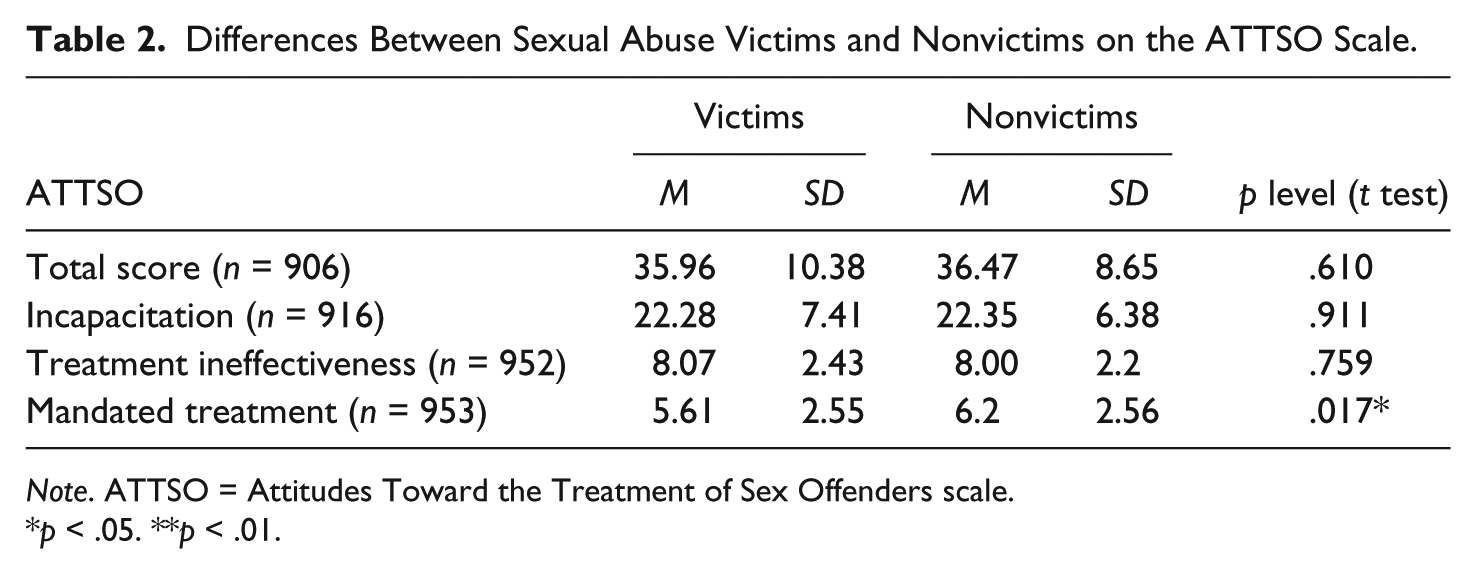
Note. ATTSO = Attitudes Toward the Treatment of Sex Offenders scale.
p < .05. **p < .01.
Sex Offender Laws Survey
Victims of sexual abuse (M = 31.78, SD = 4.44) were significantly less likely to support community notification laws, compared with those who did not report abuse (M = 32.61, SD = 4.2), t(913) = −2.0, p = .045. However, there was no significant difference between victims of sexual abuse (M = 25.39, SD = 4.33) and nonvictims (M = 25.45, SD = 4.05), t(904) = −.137, p = .891, in their support concerning residence restriction laws.
Knowledge About Sex Offenders
An independent-samples t test revealed that there was a significant difference between a history of sexual abuse and knowledge, indicating greater levels of knowledge among sexual abuse victims (M = 28.4, SD = 2.05) compared with nonvictims (M = 27.98, SD = 2.16), t(964) = 2.032, p = .042. Point-biseral correlations were conducted to investigate the level of knowledge among the different attitudes toward sex offenders. Greater knowledge about sex offenders significantly correlated with higher scores on the CATSO (r = −.375, n = 897, p =.000), ATTSO (r = −.413, n = 911, p = .000), the community notification laws (r = −.150, n = 981, p = .000), and the residence restriction laws (r = −.142, n = 976, p = .000), which indicates that a higher level of knowledge is related to more positive and less punitive attitudes toward sex offenders.
To test the relative importance of general knowledge about sex offenders on attitudes, a multiple linear regression analysis was conducted including knowledge and history of sexual abuse as predictors to the CATSO and ATTSO scores as well as the Sex Offender Laws survey (n = 1,173). For the total CATSO score, a significant regression quotation was found, F(2, 855) = 72.028, p < .005, explaining 14% of the total variance. Both knowledge (p < .005) and sexual abuse (p < .05) independently predicted the CATSO total score, as well as Severity, F(2, 919) = 49.953, p < .005, R2 of .098, and Deviancy, F(2, 938) = 29.843, p < .005, R2 of .06. Social Isolation, F(2, 919) = 11.516, p < .005, with an R2 of .042, and Capacity to Change, F(2, 921) = 54.371, p < .005, with an R2 of .106, were significantly predicted by knowledge (p < .005), but not by a history of sexual abuse (p = .064, p = .068). Regression coefficients and standard errors for the CATSO scale are presented in Table 3. For the total ATTSO score, a significant regression quotation was found, F(2, 900) = 91.198, p < .005, explaining 16. 9% of the total variance. Only knowledge (p < .005) but not sexual abuse contributed significantly to the prediction of the total ATTSO score (p < .808), Incapacitation (p < .528), Treatment Ineffectiveness (p < .301), and Mandated Treatment (p < .053). Furthermore, the multiple regression model significantly predicted Incapacitation, F(2, 910) = 80.703, p < .005 with an R2 of .151, Treatment Ineffectiveness, F(2, 945) = 42.951, p < .005, with an R2 of .083, and Mandated Treatment, F(2, 947) = 20.001, p < .005, with an R2 of .041. Finally, the model significantly predicted the believed effectiveness of community notification laws, F(2, 908) = 14, 11, p < .00, with an R2 of .30, and the residence restriction laws, F(2, 899) = 9, 74, p < .00, with an R2 of .21. Regression coefficients and standard errors for the ATTSO scale and the Sex Offenders Laws survey are presented in Tables 4 and 5.
Multiple Regression. CATSO Scale.

Note. CATSO = Community Attitudes Toward Sex Offenders scale; B = unstandardized beta coefficient; SE B = standard error; β = standardized beta coefficient; t = test statistic; p = significance value; knowledge = level of knowledge; SA = history of sexual abuse.
p < .05. **p < .01.
Multiple Regression. ATTSO Scale.

Note. ATTSO = Attitudes Toward the Treatment of Sex Offenders scale; B = unstandardized beta coefficient; SE B = standard error; β = standardized beta coefficient; t = test statistic; p = significance value; knowledge = level of knowledge; SA = history of sexual abuse.
p < .05. **p < .01.
Multiple Regression. Sex Offender Laws.

Note. B = unstandardized beta coefficient; SE B = standard error; β = standardized beta coefficient; t = test statistic; p = significance value; knowledge = level of knowledge; SA = history of sexual abuse.
p < .05. **p < .01.
Discussion
The present study compared the attitudes toward sex offenders among victims of sexual abuse and those who did not report victimization. Overall, those who reported sexual victimization demonstrated more positive attitudes toward sex offenders than those who were not victimized. Although no differences between groups were found with respect to their attitudes toward sex offender treatment in general or their support of sex offender residence restriction laws, victims of sexual abuse were less supportive of sex offender registration and community notification laws compared with nonvictims. Across all participants, knowledge about sex offenders generally predicted more positive attitudes toward sex offenders, their treatment, and the attitudes toward sex offender legislative policies regardless of victim status.
As hypothesized, individuals who reported sexual victimization endorsed significantly more positive general attitudes toward sex offenders compared with those who did not report abuse. Although it is often assumed that victims of sexual abuse would have more negative views about sex offenders than nonvictims (Strang & Sherman, 2003), our findings challenged this belief. Victims of sexual abuse were significantly more likely than nonvictims to rate that sex offenders were less dangerous and their offenses less heinous, compared with nonvictims. Furthermore, those who were not victims were more likely than victims to view sex offenders as sexually preoccupied. However, no significant difference was found between those who were victims of sexual abuse and those who were not on the believed capacity to change or the believed social isolation of sex offenders. One possible explanation for the attitudes endorsed by victims of sexual abuse in this study might be the nature of their relationships to perpetrators—93% of participants in this study were acquainted with or related to their perpetrators and only 7% reported that they were victimized by strangers. This is in line with Snyder’s (2000) findings, that the majority of those who report victimization are victimized by someone known to them and our results provide further evidence against the “stranger danger myth.” When it is considered that most of the victims in our study knew their perpetrators, it is not surprising that their views are more positive overall. While they may abhor the behavior, the perpetrator is no longer a monster—but rather someone in their family or their community—and thus the relationship is more nuanced. Those who have not been victimized may still be influenced by media portrayals of sex offenders as strangers and monsters. For example, one study found that people view offenders who are strangers as more dangerous, unpredictable, and more likely to recidivate (Fagan & Wexler, 1987). Furthermore, dehumanization of individuals, which is often done with sex offenders, can inhibit the experience of manifestation of moral behavior and moral emotions (Cuddy, Rock, & Norton, 2007; Zebel, Zimmermann, Viki, & Doosje, 2008). Similarly, Viki, Fullerton, Raggett, Tait, and Wiltshire (2012) found that increased dehumanization of sex offenders resulted in lower levels of support for their rehabilitation. Consequently, while the general public might see sex offenders as dehumanized “monsters,” victims of sexual abuse, who know sexual offenders are family members and acquaintances, are not able to abstract them to such a level and thus may have more favorable attitudes toward sex offenders and their treatment. Another factor that might have resulted in more positive attitudes toward sex offenders by the group who reported victimization could be that they generally have more accurate beliefs and knowledge about sex offenders. For example, previous studies have shown that individuals who have more accurate knowledge about sex offenders report more positive attitudes toward sex offenders (Kleban & Jeglic, 2012; Sanghara & Wilson, 2006). It is possible that sexual abuse victims accumulated more knowledge about sexual offenders due to firsthand experience and greater involvement with individuals who committed sexual offenses, and thus they held fewer stereotypical attitudes about sex offenders.
The current study found that sexual abuse victims and nonvictims did not differ in their overall attitudes toward sex offender treatment. These results challenge the widespread assumption that sexual abuse victims are more punitive than those who have not been victimized (Strang & Sherman, 2003). However, those who were victimized more often agreed that sex offenders should receive mandated treatment compared with those who did not report sexual abuse. It might be that despite doubts about the effectiveness of treating sex offenders, sexual abuse victims still think that treatment could “not hurt” (Levenson, Brannon et al., 2007). Previous research found similar results, suggesting that the general public supports treatment despite a pessimistic view regarding its effectiveness (Brown, 1999; Levenson, Brannon et al., 2007). In this study, this was only the case among those who had reported victimization.
Furthermore, victims of sexual abuse were not more supportive of sex offender laws, compared with nonvictims. While no differences were found between groups for support of residence restriction laws, victims of sexual abuse were less likely to support community notification, compared with nonvictims. The tendency of the general public’s greater support for community notification laws as opposed to the residence restriction laws was observed in a study by Schiavone and Jeglic (2009). This trend was also found in the current study among sexual abuse victims, but not among those who had not reported abuse.
The finding that victims reported lower levels of support for registration and notification laws as compared with those who did not report abuse is an important finding. Numerous sexual crime laws have been passed in the past several years on behalf of victims (Wood, 2005). While these laws often aim to protect the public against sexual victimization through the means of punishment, it is assumed that sexual abuse victims are especially supportive of these laws. As sex offender laws were often initiated by a victim’s relatives and victims’ right groups (Wood, 2005), it is particularly noteworthy that victims themselves are not more supportive of these laws than nonvictims. Furthermore, many of these laws have been found to negatively affect the reintegration progress for released sex offenders. For instance, community notification and residence restriction policies can hinder a released sex offenders’ ability to obtain or maintain employment (Tewksbury & Lees, 2006; Tewksbury, Mustaine, & Rolfe, 2016). Moreover, residence restrictions may make it very difficult to find affordable housing (Mustaine, Tewksbury, & Stengel, 2006) and may result in transience, as individuals often cannot find permanent housing and are required to move frequently (Clarke, 2016). Another consequence of these laws is that released sex offenders often report losses in social and romantic relationships (Tewksbury & Lees, 2006; Tewksbury & Zgoba, 2010), stigmatization (Tewksbury & Zgoba, 2010), feelings of shame, embarrassment, and isolation (Mercado et al., 2008), as well as harassment (Tewksbury & Lees, 2006). It has been argued that these laws destabilize the offenders, thereby increasing their risk to recidivate (Tewksbury & Zgoba, 2010). Thus, if those most affected by sexual violence are not wholly supportive of such policies and they may actually increase risk, then it is worthwhile to reevaluate the purpose of such policies.
Taken together, victims of sexual abuse showed more positive attitudes toward sex offenders and demonstrated similar views toward treatment and punishment of sex offenders as those who were not victimized. This contradicts previous research that has found victim attitudes toward sex offenders to be related to punishment. For example, Church, Sun, and Li (2011) found that attitudes toward sex offenders were significantly related to attitudes toward the treatment of sex offenders. Furthermore, Hogue and Peebles (1997) found negative attitudes toward sex offenders to be strongly related to more punitive sentencing in a sample of 50 professionals who worked with victims and/or perpetrators of sexual assault. Interestingly, attitudes toward sex offenders were shown to be more effective in discriminating different sentencing options (jail vs. probation) than the offense severity. More specifically, this study showed that attitudes alone were able to classify the choice of sentencing options in 65% of all cases (Hogue and Peebles, 1997).
Consistent with previous studies (Kleban & Jeglic, 2012; Sanghara & Wilson, 2006), the current study also found that individuals with more knowledge about sex offenders were more likely to have more positive attitudes toward this offender group regardless of victim status. Greater knowledge surrounding sex offenders significantly predicted more positive attitudes toward sex offenders and their treatment. These results are in line with previous research, which has found a positive change in attitudes toward the treatment of sex offenders after participants had been educated about the realities of sex offenders and their treatment (Kleban & Jeglic, 2012). Similarly, Redlich (2001) also found that knowledge predicted attitudes regarding the effectiveness of sex offender policies, such that participants who had greater knowledge about sex offenders were less supportive of the offender notification law and residence restriction laws than those who did not report victimization.
Limitations
The present study is not without limitations. First, we relied on participant self-reports to categorize participants as victims of sexual abuse. As the perception of victim status varies by individual, there may be some individuals who did not view their experiences as sexual abuse and thus do not consider themselves as victims of sexual abuse. However, given that official reports often represent significant underreporting of sexual victimization, confidential self-reports may be a more accurate representation of victimization. In addition, the majority of the individuals in our study who reported victimization were sexually abused by someone known to them (93%)—while this is higher than many of those who are victimized as adults, it is in line with previous research on victim–perpetrator relationships in child molestation cases. Thus, the findings of this study cannot be generalized to the perspectives of all victims of sexual abuse and the relationship between the victim and perpetrator should be taken into account.
Another limitation concerns the demographics of our sample. Almost half (48%) of the respondents described their ethnic background as Latino. This represents a higher percentage of Latinos than other similar studies examining attitudes toward sex offenders. While there are mixed results concerning the difference in prevalence of sexual abuse between Hispanics and non-Hispanics, several studies have found that Latina women were more likely to report a family member as the perpetrator, thus resulting in an overrepresentation of nonstranger abuse in our sample (Arroyo, Simpson, & Aragon, 1997; Katerndahl, Burge, Kellogg, & Parra, 2005). However, Katerndahl et al. (2005) found that these differences could be explained with sociodemographic or family environment variables as opposed to racial or ethnic differences. Given that the population in this study were all students in an urban university with similar sociodemographic backgrounds, this diminishes any differences that may exist between ethnic and racial groups.
In this study, we used the original CATSO scale (Church et al., 2008) to assess attitudes toward sex offenders. While this scale was shown to demonstrate adequate internal consistency in multiple studies (see Harper et al., 2017, for a review), there has been debate over the number of derived factors (range = 2-4 factors)—with some researchers suggesting that the scale needs to be revised (Conley, Hill, Church, Stoeckel, & Allen, 2011; Harper & Hogue, 2015; Shakley, Weiner, Day, & Willis, 2014). However, a more recent study of the CATSO-R in a Canadian sample (Corabian & Hogan, 2015) found some support for a four-factor model but found that several items did not load on the same factors described by Church and colleagues (2008). These findings suggest that the results from this study should be interpreted in light of the psychometric limitations of the CATSO.
In addition, the sample used in this study was comprised of an undergraduate student body, which is younger and more highly educated than the general population, limiting the generalizability of these findings. In addition, as these students completed the survey as part of a psychology course requirement, they may have a greater interest in understanding abnormal behavior and its treatment resulting in more positive perceptions of sex offenders and the treatment of sex offenders in general. Nevertheless, the main purpose of this article was the investigation of differences between sexual abuse victims and those who were not abused and there is no reason to believe that the differences found in this sample would not be similar in the general population. However, future research should include a more representative sample.
Implications
Given that most sex offender legislation was developed following heinous sex crimes, it is likely that current sex offender policies were developed in part as an effort to provide justice for victims (Wood, 2005). However, this study shows that victims have a more positive perception of sex offenders in general, and are more supportive of mandated treatment than nonvictims. Furthermore, victims reported less support for certain legislative efforts, such as registration and notification laws as compared with nonvictims. A significant body of research already shows that these laws are not only ineffective, but may in fact place sex offenders at an increased risk of reoffending. In addition, it appears that there is no increased support from sexual abuse victims for current sex offender policy, which may provide further impetus to develop evidence-based preventive policies to decrease sexual victimization. This, as well as the victims’ firsthand knowledge about sex offenders, further highlights the need to include stakeholders in the development of legislation and prevention efforts, especially those who have been victimized. There is evidence that notification statutes and residence restriction laws are ineffective and may be destabilizing to released sex offenders. Given that these laws are unlikely to be rescinded in the near future, it may be, at minimum, important to reevaluate and modify these laws. Thus, the findings of our study are particularly interesting especially when they are considered within the context of the restorative justice movement. For example, knowing that most sex offenders are related to their victims, punishment of such offenders can affect family and community stability and may result in underreporting. However, if the victim and community have the opportunity to contribute and be involved in the development of sanctions and laws, and these could be individually tailored to the individual and the crime they committed, then this may increase reporting and promote healing. Furthermore, it may help those who have been abused feel as if they have a voice in the criminal justice process and thus promote healing.
The findings from this study suggest that knowledge about sex offenders can contribute to more open-mindedness regarding the rehabilitation of sex offenders as opposed to punishment. Thus, interventions that target knowledge are important to change attitudes toward sex offenders and eventually shift to more effective evidence-based policies to reduce sexual recidivism. Even though there is a lack of research investigating behavior changes following psychoeducation about sex offenders, previous research suggests that psychoeducational interventions wherein individuals are engaged in discussion increase knowledge and hence lead to a change in attitudes (Kleban & Jeglic, 2012). To conclude, much more research is needed to gain a more refined understanding about victim’s attitudes toward sex offender and its influencing factors. However, this study suggests that there is no indication to argue that victims of sexual abuse are more punitive or that sex offender laws provide justice for victims.
Footnotes
Appendix
Declaration of Conflicting Interests
The author(s) declared no potential conflicts of interest with respect to the research, authorship, and/or publication of this article.
Funding
The author(s) received no financial support for the research, authorship, and/or publication of this article.