



Abstract
Despite growing interest in psychopathic personality features in juvenile offenders, few studies have examined the relationship between childhood trauma and psychopathy. The present study utilized two datasets: 253 adolescents in a residential facility for juvenile offenders in Pennsylvania and 723 institutionalized delinquents in Missouri. Zero-order correlations and linear regression techniques were employed for boys and girls to examine the relationships between trauma, assessed using the Massachusetts Youth Screening Instrument Version 2 (MAYSI-2) Traumatic Experiences Scale and the Childhood Trauma Questionnaire (CTQ), and psychopathy as measured by the Youth Psychopathic Traits Inventory (YPI) and the Psychopathic Personality Inventory–Short Form (PPI-SF). Results indicate that psychopathy is significantly correlated with childhood trauma. For the Missouri data, trauma significantly predicted psychopathy scores for both boys and girls. These results suggest that nuanced understanding of traumatic history of these adolescents may not only be a pathway to psychopathy but also a critical part of their overall assessment and treatment plan.
Introduction
Psychopathy is a personality disorder characterized by a constellation of traits relating to affective, interpersonal, and behavioral deficits, including narcissism, lack of empathy, and poor self-regulation and impulse control (Cleckley, 1941; DeLisi, 2016; Hare, 1996; Hare & Neumann, 2008; Lynam & Widiger, 2007). Multitudinous studies using data on adolescents, juvenile delinquents, or young adults from Belgium (Colins, Damme, Andershed, Fanti, & DeLisi, 2017), Canada (Corrado, DeLisi, Hart, & McCuish, 2015; Corrado, McCuish, Hart, & DeLisi, 2015; McCuish, Corrado, Hart, & DeLisi, 2015), England (Piquero et al., 2012), Poland (Boduszek, Debowska, Dhingra, & DeLisi, 2016), Portugal (Pechorro et al., 2014; Pechorro, Ray, Barroso, Maroco, & Gonçalves, 2016), Sweden (Salihovic, Özdemir, & Kerr, 2014), and across the United States (for reviews, see da Silva, Rijo, & Salekin, 2012; Salekin & Lynam, 2010; Vaughn & Howard, 2005) have consistently shown that youth with greater psychopathic traits tend to be among the most serious, violent, and chronic juvenile offenders. Researchers posit that the interaction between various cognitive and behavioral symptoms of psychopathy can predict different offending trajectories among youth offenders (Corrado, McCuish, Hart, & DeLisi, 2015; McCuish et al., 2015). For example, youth who are restless, unreliable, and irresponsible as well as inattentive and inflexible may be disinterested in school, allowing time to engage in antisocial activities. Youth with behavioral symptoms of aggression and recklessness as well as cognitive symptoms of intolerance and perceptions of others as potential threats are likely to capitalize on offending opportunities, following a chronic trajectory of offending into adulthood (Corrado, McCuish, Hart, & DeLisi, 2015). Similarly, psychopathic traits among juvenile offenders, including lack of attachment and emotional instability, are associated with involvement in the most violent offenses (McCuish et al., 2015).
The likelihood of treatment success for psychopathic offenders is controversial (D’Silva, Duggan, & McCarthy, 2004; Reid & Gacono, 2000; Salekin, 2002). There are widely held and disputed beliefs that psychopathic individuals are either immune to treatment (Salekin, 2002) or in some cases, that treatment results in an increase of psychopathy-related symptoms (D’Silva et al., 2004). Results of extensive literature reviews, however, reveal little scientific basis for either of these assertions (D’Silva et al., 2004; Salekin, 2002). Nevertheless, this ongoing controversy raises challenges for desired outcomes of rehabilitation and ability to function in the outside world. This understanding of the symptoms and behaviors related to psychopathy has profound consequences for youth in residential facilities. Sentencing and treatment are sometimes based on the presence of psychopathy and may partially determine their punishment, where they are sentenced or placed, and what services they will receive (Skeem, Polaschek, Patrick, & Lilienfeld, 2011).
Although psychopathy has a voluminous research literature, the developmental causes of psychopathic personality have been less extensively studied. In other words, much less is known when psychopathy is the dependent variable. Additional study of developmental factors associated with psychopathy will enhance our understanding of origins of the symptoms, behaviors, and thought patterns of individuals, and will help target treatment that is appropriate and effective (Forouzan & Nicholls, 2015). This is important because research has emerged that suggests that psychopathy has multiple etiologies (Waldman & Rhee, 2006); thus for some, early-life experiences are critical for understanding the development of psychopathy. This has the potential to especially affect adolescents and challenge views that psychopathy is a static trait that cannot be mollified. Accordingly, the current study focuses on adolescents to investigate the association between trauma history and psychopathy, and better understand psychopathy through a trauma lens.
Childhood trauma has been linked to antisocial personality disorder symptoms (Bierer et al., 2003; Grover et al., 2007). Youth in juvenile justice settings often report significant trauma histories (Abram et al., 2004; Cauffman, Feldman, Waterman, & Steiner, 1998; DeLisi et al., 2017; Fox, Perez, Cass, Baglivio, & Epps, 2015; Morris et al., 1995; Stokes, McCoy, Abram, Byck, & Teplin, 2015; Trulson, Haerle, Caudill, & DeLisi, 2016; Vaughn, Freedenthal, Jenson, & Howard, 2007). They disproportionately have been exposed to multiple forms of abuse and neglect, and these experiences often have profound effects on their ability to function at home and at school (Choe, Teplin, & Abram, 2008; Grisso & Barnum, 2006). For instance, Cima, Smeets, and Jelicic (2008) found that prison inmates reported higher levels of traumatic youth experiences than controls, and that certain traumatic childhood experiences seem to be related to specific facets of psychopathy such as impulsive nonplanfulness, external blame attribution, and low stress immunity. Several forms of trauma, including physical abuse, emotional abuse, emotional neglect, and sexual abuse, have been linked to childhood conduct disorder and adult psychopathy among male offenders (Dargis, Newman, & Koenigs, 2016).
There is evidence that traumatic experiences in childhood increase the odds of exhibiting aggressive and “pathological” behavior, including more serious, violent, and chronic forms of delinquent careers (Baglivio & Epps, 2016; Baglivio et al., 2014; Baglivio, Wolff, Piquero, & Epps, 2015; Fox et al., 2015). To illustrate, Nørbech, Crittenden, and Hartmann (2013) documented a case study to explore whether the dangerous behavior of psychopaths could be understood as the developmental outcome of childhood adverse events. Moreover, their study highlighted that the lack of established treatment guidelines causes challenges in providing services. There is a tension in the judicial system between punishment and rehabilitation, and between the safety of the community and concern for individuals, especially minors (Smithgall, Cusick, & Griffin, 2013). Understanding behaviors through a trauma lens helps guide this tension towards a system of rehabilitation and healing. As research continues to demonstrate a strong connection between trauma and behavioral difficulties among children, child-serving entities will continue to grapple with how to incorporate this information into their practices by “accurately assess[ing] and identify[ing] trauma and the associated symptoms” (Smithgall et al., 2013, p. 403). Thus, a trauma-informed approach to assessment and treatment may help guide work with these individuals, and provide a framework for policy at an organizational and societal level. Development and evaluation of innovative and comprehensive interventions utilizing a trauma framework have already begun with promising results, with services targeting all levels of programming, including family-, group-, and individual-level interventions (Kerig, 2012). The unifying theme of these interventions is that they utilize a trauma lens, and that they see the youth as more than their behaviors and move beyond a system of punishment.
Another consideration relates to gender differences, and the development and expression of psychopathy (Grann, 2000; Newhill, Vaughn, & DeLisi, 2010; Nicholls & Petrila, 2005; Pechorro et al., 2013; Strand & Belfrage, 2005; Vaughn, Newhill, DeLisi, Beaver, & Howard, 2008). Research suggests that males may score higher than females on psychopathy measures and differences in scoring of psychopathic traits. For instance, Lindberg, Oshukova, Miettunen, and Kaltiala-Heino (2016) found that girls scored lower than boys on the antisocial factor, poor anger control, early behavioral problems, criminal versatility, stimulation seeking, impulsivity, and irresponsibility, but higher on unstable interpersonal relationships and impersonal sexual behavior. These differences may be related to the distinction between primary psychopathy, frequently characterized by callous/unemotional traits and lack of remorse, and secondary psychopathy, associated with impulsivity and violation of social norms (Ross, Bye, Wrobel, & Horton, 2008). Results of previous studies indicate that the secondary variant of psychopathy may have a stronger connection with traumatic experiences than the primary variant, and that females are more likely to exhibit secondary traits (Gill & Stickle, 2016; Vaughn, Edens, Howard, & Toney Smith, 2009). For example, a study investigating characteristics of subgroups of psychopathy among incarcerated youth revealed that secondary psychopathy was associated with higher rates of anxiety, depression, and suicidal ideation as well as trauma history (Vaughn et al., 2009). Gill and Stickley (2016) further explored this concept among adjudicated youth with a focus on gender differences, finding that females were more likely to belong to the secondary psychopathy group than males. Overall, the secondary group was associated with more frequent and intense negative affect which, as expected, females endorsed at higher rates than males.
These findings warrant further investigation into the relationship between trauma and psychopathy with a focus on gender differences. Combining these aims would provide a better understanding of the differences between males and females in the etiology and natural history of psychopathic features (Cale & Lilienfeld, 2002), particularly vis-à-vis traumatic experiences. For example, Cauffman and colleagues (1998) found that in a sample of incarcerated juveniles, the females reported higher prevalence of posttraumatic stress disorder (PTSD) symptoms than the males. Forouzan and Nicholls (2015) studied childhood and adolescent characteristics of females with high versus low psychopathy scores, and their results suggest that female psychopaths are more likely to have been exposed to different types of victimizations, problematic parent–child relationships, the absence of a father figure, and paternal violence.
The Present Study
Psychopathy and childhood trauma discussions occur related to juvenile offenders, but these discussions tend to be isolated from each other. Extensive literature exists on the prevalence and consequences of psychopathy in this population as well as the connection between childhood trauma and offending; however, it appears that few studies seek to investigate the potential connection between these concepts among juvenile offenders. Psychopathic personality features in juvenile offenders have garnered significant research attention in the past 10 years. Despite this interest and somewhat surprisingly, few studies have examined the relationship between childhood trauma and these features with even less consideration of potential gender differences relating to psychopathy (Forouzan & Nicholls, 2015; Nicholls & Petrila, 2005). Furthermore, the existing literature is inconsistent with regard to which types of traumas are associated with psychopathy in young offenders with studies finding significant relationships with sexual abuse alone (Barese, 2008), physical and emotional abuse but not sexual (Campbell, Porter, & Santor, 2004; Dargis et al., 2016), or no significant difference in abuse history between psychopathic and nonpsychopathic juvenile offenders (Forth & Tobin, 1995). In addition, results differ with regard to whether the relationship exists for both males and females (Barese, 2008; Krischer & Sevecke, 2008; Sevecke, Franke, Kosson, & Krischer, 2016), with some studies finding a significant association among criminal boys but not among girls (Krischer & Sevecke, 2008; Sevecke et al., 2016). The present study aims to further understand the relationship between childhood trauma and psychopathic features, and the implications for assessment and practice in the juvenile justice system. We do so by investigating these relationships across two study samples: one in Pennsylvania and the other Missouri. We hypothesize that childhood trauma will be positively associated with psychopathy. In addition, given the association between secondary psychopathy and trauma history (Vaughn et al., 2009), and that girls are more likely than boys to endorse secondary psychopathy features (Gill & Stickle, 2016), we expect that these relationships will be stronger among girls compared with boys.
Method
This research employs data from two study sites to examine relations between childhood trauma and psychopathy with each study site using a different measure of juvenile psychopathy, namely the Youth Psychopathic Traits Inventory (YPI) in Pennsylvania and the Psychopathic Personality Inventory–Short Form (PPI-SF) in Missouri. These measures were chosen based on their feasibility at the time data were collected, length of time to administer, theoretical relations to major views on the conceptualization of psychopathy, and favorable psychometric properties.
Participants and Procedures
Pennsylvania site
The cross-sectional data (n = 253) are derived from private nonprofit long-term residential facilities of juvenile offenders in Western Pennsylvania. Data collection occurred between 2009 and 2010 in accordance with protocols approved by the Institutional Review Board (IRB) at the University of Pittsburgh. Criteria for boys being enrolled in the study included age between 13 and 19 years, and having been in the facility between 3 and 12 months when recruitment started. Data collection at the girls’ facility occurred over a 4-month period from October 2009 until February 2010. This facility is much smaller than the boys’ facility, so we attempted to include all girls in the facility and all of those who entered during the data collection period (n = 101). Consequently, 55% of our sample consists of boys, and 45% consists of girls. Although the gender composition of our sample does not match the overall gender composition of young people committed to juvenile justice residential facilities in the United States (which is 87% males and 13% females; Sickmund, Sladky, Kang, & Puzzanchera, 2008), it does provide an opportunity to examine gender differences in the characteristics and behaviors of young people who are committed to these facilities.
After the study was described by facility staff and the youth expressed their interest, a supervisor at the facilities provided approval for the youth to participate in the study, and the youth were referred to research staff. Prior to administering the instrument, the interviewer explained the purpose of the study and received assent from each youth (consent from those 18 and 19 years old). Structured one-on-one interviews were carried out by trained graduate students using computer-assisted survey interview (CASI) techniques. Interviewers completed an intensive 1-day training session, and an interview editor was on-site as youth were interviewed to minimize interviewer omissions and errors, help answer any questions, and provide quality control to data collection procedures. All interviews were conducted in rooms that provided private areas where confidential interviews could be conducted simultaneously between 3 and 5 youth. The CASI data collection procedures allowed the respondents to have each question read to them supplemented by response cards.
Missouri site
All youth receiving services in the Missouri State Division of Youth Services (DYS) and who met inclusion criteria were asked to participate in the research study. Eligible youth completed a survey instrument assessing demographic characteristics, substance-use patterns, psychiatric symptoms, annual offending, personality traits, and information about time in custody. Estimated time to complete the interview was 40 to 70 min. Most youth commitments to DYS care are new, and only a small percentage represent youth with prior DYS commitments. Generally, youth were committed for a variety of transgressions, including major and minor felonies.
Previous pilot work with DYS institutions had shown a high level of willingness to participate, and 728 interviews were conducted. Of these, four were stopped when interviewers determined that youth were too functionally impaired to complete the interview, and one youth elected not to complete the interview. These five interviews were not included in the dataset. Two youth were transferred to other facilities while interviewers were in the facility, and were not available for interviewing. Finally, 10 youth listed on facility rosters when interviewers arrived were on furlough and could not be interviewed. Of 740 youth potentially eligible to participate, 728 were available for interview of which all began the interview and 723 completed it.
Formal written consent was obtained from the Deputy Director for Treatment Services for the DYS. DYS administrators, facility managers, and staff were fully aware of the research project. Adolescents were notified of the upcoming project, and informed that participation was voluntary and what it would entail. Research project staff was available to answer any questions that youth or staff had regarding this process or the project in general. Youth were only allowed to participate if they had the consent of DYS and provided their own assent. Youth were informed that their decision whether to participate would in no way affect any legal situation, or standing within or outside of DYS. Youth who signed informed assent then completed the interview battery. Formal written consent was obtained by DYS, all study protocols were approved by the Washington University IRB, and the project received certificates of confidentiality from National Institute on Drug Abuse (NIDA) and the Federal Office of Human Research Protections. Study subjects were individually interviewed and given US$10 for their participation. DYS staff supervised the movement into the on-site interview room and the return movement to previous activity. All eligible DYS youth were interviewed by trained graduate students using measures that gathered information on demographic characteristics, substance use, personality traits, psychiatric symptomatology, and prior offending and victimization.
Measures
Two measures of psychopathy were employed in the present study: First, psychopathy at the Pennsylvania study site was assessed using the YPI (Andershed, Kerr, Stattin, & Levander, 2002) total score which measures components of psychopathy such as affective, behavioral, and interpersonal traits. The reliability and validity of this measure are strong (Colins, Bijttebier, Broekaert, & Andershed, 2014; Pechorro, Andershed, Ray, Maroco, & Gonçalves, 2015; Vahl et al., 2014; Vaughn, Howard, & DeLisi, 2008). The YPI assesses psychopathy among youth through 10 core psychopathy traits from 10 YPI subscales (dishonest charm, grandiosity, lying, manipulation, remorselessness, unemotionality, callousness, thrill seeking, impulsiveness, and irresponsibility). The YPI total score is the sum of all 50 items in the measure. In a group of adolescents, the YPI demonstrated strong internal consistency for the grandiose/manipulative factor, callous/unemotional factor, and the impulsive/irresponsible factor (α = .82, .81, and .68, respectively), and for the full YPI (α = .87; Andershed, Hodgins, & Tengström, 2007).
The 56-item PPI-SF (Lilienfeld & Andrews, 1996) was used to gather information on psychopathic traits at the Missouri site. 1 The PPI-SF is based directly on the 187-item PPI which has shown generally good reliability and usefulness as a self-report measure assessing psychopathic personality (Chapman, Gremore, & Farmer, 2003; DeLisi et al., 2014; Sandoval, Hancock, Poythress, Edens, & Lilienfeld, 2000). The short form was utilized based on time constraints and strong psychometric properties. The PPI and PPI-SF are highly correlated (r = .90), and possess a Likert-type response format ranging from 1 = false, 2 = mostly false, 3 = mostly true, and 4 = true. The PPI-SF is considered a “pure” personality inventory of psychopathy because it contains no items directly assessing antisocial behaviors. Theoretical domains assessed by the PPI-SF include Machiavellian egocentricity, social potency, cold-heartedness, carefree nonplanfulness, fearlessness, blame externalization, impulsive nonconformity, and stress immunity.
The Massachusetts Youth Screening Instrument Version 2 (MAYSI-2) is a brief screening tool for use in juvenile justice contacts with youth to identify signs of mental-health-related issues (Grisso & Barnum, 2006). Internal consistency alpha coefficients ranged from .61 to .86, with the exception of traumatic experiences (.51; Archer, Simonds-Bisbee, Spiegel, Handel, & Elkins, 2010). For the Massachusetts normative sample (Grisso, Barnum, Fletcher, Cauffman, & Peuschold, 2001), average corrected item-total correlations were calculated and ranged from .37 to .63, suggesting sufficient associations between items and their respective scales (Archer et al., 2010). The MAYSI-2-Traumatic Experiences (TE) scale helps identify exposure to traumatic events (Grisso & Barnum, 2006). This scale was chosen based on overall relevance of the MAYSI scales for use with juvenile offenders and time constraints.
The Childhood Trauma Questionnaire (CTQ; Bernstein & Fink, 1998) is a self-report inventory that measures five different types of childhood traumas (emotional abuse, physical abuse, sexual abuse, emotional neglect, and physical neglect). It also includes a Family Support subscale. Each type of childhood trauma is scored to indicate the degree of trauma. The scale has demonstrated strong test–retest reliability (intraclass correlation [ICC] = .88) and internal consistency for each of the factors (α = .79-.94; Bernstein et al., 1994).
Analytic Plan
In addition to assessing mean and proportional differences between boys and girls on study measures using chi-square and t tests, we employed zero-order correlations to assess the bivariate associations between YPI total scores/PPI-SF total scores and CTQ subscale scores and MAYSI-2-TE (Boys and Girls subscales). We also conducted item-level correlational analyses to uncover which specific questions in these measures were correlated with the YPI/PPI-SF. Finally, linear regression models were conducted to examine the relationships between the YPI, CTQ subscales, and MAYSI-2-TE. For the data from the Pennsylvania site, the YPI total score was used as the dependent variable, and age, the MAYSI-2 Trauma scale (for boys and girls separately due to the difference in the subscale), the CTQ Family Support subscale, the CTQ Sexual Abuse subscale, the CTQ Physical Abuse subscale, the CTQ Emotional Abuse subscale, and the CTQ Family Stress subscale were used as independent variables. For the data from the Missouri site, the PPI-SF total score was used as the dependent variable, and age and the MAYSI-2 Trauma scale (for boys and girls separately due to the difference in the subscale) were used as the independent variables. All analyses were computed using Stata 13.1 SE software (StataCorp, 2013).
Results
Descriptive Analyses
Participant data for the Western Pennsylvania sample are shown in Table 1. In this sample (n = 253), the mean age of participants was 16.24 (SD = 1.31) with 29 participants aged 13 to 14 years, 118 participants 15 to 16 years, and 106 participants 17 to 19 years. Just more than 60% of the participants were male, 51.78% African American, 22.53% White, 12.65% Hispanic, and 13.05% biracial/multiracial/other. The mean YPI total score was 105.77 (SD = 20.89; males, 106.59, SD = 21.13; females, 104.53, SD = 20.56). For the MAYSI-2-TE Girls, the mean score was 2.34 (SD = 1.71) and for the MAYSI-2-TE Boys, the mean score was 2.43 (SD = 1.50). There were significant (p < .001) differences in scores between the female and male participants in the CTQ Sexual Abuse subscale and the CTQ Emotional Abuse subscale, with females reporting higher scores for both subscales.
Demographic and Clinical Characteristics of Study Participants in Western Pennsylvania (n = 253).
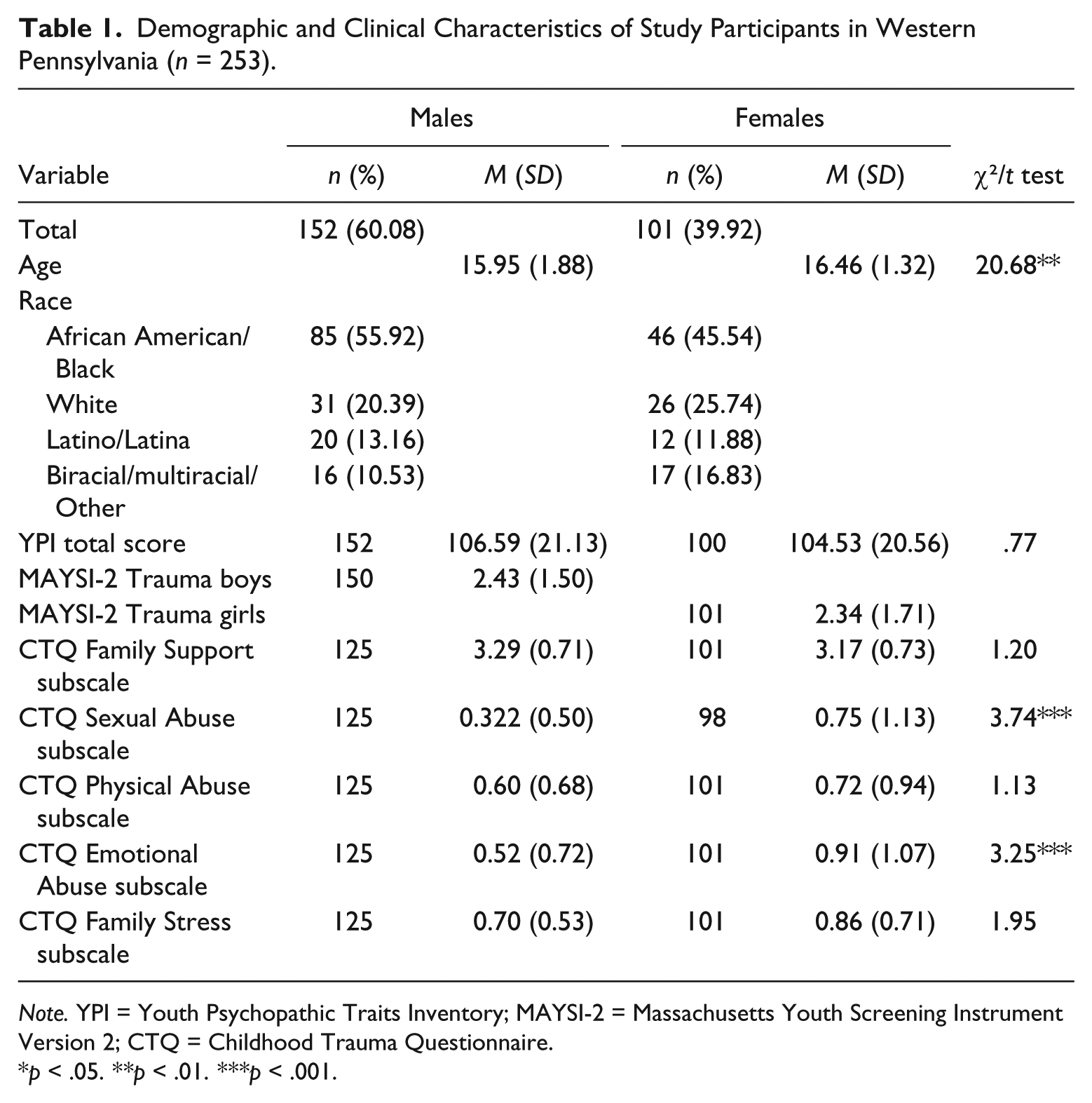
Note. YPI = Youth Psychopathic Traits Inventory; MAYSI-2 = Massachusetts Youth Screening Instrument Version 2; CTQ = Childhood Trauma Questionnaire.
p < .05. **p < .01. ***p < .001.
In the Missouri data (as shown in Table 2; n = 723), the mean age of participants was 15.49 (SD = 1.23), with 129 participants aged 11 to 14 years, 581 participants aged 15 to 17, and 13 participants aged 18 to 20. Eighty-seven percent of the participants were male, 55.40% White, 32.96% African American, 3.88% Latino/Latina, and 7.75% biracial/multiracial/Other. The mean PPI-SF score was 139.75 (SD = 18.11) for females and 137.08 (SD = 19.22) for the male participants. The MAYSI-2-TE Girls mean score was 3.21 (SD = 1.68) and for the MAYSI-2-TE Boys, the mean score was 2.93 (SD = 1.6).
Demographic and Clinical Characteristics of Study Participants in Missouri (n = 723).

Note. PPI = Psychopathic Personality Inventory; MAYSI-2 = Massachusetts Youth Screening Instrument Version 2.
p < .05. **p < .01. ***p < .001.
Psychopathy Scores, MAYSI-TE, and CTQ
Table 3 shows the results of the zero-order correlation analysis of the Western Pennsylvania data. YPI total scores were significantly correlated with the MAYSI-2-TE (girls only subscale; r = .31, p < .01), CTQ Physical Abuse subscale (r = .25, p < .001), CTQ Emotional Abuse subscale (r = .25, p < .001), and CTQ Family Stress subscale (r = .27, p < .001). The pattern of correlations revealed some differences in magnitude but not direction among males and females. For males, the YPI scores were significantly correlated with the CTQ Physical Abuse subscale (r = .19, p < .05), CTQ Emotional Abuse subscale (r = .26, p < .01), and CTQ Family Stress subscale (r = .29, p < .01). For females, the YPI scores were also significantly correlated with the CTQ Physical Abuse subscale (r = .30, p < .01), CTQ Emotional Abuse subscale (r = .27, p < .01), and CTQ Family Stress subscale (r = .26, p < .01). In addition, female YPI scores were significantly inversely correlated with the Family Support subscale (r = −.20, p < .05).
Correlations for Western Pennsylvania Sample.

Note. YPI = Youth Psychopathic Traits Inventory; MAYSI-2 = Massachusetts Youth Screening Instrument Version 2; CTQ = Childhood Trauma Questionnaire.
p < .05. **p < .01.
For the Missouri data (Table 4), PPI-SF scores were significantly associated with both the MAYSI-2-TE Girls subscale (r = .35, p < .001) and Boys subscale (r = .40, p < .001).
Correlation Matrix for Missouri Sample.
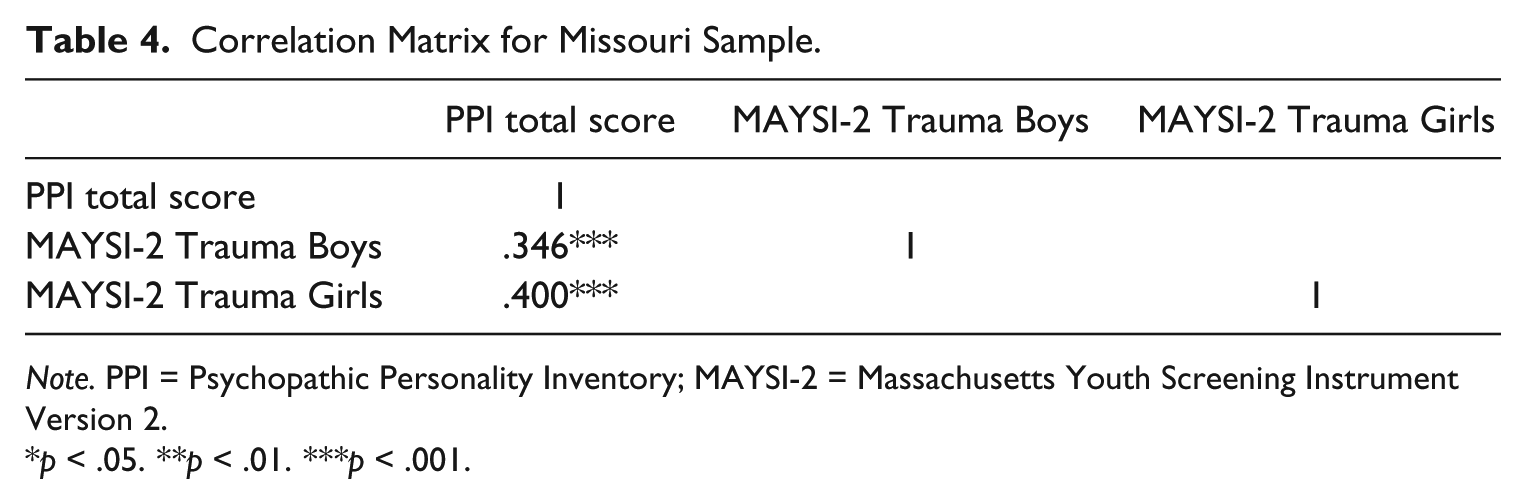
Note. PPI = Psychopathic Personality Inventory; MAYSI-2 = Massachusetts Youth Screening Instrument Version 2.
p < .05. **p < .01. ***p < .001.
To understand which of the specific items from the MAYSI-2-TE were correlated with the YPI, a finer grained supplemental-item-level analysis was employed (results not shown). For males in the Western Pennsylvania data, the YPI score was significantly correlated with the question: “Have you ever been badly hurt, or been in danger of getting badly hurt or killed” (r = .19, p < .05). For females, the YPI scores were significantly correlated with three questions: “Have you ever been badly hurt, or been in danger of getting badly hurt or killed” (r = .28, p < .01); “Have you ever been raped, or been in danger of getting raped” (r = .25, p < .05); and “Have you had a lot of bad thoughts or dreams about a bad or scary event that happened to you” (r = .25, p < .05). For the Missouri data, PPI-SF scores were correlated with the following questions for male respondents: “Have you had a lot of bad thoughts or dreams about a bad or scary event that happened to you?” (r = .29, p < .001); “Have you ever been badly hurt, or been in danger of getting badly hurt or killed?” (r = .21, p < .001). For females, the following questions were correlated with PPI-SF scores: “Have you had a lot of bad thoughts or dreams about a bad or scary event that happened to you?” (r = .34, p < .001); “Have you ever been badly hurt, or been in danger of getting badly hurt or killed?” (r = .33, p < .01); “Have you ever in your whole life had something very bad or terrifying happen to you?” (r = .27, p < .01); and “Have you ever been raped or in danger of getting raped?” (r = .26, p < .05).
Table 5 displays the results from a linear regression for the Western Pennsylvania data. Findings indicate differential results by gender. For boys, F(7, 116) = 2.88, p = .0082, R2 = .15, the CTQ Family Stress subscale was the only significant predictor of YPI scores (β = .22, p < .05). For girls, F(7, 89) = 2.18, p = .0438, R2 = .15, the MAYSI-2-TE was the only significant predictor (β = .25, p < .05). For the Missouri data (Table 6), the findings were not different for the female and male participants. Regardless of gender, the MAYSI-2-TE was a significant predictor of PPI-SF total scores for females, F(2, 90) = 8.58, p < .001, R2 = .16, and for males, F(2, 604) = 42.04, p < .001, R2 = .12. Regression diagnostics for both datasets revealed that there were no problems with multicollinearity or tolerance in the model.
Results From Linear Regression Analyses (Western Pennsylvania Sample).
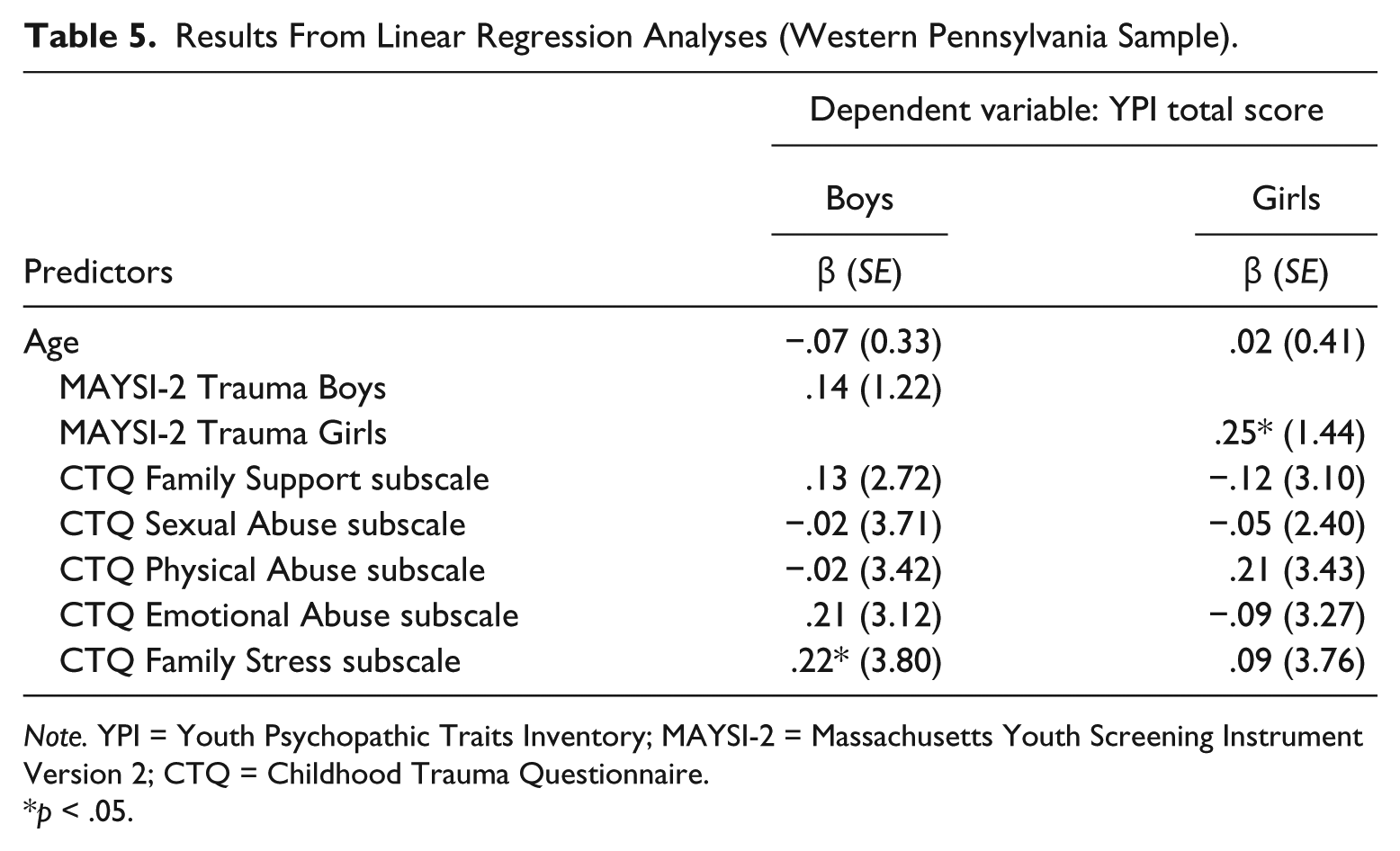
Note. YPI = Youth Psychopathic Traits Inventory; MAYSI-2 = Massachusetts Youth Screening Instrument Version 2; CTQ = Childhood Trauma Questionnaire.
p < .05.
Results From Linear Regression Analyses (Missouri Sample).

Note. PPI = Psychopathic Personality Inventory; MAYSI-2 = Massachusetts Youth Screening Instrument Version 2.
p < .001.
Discussion
The association between psychopathy and diverse forms of externalizing behaviors is widely studied; however, much less scholarly attention has been paid to the contextual causes of psychopathy, particularly the role of traumatic experiences. Limited research on this relationship may be the result of a number of factors, including that the study of psychopathy traditionally focuses on its predictive and risk assessment capacity. In addition, psychopathy researchers may view it as a congenital disorder, and fewer perceived benefits to treatment may limit interest in possible environmental causes. Consistent with our hypothesis, childhood trauma was associated with psychopathy for both male and female juvenile offenders, including physical and emotional abuse as well as family stress. These results support theories, suggesting that childhood abuse and associated attachment problems may be associated with later psychopathy (Lynam & Gudonis, 2005; Saltaris, 2002).
In both samples, childhood trauma as assessed by the MAYSI-2-TE was associated with psychopathic features among girls. These findings are similar to results from a previous study, suggesting that female psychopaths are more likely to have been exposed to different types of victimizations (Forouzan & Nicholls, 2015). Indeed, Barese (2008) found that more than 80% of a sample of female juvenile offenders reported some history of abuse, including physical, emotional, sexual, and neglect.
For boys, however, trauma was only predictive of psychopathy in the Missouri sample using the PPI-SF. Inconsistent findings across the samples of boys may result from the use of different psychopathy measures; however, the significant association found between trauma and psychopathy in boys is supported by previous studies of juvenile offenders investigating this relationship (Dargis et al., 2016; Gobin, Reddy, Zlotnick, & Johnson, 2015; Krischer & Sevecke, 2008; O’Neill, Lidz, & Heilbrun, 2003; Sevecke et al., 2016). In addition, in the Missouri sample, family stress was predictive of psychopathy for boys. This finding is consistent with additional studies supporting the hypothesis of familial (Forth & Burke, 1998; Harris, Rice, & Lalumiére, 2001; Marshall & Cooke, 1999; Neighbors, Forehand, & Bau, 1997; Widom & White, 1997) and environmental contributions to the development of male psychopathy (Aultman, 1980; Beaver, Vaughn, DeLisi, Barnes, & Boutwell, 2012; Raine, 1993; Rutter, 1977, 1979).
While psychopathy was associated with physical and emotional abuse in both male and female juvenile offenders, consistent with our second hypothesis, the associations were stronger among girls. This finding is consistent with previous research, suggesting that males and females react differently to traumatic events, with females at a higher risk of adverse psychological outcomes (Breslau & Anthony, 2007; Chesney-Lind, 1989; Foster, Kuperminc, & Price, 2004; Lansford et al., 2007; McCellan, Farabee, & Crouch, 1997; Widom & White, 1997). In addition, these results support the existing literature, indicating that females tend to exhibit traits more characteristic of the secondary variant of psychopathy which may have a stronger association with abuse history (Gill & Stickle, 2016; Vaughn et al., 2009). Conflicting reports addressing psychopathy, however, specifically suggest that the association with childhood abuse is found in boys alone (Barese, 2008; Krischer & Sevecke, 2008; Sevecke et al., 2016). Notably, each of the conflicting reports utilizes the Psychopathy Checklist: Youth Version (PCL: YV) to measure psychopathy which may limit direct comparison with the present study and explain differences in results. Interestingly, while Barese (2008) found that total psychopathy was only significantly related to childhood abuse among incarcerated boys, when looking at interpersonal/affective psychopathy features specifically, the investigation revealed a significant association with sexual abuse history among females but not among males. In addition to using the PCL: YV, studies conducted by Krischer and Sevecke (2008) and Sevecke et al. (2016) finding a link between traumatic childhood experiences and psychopathy in boys but not girls were conducted with adolescent detainees in Germany. It is possible that differing characteristics of juvenile offenders in the United States and Germany help explain the conflicting results. Nevertheless, inconsistent results indicate the need to conduct future research investigating the mechanism through which gender operates in the relationship between childhood abuse and later psychopathy.
Differences in findings for boys and girls may have repercussions for assessment and treatment as well as prevention strategies. Boys and girls may respond differently to questions, especially those regarding sensitive topics. Reporting abuse, especially sexual abuse, can be particularly challenging. Although denial of abuse or omission of details of abuse is common among both females and males, research demonstrates that females may be more likely than males to report abuse, and that factors such as social support, masculinity, ethnicity, and immigrant status may play a role in attitudes of reporting (Ashton, 2004; Azad & Leander, 2015; Humphries, Debowska, Boduszek, & Mattison, 2016; O’Leary & Barber, 2008). This is a notable challenge, especially when individuals are not given time and space to share their stories. Assessment strategies should be grounded with a trauma lens to provide an environment where disclosure may feel safer. Research has shown some gender differences in outcomes related to trauma-focused interventions, though interventions have reduced trauma symptoms for both genders (Wade et al., 2016). This again highlights the need for future research in this area to better understand the etiologies of psychopathic features, and any differences that may exist between females and males.
It is critical for professionals in residential facilities to remain current on research findings related to psychopathy and its association with trauma to make informed decisions on evidence-based practices for assessment and treatment. The current study findings suggest that utilizing a trauma-informed approach to services and support for adolescents in residential and juvenile detention settings appears warranted. Practitioners working with juvenile offenders should consider supplementing psychopathy measures with assessments of trauma to determine the most effective interventions. It becomes problematic when treatment plans solely target psychopathy scores without considering traumatic experiences and their relationship with psychopathy. Confining adolescents to one treatment trajectory limits the ability to address co-occurring problems. Evidence of heterogeneity within psychopathy for adolescents suggests that current measures of psychopathy require further development (Tatar, Cauffman, Kimonis, & Skeem, 2012). In addition, there is very little research related to the treatment of psychopathy (da Silva, Rijo, & Salekin, 2013), and the available literature regarding treatment success is inconsistent (D’Silva et al., 2004; Reid & Gacono, 2000; Salekin, 2002). If psychopathic trait assessments are utilized without regard for possible trauma, mental health practitioners are missing possible etiologies that have shaped the psychopathic behaviors and other options for treatment.
Limitations
There are limitations to the current study that should be mentioned. Because of the cross-sectional design of the study, we cannot make causal inferences between trauma and psychopathy. The time order between the traumatic experiences and psychopathy scores cannot be determined. Reverse causation is possible, such that early psychopathic features lead to greater trauma exposure. The severity of traumatic experiences is also difficult to determine. In addition, there is potential for shared method variance because data were gathered from self-report measures, which could attribute to differences found in the results between the two samples. This is particularly challenging due to the sensitive nature of reporting abuse. Another limitation is the use of the MAYSI-2-TE scale. Prior work (Archer, Stredny, Mason, & Arnau, 2004) has shown that the MAYSI-2-TE scale has demonstrated relatively weak convergent validity, suggesting that a more thorough trauma history assessment measure should be utilized (Archer et al., 2010). Moreover, we used the CTQ at one site to assess childhood traumatic experiences, and direct comparisons based on this measure are simply not available to us. Finally, there are also additional risk factors associated with childhood trauma, psychopathy, and various delinquency outcomes that we were not able to control for in the current analyses, such as gang affiliation and gang involvement (Boduszek, Dhingra, & Debowska, 2016; Dong & Krohn, 2016; Pyrooz, Turanovic, Decker, & Wu, 2016; Watkins & Taylor, 2016). Future studies should investigate whether gang involvement moderates the associations between distal abuse and trauma experiences, and subsequent antisocial personality features.
Conclusion
It is important for decision makers in the juvenile justice system to understand the interplay between environment and the multiple etiologies of psychopathy for the youth they serve. Understanding psychopathy with a trauma lens aids in tailoring treatment for offenders (Tatar et al., 2012). It is more widely accepted that youth with trauma histories are “treatable.” Therefore, the outcome of understanding psychopathy with a trauma lens may be completely different. It is our responsibility to support and intervene with modalities that can help shape the developmental transitions of these youth. This understanding of the relationship of childhood trauma and psychopathic traits should guide our practice versus simply labeling and making decisions based on limited information. The results of the current investigation suggest that nuanced understanding of traumatic history of these adolescents may not only be a pathway to psychopathy but also a critical part of their overall assessment and treatment plan.
Footnotes
Declaration of Conflicting Interests
The author(s) declared no potential conflicts of interest with respect to the research, authorship, and/or publication of this article.
Funding
The author(s) received no financial support for the research, authorship, and/or publication of this article.