




Abstract
Adverse childhood experiences (ACEs) have been linked to a host of negative health and behavioral outcomes, including crime, delinquency, and violence. Recent work on ACEs suggests that the impact of ACEs differs by gender, but research is unclear on the mechanisms of this relationship and how they impact violent delinquency. To explore whether and how the impact of ACEs on violent delinquency varies by gender, this study draws on Broidy and Agnew’s gendered expansion of general strain theory (GST), which proposes that a key explanation for the gendered impact of strain on crime lies in gender differences in the negative emotional states that mediate the relationship. Using longitudinal data on a sample of 979 at-risk youth (558 girls and 421 boys) from the Longitudinal Studies on Child Abuse and Neglect, this study examines the impact of ACEs (sexual abuse, physical abuse, emotional abuse, physical neglect, supervisory neglect, parent mental illness, parent intimate partner violence, parent substance use, parent criminality, and family trauma) on violent delinquency by gender with consideration of the three negative emotional states hypothesized by GST—anger, depression, and anxiety. Results indicate that ACEs increase the odds of violent delinquency for both boys and girls, but that this relationship is significantly stronger for boys. Mediation models suggest that anger mediates the link between ACEs and violent delinquency for girls. Implications for research and policy centering on ACEs are discussed.
Adverse childhood experiences (ACEs) are a set of traumatic and stressful events with harmful impacts on individuals throughout life (Felitti et al., 1998; Hughes et al., 2017). Typically defined as forms of childhood maltreatment and household dysfunction, ACEs have been robustly linked to a host of negative health and behavioral outcomes (Hughes et al., 2017), including crime and violence (Baglivio et al., 2014; Duke et al., 2010). Specifically, those exposed to greater numbers of these adverse events in childhood are at heightened risk of engaging in various forms of delinquency and violence in adolescence and adulthood (Duke et al., 2010; Fagan & Novak, 2018; Gajos, Leban et al., 2022; Garrido et al., 2018; Leban & Gibson, 2020; Pierce & Jones, 2021; Schilling et al., 2007).
A developing body of literature suggests that the impact of ACEs may be gendered. Although this body of work is still small and findings remain somewhat mixed, these studies support the argument that girls and boys respond and cope differently with stressors. Regarding crime and delinquency, research has found that ACEs are related to increased delinquency and externalizing symptoms for boys only (Gajos, Leban, et al., 2022; Leban, 2021; Leban & Gibson, 2020), while another study found that ACEs increase delinquency only for girls (Pierce & Jones, 2021). Alternatively, some work suggests that ACEs influence delinquency and violence similarly for both genders (Duke et al., 2010; Garrido et al., 2018) or more strongly so for boys (Garrido et al., 2018). Although this emerging research has highlighted the importance of gender in the link between ACEs and crime and delinquency, it remains unclear how and why ACEs may operate differently by gender. Gaining an understanding of mediating mechanisms may help clarify the inconclusive role of gender in the relationship between ACEs and crime and delinquency.
Agnew’s general strain theory (GST; Agnew, 1992, 2006) and its gendered expansion (Broidy & Agnew, 1997) offer an explanation that may elucidate the mechanisms linking ACEs to delinquency differently by gender. The theory focuses on the presence of strain, broadly defined as conditions disliked by individuals, with which individuals cope in noncriminal or criminal means. The effect of strain on coping is mediated through negative emotional states, such as anger, anxiety, or depression (Agnew, 1992, 2006). Individuals may engage in crime as a means to reduce or escape from strain and the resultant negative emotions. GST has been expanded to explain gender differences in the relationship between strain and criminal coping. A key part of this approach is the proposition that, in response to strain, men and boys tend to externalize their emotions and respond with anger, whereas women and girls internalize their emotions and respond with depression and anxiety (Broidy & Agnew, 1997).
Considering ACEs as a source of strain, our goal is to examine the role of gender in the relationships between ACEs, negative emotional states, and delinquency. Relying on prospective longitudinal data from a sample of at-risk youth, this study assesses how negative emotional states may explain gender differences in the link between ACEs and violent delinquency. In doing so, we attempt to clarify whether and how the link between ACEs and violent delinquency varies by gender.
Adverse Childhood Experiences
A cumulative risk model focusing on youth’s exposure to adverse events in the household, ACEs include forms of child maltreatment (i.e., neglect, physical, psychological, and sexual abuse) and household dysfunction (i.e., physical, emotional/psychological, and sexual abuse). The earliest work on ACEs documented a positive relationship between ACE exposure and the likelihood of a host of health risk behaviors in adulthood, including the leading causes of death (Felitti et al., 1998). The body of literature on ACEs has since broadened to document the relationship between ACEs and a host of negative social and behavioral problems (for a review, see Hughes et al., 2017). Work on ACEs consistently demonstrates a graded or dosage–responsive relationship between ACEs and their harms, in which higher numbers of ACEs experienced are incrementally related to worsened consequences (Felitti et al., 1998; Hughes et al., 2017).
Although a large body of studies highlight the detrimental impact of ACEs on outcomes in adulthood, research has also considered the more proximal consequences of ACEs on behavior in adolescence, particularly delinquent behavior. Although measures of delinquency vary across studies, this research has generally documented the link between ACEs and subsequent delinquent behaviors in adolescence. Specifically, this body of work has shown that ACEs are associated with violence (Duke et al., 2010; Garrido et al., 2018) and antisocial behavior (Schilling et al., 2007), self-reported delinquency (Gajos, Leban, et al., 2022; Leban & Gibson, 2020; Pierce & Jones, 2021), arrest (Fagan & Novak, 2018) and externalizing and internalizing problems (Jones et al., 2022; Leban, 2021) in adolescence. In these studies, higher numbers of ACEs are related to the increased likelihood or frequency of antisocial and delinquent behaviors. Moreover, analyses of samples of youth involved in the juvenile justice system have revealed especially elevated ACE exposure among this population (Baglivio et al., 2014) and demonstrated a graded effect in which greater exposure to ACEs corresponded with an increased likelihood of serious, chronic, and violent offending (Fox et al., 2015).
ACEs researchers have begun to consider whether ACEs may operate differently by gender. This is an important inquiry given that the broader literature on stress and trauma has long demonstrated that boys and girls tend to cope with and respond differently to traumatic experiences (Daughters et al., 2009; Rudolph, 2002). Indeed, a small and emerging body of research suggests that the impact of ACEs on delinquency is gendered. Several studies have revealed that ACEs were associated with increased delinquency for boys but not girls (Gajos, Leban, et al., 2022; Leban & Gibson, 2020). Others have found that ACEs are positively related to delinquency for both boys and girls but have a stronger impact for boys (Duke et al., 2010; Schilling et al., 2007). However, there are some inconsistent findings showing that ACEs in early childhood were related to delinquency for girls only (Pierce & Jones, 2021) or that there was no gender difference in the impact of ACEs on delinquency (Garrido et al., 2018) and interpersonal violence (Duke et al., 2010). This small body of work highlights the potential salience of gender in understanding ACEs, although these studies have yielded somewhat mixed findings. There remains a need for research to clarify the role of gender in the impact of ACEs. One promising option may be to draw on a theoretical framework that considers the role of gender in the processes that link ACEs to delinquency.
Gender, Delinquency, and GST
Perpetration of criminal and delinquent behavior is considered a gendered phenomenon. There is a notable discrepancy in the overall volume of crime perpetrated by gender, with the bulk of criminal behavior being committed by men and boys, particularly the more violent and severe behaviors (Chesney-Lind & Pasko, 2012). Research on the role of gender in criminal involvement has highlighted distinct etiological underpinnings of crime and delinquency that are structured by differences in socialization and experiences by gender (Zahn et al., 2010). Relatedly, risk and protective factors for delinquency differ or vary in salience by gender (Belknap & Holsinger, 2006; Fagan et al., 2007).
GST (Agnew, 1992, 2006) is a theoretical perspective with relevance for understanding how ACEs could influence delinquency differently by gender. The theory outlines a process through which stressful experiences (“strains”) are linked to various coping strategies, most notably criminal behavior. Strains can encompass a variety of conditions disliked by individuals, including the removal of positive stimuli, the presence of negative stimuli, and failure to accomplish a goal (Agnew, 1992). When faced with a strain, individuals can experience various negative emotional states (i.e., anger, depression, and anxiety), which they attempt to alleviate via coping strategies. Although coping can be noncriminal or criminal, GST has largely been used to understand the process through which strains result in criminal behavior. Research has documented the positive relationship between varied measures of strain and delinquency (Agnew & White, 1992; Paternoster & Mazerolle, 1994), showing that the relationship between strain and delinquency is mediated by negative emotional states (Mazerolle et al., 2000) and confirming that delinquency functions as a coping strategy that minimizes negative emotional states emanating from strain (Brezina, 1996). Moreover, externalizing negative emotions generated from strain, like anger, tend to be those emotions most strongly related to delinquency and violence (Aseltine et al., 2000; Mazerolle et al., 2000).
GST has been applied to explain gender differences in the etiology of criminal behavior. In an effort to understand women and girls commit less criminal behavior on average compared to boys and men, Broidy and Agnew (1997) proposed a gendered expansion of GST which is largely rooted in differences in childhood socialization and social processes by gender. One notable thesis was that the emotional responses to strains would differ by gender; specifically, that women and girls would be likely to internalize responses to strain in the form of emotional states like depression and anxiety, and men and boys would have a heightened likelihood of responding to strain in externalizing manners such as anger (Broidy & Agnew, 1997). In turn, the presence of internalizing emotional states should inhibit criminal behavior, while externalizing emotional states should increase the likelihood of criminal behavior, thereby offering insight into why men and boys tend to commit a greater volume of crime.
Research has shown mixed support for these expectations regarding negative emotional states by gender. Studies have generally supported the assumption that girls are more likely to respond to strain with internalizing emotional states such as depression and anxiety (Francis, 2014; Hay, 2003; Jang, 2007; Jang & Johnson, 2005; Kaufman, 2009; Sigfusdottir et al., 2004). For instance, an analysis of adolescents from one wave of the Project on Human Development in Chicago Neighborhoods found that exposure to violence and loss of close others was associated with depression and anxiety for girls only (Francis, 2014). While studies generally confirm that depressive and anxiety symptoms are implicated in girls’ delinquency, research remains inconclusive on the precise ways in which these negative emotions operate. Some have shown depression and anxiety inhibit girls’ delinquency (Francis, 2014; Jang, 2007) in line with the initial arguments of Broidy and Agnew (1997), while others have found that depressive symptoms increase delinquent and violent behaviors among girls (Kaufman, 2009; Kofler et al., 2011; Wiesner & Kim, 2006). The latter is in congruence with the argument that depression may be a unique risk factor for girls’ delinquency (De Coster, 2003; Loeber & Keenan, 1994; Vaske & Gehring, 2010; Zahn et al., 2010), and studies demonstrating high rates of depressive symptoms among girls who engage in delinquency (Teplin et al., 2002).
In addition, Broidy and Agnew argued that anger should be particularly important in the strain–offending relationship for boys, and this argument has too yielded mixed support. Work commonly shows that anger is more strongly associated with delinquency for boys (Agnew & Brezina, 1997; Hay, 2003; Sigfusdottir et al., 2004), although some have shown that the association was stronger for girls (Baek et al., 2019) or was similar across gender (De Coster & Zito, 2010). Moreover, many studies found that boys and girls may respond to strain with similar levels of anger (De Coster & Zito, 2010; Jang & Johnson, 2005; Kaufman, 2009; Kim et al., 2021; Piquero & Sealock, 2004; Sigfusdottir et al., 2004).
Despite some mixed findings, GST offers a theoretical process for understanding the role of gender in the impact of ACEs on delinquency. Although not necessarily using a GST framework, a few studies have examined how ACEs may impact emotional outcomes differently by gender. For instance, a recent study assessed gender differences in the influence of ACEs on depression and anxiety, finding that ACEs were associated with depressive symptoms for girls and both depressive and anxious symptoms for boys (Gajos, Miller, et al., 2022). Based on Agnew and Broidy’s expectation that ACEs would influence externalizing outcomes for boys and internalizing outcomes for girls, Leban (2021) investigated the relationship between ACEs and trajectories of internalizing and externalizing symptoms through adolescence, finding that high exposure to ACEs was associated with long-term elevated internalizing and externalizing symptoms for both boys and girls, and that boys who experienced higher ACEs were at a heightened risk of exhibiting elevated externalizing trajectories relative to girls. A subsequent study revealed somewhat diverging results, finding that ACEs in early childhood were positively associated with both internalized and externalized psychological distress for adolescent boys, and only with externalized distress for girls (Jones et al., 2022). Although these studies provide some evidence of gender differences in emotional responses to ACEs, studies have yet to examine how negative emotional states mediate the relationship between ACEs and delinquency differently for boys and girls.
Current Study
Work on ACEs suggests that the impact of ACEs on delinquency may vary by gender, yet research remains inconclusive regarding whether and how this may be the case. Understanding the mediating mechanisms through which ACEs influence delinquency, and how they may function differently by gender, may help shed light on why ACEs may operate differently for boys and girls to influence delinquency. The goal of this study is to examine the role of gender in the relationships between ACEs, negative emotional states, and violent delinquency. We investigate whether the relationship between ACEs and violent delinquency varies by gender and whether such differences can be explained by gender differences in negative emotional states. Following prior work and theorizing on GST, particularly the indications that internalizing negative emotional states are implicated in girls’ delinquency and externalizing negative emotional states are implicated in boys’ delinquency, several relationships are hypothesized:
(1) Boys will be more likely than girls to experience anger following exposure to ACEs and girls are more likely than boys to experience depression and anxiety symptoms following exposure to ACEs.
(2) ACE scores will be positively related to violent delinquency for both boys and girls, but the impact of ACEs on violent delinquency will be strongest for boys.
(3) Anger symptoms will mediate the relationship between ACEs and violent delinquency for boys, while depression and anxiety symptoms will mediate this relationship for girls.
Methods
Data and Sample
We drew on data from the Longitudinal Studies of Child Abuse and Neglect (LONGSCAN), a consortium of prospective longitudinal studies designed to investigate the causes, nature, and repercussions of child maltreatment (Runyan et al., 1998). Youth and their caregivers from five geographic sites (Baltimore, MD; Chicago, IL; Seattle, WA; San Diego, CA; and Chapel Hill, NC) were followed throughout childhood and adolescence. Sampling targeted youth of high-risk status, a determination based on Child Protective Services (CPS) reports of maltreatment and/or the existence of other characteristics indicative of heightened risk for maltreatment (e.g., low socioeconomic status and maternal substance use). Beginning in 1991, the baseline sample consisted of 1,354 children aged 4–6 years and their caregivers, with follow-up data collected at ages 8, 12, 14, 16, and 18. Attrition was approximately 31% by the time participants reached the age of 18 (Runyan et al., 1998), a rate similar to that of other longitudinal studies of high-risk youth (Kennedy & Gelman, 2018).
This study focused on youth who remained in the study through the age 18 survey and had complete data on ACEs, mediating emotional states, and violent delinquency. The total study sample comprised 979 youth (558 girls and 421 boys). Given that LONGSCAN data were collected from five sites, our analytic sample was geographically diverse: 11.64% lived in the East, 11.3% lived in the Midwest, 29.62% lived in the Northwest, 12.87% lived in the South, and 34.83% of participants lived in the Southwest. Furthermore, the sample was made up of a high proportion of minority youth; 46.27% were Black, 29.42% were White, 7.76% were Hispanic, and 16.55% belonged to another racial/ethnic category. Of the 979 participants, 28.79% were in low-income households, and 59.41% lived in a single-parent household.
Dependent Variable: Violent Delinquency
Violent delinquency was measured via six questions from the Delinquent & Violent Behavior survey at age 18 in which youth were asked how many times in the past year they had (1) been in a gang fight, (2) attacked someone with the idea of hurting them, (3) hit someone with the idea of hurting them, (4) used a weapon, force, or strong-arm methods to get money or things from people, (5) thrown objects such as rocks or bottles at people, and (6) physically hurt or threatened to hurt someone to get them to have sex. The variable was dichotomously coded as 1 (violent delinquency) or (0) no violent delinquency.
Independent Variables
Adverse Childhood Experiences
In line with prior ACE measures using the LONGSCAN data (e.g., Fagan & Novak, 2018; Leban, 2021), a variety index of ACEs was created via 10 dichotomous ACE indicators capturing forms of child maltreatment and household dysfunction occurring up to the age of 12. We opted to define ACEs as events occurring until age 12 to reflect the developmental period widely defined as “childhood” (Collins, 1984; Leban & Delacruz, 2023). Doing so also ensured proper temporal ordering between ACEs, mediating emotional states, and outcomes.
Child maltreatment ACEs included sexual abuse, physical abuse, emotional abuse, physical neglect (i.e., failure to provide), and supervisory neglect (i.e., lack of supervision). These ACEs were assessed via official abuse allegations from CPS which were provided by CPS at each data collection point. If an allegation of a given maltreatment ACE was reported during any assessment point, youth were considered to have experienced this ACE.
Household dysfunction ACEs were based on caregiver surveys at various data collection points. Parent mental health problems were measured via caregiver reports on their depression and mental illness in the Center for Epidemiologic Studies Depression Scale (Radloff, 1977) and Brief Symptoms Inventory (Derogatis, 1993) during the age 4, 6, 8, and 12 surveys. If the caregiver experienced clinical levels of depression and/or mental illness during any of these collection points, youth were coded as having been exposed to parental mental health problems. Parent intimate partner violence (IPV) was assessed as caregiver responses to the Conflict Tactics Scale (Straus, 1979) and Revised Conflict Tactics Scale (Straus et al., 1996) during the age 6, 8, and 12 surveys. IPV was recorded as having occurred if caregivers reported experiencing or perpetrating serious violence during any of these collection points. Parent substance use was measured during age 4, 8, and 12 surveys when caregivers reported on their use of alcohol, marijuana, cocaine, crack cocaine, PCP, acid, heroin, speed, and tranquilizers. If the caregiver reported current use of illicit drugs and/or problematic alcohol use, youth were considered to have been exposed to this ACE. Parent criminality was assessed during the age 6 through 12 surveys when caregivers reported whether either of the youth’s parents were arrested or incarcerated in the past year. Parent criminality was recorded if either parent had been arrested or incarcerated. Family trauma data were collected from age 6 through 12 surveys when the caregiver reported on whether the youth’s parents or siblings had a serious accident, illness, or death in the previous year. If the youth’s family members experienced one of these events during any of these surveys, they were considered to have experienced this ACE.
The presence of each ACE was coded dichotomously, in which each ACE item was coded as 1 (ACE had been experienced) or 0 (ACE had not been experienced). ACE items were then summed to create a score ranging from 0 to 10, in which 0 reflected having experienced none of the ACEs and 10 indicated having experienced all ACEs.
Anger
Anger symptoms were measured as a count at age 16 using the anger subscale of the Trauma Symptom Checklist (Briere, 1996). Youth were asked to report how often they experienced 9 symptoms: (1) arguing too much, (2) wanting to yell and break things, (3) getting mad and cannot calm down, (4) wanting to yell at people, (5) wanting to hurt other people, (6) feeling mean, (7) feeling like I hate people, and (8) feeling mad. Item responses were 0 (never), 1 (sometimes), 2 (lots of times), or 3 (almost all of the time). Responses to all nine anger items were then summed to create a score ranging from 0 to 27.
Depression
Depression symptoms were measured as a count at age 16 via the depression subscale of the Trauma Symptom Checklist (Briere, 1996). Youth indicated how often they experienced nine indicators of depression: (1) feeling lonely, (2) feeling sad or unhappy, (3) crying, (4) wanting to hurt myself, (5) washing myself because I feel dirty inside, (6) feeling stupid or bad, (7) feel like I did something wrong, (8) feeling like nobody likes me, and (9) wanting to kill myself. Response categories included 0 (never), 1 (sometimes), 2 (lots of times), or 3 (almost all of the time). Youth’s responses to all nine items were summed, and the resultant score ranged from 0 to 27.
Anxiety
Anxiety symptoms were measured as a count at age 16 using the anxiety subscale of the Trauma Symptom Checklist (Briere, 1996). Youth reported the frequency that they experienced nine items: (1) feeling afraid something bad might happen, (2) get scared suddenly and don’t know why, (3) feeling scared of men, (4) feeling scared of women, (5) feeling nervous or jumpy inside, (6) feeling afraid, (7) being afraid of the dark, (8) worrying about things, and (9) feeling afraid someone will kill me. Youth answered each item by responding with 0 (never), 1 (sometimes), 2 (lots of times), or 3 (almost all of the time). Item responses were summed to produce a score ranging from 0 to 27.
Gender
Participants’ gender was recorded at baseline. Two response options were given: male (1) or female (0).
Control Variables
Low income
At the age 12 survey, caregivers were asked to report the amount of money their household took in annually. Following historical poverty line data and prior research with the LONGSCAN data (e.g., Fagan & Novak, 2018; Villodas et al., 2012), if the household made less than $15,000 annually, youth were coded as low income, generating a dichotomous indicator coded as 1 (low income) or 0 (not low income).
Single-parent household
Caregivers reported on their current legal marital status at the age 12 survey. Responses included 1 (married), 2 (single; never married), 3 (separated), 4 (divorced), and 5 (widowed). The responses were coded dichotomously as 1 (any response other than married) or 0 (married).
Race/ethnicity
Race/ethnicity was reported at baseline and was coded into a series of indicators to represent White, Black, Hispanic, or other categories. Variables were coded as 1 (individual belonged to a given racial/ethnic group) or 0 (individual did not belong to a given racial/ethnic group). Black served as the reference category in analyses, as this category comprised the highest proportion of the sample (46.27%).
Site
The field site for each family was recorded at baseline into a series of dichotomous variables to represent the East (Baltimore, MD), Midwest (Chicago, IL), Northwest (Seattle, WA), Southwest (San Diego, CA), and Southern (Chapel Hill, NC) research sites. Each site was coded as 1 (individual from a given site) or 0 (individual was not from a given site). Given that the majority of the sample were from the Southwest site (34.89%), Southwest served as the site reference category in analyses.
Analytic Strategy
Analysis proceeded in several stages. First, gender differences between all variables were examined via independent samples t-tests and chi-square tests of independence. To test for gender differences in negative emotions in response to ACEs (e.g., Hypothesis 1), negative binomial regression models were estimated to examine the impact of ACEs on the three negative emotional states (i.e., anxiety, depression, and anger symptoms) by gender. Negative binomial models were used since all three emotional states were measured as discrete count variables with positively skewed and overdispersed distributions (Long, 1997). 1 Next, to examine the relationship between ACE scores and violent delinquency and whether this relationship varied by gender (e.g., Hypothesis 2), logistic regression models estimated the impact of ACEs on violent delinquency for the full sample and then included a multiplicative interaction term to test for the moderating effect of gender. Marginal effects for levels of the interaction were calculated and graphed.
Finally, testing for gender differences in mediating emotional states in the relationship between ACEs and violent delinquency (e.g., Hypothesis 3) involved estimating (1) logistic regression models of the impact of ACEs and mediating emotional states on violent delinquency separately by gender, and (2) the Karlson, Holm, and Breen (KHB; Karlson et al., 2012) method to test for significant indirect effects of mediating negative emotional states. The KHB approach is ideal for testing for indirect effects with logistic regression and other nonlinear models. Indirect effects in nonlinear models are difficult to compare due to the rescaling of coefficients that occurs when a mediator variable is introduced to a model (Kohler et al., 2011). The KHB test adjusts for this rescaling in nonlinear models and decomposes indirect effects of mediators (Karlson et al., 2012).
For ease of effect size interpretation, odds ratio (OR) and incidence rate ratio (IRR) values were reported in place of coefficients in logistic regression and negative binomial models, respectively. The alpha level was set at .05, and estimates were considered to be statistically significant if p values fell below this level. However, estimates with p values exceeding .05 but falling below .10 were also noted as approaching statistical significance. Diagnostic tests showed that variance inflation factor values for all covariates ranged from 1.15 to 2.57 (mean = 1.50), indicating that multicollinearity was not a concern in the models. Analyses were conducted in Stata 17 (StataCorp, 2021).
Results
Gender Differences in Study Variables
Table 1 reports descriptive information on study variables by gender. At the bivariate level, the prevalence and nature of ACEs exposure varied by gender. Boys, on average, had ACEs scores .243 higher than girls, a difference which was approaching statistical significance (t = −1.83, p = .067). There were significant differences in exposure to some ACEs by gender. Significantly more girls than boys had experienced sexual abuse (x2 (1) 20.65, p < .001), while boys were significantly more than girls to have experienced physical abuse (x2 (1) 14.26, p < .001), supervisory neglect (x2 (1) 7.35, p = .01), parent mental health problems (x2 (1) 4.14, p = .04), and parent substance use (x2 (1) 6.32, p = .01).
Descriptive Statistics.

Note. Means and test statistics from independent samples t-tests listed for total ACE score and mediating emotional states. Percentage of the sample and results from chi-square tests of independence displayed for all other variables. ACEs = adverse childhood experiences; IPV = intimate partner violence; SD = standard deviation.
p < .05. **p < .01. ***p < .001.
The prevalence of some other study variables also significantly varied by gender. Compared to boys, girls scored 1.78 higher on anxiety symptoms (t = 7.51; p < .001), 2.25 higher on depression symptoms (t = 7.26; p < .001), and .75 higher in anger (t = 2.68; p < .001). Significantly more boys (37.05%) than girls (17.92%) engaged in past year violence (x2 (1) 45.49, p < .001).
Impact of ACEs on Negative Emotional States by Gender
Estimates from negative binomial regression models examining the impact of ACEs on negative emotional states by gender are presented in Table 2. For girls, ACEs were significantly and positively associated with anger (IRR = 1.07, p = .004), depression symptoms (IRR = 1.05, p = .014), and anxiety symptoms (IRR = 1.05, p = .020), indicating that each additional ACE exposure increased anger scores 1.07 times, depression symptom scores 1.05 times, and anxiety symptom scores 1.05 times. For boys, there was no significant impact of ACEs on any negative emotional states, although it should be noted that ACEs were positively associated with depression symptoms at the marginally significant level (IRR = 1.06, p = .083), implying that each increase in ACEs corresponded with a 1.06 increase in depression symptoms.
Impact of ACEs on Negative Emotional States by Gender: Negative Binomial Regression Estimates.

Note. Black was left out as the racial/ethnic reference group and Southwest was left out as the site reference group. ACEs = adverse childhood experiences; CI = confidence interval; IRR = incidence rate ratio.
p < .05. **p < .01. ***p < .001. †p < .10.
Relationship Between ACEs and Violent Delinquency
Logistic regression models examining the impact of ACEs on violent delinquency for the full sample are displayed in Table 3. In Model 1, ACEs were positively associated with violent delinquency (OR = 1.13, p = .002), indicating that each additional ACE increased the odds of violent delinquency by 1.13 times. Gender was also associated with violent delinquency (OR = 2.85, p < .001), implying that boys have 2.85 times increased odds of violent delinquency compared to girls. When the negative emotional states were included in Model 2, ACEs and gender remained significant, and anger emerged as the only negative emotional state associated with violent delinquency (OR = 1.10, p < .001). Each increased value of anger was associated with 1.10 times increased odds of violent delinquency. Model 3 estimated the same model with the inclusion of a multiplicative interaction term for ACEs and gender. The coefficient for the interaction term was positive and significant in this model (OR = 1.20, p = .043), suggesting that the impact of ACEs on violent delinquency was significantly different by gender. Predictive margins were estimated and graphically displayed in Figure 1. These estimates indicated that the impact of ACEs on violent delinquency was stronger for boys than girls. Table 4 reports the marginal effects at all levels of the interaction. There were significant gender differences in marginal effects for ACEs scores of 3 through 10. 2
Impact of ACEs on Violent Delinquency for the Full Sample: Logistic Regression Estimates (n = 979).

Note. Black was left out as the racial/ethnic reference group and Southwest was left out as the site reference group. ACEs = adverse childhood experiences; CI = confidence interval; OR = odds ratio.
p < .05. **p < .01. ***p < .001. †p < .10.
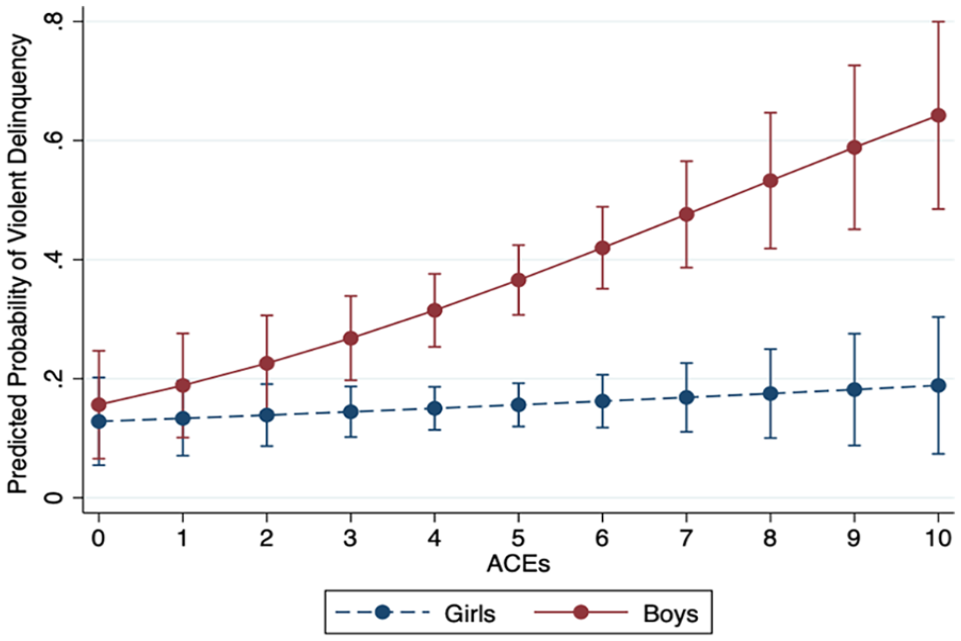
Predictive margins of the impact of ACEs on violent delinquency, by gender.
Interaction Between ACEs and Gender on Violent Delinquency: Estimates of Marginal Effects.

Note. Estimates were generated from the logistic regression model presented in Table 3, Model 3. ACEs = adverse childhood experiences; CI = confidence interval.
p < .05. **p < .01. ***p < .001. †p < .10.
Mediating Roles of Negative Emotional States by Gender
Table 5 reports results from logistic regression models estimating the impact of ACEs on violent delinquency separately by gender. Model 1 for girls and boys showed that ACEs were positively associated with violent delinquency for both genders (girls: OR = 1.15, p = .019; boys: OR = 1.15, p = .018). With each additional ACE experienced, the odds of engaging in violent delinquency increased 1.15 times for both girls and boys.
Impact of ACEs on Violent Delinquency by Gender: Logistic Regression Estimates.

Note. Black was left out as the racial/ethnic reference group and Southwest was left out as the site reference group. ACEs = adverse childhood experiences; CI = confidence interval; OR = odds ratio.
p < .05. **p < .01. ***p < .001. †p < .10.
Negative emotional states were included in the next set of models (Model 2 for girls and boys). For girls, ACEs no longer had a significant impact on violent delinquency when negative emotional states were considered. Anger was associated with violent delinquency for girls (OR = 1.10, p = .007), indicating that increased anger was associated with 1.10 times increased odds of violent delinquency. Given that no other negative emotional states were significantly associated with girls’ violent delinquency and that the association between ACEs and violent delinquency completely disappeared when anger emerged as a significant predictor of violent delinquency, the results of Model 2 provided initial evidence that anger may mediate the impact of ACEs on violence for girls. For boys, ACEs remained significantly associated with violent delinquency when negative emotional states were included in Model 2 (OR = 1.31, p < .001). In addition, anger (OR = 1.11, p = .006) and anxiety symptoms (OR = 1.22, p = .007) were both significantly associated with violent delinquency for boys, while depression symptoms (OR = 0.89, p = .059) were associated with violent delinquency at the marginally significant level. That is, boys’ odds of violent delinquency increased 1.11 times for each increase in anger, 1.22 times for each increase in anxiety symptoms, and decreased by .89 times for each increase in depression symptoms.
Finally, the mediating roles of negative emotional states were assessed using the KHB method. Stratified by gender, these models tested for the significance of indirect effects of negative emotional states and are displayed in Table 6. For girls, anger was a significant mediator in the positive relationship between ACEs and violent delinquency (b = .02, p = .036). The total proportion of the effect mediated by anger was 17.02%. Neither depression nor anxiety symptoms were significant mediators in this relationship. No negative emotional states had a mediating effect in the relationship between ACEs and violent delinquency for boys, however.
Indirect Effects of Negative Emotional States in the Relationship Between ACEs and Violent Delinquency, by Gender.

Note. ACEs = adverse childhood experiences; b = coefficient in log odds; CI = confidence interval.
p < .05. **p < .01. ***p < .001.
Conclusion and Discussion
The purpose of this study was to consider the role of negative emotional states and gender differences in the relationship between ACEs and violent delinquency. In doing so, we assessed gender differences in the relationship between ACEs and violent delinquency, examined how emotional responses to ACEs varied for boys and girls, and investigated whether negative emotional states mediated the relationship between ACEs and violent delinquency differently by gender. Our results highlight that ACEs impact negative emotional states and delinquency differently by gender, and more broadly demonstrate that boys and girls experience and respond to adversity differently.
Three primary findings emerged. First, we hypothesized that boys would respond to ACEs with anger while girls would respond to ACEs with depression symptoms and anxiety symptoms (Hypothesis 1). Our results partially supported this hypothesis; while girls did react to ACEs with increased depression symptoms and anxiety symptoms, they also experienced increased anger. Boys, however, did not respond to ACEs with anger as predicted, nor did they respond to ACEs with depression symptoms or anxiety symptoms. The lack of relationships between ACEs and negative emotional states for boys was surprising, given that prior work has found that ACEs were related to boys’ depression symptoms and anxiety symptoms (Gajos, Miller, et al., 2022), externalized and internalized psychological distress (Jones et al., 2022), and heightened trajectories of externalizing symptoms (Leban, 2021). Despite this unexpected finding, our study did find that anger, depression symptoms, and anxiety symptoms were related to boys’ violent delinquency, which implies that negative emotional states are important in understanding boys’ violent delinquency, but that they may operate independently of ACEs.
Second, it was anticipated that an increase in ACE scores would increase the odds of violent delinquency regardless of gender, but that this relationship would be stronger for boys than for girls (Hypothesis 2). This expectation was supported by our findings. We found that ACEs were related to violent delinquency for both genders, but that the impact of ACEs was significantly stronger on boys’ violent delinquency. This is generally supportive of work that has shown that ACEs are more strongly linked to delinquency for boys than for girls (Duke et al., 2010; Schilling et al., 2007), and others showing that ACEs are linked to delinquency for boys only (Gajos, Leban, et al., 2022; Leban & Gibson, 2020). This finding is also in line with the general finding in the stress and trauma literature that boys are more likely than girls to respond to stressors and adverse events in an externalizing manner (e.g., Daughters et al., 2009; Rudolph, 2002).
Finally, we hypothesized that depression and anxiety would mediate the impact of ACE scores on violent delinquency for girls, while anger would mediate the relationship between ACE scores and violent delinquency for boys (Hypothesis 3). This was not supported; however, a gender-specific mediation effect did emerge from our study. Anger mediated the relationship between ACEs and violent delinquency for girls only. This was particularly unexpected, as Broidy and Agnew (1997) proposed the opposite; that is, that anger would play an important mediating role in the relationship between strain and delinquency for boys, which has been supported by several studies (e.g., Agnew & Brezina, 1997; Hay, 2003; Sigfusdottir et al., 2004). Although our findings contradict these expectations, they are not entirely unique, as some prior work has found that anger increased delinquency for girls more so than boys (Baek et al., 2019) and that anger was related to delinquency for girls (Kim et al., 2021). Moreover, Jones et al.’s (2022) study of early childhood ACEs found that early childhood ACEs were associated with higher scores on an index of externalized psychological distress (which included anger and related symptoms) for girls and not boys. Considered alongside these prior findings, our results point to a potentially quite complex role of anger in trauma experiences, and it may be the case that anger plays a more important role in understanding girls’ delinquency than Broidy and Agnew hypothesized.
Despite these insights, the findings of this study should be considered in the context of potential limitations. Notably, the LONGSCAN comprises high-risk youth largely from minority backgrounds. Although such a sample is beneficial for ensuring ample prevalence of ACEs, delinquent behavior and negative emotionality during adolescence could already be at a heightened likelihood among high-risk samples. In addition, negative emotional states were measured at age 16, which could have further impacted findings, especially considering that youth are particularly predisposed to experience heightened sensitivity and impulsivity during mid-adolescence (Dreyfuss et al., 2014). Moreover, the measurement of gender in the LONGSCAN is somewhat limited, as it was recorded only at baseline (when youth were age 4 or 6) by researchers who were only given two response options (male or female). For this reason, the measure is more of a reflection of perceived gender in early childhood. Finally, we stratified several of our models by gender given that our goal was to examine how potential intervening processes played out differently for boys and girls, which is typical in work on gendered GST (e.g., Baek et al., 2019; De Coster & Zito, 2010; Francis, 2014; Hay, 2003; Kaufman, 2009; Kim et al., 2021; Piquero & Sealock, 2004; Sigfusdottir et al., 2004), and on gender differences in ACEs and delinquency (e.g., Duke et al., 2010; Gajos et al., 2022; Jones et al., 2022; Leban & Gibson, 2020; Pierce & Jones, 2021; Schilling et al, 2007). However, caution should be taken in estimating group-stratified models, as group differences in sample sizes and residual variation can impact differences in coefficients (Allison, 1999).
Future research should continue to unravel the role of gender in the ramifications of ACEs. The literature exploring gender differences in the impact of ACEs on delinquency and on negative emotional states remains relatively small, and existing studies widely vary in terms of the nature of samples, the ages at which ACEs and outcomes were assessed, and the measurement of emotional states. Such important differences among a small body of literature make diverging findings unsurprising and highlight the need for further research to clarify these relationships. In particular, work relying on general population samples of youth can be beneficial and can help avoid some of the shortcomings inherent to high-risk samples. Assessment of mediating emotional states and outcomes beyond adolescence could offer deeper insight into how the GST process impacts violence and crime. In addition, researchers should measure negative emotional states and violent delinquency in more nuanced ways to explore whether certain facets of these constructs are particularly relevant for boys or girls. For example, researchers should explore more diverse negative emotional states that could mediate the relationship between ACEs and delinquency in notable ways by gender and consider breaking up broader measures of negative emotional states into smaller individual symptoms (e.g., guilt, shame), each of which could have different relevance for boys and girls. Future research might also consider broadening events considered ACEs (e.g., Warner et al., 2023), particularly as some adversities may have unique relevance for girls versus boys.
In addition, continued work on gender differences in mediating emotional states could benefit from the use of innovative approaches to mediation, such as moderated mediation techniques that integrate moderation and mediation into a single model (Hayes, 2009). Such techniques could avoid some of the potential concerns in comparing results from models stratified by gender (e.g., Allison, 1999). Finally, the goal of our study was to understand how gendered reactions to ACEs could explain violent delinquency, but future work should explore additional outcomes. Internalizing outcomes may be an especially fruitful pursuit for further inquiry in this line of work, given that the gendered GST perspective implies that girls should be particularly likely to respond to strain with internalizing symptoms (Broidy & Agnew, 1997).
The role of ACEs in increasing the odds of violent delinquency regardless of gender underscores the importance of focusing on ACEs in policy and programs aiming to prevent and reduce violent behaviors. Results of this study, alongside the growing body of work on ACEs, point to the need for expanded efforts to prevent and reduce ACEs, perhaps utilizing random in-home check-ins and providing youth the opportunity to report ACEs in a safe space. In addition, given that the processes through which ACEs influenced delinquency differed by gender, programs designed to avert violent behavior may benefit by exploring gender-specific approaches for youth who have been exposed to ACEs. For example, although additional research is needed, this study demonstrated the importance of anger in how ACEs promote girls’ violent delinquency, speaking to the potential value of targeting anger issues for girls who have experienced high ACEs. Overall, policies and programs that center on care and support for adolescents could benefit from a more careful focus on gender in attempts to help youth overcome adversity and trauma.
Footnotes
Declaration of Conflicting Interests
The author(s) declared no potential conflicts of interests with respect to the authorship and/or publication of this article.
Funding
The author(s) received no financial support for the research and/or authorship of this article.
