




Abstract
Primarily, this article examines the role of organizational justice in understanding prison officers’ behavior. The authors surveyed 169 correctional officers across five correctional facilities in Ghana to explore the role of three organizational justice dimensions in prison misconduct and job stress. Results from the negative binomial and ordinal logistic analyses revealed the significant contributions of two dimensions of organizational justice in explaining misconduct and stress among officers. Officers who had higher perceptions of distributive fairness and interaction in the organization had lower odds of receiving misconduct-related complaints. Also, greater interaction was found to be associated with reduced job stress among prison officers. In addition, several officers’ characteristics were found to predict the number of times officers received misconduct complaints.
Keywords
Introduction
Correctional officers are the backbone of modern correctional facilities because they handle a broad array of tasks. Officers not only maintain safety and security at both the individual and organizational levels but also have a considerable impact on inmates’ perceptions of justice and their ability to adjust to prison life. In many ways, officers control inmates’ institutional behavior and even address daily aspects of social support (Dirkzwager & Kruttschnitt, 2012). In other words, potential positive outcomes for inmates heavily rely on certain institutional functions (Lambert et al., 2010) and on employees who are fair and unbiased in their management of confinement, treatment, and interventions.
It is understood that correctional officers’ positive attitudes and performance affect how inmates cope with prison life as well as how they later behave when released to the community (Adams, 1992). Sykes (2007) in his classic work The Society of Captives explains the effects of imprisonment on inmates and the adaptation strategies. According to Sykes, the lack of freedom and tight prison security contribute to feelings of inadequacy among the inmates. Introduced by Greenberg (1987), the concept of organizational justice explains how perceived justice and equity impact employees’ attitudes and behaviors toward the workplace. This concept has two subdomains: procedural justice and distributive justice. Without the perception of organizational justice, correctional officers may engage in negative behavior and reflect a lower level of organizational commitment (Lambert, 2003; Lambert, Hogan, & Griffin, 2007; Lambert, Paoline, & Hogan, 2006; Taxman & Gordon, 2009) and job satisfaction (Lambert, 2003; Lambert et al., 2007; Lambert, Paoline, & Hogan, 2006) and higher levels of burnout and turnover (Lambert et al., 2010) and job stress (Lambert, 2003; Lambert, Hogan, & Allen, 2006; Lambert et al., 2007; Lambert et al., 2010; Taxman & Gordon, 2009). These problems may hinder the efforts of administrators to develop policies and procedures that address institutional goals (Greenberg, 1990).
For several decades now, organizational justice theory (Greenberg, 1990) has been applied toward understanding staff performance and behavior across different organizations in America (Colquitt et al., 2013). However, the influence of organizational justice has not been well examined in other countries. It is therefore important to expand the doctrine of organizational justice to cross-cultural settings, particularly, to institutions in the process of reform, because organizational justice has been acknowledged as a key factor in the viability of institutions (Greenberg, 1990). For criminal justice institutions, understanding issues of justice and fairness is essential for service delivery improvement and outcome effectiveness (Taxman & Gordon, 2009).
To add to the existing literature, the current study sought to expand conventional approaches to organizational justice into a more global context by examining Ghanaian institutions. Per the United Nations, prisons in Ghana are inhumane because inmates are exposed to life-threatening conditions as well as harsh and degrading punishments (United Nations Human Rights [UNHR], 2013). This stressful and challenging workplace consistently affects correctional officers’ attitudes. Reform of Ghana correctional officers’ negative work-related behaviors—such as absenteeism, reporting late to work, and low productivity— has been seen as a primary issue (Ghana Prisons Service, 2015). To enhance fair treatment and integrity of service, “a high level of organizational justice should become [a] priority” within corrections (Taxman & Gordon, 2009, p. 707). To facilitate this, the current study aims to explore justice–performance relationships in the Ghanaian correctional context. We focused on how Ghanaian correctional officers’ perception of organizational justice would affect their work-related attitudes and behaviors with respect to institutional misconduct and job stress.
Organizational Justice Within Corrections
Corrections is one of the three essential components of criminal justice institutions in every country. The roles and attitudes of correctional officers affect whether inmates receive fair treatment and interventions as well as constitutionally required services, which affects prison experiences and parole outcomes (Dirkzwager & Kruttschnitt, 2012). Organizational justice, as perceived by correctional officers, can positively shape and maintain their attitudes and behaviors toward the inmates and their workplace (Lambert et al., 2007; Taxman & Gordon, 2009).
Feelings of justice and equity are formed within organizations, and Greenberg (1987, 1990) argued for two different dimensions of justice. First, distributive justice is the content and outcome–oriented concern regarding “the fairness of the ends achieved” (Greenberg, 1990, p. 400). Employees focus on whether any specific outcome (e.g., treatment, promotion, awards, feedback, recognition, and evaluation) is fair and just compared with their input and effort within the workplace (Lambert, 2003). Second, procedural justice is a process-oriented concern regarding “the fairness of the means used to achieve those ends” (Greenberg, 1990, p. 400). Employees need to believe that procedures are uniform and that opportunities provided in the process to achieve desirable outcomes are unbiased, impartial, and equitable relative to their efforts and accomplishments within the workplace (Lambert, 2003).
Within the correctional realm, the concepts of “justice, fairness and equity” that are central to organizational justice (Lambert, 2003; Taxman & Gordon, 2009) are also the basis for institutional effectiveness. They are essential for achieving goals, maintaining job satisfaction, and balancing internal system requirements with positive external outcomes (Greenberg, 1990). More importantly, correctional officers’ perceptions of distributive and procedural justice, in turn, would form a strong justice–performance relationship within facilities (Colquitt et al., 2013). Using a meta-analysis, Colquitt et al. (2013) revealed that employees who perceived a lower level of organizational justice were more likely to be associated with counterproductive work behaviors and were less likely to have positive job and task performance.
A growing body of research (Lambert, 2003; Lambert, Hogan, & Allen, 2006; Lambert et al., 2007; Lambert et al., 2010; Lambert, Paoline, & Hogan, 2006) has showed a need for research on organizational justice, especially, for understanding and improving correctional officers’ behaviors. Per Lambert et al. (2006), correctional officers who perceive organizational integrity and legitimacy can make fair decisions regarding inmates, enhance the safety of prison environments, and indirectly aid and determine the success of institutions. For example, when there is a strong sense of procedural and distributive justice, correctional officers can engage in positive and transparent interactions and, thus, “successfully practice care, custody and control” in prison as a liberal humanitarian–oriented rehabilitation approach (Ricciardelli, 2016, p. 339). Inmates were less likely to rebel or resist penalties and were more likely to cooperate with officers and respect authority when they experienced impartial, just, and fair treatment in prison (Santos, Lane, & Gover, 2012). Both procedural justice and distributive justice are antecedents of officers’ subsequent behaviors and the impact they have on inmates and the organization in general.
The Impact of Organizational Justice on Job Stress
Working in correctional facilities has been described as a unique but demanding, challenging, stressful, and dangerous experience (Armstrong & Griffin, 2004; Cheeseman, Kim, Lambert, & Hogan, 2011; Garland, Hogan, & Lambert, 2012; Griffin, 2001). However, both distributive justice and procedural justice have been found to have positive effects that mitigate the stress resulting from the inherent strain and intensity of the job. Correctional officers who perceived equal promotional opportunities in institutions received fair work-related evaluations and were made aware of changes in internal policies, and procedures (transparency) were less likely to report stress, fatigue, or emotional draining from the workplace (Lambert, Paoline, & Allen, 2006).
Believing that one’s organization embodies a high level of procedural justice would reduce the level of stress and the potential for burnout (Lambert et al., 2010). Officer perceptions would include fair, clear, and objective criteria within internal rules and processes with respect to “almost all aspects of the organization, including evaluations, promotions, pay increases, shift assignments, work assignments, and even discipline” (Lambert, Hogan, & Allen, 2006, p. 241). Lambert and Paoline (2008) further explain that procedural justice would reduce the negative emotional and psychological effects of stress as well as dissatisfaction with the nature of the job and prospects for career advancement (e.g., turnover or the intent to leave a job; Khan, Nawaz, Qureshi, & Khan, 2016; Lambert, Edwards, Camp, & Saylor, 2005; Lambert et al., 2010).
Distributive justice is another influential factor related to job stress in corrections. Perceptions of a lower level of fairness related to outcomes in the workplace could be associated with strain and stress, which might result in further dissatisfaction with life in general (Lambert & Hogan, 2011). Correctional officers weigh their benefits and rewards in proportion to the degree of effort and energy they contribute to their work. Therefore, when officers perceive greater rewards and benefits, they will be less likely to report a higher level of job stress or negative feelings toward organizations (Lambert et al., 2007).
Lambert et al. (2010) found distributive justice as a salient force directing correctional officers’ behavior. How officers perceived the rewards system within correctional institutions was critical and negatively related to job stress and burnout and further contributed to potential job satisfaction (Lambert, 2003) and job commitment (Lambert et al., 2007). In their study, correctional officers were found to have increased levels of stress when, in their judgment, outcomes were unfair when controlling for demographic background (e.g., education, age, tenure), workload, and work–family relationship.
Noted by Tewksbury and Higgins (2006), job stress for correctional officers is primarily influenced by perceived organizational justice and fairness, and feedback about job performance. Even though there is the potential for emotional dissonance with inmates—a feeling of unease that originates from the conflict between experienced and expressed emotions (Abraham, 1998; Jansz & Timmers, 2002)—and role conflicts with colleagues that might contribute to stress in the workplace, organizational stressors were the most important attributes because working in a prison is a unique bureaucratic setting with its own philosophy of “criminal justice” (Tewksbury & Higgins, 2006). In line with Tewksbury and Higgins’s (2006) study, Finney, Stergiopoulos, Hensel, Bonato, and Dewa (2013) concluded that job stress and burnout among correctional officers derived from perceptions of both distributive justice and procedural justice.
Critics may argue here that individual differences would affect job stress. For example, by surveying employees of a Midwestern maximum-security private correctional facility in the United States, Lambert et al. (2007) observed that non-White male officers were less likely to express higher levels of stress regarding their jobs than White male officers. However, the influence of individual differences on attitudes toward stress may have been overstated (Lambert, 2004). Prior studies have revealed that conventional demographic backgrounds, including age, education, gender, race, years of working experience, working status and position, and supervisory status (Lambert, Hogan, & Allen, 2006; Lambert et al., 2007; Lambert et al., 2010), do not affect correctional officers’ perceived level of job stress.
The Impact of Organizational Justice on Institutional Misconduct
Although organizational justice hypotheses have been used to explain correctional officers’ behaviors in the United States, there do not appear to be any studies that specifically examine its impact on correctional officers’ misconduct. A handful of studies, however, have indicated a relationship between procedural justice, distributive justice, and inmates’ behavior and trust as well as other criminal justice officials’ misconduct.
“Order,” as noted by Jackson, Tyler, Bradford, Taylor, and Shiner (2010), is a critical aspect of prison management. However, it is often dependent upon the levels of cooperation and acquiescence between inmates and prison authorities. Organizational justice provides “legitimacy” to order, which secures inmate compliance and cooperation, reduces inmate misbehavior, and promotes fair treatment and decision making. Inmates reported that they would trust the institutions and have confidence in authorities if they had positive prison experiences that included interactions with correctional officers who provided them procedural equality and fairness and a safe environment (Franke, Bierie, & MacKenzie, 2010).
When correctional officers are perceived to engage in procedural justice, their legitimacy is enhanced in the eyes of the inmates they supervise. A direct relationship between inmate misconduct and the level of procedural justice provided by officers has been observed (Reisig & Mesko, 2009). For instance, according to Reisig and Mesko’s (2009) study, both self-report and official records reflected a lower rate of institutional misconduct (e.g., using violence, threatening with force, property damage, contraband possession, showing disrespect for authorities, and other rule violations and infractions) among those inmates who perceived a higher level of procedural justice (such as correctional officers showing respect and courteousness to inmates, offering fair and reasonable treatment, and explaining decision-making processes).
Another longitudinal study conducted by Beijersbergen, Dirkzwager, Eichelsheim, Van der Laan, and Nieuwbeerta (2015) concluded that there was a causal relationship between inmates’ perception of procedural justice and their institutional behavior. It was found that those inmates who “felt treated fairly and humanely” by correctional officers had a lower propensity for engaging in any misconduct or being flagged for disciplinary infractions during incarceration (Beijersbergen et al., 2015, p. 210). Inmates who perceive procedural injustice, however, might also believe that they are subjected to distributive injustice when there is disproportionate use of force, sanctions, differential treatment, unequal work assignments, and other negative outcomes (Jackson et al., 2010) that might further affect their compliance in prison.
Organizational injustice can be examined not only as it affects inmates’ behavior but also as it influences criminal justice officials and leads to misconduct. For instance, law enforcement officers who perceive organizational injustice within their work environment have been found to accumulate more citizen complaints and internal affairs investigations, along with more departmental disciplinary actions (Wolfe & Piquero, 2011). In other words, perceptions of organizational justice would effectively control officers’ behavior, holding them accountable so that they engage in fewer forms of misconduct (Wolfe & Piquero, 2011). This sense of fairness would strengthen productive justice–performance relationships between institutions and participants who encounter the system (Colquitt et al., 2013). Overall, a commitment to justice facilitates courteous interactions, building respect between parties, and increasing the likelihood of fair treatment and the positive use of discretion (Gau & Brunson, 2010).
With an increased sense of organizational justice and support, officers would be more likely to comply with rules, regulations, procedures, policies, and protocols that would reduce the potential risk of misconduct (Haas, van Craen, Skogan, & Fleitas, 2015). In line with Haas et al.’s (2015) study, Wolfe and Piquero (2011) affirmed the importance of promoting organizational justice. Officers’ perceptions of procedural justice and distributive justice within criminal justice institutions would be a safeguard against allegations of individual misconduct, institutional infractions, and noble-cause corruption and would make them more likely to provide the public with impartial, just, and legitimate services and treatment.
Prior research shows that there are several considerations for the analysis of correctional officers’ behavior. First, feelings of organizational injustice seem to significantly impact levels of job stress and strain for correctional officers (Lambert, Hogan, & Allen, 2006; Lambert et al., 2007; Lambert et al., 2010). Most of the studies trying to explain the relationship between organizational justice and officers’ job stress have been conducted by Lambert et al. (2006), Lambert et al. (2007), and Lambert et al. (2010); more research should be conducted to better conceptualize and test the concept in a variety of surroundings. This is a valuable undertaking because organizational justice is one area that appears to have a positive influence on correctional officers’ attitudes and behavior that are related to fair practices that would not only improve prison conditions, but maximize the benefits of taxpayers, institutions, and the public. (Lambert et al, 2010., p. 15)
Furthermore, when operations function at a higher level of perceived organizational justice (Reisig & Mesko, 2009), corrections and law enforcement officials (Wolfe & Piquero, 2011) may be less likely to engage in work-related misconduct. The lack of research clarifying the relationship between organizational justice and correctional officers’ institutional misconduct restricts our insight into the justice–performance pipeline in corrections and, thus, the ability to reduce professional misconduct and personnel turnover (Wolfe & Piquero, 2011).
The current study tried to fill this gap in the literature by examining the effects of procedural justice, distributive justice, and interactional dimensions of organizational justice on correctional officers’ job stress and misconduct in a culturally and ethnically diverse setting within a Ghanaian prison. Moreover, this study may be the first to more specifically address the impact of organizational justice on correctional officers’ institutional misconduct in the workplace.
Corrections in Ghana: An Overview
Ghana’s correctional institutions are part of the larger criminal justice system that has been working for over a century to maintain internal security in the country (Ghana Prisons Service, 2015). Historically, formal correctional institutions date back to the establishment of prison quarters in the Cape Coast Castle in 1841 to incarcerate criminal offenders (Seidman, 1966). The effort to extend criminal jurisdiction, which is a concept used to describe a court’s power to hear cases brought by a state accusing a defendant of committing a crime, was quite progressive at the time, and by 1850, several prison cells had been built in four forts, housing a total of 129 inmates. By 1875, the British had succeeded in expanding their criminal jurisdiction over the entire southern part of their Gold Coast Colony—presently Ghana—and about a year later, the Gold Coast Prison Ordinance, which rested on the foundations of the English Prison Act of 1865, was passed (Ghana Prisons Service, 2015). Early prisons in Ghana were set up for safekeeping purposes, with no clear intention to torture or reform incarcerated offenders. However, as Seidman (1966) noted, the focus of these prisons changed from safekeeping to punitive policies, with deterrent connotations.
Currently, Ghana has several correctional facilities that house people convicted of various criminal offenses, as well as individuals awaiting their time in court. These facilities work cooperatively to achieve the aim of the Ghana Prisons Service (GPS)—maintenance of internal security. The GPS is one of several agencies that fall under the purview of the Ministry of Interior and performs several important functions as specified in the 1972 Prisons Service Decree, NRCD 46. These functions have broadly been divided into three categories: safe custody and welfare of prisoners, reformation, and rehabilitation. Although safe custody and welfare of prisoners remain the core functions of the service, reformation and rehabilitation are the noncore functions. Apart from these categories, the GPS performs other functions such as taking part in national ceremony parades and United Nations peacekeeping assignments (Ghana Prisons Service, 2015). In addition to the 1972 Prisons Service Decree, NRCD 46, the GPS is regulated by other legal frameworks, including the 1992 Constitution of Ghana, 1960 Prisons Standing Orders, Prisons Regulation L.I. 412/58, Prisons (Declaration of Prisons) Instrument, 1970 Prisons (Amendment) Regulation, and 1989 Prisons Service Scheme of Service Administration. These instruments together ensure that the service performs its functions effectively. Although the constitution of Ghana is silent on the specific role of the GPS, it establishes the Prison Service Council, a body which oversees the overall administration of the service (Constitution of Ghana, 1992, Chapter 16).
The number of prisons that operate throughout the country has progressively increased over the years. In 1948, there were a total of 29 prison facilities across Ghana. However, this number had significantly increased to 45 by 2013. These establishments include the GPS headquarters, the Officers’ Training School, the Senior Correctional Center, 7 central prisons, 13 local prisons, 7 female prisons, 3 open camp prisons, 9 agricultural settlement camp prisons, a medium-security prison, a maximum-security prison, and a contagious disease prison (Ghana Prisons Service, 2013). Collectively, these prison establishments house about 14,600 inmates, which is about 32% over the authorized capacity. 1 This creates a significant overcrowding problem (Ghana Prisons Service, 2013) with its associated issues of poor sanitation, lack of food and medicine, and widespread infectious diseases, including HIV, malaria, and tuberculosis. Although these problems are not unique to Ghanaian society (also see Aduba, 1993; Alemika, 1993), they are alarming, and efforts need to be made to address them.
In addition to the above issues, the Ghana Prisons Service faces the problems of personnel commitment and misconduct. In 2013, the total personnel strength was 5,898, 2 making up 4,029 males and 1,869 females. There were 5,288 subordinate officers and 610 superior officers (Ghana Prisons Service, 2013). In most instances, the working conditions for these officers are not good. Pay is low, promotions are limited, equipment is inadequate, they have poor supervisor–subordinate relationships, and above all, most of the officers live in dilapidated bungalows. These prevailing conditions of service have resulted in low staff morale and a poor corporate image (Ghana Prisons Service, 2015). Although this has not yet been proven in the Ghanaian context, it is generally believed that officers’ low morale accounts for some of the misconduct and abusive behaviors they engage in within the “four walls.” Abuse of prisoners’ rights is rampant, and there have been several reports of instances where prison guards physically abused inmates. Per the U.S. Department of State’s (2015) report on human rights practices in Ghana, prison guards normally use caning as a form of punishment to discipline inmates. Sometimes, according to the report, officers even authorize so-called model prisoners, also known as the “Black Coats,” to carry out the caning.
To provide further insights into the life of correctional officers in a culturally heterogeneous society like Ghana, we endeavor to examine the extent to which officers’ sense of justice and equity influences their behavior and job stress levels. Based on the organizational justice literature, we hypothesize that
Method
Research Sites and Study Participants
Field work for the current study was conducted in 5 of the 45 prison establishments in Ghana, from March to June 2014. The facilities selected for the project were in two regions of Ghana—the Greater Accra and Eastern regions—and represented five of the main categories of prisons in Ghana. Thus, the facilities included two medium-security prisons (one of which was a women’s prison), one juvenile facility, one open camp prison, and the headquarters. The women’s and men’s medium-security prisons were both located in Nsawam, Eastern region, and were established in 1973 and 1960, respectively. The Nsawam women’s medium-security prison 3 is the largest women’s prison in Ghana and stretches over 5.16 acres of land. As of March 2015, the prison housed 89 female offenders, with a staff population of 143 officers. 4 The Nsawam medium-security prison for males is the largest prison in the country and holds about 3,000 inmates. 5 The facility is a multisecurity-level prison with an outer perimeter wall 9 inches thick and about 20 feet high; it has five separate cell units, an annex block, and two other blocks for segregation and special inmates. However, the Senior Correctional Center (SCC), James Camp Prison, and headquarters of GPS are in Accra, the capital of Ghana. The Senior Correctional Center is the only facility in Ghana that houses juvenile offenders. 6 Juveniles who are sentenced to this facility are trained for a period of 6 months to 2 years in various trades—weeding, tailoring, carpentry, and draftsmanship (Ghana Prisons Service, 2013). As of 2013, there were about 120 inmates, most of whom were first-time offenders. The James Camp Prison in Accra is an open prison that houses prisoners who are nearing their release time. In effect, this prison serves as a transit point where inmates are fully prepared before being released into society. The prison headquarters is the administrative seat for GPS, and it is not a holding facility.
Prior to the field work, permission was sought from the prison administration; given the centralized nature of the GPS, a letter was sent to the GPS Research and Development Unit, detailing the nature of the study and how information obtained would be treated. After a waiting period of about 3 weeks, the prison administration granted permission to conduct the study. A letter was issued by the prison headquarters, which was shown to each of the commanders-in-charge of the facilities in which the surveys were administered. This process was necessary to be granted access to the respective facilities. Staff at the facilities also proved to be very valuable, collecting completed questionnaires sealed in envelopes. The first page of the questionnaire provided informed consent for participation, detailing that the survey was voluntary, and officers were not under any obligation to offer any information. Finally, to ensure anonymity, information that could link responses to an officer was omitted from the questionnaire. Ethical clearance was granted by the Institutional Review Boards of the authors’ institutions 4 months before survey administration. In total, 200 correctional officers from the five prison facilities were initially selected randomly to take part in the study; 169 of them filled out and returned their questionnaires, for a response rate of about 85% (see Table 1).
Descriptive Statistics of Study Variables (n = 169).
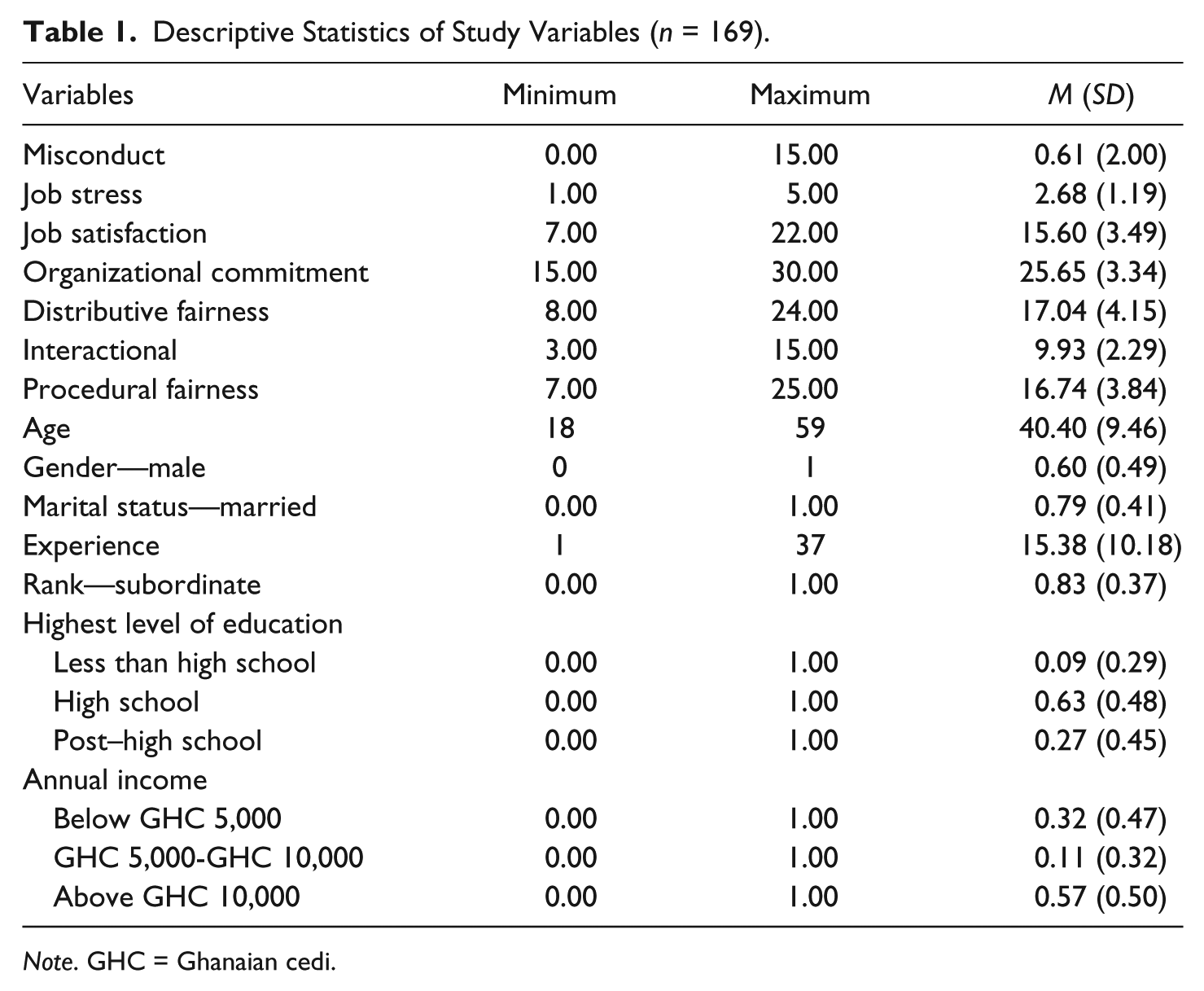
Note. GHC = Ghanaian cedi.
Measures
Dependent variables
There are two dependent variables in the current study: misconduct and job stress. Two items were used to measure misconduct, each capturing varying degrees of correctional officer misconduct: how many times they had been (a) subjected to a formal inmate complaint and (b) subjected to a formal officer complaint. These measures have been previously used in police research to capture a variety of police officer misconduct (see Wolf & Piquero, 2011). Results from principal component analysis (PCA) indicated that the two items measured the same underlying construct (factor loadings were >.90). Therefore, the items were combined to form a misconduct composite scale with an alpha value of .70, suggesting an adequate level of internal consistency. Officers scoring higher scores on the scale had engaged in more misconduct. The second dependent variable is job stress, which was measured by asking officers to indicate the extent to which they perceived their job as stressful. The item was measured on a 5-point Likert-type scale (1 = “strongly disagree,” 2 = “disagree,” 3 = “neutral,” 4 = “agree,” and 5 = “strongly agree”). The order was reversed as 1 = “strongly agree,” 2 = “agree,” 3 = “neutral,” 4 = “disagree,” and 5 = “strongly disagree.” Higher values indicated less stress and lower values more stress.
Independent variables
In total, 13 items were used to measure three aspects of organizational justice—distributive, procedural, and interactional. The items, adopted from Taxman and Gordon (2009) organizational justice study with modifications, were measured on the same 5-point Likert-type scale (1 = “strongly disagree,” 2 = “disagree,” 3 = “neutral,” 4 = “agree,” and 5 = “strongly agree”). Distributive justice was assessed by asking officers to indicate their level of agreement with the following questions: “Promotions within this organization usually depend on how well a person performs his or her job”; “My performance rating presents a fair and accurate picture of my actual job performance”; “I will be promoted or given a better job if I perform especially well”; “My own hard work will lead to recognition as a good performer”; and “I will receive a formal acknowledgement from my organization if I perform especially well.” Factor loadings for these items ranged from .64 to .81 and the scale had an alpha value of .73, indicating good internal consistency.
Procedural fairness was measured with five items asking officers to indicate their level of agreement: “There are adequate procedures to get my performance rating reconsidered if necessary”; “I understand the performance evaluation system being used in this organization”; “In general, disciplinary actions taken in this organization are fair and justified”; “I am aware of the specific steps I must take to have a personnel action against me reconsidered”; and “The procedures used to evaluate performance have been fair and objective.” Because the factor loadings (ranging from .64 to .76) indicated that the items measured the same construct, they were combined to form the procedural fairness scale with an alpha value of .70, suggesting good internal consistency.
Finally, interactional justice was measured using three items to gauge the level of communications between officers and the organization. The items were “I am promptly told when there is a change in policy, rules, or regulations that affect me”; “If I were subject to involuntary personal action, I believe my agency would adequately inform me of my grievance and appeal rights”; and “Supervisors are very interested in their subordinates.” The results showed that the three items were homogeneous as they loaded onto a single component (component loadings > .500). Accordingly, all the items were combined to form an additive scale called the interactional scale (α = .53).
Control variables
In addition to the main variables, we included several demographic characteristics in the analysis to control for their effects on misconduct and job stress. These included age, measured as a continuous variable (in years); gender (0 = “female,” 1 = “male”); marital status (0 = “single,” 1 = “married”); experience, measured by number of years served; and annual income (1 = “below GHC 5,000,” 2 = “GHC 5,000-GHC 10,000,” and 3 = “above GHC 10,000”). Officers who earned more than GHC 10,000 a year were compared with the rest. Officers’ rank was measured categorically as 1 = “lance corporal/corporal,” 2 = “sergeant,” 3 = “assistant chief officer/chief officer,” 4 = “senior chief officer,” 5 = “assistant superintendent/superintendent,” and 6 = “deputy superintendent/chief superintendent.” These categories were later collapsed into a dichotomous variable where 0 = “superior officers” (a combination of 5 and 6 categories) and 1 = “subordinate officers” (a combination of 1-4 categories).
Moreover, job satisfaction and organizational commitment were also controlled. Job satisfaction was measured with five items on the same 5-point Likert-type scale (1 = “strongly disagree,” 2 = “disagree,” 3 = “neutral,” 4 = “agree,” 5 = “strongly agree”). The items were “Overall, I am satisfied with my current job”; “I have plans to look for a better job elsewhere” (reverse coded); “If I get a job offer elsewhere, of equal pay, I will immediately leave my current job as a prison officer” (reverse coded); “No matter what, I will not leave my current job”; and “I hate my current job” (reverse coded). Results from the PCA indicated that the five items measured the same construct, with factor loadings ranging from .58 to .73. The items were therefore combined to form the job satisfaction scale, which displayed adequate internal consistency (α = .66).
Six items were used to measure organizational commitment: “I feel a sense of loyalty to the Ghana Prisons Service”; “I feel a sense of commitment to the Ghana Prisons Service”; “I feel a sense of commitment to the work and objectives of the Ghana Prisons Service”; “I feel proud of my job as a prison officer”; “I am willing to work hard to help achieve the mission of the Prison Service”; and “I feel that my job as a prison officer is important.” The categories ranged from 1 = “strongly disagree” to 5 = “strongly agree.” A PCA with a varimax rotation was used to assess the dimensionality of the six items. The results showed that the six items measured the same construct (factor loadings > .500). Accordingly, all six items were combined to form an additive scale called the commitment scale (α = .74).
Table 1 presents the descriptive statistics of the study variables. Overall, officers who participated in the study engaged in less misconduct, as demonstrated by the lower number of complaints leveled against them by inmates and their colleagues (M = 0.61, SD = 2.00). Moreover, as indicated in the table, officers were moderately stressed (M = 2.68, SD = 1.19) and satisfied with their jobs (M = 16, SD = 3.49). Regarding officers’ perceptions of organizational justice components, it can be concluded that these officers had moderate views on distributive fairness, procedural fairness, and interaction. Despite these moderate views, officers were highly committed to the prison service and its objectives (M = 26, SD = 3.34). Demographically, a majority of the officers were men between the age of 18 and 59 years (60%), with an average age of 40 years; married (79%); and with a high school education (63%). The average level of experience was 15 years, and experience ranged from 1 year to 37 years in the service. Most of the officers sampled were subordinate officers (83%), with ranks ranging from lance corporal to senior correction officer. Only 17% of the surveyed officers were at a superior level (assistant superintendent to chief superintendent of prisons). This sample reflects and represents the characteristics of the entire prison officer population, with about 10% of the officers being superior officers and 90% being subordinate officers (Ghana Prisons Service, 2013).
Analysis Plan
To explore the effect of organizational justice on officer misconduct and job stress in the correctional setting and examine the sets of hypotheses, multivariate analysis was used in this study. Specifically, given that one of the study’s dependent variables was a count variable and the other was a continuous measure, both negative binomial and ordinal logistic regression models were conducted to determine the relative impact of the independent variables on the dependent variables. Furthermore, correlation analysis was conducted to find out whether there was any issue of multicollinearity.
The results indicated a potential issue of multicollinearity in the multivariate analysis as the relationship between officers’ age and their experience was significantly correlated at a higher coefficient than the suggested threshold (r = .92). This observation is supported by the high values of variance inflation factor (VIF) for both variables. 7 We addressed this potential issue by excluding the age variable from further analysis.
Results
Organizational Justice Versus Officers’ Misconduct
To test our first hypothesis, we conducted a negative binomial regression analysis to examine the effects of the organizational justice components on officers’ misconduct at work. The results of this analysis are presented in panel A of Table 2. The model was significant (χ2 = 58.34, p < .001). After controlling for the effects of other variables, the interactional component was found to be negatively and significantly related to officers’ misconduct (Wald = 6.60, p < .05). Officers reporting greater levels of interaction in the organization were less likely to engage in more misconduct (odds ratio [OR] = .72). Stated differently, misconduct is less common among officers who believe that there is enough communication in the organization. Similarly, distributive fairness predicts officers’ propensity to engage in misconduct (Wald = 15.34, p < .001). Officers with a greater perception of distributive fairness were less likely to engage in misconduct (OR = .76). Procedural fairness was, however, not found to predict misconduct.
Multivariate Analysis Estimating the Effects of Organizational Justice Variables on Correctional Officers’ Misconduct and Job Stress (n = 169). a
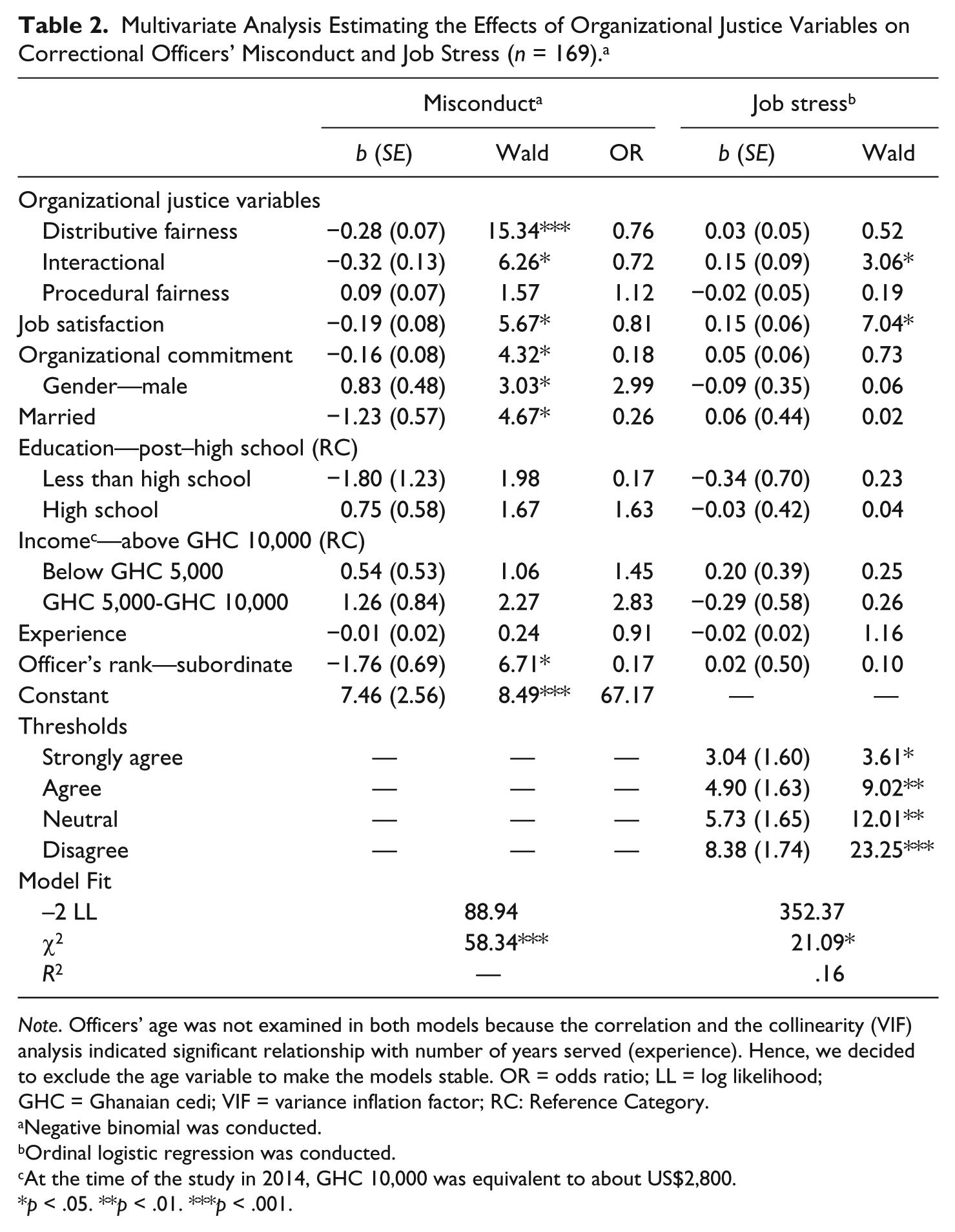
Note. Officers’ age was not examined in both models because the correlation and the collinearity (VIF) analysis indicated significant relationship with number of years served (experience). Hence, we decided to exclude the age variable to make the models stable. OR = odds ratio; LL = log likelihood; GHC = Ghanaian cedi; VIF = variance inflation factor; RC: Reference Category.
Negative binomial was conducted.
Ordinal logistic regression was conducted.
At the time of the study in 2014, GHC 10,000 was equivalent to about US$2,800.
p < .05. **p < .01. ***p < .001.
In addition, the effects of five control variables were observed. Job satisfaction, commitment, marriage, and rank were negatively related to misconduct. Specifically, officers who reported higher levels of satisfaction and commitment as well as those who were married and at the subordinate rank tended to engage in less misconduct than their counterparts. However, male officers were found to engage in more misconduct than female officers.
Organizational Justice Versus Job Stress
To test our second hypothesis, we conducted an ordinal logistic regression analysis to examine the effects of the organizational justice components on officers’ job stress. The results of this analysis are presented in panel B of Table 2. The model was significant (χ2 = 21.09, p < .05). After controlling for the effects of other variables, the interactional component was found to reduce officers’ stress (Wald = 3.06, p < .05). Officers who perceived higher levels of interaction in the organization were less likely to report the job being stressful. Officers’ perceptions of distributive and procedural fairness did not influence their levels of stress. One control variable—job satisfaction—was also found to statistically and significantly influence officers’ stress. Officers who reported being satisfied with their work also reported being less stressed.
Discussion and Conclusion
Prior studies that have attempted to explain correctional misconduct using the organizational justice model have overwhelmingly concentrated on inmates’ misconduct (Beijersbergen et al., 2015; Jackson et al., 2010; Reisig & Mesko, 2009), arguing about the importance of the organizational justice dimensions in reducing misconduct among inmates. Specifically, it has widely been established by these studies that a higher perception of procedural and distributive fairness among inmates undoubtedly leads to less misconduct such as use of violence, possession of contraband, and threatening other inmates or correctional officers with force. Ironically, there is no single study that has made the effort to examine the etiology of correctional officers’ misconduct from the organizational justice perspective. This is quite troubling—not just the gap it creates in our knowledge but the fact that similar studies have been conducted among police officers (see Haas et al., 2015; Wolf & Piquero, 2011), who are coproducers of justice and safety. To address this gap in the literature, the current study analyzed data obtained from a sample of correctional officers from five Ghanaian facilities to examine the effects of organizational justice dimensions on their misconduct and job stress.
Before discussing the observations made, we would like to caution readers against further interpretation of the findings due to inherent limitations. The data analyzed were self-reported, and we anticipate the likelihood that officers may have inflated or deflated their responses. The desirability bias is an unavoidable part of self-report surveys, and nothing could be done to mitigate its occurrence. Moreover, we acknowledge that our measures for officers’ misconduct and job stress were not sufficient to capture all the various aspects of the two concepts. Future research should use more robust measures and not rely on subjective indicators to measure misconduct.
The current study focused on three important observations. First, we observed a significant impact of organizational justice on correctional officers’ misconduct. Specifically, officers who have a greater sense of distributive fairness and interaction tend to engage in less misconduct at work. This observation supports the argument of previous police research that a higher perception of organizational justice reduces the potential for engaging in misconduct (Haas et al., 2015). When correctional officers consider the distribution of rewards—promotions, bonuses, pay raises, and other opportunities—and disciplinary actions to be fair, they are more likely to increase their compliance with rules, regulations, and procedures. Ultimately, these higher levels of compliance will reduce their risk of engaging in misconduct. Officers tasked with the responsibility of rehabilitating those that society has condemned will be less likely to use force on inmates, transport contraband on behalf of inmates, and engage in other forms of misconduct within the “thick walls” when they perceive communication channels in the organization to be effective, with information flowing constantly from the top down and vice versa. Interactional justice, a dimension of organizational justice, not only emphasizes the need for interpersonal communication within the work environment but also stresses the need for the process to be respectful, honest, and polite (Cohen-Charash & Spector, 2001; Tyler, 2006). When the process of communication is characterized by dishonesty, disrespect, and biases, officers are most likely to feel the organization is unjust.
Second, apart from the effect of the two organizational justice dimensions, several other factors were found to influence correctional officers’ misconduct. Job satisfaction and organizational commitment were both found to predict misconduct negatively, meaning that officers engage in less misconduct when they are satisfied with their work and have greater commitment to the organization. In addition, gender, marital status, and officer’s rank are all important in explaining patterns of misconduct among prison officers. Male correctional officers are likely to engage in more misconduct than their female counterparts. This observation supports the widely established gender effects on officer’s behavior (Brandl, Stroshine, & Frank, 2001; Corsianos, 2012). One reason female officers might engage in less misconduct or receive fewer complaints than their male colleagues may be due to the unique characteristics that female officers have. Ideally, female correctional officers are qualitatively different from their male counterparts. They are friendlier and less likely to use force than male officers. In addition, women officers are less likely to engage in aggressive behavior. Moreover, female officers are more likely to adopt a rehabilitative-oriented approach and positively work with inmates than male officers (Zimmer, 1986). Officers who have positive interaction with inmates might be able to reduce unnecessary conflicts within institutions. Female officers are more successful in handling potential violent situations that might otherwise result in inmates’ complaints by using better communication skills rather than physical confrontational style often adopted by male officers (Gunnison, Bernat, & Goodstein, 2017). However, officers who are married and those at lower ranks also tend to engage in less misconduct.
Third, we observed that interactional justice was a strong predictor of officers’ job stress within the correctional setting. Officers who believed that communication was active in the organization reported less stress; this affirms the importance of communication in any human environment (Cohen-Charash & Spector, 2001). Reducing stress among correctional officers requires more than the presence of communication in the organization; as Cohen-Charash and others have argued, the interactive process should be characterized by politeness, respect for all, participation, and honesty (see Cohen-Charash & Spector, 2001; Tyler, 2006). In any human interaction, the tone of voice is important as it can influence the reactions of the parties involved. Correctional superiors must speak in a tone that maximizes positive behavioral reactions from their subordinates, which will reduce frustration among the officers.
Contrary to available evidence that speaks to the role of procedural and distributive fairness in reducing correctional officers’ stress levels (see Khan et al., 2016; Lambert et al., 2010), the current analysis observed no such influence. Ghanaian officers who work in an environment rife with bureaucracy and paperwork may be more concerned about effectiveness and quality of interaction in the organization than fair procedural outcomes. Organizational rules, regulations, policies, and promotions can be fair, but when they are not effectively and properly communicated, the action can cause a lot of psychological and emotional stress among the employees. However, this study agrees with previous conclusions that correctional officers’ demographic characteristics such as gender, marital status, education, income, experience, and rank have no influence on officers’ perceived job stress (see Lambert et al., 2007; Lambert et al., 2010).
In conclusion, the current study utilized a Ghanaian sample to understand the relationship between organizational justice and two important work-related issues within the correctional environment. Theoretically, the observations made in this study support the argument that organizational justice is a vital predictor of employees’ behavior at the workplace. A just organization attracts more positive behavior among employees than an unjust institution. Employees who believe, for instance, that outcomes are distributed fairly and that existing communication channels are effective, respectful, and honest tend to engage in less misconduct. Similarly, those who think interaction in the organization is just—with communication flowing freely and all voices heard—tend to experience less stress at work.
These findings offer practical insights for correctional administrators to develop better working relationships with their officers as well as to create a conducive working environment for all. Correctional administrators must ensure a fair allocation of opportunities in the organization. Promotions, pay raises, bonuses, and other opportunities for career development should be based on a merit system. This merit-based system will ensure that the right people are rewarded and not the ones who do not deserve to be rewarded. Moreover, punishment and disciplinary actions should be evenly distributed so that employees will not feel targeted for such actions. Correctional managers must also promote open dialogue and communication; this will ensure that employees at all levels share their views and grievances and, at the same time, strengthen relationships in the organization. Effective communication within the prison system promotes a better understanding of existing rules and procedures and eliminates uncertainties.
Footnotes
Declaration of Conflicting Interests
The author(s) declared no potential conflicts of interest with respect to the research, authorship, and/or publication of this article.
Funding
The author(s) received no financial support for the research, authorship, and/or publication of this article.