



Abstract
Prior evidence shows that prisoners’ beliefs and perceptions have profound implications for their postprison success. This study shows which prisoners are more or less optimistic about their postrelease employment prospects and for what reason. Specifically, this study examines how pessimistic prisoners are about finding a job, finding an unskilled job, and finding a minimum-wage job. It also reveals whether variables drawn from labelling and human capital theories can explain between-individual differences in these perceptions. Using survey data on 154 Romanian prisoners, we find substantial differences in optimism. These differences are partly explained by prisoners’ criminal history and human capital, but more so by prisoners’ expectations about the importance of these characteristics in the hiring process. Policy implications are discussed.
Introduction
The academic literature offers strong evidence that prisoners’ reentry in the labour market is severely limited by numerous social and personal barriers. On one hand, society poses challenges through the legal ban on a growing range of occupations (Boone, 2011) and the well-documented employer discrimination of offenders (Pager, 2003). On the other hand, prisoners’ own education and work histories may narrow their chances of reentering the labour market. A vast scholarship shows that most prisoners display relatively high levels of illiteracy, are generally less educated, and have sporadic work histories (Petersilia, 2005; Ramakers, van Wilsem, Nieuwbeerta, & Dirkzwager, 2015).
Few studies focused on prisoner perceptions about their future and their role in postrelease success. The relevance of addressing these issues is indisputable because prior studies found strong correlations between prisoners’ expectancies and the likelihood to desist from crime (Burnett & Maruna, 2004; LeBel, Burnett, Maruna, & Bushway, 2008; Maruna, 2001). For example, Maruna (2001) found that those who abstain from crime hold positive expectations about their future, whereas those who persist share a rather fatalistic view, claiming that they are “doomed to fail.” A recent study reported empirical evidence for the link between perceptions about employment and actual employment outcomes; those who think a priori that they will be stigmatized use different search strategies and are, because of that, less successful in finding a job (Ray, Grommon, & Rydberg, 2016). These findings imply that improving prisoner perceptions about their postrelease future can increase their employment chances and, subsequently, may reduce their recidivism risks. Thus far, however, little is known about prisoners’ perceptions about future employment outcomes, between-individual differences in these perceptions, and ways how to improve them.
The current study contributes to this line of research by focusing on the perceptions of Romanian male prisoners about their postrelease reintegration in the labour market. The first of two research questions is as follows:
We examine how difficult prisoners perceive that it will be to find a job once they return to the community. Because the criminological literature postulates that it is important to find a “good” job rather than “any” job (Ramakers, Nieuwbeerta, van Wilsem, & Dirkzwager, 2016; Sampson & Laub, 1993), we also explore how prisoners perceive their chances of obtaining a “quality” job on release. Specifically, prisoners’ perceptions about finding a job in a skilled position and finding a well-paid job are investigated. This study also examines whether differences in prisoners’ perceptions are related to the same characteristics that have proven to predict actual employment outcomes. In criminological studies, labelling theory (Lemert, 1951; Link, Cullen, Struening, Shrout, & Dohrenwend, 1989) and human capital theory (G. S. Becker, 1964) are often used to explain employment outcomes. The second research question, therefore, is as follows:
Labelling theories suggest that individuals labelled as offenders suffer from stigmatization and discrimination by employers. According to human capital theory, it is applicants’ education, work history, and work-related skills on which employers base their hiring decisions. The current study examines to what extent prisoners’ perceptions about postrelease success depend on their criminal past and their human capital.
We address prisoner perceptions in the particular context of Romanian prisons. A Romanian study offers an insight into a prison experience that differs greatly from most previously studied countries, but is, as will be discussed, in important ways comparable with the United States and other East European countries (Lappi-Seppälä, 2011). Results from this context can speak to the generalizability of previous findings and provide insight into whether theoretical mechanisms are context specific or universal.
Theory
Various factors can be linked to prisoners’ perceptions about their postrelease success. We focus on two theories that offer valid explanations for postrelease employment outcomes, and apply these notions to prisoners’ perceptions about employment prospects. As will be explained below, an additional reason for concentrating on these theories is that our data enable us to measure both objective and subjective indicators of the concepts laid out in these theories.
Labelling Theory
Following labelling theory, individuals with a more severe criminal background are more likely to have a negative outlook on future employment prospects. Classical labelling theory emphasizes the role of social interaction in generating deviant behaviour. Hence, labelling can lead individuals to (continue to) commit crimes, because it generates mechanisms (stigmatization, stereotyping) that close doors to norm-consistent behaviour (H. S. Becker, 1963). This notion is in line with the aforementioned challenges that are posed by society, such as offender discrimination by employers or legal bans that are conditional on the severity of crimes. Drawing on the elements of this labelling perspective and prior studies, we can formulate several theoretical expectations for the objective labelling measures considered in the current study. First, the literature suggests that prisoners with a violent offending history are more likely to be negatively labelled (Albright & Denq, 1996; Atkin & Armstrong, 2013). Therefore, we expect that violent offenders are more likely to be more pessimistic about their postrelease employment prospects. Second, prior studies offer evidence that labelling is more pronounced for first-time prisoners than for recidivists (Graffam, Shinkfield, & Hardcastle, 2008). For that reason, we expect that first-time prisoners will be more pessimistic about their employment prospects.
The modified labelling theory (Link et al., 1989) posits that “behaviour, not labels, is the crucial factor determining rejection” (Link et al., 1987, p. 1463). According to this perspective, the labelling effect is mediated by how prisoners react to the negative attributes ascribed by others. In line with this, Moore, Stuewig, and Tangney (2016) noted that “ . . . solely being labelled does not lead to negative outcomes, but instead differences in how people think and feel about being stigmatized, and the degree to which they anticipate future discrimination predicts functioning” (p. 197). The notions of the modified labelling theory emphasize the relevance of including subjective labelling measures (i.e., a measure of perceived stigma) in this study. We expect that prisoners who believe that employers are reluctant to work with former offenders will have relatively pessimistic employment prospects.
Human Capital Theory
According to human capital theory, educated individuals and those with extensive work experience are more likely to have a positive outlook regarding future employment prospects. Human capital theory states that employers base their hiring decisions on the applicants’ educational background, general work experience, and their job-related skills (G. S. Becker, 1964). Evidence suggests, however, that many formerly incarcerated individuals have deficiencies in these areas (Petersilia, 2003; Ramakers et al., 2015). Moreover, confinement offers few opportunities to practice knowledge, professional skills, and work habits, and may erode basic human capital endowments (Holzer, Raphael, & Stoll, 2002). Also, incarceration interrupts men’s careers, and may as well prevent them from gaining new skills and qualifications (Apel & Sweeten, 2010; Holzer et al., 2002). As education, employment, and related areas are among the most requested reentry needs of serious offenders (Visher & Lattimore, 2007), prisoners are likely to be aware of their importance. We, therefore, expect that prisoners with low educational backgrounds, as well as those who lack work experience will be more pessimistic about their postrelease employment prospects.
Time spent in prison may improve prisoners’ general and specific human capital via participation in work and prison programs. By attending formal education classes, prisoners can increase their general human capital. In the same way, vocational training and prison work can contribute to the accumulation of specific human capital, relevant to a particular job. For example, training prisoners in a certain trade such as carpentry, plumbing, barbering, and construction can equip them for practice after release (Richmond, 2015). Moreover, successful completion of a training or program can signal future employers about their employability and willingness to desist (Bushway & Apel, 2012) and can also grow confidence among prisoners themselves. We, therefore, expect that individuals who participated in prison work and training programs will be more optimistic about their postrelease employment prospects.
Subjective measures (i.e., how prisoners assess the importance of human capital in the job search) may affect perceptions as well, especially because the importance of a certain educational level or work experience differs across jobs and might be particularly less important for the type of jobs ex-prisoners apply. We expect that those who consider education and work experience impediments in finding employment, will be more pessimistic about their ability to secure a job after release. Similarly, we expect that prisoners who feel that they are not well informed about the labour market and job search strategies will be more pessimistic about their employment prospects.
Prior Research
Optimistic Perceptions About Employment
A number of studies surveyed offenders about their reintegration prospects and reported remarkable levels of optimism. For example, in a pilot study on prereleased prisoners in Maryland, Visher, La Vigne, and Castro (2003) found that more than 75% of the prisoners thought it would be easy to stay out of prison and about two thirds felt it would be easy to find a job on release. Furthermore, more than 90% considered that once they had obtained a job, it would be easy to keep it.
Benson, Alarid, Burton, and Cullen (2011) found as well that the majority of offenders convicted to a boot camp program in the United States did not believe they would be stigmatized after release, but were highly confident about their chances of reintegration. As such, only 22% expected to not find a job in the community and 34% felt as though “the world was against them.” More than 90% believed that they would not encounter problems in readjusting to society, and that their families would be supportive and their friends “will still like them” (p. 389). Analysing several factors (i.e., social bonds, criminal embeddedness, self-control) that influence offenders’ expectations on release, the authors found that those who were attached to their parents anticipated less stigmatization, whereas those with low self-control and procrime definitions expected to be stigmatized. Attachment to parents was also positively correlated to offenders’ belief in reintegration. Surprisingly, so was criminal embeddedness as measured by self-reported crime.
Other research provides further inquiries into the mechanisms explaining prisoners’ optimism before release. For example, using self-report data on prisoners at the end of their prison spell, Visher and O’Connell (2012) found that family support during incarceration and parenthood appeared to have the most impact on postrelease optimism. Self-esteem and participation in an in-prison drug treatment program were also associated with higher levels of optimism. Long-term incarceration, preprison drug addiction, and family dysfunction were, instead, related to lower levels of optimism.
Pessimistic Perceptions About Employment
According to several other studies, most prisoners hold negative attitudes about the future and expect to face discrimination and be rejected by employers and other community members. In one of these studies, Winnick and Bodkin (2008) showed that prisoners anticipated rejection, and did not expect to be treated “like anyone else” (p. 309). They believed that most employers prefer not to hire ex-prisoners and that people would not accept an ex-prisoner as a teacher in the public school. To cope with their “stigmatized status,” prisoners relied on three types of strategies. The first one is associated with “preventive telling,” based on prisoners’ intention to openly inform their families and friends about the prison experience and the reasons why they committed crimes. The second one is associated with withdrawal and the avoidance of certain people, places, or jobs, whereas the third one is associated with secrecy and concealing their ex-prisoner status from employers and others. Withdrawal was more likely among previously employed prisoners and those who expected stigmatization and difficulty in finding a job. Together with age, the latter two factors also increased the chances of opting for the secrecy strategy. Religious prisoners were less likely to choose this strategy.
Findings from other studies suggest as well that offenders are pessimistic about their job prospects and differ in their labour market strategies. Cherney and Fitzgerald (2016) suggested that parolees adopted a range of disclosure strategies in the process of job search: Some preferred to never disclose their felony status, others disclosed it only when “it was required” or “after a period of proving themselves as good workers” (p. 10). Still others adopted a rather straightforward approach by making it public and waiting to “see what happens” (p. 10). Ray et al. (2016) found that most prisoners perceived that it would be difficult to find a job after release but did not reach out to others for help in the job search process. Instead they used a “defensive individualism” 1 strategy based on the belief that they need to find a job without anyone’s support (Ray et al., 2016, p. 18).
This Study
This study advances the literature in at least two ways. First, we are able to study perceptions about employment prospects in more detail than previous studies. Most of the handful of existing studies examined prisoners’ perceptions on general measures of recidivism and desistance from crime (Burnett, 2004; Dhami, Mandel, Loewenstein, & Ayton, 2006). Those that included measures of prisoners’ beliefs about finding employment after release did not look at particular outcomes (e.g., type of job). Moreover, as shown in the previous section, the existing studies reach ambiguous findings. Some found that most prisoners are optimistic about their chances to reintegrate successfully, others found more evidence for negative perceptions about their access to the labour market.
Second, this investigation enables us to gain a first insight into explanations for between-individual differences in perceptions. Many reentry studies paid attention to the role of labelling and human capital mechanisms in actual postrelease outcomes and found significant effects. We examine whether these mechanisms can also help to understand differences in perceptions about employment. We study these correlations empirically using both objective and subjective measures of the labelling and human capital hypothesis. Starting with the objective measures, this study will look into the correlations between, on one hand, prisoner characteristics related to labelling (i.e., criminal history) and human capital (i.e., education, work history, in-prison work, or education), and, on the other hand, perceptions about future employment. The subjective measures of the labelling and human capital hypothesis are based on questions in which prisoners were asked directly which obstacles they expected to experience in their search for a job. In sum, our examination will show how pessimistic prisoners are about their postrelease employment opportunities and for what reason.
Method
Data
The current study relies on cross-sectional data from a research project conducted with the broader aim of investigating the effects of imprisonment on Romanian offenders’ lives (Dâmboeanu, 2015). A survey was carried out in 2014 among 280 male adults incarcerated in four Romanian prisons: Craiova, Giurgiu, Timisoara, and Tulcea.
The respondents were selected proportionally to the total number of convicted prisoners incarcerated in these four prisons and according to the time they already spent in detention. Specifically, in each prison, the respondents 2 were randomly recruited from three alphabetically ordered lists, generated by prison staff: (a) one list corresponding to long-serving prisoners (who had served more than 5 years of their current sentence), (b) one corresponding to medium-serving prisoners (who had served between 2 and 5 years of their term), and (c) one corresponding to short-serving prisoners (who had served less than 2 years of their sentence). However, to create groups of roughly equal size, long-serving prisoners were overrepresented in the samples at Giurgiu and Craiova. Also, at Tulcea, only this category of prisoners has been selected for the study. 3
In the current study, a subsample of 154 prisoners who had less than 2 years left until being heard for conditional release was extracted from the original sample. The main reason for this was that these prisoners have better defined perceptions regarding their future employment than those who have more time left to serve. Almost two thirds of these respondents (65%) were incarcerated in an open and semiopen regime, whereas the rest (35%) was serving time in a maximum security and closed regime.
Measures
Dependent variables
The first dependent variable, difficult to find job, measures prisoners’ answers to the following question: How difficult do you think it will be for you to find a job after release? Initially distributed on a 5-point Likert-type scale ranging from 1 = very easy, 2 = easy, 3 = neither difficult nor easy, 4 = difficult to 5 = very difficult, this variable was dichotomized in the multivariate analyses. Based on the dichotomous measurement, less than half of prisoners (40%) expected that it would be difficult or very difficult to find a job after release (categories 1-3 were scored 0, categories 4 and 5 were scored 1). 4
Second, will find unskilled job was based on the following question: What type of jobs do you think will be available for you after release? (1 = unskilled workers, 2 = skilled workers and assimilated workers, 3 = farmers and qualified workers in agriculture forestry and fishery, 4 = workers in services and trade, 5 = administrative clerks, 6 = specialists in various activities, 7 = members of legislative and governmental bodies). 5 A dichotomous variable was created to distinguish unskilled workers (52%) from the other categories. 6
Third, we created the dichotomous variable will find minimum-wage job, which was based on the following question: What salary do you expect to receive? The three initial response options were as follows: 1 = more than the average wage, 2 = between minimum and average wage, and 3 = less than minimum wage. About 42% of the prisoners expected that they would receive less than the minimum wage. Figures 1 to 3 show the original values of the three dependent variables. Table 1 offers descriptive statistics of the dichotomous dependent variables (used in the multivariate logistic regressions) and the independent and control variables.

Perception about finding a job after release (N = 141).

Perception about type of job that will be available after release (N = 139).

Perception about wage after release (N = 126).
Descriptive Information on Dependent, Independent, and Control Variables as Used in Multivariate Logistic Regressions (N = 154).
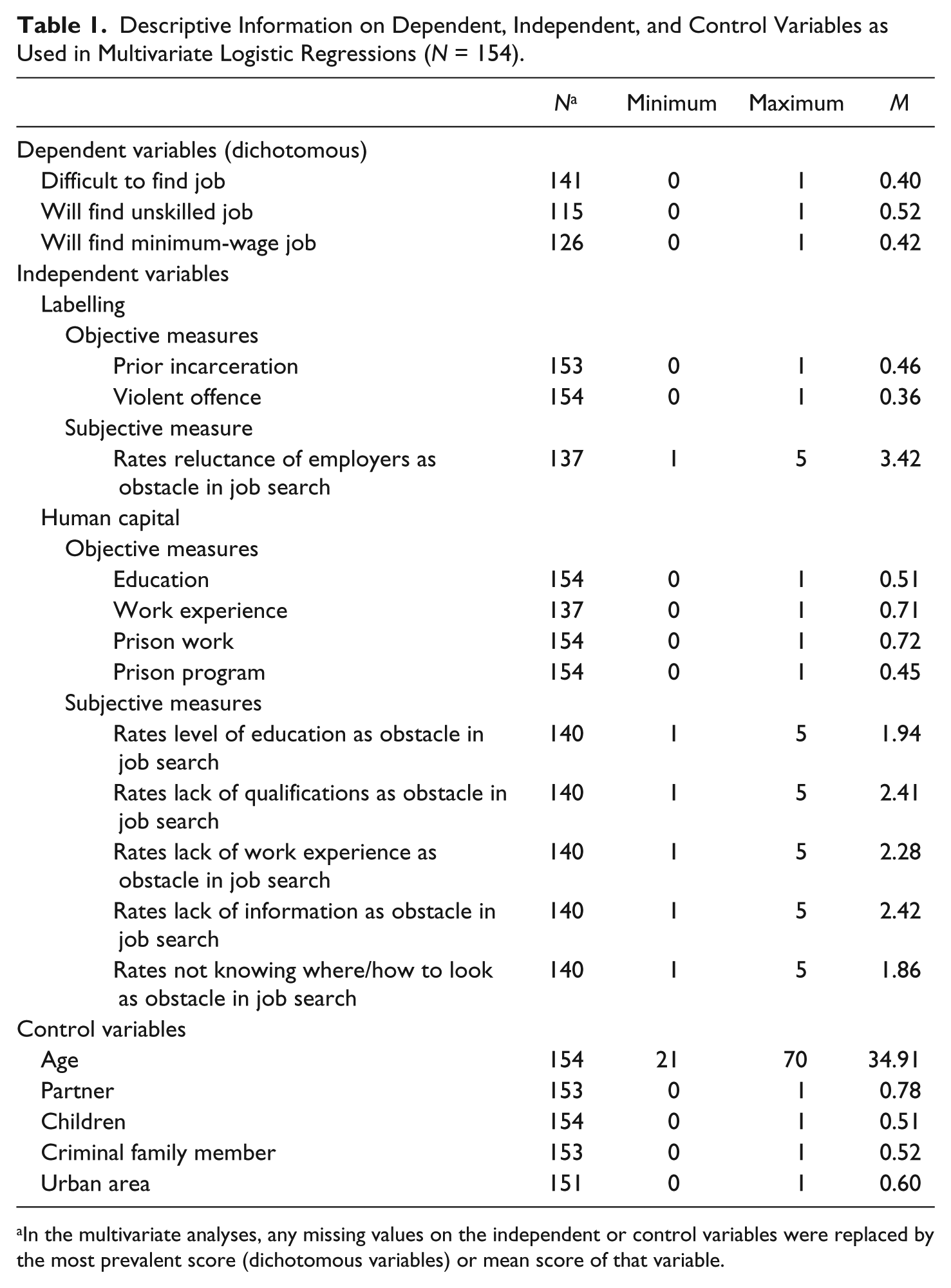
In the multivariate analyses, any missing values on the independent or control variables were replaced by the most prevalent score (dichotomous variables) or mean score of that variable.
Independent variables
First, drawing on labelling theory, we included two objective measures of criminal severity as independent variables. Prior incarceration measures whether a prisoner was previously incarcerated at least once (46%). The measure violent offence differentiates between prisoners who were incarcerated for homicide, bodily injury, violent robbery, and rape (36%) and those who were convicted for nonviolent offences. We also included a subjective labelling measure. The question, “To what extent do you think that employers’ reluctance to work with offenders will be an obstacle for you in finding a job after release?” was used to measure perceived stigma from employers (1 = very small extent, 2 = small extent, 3 = moderate extent, 4 = great extent, 5 = very great extent).
Second, a set of variables related to prisoners’ human capital prior to incarceration was included. Education differentiates between prisoners who completed nine grades or more (attended high school, 51%) and those who completed less than nine grades. Work experience distinguishes between prisoners who had at least one job prior to incarceration (71%) and those who never worked.
We also included two measures of prisoners’ involvement in prison programs. Participation in prison work shows whether prisoners worked for at least 6 months in prison (72%). Participation in prison program measures whether prisoners participated in educational or vocational programs (45%).
Finally, we added five subjective human capital indicators that measure whether prisoners perceive their human capital characteristics as obstacles in finding employment: education, vocational qualification, work experience, information about the labour market, and not knowing where and how to look for a job. 7 Again, Likert-type scale answers were used (ranging from 1 = very small extent to 5 = very great extent).
Controls
Based on the literature, two demographic measures and three measures of social bonds are included as control variables. Age represents the age at interview and ranges from 21 to 70 years old. The area of residence measures whether the prisoner previously lived in an urban (60%) or rural area. Having a partner measures whether a prisoner was married or living with his partner at the time of the arrest (78%). Having children younger than 18 years old was also included (51%). Criminal family measures whether at least one family member served a prison sentence or was incarcerated at the time of the interview (52%).
Analyses
To answer the first research question, descriptive graphs were created to show between-individual differences in the three perceptions. Multivariate logistic regressions were conducted to answer the second research question. These analyses show the correlation between an independent variable and a dependent variable while controlling for other independent variables. As mentioned above, and listed in Table 1, the data include many independent variables (objective and subjective measures of human capital and labelling as well as control variables; total of 17 factors). The number of prisoners included in the analyses (N = 154) limits the number of variables that can be included in the regression models simultaneously. As this study focuses on establishing the correlations between labelling and human capital indicators and perceptions, the findings of the models that include only the theoretically derived factors will be presented below. Sensitivity analyses were conducted to check for robustness in findings and are discussed in the “Results” section.
Results
Figures 1 to 3 show prisoners’ perceptions about future employment in more detail than the dichotomous variables that will be used in the multivariate logistic regressions. Starting with Figure 1, we find mixed responses to the question, how difficult prisoners think that it will be to find a job after release. The two extreme categories, that is, an optimistic or pessimistic attitude, are most popular. One third of the prisoners (33%) believe that it will be very easy to find a job and a similar proportion (31%) believe, instead, that it will be very difficult. In between are those who think it will be easy (13%), neither easy nor difficult (14%), and difficult (9%).
Figures 2 and 3 give insight into perceptions about the type of jobs that will be available after release and reveal diversity as well. About 43% of the prisoners seem pessimistic and anticipate that they will end up in an unskilled job. A rather substantial percentage of the prisoners believe, however, that they will find a skilled job (e.g., skilled workers and assimilated workers: 27%, farmers and qualified workers: 3%). A smaller percentage believes to end up in a higher quality job (workers in services and trade: 4%, specialists in various activities: 1%, members of legislative and governmental bodies: 4%). A substantial group of prisoners expected to not find any job (7%) or replied with a job title or description that could not be classified in either of the categories (11%). These prisoners were, therefore, excluded from further analyses.
We furthermore observe differences between prisoners in their perceptions on future wages: 42% are pessimistic and think they will earn the minimum wage, 31% expect to earn between the minimum wage and the average wage, and 27% of the prisoners think their wages will be higher than average. At the time of the survey (2014), the gross minimum wage in Romania was 900 lei or 205 euros. This is substantially less than the average wage, which was 2,328 lei or 531 euros (National Institute of Statistics and Ministry of Labour and Social Justice).
The second goal of the current study was to examine whether any of the aforementioned differences in perceptions could be explained by factors derived from the labelling and the human capital perspective. Table 2 shows the findings from three logistic regression analyses and can give insight into the relative importance of the different indicators in explaining differences in perceptions about postrelease employment prospects.
Multivariate Logistic Regressions.
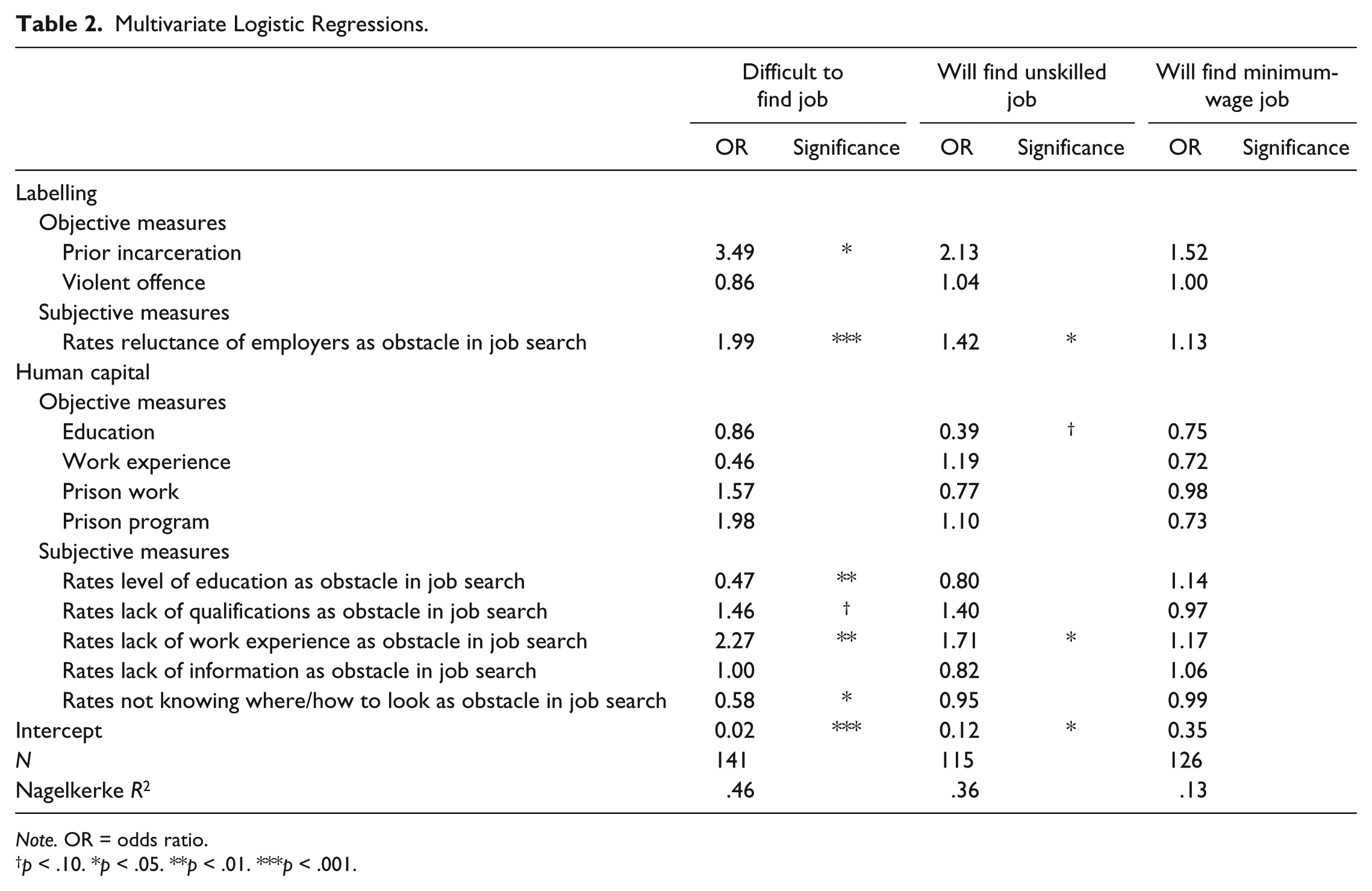
Note. OR = odds ratio.
p < .10. *p < .05. **p < .01. ***p < .001.
We find the most significant relationships for the first perception; several labelling and human capital indicators are related to prisoners’ perceptions about whether it will be difficult to find a job. Prisoners with a prior prison experience, odds ratio (OR) = 3.49, and those who feel employer reluctance can prove to be an obstacle in the job search (OR = 1.99) are more pessimistic about finding a job. Neither of the objective measures of human capital is significant, but the subjective measures seem to matter. Prisoners who believe that lack of vocational qualifications (OR = 1.46) and lack of work experience (OR = 2.27) are obstacles in finding employment are more likely to be pessimistic about their job chances on release. In contrast, and surprisingly, prisoners who think that lack of education is an obstacle in finding a job (OR = 0.47) and those that do not know how to look for a job (OR = 0.58) are less pessimistic about finding one.
Prisoners’ perceptions about finding an unskilled job are also related to indicators derived from both theoretical perspectives. Prisoners who think that employers are reluctant to hiring offenders believe they are more likely to find an unskilled than a skilled job (OR = 1.42). In addition, one objective human capital measure and one subjective human capital measure seem to explain between-individual differences in this perception. Prisoners who are educated are less pessimistic (expect they are less likely to find an unskilled than a skilled job; OR = 0.39) and those who rate lack of work experience as obstacle are more pessimistic (expect they are more likely to find an unskilled job than a skilled job; OR = 1.71).
When we turn to the third perception, Table 2 shows that none of the theoretically derived factors derived from either labelling theory or human capital theory is significantly related to prisoners’ perceptions about wage.
Sensitivity Analyses
This study’s sample size limits the inclusion of all independent and control variables in a regression model. As we aim to examine the correlations between labelling and human capital indicators and perceptions, Table 2 shows the findings of the models that control for all theoretically derived factors and excludes the control variables. Collinearity statistics revealed that multicollinearity was not an issue in these main models. To ensure that the selection of included variables did not affect the findings, we conducted sensitivity analyses: Separate models were run for the two theoretical perspectives, once without and once including the control variables (four models in total). Overall, these alternative models showed similar findings and led us to draw similar conclusions as the findings presented in Table 2 (see Table A1).
Some differences in findings are nevertheless worth mentioning. For the perception about finding an unskilled job, the alternative models implied a significant positive relationship with prior incarceration that was not found in the presented model. Some caution is, therefore, advised in interpreting this correlation (see Table A2). Also, although no significant correlations were found in the main model, some alternative models implied that those who rate employer reluctance as an obstacle and those who have a criminal family member are more likely to expect to find a minimum-wage job (see Table A3). Below, the findings will be compared with previous research and interpreted within the Romanian context.
Discussion and Conclusion
The current study aimed to describe prisoners’ perceptions about their postrelease employment outcomes, and the factors associated with these perceptions among a sample of male prisoners in Romania. The focus on prisoner perceptions was motivated by prior research implying that how prisoners regard their chances of reentering the labour market has profound implications for their behaviour and success rate on release (Maruna, 2001; Ray et al., 2016).
We found that Romanian prisoners reported rather mixed perceptions, regarding both the difficulty of finding a job and the type of job that will be within their reach. Several of them were confident that they would easily secure employment, find a quality job, and one that pays well. Others shared pessimistic views about their chances in the labour market. These findings are consistent with the previous literature showing varying degrees of pessimism in perceptions about postrelease employment across U.S. studies (Benson et al., 2011; Ray et al., 2016; Visher & O’Connell, 2012; Winnick & Bodkin, 2008). However, these studies seemed to find less polarization within their samples than we found using a Romanian sample of prisoners. Although we cannot be sure, the atypical characteristics of the Romanian labour market might have contributed to this outcome. To illustrate, although the official unemployment is moderate in Romania (6.8% at the time of the survey), the employment rate is one of the lowest in the European Union (65.7% in 2014). This seemingly contradictory situation might be explained by the fact that many people work abroad or are enrolled in the informal economy (Boboc, Țițan, & Todose, 2011). The official figures on migration for work are largely absent, but research estimates that nearly 3.5 million Romanians are working abroad on a permanent basis and an additional 1.5 million have temporary job. 8 Estimates also indicate that roughly 1.57 million individuals are working off-the-books in Romania (Consiliul Fiscal, 2014). Hence, finding a job in the formal labour market might be relatively difficult for Romanian offenders, but employment is within reach for those who are willing to go abroad or work informally.
We demonstrated that both labelling and human capital indicators were related to prisoners’ perceptions, most of the time in the direction we expected based on theory and prior research. For the general perception (difficult to find a job) and the perception about finding an unskilled job, we found that several subjective measures of labelling and human capital theory, more than the objective measures, explained between-individual differences. To illustrate, a prior incarceration was the only objective measure that was significantly related to the general perception. Recidivists were more pessimistic about finding a job (and about finding a skilled job according to some of the sensitivity analyses). These findings imply that the perceived difficulty of finding a job after prison does not only depend on personal characteristics per se but also depends on prisoners’ expectations about how much these characteristics weight in the hiring process. For instance, it was not the actual level of education or work experience that explained differences in these two perceptions, but how relevant prisoners believe these factors are in the job search. Somewhat unexpected was the finding that prisoners who believe that lack of education is an obstacle in the job search are less pessimistic about finding a job. Arguably, the type of jobs prisoners expect to find does not require a specific educational level, but may instead rely more on certain work-related skills and experience (Visher, Debus-Sherrill, & Yahner, 2011). As such, having a good education might be valued by prisoners, but is not perceived by them as a necessary requirement to find a job. A previous study conducted in Romania showed indeed that prisoners believe that a minimum level of literacy is sufficient to reintegrate into society (Thiemann, 2017). This attitude is explained by the author in relation to both “public debates emphasizing the poor quality of education in post-communist Romania and media depiction of a corrupt society rather than one in which meritocracy is prioritized” (Thiemann, 2017, pp. 24-25). A similar surprising finding was that prisoners who do not know how to look for a job are less pessimistic about finding one. Possibly, these prisoners are not planning to use formal job search methods (e.g., job-search engines, institutional support), but rather rely on their social network to find employment.
The perception about finding a minimum-wage job was not associated with any of the considered measures. Overall, wages in Romania are low: At the time of the survey, the earnings of nearly 20% of the employed were below the poverty threshold (Eurostat Dataset on Income and Living Conditions, 2014). Perhaps, this, in combination with the abovementioned characteristics of the Romanian economy, can explain why “traditional” predictors of employment outcomes cannot explain variation in expected earnings. However, differential association theory might provide better explanations for the wage perception. This idea is validated by the rather unexpected finding that having a criminal family member is positively related to the perception of finding a minimum-wage job in some of the sensitivity models. Prisoners with criminal family members might have learned from them that the only available (noncriminal) jobs are low-paid jobs. Another potential explanation for the few significant relationships with the two perceptions about type of job (wage, skilled/unskilled) could be that especially these measurements also reflect to what extent prisoners are realistic, rather than pessimistic, about their employment opportunities. Future research could examine to what extent these two interpretations are valid.
From a theoretical standpoint, we can conclude that both labelling and human capital indicators can partly explain prisoners’ perception on the difficulty of finding (skilled) employment after release. These findings show that differences in prisoners’ perceptions are related to the same characteristics that have proven to predict actual employment outcomes (G. S. Becker, 1964; Lemert, 1951; Link et al., 1989). With respect to labelling theory, a strong correlation was found between perceived stigma (employer reluctance) and the perception about finding a job. Perceived stigma may act as a deterrent in pursuing life goals such as finding work; this is called the “why try” effect (Corrigan, Larson, & Rüsch, 2009). It is important to assess to what extent employers are actually reluctant toward hiring offenders. Previous studies imply that having access to more information about the applicant as well as prior experience with hiring ex-offenders are related to more favorable employer attitudes (Giguere & Dundes, 2002). Moreover, a Romanian study conducted by Durnescu (2008) concluded that a criminal record does not represent a real source of discrimination in the labour market because employers often do not request information on criminal records from job candidates. However, more recent ethnographic work coordinated by the same author revealed that a criminal record is often required even when employers have no legal obligation to do so (Durnescu, 2017). Further research is warranted to examine whether these recent findings indeed reflect a change in the hiring practice in Romania. If so, then the pessimism expressed by the participants is just and should be addressed in prison interventions as well as at the societal level.
Relevant for human capital theory were the findings that less educated prisoners and prisoners who believe their qualifications or work experience will be an obstacle in the job search are relatively less optimistic. Although human capital theory is used to explain employers’ behaviour, our findings imply that these notions can also help to explain prisoners’ perceptions. Their human capital and ideas about the importance of this capital may refrain them from looking for (certain) jobs and lead to less successful employment outcomes. These findings point to initiatives focused on increasing prisoners’ self-efficacy (Visher et al., 2011). This recommendation is further supported by the lack of a significant relationship between participation in prison programs or prison work and perceptions. Visher and O’Connell (2012) reported similar findings among U.S. prisoners: The attendance of prison programs does not affect how prisoners perceive their employment chances after release. One possible explanation is that prisoners’ participation in programs is based on wrong intentions. The prison literature points to the process of prisonization that usually leads to the “exploitative” use of prison programs (Irwin, 1970/1987). The lack of a significant relationship may also suggest that programs do not offer a meaningful experience to prisoners (Visher & O’Connell, 2012). In Romania, most vocational programs are targeting the lowest levels of qualification for which there is low demand in the communities (construction, farming, and trade). Romanian statistics show, for instance, that labour demand for skilled workers in agriculture is extremely low (0.3% of all job vacancies in 2014). 9 Still, in the respective year, almost 20% of all prisoners who attended vocational courses were trained in livestock work and crop production. 10 The gap between the training received in prison and the outside employment opportunities sets obvious limitations on prisoners’ opportunities to transfer the skills they obtained (Richmond, 2015). Also, most of the offered prison education is limited to primary school levels, although high school and college education might be more helpful in securing employment after release and earning higher wages (Duwe & Clark, 2014; Jenkins, Steurer, & Pendry, 1995; Schumacker, Anderson, & Anderson, 1990). Like prison programs, prison work might not provide prisoners with the necessary experience as most Romanian prisoners who are eligible to perform jobs outside prisons undertake unskilled work. Prison administrations should enhance their efforts to provide vocational and work programs that mirror the job demand in the labour market.
Despite the insights delivered in this study, three limitations should be addressed. The first limitation is that we used cross-sectional data. As such, our findings cannot be interpreted as causal relationships. Longitudinal research is warranted to examine whether the correlations found in the current study could be causal relationships. Also, whether and how in-prison perceptions are related to the actual behaviour of the prisoners in this sample is an area of research that deserves further attention. We discussed Maruna’s (2001) finding that desisters held a positive outlook over their destiny and persisters held negative perceptions about their own capacity to change their behaviour. Yet, not all studies validated the significant relationship between perceptions and behaviour (Dhami et al., 2006). As the relevance of studying and aiming to improve prisoners’ perceptions depends partly on its relation with actual behaviour on release, longitudinal research that examines this relationship is warranted.
Second, this study was conducted on a subsample of prisoners who had less than 2 years left until being heard for conditional release. Given the relatively small sample of our study, we could not conduct analyses on subsamples of soon to be released prisoners. Future research is warranted to examine whether perceptions change over time and are significantly different closer to the release date. Also, as the data were collected in four Romanian prisons, it remains uncertain to what extent the findings can be generalized to all Romanian facilities. Our findings nevertheless add significant value to a large body of work that is almost solely based on American data. Notably, however, the Romanian social context shares more similarities with the U.S. context than most European countries (Lappi-Seppälä, 2011). For instance, both countries display a high level of social inequality in welfare distribution (in 2013, the Gini index was 27.5 in Romania and 41.1 in the United States) and show low expenditure on social protection (in 2013, Romania spent 14.9% of its GDP on social protection, and the United States spent 19.2%). Moreover, although the imprisonment ratio in Romania is not as exceptionally high as in the United States, it is high for European standards (143 in Romania and 689 in the United States; Walmsley, 2015). In addition, whereas American prisons are considered to be harsher than European prisons, prison conditions in Romania are incongruent with the ruling of the European Court of Human Rights (ECtHR). Overpopulation, lack of personal space, and bad hygiene conditions are structural elements of incarceration in Romanian prisons (Council of Europe, 2011, 2015). Not surprisingly, the country occupies a dishonourable first place among E.U. member states regarding the number of ECtHR cases for improper conditions of detention. As such, our findings reflect the perceptions of individuals who are confined under harsh conditions and will be released without much help. Future cross-national research is warranted to examine the extent in which prisoners’ perceptions are related to these contextual factors.
Finally, our study focused on several but not all relevant human capital and labelling factors. For example, the data we used did not allow us to consider the importance of ethnicity (i.e., as a labelling factor). Previous studies conducted in Romania showed that Roma people experience reentry different from others (Durnescu, Istrate, Teoroc, Pitiu, & Rotariu, 2016). Future research should also include factors drawn from other theories, such as social capital theories and motivation theories, to examine whether such factors improve perceptions as well as outcomes.
Also, because we were able to assess the contributions of prison programs and prison work in general, we encourage future research to consider whether particular types of (work) programs are differently related to prisoners’ perceptions about postrelease employment outcomes. Indicators that define the quality of these prison programs need to be taken into consideration in these future studies (Visher & O’Connell, 2012).
To close, ensuring that prisoners obtain employment after release is essential to any prison policy focused on the prevention of recidivism and promotion of social reintegration. How prisoners perceive their future chances of employment is an important element that can either deter or encourage their reintegration. This study gave insight into the perceptions of Romanian prisoners about their postrelease employment prospects and showed which prisoners were more or less optimistic about employment after release. Next to objective factors, prisoners’ expectations about how much these factors weight in the hiring process can explain between-individual differences in perceptions. As such, the optimal policy solution toward optimistic reentry perceptions would include not only addressing barriers related to prisoners’ actual criminal history and human capital but also focusing on how these barriers are perceived by them.
Footnotes
Appendix
Declaration of Conflicting Interests
The author(s) declared no potential conflicts of interest with respect to the research, authorship, and/or publication of this article.
Funding
The author(s) disclosed receipt of the following financial support for the research, authorship, and/or publication of this article: This work was supported by a grant from the Romanian Ministry of Education and Research, CNCS – UEFISCDI, project number PN-II-RU-PD-2012-3-0116.