




Abstract
Drawing on general strain theory of crime, the study employs the survey data from a random sample of 600 school students in Lviv, Ukraine, to examine how sanction risks and social bonds mediate and moderate the relationship between strain and adolescent delinquency. Findings from negative binomial regressions and the KHB decomposition procedure demonstrate that fear of sanctions and levels of social control mediate the relationships between strain and delinquency to a different degree, depending on the type of strain experienced. Results concerning conditioning effects are mixed, with only parental monitoring found to be a moderator of the strain–delinquency link. However, the direction of the interaction effect is unexpected. Future research needs to improve the specification of strain models and evaluate them in other sociocultural contexts.
Introduction
Studies have repeatedly shown offending to be the highest during adolescent years (Piquero, Farrington, & Blumstein, 2003), with those in the age range of 15 to 17 demonstrating the highest arrest rates for delinquent involvement (Hirschi & Gottfredson, 1983). General strain theory (GST: Agnew, 1985, 1992, 2001, 2006) is one of the most popular theoretical explanations of offending across various population groups, including adolescents. The key argument of GST links offending to negative emotions produced by strains individuals encounter in daily lives (Agnew, 2006). In addition to the causal chain between strain, negative affect, and offending, Agnew (2001, 2006) specified multiple mediating and moderating factors that may determine the outcome of one’s exposure to strain, including delinquent peer association, social support, and self-esteem.
Although GST enjoyed much scholarly attention, research findings bearing on these and other conditioning factors have been somewhat inconsistent. Furthermore, despite the complex nature of today’s formulation of GST, it still omits some potentially important factors that may affect the strain–crime relationship such as one’s perceptions of risks associated with offending. Finally, research testing key premises of GST has often failed to incorporate full range of phenomena they presume to be important for the strain–crime link. For instance, out of a number of studies investigating the interaction between social bonds and strain (e.g., Cullen, Unnever, Hartman, Turner, & Agnew, 2008; Paternoster & Mazerolle, 1994), none were able to incorporate a more complete theoretical range of social bonds as presented in Hirschi’s (1969) theory. Furthermore, additional possible mediators/moderators such as sanction risks have not been empirically studied at all. Finally, there has been only a limited number of studies that test the generalizability of the theory in unusual social contexts such as, for example, former Soviet Union countries. Although previous research has provided an insight into the way strain affects adults in some former Soviet nations (e.g., Botchkovar & Broidy, 2013; Botchkovar, Tittle, & Antonaccio, 2009), no studies have tested GST among adolescents in the post-Soviet context.
Using a random sample of adolescents from Lviv, Ukraine, this study will fill in the gaps in the existing literature by making several contributions. First, it will investigate perceived risk of sanctions as a mediator and moderator of the strain–crime relationship. Second, it will incorporate a broader range of social bonds to examine their mediating and moderating roles in the relationship between strain and offending. Finally, this research will assess the applicability of GST to explaining causes of juvenile delinquency in an unusual sociocultural context—Ukraine, where social conditions and circumstances differ substantially from those of Western settings, where most GST tests have been conducted. In particular, in contemporary Ukraine, adolescents face many challenges resulting from an anomic social environment and dysfunctional institutions, making it especially urgent to thoroughly investigate possible causal mechanisms, through which those straining conditions may influence their delinquent behavior.
The Status of GST
GST, first proposed by Agnew in 1992 and further developed in 2001 and 2006, conceptualizes offending as reaction to straining situations. Agnew defines strain as “relationships in which others are not treating an individual as he or she wants to be treated” (Agnew, 1992, p. 48). He distinguishes between three major types of strains: (a) preventing one from achieving positively valued goals, (b) removing or threatening to remove positively valued stimuli that one possesses, and (c) presenting or threatening to present one with noxious or negatively valued stimuli (Agnew, 1992). For instance, losing a family member can serve as an example of removing positively valued stimulus, whereas victimization may be an example of a negatively valued stimulus.
Agnew further argues that the association between strain and crime is indirect through a range of negative emotions—depression, guilt, anger—brought on by stressful situations experienced by individuals. The experience of these negative emotional states creates a desire to engage in corrective actions, and these actions can include different types of coping, involving cognitive, emotional, and behavioral strategies. GST also suggests a number of important moderating mechanisms affecting the strain–crime relationship, including association with delinquent peers, self-esteem and self-efficacy, social support, and negative emotionality/low constraint (Agnew, 2006; Agnew et al., 2002). Furthermore, Agnew emphasizes how events and situations within several important life domains such as family and school may influence strain–delinquency relationships (Agnew, 2005, 2006). For instance, the effect of stressors in one life domain (e.g., negative school experiences) may be conditioned by situations in other life domains (e.g., low level of parental bonding) (Agnew, 2005). In other words, criminogenic effects of particular stressors found in some adolescent life domains could sometimes be amplified by negative conditions that take place in other domains.
The direct relationship between strain and crime was explored in multiple studies conducted in various contexts (e.g., Botchkovar et al., 2009; Carson, Sullivan, Cochran, & Lersch, 2008; Cudmore, Cuevas, & Sabina, 2017; Hay & Evans, 2006; Ostrowsky & Messner, 2005; Rebellon, Manasse, Van Gundy, & Cohn, 2012; Sigfusdottir, Kristjansson, & Agnew, 2012). Overall, Agnew’s strain theory received some support with both cross-sectional (Cudmore et al., 2017; Peck, 2013; Sigfusdottir et al., 2012) and longitudinal data (Hollist, Hughes, & Schaible, 2009; Lee & Cohen, 2008; Moon, Morash, McCluskey, & Hwang, 2009). Various single and aggregate measures of strain, including physical and emotional punishment (S. W. Baron, 2004; Moon et al., 2009; Sealock & Manasse, 2012), financial hardship (Bucher, Manasse, & Milton, 2015), job- and health-related stressors (Jang & Johnson, 2005), negative relationships with others (Bao, Haas, & Pi, 2007), and victimization (Jang & Rhodes, 2012) have been shown to predict a number of delinquent acts (e.g., Rebellon et al., 2012) and other offenses such as violence and property crime (e.g., Botchkovar & Broidy, 2013).
Multiple studies have focused on youth-specific strains and their effect on delinquency. Family conflict and negative treatment by parents were found to be significantly correlated with violent and status delinquency in Asian and several Western European contexts (Bao, Haas, Chen, & Pi, 2014; Hollist et al., 2009; Moon et al., 2009; Sigfusdottir et al., 2012). Parental reactions to dropout from school (Drapela, 2006), quality of parent and child relationship (Ganem & Agnew, 2007), and parental withdrawal and absence of parental support (Hollist et al., 2009) were also examined and found to exert significant effects on multiple types of delinquency. In addition, studies explored the influence of academic and school-related strains on delinquency. A number of stressful conditions such as negative relationship with teachers, prejudiced/unfair treatment at school, poor academic performance, and feeling unsafe at school were reported to affect multiple types of delinquency in different contexts (Bao et al., 2014; Ford & Schroeder, 2008; Lee & Cohen, 2008; Peck, 2013; Pérez, Jennings, & Gover, 2008).
Although GST has been tested in different contexts, only few studies provided some mixed evidence on criminogenic effects of strain in former Soviet Union countries (e.g., Botchkovar & Broidy, 2013; Botchkovar et al., 2009). However, these studies have focused on adult population, and no research has tested GST of crime using youth data in the post-Soviet context. Only one study has tested the applicability of another strain theory, Merton’s anomie/strain to youth in post-Soviet contexts, using the same sample of Ukrainian adolescents as the present study (Antonaccio, Smith, & Gostjev, 2015). It demonstrated that young Ukrainians faced an uncertain future with few legitimate opportunities to advance professionally while being exposed to multiple illegal sources of financial success, and it found some moderate criminogenic influences of anomic strain (Antonaccio et al., 2015). Given that the effect of Mertonian strain observed in that study was not large, it is important to investigate other types of strain (e.g., school, family strains) and their interrelationships with various life domains among adolescents. These strains, in particular, may cause dissatisfaction and frustration, and they may be more salient for Ukrainian youth.
Furthermore, although the direct relationship between strain and crime is well supported empirically, findings concerning mediating and conditioning effects are often mixed. Although some studies found support for the mediating effect of negative emotions (Hay & Evans, 2006; Hollist et al., 2009), others revealed no evidence of this effect (Cudmore et al., 2017; Leeper Piquero & Sealock, 2010; Moon, Morash, & McCluskey, 2012). Research also showed inconsistent results concerning conditioning effects of social support, gender, self-esteem, self-efficacy, and delinquent peers (see Hoffmann, 2010; Morash & Moon, 2007) on the association between strain and offending behavior. In addition, whereas some conditioning variables such as delinquent peer association, have been extensively examined by the studies of GST (e.g., Bao et al., 2014; Hoffmann, 2010), other moderating and mediating variables such as external constraints have hardly received any attention. This suggests that the role of additional mediating and moderating factors in GST needs further exploration and specification, especially in the light of the relevant past research suggesting that identifying such contingencies (e.g., external constraints such as perceptions of sanctions) in traditional/anomic strain–delinquency relationship may be particularly promising in post-Soviet contexts (Antonaccio et al., 2015). Thus, it is important to incorporate more intervening links and conditions into GST to further specify the role of various life domains in the relationships between strain and delinquency. In this study, we focus on two less extensively investigated mediating and moderating factors—social bonds and perceptions of sanction risks.
Strain, Social Bonds, and Crime
Drawing on Hirschi’s (1969) social control theory, Agnew (1992) argues that strong social bonds may weaken the association between strain and crime. That is, attachment to conforming others, involvement in conventional activities leaving little to no time for offending, commitment to conventional goals such as successful career and acquisition of family, and a strong prosocial belief system are likely to decrease the likelihood of criminal coping among those exposed to strain (see Hirschi, 1969; Agnew, 1992, 2001, 2006). In addition, according to GST, experiencing criminogenic strain in different life domains (such as school, for example) may be contingent on weak bonds within the family domain (Agnew, 2005). At the same time, strain exposure itself may be associated with the weakening of social bonds (Agnew, 2006). For instance, those experiencing chronic financial hardship may be prone to losing previously strong connections with conformists, becoming disinterested in keeping their jobs, questioning their beliefs defining crime as unacceptable, and spending a lot more time with people who have run into trouble with the law (Agnew, 2001). This suggests that social bonds may moderate or mediate the link between strain and offending.
Whereas several studies concentrated on the mediating role of social bonds, and few other ones investigated their interaction with strain-relevant processes, only one study—with somewhat limited measures of social bonds—attempted to investigate both possibilities (Paternoster & Mazerolle, 1994). The research investigating the mediating effects of social control on the strain–crime association typically found support for this premise (Brezina, 1998; Gover, 2002; Lin & Yi, 2016; Maxwell, 2001; Jang & Rhodes, 2012). Strain was found to have a significant effect on delinquency via reducing commitment to school among adolescents in the United States (Brezina, 1998), via weakening attachment to family and moral beliefs among Pilipino-grade students (Maxwell, 2001), as well as via decreasing school engagement among Taiwanese youth (Lin & Yi, 2016). A recent study also found that the link between delinquency and depression produced by maltreatment may be mediated by weakened social control (Gao, Wong, & Yu, 2016).
Even fewer studies explored the conditioning effect of social bonds on the strain–crime relationship. On one hand, moral beliefs were found to condition the effect of strain on crime in the expected direction (Mazerolle & Maahs, 2000; Mazerolle & Piquero, 1997). However, other research reported no moderating effect of family attachment, moral beliefs, and religious commitment on the strain–crime link (Jang & Rhodes, 2012; Paternoster & Mazerolle, 1994). Overall, only few studies provided some evidence of the mediating and moderating effects of social control, and most of them did not cover the fuller theoretical range of the social bonds concept and did not examine a variety of strains. Finally, all of them were conducted in Western or Asian contexts.
Strain, Risk of Sanctions, and Crime
Although GST does not elaborate on relevance of perceptions of punishment, the introduction of the concept of risks of sanctions may help better specify indirect links between strain and crime. First of all, exposure to strain may actually affect cognitive mechanisms playing a role in rational evaluations of risk of punishment. This is consistent with the literature on social psychology showing that strains are common antecedents of stress (Pearlin, Menaghan, Lieberman, & Mullan, 1981), which, in turn, has been repeatedly demonstrated to affect cognitive decision-making abilities (Keinan, 1987; van den Bos, Hartveld, & Stoop, 2009). Thus, those who experience strain, because of compromised cognitive mechanisms responsible for the formation of perceptions of sanction risks, may actually underestimate their chances of being sanctioned for involvement in misbehavior and, consequently, be more likely to engage in criminal behavior. In other words, one’s fear of sanctions can serve as a mediating mechanism between strain and crime, because people exposed to strain may perceive the risk of sanctions to be relatively lower, which, in turn, makes criminal coping more likely.
Second, incorporating sanction risks may also help to specify the conditions under which individuals are more likely to forgo conventional adaptations to strain and instead select criminal coping strategies. Specifically, when discussing how GST applies to terrorism, Agnew (2010) argues that terrorists reside in straining environments, in which their perceptions of sanctions are lowered and where they have little to lose if sanctions are imposed. In particular, Agnew posits that costs of terrorism may be one of the conditioning factors affecting the relationship between strains and this type of crime, with strained individuals being less likely to be involved in terrorism when such behavior is expected to be sanctioned. Therefore, applying these arguments to other types of criminal behavior, we argue that perceptions of sanction risks may moderate the association between strain and crime, so the relationship between strain and crime should be amplified when risks of sanctions are low.
Although studies focusing on the effects of formal and informal punishment are abundant (e.g., Matthews & Agnew, 2008; Nagin & Paternoster, 1993; Nagin & Pogarsky, 2001; Tittle, Botchkovar, & Antonaccio, 2011), to date, no studies of GST incorporated the effects of fear of formal and informal sanctions as a mediating or moderating influence in the strain–crime relationship. One study, however, indirectly spoke to possible mediating effects of fear of informal sanctions (Rebellon, Leeper Piquero, Piquero, & Tibbetts, 2010), reporting that the effect of strain on criminal intentions may be partly indirect, mediated by anticipated shaming. In the absence of any research that would include a full theoretical range of deterrence-related factors, our study will be the first to account for the role of the fear of formal and informal sanctions in strain–crime relationships and to explore their possible mediating and moderating effects in the causal mechanism specified by GST.
Current Study and Hypotheses
This study will contribute to the literature in several ways. First, it will provide a more thorough specification of the strain–crime relationship by using not commonly studied mediating and moderating factors, social bonds, and fear of sanctions. In particular, it will incorporate a broad range of social bonds to examine their mediating and moderating roles in the relationship between strain and offending behavior and, for the first time, it will investigate perceived risk of sanctions as a mediator and contingency important for the strain–crime relationship. Second, it will explore the generalizability of the theory by testing these hypotheses with a sample of adolescents in an unusual social context—Ukraine. Specifically, the study will test the following hypotheses:
Method
Data and Context
Data for this study were collected from 600 school students in one of the major cities of Ukraine, Lviv, in 2006. Although the data were not collected recently, these data capture key processes of society in transition and are, thus, very valuable for testing strain theories as illustrated in past research by Antonaccio et al. (2015). The data collection was conducted by the Center for Social and Marketing Research (the leading professional organization that provides survey services in Ukraine) and involved the standard school student survey research procedures such as employment of parental consent and provision of survey incentives. This study used a two-stage random selection procedure. First, a random sample of schools was selected from the list of all 118 city public schools in six city districts. Then, from each of the selected schools, one class of ninth graders was randomly chosen out of the pool of all ninth-grade classes. Involving ninth graders was necessary to maximize the diversity of the sample. Ukrainian compulsory public education requires 9 years of schooling with many students leaving after the ninth grade to pursue technical occupations, and the remaining more academically motivated students graduating on the completion of the 12th year of schooling. All participating students filled out a self-administered questionnaire in Ukrainian language. The average response rate across schools was 85%, which appears higher than in comparable surveys conducted in the United States (Porter & Umbach, 2006).
Ukraine is a particularly interesting context for collecting data for this study because, after the collapse of the USSR, the former Soviet republic has undergone multiple political, economic, and sociocultural changes and experienced significant instability in its political, family, and economic institutions (Perelli-Harris, 2008). Ukraine is also a criminogenic environment, with higher violent crime rates than in other European countries and much widespread and systemic corruption, resulting in public distrust of many governmental institutions (Antonaccio & Tittle, 2008; Kiev International Institute of Sociology [KIIS], 2009; Matsieyvskiy, 2010; Tittle et al., 2011; United Nations Office on Drugs and Crime, 2006). Importantly, it remains a country characterized by a multitude of strains coming from the fear of being a victim of crime, distrust in the police, the lack of financial means to sustain a living and protect personal property, uncertain future, family instability, and other problems (Kostenko, 1999). Many of these strains are considered by GST to be especially criminogenic, and they may have a particularly negative impact on the behaviors of young people growing up in the country.
Variables
Dependent variable: Projected delinquency
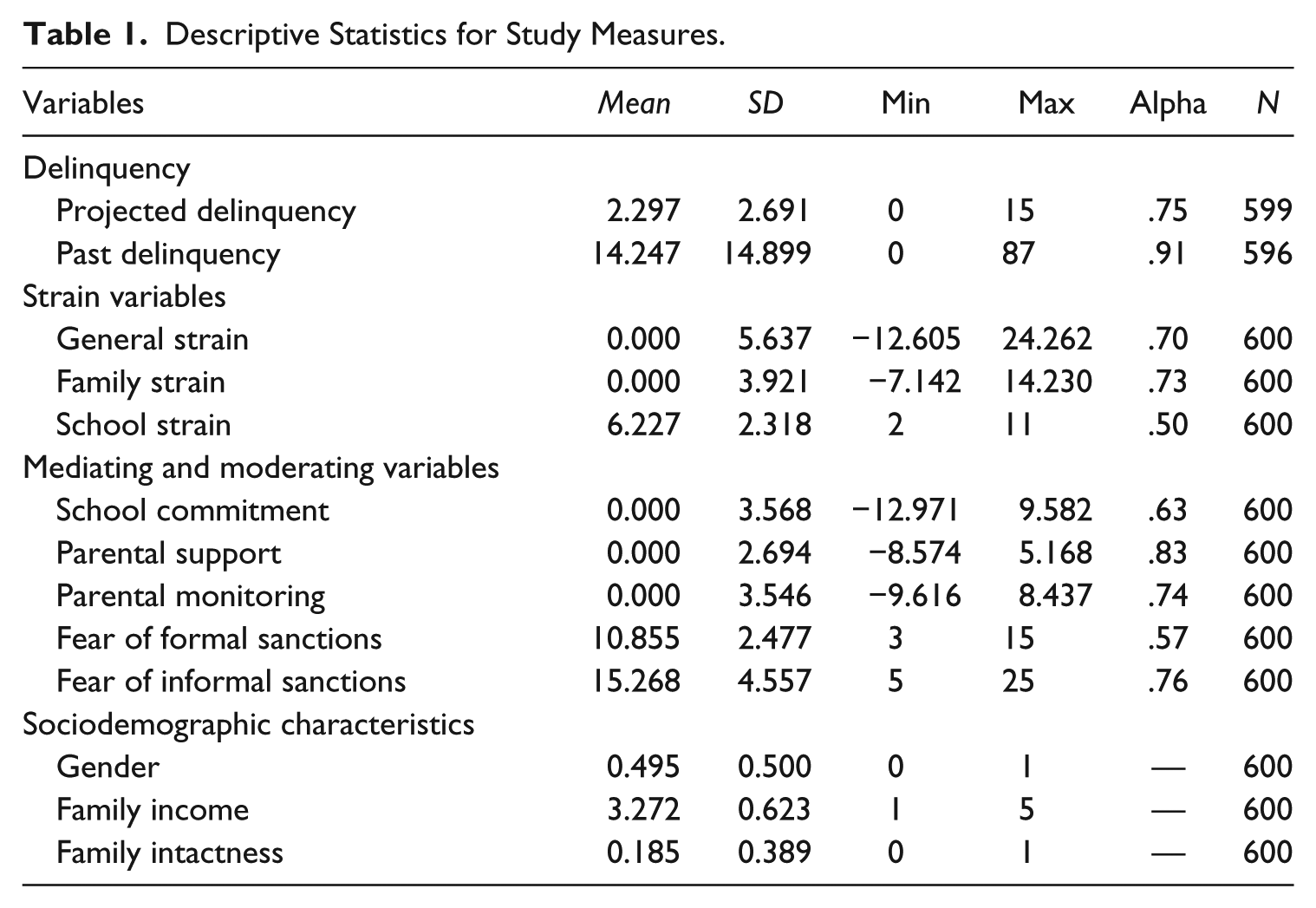
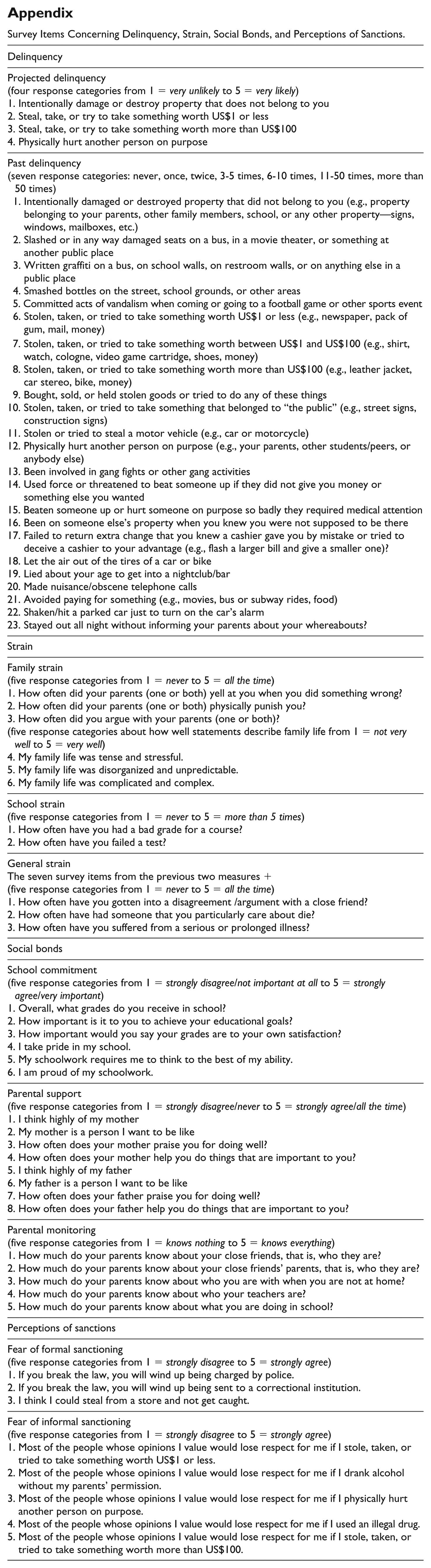
The dependent variable was constructed using four survey items asking respondents to gauge the likelihood of committing several delinquent acts (see the appendix). The item responses were summed to create the index of projected juvenile delinquency (α = .75). To establish causal order and increase variability, multiple studies used projections of crime as an outcome and supported the validity of these measures (e.g., Antonaccio et al., 2015; Pogarsky, 2004; Tittle, Antonaccio, Botchkovar, & Kranidioti, 2010). Following this research, we employ the projected delinquency as a dependent variable in the main analyses. However, to rule out any possibility of bias, in the sensitivity analyses, we also use the past delinquency index as an outcome. It consists of 23 survey items asking respondents about their past delinquent involvement (see the appendix). The item responses were summed up to construct the index of past delinquency (α = .91). The alphas and descriptive statistics for these and other measures are shown in Table 1.
Descriptive Statistics for Study Measures.
Independent variables: Past strain
Because Agnew (2006, 2013) has emphasized the importance of both cumulative strain and strain experienced in specific life domains, this study uses general as well as domain-specific (family and school) measures of strain. Family strain is an additive index, which consists of six survey items (see the appendix). These item scores were standardized and summed up, to produce the index where higher values of strain represent higher levels of strain (α = .73). Respondents were asked about their strain experiences in the past (2-3 years ago) to more clearly imply causal order.
School strain is an additive index, which consists of two items (see the appendix). The alpha for this measure is .50, which is expected because the measure consists of only two items. In addition, strain is often cumulative (Agnew, 2006), and measures of such life events (strainful incidents in this case) are not expected to have high reliability because those events are often independent (Hobfoll et al., 2009).
General strain
We also investigate the effect of cumulative strain on delinquency with a general strain index. This index is an additive measure, which includes 11 survey items—the seven survey items from the previous two measures of strain as well as the three more items reflecting strains in other domains of life (see the appendix). To create a general strain index, the item scores were standardized and summed, so that higher values represent higher levels of strain (α = .70).
Moderating and mediating variables: Present social bonds and fear of sanctions. Social bonds
were tapped using the following indicators: parental support, parental monitoring, and school commitment. These are established measures in the literature on social control, which have been utilized in multiple studies (see Agnew, 1991; Antonaccio et al., 2015; Bernburg & Thorlindsson, 1999). School commitment is an index, which consists of six items (see the appendix). The alpha for this measure is .63. It is somewhat lower because its items reflect different aspects of school commitment. Parental support index is comprised of the eight items asking respondents about their level of agreement with several statements regarding their parents (α = .83; see the appendix). Parental monitoring is measured by the five items asking about the degree to which their parents know about them doing certain things (α = .74; see the appendix). All indices were created by standardizing and then summing item scores, with higher scores indicating higher levels of social controls. All questions tapping social bonds are situated in the present time.
Perceptions of sanctions
Following past research, current perceptions of sanction risks are tapped by perceived fear of formal and informal sanctions. Fear of formal sanctions is measured by asking respondents to gauge the chance that they will be punished for different crimes and at different stages of the criminal justice system (see the appendix). The item scores were summed up to create the index of fear of formal sanctions. The alpha for this measure is .57, with lower reliability expected because the chances of punishment are specific to various crimes and different stages of the criminal justice system. Fear of informal sanctions is measured by the level of agreement that people whose opinions respondents value will lose respect if they engage in various crimes (α = .76) (see the appendix). The item scores were summed up to create the index of fear of informal sanctions. Higher scores on both indices reflect the higher levels of a perceived probability of sanctions.
Control variables
Several control variables are used in this study: gender (coded as 0 = male, 1 = female), family income (perceptions of respondents’ family income relative to other Ukrainian families on the 5-point scale from 1 = far below average to 5 = far below average), and family intactness (0 = living with both biological parents, 1 = other). Age is not used as a control variable because respondents in this study belong to the same age group. We also do not control for race because Ukraine is generally a racially homogeneous country. To assure that the results of the main analyses are robust, in sensitivity analyses, the measure of past juvenile delinquency is included in all models. The data contain few missing values on independent and control variables (less than 0.3% on any survey item, with the exception of two items, with approximately 3.5% of values missing). These values were imputed using the expectation maximization algorithm method.
Analyses
To conduct the analyses, in the models predicting juvenile delinquency, we use negative binomial regression. We employ this strategy because it is commonly considered to be appropriate for skewed criminal probability indices that, in their original metric, approximate count variables (Antonaccio et al., 2015; Botchkovar, Tittle, & Antonaccio, 2013). Furthermore, we employ ordinary least squares (OLS) regression when estimating the effects of strain on relatively normally distributed mediating variables. In all regression models, standard errors are adjusted for clustering by schools. In addition, to assess mediating effects, we utilize the KHB method, which has been specifically designed to evaluate indirect effects in nonlinear models and which allows for comparisons of coefficients in nonlinear models (Karlson & Holm, 2011). This method permits empirical assessment of the relative magnitudes of primary and secondary effects, it is less biased, and it allows for decomposing effects for both discrete and continuous measures. Finally, we evaluate moderating effects using mean-centered multiplicative interaction terms. Variance inflation factors (VIFs) in all models are below the critical value of 4.00 (Fisher & Mason, 1981).
Results
The results of bivariate analyses (available upon request) show that the associations between general, family-, and school-related strains and projected delinquency are statistically significant and in the expected direction (.22, .18, and .17, respectively). Social bonding variables and fear of sanctions are also significantly correlated with the dependent variable in the expected direction. Out of all included control variables, only gender is significantly correlated with projected delinquency, with males being more likely to engage in delinquency than females.
Models A1, B1, and C1 in Table 2 show the results of negative binomial regression analyses evaluating the direct effects of general, family, and school strains on projected delinquency. Overall, the results show support for the first hypothesis with general/cumulative and domain-specific strains being positively and significantly associated with delinquency among Ukrainian adolescents (incident rate ratio of 1.08, 1.05, and 1.06, respectively).
Negative Binomial Regression Coefficients Estimating the Direct, Mediating, and Moderating Effects of Strain, Social Bonds, and Fear of Sanctions on Projected Delinquency.
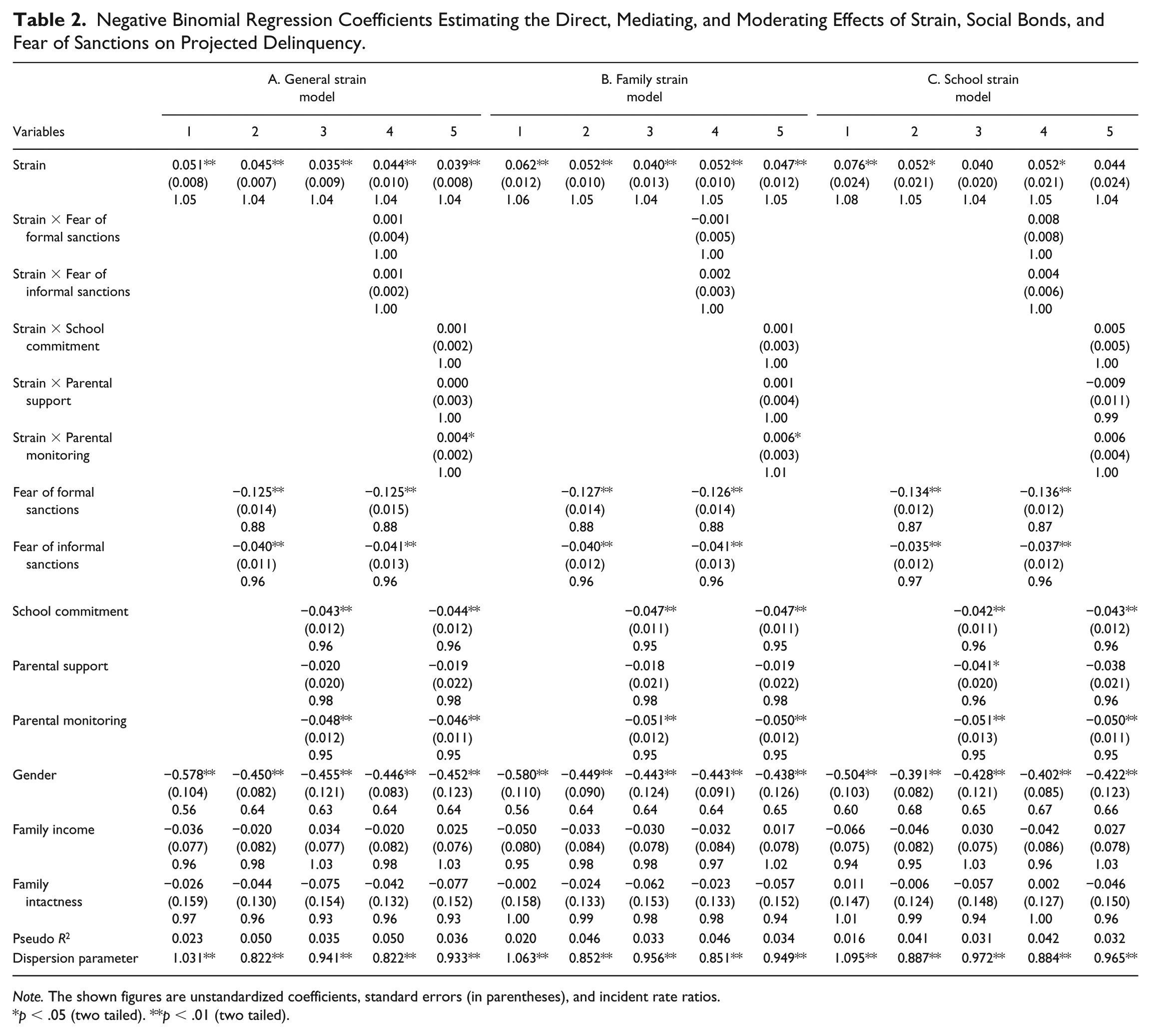
Note. The shown figures are unstandardized coefficients, standard errors (in parentheses), and incident rate ratios.
p < .05 (two tailed). **p < .01 (two tailed).
Next, to assess whether social bonding indicators and fear of sanctions mediate the relationship between strain measures and juvenile delinquent involvement (Hypotheses 2 and 3), it is necessary to establish links between strain variables and mediators (R. M. Baron & Kenny, 1986). Results from OLS regression estimating relationships between those variables are presented in Table 3. As those findings show, general/cumulative strain and family strain are, as hypothesized, associated with fear of formal sanctioning as well as with social bonding measures but not fear of informal sanctioning. School strain, however, is significantly related to all three measures of social bonds and all sanction measures—also in the expected direction.
OLS Regression Coefficients Representing the Effects of Strain on Mediators.
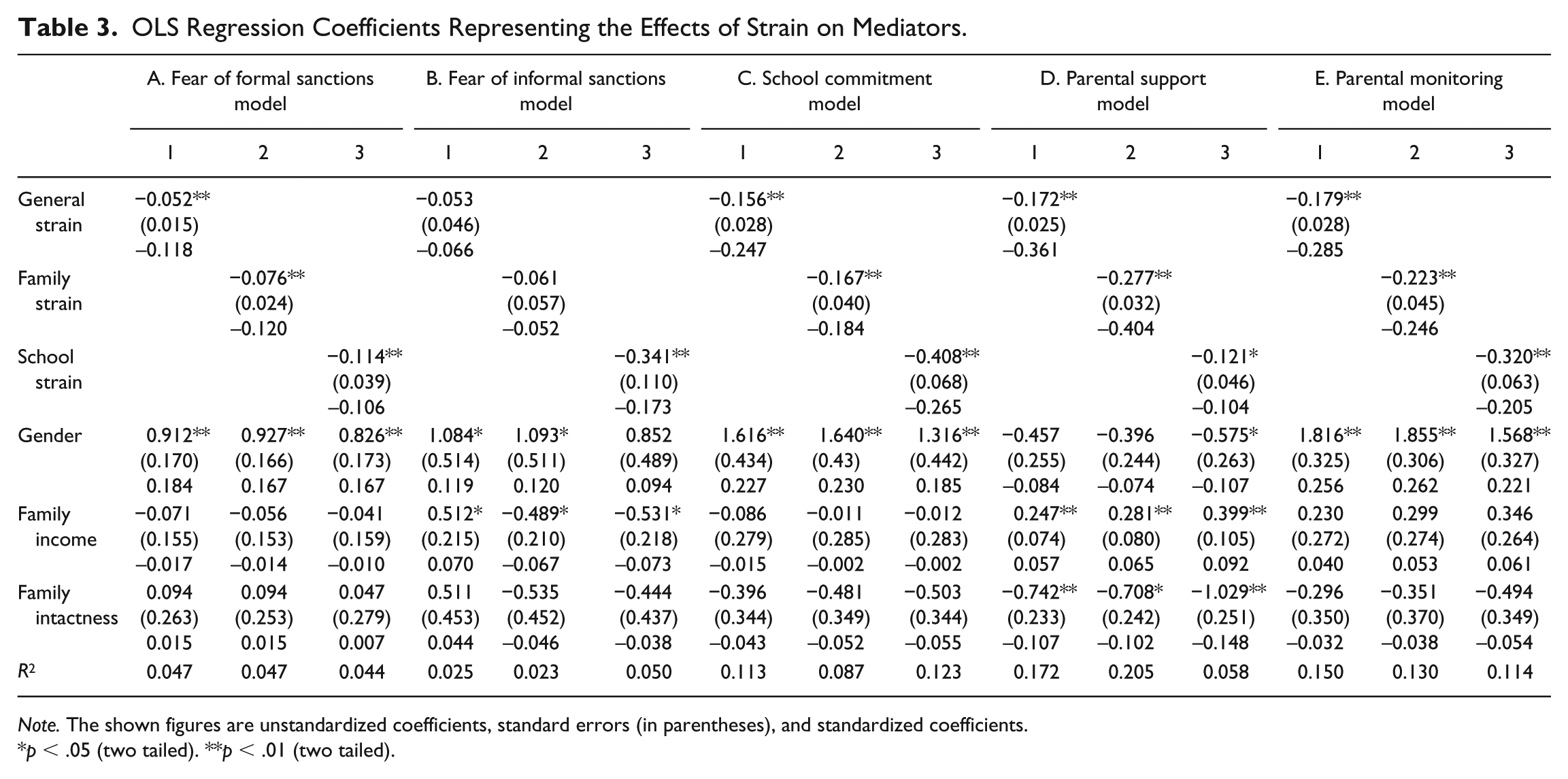
Note. The shown figures are unstandardized coefficients, standard errors (in parentheses), and standardized coefficients.
p < .05 (two tailed). **p < .01 (two tailed).
Next, the results from negative binomial regression models estimating effects of proposed mediators on delinquency, net of all control variables, establish the required links between the mediating and dependent variables (available upon request). They show that all social bonding elements and perceptions of sanctions are significantly related to delinquency. In particular, lower levels of school commitment, parental attachment, and parental monitoring lead to higher levels of projected delinquency (incident rate ratios .96, .95, and .96, respectively), whereas lower levels of fear of formal and informal sanctions also lead to higher levels of projected delinquency with fear of formal sanctions having a stronger effect (incident rations of .87 and .96, respectively).
Finally, Table 2 also shows estimates of the effects of three strain variables and mediators on crime. Models A2, B2, and C2 display the effects of the three kinds of strain when the fear of sanctions variables are incorporated, and Models A3, B3, and C3 show the effects of strains when the social bonding variables are included. Overall, in all models, we can observe a slight decrease in coefficients of general, family, and school strains with the inclusion of mediators. However, all three strain–delinquency links remain significant signaling only partial mediation, consistent with Agnew’s theoretical predictions (Agnew, 2006). One exception exists, however: when social bond elements are included in the model, the coefficient representing the relationship between school strain and delinquency loses significance, which is consistent with full mediation.
To assess the extent of mediation presented and to evaluate whether it is statistically significant, we apply the KHB decomposition procedure (Karlson & Holm, 2011). Table 4 reports the percentage mediated by each sanction perception and social bond variables and their levels of significance. Specifically, school commitment exerts a stronger mediating effect on school strain–projected delinquency relationship (22% mediated), and to a lesser extent—on general and family strain (around 12%). Parental monitoring is also a more potent mediator of the links between general, family, and school strains and delinquency mediating about 16%, 18%, and 21%, respectively. Parental support contributes little to the model mediating about 6% to 8% of the association between strains and delinquency, although its contribution is still significant. Overall, this evidence provides support for Hypothesis 2 and the role of social bonding indicators as mediators in strain–delinquency relationships. Furthermore, fear of formal sanctions is responsible for 19% of mediation of the relationship between school strain and delinquency, about 15% in the relationship between family strain and delinquency, and about 12% in the relationship between general strain and delinquency. Fear of informal sanctions accounts for 15% reduction in the relationship between school strain and delinquency. However, it has a negligible and nonsignificant mediating effect on the relationship between family and general strain and delinquency (about 4%), which is consistent with the earlier findings of no significant associations between this mediator and family and general strains. Overall, these results lend mixed support to Hypothesis 4 regarding the intervening role of fear of sanctions.
Results of KHB Decomposition Procedure Test Showing the Percent Mediated by Deterrence and Social Bonds Measures.
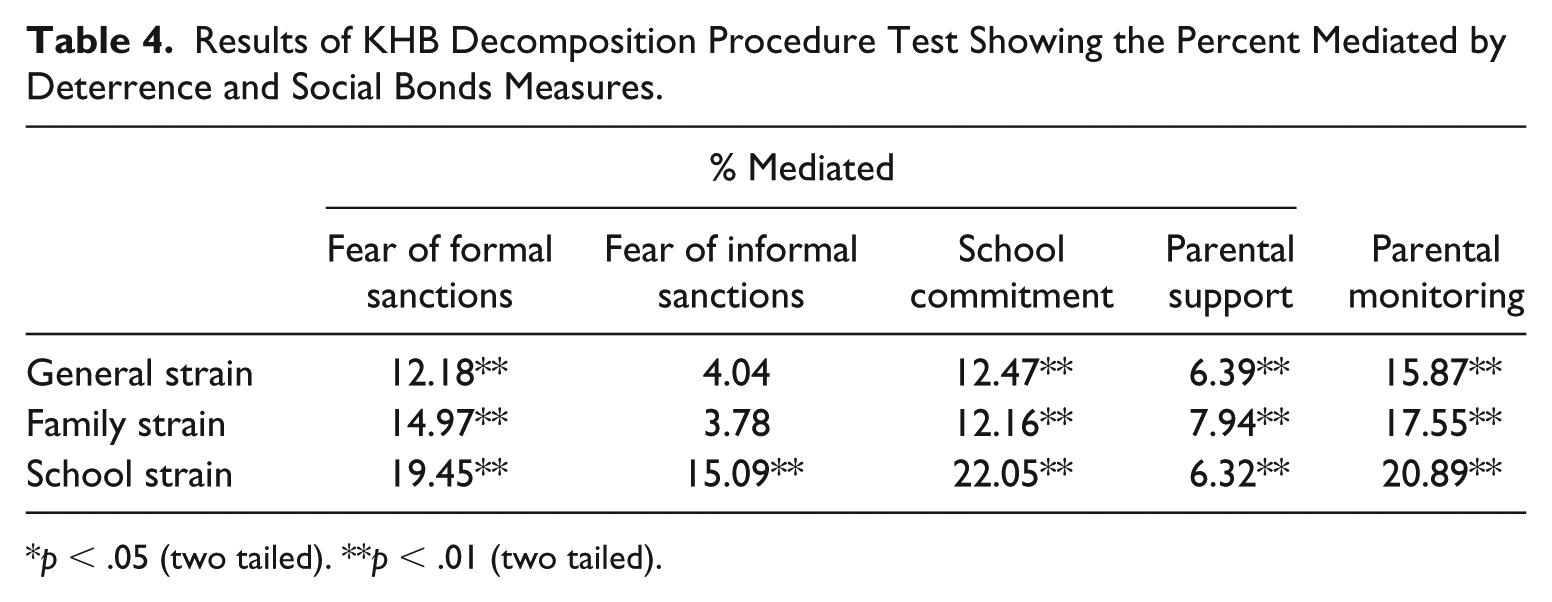
p < .05 (two tailed). **p < .01 (two tailed).
Finally, we assess possible interactions between strains and social bond elements and sanction perceptions (Hypotheses 4 and 5). As the figures from Models 4 and 5 in Table 4 demonstrate, only two interaction effects are significant—parental monitoring appears to condition the general strain–delinquency relationship (Model A4), and it also moderates the link between family strain and delinquency (Model A5).
However, in both cases, the direction of these effects is opposite to theoretical expectations as the effects of strain on delinquency are somewhat larger among those with higher levels of parental monitoring, thus providing no support for Hypotheses 4 and 5. Yet, it should be noted that the size of those interaction effects is quite small, especially for general strain (see Figure 1). The calculation of marginal effects at different levels of strain and monitoring (results available upon request) demonstrates that, whereas at any level of general strain, juveniles with high parental monitoring are still predicted to have lower levels of delinquent involvement, only at the highest level of family strain (about two standard deviations above), levels of delinquent involvement of adolescents with high levels of parental monitoring approximate those with low parental monitoring.
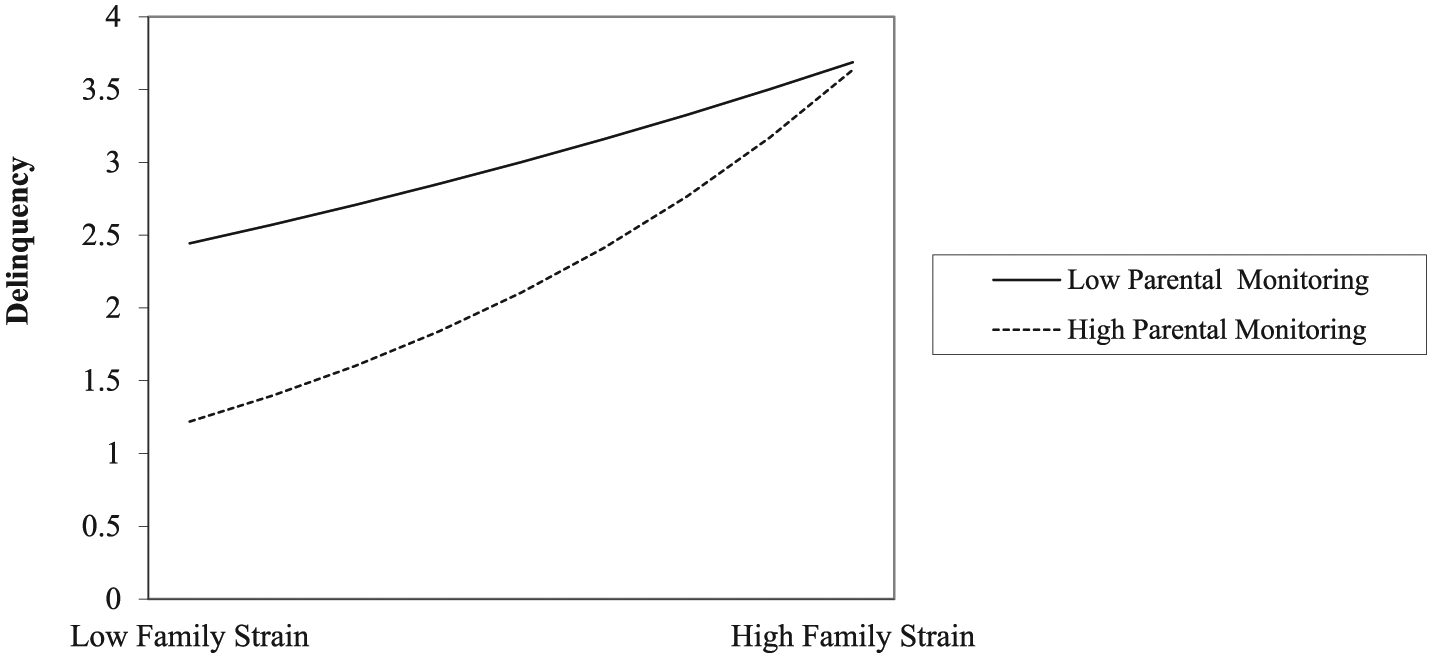
Effects of family strain on projected delinquency at different levels of parental monitoring.
Sensitivity Analyses
To verify the robustness of our results, we repeat the analyses using past delinquency reports—the measure that included 23 delinquent acts capturing multiple types of delinquency (available upon request). Overall, findings using past delinquency as a dependent variable confirm the robustness of the main results including the directions and significance of interaction effects (available upon request). To further verify the robustness of our results, we analyze how the findings vary by the type of crime (property and violent). Findings from those analyses (available upon request) show substantively similar results regarding direct and mediating effects. However, we are unable to confirm the moderating influence of parental monitoring on strain–delinquency links.
Discussion
This study sought to improve GST by specifying additional contingencies and mediating links for the strain–crime relationship as well as by investigating its potential to predict juvenile delinquency in the unusual context of Ukraine. We analyzed the effects of several types of strain relevant for adolescents, including general/cumulative, family, and school strains, on delinquent behavior. Our findings offer consistent support for the key premise of GST as strains from both school and family domains, separately and in combination with other strains, appear to increase the likelihood of delinquency. We also find that perceptions of risk of sanctioning, especially formal, and social bonds partially mediate the association between strains and delinquency. Specifically, higher levels of strain lead to lower levels of social bonds, which further increase criminal probability among adolescents. Furthermore, higher levels of strain lead to less fear of sanctions, which, in turn, also increases criminal probability. Parental monitoring seems particularly important to the strain–delinquency link, accounting for about 15% to 20% of the association. Importantly, the association between school strain and delinquency is fully mediated by school commitment. Finally, we discover a statistically significant conditioning effect of parental monitoring on the link between general strain/family strain and projected delinquency. The direction of the effect, however, is opposite to what the theory would predict, with the effects of strain on delinquency being higher among those with higher levels of parental monitoring.
Overall, these findings provide more empirical evidence on the generalizability of GST, and demonstrate that it could be applied to some unusual sociocultural contexts. They confirm that Ukrainian youth are exposed to a multitude of criminogenic strains in different life domains, which may increase their involvement in delinquent behavior. These results also echo the findings of Botchkovar and colleagues (2009) who found moderate support for the effect of general strain on criminal behavior among adults in Ukraine.
Furthermore, our results bearing on indirect effects point to the complexity of the association between strain and delinquent involvement, which appears to integrate multiple mediating and moderating influences. Contributing to the scarce literature on strain and social bonding mediators, our study demonstrates that various elements of social bonds—parental monitoring, parental support, and school commitment—play an intervening role in the relationships between strains and delinquency. Notably, parental monitoring has emerged as an especially important mediator of those associations across all types of strain. This result suggests that strain exposure in any domain undermines social bonding between children and their parents and ultimately leads to adolescent misbehavior, mostly through decreases in parental supervisory activities. However, school commitment is found to be the most powerful intervening factor in the relationship between school strain and delinquency, leading to the full mediation of the school strain–delinquency link. This result shows that, at least in some cases, strain may affect delinquency only indirectly by weakening one’s ties with specific social institutions. It also implies that reducing school strain may be instrumental for fostering more positive attitudes toward school and, thus, building stronger ties with this institution, which may subsequently reduce juvenile misbehavior.
Another interesting result relates to the intervening role of sanction risk perceptions, as we find that mostly fear of formal, rather than informal, sanctioning partially mediates the relationship between strains and delinquency. It could be that stressful events affect the traditional calculus involved in decision-making process (Becker, 1968; Keinan, 1987; van den Bos et al., 2009) by minimizing the perceptions of punishment risks. In these cases, such perceptions become insufficient to prevent individuals from using delinquent methods of coping with strain. Whereas studies typically found fear of formal sanctions to be less important than fear of informal sanctions for criminal involvement (see Matthews & Agnew, 2008; Paternoster, 2010; Tittle et al., 2011), our study shows formal sanction risks to be a stronger mediator than perceptions of informal sanction risks. This finding may reflect artificially heightened perceptions of the likelihood of formal punishment (Tittle, 1980) among those lacking personal or vicarious experience with formal social control. It also could reflect the peculiarities of Ukrainian sociocultural context as more pronounced crime-preventive effects of fear of formal punishment, and lesser influences of perceptions of informal sanctioning among Ukrainian youth could be attributed to relatively weaker powers of informally based ties in an arguably socially disrupted environment of contemporary Ukraine. Whereas these results are intriguing, because our study is the first investigation of the role of fear of formal and informal sanctions in strain–crime relationships, more studies need to examine these links and confirm our findings.
Furthermore, of particular interest is the finding of an unexpected positive interaction between strain and parental monitoring in their effect on delinquent behavior, which runs counter to the assumption that, more often, monitored students would be less likely to resort to delinquency if stressed. Along with Agnew (2006), who mentioned the harmful effects of “erratic harsh discipline,” we speculate that, at times, harsher and stricter disciplining, sometimes exercised by Ukrainian parents, might become yet another stressor exacerbating the criminogenic effects of general, and especially family, strains experienced by their children. In fact, studies showed that children in Ukrainian families often experienced physical punishment for misbehavior (see Boyko, 2002), whereas the financial difficulties experienced by many Ukrainian families likely pushed many parents to work overtime. Also, the patriarchal view of family, designating men as breadwinners, most commonly found in Ukraine clashed with the stark economic realities preventing many men from providing for their families (Gordeeva, 2013). This situation could lead to more straining family environments in many Ukrainian households. Thus, sporadic attempts to monitor and control the behavior of children who already face difficulties in family and/or at school may be consistent with Agnew’s (2006) concept of erratic harsh disciplining and its negative impact on children’s coping choices. A recent study by Bao, Haas, and Tao (2017) also noted that strict and harsh parental monitoring may increase the association with delinquent peers through restricting access and motivation for normal interactions with conventional peers as well as destruct the parent–child relationship through distancing and alienating children from their parents. The association with delinquent peers and the lack of attachment to parents may further result in higher levels of delinquent behavior. This dynamic should be explored in future studies addressing indirect effects of those factors in strain–crime relationships. It is also important to note that our conclusions regarding the observed interaction effects should be considered preliminary, because these interaction effects were relatively small in size and confirmed in most but not all sensitivity analyses.
This study is not without limitations. First, we use cross-sectional data, which make it difficult to assess the causal ordering of variables. Although we attempt to establish correct causal ordering by utilizing retrospective and prospective measures and time-ordered independent variables, in the future, longitudinal data could be used to confirm our results. It should be noted, however, that according to Agnew (2006), many detrimental effects of strain are spaced closely in time, potentially detracting from the usefulness of longitudinal designs in tests of GST. Second, nonresponse bias is another possible issue associated with these data as students who engage in delinquency the most might be more likely to skip school and, thus, to be less likely to participate in our study. However, because school delinquency surveys in the United States, such as those conducted by Office of Juvenile Justice and Delinquency Prevention (2013), have comparable response rates with ours, we can assume that chance of nonresponse bias in this study is about the same as in previous studies of school delinquency. Finally, our study does not include the actual measures of anger or related negative emotions. We believe, however, this does not threaten the validity of our findings because stressors, but not necessarily negative emotions, remain key to explaining delinquent involvement in GST (Agnew, 2001; Hoffmann & Su, 1997; Mazerolle & Maahs, 2000).
In sum, our study makes an important contribution to the literature by specifying additional mediating links for the strain–crime link, analyzing an unusual effect of parental monitoring on the association between strain exposure and delinquency in the context of Ukraine, and by putting GST to the test with an adolescent sample in a unique sociocultural setting. Notably, it illustrates the need for the development of policies that may help Ukrainian adolescent students deal with stressful environments surrounding them at home, at school, and other domains of life. Specifically, it would be useful to incorporate, on school grounds, professional counseling available to students, parents, and teachers—the practice not yet common in Ukraine. School counselors could provide advice to students and parents on how to handle everyday strains. For instance, counselors could help parents work on refraining from harsh punishments and severe arguments with children, which would create less stressful environment at home and strengthen bonds between children and parents. Adolescents living in such supportive and stable environments will be less likely to turn to delinquency.
Overall, there is a clear need for research on refining GST and evaluating the cross-cultural generalizability of its predictions. Future studies should test GST in other unusual contexts to understand the peculiarities of how strain operates in different life domains in various sociocultural environments. It would be particularly important to explore more processes capable of explaining the strain–crime link and conditions under which the effects of strain may be reduced or amplified, as well as to examine whether those mechanisms operate the same way among young people across the world. For example, future studies can focus on ways in which factors such as cognitive skills and moral attitudes intervene into or alter relationships between domain-specific strains and adolescent delinquent behavior in various sociocultural contexts. This research will help further assess the cross-cultural generalizability of GST.
Footnotes
Appendix
Survey Items Concerning Delinquency, Strain, Social Bonds, and Perceptions of Sanctions.
| Delinquency Projected delinquency (four response categories from 1 = very unlikely to 5 = very likely) 1. Intentionally damage or destroy property that does not belong to you 2. Steal, take, or try to take something worth US$1 or less 3. Steal, take, or try to take something worth more than US$100 4. Physically hurt another person on purpose Past delinquency (seven response categories: never, once, twice, 3-5 times, 6-10 times, 11-50 times, more than 50 times) 1. Intentionally damaged or destroyed property that did not belong to you (e.g., property belonging to your parents, other family members, school, or any other property—signs, windows, mailboxes, etc.) 2. Slashed or in any way damaged seats on a bus, in a movie theater, or something at another public place 3. Written graffiti on a bus, on school walls, on restroom walls, or on anything else in a public place 4. Smashed bottles on the street, school grounds, or other areas 5. Committed acts of vandalism when coming or going to a football game or other sports event 6. Stolen, taken, or tried to take something worth US$1 or less (e.g., newspaper, pack of gum, mail, money) |
| 7. Stolen, taken, or tried to take something worth between US$1 and US$100 (e.g., shirt, watch, cologne, video game cartridge, shoes, money) 8. Stolen, taken, or tried to take something worth more than US$100 (e.g., leather jacket, car stereo, bike, money) 9. Bought, sold, or held stolen goods or tried to do any of these things 10. Stolen, taken, or tried to take something that belonged to “the public” (e.g., street signs, construction signs) 11. Stolen or tried to steal a motor vehicle (e.g., car or motorcycle) 12. Physically hurt another person on purpose (e.g., your parents, other students/peers, or anybody else) 13. Been involved in gang fights or other gang activities 14. Used force or threatened to beat someone up if they did not give you money or something else you wanted 15. Beaten someone up or hurt someone on purpose so badly they required medical attention 16. Been on someone else’s property when you knew you were not supposed to be there 17. Failed to return extra change that you knew a cashier gave you by mistake or tried to deceive a cashier to your advantage (e.g., flash a larger bill and give a smaller one)? 18. Let the air out of the tires of a car or bike 19. Lied about your age to get into a nightclub/bar 20. Made nuisance/obscene telephone calls 21. Avoided paying for something (e.g., movies, bus or subway rides, food) 22. Shaken/hit a parked car just to turn on the car’s alarm 23. Stayed out all night without informing your parents about your whereabouts? Strain Family strain (five response categories from 1 = never to 5 = all the time) 1. How often did your parents (one or both) yell at you when you did something wrong? 2. How often did your parents (one or both) physically punish you? 3. How often did you argue with your parents (one or both)? (five response categories about how well statements describe family life from 1 = not very well to 5 = very well) 4. My family life was tense and stressful. 5. My family life was disorganized and unpredictable. 6. My family life was complicated and complex. School strain (five response categories from 1 = never to 5 = more than 5 times) 1. How often have you had a bad grade for a course? 2. How often have you failed a test? General strain The seven survey items from the previous two measures + (five response categories from 1 = never to 5 = all the time) 1. How often have you gotten into a disagreement /argument with a close friend? 2. How often have had someone that you particularly care about die? 3. How often have you suffered from a serious or prolonged illness? |
| Social bonds School commitment (five response categories from 1 = strongly disagree/not important at all to 5 = strongly agree/very important) 1. Overall, what grades do you receive in school? 2. How important is it to you to achieve your educational goals? 3. How important would you say your grades are to your own satisfaction? 4. I take pride in my school. 5. My schoolwork requires me to think to the best of my ability. 6. I am proud of my schoolwork. Parental support (five response categories from 1 = strongly disagree/never to 5 = strongly agree/all the time) 1. I think highly of my mother 2. My mother is a person I want to be like 3. How often does your mother praise you for doing well? 4. How often does your mother help you do things that are important to you? 5. I think highly of my father 6. My father is a person I want to be like 7. How often does your father praise you for doing well? 8. How often does your father help you do things that are important to you? Parental monitoring (five response categories from 1 = knows nothing to 5 = knows everything) 1. How much do your parents know about your close friends, that is, who they are? 2. How much do your parents know about your close friends’ parents, that is, who they are? 3. How much do your parents know about who you are with when you are not at home? 4. How much do your parents know about who your teachers are? 5. How much do your parents know about what you are doing in school? Perceptions of sanctions Fear of formal sanctioning (five response categories from 1 = strongly disagree to 5 = strongly agree) 1. If you break the law, you will wind up being charged by police. 2. If you break the law, you will wind up being sent to a correctional institution. 3. I think I could steal from a store and not get caught. Fear of informal sanctioning (five response categories from 1 = strongly disagree to 5 = strongly agree) 1. Most of the people whose opinions I value would lose respect for me if I stole, taken, or tried to take something worth US$1 or less. 2. Most of the people whose opinions I value would lose respect for me if I drank alcohol without my parents’ permission. 3. Most of the people whose opinions I value would lose respect for me if I physically hurt another person on purpose. 4. Most of the people whose opinions I value would lose respect for me if I used an illegal drug. 5. Most of the people whose opinions I value would lose respect for me if I stole, taken, or tried to take something worth more than US$100. |
Declaration of Conflicting Interests
The author(s) declared no potential conflicts of interest with respect to the research, authorship, and/or publication of this article.
Funding
The author(s) disclosed receipt of the following financial support for the research, authorship and/or publication of this article: This work was supported by the grants from the College of Humanities and Social Sciences and Department of Sociology and Anthropology, North Carolina State University.
