



Abstract
Studies of antisocial behavior in sports are important, although most lack a theoretical framework. The current study examines the endorsement of antisocial behavior in a sample of coaches using social learning theory. This features a survey of 268 Head Coaches and Assistant Coaches in the Tehran Provincial League, Iran. Results indicate that differential association, differential reinforcement, definitions, and imitation have a significant impact on antisocial behavior, with differential association being the most influential construct. Higher education in coaches was associated with lower levels of antisocial behavior. This suggests that antisocial coaching behavior is learned in a similar manner to prosocial behaviors, and that desistance requires assessment of the learning process.
Introduction
In recent years, there has been growing scholarly attention devoted to deviant behavior occurring in sport. The inherent social nature of sports; the interpersonal interactions between players, coaches, and fans; and the role of the media all provide ample opportunity to study deviance and antisocial behavior (Boardley & Kavussanu, 2011; Kavussanu, 2008; Ntoumanis & Standage, 2009). This includes long existing problems, such as players who cheat or aggression and violence by fans (Al-Yaaribi & Kavussanu, 2018; Kavussanu, 2019). It also includes examination of how negative behaviors are modeled, such as the role that coaches play in athlete’s decisions to take performance-enhancing drugs (Kabiri et al., 2018).
Antisocial behavior represents a problem that can have negative consequences for both the specific sport and the broader society (Kavussanu et al., 2015). The presence of antisocial behaviors has been shown to reduce or limit the development of prosocial behaviors and outcomes in sport (Spruit et al., 2019). In this sporting context, antisocial behavior refers to acts or activities that are designed to harm or disadvantage others (Kavussanu & Boardley, 2009; Kavussanu et al., 2013). Examples include attempts to intentionally distract or harass an opponent, deliberately fouls, and trying to injure an opponent. Existing reviews of the literature have highlighted that antisocial behavior in sports is the product of complex personal, situation, and social factors that merge within a specific context (Kavussanu, 2019). One key factor in the manifestation of antisocial behavior in sport involves the social or cultural climate (Ruiz et al., 2019). Here, antisocial behavior often develops in the athlete’s interactions with coaches and other teammates and, to a lesser extent, with engagement with fans either in person or online (Gómez-López et al., 2019).
Beron and Piquero (2016) argue that coaches are one of the most important role models for the student-athlete, and their opinions and patterns of behavior have a significant impact on youth’s cognitive and behavioral decision-making process, as well as academic performance. In sport culture, Hodge and Gucciardi (2015) found that coaches and their coaching style were important factors in the development or avoidance of antisocial behavior in their athletes (Hodge & Gucciardi, 2015). Similarly, Malete et al. (2013) identified a relationship between the endorsement of aggression and cheating by coaches and subsequent antisocial behavior by players. Thus, it could be expected that coaches who have an accepting attitude toward antisocial behavior may also encourage their athletes to engage in the behavior. In much the same manner that prosocial behaviors can be developed from coach to player, the process can be analogous with deviant or antisocial behaviors. Indeed, one of the most salient and encompassing influences on athlete behavior is the coach (Malete et al., 2013). This learning process has been documented by Guivernau and Duda (2002) who found that endorsement of unfair play by coaches increased the willingness of antisocial behavior in players when they encountered situations in the future. The researchers found that the behavior and method of coaching style by coaches guided decision-making and established team moral. Players were apt to support antisocial behaviors to avoid criticism, please their coach, and adhere to existing team norms (Malete et al., 2013).
To further research on the topic of antisocial behavior permitted and encouraged by coaches, there is a need to address previous gaps in the literature. To date, there has been a dearth of studies that rely on theoretical perspectives. In response, the current study utilizes social leaning theory as a means of explaining how the social context influences antisocial learning processes in sport. This features a sample of Iranian soccer coaches (n = 272) and the use of structural equation modeling to test key constructs.
Literature Review
Social Learning Theory
Social learning theory is one of the most widely used criminological theories used to define, explain, and predict deviant behaviors (Akers & Jennings, 2016, 2019; Akers & Jensen, 2011; Pratt et al., 2010). According to the basic suppositions of social leaning theory, deviant and antisocial behavior is shaped by the same processes that shape positive behaviors within a social context (Akers, 1985; Akers et al, 1995). Individuals learn behaviors by observing others and developing their own ideas on how these new behaviors are performed and what their consequences are, and then use this information to guide future actions. This process is based on the following four interrelated constructs: differential association, definitions, differential reinforcement, and imitation (Akers & Jensen, 2011).
Differential association is of primary importance and it refers to individual’s exposure to norms, values, attitudes, and behaviors of significant others (Akers & Jennings, 2016). Associations vary in frequency, duration, priority, and intensity. Associations that take place early in life (priority), occur most often (frequency), occupy the most time (duration), and involve the closest interpersonal relationships (intensity) are most likely to have the greatest effect. Differential association emphasizes the role that these exposures are purported to have on persons’ decisions to participate in a certain behavior (Akers et al., 1989). This requires an understanding of the motives and rationalizations directed toward the desired behavior that is learned by exposing the individual to the behavioral patterns and attitudes of those around him or her (Akers & Jensen, 2011).
The second component of social learning theory is differential reinforcement. This construct concerns the individual balance of perceived experienced or anticipated rewards with perceived punishments of certain behavior (Akers & Jensen, 2011). As such, the decision to refrain from or participate in antisocial behavior is said to depend on the experience of past, current, and future/anticipated punishments and rewards (Kabiri et al., 2019). Thus, antisocial behavior in coaching is argued to be the result of the anticipated gains and perceived consequences associated with the act.
The third element of social learning theory is definitions. Definitions refers to values, orientations, and attitudes toward antisocial or conforming behavior as held by specific individuals (Akers & Jennings, 2009). It includes attitudes, values, and orientations that a person labels as right or wrong, good or bad, desirable or undesirable, justified or unjustified, appropriate or inappropriate, excusable or inexcusable, and this in turn will impact their own likelihood for participating in antisocial or prosocial behavior (Akers & Jennings, 2016). One important element in definitions is the notion of neutralizing definitions, which are a series of justifications and rationalizations used to support antisocial behaviors. In coaching, an example may be, “all the other athletes are cheating, so you should also cheat in order to level the playing field.” Definitions may be ingrained into the individual’s learned belief system, thus being difficult to challenge and change.
The final component of social learning theory is imitation. Imitation is the result of observing the behavior from the primary and secondary reference groups such as family members, peer groups, and media sources. Imitation also results from observing the consequences of behavior in others (Akers & Jennings, 2009). Generally, an individual is more likely to imitate an observed behavior in a similar situation if the behavior has previously been associated with positive outcomes (Akers & Jennings, 2016). For example, coaches who observe other coaches employing antisocial behaviors as a tactic to gain advantages and win will be more likely to use antisocial behaviors in their own coaching. Imitation centers on the concept of modeling behavior.
Social learning theory has been tested in a wide range of deviant and antisocial behaviors such as alcohol and drug use (Akers et al., 1989; Akers & Lee, 1999; Akins et al., 2010; DeMartino et al., 2015; Durkin et al., 2005; Johnson, 1988; Lanza-Kaduce et al., 1984; Peralta & Steele, 2010; Simons et al., 1988; Steele et al., 2011; Winfree & Bernat, 1998), interpersonal aggression and violence (Cochran et al., 2016, 2017; Jennings et al., 2011; Sellers et al., 2005; Snethen & Van Puymbroeck, 2008; Yount et al., 2016; Zavala et al., 2015), and cheating (Kroher & Wolbring, 2015; Lanza-Kaduce & Klug, 1986). This body of work supports the notion that antisocial behaviors occur via learning within a social context; however, there is a need to apply the theory to broader context such as deviance in sports.
Antisocial Behavior in Sport
Antisocial behavior in sport constitutes an important and salient topic, one that would benefit from the use of theoretical approaches to provide greater understanding. Antisocial behavior includes acts intended to harm (e.g., aggressively criticizing a referee or conducting a foul) or disadvantage others (e.g., cheating behaviors such as doping, faking an injury, or wasting time) (see Sage et al., 2006). Research suggests that antisocial behavior is common among all genders, ages, types of sport, and competitive levels (Traclet et al., 2011). Research also indicates that a number of athletes accept antisocial behavior as being an acceptable component of the sport. For example, Boardley and Kavussanu (2009) found that many athletes believe that cheating, wasting time, using performance-enhancing drugs, distracting opponents’ attention, the use of fouls, attacking the referee, and criticizing opponents are effective strategies that can be used to succeed in sports. When social learning theory is included in these studies, there is evidence that athletes’ decisions to cheat via the use of performance-enhancing drugs are developed by a combination of sports subculture, imitation, and observed and perceived punishment and rewards, and through interactions with coaches, teammates, opponents, and the media (Kabiri et al., 2019). Athletes’ decisions are also guided by behavioral factors that directly or indirectly promote deviance via doping behavior. Specifically, an athlete may experience positive reinforcement by taking performance-enhancing drugs, and this may be reinforced by personal definitions that are favorable to doping behavior (Kabiri et al., 2018).
In recent years, antisocial behavior in sports has been conceptualized and measured in terms of aggressive behavior and cheating (Kavussanu et al., 2013). Aggressive behavior refers to voluntary, overt, and purposeful behavior (verbal and physical) that has the intent to cause psychological or physical injury (Kavussanu & Boardley, 2009), and cheating is defined as the intentional breaking of rules to gain an unfair advantage over others (Kavussanu, 2019).
Prior works have shown that taunting an opponent with the intention of taking the player out of the match for a few minutes or trying to intimidate an opponent by physically shoving him or her is common in soccer culture. They are often viewed as legitimate means to gain advantages over opponents (Al-Yaaribi & Kavussanu, 2018; Miller et al., 2005; Traclet et al., 2011). Boardley and Kavussanu (2011) showed that antisocial sport behaviors such as deliberately fouling an opponent or faking an injury are prevalent in soccer games, and players use them to win the match. For example, Kavussanu et al. (2006) analyzed 24 soccer games and indicated that the frequency of observed antisocial behaviors per hour per team is as follows: late tackle 1 (2.85), taunting (i.e., provoking) opposing player 2 (1.81), body-checking a player 3 (1.64), shirt pulling 4 (1.04), retaliating to a bad tackle (0.97), elbowing (0.21), trying to get an opponent booked (0.11), deliberate hand ball (0.11), diving to fool the referee (0.07), pretending to be injured (0.03), and total antisocial behavior (8.85). Similarly, analyzing 46 male and female soccer teams’ matches indicated that the three most common antisocial acts were committing a late tackle (33%), pushing (21%), and physical obstruction 5 (13%) (Kavussanu & Boardley, 2009). Using a sample of 227 male and 138 female soccer players, Sage and Kavussanu (2007) found that the three most common antisocial acts were taunting (physically or verbally taunting) an opponent (M = 2.4), retaliating for a bad tackle (M = 2.4), and deliberately obstructing (i.e., body-checking) an opponent (M = 2.3). This finding is also replicated in Sage et al.’s (2006) research; taunting (physically or verbally taunting) an opponent (M = 3.7), body-checking an opposition player, (M = 3.0), and retaliating to a bad tackle, for example, kicking out (M = 2.6), were the most common antisocial behaviors among soccer players. Cheating and aggressive behaviors have been widely investigated in recent years (Al-Yaaribi & Kavussanu, 2017, 2018; Al-Yaaribi et al., 2016; Guivernau & Duda, 2002; Hodge & Gucciardi, 2015; Hodge & Lonsdale, 2011; Kamis et al., 2016; Kavussanu, 2008; Kavussanu & Spray, 2006; Kavussanu et al., 2015). Other factors that contribute to antisocial behavior in sports include, though are not limited to, moral disengagement (Boardley & Kavussanu, 2009; Stanger et al., 2018; van de Pol et al., 2020), motivational climate and coach–player interaction (Boardley & Kavussanu, 2009; Miller et al., 2005; Ommundsen et al., 2003 Stanger et al., 2018; Vande Pol et al., 2018), moral climate (Guivernau & Duda, 2002; Spruit et al., 2019), anticipated shaming and guilt (Kavussanu et al., 2015; Stanger et al., 2013), coaching climate (Bartholomew et al., 2011; Hodge & Gucciardi, 2015), and peer deviant behavior (Benson & Bruner, 2018; Benson et al., 2017).
Using social cognitive theory, Benson and Bruner (2018) found that athletes’ daily experiences of prosocial and antisocial behaviors demonstrated by teammates motivated athletes to engage in similar behaviors. Hodge and Gucciardi (2015) indicated that coach and teammate endorsement of antisocial behavior produced higher levels of antisocial behavior conducted by an athlete. They further argued that athletes who perceived controlling climates may morally disengage by justifying antisocial behaviors as a legitimate means to a desired end emphasized by the coach and teammates (e.g., to help my team win). This moral disengagement is somewhat similar to the notion of neutralizing definitions in social learning theory. Spruit and colleagues (2019) found that the socio-moral environment plays a significant role in predicting an athlete’s moral behavior in the game, and their study revealed that antisocial moral climate is associated with more antisocial and less prosocial behavior of athletes. Miller et al. (2005) have shown that there is a significant relationship between the team culture and the legitimacy of aggressive deliberate behavior toward opponents. They described deviant subcultures where coaches and teammates endorse and encourage aggressive or cheating behavior in order for the team to win. This process is similar to the notion of differential association in social learning theory. Although informative, most of these studies are nontheoretical and lack generalizability. In response, Akers’s social learning theory, which has been successfully applied to a wide range of antisocial behaviors, including sport-related deviance, and across a host of research settings (Higgins et al., 2007; Kabiri et al., 2018, 2019; Shadmanfaat et al., 2018; Shadmanfaat, et al., 2020; Shadmanfaat, et al., 2019) provides a good starting place to provide theoretical insight and explanation to an examination of antisocial coaching behavior.
The Current Study
The current study aims to address several gaps in the existing literature. First, the use of social learning theory to explore antisocial behavior in sports improves on previous efforts that have largely not included theoretical approaches (see Al-Yaaribi & Kavussanu, 2017; Kavussanu, 2019). Moreover, learning processes in the theory indicate that antisocial behavior in sports can be learned by observing and modeling others. As a result, this study examines the perceptions of coaches rather than athletes, as it the coach who models the behavior for their athletes. Coaches and their coaching style play a significant role in athletes’ involvement in antisocial and prosocial behavior, and this relationship requires testing (Bartholomew et al., 2011; Hodge & Gucciardi, 2015). In general, most research has been done in the field of psychology, and these studies have not directly studied the antisocial behaviors of coaches and have merely examined athletes’ perceptions of the team’s moral climate or subculture (endorsing antisocial behaviors by coaches and teammates). This study contributes to a better understanding of antisocial behaviors in the sports subculture by directly examining antisocial coaching. Other advancements in the current study include an examination of coaching behaviors in Iran, thus providing international perspectives for comparison, and the use of structural equation modeling to test the relationships between the key constructs of social learning theory. This study tests the following hypothesis and subhypotheses:
Method
The goal of this study is to examine social learning theory in the context of antisocial coaching, specifically in a sample of Iranian soccer coaches. The study setting is Tehran which features the highest economic status of all 31 provinces in Iran. Tehran contributes approximately 29% of the country’s gross domestic product (GDP), and it includes approximately 18% of the country’s population. Tehran Province is also the most industrialized province in Iran, with 86.5% of its population residing in urban areas and 13.5% residing in rural areas. The Tehran Provincial League, formerly known as Tehran Clubs Championship, is the premier football league of Tehran Province and is the fifth major league in the Iranian football pyramid. It is part of Asian Football Confederation’s (AFC) “Vision Asia” program. Established in 1920, it is the oldest football league still played in Iran.
The current study features a cross-sectional sample of soccer coaches in Iran, who completed a survey during fall of 2018. The survey collection began in October 12, 2018, and ended on November 21, 2018. All coaches were male and had the AFC Professional Coaching Diploma. This includes Head Coaches and Assistant Head Coaches in the Tehran Provincial League. The coaches represented teams consisting of the following age groups: under 16 years, 16–18 years, 18–21 years, and an adult (over 21) group. Members of the research team distributed 320 questionnaires to respondents and received 268 questionnaires after excluding missing data. As such, the response rate was 83.75%. Demographic response revealed that 29.1% of respondents were younger than 35 years of age, 39.6% were between 35 and 40 years of age, 20.5% were between 41 and 45 years of age, and 10.8% were 45 years of age or older. With regard to marital status, 71% were married and 29% were single at the time of the survey. In terms of education, 35.8% had a diploma degree, 16% had an associate degree, 20.5% had a bachelor’s degree, and 27.6% had a master’s degree or PhD.
Measures of Social Learning Theory Constructs
Differential association
Differential association was assessed through normative and behavioral associations. The normative association refers to the quality of beliefs and the attitudes of important others (e.g., co-workers, close friends, reference groups) regarding antisocial behavior. The behavioral dimension refers to associations with others who engage in and endorse antisocial behavior. Two subscales were employed: differential norms and differential behavior. These were based on similar scales used in previous sport-based research (see Kabiri et al., 2018, 2019).
The behavioral dimension of differential association includes elements of frequency, duration, priority, and intensity of relationships as related to antisocial behavior in sport. Frequency of association, or the number of deviant associates, was measured using a three-item scale in which each item was measured from 1 (none of them) to 5 (all of them). These four items measured the following: (1) How many of your colleagues in the coaching profession use antisocial behavior (How serious is the prevalence of antisocial behavior in your coaching career?) (2) How many of the co-workers who you know well use antisocial behaviors as a tactic to win? (3) How many colleagues whom you associate with use antisocial behaviors as strategies to gain advantages? The normative dimension of differential association was measured using a three-item scale that assessed respondent perceptions of the beliefs and attitudes toward antisocial behavior of their close relational ties (like coach, parents, close friends, important others). Specifically, they were asked, on a scale from 1 (strongly disagree) to 5 (strongly agree), to indicate the degree to which (1) people are important to me, (2) people influence me, and (3) people whose opinions I value endorse antisocial behavior. The behavioral and normative components were summed into a single measure of differential association.
Differential reinforcement
Differential reinforcement measures perceptions regarding the positive and negative consequences of antisocial behavior. Specifically, differential reinforcement was measured by means of two subscales that focus on rewards and deterrence. The rewards subscale used Likert-type items ranging from 1 (strongly disagree) to 5 (strongly agree). The rewards subscale was measured using three items that tapped into their perceptions of the degree to which antisocial behavior (1) improves my coaching performance, (2) helps my athletes do their tasks better, and (3) promotes my personal and social image in the eyes of fans. The deterrence subscale used Likert-type items ranging from 1 (very severe reaction) to 5 (not severe reaction at all). The coaches were asked the following: (1) If you ask or force the players to be involved in on-field antisocial behaviors and the club presidents know this, how severe do you think the reaction or punishment would be? (2) If you ask or force the players to use antisocial behaviors on the field and the sports officials know this, how severe do you think the reaction or punishment would be?
Definitions
Definitions refers to the beliefs, ideas, values, and attitudes regarding antisocial behavior and was measured with questions about positive (approving the antisocial behavior) and neutralizing (justifying or rationalizing the antisocial behavior) techniques. Four items were used to measure the extent to which coaches had positive definitions regarding antisocial behavior, with responses ranging from 1 (strongly disagree) to 5 (strongly agree). These items measured how the respondent perceived the following: (1) Antisocial behavior is an effective tactic for gaining points or advantages; (2) That it is OK to be involved in antisocial behavior, if this can help you or your team win; (3) For me, antisocial behavior is acceptable; and (4) For me, antisocial behavior is a wise choice. Three questions were used to measure neutralizing definitions, with responses ranging from 1 (strongly disagree) to 5 (strongly agree). These items included the following options: (1) Antisocial behavior is an unavoidable part of competitive sports; (2) Antisocial behavior is not bad, as everyone does it; and (3) It is not right to criticize athletes or team for involving in antisocial behavior because many athletes or teams do it. The four items measuring positive definitions and the three items measuring neutralizing definitions were combined into a single measure of definitions.
Imitation
Finally, imitation refers to modeling behavior of respected or important figures. We include measures of both primary group imitation (those they are close to) and secondary group imitation. Primary group imitation was measured with two items on a scale ranging from 1 (nothing) to 5 (everything). This included the following questions: (1) How much have you learned about antisocial behavior from seeing your friends whose coaches use antisocial tactics on the field? and (2) How much have you learned about antisocial behavior from seeing your relative whose coach uses antisocial tactics on the field? Secondary group imitation was also measured using two items on the same scale. This included the following questions: (1) How much have you learned about antisocial behavior through television, internet chat rooms, or web forums? and (2) How much have you learned about antisocial behavior from seeing important people use them in their coaching?
Dependent Variable
Antisocial coaching
Before distributing the questionnaires among coaches, the term “antisocial coaching” was described to respondents: “Antisocial coaching refers to the endorsement of antisocial behavior by the coach, as well as perceptions regarding the opportunity to engage in antisocial behavior during a game, for example, endorsement of physically intimidating an opponent.” Antisocial and prosocial scales have previously been used on athletes (Kavussanu & Boardley, 2009; Kavussanu et al., 2013), and these were modified for coaches for purposes of this study. This included the prevalence of cheating and aggressive behaviors in recent games, as perceived by the coach (respondent).
Antisocial coaching was measured using the following questions: With your permission, how often did players commit the following acts within the last 6 months? (1) trying to wind up an opponent (winding up an opponent means physically or verbally taunting him or her to cause a distraction or provoke a punishable reaction), (2) intentionally distract an opponent, (3) intentionally break the rules of the game, (4) deliberately foul an opponent, (5) fake an injury, (6) try to injure an opponent, (7) retaliate after a bad foul, (8) physically intimidate an opponent, (9) deliberate and continuous criticism of the opponent players to reduce their focus on the game or make them angry, (10) deliberate and continuous criticism of referees’ judgment quality to gain advantage for own team, and (11) attacking referees to gain advantage for own team. Items 1 to 5 were summed to create a cheating scale and Items 6 to 11 were summed to create an aggressive behavior scale. The responses ranged from never (0) to almost always (5). Higher scores indicate the presence of antisocial coaching.
To test the dimensionality of antisocial coaching, exploratory factor analysis (EFA) and confirmatory factor analysis (CFA) were applied. The result suggests that antisocial coaching items have two distinct factors: (1) endorsement of cheating behavior and (2) endorsement of aggressive behavior. In particular, the EFA through Varimax rotation with Kaiser normalization obtained a two-factor solution, accounting for 81.52% of the explained variance which is larger than 60% of threshold recommended by Hair et al. (2010). Also, all of the 11 items had factor loadings greater than .50 (.74–.88) as suggested by Kaiser (1996). The cheating dimension included five items; the aggressive behavior dimension included six items. The highest total explained variance was shown by the cheating factor (59.71%), compared with 21.81% explained by aggressive behavior factor, highlighting the importance of cheating factor in the antisocial coaching measure (Kaiser–Meyer–Olkin [KMO] = 931, df = 55, Sig. = .001). CFA was applied to the two factors identified through EFA. The two-factor 11-item CFA model was estimated using AMOS 24. Result shows that all remaining items load highly on their corresponding factors, and the CFA results revealed that the factor loadings of all constructs were significant (Sig. = .01) and above .5, the minimum threshold value. The 11 items show an overall model fit to the data (CMIN/df = 1.673, goodness of fit index [GFI] =.955, comparative fit index [CFI] = .991, normed fit index [NFI] = .977, root mean square error of approximation [RMSEA] = .050).
Method of Analysis
To test the direct and indirect effects of social learning theory on antisocial coaching, structural equation modeling in AMOS was used. Two separate models examined the effects of social learning constructs on coaches’ endorsement of cheating and aggressive behaviors (i.e., antisocial behavior).
Validity and Reliability of Measurement Instruments
Composite reliability (CR) and Cronbach’s α have shown that all scales have high internal consistency (α > 0.70; CR > 0.70) as recommended (Nunally, 1978; see Table 1). The average variance extracted (AVE) confirmed the adequacy of the constructs because all scales exceed the minimum criterion of 0.5 for AVE (Hu & Bentler, 1999). CFA was also conducted on these scales. A second-order factor analysis was used to ensure that the social learning theory loaded onto the four underlying constructs (i.e., differential associations, differential reinforcement, definitions, and imitation). Next, a first-order CFA was examined with factor loadings for all items found to be significant (factor loadings greater than .50). The resulting CFA revealed good fit indices for all variables (Kline, 2015).
Validity and Reliability of Variables (n = 268).

Note. AVE = average variance extracted; MSV = maximum shared variance; CR = composite reliability; S = second-order confirmatory factor analysis; F = first-order confirmatory factor analysis; CFI = comparative fit index; SRMR = standardized root mean square residual; RMSEA = root mean square error of approximation; CMIN = chi-square value of the model.
Model fit summary of first-order confirmatory factor analysis: CMIN = 696.160, df = 448, p = .001, CMIN/df = 2.554, CFI = .960, SRMR = .046, RMSEA = .041, pClose = .868.
Model fit summary of second-order confirmatory factor analysis: CMIN = 722.791, df = 473, p = .001, CMIN/df = 2.528, CFI = .960, SRMR = .045, RMSEA = .044, pClose = .923.
Results
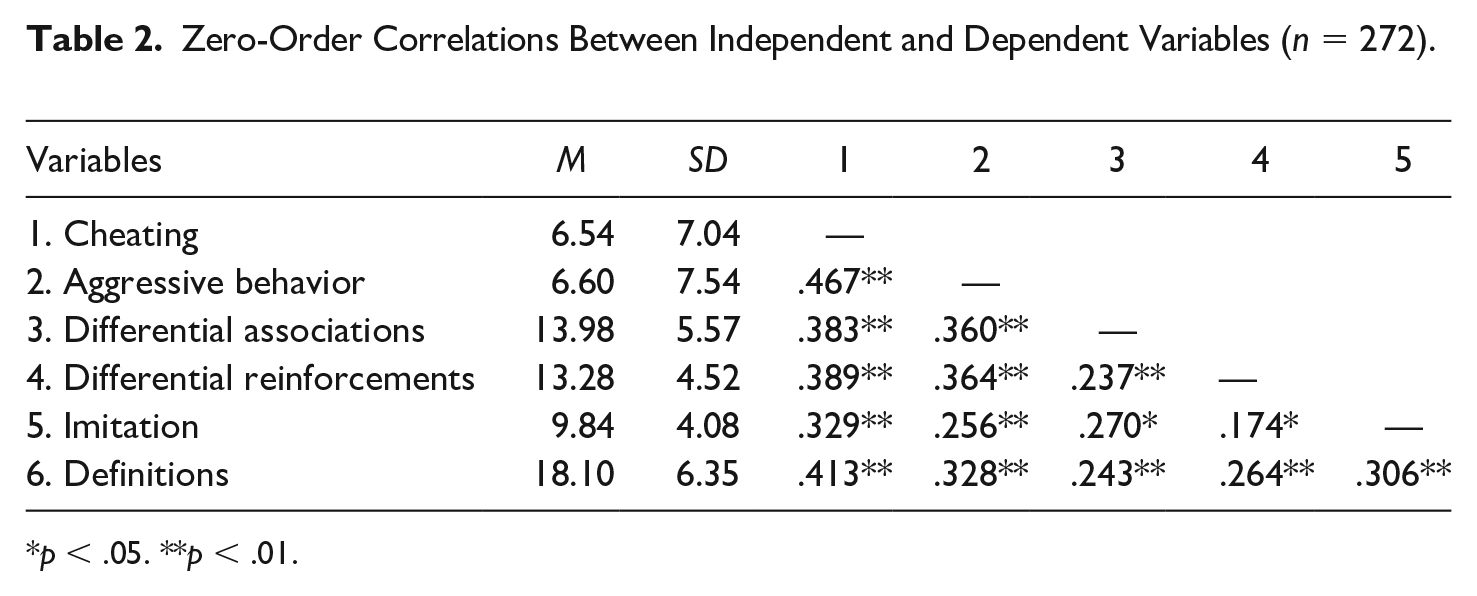
Table 2 reports zero-order correlations between independent variables (social learning constructs) and antisocial coaching. As the results indicate, there are moderate to moderately strong correlations (r >.26) between differential association, differential reinforcement, definitions, and imitation of coaches’ perceptions of cheating and aggressive behavior (p < .01).
Zero-Order Correlations Between Independent and Dependent Variables (n = 272).
p < .05. **p < .01.
Structural equation modeling with a bootstrapping method was applied to investigate the direct and indirect paths of the social learning constructs on antisocial coaching. As the structural model (see Table 3) demonstrates, education (β = −.13, p < .05), differential association (β = .21, p < .01), differential reinforcement (β = .24, p < .01), definitions (β = .24, p < .01), and imitation (β = .11, p < .05) had a direct effect on coaches’ cheating behaviors. In addition, differential association (β = .14, p < .01), differential reinforcement (β = .05, p < .01), and imitation (β = .06, p < .01) had an indirect effect on coaches’ cheating behaviors. Also, differential association had a direct effect on differential reinforcement (β = .24, p < .01), definitions (β = .14, p < .05), and imitation (β = .27, p < .01). Differential reinforcement (β = .19, p < .01) and imitation (β = .24, p < .01) had a direct effect on definitions. Moreover, differential association (β = .11, p < .01) had an indirect effect on coaches’ definitions of antisocial coaching. The model accounted for 34% of the variance in coaches’ cheating behaviors, 6% of the variance in differential reinforcement, 15% of the variance in definitions, and 7% of the variance in imitation. For the fitted AMOS model, the summary statistics (i.e., CMIN/ df = .995, GFI = .989, CFI = .999, incremental fit index [IFI] = .999, RMSEA = .001, and pClose = .871) are better than critical values and represent an adequate goodness of fit for the proposed model (Figure 1).
Direct and Indirect Effects of the Social Learning Model on Coaches’ Cheating Behavior (n = 268).
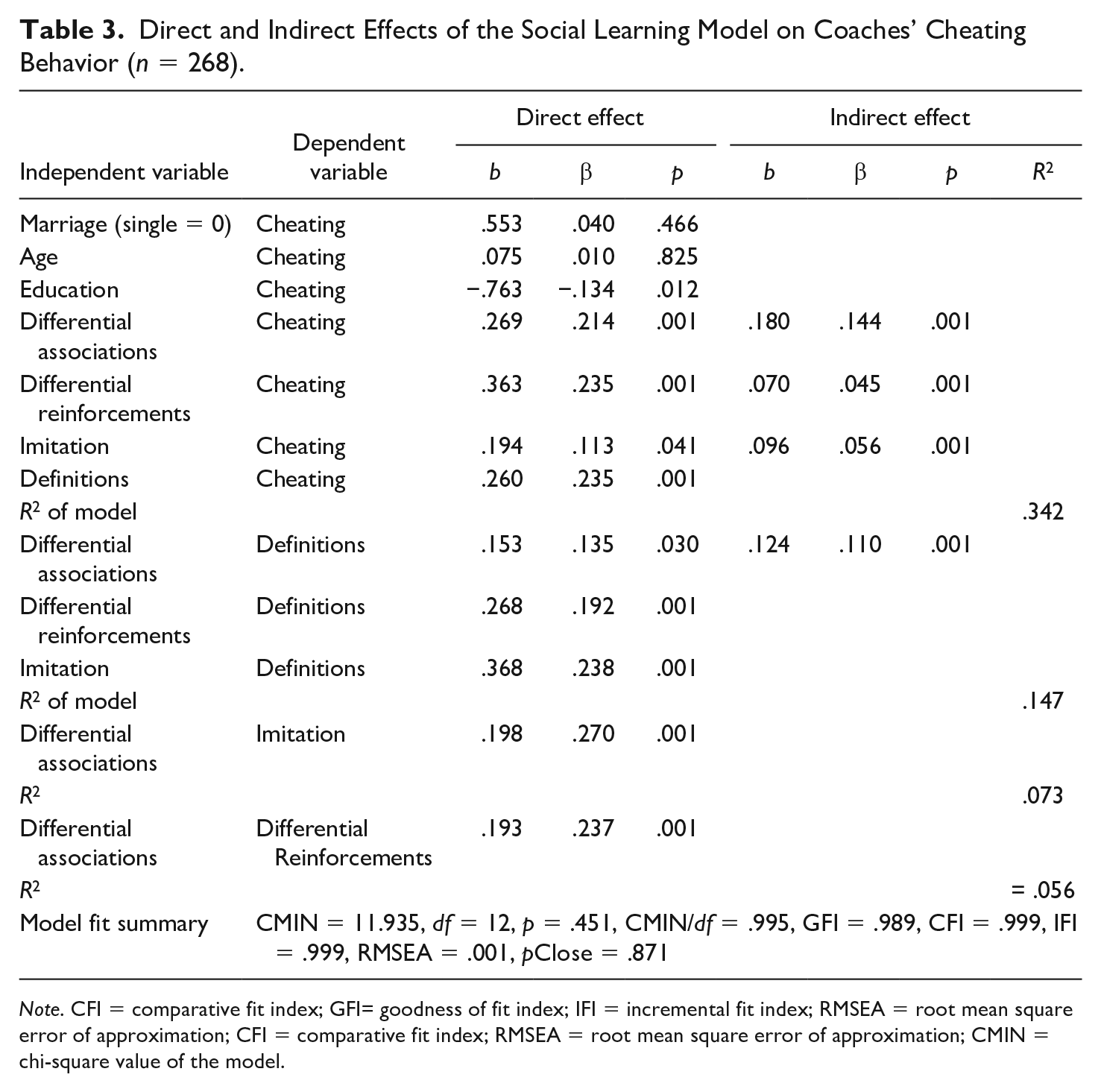
Note. CFI = comparative fit index; GFI= goodness of fit index; IFI = incremental fit index; RMSEA = root mean square error of approximation; CFI = comparative fit index; RMSEA = root mean square error of approximation; CMIN = chi-square value of the model.
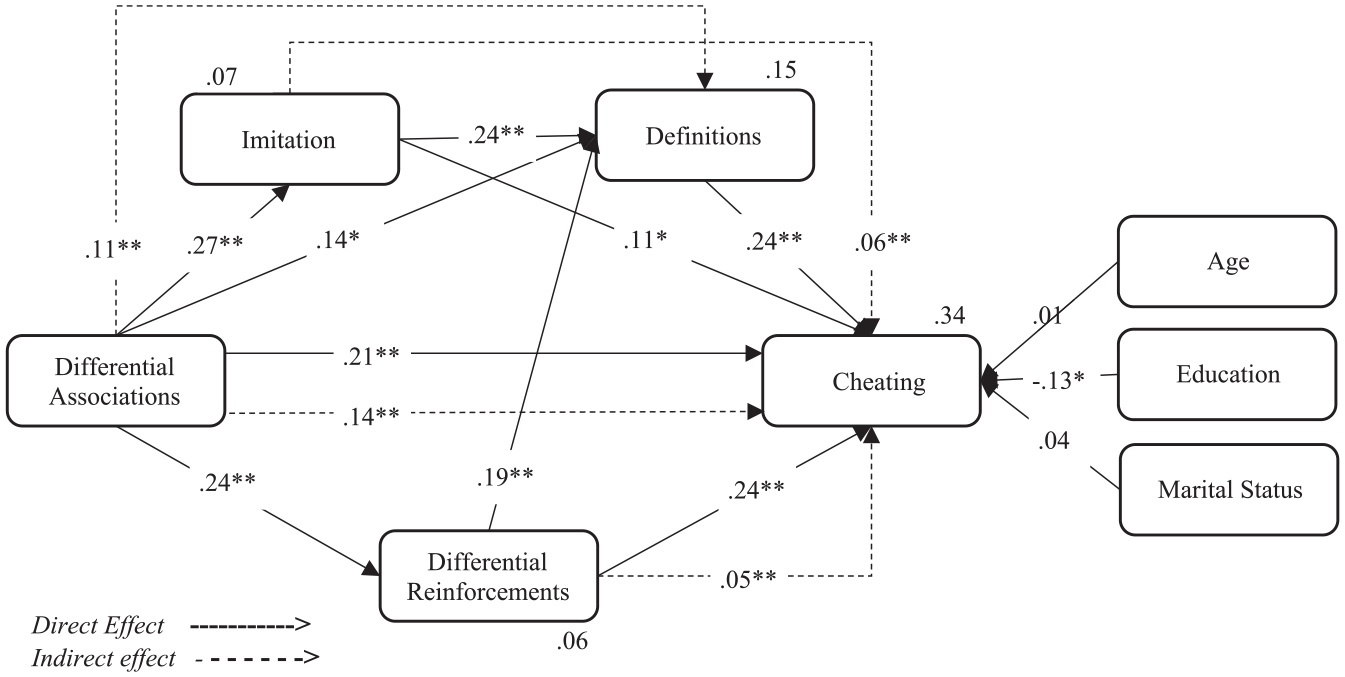
Structural equation modeling of the direct and indirect effects of social learning constructs on coaches’ cheating behavior.
As the structural model (see Table 4) shows, education (β = −.18, p < .01), differential association (β = .23, p < .01), differential reinforcements (β = .23, p < .01), and definitions (β = .13, p < .05) had a direct effect on coaches’ aggressive behaviors. In addition, differential association (β = .10, p < .01), differential reinforcement (β = .03, p < .05), and imitation (β = .03, p < .05) had an indirect effect on coaches’ aggressive behaviors. The model accounted for 29% of the variance in coaches’ aggressive behaviors. For the fitted AMOS model, the summary statistics (i.e., CMIN/df = .995, GFI = .989, CFI = .999, IFI = .999, RMSEA = .001, and pClose = .871) are better than critical values and represent an adequate goodness of fit for the proposed model (Figure 2).
Direct and Indirect Effects of the Social Learning Model on Coaches’ Aggressive Behavior (n = 268).

Note. CFI = comparative fit index; GFI= goodness of fit index; IFI = incremental fit index; RMSEA = root mean square error of approximation; CMIN = chi-square value of the model.

Structural equation modeling of the direct and indirect effects of social learning construct on coaches’ aggressive behavior.
Conclusion
Ethics and fair play are central values in the world of sports. However, sports occur within a social context where interactions can influence the presence of antisocial and prosocial behaviors. Coaches are a fundamental group responsible for guiding ethical behavior in sports. The main purpose of this research was to test the constructs of social learning theory in the context of antisocial coaching. The theory of social learning (Akers & Jennings, 2009) claims that antisocial behavior is shaped and learned like other behaviors in the social environment, principally via differential associations, differential reinforcement, imitation, and definitions. For example, the extent of coaches’ communication with other people, like colleagues, who have a positive (endorsing) attitude regarding antisocial behavior increases the likelihood that antisocial coaching is acceptable and makes the coach more likely to participate in antisocial coaching. Similarly, perceived high rewards and low deterrence lead to greater intentions to use antisocial coaching as an acceptable practice.
The current study finds support that differential association is the most important component of the social learning theory. This construct has a direct effect on coaches’ imitation, definitions, and differential reinforcement. In fact, behavioral and normative associations (i.e., differential association) were linked to imitations of antisocial behavior, approved definitions toward antisocial coaching, high perceived rewards for engaging in antisocial behavior, and low perceived deterrence and consequences related to antisocial coaching behavior. Furthermore, this study suggests that being exposed to imitation sources such as television, social media, internet, important others, and differential reinforcement (the balance of rewards and punishments) reinforces the support that coaches have for antisocial behavior. To this end, positive or neutral techniques designed to rationalize antisocial decision-making process were present, making it easier for coaches to permit and endorse antisocial behavior for their athletes. On a related note, this study suggests that education level has an impact on antisocial coaching behavior, with higher educated coaches reporting lower antisocial coaching behaviors.
This study is the first to investigate the utility of the social learning theory on coaches’ perceptions and endorsement of antisocial behaviors, using a sample of soccer coaches in Iran. There are, however, several weaknesses in the study that could be addressed in future research. Although Iran has been ignored in previous research on this topic and this study could be used for comparative purposes, there may exist key cultural differences even within the various geographical locations of Iran. There was no attempt to measure these cultural aspects in this study. In addition, the study featured a convenience sample and cross-sectional data. Future efforts would benefit from longitudinal data that could document changes in antisocial behaviors over time. Finally, the sample was exclusively male (as were the players). The topic of antisocial behaviors in coaches could be furthered with the inclusions of cross-gender perspectives for comparison purposes.
The findings of this study showed that antisocial behaviors are learned in social settings, and like other social behaviors, coaches also use these antisocial behaviors to gain advantage and superiority for their team; we also found that associating with other coaches and being in the sport environment where other sports teams engage in such antisocial behaviors also prompted respondents (coaches) to endorse such behaviors by their players. One of the most effective ways to reduce antisocial behavior is to conduct ethical training courses for coaches at different levels. Institutionalizing prosocial in coaching profession allows coaches to overcome their external motivations (endorsement of antisocial behavior) despite being in provocative situations. Similarly, providing moral atmosphere encourages athletes to engage in prosocial behaviors such as apologizing to an opponent after fouling him or her, congratulating an opponent on good play, kicking the ball out of play if an opponent is injured, or helping an opponent off the floor. Moreover, the continuous monitoring of coaching activities in clubs and the application of punitive and incentive policies can also lead to a decrease in antisocial behaviors and an increase in prosocial behaviors in the coaching profession.
Footnotes
Declaration of Conflicting Interests
The author(s) declared no potential conflicts of interest with respect to the research, authorship, and/or publication of this article.
Funding
The author(s) received no financial support for the research, authorship, and/or publication of this article.
