



Abstract
Fixated pedophilic sexual attraction is considered to be a major determinant of risk among sex offenders, but there is little empirical evidence regarding its treatment. It was hypothesized that two prominent factors which have emerged in the literature as being present among some sexual offenders, namely, impersonal, narcissistic, and predatory patterns of offending against victims, and experiencing childhood sexual abuse, may be related to specifically to the strength of pedophilic interest. Such a relationship would provide a deeper understanding of the corollaries of pedophilic interest and would suggest targets for treatment. These factors were explored in a sample of 532 sexual offenders who attended the National Centre for Risk Assessment in Israel, and were found to be significantly related to the level of pedophilic interest in the sample. The implications for treatment of high-risk offenders are discussed.
Keywords
Background
Deviant Sexual Interest
Deviant sexual preference is considered to be one of the strongest risk factors in terms of predicting dangerousness (Hanson & Morton-Bourgon, 2005). While this may be the case, there would appear to be very little evidence for the effectiveness of treating such preferences. A recent Cochrane review exploring the effectiveness of libido suppressant medications for sex offenders (Khan et al., 2015) identified a very poor evidence base for such interventions, marred by high drop-out rates, refusal to receive treatment, studies which did not use blind control groups, and lack of reporting of long-term outcomes. Behavioral interventions for deviant sexual preference, while described in some detail in the literature, would also appear to have little empirical support apart from anecdotal evidence (Marshall & Laws, 2003), and it has been argued that unlike females, male sexual preference is less amenable to social influences through the life span (Baumeister, 2000). Such a risk factor is clearly criminogenic, and identified with a high level of risk, yet there would appear to be little that can be done to ameliorate it. The current article seeks to explore behavioral and psychological factors which may be associated with deviant sexual preference and, in identifying them, pave the way for further interventions which may indirectly ameliorate it. For the purposes of the current research, we explored whether heightened pedophilic sexual interest is related to impersonal and predatory relations with child victims, as opposed to romantic interest or emotional congruence. We next hypothesized that should there be an association between heightened pedophilic interest and impersonal predatory relations, then early childhood experiences (namely, the experience of childhood sexual abuse [CSA]) may be a precursor. Such findings may have implications for the differential assessment, monitoring, and treatment of offenders with clear pedophilic interests.
Impersonal and Predatory Relations (IPR) With Child Victims
Some of the earliest theories of sex offending against children viewed the presence or absence of emotional congruence with children as being a primary characteristic in motivating offenders and characterizing them (Finkelhor & Araji, 1986). One of the best-known typologies of sexual offenses against children (Knight & Prentky, 1990) differentiated between interpersonal and narcissistic meanings for abusing children as a central axis for classification, the former group seeing children as legitimate and equal romantic partners, the latter using children for their own sexual needs. There is also evidence to suggest that offenders with heightened sexual interest in children are more likely to have fewer sexual partners, see themselves as being sexually incompetent, have lower levels of weekly sex, and have lower levels of sexual satisfaction than sexual offenders who have victimized adult women (Cale et al., 2014). While it may be argued that such a finding represents a tautology (sex offenders against children are more likely to have fewer satisfying or appropriate adult sexual relationships than sex offenders against adults), it may equally be argued that the differences between the two groups may be rooted in differences in the way that potential victims are perceived—that offenders with sexual interest in children are not able to see adult women as satisfying or adult relationships as being obtainable (and so develop relationships with children), as opposed to offenders against women who are frequently reported to offend against a background of anger, need to control, compensation for feelings of inadequacy, or opportunism (Robertiello & Terry, 2007). Similarly, it has been argued that sexual offenders against children hold distorted schemas in which they believe in mutuality and enjoyment on the part of their victims (Ward & Keenan, 1999), especially when compared with highly hostile schemas that rapists hold against women (Malamuth & Brown, 1994), yet self-serving schemas cannot preclude the lack of empathy that sexual offenders hold against children. Similarly, in a review of risk factors for sexual recidivism, callousness or lack of concern for others is noted to be a “promising” risk factor (Mann et al., 2010). The confluence of poor ability to maintain healthy and satisfactory intimate relations together with overall callousness and lack of concern for others would appear to indicate that pedophilia contains strong elements of objectification of others, including children. In a discussion of what may be considered to be a highly fixated form of pedophilia (the use of child sexual abuse materials), Bartels and Merdian (2016) discussed the level of objectification present in the schemas of sexual offenders against children. They argued that there has been a transition in the literature from conceptualizing the schema of “children as sexual objects” (Ward & Keenan, 1999) to “children as sexual beings” (Marziano et al., 2006; Ó Ciardha & Ward, 2013) “as children’s capacity for independent action or decision-making (agency) is not considered. Instead, children are reduced to their (perceived) sexual appeal, leading them to be seen as mere instruments for sexual gratification” (p. 20).
It would stand to reason that if an offender with heightened sexual interest in children holds impersonal and objectifying views of children, then the methods in which he obtains his victim’s submission may be predatory and highly regulated. The method of overcoming a child’s potential resistance to sexual abuse has long been considered as being a necessary precondition in the steps toward carrying out abuse (Finkelhor, 1984), and has been seen as a central axis in categorizing goals and offense pathways among offenders, as seen in Ward and Hudson’s (1998) self-regulation model of relapse prevention.
Childhood Sexual Abuse (CSA)
The experience of CSA among sexual offenders would appear to be high. Hanson and Slater (1988) were among the first to systematically review the phenomenon, and found that 34.6% of abusers of male victims had themselves been sexually abused in the past, and with a lower figure of 18.2% for abusers of female victims. More recent reviews have continued to find such a high prevalence (Jennings et al., 2014). Although Hanson and Morton-Bourgon (2004) later found no relationship between history of sexual abuse and recidivism, researchers have nonetheless continued to find a high prevalence of CSA among sexual offenders. Jespersen et al. (2009) found that sex offenders were over 3 times more likely to report a history of sexual abuse than non-offenders. Similarly, Levenson and Grady (2016) found in a large sample of male sex offenders (n = 635) that 38% of their sample suffered from CSA. Nunes et al. (2013) found large effect sizes for CSA in predicting pedophilic sexual interest in a sample of 462 incarcerated sex offenders (Cohen’s d = 0.71) as measured by the Screening Scale for Pedophilic Interests (SSPI; Seto et al., 2004). While some have questioned whether sexual offenders are telling the truth when they report that they have been sexually abused, self-report of CSA still remains high even when sexual offenders are questioned while being monitored with polygraph (29%; Hindman & Peters, 2001). More recently, Plummer and Cossins (2018) surveyed the literature and found that CSA victims were more likely to become offenders if they were abused frequently, by a father figure or someone with whom they had a dependency relationship, and if the abuse occurred during adolescence. It would appear that the relationship between CSA and later abuse perpetration is particularly strong for what was termed as “mixed offenders,” namely, those who carried out more than one modality of sexual abuse toward their child victims (Alanko et al., 2017), supporting the hypothesis that CSA is related not just to later perpetration but to higher levels of fixation, activity, and pedophilic interest.
Crucially, while there would appear to be a relationship between CSA and later sexual offending, CSA-focused treatment would appear to be a very rare component of treatment programs for sex offenders. The most recent survey of treatment providers in North America performed by the Safer Society (McGrath et al., 2009), surveying over 1,300 offense-specific treatment programs in North America, found that no treatment providers list sexual trauma therapy as being with the top three theories that best describe their program (the figure is higher for adolescent offenders). Ricci and Clayton (2016) argue that there is a long-standing belief among treatment providers that directly targeting and resolving earlier trauma may foster excuse making among patients and thus hinder treatment progress. While this may be the case, it should be noted that most recently some practitioners have advocated Trauma Informed Care for sex offenders. While not necessarily advocating wholesale resolution of trauma at the heart of sex offender treatment, such an approach advises therapists to be aware and empathic of the manifestation of trauma and in doing so avoid disempowering relationship dynamics, given the extant knowledge of the effects of childhood trauma on many forms of psychopathology (Levenson et al., 2018).
While each of the above-mentioned factors have been described individually in the literature, there would appear to be little research that attempts to investigate the interaction between them, and whether some of the factors subsume others. Gold et al. (1998) found in a factor analysis of power dynamics between abuser and abused that objectification and coerced compliance represented two distinct forms of dynamics, loading onto two distinct factors (based on retrospective reports of victims), but in the absence of any knowledge of the abuser and his level of sexual fixation (which is measured partially in the current study by the number of previous victims), it cannot be known whether more fixated abusers will tend to develop multiple forms of relationship dynamics with their various victims. A further possible interaction between the currently researched factors is also the potential for early abuse and identification with the abuser, whereby the abused to abuser cycle replicates the form of abuse that the person suffered. A study by Burton (2003) found a high level of repetition of the form of modus operandi used in the abuse to abuser cycle, with an odds ratio (OR) of 3.95 for use of direct force, OR of 3.88 for use of threats, and an OR of 9.22 for the use of favors, in comparing the experiences of abusers who had suffered these forms of modus operandi in their own CSA, when compared with abusers who suffered a different modus operandi in the CSA they experienced (n = 179). Again, it should be noted that while such a correlation was found, there was no further study of such factors and their relationship with strength of sexual interest or offense background. Similarly, Danni and Hampe (2000) found that a history of CSA and the use of manipulative seduction tactics were the two most significant factors in predicting sexual offenses against children (as opposed to hebophilic or incest offenses), yet they too did not explore the strength of pedophilic interest, or whether objectification of the victim was a further predictive factor in differentiating pedophiles from non-pedophilic child molesters. Leibowitz (2012) identified a correlation between a history of sexual abuse and the use of coercive strategies in the modus operandi of adolescent sexual abusers. Similarly, Kaufman et al. (1998) explored the differences in modus operandi between adolescent and adult offenders, and between intra- and extra-familial offenders, yet found few differences, and did not look at other mediating factors, such as dangerousness, offense history, or sexual interest. A more recent strategy in the literature for exploring the relationship between sexual fixation and modus operandi has emerged around the use of online internet grooming. It can be reasoned that such offenders will have highly specific sexually deviant interests in children, and indeed Kloess et al. (2015) survey a growing body of literature testifying to the prevalence of varied, coercive, highly sexualized, sophisticated, and often threatening behaviors involved.
Aim of the Current Research
The current research aims to explore whether there is a relationship between heightened sexual interest in children and IPR—a tendency to treat them as sexual objects, characterized by impersonal relations with them, predatory and callous modus operandi, and orgasm-focused objectives above and beyond any form of emotional congruence, akin to Knight and Prentky’s (1990) “narcissistic” as opposed to “interpersonal” offender. Are their aims in offending different to those who have a lower level of pedophilic interest? Following this, we explore whether a history of CSA may have been a significant development factor among those who developed such a predatory style.
Method
Sample
The current research is based on a sample of 545 adult male sex offenders who were referred to the National Centre for Risk Assessment between the years 2008 and 2010. These offenders were the first people to be assessed at the Centre within the context of the Public Defence Against Sexual Offences Act (Israel, 2006) came into force, and were assessed for decision making at time of sentencing, or for determining or extending community supervision orders. During these first 2 years of the Centre’s existence, every sentenced offender who had committed a sex offense against a child (defined as being under the age of 16) was referred, together with every sex offender released from prison, irrespective of the type of victim. For the purposes of the current research, 13 subjects were excluded from the analysis due to the fact that they obtained a score of 0 in the main outcome criterion (SSPI, detailed below). Demographic and offense-related details of the sample are presented in Table 1.
Socio-Demographic Characteristics of the Sample.

Measures
All measures were taken from indictments and risk assessments. Variables were coded according to mixed-methods procedures, in which criteria were categorically quantified according to set rules. Inter-rater reliability was established by two raters coding 15 cases according to the specified criteria, and reliability was found to be .98.
The SSPI (Seto et al., 2004) is a brief measure of sexual attraction to children based on four items taken from file information. These four items are the presence of any male child victims, more than one child victim, any prepubescent victim (under the age of 12), and any extra-familial victims. Each item is scored 0 (absent) or 1 (present), with the exception of the first item (male child victims) which is scored 0 (absent) or 2 (present), making possible scores on the SSPI range from 0 to 5. As the current study is concerned only with sex offenders against children, subjects with a score of 0, who by necessity had not offended against children, were excluded from the study. In Seto et al.’s (2004) original research, significant correlations were found between total scores and phallometric data, making the SSPI a proxy measure for sexual interest in children. Subsequent studies attesting to the discriminant validity of the SSPI are reviewed by Helmus et al. (2015) who concluded that the “SSPI is useful as a brief measure of sexual interest in children. It performs equally as well as indicators of deviant sexual interests from other risk scales.” (p. 42) SSPI scores are presented in Table 2.
Distribution of SSPI Scores.
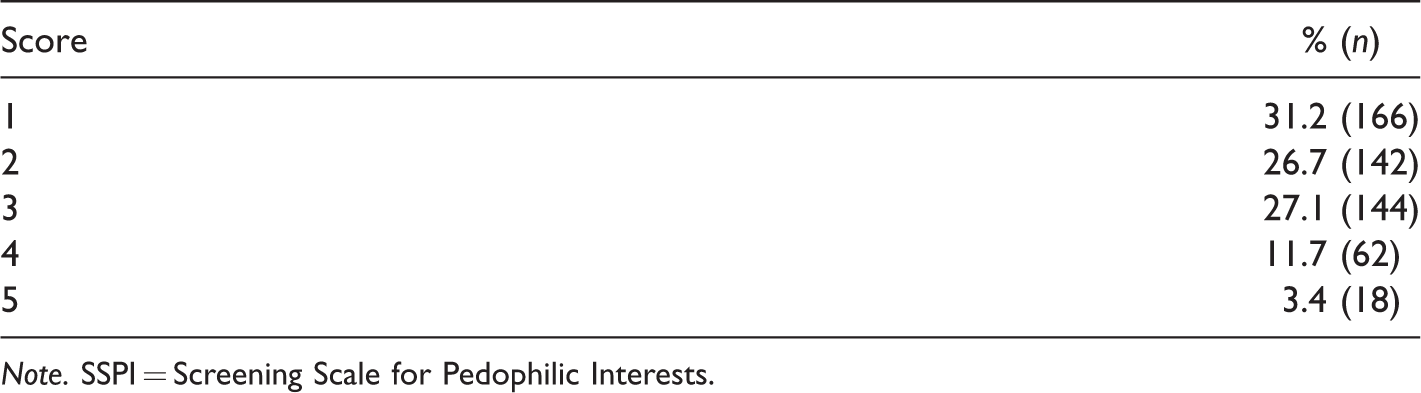
Note. SSPI = Screening Scale for Pedophilic Interests.
CSA
For the purposes of the current research, CSA was coded dichotomously according to the subject’s self-report, coded as a score of 0 (absent) or 1 (present).
IPR with child victims
This scale was constructed according to the description of the offense process in the indictment, whereby a score of 0 (absent) or 1 (present) was given for each of the following variables—whether the same modus operandi was used repeatedly for repeated offenses (e.g., use of material reinforcers such as puppies), escalation of offenses over time, increasing frequency of repeat offenses over time, variability in offense type, use of threats, and use of physical force. In addition, the objectification of the victim in terms of the nature of the sexual assault was also explored. Rudman and Mescher (2012) noted that one of the primary definitions of objectification is the tendency to treat the other person as a tool for one’s own needs and purposes, together with a lack of agency and self-determination, making the victim inert, lacking autonomy. For the purposes of the current study, sexually objectifying behaviors were chosen that reflected this tendency. These behaviors were operationalized and identified as those which objectified the victim according to these criteria, and from the available data, which were taken from the indictments, namely, whether the victim was ordered to masturbate or to touch the body of the offender, whether the victim’s body was used as a surface to masturbate on, whether the offender masturbated in front of the victim, and whether the perpetrator performed oral, anal, or vaginal sex. Again, each item was coded 0 (absent) or 1 (present). The overall scale provides a range of total scores between 0 and 11. Internal consistency of the scale was satisfactory (Cronbach’s α = .77).
Statistical Analysis
The first part of the analysis focused on socio-demographic characteristics of the sample, together with descriptions of previous offense backgrounds. In addition, the distribution of levels of pedophilic interest and descriptions of scores on the scales measuring IPR and the presence of CSA are also summarized in Table 3.
Descriptive Statistics of SSPI and IPR.

Note. SSPI = Screening Scale for Pedophilic Interests; IPR = impersonal and predatory relations.
Differences in levels of pedophilic interest and IPR were explored between the group of offenders who had experienced CSA compared with the group who did not report experiencing CSA. Finally, a stepwise regression model was conducted to assess the relationship between the independent variables and their prediction of level of pedophilic interest.
Results
In Table 4, differences in levels of pedophilic interest and IPR are presented between the group of offenders who had experienced CSA and those who had not. The results indicate that those who had experienced sexual abuse in childhood were significantly more likely to have higher levels of pedophilic interest, and higher levels of impersonal and predatory modus operandi toward their victims. Standardized effect sizes examining the influence of CSA on pedophilic interest indicated a medium to large effect size (Cohen’s d = 0.75), and the influence of CSA on IPR demonstrated a small to medium effect size (Cohen’s d = 0.27).
Differences in Pedophilic Interest and Impersonal and Predatory Relations Amongst Subjects with and without a History of CSA.

Note. SSPI = Screening Scale for Pedophilic Interests; IPR = impersonal and predatory relations.
A stepwise regression model was conducted to assess whether CSA and IPR can predict pedophilic interest, as presented in Table 5. In addition, the following control variables were entered as covariates into the regression model: age, education, previous or current relationship status (defined as cohabitation with a partner for at least 2 years), stable occupation history, previous non-sexual offense history, multiple victims, age at first criminal conviction, age at first sex offense conviction, and age at commission of first sex offense. Only two of these control variables were found to be significant (age at first criminal conviction and multiple victims). IPR was entered into the first step, F(1, 514) = 49.09, p < .0001, accounting for 7.4% of the variance (R2 = .074). CSA was entered into the second step of the model, F(2, 513) = 44.70, p < .0001, which together with IPR accounted for 13.5% of the variance (R2 = .135). The contribution of the two control variables which were found to be significant in the model was modest, where age at conviction for the first offense was significant, F(3, 512) = 32.17, p < .0001, adding another 1.1% to the variance of the model, and similarly the presence of multiple victims, F(4, 511) = 25.28, p < .0001, added another 0.7% to the variance of the model. The whole model explained altogether 15.3% of the variance of pedophilic interest within the sample. Tolerance levels for both variables in the final model were higher than 0.8, and the variance inflation factor (VIF) levels for all the variables in the model were lower than 1.070.
Stepwise Regression Model Predicting SSPI From the Independent Variables (CSA, IPR).

Note. SSPI = Screening Scale for Pedophilic Interests; CSA = childhood sexual abuse; IPR = impersonal and predatory relations; AGECP2 = Age at First Criminal Conviction; NNVIC = Multiple Victims.
Discussion
The current research found a clear association between the strength of pedophilic interest (as assessed by a proxy measure) and impersonal and predatory modus operandi patterns in offending. In addition, there is clear evidence that such offenders have a history of CSA. While the current regression analysis can only identify associations and differences between groups, it can be argued that the findings go some way in explaining the development of sexual deviance among sexual offenders. Structural equation modeling by Hunter et al. (2010) posited a developmental pathway between sexual victimization by males, and the development of pedophilia, partially mediated by hostile masculinity. The same researchers also found an association between early sexual victimization and the development of psychosocial deficits, which in turn mediated the development of psychopathic and antagonistic attitudes. Similarly, it can be argued that the current research indicates a similar developmental pathway—early sexual abuse directly influences the development of deviant fixated sexuality, and as a result of the abuse, the ability to relate to the other in a loving or caring way is lost (leading to the objectification of others and seeing them purely as sexual objects) and as a result of the deviant sexual interest, the only means to obtain sexual partners are through coercion, predation, and escalatory tactics. Indeed, it has been argued that sexual deviance occurs due to the inability to form loving relationships (following abuse), and that the sexual drive is transferred onto non-consenting people, acts, or objects (Money, 1986).
The finding that impersonal and predatory patterns of relating to victims may strengthen the importance of empathy-enhancement interventions for treating offenders with higher levels of deviant fixation. While numerous studies have failed to find a relationship between empathy and reoffending (Hanson & Bussiere, 1998; Hanson & Morton-Bourgon, 2004; Vachon et al., 2014), others have argued that empathy deficits are related to other more established risk factors (Barnett & Mann, 2013), or that there would appear to be strong theoretical grounds for incorporating such work which has not yet been empirically validated (Day et al., 2010; Mann & Barnett, 2013). The current research would indicate a middle road, where empathy interventions would be indicated for more sexually fixated offenders. It should be noted that other researchers have found a relationship between pedophilic sexual fixation and what may be argued to be the converse of victim objectification, namely, emotional identification with the victim (Hermann et al., 2017; McPhail et al., 2013). However, while such subjective distorted cognitions may be characteristic of such fixated offenders, in a similar vein to the “interpersonal” classification of Knight and Prentky (1990), this does not necessarily preclude the use of predatory and impersonal behaviors on the part of such fixated abusers. It may further be hypothesized that the commission of such objectifying sexual behaviors enables the abuser to carry out his sexual desires in a way which prevents him from seeing the distress or the damage being caused to the victim.
The confluence of IPR with victims, together with a history of CSA, as factors related to pedophilic interest has clear therapeutic implications In particular, it may be argued that recent developments in trauma-informed care, where offenders may be able to understand their victims’ suffering through the prism of their own experiences of abuse, may be salient for those with high levels of pedophilic interest (Levenson et al., 2018). Similarly, while the current research does not indicate downplaying the importance of traditional relapse prevention work for sex offenders with high levels of pedophilic interest, the findings would support the importance of therapeutic interventions which could both ameliorate the effects of CSA and develop the ability to develop meaningful and positive relationships and life goals which would appear to be lacking among sex offenders with higher levels of pedophilic interest, as advocated by Marshall et al. (2011), Levenson and Grady (2016), and Ward and Willis (2016).
Altogether, the confluence of CSA and the development of impersonal and predatory patterns of relating to victims account for 13.5% of the variance of pedophilic interest. It may be argued that such factors are simply well-known factors that are associated with general antisocial behavior (Papalia et al., 2018), which in itself is associated with dangerousness of sex offenders (Hanson et al., 2003). However, the current research found that when factors associated with antisociality were entered as covariates (age at first criminal conviction, previous non-sexual offense history, occupational stability, educational attainment), these were found to have little-to-no association with pedophilic interest. Similarly, it could be argued that the current results are an artifact of demographic factors (age, intimate relationship), which found to have a strong relationship with sexual dangerousness (Hanson et al., 2003), yet again these factors were found to have little to no influence on pedophilic interest. Finally, there was no evidence in the current study for the significance of factors which could be hypothesized to be involved in the development of fixated sexual interest, such as age at first sexual offence, or multiple victims (Bartels & Beech, 2016). While the contribution of the currently researched factors of 13.5% of the variance in pedophilic interest could be seen as being modest, the finding that none of the other factors had a significant relationship with pedophilic interest would suggest that pedophilic interest is a unique variable with unique characteristics that are amenable to therapeutic and preventive intervention, and it may be the case that future research will be able to uncover further mechanisms, presumably intra-psychic, which are related to fixated pedophilic interest and would be amenable to further intervention.
Limitations
The participants of the current research were taken from a heterogeneous sample of sex offenders who were at different stages of the justice process, including for the purpose of pre-sentencing reports or following release into the community to determine supervision limitations or further treatment options. Some of the participants had undergone treatment, others had not. A more fine-grained analysis was not possible for the purposes of the current research, but these factors may have influenced self-report particularly CSA. However, while this may be the case, there is no a priori reason for sex offenders undergoing assessment to assume that withholding or reporting a history of CSA would have a particular bearing on the outcome of their risk assessment. The operational definition of CSA for the purposes of the current research was dichotomous, precluding a more refined analysis which could take into account the different elements of the abuse, such as relationship with the offender, frequency, and escalation, which have been found to have a differential effect on the later offense perpetration (Plummer & Cossins, 2018). A further limitation of the current research is the operational definition of the variables, which were selected on a rational basis, and would preclude the investigation of intra-psychic processes behind victim objectification, selection of modus operandi, and the experience of CSA. While the use of such intra-psychic measures would give further support to the current findings, it should be noted that the current measures, while limited in scope, were found to be highly objective as shown by their high level of inter-rater reliability.
Footnotes
Authors' Note
Judith Abulafia is also affiliated with Be'er Ya'akov Center for Mental Health, Israel.
Declaration of Conflicting Interests
The author(s) declared no potential conflicts of interest with respect to the research, authorship, and/or publication of this article.
Funding
The author(s) received no financial support for the research, authorship, and/or publication of this article.
