



Abstract
The study of offense narratives emphasizes the agency of the offender which brings psychology closer to law. As an effort to create a standardized and quantitative method to evaluate offender narratives, Youngs and Canter developed the Narrative Roles Questionnaire (NRQ) based on the content analyses of the crime narratives of offenders in UK prisons. The current study aims to investigate the applicability of offense narrative roles framework among Turkish offenders. The application of the offense narrative roles model to a non-Western country is the first step toward the acceptance of criminal narrative theory as a universal explanation of criminal behavior. A translation of the NRQ was administered to 468 Turkish male inmates who have committed a wide range of offenses from fraud to murder. The results of an MDS analysis yielded four roles, namely Professional, Revenger, Hero, and Victim, echoing the original formulation proposed by Youngs and Canter. The reliability coefficients of scales derived for these roles were all at desired levels. The results support the applicability of the NRQ framework in a non-English context.
Keywords
Narrative Theory
People make sense of the world by developing a personal narrative. Both expected and unexpected changes in circumstances affect the flow of that story line, shape the narratives, and have great impact on the characters, identities, and roles that are assigned to selves and others (McAdams, 1988). One of the most significant researchers in narrative theory, McAdams (2008), defines narrative identity as “individual’s internalized, evolving, and integrative story” which starts to develop during adolescence and early adulthood and continues to evolve throughout the life span (p. 242). The focus of the life stories, the characters, and the imago(es) which “is an idealized personification of the self that functions as a protagonist in the narrative,” change throughout life as the demands of each age span change (McAdams, 2001, p. 206).
Narrative Theory in Criminology
The narrative approach is also increasingly contributing to the understanding of criminality. The narrative has been conceptualized mainly in three ways by criminologists and each conceptualization has been adopted by researchers with different approaches. As Presser (2010) argues, criminologists, due to their positivist tendencies, mostly take the narrative “either as a record or as interpretation” (p. 434). The first way of approaching narratives is to treat them as a record of experience. This raises questions about the authenticity of offender narratives. One of the reasons why the authenticity of offender narratives is found questionable, which in turn has prevented criminologists from acknowledging narratives as a means to explain criminal behavior, stems from the notion that offenders are inclined to distort reality to manipulate others (Presser, 2009). The second way of approaching narratives, especially by ethnographers of crime, and criminologists with a feminist or other critical approaches, is viewing narratives as interpretations (Presser, 2009, 2010). The subjectivity of the accounts is not considered problematic if the aim is to uncover the “individual versions of actual circumstances” (Presser, 2009, p. 183). Lastly, only a few of those in the field adopt an approach viewing the narrative as “a shaper of experience” (Presser, 2010, p. 435). Presser builds a case for “a narrative criminology that situates stories as antecedents to crime” (Presser, 2009, p. 178). Maruna and Copes (2005), by focusing on the role of narratives on the future actions of offenders, explain the underlying mechanisms of desistance from or persistence with crime through neutralizations embedded within personal narratives.
Maruna (2001) suggests that involvement in future criminal behavior depends on the connotations of the incident in the offender’s mind. In a similar fashion, Ward et al. (2007) propose that by therapeutic interventions a positive change in the offender’s narrative will act as a preventive factor against recidivism. The main proposal is that reconstruction of the interpretation of a past offending behavior can shape future actions. In the current paper, narratives are identified as subject to reconstruction and change in the face of life events. Thus, the offense narrative roles framework supports the theories proposed by Maruna (2001) and Ward et al. (2007) as ways of understanding, predicting, and preventing recidivism. The narrative roles model used here is differentiated from desistance theories in terms of its contribution to the understanding of the initiation of the criminal action.
The criminal narrative roles framework provides a rich understanding of the internal processes that take place during an offense in contrast to approaches that explain recidivism. The major contribution of the recent application of narrative theory to criminology is to challenge the meaning and the function of narratives of offenders. As narratives are strongly linked to the self, they are not mere means of sharing the actual or interpretative experience (Bruner, 2004). “P(p)ersons think, feel, act and make moral choices according to narrative structures” (Sclater, 2003, p. 317).
Narrative makes a point with a moral stand. In that sense, offender narratives are expected to provide an explanation for the violation of norms, that is, for the act of breaking the law. Using this information, we can reach a better understanding of the offender’s underlying cognitive distortions and moral justifications from the mouth of the protagonist of the criminal action (Presser, 2010). Canter and Youngs (2009) formulated the narrative roles model to explain the instigator role of narratives in criminal action. It unveils the experience of crime which facilitates the understanding of the meaning attributed to the act by the actor him/herself and shows the immediate precursors of crime.
The application of offense narrative roles in criminological research sheds new light on understanding the psychological processes of criminal behavior whilst giving an offender the role of a protagonist rather than a passive organism drawn to crime by psycho-social factors beyond his/her control. While most criminological research is centered on predisposing factors and circumstances that drive the offender into criminal behavior the significance of the experience of crime for the offender is often undervalued. Understanding the experiential aspects of criminal behavior can open up the path to the explanation of the internal psychological processes that take place during the offense. The significance of studying the experience of crime comes from its emphasis on the agency of the offender which brings psychology closer to law (Canter, 2010). The approach casts the narrative teller in the leading role in the act of crime emphasizing the agency of the offender.
The Application of the Offense Narrative Roles Framework in Turkish Culture
Culture is expected to have an effect on the comprehension, expression, and enactment of offense roles. The investigation of possible effects of culture on offense narrative roles was suggested by Youngs and Canter (2012a) to be the focus of future research. The major goal of the current study is to check for the applicability of the offense narrative roles model’s replicability in a non-Western country while uncovering the effects of culture on the experience of crime through the investigation of narrative roles that Turkish offenders adopt while committing crime. Each offense narrative role has a form of cognitive, affective, and behavioral coherence for any given offense. The current study aims to show the cultural transferability of these narrative themes among Turkish offenders and investigate any differences or similarities in terms of how they depict these roles.
In order to put the present study into perspective and present the differences and similarities in the depiction of these roles in a clear light, information on crime and effect of culture on crime in Turkey will be provided in the subsequent sections.
The Development of Narrative Themes
Canter (1994), who is one of the first to draw attention to the significance of the personal stories of offenders and to highlight the importance of the relationship between these stories and offenders’ actions and characteristics, calls these stories “inner narratives” (p. 121). These narratives are shaped by the protagonist’s view of self in interaction with the immediate as well as the broad social surrounding, culture. Ward (2012) describes narrative role as “a set of beliefs about the self” revolving around “dynamic themes” and based upon a person’s awareness about one’s emotions, cognitions and behaviors and is distinct from the “real self” (p. 254).
Studies uncovering individual’s underlying themes in their dynamic self and their interaction with others propose two main concepts which are, dominance/submission and love/hate (Leary, 1957), control and openness/inclusion (Schutz, 1992), “S” (striving for superiority) and “O” (strivings for intimacy) (Hermans, 1996) and agency and communion (McAdams, 2001). The framework developed by Canter and Youngs (2009) is based on McAdam’s categorization. The narratives of individuals who are high in agency motivation have themes related to responsibility, mastery, success, and status. Also their narratives are richer in terms of separations and disagreements compared to the narratives of those who are low in agency motivation. People with a high communion motive create narratives featuring love, friendship, and dialog, being high in similarities and connections (McAdams, 2008).
Major themes in the narratives of non-criminal individuals revolve around two dichotomous dimensions with high and low on each creating combinations to yield different narratives. These two main themes are re-defined and re-labeled as potency and intimacy by Youngs and Canter (2012a) to better fit a criminal context. McAdams (2008) shows that the narratives of people with high intimacy motive feature love, friendship, and dialog. However the way of expressing intimacy is different in the criminal context. For an offender, the meaning of intimacy is taken to mean the degree of contact and involvement with others often being brutal or hurtful. The concept of intimacy is therefore re-defined as the awareness of the victim and the level of interaction between the victim and offender (Youngs & Canter, 2012a). The potency theme is redefined as an offenders’ mastery of the victim and the crime-related circumstances. Imposing his/her will on the situation and the victim, rather than pursuing success and showing achievement, which are the core concepts of agency theme among “non-criminal adults.” The justifications each offense narrative role is associated with differ based on the levels of potency and intimacy as well as the level of awareness of the impact on the victim. As a result each narrative role’s criminal experience is associated with different affective components such as pleasure, displeasure, arousal, or calm.
Offenders with low levels of potency would have a tendency to deny their responsibility and/or attribute responsibility to others. However; offenders with high levels of potency would own the responsibility of their actions but probably with a different interpretation of the meaning of their actions and a distortion of their idea of the consequences. Offenders who are low in intimacy would tend to minimize the impact of their actions on the victim through suggesting that the victim was not the real target and/or that the victim deserved it. On the other hand offenders with high levels of potency would be more goal oriented and would focus on the objectives that they intend to accomplish by the offense rather than the victim (Canter & Youngs, 2012; Youngs & Canter, 2012a, 2012b).
The formulation of offender narratives draws on the analyses of fictional characters in literary work. In particular Frye’s (1957) four major narrative themes, namely tragedy, comedy/romance, irony, and adventure . The roles might have different connotations in the life of an offender, thus as part of the adaptation process Canter and Youngs (2009) changed Frye’s “comedy/romance” to “quest,” as the latter term better represents the underlying narrative themes of incarcerated offenders.
Narrative Roles Derived from Offense Narratives
One effective way of investigating offense narratives of offenders is to study the roles they enact during the act of the offense. This is an episodic form of narrative and captures event-related narrative themes that are activated whilst committing the crime (Youngs & Canter, 2012a, 2012b). These roles motivate the criminal behavior. Narrative roles are derived from the narratives of the offenders and are summaries of their offense narratives. Offense narrative roles are the tangible categories driven from complex and implicit narratives. Future research was suggested to draw quantitative guidelines to understand and examine narratives by the use of qualitative data (Youngs & Canter, 2012a; Maruna & Copes, 2005).
Four main themes were proposed, namely adventure, quest, irony, and tragedy based on the offense narratives of offenders. These yield four main roles enacted by the offender during the act of offense, namely professional, revenger, victim, and hero. These narratives and roles have been found to be applicable to offenders across a broad range of crimes (Youngs & Canter, 2009; Ioannou et al., 2015; Ioannou et al., 2017) and offender types (rioters, Willmott & Ioannou, 2017; young offenders, Ioannou et al., 2018; violent offenders, Dedeloudis, 2016; offenders with personality disorders and psychopathy, Goodland et al., 2019). These roles are thought of as the antecedents of criminal actions and offenders engage in certain behaviors as an enactment of their roles.
Adventure narrative theme and professional role
The offender with an Adventure Narrative is “high in potency and low in intimacy” and tries to achieve control over his environment and acts in a way to acquire emotional satisfaction and solid rewards. He 1 enacts the role of the Professional and during the offense, behaving in a calm manner and in control of the environment (Canter & Youngs, 2009; Youngs & Canter, 2009, 2012a). This narrative is mostly “provided by burglars and robbers” (Youngs & Canter, 2012a, p. 243). The victim is irrelevant to the offender’s actions. He acts like a professional, takes responsibility for his actions, and experiences pleasure out of the fulfilment of his goal (e.g., monetary gains).
Irony narrative theme and victim role
The offender with the Irony narrative is “low in potency and high in intimacy.” He adopts the Victim role. He feels confused and helpless. He has no control over the situation and against his will and consent he is being drawn into the offense by external parties who are significant to him. He cannot make sense of things and he feels like there are no rules. He thinks that he is involved in the crime because of his powerlessness, and confusion which makes him the “main victim of the event” rather than the offender (Canter & Youngs, 2009, p. 129). The responsibility of his actions is attributed to others (Youngs & Canter, 2009, 2012a, 2012b).
Quest theme and revenger role
The Quest Narrative is associated with the Revenger role and the person who is enacting this role is “high both in intimacy and potency.” The offender believes that he has been treated unfairly, deprived and wronged and he feels that there is nothing else to do but to take his revenge and make the ones who wronged him pay for it. He seeks vengeance for what has been done to him or to significant others, as a reaction to a built-up anger against the victim who is significant to him. His offenses are justified and he has no choice other than taking his revenge (Canter & Youngs, 2009; Youngs & Canter, 2009, 2012a, 2012b).
Tragedy theme and hero role
The person with the Tragedy narrative enacts the role of Hero. He is “low both in potency and intimacy.” For the tragic hero, his actions are justified, and the responsibility for his actions is attributed to others. He sees the offense as the only way out for him and he believes that he is driven by the fates. He sees himself on an heroic mission. He seeks recognition and engages in a criminal act to rescue things. The victim is not significant to him (Canter & Youngs, 2009; Youngs & Canter, 2009, 2012a, 2012b).
Components of the Offense Narrative Roles
There are other theories that acknowledge the influence of role taking in criminality. One of those is symbolic interactionism. The effect of Mead’s (1934) ideas on social control on criminality is expanded by Matsueda (1992) by the suggestion that role taking mediates the effect of social control on criminality. According to Matsueda (1992) delinquency is caused by taking the role of a rule violator, a process which occurs as a result of adopting a role based on others’ view of the individual. The awareness of the other is emphasized in symbolic interactionist theory. The investigation of criminal narrative roles includes the level of other awareness as well. The narrative roles framework keeps the self and the meaning of the offending behavior, as depicted in the story of the protagonist himself, at its focus (Canter & Youngs, 2009; Youngs & Canter, 2012a). Furthermore, it extends the role of the other which is an important component of symbolic interactionist explanations of criminality. It gives the other the role of antagonist in the narrative of the protagonist and encapsulating the interaction between these two parties. The measurement of narrative roles with a standard scale provides a way to operationalize criminal narratives.
One other influential theory in the explanation of the continuation of criminality, through the enactment of certain roles, is the labeling theory. The adoption of roles is a core idea proposed by this theory. The roles that are imposed by society shape the future criminal actions of offenders (Becker, 1963). The central argument in this approach is the roles offenders enact. However, the internal psychological processes are given less emphasis. The role of society is emphasized (Blackburn, 1993).
The idea of roles being the shaper of future criminality is close to the main argument of the current study. However, it differs from labeling theory because the aim of the current framework is to provide an explanation not only for recidivism but also for the initial offending behavior. Labeling theory limits the significance of individual factors affecting the “role adoption or enactment processes” (Becker, 1963). The narrative roles framework involves the role of labeling and how individuals are influenced by society whilst forming the roles they enact during offending. It also keeps the agency of the offender in focus, which is less apparent from a labeling perspective. In this way, the offense narrative roles framework combines the effects of individualistic and societal factors in criminality.
Stryker (1968) suggests people take on roles and assign roles to others as a result of the interaction between societal and internal dynamics. People can adopt different roles based on the social rewards attached to each role as well the meaning they assign to each role associated with each role’s salience. The narrative roles framework takes these into consideration and it incorporates various influential psychological and criminological theories and expands them. The current framework benefits from previous theories in its foundation. Thus, the current research uses an integrative model rather than applying one of the aforementioned theories.
The narrative roles framework is grounded on three major aspects which the offense roles are based on, namely, emotional, cognitive, and identity aspects. Each building block of the framework grounds itself in significant psychological and criminological theories. The emotional components of criminal narratives is rooted in previous research conducted on the emotional experience of offenders during the commission of crime. Katz’s (1988) suggestions on the seductive quality of criminality and the thrill and joy aspects of the criminal experience are included in the current model. The internal rewards criminals gain through the act of crime cause them to start and maintain future criminal activity. One of those internal rewards is the emotional gain provided through criminal activity (Canter & Ioannou, 2004). Canter and Ioannou (2004) and Katz (1988) suggest that offenders engage in certain criminal behaviors for the sake of an anticipation of pleasure and “for the thrill of it.” The offense narrative roles differ from one another in terms of the level of arousal/non-arousal and pleasure/displeasure felt while offending (Canter & Ioannou, 2004; Ioannou, 2006; Russell, 1997).
Another important component of the criminal experience are cognitions. The offense narrative roles include the cognitions of offenders about a given crime, such as how they think about themselves, others, and their actions. The types of cognitive distortions used as justifications for criminal action differ based on the level of potency and intimacy the offender holds during the act of crime, his or her offense role, and the role that is assigned to the victim. These affect the way the offender interprets the event (Youngs & Canter, 2012a). Depending on the level of potency, offenders either take responsibility for their actions or they use strategies to attribute the responsibility to others and/or the victim (Bandura, 1999; Matza & Sykes, 1961; Sykes & Matza, 1957).
The third component of offense narrative roles is the identity of the offender. This includes the dimension of “self-awareness relative to the victim” (Youngs & Canter, 2012b, p. 15). During the act of a crime the identity might be weak or strong and the victim might be significant or not. These are the key factors that determine the identity of the offender at the time of the offense which differs from one offense role to another. As Erikson (1994) theorizes in a structured and detailed way, identity development is a never-ending process and is always subject to change and vulnerable to fluctuations. Canter and Youngs (2012) draw attention to the significance of the question of the consistency of roles across crimes. Certain roles combined with certain underlying personality characteristics might lead to a more enduring pattern of behaviors whereas some might lead to gross fluctuations during the encounter of different circumstances and/or different victims.
Why Should We Study Offense Narratives?
In order to understand and make inferences about an offender’s offense pattern, the related psychological processes need to be uncovered, and a database of the links between offense styles and offender characteristics should be available for future reference. It is important to examine the offense narratives because they allow us to “understand offender’s actions in a crime” and also to identify the salient actions which in turn will help in the investigation process (Canter & Youngs, 2012, p. 264). Furthermore, as both Ward (2012) and Canter and Youngs (2012) emphasize, narrative role studies have been promising in the treatment and rehabilitation of offenders. In particular, Ward’s Good Lives Model (Ward et al., 2007) and Maruna’s (2001) work on desisters and persisters (comprising the condemnation and redemption narratives) show the importance of narratives in the rehabilitation of offenders. As opposed to reducing the main themes only to condemnation and redemption, the offense narrative roles model (being episodic in nature and being concerned with the actual criminal experience) provides an understanding of the offender within the criminal context and can open up new directions in terms of therapeutic interventions that offenders can benefit from especially to achieve desistance. People with narratives that lack complexity and coherence can experience improvements in their symptoms through narrative therapy (McAdams, 2008). In addition, the offender narrative approach is an important tool in the decision making processes that take place during police investigations. The inferred offender/suspect characteristics from the narrative roles are helpful while forming the initial contact, determining the approach and the strategies that are going to be used during the interview (Youngs & Canter, 2009; Youngs & Zeyrek-Rios, 2014; Read & Powell, 2011).
The Need for a Standard Measure
One of the challenges in uncovering offense narrative roles is to create standard measures that can be used in various populations and settings (e.g., prisons, rehabilitation programs etc.) so that the results can be replicable. As an effort to create a standardized and quantitative method to evaluate the offender narratives, Youngs and Canter (2012b) developed the Narrative Roles Questionnaire (NRQ) based on the content analyses of the crime narratives of offenders.
The items of the NRQ were drawn from the content analyses of the experience of offenders whilst committing the crime which were obtained through intensive open-ended interviews. The accounts were gathered from 38 offenders who had committed a variety of crimes. The items representing each narrative role included “the offender’s interpretation of the event and his or her actions within that event; the offender’s self-awareness or identity in the interpersonal crime event and the emotional and other experiential qualities of the event for the offender” (Youngs & Canter, 2012b, p. 6). As the items are drawn from the offenders’ statements with their own words, the questionnaire captures their interpretations of the event and the justifications of the crime, components regarding their identity, and the emotional states at the time of the crime. The quantitative measures of offense narratives do not require an articulate and coherent story-telling. This can be difficult to achieve by most offenders considering their education levels and psycho-social background characteristics. Also, the issue of social desirability can be minimized by asking direct and non-threatening, non-judgmental questions to assess their tangible offense roles compared to open-ended qualitative story-telling, which can activate justification/neutralization techniques in offenders’ stories.
The Results of the Original Narrative Roles Questionnaire (NRQ)
After the NRQ was developed based on the open ended interviews of 38 offenders, the 33 item scale was administered to 71 offenders in UK prisons who had committed various crimes. The data were subjected to Smallest Space Analysis. Smallest Space Analysis (SSA) is a non-metric multidimensional scaling procedure. It is based on the correlation of the relationship of every variable with every other variable. It has been found to yield clear results that help to explain the underlying structure of a set of variables. The results of the SSA of the NRQ yield four roles, namely professional, revenger, hero, and victim.
The professional role is associated with the feelings of satisfaction revealed in statements for example, fun, excitement, interesting). The offense is perceived like a task (e.g., usual day’s work, doing a job). His actions are pre-planned and he has control over the situation (e.g., all to plan, routine, in control, knew what doing) and he is aware of the risks associated with the offense (e.g., taking a risk).
The items on the NRQ that are associated with the victim role are parallel to their narratives, as they state feeling “helpless, confused and that they wanted it over.”
The offender with the revenger role states that “he was taking revenge, it was right and he was getting his own back.”
The offender with a hero role states that “he was on a mission, looking for recognition and he couldn’t stop” (Youngs & Canter, 2012a, 2012b).
In the original study the Cronbach’s alpha for the overall NRQ was .85, for the Professional Role .90, for the Victim Role .54, for the Hero Role .51, and for the Revenger Role .79. Previously a need for an elaborate version of NRQ was highlighted by Youngs and Canter (2012b), which was fulfilled by expanding the original version with 33 items to 52 items, while remaining consistent with the original process that was explained above. The long version also consists of the identity, emotional, and cognitive aspects of narratives. In the current study the extended version was translated into Turkish (see Supplemental Appendix Table 3).
Crime in Turkey
Crime can best be understood and explained within the cultural context that it occurs. Cultural criminology explains criminality by focusing on the cultural dynamics (Ferrell et al., 2017). When we look at the crime statistics in Turkey, the findings show that in 2006, due to a dense population and weak social control, crimes were mostly committed in city centers (Sargin & Temurcin, 2010). The total number of recorded crimes between 2007 and 2010 decreased in England and Wales by 25%, however it increased by 57% in Turkey. The prison population has doubled in Turkey between 2005 and 2010. In addition, the number of prisoners per 100,000 inhabitants per year between 2005–2007 and 2008–2010 increased from 146 to 154 in the UK and increased from 102 to 157 in Turkey (Clarke, 2013). In Turkey, the terrorism threat, despite dropping significantly in recent years, is one of the biggest sources of fear in society. Based on poorly recorded statistics, the number of suicide bombings in Turkey is over 35 since 1996 (Lester & Zeyrek-Rios, 2017).
The socio-demographic characteristics are known to play a great role in Turkish offenders’ criminality, as the country’s economic status worsens and real per capita income lowers, the overall criminality rates increase (Icli, 2007). The results of the investigation of socio-demographic determinants of the increase in crime rate in Turkey showed that, urbanization ratio, low income, unemployment, immigration into the country, and low education levels were significant factors of an increase in crime rate in 81 provinces of Turkey (Comertler & Kar, 2007).
The investigation of culture-specific factors affecting criminality in Turkey, or an analysis of culture-specific narratives in Turkey, is beyond the scope of current paper; however in order to provide a background for the context in which the study was conducted, only a snapshot of the society is provided from the viewpoint of the researcher who was born and raised in Turkey and has had a leading role in the adaptation of various scales to Turkish culture while investigating the transferability of western-originated theories into Turkish culture (Zeyrek & Lester, 2006, 2008, 2009; Zeyrek et al., 2006, 2009) and is currently working on the adaptation of scales that are widely used to assess personality and psychopathology.
Cultural Context
Turkey is unique both in terms of its geographical location and the societal structure. Turkey is literally and metaphorically a bridge between Asia and Europe. The culture comprises of a combination of values and characteristics that are commonly associated with Asian societies while Turkish people generally live a European life style. Turkey has had a secular and democratic government since 1920s (Sigal et al., 2005). Despite the changes in the views of the ruling parties over time, the society holds secular and democratic values. The country has been going through various significant changes especially since the 1980s with the implementation of European standards in its economic, legal, and education systems. These implementations had an effect on society causing changes in the social climate, especially with the increasing effect of globalization. Thus, Turkish society holds collectivist values yet is still open to Western influences (Zeyrek et al., 2009; Sigal et al., 2005). Although Turkish culture is located closer on the collectivist end of the individualism-collectivism spectrum, Turkish society does not display all of the features of a collectivist cultural pattern (Goregenli, 1997). With the economic growth and increases in the educational opportunities especially in urban areas, raising independent children became valued for high income Turkish families (Kagitcibasi & Ataca, 2005).
Being predominantly Muslim, and a secular country at the same time ruled by democracy, Turkey has become a popular context to test for the applicability of well-established Western originated psychological theories (Zeyrek et al., 2009). The most commonly studied topics are personality theories (Karaman et al., 2010; Karanci et al., 2007), treatment techniques, and assessment of psychopathology (Atay, 2009). The study of criminal theories in Turkey is relatively new, starting to increase after the 1990s. The adaptation of major theories to the Turkish culture is scarce (Dinler, 2016). For instance, a research investigating whether Islam deters people from committing crime in Turkey, found that Islam deterred alcohol use and some deviant acts, however it did not have an effect on violence (Ozbay, 2016). The results of the application of Hirschi’s (1969) social bonding theory in Turkish culture showed that for both males and females, variables associated with social bonding played an important role in the delinquency of Turkish high school students (Ozbay & Ozcan, 2008). The number of studies investigating the transferability of major criminological theories is still very limited. Consequently, the examination of the applicability of the offense narrative roles framework in the Turkish context is valuable. As Turkey has a very different cultural context compared to the one in which the offense narratives roles framework was originated, showing that the framework is useful in understanding Turkish offenders’ criminal behavior is the first step toward acknowledging the universality of criminal narrative theory in explaining criminal behavior.
Offense Narrative Roles in the Turkish Context
There are many advantages of having collectivist cultural values, such as low suicide rates, few cases of known serial offenses against persons, and less depression among citizens (Zeyrek et al., 2009). However, the societal influence can be as detrimental as it can be protective. Societal judgments play a great role in the person’s life and the very same reasons that help to keep the suicide levels low might push a person to a situation where he is expected to kill his own family member to defend the honor of the family.
Family honor is an important concept within the society especially in rural parts, which can be abused as a motive for various types of crimes, especially for femicide for which the victims are generally family members, wives, or girlfriends (Zeyrek-Rios, 2019). This type of societal pressure to protect the honor of your family and yourself can affect the number of incidents that occur in the country as well as the nature of the crimes. The concept of honor has a broad meaning in Turkish culture. Acts that can be considered as damaging to the family honor can include the pre-marital affair of a sister or a daughter or an extra marital affair of a wife or a mother, it can also include being cursed in public or not being able to recover the money back that you lent.
Being vulnerable to societal pressure is important. As the person gets more embedded within society, the chances of him doing something brutal in order to fulfil societal expectation gets higher (Zeren et al., 2012). The roles assigned to males and behaviors associated with masculinity is different from the modern understanding of masculinity in Western cultures. One of the main characteristics attributed to a “real man” in Turkey is to take what is his and never tolerate unfairness, thus revengers see themselves acting “manly.” Men are also expected to be the defenders of their and their family’s honor and pride. This can explain those violent offenses which take place as a result of humiliating or disrespecting one or one’s family (Icli, 2019).
In Turkey, most offenders are found to have immigrated from their hometown to bigger cities, either in their adulthood or with their families in their childhood (Dinler & Içli, 2009). Although it might not be considered as culturally shocking as moving to another country, the differences in the culture, lifestyles, and values between rural parts, especially in the East, and the big cities in the West are so significant that the narrative of the person who has immigrated from his hometown to a big city center is expected to show the signs of being in-between.
Especially in the rural areas the family unit has a significant effect and meaning in an individual’s life (Kara, 2007). The authors hypothesize that the narratives of the prisoners in Turkey will hold these aforementioned elements and the blend of different lifestyles. Turkey is a striving to be a Western country while still maintaining strong ties to its Asian roots. The role of social ties still has an important hold on individuals’ lives. The influence of being in between, and/or having a combination of both individualistic and collectivist cultural values, will be expected to be reflected in their narrative roles.
Method
Sample
The sample consisted of 468 male inmates incarcerated in the Sakran prison complex at various security levels located in Aliaga, Izmir. The mean age of the sample was 33.16 (SD = 8.9). The minimum age was 19 and the maximum was 67 with a median of 31. The majority of the sample (72%) has a maximum education level lower than a high school qualification. When their occupation before being incarcerated was asked, 35% reported being self-employed, 24% reported being a craftsman, 16% reported being laborers, and 15% reported being unemployed. The results of the examination of current marital status of the offenders show that 38% (N = 179) were single, 28% (N = 132) were married, 12% were divorced (N = 56). A wide variety of offenses were chosen by offenders for further examination, namely robbery (15%, N = 72), burglary (19%, N = 87), physical harm (20%, N = 93), murder (15%, N = 72), sexual offenses (7%, N = 33), fraud (7%, N = 32), and drug offenses (12%, N = 56).
Instruments
Initially the psycho-social characteristics were asked, followed by the details of an offense that they can remember clearly, which can be the most recent crime, most severe crime, or most significant crime. Once the details of the crime was asked and still intact in the mind, the questions to determine the roles they enacted during the offense were asked.
Narrative roles questionnaire (NRQ)
As an effort to create a standardized and quantitative method to evaluate the offender narratives, Youngs and Canter (2012b) developed the NRQ based on the content analyses of the crime narratives of offenders. It contains 52 items drawn from the offenders’ statements gathered in the original research (Youngs & Canter, 2012b) including offenders’ interpretations of the event and the justifications of the crime, components regarding the identity of the offenders, and the emotional states at the time of the crime. The original 33-item NRQ has a high internal reliability (0.85). There are four main themes, namely Irony, Tragedy, Adventure, and Quest and four main roles associated with each theme, Victim, Hero, Professional, and Revenger, respectively. The offenders were asked to “indicate the extent to which each of the statements on the scale described what it was like for the crime that they have just talked about.” The items were assessed on a 5 point Likert scale, ranging from not at all (1) to very much (5) with a midpoint of some (3).
The non-threatening nature of the NRQ provides the opportunity of minimizing the need for coherence, biases resulting from social desirability and justifications, in comparison to a life story interview. In the current study, as part of the validation of the NRQ for Turkish culture and to gather replicable data from Turkish prisoners, NRQ was translated to Turkish by the researcher and back translated by a person who is fluent in both languages and not familiar with the original scale. The back translation was checked by a native speaker and any discrepancies were discussed and dealt with before administering the scale to Turkish offenders.
Procedure
Access to prisons
After ethical permissions were obtained both from the School Research Ethics Panel at the University of Huddersfield, UK, and the Turkish Ministry of Justice, the researcher traveled to Turkey to collect data. After explaining the nature of the research the researcher obtained verbal permissions from the prosecutor responsible for the Sakran prison complex and five directors of each prison. The Sakran Prison complex (a.k.a. campus) opened in 2009. The inmate population of the complex is very diverse and almost all of them were previously transferred from prisons all around Turkey. The reason why the researcher preferred to collect data in a prison complex rather than a conventional prison was the diversity and the chance to encounter inmates from a wide range of backgrounds.
Pilot study
Before the data collection process started, a pilot study was conducted on persons with low levels of education to see whether the Turkish translation of the measures was understandable for offenders. The translations were presented to seven people, three of whom had poor literacy skills with no formal education, and four of whom only graduated from grade school. Some changes were made to the NRQ after taking the reactions and the suggestions of the participants into consideration.
Data collection
The participants were informed that the participation was voluntary and unpaid and that they were free to withdraw at any time and without giving a reason. After completing the questionnaires participants put the questionnaires in an envelope provided by the researcher and put the sealed envelopes in a box with no identifying information on the envelopes. The collected data were anonymized and identification numbers were assigned to each participant with no indication of the participant’s identity.
Results
The current study adopts both a multidimensional analysis and exploratory factor analyses to illustrate the structure of the scale. Then internal reliability of each role and the overall scale along with their descriptive information were analyzed.
Structure of the Turkish NRQ
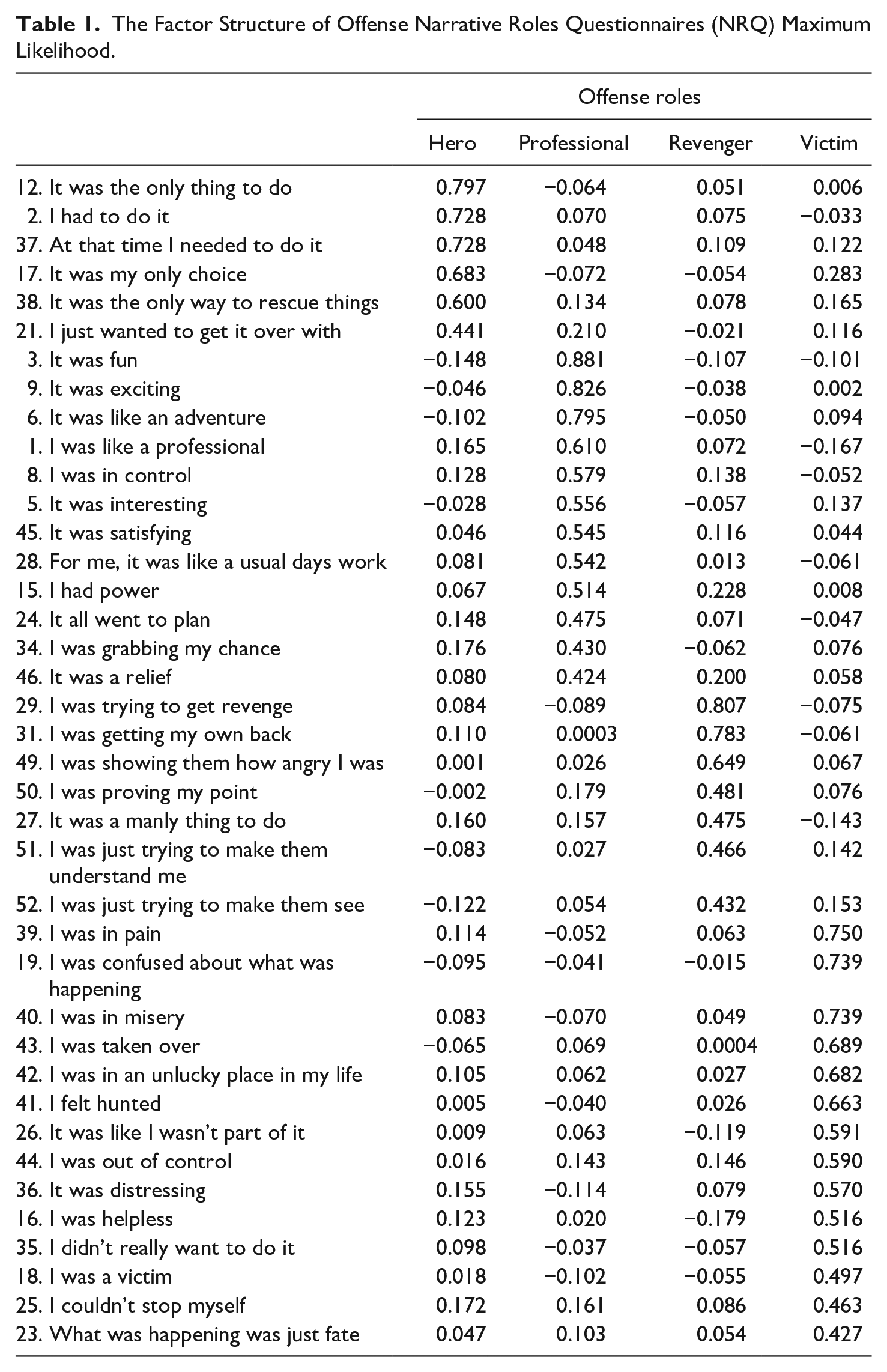
Initially IBM SPSS Statistics Software 22nd version was used to conduct exploratory factor analysis (EFA) to reveal the underlying components of the questionnaire. As the scale was developed by Youngs and Canter (2012a, 2012b) based on a theory, Maximum Likelihood method was used. An oblique rotation was preferred because the correlations between factors are higher than .30 (e.g., between Victim & Hero = .39, Professional & Hero = .36, Professional & Revenger = .38). Four factors were extracted based on the original factor structure of the Narrative roles questionnaire. Based on the item loadings, 13 items were eliminated due to low loadings on one factor (below .4) or complex loadings (over .3 loadings on more than one factor) (see Supplemental Appendix Table 2).
The Kaiser-Meyer-Olkin measure indicated the sample size was adequate (KMO = .903). Bartlett’s test of sphericity (χ2(741) = 10,082.84, p < .001) indicated that items were sufficiently large for EFA. The four factors that were extracted based on the theoretical framework explained 47% of the variance. Table 1 shows the factor loadings for each item in the components after direct oblimin rotation.
The Factor Structure of Offense Narrative Roles Questionnaires (NRQ) Maximum Likelihood.
Smallest space analysis (SSA)
In the second step, multi-dimensional scaling was adopted. Hebrew University Data Analysis Package (HUDAP8) software is used, which contains data analysis methods that are intrinsic, in which the data is treated in terms of internal inequalities and the techniques are based on the methods that Guttman (1954a, 1954b) developed. The SSA is a non-metric multidimensional scaling procedure assuming that analyzing the relationship of every variable with every other variable will yield useful results in explaining the underlying structure of a set of variables. The relationship between each item is assessed by using their inter-correlations. The SSA computes the coefficients of association between variables and presents a rank order among these correlations in a form of a triangular matrix. Furthermore, a visual representation of these associations is also generated that achieves the best fit between the rank order of the correlations and the rank order of the distances in the geometric space. As a result, the items which are highly correlated with each other would appear closer together in the SSA configuration. The items that are located closer to each other form the underlying themes. The variables that share the elements of the same facet will appear closer whereas variables that do not share these elements will appear further from each other and constitute different themes. The coefficient of alienation is calculated based on the level of fit between the rank orders of the distances between the points in the geographical representation and the rank orders of the correlations between the variables. A smaller COA represents a better fit between the configuration and the correlation matrix. A coefficient closer to zero indicates a better fit, with a coefficient smaller than .15 being considered a good fit, and a coefficient between .15 and .20 is considered a reasonably good fit (Borg & Lingoes, 1987; Guttman, 1954a, 1954b).
To examine the underlying structure of the Offense Narrative Roles Questionnaire Smallest Space Analysis (SSA) was used to spatially represent the relationship of every item to every other one. The 3-dimensional resulting configuration (see Figure 1) has a coefficient of alienation of .113 with 16 iterations, which indicates a very good fit between the corresponding spatial distances depicted on the configuration and the Pearson’s intercorrelation of the NRQ items. The item labels are placed in the plot, which enables the interpretation of data. Each region corresponds to an underlying offense role theme. The region appearing on the left side of the configuration represents the “victim role theme,” whereas the right hand side region represents the “professional role theme.” There is a major distinction between these two regions. The furthest items on the right representing the professional role are “It was fun” and “I was like a professional.” The furthest item on the left side of the SSA configuration, which represents the victim role, is “I was a victim.” The Hero role is located at the bottom middle and the Revenger theme is located at the top of the configuration. The visual representation of the distribution of items forming four distinct regions representing the underlying professional, revenger, hero, and the victim themes found in earlier studies.
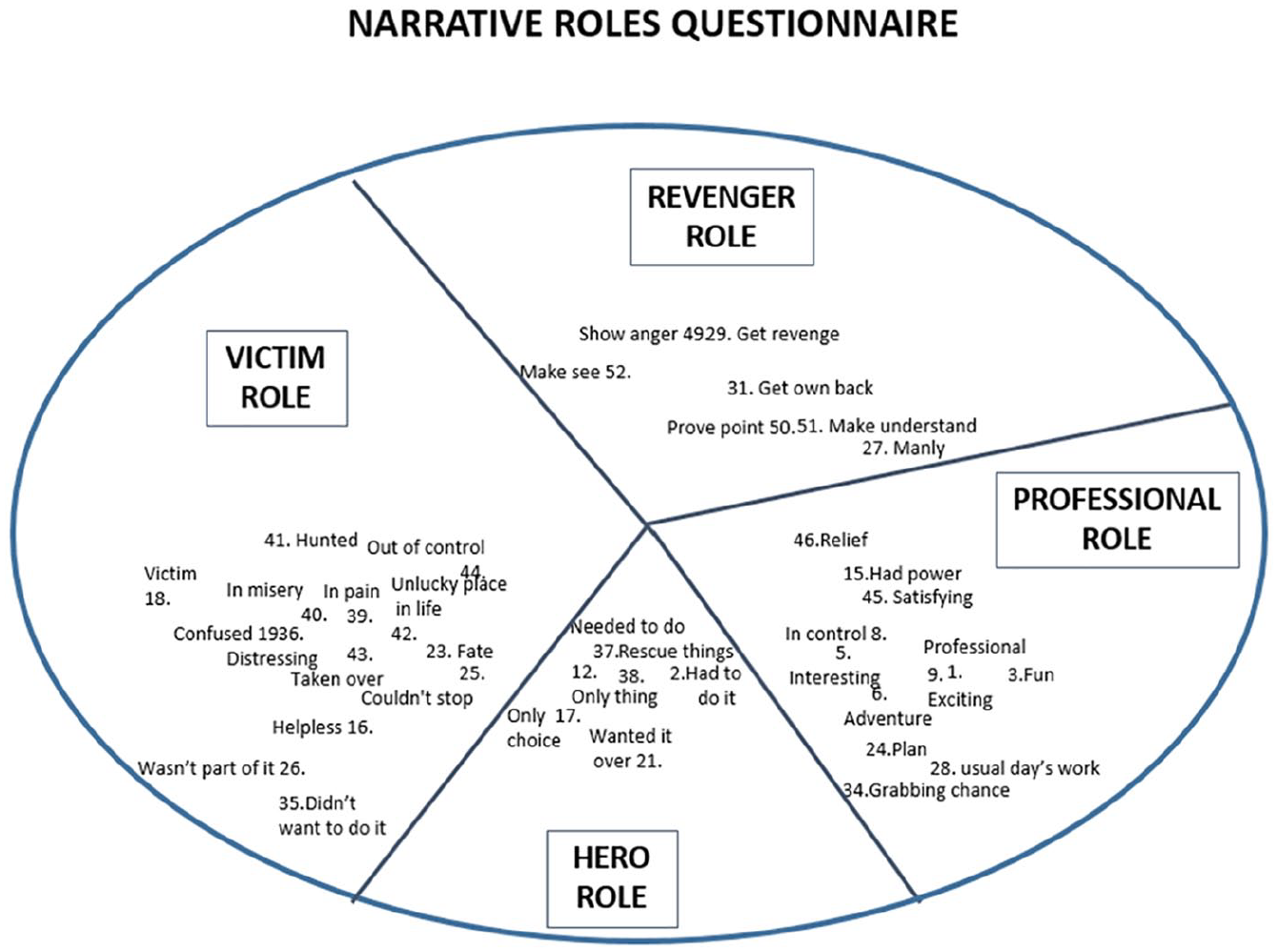
Projection of the three-dimensional, axis 1 versus axis 2 smallest space analysis (SSA) of the items of the narrative roles questionnaire (39 items).
Summary of the Structure of the Turkish NRQ
The Turkish narrative roles, based on the results of the SSA analysis and the exploratory factor analysis, echo the overall formulation of Youngs and Canter’s (2012a) theoretical paper. The hero role which is associated with the tragedy theme is associated with feelings of obligation and having to commit the crime to “rescue things,” and seeing the crime “as the only way out and the only thing to do.” The crime is accepted as something that the hero cannot avoid, thus he goes along with it. The revenger role is associated with the quest narrative theme. The revenger goes on a mission to “get his revenge and get his own back” which aims to “make the victims see and understand” and his acts are driven by “anger” due to feelings of being wronged in the past. The professional role is associated with the adventure narrative theme. The crime, which he sees as a “usual day’s work,” is an opportunity for him to obtain gains whilst “having fun.” He feels “in control” of his environment. The victim role is associated with the irony narrative theme. He sees himself the actual “victim” of the crime due to his “helplessness” and “lack of control” during the offense. He feels “hunted, confused and in pain” because he was thrown into the crime against his will and “he didn’t want to do it.”
Internal Reliability of the Offense Narrative Roles
The reliability of the NRQ and four scales, namely Professional, Revenger, Hero, and Victim roles are explored (see Supplemental Appendix Table 4). The Professional Role has an alpha coefficient of .89, the Revenger Role has .80, the Hero Role has .88, and the Victim Role has .91, which were all at desired levels. The overall NRQ has an alpha coefficient of .93.
Correlations between Roles
The results of the Pearson’s correlation analysis suggest that there is a medium and positive relationship between professional and revenger (r = .47) roles, professional and hero (r = .47) roles, revenger and hero (r = .38) roles, revenger, and victim (r = .33) roles and there is a strong positive relationship between hero and victim (r = .55) roles and a small positive relationship between professional and victim (r = .20) roles.
Discussion
Offense narrative roles integrate the emotional, cognitive, and identity aspects of the crime and sheds new light on the topic of why a specific action is carried out here and now. The major contribution of the recent application of narrative theory to criminology is to challenge the meaning and the function of narratives of offenders and present a new perspective. Offense narrative roles have an explanatory power for criminal actions and help to explain different criminal action patterns (Youngs & Canter, 2012b). As Canter & Youngs (2012) suggested “the hero, victim, professional and revenger narrative themes are only the essence of crime narratives and many refinements are possible” (p. 273). As they suggested further research should elaborate the given four narrative roles. The current study aims to elaborate the theory and extend its use in a different culture by exploring the modifications required to represent each role within a Turkish offender sample.
The Turkish Narrative Roles Questionnaire yields four distinct factors, professional, revenger, hero and victim roles. In the original NRQ the hero role is defined to be a “role of hubris, of taking on and overcoming challenges,” (Youngs & Canter, 2012b, p. 19) however in the Turkish context the hero role is mostly associated with the feelings of obligation and crime is seen as the only choice to act on in order to make things better. They don’t pursue a heroic mission but rather they follow a set of actions that they believe that they have to do to rescue things. The difference can be due to the concept of masculinity in Turkish culture and the expectations of the society for the “man.” Just like one of the participants has illustrated “a man should provide food and shelter for his family, if he cannot, then he is not a man! To keep your family intact, be respected as a family father and not to be laughed at behind your back, you need to bring bread! When I couldn’t bring it through the right way, I had to do it through the wrong way! In order to feed my family, stealing was my only choice and I just went along with it! My only goal was not to let my children go to bed hungry.” (I.K, 38, convicted of burglary).
The victim role is similar to the notion that the British offenders hold, as it is associated with feeling confused, helpless, and lacking control. The revenger role is driven by the feelings of having been treated wrongly and the main goal of the offense is to take vengeance accompanied by the feelings of anger, which is very similar to the revenger role among British offenders. The professional role is also similar to the British concept as being goal-oriented and enjoying the criminal act. There are minor conceptual differences in terms of the understanding, conceptualization, and the enactment of these roles among Turkish offenders. Nonetheless, the structure of the Turkish NRQ is fairly close to the theoretical formulations presented by Youngs and Canter (2012a). The reliability coefficients were above the desired levels for the overall NRQ as well as its four factors.
Implications
One of the main goals of the current research is to incorporate the notion of human agency into work on the correlates of criminality which all too often is deterministic in outlook. Thus a major contribution, is to address a weakness in current criminology theories by the addition of a human agency factor through the investigation of offense narratives. In this way we bring psychology closer to the law.
Whilst being grounded on a strong theoretical base, the effect of cultural context on the experience of crime has always been suggested as a focus for future research (Youngs & Canter, 2012a, 2012b). The current study aims to elaborate the theory and extend its use to a non-Western culture by exploring the modifications required to represent each role within the Turkish context. The current study is the first one to explore the applicability of offense narrative roles model in another culture. As the current study provides an explanation of criminal behavior that keeps the agency as its focus, the application of the offense narrative roles model to Turkish offenders is the first step toward the acceptance of criminal narrative theory as a universal explanation of criminal behavior. The current study shows that the experience of crime can be explored in depth by the application of Canter and Youngs’ (2009) offense narrative roles model. The emotional, identity, and cognitive aspects of crime can be studied by the application of four roles potentially enacted whilst committing the offense.
The major methodological contribution of the current study is the adaptation of the measure to the Turkish context which shows the transferability of the theory to a non-Western country. The issue of reliability and validity raised by Ward (2012) was also addressed by studying the NRQ in a very different culture and obtaining very high internal reliability coefficients. The use of the combination of methods, namely multi-dimensional scaling and factor analyses, together to establish the structure of the scale is another methodological contribution of the current paper which makes the current research a useful example to researchers in the field with different metrological orientations.
As the affective, cognitive and identity components of the criminal experience are subjective in nature, depicting the subjectivity of these internal processes could be achieved via interviews. However, for reasons, such as the low educational levels of offender populations, which make their narrative accounts vulnerable to being ill-formed or weakly articulated, as well as narratives being biased expressions of internal processes due to underlying psychological disorders, such as psychopathy, which is common among inmates, a standardized-self report method was preferred. One major challenge in uncovering the instigator role of narrative roles in criminal action is to create a standard measure that can be used in different contexts and settings to test for replicable results. Thus showing the utility of the standardized measure for offense narratives opens up paths for future research that can be conducted in various settings and in different cultural contexts. The NRQ has two major advantages over traditional offense accounts gathered via open ended interviews; the first one is the non-threatening and non-judgmental nature of the items which can minimize social desirability and justifications; second the high internal reliability and easy to use nature of the instrument which makes it a great measure for exploration of the criminal narratives in different cultures and contexts.
The integration of narratives in the understanding of offender’s experience of crime has various practical implications. Uncovering the narrative themes underlying their offending behaviors can provide an insight into developing effective therapeutic interventions in the rehabilitation of offenders (Canter & Youngs, 2012). The differentiation among offenders based on their experience while committing the offense can lead to the development of new intervention techniques that specifically target each offense role. As offenders enacting predominantly a professional role during an offense will benefit from a different type of treatment program than an offender with a victim role, integrating offense narrative roles to the core of treatment of offenders will provide fruitful results (Ioannou et al., 2017). Obviously taking the differences that are shown to play a critical role in the enactment of offense roles into consideration will be beneficial in developing different rehabilitation strategies for offenders based on the roles they enact during the offense with a goal of providing psychological treatments as well as lowering recidivism rates. The role of narrative shifts in desistance from crime versus persistence in crime can be a beneficial area to develop further in therapeutic settings (Maruna, 2001).
The offense narratives roles model can open paths to the development of efficient ways to interact with each offender. The results point to the potential development of interview techniques based on offense roles which will be helpful in gathering useful information that will improve the investigative decision making processes as well as in obtaining confessions. The major practical contribution of uncovering offense narrative roles is within the investigative decision making. The practice of inferring the offender’s characteristics based on his/her actions at the time of offense relies on the careful examination of the “psychological processes implied by a particular pattern of offending behaviour” (Canter & Youngs, 2012, p. 264). The earlier work of Canter and Youngs builds up to the offense narrative as a useful means of understanding the here and now of the crime (e.g., Canter & Heritage, 1990, 1995; Canter & Youngs, 2009) for different type of offenders. Future research should investigate the differences in offenders’ offending styles based on the roles they enact during the offense. In the process of differentiating offenders from one another, linking crimes that are committed by the same offender, and providing “profiling equations” in order to infer offender characteristics based on crime scene information, a framework explaining the similarities and differences in crimes in terms of psychological processes is required. Thus the utility of the framework adopted in the current study in distinguishing among different type of offenders based on Narrative Roles can be helpful in police investigations as well as interrogations.
Future Directions in Research
Future research should uncover the relationship between offense narrative roles and offending history. As the relationship between offense narrative roles and history of offending is unraveled, a new approach of developing a profiling technique becomes possible. Moreover, showing the relationship between history of offending styles and offense narrative roles is specifically important as it will help inferring offender’s criminal past based on the factors associated with their criminal experience. The thought processes, identity formation, emotional structures of the repeated criminal can be different than the one timer. Within this frame of thought, we have a better chance of understanding and uncovering the processes underlie the experience of crime more accurately by investigating the criminal careers in depth. A more detailed and thorough examination of the criminal careers and criminal developments of offenders should be the focus of future research.
In order to increase the objective quality of the data, future research can benefit from collaborative information and it can combine official/legal data and information gathered through self-report measures. In order to infer offender’s offending history and characteristics from their current behaviors they engaged in a specific offense, a linkage between current and past offending behaviors should be investigated. Thus data regarding the modus operandi and pre-peri and post crime behaviors of offenders is a necessity to provide accurate profiling equations, which needs to be the focus of future research. In addition to the exploration of utility of offense narrative roles in different cultures, still keeping the focus on the here-and-now of the crime, future studies should address the pathways leading to the development of specific offense roles and the level of operation on the main narrative themes by exploring the psycho-social and criminal background correlates of the roles. The developmental pathways in the formation of roles is a significant issue in understanding the effect of certain characteristics and life experiences on the enactment of these roles whilst committing a crime. The criminal and psycho-social correlates of offense narrative roles require further research.
In addition to offense narrative roles, the offenders’ life narrative themes should be uncovered to develop strategies to help them to desist from crime. As Ward and Marshall (2007) put forward neatly, an offender can only be rehabilitated through the development of a “more adaptive narrative identity” (p. 28). Also it was shown by Maruna (2001) that offenders with a condemnation script and adopt the role of victim of external forces can be exchanged with a redemption script in which they will be empowered to reinterpret the criminal past and develop new identities and ways of looking at themselves/life and world. The relationship between offense and life narratives will be very fruitful in discovering the underlying general life related narrative themes associated with the narrative roles enacted during the offense. As suggested by Canter and Youngs (2012) and implied by Ward (2012) the relationship between overall life narrative themes and offense narrative roles are worth exploring both in the understanding of the psychological processes of criminal action within the offenders’ general view of self/life and world and in developing specific therapeutic strategies for offenders holding certain type of offense and life narrative themes. A form of consistency is expected in the individual’s life however as offense is a specific form of an episodic narrative how a general view of life/world/self can affect the roles that are adopted and enacted during the offense needs further clarification. Future research should focus on to explore whether there is a consistency among life and offense narratives. Research investigating the relationship between self and offense narrative roles will shed light on the issue raised by Ward (2012) in his commentary on Youngs and Canter’s (2012a) paper on narrative identity among offenders.
In conclusion the study of offense narrative themes in different cultures can open up new directions both in investigative decision making processes and the treatment of offenders which can be utilized in different countries. The relationship of offense narratives roles with overall life narratives and with patterns of offending styles are two major areas that should be addressed in future research.
Supplemental Material
sj-docx-1-ijo-10.1177_0306624X211010285 – Supplemental material for Offense Narrative Roles of Turkish Offenders
Supplemental material, sj-docx-1-ijo-10.1177_0306624X211010285 for Offense Narrative Roles of Turkish Offenders by Emek Yuce Zeyrek-Rios, David V. Canter and Donna Youngs in International Journal of Offender Therapy and Comparative Criminology
Footnotes
Authors’ Note
This study is a revised subpart of the corresponding author’s doctoral thesis entitled “Experiential aspects of crime: A narrative approach” submitted to University of Huddersfield (UK) in 2018 and revised part of this study was presented at 127th Annual Convention of the American Psychological Association at Chicago, IL in 2019. No abstract or a full text has been published elsewhere.
Declaration of Conflicting Interests
The author(s) declared no potential conflicts of interest with respect to the research, authorship, and/or publication of this article.
Funding
The author(s) disclosed receipt of the following financial support for the research, authorship, and/or publication of this article: As part of Emek Yuce Zeyrek-Rios’ doctoral research, this study was funded by the Ministry of National Education, Turkey.

Supplemental Material
Supplemental material for this article is available online.
Notes
References
Supplementary Material
Please find the following supplemental material available below.
For Open Access articles published under a Creative Commons License, all supplemental material carries the same license as the article it is associated with.
For non-Open Access articles published, all supplemental material carries a non-exclusive license, and permission requests for re-use of supplemental material or any part of supplemental material shall be sent directly to the copyright owner as specified in the copyright notice associated with the article.
