



Abstract
Protective factors facilitate success on community supervision, but relatively little is known about correctional clients who are highly compliant particularly in the federal system. Drawing on a near population of federal clients on supervised release in the Midwestern United States, the current study examined variables associated with compliant supervision status. One day on supervision contributed to a 1% reduction in the logged odds of supervision compliance. Clients with no drug history had 793% increased odds, clients with sustained remission had 620% increased odds, and clients with early remission had 458% increased odds of compliant supervision status relative to clients actively using drugs. Among the federal Post Conviction Risk Assessment (PCRA) indices, only PCRA Criminal History was significant as clients with less extensive criminal history were more likely to be compliant supervision clients. A one-unit change in PCRA Criminal History status was associated with 25% reduced odds of supervision compliance. Total conditions were inversely associated with compliant supervision status with each additional condition associated with a 19% reduced likelihood of compliant supervision status. None of the demographic variables was significantly associated with compliant supervision status. Implications of the findings for the protective factor paradigm in corrections are discussed.
Introduction
Risk assessment is a ubiquitous feature of the criminal justice system employed at virtually every stage of the correctional process from pretrial assessment and supervision, to intake and classification in jail and prison, to supervision on probation, parole, or federal supervised release. Overwhelmingly, criminal justice practitioners and criminologists have focused the bulk of their attention on clients that are higher risk and thus pose greater challenges for treatment and supervision purposes (cf., Baglivio et al., 2018; Feeley & Simon, 1992; Garland, 2012; Petersilia, 1999; Singh et al., 2011; Wang & Diamond, 1999). Although it is prudent to focus on more severe offenders for correctional needs and to facilitate public safety, this focus obscures the reality that a non-trivial amount of offenders or correctional clients function well on supervision, are compliant, and in some cases, are less resource intensive and therefore easier to supervise.
The protective factor paradigm effectively frames consideration of correctional clients that fare well on supervision. Common in prevention and juvenile delinquency research (e.g., Farrington et al., 2016; Li et al., 2019; Lösel, & Farrington, 2012; Ttofi et al., 2016), protective factors are characteristics that insulate, buffer, or protect offenders from offending, substance use, or recidivism. In many respects, protective factors represent behaviors that are consistent with immersion in conventional activities, such as employment, education, church, engagement with prosocial family members and friends, and others help to transition former offenders to non-offender status (see, Petersilia, 2007). Variously referred to as strengths, assets, or resilience factors, protective factors span multiple domains and include a mix of static and dynamic factors the latter of which are often a target for correctional change (De Vries Robbé & Willis, 2017; Garland et al., 2011; Klepfisz et al., 2017; Maruna, 2001; Shepherd et al., 2018). To the extent that correctional clients exhibit protective factors, correctional officers seek to encourage, cultivate, and enhance those protective factors to facilitate the desistance process during the transition from prison to community. 1
Protective Factors and Correctional Clients
Numerous correctional studies examined protective factors that facilitate success on supervision or studied risk factors for recidivism and noncompliance in which case one can infer protective factors. For example, younger age is commonly a risk factor for noncompliance and older age is commonly negatively associated with noncompliance. In other words, risk factors and protective factors are obverse. Irrespective of the approach, correctional researchers identified several protective factors based on diverse data sources and analytical techniques. In a comparative study of parolees, probationers, and shock incarceration clients, MacKenzie et al. (1992) reported several correlates of positive adjustment to supervision including older age, higher intelligence, less criminal history, shorter criminal career, employment, and involvement in positive social activities. Schram et al. (2006) investigated 546 female parolees and found that employment, residential stability, and involvement in substance abuse treatment were associated with successful functioning on supervision.
In a study of more than 3,000 felony probation clients, Harris (2011) identified clients whose first criminal offense did not occur until adulthood and thus had no prior criminal history. These offenders were highly successful on supervision and easier to supervise because they maintained employment, abstained from drug use, and conscientiously followed conditions of supervision (e.g., paid supervision fees, never missed appointments). Evans et al. (2012) studied more than 25,000 parolees and probationers and examined multiple positive and adverse supervision outcomes. They found several predictors of successful completion of supervision including older age, white race/ethnicity, greater educational attainment, employment, more social support, and prior history of drug treatment. Drawing on data from nearly 30,000 offenders released from state prison, Ostermann (2013, 2015) found several factors that insulated offenders from recidivism. These included older age, female gender, white ethnicity, less criminal history, and less deprivation in social background (also see, Ostermann et al., 2013). 2
Grattet and Lin (2016) analyzed data from the California Parole Study and examined five forms of misconduct including absconding, technical violations, drug use or possession, (non-sexual) violent reoffending, and sexual reoffending. Several protective factors emerged from their analyses. Little to no history of imprisonment, better mental health, female gender, and older age (age 45+) were protective for all five parole outcomes suggesting that parolees who exhibit these characteristics are likely easier to supervise and more compliant. Recently, Powers et al. (2018) examined a sample of more than 30,000 parolees and found several protective factors that were associated with reduced likelihood of absconding. These included older age, white race/ethnicity, greater educational attainment, better psychosocial functioning, and less criminal history. These characteristics typified individuals that fared well on parole in terms of their compliance and behavioral functioning.
Criminologists have paid less attention to potential protective factors among correctional clients in the federal criminal justice system. Based on data from more than 40,000 federal probationers or supervised releases, Walters and Cohen (2016) found several factors that protected against recidivism among male offenders including older age, less criminal history, white racial status, and prosocial as opposed to criminal thinking/cognitive approach. Among women, older age, less criminal history, and prosocial thinking were also associated with compliance. In their recent study of more than 1,000 defendants on federal pretrial supervision, DeLisi et al. (2019) reported that minimal risk clients were those who were significantly older at first arrest, had no history of arrest or violence perpetration, and had no substance use history. Indeed, they identified 65 federal clients that fared well on supervision and across a 5-year follow-up period, this cohort of clients with these protective features amassed a mere four arrests, all for low-level offenses. Overall, older age, female gender, little to no prior criminal history or revocation history, sobriety, and involvement in conventional social institutions, such as family, work, and prosocial activities are among the most consistent protective factors (Anderson et al., 1991; Hochstetler et al., 2016; Mayzer et al., 2004; Pearl, 1998; Spruit et al., 2017; Threadcraft-Walker et al., 2018; Trulson et al., 2011; Wodahl et al., 2011) among correctional clients.
Current Aim
There is a broader importance to understanding compliant offenders. In recent years there is an emphasis on reducing the size of the correctional population, and indeed, during the Covid 19 pandemic, many jails and prisons have released prisoners to an unprecedented degree. Almost always, the decision on who to release relates primarily to offenders who perpetrated the least serious offenses (read non-violent) and who appear to be the “best” risk for adequate behavioral functioning in the community. The more that is known about compliant correctional clients, the more scientifically informed those decisions will be. A variety of protective factors characterizes successful correctional clients. The current study extends this literature in three ways by (1) examining clients who are less resource intensive to supervise based on having just one incident of noncompliance during their supervision, (2) using new covariates including the federal post-conviction risk assessment (PCRA), and (3) using a quasi-population of correctional clients on federal supervised release. The central research question is which factors are associated with compliant supervision status.
Method
Participants
The current study used retrospective, archival data from the total population of 865 active correctional clients in a federal jurisdiction in the Midwestern United States (two clients had incomplete data thus the analytical sample is 863). All clients were on supervised release after serving a confinement sentence under the supervision of the Bureau of Prisons. The sample was 84% male, 16% female, 79.4% white, 20.6% African American, 92% non-Hispanic, 8% Hispanic, and the mean age was nearly 44 years. The most common instant/most recent conviction offenses were distribution of methamphetamine (35%), felon in possession of firearm (13%), bank fraud, money laundering, and/or identity theft (13%), distribution of cocaine base (12%), possession or manufacturing of child pornography (6.5%), distribution of marijuana (6%), use of firearm during a drug trafficking offense (4.5%), and distribution of cocaine (3.6%). The clients were diverse in terms of their criminal history and criminal justice system involvement. The federal criminal history rank employs a 6-point system where I = lowest risk and VI = highest risk in terms of criminal history. In these data, 35.4% were Criminal History Rank I, 13.5% were Criminal History Rank II, 18.7% were Criminal History Rank III, 12.5% were Criminal History Rank IV, 6.7% were Criminal History Rank V, and 13.2% were Criminal History Rank VI.
Procedures
We collected data in two ways. First, all data in the client’s Probation/Pretrial Services Automated Case Tracking System (PACTS) file were electronically extracted and converted to an Excel spreadsheet. PACTS is the case management platform used in all 94 federal districts to track federal defendants. This electronic extraction contained information on numerous variables including demographics, case information, conditions, criminal history indices, and other documents relevant to the client’s social and criminal history. Second, the senior author manually collected additional data from presentence reports (PSR), offender documents from the Bureau of Prisons, local, state, and national criminal histories, psychological and psychiatric reports, treatment reports, and other relevant documents located in PACTS.
During the PSR interview process, defendants self-reported their address and residency history and requests for criminal history were sent to all of those areas. In addition, defendants were questioned about juvenile placements and if the defendant lived in any other location than with their parents, such as foster care, group homes, juvenile homes, state facilities, and others. Based on this information, verification was sent by United States Probation to those facilities. 3 Additional self-reported information on antisocial behavior was gleaned from official mental health and educational records. The senior author coded all data and entered it into Excel then transferred into Stata/IC 14.2 for analyses. The Administrative Office of the U.S. Courts and Chief District Judge in this federal jurisdiction provided research approval for the study.
Measures
Dependent variables
Compliant supervision status (0 = no, 1 = yes) is defined as clients who have only one incident of noncompliance that was resolved with a verbal admonishment from the supervising probation officer. This dependent variable is used in the logistic regression model. Compliant supervision status is derived from a count measure of noncompliance incidents while on supervision (
Criminal career parameters
For the difference of means t-tests, nine count measures were included to quantify the criminal career including age of arrest onset, juvenile police contacts, juvenile confinement, total arrest charges, total convictions, total prison sentences, total probation revocations, total parole revocations, and criminal career span measured in years.
Independent Variables
Days on Supervision is a count measure indicating the number of days the client has been on supervised release and serves as the exposure or time-at-risk variable.
Total conditions is a count measure of the number of formal conditions of the client’s supervised release. 5
Demographics
Dichotomous terms for sex (0 = female, 1 = male), race (0 = white, 1 = African American), Hispanic (0 = no, 1 = yes) and continuous measure of client’s current age were controlled.
Substance use history
Dichotomous terms for no drug history (0 = no, 1 = yes), sustained remission (0 = no, 1 = yes), and early remission (0 = no, 1 = yes) were used with active drug user the omitted referent in regression analyses.
Federal post conviction risk assessment
The Federal Post Conviction Risk Assessment (PCRA) consists of two sections. One section is completed by the officer—known as the Officer Assessment—and one section is completed by the offender—known as the Offender Self-Assessment. The Offender Assessment utilizes data in PACTS and the PSR and is a quantitatively-scored instrument that provides a consistent and valid method of predicting risk of re-arrest and reconviction. The Officer Assessment has seven domains with some scored and some unscored items.
6
Prior research supports the reliability and validity of the PCRA (Cohen & Bechtel, 2017; Cohen & Whetzel, 2014; DeLisi et al., 2018; Harris et al., 2015; Johnson et al., 2011; Lowenkamp et al., 2013). Univariate statistics for PCRA Risk are (
PCRA Criminal History (
PCRA Education/Employment (
PCRA Drug/Alcohol (
PCRA Cognitions (
PCRA Social Networks (
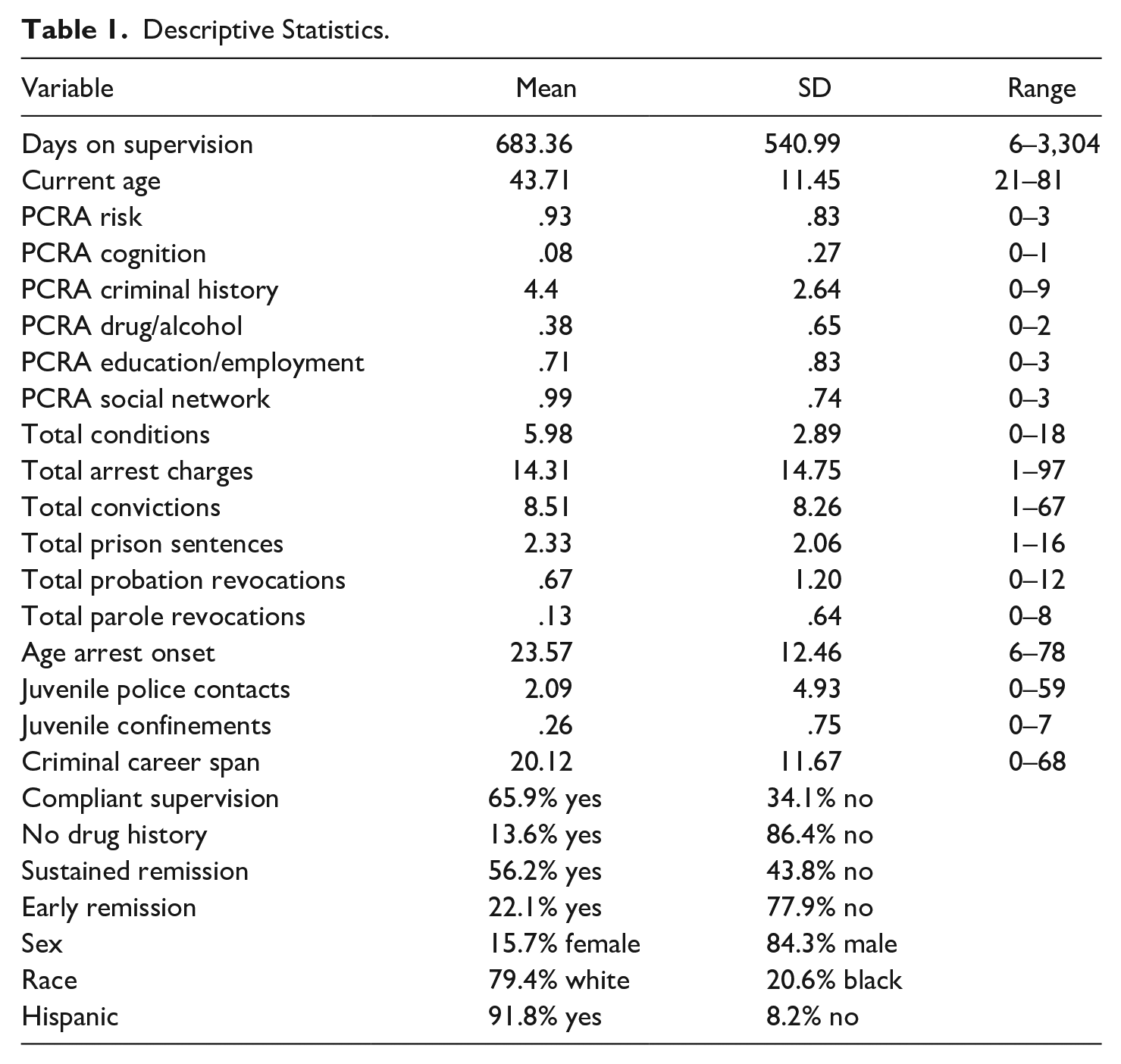
Descriptive Statistics.
Data Analysis
We used descriptive statistics (Table 1), difference of means t-tests (Table 2), and binary logistic regression (Table 3). In the binary logistic regression model, we specified odds ratios given their intuitive value. We performed the logistic regression model with bootstrapped standard errors with 500 replications to increase confidence in the estimates with corresponding 95% confidence intervals. To examine the sensitivity of the logistic regression model, we performed a supplemental analysis to include only clients at the 50th percentile of above for days on supervision to reduce the potential confounding effects of short duration on supervision (e.g., less than 1 month).
Criminal Career Difference of Means by Supervision Status.

Logistic Regression Model for Compliant Supervision.

Note. ***p < .001.
Findings
Criminal Career and PCRA Risk Difference of Means by Supervision Status
As shown in Table 2, current supervision status revealed significant criminal career differences. Clients currently characterized as compliant on supervision had later starting, shorter, less extensive, and less severe criminal careers compared to clients that were not currently compliant to supervise. This is seen for total arrest charges (t = 5.56, p < .001), total convictions (t = 5.53, p < .001), total prison sentences (t = 2.78, p < .01), total probation revocations (t = 2.31, p < .05), age of arrest onset (t = –6.19, p < .001), juvenile police contacts (t = 4.55, p < .001), juvenile confinements (t = 3.00, p < .01), and criminal career span (t = 3.82, p < .001). The only criminal career parameter that was not significant was total parole revocations (t = –0.02, ns). In addition, compliant clients had uniformly lower PCRA risk assessments for total risk (t = 7.92, p < .001), cognition (t = 3.28, p < .001), criminal history (t = 10.59, p < .001), drug/alcohol (t = 4.82, p < .001), education/employment (t = 2.34, p < .05), and social network (t = 6.54, p < .001) in addition to fewer total conditions (t = 7.11, p < .001).
Logistic Regression Model for Compliant Supervision
As shown in Table 3, several factors were associated with compliant supervision status. Days on supervision was inversely associated with compliant supervision (OR = .99, z = –5.54, p < .001), the shorter length of time an offender was on supervised release, the more likely he or she had few problems. Each day on supervision reduced the likelihood of compliant supervision status by 1% lower odds. None of the demographic variables was significantly associated with compliant supervision status. In contrast, drug history was robustly associated with compliant supervision status. Clients with no drug history had 793% increased odds (OR = 8.93, z = 3.46, p < .001), clients with sustained remission had 620% increased odds (OR = 7.20, z = 3.94, p < .001), and clients with early remission had 458% increased odds (OR = 5.58, z = 3.24, p < .001) of compliant supervision status. Among the PCRA indices, only PCRA Criminal History was significant as clients with less extensive criminal history (OR = .75, z = –3.49, p < .001) were more likely to be compliant supervision clients. A one-unit change in PCRA Criminal History status was associated with 25% reduced odds of compliant supervision status. Total conditions were inversely associated with compliant supervision status (OR = .81, z = –5.33, p < .001) with each additional condition associated with a 19% reduced likelihood of compliant supervision status.
Sensitivity Analysis for Logistic Regression Model
Given the significant association for days on supervision, we tested the sensitivity of the model by limiting the analysis to clients at the 50th percentile or above of days on supervision, which was 534 days. This removed clients that had been on supervision for potentially too brief a duration to accumulate noncompliance incidents. The results were substantively the same as those in Table 2 regarding current drug status and total conditions. No drug history, sustained remission, and early remission were positively associated with compliant supervision status and total conditions were inversely associated with compliant supervision status. Two other effects attenuated. The PCRA Criminal History variable was no longer significant but trended toward significance (OR = .83, z = –1.77, p < .077) and the effect for race (indicating white clients) also trended toward significance (OR = .57, z = –1.85, p < .064).
Discussion
For several decades, correctional practitioners have employed scientific principles in the reliable and valid identification, supervision, and treatment of correctional clients (Andrews & Bonta, 2010; Duriez et al., 2018; Hanson et al., 2009; Smith et al., 2009). Implicit in this paradigm is the realization that some offenders are low-risk and will likely require fewer resources for supervision. Moreover, even some clients with extensive criminal histories who are high-risk in their assessment will nevertheless fare well on supervision. As such, identifying the factors associated with compliant supervision status is important for both research and correctional practice. Several discussion points are worth noting.
First, compared to clients that are actively using drugs while on supervision, those in early or sustained remission or who abstained from drugs throughout life were dramatically more likely to be compliant correctional clients in terms of supervision. The effect sizes were large and revealed a gradient of time or latency from drug use from early remission (458%) to sustained remission (620%) to no drug history (793%). Consistent with research that shows drug use is a risk factor for noncompliance, violation, and revocation of correctional sentence (Bennett et al., 2008; Salas-Wright et al., 2016), avoidance of drug use is commensurately linked with compliant supervision status. We suspect that practitioners are well aware of the critical role of drug use and by extension drug abstention and compliance on supervision. Prolonged sobriety can represent a variety of circumstances that bode well for a correctional client’s ability to navigate supervision, including involvement in drug treatment during BOP confinement, severance of former friendship networks where drug use was pivotal, and willingness and desire to lead a drug-free, crime-free life. Indeed, in our various practitioner roles, clients have stated that cessation of drug use was “the switch” that helped to change them from offender to non-offender (or at least set into motion the desistance processes therein). This comports with Opsal’s (2011) qualitative study of women parolees who shed their formerly deviant self-identity by renouncing or disassociating themselves from their prior drug use and drug lifestyle.
It is also important to recognize that substance use and abuse is itself a fundamental marker of correctional status. To illustrate, Vaughn et al. (2012) analyzed data on approximately 38,000 participants selected from the 2009 National Survey on Drug Use and Health. Compared to those in the general population, persons or probation or parole had significantly higher past year binge drinking, cigarette, marijuana, cocaine, hallucinogens, inhalants, prescription opiates, tranquilizers, crack cocaine, heroin, and methamphetamine use. In addition, correctional clients were more likely to have early onset substance use, meet diagnostic criteria for four types of substance dependence, to drive while intoxicated, and to sell illegal drugs. In this regard, substance use is an element of a broader antisocial behavioral pattern and as the current findings indicate, once that connection to drug use is broken—easier, compliant conduct ensues.
Second, criminal history is crucial for understanding which clients are less resource intensive to manage on supervision. In the logistic regression model, a one-unit interval change in PCRA Criminal History resulted in a 25% decreased odds likelihood of compliant supervision. Thus, high-risk clients are 75% less likely (reduced odds) than low-risk clients to be compliant. Put another way, the lowest risk clients are 75% more likely (higher odds) than their high-risk peers to be compliant. That finding provides additional support for the PCRA and its classification accuracy regarding various offender types. The significance of PCRA Criminal History also makes intuitive sense given the profound role of criminal history for understanding offender risk (Andrews et al., 2006; Bonta, 2002; Caudy et al., 2013; DeLisi, 2016; Whitten et al., 2017). 7
It is also important to recognize that current compliant supervision status is not a transitory phase in the criminal career, but likely represents a broader tendency toward compliance—even among offenders with at times lengthy criminal records. The t-tests make clear that compliant supervision offenders have less extensive criminal careers and less noncompliance with the justice system compared to clients that are more difficult to manage currently. The relatively advanced age of these offenders is also illustrative. The mean age is approximately 44 years that is considered old in criminological terms (DeLisi & Piquero, 2011). Thus, the inexorable processes of aging among offenders with significant but not extreme criminal careers likely facilitates their compliance.
Third, an inverse association occurred for total conditions and compliant supervision. This likely reflects multiple issues. First, clients that receive fewer conditions exhibit fewer criminogenic risks and needs and thus have fewer problems to address during their supervision. Thus, it is reasonable that a correctional client with fewer entanglements would be easier to supervise. Second, fewer conditions also means there are fewer opportunities for the client to be noncompliant, which is supportive of research showing that more intensive community supervision with more conditions is associated with increased violations and revocation (cf., Cohen, 2019; Petersilia & Turner, 1993; Zettler & Medina, 2019) among community correctional clients.
Fourth, although correctional practitioners commonly use risk assessment tools, there is variation among correctional staff in terms of the degree to which they adhere to actuarial tools, to the degree that they “believe” in the outcomes produced by the actuarial tools, and to the degree that actuarial tools (compared to their own professional judgment, experiences, and training) best identify offender risk levels (Hochstetler et al., 2017; Miller & Maloney, 2013; Shook & Sarri, 2007; Viglione et al., 2015). Most of the subscales of the PCRA, a respected risk assessment instrument (Cohen & Bechtel, 2017; Cohen & Whetzel, 2014; DeLisi et al., 2018), were not significantly associated with compliant supervision status. That points to the challenges of trying to identify the positive cases of clients that perform well. Indeed, the more “intuitive” measures of current substance use status fared well in this regard.
Finally, despite the strengths of a near population, comprehensive data collection that minimized shared methods variance, and the use of multiple control variables to guard against confounding effects, the current study had limitations as well. For instance, despite the salience of risk indices to assessing the correctional population, there are critical qualitative issues that are crucial for understanding offender change and we were not able to capture these. Our practitioner experiences suggest that some correctional clients—even ones with substantial criminal histories and polysubstance abuse—finally reach a point of fatigue with drug use, offending, and criminal justice system involvement, and it is this maturational point that facilitates their compliance. Qualitative data (e.g., Gideon, 2009) have shown the importance of the correctional client-officer relationship and that a nuanced blend of enforcement, care, supervision, and support helps offenders desist from crime. In addition, although the multivariate models contained multiple validated risk indices pertaining to the PCRA, we lacked a measure of self-control that has shown to be importantly related to an array of offending and justice system outcomes (Beaver et al., 2009; DeLisi & Berg, 2006; Vazsonyi et al., 2017).
Conclusion
Irrespective of these limitations, the current study provided some good news in a domain where skepticism and cynicism dominate the notion that serious criminal offenders can fare well on supervision. Following the lead of prevention and juvenile delinquency scholars, we implore penologists to also consider protective factors that facilitate supervision success and hasten the reentry transition. The more correctional officials can clearly identify the correlates of compliant offender status, the more informed the decisions about who to potentially release from custody during exigent circumstances, such as the Covid 19 pandemic, will be.
Footnotes
Declaration of Conflicting Interests
The author(s) declared the following potential conflicts of interest with respect to the research, authorship, and/or publication of this article: Matt DeLisi receives consulting income and travel expenses in criminal and civil litigation relating to criminological and forensic assessment of criminal offenders, receives editorial remuneration from Elsevier, has received expert services income from the United States Department of Justice and the Administrative Office of the United States Courts, and receives royalty income from Cambridge University Press, John Wiley & Sons, Jones & Bartlett, Kendall/Hunt, McGraw-Hill, Palgrave Macmillan, Routledge, Sage, University of Texas Press, and Bridgepoint Education. No direct remuneration is associated with the current study. The views reflected in this study do not necessarily represent those of the Administrative Office of the U.S. Courts, Probation and Pretrial Services Office, or the Federal Judiciary.
Funding
The author(s) received no financial support for the research, authorship, and/or publication of this article.
