



Abstract
Although the deleterious impact of adverse childhood experiences (ACEs) on offending has been established, less is known about the possible protective factors that may buffer this relationship. Using a sample of over 28,000 adjudicated delinquents from a large southern state, the current study investigated the role of substance (non)use on the relationship between ACEs and recidivism and whether these results differed by race/ethnicity and sex. Results illustrate that ACEs increase the likelihood of recidivism among youth who engaged in moderate-to-high substance use. However, this effect was not found among youth who reported little-to-no substance use. Furthermore, these effects were largely consistent across race/ethnicity and sex. Policy implications of this buffering effect are discussed as well as limitations and directions for future research.
For several decades, scholars have been interested in identifying and examining the impact of various risk factors (e.g., individual, situational, family, community) on offending across the life course (Loeber & Farrington, 2000; Piquero, Farrington, & Blumstein, 2003; Sampson & Lauritsen, 1994). A recent area of focus in this domain centers on adverse childhood experiences (ACEs; Felitti et al., 1998), which represent a set of 10 distinct traumatic events that have been reported to increase an individual’s likelihood of experiencing negative health and social outcomes (Bellis, Lowey, Leckenby, Hughes, & Harrison, 2014; Fox, Perez, Cass, Baglivio, & Epps, 2015; Hillis, Anda, Felitti, & Marchbanks, 2001; Hillis et al., 2004). Current research has linked heightened exposure of these adverse events to an increased likelihood of juvenile offending (Baglivio & Epps, 2016; Baglivio, Wolff, Piquero, & Epps, 2015; Fox et al., 2015; Vaughn et al., 2017; Wolff, Baglivio, & Piquero, 2017).
Although ACEs and other risk factors have been found to increase crime, less is known about potential protective factors that may buffer the negative effects of risk factors on crime. While researchers have started investigating potential risk factors among those generally at risk for offending (Farrington, Ttofi, & Piquero, 2016; Fontaine, Brendgen, Vitaro, & Tremblay, 2016; Jolliffe, Farrington, Loeber, & Pardini, 2016; Kim, Gilman, Hill, & Hawkins, 2016; Ttofi et al., 2016), little is known about which types of protective factors, if any, are important in buffering the deleterious effects of ACEs on criminal behavior. To the best of our knowledge, only one study to date has explored a potential protective mechanism in the relationship between ACEs and crime (Craig, Baglivio, Wolff, Piquero, & Epps, 2017), which found that while social bonds serve to decrease the likelihood of recidivism, they do not moderate the impact of ACEs on reoffending. The current study seeks to further this line of inquiry by considering an additional potential moderator, low substance use, on the ACE–crime relationship.
Understanding the interplay between ACEs, substance use, and offending is important for several reasons. First, substance use is also a well-known correlate of offending (Dawkins, 1997; Lipsey & Derzon, 1998), and prior research has found that those who experience ACEs were more likely to use and abuse substances (Anda et al., 1999; Dube, Anda, Felitti, Edwards, & Croft, 2002; Dube et al., 2003; Perez, Jennings, & Baglivio, 2017; Vaughn et al., 2017; Young, Hansen, Gibson, & Ryan, 2006). Second, because limited attention has been given to examining the protective factors that may buffer ACEs on criminal behavior, we know very little about whether low substance use may impact the ACE–crime relationship. As a result, identifying potential protective factors, such as low substance use, has important implications for understanding the components that may modify the negative effects of this risk factor. Lastly, to the extent that substance use moderates the effect of ACEs on crime, it becomes important to develop specific interventions aimed at preventing delinquency and future offending (Farrington & Welsh, 2008).
In the current study, we aim to investigate whether substance use moderates the relationship between ACEs and offending. Specifically, by considering three distinct levels of substance use (high, moderate, and low), we seek to understand whether substance use is not only a risk factor but also a protective factor (among those with no or limited use) in the relationship between ACEs and crime. Further, as suggested by recent evidence, ACEs may operate differently by race/ethnicity (DeLisi et al., 2017) and sex (Duke, Pettingell, McMorris, & Borowsky, 2010). As a result, we also investigate how these relationships differ by race/ethnicity as well as sex. Prior to presenting the results of our analyses, we first provide an overview of the findings on the ACE–crime relationship, followed by a discussion on protective factors of crime. From there, our discussion turns to the role of substance use on offending with a focus on recidivism before we discuss the potential interrelationships on substance use, ACEs, and crime.
ACEs and Crime
ACEs were initially identified by Felitti and his colleagues (1998) among a sample of privately insured adults. This set of 10 events, which include physical abuse, emotional abuse, sexual abuse, physical neglect, emotional neglect, household substance abuse, violent treatment toward mother, parental separation or divorce, household mental illness, and having a household member with incarceration history, were found to increase the risk of a range of negative health outcomes such as lung disease, cancer, and early death. In order to assess these adverse experiences, individuals are assigned an ACE score that ranges from 0 to 10. For example, a score of “0” indicates none of the 10 traumatic events have been experienced whereas a score of “10” indicates that the individual has experienced all of the events at a minimum of one time. The ACE framework maintains a binary coding of each ACE so that regardless of how many times a particular individual has experienced a distinct event, they receive a “1” for the ACE. For example, if an individual was exposed to multiple occurrences of sexual abuse they would still only receive a “1” for that ACE.
Scholars have reported that ACEs are strongly correlated and have lasting, cumulative adverse effects on brain development (Anda et al., 2006; Anda, Butchart, Felitti, & Brown, 2010; Cicchetti, 2013; Teicher et al., 2003). Given these enduring effects, it is not surprising that ACEs have been implicated in a diverse range of negative outcomes. Indeed, using a variety of different samples, high exposure to ACEs have been linked to reduced educational attainment, employment issues, sexual promiscuity, morbid obesity, increased substance use, and of direct relevance to the current study, delinquent behavior (Bellis et al., 2014; Drury et al., 2017; Fox et al., 2015; Hillis et al., 2001, 2004; Vaughn et al., 2017; Wolff et al., 2017). For example, using a sample of adjudicated youth from the Florida Department of Juvenile Justice (FLDJJ), Fox, Perez, Cass, Baglivio, and Epps (2015) reported that youth with more ACEs were more likely to become serious, chronic, and violent juvenile offenders. Analyses of a sample of first- and second-generation immigrants revealed that ACEs increased the likelihood of being diagnosed with personality, anxiety, mood, and substance use disorders as well as engaging in nonviolent and violent antisocial behavior (Vaughn et al., 2017). Further, juvenile offenders from disadvantaged neighborhoods were also more likely to have a higher ACE score (Baglivio, Wolff, Epps, & Nelson, 2017a). This represents an additional obstacle for these individuals in avoiding potential negative outcomes as they would not have access to the same resources as those from more affluent backgrounds.
Recently, DeLisi and his colleagues (2017) investigated for potential racial and ethnic differences in the impact of ACEs on crime using a sample of 2,520 male juvenile delinquents that were confined to a juvenile correctional facility in a large southern state. These researchers reported inconsistent effects in the impact of ACE exposure on committed offense by race/ethnicity. For instance, African Americans who had only one ACE were less likely to have homicide be their committing offense while Hispanics with four ACEs were more likely to have been committed for homicide. Whites, on the other hand, were less likely to be committed for homicide if they had five or six ACEs. As a whole, the researchers failed to find a stable pattern in the relationship of ACEs and committing offense by race/ethnicity and instead suggested that ACEs operate in both consistent and inconsistent ways by race/ethnicity. This highlights the need to consider potential buffering factors that may help contextualize these differences.
Protective Factors Buffering the Impact of Risk Factors on Crime
Given the deleterious consequences of cumulative trauma exposure on subsequent behavior, it would be instructive to identify potential protective factors that may temper the negative effects of this known risk factor. To our knowledge, only one study to date has explicitly looked for a potential moderating effect in the relationship between ACEs and crime (Craig et al., 2017). Specifically, Craig and her colleagues investigated the impact of attachment to prosocial others using a sample of adjudicated delinquents from the state of Florida. While they did find that stronger attachment reduced the likelihood of recidivism, this effect failed to moderate the impact of ACEs on reoffending.
Other studies have also investigated potential moderators in the impact of ACEs on different adverse outcomes (Logan-Greene, Green, Nurius, & Longhi, 2014; Mersky, Topitzes, & Reynolds, 2013; Nurius, Logan-Greene, & Green, 2012). For instance, using a population-based survey sample from Washington State, Nurius, Logan-Greene, and Green (2012) found that having socioemotional support decreased the positive relationship between ACEs and poor mental health, even after controlling for demographics and socioeconomic status (SES). Using the same sample, a subsequent study reported that sleep quality and overall life satisfaction also moderated the relationship between ACEs and poor physical/mental health (Logan-Greene et al., 2014). Finally, Flouri, Buchanan, Tan, Griggs, and Attar-Schwartz (2010) reported that feeling close to one’s grandparents moderated the association between early stressful life events (which included some ACE measures) and general psychopathology including conduct problems.
Although the investigation of protective factors within the ACE paradigm on crime appear to be limited, there have been a handful of prior studies that have sought to identify protective factors among other at-risk populations (Fontaine et al., 2016; Kim et al., 2016; Losel & Bliesener, 1994; Smith, Lizotte, Thornberry, & Krohn, 1995; Ttofi et al., 2016; Werner & Smith, 1982, 1992). Using a longitudinal sample of at-risk 1 individuals from the Hawaiian island of Kauai, Werner and Smith (1992) reported that belonging to an intact family throughout one’s youth, exhibiting good classroom behavior, having a high IQ, and not needing mental health services were protective of young adult offending. Losel and Bliesener (1994) also sought to identify protective factors of conduct problems among a sample of German youth in residential institutions. Protective factors included having a higher self-efficacy, a reduced sense of helplessness, a positive self-concept, a larger social network, and having a more realistic view of the future.
Farrington, Ttofi, and Piquero (2016), using the Cambridge Study in Delinquent Development, were also interested in factors that may buffer the relationship between known risk factors and later convictions. Among boys that had at least one convicted parent, those that were more honest, came from families with high incomes, were less troublesome, had a parent with a high interest in education, came from a small family, and had parents that engaged in good child-rearing practices were less likely to be convicted themselves. Note that this parental conviction risk factor is highly similar to one of the measures in the ACE construct—having a history of household member incarceration. Interestingly, the protective factors were different based on the risk factor being considered. For instance, high verbal IQ, high school attainment, having a mother with a full-time job, having an older mother, and being low in daring were found to be protective among boys who experienced poor child-rearing.
In sum, these studies suggest that individual-level factors such as personality traits and intelligence, family factors such as parental involvement and supervision, and community-level factors such as the existence of a nonfamilial support system are beneficial in reducing the impact of risk factors on later offending (Farrington et al., 2016; Fontaine et al., 2016; Kim et al., 2016; Losel & Bliesener, 1994; Ttofi et al., 2016; Werner & Smith, 1992). However, it is important to note that the aforementioned studies heavily focused on protective factors that were measured earlier in life such as at birth (Werner & Smith, 1992) or during childhood (Farrington et al., 2016; Fontaine et al., 2016; Kim et al., 2016). Although important advancements have been made in this domain, one limitation is understanding whether other factors at later stages in the life course may also be protective. Additionally, none of the studies considered potential buffering effects in the relationship between traumatic exposure and crime. As demonstrated by Farrington and colleagues (2016), the protective factors may change based upon the risk factor being considered, so it is important to expand our knowledge of protective factors for ACEs specifically.
The Impact of Substance Use on Offending/Recidivism
The connection between substance use and criminality has received a great amount of attention in social science and public health research. Although both substance use and criminal offending can be classified as forms of deviant behavior, they are often treated as distinct constructs in the etiology of crime and violence (Le Blanc & Loeber, 1998; White, Buckman, Pardini, & Loeber, 2015). Though many potential explanations between substance use and crime have been articulated (e.g., Ellickson & McGuigan, 2000; Ford, 2005; Goldstein, 1985), and the directionality of this relationship remains unclear (Wagner, 1996; White, Loeber, Stouthamer-Loeber, & Farrington, 1999), evidence suggests that alcohol and/or illicit drug use influences crime and violence (White, 2014).
To date, a large body of research has linked substance use to delinquency among adolescents (Dawkins, 1997; Dembo, Pacheco, Schmeidler, Fisher, & Cooper, 1998; Lipsey & Derzon, 1998; Maldonado-Molina, Reingle, Jennings, & Prado, 2011; Rossow, Pape, & Wichstrom, 1999). Further, prior efforts also suggest that substance use/abuse increases reoffending among youth offenders. For example, using a sample of over 500 Colorado youth, Stoolmiller and Blechman (2005) compared both parental- and self-reported alcohol and drug use on juvenile offenders. The authors found that compared to youth with no reported substance use, youth who reported drug or alcohol use (through parental reports or self-reports) were at a greater risk of reoffending. However, when both parental- and self-reports were examined simultaneously, only parental reports of youth substance use remained significant. In a more recent assessment using a sample of 700 juvenile offenders, Hoeve, McReynolds, McMillan, and Wasserman (2013) found that youth with a substance use disorder were at an increased risk for serious future offending than youth without a disorder (see also Colins et al., 2011; McReynolds, Schwalbe, & Wasserman, 2010; Schubert, Mulvey, & Glasheen, 2011). Other assessments, however, report evidence contrary to the substance use and offending relationship. For example, researchers have found no evidence linking substance use to reoffending (Dembo et al., 1998), that substance use actually decreases reoffending (Wierson & Forehand, 1995), or that only alcohol use (and not drug use) is associated with violence (Parker & Auerhahn, 1998).
A few meta-analyses have also focused on the substance use and reoffending relationship. In a meta-analysis that specifically focused on various risk factors that predict juvenile recidivism, Cottle, Lee, and Heilbrun (2001) examined the effects of substance use and substance abuse separately (among other risk factors) on juvenile reoffending. In their assessment, Cottle and colleagues found substance abuse, but not substance use, to be a strong predictor of recidivism. However, the authors note that the conflicting findings may be due to potential discrepancies in how substance use and abuse were defined and the different methods utilized across the studies. A more recent meta-analysis conducted by Collins (2010), using both adult and juvenile studies, focused on several variables that predicted violent and nonviolent recidivism. In her assessment of 57 published studies, the author found that drug use exerted a strong and positive effect on violent recidivism, regardless of gender. In addition, alcohol use significantly predicted recidivism. However, data on alcohol use were only available for males and not females in the study. Overall, despite how the construct is measured or operationalized, the majority of research illustrates that substance use/abuse problems increase the risk of reoffending among juveniles.
In addition, limited attention has been given to explicitly examining racial/ethnic and sex differences in the substance use and crime relationship. For example, Watts and Wright (1990) found that the impact of substance use on violent delinquency is more pronounced among Blacks and Mexican Americans compared to Whites. Such differences may not exist by sex, however; Bachman and Peralta (2002) utilized data from the Monitoring the Future Survey and found that heavy alcohol use increased the likelihood of violence for males and females in a similar fashion. In a study that examined both race/ethnicity and sex differences, Barnes, Welte, and Hoffman (2002) found that the relationship between alcohol abuse and delinquency was stronger for males (as opposed to females) and among American Indian and Asians (as opposed to Whites, Hispanics, and Blacks).
Substance Use, ACEs, and Crime
A large body of research indicates that ACEs increase the use and abuse of both alcohol and drugs (Anda et al., 1999; Dube et al., 2002, 2003; Mersky et al., 2013; Young et al., 2006). This finding has been reported using a variety of samples including a group of adult members of a large health maintenance organization (Anda et al., 1999; Dube et al., 2002, 2003), a group of minority young adults from Chicago (Mersky et al., 2013), and a sample of male Marine recruits (Young et al., 2006). A recent study conducted by van der Put, Creemers, and Hoeve (2014) examined the interplay between risk and protective factors, substance use, and recidivism. Using a sample of over 12,000 youth, the authors classified three types of juvenile substance users: (1) abstainers (e.g., no use of alcohol and/or drugs), (2) juvenile substance users without substance abuse problems (e.g., substance use did not lead to disruption in life and/nor contributed to crime), and (3) juvenile substance users with substance abuse problems (e.g., substance use lead to disruption in life or contributed to crime). Several findings from their study are noteworthy. First, youth who abstained from using substances had a higher prevalence of protective factors; whereas, youth substance users with substance abuse problems had a higher prevalence of risk factors. Second, recidivism was highest among juvenile users with substance abuse problems and least prevalent among youth who abstained from alcohol and/or drugs. Third, the impact of risk and protective factors on recidivism was more important among abstainers as opposed to youth classified as substance users or youth with substance abuse problems. As stated by the authors, these results suggest “that interventions aimed at reducing criminal recidivism by addressing risk and/or protective factors may be less effective in juvenile offenders with substance use problems” (p. 271).
There is also evidence to suggest a linkage between ACEs, substance use, and antisocial behavior. Specifically, Douglas and her colleagues (2011) examined the relationship between ACEs, antisocial personality disorder (ASPD), and substance abuse disorder (SUD). First, the scholars found that ACEs increased receiving a diagnosis of ASPD. Second, they also found that individuals with ASPD tended to demonstrate an earlier age of onset of substance use–related issues. Finally, these individuals also had a higher prevalence of SUD diagnoses than those without ASPD.
Two additional studies utilized generalized structural equation modeling to investigate potential mediators, including substance abuse problems, of the ACE–antisocial behavior relationship using a sample of adjudicated delinquents from the state of Florida (Perez et al., 2017; Perez, Jennings, Piquero, & Baglivio, 2016). The first study conducted by Perez, Jennings, Piquero, and Baglivio (2016) reported that certain personality characteristics, namely, aggression and impulsivity, mediated the relationship between ACEs and suicide attempts; however, there was no evidence that substance abuse problems mediated this effect. In contrast, a subsequent study reported that substance abuse problems partially mediated the relationship between ACEs and serious, violent, and chronic delinquency (Perez et al., 2017). Taken together, these findings suggest that ACEs may not only increase offending and substance use, but that there is also a relationship between substance use and antisocial behavior, particularly chronic and violent delinquency.
In short, the majority of research illustrates that substance use/abuse problems increases the risk of reoffending among youth. Further, prior efforts suggest that risk and/or protective factors may be salient in understanding the substance use and reoffending relationship. However, as the research by van der Put et al. revealed (2014), those with substance abuse issues may be less likely to possess these protective factors that would buffer the negative impact of ACEs on their behavior. This may have implications for an individual’s substance use/abuse and criminal behavior (see Douglas et al., 2011).
Current Study
A growing body of research illustrates that protective factors may buffer the effect of risk factors on adverse outcomes. Moreover, as the work by Douglas and colleagues (2011) suggested, there appears to be a connection between trauma exposure, substance use, and antisocial behavior with some evidence suggesting this may be a mediating relationship (Perez et al., 2017). Our study seeks to build upon these prior efforts by assessing the potential moderating role of substance use on the relationship between ACEs and recidivism. Specifically, the current study investigates whether low substance use (vs. high or moderate substance use) buffers the deleterious impact of ACEs on recidivism. Further, as research reveals inconsistent racial/ethnic and sex differences in the impact of ACEs on crime (DeLisi et al., 2017; Duke et al., 2010), how these effects differ by race/ethnicity and sex are also explored.
Using a large sample of previously adjudicated youth from the state of Florida, we hypothesize that low substance use will moderate the impact of ACEs on recidivism such that among those who do not engage in substance use, the positive relationship between ACEs and reoffending will be reduced. Given that the prior literature on the differential impact of race/ethnicity on the substance use–crime association is scant, our racial/ethnic- and sex-subsample analyses are exploratory in nature.
Method
Sample
The current study examines 28,169 male and female offenders who completed a community-based juvenile justice placement from July 1, 2009, to June 30, 2012, in Florida. Community-based placements included formal diversion, probation supervision, day treatment/day reporting, and intensive family therapy as a probation overlay service (predominately multisystemic therapy and functional family therapy during the study period). Youth formally processed into the juvenile justice system are administered the Positive Achievement Change Tool (PACT) risk/needs assessment. The PACT has two versions: a prescreen and a full assessment. 2 Both versions provide an overall risk to reoffend classification (low, moderate, moderate–high, and high risk), while the full assessment additionally provides criminogenic need domain scores (criminal history, school, free time, employment, relationships, family, substance use, mental health, antisocial attitudes, aggression, and social skills). Youth assessed as moderate–high or high risk receive the full assessment, as does any youth considered for the intensive family therapy overlay, or residential placement. During supervision, youth were assessed every 180 (low and moderate risk) or 90 (moderate–high and high risk) days. Only youth assessed with the full assessment were included in the current study, as only the full assessment contains the requisite items to create the ACE score. 3
Measures: Dependent Variables
Two dependent measures of official recidivism were employed to ensure robustness of results across methods. As many youth were, or turned, 18 years of age during the follow-up period, both juvenile and adult official records were used. Rearrest was classified as a referral or adult arrest for an offense which occurred within 365 days of a given youth completing the community-based placement. Reconviction was classified as an adjudication/adjudication withheld or adult conviction for any offense that occurred within 365 days of a given youth completing the community-based placement (6 months lag-time after the 12-month follow-up is provided for adjudication/conviction to allow for court backlog). Of note, reconviction is the official measure used by FLDJJ, from which the data were derived, ensuring policy relevance. The sample recidivism rates were 40.3% and 24.7% for rearrest and reconviction, respectively.
Measures: Level of Substance Use
The key independent variable in the current study is a measure of the level of substance use. The PACT current substance use domain has a maximum risk score of 12 points and a maximum promotive score of 7 points. These scores allow for the creation of a “buffer score” which subtracts a youth’s percentage of maximum risk on the current substance use domain from the youth’s percentage of maximum promotive score (buffer score = promotive − risk). For instance, if a youth scored 5 promotive points (71.4% of maximum promotive) and 3 risk points (25% of maximum risk) on the current substance use domain, the youth’s buffer score would be 46.4% (71.4 − 25 = 46.4). This method of computing buffer scores is identical to that employed in recent work assessing changes in such scores during placement and juvenile recidivism (Baglivio, Wolff, Piquero, Howell, & Greenwald, 2017). The sample buffer scores were then trichotomized into the top 10%, middle 80%, and bottom 10%. It should be reiterated that the higher (greater than 0) the substance use buffer score, the greater the promotive balance (less substance use risk) for a given youth.
Measures: ACE Score
Each youth’s ACE score was created based on indications of exposure (yes/no) to the 10 specific types of emotional abuse, emotional neglect, physical abuse, sexual abuse, physical neglect, domestic violence toward mother, parental separation/divorce, household substance abuse, household mental health problems, and household incarceration history. The 10 binary exposure indicators are summed to arrive at an ACE score ranging from 0 (not exposed to any abuse types) to 10 (exposed to all 10 abuse types). The mean ACE score of the current sample was 2.64. This construction of ACE scores is consistent with that employed across disciplines (cf. Baglivio et al., 2014; Felitti et al., 1998).
Measures: Control Variables
The juvenile’s sex (male = 1), age at completion of the community-based service (continuously measured), race (Black non-Hispanic = 1, else = 0), and ethnicity (Hispanic = 1, else = 0) were included as demographic controls. Criminal history items were automated from the juvenile justice systems’ centralized database and therefore did not depend on youth recall/self-report. Criminal history control measures included age at first arrest (12 and under, 13 to 14, 15, 16, or over 16 years of age; as per the PACT protocol) and prior felony adjudications (0, 1, 2, or 3 or more). Additional control measures included history of mental health problems (formal diagnosis = 1, else = 0), delinquent peer associations (all prosocial peers = 1, no or mixed friends = 2, or all antisocial peers or gang membership/association = 3), and impulsivity (often acts before thinking/highly impulsive = 1, else = 0). Descriptive statistics for all variables included in the current analysis are shown in Table 1.
Descriptive Statistics for the Analysis of ACEs and Recidivism.

Note. ACEs = adverse childhood experiences.
Analytic Strategy
The relationship between ACEs, substance abuse, and recidivism was explored using traditional bivariate and multivariate methods. First, we examined the bivariate correlations among all variables included in the analysis to be sure that collinearity was not an issue. Subsequently, logistic regression was used to evaluate the impact of ACEs across three subsamples of youth, who varied in terms of the buffer score (high, medium, and low). This “pick-a-point” method has been used in past research to probe the interaction between two variables within the context of logistic regression (Hayes & Matthes, 2009). This method involves selecting representative values (e.g., high, moderate, and low) on the moderator variable (the substance abuse buffer score) and then estimating the effect of ACEs at those specified values (see, e.g., Aiken & West, 1991; Cohen, Cohen, West, & Aiken, 2003). The results presented here are based on samples among the top 10%, middle 80%, and bottom 10% of the substance abuse buffer score.
Results
Table 2 presents the bivariate correlations for all key variables included in the analysis. Results of this preliminary analysis indicate that collinearity is not an issue as all correlations are below .50. Further, the bivariate relationship between the independent variables and both measures of juvenile recidivism were consistent with theory and past research. ACEs were positively associated with both rearrest and reconviction, as was being male and Black. Prior felonies were also positively and significantly related to both measures of recidivism as was having a history of mental health problems, the presence of antisocial peers, and greater impulsivity.
Correlations Between Variables in Analysis of ACE and Current Drug Use.

Note. n = 28,169. ACEs = adverse childhood experiences.
*p < .05. **p < .01.
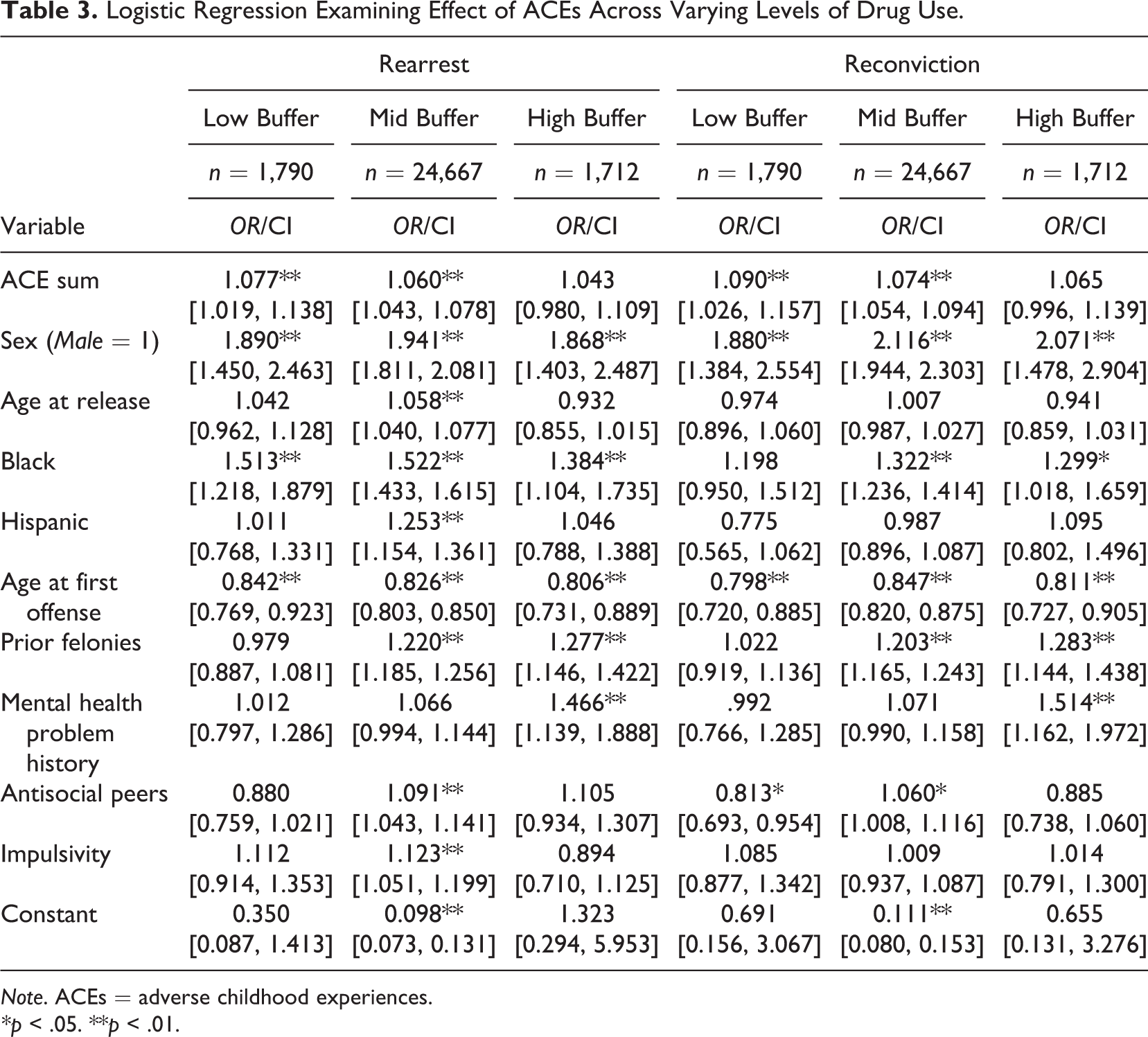
Turning to the results most central to the current research, Table 3 presents the estimates from a total of six logistic regression models. Here, the effect of the focal variable, ACEs, on both measures of recidivism was estimated for a total of three groups (those with high, medium, and low substance abuse buffer scores), while controlling for several variables that have been shown in past research to be related to future offending among juveniles. Results indicated that ACEs exerted a significant positive effect on both rearrest and recidivism among youth who fell within the bottom 10% of the substance abuse buffer score (i.e., had the highest level of substance abuse). Specifically, for each additional ACE, a youth had experienced it was estimated that they had a 9% greater chance of being reconvicted and nearly an 8% chance of being rearrested. Among those with moderate substance abuse buffer scores, the effect of ACEs on both measures of recidivism was still significant, although slightly reduced (7.4% greater chance of being reconvicted and a 6% greater chance of being rearrested). Finally, for youth among the top 10% of the substance abuse buffer score (lowest level of substance abuse), ACEs were no longer significantly related to rearrest or reconviction.
Logistic Regression Examining Effect of ACEs Across Varying Levels of Drug Use.
Note. ACEs = adverse childhood experiences.
*p < .05. **p < .01.
Table 4 presents the results of sex-specific logistic regression models designed to assess whether the same pattern of results exists among male and female youth. To conserve space, only the main effect of ACEs is presented, although each model contains the same control variables as those indicated in Table 3. Results presented in Table 4 are consistent with those presented for the full sample. Among both males and females, ACEs significantly increase the odds of rearrest and reconviction among youth with a low or moderate substance abuse buffer score. This is especially pronounced among females with low buffer scores, where each additional ACE was associated with a 14% greater chance of reconviction. For male and female youth who did not have substance abuse issues (i.e., high buffer scores), the effect of ACEs is not statistically significant.
Sex-Specific Logistic Regression Models Examining Effect of ACEs Across Varying Levels of Drug Use.

Note. ACEs = adverse childhood experiences. Main effects of ACEs shown. All control variables shown in previous tables included in all models. ACEs = adverse childhood experiences.
*p < .05. **p < .01.
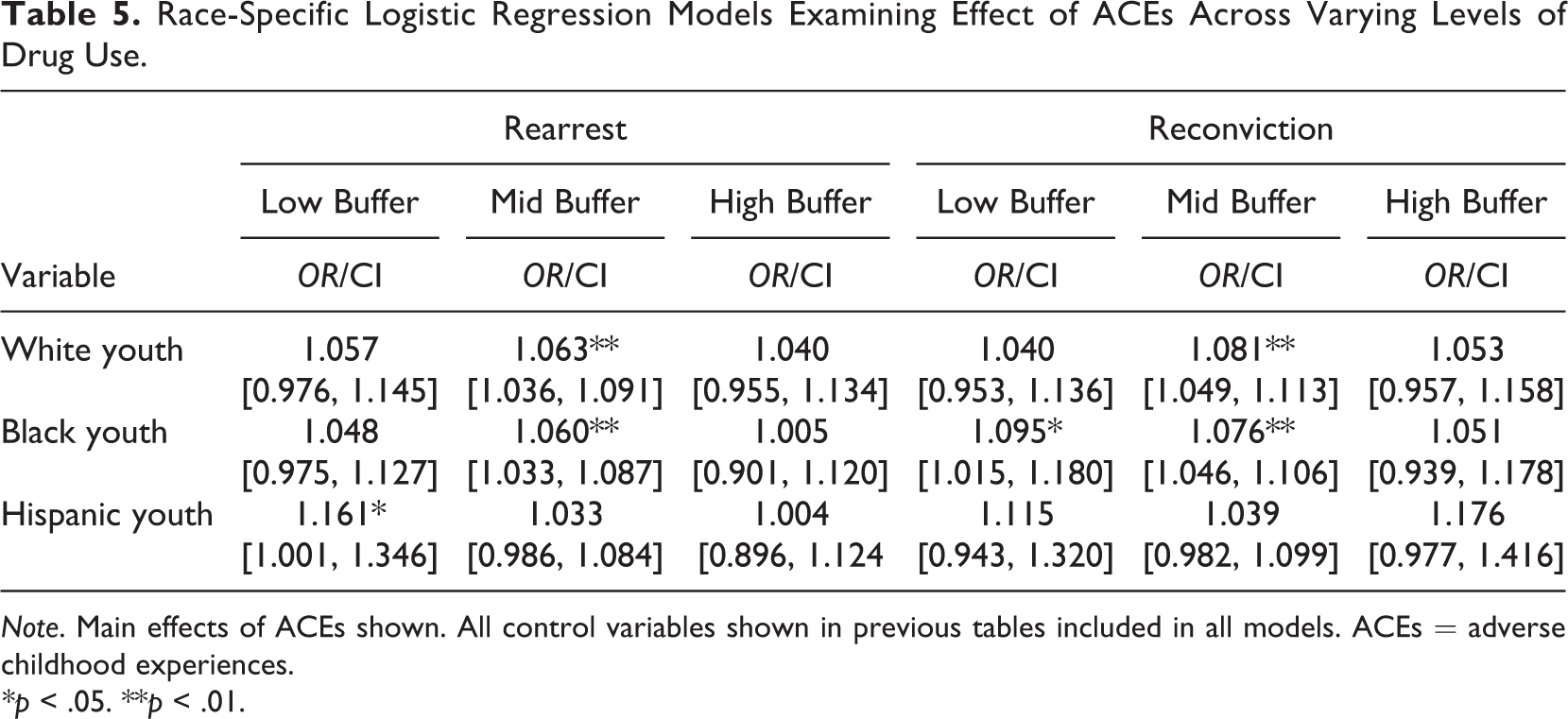
Results are less consistent across racial/ethnic subgroups. Results of the race/ethnicity-specific models are shown in Table 5. Again, only the main effect of ACEs is shown; however each model contains all relevant control variables. The clearest evidence of a moderation effect is seen among Black youth, where each ACE is associated with a 10% increase in reconviction among youth with low buffer scores, a 7.6% increase among those with moderate buffer scores, and a nonsignificant increase among those in the top 10% of substance abuse buffer scores. Consistent with past research on ACEs (Wolff et al., 2017), there is little evidence that higher ACE scores are associated with a higher probability of recidivism among Hispanic youth. Finally, for White youth, the effect of ACEs was only significant among those with moderate substance abuse problems.
Race-Specific Logistic Regression Models Examining Effect of ACEs Across Varying Levels of Drug Use.
Note. Main effects of ACEs shown. All control variables shown in previous tables included in all models. ACEs = adverse childhood experiences.
*p < .05. **p < .01.
In combination, results provide support for the assertion made here, that the effect of ACEs may be conditional on other risk and/or protective factors, such as substance abuse. This effect appears to cut across both racial/ethnic and sex lines, though some nuances do exist. The results are discussed below in the context of research on ACEs, substance abuse, and juvenile recidivism. 4
Discussion and Conclusion
Although the harmful effect of ACEs on offending in general and recidivism in particular has been established (Bellis et al., 2014; Felitti et al., 1998; Fox et al., 2015; Hillis et al., 2001, 2004; Wolff et al., 2017), scholars have only recently started to investigate the potential mediators and moderators of this relationship (Craig et al., 2017; Perez et al., 2016, 2017). The identification of protective factors is particularly critical, given the policy relevance of such findings are important for not only decreasing crime but also improving education, employment, and other prosocial life outcomes of these individuals. While prior research failed to provide evidence that social bonds moderated the ACE–recidivism relationship (Craig et al., 2017), the current study sought to identify whether another potential factor, that of substance use, would buffer this effect. This research also built upon prior research that has reported that substance abuse problems partially mediated the relationship between ACEs and serious, violent, and chronic juvenile offending (Perez et al., 2017).
Using a large sample of adjudicated Florida delinquents, the current study found that substance nonuse moderated the relationship between ACEs and recidivism, measured as both rearrest and reconviction. Among the subsamples that had low or moderate substance use buffering scores (meaning a substance use risk deficit–more substance abuse risk than promotive), ACEs were found to increase the odds of recidivism. However, this significant effect was no longer present among those who scored high in the substance use buffering scale, indicating ACEs had no impact on the likelihood of recidivism among those that exhibited a low level of drug use. When considered in conjunction with the findings by Perez, Jennings, and Baglivio (2017), this further implicates the importance of substance use and abuse in the relationship between ACEs and crime.
As previously discussed, those who experience ACEs were more likely to use and abuse substances (Anda et al., 1999; Dube et al., 2002, 2003; Perez et al., 2017; Young et al., 2006). Similarly, it has also been reported that juveniles who abstain from substance use were less likely to have risk factors and more likely to have protective factors relative to youth who did engage in substance use (van der Put, Creemers, & Hoeve, 2014). Importantly, the impact of these risk and protective factors was found to be stronger among those who did not engage in substance use. Although van der Put and his colleagues did not include ACEs as a risk factor, it is interesting to note that in the current study the risk factor of cumulative trauma exposure (ACEs) failed to have a significant effect on crime among those with low levels of substance use. However, the findings by van der Put and colleagues could suggest that these individuals with low levels of substance use may also be more receptive to potential interventions geared toward reducing recidivism.
Sex- and racial/ethnic-subsample analyses were also considered. Regardless of the youth’s sex, the results were the same—ACEs increased the odds of reoffending among those with a high or moderate substance abuse problem. ACEs did not appear to have an effect on reoffending among those who did not have a substance abuse issue among both males and females. This finding is similar to that reported by Collins (2010) who, in a meta-analysis of 57 studies, found that drug use consistently increased the risk of violent recidivism regardless of sex. In analyses not shown (available upon request), it was found that the males in the sample had higher buffer scores than the females, indicating they tended to have fewer substance abuse problems. This unexpected finding may be a selection effect as our sample self-selected for higher risk youth by examining only youth administered the PACT full assessment.
The findings were less consistent for race/ethnicity, however. Specifically, ACEs increased the likelihood of rearrest and reconviction among Whites who had exhibited a moderate substance abuse problem but not a high substance abuse problem. Among Blacks, ACEs increased the likelihood of rearrests among those with a moderate substance abuse problem and reconviction among those with a high or moderate substance abuse problem. Finally, ACEs increased the likelihood of rearrests among Hispanics with a high substance abuse problem. Although the exact patterning of these results differs by both race/ethnicity and the severity of the youth’s substance abuse problem, the results nonetheless suggest that substance nonuse is still protective of offending among all youth with greater ACE exposures.
Supplementary analyses not presented here (available upon request) indicated that there were racial/ethnic differences in the buffer scores across race/ethnicity. Specifically, Black youth had significantly lower buffer scores (more substance use) than both Hispanics and Whites, but Hispanics and Whites did not have significantly different scores from one another. These results suggest that as a whole, Blacks tend to have more substance abuse problems than their counterparts. This is in accord with prior findings that reported substance use increased violent delinquency more among Blacks and Hispanics than Whites (Watts & Wright, 1990).
Although overall the racial/ethnic results followed a similar pattern as the full model, the inconsistent effects of the severity of substance abuse problems on the effect of ACEs on crime are similar to that reported by DeLisi et al. (2017), who also found race/ethnicity had differential effects on the relationship between ACEs and committing offense, and Wolff, Baglivio, and Piquero (2017) who found nuances in the ACE–recidivism relationship across race/ethnicity. In tandem, these findings suggest the need to look deeper into the mechanisms that may be causing these differences as they may be suggesting contextual factors such as socioeconomic background are salient in the relationship between ACEs and crime (see Baglivio, Wolff, Epps, & Nelson, 2017a).
Although this study was, to the best of our knowledge, the first to investigate the potential moderating role of substance use on ACEs and crime, prior work has also studied the role of substance use as a moderator in other relationships. Specifically, Baglivio, Wolff, Jackowski, and Greenwald (2017b) reported that changes in one’s substance use domain scores, as well as one’s peer associations, during residential placement moderated the effects of a deleterious neighborhood context on reoffending. In conjunction with the current study, these findings highlight the importance of substance use and suggest that interventions geared toward decreasing one’s abuse and use of illicit drugs can decrease recidivism by moderating the harmful effects of both ACEs and neighborhood disadvantage. This further underscores the importance of implementing evidence-based drug prevention and intervention programs. As a specific example of effective prevention programs for those with no or lower levels of prior use, the Blueprints for Healthy Youth Development endorsed “model-plus” Life Skills Training school-based program (cf. Botvin, Griffin, & Nichols, 2006; Griffin, Botvin, Nichols, & Doyle, 2003) has a long record of success.
The findings of the current study should be considered in light of its limitations. Although the creation of ACE scores in the current study is in keeping with ACE across disciplines, the binary nature of each exposure precludes weighting by intensity, duration, or frequency of exposure, deemed requisite by other child maltreatment scholars (Smith & Thornberry, 1995). Additionally, others have critiqued the 10 ACE exposures as too narrow, suggesting that additional abuse types (such as low SES, witnessing violence outside of the family, and peer rejection) be included (Finkelhor, Shattuck, Turner, & Hamby, 2012). Nonetheless, we maintain ACE exposures as measured in the current study that mirror those examined in the literature above, associated with a plethora of negative health, mental health, and criminogenic and public health outcomes. Second, our sample consisted of higher risk adjudicated delinquents from a single southeastern state in the United States, thus limiting its generalizability. Yet, this sample does have strong policy relevance given that they are involved in the juvenile justice system and have been identified as higher risk to reoffend. Third, our measure of recidivism relied upon official measures of rearrest and reconvictions, potentially leading to an underestimate of the juveniles’ true reoffending rates. Fourth, the drug use measure did not differentiate the type of drug(s) the juvenile used, so we were unable to separate those who used less serious drugs (i.e., marijuana) from other, more serious users.
Future research should seek to address these limitations by using more diverse samples as well as self-reported measures of offending. Though not the focus of the current study, the analyses indicated that while having mental health problems did not have a significant effect on recidivism among those who scored low or moderate in the substance use buffer scale, having a mental health problem significantly increased the odds of rearrests by 47% and reconvictions by 51% among juveniles that had a high substance use buffer score (less substance use risk). This indicates a potential relationship between drug use, mental health, and reoffending that should be investigated further. Moreover, additional protective mechanisms should be considered as well. For instance, in their analysis of the Cambridge Study in Delinquent Development, Farrington and his colleagues (2016) identified several factors that were found to be protective against other known risk factors, namely coming from a small family, being rated as low in troublesomeness, and having high school attainment. It would be worthwhile to expand our knowledge of factors that may buffer the impact of ACEs on delinquency and crime so that interventions could be targeted toward these protective mechanisms. This approach could serve to not only decrease future offending but also prove beneficial across other life domains as well. Finally, it would also be useful to consider the relationship of protective factors on individual ACE exposures. For instance, different factors may buffer the impact of some, but not all, ACEs.
In sum, the current study highlights the important interaction between substance use, ACEs, and recidivism. While ACEs are known to increase the likelihood of reoffending, this does not hold true among those with the lowest levels of substance use. These findings indicate that the effect of ACEs on offending should be considered within the larger context of an individual’s life, including other risk, protective, and promotive factors that have been found to be related to crime.
Footnotes
Declaration of Conflicting Interests
The author(s) declared no potential conflict of interest with respect to the research, authorship, and/or publication of this article.
Funding
The author(s) received no financial support for the research, authorship, and/or publication of this article.