



Abstract
The effect of modifying additives on the kinetics of imidisation of polyamido acid and the physicomechanical properties of the obtained materials was investigated. The optimum parameters for the moulding of polyimide films were established.
Polyimide materials can be used successfully as the polymer base for the creation of multilayer composite materials to be used under the extreme conditions of near space [1]. The combination of high strength characteristics, retained even after exposure to radiation, high and low temperatures, and UV irradiation, make it possible to count on polyimides (PIs) as promising materials in multilayer superlight structures of space vehicles [2].
In spite of the number of advantages of polyimide materials over other heat-resistant polymers whose working temperature range is compatible with that of polyimides, work on improving the properties of polyimides in Russia is continuing at present, although not as intensively as in the 1960s–1980s. This is due among other things to the limited collection of initial monomers: acid anhydrides and diamines. Therefore, investigation of the possibilities of improving the properties of polyimide materials by their modification is an urgent task. The present paper sets out the results of investigating the properties of polyimide film materials (PI films) obtained by introducing modifying additives of different nature.
The prepolymer from which the PI films were formed was polyamido acid (PAA) synthesised at the ‘Plastik’ Scientific Production Association from 3,3′-4, 4′-(diphenyl oxide) tetracarboxylic acid dianhydride (DPO) and resorcinol diaminodiphenyl ether (Diamine R). As the solvent for the obtained polyamido acid we used N,N-dimethylformamide (DMF), which was also employed as the synthesis medium. The end product of synthesis was PAA-RD lacquer with a mass fraction of polyamido acid of ~15 wt% [3].
The strength properties of polyimides were assessed from the results of testing PI films obtained by thermal cyclisation. PAA solutions were applied to a substrate of fluoroplastic and placed in an oven at a temperature of 100°C with the aim of intense solvent evaporation. Then the obtained film was separated from the substrate and placed in a special frame which was installed in an oven at a temperature of 250°C for 30 min with the aim of carrying out imidisation – the formation of an imide ring and the removal of imidised water. The thickness of the obtained films was 40–60 μm. The scheme of the reaction is shown in
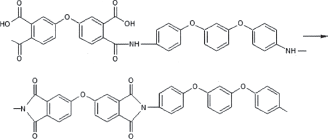
Scheme of the imidisation reaction
To optimise the qualitative and quantitative composition of the obtained materials, it was necessary under laboratory conditions to investigate the kinetics and thermodynamics of imidisation processes, which were studied by IR spectroscopy and differential scanning calorimetry (DSC) methods. IR spectra of imidised films were obtained on a Fourier transform Shimadzu IRAffinity-1 instrument, and DSC of polyamido acid solutions in DMF was conducted on a Netzsch DSC 214 Polyma instrument (nitrogen was used as the purging gas).
The first task in the present work was to choose modifiers capable of improving the physicomechanical properties of polyimide materials. It is well known that the introduction of nanosized additives into a polymer matrix can increase the strength characteristics of heat-resistant polymeric materials [2]. In this connection, it is of particular interest to introduce nanosized materials into a polyimide matrix. There are two approaches that make it possible to introduce nanosized additives into polyimide: the introduction of ready nanoparticles into the polymer matrix at different stages of its forming or the parallel synthesis of the polymer matrix and nanoparticles within it [4]. In the present work we took the first path: the addition to the polyamido acid of ready nanosized modifiers. Carbon nanotubes (CNTs) of two types were used: CNT1 of CoMo 1% composition and CNT2 of FeMo 5% composition, treated with nitric acid with a specific surface of 250–1500 m2/g and an ash content of less than 0.5%. However, at the stage of mechanical addition of nanoparticles into the polymer matrix, the problem arises of the impossibility of them being uniformly distributed in the mass of the polyamido acid lacquer. To this end, superconcentrates of nanotubes in oligoester cyclocarbonate of grade Laprolat-301g (‘Makromer', Vladimir) were prepared. As is known from earlier work [5], the addition of 15 wt% Laprolat-301g (in terms of the pure polyamido acid) is capable of increasing the elongation at break of polyimide films roughly twofold. The distribution of filler was conducted using an MOD MEF 91 ultrasonic disperser with a working frequency of 22 kHz and an intensity of ultrasonic treatment of 250 W/cm2. The process of dispersion lasted 3 min for each type of nanotube.
To a solution of polyamido acid was added the obtained superconcentrate of CNTs and Laprolat-301 to establish a content of the latter in the obtained film of 15 wt%. Films were formed in an oven by the technology described above. The obtained films were then tested according to GOST 14236–81 to determine their deformation and strength properties. The obtained data are presented in

The dependence of the tensile strength of polyimide films on the concentration of carbon nanotubes: CNT1 – 1% superconcentrate of CNT CoMo 1% in Laprolat-301g; CHT2 – 1% superconcentrate of CNT FeMo 5% in Laprolat-301g. Vertical axis: σ, MPa; Horizontal axis: CNT concentration, wt%; Wording far left on horizontal axis: Without modifier; ■ PAA + solution of CNT1 in Laprolat-301g; ■ PAA + solution of CNT2 in Laprolat-301g

The dependence of the elongation at break of polyimide films on the concentration of carbon nanotubes: CNT1 – 1% superconcentrate of CNT CoMo 1% in Laprolat-301g; CHT2 – 1% superconcentrate of CNT FeMo 5% in Laprolat-301g. Vertical axis: ∊, %; Horizontal axis: CNT concentration, wt%; Wording far left on horizontal axis: Without modifier; ■ PAA + solution of CNT1 in Laprolat-301g; ■ PAA + solution of CNT2 in Laprolat-301g
As can be seen from the obtained data, the introduction of nanosized fillers has an adverse effect on the elongation at break of the films, but is capable of increasing their strength, which turned out to be timely when adding a superconcentrate of CNTs of CoMo 1% composition with a content of CNTs in the PAA-RD lacquer of 0.075 wt% and when adding a superconcentrate of CNTs of FeMo 5% composition with a content of CNTs in the PAA-RD lacquer of 0.15 wt%. In subsequent work the obtained modifiers were referred to as ‘nanomodifier 1’ and ‘nanomodifier 2’ (NM1 and NM2).
The degree of transformation of polyamido acid in PI is judged from the decrease in the IR spectra of the polymers in the intensity of the absorption bands characteristic of imide bonds (1550, 1680, 3260 cm”
1
) and carboxyl groups (1710 cm–1), and from the intensity of the absorption bands characteristic of the imide ring (720, 1380, 1735, 1780 cm”
1
) [6]. Examples of IR spectra of films are presented in
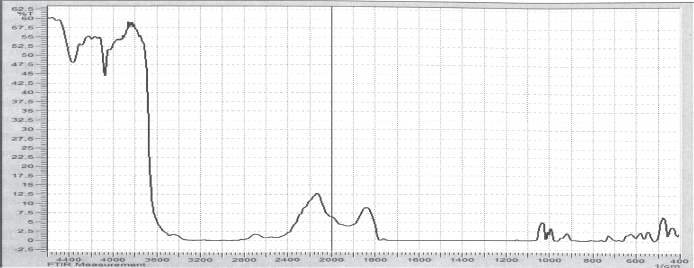
IR spectrum of free film of PAA (before imidisation). Vertical axis: Transmittance, % [delete ‘%T']; Horizontal axis: cm–1 [delete ‘1/cm']

IR spectrum of film. Holding at 250°C for 30 min. Vertical axis: Transmittance, % [delete ‘%T']; Horizontal axis: cm–1 [delete ‘1/cm']
The completeness of the reaction of imidisation of PI films without modifiers and with modifiers can be estimated by means of the formula [7]
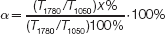
where α is the degree of imidisation, T1780/T1050 is the ratio of the intensity of the imide ring of the carbonyl to the intensity of the peak of the hydrogen in the phenyl ring, taken from the standard, x% relates to the investigated specimen, and 100% relates to the specimen imidised for 5 h, i.e. to the specimen in which imidisation is considered to be complete. The dependence α = f(t) is then plotted, where t is the holding time of the specimen in the oven at 250°C. Laprolat-301g and heat-resistant epoxytriphenol resin ETP (‘Makromer', Vladimir) were used as the modifiers. As is known from earlier work [5], the introduction of 2 wt% ETP relative to the PAA is capable of increasing the tensile strength of the obtained films.
Results concerning the dependence of the degree of imidisation of films with modifiers and without modifiers on the imidisation time are presented in
The dependence of the degree of imidisation of films on the imidisation time at 250°C

As can be seen from
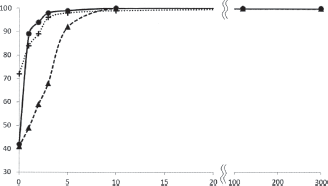
The dependence of the degree of imidisation of films on the imidisation time at 250°C. Vertical axis: Degree of imidisation; Horizontal axis: Holding time at 250°C, min; –•– PAA without modifier; –▲– PAA + 15% Laprolat-301g; ··+·· PAA + % ETP
To study the effect of modifiers on the thermodynamic characteristics of imidisation, it was proposed to investigate systems by DSC. PAA lacquer was poured into an aluminium crucible. The crucible was then pressed down, and the lid of the crucible was perforated to prevent any explosion during DMF evaporation. The crucible was placed in an instrument that scanned the heat flux at different heating rates. Examples of the DSC thermograms obtained are presented in
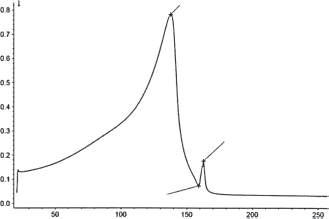
DSC thermogram of PAA-RD lacquer without modifiers. Scanning rate 3 deg/min. Vertical axis: DSC, mW/mg; Horizontal axis: Temperature, °C; Wording by downward-pointing arrow, top left: exo; Wording by high peak: Peak 137.9°C, 0.7801 mW/mg; Wording by middle peak: Peak 162.7°C, 0.1747 mW/mg; Wording by low peak: Peak 159.0°C, 0.07349 mW/mg

DSC thermogram of PAA-RD lacquer with Laprolat-301g (15 wt% in terms of PAA). Scanning rate 10 deg/min. Vertical axis: DSC, mW/mg; Horizontal axis: Temperature, °C; Wording by downward-pointing arrow, top left: exo; Wording by left-hand high peak: Peak 142.8°C, 1.02 mW/mg; Wording by right-hand high peak: Peak 173.6°C, 1.084 mW/mg; Wording by low peak: Peak 172.9°C, 0.2566 mW/mg
The DSC thermograms of modified and unmodified lacquers have a distinct endothermic peak that corresponds to the process of solvent removal, and also an exothermic peak that corresponds to the imidisation reaction. It is worth noting that on the DSC thermograms of lacquer PAA-RD modified with Laprolat-301g there are no peaks characterising the possible chemical interaction of PAA-RD and modifier. Thus, it is demonstrated that the mechanism of action of this active modifier differs from its action on epoxy resins, where partial chemical grafting of oligoester cyclocarbonate to the secondary nitrogen atom occurs [8].
The effect of modifiers can be assessed by comparing the activation energy of the imidisation of unfilled polyamido acid with an active diluent and with fillers. The activation energy of the conversion of PAA into PI can be calculated from the shift in the DSC peaks obtained at different scanning rates by the method developed by Kissinger [9]. This method is based on the assumption that the measured heat flux is proportional to the rate of the reaction. It is assumed that the rate of the reaction at time t is a function of the degree of imidisation. DSC determination can be carried out with different heating rates. The activation energy can then be obtained using a ln β-1000/Tp graph, where Tp is the temperature of the exothermic peak corresponding to the imidisation reaction, and β is the scanning rate. DSC data are presented in
Values of the coordinates of the peaks of solvent removal and the imidisation reaction for lacquers of PAA with different modifiers

From the obtained data it follows that the introduction of all the modifiers described above shifts the coordinates of the peaks of the exothermic reaction of imidisation towards lower temperatures. Here, the introduction into polyamido acid of both Laprolat and ETP has no influence on change in the activation energy of the imidisation reaction, which can be determined as the slope tangent to the abscissa in Kissinger coordinates (
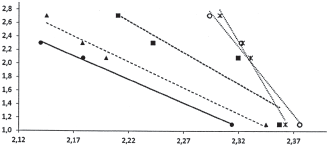
The shift in imidisation peaks in Kissinger coordinates. Vertical axis: ln β; Horizontal axis: 1000/Tp; • PAA without modifier; ■ PAA + 15% Laprolat; ▲ PAA + 2% ETP; * PAA + 15% NM1; ○ PAA + 15% NM2
Thus, as a result of the investigations:
A method has been developed for introducing carbon nanotubes to modify polyamido acid.
Modified PI materials of optimum composition have been developed.
The deformation and strength properties of modified polyimide materials have been investigated. It has been established that the introduction of 0.075% carbon nanotubes of CoMo 1% composition increases the tensile strength by 42%, while the introduction of 0.15% carbon nanotubes of CoFe 5% composition increases the tensile strength by 25%. Here, the elongation at break falls.
The thermodynamic characteristics of imidisation processes have been determined by differential scanning calorimetry and IR spectroscopy. It has been established that the introduction into polyamido acid of modifiers Laprolat-301g and ETP has no effect on the activation energy of imidisation, while the introduction of CNTs increases the activation energy. All the modifiers described lower the temperature of imidisation of polyamido acid.