



Abstract
The effect of modifying additives on the characteristics of polyimide binders was investigated, and the mechanisms of interaction between fibre and binder were studied.
It is difficult to imagine today's society managing without different types of composite material, while the level of science is directly related to discoveries in this field of polymer chemistry. The development of fibrous composite materials (FCMs) based on fibres of different organic and inorganic nature has been one of the most important tasks facing chemists in recent decades [1]. The acknowledged world leader in the development of heat-resistant and thermally stable polymer composite materials for use in near and outer space is the US research centre NASA, which is aiming to replace the metal parts of aircraft and space vehicles with lighter parts made of carbon-fibre-filled and organic plastics [2]. Of greatest interest in this sphere are materials with a polyimide binder [3,4]. Owing to their unique combination of heat stability and physicomechanical properties, polyimides (PIs) are in demand not only as film materials but also as the polymer matrix of composite materials. However, the heat stability of polyimides is no guarantee that this quality will be acquired by the composite as a whole [2]. The present paper is devoted to an investigation of the laws governing the development of materials based on industrially produced twill-weave ‘Ruslan’ polyaramid fibre (Art. 86-294-05VO, Peredovaya Tekstil'shchitsa factory, Korolev). Modified polyamido acid (PAA) synthesised from 3,3′,4,4′-(diphenyl oxide) tetracarboxylic acid dianhydride (DPO) and resorcinol diaminediphenyl ether (Diamine R) at the ‘Plastik’ Research and Production Association was used as the prepolymer [5]. A small number of studies have been conducted on polyaramid fibres as a reinforcing agent [6–8]; the presented fabric has a chemical structure and elongation at break similar to binders and a low density, which was why the given fabric was chosen as the initial component of the developed material [9]. The modifiers used for the polyamido acid were ‘Laprolat-301g’ oligoester cyclocarbonate (15 wt%), heat-resistant epoxytriphenol resin (ETP) (2 wt%), and a nanomodifier (‘Nanomodifier 2’) based on a superconcentrate of carbon nanotubes (CNTs) in Laprolat with a content of CNTs in PAA-RD lacquer of 0.15%. The choice of these modifiers and their content in the binder were governed by the increase in the physicomechanical characteristics of the binder [10].
From the literature it is reliably known that in polymer composite materials, besides the fibre and the polymer matrix, there develops a valuable third component – the interface between the binder and the fibre. Here, the fibre is responsible for the strength characteritics of the material, the matrix is responsible for stress dissipation, and the interphase layer is responsible for transferring the strength properties of the fibre to the FCM as a whole [11]. In this way, FCMs comprise complex systems, and the strength properties of such materials depend on many closely interrelated factors. The most important factor determining the strength and mechanism of failure of FCMs is their adhesive strength, while adsorption and wetting are the most important processes determining the formation of a strong bond at the interphase boundary [12]. There are several adsorption theories which have been set out in detail elsewhere [13].
The change in the Gibbs adsorption in time was determined on a KFK-2MP photoelectric concentration colorimeter by comparing the change in optical density of binder solutions with immersed adsorbent (polyaramid fabric) with previously plotted calibration graphs at a wavelength of 590 nm. The Gibbs adsorption was determined by means of the formula

where msol is the mass of the polyamido acid solution, g; Cinit is the initial concentration of polyamido acid in the solution, wt%; C is the concentration of the polyamido acid in the solution t minutes after immersion of the adsorbent, wt%; and mads is the mass of the adsorbent, g.
The effect of nanomodifiers cannot be assessed by the given procedure. Data on the change in Gibbs adsorption for an unmodified binder and for binders with ETP (2 wt%) and Laprolat (15 wt%) in time are presented in
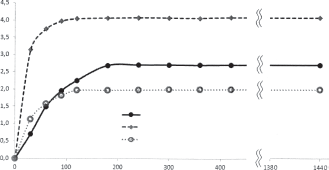
Gibbs adsorption isotherms for the binders. Vertical axis: Gibbs adsorption, g/g; Horizontal axis: Time, min –•– PAA without modifiers; –♦– PAA + 15% Laprolat-301g; –○– PAA + 2% ETP

The unit for determining the interphase tension by the sheet pull-out method: 1 – electronic balance; 2 – investigated liquid; 3 – vessel; 4 – specimen of polyaramid fibre fabric; 5 – elastic rod; 6 – pin
As can be seen from
The adhesion between fibre and binder is one of the most important characteristics for composite materials, and it is assessed using the quantity

where F is the force needed to pull a strand from a knot held together by imidised binder, N; and T is the linear density of the complex strand, tex. Such normalisation of the force is due to the impossibility of accurately measuring the area of contact of the fibre and binder. The obtained data are presented in
The ‘fibre–binder’ adhesive strength determined by the method of pulling a strand from a knot

It is evident that only the introduction of Laprolat-301 as the modifier increases the bond strength between fibre and binder. This once again demonstrates the expediency of introducing oligoester cyclocarbonate as a surfactant, which increases the interphase interaction between binder and fibre.
An important characteristic of phase interfaces is the specific free surface energy, γ, which can be regarded as the work of isothermal formation per unit new interface:

where Fs is the free energy of formation of the new surface, and σ is the area of the geometric phase interface.
The work of adhesion is related to the specific free surface energy by the expression

where γ1 is the specific free surface energy of the fibre, γ2 is the specific free surface energy of the polymer binder, and γ12 is the specific free surface energy of the ‘fibre–binder’ boundary [12].
However, it is worth noting that, in the process of imidisation, Wa of the binder changes on account of the occurrence of different processes:
change in the surface layer;
reorientation of the macromolecules in space;
chemical reactions;
change in the composition of the phases;
the emergence of defects at the phase boundary.
According to the molecular theory of wetting, the specific free surface energy can be presented as the sum of its two components: its dispersion component, gd, and its polar component, γp:

The specific free surface energy depends not only on the chemical bonds within the polymer chain but also on the surface morphology, which is influenced greatly by the method by which the films are formed, the nature and rate of evaporation of the solvent, and other factors. A necessary and very important stage in the manufacture of FCMs is the wetting of the fibre surface by the binder, a quantitative characteristic of which is the wetting angle θ. A minimal value of the wetting angle promotes an increase in the area of contact between the fibre and binder, which is an important factor for the creation of high-strength materials. However, the immediate running of binder over the surface of the substrate may promote sealing of air bubbles in defects of the loose fibrillar structure of the polyaramid fabric [16], which will create defects in the end material as early as at the initial stage of impregnation. The equilibrium wetting angle is defined by Young's law:

where γSV is the specific free surface energy of the ‘fibre–gas’ boundary, γSL is the interphase specific free surface energy of the ‘fibre–binder’ boundary, and γLV is the surface tension of the binder.
It is worth noting that the wetting process for polymers, in contrast to low-molecular-weight liquids, involves a change in chain conformation, and consequently additional energy consumption [17].
The values of the wetting angles for the developed binders on the surface of polyaramid fibre fabric are given in
The values of the wetting angles of polyimide binders on the surface of the fabric

As can be seen from the data presented in
The work of adhesion is related to the wetting angle by the well-known Young-Dupré expression:

The surface tension and the wetting angle are important processing characteristics because low wetting angle values may predetermine good adhesion properties, while high surface tension values improve the wetting of the filler surface and the diffusion of binder into interfibre space [16].
To determine the surface tension of the liquid binder, the method of sheet separation, or Wilhelm's method, was used in the present work. This is based on the change in the force necessary to pull out a sheet (a piece of fabric) immersed in liquid. The surface tension is calculated by means of the formula

where mV is the balance reading the moment the sheet is pulled out of the liquid, mL is the mass of the binder remaining on the sheet, which is recorded from the difference in balance readings before and after measurement, and 2d is the perimeter of wetting of fabric of width d.
The obtained data are presented in
The surface tension of the binders

From the data in
Now, using the Young-Dupré equation, it is possible to calculate the work of adhesion of the developed binders and fibre. The obtained data are given in
The work of adhesion of binder to fibre

From the data presented in
To determine the specific free surface energy of the PAA and PI films, the two-liquid method was used. Within the framework of this method,
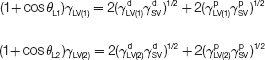
where θL1 and θL2 are the wetting angles of drops of the test liquids on the surface,
The surface tension (γLV) and its dispersion (

In this way, the system of equations will take the following form:


To find the polar and dispersion components of the surface tension of the developed films, the wetting angles of ethylene glycol and water on the surfaces of these films were determined. The obtained values are presented in
The values of the wetting angles of the test liquids (water and ethylene glycol) on the surface of PAA and PI films

The solutions of the system of equations are presented in
The surface tension (γLV) and its dispersion (

Reduction in the wetting angles is evidently connected with increase in the polar component
As can be seen from
At the final stage of the work, the physicomechanical properties of the impregnated fabrics were assessed. The fabric specimen was impregnated with a binder solution and was then placed in an oven, where it was dried at a temperature of 100°C for 60 min with the aim of evaporating the excess solvent. Then, in the same oven, the specimen was heated to 240–250°C to carry out imidisation and remove the residues of solvent. The imidised specimen was then placed in a press at a temperature of 280°C for 25–30 min for the completion of imidisation and final impregnation of the fabric pores by the binder. The obtained specimens were removed from the press and tested according to GOST 3813-72 (specimen size 50 × 200 mm, elongation rate 50 mm/min) for elongation at break and tensile strength. The obtained data are presented in
The physicomechanical properties of impregnated fabrics

As can be seen from the data presented, impregnation of the polyaramid fabric by the developed binders increases the tensile strength over the warp but lowers the tensile strength over the weft of the fabric. The greatest strength in this case was achieved by introducing thermally stable ETP epoxy resin into the polyimide. This nature of change in the strength properties can be attributed to the mechanism of interaction of the fibres and binder: the polyamido acid solution diffuses into the interfibre space, causing its swelling, which on the one hand makes it possible to fill the defects of the fibre and remove residual stresses and on the other hand can affect the integrity and strength of the fibrillar structure of the polyaramid fibre, causing it to loosen [18].
Conclusions
The main laws governing the interphase interaction between a polyimide binder and a reinforcing component based on polyaramid fabric have been studied.
The effect of different modifiers in the polyimide binder on the characteristics of interphase interaction with polyaramid fabric has been investigated.
It has been shown to be expedient to introduce the oligoester cyclocarbonate modifier Laprolat into the polyamido acid for chemical adsorption of the modifier and for the formation of an intermediate layer between fibre and binder. Here, there is an increase in the ‘fibre–binder’ adhesive strength (from 0.28 to 0.33 N/tex) and in the surface tension of the modified film (from 39.7 to 44.2 mJ/m2).
The physicomechanical properties of polyaramid fabrics impregnated by different polyimide binders have been studied. It has been shown that the introduction of 2 wt% ETP resin modifier makes it possible to increase the tensile load from 3589 N (for fabric impregnated with a binder without modifiers) to 3740 N. The tensile load over the weft falls in this case.