



Abstract
During the Twenty-First Dynasty, funerary customs of the priesthood of Amun in Thebes were relatively altered due to the socio-political and economic circumstances of that period. The quest for security compelled the priests to use hidden collective tombs with no decorations or inscriptions other than those written on funerary objects. Of these are three papyrus sheaths that once belonged to three priestesses of Amun. Those formerly unpublished statuettes have been particularly intriguing as they were found within the priestesses’ burials in two collective tombs of Deir el-Bahari - the Royal Cache (DB 320), and Bab el-Gusus - and hence belong to a class of objects that has not been sufficiently investigated.
Keywords

Introduction
The current paper deals with a funerary class of objects referred to as ‘papyrus sheaths and Ptah-Sokar-Osiris statues’. 1 For reasons that shall be explained below, I will be referring to them in the course of this research as ‘Osirian statuettes’.
These statuettes have become an essential element of funerary furniture of the elite from the Third Intermediate Period until the Ptolemaic Period. They take the form of the god Osiris standing on a base and equipped with an array of Osirian insignia. The size of such Osirian statuettes varies from 40–80 cm according to type and provenance. 2
Although Osirian statuettes were often overlooked by early excavators in favour of other funerary objects such as papyri, they became the focus of several studies in recent decades. Of these worth noting is the distinguished work of Maarten Raven, 3 who classified the statuettes according to their style and period of origin, and the work of Carlo Rindi Nuzzolo, who studied the positioning of the Ptah-Sokar-Osiris statuettes in the tombs and published several examples. 4 Furthermore, David Aston published two statuettes and revised Raven’s typology, adding valuable notes. 5 In addition, there are several others who studied and published works on similar statues and collections. 6
The statuettes of the three priestesses studied herewith belong to a sub-category of Osirian statuettes known as ‘papyrus sheaths’ that was favoured by the priests of Amun in Thebes during the Twenty-First and Twenty-Second Dynasties. The aim of the current research is to shed light on this previously unexplored sub-category, hoping to reach a better understanding of the socio-religious circumstances related to the two finds of Deir el-Bahari, especially considering the fact that none of the papyrus sheaths of this period and provenance have ever been published.
Identifying the exact location and ownership of the statuettes was a challenge that we faced particularly while studying the two statuettes of the ‘Second Find of Deir el-Bahari’. The circumstances surrounding the discovery of the Tomb of the Priests of Amun, better known as Bab el-Gusus, 7 led to the insufficient recording of the excavation. The find, which consisted of 153 burials belonging to the priesthood of Amun, was made in 1891 by Eugène Grébaut and Georges Daressy. 8 For security reasons, the tomb was emptied within nine days 9 and its contents were swiftly transferred by Nile boats to the Giza Museum. In spite of Daressy’s efforts to create a detailed record of the find, some information was overlooked, and in some cases confused, such as the ownership and precise location of each Osirian statuette. Another factor that led to missing data was the dispersal of the contents of the tomb due to the political circumstances of the period and the overcrowded state of the Giza Museum. 10 This led to the distribution of the finds over seventeen different countries resulting in their eventual placement in 35 museums around the world. 11 All of these were additional factors leading to a muddled and insufficiently detailed record of the tomb and its contents.
Overview of the Osirian Statuettes
In his typology, Raven classified the Osirian statuettes into five main types with a number of subdivisions in each. Within these five types, one can recognize two subcategories of statuettes. The earlier group of statuettes was mostly used as papyrus sheaths, and therefore each contained a hollow cavity. The second group, widely known as Ptah-Sokar-Osiris statues, contained both solid and hollow specimens. When present, the cavity did not contain a papyrus but rather contained other objects related to resurrection such as a miniature mummy or models of human organs. 12 However, because the cavity is often absent, it is not preferable for use as a dating criterion. 13
The first appearance of the papyrus sheath Osirian statuettes was in a royal context within the burial equipment of Amenhotep II where a statue containing a scroll of papyrus was found. 14 Later on, specimens from the Nineteenth and Twentieth Dynasties were found in private tombs. 15 This type became more widely used during the Twenty-First and Twenty-Second Dynasties when most specimens of statuettes were papyrus sheaths that represented the god Osiris in his singular form. The custom of having a papyrus scroll within an Osirian statuette lasted until the end of the Twenty-Second Dynasty. 16 By the Twenty-Fifth Dynasty, the statuettes had ceased to be papyrus sheaths and instead began representing Osiris in his combined form with Sokar, and sometimes with Ptah-Sokar, a pattern that lasted through the Late Period to reach its zenith during the Ptolemaic Period, only to lose its popularity before Roman times. 17
The association between the gods Sokar and Osiris may go as far back as the Old Kingdom. 18 A Sokar-Osiris form appeared during the Middle Kingdom and the combined deities would continue to appear as Osiris-Sokar from the New Kingdom onward and would be developed further into the Ptolemaic Period. 19 The connection had many mythological roots, such as the belief that the organs of the body of Osiris were collected in Sokar’s ḥnw boat, 20 in addition to the two gods’ common funerary and agricultural characteristics. 21 This connection affected funerary rituals and Osiris-related ceremonies for several centuries. As for Ptah, from the Fifth Dynasty onward, the god was closely associated with Sokar, and by the Middle Kingdom both deities merged with Osiris and started being worshiped as a combined deity. 22 However, by the Late Period, Ptah’s dominance would fade in favour of that of Osiris. 23
In all cases, both groups of statuettes represented Osiris, the combination Sokar-Osiris, or Ptah-Sokar-Osiris 24 with the intent of securing protection for the deceased and ensuring his or her resurrection. 25 Statuettes of the two groups were funerary objects made for each individual. 26 The statuettes were made of wood and represented Osiris in his standing form attached to a wooden base with a variety of colours and Osirian emblems. 27 Therefore, each statuette was placed near the mummy, coffin or sarcophagus of the individual that it represented. 28 The papyrus sheaths were placed beside coffin sets 29 in no particular order, 30 while the Ptah-Sokar-Osiris statuettes were positioned by the head, feet or side of coffins, 31 likely facing towards the east. 32
Finding the right terminology for these statuettes was a challenge that scholars who have previously investigated specimens of these types must have faced. We studied the terminology of Maarten Raven who called them ‘papyrus sheaths and Ptah-Sokar-Osiris statues’, 33 and that of David Aston who called them ‘Osiris figures’ 34 to reach a term that might be more explicative. Regarding the former, some might find that it is too lengthy and that it does not cover the types that are neither papyrus sheaths nor Ptah-Sokar-Osiris. As for the latter, the name Osiris is exclusive to the singular form of the god and does not include his combined forms, while the word ‘figure’ could be mistaken for a two-dimensional image. In addition, both sub-categories represent images of Osiris, either the singular or the combined form of the god, and all types are of relatively small size. Accordingly, we found that the term ‘Osirian statuettes’ would be more suitable and therefore used this term throughout the course of this research.
The Function of Papyrus Sheaths
Two factors led to the widespread use of papyrus sheaths from the Twenty-First Dynasty onward. The first factor was related to the development of the use of funerary papyri, while the second was related to the development of the tomb architecture.
Raven suggested that the custom of having funerary papyri buried with the deceased started by the late Old Kingdom for royalty only. 35 However, it is likely that the Pyramid Texts were copied from master texts written on papyri onto the walls of the burial chambers and antechambers of the late Old Kingdom pyramids, after being modified for the deceased royalty. 36 It is worth noting that there were never any funerary papyri found in a king’s tomb throughout the ancient Egyptian eras, except for that of Amenhotep II that was found in his papyrus sheath, indicating that kings did not possess funerary papyri but instead had the walls of their tombs decorated with the desired funerary texts. 37 The custom of having funerary papyri became more personalised through the following eras to be more widely used amongst the elite. 38 From the Eighteenth Dynasty onwards, a papyrus of the Book of the Dead would often be placed on the mummies of private individuals, 39 and would occasionally be spread over the mummy and the mask 40 or over one of the coffins. 41 From the end of the New Kingdom onwards, there were two papyri buried with the dead, one of the Book of the Dead and the other of the Imduat. 42 For the Twenty-First Dynasty Theban elite, it became customary to place the Imduat papyrus on the mummy, a sensible location as the Imduat was considered a description of the nightly journey of the sun and thus was important to keep as close to the body as possible. 43 A papyrus of this type was frequently placed within the mummy’s bandages, 44 often between its legs, 45 and sometimes spread around its chest, abdomen or legs. 46 Consequently, the need emerged for another place to put the other papyrus of the Book of the Dead, leading to the appearance of the papyrus sheaths. 47 It was only natural that the shape of these sheaths would be that of Osiris with whom the deceased was associated, an association that was meant to secure resurrection for the deceased. As they got past the nightly journey, the deceased needed to know more about prw m hrw, or Going Forth by Day. The placement of the Book of the Dead papyrus inside the statue placed in the near vicinity of the mummy was hence a practical one.
The second factor that induced the use of statues as papyrus sheaths during the Twenty-First and the Twenty-Second Dynasties is the change that happened in the burial and funerary customs of this period. With the lack of security and the worsening of economic conditions, the Theban tombs of the elite were no longer decorated or accessible, but instead were simple hidden burials. 48 The need for a space to write the texts that were once written on the walls of the tombs led to the widespread use of the papyrus sheaths amongst the elite of this period. Brief extracts and smaller vignettes of the Book of the Dead were recorded on relatively small papyri no more than one square meter each, to fit in the small cavity of the statuettes. 49
These papyri were greatly valued by tomb looters in the late nineteenth century. For instance, the Royal Cache was a source of some papyri that were looted nearly a decade before its official discovery. 50 One example is a papyrus that came from one of the statues of the cache and was described by Amelia Edwards. 51 It was sold by the Abdel Rasoul brothers to an English antiquities dealer a few years before the official discovery of the cache, 52 and is now unfortunately missing. 53 Another example is the papyrus of Duathathor-Henuttawy that was once placed in the papyrus sheath studied below. 54 The looters took the papyrus, leaving the statuette behind.
The Statuettes
1. Osirian Statuette of Tawdjatre
Provenance: Bab el-Gusus, Deir el-Bahari, Western Thebes. Registered in museum records in 1891, from the excavations of Grébaut and Daressy
Date: Mid-Twenty-First Dynasty 55
Material: Painted wood papyrus sheath
Type: I C of Raven Typology 56
Measurements: Height: 110.5 cm with base, 102 cm without base. Base: height 8.5 cm, length 62 cm, and width 21 cm
Current location: Egyptian Museum in Cairo, JE 29314, SR 4/6832, TR 15.12.25.5
Owner: Chantress of Amun Tawdjatre
Description
Wooden statuette painted black except for the white of the eyes and a white column that runs down the centre of the statue from the forearms to the feet. The column includes the following hieroglyphic text:
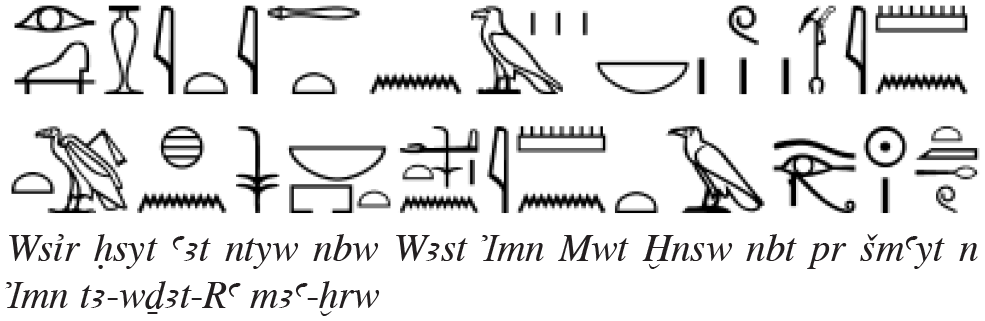
Translation: The Osiris Great Singer 57 of those lords of Waset, Amun, Mut and Khonsu, the Mistress of the House, the Chantress of Amun, 58 Tawdjatre, true of voice.
The statue is equipped with an atef crown and has the arms crossed on the chest with the hands clenched into fists. The holes that once held the uraeus, the false beard, and the sceptres are still visible, but the accessories are missing. The squat body of the statue has a cavity in the trunk. The statue is standing on a yellow base that is partially broken (figs 1–2).
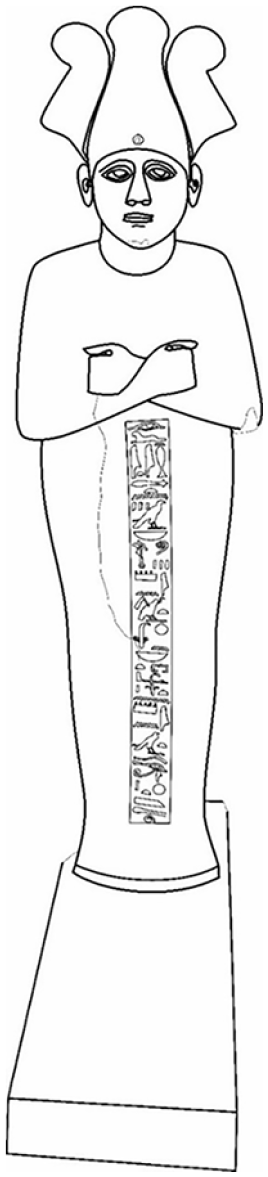
Osirian Statuette of Tawdjatre, JE 29314 (drawing: Iman Elsaid).
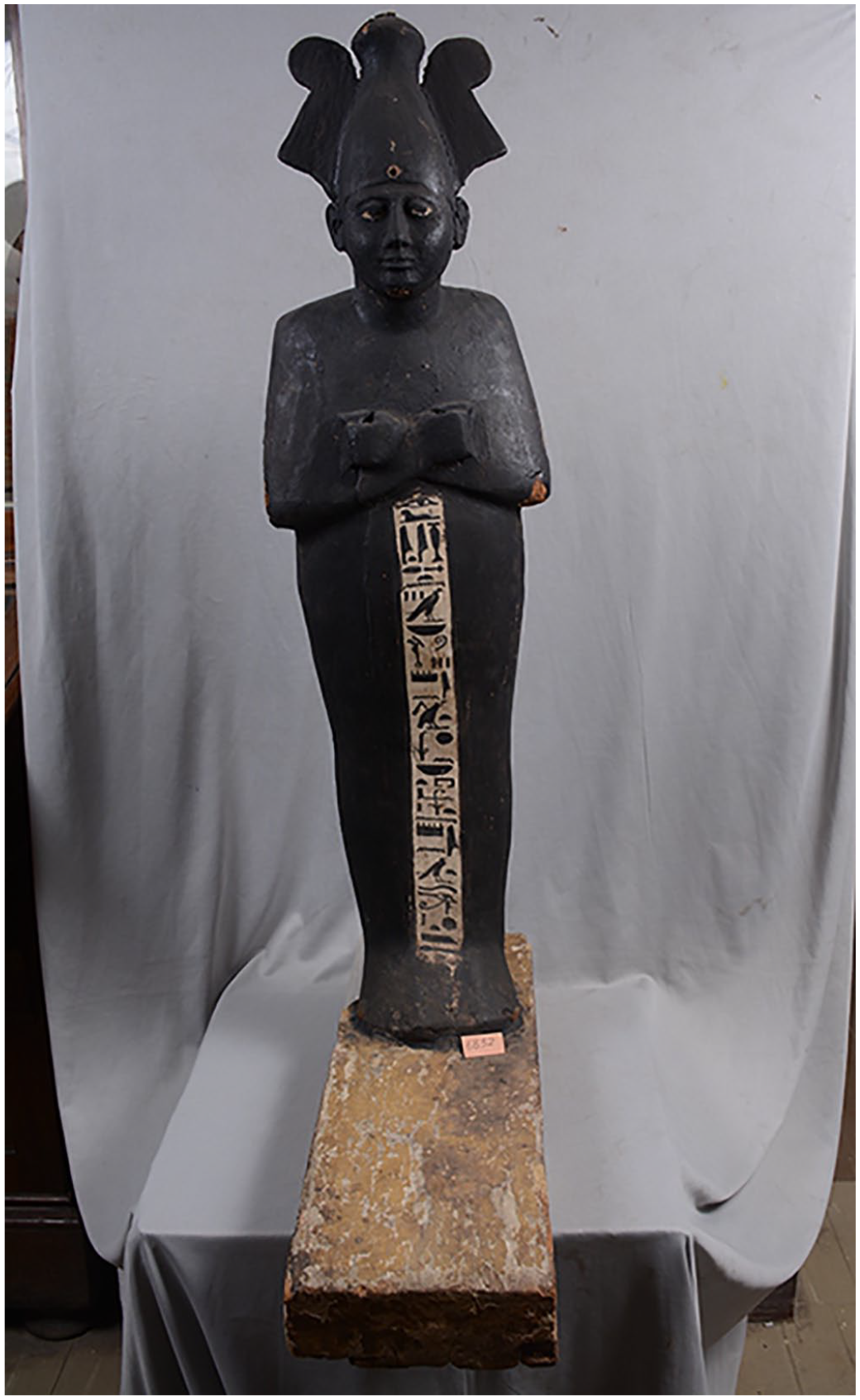
Osirian Statuette of Tawdjatre, JE 29314 (photo: Sameh Abdel-Mohsen).
Discussion and Commentary
The statuette is one of the 77 Osiris statuettes (mostly papyrus sheaths) that were found at Bab el-Gusus. 59 The tomb is believed to have been cut under the High Priest of Amun Psusennes III after Year One of King Psusennes II, 60 both of whom were allegedly the same person. 61 The statuette’s squat body, crossed arms, and black colour designate it as type I C of Raven’s Typology. 62
According to Raven, this type of black Osirian statuette (type I C) developed from the black statues that were found in some New Kingdom royal tombs. 63 Specimens of these were found in the Eighteenth Dynasty tombs of Thutmosis III, 64 Amenhotep II 65 and Thutmosis IV. 66 One of the statues found in the tomb of Amenhotep II stands as the first known example of a papyrus sheath, which represents the king in the form of Osiris. 67 The statue was equipped with a panel at the back that contained the only known example of a royal funerary papyrus. 68
On the other hand, Aston opposed Raven’s view, suggesting that the black statues developed from Raven’s type II. Aston’s view is based wholly on the chronological order that places type I C in the second half of the Twenty-First Dynasty between 1025–925 BC, while type II is dated between 1300–1000 BC. 69 However, the black coloured Osirian statuettes are not exclusively restricted to the above-mentioned period, as some examples are dated to later periods. 70 Consequently, the use of the black colour as a dating criterion on its own would not be applicable, making Raven’s typology more relevant.
The black colour of the statuettes reflects a multitude of symbolisms for the ancient Egyptians. Osiris was linked to the colour black to the extent that he had amongst his epithets that of km, meaning ‘The Black One’, 71 making it a favourable colour for painting Osirian statuettes. 72 Black had mixed symbolism of being strongly associated with both the afterlife, and the black silty fertile lands of Egypt, 73 the two of which serve the idea of resurrection. It is also the colour of darkness and therefore symbolises the nightly journey of the deceased Osiris. 74 In addition, black was favoured as a magical protective colour against dangerous supernatural beings. 75 These symbols made black a favourable colour for use on funerary statues, coffins, and other funerary artifacts from the New Kingdom onward. 76 As the black colour of the statuette of Tawdjatre does not have the glare of the varnish, we believe that the statue is coloured with black paint. Both varnish and paint were used to coat funerary objects in black. 77
The statuette once enclosed a papyrus containing extracts of the Book of the Dead, Cairo SR VII/11496 (fig. 8). 78 The papyrus is 4.32 m long and 32 cm wide, 79 and was placed in the cavity cut from the lower side of the base that was closed with a now missing wooden stopper. Today the base is partially destroyed from the back.
Raven verified that the cutting of the cavity of this type of statue was done by adding a removable panel to the back of the statuette. 80 This panel, which was fixed into the statuette, is detected underneath the black paint (fig. 6), indicating that its purpose was to facilitate the cutting of the cavity and was not used for placing the papyrus inside.
Closer examination of the statuette shows that it was manufactured using several pieces of wood attached together and painted over in black (fig. 7). The black paint is removed in several areas of the statue (figs 3–7).
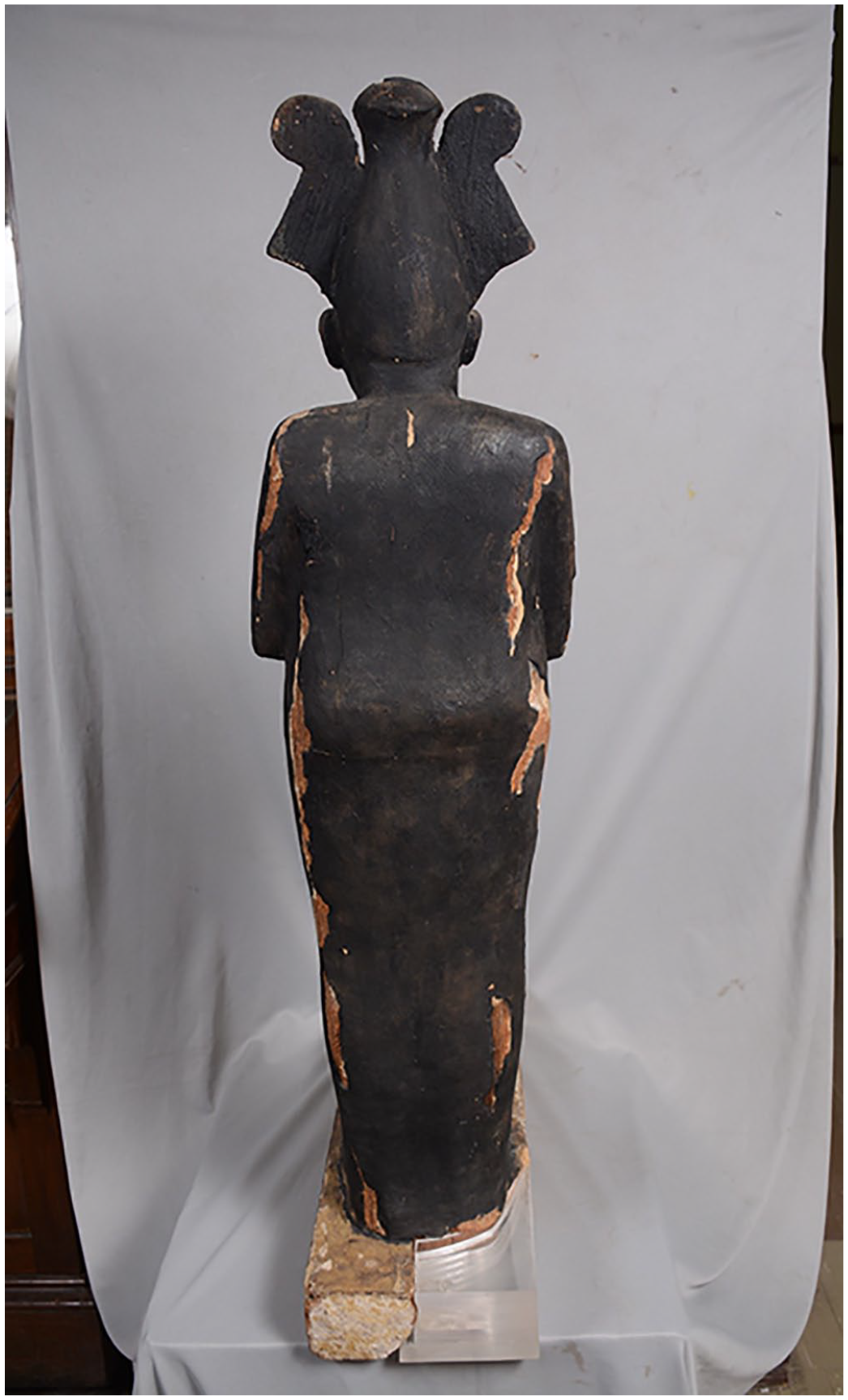
Back of the Osirian Statuette of Tawdjatre, JE 29314 (photo: Sameh Abdel-Mohsen).
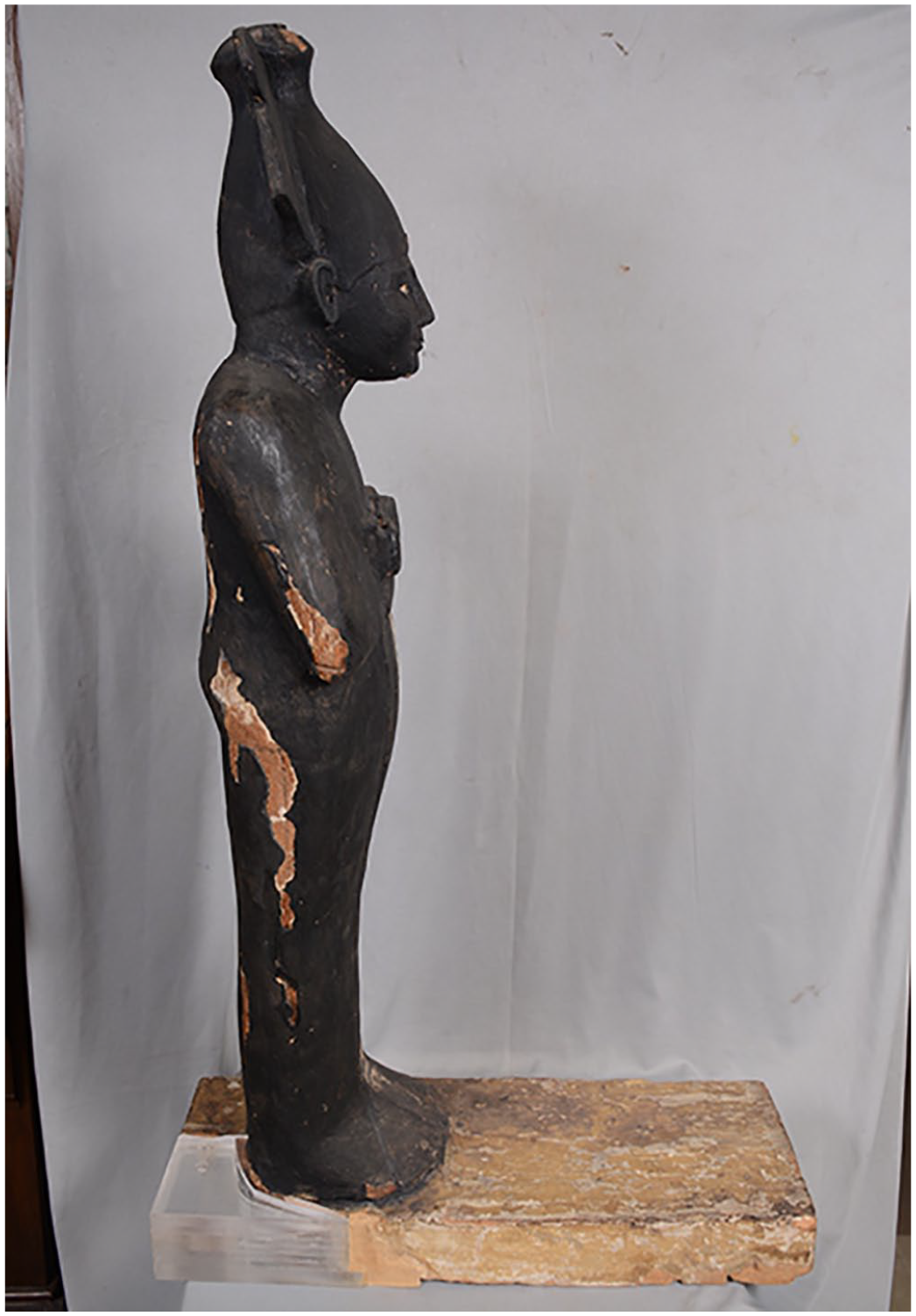
Osirian Statuette of Tawdjatre, JE 29314, right side (photo: Sameh Abdel-Mohsen).
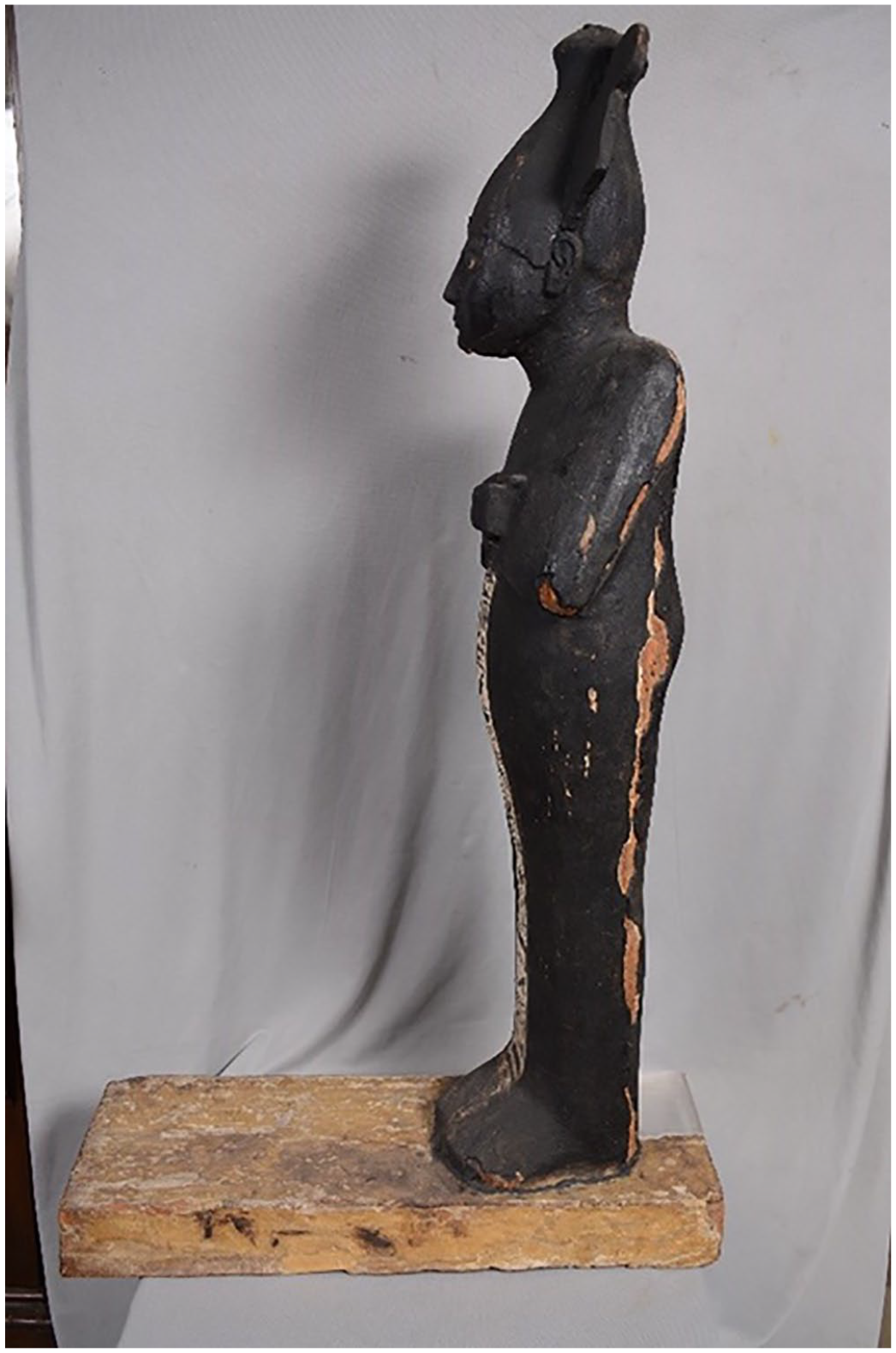
Osirian Statuette of Tawdjatre, JE 29314, left side (photo: Sameh Abdel-Mohsen).
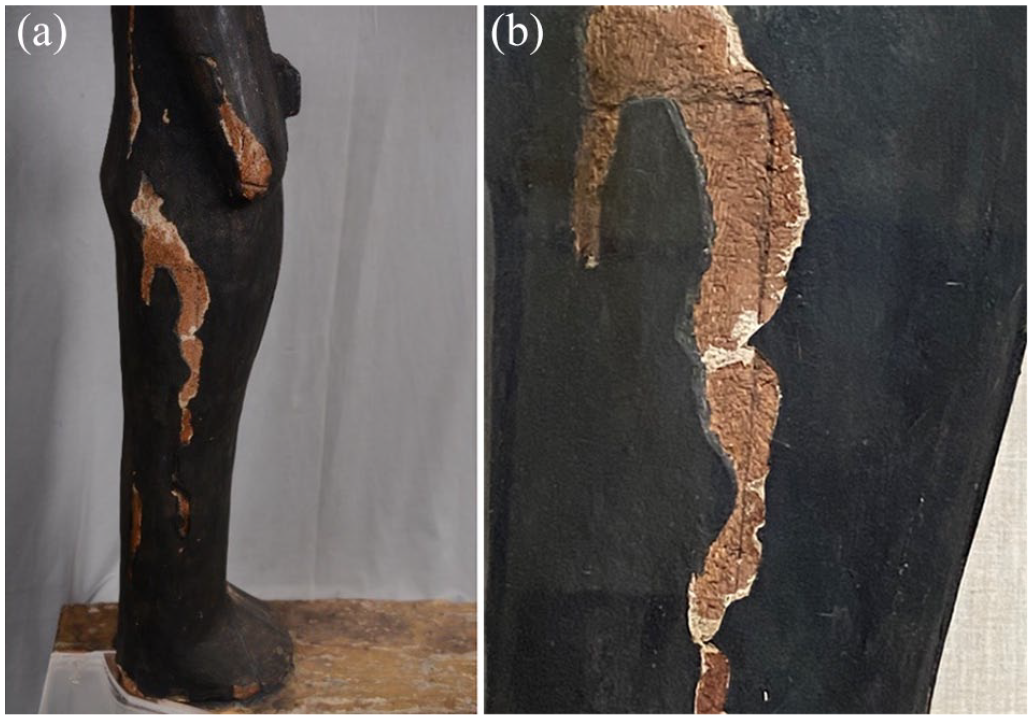
Osirian Statuette of Tawdjatre, JE 29314, details showing the back-panel (photo: Sameh Abdel-Mohsen).
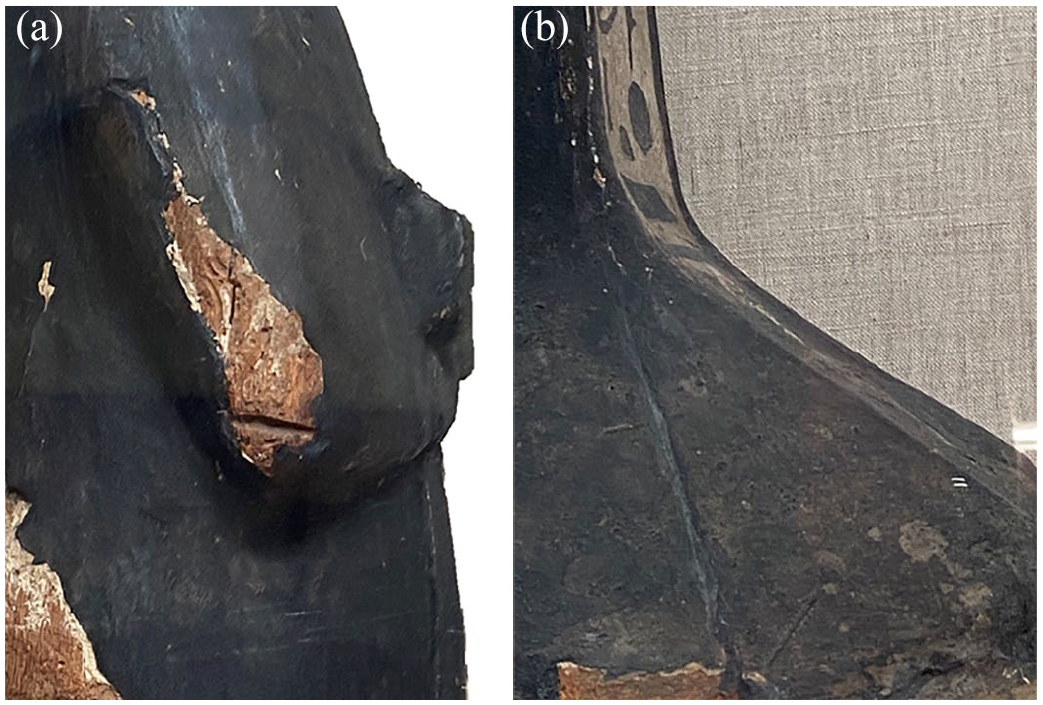
Osirian Statuette of Tawdjatre, JE 29314, details showing the joint wood pieces underneath the black paint (photo: Sameh Abdel-Mohsen).
The owner of the statue is also the owner of the Imduat papyrus JE 34033, Cairo SR 7/ 11500 that was found on the mummy, and the owner of the coffin set (outer coffin, inner coffin and mummy-cover) JE 29737, 81 or number A.144 on Daressy’s list, 82 where her other titles ḥsyt ʿȝt n Mwt and wʿbt Ptḥ were found. 83
Ranke gives the reading tȝ ỉr.t-Rʿ
84
to a name of the same writing but the clear use of the wḏȝt eye  , Gardiner Sign List D10, instead of the ỉr eye
  , Gardiner Sign List D4, on the statuette as well as on the papyrus, makes the reading tȝ-wḏȝt-Rʿ
85
a more favourable one. The name of the priestess would therefore be translated as ‘The perfect eye of Re’.
, Gardiner Sign List D4, on the statuette as well as on the papyrus, makes the reading tȝ-wḏȝt-Rʿ
85
a more favourable one. The name of the priestess would therefore be translated as ‘The perfect eye of Re’.
The writing of the title of the Chantress of Amun had a misuse of the sign  M 22 instead of
  M 26. This is unlikely to be a mistake by the scribe as it is written in the same way on other funerary objects of the owner.
86
In addition, when comparing other texts, we found that the use of M 22 in place of M 26 was common on other examples of the same period such as the statue JE 29316 studied below and other specimens.
87
M 26. This is unlikely to be a mistake by the scribe as it is written in the same way on other funerary objects of the owner.
86
In addition, when comparing other texts, we found that the use of M 22 in place of M 26 was common on other examples of the same period such as the statue JE 29316 studied below and other specimens.
87
While the titles of šmʿyt n Ίmn and nbt pr are the most common titles used by the priestesses at Bab el-Gusus, the title ḥsyt ʿȝt, which may be translated as the Chief Singer, was much rarer and indicated the importance of its holder, 88 revealing the high status of Tawdjatre.
The ending of the term mȝʿ-ḫrw is not clear due to slight damage. However, with the comparison of the writing on the papyrus belonging to the priestess,
89
it was found that the term mȝʿ-ḫrw was written in a variety of signs with a variety of endings, including Gardiner Sign List  X 1,
X 1,  G 43, and
  Z 7. The latter highly matches the inscription on the statuette and is likely the ending used. The translation as ‘true of voice’ remains the most comprehensive one for us,
90
and was therefore applied through this work.
Z 7. The latter highly matches the inscription on the statuette and is likely the ending used. The translation as ‘true of voice’ remains the most comprehensive one for us,
90
and was therefore applied through this work.
It is worth mentioning that texts starting with Wsỉr and ending with the deceased’s name followed by mȝʿ-ḫrw, like the text on this specimen, are of the most frequent texts on such statues 91 and are coherent with the function of the statues as emblems of resurrection.
2. Osirian Statuette of Djedmutiwesankh
Provenance: Bab el-Gusus, Deir el-Bahari, Western Thebes. Registered in museum records 1891, from the excavations of Grébaut and Daressy
Date: Mid/late Twenty-First Dynasty 92
Material: Painted wood papyrus sheath
Type: II D Raven typology 93
Measurements: Height 54.5 cm with the base, base length 29.5 cm
Current location: Egyptian Museum in Cairo, JE 29316, SR 4/6005, TR 12.11.25.7
Owner: Chantress of Amun Ankhdjetmut or rather Djedmutiwesankh 94
Description
Wooden polychrome statue with the body painted white and the face, ears, neck and hands painted green. On the head is an atef crown painted golden yellow with the side feathers in black. A black Osirian beard is shown as if fixed in place with golden yellow straps. The wide eyes and the content smile give an almost living feeling. The statue’s neck is decorated with a wsḫ collar of six rows painted golden yellow, black, green and red, ending with a row of black drop-shaped beads.
The three-dimensional hands have drawn through them two nḫȝḫȝ Osirian flails
95
and two red mummy-braces (figs 9, 11). Stretching from the hands downwards lies a yellow column with hieroglyphic inscriptions. The text reads as follows:

Translation: An offering that the king made for Osiris Khenty Imentt, Wennefer, the ruler of the living (fig. 10).
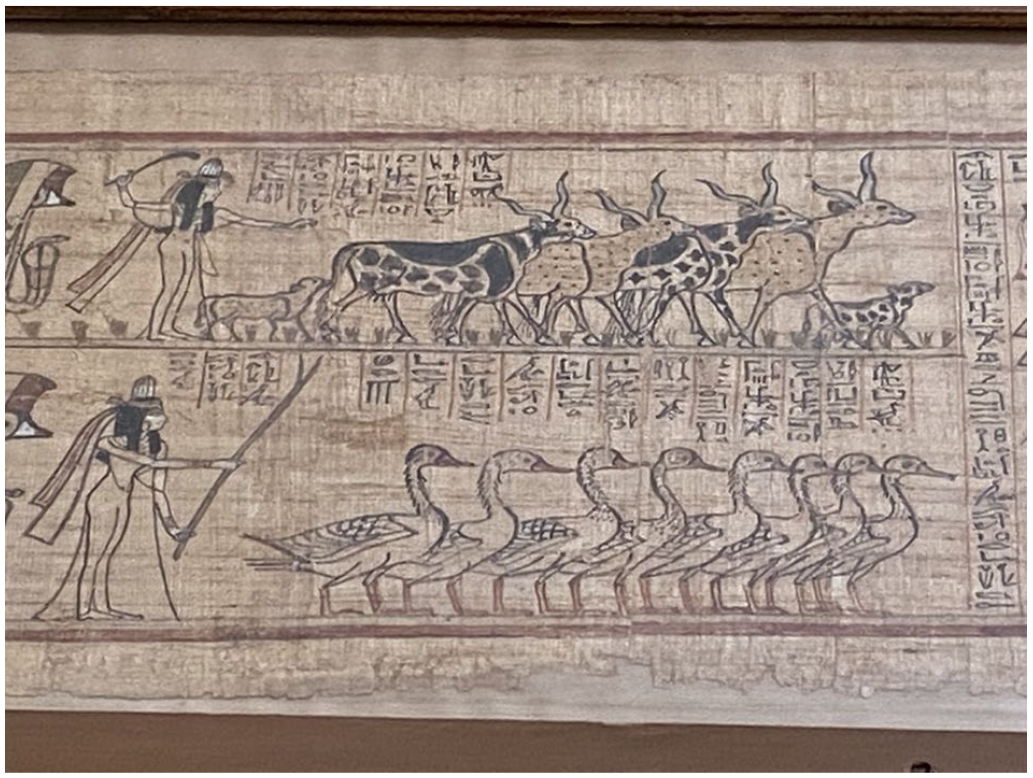
Papyrus of Tawdjatre SR 7/ 11496, detail (photo: Abir Enany).
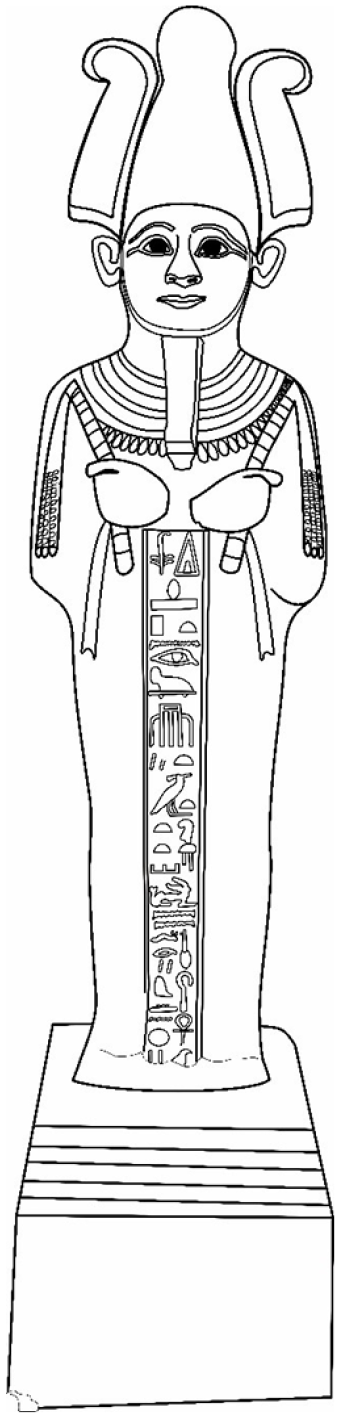
Osirian Statuette of Djedmutiwesankh, JE 29316 (drawing: Iman Elsaid).
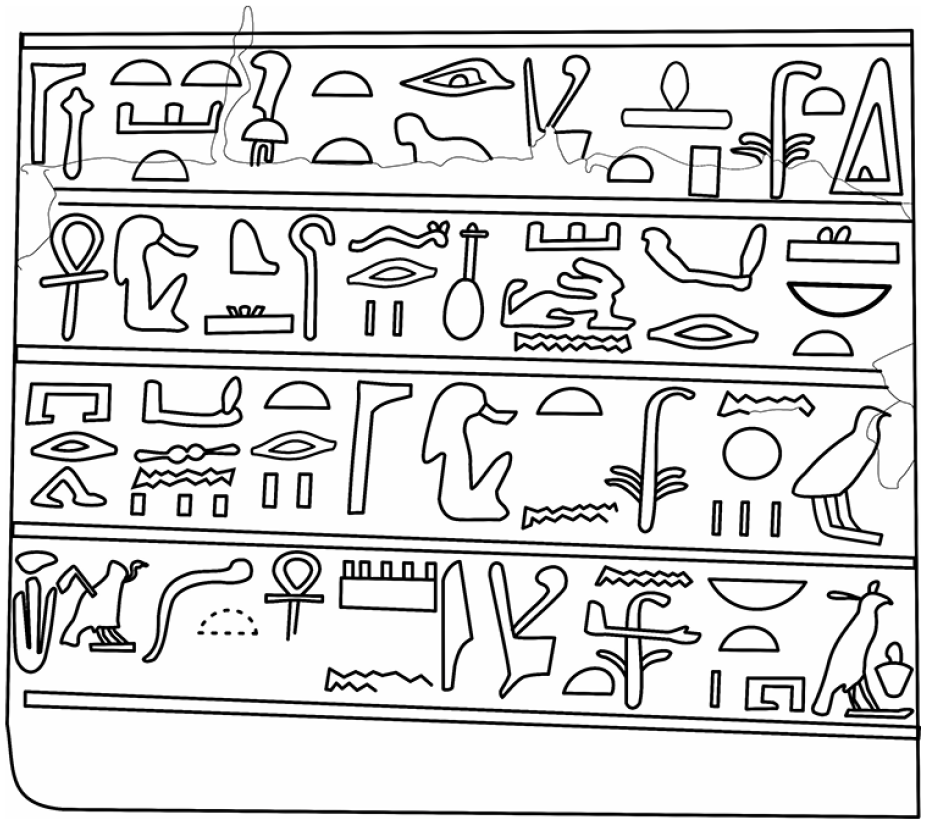
Osirian Statuette of Djedmutiwesankh, JE 29316, text on the base (drawing: Iman Elsaid).
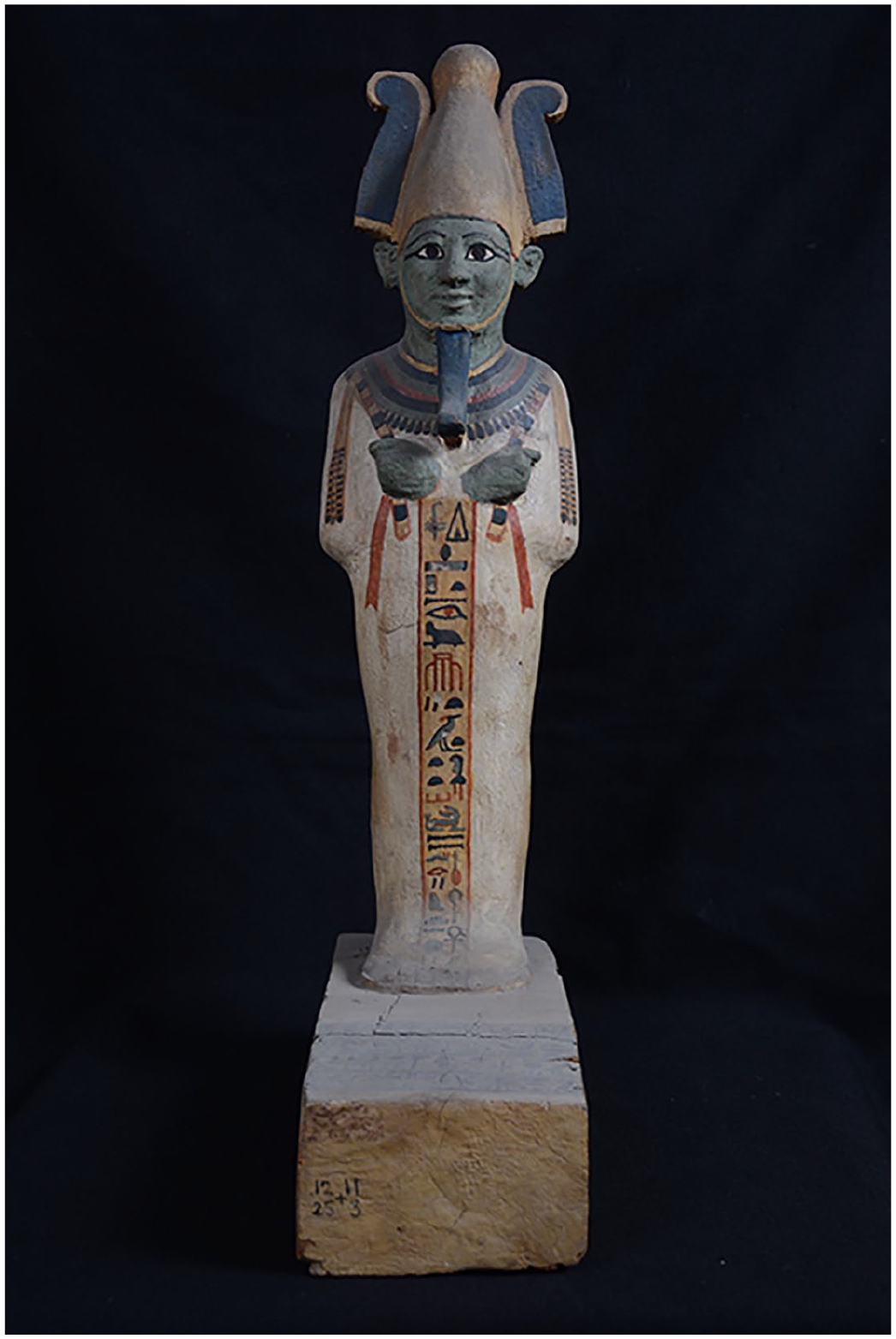
Osirian Statuette of Djedmutiwesankh, JE 29316 (photo: Sameh Abdel-Mohsen).
The back side of the statue shows the mʿnḫt tassel between the two ends of the collar that is common in this type of Osiris statuette, 96 two suspension red mummy-braces and another long ribbon stretching from the end of the tassel to the base (fig. 12).
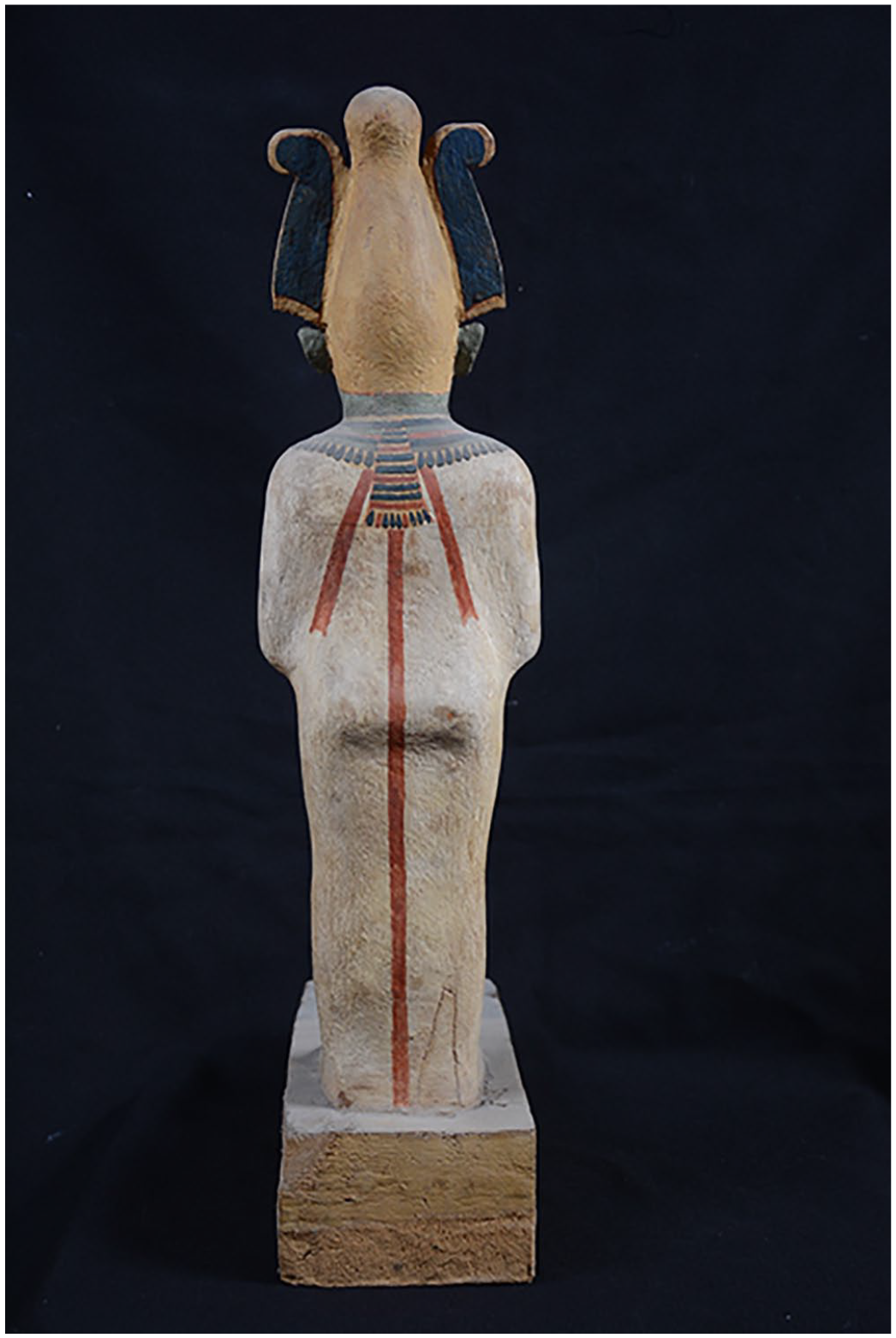
Osirian Statuette of Djedmutiwesankh, JE 29316, back side (photo: Sameh Abdel-Mohsen).
The statue has no back pillar and is fixed on a yellow base that has four lines of black hieroglyphic inscriptions with the following text:
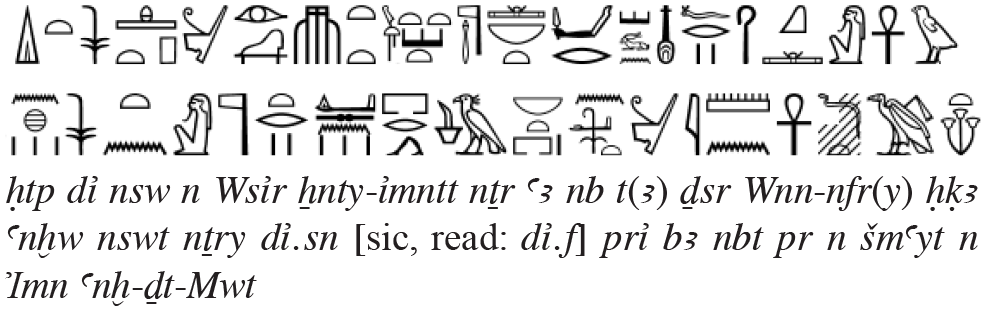
Translation: An offering that the king made for Osiris Khenty Imentt, the great god, the lord of the sacred land, Wennefer, the ruler of the living, the divine king, may they (sic) [read: he] cause the ascent (of) the Ba (of) the Lady of the House, the Chantress of Amun, Djedmutiwesankh.
When examined, it becomes clear that the statuette was fixed to the base by a protruding wedge that was inserted into a cavity in the base. They were apparently both attached together by a pair of wooden pegs that were inserted through two holes which can be seen on the right side of the base (fig. 13). The statue contains a long cavity that starts at the wedge at the base and goes deep into the statue’s length (fig.16). The wooden stopper that is customarily used to seal the mouth of the cavity is missing.
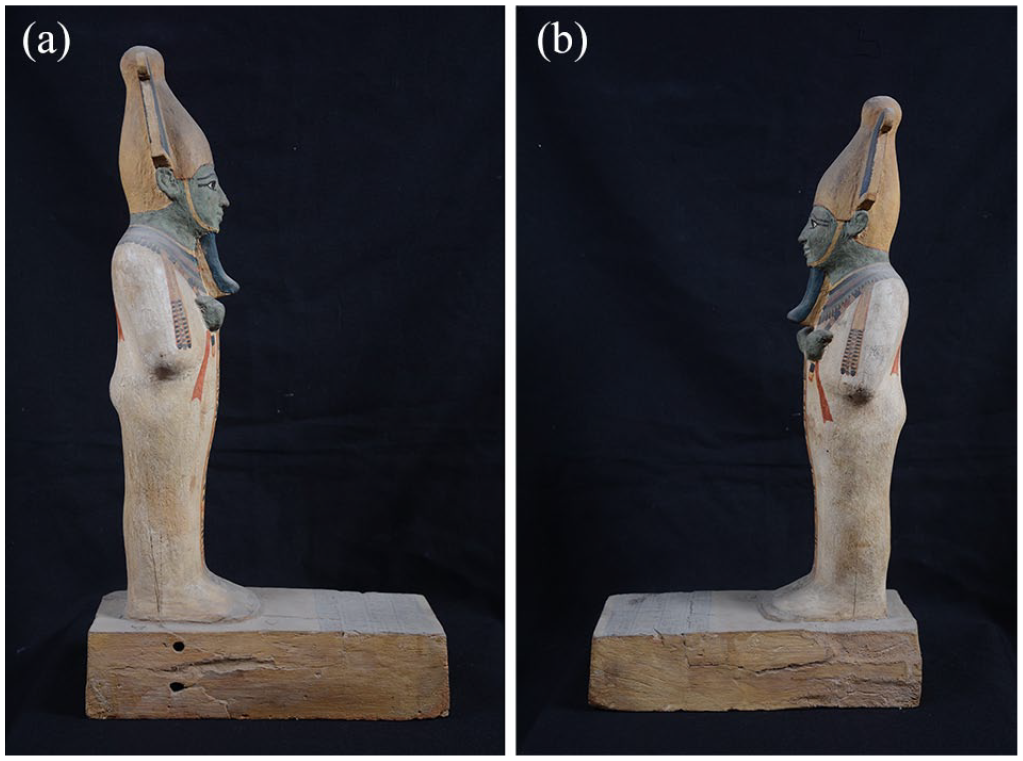
Osirian Statuette of Djedmutiwesankh, JE 29316, right side (a) and left side (b) (photo: Sameh Abdel-Mohsen).
Discussion and Commentary
The statuette, which was found at Bab el-Gusus, is of type II D of Raven’s typology. Its cavity opens from the base of the statuette and was devised to contain a papyrus (fig. 16). The missing stopper may hint to a robbery that targeted the papyrus and left the statue unharmed or may otherwise be due to the unusual circumstances of the transport of the find and of its storage at the Giza Museum.
The main characteristics of type II D are found on the statue, such as being polychrome with a green face, the atef crown, and the white wrap in addition to the hieroglyph text column on the front and on the top of the base. Raven noticed similarities in style with his type I C, such as statue JE 29314 studied above, indicating a proximity of time as he explained it. 97 Apart from their difference in colour, Raven’s view may be confirmed by their shared characteristics such as the atef crown, the protruding arms and hands, the hieroglyph column on the front and the yellow base. Both statues studied here would therefore validate this view as they both share the same date of the Twenty-First Dynasty.
The preference of the atef crown on these statuettes emphasizes the dominance of the Osirian significance of the object. In fact, Osiris was so associated with this crown that one of his epithets was the atfy, or ‘The one with the atef crown’. 98
The mummy-braces, also known as stola, 99 started to be used in the late New Kingdom 100 and became an essential element of the funerary objects that were placed on the mummies of the Third Intermediate Period in Thebes. 101 This term refers to red-dyed leather straps that were placed on the chests and backs of the mummies. 102 The straps were placed crossed on the chest and ran over the shoulders and down the upper back the mummy. 103 They were often inscribed with the name(s) of the Theban High Priest of Amun and/or the Tanite king who were likely contemporary with the date of death. 104 In fact, using these mummy-braces must have been so crucial that they were painted on statues and other funerary objects. 105 However, we notice that the mummy-braces represented on the statuette are in an incomplete form. It is possible that this is due to the novelty of the idea of representing them on funerary objects, a custom that started in the late Twenty-First Dynasty 106 and would become established by the Twenty-Second Dynasty. 107
The texts on the statuette follow the common patterns of texts on type II D statuettes. The use of the offering formula ḥtp dỉ nsw found on the statuette is the most frequently inscribed text on Osiris statues. 108 The translation of the text ḥtp dỉ nsw n Wsỉr ẖnty-ỉmntt as ‘an offering that the king made for Osiris Khenty Imentt’ has been applied in similar examples. 109 In addition, the epithets of Osiris ẖnty-ỉmntt and nṯr ʿȝ used on this statuette are of the most preferred on the Osiris statues. 110
As for Wnn-nfr, it is better translated as ‘he who is permanently in a condition of beneficence’, 111 or the beneficent one. The ending of the word nfr in the name in both texts on the statuette with two strokes is, to our knowledge, unparallel and is likely a mistake by the artist.
While the text on the front of the statuette is neatly written in hieroglyphs (fig. 14), the text on the base is written in cursive hieroglyphic and contains some inaccuracies (figs 10–15). For instance, the sign for ʿȝ, usually written with  O 29, looks more like a flower than a pillar. Similar use was found on other examples from the same dynasty.
112
The pr sign
O 29, looks more like a flower than a pillar. Similar use was found on other examples from the same dynasty.
112
The pr sign  O1 in the fourth line is missing one of its sides. In the deceased’s name found in the fourth line, the head and neck of the goddess Mut
  G 15 are almost deformed, and the
  M 85 sign at the end of the priestess’s name is written in an almost abstract fashion. Other funerary objects of the same cache were prepared in advance and had a space left blank to have the name of the deceased added before burial; however, the names were never added.
113
In this case, it is possible that this is caused by the addition of the name of the priestess shortly before the burial.
M 85 sign at the end of the priestess’s name is written in an almost abstract fashion. Other funerary objects of the same cache were prepared in advance and had a space left blank to have the name of the deceased added before burial; however, the names were never added.
113
In this case, it is possible that this is caused by the addition of the name of the priestess shortly before the burial.
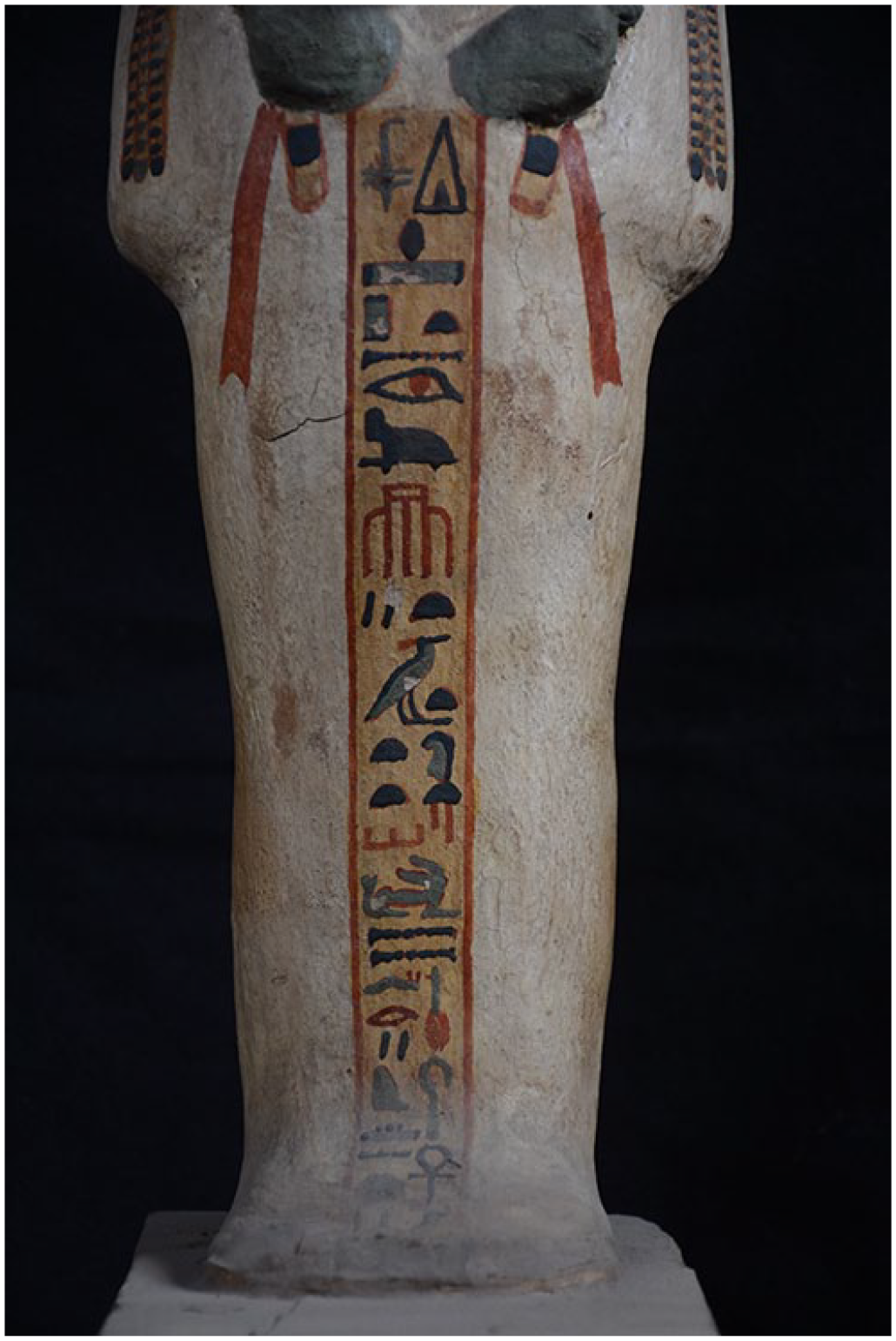
Osirian Statuette of Djedmutiwesankh, JE 29316, text on the statue (photo: Sameh Abdel-Mohsen).
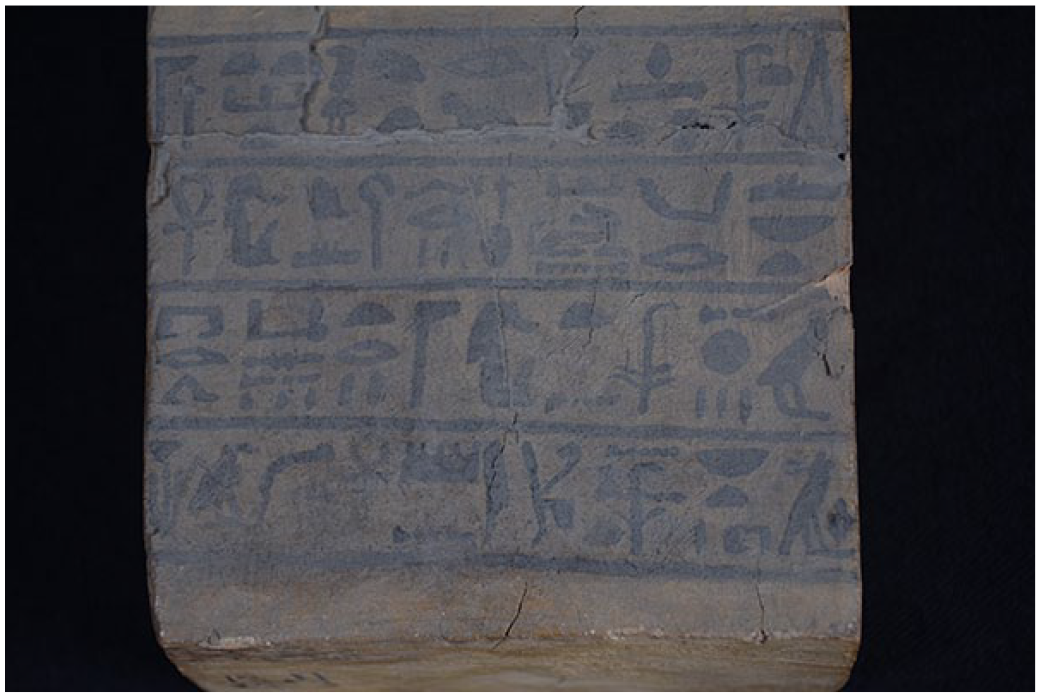
Osirian Statuette of Djedmutiwesankh, JE 29316, text on the base (photo: Sameh Abdel-Mohsen).
The artist switched the traditional order of the signs  and
and  in Osiris’s epithet nṯr ʿȝ. The reasoning behind this was likely to make use of the empty space in front of the sign
  and thus write the epithet in the limited space left at the end of the first line. Parallels of such a switch are also present on other specimens.
114
and thus write the epithet in the limited space left at the end of the first line. Parallels of such a switch are also present on other specimens.
114
The term t(ȝ) ḏsr, which is often translated as ‘necropolis’, 115 is better used here with its reference to Abydos, 116 as it is sometimes used, since there was a preference on the Osirian statuettes of the type studied here to associate the god to Abydos. 117 The yellow colour applied on the base is likely to indicate the colour of the sand 118 that was related to Osiris, who had the epithet ḥry-šʿy.f ‘The One above his Sand’ among his epithets during the Twenty-First Dynasty, an epithet that was also employed to refer to Sokar and Sokar-Osiris. 119
The reading of the sign  G 208 A used on the base was problematic. Research into its origins and uses revealed that it is one of the signs
120
added to Gardiner’s List as a development of the
G 208 A used on the base was problematic. Research into its origins and uses revealed that it is one of the signs
120
added to Gardiner’s List as a development of the  G 21.
121
The latter may have been rarely misread in Late Egyptian as bȝ,
122
meaning soul,
123
which is the reading that we believe is meant for the sign utilized here instead of the more widely used human headed bird G 53 or the Jabiru bird G 29.
124
This suggestion is confirmed with the placement of the sign
G 21.
121
The latter may have been rarely misread in Late Egyptian as bȝ,
122
meaning soul,
123
which is the reading that we believe is meant for the sign utilized here instead of the more widely used human headed bird G 53 or the Jabiru bird G 29.
124
This suggestion is confirmed with the placement of the sign  R 7, used as an ideogram in words pronounced bA, in front of the sign G 208 A in the text here studied. This sophisticated knowledge of the language could give us some insight on the level of education of the artists in the workshops responsible for the production of the funerary furniture of the priesthood of Amun, who were seemingly familiar with the development of the writings and not merely copying older texts.
The epithet of Osiris 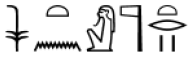 has two strokes instead of the usual three that make the epithet read nswt nṯrw, meaning ‘king of the gods’.
125
The missing stroke could be a mistake by the artist but was more likely done intentionally to change the reading into nswt nṯry, thus translated as the ‘divine king’. This is indicated by the latter being used as an epithet for Osiris during the period of the Twenty-First to the Twenty-Fourth Dynasties,
126
and is therefore the translation that was adopted in this research. However, the two strokes usually used in this case were the two diagonal strokes
has two strokes instead of the usual three that make the epithet read nswt nṯrw, meaning ‘king of the gods’.
125
The missing stroke could be a mistake by the artist but was more likely done intentionally to change the reading into nswt nṯry, thus translated as the ‘divine king’. This is indicated by the latter being used as an epithet for Osiris during the period of the Twenty-First to the Twenty-Fourth Dynasties,
126
and is therefore the translation that was adopted in this research. However, the two strokes usually used in this case were the two diagonal strokes  Z 4
127
rather than the two vertical strokes
Z 4
127
rather than the two vertical strokes Z 4 A used here.
The artist used the plural suffix pronoun sn with reference to the god Osiris. It is probable that this was a mere mistake by the artist who copied the form from other texts that mention several gods then their names followed by dỉ.sn. 128 However, as parallels of such use are found on other texts, 129 it is probable that the combination Osiris Wennefer was occasionally used to indicate the two forms of the god merged in one. 130 This was not the rule as the combined form of the deity was more frequently treated as one, 131 where Wnn-nfr is considered an epithet of Osiris. 132
Another inaccuracy that is found on the base was the location of the sign  N 35 in the text dỉ.sn prỉ bȝ nbt pr n šmʿyt n Ίmn that should have been placed after prỉ bȝ to be dỉ.sn prỉ bȝ n nbt pr šmʿyt n Ίmn, or ‘may they cause the ascent of the bȝ of the lady of the house, Chantress of Amun’.
The difference in the style of writing between the text on the body of the statuette and that on the base indicates that they were made by two different artists. Judging by the difference in quality, it is likely that the two artists were at two different levels of experience. A more skilled artist was in charge of the section that is more visible, i.e. the body, while a novice artist was assigned the task of preparing the base. The concept of passing knowledge through practical training from one generation to another was a familiar concept in ancient Egypt. 133 It remains to be known how a novice has such a good knowledge of writing, as one infers from the sign used to write the word ‘ba’.
The reading of the name of the owner 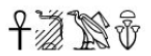 written on the base of the statuette presented some difficulties as there were no women with the title šmʿyt n Ίmn or any other individual that we know of with the reading ʿnḫ-ḏt-Mwt as the hieroglyphs should read. However, there were individuals with the name ḏd Mwt that was used during the Twenty-First Dynasty as an abbreviation for the name ḏd-Mw.t-ỉw.s-ʿnḫ
134
which is translated ‘the goddess Mut said: she will live’.
135
It is safe to assume that the name of owner of the statuette is written in its abbreviated form, and that the ʿnḫ sign written before the name may have been placed by the scribe to fill the space and to relate to the full name of the owner. The use of the sign
written on the base of the statuette presented some difficulties as there were no women with the title šmʿyt n Ίmn or any other individual that we know of with the reading ʿnḫ-ḏt-Mwt as the hieroglyphs should read. However, there were individuals with the name ḏd Mwt that was used during the Twenty-First Dynasty as an abbreviation for the name ḏd-Mw.t-ỉw.s-ʿnḫ
134
which is translated ‘the goddess Mut said: she will live’.
135
It is safe to assume that the name of owner of the statuette is written in its abbreviated form, and that the ʿnḫ sign written before the name may have been placed by the scribe to fill the space and to relate to the full name of the owner. The use of the sign  X 1 in the abbreviated form on the base is thus a mere writing error from the artist.
Of the women who carried the title šmʿyt n Ίmn there were seven who carried the name ḏd-Mw.t-ỉw.s-ʿnḫ, four of whom were buried at Bab el-Gusus. 136 The owner of the statue studied here is one of those four women who carried the title šmʿyt n Ίmn, the name ḏd-Mw.t-ỉw.s-ʿnḫ, and who were buried at Bab el-Gusus. The names and titles of those four women are as follows:
1)  Wsỉr šmʿyt n Ίmn ḏd-Mw.t-ỉw.s-ʿnḫ,
137
owner of coffin set A.15 of Daressy’s list. The coffin set is the previous JE 29691 that was registered for an anonymous woman.
138
Today the set is in Florence, Museo Archeologico, inventory numbers 8524, 8528, 9534.
139
The name of the owner was not written on any of the five pieces of the coffin set (inner coffin with lid, outer coffin with lid, and mummy-cover). Instead, gaps were left to add names that were never added on these apparently prefabricated set pieces. Fortunately, the name and title of the owner were written on the Osirian shroud covering the mummy within the set.
140
Wsỉr šmʿyt n Ίmn ḏd-Mw.t-ỉw.s-ʿnḫ,
137
owner of coffin set A.15 of Daressy’s list. The coffin set is the previous JE 29691 that was registered for an anonymous woman.
138
Today the set is in Florence, Museo Archeologico, inventory numbers 8524, 8528, 9534.
139
The name of the owner was not written on any of the five pieces of the coffin set (inner coffin with lid, outer coffin with lid, and mummy-cover). Instead, gaps were left to add names that were never added on these apparently prefabricated set pieces. Fortunately, the name and title of the owner were written on the Osirian shroud covering the mummy within the set.
140
2) 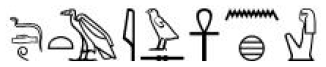 ḏd-Mwt-ỉw.s-ʿnḫ,
141
owner of coffin set A.45 of Daressy’s list, previously JE 29652, now in Istambul Arkeoloji Müzeleri, inventory number 10872.
142
The name was found in both forms in her burial.
143
On the Osirian shroud is the title and abbreviated form of her name
ḏd-Mwt-ỉw.s-ʿnḫ,
141
owner of coffin set A.45 of Daressy’s list, previously JE 29652, now in Istambul Arkeoloji Müzeleri, inventory number 10872.
142
The name was found in both forms in her burial.
143
On the Osirian shroud is the title and abbreviated form of her name 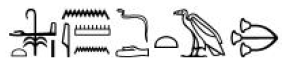 šmʿyt n Ίmn ḏd-Mwt,
144
while the inner coffin held the full form.
šmʿyt n Ίmn ḏd-Mwt,
144
while the inner coffin held the full form.
3)  ,
, 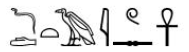 šmʿyt n Ίmn ḏd-Mw.t-ỉw.s-ʿnḫ,
145
owner of coffin set A.110
146
(inner coffin and mummy-cover), which has no original Journal d’entrée number. Today the set is in the Sociedade de Geografia de Lisboa,
147
coffin number SGL –AC-517 and mummy-cover number SGL –AC-518.
šmʿyt n Ίmn ḏd-Mw.t-ỉw.s-ʿnḫ,
145
owner of coffin set A.110
146
(inner coffin and mummy-cover), which has no original Journal d’entrée number. Today the set is in the Sociedade de Geografia de Lisboa,
147
coffin number SGL –AC-517 and mummy-cover number SGL –AC-518.
4) 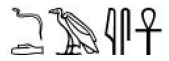 ḏd-Mw.t-ỉw.s-ʿnḫ, owner of the coffin set A.150 of Daressy’s list; JE 29679; (CG 6113, 6114, 6088, 6089, 6090), whose name was found in its full form on the coffin set
148
(outer coffin, inner coffin and mummy-cover) and in the abbreviated form
ḏd-Mw.t-ỉw.s-ʿnḫ, owner of the coffin set A.150 of Daressy’s list; JE 29679; (CG 6113, 6114, 6088, 6089, 6090), whose name was found in its full form on the coffin set
148
(outer coffin, inner coffin and mummy-cover) and in the abbreviated form  Wsỉr šmʿyt n Ίmn ḏd-Mwt on the Osirian shroud.
149
Wsỉr šmʿyt n Ίmn ḏd-Mwt on the Osirian shroud.
149
This narrows the ownership of the statuette here discussed down to two possibilities. The first possibility is that it belonged to the Chantress of Amun Djedmutiwesankh buried in coffin set A.150. Another possibility is that it belonged to the Chantress of Amun Djedmutiwesankh buried in coffin set A.45.
According to the available data, confirming the ownership of the statuette with high accuracy is hard to achieve. The comparison between the writing of the names of the two chantresses was not revealing, as both used the same abbreviated form of their names with both abbreviated forms using the determinative  M 85 with the minor difference of using the sign
  G 14 on A.45, in contrast to the sign
  G 15 on A.150. The latter is the same sign used on the base of the statuette here studied. This slight difference in the writing of the signs G 14 and G 15 is not sufficient to be used as a decisive criterion. Further investigation into the location and specifics of both burials was made to attempt to decide on the owner of the statuette.
According to the description of the find, the burial A.150 was found in the double burial chamber D 150 at the end of the corridor that was packed with the largest coffins of the tomb. 151 In fact, those buried in this double burial chamber were the top elite who were related to the High Priest Panedjem II, 152 and consequently enjoyed more lavish burials. The coffin set of this burial consists of an outer coffin, an inner coffin and a mummy-cover. 153 The mummy within this burial was equipped with two papyri, one placed under the right armpit and the other by the left side of the mummy. 154 One of these is identified as the Imduat papyrus SR VII/10220. 155 The other papyrus is likely SR VII/10223 of the Book of the Dead, according to Niwiński who suggested that both papyri belonged to the same burial. 156 This is supported by the observation that there are only two papyri from Bab el-Gusus that belonged to a Chantress of Amun Djedmutiwesankh both of which are currently on display in the Egyptian Museum in Cairo. On the latter papyrus VII/10223 both the complete form (fig. 17a) and the abbreviated form of the name (fig. 17b) are found. 157
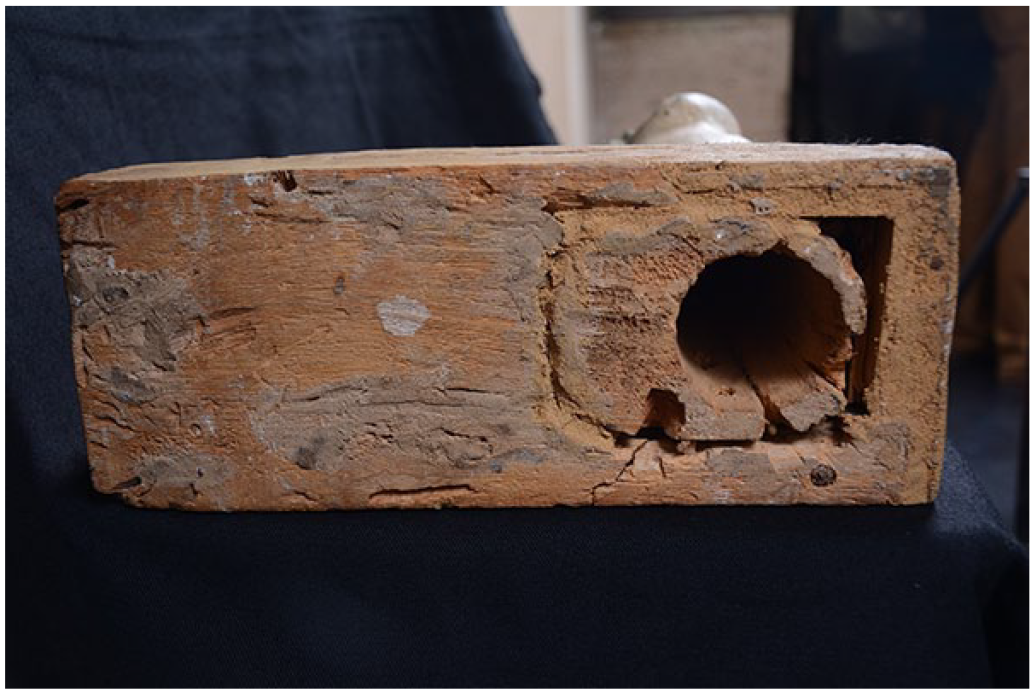
Osirian Statuette of Djedmutiwesankh, JE 29316, the opening of the cavity from the base (photo: Sameh Abdel-Mohsen).
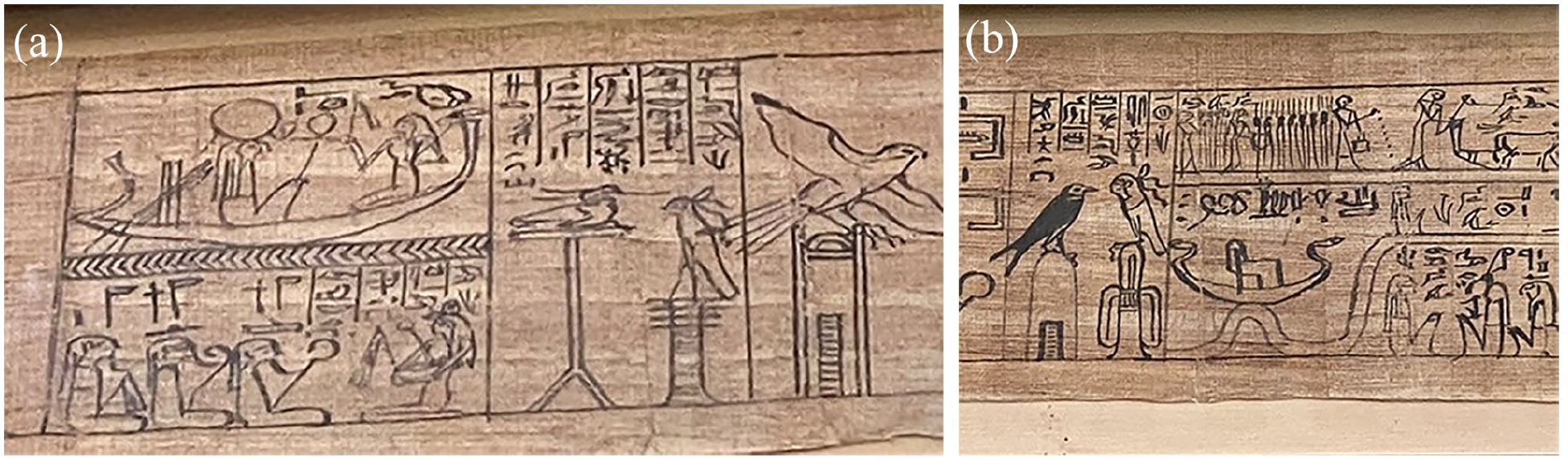
Details of papyrus SR VII/10223 showing the two forms of the name of Djedmutiwesankh (photo: Abir Enany).
Alternatively, the burial A.45 was placed in the middle of main corridor B of Bab el-Gusus. 158 The coffin set of this burial comprises solely of the inner coffin 159 with no record of any papyrus placed on the mummy or within the coffin. 160
According to the analysis above, in spite of the probability that the papyrus sheath here studied might belong to the burial A.45 to provide a place for a papyrus as there were none on the mummy, we believe that it more likely belonged to the more luxurious burial A.150 where the name of the priestess was found in both the full and the abbreviated forms.
The abbreviated form of the name was called rn nfr by ancient Egyptians and may be translated as ‘the name of young age’, ‘the favourable name’, or ‘the regenerant name’. 161 The custom of giving an individual such a name in their childhood was common during the Old Kingdom. It then began to fade from the end of the Old Kingdom onwards, until it started to regain its popularity during the Third Intermediate Period and through the Late Period. 162 The abbreviated form was often a shortened version of the name, and it was therefore important to write on funerary objects to benefit from the positive connotation of the word nfr, to help in ensuring the deceased admittance into the world of eternity and guaranteeing a justified trial for him or her in the court of Osiris. 163 It is for this reason that the abbreviated name ḏd-Mwt was found on the statue’s base while both forms were written on the papyrus.
3. Osirian Statuette of Duathathor-Henuttawy
Provenance: Thebes, Royal Cache (DB320), Deir el-Bahari, Western Thebes, corridor B of the tomb. Registered in museum records in 1881, from the excavations of Maspero and Brugsch for the Egypt Antiquities Service
Material: Painted wood papyrus sheath
Date: Early Twenty-First Dynasty
Type: II D Raven typology 164
Measurement: Height with base: 73 cm, without base: 61 cm. Base: height 12 cm, length 40 cm, breadth 14.5 cm
Current location: Egyptian Museum in Cairo, JE 46948, SR 4/2381
Owner: Queen Duathathor-Henuttawy
Description
Wooden polychrome statue representing Osiris in a white mummy mantle that starts under the broad collar downward. The face and ears are painted green. The head is equipped with an atef crown of a yellow-mustard colour with a red sun disc painted on its front side and the two side feathers painted in black. The arms and hands are represented in three-dimensions. Both hands are broken today but they were once shown holding a tool each, only one of which may still be partly seen painted on the chest of the statuette. The neck and the upper chest were once decorated with a broad collar, only traces of which may be seen today and therefore it is hard to confirm its type. Underneath the collar stretches a red ribbon that surrounds the edge of the white mantle all around the body of Osiris ending at the back. Two red mummy-braces are crossed on the chest and underneath the arms then continue underneath the collar to cross over the shoulders and dangle over the back side of the statuette (figs 18–20). The hieroglyphic text that is written in black paint in a column with a yellow background and a red frame, reads as follows:

Translation: The Osiris Great Royal Wife, the Lady of the Two Lands, Duathathor-Henuttawy, true of voice (figs 18, 22).

Osirian statuette of Duathathor-Henuttawy, JE 46948 (drawing: Iman Elsaid).
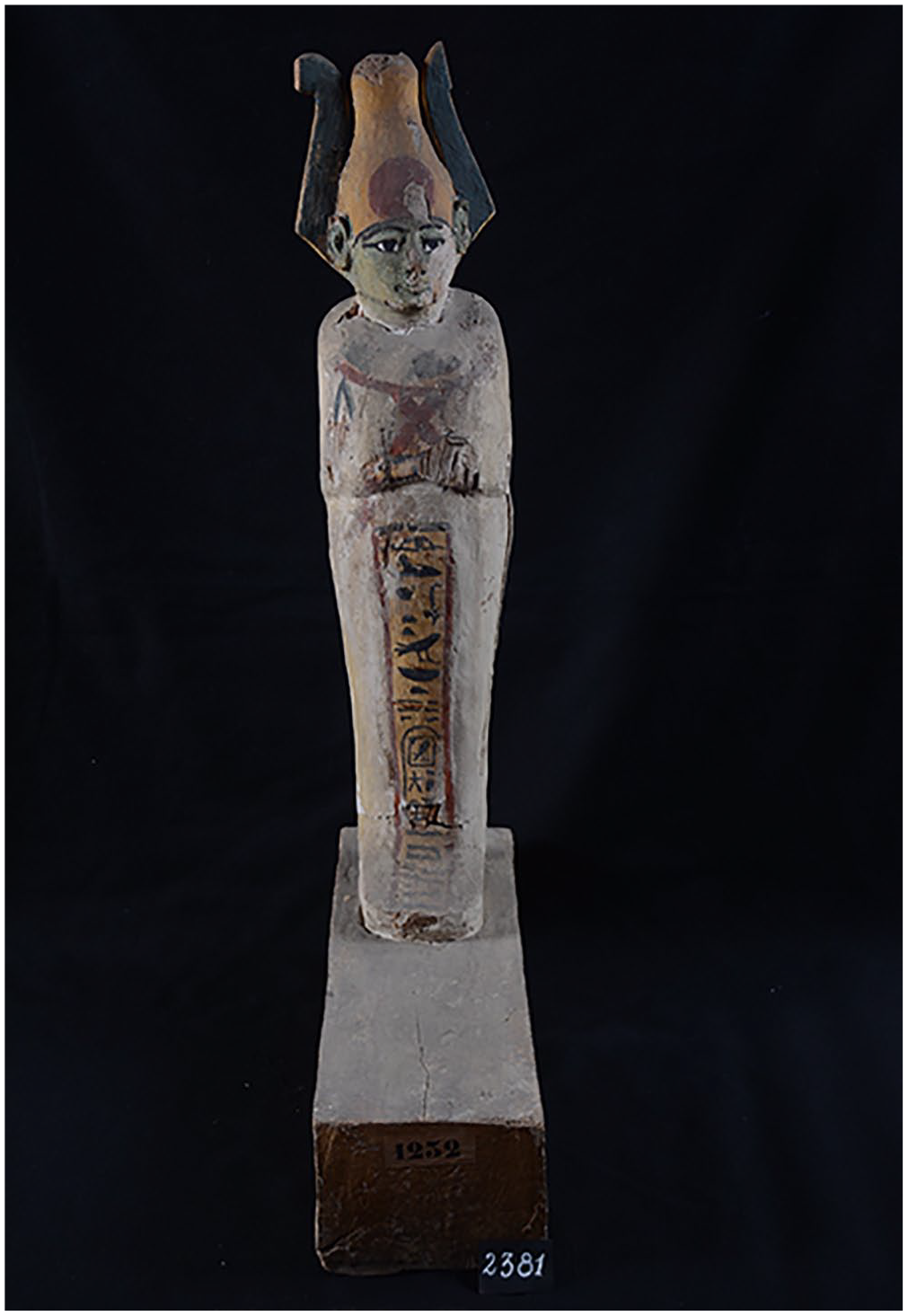
Osirian statuette of Duathathor-Henuttawy, JE 46948 (photo: Sameh Abdel-Mohsen).
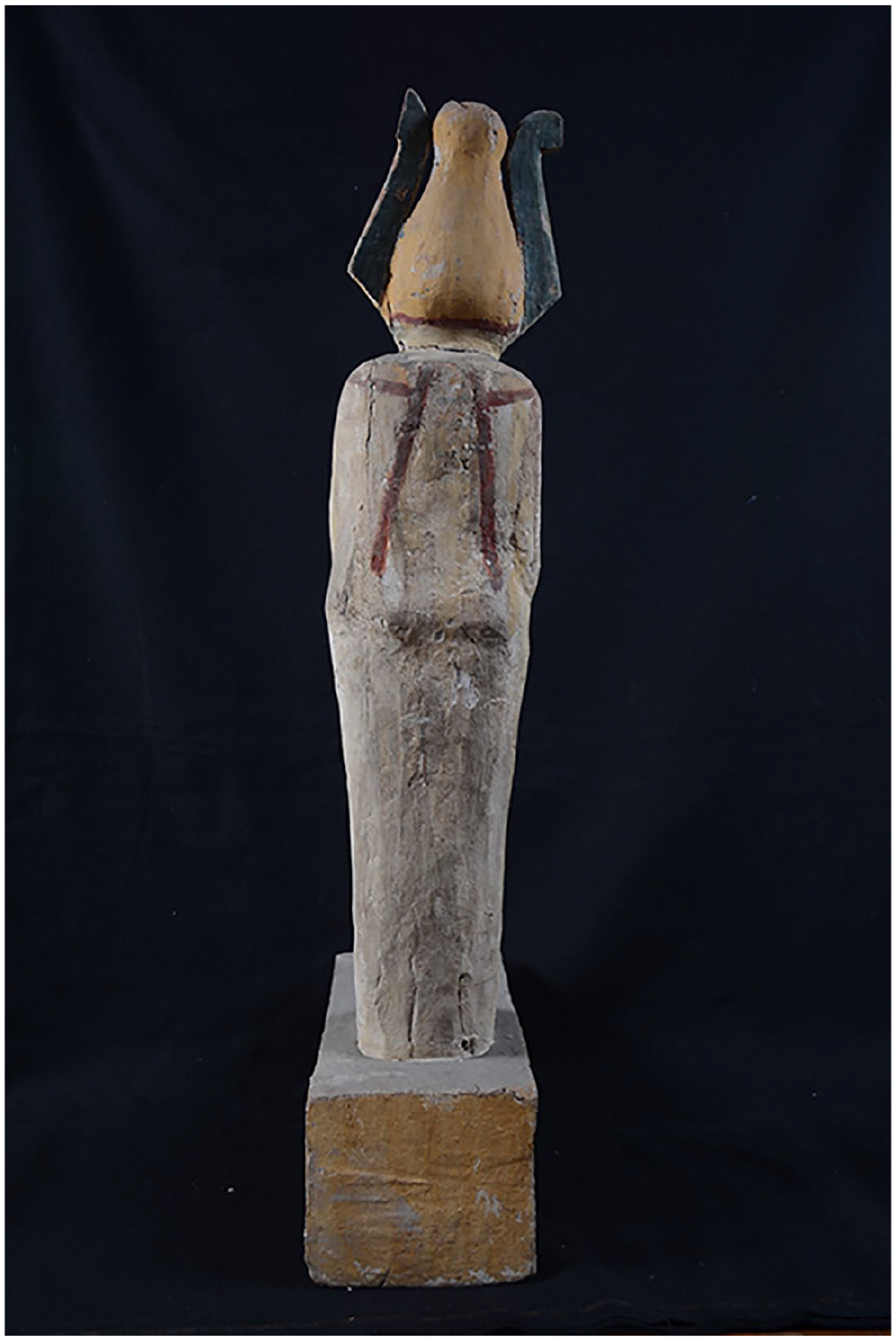
Osirian statuette of Duathathor-Henuttawy, JE 46948, back side (photo: Sameh Abdel-Mohsen).
The statuette is fixed on a rectangular base made of another piece of wood with no inscriptions. The lower part of the base shows the wooden stopper that is used to seal the papyrus sheath (fig. 24).
Discussion and Commentary
The owner of the statuette, Duathathor-Henuttawy, was the daughter of Queen Tentamun, as is clearly indicated on the papyrus that was once inside the statue, 165 and a probable daughter of either King Ramses XI or less likely Smendes (Nsỉ-bȝ-nb-ḏdw), the first king of the Twenty-First Dynasty. On the objects of the funerary furniture of the queen and on her papyri are the titles of the queen ḥmt nswt wrt ‘Great Royal Wife’ of an unnamed High Priest of Amun and mwt nswt ‘Royal Mother’ of unnamed priests and priestesses, which increased the difficulty of identifying her lineage. However, there is currently a cautious belief that she was the wife of Panedjem I, 166 and is often referred to by Egyptologists as Henuttawy A, following Kenneth Kitchen’s suggestion. 167 In addition to her royal titles, the queen held the priestly title of ḥsyt ʿȝt n Ίmn m Wȝst ‘Chief Singer of Amun in Waset’, that, as mentioned above, was a rare and high priestly title amongst the priestesses of Amun. 168
The papyrus that must have been once enclosed within this papyrus sheath was among the looted artifacts that was later bought by Mariette. 169 The papyrus was transferred to be displayed at the Grand Egyptian Museum in Cairo (GEM 15280) and formerly had the Journal d’entrée number JE 95856. It is 45.5 cm in height and 3.67 m in length and contains extracts of the Book of the Dead. 170 The queen is also the owner of the papyrus in the Egyptian Museum in Cairo JE 95887 that was found in the coffin set at the Royal Cache. 171
The papyrus sheath studied here is one of the seven papyrus sheaths that were found in the Royal Cache (DB 320). 172 It was found beside the queen’s coffin set in the cache in 1881. 173 The coffin set was found in corridor B of DB 320, 174 and is now at the Egyptian Museum in Cairo JE 26204. 175 The coffins were looted before the official discovery and the jewellery and other belongings of the queen were taken by the looters. 176 The damage to the statuette in several spots is most likely a result of this robbery. The mummy is today in the Egyptian Museum in Cairo (CG 61090).
This statuette is one of the latest examples known of the polychrome statues of type II D of Raven typology. 177 It carries the general characteristics of type II D including the green face of Osiris, the atef crown, the polychrome paint, the crossed arms, the vertical text on the front of the body, and the back panel that can be detected underneath the paint (fig. 21). However, it has some minor differences including the lack of text on the base, the atef crown having a sun disc that is found on other examples of the type such as JE 46949, SR 4/2379, which is not an unusual attribute of Osiris. 178
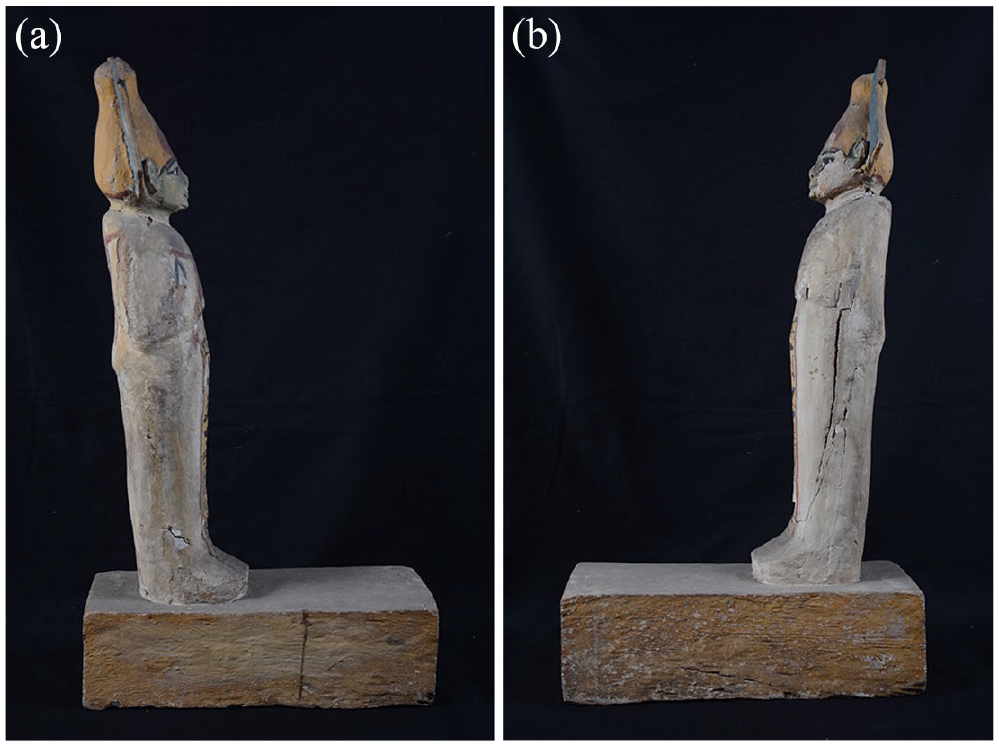
Osirian statuette of Duathathor-Henuttawy, JE 46948, right side (a) and left side (b) (photo: Sameh Abdel-Mohsen).
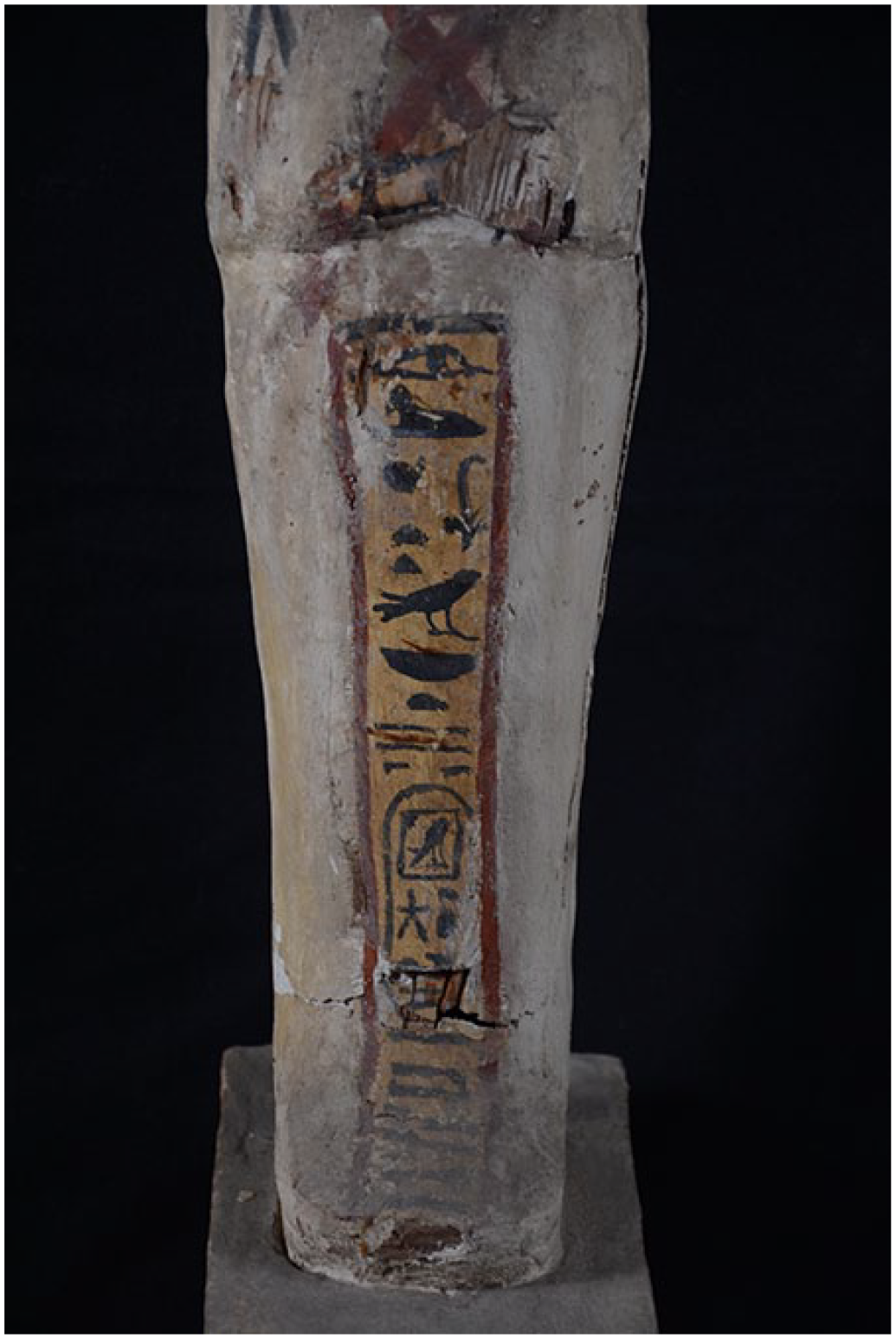
Osirian statuette of Duathathor-Henuttawy, JE 46948, details of text (photo: Sameh Abdel-Mohsen).
The statuette lacks the typical counterpoise of type II D, which is the mʿnḫt tassel, but instead one finds on the back the rest of the red ribbon that surrounds the edge of the mantle and the red mummy-braces (fig. 20).
The deliberate use of the red colour in the mummy adornments during the Twenty-First and the Twenty-Second Dynasties resonates with the use of the red colour on several types of funerary accessories in ancient Egypt. 179 Its use relates to the red bands used on coffins from the New Kingdom until the Late Period that were meant to reflect the rejuvenation of the red colour and protection of the solar encirclement. 180 The use of the colour saw a general increase during the Third Intermediate Period to the extent that some mummies of the period had red linen shrouds. 181 It may be inferred that this is a reflection of the growing association of Osiris with the sun god Re.
The broken hands of the statuette make it difficult to distinguish the tools they once held. The remnants of the tool could be identified as the nḫȝḫȝ flail usually used on similar statuettes. However, judging by the direction of the tool on the remaining paint, the tools may have been hoes (fig. 23). According to our knowledge, the depiction of the hoes in the hands of the deity has no similarity in Osirian statuettes as these agriculture tools were associated with the ushebtis. The confusion between the two types of statuettes has another parallel, an Osirian statuette of the Leiden Museum collection Wijngaarden 1932 n. 19 of the type II E, 182 that was inscribed with the ushebti formula (BD Ch. 6). 183 The use of this formula was interpreted by Raven to have been caused by the confusion of the Egyptian artist between the two types of funerary statues. Confirmation regarding the type of tool here presented would be difficult and awaits future research in parallel Osirian statuettes.
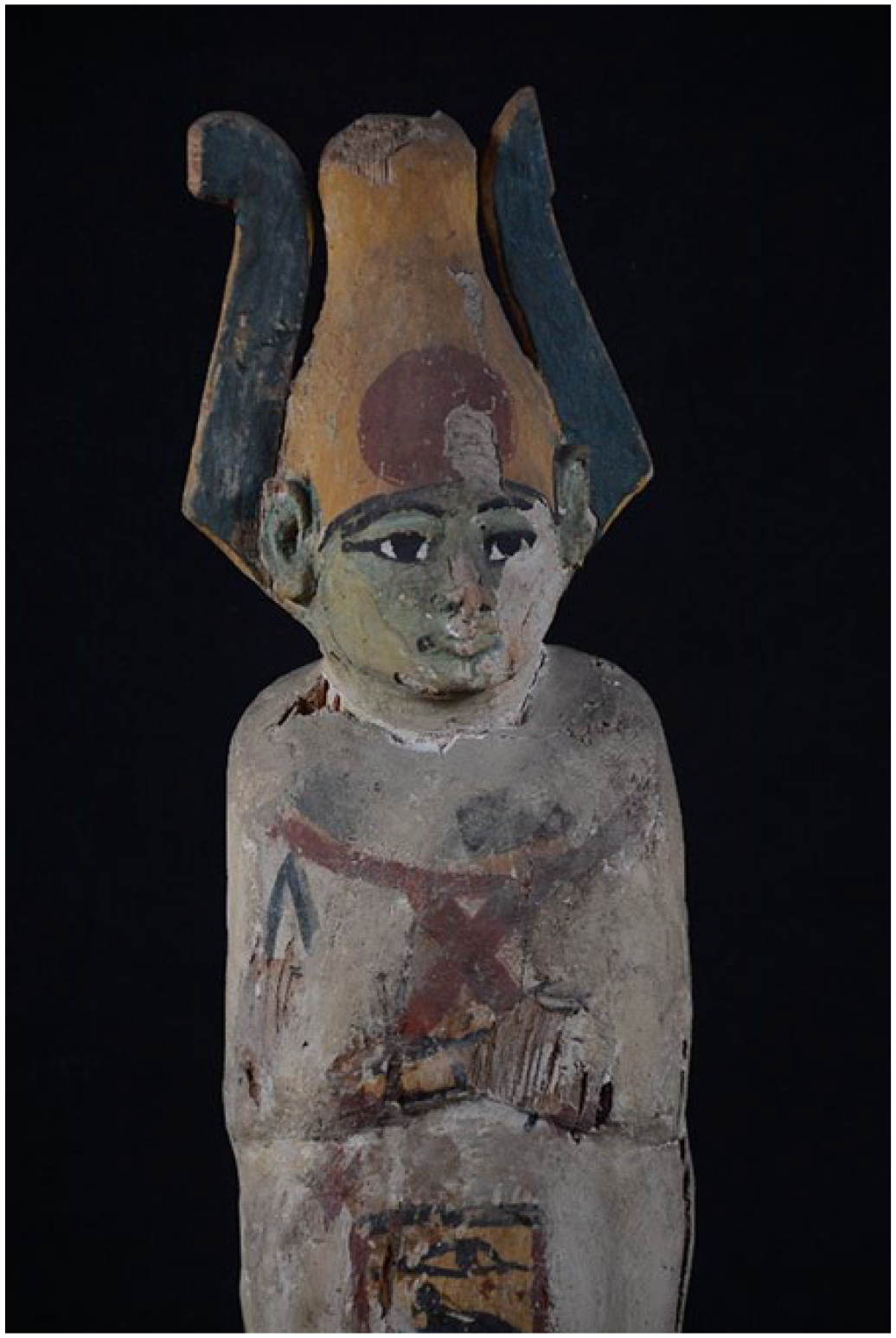
Osirian statuette of Duathathor-Henuttawy, JE 46948, details (photo: Sameh Abdel-Mohsen).
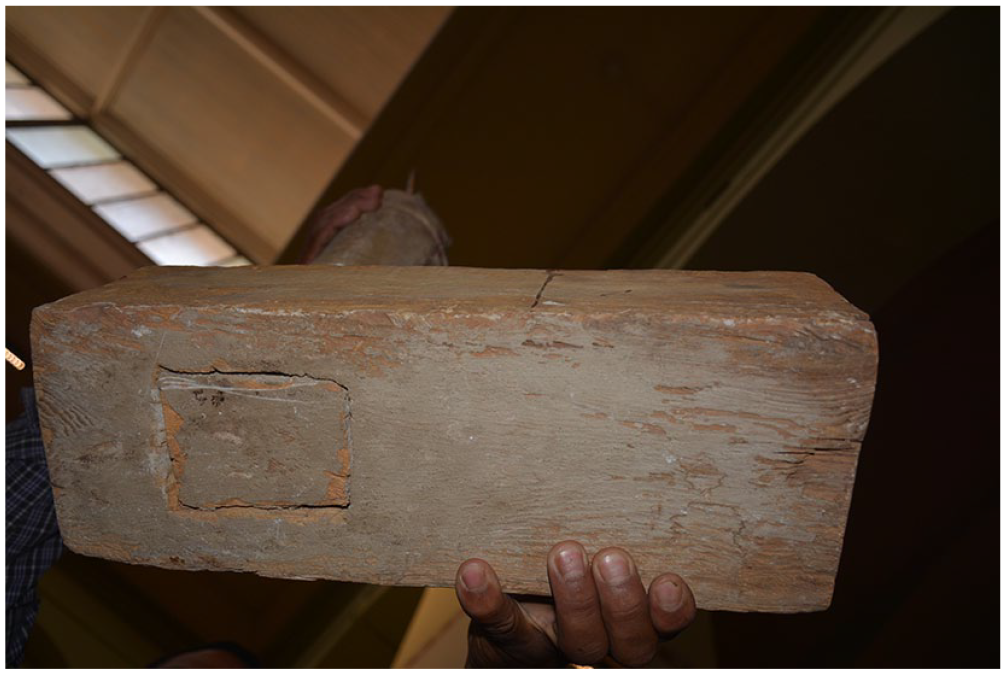
Osirian statuette of Duathathor-Henuttawy, JE 46948, stopper of the cavity (photo: Sameh Abdel-Mohsen).
Concluding Comments
Osirian statuettes became an essential element of the funerary furniture of the Third Intermediate Period. During the Twenty-First Dynasty, the most widely used type of these statuettes were the papyrus sheaths. The reasons for their popularity emerged from two necessities. One was finding a suitable place for the papyrus of the Book of the Dead since the papyrus of the Imduat was placed on the mummy, and the other was finding a secure place for the funerary texts as the tombs were no longer decorated at this time due to the weakening of the economy and security.
The three statuettes studied above belonged to three women of the priesthood of Amun of the Twenty-First Dynasty and therefore share many common characteristics. One of the specimens is of the type I C and the two others are of the type II D of Raven typology. Both types share several attributes as they belonged to the same period. Since all three statuettes were used as papyrus sheaths, they contain a hollow cavity that was plugged from the bottom of the base with a wooden stopper. All three were made of several pieces of wood joined together then painted over.
The arms and hands were carved in relief in all three statues in a crossed Osirian manner. However, the emblems held in their hands differ on all three. In statue JE 29314, they were made separately, likely of a different material, and are missing. On the two others, they were painted over.
The statuettes are therefore rich with Osirian symbolism, including the colours associated with his skin (namely green and black) and other colours related to him such as white, yellow and red. All three represent the god standing on a yellow base symbolizing the sand of the desert that was strongly associated with Osiris. The use of the atef crown on the three specimens reflects the strong association with the god Osiris, who was the god associated the most with this crown.
Although the three statuettes here studied belonged to women, they are represented as the male god Osiris. The preference of masculine attributes on the statuettes is likely related to the status gained by women of the priesthood of Amun during the Third Intermediate Period. Within the priesthood of Amun, women reached similar social statuses to the men as reflected in the burials of the period. 184 The use of the masculine attribute on the statuettes is thus a means to ensure the owner’s union with Osiris and to balance the feminine features represented on their coffin sets. 185
Evidence from one of the three statuettes studied here, JE 29316, indicates that these statuettes were not necessarily crafted under commission. They could be produced and only inscribed with the deceased’s name before the burial. There are also indications that each statuette was manufactured by more than one artist of differing levels of skill. Some artisans manufactured the bodies of the statuettes and others the bases, then the pieces were later assembled. This again points to the extent of their popularity, to the degree that required a relatively large-scale production.
Fortunately, this type of statue did not attract the attention of modern looters who preferred the papyri within and therefore the Osiris statues were mostly left undisturbed.
Footnotes
Acknowledgments
This contribution was prepared for publication through the author’s participation in the Mentoring for Egyptian and Sudanese Authors (MESA) scheme of the Egypt Exploration Society thanks to generous funding from their Patrons, with Rogério Sousa acting as a mentor to the author.
Funding
The author(s) received no financial support for the research, authorship, and/or publication of this article.
