



Abstract
In February 1890, the remains of around 180,000 mummified cats, weighing about 19.5 tons, were sent from Alexandria to Liverpool and sold at auction to be used as agricultural fertiliser. The mummies originated from a cemetery at Beni Hasan in Egypt. Analysis of contemporary reports in the British press allows this event to be examined in some detail, from the initial discovery of the cemetery and its commercial exploitation locally and internationally, to the popular and academic responses to it. The episode can also be linked to the wider commercial exploitation of mummified remains from ancient Egypt, including as tourist souvenirs, items in private collections, and their acquisition by public museums. Press reports reflected contemporary European attitudes to ancient and modern Egypt, but also domestic concerns with agricultural productivity.

Introduction
On 1 February 1890, the steamer Pharos of the Moss Line arrived in Liverpool from Alexandria in Egypt, carrying a cargo of mummified cats. According to contemporary press reports, these had been stripped of their bandages, and were the first instalment of a quantity to be imported as agricultural fertiliser. Weights given for the cargo varied between nineteen and 20 tons, the quantity of cats was estimated as 180,000 specimens, and they were said to date to around 2,000 BC, and to have been accidentally discovered by an Egyptian agricultural labourer in a cemetery about 200 miles from Cairo. 1 The cargo, and another which arrived later aboard the Thebes, were auctioned in Liverpool on two days. The mummies had been compacted to reduce the space taken up by the cargo, but some had survived reasonably intact, and a number of whole mummies, or mummy parts, were sold to buyers as museum specimens or curiosities.
The Discovery
The precise location of the cemetery from which the mummified cats came is uncertain, but specimens from it in what is now the Liverpool World Museum are identified as coming from Istabl Antar (Speos Artemidos).
2
Jaromir Malek has noted that: The cemeteries with extensive deposits of mummified cats at Istabl Antar (Speos Artemidos), south of Beni Hasan in Middle Egypt, have been subjected to large-scale pillaging and illicit excavating but they have never been scientifically examined. They are situated close to the mouth of a wadi near the rock-cut temple of the goddess Pakhet, commissioned by Queen Hatshepsut around 1470 BC.
3
The cemetery was discovered in 1888, and its exploitation was witnessed soon after by the art historian William Conway (1856–1937) while travelling along the Nile. 4 He wrote about it in an article for The English Illustrated Magazine, 5 and included an expanded description in his 1891 book The Dawn of Art in the Ancient World. 6 The discovery seems to have been an accidental one, by a local farmer, but may have been a result of illicit excavation. There are reports in the British press in January 1890 deploring the damage to tombs at Beni Hasan, with cartouches and other inscriptions being hacked out for sale, 7 and on Tuesday 25 February 1890, a question was asked regarding this matter in Parliament. In the House of Commons, Henry Howorth MP 8 asked Sir James Fergusson, Under Secretary for Foreign Affairs ‘whether it was true… that some person unknown had this winter been systematically mutilating the tombs of Beni Hassan in Egypt; that 25 Royal names had been erased and the heads of the principal figures abstracted’, citing a report made in a letter to The Academy, written by Lt. Col. Rose, Inspector-General of Irrigation in Egypt on 8 February 1890. 9
Conway says that the ancient cemetery was discovered in the summer of 1888, about a mile from the modern village, and just past the village’s cemetery. He describes the cat cemetery as being ‘a layer of them, a stratum thicker than most coal seams in a series of pits, ten to twenty cats deep’. Some mummies were ‘caked together in black lumps’, 10 but ‘now and again an elaborately plaited mummy turned up; still more rarely one with a gilded face (of such I myself found three lying about)’. There were also three bronze figures, two in the form of small cats, the third ‘a life-size bronze, a hollow casting, inside which the actual cat was buried. One or more bronze statuettes of Osiris, god of the dead, were likewise (I believe) found among the cats. All these objects are in the author’s possession’. 11 The cemetery was excavated by local people, with better preserved mummies being sold to travellers by village children. 12 He went on to describe what happened to the rest of the mummies.
Some contractor came along and offered so much a pound for their bones to make into something - soap, or tooth-powder, I dare say, or even paint. So men went systematically to work, peeled cat after cat of its wrappings, stripped off the brittle fur, and piled the bones in black heaps, a yard or more high, looking from the distance like a kind of rotting haycocks scattered on the sandy plain. The rags and other refuse, it appears, make excellent manure, and donkey loads of them were carried off to the fields to serve that useful, if unromantic, purpose.
13
A letter dated 30 January 1890 from Leventon & Co., the company who eventually bought the entire cargo of mummies, added the detail that ‘many of the cats were wrapped in cloth of gaudy colours & richly embroidered material, others in plain linen’. 14 The separation of bones from the mummies was not complete, as a number of partially intact ones survived to be sold in Liverpool, but along with compaction of the remains to minimise the space taken up by the cargo, it explains why there were so few of them. The resulting material was transported to Alexandria, from where it was shipped to Liverpool. Shipment was via two vessels of the Moss Line, Pharos and Thebes. 15 It was financed by the merchant bank Kleinwort, Benson, but when it arrived, their client, Messrs. Seventon and Co., refused to accept the cargo. Why is not clear, but Kleinworts then sent the cat mummy remains for sale at auction. 16 Although most of the mummies in the cemetery were those of cats, it appears that a small number of other species were represented as well. In a lecture to the Liverpool Biological Society on 16 February 1890, William Herdman, 17 Professor of Natural History at Liverpool University, said that the few specimens which he had been able to secure for the Zoological Museum of the University ‘were chiefly heads of cats, ichneumons, a dog, and some fragments of crocodile’. 18
The Sales
Reports in the contemporary press are the main source of information on both sales, but these reports are not always consistent. Although press coverage of the cat mummies was widespread throughout the UK, production pressures on daily papers would have meant that little time could be spent on fact checking, and the often strong similarity in reports across various titles suggests that where a source was not indicated, many papers rewrote, or simply used verbatim, copy supplied by news bureaux.
The Liverpool Journal of Commerce reported the Pharos as being in the Bramley-Moore dock at Liverpool on 1 February 1890, 19 and initial reports of an incoming cargo of cat mummies were carried by papers on 1 and 3 February 1890. 20 On 3 February, the Journal carried a single paragraph report noting the importation of the fragmented mummies for fertiliser, and humorously suggested that following this a syndicate was being formed to recover the chariots of the pharaoh of the Exodus from the Red Sea. A further report in the Journal the next day mentioned the Pharos and its cargo of ‘about twenty tons of embalmed cats, consigned to Messrs. Seventon and Co.’, but said that it had just landed in the Alexandra dock in Liverpool. It went on to say that the mummies ‘were knocked down for £3 13s 9d [£3.67] per ton’, indicating that the first sale had already taken place, with bidding being ‘brisk’. This report was picked up by a number of papers which cited the Journal as their source. 21 However, a letter from Leventon & Co. to Thomas J. Moore, Curator of the Liverpool Museum, dated 30 January 1890, not only gave information on the original discovery, but said that the results of a chemical analysis of the bones was expected ‘tomorrow’, indicating that the first sale might already have taken place. It was held at the salerooms of James Gordon & Co., and was described by one paper as being largely attended by trade buyers. The report also said that the auctioneer had used the head of one of the mummies as his hammer. 22
Although the first consignment shipped on the Pharos was stated to be 19.5 or 20 tons, this may be the total for both cargoes, as a figure of 8.5 or nine tons is given for the second consignment in several sources. 23 Similarly, it is most likely that the mummies sold for £3 13s 9d per ton (£3.67) in Liverpool, although some sources say that this was the price paid for them in Egypt. 24 As previously noted, the purchaser was Messrs. Leventon & Co., of Hackins Hey in Liverpool, ‘importers of bones from the different Mediterranean ports, and of guano’. 25 Shortly after the first sale, a number of press reports note that Thomas Moore and Reverend Henry Hugh Higgins (1814–1893) had dated the mummies to around 2,000 BC. 26 Moore was the first curator of the Liverpool Museum, much of which was originally based on the menagerie and natural history collection of the thirteenth Earl of Derby, of which Moore had been one of the curators, 27 while H. H. Higgins is now best known as a botanist, geologist, and authority on scientific classification, who travelled in Egypt in 1848. 28

Letter to the Liverpool Museum from Leventon & Co. Envelope (photo: National Museums Liverpool, World Museum).
Most accounts in the contemporary press relate to the second sale. The earliest report is dated 10 February 1890. 29 It said that there was ‘keen competition’, giving example prices, and saying that this consignment had been ‘pronounced inferior to the first batch’. It did not specify, but this probably referred to the preservation of the mummies, rather than their effectiveness as fertiliser. The same report, or extracts from it, was also republished in a number of other newspapers between 11 February and 16 February. 30 Further reports in a number of papers followed on 11 February, substantially the same, but with some variations. 31 The sale was of 8.5 tons of mummies (some sources say nine), shipped in 100 bags on the Thebes, and took place at noon in the offices at 9 Rumford Street of James Gordon and Co. The auctioneer, James Gordon, said that an article had been written on the mummies by ‘Professor Conway’, dating them as 3,000–4,000 years old. 32 The sale room contained a basket of bones as a sample of the cargo. Bidding began at £3 per ton, and finished at £5 17s 6d (£5.86), the auction again won by Leventon & Co. After the bones had been sold, a number (30 according to one source) of cat’s heads were sold. 33 Prices for these ranged from 1s 9d (8p) to 4s 6d (23p) each. 34 The heads were being sold because ‘the brokers had been deluged with letters asking if they would sell specimens as samples’. As the auctioneer worked up the bidding on the heads, he commented on the fact that many of them had been bought by a ‘Mr Gorst’, who the auctioneer alleged to laughter from the audience was planning to sell them to museums at £4 to £5 each. Some ‘old gentlemen – evidently scientists – who were in the room’ urged the auctioneer not to damage the intact mummy fragments by rough handling, and if the first sale had been business oriented, this one ‘from first to last evoked great merriment’, and there was a contrast between ‘the interest with which a few men of science looked upon the business as opposed to the banter indulged in by men of business’. 35

Letter to the Liverpool Museum from Leventon & Co. First page (photo: National Museums Liverpool, World Museum).

Letter to the Liverpool Museum from Leventon & Co. Second page (photo: National Museums Liverpool, World Museum).
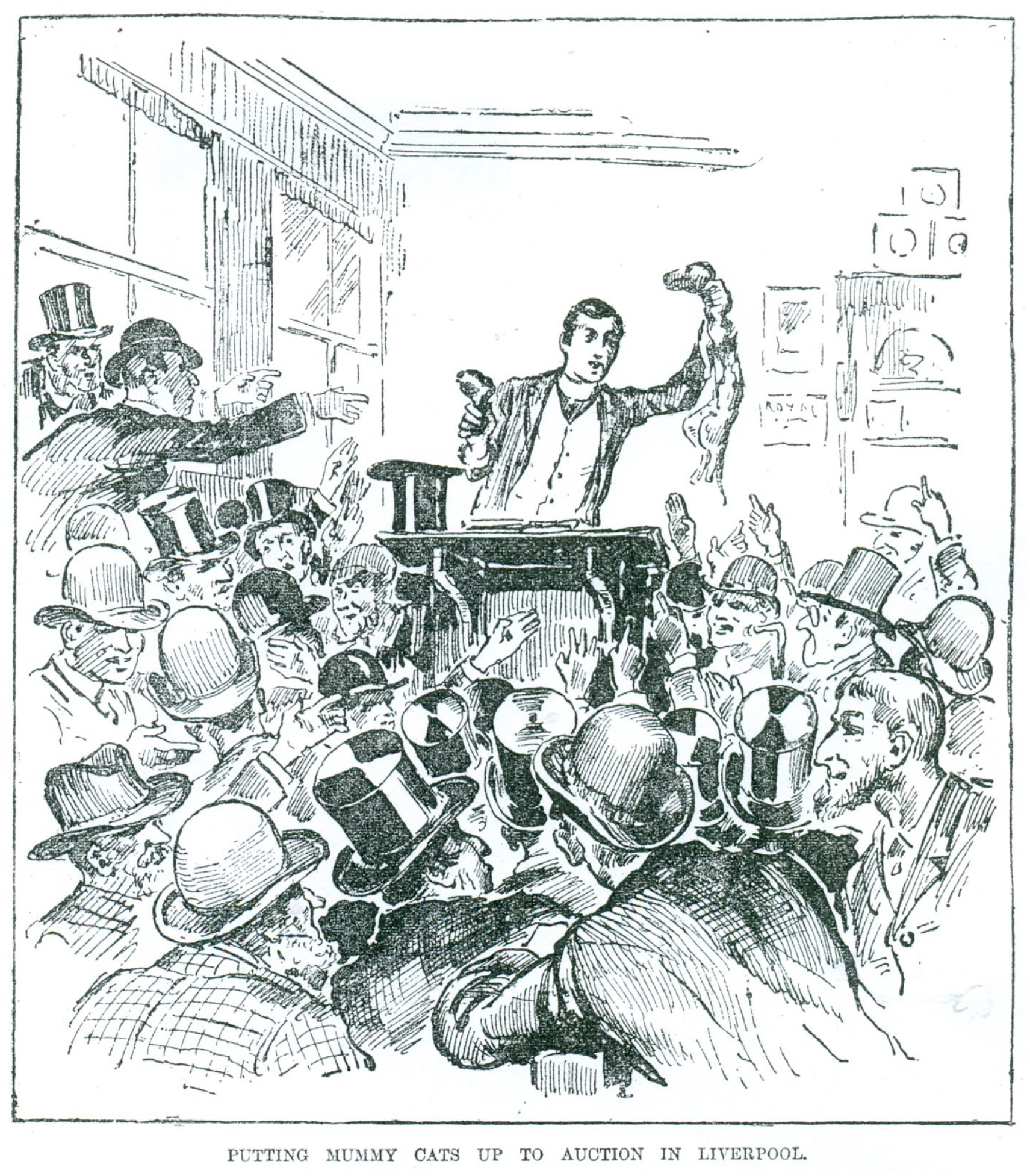
Illustration of the second cat auction held at James Gordon and Co., Rumford Street, Liverpool on 10 February 1890 (Daily Graphic, 12 February 1890; photo: National Museums Liverpool, World Museum; Mayer Collection Guard Book 2, 27).
Mummies for Manure
While the sale of these mummies for fertiliser in the United Kingdom may have been a one-off incident, there is some evidence to suggest that such use of mummies may not have been. Caution must be exercised with any claims about the use of mummies for commercial purposes. For instance, despite widespread references to mummy bandages or wrappings being used to produce paper, especially in the United States, it is unlikely that this ever happened, and certainly not on any significant scale,
36
although there was a trade for many years in mumia or mummy for medical purposes. However, in 1870 The Times of London carried a report from Cairo dated 28 December, from an anonymous special correspondent who said that: The other day at Sakhara I saw nine camels pacing down from the mummy pits to the bank of the river laden with nets in which were femora, tibia, and other boney bits of the human form, some 2cwt.
37
in each net on each side of the camel. Among the pits there were people busily engaged in searching out, sifting, and sorting the bones which almost crust the ground. On inquiry I learnt that the cargoes with which the camels were laden would be sent down to Alexandria and thence be shipped to English manure manufacturers. They make excellent manure, I was told, particularly for swedes and other turnips. The trade is brisk, and has been going on for years, and may go on for many more.
38
A few years later, J. C. McCoan’s book Egypt as It Is, in a chapter on commerce, noted that: Up to 1872 the shipment of Bones had formed a considerable feature of this branch of the Egyptian trade,- mummy bones contributing nearly as much as those of modern cattle to the yearly total of 10,000 tons sent chiefly to England. Since then, however, the pillage of tombs for this purpose has been prohibited, and the sugar refineries of the Daïra
39
now consume as much of this article as can be legitimately collected.
40
The date quoted is around the period covered by the Times report, and it is interesting that McCoan adds shortly after that ‘Rags, over and above the consumption of the Boulak paper mill, [were exported] to the yearly extent of 16,036 bales, also for the greater part to the all-absorbing market of Great Britain’, 41 without suggesting that any of these were from mummies. Adding weight to McCoan’s credibility as a source is the fact that his book was a detailed study of the administrative, commercial, and industrial condition of Egypt at that time, with considerable statistical information, which remained in print between 1877 and 1882. Also, McCoan founded the Levant Herald, and edited it for a number of years. 42 It was a bilingual periodical with a financial, economic and commercial focus on the territories of the Ottoman Empire, published between 1856 and 1914, changing its name on a number of occasions to evade Ottoman press censorship, which circulated in Britain and continental Europe as well as within the Empire itself. 43
Some years after McCoan’s book had appeared, the travel writer Constance Gordon-Cumming
44
wrote: how disgusted we all were when, among the vast supplies of bones brought to certain mills from Russian slaughter-houses, it was reported that human bones collected from Crimean battle-fields were freely mixed with those of cattle, and were all ground up together to enrich British soil!
She went on to comment on plague burial pits in London behind the National Gallery being dug up and spread over Kensington Gardens, and to remark, regarding modern Egypt: that, not content with converting the bones of thousands, and tens of thousands, of her ancestors into charcoal, to be used in refining sugar for their degenerate descendants and their foreign taskmasters, she must needs actually make merchandise of her dead. These precious mummies… now in the hour of Egypt’s degradation are valued at so much per ton, and sold to strangers and aliens as a suitable manure for foreign soil! As you journey towards Memphis [presumably from Alexandria], you might very recently have chanced to meet long strings of camels, heavily laden with human bone dust from the tombs. Here, too, from these old Alexandrian catacombs to the merchant vessels in the harbour, barges laden with brown dust ply to and fro; their cargo is carried on board in baskets, and thrown into the hold, and the vessels deliver their choice goods in British ports at 6l 10s [£6.50] per ton, to be mixed with the guano of Peru, and sold at a considerable profit. Several eye-witnesses have told us how they visited the ancient sepulchres while this work was going on, and saw pieces of human bone, small earthenware lamps, and tear-glasses, among the dishonoured dust of these myriad Egyptians, who were to be carried over the seas to fertilise English fields.
45
One report on the sale of the Beni Hasan cat mummies concluded by alleging, without identifying its source, that ‘it is stated on good authority that the remains of Egyptian mummified human beings have before now been ground in English mills for manure’. 46
Pharaohs and Fertility
While we might expect most coverage of the sale in the contemporary British press to focus on the ancient Egyptian origins of the cargo sold in Liverpool, two other themes which can be identified are whether mummies were effectively a natural resource to be exploited in the same way as guano, and whether new sources of fertiliser were urgently needed.
Opinions were divided on whether mummified remains from Egypt could be a long-term source of fertiliser. One paper saw the sale as something of an aberration: It is hardly probable that the singular deposits in what is now the Egyptian desert will long supply the insatiable demand of our agriculturalists for fertilisers; it is rather likely that purchase of ground mummy cats for manure by a farmer will remain as a memory and a tale to be told in days to come.
47
Another, however, was of the opposite opinion. ‘Those mummified Egyptian cats sold so well yesterday in Liverpool that further search in the cemeteries of Pharaoh-land is certain, as a response to an active commercial demand’, although it also thought that the bones in the second sale ‘considered purely as fertiliser for the agriculturalist… may not be a cheap speculation on the part of buyers’. 48 A third paper also shared this view, and suggested that the supply of cat mummies was effectively limitless.
Regarding the cat mummies which they have been bringing in tons from Egypt to Liverpool for manure, there should be no great difficulty, according to the report, in getting tons and tons of them, again and again. Millions of mummified cats, it is said, lie in the fields adjoining the remains of the Temple of Pasht or Bubastis. The cat was sacred to the goddess Pasht; and she had herself a cat’s head. From far and near her worshippers brought dead cats to be embalmed and buried at her shrine.
49
The idea that animal mummies found in Egypt were a natural resource to be exploited seems to have been voiced long before the arrival of the cargoes from Beni Hasan. One paper quoted a report in which the author, a British Member of Parliament named Leigh, (most probably Thomas Pemberton Leigh, 1793–1867) described their visit to catacombs of sacred crocodiles at ‘Maäbdeh’ in 1863.
The mountain, they said, was stuffed with them; [crocodile mummies] and it is possible. Assuredly the pits are a mine of nitrate; and this exportation of mummies for manure may effect one good thing at least, by causing them to be emptied. Treasures may lie beyond the vaults where these myriads of crocodiles are stored.
50
The quality of the mummies as fertiliser was mentioned in one of the first press reports, which incorrectly stated that the mummified cats were to be delivered ‘not in bulk, but in powder’ (the bones were processed after the sale) but went on to say of the final powder, ‘it being stated that this, when mixed with certain chemicals, forms an even better fertiliser than the much-talked-of nitrate’.
51
Another quoted an analysis, presumably the same one referred to by Leventon & Co. in their letter to the Liverpool Museum, which revealed that ‘Analysis of the mummified cats imported from Egypt shows that there is in each body an average of 36 per cent of Phosphate of Lime, and 6½ per cent of Ammonia’.
52
The supposed superiority of the cat mummies as fertiliser led to the humorous suggestion in one paper, subsequently reprinted in a number of others, that as nitrates ‘have not been going well lately’, this would lead to competing brands of cat mummy fertiliser, including: the Great Pyramid, the First Cataract, the Memphis, the Memnon, the Pharaoh, or the Joseph and his brethren; and it will equally be a matter of course that adulterated cat will be thrown upon the market, and pussie of the suburban cat-walk be pounded up and purveyed as ‘Pure Egyptian’.
53
Although the chemical analysis of the mummies carried out by Leventons was mentioned by the press, a belief in their superior quality as fertiliser might also have been a reflection of the values associated by the British public at this time with ancient Egypt.
Given the eventual use of the mummies as crop fertiliser, it was not surprising that a link was made to the popular trope of ‘mummy wheat’ – found in tombs and supposedly still able to germinate after thousands of years: We have not yet heard how mummy cat acts as a fertiliser. Mummy wheat is said to exhibit evidences of vitality thousands of years after it has been secreted in the wrappings of mummy humanity, but we doubt whether the cat, either as a cat or as a manure, will develop corresponding activity.
54
Whatever their actual quality as fertiliser, the sale of the mummies attracted attention in the context of concerns that the fertility of the soil generally was declining, and that new sources of fertiliser were needed. One paper suggested that ‘This incident shows that there is evidently good grounds for believing that the world’s stock of fertilisers is becoming scarce’ and referred to a letter on this topic in the Times the day before. 55 The letter was from Henry Kains-Jackson, 56 and set out his view that the earth was losing its fertility through over intensive agriculture, and that artificial fertilisers used to compensate for this were becoming increasingly scarce. 57 His letter was taken sufficiently seriously to warrant comment on it in an editorial, although this disagreed with his view. 58 A week later, The Times carried another letter from him responding to criticism of the first, and two others from writers disagreeing with his views. 59 Another paper on the same day carried a report on the cat mummy auction, immediately preceding which was a paragraph which quoted from a letter by ‘Mr H. Kains-Jackson’. In the letter he denied having said that there was great danger in the near future of the cultivated lands of Europe becoming exhausted, and said that ‘indeed, a silly jest has gone the round of the press in the past week quite to the contrary’, 60 but in another letter to The Times he again referred to the ‘silly jest’, which was to the effect that as the fertility of the Earth would not be exhausted for thousands or perhaps millions of years there was no need to worry because that was not in the lifetime of readers, complaining that it was not an adequate response to ‘an uncompromising thesis’.
A few days afterwards, a farming column in a regional newspaper quoted a report mentioning both the importation of the mummies as ‘the introduction of a new manure to our agricultural economy’, and ‘A writer in The Times [who] has been electrifying readers with considerations on the diminution of the earth’s primal fertility’. The writer, of course, was Kains-Jackson, and the quoted report was immediately followed by a piece discussing his theories and disagreeing with them. During this, the writer also noted that ‘The remains of Egyptian men have long been used as manure, and now we are putting Egyptian cats to a profitable use’. 61
Not long afterwards, a women’s magazine carried an article quoting from the letters by Kains-Jackson in The Times, which was immediately followed by another on the cargoes of cat mummies imported to Liverpool. Interestingly, bearing in mind the comments from Constance Gordon-Cumming previously quoted, the first article included a passage Kains-Jackson had quoted from the German scientist and pioneer of organic chemistry and nitrogen fertilisers Justus von Liebig, in which Liebig referred to the British trade in bones for fertilisers: ‘England,’ said Liebig many years ago ‘is carrying away from other countries the elements of their fertility. From the battlefields of Leipsic[sic], of Waterloo, the Crimea, the bones have been taken as from the catacombs of Sicily were taken the skeletons of numerous generations. Like a vampire, England flies at the throat of Europe, of the whole world, to suck the blood of nations.’ This strong language was applied by the Baron to the trade of this country in its efforts to obtain bones and bone-dust to replace the fertility absorbed by our intense system of cropping…
62
Mummies and Morality
Many press reports of the import and sale of the cat mummies treated the event as an amusing oddity, and took full advantage of the opportunity to indulge the Victorian love of puns, with the inevitable plays on ‘cat-acombs’, 63 the Egyptian discoverer being ‘a lucky fellah’, and suchlike. 64 But they also took it as an opportunity to draw moral lessons and make judgements both on those who imported the mummies, and the modern and ancient Egyptians.
This began some time before the arrival of the Beni Hasan mummies. In 1870, the humorous magazine Punch commented on an undated passage from the Echo, which in turn had mused on a report in the Times a week before of bones from mummy pits being taken to be made into fertiliser
65
and suggested that: ‘The rich fields of turnips and mangolds that will spring from the desiccated skeletons of CHEOPS’ subjects will in turn become prime beef and mutton, and Newgate Market will represent the final stage of this curious transmigration of bodies.’What a journey for our imagination to take, from Egyptian CHEOPS to London Chops!
66
Six years later, an article on Egypt by Arthur Arnold, probably the British Liberal politician and author of that name, reported McCoan’s figures on the export of mummy bones for fertiliser and expressed his opinion: That the bones of Cleopatra should be exported in a miscellaneous heap to fertilise an English turnip field is at least as shocking as that – ‘Imperial [sic] Caesar, dead and turned to clay, Might stop a hole to keep the wind away.’
67
The trope of sic transit gloria mundi, 68 and the allusion to Hamlet Act V Scene 1 was returned to after the arrival of the mummies.
Little did the Egyptians who so reverently preserved the remains of their four-footed deities think that these would yet be sent far from holy Father Nile to fatten the fields of a nation who knew not Joseph, nor any of the long line of Pharaohs… ‘To what base uses may not we return, Horatio?’ If there is anything incongruous about Caesar’s clay being used to turn aside the wind, there is even more in seeing the deified dust of so sacred an animal as the cat being used to supply the means of developing the monster turnip and the gigantic cabbage for an upstart nation.
69
The link between cats and the deities Pasht and Bastet was explored by a number of papers. Referring to the legends of agricultural gods like Bacchus and Ceres, one paper lamented that ‘The cat, on the other hand, is invited to transmute his, or her, divinity into anything which may please the proprietor of three acres and a cow. It is a sacrilegious idea to plant a deity and expect him to fertilise a turnip’.
70
The stories in Herodotus
71
of the veneration of cats by ancient Egyptians were invoked, but some writers made a point of contrasting this reverence with attitudes in modern Egypt. Constance Gordon-Cumming, who reported the transport of bones from mummy pits at Saqqara, expressed her opinion that: not content with converting the bones of thousands, and tens of thousands, of her ancestors into charcoal, to be used in refining sugar for their degenerate descendants and their foreign taskmasters, she [Egypt] must needs actually make merchandise of her dead. These precious mummies… now in the hour of Egypt’s degradation are valued at so much per ton, and sold to strangers and aliens as a suitable manure for foreign soil!
72
Her use of the phrase ‘foreign taskmasters’ acknowledged to some extent the economic exploitation of Egypt by European powers, but labelling the Egyptians themselves as degenerate could be used to justify such exploitation, and she was not the only writer to make this accusation. Another offered their view that ‘I am afraid the Egyptians of our day are a degenerate race, for they have no respect for the religious and historical traditions and monuments of their forefathers.’
73
The use of actual ground mummy (rather than substitute materials) as the basis for a particular shade of brown paint may not have been as common as it is often thought to be, but the belief that it was common led one paper to express its opinion that: As the Egyptians have previously been known to sell the mummies of their ancestors in order that they may be ground into brown paint, of which they are said to be an excellent basis, no wonder need now be felt that the remains of the many sacred animals to be found in their tombs should similarly be put to commercial use.
74
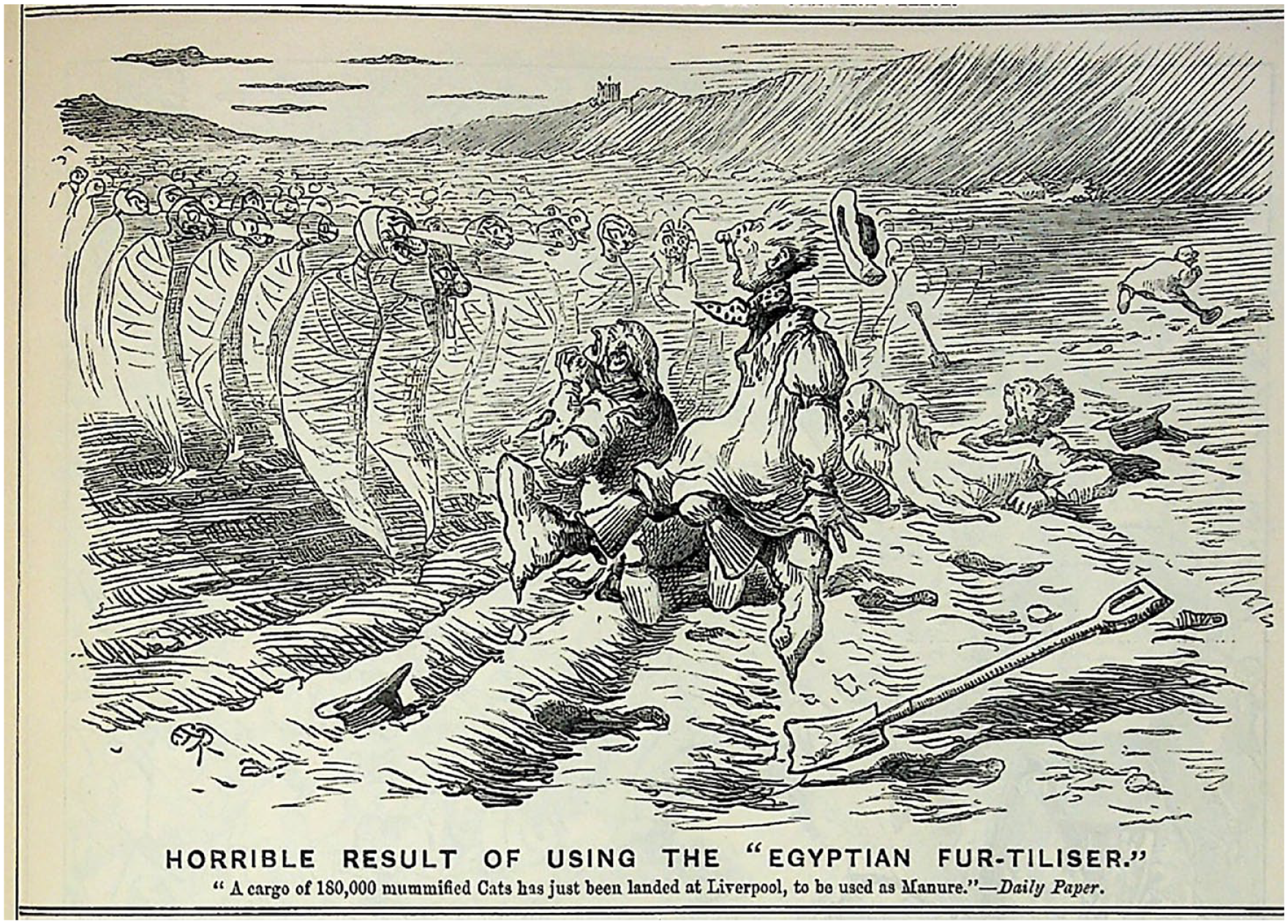
Punch cartoon, 15 February 1890: 81 (photo: author).
Some disquiet was expressed at the destruction of archaeological material involved in such use. One paper 75 noted that the discovery of the Beni Hasan cemetery ‘was regarded as one of much antiquarian interest’ but noted that this had not been enough to protect it, as ‘this is an age of rampant disrespect’, and ‘The disrespect for antiquities which the age exhibits is enough to make men shed salt tears!’, before contrasting it with the treatment of a recently unrolled mummy, and invoking the ‘Imperious Caesar, dead and turned to clay, Might stop a hole to keep the wind away’ line from Hamlet. Another publication noted that in the Colchester Museum, one embalmed cat was exhibited ‘as a treasure’, while 180,000 of ‘these holy beasts [had been] brought over to this country, after many centuries of solemn repose, to be cast upon the ground as manure’. It worked out their price as a tenth of a penny each, literally ‘ten a penny’ as the proverbial expression had it, but came to the conclusion that ‘they have been idle long enough, and we can only hope that they will be more useful in this country than they ever were in their own’. 76 Another writer suggested that ‘It is possible that Egypt may be made to re-imburse us for our modern expenditure in Egypt by sending us the mummies of her once semi-sacred cats’. 77
Somewhat surprisingly, there seems to have been little if any reference in the press to any supposed curse triggered by the impious exploitation of the mummies, with the exception of Punch, the leading comic magazine of its day, which featured a cartoon showing terrified agricultural workers fleeing the ghosts of the cats, with the title ‘Horrible Results of Using the “Egyptian Fur-tiliser”’. 78
Specimens and Curios
Most of the cargo imported into Liverpool was destroyed when it was processed as fertiliser, but the small number of fragments which were sold separately survived, and we can track the eventual fate of at least some of them. Seven specimens were donated to the Liverpool Museum by Leventon & Co. 79 Another is described as being acquired in 1890 by Miss Margaret Eleanor Moss, and donated by her in 1907 to the Liverpool Museum, 80 and a ninth was purchased from Cheltenham College in 1975, having been donated to the College by the Cheltenham Philosophical Institution at an unknown date. 81
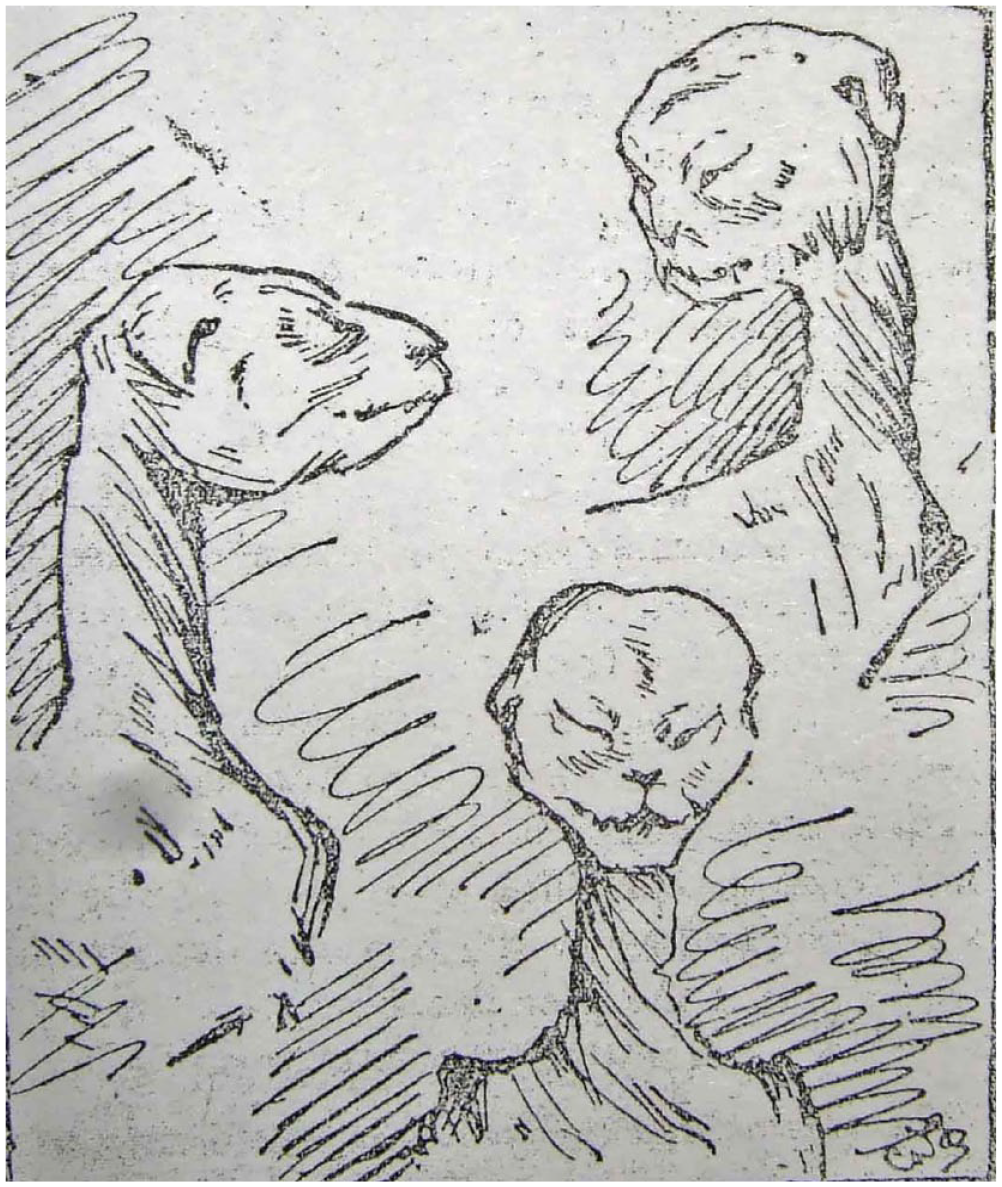
Sketch of specimens donated to Liverpool Museum (photo: National Museums Liverpool, World Museum).
Despite the claim made by one paper that ‘some of these [specimens] are in the British Museum’, 82 this does not seem to have been the case as no animal mummies are recorded in its collections database as coming from Beni Hasan. One skull (no. 90.3.7.1) was donated to the Natural History Museum, at that time the British Museum (Natural History) in 1900 via the Royal College of Science. 83
It is most probable that the rest of the specimens which were sold at the auctions went to commercial dealers, one of which may have been the Mr. Gorst referred to by the auctioneer. Some certainly ended up with a Liverpool dealer named Cross, as there were several advertisements of the firm offering mummified cat heads: Various. To those concerned. Recent arrivals MUMMY CAT’S HEADS 2,000 years before Christ; few specimens, 5s [£0.25] and 7s 6d [£0.36] each – Cross, Naturalist, Liverpool 8434.
84
Another appeared about two weeks later: Mummified cats heads. Recent arrival at Liverpool. A specimen 5s. [£0.25] 2000 years BC – Cross, Naturalist Liverpool. 70,000 bundles of Peacock’s feathers.
85

One of the specimens – 1978.291.400 (photo: National Museums Liverpool, World Museum).
Some of these heads would have gone to private collectors, but others seem to have been purchased by institutions, for example the one now in Liverpool originally acquired by the Cheltenham Philosophical Institution. A letter to a local paper in Wales suggested that the Museum Committee of the Bangor Corporation should try to acquire: one or two specimens of ‘mummified cats’ now on their way to Liverpool. The expense would not be great. A couple of complete cats could be obtained for 10s 6d [£0.51]. I understand that there are now on view at the University College some heads of these sacred but defunct animals; but I should prefer to view complete specimens.
86
The cats were referred to in a number of lectures, at some of which specimens of the mummies were displayed. These included Herdman’s lecture to the Liverpool Biological Society in February 1890, and in March of the same year Professor D’Arcy Thompson read a paper on ‘The Classical Names of Animals’ to the Dundee Branch of the Educational Institute of Scotland. A press report said that ‘The head of a mummy cat was exhibited, and he said it was an interesting problem to find out if it was really of the cat kind’. 87 While the head is not specifically said to be from the Beni Hasan mummies, the timing of the talk makes this a likely source. Later that month, Mr D. A. Boyd spoke to the Natural History Society of Glasgow about animal worship in ancient Egypt, and ‘exhibited a head of a mummied cat, from Beni-Hasas [sic]’. 88
Further reports of talks where cat mummies or heads were exhibited suggest links to the cargoes from Beni Hasan. In April 1890, at a meeting or ‘conversazione’ of the University Extension Society in North Shields, exhibits included the head of a mummified cat, but its origin was not specified. 89 In June of that year, the first South American Missionary Exhibition, a fundraising event held at Blackheath in London, included mummified cats from Egypt, and in July the ninth anniversary of the Lewisham Bridge branch of the British Women’s Temperance Association in south-east London was commemorated with a lecture ‘Through Egypt and up the Nile’. Miss Robinson, the lecturer, was accompanied by ‘four friends in Egyptian costumes’, and spoke for an hour on her trip to Egypt the previous year. ‘Egyptian curiosities’, including a mummified cat, were exhibited. 90 However, while the timing of both these events suggests that the mummies may have come from the Liverpool auctions, the general popularity of animal mummies as souvenirs for travellers in Egypt means that they may have been acquired there, and become items of particular interest after the publicity given to the imported mummies. There are mentions of cat mummies being exhibited at a number of charity fundraising bazaars during 1890, in Wrexham, Northampton, Nottingham, and Topsham, 91 but again while the timing is suggestive, they cannot be reliably attributed to the Liverpool cargoes.
Conclusion: Cats in Context
Today, the value of the surviving cat mummies of Beni Hasan is scientific and cultural, rather than economic. Looking at them in a wider context, however, reminds us of the often uneasy relationship between differing ways of valuing cultural artefacts of the past. Whether as tourist souvenirs or material for fertiliser, the contents of the cemetery at Beni Hasan were viewed at the time primarily in terms of their financial value. This in turn leads to questions about the scale and duration of the wider exploitation of other archaeological sites and mummified remains, including human ones. This article is based on reports in the English press, and a fuller analysis, in which the participation of Egyptian colleagues would be both welcome and important, would involve non-English language sources and Egyptian archives. However, research thus far suggests that such exploitation had been going on for some time on a significant scale well before the two cargoes of mummies were exported to Liverpool.
Public reaction to the eventual use of the Beni Hasan mummies, expressed through the press, draws on well-known tropes and stereotypes, particularly those relating to mortality and the supposedly decadent successors of ancient empires. Both, as reminders of the disintegration of great empires of the past, can be seen as reflecting insecurities about those of the present, including their ability to feed themselves, and claims that modern Egyptians were failing to value their heritage made it easier to justify economic, as well as cultural, exploitation. Although a formal protectorate was not established by Britain in Egypt until 1914, British forces had intervened there already in 1882, leading to the occupation and so-called ‘veiled protectorate’.
The story of the cat mummies of Beni Hasan, of course, is also a reminder of how much the history of objects now in museums continued, and still continues, to accumulate beyond their original creation and use.
Footnotes
Acknowledgements
I am grateful to Dr Ashley Cooke for his assistance with information on material in the collections of the Liverpool World Museum, and for permission to reproduce images of one of the mummified cats, a contemporary sketch of others, and of the auction in 1890; to Prof Martin Bommas for information on Beni Hasan and the Speos Artemidos site; and to Dr Nicky Nielsen, whose online lecture on the cat mummies and their use as fertiliser prompted me to revisit this topic.
Funding
The author did not receive funding for this project.
1.
The original report on these cargoes seems to have been in the Liverpool Journal of Commerce for 4 February 1890. Reports citing it, without a page reference, were carried by a number of regional papers including the Aberdeen Weekly Journal, 4 February 1890: 6. ‘Novel importation’.
2.
Liverpool World Museum: 15.2.07.2a; 1976.159.273; 1978.291.400, .402, .403, .405, .410, .412, .413.
7.
E.g., Leeds Mercury, 22 January 1890: 3. ‘Literary and art gossip’.
8.
Henry Hoyle Howorth, 1842–1923. Conservative politician, amateur historian and archaeologist, and a Trustee of the British Museum.
9.
Morning Post, 26 February 1890: 3. Content is not available for Hansard between 22 December 1888 and 2 May 1890, including the date of Howorth’s question.
12.
Conway 1891: 182; and see  : 27, which notes the suitability of animal, rather than human mummies, as tourist souvenirs.
14.
See figs 1–.
15.
Aberdeen Weekly Journal, 4 February 1890: 6. ‘A novel importation’.
16.
18.
Herdman 1889/90: 95–96.
19.
Liverpool Journal of Commerce, 1 February 1890: 2.
20.
Birmingham Post, 1 February 1890: 5. ‘London correspondence’; Belfast Newsletter, 3 February 1890: 5. ‘A new industry’.
21.
Liverpool Journal of Commerce, 4 February 1890: 5. ‘A novel importation’. Other papers, e.g., Aberdeen Weekly Journal, 4 February 1890: 6. ‘A novel importation’; Hull Daily Mail, 4 February 1890: 4. ‘A novel importation’; Morning Post, 4 February 1890: 5. ‘A consignment of mummified cats’; Sheffield Daily, 4 February 1890: 4. ‘Importation of dead cats’.
22.
Leicester Chronicle, 8 February 1890: 3. ‘A curious cargo’.
23.
E.g., Bristol Mercury, 11 February 1890: 6. ‘Sale of feline mummies: Amusing scene’.
24.
E.g., Dundee Courier and Argus, 4 February 1890: 3. ‘A queer importation’.
25.
Leeds Mercury, 11 February 1890: 5, 8. Guano is accumulated excrement, usually of seabirds, commercially exploited for fertiliser.
26.
Daily Telegraph, 4 February 1890: 3; Leicester Chronicle, 8 February 1890: 3. ‘A curious cargo’.
29.
Edinburgh Evening News, 8 February 1890: 3. ‘Selling the mummified cats’.
30.
E.g., Birmingham Daily Post, 11 February 1890: 6; Reynold’s Newspaper, 16 February 1890: 8. ‘The trade in mummified cats’.
31.
Typical of these is Bristol Mercury, 11 February 1890: 6. ‘Sale of feline mummies’.
32.
33.
Leeds Mercury, 11 February 1890: 5, 8. ‘Mummified cats as manure’.
34.
35.
Bristol Mercury, 11 February 1890: 6.
37.
Cwt. (centum weight) is the abbreviation for hundredweight, which was equal to 112 lbs, roughly 50.8 kg.
38.
The Times, 7 January 1870: 8. ‘Egypt – from our special correspondent.’
39.
Khedival estates. Bone charcoal was used in sugar refining, particularly to decolour the sugar.
46.
Bristol Mercury, 11 February 1890: 6.
47.
Liverpool Mercury, 11 February 1890: 5.
48.
Leeds Mercury, 11 February 1890: 5.
49.
Edinburgh Evening News, 25 February 1890: 3. ‘Mummy cats’.
50.
Manchester Times, 15 March 1890: 6. ‘Miscellaneous extracts’. ‘The cave of the crocodiles’, quoting an undated extract from Saint James’s Gazette.
51.
Birmingham Post, 1 February 1890: 5. ‘London correspondence’.
52.
Edinburgh Evening News, 11 February 1890: 3. ‘News’.
53.
Sheffield Star, 4 February 1890: 4. ‘Importation of dead cats’.
54.
Newcastle Courant, 15 February 1890: 2. ‘Timely topics’.
55.
Liverpool Journal of Commerce, 4 February 1890: 5.
56.
Kains-Jackson edited the 1879 Farmer’s and Gardener’s Almanack, published from the offices of The Farmer magazine. He also seems to be the author of The Fields of Great Britain, an 1890 agriculture textbook.
57.
The Times, 3 February 1890: 13.
58.
The Times, 3 February 1890: 9.
59.
The Times, 11 February 1890: 7. ‘The earth losing fertility’.
60.
Daily Telegraph, 11 February 1890: 2.
61.
Bucks Herald, 15 February 1890: 3; quoting Leeds Mercury, n.d.
62.
The Ladies Treasury, March 1890: 154. ‘Matters of the day’.
63.
Fun, 12 February 1890: 70. ‘A fortunate cat-astrophe.’
64.
Burnley Express, 8 February 1890: 4.
65.
The Times, 7 January 1870: 8. See fn. 35 above.
66.
Punch, 15 January 1870: 12. ‘Alexandria to Smithfield’.
67.
Cassell’s Family Magazine, Annual Volume for 1876: 633–635. ‘Egypt of today’.
68.
‘Thus passes the glory of the world’.
69.
Dundee Courier and Argus, 4 February 1890: 2. ‘Feline antiquities’; Dundee Courier and Argus, 4 February 1890: 3. ‘A novel importation.’
70.
Sheffield Star, 4 February 1890: 4. ‘Importation of dead cats’.
71.
Godley 1920: 2.66–67.
73.
Wrexham Advertiser, 8 February 1890: 7. ‘Jottings from London’.
74.
Birmingham Post, 1 February 1890: 5. ‘London correspondence’.
75.
Sheffield Evening Telegraph, 6 February 1890: 4. ‘Importation of dead cats’.
76.
Essex Standard, 8 February 1890: 5.
77.
The Ladies Treasury, March 1890: 154. ‘An extraordinary class of fertilisers’.
78.
Punch, 15 February 1890: 81. ‘Horrible results of using the “Egyptian fur-tiliser”’.
79.
Liverpool World Museum: 1978.291.400, .402, .403, .405, .410, .412, .413.
80.
Liverpool World Museum: 15.2.07.2a.
81.
Liverpool World Museum: 1976.159.273.
82.
Worcestershire Chronicle, 8 March 1890: 1. ‘Notes by citizen’.
84.
Bristol Mercury and Daily Post, 25 February 1890: 2. Advertisement.
85.
Bristol Mercury, 13 March 1890: 2. Advertisement.
86.
North Wales Chronicle, 15 March 1890: 5. ‘Bangor Museum’.
87.
Dundee Courier, 3 March 1890: 2. ‘Letters to the Editor’.
88.
Glasgow Herald, 28 March 1890: 6. ‘Natural History Society of Glasgow meeting’.
89.
Shields Daily Gazette, 24 April 1890: 3. ‘North Side news’.
91.
Wrexham Weekly Advertiser, 15 February 1890: 5. ‘Bazaar at Rhosddu’; Northampton Mercury, 29 March 1890: 1. ‘Local chit-chat’; Nottingham Evening Post, 15 April 1890: 3. ‘Missionary loan exhibition in Nottingham’; Western Times [Exeter], 24 July 1890: 4. ‘Bazaar at Topsham’.