



Abstract
Introduction
This study examines parents’ perceptions of environmental factors in home, school and community settings on daily functioning of adolescents with executive function deficits. The aim was to map environmental supports and barriers and identify factors that predict functioning.
Method
Parents of 81 adolescents (10–14 years) completed the Behavior Rating Inventory of Executive Function, Participation and Environment Measure for Children and Youth (PEM-CY) part B and Child Evaluation Checklist (CHECK). We used the BRIEF scores to form a group of adolescents with executive function deficits (n = 41) and a matched group with typical development (n = 40). Correlation and discriminate analyses compared environmental factors across groups (PEM-CY) and identified those that predict daily functioning (CHECK).
Results
Compared to parents of adolescents with typical development, parents of adolescents with executive function deficits reported significantly more environmental barriers than supports (PEM-CY). School and community social demands of activity predicted the adolescents’ current daily functioning (CHECK).
Conclusion
Cognitive and social demands of activities appear to be common factors that limit functioning of adolescents with executive function deficits in home, school and community environments. The PEM-CY part B can promote awareness of the main support and barrier factors and help focus goals for efficient intervention programmes for these adolescents.
Keywords
Introduction
Adolescence is considered a time of enormous change and transition towards independent and responsible adulthood, and entails adjustments in personal goals and motivation (Crone and Dahl, 2012). Adolescents can prepare for successful and meaningful adult lives through regular opportunities for participation in positive developmentally appropriate life experiences (Gorter et al., 2011). Participation, defined as ‘involvement in life situations’ or ‘engagement in daily activities’ (World Health Organization, 2007), occurs naturally when individuals are actively involved in occupations (daily life activities) they find purposeful and meaningful (American Occupational Therapy Association, 2014). Participation in meaningful activities helps adolescents build a strong connectedness to their communities, expand their social roles and, in turn, facilitate their readiness for adulthood (Gorter et al., 2011).
However, adolescents with executive function deficits (EFD) characterised by extremely challenging participation demands often struggle to organise and self-regulate their daily functioning in different environments (Josman and Rosenblum, 2018). Executive functions (EFs) are defined as a set of neurocognitive processes that allow individuals to achieve short and long-term goals, particularly when environmental demand changes require those individuals to adjust their thinking and actions (Crone and Dahl, 2012). Thus, delays in attaining EF skills can interfere with an adolescent’s ability to manage and complete daily tasks successfully and navigate ineffective social interactions with the environment, leading to significant and lasting cognitive, academic and social difficulties (Jacobson and Mahone, 2012).
Adolescents with EFD often present as disorganised, lacking initiative and forgetful. Often described as lazy or procrastinators, they have difficulty starting assignments or may persevere at one task until completed. They may struggle to shift between activities, prioritise important tasks, manage time and meet deadlines. They require frequent prompts and cues and typically react better with visual reminders when expected to do more than one task at a time (Otero et al., 2014).
Environmental factors affect individuals’ access to occupations and the quality of and satisfaction with performance. However, recent studies have shown that parents of adolescents with disabilities report significantly fewer environmental supports and more environmental barriers to their children’s participation than do parents of children without disabilities (McCauley et al., 2013). For example, Fogel et al. (2019) found that compared to adolescents with typical development, parents of adolescents with EFD perceived their children as having lower functioning and less participation in home, school and community environment activities and, therefore, less involvement in them, according to the parent-reported Child Evaluation Checklist (CHECK), which helps identify the level of functioning (Rosenblum, 2012).
Despite recent interest in these environmental factors, little research has examined the impact of the environment on participation with a focus on specific environmental factors, different settings, or diverse populations in terms of age or difficulties (Anaby et al., 2013). Some studies reported on environmental factor differences between children with and without extensive disabilities (for example, Bedell et al., 2013). However, specific evidence remains scant about differences in the environmental factors themselves among adolescents with EFD characteristics or about their relationships to their daily functioning.
In qualitative meta-syntheses of environmental factors that support or delay the daily functions of adolescents with difficulties (McCauley et al., 2013), three factors emerged as most strongly influencing participation: adult and peer understanding of individual abilities and needs, decisions regarding accommodation, and quality of services and policies (Kramer et al., 2012). Anaby et al. (2013) found that the most common participation facilitators involved geographical location and support of family and friends; the most common barriers included attitudes, physical environment, transportation, politics and lack of staff and service-provider support. Stewart et al. (2014) recognised six sub-themes in which interactions contribute to transitional complexities for adolescents with disabilities: early childhood and adolescent experiences, inclusion and attitudes, building capacities, providing information about transitions, services and support, and policy.
Coster et al. (2012) designed the Participation and Environment Measure for Children and Youth (PEM-CY) to deal with these transitional complexities, to link participation to environmental factors across home, school and community settings and to assess children’s participation across broad personal dimensions. In developing the PEM-CY, they considered the perspectives of caregivers of children with varied disabilities. Thus, the PEM-CY lists the most common and important environmental factors respondents mentioned, many of which the international classification of functioning, disability and health – child and youth version of the World Health Organization (2007) also lists: physical layout (amount of space and furniture), sensory qualities (sound, light, temperature and object textures), child’s relationships with family members, attitudes, services, supplies, information and money. Furthermore, within each environment, the PEM-CY factors reflect potentially modifiable factors that might facilitate successful participation: the activity’s physical (strength, endurance, coordination), cognitive (concentration, attention, problem-solving), social (communication, interaction with others) and time demands.
The extensive research of Fogel et al. (‘Daily participation patterns of adolescents with and without executive function deficit: parents’ perspectives’, submitted) analysed and reported differences in participation (frequency and involvement) according to the PEM-CY. As a part of that larger study, the main aim of this present study was to determine, compare and analyse characteristics of environmental factors that may affect adolescents with or without EFD, as perceived by their parents. In this smaller study, we analysed environmental factors from only part B of the PEM-CY. Specific study objectives were to determine:
differences between adolescents with and without EFD in terms of supports and barriers in home, school and community environments; whether environmental factors from the PEM-CY can predict participants’ functioning and study classification; connections between the environmental factors and daily functioning of participants with EFD, as measured by the CHECK; and whether environmental factors can predict daily functioning of participants with EFD, as measured by the CHECK in the group with EFD.
Method
Participants
Study participants were recruited through published community advertisements aimed towards adolescents aged 10–14 years with and without daily functioning difficulties, including those with single, multiple or no formal diagnoses. However, potential participants with known psychiatric or emotional disorders, autistic spectrum disorders, physical disabilities or neurological diseases were excluded.
As an inclusion criterion, the adolescent respondents performed two subtests from the Wechsler Intelligence Scale for Children (WISC-R; Wechsler, 1998), with a score of higher than 5 required for inclusion. All 81 respondents met the criteria, and they and their parents were invited to participate in the study.
After acceptance into the study, the parents completed the Behavior Rating Inventory of Executive Function (BRIEF; Gioia et al., 2000), a demographic questionnaire, and the CHECK (Rosenblum, 2012) to provide data regarding their children’s current daily functioning. The participants were divided into two groups – one, 41 adolescents with EFD; the other, 40 adolescents with typical development (TD) – according to the BRIEF scores. In particular, inclusion in the research (EFD) group required the adolescents to score a minimum of 65 (outside normal range) on the metacognition (MI) or behavioural regulation (BRI) composite indices of the parents’ BRIEF reports. Inclusion in the control (TD) group, matched to the group with EFD by the adolescents’ age and gender, required index scores below 65.
Ethics
The University of Haifa ethics committee approved this study. All respondents and their parents signed written informed consent forms for participation.
Instruments: inclusion criteria
WISC-R (Wechsler, 1998), Hebrew version
The adolescent respondents completed the WISC-R as an initial inclusion criterion. The WISC-R assesses intellectual functioning with vocabulary and block design tests aimed primarily at ruling out mental retardation.
BRIEF (Gioia et al., 2000)
We used scores of the parent-reported BRIEF as a criterion for division between the group with EFD and the control group (with TD). The BRIEF includes 86 questions in five cognitive subscales (initiation, working memory, plan-organise, organisation of materials and monitoring) and three behavioural subscales (inhibit, shift and emotional control). These eight subscales form two composite indices (MI and BRI) and one composite score, the global executive composite. The results are expressed in t-scores (higher scores reflect more problematic behaviour). A t-score of 65 or higher is considered within the clinical range. Mean internal consistency ranges from 0.82 to 0.98, and test–retest correlation ranges from 0.72 to 0.84.
Instrument: participant characteristics
Demographic questionnaire
Parents completed the demographic questionnaire, which includes information about the adolescent’s age, gender and parents’ education and socioeconomic status.
Instruments: current daily functioning assessment
CHECK (Rosenblum, 2012)
Functional information was collected from the CHECK, which helps identify developmental delays based on parental reports. This tool includes two parts. The CHECK-A reports the child’s current level of functioning, with a focus on frequency, using 32 statements rated on a Likert scale from 1 (never) to 4 (always). Example statements include, ‘Completes tasks he or she takes upon him or herself’ and ‘Correctly estimates difficulty of the task’. The CHECK-B also rates the participant’s functioning, but with a focus on a comparison to expectations for same-aged peers. It uses 12 statements rated from 1 (low) to 5 (high). Example items include, ‘Compared to other children, the overall functioning of my child is…’ and ‘In the area of work habits, the overall functioning of my child is…’. An average score was calculated for each part. Internal consistency was α = 0.96 for CHECK-A and α = 0.94 for CHECK-B. Construct validity was established and documented in previous papers (Josman and Rosenblum, 2018).
Outcome measure: PEM-CY (Coster et al., 2012)
Parents completed the PEM-CY as the primary outcome measure, and the results are presented in terms of the adolescents (‘participants’). In PEM-CY part B – the focus of this study – parents are asked whether certain environmental features help or make it harder for their children to participate in activities in each of three settings: home, school and community. If parents report a feature as helping, then it is coded as a support factor; if they report it sometimes or usually makes things harder, then the item is coded as a barrier factor. The internal consistency of the PEM-CY was moderate to good for participation frequency (α = 0.59–0.70) and participation involvement (α = 0.72–0.83) summary scores. Test–retest reliability was reported as moderate to good for all participation and environment summary scores, with interclass correlation (ICC) from 0.58 to 0.95 and across items within the home, school and community sections of the instrument (ICC = 0.68–0.96).
Data analysis
We conducted descriptive analyses (mean, standard deviation and percentages) to identify the main demographic and inclusion characteristics of the adolescents (henceforth called participants) in each group; t-tests to examine the BRIEF total and index scores and multivariate analysis of variance (MANOVA) for the WISC-R95 assessment and CHECK questionnaire. Differences between the groups in gender and other sociodemographic variables were examined with chi-squared tests.
The barrier and support items identified from the PEM-CY environmental factors in home, school and community settings were also examined using chi-squared tests and the percentage in each group. Cramer’s V (V) range labels were used to describe the magnitude or association between the environmental factors in each environment. Values of the V description labels were small (≤0.2), medium (0.3–0.5) and large (≥0.6; Cohen, 1988). Discriminant analyses were conducted to determine which variables best predicted group membership.
Spearman correlation analyses were used to examine correlations between high effect-size environmental factors and the participants’ daily performance according to their parents’ reports in CHECK. We applied stepwise linear regression analysis – which automates the choice of predictive variables and removal of unimportant variables – for PEM-CY environmental factors to identify the strongest predictors of the daily functions of the group with EFD.
Results
Participant characteristics
As depicted in Table 1, the group with EFD (n = 41) included 29 (70.7%) boys and 12 (29.3%) girls with a mean age of 11.88 (standard deviation (SD) = 1.08) years. The group with TD (n = 40) included 28 (70%) boys and 12 (30%) girls with a mean age of 12.19 (SD = 1.08) years. Both groups were within the average range (10) of the two WISC-R95 subtests. Significant functional differences were found between groups in the CHECK questionnaire scores [F(2, 38) = 156.14, P<0.001, η2 = 0.8] and BRIEF indices, with a lower mean in the EFD study group ([F(2,78) = 11.30, P<0.001, ηp2 = 0.23]): BRI (t(79) = 11.73, P<0.001), MI (t(79) = 17.1, P<0.001) and global executive composite (t(79) = 19.44, P<0.001).
Participant characteristics in each study group.
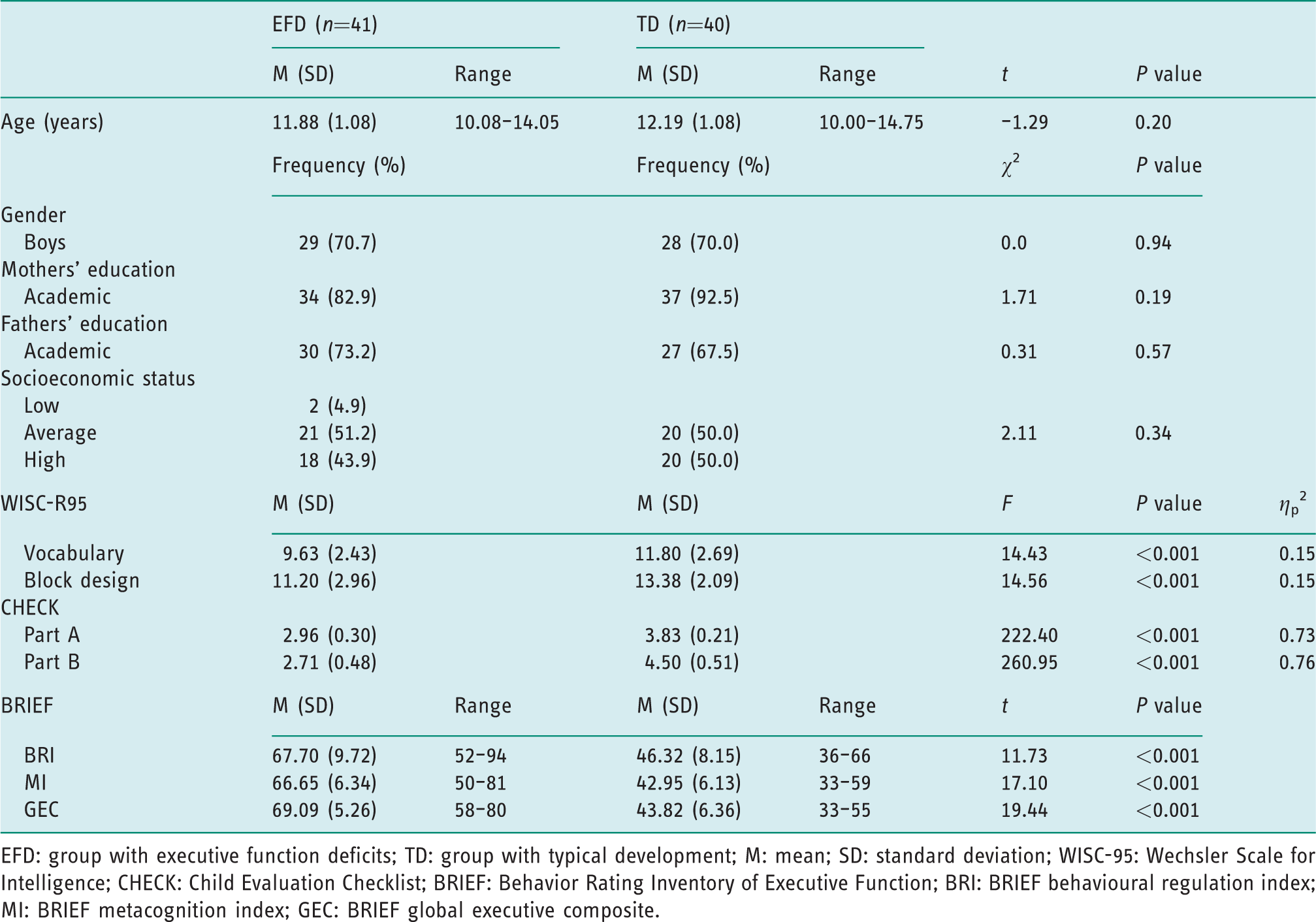
EFD: group with executive function deficits; TD: group with typical development; M: mean; SD: standard deviation; WISC-95: Wechsler Scale for Intelligence; CHECK: Child Evaluation Checklist; BRIEF: Behavior Rating Inventory of Executive Function; BRI: BRIEF behavioural regulation index; MI: BRIEF metacognition index; GEC: BRIEF global executive composite.
Predicting group classification by PEM-CY environmental factors
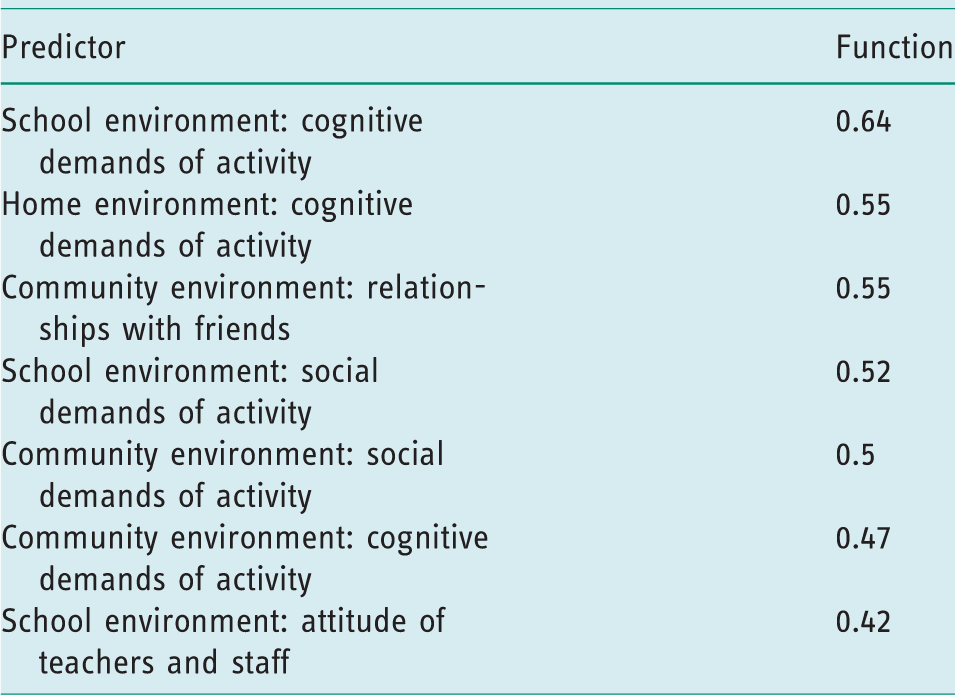
Discriminant function was calculated for environmental factors having a high effect size. Their group classification was found to be significant (Λ = 0.3, P<0.001), with all variables providing a high contribution to group membership (loading range 0.42–0.64). Values for all environmental factors are presented in Table 2. Based on these functions for the PEM-CY environmental factors, 91.4% of the study participants were correctly classified into their respective groups (in particular, 90.2% of participants in the group with EFD and 92.5% in the group with TD). A kappa value of 0.83 (P<0.001) was calculated, demonstrating that group classification did not occur by chance.
Discriminant analysis structure matrix: predictors’ loading value (home, school and community environments).
Environmental supports and barriers: home environmental factors
Figure 1 illustrates significant group differences found in home environment barrier items. For example, 70.7% of parents of adolescents in the group with EDF rated cognitive demands of activity as limiting their children’s participation versus 7.5% of parents of adolescents in the group with TD. This pattern was similar for social demands of activity (61.0% vs. 2.5%), time (53.7% vs. 25.0%) and money (36.6% vs. 7.5%). No significant group differences were found for physical demands of activity, information or services. These may constitute support resources for parents of adolescents with EDF.
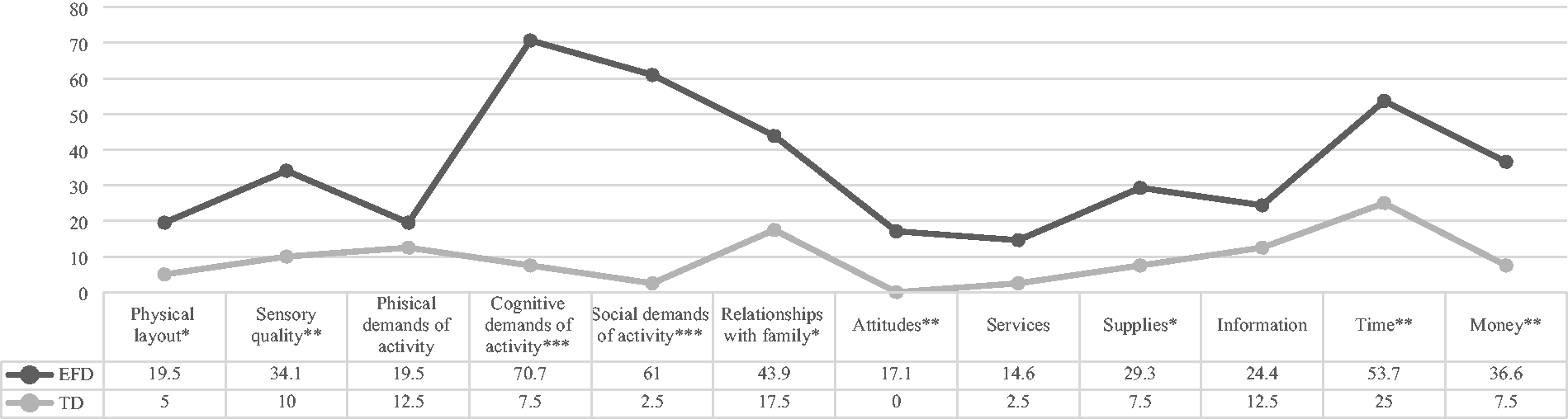
Differences between groups in home environment barrier items, (percentage and χ2). EFD: group with executive function deficits; TD: group with typical development. *P<0.05; **P<0.01; ***P<0.001.
School environmental factors
Figure 2 illustrates significant group differences found in school environmental factor barriers items. For example, 82.9% of parents of adolescents with EDF noted that cognitive demands of activity limited their children’s participation versus 12.5% of parents of adolescents with TD. This pattern was similar for social demands of activity (61.0% vs. 2.5%), attitudes of teachers and staff (58.5% vs. 7.5%), relationships with peers (53.7% vs. 10.0%), school policies and procedures (43.9% vs. 2.5%), supplies (43.9% vs. 2.5%), information (26.8% vs. 5.0%), time (26.8% vs. 2.5%) and money (39.0% vs. 12.5%). Similar to the home environment, we found no significant differences between the perspectives of parents of adolescents with and without EDF in physical demands of activity, which may constitute a support resource for parents of adolescents with EDF.
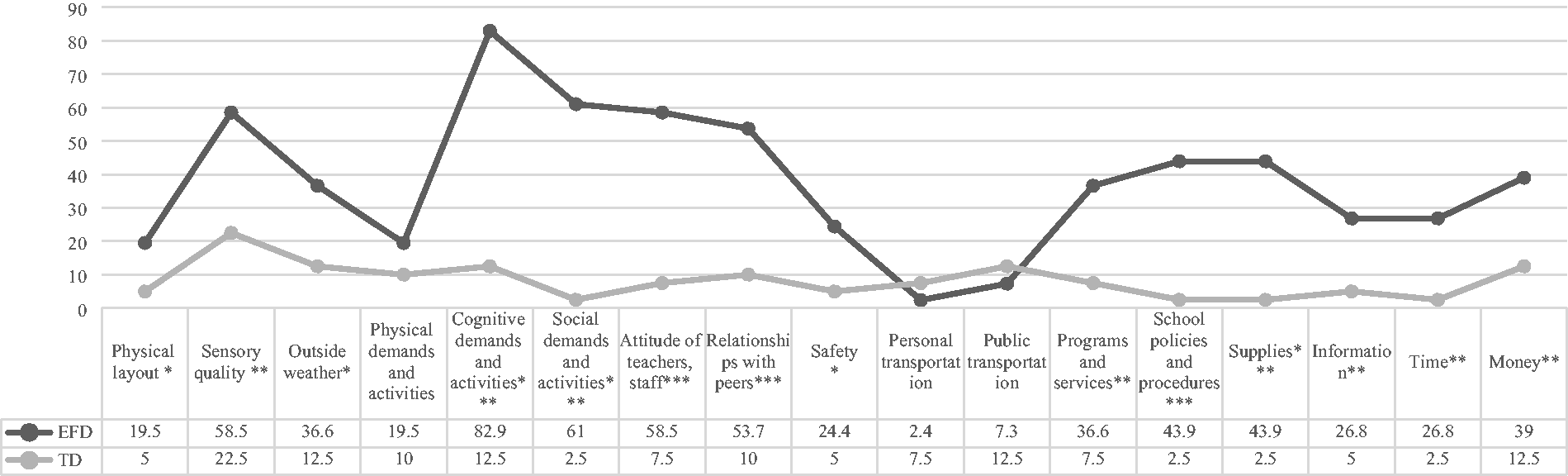
Differences between groups in school environment barriers items (percentage and χ2). EFD: group with executive function deficits; TD: group with typical development. *P<0.05; **P<0.01; ***P<0.001.
Community environmental factors
Figure 3 illustrates significant differences between the parents of adolescents with and without EFD in the community environment barriers items. The results indicate that 56.1% of the parents of adolescents with EDF rated that cognitive demands of activity limited their children’s participation versus 2.5% of parents of adolescents with TD. This pattern was similar for social demands of activity (58.5% vs. 2.5%), relationships with peers (63.4% vs. 2.5%), attitudes (63.4% vs. 2.5%), sensory quality (26.8% vs. 0%) and outside weather (26.8% vs. 0%). Interestingly, compared to the findings for home and school environments, significant differences were found in physical activity demands (26.8% vs. 10.0%) for community activities.
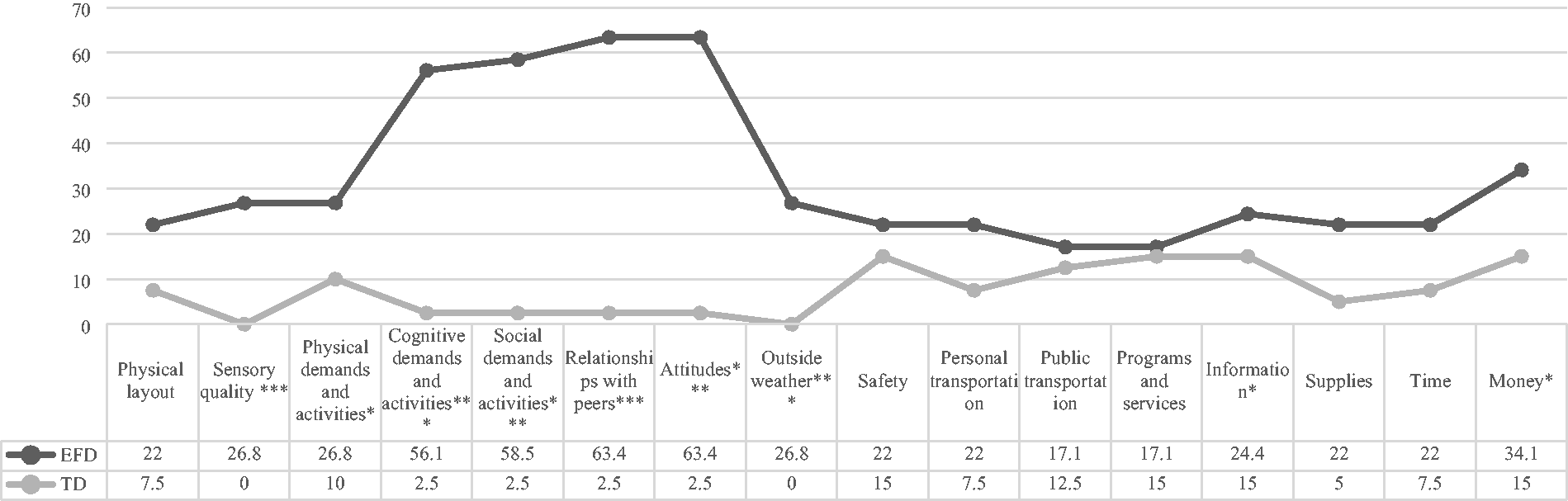
Differences between groups in community environment barriers items (percentage and χ2). EFD: group with executive function deficits; TD: group with typical development. *P<0.05; **P<0.01; ***P<0.001.
Connections between environmental factors and CHECK daily functioning
Correlations between the seven environmental factors (from the discriminant analysis structure matrix) and the CHECK (parts A and B) were conducted to understand more about the relationships between the adolescents’ daily functions and the environmental factors in the group with EFD. Significant negative correlations were found between the school environment social demands of activity and the CHECK-A (r = –0.48, P = 0.001) and CHECK-B (r = –0.52, P = 0.001). Significant negative correlations were also found between the community environment social demands of activity and the CHECK-A (r = –0.57, P<0.001) and CHECK-B (r = –0.32, P<0.04).
Predicting CHECK daily functioning by environmental factors
Stepwise regression analyses were conducted on scores of the group with EFD, using the CHECK-A and CHECK-B as dependent variables. The community environment social demands of activity predicted 32% of the variance in the CHECK-A (R2 = 0.30, P<0.001) and 6% of the variance in school environment social demands of activity (R2 = 0.35, P<0.05). The school environment social demands of activity predicted 27% of the variance in the CHECK-B (R2 = 0.25, P = 0.001).
Discussion and implications
The significant group differences found for most environmental factors in this study illustrate that parents of adolescents with TD generally perceive most factors in home, school and community environments as less obstructive than do parents of adolescents with EFD. The environmental factors that the group with EFD found challenging reinforce prior reports that those adolescents face more barrier factors than do their peers with TD. The results are also consistent with previous findings that indicated that parents of adolescents with EFD perceive their children as presenting fewer daily participation patterns.
However, the unique contribution of this study is that it highlights some environmental factors that are most predictive for adolescents with EFD according to their parent’s report: cognitive and social demands of activity, attitude of teachers and staff, and relationships with friends. These factors were found to be extremely advantageous in classifying the study populations according to their characteristics (that is, with EFD or with TD) and meaningful in predicting the adolescents’ daily functioning.
Cognitive and social demands of activity
Cognitive and social demands reflect features of activities within the environments that parents report as affecting their child’s participation (Coster et al., 2012). Each daily activity requires cognitive and social demands specific to that activity. A change in one feature of an activity may change the degree of demand in another feature. For example, adding to the number of steps or sequences in an activity increases cognitive demands, such as attention skills and problem-solving abilities (American Occupational Therapy Association, 2014). Activities performed in a familiar context minimally challenge EF; however, even minimal changes in activity demands or context require activating EF, such as inhibiting automatic responses or selecting, implementing and monitoring alternative plans of action (Connor and Maeir, 2011). As such, task demands that are unmatched to abilities require extra effort, and attempting many strategies at one time could compromise performance and learning (Toglia et al., 2012).
Adolescents with TD can navigate increasingly complex situations and task demands that require inhibitory control over impulses, increased attention and construction, more self-control and less distractibility (Fuster, 2002). However, adolescents with EFD are particularly vulnerable to increasing environmental demands for self-regulation, less parental support, and growing internal and external social expectations for autonomous functioning (Maeir et al., 2018).
Tseng and Gau (2013) found that different environments may challenge different EF components. In their study, for example, teachers reported more variety and severity of EF impairments than did parents among children and adolescents aged 5–15 years. The teachers used inhibition, organisation of materials, and planning and organising to predict attention deficit/hyperactivity disorder (ADHD) symptoms, whereas parents relied predominantly on inhibition, working memory and planning and organising. Furthermore, in examining EF as a mediator between ADHD and social problems, Tseng and Gau found that youth with ADHD but no social problems performed better on certain EF measures (for example, working memory, planning and response inhibition) than did youth with ADHD and social problems. Engaging in social interaction entails multiple cues in perception, selecting adequate behavioural responses and monitoring their effectiveness. Therefore, it is inherently linked with EF (Connor and Maeir, 2011; World Health Organization, 2007). These examples emphasise the EF presence of cognitive and social demands in different environments. The negative effects of EFD on occupational performance are widespread; they interfere with independence and engagement in preferred occupations. Therefore, adolescents with EFD may avoid tasks that exceed their EF capacities.
Relationships with friends
Positive peer interactions in adolescence are essential to an adolescent’s identity-building and emotional wellbeing (Wojslawowicz-Bowker et al., 2006). However, this study’s results indicate that interacting with friends may also be a barrier factor for adolescents with EFD, whose lower cognitive competencies, such as self-regulatory behaviour and poor EF, may predict problem behaviours and social dysfunction. Peer relationship difficulties in adolescence are predictive of future negative outcomes, including substance abuse, academic difficulties, psychopathology and continued social difficulties (Holmes et al., 2016).
Attitude of teachers and staff
Adolescents with EFD can be described as having a ‘hidden disability’, meaning there is no external manifestation of their difficulties – they look like their peers with TD and present with normal IQs. However, they cope with many functional difficulties, of which they and others in their environments may be unaware – and which affect their daily functions (Josman and Rosenblum, 2018). The hidden disability becomes more complex because their demands and expectations are identical to those of the general population (Bedell et al., 2013). Thus, adolescents with undiagnosed EFD may ‘blend in’, overlooked by teachers until they begin struggling due to increased environmental demands and decreased environmental supports (Dawson and Guare, 2010).
The literature suggested that various disabilities influence teachers’ attitudes differently. For example, teachers were generally more supportive of including adolescents with physical and sensory disabilities than those with intellectual, learning or behavioural disabilities (Vaz et al., 2015). Teachers report greater academic and behavioural difficulty in elementary school students with poorer EF and find it difficult to manage the students’ disruptive and disengaged behaviours. Sullivan et al. (2014) proposed that the approaches teachers use to respond to unproductive student behaviour may not address the underlying causes of that behaviour. This may be the part of the reason why parents in this study report teachers, coaches and staff attitudes and actions towards their children as major environmental factors that inhibit daily functions.
Social demands of activity and daily functions
Adolescents are involved in daily situations at their schools, workplaces and other social grounds characterised by formally accountable expectations and behaviours that challenge their social cognition. Social cognition enables individuals to be part of a social group – to understand, explain and predict another individual’s actions and thus negotiate complex interpersonal decisions (Crone, 2013). It requires adolescents to use their EF skills, such as monitoring, inhibiting and shifting behaviour according to changes or understanding, explaining, predicting, planning and organising their actions (Brizio et al., 2015). In addition, they need the ability to recognise how others plan and organise, social relationships among third parties, and that individuals’ actions are driven by their goals and perceptions of the situation (Tomasello and Vaish, 2013).
Social demands of activity, according to the PEM-CY, refers to such communication and interaction with others. Social factors have long been recognised as contributing to health, participation in daily functioning and wellbeing. The results of this study’s predictive analysis and the negative correlation results reflect the relationships between daily functioning and the social demands of school and the community environments. From the parents’ viewpoints, as the social demands of an activity increase, the adolescents’ daily functioning decreases. The social demand of activity in the community environment predicted 32%, and the school environment predicted 27%, of the adolescents’ daily functioning.
This study’s results provide more evidence about the daily functioning and social demands among adolescence with EFD. They suggest that intervention programmes focused on the EF components identified as the underlying mechanism of the social demands of the activity may promote daily functioning of these adolescents and improve their quality of life in the school and community environments.
Implications for occupational therapy
One occupational therapy targeted outcome is to enhance engagement in occupation, enabling participation in desired roles and life situations at home and in the community (American Occupational Therapy Association, 2014). Occupational therapists can work with adolescents to enhance participation in self-selected goals, improve their capabilities to develop problem-solving strategies and, potentially, overcome environmental barriers they face daily. Environments affect a client’s access to occupations and influence the quality of and satisfaction with performance. An adolescent who has difficulty performing effectively in one environment or context may be successful when the environment or context is changed.
The tension between environmental demands and personal competencies and strengths can challenge adolescents with EFD. Analysing the supporting and inhibiting environmental factors is an inseparable part of the occupational therapy treatment with adolescents with EFD to improve their daily functions. Environmental requirements and societal expectations only increase with age; ultimately, adolescents must deal with them effectively and independently. As occupational therapists, preparing adolescents for these challenges (increasing awareness and analysing factors according to individual goals) and providing tools that can be used in the future (using mediation tools, creating external and internal strategies and training the adolescents for transfer and generalisation) is our duty, as well as within our ability.
At the clinical level, the results of the study reinforce the need to help practice the socially demanding occupations in a supported context, make adaptations, and facilitate the social demands of the activity to improve daily functioning in the school and community environments for adolescents with EFD. Such interventions can be performed through top-down, occupation-based intervention approaches to therapy. These approaches include the cognitive orientation to daily occupational performance approach (Polatajko, 2017), the teen Cog-Fun model of intervention (Levanon-Erez and Maeir, 2014) and the functional individualised therapy for teenagers with executive deficits (Fogel et al., 2018) deal with different environmental factors that enable and inhibit functioning and, therefore, can meet these adolescents’ needs.
Our results suggest that clinically, the PEM-CY may serve as an organised basis for a structured interview with the adolescent’s parents. The PEM-CY was found to be a useful and sensitive tool to understand parents’ perceptions and needs and to help clinicians map environmental factors for intervention processes that promote daily functioning for adolescents with EFD.
Limitations and future directions
Despite the meaningful results, this study had some limitations. It involved a small sample in a specific age range; a larger sample may have expanded the information about environmental factors. In addition, the study considered only the parents’ perspectives. Future studies may consider the gap between parents’ and adolescents’ perspectives and consider the young people’s perceptions about environmental supports and barriers. To identify individual differences between adolescents and provide appropriate treatment for each individual, we also recommend further studies examine factors that inhibit daily functions relative to the specific EF components identified: social cognition, teachers’ attitudes and relationships with friends for adolescents with EFD.
Key findings
Environmental factors inhibit adolescents with executive function deficits significantly more than they inhibit their typically developing peers. Social and cognitive demands are major barriers in daily functioning among adolescents with executive function deficits. Social demands of activity predict daily performance among adolescents with executive function deficits.
What the study has added
This study contributes to occupational therapists’ theoretical and clinical knowledge about environmental factors and the need to refer to them as an integral part of the treatment goals.
Footnotes
Acknowledgements
The authors would like to thank Mrs Reanna Hirsh for helping collect the data and Dr Liron Lamash for her advice on data processing of the questionnaire.
Research ethics
This study was approved by the Faculty of Social Welfare and Health Sciences, University of Haifa ethics committee (approval numbers 253/13).
Consent
All potential participants who met the inclusion criteria and their parents signed consent forms and were informed of the study’s risks and benefits, that their participation was voluntary and that their identity would not be disclosed. All data were handled anonymously by serial numbers and stored in a secured closet accessible to only the principal investigator.
Declaration of conflicting interests
The authors declared no potential conflicts of interest with respect to the research, authorship and/or publication of this article.
Funding
The authors received no financial support for the research, authorship and/or publication of this article.
Contributorship
Yael Fogel researched literature, applied for ethical approval, collected the data and carried out the statistical analysis, and wrote the manuscript. All authors contributed to the methodology of the project, interpreted the data, and reviewed and approved the final version.