




Abstract
Introduction
Students with learning disabilities and attention-deficit/hyperactivity disorder are well represented on college campuses. However, they experience challenges to meeting occupational and role expectations associated with being in college. Mentors serve as natural supports for young people within college environments. This study investigates the ways in which graduate-student mentors, who were supported in understanding learning disabilities and attention-deficit/hyperactivity disorder and their mentee’s strengths and challenges through an occupational lens, provided problem-solving supports for undergraduate mentees with learning disabilities and attention-deficit/hyperactivity disorder.
Methods
Thematic qualitative analysis was used to investigate problem-solving supports provided by mentors (n = 57) of undergraduate mentees (n = 52) with learning disabilities and attention-deficit/hyperactivity disorder.
Results
Three themes, executive functioning, adult life skills, and academics, represent areas in which mentors worked with mentees in guiding and co-creating strategies to address academic, social, and daily life challenges. Mentors’ understanding of their mentees’ disability-related challenges and strengths within everyday life situations was important for fostering the occupational performance of mentees.
Conclusion
The inclusion of biopsychosocial approaches is needed in the development of disability-related mentorship interventions where occupational therapists can leverage disciplinary understanding of disabilities and the fostering of occupational performance to support social functioning and participation in college.
Keywords
Introduction
Students with learning disabilities (LD) and attention-deficit/hyperactivity disorder (ADHD) are well represented on college campuses (Newman et al., 2011). However, while students with LD/ADHD attend college at rates equal to those without disabilities, their college completion remains lower (Cortiella and Horowitz, 2014; Showers and Kinsman, 2017). College students with LD/ADHD experience challenges in executive functioning and information processing (DuPaul and Volpe, 2009; Johnson et al., 2010), emotional regulation (Asherson et al., 2014; Elias, 2004), social performance (Asherson et al., 2014; Kavale and Mostert, 2004), and academic performance (Asherson et al., 2014; DuPaul et al., 2013). These varied behavioral and functional challenges in LD/ADHD can exacerbate difficulties in the performance of occupations and participation in current and desired social roles (Kreider et al., 2015). Development of supports at both the individual and environmental levels is important for improving the outcomes of young people with LD/ADHD who are transitioning to adult roles through college pathways (Wolf, 2001; Kreider et al., 2018).
College mentorship has been linked to positive impacts on students’ persistence, academic achievement, and professional development (Coles, 2011). However, sparse research informs on the specific ways in which mentorship can facilitate the coping strategies, career development, and academic and occupational performance of students with LD/ADHD. The combination of challenges related to (a) executive functioning challenges, (b) managing emerging adult roles, and (c) navigating LD/ADHD symptoms increases the risk of poor personal, academic, and career outcomes (Gerber, 2012; Kreider et al., 2015).
We used the Person Environment Occupational Performance (PEOP) model (Baum et al., 2015) as a theoretical lens in conceptualizing how mentors can support college students with LD/ADHD in progressing toward personal and professional goals. The PEOP model includes three essential components: (a) person characteristics (physical, motor, cognitive, etc.); (b) environmental factors (social support, physical environment, cultural aspects, etc.); and (c) the characteristics of the activity, task, or role. Within the PEOP model, the interaction between the person, environment, and task demands can facilitate or hinder an individual’s performance toward their desired goals (Baum et al., 2015). Consequently, in order to enhance performance in everyday life activities and contexts, students with LD/ADHD may benefit from supporters that are knowledgeable about (a) LD/ADHD symptoms, strengths, and challenges; (b) career trajectories; and (c) holistic mentorship approaches. Mentors serve as natural supports for young people within college and workplace environments. Mentors are able to provide emotional and social support while offering important understanding through provision of the school or workplace’s cultural or normative framework (Kreider et al., 2018). Mentorship is a dynamic, long-term relationship whereby the primary goal is the professional and personal development of the mentee (Eby et al., 2011). While mentorship interventions are typically able to offer supports for academic and career competence and socialization (Coombs-Richardson, 2002), mentors who are also knowledgeable about their mentee’s disability-related challenges are able to provide needed holistic support – support that considers the whole person, with a focus on strengths and abilities (Kreider et al., 2018). We refer to this strengths-based understanding of the disabling condition as (dis)ability-informed mentorship. This type of support can be considered a biopsychosocial support whereby the mentor is able to offer psychological and social support with regard to the mentee’s disability-related biological considerations.
There exists a gap in the literature about how mentors, especially those who understand about LD/ADHD conditions, could assist undergraduate students with LD/ADHD in fostering the occupational performance needed to progress toward personal, academic, and career goals. This study investigates the ways in which neurotypical graduate-student mentors, who were (dis)ability-knowledgeable, provided problem-solving supports for their undergraduate mentees with the developmental neuropsychological conditions of LD and/or ADHD for the purpose of informing development of a biopsychosocial mentorship intervention that supports young people’s occupational performance across the broad range of young adult contexts and roles.
Methods
Thematic qualitative analysis was used to investigate problem-solving supports provided by mentors. This research was a part of a larger study that tested a multi-component model of holistic support for undergraduate students with LD/ADHD pursuing science-related fields of study, of which LD/ADHD-informed mentorship was one component; details regarding the larger study are published elsewhere (Kreider et al., 2018). This study reports on a post-hoc analysis of existing data that were collected to inform program development and to monitor mentee and mentor outcomes.
Study procedures were approved by the university’s Health Science Center Institutional Review Board and all participants provided written informed consent prior to engagement in study activities. Participants were 52 undergraduate student mentees with LD/ADHD and 57 graduate-student mentors who were matched based on the mentee’s field of study. Graduate-student mentors were recruited on campus during a time when the university was encouraging faculty, staff, and students to engage in mentorship activities. The university has several mentoring opportunities, among them are peer, undergraduate research, and first-generation student mentorship programs. Further, as part of the University of Florida Graduate School’s professional development initiatives, a graduate-student mentoring award is offered yearly for graduate students who engage in mentorship. The university’s pro-mentorship culture was helpful in graduate-student recruitment, which resulted in an ample number of students that were interested in study participation. Undergraduate and graduate student participants were compensated for study-related activities.
All study activities took place on the campus of a large, research-intensive university in the southern United States. Undergraduates were enrolled for four semesters (2 academic years) and engaged in one-to-one mentorship and monthly group meetings that included focused discussion about student-related experiences. Mentors also met as a group two to three times each semester to receive ongoing training regarding LD/ADHD and to engage in discussions regarding their mentorship experiences.
Members of the investigative team included engineering researchers, food science and human nutrition researchers, and researchers with clinical expertise in occupational therapy (first author), psychology, and health education. The occupational therapy researcher and the health education researcher worked together to lead development of the content delivered in the group meetings during the first 2 of 4 years, with the occupational therapy researcher leading content development for the group meetings in the final 2 years. Discussions during group meetings were primarily led by the occupational therapy researcher, with facilitation contributions from all members of the investigative team. Research assistants, who were primarily occupational therapy students or pre-occupational therapy students, were also present during group meetings to assist with note-taking and meeting debriefings. A combination of techniques was used to focus the discussions within the mentor and undergraduate group meetings, which included knowledge sharing (that is, knowledge articulation) (Toglia et al., 2012), reflective prompts for bolstering self-awareness of performance (Toglia and Kirk, 2000), and guided discovery probes (Overholser, 2013). Techniques used were selected as useful therapeutic strategies for fostering performance through learning (Babulal et al., 2016) and strategy development (Toglia et al., 2012).
Textual data were drawn from (a) transcripts from the group meetings held with undergraduates (n = 30 undergraduate group meetings) and mentors (n = 20 mentor group meetings); (b) written responses to focused questions posed within mentee and mentor group meetings; (c) mentors’ open-ended responses on end-of-semester surveys; and (d) mentor logs, which were short surveys completed every 2 weeks by the mentors, and reported on during the one-to-one mentorship meetings.
Thematic analysis was used to identify and describe conceptual areas of problem-solving topics provided by mentors (Sandelowski and Barroso, 2003). Data were structurally coded to identify passages containing information regarding communication and interaction between mentors and mentees (Saldana, 2013). Structural codes were then topically coded to categorize problem-solving topics covered. Data were reduced to conceptual themes around problem-solving (Sandelowski and Barroso, 2003).
Themes were developed through the use of constant comparison of the data to emerging conceptualizations. Researchers’ prolonged engagement with participants supported the credibility of the analysis. Weekly meetings between the coding team and the senior researcher involved discussion and verification of codes and developing conceptualizations, which contributed to the dependability of findings.
Results
Three themes were identified regarding problem-solving support provided by mentors: executive functioning, adult life skills, and academics.
Mentors provided supports for problem-solving that ranged from facilitating the development of specific academic skills, such as organizing class notes, to fostering the mentee’s personal development, such as problem-solving social situations. Mentors often co-created strategies and solutions for problems that mentees experienced across their various life contexts, which included academics, daily life, career, and social situations. Supports went beyond academic and professional enculturation within the mentor’s and mentee’s shared fields of study to include holistic supports. Holistic supports fostered the undergraduate mentee’s transition to college and adult roles and contexts, which also included learning how to understand and manage one’s LD/ADHD.
Mentors worked with their mentees in guiding and co-creating strategies for overcoming challenges experienced by mentees in areas of academics, social situations, and daily life. Mentors provided direct suggestions of solutions, prompting of the mentee to create their own solutions, and discussions with the mentee whereby the mentor and mentee together talked through strategies for problem-solving challenges experienced and/or anticipated.
Executive functioning
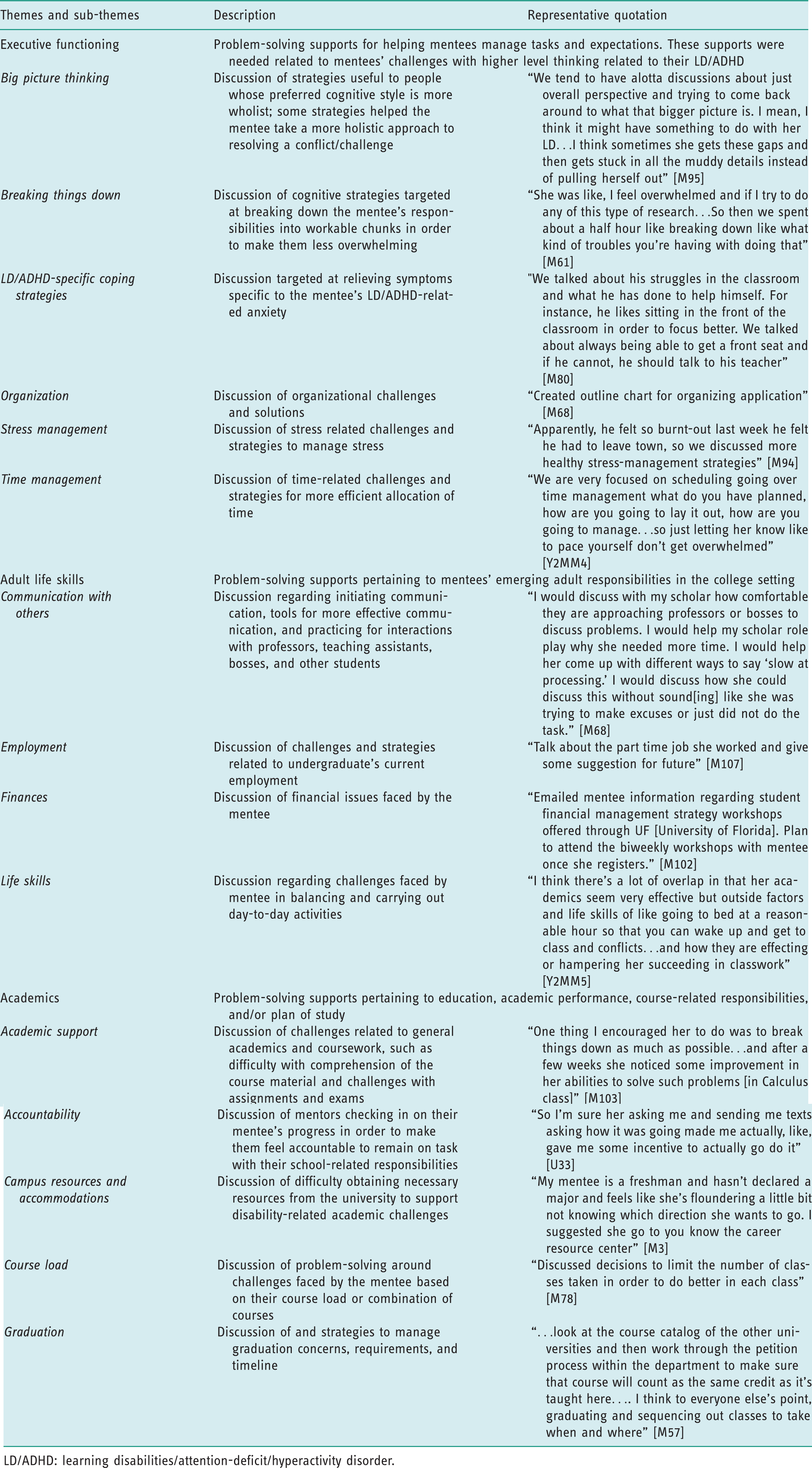
Problem-solving supports were carried out in the context of the mentee’s capacity to evaluate, synthesize, and critically think about the demands of a multifaceted college setting, as well as the mentee’s capacity to make adjustments when faced with difficult situations. Problem-solving supports are delineated by six sub-themes, which are detailed in Table 1. Sub-themes include: (a) big picture thinking, (b) breaking things down, (c) LD/ADHD-specific coping strategies, (d) organization, (e) stress management, and (f) time management. Discussions regarding challenges related to executive functioning necessitated problem-solving supports related to academics, personal life, and the mentees’ general responsibilities.
Topical categories representing types of problem-solving assistance provided by mentors, category definitions, and representative quotations.
LD/ADHD: learning disabilities/attention-deficit/hyperactivity disorder.
Mentors fostered the development of skills that worked to address challenges in executive functioning. Mentors used the ongoing support provided in the mentor group meetings to (a) discuss and gain deeper understanding of their mentee’s LD/ADHD-related challenges, (b) gain ideas for how to support and strategize with their mentee about their challenges, and (c) discuss experiences in working with their mentee to identify the mentee’s strengths and the situations and contexts that may match strengths.
Occupational performance in the area of adult life skills
Supports involved undergraduate mentees’ abilities to handle the additional challenges associated with living with new adult responsibilities within the college context. Discussions around these challenges were not as closely related to the student’s disability, but rather, dealt with skills that young people need as they transition to the college environment. Adult life skills included problem-solving supports in four areas (sub-themes), which are detailed in Table 1. Sub-themes include: (a) communication with others, (b) employment, (c) finances, and (d) balancing life and responsibilities. Graduate-student mentors, as older students who had likely experienced similar challenges in their transition to adult and college-based roles and contexts, were able to provide guidance and support for problem-solving across the wide range of situations experienced by their mentees.
Occupational performance in the context of academics
When strategizing about academics, mentor–mentee pairs collaborated to identify strategies that fostered the mentee’s abilities to manage courses, improve performance within the courses, and plan future coursework. Problem-solving supports for occupational performance related to academics are categorized into five sub-themes, which are detailed in Table 1 and include: (a) academic support, (b) accountability, (c) course load, (d) campus resources and accommodations, and (e) graduation. While academically focused guidance and problem-solving were largely informed by the mentors’ understanding of the mentee’s LD/ADHD, some discussions relied on the mentor’s experiences in recently overcoming challenges related to being on a similar academic path.
Discussion
This study delineates key areas of challenge experienced by undergraduate student mentees with LD/ADHD and the resultant problem-solving supports that were provided by mentors. We found that mentor and mentee dyads often worked together to co-create strategies for overcoming difficulties and heading off potential and future anticipated challenges. Within this study, whole-student (dis)ability-informed mentorship entailed mentors understanding their mentee’s strengths while also supporting the mentee’s engagement in occupations across varied contexts and social role expectations; it involved support for mentees’ academic, career-development, psychosocial, and disability-related needs and challenges. These findings are consistent with mentorship programs within higher education that identified problem-solving as a major emphasis of the mentorship relationship (Kilcullen, 2007; Komaratat and Oumtanee, 2009).
Problem-solving supports from mentors were important for learning how to navigate new adult expectations and contexts, and balance the multiple roles that college students engage in.
This finding elucidates the ways in which mentors provided supports that extended beyond academic and professional development to the supports that aided in the young people’s transition to college life and adult responsibilities. Moreover, because problem-solving and executive functions underpin abilities to meet occupational challenges that arise with current and future anticipated social contexts, mentorship can be an important strategy for supporting the social functioning of young people as they transition to new adult roles and contexts.
Problem-solving within the context of the mentees’ LD/ADHD symptomatology and everyday life challenges required the mentors to develop a depth of understanding about mentees’ strengths, interests, and disability-related challenges. This understanding was supported by mentors’ ongoing engagement in the group mentor meetings, which focused on supporting their understanding of LD/ADHD-related challenges and strengths through an occupational lens. This strength-based (dis)ability-informed mentorship provided a framework for supporting the whole student, which is consistent with positive psychology literature and strength-based therapeutic practices (Mills and Kreutzer, 2016; Smith, 2006). Through use of a (dis)ability-informed frame of reference, mentors were able to provide needed guidance and problem-solving across the breadth of young adult roles and contexts, including their mentee’s disability context, which we refer to as whole-student mentorship.
Study mentees needed guidance from mentors across a broad range of areas. As such, our (dis)ability-informed mentors were able to provide problem-solving support that was important for facilitating their mentee’s occupational performance and participation in current and future anticipated roles (Kreider et al., 2018). We found that mentors were able to provide problem-solving supports within the context of the mentee’s everyday life experiences. The provision of ongoing support that focused on the mentors’ application of an occupational lens when supporting their mentees was an important aspect of the mentorship.
The mentor–mentee relationships that developed among study participants were consistent with published descriptions of successful mentor–mentee relationships; relationships that are long-term, dynamic, and have the shared goal of the holistic development of the mentee though the provision of advice, counseling, and social support (Coombs-Richardson, 2002; Eby et al., 2011). Notably, we found that some of the areas of problem-solving supports that were provided by our mentors resulted from the mentor being able to take on an additional role beyond the roles typically described in the mentorship literature (for example being an advisor, or providing counsel or social support).
Because mentor–mentee matches were based on field of study, our mentors were also able to provide problem-solving support for their mentee’s academic challenges. This was an important aspect of the mentor selection as interventions that provide academic problem-solving strategies are effective for improving the educational outcomes of students with LD/ADHD across educational age-ranges (Hutchinson, 1993), including in higher education (Zawaiza and Gerber, 1993).
We found that the mentors’ role in the co-creation of strategies for problem-solving around mentees’ executive dysfunctions and LD/ADHD-related challenges had similarities to existing models of executive functioning coaching. Coaching for executive functioning provides tailored supports for improving skills and strategies for regulating executive functioning, such as complex problem-solving and sustaining effort across time (Parker and Boutelle, 2009). While similarities existed, the problem-solving discussions among dyads in our study were less goal-oriented than supports provided within coaching models for support.
Our mentorship was disability focused, which is not uncommon on college campuses. However, campus-based disability-focused mentorships are often provided by mentors with a disability or with expertise in disability; these disability-focused mentorships provide assistance with advice, campus resources, academics, approaching authority figures, and self-advocacy (Harris et al., 2011; Patrick and Wessel, 2013; Zwart and Kallemeyn, 2001). Our selection of mentors, which was based on field of study rather than on disability experience, necessitated the provision of ongoing supports for the mentors in understanding LD/ADHD, which were integral in fostering the mentors’ abilities to provide supports for problem-solving the breadth of their mentee’s challenges.
Limitations
Although three conceptual themes emerged from the data, these themes may not represent the full range of areas of problem-solving needed within (dis)ability-informed LD/ADHD mentorship relationships. Additional investigation as to the process and efficacy of (dis)ability-informed mentorship interventions that support the whole student with LD/ADHD is warranted.
Implications for future studies
Within occupational therapy and rehabilitation fields, problem-solving interventions are effective in improving the functioning and performance within everyday life situations of individuals from clinical populations (for example traumatic brain injury; Dawson et al., 2009) whose symptomatology include executive functioning difficulties (Cogan, 2014). Mentorship interventions supporting the occupational performance of young people with LD/ADHD should test the incorporation of evidence-based strategies from clinical problem-solving interventions, such as the use of guided discovery for strategy generation and adaptation.
Conclusion
Mentors are supports commonly found on college campuses. Mentors, whose mentorship training included supports for understanding the LD/ADHD conditions, were able to provide problem-solving supports for the challenges experienced by the undergraduate mentees within their everyday lives and the college context. Mentors’ ability to understand their mentees’ disability-related challenges within the broad range of situations and contexts experienced by the mentees was important for supporting mentees’ multifaceted needs through the mentorship. Occupational therapists can leverage disciplinary understanding of disabilities and the fostering of occupational performance to advance mentorship interventions that support the whole person. The inclusion of biopsychosocial approaches is needed in the development of disability-related mentorship interventions; such interventions can support social functioning and may improve the college experience and persistence of young people with LD/ADHD pursuing higher education.
Key findings
Mentors, whose mentorship training included a focus on understanding LD/ADHD, were able to provide problem-solving supports for challenges experienced by mentees within their everyday lives and the college context.
What the study has added
Occupational therapists can leverage disciplinary understanding of disabilities and foster occupational performance to advance mentorship interventions that support the whole young person transitioning to adult roles and contexts through college.
Footnotes
Research ethics
This research was approved by the University of Florida’s Health Science Center Institutional Review Board.
Consent
Informed consent was obtained from the participant prior to participation in the study. This study was initially approved on August 20, 2012; continued approved was obtained on December 2, 2019.
Declaration of conflicting interests
The authors report no conflict of interest.
Funding
This research is based upon work supported by the U.S. National Science Foundation under Grant Number (HRD-1246587). This work is also supported in part the National Institutes of Health, National Center Medical Rehabilitation Research (NICHD) (K12 HD055929). Any opinions, findings, and conclusions or recommendations expressed in this material are those of the author(s) and do not necessarily reflect the views of the National Science Foundation or the National Institutes of Health.
Contributorship
All authors contributed to the work presented in this paper. Study conception and design: CK, HK. Acquisition of data: CK, SM. Analysis and interpretation of data: CK, HK. CK, HK, and SM worked together to draft the manuscript and all authors provided final approval of the version submitted for publication and agree to be accountable for all aspects of the work as presented.
