



Abstract
Introduction
The development of professional attitude evolves over time and contributes to the formation of professional identity. This study tracked formation of professional identity by comparing professional attitudes of three cohorts: new graduates, final-year, and first-year students of occupational therapy.
Method
The online survey, including a 5-point Likert scale 17-item questionnaire and one qualitative inquiry using an incomplete statement, revealed the perception and future career prospects of 144 novice practitioners and students of occupational therapy. Written statements were compared to each other to provide insight about the participants’ perspectives during the three time periods.
Findings
One-way ANOVA indicated that there were significant differences in professional attitudes among the three cohorts (F (2, 141) = 14.32, p < 0.0001), demonstrating a downward trend in professional identity formation. The comparison analysis of statements confirmed the quantitative results and highlighted an issue of negative professional identity through indicating great concerns over the future career prospects.
Conclusion
Despite increased awareness of occupational therapy over time, these participants seemed to have had trouble developing a sound sense of professional identity. Possible sources and solutions for this issue were discussed, to better facilitate a clear sense of professional identity in occupational therapy students and practitioners.
Keywords
Introduction
A survey of a representative sample of Iranian occupational therapists found there was a low level of motivation towards occupational therapy practice, which merited further investigation (Ghamari et al., 2012). A more comprehensive national survey by self-report questionnaires confirmed that this phenomenon was more pervasive throughout the country (Ghamari et al., 2015). The conclusion of these two studies suggested that a poor sense of professional identity may have contributed to the low level of motivation for practice (Ghamari et al., 2012, 2015). It was anticipated that a poor sense of professional identity might put occupational therapists in danger of identity confusion that could increase their vulnerability to all aspects of burnout including emotional exhaustion, depersonalisation, and lack of personal accomplishment (Edwards and Dirette, 2010). Supporting this concern was a research that found 80.4% of Iranian occupational therapists reported mild to moderate symptoms of burnout, which was primarily due to low job satisfaction (Mozayan et al., 2012).
Identity is related to attitude and self-perception, derived from personal values, beliefs, expectations and goals, which promote skill development that constitutes a repertoire of behavioural choices (Eccles, 2009). A developed, strong sense of professional identity provides a set of assets that an individual owns, such as a clear and stable picture of his/her goals, interest and talents that give him/her the capacity to make untroubled decisions, and be self-confident to do vocational tasks (Khasawneh et al., 2007). Evolving over time, the formation of a strong professional identity is largely due to the development of a sound professional attitude (Lindquist et al., 2004). It has been suggested that establishment of sound professional attitudes is so important during university years (between 18 and 24 years of age) (Khasawneh et al., 2007). In other words, development of professional attitudes is a significant contributory factor to the formation of college students’ professional identity in that it is initiated with career choice and forms throughout university education where students prepare for the future career (Ireri et al., 2013). In addition, development of students’ professional attitudes has been found to be the basis for career longevity (Lindquist et al., 2004). For these reasons, insufficient information about the chosen major coupled with uncertainty about career direction can cause professional identity crisis, which renders university students unable to make sound and confident decisions about who they want to be as a working person after graduation (Khasawneh et al., 2007).
According to Tan and colleagues, the formation of professional identity may begin first by choosing a specific field of study, such as occupational therapy, to major in at a university. This career choice may stem from prior knowledge about a specific profession and having preference for studying such a profession (Tan et al., 2017). Upon entering the university, the process continues as students complete their courses, get proper supervision by having access to successful role models in their programme and have direct clinical experiences in the field. Finally, as students approach graduation, it is expected that they would have developed professional self-efficacy that is related to both their personal beliefs and clinical decision-making abilities (Tan et al., 2017). Professional self-efficacy is required for students to put effort into and persevere longer to successfully complete job-related tasks (Tan et al., 2017).
Professional identity formation and occupational therapy
A sound professional attitude was found to be an important factor for making a successful transition from being an occupational therapy student to a graduating therapist, who was committed to practice competently and effectively, in order to handle occupational stress and avoid professional burnout (Boehm et al., 2015; Edwards and Dirette, 2010). Historically, professional identity was deemed to be the second most consistent theme in the series of Eleanor Clarke Slagle Lectureships presented at American Occupational Therapy Conferences; ‘The subject has been controversial … [since] occupational therapy has not yet come to terms with its role or its status identity’ (DeBeer, 1987: p. 528). The same issue still remains controversial in recent evidence (Turner and Knight, 2015). For example, British authors Clouston and Whitcombe (2008) indicated that professional identity and value of occupational therapy in the United Kingdom were challenged in such a way as to undermine the profession in terms of its identity. The problem was due to ‘socially defined concepts of occupation and the viewpoints of other more powerful and established professional players’ (p. 314). They also believed that ‘the professional identity and assumptions of occupational therapy are nebulous and incoherently defined, so intersubjective understanding is variable’ (Clouston and Whitcombe, 2008: p. 317).
Unlike other health-based medical models, the philosophical basis of the occupational therapy profession centres around defining the influence of daily activities or occupations across the lifespan on health and well-being of individuals (American Occupational Therapy Association, 2020). It is acknowledged that the profession’s identity is strongly influenced by the fundamental belief that humans are occupational beings with diverse needs that need to be addressed to enhance quality of life (Abreu and Peloquin, 2004; Hasselkus, 2006). As a result, occupational therapy interventions enable a person to do what they need and want to do through experiencing everyday occupations, which become therapeutic and meaningful to his/her recovery (Cohn, 2019; Hasselkus, 2006).
One complication of utilising occupation-centred therapy in a medically dominated health services field was identified as residing in occupational therapists’ abilities to express sound professional attitudes when having difficulties in quickly and easily explaining the profession’s contribution to health care and describing what occupational therapy does (Wilding and Whiteford, 2007, 2008). Lack of this ability may lead to professional identity crisis. As a result, there is potential for occupational therapists to overlook the valuable contribution of occupation to health, which makes the profession somewhat indistinguishable from other health allied professions such as physical therapy or social work, thus leading to abandonment of the philosophical basis of the profession. Consequently, an undeveloped professional identity in occupational therapy might trigger adoption of the identity of other allied health professions or choice to leave the profession (Edwards and Dirette, 2010; Ikiugu and Rosso, 2003).
Iranian occupational therapists were found to have trouble sticking to their philosophical paradigm so that they appeared to have distanced themselves from occupation-centred practice (Khayyatzadeh-Mahani et al., 2015). In a comparative study, it appeared that Iranian occupational therapists had a tendency to adopt less frequently utilised occupation-centred approach than did their American counterparts (Khazaeli et al., 2012). Several factors (i.e. cultural and the fact that occupational therapy services are not covered by insurance) were known to be partially responsible for such deviation from typical occupational therapy procedure, which may put Iranian occupational therapists at risk of professional identity crisis (Khazaeli et al., 2012). In particular, occupational therapy education and practice in Iran have faced many problems such as ‘contextual barriers, non-acceptance from clients’ perspectives and educational challenges’, which are mainly influenced by dominant Iranian perspectives on the definition of health that is derived from the medical paradigm (Khayyatzadeh-Mahani et al., 2015: p. 156).
Some western scholars have attempted to investigate through qualitative research about the changes in occupational therapy students’ professional attitudes over time throughout the duration of the university educational programme. Two longitudinal research studies highlighted the establishment of sound professional attitudes through students’ increased awareness of occupational therapy during the period of educational programme, which may have positively influenced their future career plans (Björklund and Svensson, 2006; McKenna et al., 2001). Additionally, the process of shaping sound professional attitudes was reported to be largely dependent on the students’ self-selection into occupational therapy (McKenna et al., 2001) and the information about the profession available in society (public view) that had impacted students when deciding to choose occupational therapy as their university major (Björklund and Svensson, 2006).
Statement of the problem
With high prevalence of burnout among Iranian occupational therapists, it is likely that students of occupational therapy may have struggled to adopt a sound professional identity (Ramezani and Kamkar, 2019). Of greater concern over this undeveloped professional identity might be a drawback rooted in the first step of professional identity formation, described by Tan et al. (2017), where first-year students have insufficient information about the occupational therapy or no preference for choosing such profession at the outset of their entry to university. This may be partially due to the National Entrance Exam (NEE) that is held annually by the National Organisation of Educational Testing (NOET, 2021), governed by Ministry of Science and Higher Education. Normally, there are a large number of graduated high school applicants who want to go to university, so NOET has been assigned the mission to set up the NEE to solve the problems related to students’ selection. Applicants must annually sit the NEE; meanwhile, they are allowed to make a list of options for university majors in order of preference, with medicine, dentistry and pharmacy are typically high on their list of priorities. Since entry into an occupational therapy baccalaureate level programme is typically considered of low priority, it could be argued that nominees for studying occupational therapy at university academic programmes may be those applicants who did not obtain satisfactory scores on the NEE for more desirable careers.
To date, there has been one unpublished study of a nationwide sample of 417 Iranian occupational therapy students to assess their attitude towards the profession and its future career prospects. The study showed that 42.9% of the participants expressed dissatisfaction with being selected to study occupational therapy as their university major. Close to half of the participants (46%) reported lack of interest in studying occupational therapy. Slightly under half the participants (47.7%) perceived that occupational therapy as their future career would not afford them to earn a good salary or be recognised to have high status as a professional (Ramezani and Kamkar, 2019). Ramezani and Kamkar argued that the reason why a considerable percentage of students were doubtful about studying occupational therapy could have originated from the Iranian society, whereby the profession has not been well-accepted and has not gained prestige or high professional status.
Statement of the purpose
There has been no study to date to show how professional identity of Iranian occupational therapy students evolve as they progress through the programme and become an educated workforce post-graduation. Since the process of professional identity formation could be extremely influenced by sociocultural parameters, the authors of this article perceived it necessary to do a comparative study, in order to track the formation of professional identity by comparing the professional attitudes of first-year students, final-year students and newly graduated occupational therapists. We aimed to investigate whether participants’ increased awareness of occupational therapy during the period of educational programme and post-graduation could have enhanced formation of professional identity, similar to what happened in the two above-mentioned longitudinal studies by Björklund and Svensson (2006) and McKenna et al. (2001). Considering the special circumstances such as high rate of professional burnout among Iranian occupational therapists, low level of public awareness of the profession and the influence of the NEE on the selection of entry-level students, it was hypothesised that formation of professional identity in our participants would be much more complex than their counterparts in the western societies.
Method
Study population and sampling
In an attempt to provide an overall picture of the evolution of professional identity and attitudes about the occupational therapy profession, a cross-sectional approach was employed. The study was conducted between December 2019 and March 2020. A purposive sampling method was used to allow researchers to recruit as many participants as possible. The student participants were recruited from all of the twelve occupational therapy educational programmes across the country offering undergraduate bachelor degrees (World Federation of Occupational Therapists, 2021a). The graduate participants were recruited from all the fifteen provincial branches of the Iranian Occupational Therapy Association (IROTA), a non-profit professional organisation representing the interests of graduate occupational therapists across Iran (World Federation of Occupational Therapists, 2021b). Eligible participants, who matched the inclusion criteria, were students in their first and fourth (final) years of an undergraduate degree, and newly graduated occupational therapists with up to 2 years of occupational therapy working experience. Recruiting three different cohorts was considered to be helpful in tracking the evolution of professional identity by exploring the changes in the three cohorts’ professional attitudes. In fact, the participants’ immersion in the field through proceeding with the educational programme and post-graduation were assumed to have caused increased awareness about the occupational therapy profession. These three cohorts were chosen because there was no quantitative occupational therapy research about examining the quality of professional identity formation from students at their entry-level into the newly graduated practitioners at their novice or advanced beginner stages with under 2 years of working experience.
Measures
Participants were asked to complete a web-based survey that initiated with demographic information (i.e. age, gender, marital status and years of working experience), continued with a 17-item Likert questionnaire, standardised for Iranians, named Professional Attitude Scale, and finally ended with an open-ended qualitative inquiry, namely, an incomplete statement.
Professional attitude scale (PAS)
The PAS is a one-factor self-reported questionnaire designed to measure professional attitude by enquiring about one’s perception of his/her profession and future career prospects. This 17-item questionnaire rated each item on a 5-point Likert scale with the values ranging from 1 (strongly disagree) to 5 (strongly agree). The total score of the scale (range 17–85) was used for the statistical analysis purposes of this study, where higher scores identified individuals with enhanced sense of professional attitudes. Four examples of survey items are as follows: ‘I am satisfied with choosing this profession’; ‘I have no worry about my future career prospects’; ‘The community in which I live has a positive view of my profession’; and ‘My profession will afford me an opportunity to earn good money.’ The PAS is a Persian standardised questionnaire with its approval of validity (content and construct) as well as reliability (Cronbach’s alpha of 0.74) that was obtained from a study on a sample of 156 Iranian university students (Jamali and Ghalenoei, 2013). In our sample, Cronbach’s alpha coefficient for the PAS was 0.86. With this high value, the PAS was proved to have acceptable internal consistency (homogeneity) so that all test items measured the same construct in the current study.
Included at the end of the online survey was an incomplete statement that participants were asked to complete. The authors found that qualitative inquiry was useful for improving consistency in research findings by the means of gathering multiple sources of data. It was considered that qualitative data obtained from answers to this incomplete statement would complement the quantitative analysis and serves as a check on probable mean differences in the three cohorts’ professional attitude scores, as hypothesised. The incomplete statement was ‘Currently, I think occupational therapy would be a profession that ...’.
Procedures
This research was approved by the Research Ethics Committee of Shiraz School of Rehabilitation Sciences, affiliated with Shiraz University of Medical Sciences, Shiraz, Iran (Approval number: IR.SUMS.REHAB.REC.1398.042). A research assistant was assigned the task of identification of class delegates by calling the college offices and asking them to provide delegates’ contact information. A class delegate is a student elected as spokesperson by their classmates to be in liaison between the class and the faculty officials. Once identified, 24 class delegates, representing all approved occupational therapy educational programmes, were contacted by the research assistant to be informed about the research procedures. Then, follow-up emails with the research package as an attachment were sent to the delegates. They were asked to forward the emails to their classmates to recruit potential participants for this study. The research package attached to the emails consisted of four main parts: (1) an outline of the research aims, (2) an instruction of the research procedure, (3) a notification that the completion of the online survey would denote participant’s informed consent to participate and (4) a weblink to complete the online research instrument. Once completed, the online surveys were automatically returned to the first author’s online database in such a way as to be stored electronically for analysis purposes. In order to increase the response rate, the delegates were contacted at three 1-month intervals, being asked to remind their classmates to complete the survey. The same process was undertaken after the identification of delegates of fifteen provincial branches of the IROTA. The information about delegates of provincial branches was retrieved from the IROTA website (World Federation of Occupational Therapists, 2021b).
Data analysis
Quantitative data analysis was performed using IBM SPSS version 23. Significance level was set at p < 0.05 for each test. Descriptive statistics were calculated to determine frequencies, means and standard deviations. Group differences were analysed by using the one-way ANOVA procedure. A statistical software was used to calculate the minimum required sample size of 135 subjects for a one-way ANOVA study, to ensure that mean differences among three cohorts was detected, using an F test with a 0.05 significance level and β = 0.2.
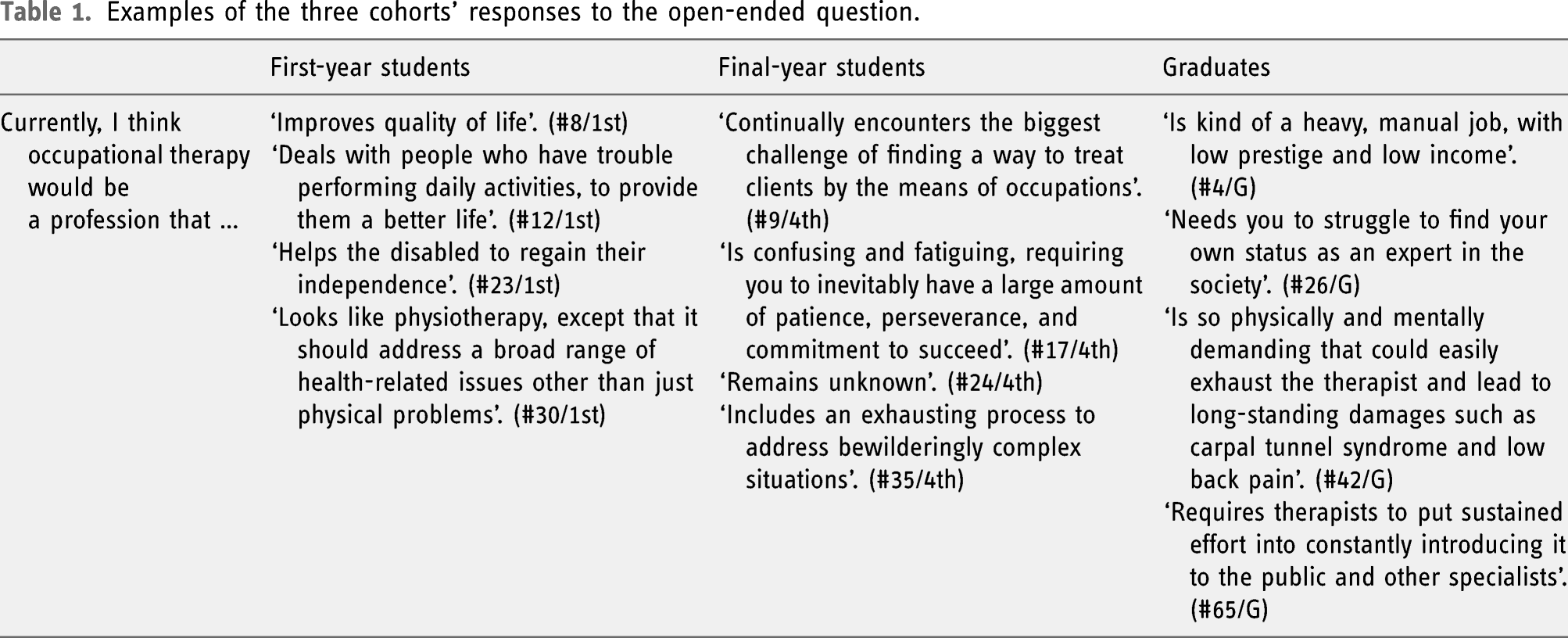
Examples of the three cohorts’ responses to the open-ended question.
Results
General characteristics of the study population regarding educational level.

aM ± SD.
bN. (%).
cOne-way ANOVA.
As shown in Table 2, a one-way analysis of variance indicated that there was a highly significant difference in professional attitudes among three cohorts (F (2, 141) = 14.32, p < 0.0001). Although there was a marked uneven sample size distribution between the three cohorts, Levene’s Test of Equality of Error Variances demonstrated that the assumption of the homogeneity of variance was not violated such that the error variance of the dependent variable was equal across groups (F (2, 141) = 1.71, p = 0.185). Post hoc comparison using the least significant difference test indicated that all the three cohorts were significantly different from each other. Figure 1 shows the downward trend in shaping professional identity over time. This is to say that the more the participants immersed in the profession, the less they were likely to adopt a stronger sense of professional identity. Using eta squared, a large effect size of 0.169 for the PAS indicated that the differences in the mean scores between the three cohorts were considerable. An independent sample t-test showed no significant difference between men and women for professional attitudes (p = 0.24). An error bar chart to identify the differences in the means and standard errors obtained from the Professional Attitude Scale.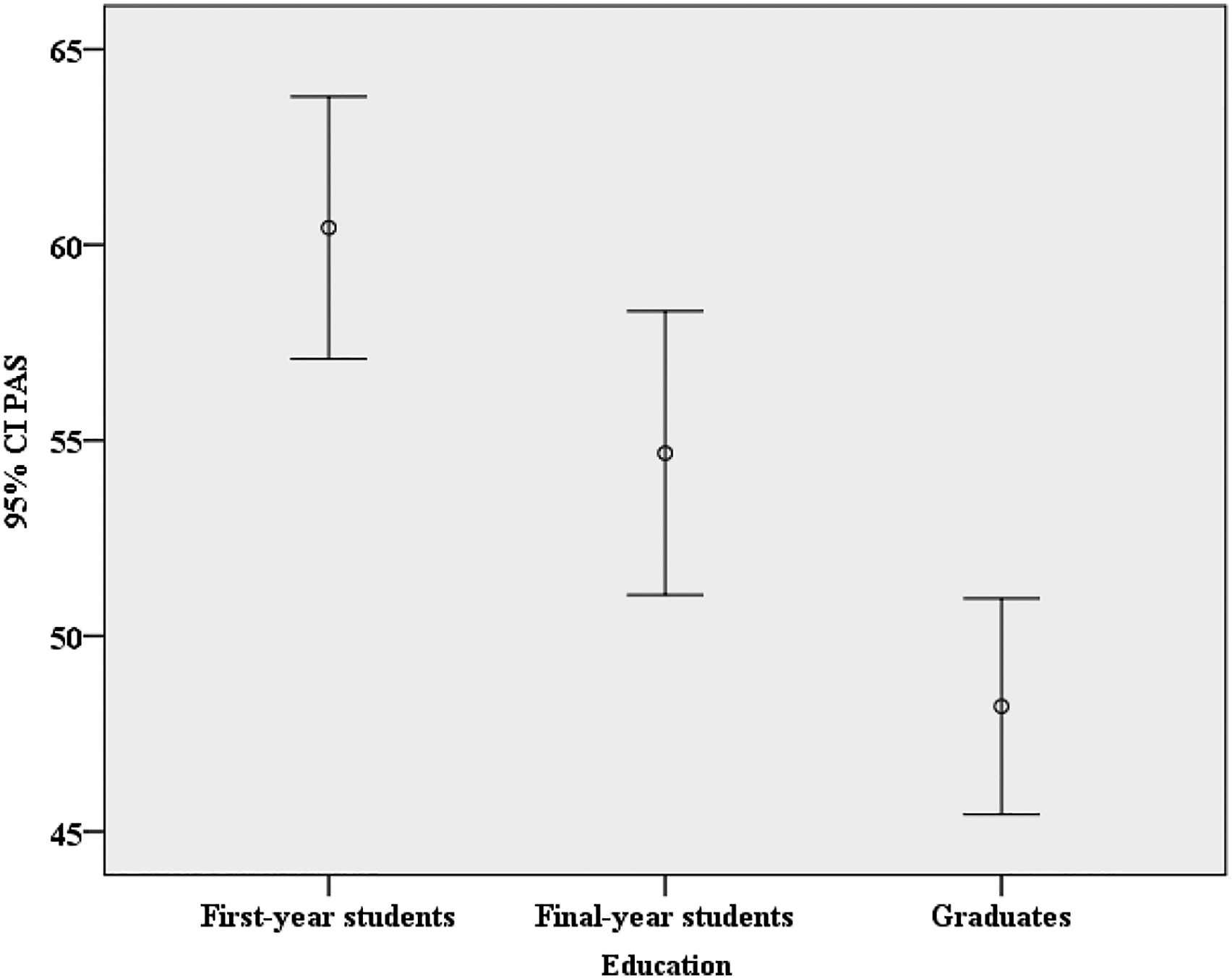
Figure 1 is an error bar chart that identifies the differences in the means and standard errors obtained from the PAS, which pinpoints the 95% confidence interval (CI), which is a range centred on the mean and extended a distance either side of it. The extent to which the CIs overlap creates a visual image of the differences between professional attitudes of the three cohorts. As shown, there is a significant marked difference between the professional attitudes of the new graduates and the other two cohorts because there is no overlap of 95% CIs. A significant difference exists between the professional attitudes of the final-year and first-year students with a slight overlap of 95% CIs.
Turning now to the responses to the open-ended qualitative inquiry, it was evident that perceptions of the three cohorts differed with varying degrees of concerns. Participant statements were short and concise with typically one or two sentences ranging from 2 to 60 words. Except for those affirmative statements, our focus was on those reflecting participants’ concerns, in order to help find explanation for our quantitative findings. Such statements suggested the participants’ emotional stressors and uncertainty about future career prospects. These data were entered into a matrix table to facilitate comparison of statements within-groups and between-groups, which helped identify similarities and trends across the three cohorts. By comparing Figure 1 to Table 1, it is revealed that qualitative indicators matched the quantitative findings. Similar to the trend shown in Figure 1, Table 1 also suggests a downward trend in shaping professional attitude, thus providing a visual appraisal of negative professional identity.
First-year students
Overall, first-year students tended to be more optimistic than the other two cohorts, expressing less concern. Their perspectives about occupational therapy were influenced by a common sense view that they are going to study a health-related profession that is supposed to offer healthcare services. According to responses, they thought occupational therapy was about making life better. Nearly two-third of participants viewed occupational therapy as a branch of rehabilitation sciences helping the disabled to regain independence. However, there were close to 30% statements that showed first-year students to be fairly uninformed or unsure about the field of occupational therapy. For example, eight participants (25%) conceived the profession as comparable to physiotherapy.
Final-year students
On the other hand, a number of issues related to the job requirements and uncertainty about achieving success in career were identified in the final-year students’ perspectives. Some seemed to have been apprehensive of their future career by giving equivocal answers to the question. For example, six participants (16%) believed that occupational therapy was about having endless patience and perseverance, without which success was unattainable. Four participants (11%) attributed occupational therapy to the exhausting process whereby a lot of sustained effort a therapist should put into meeting his/her job requirements. Eleven participants (30%) seemed as though they were not certain of having confidence in themselves to fulfil demanding job requirements.
Newly graduated occupational therapists
Besides statements that revealed more technically advanced descriptions of occupational therapy compared to the other two cohorts, concerns regarding future career prospects were more evident in the newly graduated occupational therapists as a majority of them complained about low income potential (26% of participants) and poor public recognition (37% of participants). Twelve participants (16%) complained that occupational therapy was about addressing difficult, long-term health-related problems. Seven participants (9%) seemed to be dissatisfied with ‘having a job with low prestige’. Three (4%) regarded it as discouraging to have earned very little in exchange for devoting a great amount of time and energy. There were some suggestions that occupational therapy deserved a better place, support and recognition.
Discussion
The results of this study revealed an undeveloped professional identity, regardless of increased awareness of occupational therapy as participants proceeded through the programme and after graduation. Adopting a clear sense of professional attitude was found to have association with motivation and satisfaction, which are two important factors to heighten the students’ tendency towards learning and achievement (Day, 2002; Lindquist et al., 2004). Thus, the issue with evolution of professional identity might put students and practitioners in jeopardy. They may have failed to develop a commitment to their chosen profession during university education, nor did they establish a basis for career longevity after graduation (Day, 2002; Lindquist et al., 2004). Hence, the finding of this current study suggests a serious issue in professional identity formation of candidates studying occupational therapy in Iran, demonstrating their great concern over the future career prospects. This issue could be a serious setback to the occupational therapy profession in Iran. Given that previous studies have reported the linkage between an undeveloped sense of professional identity and high levels of burnout among occupational therapists (Edwards and Dirette, 2010; Scanlan, 2018), the insights gained from this study may be of assistance to our better understanding of the fact regarding a high rate of burnout among Iranian occupational therapists.
The findings of this study contrasted with the results of the two qualitative longitudinal research studies on occupational therapy professional identity development conducted in Australia and Sweden. Following from entry to and exit from a bachelorette occupational therapy programme, a survey on a sample of Australian students demonstrated that ‘while generally positive on entry to the course, students’ [professional] attitudes were even more positive on completion’ (McKenna et al., 2001: p. 157). Development of a sound professional attitude was also evident in a Swedish cohort when being followed over a period of 6 years from commencement of the course to their last semester and finally after 3 years of occupational therapy practice (Björklund and Svensson, 2006).
Based on the sociocultural conditions prevailing in Iran, fully described in the Introduction section, we provided three possible explanations for the inconsistency between our results and the two above-mentioned longitudinal research studies. In fact, our results broadly support the work of Khayyatzadeh-Mahani et al. (2015) in this area, which links the occupational therapy education and practice in Iran with contextual barriers and educational challenges.
Firstly, the issue may be rooted in the student selection procedure applied in Iran, which may have led to select students that were disappointed or apathetic about their chosen university major. This is to say that according to the student selection strategy applied in Iran, students would conceivably enter the occupational therapy programme with no predetermined reason, showing this type of student selection to be generally by chance, not on purpose. Students may think entering the occupational therapy programme was their last choice and that acceptance in the programme was a consolation prize, inferring that they should be satisfied because the other graduated high school applicants could not pass the NEE and were not admitted to a university at all. Unlike the strategy applied in Iran to select students, it seems that selection of occupational therapy students in the western countries has been based on more efficient admission procedures such as interviews, pre-admission academic courses, discipline-specific attitude tests and written submissions, in order for candidates to be selected on the basis of appropriate personality factors (i.e. interpersonal communication skills) and career motivation (Lysaght et al., 2009; Rozier et al., 1992). These kinds of admission procedures can potentially result in selecting students with specified, predetermined reasons to pursue occupational therapy. For example, Rozier et al. (1992) provided a typical example to support this argument through conducting a research on a sample of students recruited from four accredited occupational therapy programmes in the United States. Using an attitude inventory questionnaire, Rozier et al. (1992) found that students made decision to become occupational therapists based on some predetermined reasons including job availability and prestige the profession has as well as its nature of being helpful for other people. Australian researchers (Turpin et al., 2012) showed that students commencing bachelor degrees of occupational therapy had background knowledge about what occupational therapists do; how they do it; why they do it and who they work with.
Secondly, undeveloped professional identity in our study population could possibly be attributed to the quality of university education programmes in Iran. As evident in the final-year students’ responses to the open-ended qualitative inquiry, they are not adequately prepared for practice. It is acknowledged that a high quality occupational therapy educational programme that included rich curriculum full of varied and plentiful fieldwork could provide students plenty of opportunity to be prepared for practice upon entering the workforce (Doherty et al., 2009). Doherty et al. (2009) highlighted the association between vivid future career plans and better understanding of the complexity of occupational therapy during educational courses, which may have smoothed the way for transition from student to therapist. Additionally, occupational therapy curriculum enriched with course contents aimed at improving critical thinking and problem-based learning were also found to increase students’ awareness of occupational therapy and develop a clear sense of professional identity (Ikiugu and Rosso, 2003; Whitcombe, 2013).
Thirdly, the results of this study could be due to an important external factor attributed to the lack of public and community awareness about the nature and scope of occupational therapy in Iran. There are endless cross-cultural meanings for disability and wide variance in intracultural meanings, which are all impacted by the society attitudes, values, rehabilitation concepts and economic factors (Leavitt, 2006). Culturally, Iranian families tend to react emotionally to disability and provide their loved ones with disability a substantial amount of support and excessive help, even at no request by the person (Rassafiani et al., 2013). For this reason, it could be argued that independency in doing daily activities is not as weighty a matter as some western countries as far as culture is concerned. Presumably, this cultural value conflicts with occupational therapy core assumptions and practice in Iran and is generally seen as a factor causing occupational therapy to remain publicly unknown (Rassafiani et al., 2013, 2018). In addition, occupational therapy is a relatively new profession in Iran with a history of about 35 years of university education. Therefore, it is no surprise that with the Iranian population of more than 80 million, the small workforce of approximately 3000 occupational therapists could have been another predictive factor for lack of public awareness of the profession (Rassafiani et al., 2018).
Historically, clarifying what we do as occupational therapists has been a tireless issue since inception of the profession more than 100 years ago. Addressing the American Occupational Therapy Association (AOTA) President, Amy Lamb, occupational therapists have a widely held belief that ‘no one knows what occupational therapy is’ (Lamb, 2018: p. 3). Such is the dominance of biomedicine paradigm on public’s view of health that occupational therapy students and practitioners across the world, especially in Iran, have faced a tremendous challenge of developing their own professional identity (Ashby et al., 2016; Boehm et al., 2015; Clouston and Whitcombe, 2008; Ikiugu and Rosso, 2003). Publicly emphasising the considerable therapeutic effect and value of occupation and improvement in marketing of occupational therapy services have been advised to be helpful for making occupational therapy more recognisable, thus addressing the issue with formation of a poor sense of occupational identity (Ashby et al., 2016; Boehm et al., 2015).
Limitations, strengths and recommendations for future research
Although all potential participants were targeted for this research, the response rate was lower than expected. This might be due to the fact that there was no incentive provided for participation in this online survey. This cross-sectional study has highlighted a controversial issue regarding professional attitudes towards occupational therapy and future career prospects among Iranian students and new graduates; however, it could have collected more accurate data on the topic under study, if it had been a longitudinal research on a same sample. Yet, doing a prospective type of research requires special considerations regarding budget and time that was beyond our capacity to conduct such research. As a result, it is recommended that future research be conducted longitudinally or be aimed at exploring how professional attitude towards occupational therapy is shaped in Iranian students and graduates, so as to find the reasons for and deal with the serious issue raised in this current research.
Nonetheless, there are a couple of important strengths to this study, principally by using a standardised questionnaire to enhance the credibility of the research and a methodological approach to advance data analysis. The latter was achieved through the visual impact of the matrix table and the error bar chart that assist readers in making direct comparisons of quantitative/qualitative findings, in order to draw attention to the downward trend in shaping professional attitudes.
Implications
Facilitating a clear sense of professional identity in occupational therapy students and practitioners requires a huge investment of time and effort, for instance, in educating students. Accordingly, immersion in active learning experiences will plunge students into creative problem-solving, critical thinking, and will reinforce the concept of ‘doing’, as the occupation of students and professors. This type of teaching will arouse the most uninterested, bored students. Additionally, professors could become role models that are armed with the goal to do active learning during every class, which is not necessarily confined to classroom boundaries.
According to Cohn, ‘The responsibility to increase awareness of our profession belongs to us’ (Cohn, 2019: p. 1). This requires that teachers creatively manifest both classroom activities and service-learning experiences in the community by using words, images and actions (doing) to teach students to promote the value of occupational therapy to the public in this era of social media (Jacobs, 2012). For example, providing a booth at a fair about occupational therapy for elders or shopping centre table handing out brochures about our profession and asking customers, ‘Do you know what occupational therapists do?’ or ‘Do you know anyone who has received occupational therapy?’ These kinds of expectations coupled with provision of real opportunities may increase community awareness and develop self-pride, self-identity, self-confidence and sense of self-efficacy in students and new graduates. We wish for a day when everyone all over the world would know what occupational therapists do!
Conclusion
This study appears to be the first study to compare the perceptions of occupational therapy among three different cohorts of Iranian participants at entry into the programme, approaching the final year of education, and new graduates. The study identified the issue of undeveloped professional identity by comparing professional attitudes of the three cohorts. This issue in Iranian candidates might be attributed to a complex set of causes: the student selection procedure, educational programmes and low public awareness of the contribution of the profession to the healthcare system. Future research should provide more rigorous, detailed examination of all contributing factors to this negative pattern.
Key findings
Formation of a sound professional identity seems to be challenging for Iranian students and practitioners of occupational therapy. There continues to be a need to address the challenge of low public awareness of occupational therapy in Iran.
What the study has added
Finding practical solutions to facilitate sound professional attitudes and identity in occupational therapy students may protect occupational therapy practitioners from professional stress, and it could guarantee later success in an occupational therapy career.
Footnotes
Acknowledgments
We would like to thank the cooperation of participants.
Authors’ contributions
All authors made contributions to the study conception and design. Data analysis was done by SAD. All authors made contributions to the interpretation of data. SAD prepared the initial draft of the manuscript. All authors have reviewed, approved and consented to the submission, and they are accountable for all aspects of its accuracy and integrity in accordance with ICMJE criteria.
Declaration of conflicting interests
The author(s) declared no potential conflicts of interest with respect to the research, authorship and/or publication of this article.
Funding
The author(s) disclosed receipt of the following financial support for the research, authorship and/or publication of this article: This research was financially supported by Shiraz University of Medical Sciences, Shiraz, Iran (Grant number: 98-01-06-21106).

Ethical approval
The present study was approved by the ethics committee of Shiraz School of Rehabilitation Sciences affiliated with Shiraz University of Medical Sciences, Shiraz, Iran (Approval ID: IR.SUMS.REHAB.REC.1398.042).